EP1363985B2 - Verfahren zur verringerung oder eliminierung von schwefelwasserstoff - Google Patents
Verfahren zur verringerung oder eliminierung von schwefelwasserstoff Download PDFInfo
- Publication number
- EP1363985B2 EP1363985B2 EP01272112.2A EP01272112A EP1363985B2 EP 1363985 B2 EP1363985 B2 EP 1363985B2 EP 01272112 A EP01272112 A EP 01272112A EP 1363985 B2 EP1363985 B2 EP 1363985B2
- Authority
- EP
- European Patent Office
- Prior art keywords
- product
- reaction
- reaction product
- formaldehyde
- amine
- Prior art date
- Legal status (The legal status is an assumption and is not a legal conclusion. Google has not performed a legal analysis and makes no representation as to the accuracy of the status listed.)
- Expired - Lifetime
Links
Images


Classifications
-
- C—CHEMISTRY; METALLURGY
- C10—PETROLEUM, GAS OR COKE INDUSTRIES; TECHNICAL GASES CONTAINING CARBON MONOXIDE; FUELS; LUBRICANTS; PEAT
- C10L—FUELS NOT OTHERWISE PROVIDED FOR; NATURAL GAS; SYNTHETIC NATURAL GAS OBTAINED BY PROCESSES NOT COVERED BY SUBCLASSES C10G OR C10K; LIQUIFIED PETROLEUM GAS; USE OF ADDITIVES TO FUELS OR FIRES; FIRE-LIGHTERS
- C10L3/00—Gaseous fuels; Natural gas; Synthetic natural gas obtained by processes not covered by subclass C10G, C10K; Liquefied petroleum gas
- C10L3/06—Natural gas; Synthetic natural gas obtained by processes not covered by C10G, C10K3/02 or C10K3/04
- C10L3/10—Working-up natural gas or synthetic natural gas
- C10L3/101—Removal of contaminants
- C10L3/102—Removal of contaminants of acid contaminants
- C10L3/103—Sulfur containing contaminants
-
- C—CHEMISTRY; METALLURGY
- C10—PETROLEUM, GAS OR COKE INDUSTRIES; TECHNICAL GASES CONTAINING CARBON MONOXIDE; FUELS; LUBRICANTS; PEAT
- C10L—FUELS NOT OTHERWISE PROVIDED FOR; NATURAL GAS; SYNTHETIC NATURAL GAS OBTAINED BY PROCESSES NOT COVERED BY SUBCLASSES C10G OR C10K; LIQUIFIED PETROLEUM GAS; USE OF ADDITIVES TO FUELS OR FIRES; FIRE-LIGHTERS
- C10L3/00—Gaseous fuels; Natural gas; Synthetic natural gas obtained by processes not covered by subclass C10G, C10K; Liquefied petroleum gas
- C10L3/06—Natural gas; Synthetic natural gas obtained by processes not covered by C10G, C10K3/02 or C10K3/04
- C10L3/10—Working-up natural gas or synthetic natural gas
Definitions
- This invention relates to the reduction or elimination of hydrogen sulphide from gaseous and liquid hydrocarbons, and sewage gases, more especially from natural gas and liquid hydrocarbon streams.
- a stream of the hydrocarbon is first contacted with an alkaline liquid such as an amine or a solution of a metallic hydroxide, causing the formation of water-soluble sulphide salts.
- alkaline liquid such as an amine or a solution of a metallic hydroxide
- These salts can be preferentially extracted into the water layer, and later converted to elemental sulphur by an oxidation process.
- sulphide ions are removed from crude oil stocks in refinery operations by the use of a dialkylamine reacted with an aldehyde such as formaldehyde in the approximate ratio of 2 molecules of the amine to 1 molecule of the aldehyde.
- aldehyde such as formaldehyde
- reaction products do not always react quickly or efficiently with sulphide in oil stocks at low temperatures and pressures.
- WO 90/07467 discloses the use of alkanolamines reacted with lower aldehydes to form triazines and their use as H 2 S-scavengers in gaseous or liquid streams of hydrocarbon gases.
- This type of molecule is typically efficient when used in liquid/gas scrubber towers, by direct atomisation into a gas stream or by injection into water streams carrying hydrogen sulphide.
- its effect is decreased markedly when use is attempted in liquid hydrocarbon streams, and may also be decreased when atomised into very dry gas streams.
- US 4,748,011 relates to a method of sweetening natural gas.
- a composition containing formaldehyde, methanol and isopropanol is disclosed.
- the present invention provides a process as claimed in claim 1.
- Products used in the process of the invention avoid or minimise the problems of calcium carbonate mentioned above.
- the starting material has no or substantially no amine basicity and little or no buffering capacity.
- Urea contains nitrogen atoms, but contains no basic functionality.
- compounds for use in the process of the present invention differ from the products used in WO 90/07467 discussed above.
- Mixtures of two or more such starting materials for example two or more of the components (ii) mentioned, e.g. two or more of the alcohols mentioned, or one or more such alcohols with urea, may be used if desired.
- reaction product of formaldehyde and ethylene glycol should especially be mentioned.
- the H 2 S-scavenger product used comprises an acetal, especially a hemiacetal.
- the acetal may be cyclic, the two acetal oxygen atoms forming part of a ring.
- the reactants may be reacted with or without the presence of an acid catalyst in the presence or absence of a solvent, and generally at elevated temperature.
- Suitable acid catalysts are, for example, sulphuric acid, phosphoric acid and sulphonic acids.
- Suitable solvents are, for example, hydrocarbons, for example naphtha, xylene or toluene, oxygenated solvents, or water. If desired, the product can be separated from the water or other solvent after reaction.
- the reaction may be carried out, for example, at a pH in the range of from 2 to 8 or more, more especially at a pH of 4 or above. Particularly in the case of the reaction between an alcohol and formaldehyde, any acid catalyst is preferably neutralised after reaction.
- the pH of the product may be raised, for example by the addition of sodium hydroxide, potassium hydroxide, sodium carbonate or potassium carbonate.
- the pH of the final product is in the range of from 4 to 11, especially, for example, in the range of from 10 to 10.5.
- the reactants may, for example, be reacted in a substantially stoichiometric ratio. However, other ratios may be used, and, for example, it is not necessary to proceed to full reaction of all hydroxy or urea groups.
- the reaction is preferably carried out so that both hydroxy groups are reacted, or alternatively less than the stoichiometric amount of formaldehyde may be used.
- the molar ratio of formaldehyde to ethylene glycol may, for example, be up to 2 : 1. Reaction of a substantially 2 : 1 or less than 2 : 1, e.g. substantially 1 : 1 molar mixture of formaldehyde : ethylene glycol may especially be mentioned.
- a stoichiometric excess of the alcohol or urea is used the presence of residual free carbonyl compound in the final product may be reduced to extremely low levels.
- reaction product or products will depend, inter alia, on the stoichiometry of the products reacted together.
- ethylene glycol and formaldehyde the reaction may be carried out to produce ethylene glycol hemiformal (also known as [1,2-ethanediylbis(oxy)]-bis-methanol or 1,6-dihydroxy-2,5-dioxahexane).
- ethylene glycol hemiformal also known as [1,2-ethanediylbis(oxy)]-bis-methanol or 1,6-dihydroxy-2,5-dioxahexane.
- Other products may also be formed. Oligomeric compounds of different chain lengths should be mentioned.
- Typical syntheses in the literature indicate that one mol of ethylene glycol can be reacted with two mols of formaldehyde in the presence of mineral acid (0.1-10% or ⁇ 0.1%) as a catalyst.
- Water may be removed by conventional or azeotropic distillation in order to drive the reaction further to completion.
- reaction may readily be carried out without catalyst.
- the final product may be neutralised or made alkaline in order to improve product stability. As mentioned above, mixtures comprising hemiformals may be produced.
- reaction product comprises preferably dimethylolurea (also known as N,N-bis-(hydroxymethyl)urea)
- the products Ia-Ib are known and/or are available commercially.
- Ethylene glycol hemiformal and its admixture with dimethylolurea are known as bactericidal agents, for example for use in cutting fluids for metal machining.
- the products are used in concentrations of less than 5% by weight, for example in concentrations of 0.01 to 0.2% by weight, although concentrations of up to 3% or even 4% have been used in some cases. There has been no prior disclosure of such materials for scavenging hydrogen sulphide.
- a mixture of scavenging products of the invention for example a mixture of an alcohol-formaldehyde reaction product and a urea-formaldehyde reaction product, more especially a mixture of ethylene glycol-formaldehyde and urea-formaldehyde reaction products, may be mentioned.
- the mixture may comprise a mixture of the above two reaction products Ia and Ib.
- the reaction products may be used, for example, in a weight ratio of 1:99 to 99:1.
- the present invention especially provides a process for reducing the level of hydrogen sulphide in hydrocarbons by treatment of the hydrocarbon with a formaldehyde-hydroxyl reaction product and/or formaldehyde-urea reaction product, the starting materials being substantially amine-free.
- products of the invention have the advantage of avoiding or minimising the problems of calcium carbonate scale formation encountered with the use of triazines.
- the pH remains substantially stable on addition of the scavenging product.
- reaction products of the invention such as the reaction product of ethylene glycol and formaldehyde reacts with hydrogen sulphide to produce a structure which is soluble in lower alcohols such as methanol and ethanol, and therefore leads to fewer problems in use.
- Products comprising ethylene glycol hemiformal, and ethylene glycol hemiformal-dimethylolurea mixtures have, for example, given excellent results.
- Reaction products of glycerol with formaldehyde have also been tested as well as, for example, the ethylene glycol-formaldehyde reaction products. Excellent results have been obtained. These products show reduced or no pH effect on the systems, high efficiency, reasonable cost, and reduction of free aldehyde in the chemicals and the hazards which accompany their presence.
- the process is especially suitable for the treatment of a hydrocarbon stream.
- the hydrocarbon may be a liquid hydrocarbon or a hydrocarbon gas and is operated to remove or reduce the levels of H 2 S in such products. Levels of other mercaptans or other contaminants may also be reduced.
- the process may be used for "sweetening" of sour natural gas or oil or other gaseous or liquid fuels, for example produced natural gas or crude oil streams, or streams of refined fuels, including liquefied petroleum gas, e.g. butane, systems, or coal gas or town gas streams, or for the treatment of such material contained in storage tanks or vessels.
- the treatment of sewage gas should also be mentioned.
- the process is used to reduce the hydrogen sulphide level in a gas, for example a gas containing water and/or a liquid hydrocarbon.
- the product may be utilised, for example, by direct injection (in undiluted form and without the use of special ancillary equipment such as bubble towers) into crude oil at a well head or into a pipeline, or by direct atomisation into a stream of hydrocarbon gas. It may also be dosed directly into refined hydrocarbon fuels, either gaseous or liquid, or into refinery feedstocks. Alternatively, the product may, for example, be utilised dissolved or diluted in, for example, hydrocarbons, alcohols (including glycols) or water.
- Typical solvents which can be used effectively include toluene, xylene, heavy aromatic naphtha, de-aromatised petroleum distillate, water and mono-alcohols and di-alcohols having 1 to 10 carbon atoms in the structure, e.g. methanol, ethanol or glycol, and mixtures of the above; as will be readily understood in the art, however, the solvent should be chosen to avoid toxicity and flammability hazards.
- the solutions used may have, for example, a concentration of from 10 to 95% by weight, for example at least 50%, often at least 70%, and for example up to 90%, by weight.
- the present invention provides an H 2 S-scavenger product comprising at least 10% by weight of reaction product of the invention in solution in a hydrocarbon or an alcohol or water. Solutions in methanol or ethanol should especially be mentioned.
- reaction products of the invention has been seen to cause an objectionable precipitate of incompletely defined identity.
- Results to date suggest that sparingly soluble ringed sulphur compounds of 5, 7 and 8 ring atoms are possibly being formed.
- addition of methanol, ethanol and amine were useful. Methanol and ethanol were helpful in keeping the ring compounds in solution.
- adding small quantities of amines, for example monoethanolamine serves to reduce or eliminate the solids problems. Addition of alkanolamine to the formal reaction products used resulted for example in stable formal mixtures which react with hydrogen sulphide but have a decreased tendency toward precipitation. In some cases this addition actually improves the efficiency of reaction of the primary acetal or hemiacetal or other reaction product.
- the amine should generally be water-soluble.
- the amine may be, for example, monoethanolamine, diethanolamlne, triethanolamine or other oxygen-containing amine, for example a morpholine, e.g. the commercial product Amine C6 or C8 (a morpholine residue available from Huntsman Chemicals, UK), a triazine, for example 1,3,5-tri-(2-hydroxyethyl)hexahydro-s-triazine ("monoethanolamine triazine”), a bisoxazolidine, for example N,N'-methylenebisoxazolidine, or a straight chain (C 3 -C 4 ) alkylamine, e.g.
- the amine will have a higher basicity and has buffering capacity.
- the amount of amine may vary with conditions of use, and according, for example, to the amine itself, but may be, for example, up to 40%, and especially at least 5%, especially from 5 to 30%, more especially from 10 to 20%, e.g. substantially 10%, by weight, calculated on the total product, including any solvent and including amine.
- the reaction product solution may itself be made up, for example, of
- reaction product solution the relative proportions of reaction product and amine are substantially equivalent to the relative proportions in the reaction product solution shown above.
- an H 2 S-scavenger product comprising
- the glycol is charged to a stirred reactor and the formalin is added over a period of approximately 30 minutes.
- the reaction mixture is warmed with stirring for 2 hours at 65°C.
- the samples were derivatised using N,O-bis(trimethylsilyl)trtfluoroacetamide (BSTFA) with 1% trimethylchlorosilane (TMCS).
- BSTFA N,O-bis(trimethylsilyl)trtfluoroacetamide
- TMCS trimethylchlorosilane
- BSTFA/TMCS reagent 100 ⁇ l
- pyridine 10 ⁇ l
- sample 3 ⁇ l
- the vial was sealed with a screw cap with a PTFE-lined septum and heated in an incubator at 80°C for 30 minutes.
- the samples were diluted to approx 3 ml with dichloromethane prior to GC/MS analysis.
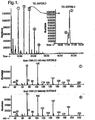
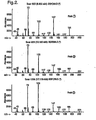
- a Total ion Chromatogram (TIC) is given in Figure 1 and mass spectrometry data for peaks 1, 2 and 3 is shown in Figure 2 .
- the compounds 1-5 appear to be oligomers with increasing chain length. A closer look at the peaks shows overlap of two compounds in each of them. These two compounds have different mass spectra, even though most of the fragment ions are the same.
- Some possible structures of the main peak ((I) of peak 3 in Figure 1 ) are given in Table 1 below.
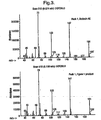
- Mass spectrometry of peak I ( Figure 3a ) shows a major fragment ion of m/z 191 and no major fragment ion of m/z 117.
- structure (IV) appears to be the most probable structure from the MS results. All major fragment ions (m/z 73, 103, 147, 191) in the mass spectrum can be identified from this structure.
- the TMS groups have replaced the hydroxyl protons during derivatisatlon.
- the minor peak ((ii) in Figure 1 ) is most probably identical to structure (III). All major fragment ions (m/z 73, 103, 117, 147, 191, 221) in the mass spectrum can be identified from this structure.
- the glycerol Is charged to a stirred reactor and the formalin is added over a period of approximately 30 minutes.
- the reaction mixture is warmed with stirring for 2 hours at 65°C.
- the glucose is charged to a stirred reactor and the formalin is added over a period of approximately 30 minutes.
- the reaction mixture is warmed with stirring for 2 hours at 65°C.
- reaction conditions described are typical, but are by no means limiting. Extensive work with monoethylene glycol has shown that reaction products are formed over a wide range of reaction times and temperatures. Both acid catalysts and alkaline catalysts were investigated, and reactions were possible over a fairly wide range of pH values. In general, it appears that high temperatures are not needed; temperatures of 100°C and greater can be tolerated. Also, pH ranges from below 4.0 to over 8.5 were evaluated. Reaction products could be made repeatedly and reproducibly within this range. Below pH 4 the likelihood for corrosion in production equipment, as well as the formation of other possible species, makes such conditions less desirable. In like manner, reaction can be carried out at pH values of over 8.5, but possible side reactions, such as Cannizzaro condensations, may detract
- the detection In the vapour phase may be carried out by the use of electrochemical cells, by collection of the gas In a suitable analytical gas train, by the use of absorptive media consisting of a calibrated glass or plastic tube containing an inert substrate bearing lead compounds which are calibrated to give a direct reading of sulphide content, or by any other method based on sound and analytical techniques:
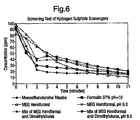
- Results are shown graphically in Figure 6 of the accompanying drawings. Tests with the mixture of monoethylene glycol hemiformal and dimethylolurea were carried out with the Bodoxin AH as supplied (approximately 95% in water, pH 4), and also with the addition of a suitable buffering agent to give pH 9.5.
- reaction rates using higher pH products were faster than those obtained using unbuffered products.
- a glass cell was fitted with a gas dispersion (frit) tube, and accurately measured quantities of the product and water were added to the cell.
- a stream of gas containing H 2 S was then passed at a carefully controlled rate through the product/water charge.
- the content of H 2 S in the gas leaving the cell is measured, or detected, using either an electronic H 2 S detector, based on an electrochemical cell, such as is provided by Draeger or others, or alternatively, the gas can be monitored by use of indicating H 2 S absorption tubes such as are supplied by Draeger or others, wet or colorimetric colour methods, or similar.
- the start time is recorded upon initiation of flow through the cell, and the end time is recorded when the level of H 2 S in the cell effluent has reached a predetermined value.
- the entering H 2 S level was 200 ppm in the test, and the test was stopped when the level of H 2 S in the effluent reached 10 ppm. Under these conditions test run times of ca. 4-5 hours are seen with the reference product. (The details of the quantity and ratio of liquids chosen can be varied to compensate for a range of H 2 S concentrations in the gas phase, and to accommodate convenient time spans.)
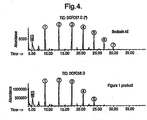
- Monoethylene glycol (1.05 mol) was mixed with formaldehyde (1 mol, 50% solution) and the pH was adjusted with phosphoric acid to pH 2.5. The mixture was heated to 65°C, and kept there for 2 hours. The end pH was recorded as 2.5. Gas chromatography and mass spectrometry results showed a series of oligomeric compounds as in A above.
Landscapes
- Chemical & Material Sciences (AREA)
- Oil, Petroleum & Natural Gas (AREA)
- Engineering & Computer Science (AREA)
- Chemical Kinetics & Catalysis (AREA)
- General Chemical & Material Sciences (AREA)
- Organic Chemistry (AREA)
- Treating Waste Gases (AREA)
- Organic Low-Molecular-Weight Compounds And Preparation Thereof (AREA)
- Gas Separation By Absorption (AREA)
- Glass Compositions (AREA)
- Exhaust Gas After Treatment (AREA)
Claims (14)
- Verfahren zum Senken des Gehalts an Schwefelwasserstoff in flüssigem oder gasförmigem Kohlenwasserstoff oder in Faulgas durch Behandlung der Flüssigkeit oder des Gases mit einem H2S-Scavenger-Produkt, das das Reaktionsprodukt aus(i) Formaldehyd mit(ii) Ethylenglykol, Propylenglykol, Glycerin, Diethylenglykol, Triethylenglykol oder Harnstoff,umfasst, wobei das bzw. der Ethylenglykol, Propylenglykol, Glycerin, Diethylenglykol, Triethylenglykol oder Harnstoff und das Reaktionsprodukt von basischen Gruppen frei sind.
- Verfahren gemäß Anspruch 1, wobei das Reaktionsprodukt das Reaktionsprodukt aus Formaldehyd mit Ethylenglykol ist.
- Verfahren gemäß Anspruch 2, wobei das Reaktionsprodukt durch Reaktion von Formalin mit Ethylenglykol in einem Verhältnis von im Wesentlichen 2:1 oder im Wesentlichen 1:1 ableitbar ist.
- Verfahren gemäß einem der Ansprüche 1 bis 3, wobei das Reaktionsprodukt in Lösung verwendet wird.
- Verfahren gemäß Anspruch 4, wobei das Lösungsmittel ausgewählt ist aus Toluol, Xylol, aromatischem Schwerbenzin, dearomatisiertem Erdöldestillat, Wasser und Monoalkoholen und Dialkoholen mit 1 bis 10 Kohlenstoffatomen und Gemischen derselben.
- Verfahren gemäß Anspruch 5, wobei das Reaktionsprodukt in Lösung in einem Kohlenwasserstoff, einem Alkohol oder Wasser verwendet wird.
- Verfahren gemäß Anspruch 6, wobei das Reaktionsprodukt in einer Menge von mindestens 10 Gew.-% in der Lösung vorliegt.
- Verfahren gemäß einem der Ansprüche 1 bis 7, wobei das Scavenger-Produkt im Wesentlichen wasserfrei ist.
- Verfahren gemäß einem der Ansprüche 1 bis 8, wobei das Scavenger-Produkt ein Amin umfasst.
- Verfahren gemäß Anspruch 9, wobei das Amin ein Alkanolamin oder ein Morpholin ist.
- Verfahren gemäß Anspruch 10, wobei das Scavenger-Produkt Monoethanolamin umfasst.
- Verfahren gemäß einem der Ansprüche 9 bis 11, wobei das Amin in einer Menge von bis zu 40 Gew.-%, bezogen auf das Gewicht des Amins und des angegebenen Reaktionsprodukts, vorliegt.
- Verfahren gemäß einem der Ansprüche 1 bis 12, wobei das Scavenger-Produkt einen pH-Wert im Bereich von 4 bis 11, vorzugsweise von 10 bis 10,5 aufweist.
- Verfahren gemäß einem der Ansprüche 1 bis 13, wobei das Scavenger-Produkt dazu verwendet wird, den Schwefelwasserstoffgehalt in Erdgas oder Erdöl oder in einem raffinierten Brennstoff zu senken.
Applications Claiming Priority (3)
| Application Number | Priority Date | Filing Date | Title |
|---|---|---|---|
| GBGB0031710.7A GB0031710D0 (en) | 2000-12-27 | 2000-12-27 | Process for the reduction or elimination of hydrogen sulphide |
| GB0031710 | 2000-12-27 | ||
| PCT/GB2001/005758 WO2002051968A1 (en) | 2000-12-27 | 2001-12-21 | Process for the reduction or elimination of hydrogen sulphide |
Publications (3)
| Publication Number | Publication Date |
|---|---|
| EP1363985A1 EP1363985A1 (de) | 2003-11-26 |
| EP1363985B1 EP1363985B1 (de) | 2007-08-29 |
| EP1363985B2 true EP1363985B2 (de) | 2019-01-30 |
Family
ID=9905939
Family Applications (1)
| Application Number | Title | Priority Date | Filing Date |
|---|---|---|---|
| EP01272112.2A Expired - Lifetime EP1363985B2 (de) | 2000-12-27 | 2001-12-21 | Verfahren zur verringerung oder eliminierung von schwefelwasserstoff |
Country Status (13)
| Country | Link |
|---|---|
| US (1) | US7078005B2 (de) |
| EP (1) | EP1363985B2 (de) |
| AT (1) | ATE371713T1 (de) |
| AU (1) | AU2002216263B2 (de) |
| CA (1) | CA2433871C (de) |
| DE (1) | DE60130260T2 (de) |
| DK (1) | DK1363985T3 (de) |
| EG (1) | EG23049A (de) |
| GB (1) | GB0031710D0 (de) |
| MX (1) | MXPA03005924A (de) |
| MY (1) | MY135675A (de) |
| NO (1) | NO339183B1 (de) |
| WO (1) | WO2002051968A1 (de) |
Families Citing this family (77)
| Publication number | Priority date | Publication date | Assignee | Title |
|---|---|---|---|---|
| DE10244442A1 (de) | 2002-09-24 | 2004-04-01 | Schülke & Mayr GmbH | Emissionsarme Formaldehyd-Depot-Zubereitungen und deren Verwendung |
| US7255796B2 (en) * | 2004-07-08 | 2007-08-14 | General Electric Company | Method of preventing hydrogen sulfide odor generation in an aqueous medium |
| EP1951410B1 (de) | 2005-11-07 | 2011-01-12 | Specialist Process Technologies Limited | Funktionelle flüssigkeit und herstellungsverfahren dafür |
| US20070119747A1 (en) * | 2005-11-30 | 2007-05-31 | Baker Hughes Incorporated | Corrosion inhibitor |
| GB0525446D0 (en) * | 2005-12-14 | 2006-01-25 | Oilplus Ltd | Method |
| US20080016768A1 (en) | 2006-07-18 | 2008-01-24 | Togna Keith A | Chemically-modified mixed fuels, methods of production and used thereof |
| CA2603022C (en) * | 2006-10-26 | 2010-06-29 | Canwell Enviro-Industries Ltd. | Formulation for hydrogen sulphide scavenging from hydrocarbon streams and use thereof |
| EP2288677A2 (de) | 2008-04-18 | 2011-03-02 | M-i Swaco Norge As | Verfahren zur vorhersage / optimierung der schwefelwasserstoffabfangkapazität und verringerung von kesselsteinbildung |
| US8430161B2 (en) * | 2008-05-20 | 2013-04-30 | Bp Corporation North America Inc. | Mitigation of elemental sulfur deposition during production of hydrocarbon gases |
| CA2770134C (en) * | 2008-08-05 | 2018-01-16 | Spirit Of The 21St Century Group, Llc | Modified fuels comprising triglycerine having at least one hydroxyl group and method of making and using thereof |
| MX337923B (es) * | 2009-11-02 | 2016-03-28 | Exxonmobil Upstream Res Co | Sistema criogenico para la eliminacion de gases acidos de una corriente de gas de hidrocarburos, con eliminacion de un sulfuro de hidrogeno. |
| US20110147272A1 (en) * | 2009-12-23 | 2011-06-23 | General Electric Company | Emulsification of hydrocarbon gas oils to increase efficacy of water based hydrogen sulfide scavengers |
| WO2012004199A1 (en) * | 2010-07-06 | 2012-01-12 | Shell Internationale Research Maatschappij B.V. | Bituminous composition |
| RU2459861C2 (ru) * | 2010-09-06 | 2012-08-27 | Общество с ограниченной ответственностью "ПЛАСТНЕФТЕХИМ" | Нейтрализатор/поглотитель сероводорода и летучих маркаптанов |
| ES2549530T3 (es) * | 2010-11-22 | 2015-10-29 | Dorf Ketal Chemicals (I) Private Limited | Composición de aditivo y procedimiento para captar sulfuro de hidrógeno en corrientes de hidrocarburos |
| US8512449B1 (en) * | 2010-12-03 | 2013-08-20 | Jacam Chemical Company 2013, Llc | Oil-soluble triazine sulfide scavenger |
| US8932458B1 (en) | 2012-03-27 | 2015-01-13 | Marathon Petroleum Company Lp | Using a H2S scavenger during venting of the coke drum |
| US9638018B2 (en) * | 2012-12-19 | 2017-05-02 | Ecolab Usa Inc. | Scavenging hydrogen sulfide |
| BR112015011232B1 (pt) * | 2012-12-19 | 2021-07-06 | Ecolab Usa Inc | método de tratamento por compressão para eliminação de sulfeto de hidrogênio em um fluido de produção |
| EP2935524B1 (de) * | 2012-12-19 | 2018-08-15 | Nalco Company | Funktionalisierte wasserstoffsulfidfänger |
| US9587181B2 (en) * | 2013-01-10 | 2017-03-07 | Baker Hughes Incorporated | Synergistic H2S scavenger combination of transition metal salts with water-soluble aldehydes and aldehyde precursors |
| EP2951149B1 (de) | 2013-01-30 | 2018-10-10 | Ecolab USA Inc. | Wasserstoffsulfidfänger |
| US9480946B2 (en) | 2013-04-15 | 2016-11-01 | Baker Hughes Incorporated | Metal carboxylate salts as H2S scavengers in mixed production or dry gas or wet gas systems |
| US9340723B2 (en) * | 2013-06-26 | 2016-05-17 | Halliburton Energy Services, Inc. | Catalyzed polyamine sulfide scavengers and methods of use in subterranean treatment fluids |
| WO2014210166A1 (en) | 2013-06-27 | 2014-12-31 | Ecolab Usa Inc. | Epoxide-based hydrogen sulfide scavengers |
| US9273254B2 (en) | 2013-12-20 | 2016-03-01 | Ecolab Usa Inc. | Amino acetals and ketals as hydrogen sulfide and mercaptan scavengers |
| US9458393B2 (en) | 2014-04-15 | 2016-10-04 | Ecolab Usa Inc. | Hydantoins as hydrogen sulfide and mercaptan scavengers |
| WO2016022296A1 (en) * | 2014-08-08 | 2016-02-11 | Chevron U.S.A. Inc. | Process, method, and system for removing heavy metals from fluids |
| EP3286175B1 (de) | 2015-04-22 | 2020-12-02 | Ecolab USA Inc. | Entwicklung eines hochtemperaturbeständigen scavengers zur beseitigung von schwefelwasserstoff |
| AU2016320678B2 (en) * | 2015-09-08 | 2021-07-29 | Ecolab Usa Inc. | Hydrocarbon soluble/dispersible hemiformals as hydrogen sulfide scavengers |
| US10584286B2 (en) | 2015-09-08 | 2020-03-10 | Ecolab Usa Inc. | Hydrogen sulfide scavengers |
| US11261370B2 (en) | 2015-09-30 | 2022-03-01 | Cameron International Corporation | Scale deposition inhibiting scavenger compositions and their use |
| BR102015028532A2 (pt) * | 2015-11-13 | 2017-05-23 | Oxiteno S A Indústria E Comércio | composição de sequestrante para aplicação na eliminação e/ou redução de sulfeto de hidrogênio e/ou mercaptanas em fluido |
| DE102015121689A1 (de) | 2015-12-14 | 2017-06-14 | Schülke & Mayr GmbH | Verwendung von Zusammensetzungen mit einem Gehalt an 3,3'-Methylenbis(5-methyloxazolidin) bei der Entfernung von Schwefelverbindungen aus Prozessströmen |
| WO2017120485A1 (en) * | 2016-01-08 | 2017-07-13 | Ecocalb Usa Inc. | Multifunctional product with hydrogen sulfide scavenging and hydrate inhibition capacity |
| WO2017118894A1 (en) | 2016-01-08 | 2017-07-13 | Dorf Ketal Chemicals (India) Private Limited | Nitrogen based hydrogen sulfide scavengers and method of use thereof |
| RU2620792C1 (ru) * | 2016-06-09 | 2017-05-29 | ООО "Эконефтехимтехника" | Способ получения средства для селективного удаления сероводорода и меркаптанов из газов, нефти и нефтепродуктов |
| EP3578622B1 (de) * | 2016-07-01 | 2020-10-07 | Clariant International Ltd | Zusammensetzungen mit synergierten acetalen und verfahren zur spülung von sulfiden und mercaptanen |
| WO2018001630A1 (en) * | 2016-07-01 | 2018-01-04 | Clariant International Ltd | Synergized acetals composition and method for scavenging sulfides and mercaptans |
| WO2018001629A1 (en) * | 2016-07-01 | 2018-01-04 | Clariant International Ltd | Synergized acetals composition and method for scavenging sulfides and mercaptans |
| DE102016113930A1 (de) | 2016-07-28 | 2018-02-01 | Schülke & Mayr GmbH | Kondensationsprodukt aus 1-Aminopropan-2-ol und Formaldehyd und dessen Verwendung zur Verminderung der Menge von Schwefelwasserstoff in Flüssigkeiten und Gasen |
| EP3491106B1 (de) | 2016-07-29 | 2020-07-15 | Ecolab Usa Inc. | Fäulnisverhindernde und schwefelwasserstoffabsorbierende zusammensetzungen |
| CA3031926C (en) * | 2016-08-03 | 2024-01-16 | General Electric Company | Enhanced performance of sulfide scavengers |
| US10513662B2 (en) * | 2017-02-02 | 2019-12-24 | Baker Hughes, A Ge Company, Llc | Functionalized aldehydes as H2S and mercaptan scavengers |
| EA202091866A1 (ru) * | 2017-03-23 | 2020-10-28 | Клариант Интернэшнл Лтд | Синергетические ацетальные композиции и способ улавливания сульфидов и меркаптанов |
| WO2018222439A1 (en) * | 2017-05-30 | 2018-12-06 | Hexion Inc. | Scavengers |
| WO2019014415A1 (en) * | 2017-07-13 | 2019-01-17 | Ecolab USA, Inc. | METHOD FOR REMOVING A COMPOUND CONTAINING SULFUR BY ADDITION OF A COMPOSITION |
| US10696906B2 (en) | 2017-09-29 | 2020-06-30 | Marathon Petroleum Company Lp | Tower bottoms coke catching device |
| US11555140B2 (en) | 2017-12-22 | 2023-01-17 | Clariant International Ltd | Synergized hemiacetals composition and method for scavenging sulfides and mercaptans |
| US20190194551A1 (en) | 2017-12-22 | 2019-06-27 | Clariant International, Ltd. | Synergized acetals composition and method for scavenging sulfides and mercaptans |
| EP3505591A1 (de) | 2018-01-02 | 2019-07-03 | Clariant International Ltd | Synergierte acetalzusammensetzung und verfahren zum spülen von sulfiden und mercaptanen |
| EP3505590A1 (de) | 2018-01-02 | 2019-07-03 | Clariant International Ltd | Synergierte acetalzusammensetzung und verfahren zum spülen von sulfiden und mercaptanen |
| JP2021120136A (ja) * | 2018-04-27 | 2021-08-19 | 株式会社クラレ | 含硫黄化合物除去用の組成物 |
| US12000720B2 (en) | 2018-09-10 | 2024-06-04 | Marathon Petroleum Company Lp | Product inventory monitoring |
| EP3914676A1 (de) | 2019-01-23 | 2021-12-01 | ChampionX USA Inc. | Vollständige entfernung von feststoffen bei schwefelwasserstoffspülvorgängen unter verwendung eines fängers und eines michael-akzeptors |
| US12031676B2 (en) | 2019-03-25 | 2024-07-09 | Marathon Petroleum Company Lp | Insulation securement system and associated methods |
| US11975316B2 (en) | 2019-05-09 | 2024-05-07 | Marathon Petroleum Company Lp | Methods and reforming systems for re-dispersing platinum on reforming catalyst |
| CA3212048A1 (en) | 2019-05-30 | 2020-11-30 | Marathon Petroleum Company Lp | Methods and systems for minimizing nox and co emissions in natural draft heaters |
| BR112021020480A2 (pt) | 2019-06-19 | 2022-03-15 | Bl Technologies Inc | Soluções concentradas estabilizadas de formaldeído e métodos de uso das mesmas |
| US11384301B2 (en) | 2020-02-19 | 2022-07-12 | Marathon Petroleum Company Lp | Low sulfur fuel oil blends for stability enhancement and associated methods |
| CN113877366B (zh) * | 2020-07-02 | 2023-05-02 | 中国石油化工股份有限公司 | 复合吸收剂和选择性脱除硫化氢的方法 |
| DE102020120287A1 (de) | 2020-07-31 | 2022-02-03 | Vink Chemicals Gmbh & Co. Kg | Zusammensetzungen und verfahren zur entfernung von schwefelverbindungen aus prozessströmen |
| US12473500B2 (en) | 2021-02-25 | 2025-11-18 | Marathon Petroleum Company Lp | Assemblies and methods for enhancing control of fluid catalytic cracking (FCC) processes using spectroscopic analyzers |
| US12461022B2 (en) | 2021-02-25 | 2025-11-04 | Marathon Petroleum Company Lp | Methods and assemblies for determining and using standardized spectral responses for calibration of spectroscopic analyzers |
| US11702600B2 (en) | 2021-02-25 | 2023-07-18 | Marathon Petroleum Company Lp | Assemblies and methods for enhancing fluid catalytic cracking (FCC) processes during the FCC process using spectroscopic analyzers |
| US11898109B2 (en) | 2021-02-25 | 2024-02-13 | Marathon Petroleum Company Lp | Assemblies and methods for enhancing control of hydrotreating and fluid catalytic cracking (FCC) processes using spectroscopic analyzers |
| US20250012744A1 (en) | 2021-02-25 | 2025-01-09 | Marathon Petroleum Company Lp | Methods and assemblies for enhancing control of refining processes using spectroscopic analyzers |
| US11905468B2 (en) | 2021-02-25 | 2024-02-20 | Marathon Petroleum Company Lp | Assemblies and methods for enhancing control of fluid catalytic cracking (FCC) processes using spectroscopic analyzers |
| CN113234473A (zh) * | 2021-06-04 | 2021-08-10 | 滨州乾坤化工机械有限公司 | 一种油田用液体脱硫剂及其制备和应用方法 |
| US11692141B2 (en) | 2021-10-10 | 2023-07-04 | Marathon Petroleum Company Lp | Methods and systems for enhancing processing of hydrocarbons in a fluid catalytic cracking unit using a renewable additive |
| CA3188122A1 (en) | 2022-01-31 | 2023-07-31 | Marathon Petroleum Company Lp | Systems and methods for reducing rendered fats pour point |
| US11946008B2 (en) | 2022-05-04 | 2024-04-02 | Nexgen Oilfield Chemicals, Llc | Compositions and methods for scavenging hydrogen sulfide |
| US12311305B2 (en) | 2022-12-08 | 2025-05-27 | Marathon Petroleum Company Lp | Removable flue gas strainer and associated methods |
| US12306076B2 (en) | 2023-05-12 | 2025-05-20 | Marathon Petroleum Company Lp | Systems, apparatuses, and methods for sample cylinder inspection, pressurization, and sample disposal |
| US12533615B2 (en) | 2023-06-02 | 2026-01-27 | Marathon Petroleum Company Lp | Methods and systems for reducing contaminants in a feed stream |
| US12415962B2 (en) | 2023-11-10 | 2025-09-16 | Marathon Petroleum Company Lp | Systems and methods for producing aviation fuel |
| US12599848B2 (en) | 2024-06-03 | 2026-04-14 | Marathon Petroleum Company Lp | Systems, analyzers, controllers, and associated methods to enhance fluid separation for distillation operations |
Family Cites Families (9)
| Publication number | Priority date | Publication date | Assignee | Title |
|---|---|---|---|---|
| US4748011A (en) * | 1983-07-13 | 1988-05-31 | Baize Thomas H | Method and apparatus for sweetening natural gas |
| GB8517333D0 (en) * | 1985-07-09 | 1985-08-14 | Ici Plc | Purification of hydrocarbon mixture |
| DK163387C (da) * | 1988-12-20 | 1992-07-13 | Catena Systems Aps | Moentlaasautomat til udlevering af et i automaten fastholdt laaseorgan |
| DE68923793T2 (de) * | 1988-12-23 | 1996-04-04 | Petrolite Holdings Inc | Verfahren zum süssen von kohlenwasserstoffen. |
| DE4002132A1 (de) * | 1990-01-25 | 1991-08-01 | Hoechst Ag | Verfahren zum abfangen von schwefelwasserstoff mit glyoxal |
| US5569443A (en) * | 1994-11-18 | 1996-10-29 | The Dow Chemical Company | Method for removing hydrogen sulfide from a gas using polyamino disuccinic acid |
| US5792438A (en) * | 1996-08-20 | 1998-08-11 | The Sulfatreat Company | Process and composition for increasing the reactivity of sulfur scavenging iron oxides |
| US6063346A (en) * | 1998-06-05 | 2000-05-16 | Intevep, S. A. | Process for scavenging hydrogen sulfide and mercaptan contaminants from a fluid |
| US6887445B2 (en) * | 1998-08-04 | 2005-05-03 | M-I L.L.C. | Process for sulfur scavenging |
-
2000
- 2000-12-27 GB GBGB0031710.7A patent/GB0031710D0/en not_active Ceased
-
2001
- 2001-12-21 MX MXPA03005924A patent/MXPA03005924A/es active IP Right Grant
- 2001-12-21 DK DK01272112T patent/DK1363985T3/da active
- 2001-12-21 WO PCT/GB2001/005758 patent/WO2002051968A1/en not_active Ceased
- 2001-12-21 EP EP01272112.2A patent/EP1363985B2/de not_active Expired - Lifetime
- 2001-12-21 AT AT01272112T patent/ATE371713T1/de active
- 2001-12-21 DE DE60130260T patent/DE60130260T2/de not_active Expired - Lifetime
- 2001-12-21 CA CA2433871A patent/CA2433871C/en not_active Expired - Lifetime
- 2001-12-21 US US10/250,436 patent/US7078005B2/en not_active Expired - Lifetime
- 2001-12-21 AU AU2002216263A patent/AU2002216263B2/en not_active Ceased
- 2001-12-24 MY MYPI20015873A patent/MY135675A/en unknown
- 2001-12-26 EG EG20011373A patent/EG23049A/xx active
-
2003
- 2003-06-27 NO NO20032983A patent/NO339183B1/no not_active IP Right Cessation
Also Published As
| Publication number | Publication date |
|---|---|
| DE60130260T2 (de) | 2008-05-21 |
| CA2433871C (en) | 2010-12-14 |
| GB0031710D0 (en) | 2001-02-07 |
| US20040096382A1 (en) | 2004-05-20 |
| ATE371713T1 (de) | 2007-09-15 |
| NO20032983D0 (no) | 2003-06-27 |
| CA2433871A1 (en) | 2002-07-04 |
| MXPA03005924A (es) | 2005-02-14 |
| WO2002051968A1 (en) | 2002-07-04 |
| DK1363985T3 (da) | 2008-02-04 |
| NO20032983L (no) | 2003-08-26 |
| US7078005B2 (en) | 2006-07-18 |
| MY135675A (en) | 2008-06-30 |
| EP1363985A1 (de) | 2003-11-26 |
| EG23049A (en) | 2004-01-31 |
| DE60130260D1 (de) | 2007-10-11 |
| NO339183B1 (no) | 2016-11-14 |
| AU2002216263B2 (en) | 2007-08-09 |
| EP1363985B1 (de) | 2007-08-29 |
Similar Documents
| Publication | Publication Date | Title |
|---|---|---|
| EP1363985B2 (de) | Verfahren zur verringerung oder eliminierung von schwefelwasserstoff | |
| AU2002216263A1 (en) | Process for the reduction or elimination of hydrogen sulphide | |
| US5688478A (en) | Method for scavenging sulfides | |
| CA2196418C (en) | Hydrogen sulfide scavenging process | |
| US5554349A (en) | Process for scavenging H2 S by mixtures of hexahydrotriazines | |
| EP1070755B1 (de) | Aus Dieselgasölen und sauerstoffhaltigen Verbindungen bestehendes flüssiges Gemisch | |
| EP2213648B1 (de) | Aldehyd-Amin-Formulierungen und Herstellungs- und Verwendungsverfahren dafür | |
| CA2491973C (en) | Sulfur scavenging amines being monomeric adducts of a sterically hindered amine and an aldehyde or donor thereof | |
| WO1998050135A1 (en) | Regeneration of sulfide scavengers | |
| RU2418036C1 (ru) | Нейтрализатор сероводорода и способ его использования | |
| AU2004235671A1 (en) | Diamine Terminated Primary Amine-Aldehyde Sulfur Converting Compositions and Methods for Making and Using Same | |
| RU2510615C2 (ru) | Нейтрализатор сероводорода и меркаптанов | |
| US20200024526A1 (en) | Functionalized aldehydes as h2s and mercaptan scavengers | |
| US5582808A (en) | Borohydrides to inhibit polymer formation in petrochemical caustic scrubbers | |
| GB2290799A (en) | Composition and method for sweetening hydrocarbons | |
| US4238206A (en) | Using solvents for acidic gas removal | |
| CN111944560A (zh) | 一种油气田用脱硫剂及其制备方法 | |
| Huang et al. | High temperature COS hydrolysis catalysed by γ-Al2O3 | |
| EP3727652A1 (de) | Zusammensetzungen mit synergierten acetalen und verfahren zur spülung von sulfiden und mercaptanen | |
| RU2496853C2 (ru) | Нейтрализатор сероводорода и способ его использования | |
| EP3505590A1 (de) | Synergierte acetalzusammensetzung und verfahren zum spülen von sulfiden und mercaptanen | |
| US12116542B2 (en) | Catalysis of the reaction between hydrogen sulfide scavengers and hydrogen sulfide using tertiary amines | |
| RU2104758C1 (ru) | Способ очистки газов от сероводорода | |
| Langer et al. | Reaction of the nitrate radical with some potential automotive fuel additives. A kinetic and mechanistic study | |
| US11802246B2 (en) | Synergistic effects among mercaptan scavengers |
Legal Events
| Date | Code | Title | Description |
|---|---|---|---|
| PUAI | Public reference made under article 153(3) epc to a published international application that has entered the european phase |
Free format text: ORIGINAL CODE: 0009012 |
|
| 17P | Request for examination filed |
Effective date: 20030717 |
|
| AK | Designated contracting states |
Kind code of ref document: A1 Designated state(s): AT BE CH CY DE DK ES FI FR GB GR IE IT LI LU MC NL PT SE TR |
|
| AX | Request for extension of the european patent |
Extension state: AL LT LV MK RO SI |
|
| RIN1 | Information on inventor provided before grant (corrected) |
Inventor name: JOHNSEN, ANNE, FAISTRUP Inventor name: SMITH, HUBERN, LARRY Inventor name: KNUDSEN, BORRE, LEIF |
|
| 17Q | First examination report despatched |
Effective date: 20031216 |
|
| 17Q | First examination report despatched |
Effective date: 20031216 |
|
| GRAP | Despatch of communication of intention to grant a patent |
Free format text: ORIGINAL CODE: EPIDOSNIGR1 |
|
| GRAS | Grant fee paid |
Free format text: ORIGINAL CODE: EPIDOSNIGR3 |
|
| GRAA | (expected) grant |
Free format text: ORIGINAL CODE: 0009210 |
|
| AK | Designated contracting states |
Kind code of ref document: B1 Designated state(s): AT BE CH CY DE DK ES FI FR GB GR IE IT LI LU MC NL PT SE TR |
|
| REG | Reference to a national code |
Ref country code: GB Ref legal event code: FG4D |
|
| REG | Reference to a national code |
Ref country code: CH Ref legal event code: EP |
|
| REG | Reference to a national code |
Ref country code: IE Ref legal event code: FG4D |
|
| REF | Corresponds to: |
Ref document number: 60130260 Country of ref document: DE Date of ref document: 20071011 Kind code of ref document: P |
|
| PG25 | Lapsed in a contracting state [announced via postgrant information from national office to epo] |
Ref country code: FI Free format text: LAPSE BECAUSE OF FAILURE TO SUBMIT A TRANSLATION OF THE DESCRIPTION OR TO PAY THE FEE WITHIN THE PRESCRIBED TIME-LIMIT Effective date: 20070829 Ref country code: ES Free format text: LAPSE BECAUSE OF FAILURE TO SUBMIT A TRANSLATION OF THE DESCRIPTION OR TO PAY THE FEE WITHIN THE PRESCRIBED TIME-LIMIT Effective date: 20071210 |
|
| REG | Reference to a national code |
Ref country code: DK Ref legal event code: T3 |
|
| PG25 | Lapsed in a contracting state [announced via postgrant information from national office to epo] |
Ref country code: CH Free format text: LAPSE BECAUSE OF FAILURE TO SUBMIT A TRANSLATION OF THE DESCRIPTION OR TO PAY THE FEE WITHIN THE PRESCRIBED TIME-LIMIT Effective date: 20070829 Ref country code: LI Free format text: LAPSE BECAUSE OF FAILURE TO SUBMIT A TRANSLATION OF THE DESCRIPTION OR TO PAY THE FEE WITHIN THE PRESCRIBED TIME-LIMIT Effective date: 20070829 |
|
| REG | Reference to a national code |
Ref country code: CH Ref legal event code: PL |
|
| PG25 | Lapsed in a contracting state [announced via postgrant information from national office to epo] |
Ref country code: BE Free format text: LAPSE BECAUSE OF FAILURE TO SUBMIT A TRANSLATION OF THE DESCRIPTION OR TO PAY THE FEE WITHIN THE PRESCRIBED TIME-LIMIT Effective date: 20070829 |
|
| EN | Fr: translation not filed | ||
| PG25 | Lapsed in a contracting state [announced via postgrant information from national office to epo] |
Ref country code: GR Free format text: LAPSE BECAUSE OF FAILURE TO SUBMIT A TRANSLATION OF THE DESCRIPTION OR TO PAY THE FEE WITHIN THE PRESCRIBED TIME-LIMIT Effective date: 20071130 |
|
| ET | Fr: translation filed | ||
| REG | Reference to a national code |
Ref country code: FR Ref legal event code: EERR Free format text: CORRECTION DE BOPI 08/17 - BREVETS EUROPEENS DONT LA TRADUCTION N A PAS ETE REMISE A L INPI. IL Y A LIEU DE SUPPRIMER : LA MENTION DE LA NON-REMISE. LA REMISE DE LA TRADUCTION EST PUBLIEE DANS LE PRESENT BOPI. |
|
| PG25 | Lapsed in a contracting state [announced via postgrant information from national office to epo] |
Ref country code: PT Free format text: LAPSE BECAUSE OF FAILURE TO SUBMIT A TRANSLATION OF THE DESCRIPTION OR TO PAY THE FEE WITHIN THE PRESCRIBED TIME-LIMIT Effective date: 20080129 |
|
| PLBI | Opposition filed |
Free format text: ORIGINAL CODE: 0009260 |
|
| PG25 | Lapsed in a contracting state [announced via postgrant information from national office to epo] |
Ref country code: SE Free format text: LAPSE BECAUSE OF FAILURE TO SUBMIT A TRANSLATION OF THE DESCRIPTION OR TO PAY THE FEE WITHIN THE PRESCRIBED TIME-LIMIT Effective date: 20071129 |
|
| PLAX | Notice of opposition and request to file observation + time limit sent |
Free format text: ORIGINAL CODE: EPIDOSNOBS2 |
|
| 26 | Opposition filed |
Opponent name: CLARIANT PRODUKTE (DEUTSCHLAND) GMBH Effective date: 20080527 |
|
| PG25 | Lapsed in a contracting state [announced via postgrant information from national office to epo] |
Ref country code: MC Free format text: LAPSE BECAUSE OF NON-PAYMENT OF DUE FEES Effective date: 20071231 |
|
| NLR1 | Nl: opposition has been filed with the epo |
Opponent name: CLARIANT PRODUKTE (DEUTSCHLAND) GMBH |
|
| PG25 | Lapsed in a contracting state [announced via postgrant information from national office to epo] |
Ref country code: IE Free format text: LAPSE BECAUSE OF NON-PAYMENT OF DUE FEES Effective date: 20071221 |
|
| PLAF | Information modified related to communication of a notice of opposition and request to file observations + time limit |
Free format text: ORIGINAL CODE: EPIDOSCOBS2 |
|
| PLBB | Reply of patent proprietor to notice(s) of opposition received |
Free format text: ORIGINAL CODE: EPIDOSNOBS3 |
|
| PG25 | Lapsed in a contracting state [announced via postgrant information from national office to epo] |
Ref country code: CY Free format text: LAPSE BECAUSE OF FAILURE TO SUBMIT A TRANSLATION OF THE DESCRIPTION OR TO PAY THE FEE WITHIN THE PRESCRIBED TIME-LIMIT Effective date: 20070829 |
|
| PG25 | Lapsed in a contracting state [announced via postgrant information from national office to epo] |
Ref country code: LU Free format text: LAPSE BECAUSE OF NON-PAYMENT OF DUE FEES Effective date: 20071221 |
|
| PG25 | Lapsed in a contracting state [announced via postgrant information from national office to epo] |
Ref country code: TR Free format text: LAPSE BECAUSE OF FAILURE TO SUBMIT A TRANSLATION OF THE DESCRIPTION OR TO PAY THE FEE WITHIN THE PRESCRIBED TIME-LIMIT Effective date: 20070829 |
|
| APAH | Appeal reference modified |
Free format text: ORIGINAL CODE: EPIDOSCREFNO |
|
| APBM | Appeal reference recorded |
Free format text: ORIGINAL CODE: EPIDOSNREFNO |
|
| APBP | Date of receipt of notice of appeal recorded |
Free format text: ORIGINAL CODE: EPIDOSNNOA2O |
|
| APBQ | Date of receipt of statement of grounds of appeal recorded |
Free format text: ORIGINAL CODE: EPIDOSNNOA3O |
|
| APBU | Appeal procedure closed |
Free format text: ORIGINAL CODE: EPIDOSNNOA9O |
|
| PLAY | Examination report in opposition despatched + time limit |
Free format text: ORIGINAL CODE: EPIDOSNORE2 |
|
| PLBC | Reply to examination report in opposition received |
Free format text: ORIGINAL CODE: EPIDOSNORE3 |
|
| REG | Reference to a national code |
Ref country code: FR Ref legal event code: PLFP Year of fee payment: 15 |
|
| APBM | Appeal reference recorded |
Free format text: ORIGINAL CODE: EPIDOSNREFNO |
|
| APBP | Date of receipt of notice of appeal recorded |
Free format text: ORIGINAL CODE: EPIDOSNNOA2O |
|
| APBQ | Date of receipt of statement of grounds of appeal recorded |
Free format text: ORIGINAL CODE: EPIDOSNNOA3O |
|
| APAH | Appeal reference modified |
Free format text: ORIGINAL CODE: EPIDOSCREFNO |
|
| PGFP | Annual fee paid to national office [announced via postgrant information from national office to epo] |
Ref country code: DE Payment date: 20151215 Year of fee payment: 15 |
|
| PGFP | Annual fee paid to national office [announced via postgrant information from national office to epo] |
Ref country code: AT Payment date: 20151125 Year of fee payment: 15 Ref country code: FR Payment date: 20151110 Year of fee payment: 15 |
|
| PGFP | Annual fee paid to national office [announced via postgrant information from national office to epo] |
Ref country code: IT Payment date: 20151221 Year of fee payment: 15 |
|
| REG | Reference to a national code |
Ref country code: DE Ref legal event code: R119 Ref document number: 60130260 Country of ref document: DE |
|
| REG | Reference to a national code |
Ref country code: AT Ref legal event code: MM01 Ref document number: 371713 Country of ref document: AT Kind code of ref document: T Effective date: 20161221 |
|
| REG | Reference to a national code |
Ref country code: FR Ref legal event code: ST Effective date: 20170831 |
|
| PG25 | Lapsed in a contracting state [announced via postgrant information from national office to epo] |
Ref country code: AT Free format text: LAPSE BECAUSE OF NON-PAYMENT OF DUE FEES Effective date: 20161221 Ref country code: FR Free format text: LAPSE BECAUSE OF NON-PAYMENT OF DUE FEES Effective date: 20170102 Ref country code: IT Free format text: LAPSE BECAUSE OF NON-PAYMENT OF DUE FEES Effective date: 20161221 |
|
| PG25 | Lapsed in a contracting state [announced via postgrant information from national office to epo] |
Ref country code: DE Free format text: LAPSE BECAUSE OF NON-PAYMENT OF DUE FEES Effective date: 20170701 |
|
| APBU | Appeal procedure closed |
Free format text: ORIGINAL CODE: EPIDOSNNOA9O |
|
| PUAH | Patent maintained in amended form |
Free format text: ORIGINAL CODE: 0009272 |
|
| STAA | Information on the status of an ep patent application or granted ep patent |
Free format text: STATUS: PATENT MAINTAINED AS AMENDED |
|
| 27A | Patent maintained in amended form |
Effective date: 20190130 |
|
| AK | Designated contracting states |
Kind code of ref document: B2 Designated state(s): AT BE CH CY DE DK ES FI FR GB GR IE IT LI LU MC NL PT SE TR |
|
| REG | Reference to a national code |
Ref country code: DE Ref legal event code: R102 Ref document number: 60130260 Country of ref document: DE |
|
| PGFP | Annual fee paid to national office [announced via postgrant information from national office to epo] |
Ref country code: DK Payment date: 20181221 Year of fee payment: 18 |
|
| PGFP | Annual fee paid to national office [announced via postgrant information from national office to epo] |
Ref country code: NL Payment date: 20181221 Year of fee payment: 18 |
|
| REG | Reference to a national code |
Ref country code: NL Ref legal event code: MP Effective date: 20070829 |
|
| PG25 | Lapsed in a contracting state [announced via postgrant information from national office to epo] |
Ref country code: NL Free format text: LAPSE BECAUSE OF FAILURE TO SUBMIT A TRANSLATION OF THE DESCRIPTION OR TO PAY THE FEE WITHIN THE PRESCRIBED TIME-LIMIT Effective date: 20070829 |
|
| PG25 | Lapsed in a contracting state [announced via postgrant information from national office to epo] |
Ref country code: NL Free format text: LAPSE BECAUSE OF NON-PAYMENT OF DUE FEES Effective date: 20070829 |
|
| PG25 | Lapsed in a contracting state [announced via postgrant information from national office to epo] |
Ref country code: DK Free format text: LAPSE BECAUSE OF FAILURE TO SUBMIT A TRANSLATION OF THE DESCRIPTION OR TO PAY THE FEE WITHIN THE PRESCRIBED TIME-LIMIT Effective date: 20190130 |
|
| REG | Reference to a national code |
Ref country code: NL Ref legal event code: NE Effective date: 20200430 |
|
| PGFP | Annual fee paid to national office [announced via postgrant information from national office to epo] |
Ref country code: GB Payment date: 20201210 Year of fee payment: 20 |
|
| REG | Reference to a national code |
Ref country code: GB Ref legal event code: PE20 Expiry date: 20211220 |
|
| PG25 | Lapsed in a contracting state [announced via postgrant information from national office to epo] |
Ref country code: GB Free format text: LAPSE BECAUSE OF EXPIRATION OF PROTECTION Effective date: 20211220 |