EP1359694A2 - Verfahren zum Interleaving von Daten und Teilnehmer-Endgerät - Google Patents
Verfahren zum Interleaving von Daten und Teilnehmer-Endgerät Download PDFInfo
- Publication number
- EP1359694A2 EP1359694A2 EP03008138A EP03008138A EP1359694A2 EP 1359694 A2 EP1359694 A2 EP 1359694A2 EP 03008138 A EP03008138 A EP 03008138A EP 03008138 A EP03008138 A EP 03008138A EP 1359694 A2 EP1359694 A2 EP 1359694A2
- Authority
- EP
- European Patent Office
- Prior art keywords
- data
- time
- packets
- critical
- transmission
- Prior art date
- Legal status (The legal status is an assumption and is not a legal conclusion. Google has not performed a legal analysis and makes no representation as to the accuracy of the status listed.)
- Withdrawn
Links
Images

Classifications
-
- H—ELECTRICITY
- H04—ELECTRIC COMMUNICATION TECHNIQUE
- H04L—TRANSMISSION OF DIGITAL INFORMATION, e.g. TELEGRAPHIC COMMUNICATION
- H04L1/00—Arrangements for detecting or preventing errors in the information received
- H04L1/004—Arrangements for detecting or preventing errors in the information received by using forward error control
- H04L1/0056—Systems characterized by the type of code used
- H04L1/0071—Use of interleaving
-
- H—ELECTRICITY
- H03—ELECTRONIC CIRCUITRY
- H03M—CODING; DECODING; CODE CONVERSION IN GENERAL
- H03M13/00—Coding, decoding or code conversion, for error detection or error correction; Coding theory basic assumptions; Coding bounds; Error probability evaluation methods; Channel models; Simulation or testing of codes
- H03M13/27—Coding, decoding or code conversion, for error detection or error correction; Coding theory basic assumptions; Coding bounds; Error probability evaluation methods; Channel models; Simulation or testing of codes using interleaving techniques
- H03M13/2703—Coding, decoding or code conversion, for error detection or error correction; Coding theory basic assumptions; Coding bounds; Error probability evaluation methods; Channel models; Simulation or testing of codes using interleaving techniques the interleaver involving at least two directions
- H03M13/271—Row-column interleaver with permutations, e.g. block interleaving with inter-row, inter-column, intra-row or intra-column permutations
-
- H—ELECTRICITY
- H04—ELECTRIC COMMUNICATION TECHNIQUE
- H04L—TRANSMISSION OF DIGITAL INFORMATION, e.g. TELEGRAPHIC COMMUNICATION
- H04L1/00—Arrangements for detecting or preventing errors in the information received
- H04L1/004—Arrangements for detecting or preventing errors in the information received by using forward error control
- H04L1/0056—Systems characterized by the type of code used
- H04L1/007—Unequal error protection
Definitions
- the present invention relates to a method for provisioning and transmission of data in a data transmission system by transferring several Data blocks from a data transmission device to terminals, before transmission interleaving the data to the end devices of at least two data blocks he follows.
- the object of the present invention is to provide a possibility which allows an interleaving process to be optimized, taking into account that data blocks of different relevance can exist.
- Another subject the present invention is a subscriber terminal according to claim 9. Die
- Die The invention is basically applicable to all types of data transmission systems, in particular for communication systems, for example wireless communication systems.
- a first object of the invention is a method for providing and Transmission of data in a data transmission system by transmission of several data blocks from a data transmission device to terminals, where before an interleaving of at least two of the data to the end devices Data blocks are done.
- Interleaving is basically any type of division and regrouping the data of the individual data blocks understood, whereby data different data blocks combined to a new data packet become.
- the advantage of interleaving is that the data of a data block is based on several data packets can be distributed and so the individual data of the Data blocks can be separated during data transmission. Will at a Data transmission incorrectly transfer a data packet, so not all data go of a data block, but only part of the data block. The lost part that has gone can then possibly be derived from the remaining data of the data block, which is in other data packets were transmitted, can be reconstructed.
- Only one data transmission device of the data transmission system can be used Perform the inventive method described here, or it can also several or all of the data transmission devices of the data transmission system carry out such a method and also be trained accordingly.
- the amount of data over which interleaving is carried out can be determined by the Data content of a data frame (frame) are defined, which ultimately to the End devices is transmitted.
- a data frame is usually at least defined by signaling data (header) and user data, the signaling data at least identification data for identifying the data frame contain.
- the amount of data that is interleaved can vary but also determined by a predetermined transmission time for one of the data blocks become.
- a typical broadcast time in satellite data transmission systems for Data blocks that contain user data are, for example, one second.
- the data blocks can be used for each data unit of an algorithm, a transmission point in time is determined, the sequence of the Sending times from the original sequence of data units within the Data blocks deviate. So it will be an individual broadcast Data units of the data blocks in which the sequence of data units does not corresponds more to the original sequence of the data units in the data blocks.
- the meaning of the data units is defined below.
- a transmission time of one second is provided for a non-time-critical data block and if 2 time-critical data blocks are to be sent at the same time, then the algorithm is designed such that the first time-critical message in the first half of the airtime, that is, sent in the first 1 ⁇ 2 second and the second time-critical message in the second half of the transmission time, i.e. in the second 1 ⁇ 2 second Posted.
- the importance of time-critical and non-time-critical data blocks will be defined below.
- time-critical data blocks are already in a fraction of 1 / k of the transmission time of the non-time-critical data block completely can be received and processed in the terminal. Can also be faster The time-critical data blocks are sent because they are already there the first time-critical data block started sending the data can be, because the second time-critical data block must only in the second Fraction 1 / k of the transmission time are available for transmission. The same applies to others time-critical data blocks.
- the data blocks can be packed in the same packages indexed data addresses. Interleaving can then occur successive transmission of one data unit of a packet. So it is for example after the distribution of the data of the data blocks on the Packets sent any first data unit of the first packet, then one any first data unit of the second packet, then any first Data unit of the third packet etc. up to the last packet. Then a second one Data unit of the first packet sent, then a second data unit of the second package etc. up to the last package. This procedure is to the last Data unit of each packet continued.
- the order of the transmission of the Data units per packet are assumed. But it can also be a broadcast of the Data units per packet according to the indexing of the data addresses of the Package. It can thus be provided that the Data units of all packets with the lowest or highest data address are sent and then the data units of all packets with the next higher or next lower data address are sent.
- Indexed data addresses mean that corresponding data addresses of the individual data packets for the data transmission system via the addresses are recognizable, d. H. that in particular the beginning and end of the data packets can be determined are and that a sequence of data is defined within the data packets is.
- the type of indexing and addressing can in principle be freely used in a suitable manner Be chosen wisely.
- a further development of the invention provides that at least a first group of Packets are reserved for data blocks with time-critical data and at least one second group of packets reserved for data blocks with non-time-critical data becomes. So not all types of data are alike on data packets divided, but it is according to the meaning of the data, especially after time-critical aspects. This is a different treatment time-critical and non-time-critical data possible as part of interleaving, offers the advantages for the further processing of data, as further below is performed.
- Time-critical data should be understood to mean data that safe operation or for certain applications in the end devices if possible must be transferred to the end devices immediately. Typical periods are here under a second.
- time-uncritical data is data that Device needed for operation or certain applications, but also can arrive at the terminal with a certain delay without the Operation of the terminal is significantly disrupted.
- the ratio of the numbers of the Packets that are reserved for time-critical and non-time-critical data preferably determined by the ratio of the data quantities of the time-critical data and non-time-critical data. Amounts the amount of data of the time-critical data A quarter or half of the data volume of the non-time-critical data becomes a quarter or half of the packets reserved for the time-critical data, the rest for the non-time-critical data.
- status messages are used as time-critical data or signaling data are transmitted and as non-time-critical data User data are transmitted, the user data being used directly for subscriber operation of the end devices are used.
- status information Identification data of system components version data of certain Software can also transmit other types of status information, so Signaling data can be transmitted in all types of signaling for controlling the data exchange between the data transmission device and Terminal is required or helpful.
- All data packets therefore have the same length.
- a data unit for example a bit, a byte or another defined data symbol with a defined one Symbol length can be provided.
- the packages in the second group become simple completely filled with the non-time-critical data of the corresponding data blocks. If the end of a data block with non-time-critical data has been reached, this will be Filling the packets that are reserved for non-time-critical data with the next data block of non-time-critical data continued.
- time-critical data is treated differently: it is time-critical data Data reserved packets not up to the full length n with the data more time-critical Data blocks filled, but there are only n / k data units of a packet Data of a certain data block filled, in the simplest case only the first half of the package.
- the data content of the data block with time-critical data is thus the first half of several packages distributed.
- Interleaving makes the data content of the packets like this transfer that all data units that are are at the beginning of the packages. Then all data units are successively transmitted, which are in second place of the packets. This continues until the End of packets is reached.
- the Whole number k can basically be freely defined. However, it preferably corresponds the number of data blocks with time-critical data in a certain unit of time must be transferred.
- the data volume of the time-critical data is at a maximum half, ideally a maximum of a quarter of the data volume of the non-time-critical Data is. This ensures the effectiveness of the process.
- the data transmission devices of the data transmission system expediently point Devices for providing data in the form of several data blocks and, on the other hand, devices for the transmission of data to terminals, wherein each data transmission device according to the present invention one Device for interleaving at least two data blocks according to the invention Method before the transmission of the data to the terminals.
- the device for interleaving can in particular be further developed such that they to carry out individual or all steps of an interleaving process is suitable, as described above.
- the facility for interleaving is then suitable for the corresponding steps of the interleaving process customized.
- Another object of the present invention is a subscriber terminal for a data transmission system.
- the subscriber terminal a device for the reconstruction of data blocks, which from the subscriber terminal by a receiving device from at least one data transmitting device were received and which before receiving an interleaving were subjected to a procedure described above.
- the corresponding The device of the subscriber terminal is thus designed to store the data recognizable in the form described above and from this by a Interleaving complementary de-interleaving again the original data blocks to reconstruct.
- a further development of the present subscriber terminal includes a computer program for processing data of a data transmission system, which subjected to interleaving according to a method described above were using the computer program for interaction with facilities of a subscriber terminal mentioned above is formed.
- the computer program recognizes and processes the data in the form described above and is able to do so by de-interleaving which is complementary to interleaving to reconstruct the original data blocks.
- a further development of the present subscriber terminal includes an Computer program product including a machine-readable program carrier, on which an aforementioned computer program in the form of electronic readable control signals is stored, the computer program product is designed to interact with a subscriber terminal.
- the control signals can be stored in any suitable form, the electronic Reading can then be carried out accordingly by electrical, magnetic, electromagnetic, electro-optical or other electronic processes.
- Examples for such program carriers are magnetic tapes, floppy disks, hard drives, CD-ROM or Semiconductor components.
- a data transmission system is shown schematically in FIG.
- a data sending device for example a data transmission satellite 1 or one earth-bound data transmission devices 3, has a device DU (Data Unit) to provide data blocks.
- Data blocks There are two types of data blocks are considered: user data and signaling data. This is based on the Tables explained in more detail.
- Each data transmission device 1, 3 also has one Device DIU (Data Interleaving Unit) for interleaving data blocks. This interleaving of the data blocks takes place before a transfer of the data a subscriber terminal UT (User Terminal) takes place.
- the Subscriber terminal UT has a receiving device RU (Receive Unit) and a device DPU (Data Processing Unit) for the reconstruction of data blocks from the received data.
- RU Receiveive Unit
- DPU Data Processing Unit
- the transmission of signaling data in data transmission systems is often significantly more time-critical than the transmission of user data. Besides, they are Signaling data is often significantly shorter than the user data.
- Each of the three messages N, A, B forms a data block.
- the packages a, b, c, ... are shown here in the form of columns.
- Interleaving is carried out by transferring the data units in the row direction of table 1 or table 2. Interleaving is thus realized by First, all data units, their data address, are transmitted one after the other has the lowest index, i.e. a0, b0, c0, d0, ... Then the Transfer the next row a1, b1, c1, d1, ...
- not all packages are equally filled with data from any data block.
- Part of the packages namely in the case of table 1 the packets c, f, i, l and in the case of table 2 the packets c, h, are reserved for data of signaling data A, B, the remaining packets are for User data N reserved.
- the number of packets reserved for signaling data is about the ratio of the amount of data of the signaling data to the amount of data the user data defined.
- the packets that are reserved for the user data are continuously updated with Data units N1, N2, N3, .... of the user data N are filled.
- a package is a complete filled, the next packet b is continued until all the packets for the User data N are reserved, are filled with user data N.
- One advantage of the method described here is that the signaling data A can be received completely by the terminal UT after half the time that is required to transmit all packets a, b, c ... completely. This is made possible by the distribution of the signaling data to the packets described here and the subsequent line-by-line transmission of the packets, since after the transmission of the first six lines with the indices 0, 1, 2, 3, 4, 5, the signaling data are completely transmitted. This guarantees that time-critical data in particular is transferred to the UT terminal as quickly as possible and that interleaving with sufficient separation nevertheless takes place.
- the m columns or packets that are reserved for the user data are filled column by column and thus packet by packet with data.
- the columns or packets reserved for signaling data are filled in, the column is changed after every n / kth symbol. Line by line of the matrix is then transmitted to the terminals UT, whereby the entirety of the data is sent and at the same time interleaving takes place.
- a computer program for processing the received data set up for the reconstruction of the data blocks of the data transmission system if the other hardware requirements in the subscriber terminal UT are given.
- the computer program then enables in particular in cooperation with the data processing device DPU the recognition and Processing the data packets of signaling data A, B and user data N.
- a data can be obtained from the received data Have undergone interleaving through a complementary de-interleaving original signaling data A, B and user data N restored become.
- the computer program can preferably with the help of a computer program product be introduced into the subscriber terminal UT, the computer program product a machine-readable program carrier (data carrier) DC includes, on which the computer program in the form of electronically readable Control signals is stored.
- a machine-readable program carrier (data carrier) DC includes, on which the computer program in the form of electronically readable Control signals is stored.
- An example would be a chip card with one Semiconductor chip in which the computer program is stored. But there are also all other suitable types of computer program products applicable.
Landscapes
- Engineering & Computer Science (AREA)
- Computer Networks & Wireless Communication (AREA)
- Signal Processing (AREA)
- Physics & Mathematics (AREA)
- Probability & Statistics with Applications (AREA)
- Theoretical Computer Science (AREA)
- Detection And Prevention Of Errors In Transmission (AREA)
Abstract
Description
- alle Pakete eine Länge von n Dateneinheiten aufweisen,
- Pakete der ersten Gruppe von Paketen mit n/k, k=2, 3, 4, 5... Dateneinheiten eines Datenblocks zeitkritischer Daten gefüllt werden und
- Pakete der zweiten Gruppe von Paketen mit n Dateneinheiten eines Datenblocks zeitunkritischer Daten gefüllt werden.
- Fig. 1:
- Schematische Darstellung eines Datenübertragungssystems
- Tab. 1 und 2:
- Schematische Darstellung der Aufteilung von Datenblocks auf Datenpakete
- Nutzdaten N mit einer Länge von 96 Dateneinheiten bzw. Symbolen B1, B2, B3, B4....., B96, die Daten enthalten, aufgrund derer ein Endgerät UT unmittelbar seine Position bestimmen kann,
- Signalisierungsdaten A mit einer Länge von 12 oder 24 Dateneinheiten bzw. Symbolen A1, A2, A3, ... A12 bzw. A1, A2, A3, ... A24
- Signalisierungsdaten B mit einer Länge von 12 oder 24 Dateneinheiten bzw. Symbolen B1, B2, B3, ..., B12 bzw. B1, B2, B3, ..., B24
Zahl der Pakete für Signalisierungsdaten/Zahl der Pakete für'Nutzdaten
ebenfalls gleich 1 : 4 gewählt wird, wie Tabelle 2 zeigt.
Zahl der Pakete für Slgnallsierungsdaten/Zahl der Pakete für Nutzdaten
ebenfalls gleich 1 : 2 gewählt wird, wie Tabelle 1 zeigt.
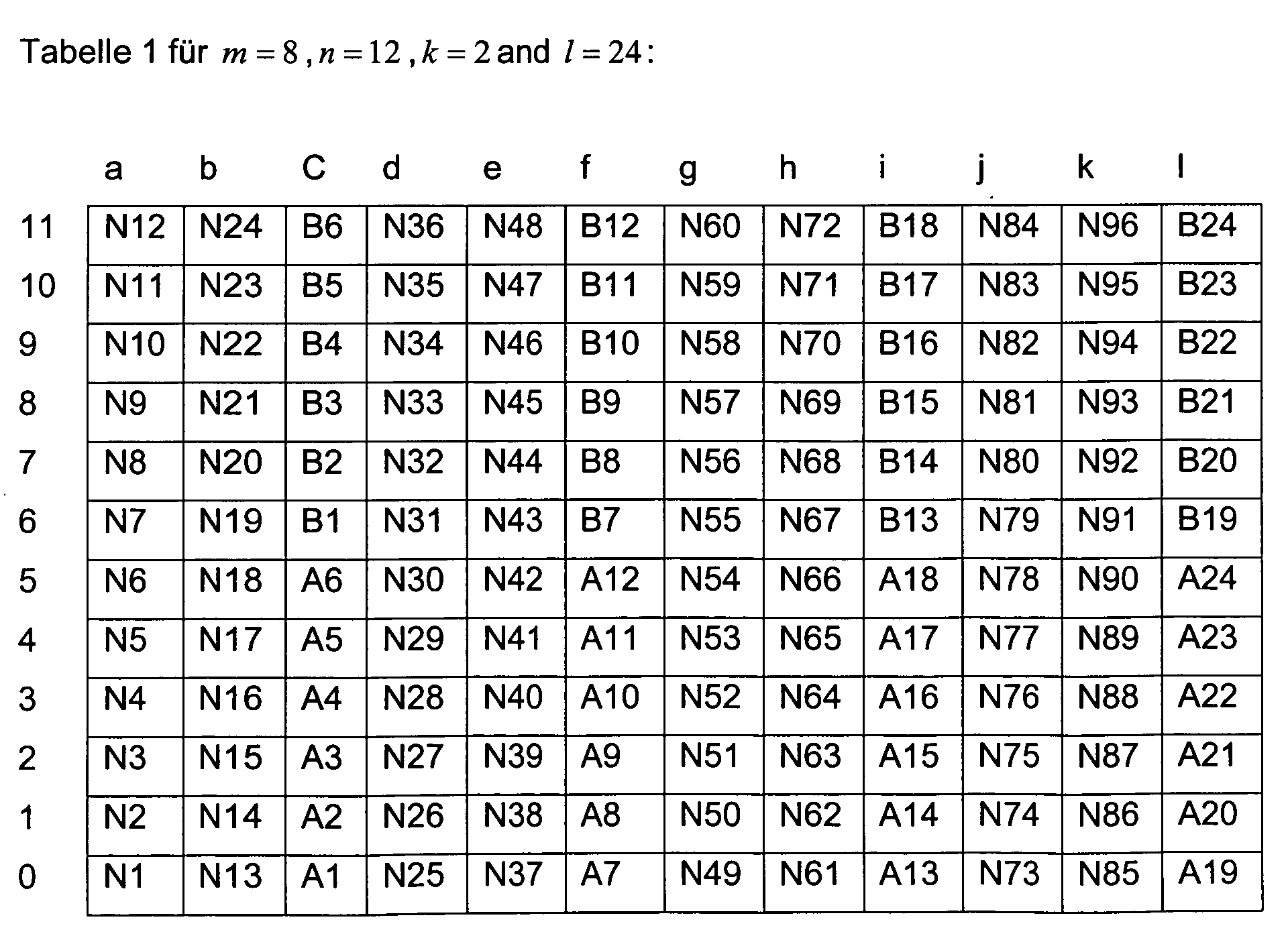

Angenommen, es sollen Nutzdaten, also eine lange Datennachricht mit einer Länge von n×m Dateneinheiten bzw. Symbolen einmal pro Sekunde übertragen werden und es sollen k Signalisierungsdaten, also kurze Nachrichten, mit einer Länge von l Dateneinheiten bzw. Symbolen pro Sekunde übertragen werden Wenn man ganze Zahlen i, j und p finden kann, so dass gilt: k×l=i×n, k×j=n und m=i×(p-1), dann kann in jedem Fall eine Aufteilung der Daten auf Pakete erfolgen, wie sie beispielhaft in den Tabellen 1 und 2 gezeigt wurde.


Claims (11)
- Verfahren zur Bereitstellung und Übertragung von Daten in einem Datenübertragungssystem durch Übertragung von mehreren Datenblocks von einer Daten-Sendeeinrichtung an Endgeräte, wobei vor der Übertragung der Daten an die Endgeräte ein Interleaving von mindestens zwei Datenblocks erfolgt, dadurch gekennzeichnet, dass zum Interleaving für jede Dateneinheit der Datenblocks mit Hilfe eines Algorithmus ein Sendezeitpunkt derart festgelegt wird, dass zur Übertragung von k zeitkritischen Datenblocks mit k= 2, 3, 4, ... und eines zeitunkritischen Datenblocks die Sendezeitpunkte der Dateneinheiten eines jeden zeitkritischen Datenblocks jeweils in einem Bruchteil 1/k der Sendezeit des zeitunkritischen Datenblocks festgelegt werden.
- Verfahren nach Anspruch 1, dadurch gekennzeichnet, dass die Datenblocks in gleiche Pakete mit indizierten Datenadressen aufgeteilt werden und ein Interleaving durch aufeinanderfolgende Übertragung jeweils einer Dateneinheit eines Paketes erfolgt.
- Verfahren nach Anspruch 2, dadurch gekennzeichnet, dass zunächst nacheinander die Dateneinheiten aller Pakete mit der niedrigsten oder höchsten Datenadresse gesendet werden und dann die nacheinander die Dateneinheiten aller Pakete mit der nächsthöheren oder nächstniedrigeren Datenadresse gesendet werden.
- Verfahren nach Anspruch 2 oder 3, dadurch gekennzeichnet, dass mindestens eine erste Gruppe von Paketen für Datenblocks mit zeitkritischen Daten reserviert wird und mindestens eine zweite Gruppe von Paketen für Datenblocks mit zeitunkritischen Daten reserviert wird.
- Verfahren nach einem der Ansprüche 1 bis 4, dadurch gekennzeichnet, dass als zeitkritische Daten Statusnachrichten oder Signalisierungsdaten übertragen werden und als zeitunkritische Daten Nutzdaten übertragen werden.
- Verfahren nach einem der Ansprüche 2 bis 5, dadurch gekennzeichnet, dassalle Pakete eine Länge von n Dateneinheiten aufweisen,Pakete der ersten Gruppe von Paketen mit n/k, k=2, 3, 4, 5... Dateneinheiten eines Datenblocks zeitkritischer Daten gefüllt werden undPakete der zweiten Gruppe von Paketen mit n Dateneinheiten eines Datenblocks zeitunkritischer Daten gefüllt werden.
- Verfahren nach einem der Ansprüche 1 bis 6, dadurch gekennzeichnet, dass die Datenmenge der zeitkritischen Daten maximal die Hälfte der Datenmenge der zeitunkritischen Daten beträgt.
- Verfahren nach Anspruch 7, dadurch gekennzeichnet, dass die Datenmenge der zeitkritischen Daten maximal ein Viertel der Datenmenge der zeitunkritischen Daten beträgt.
- Teilnehmer-Endgerät (UT) für ein Datenübertragungssystem zum Empfang und De-Interleaving von Daten, welche vor dem Empfang einem Verfahren nach einem der Ansprüche 1 bis 8 unterzogen wurden, aufweisend eine Einrichtung (DPU) zur Rekonstruktion von Datenblocks, welche vom Teilnehmer-Endgerät durch eine Empfangseinrichtung (RU) von mindestens einer Daten-Sendeeinrichtung (1, 3) empfangen wurden, und ausgebildet zum De-Interleaving von Daten einer Form, welche sich durch ein Interleaving nach einem Verfahren nach einem der Ansprüche 1 bis 8 ergibt.
- Teilnehmer-Endgerät nach Anspruch 9, eingerichtet zur Verarbeitung von Daten eines Datenübertragungssystems mit Hilfe eines Computer-Programms, wobei die Daten des Datenübertragungssystems nach einem Verfahren nach einem der Ansprüche 1 bis 8 einem Interleaving unterzogen wurden und wobei das Computer-Programm für ein Zusammenwirken mit Einrichtungen (DPU) des Teilnehmer-Endgerätes (UT) ausgebildet ist.
- Teilnehmer-Endgerät nach Anspruch 10, eingerichtet zur Aufnahme eines Computer-Programm-Produkts beinhaltend einen maschinenlesbaren Programmträger (DC), auf dem ein Computer-Programm nach Anspruch 10 in Form von elektronisch auslesbaren Steuersignalen gespeichert ist, wobei das Computer-Programm-Produkt zum Zusammenwirken mit dem Teilnehmer-Endgerät (UT) ausgebildet ist.
Applications Claiming Priority (2)
| Application Number | Priority Date | Filing Date | Title |
|---|---|---|---|
| DE10219700 | 2002-05-02 | ||
| DE10219700A DE10219700C1 (de) | 2002-05-02 | 2002-05-02 | Verfahren zum Interleaving von Daten |
Publications (2)
| Publication Number | Publication Date |
|---|---|
| EP1359694A2 true EP1359694A2 (de) | 2003-11-05 |
| EP1359694A3 EP1359694A3 (de) | 2006-01-11 |
Family
ID=27762991
Family Applications (1)
| Application Number | Title | Priority Date | Filing Date |
|---|---|---|---|
| EP03008138A Withdrawn EP1359694A3 (de) | 2002-05-02 | 2003-04-08 | Verfahren zum Interleaving von Daten und Teilnehmer-Endgerät |
Country Status (3)
| Country | Link |
|---|---|
| US (1) | US7471695B2 (de) |
| EP (1) | EP1359694A3 (de) |
| DE (1) | DE10219700C1 (de) |
Families Citing this family (4)
| Publication number | Priority date | Publication date | Assignee | Title |
|---|---|---|---|---|
| DE10219700C1 (de) * | 2002-05-02 | 2003-09-18 | Astrium Gmbh | Verfahren zum Interleaving von Daten |
| EP2197130A3 (de) * | 2008-12-10 | 2017-05-03 | Siemens Schweiz AG | Verfahren zur deterministischen Übertragung von zeitkritischen und zeitunkritischen Daten auf einem gemeinsamen Datenkanal |
| US20140281367A1 (en) * | 2013-03-14 | 2014-09-18 | Mark W. Johnson | Address calculation for received data |
| US10939454B2 (en) * | 2014-12-11 | 2021-03-02 | Qualcomm Incorporated | Prioritizing colliding transmissions in LTE and ultra-low latency LTE communications |
Family Cites Families (23)
| Publication number | Priority date | Publication date | Assignee | Title |
|---|---|---|---|---|
| DE1017175B (de) | 1956-04-19 | 1957-10-10 | Cassella Farbwerke Mainkur Ag | Verfahren zur Herstellung neuer anaesthetisch wirkender Aminocarbonsaeureamide |
| CH607474A5 (de) * | 1976-11-12 | 1978-12-29 | Ibm | |
| EP0684719A1 (de) * | 1994-05-25 | 1995-11-29 | International Business Machines Corporation | Verfahren und Vorrichtung zum Übertragen von Hochprioritätsverkehr auf Niedrigergeschwindigkeits-Kommunikationsverbindungen |
| JPH08214028A (ja) | 1995-02-03 | 1996-08-20 | Toshiba Corp | データ形成方法、データ再生方法、データ形成再生方法、データ形成装置、データ再生装置およびディスク |
| US5796735A (en) * | 1995-08-28 | 1998-08-18 | Integrated Device Technology, Inc. | System and method for transmission rate control in a segmentation and reassembly (SAR) circuit under ATM protocol |
| US6292484B1 (en) * | 1997-06-11 | 2001-09-18 | Data Race, Inc. | System and method for low overhead multiplexing of real-time and non-real-time data |
| EP1017175B1 (de) * | 1998-05-27 | 2007-07-18 | Ntt Mobile Communications Network Inc. | Verfahren und Vorrichtung zum Verchachteln einer ersten Bitsequenz in eine zweite Bitsequenz |
| FI105734B (fi) * | 1998-07-03 | 2000-09-29 | Nokia Networks Oy | Automaattinen uudelleenlähetys |
| DE19842039B4 (de) * | 1998-09-14 | 2014-09-04 | Siemens Aktiengesellschaft | Verfahren zur Übertragung von Signalisierungsinformationen in einem Funk-Kommunikationssystem |
| US7058027B1 (en) * | 1998-09-16 | 2006-06-06 | Scientific Research Corporation | Systems and methods for asynchronous transfer mode and internet protocol |
| US6370666B1 (en) * | 1998-12-02 | 2002-04-09 | Agere Systems Guardian Corp. | Tuning scheme for error-corrected broadcast programs |
| US6934759B2 (en) * | 1999-05-26 | 2005-08-23 | Enounce, Inc. | Method and apparatus for user-time-alignment for broadcast works |
| DE19924211A1 (de) * | 1999-05-27 | 2000-12-21 | Siemens Ag | Verfahren und Vorrichtung zur flexiblen Kanalkodierung |
| US6259744B1 (en) * | 1999-06-01 | 2001-07-10 | Motorola, Inc. | Method and apparatus for mapping bits to an information burst |
| US7380015B1 (en) * | 1999-09-10 | 2008-05-27 | Kdd Corporation | Apparatus and method for compression-transmitting and decoding picture information and storage medium stored its control programs |
| US6662247B1 (en) * | 1999-11-30 | 2003-12-09 | Rockwell Automation Technologies, Inc. | Protocol for extended data transfer in scan-based industrial controller I/O system |
| JP2001175630A (ja) * | 1999-12-14 | 2001-06-29 | Fujitsu Ltd | データ送信装置、データ受信装置、データ転送装置および方法 |
| US6337642B1 (en) * | 1999-12-28 | 2002-01-08 | Texas Instruments Incorporated | Method for efficient interleaving of variable length packets with maximized block size |
| US6823394B2 (en) * | 2000-12-12 | 2004-11-23 | Washington University | Method of resource-efficient and scalable streaming media distribution for asynchronous receivers |
| US6804220B2 (en) * | 2001-05-07 | 2004-10-12 | Qualcomm Incorporated | Method and apparatus for generating control information for packet data |
| US6944691B1 (en) * | 2001-07-26 | 2005-09-13 | Cypress Semiconductor Corp. | Architecture that converts a half-duplex bus to a full-duplex bus while keeping the bandwidth of the bus constant |
| DE10219700C1 (de) * | 2002-05-02 | 2003-09-18 | Astrium Gmbh | Verfahren zum Interleaving von Daten |
| DE10219701B4 (de) * | 2002-05-02 | 2006-08-31 | Eads Astrium Gmbh | Verfahren zum Interleaving von Navigationsdaten |
-
2002
- 2002-05-02 DE DE10219700A patent/DE10219700C1/de not_active Expired - Fee Related
-
2003
- 2003-04-08 EP EP03008138A patent/EP1359694A3/de not_active Withdrawn
- 2003-05-01 US US10/426,785 patent/US7471695B2/en not_active Expired - Fee Related
Also Published As
| Publication number | Publication date |
|---|---|
| US20040081207A1 (en) | 2004-04-29 |
| DE10219700C1 (de) | 2003-09-18 |
| EP1359694A3 (de) | 2006-01-11 |
| US7471695B2 (en) | 2008-12-30 |
Similar Documents
| Publication | Publication Date | Title |
|---|---|---|
| DE2731963C2 (de) | Verfahren und Anordnung zum Zugriff mehrerer Datenstationen zu einem gemeinsamen Übertragungskanal | |
| DE69022705T2 (de) | System zur Kodierung/Dekodierung von digitalen Signalen zur Übertragung und/oder Speicherung. | |
| DE69425400T2 (de) | Verfahren und Vorrichtung zur Verschachtelung einer Folge von Datenelementen | |
| DE3300263A1 (de) | Schaltungsanordnung zur zuteilung des zugriffs zu einer auf anforderungsbasis gemeinsam benutzten sammelleitung | |
| DE69418860T2 (de) | Verfahren und Vorrichtung zur Block Verschachtelung und Entschachtelung | |
| DE2559119B2 (de) | Schaltung zur konzentrierung digitaler signale | |
| DE10219700C1 (de) | Verfahren zum Interleaving von Daten | |
| DE2803424C3 (de) | Verfahren und Schaltungsanordnung zum Adressieren wenigstens einer Empfangsstation von einer Sendestation aus | |
| DE10219701B4 (de) | Verfahren zum Interleaving von Navigationsdaten | |
| EP0802651A2 (de) | Fehlerrobustes Multiplexverfahren mit möglicher Retransmission | |
| DE2057256A1 (de) | Verfahren und Schaltungsanordnung zur Datensicherung bei der UEbertragung binaerer Daten | |
| EP0802646A2 (de) | Fehlerrobustes Multiplexverfahren mit HEADER-Kontrollfeld | |
| DE1934675A1 (de) | Fehlererkennungsverfahren fuer Datenuebertragungssysteme | |
| DE2160567C3 (de) | Datenübertragungs-Anschlussgerät | |
| DE1474046C3 (de) | Vorrichtung zur Umwandlung von Schlüsselwörtern in Adressen | |
| EP0173274A2 (de) | Verfahren und Schaltungsanordnung zur Herstellung und zum Betreiben einer Zeitvielfach-Breitbandverbindung | |
| DE2831887C2 (de) | Anordnung zum Übertragen von Daten zwischen einer zentralen Verarbeitungseinheit und mehreren peripheren Einheiten | |
| EP0003232A1 (de) | Schaltungsanordung zum Umwandeln von Binärinformationen mittels Kontrollbits | |
| DE69008896T2 (de) | Fehlerkorrekturkodierer/-dekodierer für numerische Übertragungsanlage. | |
| DE1944963A1 (de) | Stoerungsgesichertes UEbertragungssystem | |
| DE2502420B2 (de) | Datenuebertragungsverfahren mit quittung | |
| EP0774849B1 (de) | Verfahren zum Übertragen von binären, asynchronen Daten über einen synchronen Kanal | |
| DE1263858C2 (de) | Verfahren zum periodischen abtasten einer vielzahl von leitungen auf ihren elektrischen zustand hin und vorrichtungen zur durchfuehrung dieses verfahrens | |
| EP1054532B1 (de) | Datenübertragungsverfahren | |
| DE2704822C3 (de) | Verfahren zur Sprachverschlüsselung nach dem Zeitverwürfelungsverfahren |
Legal Events
| Date | Code | Title | Description |
|---|---|---|---|
| PUAI | Public reference made under article 153(3) epc to a published international application that has entered the european phase |
Free format text: ORIGINAL CODE: 0009012 |
|
| AK | Designated contracting states |
Kind code of ref document: A2 Designated state(s): AT BE BG CH CY CZ DE DK EE ES FI FR GB GR HU IE IT LI LU MC NL PT RO SE SI SK TR |
|
| AX | Request for extension of the european patent |
Extension state: AL LT LV MK |
|
| RAP1 | Party data changed (applicant data changed or rights of an application transferred) |
Owner name: EADS ASTRIUM GMBH |
|
| PUAL | Search report despatched |
Free format text: ORIGINAL CODE: 0009013 |
|
| AK | Designated contracting states |
Kind code of ref document: A3 Designated state(s): AT BE BG CH CY CZ DE DK EE ES FI FR GB GR HU IE IT LI LU MC NL PT RO SE SI SK TR |
|
| AX | Request for extension of the european patent |
Extension state: AL LT LV MK |
|
| RIC1 | Information provided on ipc code assigned before grant |
Ipc: H03M 13/27 20060101ALI20051124BHEP Ipc: H04L 1/00 20060101AFI20030830BHEP |
|
| 17P | Request for examination filed |
Effective date: 20060623 |
|
| 17Q | First examination report despatched |
Effective date: 20060803 |
|
| AKX | Designation fees paid |
Designated state(s): AT BE BG CH CY CZ DE DK EE ES FI FR GB GR HU IE IT LI LU MC NL PT RO SE SI SK TR |
|
| STAA | Information on the status of an ep patent application or granted ep patent |
Free format text: STATUS: THE APPLICATION IS DEEMED TO BE WITHDRAWN |
|
| 18D | Application deemed to be withdrawn |
Effective date: 20111101 |