EP1349646B1 - Werkstoff zur detoxikation körperfremder, toxisch wirkender substanzen im blut - Google Patents
Werkstoff zur detoxikation körperfremder, toxisch wirkender substanzen im blut Download PDFInfo
- Publication number
- EP1349646B1 EP1349646B1 EP01998393A EP01998393A EP1349646B1 EP 1349646 B1 EP1349646 B1 EP 1349646B1 EP 01998393 A EP01998393 A EP 01998393A EP 01998393 A EP01998393 A EP 01998393A EP 1349646 B1 EP1349646 B1 EP 1349646B1
- Authority
- EP
- European Patent Office
- Prior art keywords
- molecular sieve
- material according
- matrix
- blood
- water
- Prior art date
- Legal status (The legal status is an assumption and is not a legal conclusion. Google has not performed a legal analysis and makes no representation as to the accuracy of the status listed.)
- Expired - Lifetime
Links
- 239000000463 material Substances 0.000 title claims abstract description 29
- 239000008280 blood Substances 0.000 title claims abstract description 21
- 210000004369 blood Anatomy 0.000 title claims abstract description 21
- 238000001784 detoxification Methods 0.000 title claims abstract description 7
- 239000003440 toxic substance Substances 0.000 title abstract description 7
- 231100000614 poison Toxicity 0.000 title abstract description 4
- URGAHOPLAPQHLN-UHFFFAOYSA-N sodium aluminosilicate Chemical compound [Na+].[Al+3].[O-][Si]([O-])=O.[O-][Si]([O-])=O URGAHOPLAPQHLN-UHFFFAOYSA-N 0.000 claims abstract description 53
- 239000002808 molecular sieve Substances 0.000 claims abstract description 38
- 239000011159 matrix material Substances 0.000 claims abstract description 25
- XLYOFNOQVPJJNP-UHFFFAOYSA-N water Substances O XLYOFNOQVPJJNP-UHFFFAOYSA-N 0.000 claims abstract description 19
- 238000002425 crystallisation Methods 0.000 claims abstract description 16
- 239000012528 membrane Substances 0.000 claims abstract description 15
- 238000004519 manufacturing process Methods 0.000 claims abstract description 5
- 125000002091 cationic group Chemical class 0.000 claims abstract 3
- 230000018044 dehydration Effects 0.000 claims description 17
- 238000006297 dehydration reaction Methods 0.000 claims description 17
- 238000000034 method Methods 0.000 claims description 8
- 230000002785 anti-thrombosis Effects 0.000 claims description 5
- 239000003146 anticoagulant agent Substances 0.000 claims description 5
- IJGRMHOSHXDMSA-UHFFFAOYSA-N Atomic nitrogen Chemical compound N#N IJGRMHOSHXDMSA-UHFFFAOYSA-N 0.000 claims description 4
- 229920001971 elastomer Polymers 0.000 claims description 4
- 239000000806 elastomer Substances 0.000 claims description 4
- 239000000203 mixture Substances 0.000 claims description 3
- 238000001179 sorption measurement Methods 0.000 claims description 3
- 239000000126 substance Substances 0.000 claims description 3
- 238000003795 desorption Methods 0.000 claims description 2
- 239000011261 inert gas Substances 0.000 claims description 2
- 229910052757 nitrogen Inorganic materials 0.000 claims description 2
- 239000002861 polymer material Substances 0.000 claims description 2
- 229920001169 thermoplastic Polymers 0.000 claims description 2
- 229920002725 thermoplastic elastomer Polymers 0.000 claims description 2
- VYPSYNLAJGMNEJ-UHFFFAOYSA-N Silicium dioxide Chemical compound O=[Si]=O VYPSYNLAJGMNEJ-UHFFFAOYSA-N 0.000 claims 4
- 239000013543 active substance Substances 0.000 claims 2
- 229910052681 coesite Inorganic materials 0.000 claims 2
- 229910052906 cristobalite Inorganic materials 0.000 claims 2
- 239000000377 silicon dioxide Substances 0.000 claims 2
- 239000011734 sodium Substances 0.000 claims 2
- 229910052682 stishovite Inorganic materials 0.000 claims 2
- 229910052905 tridymite Inorganic materials 0.000 claims 2
- 239000005995 Aluminium silicate Substances 0.000 claims 1
- DGAQECJNVWCQMB-PUAWFVPOSA-M Ilexoside XXIX Chemical compound C[C@@H]1CC[C@@]2(CC[C@@]3(C(=CC[C@H]4[C@]3(CC[C@@H]5[C@@]4(CC[C@@H](C5(C)C)OS(=O)(=O)[O-])C)C)[C@@H]2[C@]1(C)O)C)C(=O)O[C@H]6[C@@H]([C@H]([C@@H]([C@H](O6)CO)O)O)O.[Na+] DGAQECJNVWCQMB-PUAWFVPOSA-M 0.000 claims 1
- 229910000323 aluminium silicate Inorganic materials 0.000 claims 1
- 229940115440 aluminum sodium silicate Drugs 0.000 claims 1
- 229910052751 metal Inorganic materials 0.000 claims 1
- 239000002184 metal Substances 0.000 claims 1
- 230000000737 periodic effect Effects 0.000 claims 1
- 229910052708 sodium Inorganic materials 0.000 claims 1
- 239000000429 sodium aluminium silicate Substances 0.000 claims 1
- 235000012217 sodium aluminium silicate Nutrition 0.000 claims 1
- 231100000331 toxic Toxicity 0.000 claims 1
- 230000002588 toxic effect Effects 0.000 claims 1
- 239000000243 solution Substances 0.000 description 16
- 210000004379 membrane Anatomy 0.000 description 15
- 150000001768 cations Chemical class 0.000 description 10
- 238000011068 loading method Methods 0.000 description 8
- 230000008025 crystallization Effects 0.000 description 6
- 238000000502 dialysis Methods 0.000 description 5
- 239000004480 active ingredient Substances 0.000 description 4
- 231100000167 toxic agent Toxicity 0.000 description 3
- 229910017090 AlO 2 Inorganic materials 0.000 description 2
- 206010027439 Metal poisoning Diseases 0.000 description 2
- 229910004298 SiO 2 Inorganic materials 0.000 description 2
- 239000003814 drug Substances 0.000 description 2
- 229940079593 drug Drugs 0.000 description 2
- 208000008127 lead poisoning Diseases 0.000 description 2
- 238000000746 purification Methods 0.000 description 2
- XDTMQSROBMDMFD-UHFFFAOYSA-N C1CCCCC1 Chemical compound C1CCCCC1 XDTMQSROBMDMFD-UHFFFAOYSA-N 0.000 description 1
- 0 CC(*CC(C)(C)N)C(C)C(C)N(C(C)C(C)C(C)C(C)N)N=O Chemical compound CC(*CC(C)(C)N)C(C)C(C)N(C(C)C(C)C(C)C(C)N)N=O 0.000 description 1
- 239000004952 Polyamide Substances 0.000 description 1
- DNEHKUCSURWDGO-UHFFFAOYSA-N aluminum sodium Chemical compound [Na].[Al] DNEHKUCSURWDGO-UHFFFAOYSA-N 0.000 description 1
- 230000017531 blood circulation Effects 0.000 description 1
- 239000012503 blood component Substances 0.000 description 1
- 229920002678 cellulose Polymers 0.000 description 1
- 239000001913 cellulose Substances 0.000 description 1
- 239000000385 dialysis solution Substances 0.000 description 1
- 230000000694 effects Effects 0.000 description 1
- 238000002615 hemofiltration Methods 0.000 description 1
- 239000012510 hollow fiber Substances 0.000 description 1
- 230000002503 metabolic effect Effects 0.000 description 1
- 229920003229 poly(methyl methacrylate) Polymers 0.000 description 1
- 229920002492 poly(sulfone) Polymers 0.000 description 1
- 229920002239 polyacrylonitrile Polymers 0.000 description 1
- 229920002647 polyamide Polymers 0.000 description 1
- 229920000642 polymer Polymers 0.000 description 1
- 239000004926 polymethyl methacrylate Substances 0.000 description 1
- 239000011148 porous material Substances 0.000 description 1
- 239000002594 sorbent Substances 0.000 description 1
- 229920002994 synthetic fiber Polymers 0.000 description 1
- 239000004416 thermosoftening plastic Substances 0.000 description 1
Images
Classifications
-
- B—PERFORMING OPERATIONS; TRANSPORTING
- B01—PHYSICAL OR CHEMICAL PROCESSES OR APPARATUS IN GENERAL
- B01J—CHEMICAL OR PHYSICAL PROCESSES, e.g. CATALYSIS OR COLLOID CHEMISTRY; THEIR RELEVANT APPARATUS
- B01J20/00—Solid sorbent compositions or filter aid compositions; Sorbents for chromatography; Processes for preparing, regenerating or reactivating thereof
- B01J20/28—Solid sorbent compositions or filter aid compositions; Sorbents for chromatography; Processes for preparing, regenerating or reactivating thereof characterised by their form or physical properties
- B01J20/28014—Solid sorbent compositions or filter aid compositions; Sorbents for chromatography; Processes for preparing, regenerating or reactivating thereof characterised by their form or physical properties characterised by their form
- B01J20/28033—Membrane, sheet, cloth, pad, lamellar or mat
-
- A—HUMAN NECESSITIES
- A61—MEDICAL OR VETERINARY SCIENCE; HYGIENE
- A61M—DEVICES FOR INTRODUCING MEDIA INTO, OR ONTO, THE BODY; DEVICES FOR TRANSDUCING BODY MEDIA OR FOR TAKING MEDIA FROM THE BODY; DEVICES FOR PRODUCING OR ENDING SLEEP OR STUPOR
- A61M1/00—Suction or pumping devices for medical purposes; Devices for carrying-off, for treatment of, or for carrying-over, body-liquids; Drainage systems
- A61M1/36—Other treatment of blood in a by-pass of the natural circulatory system, e.g. temperature adaptation, irradiation ; Extra-corporeal blood circuits
- A61M1/3679—Other treatment of blood in a by-pass of the natural circulatory system, e.g. temperature adaptation, irradiation ; Extra-corporeal blood circuits by absorption
-
- B—PERFORMING OPERATIONS; TRANSPORTING
- B01—PHYSICAL OR CHEMICAL PROCESSES OR APPARATUS IN GENERAL
- B01D—SEPARATION
- B01D61/00—Processes of separation using semi-permeable membranes, e.g. dialysis, osmosis or ultrafiltration; Apparatus, accessories or auxiliary operations specially adapted therefor
-
- B—PERFORMING OPERATIONS; TRANSPORTING
- B01—PHYSICAL OR CHEMICAL PROCESSES OR APPARATUS IN GENERAL
- B01D—SEPARATION
- B01D69/00—Semi-permeable membranes for separation processes or apparatus characterised by their form, structure or properties; Manufacturing processes specially adapted therefor
- B01D69/14—Dynamic membranes
- B01D69/141—Heterogeneous membranes, e.g. containing dispersed material; Mixed matrix membranes
-
- B—PERFORMING OPERATIONS; TRANSPORTING
- B01—PHYSICAL OR CHEMICAL PROCESSES OR APPARATUS IN GENERAL
- B01D—SEPARATION
- B01D71/00—Semi-permeable membranes for separation processes or apparatus characterised by the material; Manufacturing processes specially adapted therefor
- B01D71/02—Inorganic material
- B01D71/028—Molecular sieves
-
- B—PERFORMING OPERATIONS; TRANSPORTING
- B01—PHYSICAL OR CHEMICAL PROCESSES OR APPARATUS IN GENERAL
- B01J—CHEMICAL OR PHYSICAL PROCESSES, e.g. CATALYSIS OR COLLOID CHEMISTRY; THEIR RELEVANT APPARATUS
- B01J20/00—Solid sorbent compositions or filter aid compositions; Sorbents for chromatography; Processes for preparing, regenerating or reactivating thereof
- B01J20/02—Solid sorbent compositions or filter aid compositions; Sorbents for chromatography; Processes for preparing, regenerating or reactivating thereof comprising inorganic material
- B01J20/10—Solid sorbent compositions or filter aid compositions; Sorbents for chromatography; Processes for preparing, regenerating or reactivating thereof comprising inorganic material comprising silica or silicate
- B01J20/16—Alumino-silicates
- B01J20/18—Synthetic zeolitic molecular sieves
- B01J20/186—Chemical treatments in view of modifying the properties of the sieve, e.g. increasing the stability or the activity, also decreasing the activity
-
- B—PERFORMING OPERATIONS; TRANSPORTING
- B01—PHYSICAL OR CHEMICAL PROCESSES OR APPARATUS IN GENERAL
- B01J—CHEMICAL OR PHYSICAL PROCESSES, e.g. CATALYSIS OR COLLOID CHEMISTRY; THEIR RELEVANT APPARATUS
- B01J20/00—Solid sorbent compositions or filter aid compositions; Sorbents for chromatography; Processes for preparing, regenerating or reactivating thereof
- B01J20/28—Solid sorbent compositions or filter aid compositions; Sorbents for chromatography; Processes for preparing, regenerating or reactivating thereof characterised by their form or physical properties
- B01J20/28014—Solid sorbent compositions or filter aid compositions; Sorbents for chromatography; Processes for preparing, regenerating or reactivating thereof characterised by their form or physical properties characterised by their form
- B01J20/28026—Particles within, immobilised, dispersed, entrapped in or on a matrix, e.g. a resin
-
- B—PERFORMING OPERATIONS; TRANSPORTING
- B01—PHYSICAL OR CHEMICAL PROCESSES OR APPARATUS IN GENERAL
- B01J—CHEMICAL OR PHYSICAL PROCESSES, e.g. CATALYSIS OR COLLOID CHEMISTRY; THEIR RELEVANT APPARATUS
- B01J2220/00—Aspects relating to sorbent materials
- B01J2220/40—Aspects relating to the composition of sorbent or filter aid materials
- B01J2220/46—Materials comprising a mixture of inorganic and organic materials
Definitions
- the filter material can be made of hollow fibers (capillaries), cellulose or synthetic materials such as polyamide, polyacrylonitrile, Polymethyl methacrylate or polysulfone.
- the blood flows through pores This filter material (structured membrane), which in turn from a Dialysis fluid is washed around. On the filter material then finds the exchange of Blood substances take place.
- the patent DD 270 867 A1 referenced in particular the patent DD 270 867 A1 referenced.
- the nephrologists and dialysis specialists now demand more and more an individual Blood purification, especially in the form of dialysis.
- the object of the invention is now to to provide a material that meets the above requirement, associated with a greater effectiveness of detoxification at the same time Compliance with the above pH.
- the material of the invention is now characterized characterized in that the chromatographed molecular sieve additionally water of crystallization contains, in such a way that with respect to a basic molar amount of (m) Water of crystallization of at least 100, the molecular sieve is partially dehydrated at a degree of dehydration of at least 40%, wherein the molecular sieve with the reduced molar amount (m ') of water of crystallization with the chromatographing Solution is loaded.
- the molecular sieve is in particular a metal-aluminum silicate of the following formula: Me n [(AlO 2 ) x (SiO 2 ) Y ] .m (m ') H 2 O
- the molecular sieve contains a Grundmolmenge (m) of water of crystallization of in particular at least 200, that at a degree of dehydration of preferably from 50% to 80% is partially dehydrated.
- m Grundmolmenge
- the sodium-aluminum silicate of the following formula is preferably to be mentioned: Na 86 [(AlO 2 ) 86 (SiO 2 ) 106 ]. 276 H 2 O
- a partially dehydrated molecular sieve as a carrier for the Cation solution can be the cation composition and cation concentration by means of the appropriate Dehydratmaschinesgrades variable in compliance with the pH of the blood can be adjusted from 7.5 ⁇ 0.5.
- the cation solution has the following composition: K + 4 to 6 mmol / l Ca 2+ 2 to 3 mmol / l Na + 130 to 160 mmol / l Fe 2+ 10 to 40 mol / l Mg 2+ 0.5 to 1.5 mmol / l NH 4 + 10 to 50 mol / l Zn 2+ 5 to 30 mol / l
- the object is to provide a method for producing the to provide material according to the invention.
- the dehydration and / or loading is / are in particular in Presence of an inert gas, such as nitrogen, carried out.
- the Dehydration and / or loading is / are preferably carried out under Normal pressure.
- the loading itself can, for example, by means of a ball mill be made.
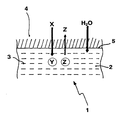
- the membrane 1 for example a dialysis membrane, comprises a matrix 2 , in which the chromotographed molecular sieve 3 , an adduct of the cation solution Y and the molecular sieve, is incorporated, the molecular sieve being partially dehydrated. Furthermore, the chromatographed molecular sieve is substantially evenly distributed within the matrix.
- the toxic substance X for example in the context of lead poisoning. Via the interface 5 of membrane and blood the substance X penetrates into the membrane 2 . By means of the cation solution Y, an adsorption of the toxic substance takes place.
- the chromatographed molecular sieve is additionally with a Loaded drug Z in the form of an antithrombotic, with an adsorption of water as a blood component with desorption of the active ingredient takes place.
- a partially dehydrated molecular sieve can via the Dehydratmaschinesgrad the rate of release of the active ingredient Z to be controlled.
- a drug adduct with a Dehydration level of 60% eager water absorb as an adduct a degree of dehydration of 30%, with respect to the same Loading amount of active ingredient.
Landscapes
- Chemical & Material Sciences (AREA)
- Chemical Kinetics & Catalysis (AREA)
- Analytical Chemistry (AREA)
- Organic Chemistry (AREA)
- Health & Medical Sciences (AREA)
- Inorganic Chemistry (AREA)
- Dispersion Chemistry (AREA)
- Vascular Medicine (AREA)
- Heart & Thoracic Surgery (AREA)
- Engineering & Computer Science (AREA)
- Anesthesiology (AREA)
- Biomedical Technology (AREA)
- Hematology (AREA)
- Life Sciences & Earth Sciences (AREA)
- Animal Behavior & Ethology (AREA)
- General Health & Medical Sciences (AREA)
- Public Health (AREA)
- Veterinary Medicine (AREA)
- Water Supply & Treatment (AREA)
- Cardiology (AREA)
- Solid-Sorbent Or Filter-Aiding Compositions (AREA)
- External Artificial Organs (AREA)
- Medicines Containing Material From Animals Or Micro-Organisms (AREA)
Description
- eine blutdurchlässige und blutverträgliche Matrix, insbesondere in Form einer Membran; sowie
- ein Molekularsieb, das in die Matrix eingearbeitet bzw. matrixmäßig verarbeitet und bei einem pH-Wert von 7,5 ± 0,5 mit einer chromatographierenden Lösung, insbesondere in Form einer Kationenlösung, beladen ist, wobei das chromatographierte Molekularsieb die Detoxikation des Blutes vornimmt.
| K+ | 4 bis 6 mmol/l |
| Ca2+ | 2 bis 3 mmol/l |
| Na+ | 130 bis 160 mmol/l |
| Fe2+ | 10 bis 40 mol/l |
| Mg2+ | 0,5 bis 1,5 mmol/l |
| NH4 + | 10 bis 50 mol/l |
| Zn2+ | 5 bis 30 mol/l |
- Der Beladungsgrad der chromatographierenden Lösung bzw. Kationenlösung ist kleiner als der Dehydratisierungsgrad des partiell dehydratisierten Molekularsiebes. Der Beladungsgrad ist dabei 45 % bis 75 %.
- Das chromatographierte Molekularsieb ist innerhalb der Matrix im Wesentlichen gleichmäßig verteilt.
- Die Matrix ist ein Polymerwerkstoff, insbesondere wiederum ein Elastomer, ein thermoplastisches Elastomer oder ein thermoplastischer Kunststoff. Wichtig in diesem Zusammenhang ist, dass diese Werkstoffe blutdurchlässig und blutverträglich sind.
- das Molekularsieb mit einer Grundmolmenge (m) an Kristallwasser von wenigstens 100 wird bei 400 bis 500°C, vorzugsweise bei etwa 450°C, mehrere Stunden, vorzugsweise 1 bis 7 Stunden, lang bei einem Dehydratisierungsgrad von mindestens 40% partiell dehydratisiert;
- anschließend wird das partiell dehydratisierte Molekularsieb mit der reduzierten Molmenge (m') an Kristallwasser mit der chromatographierenden Lösung sowie gegebenenfalls mit einem Antithrombotikum unter Bildung des chromatographierten Molekularsiebes beladen;
- schließlich wird das chromatographierte Molekularsieb in die Matrix eingearbeitet bzw. matrixmäßig verarbeitet.
- strukturierte Membran (porenartig, schaumartig);
- perforierte Membran;
- sorptionsblockartige Membran.
- 1
- Membran (Dialyse-Membran)
- 2
- Matrix
- 3
- chromatographiertes Molekularsieb
- 4
- Blut
- 5
- Grenzfläche von Membran und Blut
- X
- körperfremde, toxisch wirkende Substanz im Blut
- Y
- chromatographierende Lösung (Kationenlösung)
- Z
- Wirkstoff (Antithrombotikum)
Claims (15)
- Werkstoff zur Detoxikation körperfremder, toxisch wirkender Substanzen (X) im Blut (4), umfassend wenigstens:dadurch gekennzeichnet, dasseine blutdurchlässige und blutverträgliche Matrix (2), insbesondere in Form einer Membran (1); sowieein Molekularsieb, das in die Matrix (2) eingearbeitet bzw. matrixmäßig verarbeitet und bei einem pH-Wert von 7,5 ± 0,5 mit einer chromatographierenden Lösung (Y), insbesondere in Form einer Kationenlösung, beladen ist, wobei das chromatographierte Molekularsieb (3) die Detoxikation des Blutes (4) vornimmt;das chromatographierte Molekularsieb (3) zusätzlich Kristallwasser enthält, und zwar derart, dass in Bezug auf eine Grundmolmenge (m) an Kristallwasser von wenigstens 100 das Molekularsieb bei einem Dehydratisierungsgrad von mindestens 40% partiell dehydratisiert ist, wobei das Molekularsieb mit der reduzierten Molmenge (m') an Kristallwasser mit der chromatographierenden Lösung (Y) beladen ist.
- Werkstoff nach Anspruch 1, dadurch gekennzeichnet, dass das Molekularsieb ein Metall-Aluminium-Silikat der folgenden Formel ist:
- Werkstoff nach Anspruch 2, dadurch gekennzeichnet, dass ein Metall der ersten oder zweiten Hauptgruppe des Periodensystems, vorzugsweise Natrium, Verwendung findet.
- Werkstoff nach Anspruch 2 oder 3, dadurch gekennzeichnet, dass das Molekularsieb ein Natrium-Aluminium-Silikat der folgenden Formel ist:
- Werkstoff nach einem der Ansprüche 1 bis 4, dadurch gekennzeichnet, dass das Molekularsieb eine Grundmolmenge (m) an Kristallwasser von wenigstens 200 enthält.
- Werkstoff nach einem der Ansprüche 1 bis 5, dadurch gekennzeichnet, dass das partiell dehydratisierte Molekularsieb einen Dehydratisierungsgrad von 50 % bis 80 % aufweist.
- Werkstoff nach einem der Ansprüche 1 bis 6, dadurch gekennzeichnet, dass der Beladungsgrad der chromatographierenden Lösung (Y) kleiner ist als der Dehydratisierungsgrad des partiell dehydratisierten Molekularsiebes.
- Werkstoff nach Anspruch 7, dadurch gekennzeichnet, dass der Beladungsgrad der chromatographierenden Lösung (Y) 45 % bis 75 % beträgt.
- Werkstoff nach einem der Ansprüche 1 bis 8, dadurch gekennzeichnet, dass die chromatographierende Lösung (Y) eine Kationenlösung folgender Zusammensetzung ist:
- Werkstoff nach einem der Ansprüche 1 bis 9, dadurch gekennzeichnet, dass das chromatographierte Molekularsieb (3) innerhalb der Matrix (2) im Wesentlichen gleichmäßig verteilt ist.
- Werkstoff nach einem der Ansprüche 1 bis 10, dadurch gekennzeichnet, dass die Matrix (2) ein Polymerwerkstoff, vorzugsweise ein Elastomer, ein thermoplastisches Elastomer oder ein thermoplastischer Kunststoff ist.
- Werkstoff nach einem der Ansprüche 1 bis 11, dadurch gekennzeichnet, dass das chromatographierte Molekularsieb (3) zusätzlich mit einem Wirkstoff (Z) in Form eines Antithrombotikum beladen ist, so dass bei Blutkontakt der Matrix (2) eine Adsorption von Wasser unter Desorption des Wirkstoffes stattfindet, wobei der Kristallwassergehalt des Molekularsiebes zunimmt.
- Verfahren zur Herstellung eines Werkstoffes nach einem der Ansprüche 1 bis 12, gekennzeichnet durch folgende Verfahrensschritte:das Molekularsieb mit einer Grundmolmenge(m) an Kristallwasser von wenigstens 100 wird bei 400 bis 500°C, vorzugsweise bei etwa 450°C, mehrere Stunden, vorzugsweise 1 bis 7 Stunden, lang bei einem Dehydratisierungsgrad von mindestens 40% partiell dehydratisiert;anschließend wird das partiell dehydratisierte Molekularsieb mit der reduzierten Molmenge (m') an Kristallwasser mit der chromatographierenden Lösung (Y) sowie gegebenenfalls mit einem Antithrombotikum unter Bildung des chromatographierten Molekularsiebes (3) beladen;schließlich wird das chromatographierte Molekularsieb (3) in die Matrix (2) eingearbeitet bzw. matrixmäßig verarbeitet.
- Verfahren zur Herstellung eines Werkstoffes nach Anspruch 13, dadurch gekennzeichnet, dass die Dehydratisierung und/oder Beladung in Gegenwart eines inerten Gases, beispielsweise von Stickstoff, durchgeführt wird/werden.
- Verfahren zur Herstellung eines Werkstoffes nach Anspruch 13 oder 14, dadurch gekennzeichnet, dass die Dehydratisierung und/oder Beladung unter Normaldruck durchgeführt wird/werden.
Applications Claiming Priority (3)
| Application Number | Priority Date | Filing Date | Title |
|---|---|---|---|
| DE10059197 | 2000-11-29 | ||
| DE10059197 | 2000-11-29 | ||
| PCT/DE2001/004335 WO2002043844A1 (de) | 2000-11-29 | 2001-11-17 | Werkstoff zur detoxikation körperfremder, toxisch wirkender substanzen im blut |
Publications (2)
| Publication Number | Publication Date |
|---|---|
| EP1349646A1 EP1349646A1 (de) | 2003-10-08 |
| EP1349646B1 true EP1349646B1 (de) | 2005-08-31 |
Family
ID=7665064
Family Applications (1)
| Application Number | Title | Priority Date | Filing Date |
|---|---|---|---|
| EP01998393A Expired - Lifetime EP1349646B1 (de) | 2000-11-29 | 2001-11-17 | Werkstoff zur detoxikation körperfremder, toxisch wirkender substanzen im blut |
Country Status (5)
| Country | Link |
|---|---|
| EP (1) | EP1349646B1 (de) |
| AT (1) | ATE303200T1 (de) |
| AU (1) | AU2002215860A1 (de) |
| DE (2) | DE10156698A1 (de) |
| WO (1) | WO2002043844A1 (de) |
Families Citing this family (2)
| Publication number | Priority date | Publication date | Assignee | Title |
|---|---|---|---|---|
| DE10236363A1 (de) | 2001-09-03 | 2003-03-27 | Intech Thueringen Gmbh | Medizinisches Kissen, insbesondere Anti-Dekubitus-Kissen |
| EP2072117A1 (de) * | 2007-12-19 | 2009-06-24 | Nederlandse Organisatie voor toegepast- natuurwetenschappelijk onderzoek TNO | Absorbierendes Material |
Family Cites Families (4)
| Publication number | Priority date | Publication date | Assignee | Title |
|---|---|---|---|---|
| DE2722025A1 (de) * | 1977-05-16 | 1978-11-30 | Hoechst Ag | Membraneinheit, vorrichtung mit membraneinheit und verfahren zur blutreinigung |
| DE3110128A1 (de) * | 1981-03-16 | 1982-09-23 | Fraunhofer-Gesellschaft zur Förderung der angewandten Forschung e.V., 8000 München | Verfahren und vorrichtung zur entgiftung und regeneration von blut, blutbestandteilen und bei der blutreinigung anfallenden loesungen sowie kit fuer die durchfuehrung des verfahrens |
| DE3738691A1 (de) * | 1987-11-13 | 1989-05-24 | Chmiel Horst | Verfahren und vorrichtung zur praeparativen fluessigkeitschromatographie bzw. adsorption |
| DD270867B1 (de) * | 1988-04-15 | 1990-08-22 | Thueringen Gummiwerke Veb | Neues mittel zur entfernung toxischer substanzen aus dem blut |
-
2001
- 2001-11-17 EP EP01998393A patent/EP1349646B1/de not_active Expired - Lifetime
- 2001-11-17 AU AU2002215860A patent/AU2002215860A1/en not_active Abandoned
- 2001-11-17 WO PCT/DE2001/004335 patent/WO2002043844A1/de not_active Ceased
- 2001-11-17 DE DE10156698A patent/DE10156698A1/de not_active Withdrawn
- 2001-11-17 AT AT01998393T patent/ATE303200T1/de not_active IP Right Cessation
- 2001-11-17 DE DE50107318T patent/DE50107318D1/de not_active Expired - Fee Related
Also Published As
| Publication number | Publication date |
|---|---|
| AU2002215860A1 (en) | 2002-06-11 |
| DE50107318D1 (de) | 2005-10-06 |
| ATE303200T1 (de) | 2005-09-15 |
| DE10156698A1 (de) | 2002-06-06 |
| WO2002043844A1 (de) | 2002-06-06 |
| EP1349646A1 (de) | 2003-10-08 |
Similar Documents
| Publication | Publication Date | Title |
|---|---|---|
| DE69713667T2 (de) | Medizinische Vorrichtung zur extrakorporalen Blut-oder Blutplasmabehandlung und Herstellungsverfahren für diese Vorrichtung | |
| DE3110128A1 (de) | Verfahren und vorrichtung zur entgiftung und regeneration von blut, blutbestandteilen und bei der blutreinigung anfallenden loesungen sowie kit fuer die durchfuehrung des verfahrens | |
| DE2512212A1 (de) | Verfahren zur entfernung eines giftstoffes aus der dialysefluessigkeit eines umlauf-dialysesystems | |
| DD142150A5 (de) | Dialysematerial und verfahren zur entfernung von uraemischen substanzen in einer kuenstlichen niere | |
| DE19528188C1 (de) | Verfahren zur Adsorption von Stickstoff aus Gasgemischen mittels Druckwechseladsorption mit Zeolithen | |
| DE3045451C2 (de) | Verfahren und Einrichtung zur Gasaufbereitung unter Anwendung der Druckswing-Adsorption | |
| DE3432923A1 (de) | Biokatalysator und verfahren zu seiner herstellung | |
| DE2757576A1 (de) | Impraegnierte aktivkohle fuer die verwendung als luftreinigungsmittel und verfahren zu ihrer herstellung | |
| CH646185A5 (de) | Filtermaterial. | |
| DE2632576A1 (de) | Verfahren zur entfernung von schwefeldioxid aus rauchgas und zur herstellung eines absorptionsmittels fuer schwefeldioxid sowie absorptionsmittel | |
| EP1349646A1 (de) | Werkstoff zur detoxikation körperfremder, toxisch wirkender substanzen im blut | |
| DE2617649C2 (de) | Verfahren zum Entfernen von Schwefelwasserstoff und Schwefeldioxid aus Abgasen | |
| DE3715526C2 (de) | ||
| DE69820310T2 (de) | Geträgerter Desodorisierungskatalysator und deren Herstellung | |
| DE4413359A1 (de) | Mittel und Verfahren zur Reinigung von Gasen und Abgasen von NOx | |
| EP0729778B1 (de) | Verfahren zum Entschwefeln eines H2S enthaltenden Gases | |
| DE60317652T2 (de) | Verfahren zur Reinigung von Polyetherpolyolen | |
| DE4117234A1 (de) | Praeparat zur biosorption von schwermetallen sowie dessen herstellung und anwendung | |
| DE19529094A1 (de) | Verfahren zur Adsorption von Stickstoff aus Gasgemischen mittels Druckwechseladsorption mit Zeolithen | |
| DE4100253C2 (de) | Adsorptionsmittel auf Molekularsiebbasis | |
| EP1349645B1 (de) | Werkstoff zur begrenzten selektiven adsorption und/oder absorption von körpereigenen substanzen im blut | |
| DE102005032928A1 (de) | Verfahren zur Herstellung von Aktivkohle, Körpern aus Aktivkohle und mit Aktivkohle versehenen Körpern | |
| DE3000897A1 (de) | Katalysatoren und verfahren zu ihrer herstellung | |
| DE19918953C2 (de) | Teilchenförmiges Konstrukt mit Biomasse und dessen Verwendung | |
| EP0945179B1 (de) | Platin-enthaltender Katalysator zur Gewinnung von Stickstoffmonoxid und Verfahren zu seiner Herstellung |
Legal Events
| Date | Code | Title | Description |
|---|---|---|---|
| PUAI | Public reference made under article 153(3) epc to a published international application that has entered the european phase |
Free format text: ORIGINAL CODE: 0009012 |
|
| 17P | Request for examination filed |
Effective date: 20030410 |
|
| AK | Designated contracting states |
Kind code of ref document: A1 Designated state(s): AT BE CH CY DE DK ES FI FR GB GR IE IT LI LU MC NL PT SE TR |
|
| AX | Request for extension of the european patent |
Extension state: AL LT LV MK RO SI |
|
| 17Q | First examination report despatched |
Effective date: 20031211 |
|
| RAP3 | Party data changed (applicant data changed or rights of an application transferred) |
Owner name: INTECH THUERINGEN GMBH |
|
| GRAP | Despatch of communication of intention to grant a patent |
Free format text: ORIGINAL CODE: EPIDOSNIGR1 |
|
| GRAS | Grant fee paid |
Free format text: ORIGINAL CODE: EPIDOSNIGR3 |
|
| GRAA | (expected) grant |
Free format text: ORIGINAL CODE: 0009210 |
|
| AK | Designated contracting states |
Kind code of ref document: B1 Designated state(s): AT BE CH CY DE DK ES FI FR GB GR IE IT LI LU MC NL PT SE TR |
|
| PG25 | Lapsed in a contracting state [announced via postgrant information from national office to epo] |
Ref country code: IT Free format text: LAPSE BECAUSE OF FAILURE TO SUBMIT A TRANSLATION OF THE DESCRIPTION OR TO PAY THE FEE WITHIN THE PRESCRIBED TIME-LIMIT;WARNING: LAPSES OF ITALIAN PATENTS WITH EFFECTIVE DATE BEFORE 2007 MAY HAVE OCCURRED AT ANY TIME BEFORE 2007. THE CORRECT EFFECTIVE DATE MAY BE DIFFERENT FROM THE ONE RECORDED. Effective date: 20050831 Ref country code: IE Free format text: LAPSE BECAUSE OF FAILURE TO SUBMIT A TRANSLATION OF THE DESCRIPTION OR TO PAY THE FEE WITHIN THE PRESCRIBED TIME-LIMIT Effective date: 20050831 Ref country code: TR Free format text: LAPSE BECAUSE OF FAILURE TO SUBMIT A TRANSLATION OF THE DESCRIPTION OR TO PAY THE FEE WITHIN THE PRESCRIBED TIME-LIMIT Effective date: 20050831 Ref country code: NL Free format text: LAPSE BECAUSE OF FAILURE TO SUBMIT A TRANSLATION OF THE DESCRIPTION OR TO PAY THE FEE WITHIN THE PRESCRIBED TIME-LIMIT Effective date: 20050831 Ref country code: FI Free format text: LAPSE BECAUSE OF FAILURE TO SUBMIT A TRANSLATION OF THE DESCRIPTION OR TO PAY THE FEE WITHIN THE PRESCRIBED TIME-LIMIT Effective date: 20050831 |
|
| REG | Reference to a national code |
Ref country code: CH Ref legal event code: EP Ref country code: GB Ref legal event code: FG4D Free format text: NOT ENGLISH |
|
| REG | Reference to a national code |
Ref country code: IE Ref legal event code: FG4D Free format text: LANGUAGE OF EP DOCUMENT: GERMAN |
|
| REF | Corresponds to: |
Ref document number: 50107318 Country of ref document: DE Date of ref document: 20051006 Kind code of ref document: P |
|
| PG25 | Lapsed in a contracting state [announced via postgrant information from national office to epo] |
Ref country code: CY Free format text: LAPSE BECAUSE OF FAILURE TO SUBMIT A TRANSLATION OF THE DESCRIPTION OR TO PAY THE FEE WITHIN THE PRESCRIBED TIME-LIMIT Effective date: 20051117 Ref country code: AT Free format text: LAPSE BECAUSE OF NON-PAYMENT OF DUE FEES Effective date: 20051117 |
|
| PG25 | Lapsed in a contracting state [announced via postgrant information from national office to epo] |
Ref country code: SE Free format text: LAPSE BECAUSE OF FAILURE TO SUBMIT A TRANSLATION OF THE DESCRIPTION OR TO PAY THE FEE WITHIN THE PRESCRIBED TIME-LIMIT Effective date: 20051130 Ref country code: BE Free format text: LAPSE BECAUSE OF NON-PAYMENT OF DUE FEES Effective date: 20051130 Ref country code: DK Free format text: LAPSE BECAUSE OF FAILURE TO SUBMIT A TRANSLATION OF THE DESCRIPTION OR TO PAY THE FEE WITHIN THE PRESCRIBED TIME-LIMIT Effective date: 20051130 Ref country code: CH Free format text: LAPSE BECAUSE OF NON-PAYMENT OF DUE FEES Effective date: 20051130 Ref country code: MC Free format text: LAPSE BECAUSE OF NON-PAYMENT OF DUE FEES Effective date: 20051130 Ref country code: LU Free format text: LAPSE BECAUSE OF NON-PAYMENT OF DUE FEES Effective date: 20051130 Ref country code: LI Free format text: LAPSE BECAUSE OF NON-PAYMENT OF DUE FEES Effective date: 20051130 Ref country code: GR Free format text: LAPSE BECAUSE OF FAILURE TO SUBMIT A TRANSLATION OF THE DESCRIPTION OR TO PAY THE FEE WITHIN THE PRESCRIBED TIME-LIMIT Effective date: 20051130 |
|
| PG25 | Lapsed in a contracting state [announced via postgrant information from national office to epo] |
Ref country code: ES Free format text: LAPSE BECAUSE OF FAILURE TO SUBMIT A TRANSLATION OF THE DESCRIPTION OR TO PAY THE FEE WITHIN THE PRESCRIBED TIME-LIMIT Effective date: 20051212 |
|
| GBT | Gb: translation of ep patent filed (gb section 77(6)(a)/1977) | ||
| RAP2 | Party data changed (patent owner data changed or rights of a patent transferred) |
Owner name: PHOENIX AG |
|
| PG25 | Lapsed in a contracting state [announced via postgrant information from national office to epo] |
Ref country code: PT Free format text: LAPSE BECAUSE OF FAILURE TO SUBMIT A TRANSLATION OF THE DESCRIPTION OR TO PAY THE FEE WITHIN THE PRESCRIBED TIME-LIMIT Effective date: 20060223 |
|
| NLV1 | Nl: lapsed or annulled due to failure to fulfill the requirements of art. 29p and 29m of the patents act | ||
| REG | Reference to a national code |
Ref country code: IE Ref legal event code: FD4D |
|
| ET | Fr: translation filed | ||
| PLBE | No opposition filed within time limit |
Free format text: ORIGINAL CODE: 0009261 |
|
| STAA | Information on the status of an ep patent application or granted ep patent |
Free format text: STATUS: NO OPPOSITION FILED WITHIN TIME LIMIT |
|
| REG | Reference to a national code |
Ref country code: CH Ref legal event code: PL |
|
| 26N | No opposition filed |
Effective date: 20060601 |
|
| BERE | Be: lapsed |
Owner name: INTECH THURINGEN G.M.B.H. Effective date: 20051130 |
|
| PGFP | Annual fee paid to national office [announced via postgrant information from national office to epo] |
Ref country code: DE Payment date: 20081121 Year of fee payment: 8 |
|
| PGFP | Annual fee paid to national office [announced via postgrant information from national office to epo] |
Ref country code: FR Payment date: 20081113 Year of fee payment: 8 |
|
| PGFP | Annual fee paid to national office [announced via postgrant information from national office to epo] |
Ref country code: GB Payment date: 20081117 Year of fee payment: 8 |
|
| GBPC | Gb: european patent ceased through non-payment of renewal fee |
Effective date: 20091117 |
|
| REG | Reference to a national code |
Ref country code: FR Ref legal event code: ST Effective date: 20100730 |
|
| PG25 | Lapsed in a contracting state [announced via postgrant information from national office to epo] |
Ref country code: FR Free format text: LAPSE BECAUSE OF NON-PAYMENT OF DUE FEES Effective date: 20091130 |
|
| PG25 | Lapsed in a contracting state [announced via postgrant information from national office to epo] |
Ref country code: DE Free format text: LAPSE BECAUSE OF NON-PAYMENT OF DUE FEES Effective date: 20100601 |
|
| PG25 | Lapsed in a contracting state [announced via postgrant information from national office to epo] |
Ref country code: GB Free format text: LAPSE BECAUSE OF NON-PAYMENT OF DUE FEES Effective date: 20091117 |