EP1314529A2 - Verfahren und Vorrichtung zum Herstellen von latexfreien Materialien - Google Patents
Verfahren und Vorrichtung zum Herstellen von latexfreien Materialien Download PDFInfo
- Publication number
- EP1314529A2 EP1314529A2 EP02026093A EP02026093A EP1314529A2 EP 1314529 A2 EP1314529 A2 EP 1314529A2 EP 02026093 A EP02026093 A EP 02026093A EP 02026093 A EP02026093 A EP 02026093A EP 1314529 A2 EP1314529 A2 EP 1314529A2
- Authority
- EP
- European Patent Office
- Prior art keywords
- belt
- drum
- mpa
- predetermined
- latex
- Prior art date
- Legal status (The legal status is an assumption and is not a legal conclusion. Google has not performed a legal analysis and makes no representation as to the accuracy of the status listed.)
- Withdrawn
Links
- 239000000463 material Substances 0.000 title claims abstract description 65
- 238000000034 method Methods 0.000 title claims abstract description 29
- 229920000126 latex Polymers 0.000 title claims description 49
- 239000004816 latex Substances 0.000 title claims description 49
- 238000004519 manufacturing process Methods 0.000 title description 4
- 229920001084 poly(chloroprene) Polymers 0.000 claims abstract description 11
- 239000003086 colorant Substances 0.000 claims abstract description 7
- 229920003051 synthetic elastomer Polymers 0.000 claims description 18
- 239000005061 synthetic rubber Substances 0.000 claims description 18
- 239000007788 liquid Substances 0.000 claims description 8
- 239000011344 liquid material Substances 0.000 claims 2
- 238000000151 deposition Methods 0.000 claims 1
- 238000010438 heat treatment Methods 0.000 claims 1
- 229920001971 elastomer Polymers 0.000 description 8
- 239000000047 product Substances 0.000 description 7
- 239000005060 rubber Substances 0.000 description 7
- 229920002725 thermoplastic elastomer Polymers 0.000 description 7
- 239000000203 mixture Substances 0.000 description 6
- 229910001220 stainless steel Inorganic materials 0.000 description 6
- 239000010935 stainless steel Substances 0.000 description 6
- 230000002009 allergenic effect Effects 0.000 description 3
- 229920001577 copolymer Polymers 0.000 description 3
- PCHJSUWPFVWCPO-UHFFFAOYSA-N gold Chemical compound [Au] PCHJSUWPFVWCPO-UHFFFAOYSA-N 0.000 description 3
- 229910052737 gold Inorganic materials 0.000 description 3
- 239000010931 gold Substances 0.000 description 3
- 229920000642 polymer Polymers 0.000 description 3
- 229910052709 silver Inorganic materials 0.000 description 3
- 239000004332 silver Substances 0.000 description 3
- 229920001169 thermoplastic Polymers 0.000 description 3
- 239000004416 thermosoftening plastic Substances 0.000 description 3
- KAKZBPTYRLMSJV-UHFFFAOYSA-N Butadiene Chemical compound C=CC=C KAKZBPTYRLMSJV-UHFFFAOYSA-N 0.000 description 2
- 244000043261 Hevea brasiliensis Species 0.000 description 2
- RRHGJUQNOFWUDK-UHFFFAOYSA-N Isoprene Chemical compound CC(=C)C=C RRHGJUQNOFWUDK-UHFFFAOYSA-N 0.000 description 2
- 239000000654 additive Substances 0.000 description 2
- 238000006243 chemical reaction Methods 0.000 description 2
- 239000003795 chemical substances by application Substances 0.000 description 2
- 239000000945 filler Substances 0.000 description 2
- 238000009472 formulation Methods 0.000 description 2
- 239000003205 fragrance Substances 0.000 description 2
- VNWKTOKETHGBQD-UHFFFAOYSA-N methane Chemical compound C VNWKTOKETHGBQD-UHFFFAOYSA-N 0.000 description 2
- 238000000465 moulding Methods 0.000 description 2
- 229920003052 natural elastomer Polymers 0.000 description 2
- 229920001194 natural rubber Polymers 0.000 description 2
- 229920001296 polysiloxane Polymers 0.000 description 2
- 229920003048 styrene butadiene rubber Polymers 0.000 description 2
- 238000004073 vulcanization Methods 0.000 description 2
- NLHHRLWOUZZQLW-UHFFFAOYSA-N Acrylonitrile Chemical compound C=CC#N NLHHRLWOUZZQLW-UHFFFAOYSA-N 0.000 description 1
- 206010067484 Adverse reaction Diseases 0.000 description 1
- JOYRKODLDBILNP-UHFFFAOYSA-N Ethyl urethane Chemical compound CCOC(N)=O JOYRKODLDBILNP-UHFFFAOYSA-N 0.000 description 1
- 229920000181 Ethylene propylene rubber Polymers 0.000 description 1
- 206010020751 Hypersensitivity Diseases 0.000 description 1
- VQTUBCCKSQIDNK-UHFFFAOYSA-N Isobutene Chemical group CC(C)=C VQTUBCCKSQIDNK-UHFFFAOYSA-N 0.000 description 1
- 229920000459 Nitrile rubber Polymers 0.000 description 1
- 239000006057 Non-nutritive feed additive Substances 0.000 description 1
- 239000005062 Polybutadiene Substances 0.000 description 1
- 239000004721 Polyphenylene oxide Substances 0.000 description 1
- 229910000831 Steel Inorganic materials 0.000 description 1
- 239000002174 Styrene-butadiene Substances 0.000 description 1
- 239000004809 Teflon Substances 0.000 description 1
- 229920006362 Teflon® Polymers 0.000 description 1
- 229920006311 Urethane elastomer Polymers 0.000 description 1
- 230000006838 adverse reaction Effects 0.000 description 1
- 208000026935 allergic disease Diseases 0.000 description 1
- 230000007815 allergy Effects 0.000 description 1
- HSFWRNGVRCDJHI-UHFFFAOYSA-N alpha-acetylene Natural products C#C HSFWRNGVRCDJHI-UHFFFAOYSA-N 0.000 description 1
- 239000003963 antioxidant agent Substances 0.000 description 1
- 230000015572 biosynthetic process Effects 0.000 description 1
- 229920005549 butyl rubber Polymers 0.000 description 1
- 239000003054 catalyst Substances 0.000 description 1
- 238000004140 cleaning Methods 0.000 description 1
- 239000003245 coal Substances 0.000 description 1
- 238000007796 conventional method Methods 0.000 description 1
- 238000010586 diagram Methods 0.000 description 1
- 238000007598 dipping method Methods 0.000 description 1
- 230000000694 effects Effects 0.000 description 1
- 239000013013 elastic material Substances 0.000 description 1
- 239000000806 elastomer Substances 0.000 description 1
- 239000003995 emulsifying agent Substances 0.000 description 1
- 239000000839 emulsion Substances 0.000 description 1
- 238000005516 engineering process Methods 0.000 description 1
- 125000002534 ethynyl group Chemical group [H]C#C* 0.000 description 1
- 239000012467 final product Substances 0.000 description 1
- 230000009969 flowable effect Effects 0.000 description 1
- 239000012530 fluid Substances 0.000 description 1
- 239000007789 gas Substances 0.000 description 1
- 238000000227 grinding Methods 0.000 description 1
- 238000001746 injection moulding Methods 0.000 description 1
- 229920000592 inorganic polymer Polymers 0.000 description 1
- 230000001788 irregular Effects 0.000 description 1
- 229920003049 isoprene rubber Polymers 0.000 description 1
- 238000012423 maintenance Methods 0.000 description 1
- 239000002184 metal Substances 0.000 description 1
- 229910052751 metal Inorganic materials 0.000 description 1
- 238000002156 mixing Methods 0.000 description 1
- 210000003205 muscle Anatomy 0.000 description 1
- 239000003345 natural gas Substances 0.000 description 1
- 229920006173 natural rubber latex Polymers 0.000 description 1
- 239000003921 oil Substances 0.000 description 1
- 239000003208 petroleum Substances 0.000 description 1
- 238000000554 physical therapy Methods 0.000 description 1
- 239000004014 plasticizer Substances 0.000 description 1
- 229920002857 polybutadiene Polymers 0.000 description 1
- 229920000728 polyester Polymers 0.000 description 1
- 229920000570 polyether Polymers 0.000 description 1
- 229920001195 polyisoprene Polymers 0.000 description 1
- 238000006116 polymerization reaction Methods 0.000 description 1
- 229920002379 silicone rubber Polymers 0.000 description 1
- 239000002002 slurry Substances 0.000 description 1
- 239000007787 solid Substances 0.000 description 1
- 239000000243 solution Substances 0.000 description 1
- 239000007858 starting material Substances 0.000 description 1
- 239000010959 steel Substances 0.000 description 1
- 230000000153 supplemental effect Effects 0.000 description 1
- 229920002994 synthetic fiber Polymers 0.000 description 1
- BFKJFAAPBSQJPD-UHFFFAOYSA-N tetrafluoroethene Chemical group FC(F)=C(F)F BFKJFAAPBSQJPD-UHFFFAOYSA-N 0.000 description 1
- XLYOFNOQVPJJNP-UHFFFAOYSA-N water Substances O XLYOFNOQVPJJNP-UHFFFAOYSA-N 0.000 description 1
Images


Classifications
-
- B—PERFORMING OPERATIONS; TRANSPORTING
- B29—WORKING OF PLASTICS; WORKING OF SUBSTANCES IN A PLASTIC STATE IN GENERAL
- B29C—SHAPING OR JOINING OF PLASTICS; SHAPING OF MATERIAL IN A PLASTIC STATE, NOT OTHERWISE PROVIDED FOR; AFTER-TREATMENT OF THE SHAPED PRODUCTS, e.g. REPAIRING
- B29C41/00—Shaping by coating a mould, core or other substrate, i.e. by depositing material and stripping-off the shaped article; Apparatus therefor
- B29C41/24—Shaping by coating a mould, core or other substrate, i.e. by depositing material and stripping-off the shaped article; Apparatus therefor for making articles of indefinite length
- B29C41/28—Shaping by coating a mould, core or other substrate, i.e. by depositing material and stripping-off the shaped article; Apparatus therefor for making articles of indefinite length by depositing flowable material on an endless belt
-
- B—PERFORMING OPERATIONS; TRANSPORTING
- B29—WORKING OF PLASTICS; WORKING OF SUBSTANCES IN A PLASTIC STATE IN GENERAL
- B29C—SHAPING OR JOINING OF PLASTICS; SHAPING OF MATERIAL IN A PLASTIC STATE, NOT OTHERWISE PROVIDED FOR; AFTER-TREATMENT OF THE SHAPED PRODUCTS, e.g. REPAIRING
- B29C41/00—Shaping by coating a mould, core or other substrate, i.e. by depositing material and stripping-off the shaped article; Apparatus therefor
- B29C41/24—Shaping by coating a mould, core or other substrate, i.e. by depositing material and stripping-off the shaped article; Apparatus therefor for making articles of indefinite length
- B29C41/32—Making multilayered or multicoloured articles
-
- B—PERFORMING OPERATIONS; TRANSPORTING
- B29—WORKING OF PLASTICS; WORKING OF SUBSTANCES IN A PLASTIC STATE IN GENERAL
- B29K—INDEXING SCHEME ASSOCIATED WITH SUBCLASSES B29B, B29C OR B29D, RELATING TO MOULDING MATERIALS OR TO MATERIALS FOR MOULDS, REINFORCEMENTS, FILLERS OR PREFORMED PARTS, e.g. INSERTS
- B29K2105/00—Condition, form or state of moulded material or of the material to be shaped
- B29K2105/0058—Liquid or visquous
- B29K2105/0064—Latex, emulsion or dispersion
Definitions
- This invention relates to latex-free elastic exercise bands and tubing and the methods of producing the same. More particularly, the invention relates to the non-allergenic properties of both the exercise bands and tubing, which is made from synthetic rubber.
- Sheets, elastic exercise bands and tubing are commonly used as a means of providing resistance during exercise, such as during fitness classes and for physical therapy uses. Latex free sheets are also used for clothing, balls, balloons and any areas where rubber characteristics are required. Most of the time bands/tubing are stretched and released a number of times by the body part being worked. For example, a user may hold one end on the band/tube in one hand and stretch and or pull the other half, to work certain muscles.
- bands/tubing are made from natural rubber latex, and are commonly provided in different resistance levels in order to provide the required resistance level as required for a particular exercise.
- latex sheets/bands are most commonly produced as a cast sheet or a calendared sheet which is then provided in finite lengths or in a continuous roll which can be cut to specific lengths.
- Latex sheets/bands are also produced similar to latex tubing by an extruding method of allowing a latex material to be pushed through a specific die or by extruding the material through a dog-bone shaped orifice, to form an elongated band having various thicken edges. Both bands and tubing sometimes require handles for the users.
- One example of exercise equipment based on latex elastic materials is Castellanos U.S. Patent No. 5,129,647.
- latex The most important concern about the use of latex is the potential for allergy to natural rubber. It has become apparent that contact with latex products can cause an adverse reaction in many individuals. These reactions vary according to the individual and duration and type of latex contact which occurs. As a result, however, many people are required to avoid any and all contact with latex.
- Such inability to contact latex products can be of particular disadvantage to healthcare professionals such as physical therapists, who in the normal course of their work are often required to assist their patients in using these resistive exercise devices.
- both latex and thermoplastic elastomers have an unpleasant odor.
- latex manufacturers are generally forced to provide an odorant in the latex compositions. This is also true of thermoplastic elastomers, which during formulation also use odorants to mask the smell.
- thermoplastic elastomeric articles such as, for example, semi-pneumatic tires, comprising the steps of admixing a thermoplastic, elastomeric molding composition including a vulcanizable or otherwise thermosetable elastomer, inert filler materials, a plasticizer and certain processing aids.
- the molding composition is then milled into a flat sheet, extruded into a tubular shape, cut, shaped and then molded at a temperature less than about 70° F into thermoplastic elastomeric articles such as, for example, semi-pneumatic tires. This process has not been found to be suitable for conversion to a method of making exercise bands.
- thermoplastic elastomers sheets/bands While other methods are used to produce a thermoplastic elastomers sheets/bands, they are generally not suited for a substitute for latex.
- Thermoplastic elastomers are generally manufactured by dipping or other conventional methods, which includes injection molding. Using this technology, the bands are provided in a seamless, substantially ringshipped form.
- This method uses a generally elongated die where the thermoplastic elastomers are then immediately cast onto large cooled rollers to lower the temperatures, add strength and to solidify the material in a form of an elongated continuous film. Using this method results in undesirable side edges, thus the edges must be trimmed to provide a more finished appearance.
- a non-allergenic resistive exercise device is described.
- the device is in the form of a relatively thin elongate band of thermoplastic elastomer.
- the device is in the form of a seamless endless band, while in another, the band is substantially stripshaped.
- the bands can be textured to enhance the ability of a user to grip them during use, and the bands can also be printed or otherwise ornamented.
- the exercise devices of the instant invention are latex-free so as to be non-allergenic, do not require supplemental powdering of their surfaces, and are virtually odor-free.
- the thermoplastic elastomer material is extruded through an elongate-shaped die to form a cast film, which is solidified and cut to the desired length for use.
- the die in desirably substantially dog bone-shaped, in order to produce elongate bands having thickened side edges.
- the material is extruded as a hollow tube which is inflated with a gas and enlarged to form a large diameter tube having relatively thin walls. The tube is then cut transversely to form a plurality of seamless, substantially ring-shaped bands.
- Another object is to provide a non latex material formed into sheets and bands for use as exercise equipment.
- Still another object is to provide a method of forming the non latex material in predetermined thicknesses.
- Yet another object of the present invention is to provide a method for forming the non latex material while incorporating predetermined colors on some or all of the material.
- the invention comprises a method and apparatus for forming non latex materials such as synthetic rubbers into sheets of specific thicknesses and strengths, as desired.
- the sheets typically have a thickness of from at least 0.004 inches to 0.25 inches.
- a plurality of sources supply material of at least two colors to form a sheet having stripes.
- Preferred sheets have an elongation to break of about 150% to about 1500%, a tensile strength of about 5 Mpa to about 50 Mpa and a modulus at 300% elongation of about 1 Mpa to about 10 Mpa.
- Other thicknesses and strengths are also possible, depending upon the end use of the material.
- the final sheet may be cut from larger sheets while they are being produced or may be cut at a later time.
- Sheets made according to the present invention may also be formed into shapes such as tubes and continuous bands by proper bonding techniques such as vulcanization. While these Sheets, Bands and Tubing can be produced in single sheets or whole tubing, they can be connected either by cold or heat vulcanization or use of a single type connector.
- the Sheets, Bands and Tubing can also be textured to enhance the ability of a user to grip them during use, furthermore, all these products can be printed in any color.
- any non latex products comprising of steps that allows a flowable material, including at least about 95% synthetic rubber to flow over a sheet consisting of either metal or rubber under a wide array of tension strength and through a series of stations of precision-guided horizontal, vertical or rotational drives.
- the synthetic rubber flows over a steel drum onto a hard surface sheet and between a Teflon/Silicone or any type of non-stick material roller to adjust the thickness and width. Thicknesses ranged from about 0.004 inches to 0.25 inches.
- the width of the sheet being formed can range from as little as one inch to as much as 144 inches or more.
- the non latex material of this invention may be any of the many forms of synthetic rubbers made from starting materials such as petroleum, natural gas, oil acetylene and coal.
- Synthetic rubbers are defined, for the purpose of this invention, as those elastomeric materials that can be formed into sheets having suitable properties for exercise equipment, although the products of this invention may be used for any purpose and is not limited to exercise equipment.
- Preferred synthetic rubbers are polymers and copolymers which form sheets having an elongation to break of about 150% to about 1500%, a tensile strength of about 5 Mpa to about 50 Mpa and a modulus at 300% elongation of about 1 Mpa to about 10 Mpa.
- other synthetic rubbers may also be used.
- Synthetic rubbers include styrene-butadiene copolymers such as Buna S and SBR rubber, and cis-polybutadiene and cis-polyisoprene. Both of these rubber materials have properties close to that of natural rubber or latex.
- Other synthetic rubbers are copolymers of acrylonitrile and butadiene, known as nitrile elastomers. Copolymers of isobutylene and 1.3% isoprene, or butyl rubbers are also useful, as are ethylene-propylene rubbers.
- Urethane elastomers consisting of urethane blocks and polyether or polyester blocks, and silicone rubbers are organic derivatives of inorganic polymers, e.g., the polymer of dimethysilanediol.
- the preferred synthetic rubber is polychloroprene, sold as Neoprene.
- the formulation for synthetic rubbers includes emulsifiers, catalysts and curing agents, fillers, antioxidants and other additives normally added to make a final product.
- the synthetic rubber used in the present invention is in liquid form, whether a solution, slurry, emulsion, or other mixture of fluids.
- the preferred method of applying the non latex material of this invention is to pour the uncured form on the curing belt, described herein below, in liquid form, followed by squeezing the poured liquid to a desired thickness by passing the belt containing the liquid between a roller and the surface of the belt while the belt is on the large roller supporting it.
- the rubber is cured by transferring the gel or film formed on the belt past at least one oven or heat source to cause polymerization and formation of a cured rubber.
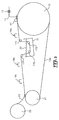
- the apparatus of the present invention, 10 generally, comprises a number of stations or steps at which various processing steps take place to provide the products of the present invention.
- a schematic diagram shows a supply source 11 of non latex material such as synthetic rubber to deposit the material in liquid form on a belt 13, which in turn is supported on a large drum 15.
- drum is descriptive and equivalent elements such as cylinders and rollers may also be used.
- belt is descriptive and equivalent elements can be used.
- a roller 17 adjusts the thickness of the layer of material. Other devices such as doctor blades and presses can be used, provided they are capable of adjusting the thickness of the uncured material as required.
- the continuous rotation of the drum via drive mechanism 14 causes the deposited layer to travel through at least one oven 19 to cure the non latex material as it passes to return drum 21.
- the cured sheet 23 is lifted from the belt and wound on a second drum 25.
- the underside 13a of belt 13 is free of material and may be cleaned before it again reaches the supply source 11.
- Fig. 2 illustrates the supply system 11 in greater detail.
- the system includes a plurality of pipes 111, 113, 115, and 117 coming from individual supplies of non latex material, each controlled by valves 211, 213, 215 and 217 respectively, to produce a continuous sheet of uncured non latex material 131 on belt 13.
- the roller 17 of Fig. 1 will complete the blending as roller 17 adjusts the desired thickness by pressure on belt 13 as it passes along first drum 15.
- the preferred thickness for said non latex material is a thickness of from at least 0.004 inches to more than 0.25 inches.
- pipes 111, 113, 115 and 117 can supply non latex materials from different sources, so that, for example, two or more colors can be formed in one continuous sheet.
- pipes 111, 113, 115 and 117 can be moved in a regular or irregular pattered alone the axis of drum 15, so that the discharged non latex material, particularly when more than one color is used, results in a series of stripes that may appear to have waves or other patterns in the thus formed sheet.
- the preferred material for the first and second drums and the belt is stainless steel because the polymers used in the present invention tend not to stick to stainless steel. Other materials having this same property can be used, provided they have adequate strength for other features of the present invention. It is important that the belt be kept under tension. Preferred tension is at least 1,000 pounds of tension and preferably at least 2,000 pounds of tension, so that the surface of the belt is stable and does not flex while caring the non latex material as it is cured. said outer surface of said first and second drum and said belt is stainless steel.
- the first drum made of stainless steel, has a diameter of about six feet and is driven to rotate in a counter clockwise direction as seen in Fig. 1.
- Uncured polychloroprene having curing agents and other additives that comprised less than five percent of the liquid, was deposited on a stainless steel belt 13 approximately 150 feet long and attached or carried at the other end by a two foot diameter stainless steel drum.
- the preferred diameter of the first drum is at least five feet in diameter and the preferred diameter of the second drum is at least one foot in diameter.
- the preferred length of the belt is at least 50 feet in length.
- roller 17 may have tetrafluoroethylene, silicone or any type of non-stick material covering the roller to adjust the thickness and width. Thicknesses ranged from about 0.004 inches to more than 0.25 inches. The width of the sheet being formed can range from as little as one inch to as much as 144 inches or more, depending on the width of drums 15 and 21, and whether or not more than one sheet is bonded to another at a later processing state.
- the drums rotated at a speed of about three feet per minute, and the preferred speed is between one and five feet per minute.
- the polychloroprene is then cured as the belt progresses from roller 17 to the return drum 21 by passing through at least one oven 19.
- Three ovens 19a, 19b and 19c are shown in Fig. 3. Oven temperatures range from 25° C to 60° C. It is preferred to have at least one wash cycle as well for removal of any solids.
- the wash cycle is accomplished as illustrated schematically in Fig. 3, by passing the belt holding the curing polychloroprene around a roller 171, into bath vat 31, which is filled with a quantity of water 33, around rollers 173 and 175, out of vat 31 and around roller 177 to drum 21, for removal of sheet 23 on to drum 25 for further processing or use.
- the sheet 25 can have at least one contact roller 179, as shown in Fig. 3, for imparting a predetermined texture to said non latex material during curing.
- the apparatus was operated for periods of time as long as thirty hours before shutting down for cleaning and maintenance.
- a wide variety of striped sheets were made, including but not limited to horizontal, vertical and wavy stripes. Colors used included white, orange, green, blue, purple, tan, silver and gold. Color combinations included sheets having a two inch wide top stripe of white and a three inch wide stripe of a specific color, including orange, green, blue, purple, tan, silver and gold. One sheet was made having five stripes, comprising white, orange, green, blue and purple. Another sheet was made having three stripes, comprising tan, silver and gold.
Landscapes
- Engineering & Computer Science (AREA)
- Mechanical Engineering (AREA)
- Moulding By Coating Moulds (AREA)
- Manufacture Of Macromolecular Shaped Articles (AREA)
Applications Claiming Priority (2)
| Application Number | Priority Date | Filing Date | Title |
|---|---|---|---|
| US999460 | 2001-11-23 | ||
| US09/999,460 US6887061B2 (en) | 2001-11-23 | 2001-11-23 | Method and apparatus for manufacturing latex free materials |
Publications (2)
| Publication Number | Publication Date |
|---|---|
| EP1314529A2 true EP1314529A2 (de) | 2003-05-28 |
| EP1314529A3 EP1314529A3 (de) | 2008-05-28 |
Family
ID=25546354
Family Applications (1)
| Application Number | Title | Priority Date | Filing Date |
|---|---|---|---|
| EP02026093A Withdrawn EP1314529A3 (de) | 2001-11-23 | 2002-11-22 | Verfahren und Vorrichtung zum Herstellen von latexfreien Materialien |
Country Status (3)
| Country | Link |
|---|---|
| US (2) | US6887061B2 (de) |
| EP (1) | EP1314529A3 (de) |
| CA (1) | CA2411631A1 (de) |
Cited By (1)
| Publication number | Priority date | Publication date | Assignee | Title |
|---|---|---|---|---|
| CN111120653A (zh) * | 2019-12-26 | 2020-05-08 | 宁波海山克尔铃密封件有限公司 | 一种密封垫片及其生产装置 |
Families Citing this family (9)
| Publication number | Priority date | Publication date | Assignee | Title |
|---|---|---|---|---|
| US9440128B2 (en) | 2002-06-11 | 2016-09-13 | Ben Huang | Method of making a grip |
| US7347792B2 (en) * | 2006-05-22 | 2008-03-25 | Ben Huang | Decorative golf club grip |
| US20090183807A1 (en) * | 2007-08-16 | 2009-07-23 | Sadlier Claus E | More versatile flexible cover and method of manufacture |
| US8435372B1 (en) | 2007-08-16 | 2013-05-07 | Les Industries Touch Inc. | Manufacture of versatile flexible cover using mandrel |
| US7919031B2 (en) * | 2008-04-17 | 2011-04-05 | Global Ip Holdings, Llc | Method and system for making plastic cellular parts and thermoplastic composite articles utilizing same |
| US9661833B2 (en) | 2009-04-10 | 2017-05-30 | Ben Huang | Multi-layered grip |
| JP5678813B2 (ja) * | 2011-06-20 | 2015-03-04 | コニカミノルタ株式会社 | 液晶表示装置用光学フィルムの製造方法 |
| JP5682522B2 (ja) * | 2011-09-15 | 2015-03-11 | コニカミノルタ株式会社 | 液晶表示装置用光学フィルムの製造方法 |
| US10653124B2 (en) | 2017-05-03 | 2020-05-19 | Winn Incorporated | Reel component and method of manufacturing same |
Citations (3)
| Publication number | Priority date | Publication date | Assignee | Title |
|---|---|---|---|---|
| US4089718A (en) | 1975-11-26 | 1978-05-16 | Amerace Corporation | Process for making thermoplastic elastomeric articles |
| US5129647A (en) | 1990-12-24 | 1992-07-14 | Edward Castellanos | Elastic resistance exerciser secured at the waist |
| US5945060A (en) | 1997-08-01 | 1999-08-31 | Magister Corporation | Method of making latex-free elastic exercise bands |
Family Cites Families (17)
| Publication number | Priority date | Publication date | Assignee | Title |
|---|---|---|---|---|
| GB216188A (en) * | 1923-02-19 | 1924-05-19 | Dunlop Rubber Co | Improvements in or relating to the manufacture of golf balls |
| US1603812A (en) * | 1924-01-30 | 1926-10-19 | Stein Jacob | Method for making striped rubber sheeting |
| US1894845A (en) * | 1930-03-04 | 1933-01-17 | Spicers Ltd | Film casting machine |
| US2085532A (en) * | 1932-01-30 | 1937-06-29 | Celanese Corp | Production of artificial materials and apparatus therefor |
| US2346765A (en) * | 1938-09-12 | 1944-04-18 | Carbide & Carbon Chem Corp | Apparatus for making sheet material |
| US2441235A (en) * | 1941-10-08 | 1948-05-11 | Us Rubber Co | Apparatus for making sponge rubber articles |
| US2576317A (en) * | 1947-01-14 | 1951-11-27 | New Wrinkle Inc | Apparatus for producing selfsupporting wrinkle film |
| US3032815A (en) * | 1956-08-14 | 1962-05-08 | Braunschweiger Farbenwerke Wil | Process and apparatus for manufacturing sheets from polymerizable substantially solvent-free casting resins |
| US4193959A (en) * | 1964-08-31 | 1980-03-18 | Lemelson Jerome H | Pressure forming method |
| GB1326541A (en) * | 1969-12-30 | 1973-08-15 | Res & Dev Co Ltd | Production of sheets or films from a liquid material |
| US3923941A (en) * | 1970-11-05 | 1975-12-02 | Armstrong Cork Co | Process for producing a marbleized plastic sheet |
| DE3485470D1 (de) * | 1983-10-05 | 1992-03-05 | Nippon Petrochemicals Co Ltd | Verfahren zur herstellung thermoplastischer kunststoffolien oder fuellstoffhaltiger kunststoffolien. |
| US4584231A (en) * | 1983-12-02 | 1986-04-22 | Vcf Packaging Films, Inc. | Solvent cast acrylic film |
| JPS61268413A (ja) * | 1985-05-24 | 1986-11-27 | Mitsubishi Rayon Co Ltd | 不規則な異色流れ模様を有する合成樹脂板の連続的製造方法 |
| US5536158A (en) * | 1993-10-25 | 1996-07-16 | Eastman Kodak Company | Apparatus for drying solvent based film |
| DE19644112A1 (de) * | 1995-11-01 | 1997-05-28 | Lonza Folien Gmbh | Siliconkautschuk-Gießfolien und Verfahren und Vorrichtung zu deren Herstellung |
| US6387304B2 (en) * | 1998-03-31 | 2002-05-14 | Du Pont-Mrc Co., Ltd. | Method of manufacturing artificial marble having stripe pattern |
-
2001
- 2001-11-23 US US09/999,460 patent/US6887061B2/en not_active Expired - Fee Related
-
2002
- 2002-11-12 CA CA002411631A patent/CA2411631A1/en not_active Abandoned
- 2002-11-22 EP EP02026093A patent/EP1314529A3/de not_active Withdrawn
-
2005
- 2005-03-18 US US11/084,549 patent/US20050202112A1/en not_active Abandoned
Patent Citations (3)
| Publication number | Priority date | Publication date | Assignee | Title |
|---|---|---|---|---|
| US4089718A (en) | 1975-11-26 | 1978-05-16 | Amerace Corporation | Process for making thermoplastic elastomeric articles |
| US5129647A (en) | 1990-12-24 | 1992-07-14 | Edward Castellanos | Elastic resistance exerciser secured at the waist |
| US5945060A (en) | 1997-08-01 | 1999-08-31 | Magister Corporation | Method of making latex-free elastic exercise bands |
Cited By (1)
| Publication number | Priority date | Publication date | Assignee | Title |
|---|---|---|---|---|
| CN111120653A (zh) * | 2019-12-26 | 2020-05-08 | 宁波海山克尔铃密封件有限公司 | 一种密封垫片及其生产装置 |
Also Published As
| Publication number | Publication date |
|---|---|
| US6887061B2 (en) | 2005-05-03 |
| US20050202112A1 (en) | 2005-09-15 |
| EP1314529A3 (de) | 2008-05-28 |
| CA2411631A1 (en) | 2003-05-23 |
| US20030098521A1 (en) | 2003-05-29 |
Similar Documents
| Publication | Publication Date | Title |
|---|---|---|
| US6887061B2 (en) | Method and apparatus for manufacturing latex free materials | |
| US8431055B2 (en) | Method of forming a textured condom | |
| US4511354A (en) | Hydrocarbon block copolymer with dispersed polysiloxane | |
| DE69819732T2 (de) | Latex-freie elastische übungsbänder sowie deren herstellungsverfahren | |
| US4386179A (en) | Hydrocarbon block copolymer with dispersed polysiloxane | |
| EP1067065B1 (de) | Kontakttoaster mit einem Förderband | |
| CN104736351B (zh) | 包含装饰物的聚合物制品以及制造方法 | |
| TWI386241B (zh) | 裝飾性之握把布及製造用於該握把布之聚合物區域的方法 | |
| US2752279A (en) | Embossed laminated foam rubber and fabric material and method of making same | |
| NO791867L (no) | Fremgangsmaate og apparat for fremstilling av en bane | |
| CN101678957B (zh) | 采用双传送带系统制造地垫的设备 | |
| DE69231944T2 (de) | Verfahren zur Herstellung von einem mehrschichtigen Stoff, der mit einem vulkanisierten Elastomer verbunden zu einem thermoplastischen Elastomer, der polyamidische Sequenzen erhalt, hergestellt ist; und der mehrschichtige Stoff | |
| AT408513B (de) | Tauchartikel aus einem elastomer | |
| US2176945A (en) | Continuous molding device | |
| US4552914A (en) | Hydrocarbon block copolymer with dispersed polysiloxane | |
| CN101638171A (zh) | 一种无缝输送带及其制造方法 | |
| DE3236447A1 (de) | Endlosfaserverstaerkte verbundwerkstoffe | |
| US2056406A (en) | Imitation leather and method of making the same | |
| KR20200135629A (ko) | 발포매트 제조용 압착시트의 성형장치 | |
| GB641223A (en) | Improvements in or relating to laminated flexible material suitable for belting | |
| JPS6323938A (ja) | ゴム発泡体の連続的製造方法 | |
| JP4157994B2 (ja) | 事務機器用ローラの製造方法 | |
| JP4513216B2 (ja) | 模様入りゴムシートの製造方法 | |
| TW201100225A (en) | Method for producing seamless fitting article with thermoplastic material | |
| DE1802085C3 (de) | Vorrichtung zum Herstellen von Gummilaufstreifen zum Runderneuern von Fahrzeugreifen |
Legal Events
| Date | Code | Title | Description |
|---|---|---|---|
| PUAI | Public reference made under article 153(3) epc to a published international application that has entered the european phase |
Free format text: ORIGINAL CODE: 0009012 |
|
| AK | Designated contracting states |
Designated state(s): AT BE BG CH CY CZ DE DK EE ES FI FR GB GR IE IT LI LU MC NL PT SE SK TR |
|
| AX | Request for extension of the european patent |
Extension state: AL LT LV MK RO SI |
|
| RAP1 | Party data changed (applicant data changed or rights of an application transferred) |
Owner name: DONOVAN, JAMES A. |
|
| PUAL | Search report despatched |
Free format text: ORIGINAL CODE: 0009013 |
|
| AK | Designated contracting states |
Kind code of ref document: A3 Designated state(s): AT BE BG CH CY CZ DE DK EE ES FI FR GB GR IE IT LI LU MC NL PT SE SK TR |
|
| AX | Request for extension of the european patent |
Extension state: AL LT LV MK RO SI |
|
| 17P | Request for examination filed |
Effective date: 20081006 |
|
| AKX | Designation fees paid |
Designated state(s): AT BE BG CH CY CZ DE DK EE ES FI FR GB GR IE IT LI LU MC NL PT SE SK TR |
|
| 17Q | First examination report despatched |
Effective date: 20091127 |
|
| STAA | Information on the status of an ep patent application or granted ep patent |
Free format text: STATUS: THE APPLICATION IS DEEMED TO BE WITHDRAWN |
|
| 18D | Application deemed to be withdrawn |
Effective date: 20120601 |