EP1313735B1 - Flüssigkristalline perylen-3,4:9,10-tetracarbonsäurediimide - Google Patents
Flüssigkristalline perylen-3,4:9,10-tetracarbonsäurediimide Download PDFInfo
- Publication number
- EP1313735B1 EP1313735B1 EP01969490A EP01969490A EP1313735B1 EP 1313735 B1 EP1313735 B1 EP 1313735B1 EP 01969490 A EP01969490 A EP 01969490A EP 01969490 A EP01969490 A EP 01969490A EP 1313735 B1 EP1313735 B1 EP 1313735B1
- Authority
- EP
- European Patent Office
- Prior art keywords
- perylene
- formula
- tetracarboxylic
- general formula
- diimides
- Prior art date
- Legal status (The legal status is an assumption and is not a legal conclusion. Google has not performed a legal analysis and makes no representation as to the accuracy of the status listed.)
- Expired - Lifetime
Links
- 239000007788 liquid Substances 0.000 title description 4
- 229910052739 hydrogen Inorganic materials 0.000 claims abstract description 37
- 239000001257 hydrogen Substances 0.000 claims abstract description 15
- UFHFLCQGNIYNRP-UHFFFAOYSA-N Hydrogen Chemical compound [H][H] UFHFLCQGNIYNRP-UHFFFAOYSA-N 0.000 claims abstract description 12
- 239000000460 chlorine Substances 0.000 claims abstract description 10
- 125000005110 aryl thio group Chemical group 0.000 claims abstract description 8
- 125000004104 aryloxy group Chemical group 0.000 claims abstract description 8
- 239000011368 organic material Substances 0.000 claims abstract description 8
- WKBOTKDWSSQWDR-UHFFFAOYSA-N Bromine atom Chemical compound [Br] WKBOTKDWSSQWDR-UHFFFAOYSA-N 0.000 claims abstract description 6
- ZAMOUSCENKQFHK-UHFFFAOYSA-N Chlorine atom Chemical compound [Cl] ZAMOUSCENKQFHK-UHFFFAOYSA-N 0.000 claims abstract description 6
- GDTBXPJZTBHREO-UHFFFAOYSA-N bromine Substances BrBr GDTBXPJZTBHREO-UHFFFAOYSA-N 0.000 claims abstract description 6
- 229910052794 bromium Inorganic materials 0.000 claims abstract description 6
- 229910052801 chlorine Inorganic materials 0.000 claims abstract description 6
- OKTJSMMVPCPJKN-UHFFFAOYSA-N Carbon Chemical group [C] OKTJSMMVPCPJKN-UHFFFAOYSA-N 0.000 claims abstract description 5
- 150000002431 hydrogen Chemical class 0.000 claims abstract description 5
- 229910010272 inorganic material Inorganic materials 0.000 claims abstract description 5
- 239000011147 inorganic material Substances 0.000 claims abstract description 5
- 239000000990 laser dye Substances 0.000 claims abstract description 5
- 230000005693 optoelectronics Effects 0.000 claims abstract description 5
- 125000001769 aryl amino group Chemical group 0.000 claims abstract description 4
- 239000002178 crystalline material Substances 0.000 claims abstract description 4
- 239000007850 fluorescent dye Substances 0.000 claims abstract description 4
- 238000005401 electroluminescence Methods 0.000 claims abstract 2
- 239000003054 catalyst Substances 0.000 claims description 13
- 229910052757 nitrogen Inorganic materials 0.000 claims description 12
- 230000000269 nucleophilic effect Effects 0.000 claims description 10
- 238000004519 manufacturing process Methods 0.000 claims description 9
- CLYVDMAATCIVBF-UHFFFAOYSA-N pigment red 224 Chemical compound C=12C3=CC=C(C(OC4=O)=O)C2=C4C=CC=1C1=CC=C2C(=O)OC(=O)C4=CC=C3C1=C42 CLYVDMAATCIVBF-UHFFFAOYSA-N 0.000 claims description 9
- 239000003880 polar aprotic solvent Substances 0.000 claims description 9
- 150000003141 primary amines Chemical class 0.000 claims description 9
- GTDPSWPPOUPBNX-UHFFFAOYSA-N ac1mqpva Chemical compound CC12C(=O)OC(=O)C1(C)C1(C)C2(C)C(=O)OC1=O GTDPSWPPOUPBNX-UHFFFAOYSA-N 0.000 claims description 7
- 238000006358 imidation reaction Methods 0.000 claims description 7
- 125000001424 substituent group Chemical group 0.000 claims description 7
- 239000000010 aprotic solvent Substances 0.000 claims description 6
- WVDDGKGOMKODPV-UHFFFAOYSA-N Benzyl alcohol Chemical compound OCC1=CC=CC=C1 WVDDGKGOMKODPV-UHFFFAOYSA-N 0.000 claims description 4
- HRKQOINLCJTGBK-UHFFFAOYSA-N dihydroxidosulfur Chemical compound OSO HRKQOINLCJTGBK-UHFFFAOYSA-N 0.000 claims description 4
- YGRXZLAMYLGXMF-UHFFFAOYSA-N sbb059221 Chemical compound C1=C(Cl)C(C=2C(Cl)=CC=3C(OC(=O)C=4C=3C=2C2=C(Cl)C=4)=O)=C3C2=C(Cl)C=C2C(=O)OC(=O)C1=C32 YGRXZLAMYLGXMF-UHFFFAOYSA-N 0.000 claims description 4
- 125000000951 phenoxy group Chemical group [H]C1=C([H])C([H])=C(O*)C([H])=C1[H] 0.000 claims description 3
- 125000004191 (C1-C6) alkoxy group Chemical group 0.000 claims 2
- 125000004093 cyano group Chemical group *C#N 0.000 claims 2
- 125000002887 hydroxy group Chemical group [H]O* 0.000 claims 2
- 125000003837 (C1-C20) alkyl group Chemical group 0.000 claims 1
- 125000004169 (C1-C6) alkyl group Chemical group 0.000 claims 1
- 125000004209 (C1-C8) alkyl group Chemical group 0.000 claims 1
- 229910052736 halogen Inorganic materials 0.000 claims 1
- 150000002367 halogens Chemical class 0.000 claims 1
- 125000005842 heteroatom Chemical group 0.000 claims 1
- 125000004435 hydrogen atom Chemical group [H]* 0.000 claims 1
- 125000000449 nitro group Chemical group [O-][N+](*)=O 0.000 claims 1
- 125000004433 nitrogen atom Chemical group N* 0.000 claims 1
- 125000000217 alkyl group Chemical group 0.000 abstract description 3
- 125000003545 alkoxy group Chemical group 0.000 abstract description 2
- 125000004414 alkyl thio group Chemical group 0.000 abstract 1
- -1 phenoxy, phenylthio, phenylamino, 2-naphthyloxy, 2-naphthylthio Chemical group 0.000 description 370
- YMWUJEATGCHHMB-UHFFFAOYSA-N Dichloromethane Chemical compound ClCCl YMWUJEATGCHHMB-UHFFFAOYSA-N 0.000 description 15
- 238000000034 method Methods 0.000 description 15
- OKKJLVBELUTLKV-UHFFFAOYSA-N Methanol Chemical compound OC OKKJLVBELUTLKV-UHFFFAOYSA-N 0.000 description 12
- SMWDFEZZVXVKRB-UHFFFAOYSA-N Quinoline Chemical compound N1=CC=CC2=CC=CC=C21 SMWDFEZZVXVKRB-UHFFFAOYSA-N 0.000 description 12
- 150000003254 radicals Chemical class 0.000 description 12
- 230000008569 process Effects 0.000 description 10
- XEEYBQQBJWHFJM-UHFFFAOYSA-N Iron Chemical compound [Fe] XEEYBQQBJWHFJM-UHFFFAOYSA-N 0.000 description 8
- 238000006243 chemical reaction Methods 0.000 description 8
- 239000002904 solvent Substances 0.000 description 8
- 238000002360 preparation method Methods 0.000 description 7
- 239000000047 product Substances 0.000 description 7
- XKRFYHLGVUSROY-UHFFFAOYSA-N Argon Chemical compound [Ar] XKRFYHLGVUSROY-UHFFFAOYSA-N 0.000 description 6
- ZOIORXHNWRGPMV-UHFFFAOYSA-N acetic acid;zinc Chemical compound [Zn].CC(O)=O.CC(O)=O ZOIORXHNWRGPMV-UHFFFAOYSA-N 0.000 description 6
- 239000002585 base Substances 0.000 description 6
- 230000015572 biosynthetic process Effects 0.000 description 6
- 238000010438 heat treatment Methods 0.000 description 6
- 239000004246 zinc acetate Substances 0.000 description 6
- 238000001816 cooling Methods 0.000 description 5
- JMTJOYSOISUALH-UHFFFAOYSA-N 3,4,5-tridodecoxyaniline Chemical compound CCCCCCCCCCCCOC1=CC(N)=CC(OCCCCCCCCCCCC)=C1OCCCCCCCCCCCC JMTJOYSOISUALH-UHFFFAOYSA-N 0.000 description 4
- GLZPCOQZEFWAFX-UHFFFAOYSA-N Geraniol Chemical compound CC(C)=CCCC(C)=CCO GLZPCOQZEFWAFX-UHFFFAOYSA-N 0.000 description 4
- VEXZGXHMUGYJMC-UHFFFAOYSA-N Hydrochloric acid Chemical compound Cl VEXZGXHMUGYJMC-UHFFFAOYSA-N 0.000 description 4
- JUJWROOIHBZHMG-UHFFFAOYSA-N Pyridine Chemical compound C1=CC=NC=C1 JUJWROOIHBZHMG-UHFFFAOYSA-N 0.000 description 4
- 150000001412 amines Chemical class 0.000 description 4
- 150000001875 compounds Chemical class 0.000 description 4
- 238000000921 elemental analysis Methods 0.000 description 4
- AWJUIBRHMBBTKR-UHFFFAOYSA-N isoquinoline Chemical compound C1=NC=CC2=CC=CC=C21 AWJUIBRHMBBTKR-UHFFFAOYSA-N 0.000 description 4
- IJGRMHOSHXDMSA-UHFFFAOYSA-N nitrogen Substances N#N IJGRMHOSHXDMSA-UHFFFAOYSA-N 0.000 description 4
- 238000000746 purification Methods 0.000 description 4
- SMUQFGGVLNAIOZ-UHFFFAOYSA-N quinaldine Chemical compound C1=CC=CC2=NC(C)=CC=C21 SMUQFGGVLNAIOZ-UHFFFAOYSA-N 0.000 description 4
- 0 *c1c(*)c(*)cc(N(C(c2cc(*)c(-c(c([Al]=C)c3)c4c(c(C(N5c6cc(S)c(*)c(*)c6)=O)c6)c3C5=O)c3c2c2cc5c3-c4c6[Al]=[Al]5)=O)C2=O)c1 Chemical compound *c1c(*)c(*)cc(N(C(c2cc(*)c(-c(c([Al]=C)c3)c4c(c(C(N5c6cc(S)c(*)c(*)c6)=O)c6)c3C5=O)c3c2c2cc5c3-c4c6[Al]=[Al]5)=O)C2=O)c1 0.000 description 3
- QTBSBXVTEAMEQO-UHFFFAOYSA-N Acetic acid Chemical compound CC(O)=O QTBSBXVTEAMEQO-UHFFFAOYSA-N 0.000 description 3
- LFQSCWFLJHTTHZ-UHFFFAOYSA-N Ethanol Chemical compound CCO LFQSCWFLJHTTHZ-UHFFFAOYSA-N 0.000 description 3
- ZMXDDKWLCZADIW-UHFFFAOYSA-N N,N-Dimethylformamide Chemical compound CN(C)C=O ZMXDDKWLCZADIW-UHFFFAOYSA-N 0.000 description 3
- KWYUFKZDYYNOTN-UHFFFAOYSA-M Potassium hydroxide Chemical compound [OH-].[K+] KWYUFKZDYYNOTN-UHFFFAOYSA-M 0.000 description 3
- VYPSYNLAJGMNEJ-UHFFFAOYSA-N Silicium dioxide Chemical compound O=[Si]=O VYPSYNLAJGMNEJ-UHFFFAOYSA-N 0.000 description 3
- HEMHJVSKTPXQMS-UHFFFAOYSA-M Sodium hydroxide Chemical compound [OH-].[Na+] HEMHJVSKTPXQMS-UHFFFAOYSA-M 0.000 description 3
- 150000001298 alcohols Chemical class 0.000 description 3
- 229910052786 argon Inorganic materials 0.000 description 3
- 125000003118 aryl group Chemical group 0.000 description 3
- 238000012512 characterization method Methods 0.000 description 3
- 238000004040 coloring Methods 0.000 description 3
- 239000010408 film Substances 0.000 description 3
- RAXXELZNTBOGNW-UHFFFAOYSA-N imidazole Natural products C1=CNC=N1 RAXXELZNTBOGNW-UHFFFAOYSA-N 0.000 description 3
- 239000000463 material Substances 0.000 description 3
- 229910052751 metal Inorganic materials 0.000 description 3
- 239000002184 metal Substances 0.000 description 3
- 150000007522 mineralic acids Chemical class 0.000 description 3
- 239000000203 mixture Substances 0.000 description 3
- 125000002347 octyl group Chemical group [H]C([*])([H])C([H])([H])C([H])([H])C([H])([H])C([H])([H])C([H])([H])C([H])([H])C([H])([H])[H] 0.000 description 3
- 125000002080 perylenyl group Chemical group C1(=CC=C2C=CC=C3C4=CC=CC5=CC=CC(C1=C23)=C45)* 0.000 description 3
- 238000003756 stirring Methods 0.000 description 3
- 125000000446 sulfanediyl group Chemical group *S* 0.000 description 3
- 125000000999 tert-butyl group Chemical group [H]C([H])([H])C(*)(C([H])([H])[H])C([H])([H])[H] 0.000 description 3
- XLYOFNOQVPJJNP-UHFFFAOYSA-N water Substances O XLYOFNOQVPJJNP-UHFFFAOYSA-N 0.000 description 3
- DNIAPMSPPWPWGF-GSVOUGTGSA-N (R)-(-)-Propylene glycol Chemical compound C[C@@H](O)CO DNIAPMSPPWPWGF-GSVOUGTGSA-N 0.000 description 2
- 125000006219 1-ethylpentyl group Chemical group [H]C([H])([H])C([H])([H])C([H])([H])C([H])([H])C([H])(*)C([H])([H])C([H])([H])[H] 0.000 description 2
- LDKSCZJUIURGMW-UHFFFAOYSA-N 1-isothiocyanato-3-methylsulfanylpropane Chemical group CSCCCN=C=S LDKSCZJUIURGMW-UHFFFAOYSA-N 0.000 description 2
- PAMIQIKDUOTOBW-UHFFFAOYSA-N 1-methylpiperidine Chemical compound CN1CCCCC1 PAMIQIKDUOTOBW-UHFFFAOYSA-N 0.000 description 2
- 238000005160 1H NMR spectroscopy Methods 0.000 description 2
- 125000000143 2-carboxyethyl group Chemical group [H]OC(=O)C([H])([H])C([H])([H])* 0.000 description 2
- 125000001731 2-cyanoethyl group Chemical group [H]C([H])(*)C([H])([H])C#N 0.000 description 2
- 125000003006 2-dimethylaminoethyl group Chemical group [H]C([H])([H])N(C([H])([H])[H])C([H])([H])C([H])([H])* 0.000 description 2
- 125000000954 2-hydroxyethyl group Chemical group [H]C([*])([H])C([H])([H])O[H] 0.000 description 2
- 125000004200 2-methoxyethyl group Chemical group [H]C([H])([H])OC([H])([H])C([H])([H])* 0.000 description 2
- 125000005916 2-methylpentyl group Chemical group 0.000 description 2
- 125000005924 2-methylpentyloxy group Chemical group 0.000 description 2
- QOXOZONBQWIKDA-UHFFFAOYSA-N 3-hydroxypropyl Chemical group [CH2]CCO QOXOZONBQWIKDA-UHFFFAOYSA-N 0.000 description 2
- SXIFAEWFOJETOA-UHFFFAOYSA-N 4-hydroxy-butyl Chemical group [CH2]CCCO SXIFAEWFOJETOA-UHFFFAOYSA-N 0.000 description 2
- QPLDLSVMHZLSFG-UHFFFAOYSA-N Copper oxide Chemical compound [Cu]=O QPLDLSVMHZLSFG-UHFFFAOYSA-N 0.000 description 2
- 229910002483 Cu Ka Inorganic materials 0.000 description 2
- SNRUBQQJIBEYMU-UHFFFAOYSA-N Dodecane Natural products CCCCCCCCCCCC SNRUBQQJIBEYMU-UHFFFAOYSA-N 0.000 description 2
- SECXISVLQFMRJM-UHFFFAOYSA-N N-Methylpyrrolidone Chemical compound CN1CCCC1=O SECXISVLQFMRJM-UHFFFAOYSA-N 0.000 description 2
- 238000005481 NMR spectroscopy Methods 0.000 description 2
- NBIIXXVUZAFLBC-UHFFFAOYSA-N Phosphoric acid Chemical compound OP(O)(O)=O NBIIXXVUZAFLBC-UHFFFAOYSA-N 0.000 description 2
- CZPWVGJYEJSRLH-UHFFFAOYSA-N Pyrimidine Chemical compound C1=CN=CN=C1 CZPWVGJYEJSRLH-UHFFFAOYSA-N 0.000 description 2
- CDBYLPFSWZWCQE-UHFFFAOYSA-L Sodium Carbonate Chemical compound [Na+].[Na+].[O-]C([O-])=O CDBYLPFSWZWCQE-UHFFFAOYSA-L 0.000 description 2
- XLOMVQKBTHCTTD-UHFFFAOYSA-N Zinc monoxide Chemical compound [Zn]=O XLOMVQKBTHCTTD-UHFFFAOYSA-N 0.000 description 2
- 239000002253 acid Substances 0.000 description 2
- 150000007513 acids Chemical class 0.000 description 2
- 125000001204 arachidyl group Chemical group [H]C([*])([H])C([H])([H])C([H])([H])C([H])([H])C([H])([H])C([H])([H])C([H])([H])C([H])([H])C([H])([H])C([H])([H])C([H])([H])C([H])([H])C([H])([H])C([H])([H])C([H])([H])C([H])([H])C([H])([H])C([H])([H])C([H])([H])C([H])([H])[H] 0.000 description 2
- 125000000484 butyl group Chemical group [H]C([*])([H])C([H])([H])C([H])([H])C([H])([H])[H] 0.000 description 2
- 125000002057 carboxymethyl group Chemical group [H]OC(=O)C([H])([H])[*] 0.000 description 2
- 239000007795 chemical reaction product Substances 0.000 description 2
- QMVPMAAFGQKVCJ-UHFFFAOYSA-N citronellol Chemical compound OCCC(C)CCC=C(C)C QMVPMAAFGQKVCJ-UHFFFAOYSA-N 0.000 description 2
- 238000004440 column chromatography Methods 0.000 description 2
- OPQARKPSCNTWTJ-UHFFFAOYSA-L copper(ii) acetate Chemical compound [Cu+2].CC([O-])=O.CC([O-])=O OPQARKPSCNTWTJ-UHFFFAOYSA-L 0.000 description 2
- VPUGDVKSAQVFFS-UHFFFAOYSA-N coronene Chemical compound C1=C(C2=C34)C=CC3=CC=C(C=C3)C4=C4C3=CC=C(C=C3)C4=C2C3=C1 VPUGDVKSAQVFFS-UHFFFAOYSA-N 0.000 description 2
- 125000000582 cycloheptyl group Chemical group [H]C1([H])C([H])([H])C([H])([H])C([H])([H])C([H])(*)C([H])([H])C1([H])[H] 0.000 description 2
- 125000000113 cyclohexyl group Chemical group [H]C1([H])C([H])([H])C([H])([H])C([H])(*)C([H])([H])C1([H])[H] 0.000 description 2
- 125000000640 cyclooctyl group Chemical group [H]C1([H])C([H])([H])C([H])([H])C([H])([H])C([H])(*)C([H])([H])C([H])([H])C1([H])[H] 0.000 description 2
- 125000001511 cyclopentyl group Chemical group [H]C1([H])C([H])([H])C([H])([H])C([H])(*)C1([H])[H] 0.000 description 2
- 125000002704 decyl group Chemical group [H]C([H])([H])C([H])([H])C([H])([H])C([H])([H])C([H])([H])C([H])([H])C([H])([H])C([H])([H])C([H])([H])C([H])([H])* 0.000 description 2
- XBDQKXXYIPTUBI-UHFFFAOYSA-N dimethylselenoniopropionate Natural products CCC(O)=O XBDQKXXYIPTUBI-UHFFFAOYSA-N 0.000 description 2
- 125000003438 dodecyl group Chemical group [H]C([H])([H])C([H])([H])C([H])([H])C([H])([H])C([H])([H])C([H])([H])C([H])([H])C([H])([H])C([H])([H])C([H])([H])C([H])([H])C([H])([H])* 0.000 description 2
- 239000000975 dye Substances 0.000 description 2
- 238000005516 engineering process Methods 0.000 description 2
- 125000001495 ethyl group Chemical group [H]C([H])([H])C([H])([H])* 0.000 description 2
- 239000007789 gas Substances 0.000 description 2
- 125000005843 halogen group Chemical group 0.000 description 2
- 125000003187 heptyl group Chemical group [H]C([*])([H])C([H])([H])C([H])([H])C([H])([H])C([H])([H])C([H])([H])C([H])([H])[H] 0.000 description 2
- 125000004051 hexyl group Chemical group [H]C([H])([H])C([H])([H])C([H])([H])C([H])([H])C([H])([H])C([H])([H])* 0.000 description 2
- RBTARNINKXHZNM-UHFFFAOYSA-K iron trichloride Chemical compound Cl[Fe](Cl)Cl RBTARNINKXHZNM-UHFFFAOYSA-K 0.000 description 2
- 125000000959 isobutyl group Chemical group [H]C([H])([H])C([H])(C([H])([H])[H])C([H])([H])* 0.000 description 2
- 125000001972 isopentyl group Chemical group [H]C([H])([H])C([H])(C([H])([H])[H])C([H])([H])C([H])([H])* 0.000 description 2
- 125000001449 isopropyl group Chemical group [H]C([H])([H])C([H])(*)C([H])([H])[H] 0.000 description 2
- CDOSHBSSFJOMGT-UHFFFAOYSA-N linalool Chemical compound CC(C)=CCCC(C)(O)C=C CDOSHBSSFJOMGT-UHFFFAOYSA-N 0.000 description 2
- 125000002960 margaryl group Chemical group [H]C([*])([H])C([H])([H])C([H])([H])C([H])([H])C([H])([H])C([H])([H])C([H])([H])C([H])([H])C([H])([H])C([H])([H])C([H])([H])C([H])([H])C([H])([H])C([H])([H])C([H])([H])C([H])([H])C([H])([H])[H] 0.000 description 2
- 150000002739 metals Chemical class 0.000 description 2
- BDAGIHXWWSANSR-UHFFFAOYSA-N methanoic acid Natural products OC=O BDAGIHXWWSANSR-UHFFFAOYSA-N 0.000 description 2
- 125000002496 methyl group Chemical group [H]C([H])([H])* 0.000 description 2
- UAEPNZWRGJTJPN-UHFFFAOYSA-N methylcyclohexane Chemical compound CC1CCCCC1 UAEPNZWRGJTJPN-UHFFFAOYSA-N 0.000 description 2
- 125000002757 morpholinyl group Chemical group 0.000 description 2
- 125000001421 myristyl group Chemical group [H]C([*])([H])C([H])([H])C([H])([H])C([H])([H])C([H])([H])C([H])([H])C([H])([H])C([H])([H])C([H])([H])C([H])([H])C([H])([H])C([H])([H])C([H])([H])C([H])([H])[H] 0.000 description 2
- 125000001971 neopentyl group Chemical group [H]C([*])([H])C(C([H])([H])[H])(C([H])([H])[H])C([H])([H])[H] 0.000 description 2
- 125000001196 nonadecyl group Chemical group [H]C([*])([H])C([H])([H])C([H])([H])C([H])([H])C([H])([H])C([H])([H])C([H])([H])C([H])([H])C([H])([H])C([H])([H])C([H])([H])C([H])([H])C([H])([H])C([H])([H])C([H])([H])C([H])([H])C([H])([H])C([H])([H])C([H])([H])[H] 0.000 description 2
- 125000001400 nonyl group Chemical group [H]C([*])([H])C([H])([H])C([H])([H])C([H])([H])C([H])([H])C([H])([H])C([H])([H])C([H])([H])C([H])([H])[H] 0.000 description 2
- 125000005447 octyloxy group Chemical group [H]C([H])([H])C([H])([H])C([H])([H])C([H])([H])C([H])([H])C([H])([H])C([H])([H])C([H])([H])O* 0.000 description 2
- 150000007524 organic acids Chemical class 0.000 description 2
- 125000000913 palmityl group Chemical group [H]C([*])([H])C([H])([H])C([H])([H])C([H])([H])C([H])([H])C([H])([H])C([H])([H])C([H])([H])C([H])([H])C([H])([H])C([H])([H])C([H])([H])C([H])([H])C([H])([H])C([H])([H])C([H])([H])[H] 0.000 description 2
- 125000002958 pentadecyl group Chemical group [H]C([*])([H])C([H])([H])C([H])([H])C([H])([H])C([H])([H])C([H])([H])C([H])([H])C([H])([H])C([H])([H])C([H])([H])C([H])([H])C([H])([H])C([H])([H])C([H])([H])C([H])([H])[H] 0.000 description 2
- 125000001147 pentyl group Chemical group C(CCCC)* 0.000 description 2
- 125000005936 piperidyl group Chemical group 0.000 description 2
- BWHMMNNQKKPAPP-UHFFFAOYSA-L potassium carbonate Chemical compound [K+].[K+].[O-]C([O-])=O BWHMMNNQKKPAPP-UHFFFAOYSA-L 0.000 description 2
- 239000002244 precipitate Substances 0.000 description 2
- 125000001436 propyl group Chemical group [H]C([*])([H])C([H])([H])C([H])([H])[H] 0.000 description 2
- 230000001681 protective effect Effects 0.000 description 2
- UMJSCPRVCHMLSP-UHFFFAOYSA-N pyridine Natural products COC1=CC=CN=C1 UMJSCPRVCHMLSP-UHFFFAOYSA-N 0.000 description 2
- 125000000719 pyrrolidinyl group Chemical group 0.000 description 2
- 239000011541 reaction mixture Substances 0.000 description 2
- 238000003303 reheating Methods 0.000 description 2
- 239000000741 silica gel Substances 0.000 description 2
- 229910002027 silica gel Inorganic materials 0.000 description 2
- 238000010583 slow cooling Methods 0.000 description 2
- 125000004079 stearyl group Chemical group [H]C([*])([H])C([H])([H])C([H])([H])C([H])([H])C([H])([H])C([H])([H])C([H])([H])C([H])([H])C([H])([H])C([H])([H])C([H])([H])C([H])([H])C([H])([H])C([H])([H])C([H])([H])C([H])([H])C([H])([H])C([H])([H])[H] 0.000 description 2
- 238000006467 substitution reaction Methods 0.000 description 2
- 235000007586 terpenes Nutrition 0.000 description 2
- 230000007704 transition Effects 0.000 description 2
- 125000002889 tridecyl group Chemical group [H]C([*])([H])C([H])([H])C([H])([H])C([H])([H])C([H])([H])C([H])([H])C([H])([H])C([H])([H])C([H])([H])C([H])([H])C([H])([H])C([H])([H])C([H])([H])[H] 0.000 description 2
- 125000002948 undecyl group Chemical group [H]C([*])([H])C([H])([H])C([H])([H])C([H])([H])C([H])([H])C([H])([H])C([H])([H])C([H])([H])C([H])([H])C([H])([H])C([H])([H])[H] 0.000 description 2
- 238000004736 wide-angle X-ray diffraction Methods 0.000 description 2
- 239000001490 (3R)-3,7-dimethylocta-1,6-dien-3-ol Substances 0.000 description 1
- WRIDQFICGBMAFQ-UHFFFAOYSA-N (E)-8-Octadecenoic acid Natural products CCCCCCCCCC=CCCCCCCC(O)=O WRIDQFICGBMAFQ-UHFFFAOYSA-N 0.000 description 1
- QMVPMAAFGQKVCJ-SNVBAGLBSA-N (R)-(+)-citronellol Natural products OCC[C@H](C)CCC=C(C)C QMVPMAAFGQKVCJ-SNVBAGLBSA-N 0.000 description 1
- CDOSHBSSFJOMGT-JTQLQIEISA-N (R)-linalool Natural products CC(C)=CCC[C@@](C)(O)C=C CDOSHBSSFJOMGT-JTQLQIEISA-N 0.000 description 1
- AVQQQNCBBIEMEU-UHFFFAOYSA-N 1,1,3,3-tetramethylurea Chemical compound CN(C)C(=O)N(C)C AVQQQNCBBIEMEU-UHFFFAOYSA-N 0.000 description 1
- GGYVTHJIUNGKFZ-UHFFFAOYSA-N 1-methylpiperidin-2-one Chemical compound CN1CCCCC1=O GGYVTHJIUNGKFZ-UHFFFAOYSA-N 0.000 description 1
- LQJBNNIYVWPHFW-UHFFFAOYSA-N 20:1omega9c fatty acid Natural products CCCCCCCCCCC=CCCCCCCCC(O)=O LQJBNNIYVWPHFW-UHFFFAOYSA-N 0.000 description 1
- OSWFIVFLDKOXQC-UHFFFAOYSA-N 4-(3-methoxyphenyl)aniline Chemical compound COC1=CC=CC(C=2C=CC(N)=CC=2)=C1 OSWFIVFLDKOXQC-UHFFFAOYSA-N 0.000 description 1
- QSBYPNXLFMSGKH-UHFFFAOYSA-N 9-Heptadecensaeure Natural products CCCCCCCC=CCCCCCCCC(O)=O QSBYPNXLFMSGKH-UHFFFAOYSA-N 0.000 description 1
- RYGMFSIKBFXOCR-UHFFFAOYSA-N Copper Chemical compound [Cu] RYGMFSIKBFXOCR-UHFFFAOYSA-N 0.000 description 1
- 239000005792 Geraniol Substances 0.000 description 1
- GLZPCOQZEFWAFX-YFHOEESVSA-N Geraniol Natural products CC(C)=CCC\C(C)=C/CO GLZPCOQZEFWAFX-YFHOEESVSA-N 0.000 description 1
- 229910021578 Iron(III) chloride Inorganic materials 0.000 description 1
- 239000002841 Lewis acid Substances 0.000 description 1
- OYHQOLUKZRVURQ-HZJYTTRNSA-N Linoleic acid Chemical compound CCCCC\C=C/C\C=C/CCCCCCCC(O)=O OYHQOLUKZRVURQ-HZJYTTRNSA-N 0.000 description 1
- 229920000106 Liquid crystal polymer Polymers 0.000 description 1
- FYYHWMGAXLPEAU-UHFFFAOYSA-N Magnesium Chemical compound [Mg] FYYHWMGAXLPEAU-UHFFFAOYSA-N 0.000 description 1
- FXHOOIRPVKKKFG-UHFFFAOYSA-N N,N-Dimethylacetamide Chemical compound CN(C)C(C)=O FXHOOIRPVKKKFG-UHFFFAOYSA-N 0.000 description 1
- GLZPCOQZEFWAFX-JXMROGBWSA-N Nerol Natural products CC(C)=CCC\C(C)=C\CO GLZPCOQZEFWAFX-JXMROGBWSA-N 0.000 description 1
- 239000005642 Oleic acid Substances 0.000 description 1
- ZQPPMHVWECSIRJ-UHFFFAOYSA-N Oleic acid Natural products CCCCCCCCC=CCCCCCCCC(O)=O ZQPPMHVWECSIRJ-UHFFFAOYSA-N 0.000 description 1
- HCHKCACWOHOZIP-UHFFFAOYSA-N Zinc Chemical compound [Zn] HCHKCACWOHOZIP-UHFFFAOYSA-N 0.000 description 1
- CIUQDSCDWFSTQR-UHFFFAOYSA-N [C]1=CC=CC=C1 Chemical compound [C]1=CC=CC=C1 CIUQDSCDWFSTQR-UHFFFAOYSA-N 0.000 description 1
- 238000010521 absorption reaction Methods 0.000 description 1
- 238000000862 absorption spectrum Methods 0.000 description 1
- 235000011054 acetic acid Nutrition 0.000 description 1
- 238000004220 aggregation Methods 0.000 description 1
- 230000002776 aggregation Effects 0.000 description 1
- 125000001931 aliphatic group Chemical group 0.000 description 1
- 229910000288 alkali metal carbonate Inorganic materials 0.000 description 1
- 150000008041 alkali metal carbonates Chemical class 0.000 description 1
- 150000008044 alkali metal hydroxides Chemical class 0.000 description 1
- DTOSIQBPPRVQHS-PDBXOOCHSA-N alpha-linolenic acid Chemical compound CC\C=C/C\C=C/C\C=C/CCCCCCCC(O)=O DTOSIQBPPRVQHS-PDBXOOCHSA-N 0.000 description 1
- 235000020661 alpha-linolenic acid Nutrition 0.000 description 1
- 229910000147 aluminium phosphate Inorganic materials 0.000 description 1
- JGQFVRIQXUFPAH-UHFFFAOYSA-N beta-citronellol Natural products OCCC(C)CCCC(C)=C JGQFVRIQXUFPAH-UHFFFAOYSA-N 0.000 description 1
- CODNYICXDISAEA-UHFFFAOYSA-N bromine monochloride Chemical compound BrCl CODNYICXDISAEA-UHFFFAOYSA-N 0.000 description 1
- 125000004432 carbon atom Chemical group C* 0.000 description 1
- 150000001732 carboxylic acid derivatives Chemical class 0.000 description 1
- 235000000484 citronellol Nutrition 0.000 description 1
- 239000003086 colorant Substances 0.000 description 1
- 229910052802 copper Inorganic materials 0.000 description 1
- 239000010949 copper Substances 0.000 description 1
- 239000006184 cosolvent Substances 0.000 description 1
- 239000013078 crystal Substances 0.000 description 1
- 229960004643 cupric oxide Drugs 0.000 description 1
- RAABOESOVLLHRU-UHFFFAOYSA-N diazene Chemical compound N=N RAABOESOVLLHRU-UHFFFAOYSA-N 0.000 description 1
- 229910000071 diazene Inorganic materials 0.000 description 1
- 238000000295 emission spectrum Methods 0.000 description 1
- 238000002474 experimental method Methods 0.000 description 1
- 238000002189 fluorescence spectrum Methods 0.000 description 1
- 235000019253 formic acid Nutrition 0.000 description 1
- 229940113087 geraniol Drugs 0.000 description 1
- 125000003707 hexyloxy group Chemical group [H]C([H])([H])C([H])([H])C([H])([H])C([H])([H])C([H])([H])C([H])([H])O* 0.000 description 1
- 229930195733 hydrocarbon Natural products 0.000 description 1
- 239000011261 inert gas Substances 0.000 description 1
- 230000003993 interaction Effects 0.000 description 1
- 238000011835 investigation Methods 0.000 description 1
- 229910052742 iron Inorganic materials 0.000 description 1
- BAUYGSIQEAFULO-UHFFFAOYSA-L iron(2+) sulfate (anhydrous) Chemical compound [Fe+2].[O-]S([O-])(=O)=O BAUYGSIQEAFULO-UHFFFAOYSA-L 0.000 description 1
- 229910000359 iron(II) sulfate Inorganic materials 0.000 description 1
- LNOZJRCUHSPCDZ-UHFFFAOYSA-L iron(ii) acetate Chemical compound [Fe+2].CC([O-])=O.CC([O-])=O LNOZJRCUHSPCDZ-UHFFFAOYSA-L 0.000 description 1
- QXJSBBXBKPUZAA-UHFFFAOYSA-N isooleic acid Natural products CCCCCCCC=CCCCCCCCCC(O)=O QXJSBBXBKPUZAA-UHFFFAOYSA-N 0.000 description 1
- 229930007744 linalool Natural products 0.000 description 1
- 235000020778 linoleic acid Nutrition 0.000 description 1
- OYHQOLUKZRVURQ-IXWMQOLASA-N linoleic acid Natural products CCCCC\C=C/C\C=C\CCCCCCCC(O)=O OYHQOLUKZRVURQ-IXWMQOLASA-N 0.000 description 1
- 229960004488 linolenic acid Drugs 0.000 description 1
- KQQKGWQCNNTQJW-UHFFFAOYSA-N linolenic acid Natural products CC=CCCC=CCC=CCCCCCCCC(O)=O KQQKGWQCNNTQJW-UHFFFAOYSA-N 0.000 description 1
- 239000011777 magnesium Substances 0.000 description 1
- 229910052749 magnesium Inorganic materials 0.000 description 1
- UEGPKNKPLBYCNK-UHFFFAOYSA-L magnesium acetate Chemical compound [Mg+2].CC([O-])=O.CC([O-])=O UEGPKNKPLBYCNK-UHFFFAOYSA-L 0.000 description 1
- 239000011654 magnesium acetate Substances 0.000 description 1
- 229940069446 magnesium acetate Drugs 0.000 description 1
- 235000011285 magnesium acetate Nutrition 0.000 description 1
- 238000002844 melting Methods 0.000 description 1
- 230000008018 melting Effects 0.000 description 1
- GYNNXHKOJHMOHS-UHFFFAOYSA-N methyl-cycloheptane Natural products CC1CCCCCC1 GYNNXHKOJHMOHS-UHFFFAOYSA-N 0.000 description 1
- 230000007935 neutral effect Effects 0.000 description 1
- ZQPPMHVWECSIRJ-KTKRTIGZSA-N oleic acid Chemical compound CCCCCCCC\C=C/CCCCCCCC(O)=O ZQPPMHVWECSIRJ-KTKRTIGZSA-N 0.000 description 1
- 235000021313 oleic acid Nutrition 0.000 description 1
- 235000005985 organic acids Nutrition 0.000 description 1
- 239000003960 organic solvent Substances 0.000 description 1
- 229920000098 polyolefin Polymers 0.000 description 1
- 229910000027 potassium carbonate Inorganic materials 0.000 description 1
- 238000001556 precipitation Methods 0.000 description 1
- 235000019260 propionic acid Nutrition 0.000 description 1
- 238000006862 quantum yield reaction Methods 0.000 description 1
- IUVKMZGDUIUOCP-BTNSXGMBSA-N quinbolone Chemical compound O([C@H]1CC[C@H]2[C@H]3[C@@H]([C@]4(C=CC(=O)C=C4CC3)C)CC[C@@]21C)C1=CCCC1 IUVKMZGDUIUOCP-BTNSXGMBSA-N 0.000 description 1
- 239000012429 reaction media Substances 0.000 description 1
- 229910000029 sodium carbonate Inorganic materials 0.000 description 1
- 239000007787 solid Substances 0.000 description 1
- 239000007858 starting material Substances 0.000 description 1
- 239000000758 substrate Substances 0.000 description 1
- 239000000725 suspension Substances 0.000 description 1
- 238000003786 synthesis reaction Methods 0.000 description 1
- 125000001973 tert-pentyl group Chemical group [H]C([H])([H])C([H])([H])C(*)(C([H])([H])[H])C([H])([H])[H] 0.000 description 1
- 239000010409 thin film Substances 0.000 description 1
- 235000021122 unsaturated fatty acids Nutrition 0.000 description 1
- 150000004670 unsaturated fatty acids Chemical class 0.000 description 1
- 239000011701 zinc Substances 0.000 description 1
- 229910052725 zinc Inorganic materials 0.000 description 1
- 239000011787 zinc oxide Substances 0.000 description 1
- XDWXRAYGALQIFG-UHFFFAOYSA-L zinc;propanoate Chemical compound [Zn+2].CCC([O-])=O.CCC([O-])=O XDWXRAYGALQIFG-UHFFFAOYSA-L 0.000 description 1
Classifications
-
- C—CHEMISTRY; METALLURGY
- C09—DYES; PAINTS; POLISHES; NATURAL RESINS; ADHESIVES; COMPOSITIONS NOT OTHERWISE PROVIDED FOR; APPLICATIONS OF MATERIALS NOT OTHERWISE PROVIDED FOR
- C09K—MATERIALS FOR MISCELLANEOUS APPLICATIONS, NOT PROVIDED FOR ELSEWHERE
- C09K19/00—Liquid crystal materials
- C09K19/52—Liquid crystal materials characterised by components which are not liquid crystals, e.g. additives with special physical aspect: solvents, solid particles
- C09K19/60—Pleochroic dyes
-
- C—CHEMISTRY; METALLURGY
- C07—ORGANIC CHEMISTRY
- C07D—HETEROCYCLIC COMPOUNDS
- C07D471/00—Heterocyclic compounds containing nitrogen atoms as the only ring hetero atoms in the condensed system, at least one ring being a six-membered ring with one nitrogen atom, not provided for by groups C07D451/00 - C07D463/00
- C07D471/02—Heterocyclic compounds containing nitrogen atoms as the only ring hetero atoms in the condensed system, at least one ring being a six-membered ring with one nitrogen atom, not provided for by groups C07D451/00 - C07D463/00 in which the condensed system contains two hetero rings
- C07D471/06—Peri-condensed systems
-
- C—CHEMISTRY; METALLURGY
- C09—DYES; PAINTS; POLISHES; NATURAL RESINS; ADHESIVES; COMPOSITIONS NOT OTHERWISE PROVIDED FOR; APPLICATIONS OF MATERIALS NOT OTHERWISE PROVIDED FOR
- C09B—ORGANIC DYES OR CLOSELY-RELATED COMPOUNDS FOR PRODUCING DYES, e.g. PIGMENTS; MORDANTS; LAKES
- C09B5/00—Dyes with an anthracene nucleus condensed with one or more heterocyclic rings with or without carbocyclic rings
- C09B5/62—Cyclic imides or amidines of peri-dicarboxylic acids of the anthracene, benzanthrene, or perylene series
-
- C—CHEMISTRY; METALLURGY
- C09—DYES; PAINTS; POLISHES; NATURAL RESINS; ADHESIVES; COMPOSITIONS NOT OTHERWISE PROVIDED FOR; APPLICATIONS OF MATERIALS NOT OTHERWISE PROVIDED FOR
- C09K—MATERIALS FOR MISCELLANEOUS APPLICATIONS, NOT PROVIDED FOR ELSEWHERE
- C09K19/00—Liquid crystal materials
- C09K19/04—Liquid crystal materials characterised by the chemical structure of the liquid crystal components, e.g. by a specific unit
- C09K19/06—Non-steroidal liquid crystal compounds
- C09K19/34—Non-steroidal liquid crystal compounds containing at least one heterocyclic ring
- C09K19/3441—Non-steroidal liquid crystal compounds containing at least one heterocyclic ring having nitrogen as hetero atom
- C09K19/3483—Non-steroidal liquid crystal compounds containing at least one heterocyclic ring having nitrogen as hetero atom the heterocyclic ring being a non-aromatic ring
-
- C—CHEMISTRY; METALLURGY
- C09—DYES; PAINTS; POLISHES; NATURAL RESINS; ADHESIVES; COMPOSITIONS NOT OTHERWISE PROVIDED FOR; APPLICATIONS OF MATERIALS NOT OTHERWISE PROVIDED FOR
- C09K—MATERIALS FOR MISCELLANEOUS APPLICATIONS, NOT PROVIDED FOR ELSEWHERE
- C09K19/00—Liquid crystal materials
- C09K19/52—Liquid crystal materials characterised by components which are not liquid crystals, e.g. additives with special physical aspect: solvents, solid particles
- C09K19/60—Pleochroic dyes
- C09K19/606—Perylene dyes
Definitions
- the invention relates to the preparation of these perylimides and their use as liquid-crystalline materials for electronic, optoelectronic and photonic applications, for coloring high molecular weight organic and inorganic materials, as fluorescent dyes and as laser dyes and as organic materials for solar collectors and electroluminescent applications.
- the materials used must not only have suitable molecular properties such as color and emission but also a supramolecular order, which is usually determined by the crystal structure.
- liquid-crystalline phases which have great advantages over pigmentary solids in the application.
- the mobility of the molecules present in the liquid-crystalline phase enables the production of films of uniform layer thickness and a macroscopic order induced by the substrate. If low viscosities are desired for the production process, it is also possible to raise the temperature above the melting point for the production of films. On the other hand, it is also possible to achieve stable liquid-crystalline orders by attaching thermally or photochemically crosslinkable groups over large temperature ranges.
- liquid crystalline polymers which are partially functionalized in the side chains with Perylimidäen, so do not represent intrinsically liquid-crystalline low molecular weight dyes.
- the object of the invention was to provide further liquid-crystalline dyes with advantageous application properties.
- a process for the preparation of perylene-3,4: 9,10-tetracarboxylic diimides of the general formula Ia in the Ar optionally substituted aryloxy, arylthio, hetaryloxy or heterarylthio found, which is characterized in that 1,6,7,12-tetrachloroperylene-3,4: 9,10-tetracarboxylic dianhydride (IIa) in the presence of a polar aprotic solvent and an imidization catalyst with identical or different primary amines of the general formulas III and the thereby formed 1,6,7,12-tetrachloroperylene-3,4: 9,10-tetracarboxylic diimides of general formula I ' in the presence of an inert aprotic solvent and a non-nucleophilic or only weakly nucleophilic base with an aromatic alcohol or thioalcohol of the general formula IV H-Ar IV implements.
- IIa 9,10-tetrac
- the use of the perylimides of the formula I has been found as liquid-crystalline materials in electronic, optoelectronic or photonic applications, for coloring high molecular weight organic and inorganic materials, as fluorescent dyes and as laser dyes and as organic materials for solar collectors and electroluminescent applications.
- radicals R 1 to R 4 other than hydrogen are chlorine, bromine, phenoxy, phenylthio, phenylamino, 2-naphthyloxy, 2-naphthylthio, 2-, 3- and 4-pyridyloxy, 2-, 3- and 4-pyridylthio, 2-, 4- and 5-pyrimidyloxy and 2-, 4- and 5-pyrimidylthio, with chlorine and bromine being preferred and phenoxy being particularly preferred.
- the perylene skeleton is to be substituted, then preferably all or only two (in particular 1,7-substitution) of the radicals R 1 to R 4 are identical to the abovementioned radicals.
- the aryl and hetaryl radicals may each carry up to three, preferably one or two, substituents.
- Examples of particularly preferred substituted aromatic radicals R 1 to R 4 are 4- and 3-tert-butylphenoxy, 4-cyclohexylphenoxy, 4-propoxyphenoxy, 4-butoxyphenoxy, 4-hexyloxyphenoxy and 1,1,3,3-tetramethylbutylphenoxy.
- At least four of the radicals R 5 to R 10 which substitute the phenyl radicals on the imide nitrogen atoms are different from hydrogen, wherein preferably both phenyl radicals each carry two of the substituents other than hydrogen. Both 3,5- and 3,4-disubstitution are possible.
- all radicals R 5 to R 10 are preferably different from hydrogen. They can be the same or different.
- at least the radicals located on a phenyl radical are the same. Particular preference is given to perylimides of the formula I in which both phenyl radicals carry the same substituents.
- the alkyl chains of the radicals R 5 to R 10 may be linear or branched and generally have 8 to 20, preferably 10 to 14, carbon atoms.
- alkyl chains of the radicals R 5 to R 10 may contain one to four, in particular three, double bonds.
- unsaturated radicals especially those radicals are suitable which are derived from naturally occurring terpene hydrocarbons and terpene alcohols and from the alcohols of unsaturated fatty acids.
- Particularly suitable alkenyloxy radicals are formed, for example, by geraniol, nerol, linalool and citronellol and the alcohols of oleic acid, linoleic acid and linolenic acid.
- phenyl radicals which substitute imide nitrogen atoms are 3,4,5-tridodecyloxyphenyl, 3,4,5-tridecyloxyphenyl, 3,5- and 3,4-didodecyloxyphenyl.
- the perylimides of the formula I according to the invention can advantageously be prepared by the likewise inventive process in which the desired substituted perylene-3,4: 9,10-tetracarboxylic dianhydrides of the formula II in the presence of a polar aprotic solvent and an imidation catalyst with the same or different primary Amines of formulas III are implemented.
- Particularly suitable polar aprotic solvents are aprotic nitrogen heterocycles, such as pyridine, pyrimidine, imidazole, quinoline, isoquinoline, quinaldine, N-methylpiperidine, N-methylpiperidone and N-methylpyrrolidone, carboxylic acid amides, such as dimethylformamide and dimethylacetamide, and tetraalkylureas, such as tetramethylurea. with quinoline being particularly preferred.
- aprotic nitrogen heterocycles such as pyridine, pyrimidine, imidazole, quinoline, isoquinoline, quinaldine, N-methylpiperidine, N-methylpiperidone and N-methylpyrrolidone
- carboxylic acid amides such as dimethylformamide and dimethylacetamide
- tetraalkylureas such as tetramethylurea. with quinoline being particularly preferred.
- the amount of solvent is not critical per se. From 5 to 120 g of solvent per g of perylene-3,4: 9,10-tetracarboxylic dianhydride (II) can be used.
- Particularly suitable as imidation catalysts are Lewis acid salts of organic and inorganic acids with metals such as zinc, iron, copper and magnesium and the oxides of these metals, eg zinc acetate, zinc propionate, zinc oxide, iron (II) acetate, iron (III) chloride, iron (II) sulfate, copper (II) acetate, cupric oxide and magnesium acetate, with zinc acetate being particularly preferred.
- metals such as zinc, iron, copper and magnesium and the oxides of these metals, eg zinc acetate, zinc propionate, zinc oxide, iron (II) acetate, iron (III) chloride, iron (II) sulfate, copper (II) acetate, cupric oxide and magnesium acetate, with zinc acetate being particularly preferred.
- metals such as zinc, iron, copper and magnesium and the oxides of these metals, eg zinc acetate, zinc propionate, zinc oxide, iron (II) acetate, iron (III
- acids themselves, ie, for example, organic acids, in particular C 1 -C 3 -carboxylic acids such as formic acid, acetic acid and propionic acid, and inorganic acids such as phosphoric acid, in each case preferably in the most concentrated form, as imidization catalysts.
- the acids serve simultaneously as a solvent or as a co-solvent and are therefore usually used in excess.
- the molar ratio of primary amine (III) to perylene-3,4: 9,10-tetracarboxylic dianhydride (II) is about 2: 1 to 4: 1, preferably about 2.2: 1 to 3: 1.
- the reaction temperature is generally 60 to 250 ° C, preferably 100 to 230 ° C, particularly preferably 160 to 200 ° C.
- reaction is completed in 1 to 4 hours.
- the product may be recrystallized (e.g., dissolved in an organic solvent such as dichloromethane and reprecipitated with an aliphatic alcohol such as methanol) or subjected to column chromatography (e.g., silica gel / dichloromethane).
- an organic solvent such as dichloromethane and reprecipitated with an aliphatic alcohol such as methanol
- column chromatography e.g., silica gel / dichloromethane
- the reaction is conveniently carried out stepwise by first the amine (IIIa) in an amount of about 0.8 to 1 mol per mol of (II) and after completion of the formation of the monoimide, the amine (IIIb) in an amount of about 1 to 2 moles per mole of (II) Formation of the diimide is used (see. Adv. Mater. 11, pp. 754-758 (1999) ).
- the perylimides of the formula I can advantageously be obtained in high purity (value content generally ⁇ 95%) and good yield (generally from 60 to 95%).
- the perylene-3,4: 9,10-tetracarboxylic dianhydrides (II) used as starting materials for this preparation process according to the invention are known per se or can be prepared by known methods starting from 1,6,7,12-tetrachloroperylene-3,4: 9,10 tetracarboxylic dianhydride (IIa) or 1,7-dibromoperylene-3,4: 9,10-tetracarboxylic dianhydride (IIb) are prepared (see. WO 97/22607 and EP-A-227 980 ).
- a further possibility for the preparation of the (het) aryloxy- and (het) arylthio-substituted perylimides of the formulas Ia and Ib consists, according to the further processes according to the invention, in a first step of 1,6,7,12-tetrachloroperylene-3,4: 9, Reacting 10-tetracarboxylic dianhydride (IIa) or 1,7-dibromoperylene-3,4: 9,10-tetracarboxylic dianhydride (IIb) in the presence of a polar aprotic solvent and an imidization catalyst with identical or different primary amines of the formula III and the 1 formed thereby , 6,7,12-tetrachloroperylene-3,4: 9,10-tetracarboxylic diimides of the formula I 'or 1,7-dibromoperylene-3,4: 9,10-tetracarboxylic diimides of the formula I "in a second
- the first step of this production method according to the invention can be carried out analogously to the method described above.
- the amount of solvent is not critical per se, usually 10 to 50 g, preferably 25 to 35 g, solvent per g of perylimide of the formula I 'or I "is used.
- alkali metal hydroxides e.g. Sodium hydroxide and potassium hydroxide
- alkali metal carbonates e.g. Sodium carbonate and potassium carbonate
- the reaction temperature is usually 60 to 180 ° C, especially 80 to 140 ° C.
- reaction is completed in 1 to 5 hours, especially in 1 to 2 hours.
- a dilute inorganic acid e.g. 5 to 10 wt .-% hydrochloric acid
- the perylimides of the formula Ia or Ib thus obtained already have a value content ⁇ 95%, so that further purification can be dispensed with. However, if additional purification is desired, it may be done as in the other manufacturing process already described.
- the perylimides of the formula I according to the invention are outstandingly suitable for a large number of applications, in particular for electronic, optoelectronic and photonic applications, for example as charge transport materials in light-emitting diodes and photovoltaic diodes, photoconductors and transistors.
- they are useful as fluorescent colorants for coloring high molecular weight organic materials (eg, polyolefins) and inorganic materials, and can be used as laser dyes.
- reaction mixture was poured with stirring into 100 ml of hydrochloric acid.
- the resulting red precipitate was filtered off with suction and washed first with water and then with methanol.
- the product was then purified by dissolving in dichloromethane and precipitation by addition of methanol and dried at 70 ° C in a fine vacuum.
- the dark red product was purified by column chromatography on silica gel with dichloromethane.
- An additional diffraction experiment on an oriented sample revealed a hexagonal arrangement of the 1st order reflections, suggesting a disordered hexagonal discotic mesophase D hd with a lattice constant of 32.5 ⁇ and one molecule per column segment.
Landscapes
- Chemical & Material Sciences (AREA)
- Organic Chemistry (AREA)
- Crystallography & Structural Chemistry (AREA)
- Engineering & Computer Science (AREA)
- Materials Engineering (AREA)
- Nitrogen Condensed Heterocyclic Rings (AREA)
- Heterocyclic Carbon Compounds Containing A Hetero Ring Having Oxygen Or Sulfur (AREA)
- Indole Compounds (AREA)
- Low-Molecular Organic Synthesis Reactions Using Catalysts (AREA)
Description
- Die vorliegende Erfindung betrifft neue Perylen-3,4:9,10-tetracarbonsäurediimide (im folgenden kurz Perylimide genannt) der allgemeinen Formel I

- R1, R2, R3 und R4
- unabhängig voneinander Wasserstoff, Chlor, Brom oder gewünschtenfalls substituiertes Aryloxy, Arylthio, Arylamino, Hetaryloxy oder Hetarylthio;
- R5, R6, R7, R8, R9 und R10
- unabhängig voneinander Wasserstoff oder C8-C20 Alkyl, C8-C20 Alkoxy oder C8-C20 Alkylthio, dessen Kohlenstoffkette jeweils bis zu vier Doppelbindungen enthalten kann, wobei mindestens vier dieser Reste von Wasserstoff verschieden sind.
- Außerdem betrifft die Erfindung die Herstellung dieser Perylimide und ihre Verwendung als flüssigkristalline Materialien für elektronische, optoelektronische und photonische Anwendungen, zum Einfärben von hochmolekularen organischen und von anorganischen Materialien, als Fluoreszenzfarbstoffe und als Laserfarbstoffe sowie als organische Materialien für Solarkollektoren und Elektrolumineszenzanwendungen.
- Für eine Vielzahl von technologischen Anwendungen, z.B. für die Anwendung als Ladungstransportmaterial, müssen die verwendeten Materialien nicht nur geeignete molekulare Eigenschaften wie Farbe und Emission sondern auch eine supramolekulare Ordnung, die üblicherweise durch den Kristallverband bestimmt wird, aufweisen.
- Besonders interessante Anordnungen von Funktionsmolekülen ergeben sich in flüssigkristallinen Phasen, die gegenüber pigmentären Festkörpern große Vorteile bei der Applikation besitzen. So ermöglicht die in der flüssigkristallinen Phase vorhandene Mobilität der Moleküle die Herstellung von Filmen einheitlicher Schichtdicke und eine durch das Substrat induzierte makroskopische Ordnung. Falls niedrige Viskositäten für den Herstellungsprozeß wünschenswert sind, ist für die Herstellung von Filmen auch eine Temperaturerhöhung über den Schmelzpunkt möglich. Andererseits lassen sich auch über große Temperaturbereiche stabile flüssigkristalline Ordnungen durch Anbringen thermisch oder photochemisch vernetzbarer Gruppen erzielen.
- Auf der Basis von Perylimiden sind bislang die folgenden flüssigkristallinen Verbindungen bekannt.
- In Chem. Mater. 10, S. 1309 - 1319 (1998) werden Perylimide beschrieben, die an den Imidstickstoffatomen mit Oligoethylenoxysubstituenten als mesogenen Gruppen derivatisiert sind. Diese Gruppen neigen jedoch dazu, Luftfeuchtigkeit aufzunehmen, so daß insbesondere dünne Filme der flüssigkristallinen Phase nicht morphologisch stabil sind.
- Angew. Chem. 110, S. 1463 - 1467 (1998) betrifft flüssigkristalline Coronendiimide, die jedoch erst bei Temperaturen über 150°C kolumnare flüssigkristalline Phasen bilden und nur mithilfe von aufwendigen Verfahren ausgehend von Perylenderivaten hergestellt werden können.
- Weiterhin werden in der
EP-A-422 535 - Schließlich sind aus den
WO-A-97/22607 94/25504 - Der Erfindung lag die Aufgabe zugrunde, weitere flüssigkristalline Farbstoffe mit vorteilhaften Anwendungseigenschaften bereitzustellen.
- Demgemäß wurden die eingangs definierten Perylimide der Formel I gefunden.
- Bevorzugte Perylimide der Formel I sind den Unteransprüchen zu entnehmen.
- Außerdem wurde ein Verfahren zur Herstellung dieser Perylimide gefunden, welches dadurch gekennzeichnet ist, daß man ein Perylen-3,4:9,10-tetracarbonsäuredianhydrid der allgemeinen Formel II


- Weiterhin wurde ein Verfahren zur Herstellung von Perylen-3,4:9,10-tetracarbonsäurediimiden der allgemeinen Formel Ia


H-Ar IV
umsetzt. - Schließlich wurde ein Verfahren zur Herstellung von Perylen-3,4:9,10-tetracarbonsäurediimiden der allgemeinen Formel Ib


H-Ar IV
umsetzt. - Nicht zuletzt wurde die Verwendung der Perylimide der Formel I als flüssigkristalline Materialien in elektronischen, optoelektronischen oder photonischen Anwendungen, zum Einfärben von hochmolekularen organischen und von anorganischen Materialien, als Fluoreszenzfarbstoffe und als Laserfarbstoffe sowie als organische Materialien für Solarkollektoren und Elektrolumineszenzanwendungen gefunden.
- Im folgenden sollen die Variablen in Formel I näher erläutert werden.
- Beispiel für von Wasserstoff verschiedene Reste R1 bis R4 sind Chlor, Brom, Phenoxy, Phenylthio, Phenylamino, 2-Naphthyloxy, 2-Naphthylthio, 2-, 3- und 4-Pyridyloxy, 2-, 3- und 4-Pyridylthio, 2-, 4- und 5-Pyrimidyloxy und 2-, 4- und 5- Pyrimidylthio, wobei Chlor und Brom bevorzugt sind und Phenoxy besonders bevorzugt ist.
- Wenn das Perylengerüst substituiert sein soll, dann bedeuten vorzugsweise alle oder nur zwei (insbesondere 1,7-Substitution) der Reste R1 bis R4 gleiche der obengenannten Reste. Die Aryl- und Hetarylreste können dabei jeweils bis zu drei, bevorzugt ein oder zwei, Substituenten tragen.
- Beispiele für diese Substituenten sind:
- Methyl, Ethyl, Propyl, Isopropyl, Butyl, Isobutyl, tert.-Butyl, Pentyl, Isopentyl, Neopentyl, tert.-Pentyl, Hexyl, 2-Methylpentyl, Heptyl, 1-Ethylpentyl, Octyl, 2-Ethylhexyl, Isooctyl, tert.-Octyl, Nonyl, Isononyl, Decyl, Isodecyl, Undecyl, Dodecyl, Tridecyl, Isotridecyl, Tetradecyl, Pentadecyl, Hexadecyl, Heptadecyl, Octadecyl, Nonadecyl und Eicosyl (die obigen Bezeichnungen Isooctyl, Isononyl, Isodecyl und Isotridecyl sind Trivialbezeichnungen und stammen von den bei der Oxosynthese erhaltenen Alkoholen), wobei C1-C8-Alkylreste und insbesondere tert.-Butyl bevorzugt sind;
- 2-Methoxyethyl, 2-Ethoxyethyl, 2-Propoxyethyl, 2-Isopropoxyethyl, 2-Butoxyethyl, 2- und 3-Methoxypropyl, 2- und 3-Ethoxypropyl, 2- und 3-Propoxypropyl, 2- und 3- Butoxypropyl, 2- und 4-Methoxybutyl, 2- und 4-Ethoxybutyl, 2- und 4-Propoxybutyl, 3,6-Dioxaheptyl, 3,6-Dioxaoctyl, 4,8-Dioxanonyl, 3,7-Dioxaoctyl, 3,7-Dioxanonyl, 4,7-Dioxaoctyl, 4,7-Dioxanonyl, 2- und 4-Butoxybutyl, 4,8-Dioxadecyl, 3,6,9-Trioxadecyl, 3,6,9-Trioxaundecyl, 3,6,9-Trioxadodecyl, 3,6,9,12-Tetraoxatridecyl und 3,6,9,12-Tetraoxatetradecyl;
- 2-Methylthioethyl, 2-Ethylthioethyl, 2-Propylthioethyl, 2-Isopropylthioethyl, 2-Butylthioethyl, 2- und 3-Methylthiopropyl, 2- und 3-Ethylthiopropyl, 2- und 3-Propylthiopropyl, 2- und 3- Butylthiopropyl, 2- und 4-Methylthiobutyl, 2- und 4-Ethylthiobutyl, 2- und 4-Propylthiobutyl, 3,6-Dithiaheptyl, 3,6-Dithiaoctyl, 4,8-Dithianonyl, 3,7-Dithiaoctyl, 3,7-Dithianonyl, 4,7-Dithiaoctyl, 4,7-Dithianonyl, 2- und 4-Butylthiobutyl, 4,8-Dithiadecyl, 3,6,9-Trithiadecyl, 3,6,9-Trithiaundecyl, 3,6,9-Trithiadodecyl, 3,6,9,12-Tetrathiatridecyl und 3,6,9,12-Tetrathiatetradecyl;
- 2-Monomethyl- und 2-Monoethylaminoethyl, 2-Dimethylaminoethyl, 2- und 3-Dimethylaminopropyl, 3-Monoisopropylaminopropyl, 2- und 4-Monopropylaminobütyl, 2- und 4-Dimethylaminobutyl, 6-Methyl-3,6-diazaheptyl, 3,6-Dimethyl-3,6-diazaheptyl, 3,6-Diazaoctyl, 3,6-Dimethyl-3,6-diazaoctyl, 9-Methyl-3,6,9-triazadecyl, 3,6,9-Trimethyl-3,6,9-triazaundecyl, 12-Methyl-3,6,9,12-tetraazatridecyl und 3,6,9,12-Tetramethyl-3,6,9,12-tetraazatridecyl;
- Propan-2-on-1-yl, Butan-3-on-1-yl, Butan-3-on-2-yl und 2-Ethylpentan-3-on-1-yl;
- 2-Methylsulfonylethyl, 2-Ethylsulfonylethyl, 2-Propylsulfonylethyl, 2-Isopropylsulfonylethyl, 2-Butylsulfonylethyl, 2- und 3-Methylsulfonylpropyl, 2- und 3-Ethylsulfonylpropyl, 2- und 3-Propylsulfonylpropyl, 2- und 3-Butylsulfonylpropyl, 2- und 4-Methylsulfonylbutyl, 2- und 4-Ethylsulfonylbutyl, 2- und 4-Propylsulfonylbutyl und 4-Butylsulfonylbutyl;
- Carboxymethyl, 2-Carboxyethyl, 3-Carboxypropyl, 4-Carboxybutyl, 5-Carboxypentyl, 6-Carboxyhexyl, 8-Carboxyoctyl, 10-Carboxydecyl, 12-Carboxydodecyl und 14-Carboxytetradecyl;
- Methylcarboxymethyl, Ethylcarboxymethyl, Propylcarboxymethyl, Butylcarboxymethyl, Pentylcarboxymethyl, Hexylcarboxymethyl, Methyl-2-carboxyethyl, Ethyl-2-carboxyethyl, Propyl-2-carboxyethyl, Butyl-2-carboxyethyl, Pentyl-2-carboxyethyl, Hexyl-2-carboxyethyl, Methyl-3-carboxypropyl, Ethyl-3-carboxypropyl, Propyl-3-carboxypropyl, Butyl-3-carboxypropyl, Pentyl-3-carboxy-propyl, Hexyl-3-carboxypropyl, Methyl-4-carboxybutyl, Methyl-5-carboxypentyl, Methyl-6-carboxyhexyl, Methyl-8-carboxyroctyl, Methyl-10-carboxydecyl, Methyl-12-carboxydedecyl und Methyl-14-carboxytetradecyl;
- Sulfomethyl, 2-Sulfoethyl, 3-Sulfopropyl, 4-Sulfobutyl, 5-Sulfopentyl, 6-Sulfohexyl, 8-Sulfooctyl, 10-Sulfodecyl, 12-Sulfododecyl und 14-Sulfotetradecyl;
- Methylsulfomethyl, Ethylsulfomethyl, Propylsulfomethyl, Butylsulfomethyl, Pentylsulfomethyl, Hexylsulfomethyl, Methyl-2-sulfoethyl, Ethyl-2-sulfoethyl, Propyl-2-sulfoethyl, Butyl-2-sulfoethyl, Pentyl-2-sulfoethyl, Hexyl-2-sulfoethyl, Methyl-3-sulfopropyl, Ethyl-3-sulfopropyl, Propyl-3-sulfopropyl, Butyl-3-sulfopropyl, Pentyl-3-sulfopropyl, Hexyl-3-sulfopropyl, Methyl-4-sulfobutyl, Methyl-5-sulfopentyl, Methyl-6-sulfohexyl, Methyl-8-sulfooctyl, Methyl-10-sulfodecyl, Methyl-12-sulfododecyl und Methyl-14-sulfotetradecyl;
- 2-Hydroxyethyl, 2- und 3-Hydroxypropyl, 1-Hydroxyprop-2-yl, 2- und 4-Hydroxybutyl, 1-Hydroxybut-2-yl und 8-Hydroxy-4-oxaoctyl;
- 2-Cyanoethyl, 3-Cyanopropyl, 2-Methyl-3-ethyl-3-cyanopropyl, 7-Cyano-7-ethylheptyl und 4-Methyl-7-methyl-7-cyanoheptyl;
- Methoxy, Ethoxy, Propoxy, Isopropoxy, Butoxy, Isobutoxy, sec.-Butoxy, tert-Butoxy, Pentyloxy, Isopentyloxy, Neopentyloxy, tert.-Pentyloxy, Hexyloxy und 2-Methylpentyloxy;
- Cyclopentyl, Cyclohexyl, Cycloheptyl, Cyclooctyl, Morpholinyl, Pyrrolidinyl und Piperidyl.
- Beispiele für besonders bevorzugte substituierte aromatische Reste R1 bis R4 sind 4- und 3-tert.-Butylphenoxy, 4-Cyclohexylphenoxy, 4-Propoxyphenoxy, 4-Butoxyphenoxy, 4-Hexyloxyphenoxy und 1,1,3,3-Tetramethylbutylphenoxy.
- Mindestens vier der die Phenylreste an den Imidstickstoffatomen substituierenden Reste R5 bis R10 sind von Wasserstoff verschieden, wobei vorzugsweise beide Phenylreste jeweils zwei der von Wasserstoff verschiedenen Substituenten tragen. Dabei ist sowohl 3,5- als auch 3,4-Disubstitution möglich. Bevorzugt sind jedoch alle Reste R5 bis R10 von Wasserstoff verschieden. Sie können dabei gleich oder verschieden sein. Vorzugsweise sind jedoch mindestens die an einem Phenylrest befindlichen Reste gleich. Besonders bevorzugt sind Perylimide der Formel I, in der beide Phenylreste dieselben Substituenten tragen.
- Die Alkylketten der Reste R5 bis R10 können linear oder verzweigt sein und weisen in der Regel 8 bis 20, bevorzugt 10 bis 14, Kohlenstoffatome auf.
- Neben den bereits oben genannten Alkylresten seien für die Reste R5 bis R10 beispielhaft folgende geeignete Alkoxy- und Alkylthioreste genannt:
- Octyloxy, 2-Ethylhexyloxy, Isooctyloxy, Nonyloxy, Isononyloxy, Decyloxy, Isodecyloxy, Undecyloxy, Dodecyloxy, Tridecyloxy, Tetradecyloxy, Pentadecyloxy, Hexadecyloxy, Heptadecyloxy, Octadecyloxy, Nonadecyloxy und Eicosyloxy;
- Octylthio, 2-Ethylhexylthio, Isooctylthio, Nonylthio, Isononylthio, Decylthio, Isodecylthio, Undecylthio, Dodecylthio, Tridecylthio, Tetradecylthio, Pentadecylthio, Hexadecylthio, Heptadecylthio, Octadecylthio,Nonadecylthio und Eicosylthio.
- Außerdem können die Alkylketten der Reste R5 bis R10 ein bis vier, insbesondere drei, Doppelbindungen enthalten. Bei diesen ungesättigten Resten sind vor allem solche Reste geeignet, die sich von natürlich vorkommenden Terpenkohlenwasserstoffen und Terpenalkoholen und von der Alkoholen ungesättigter Fettsäuren ableiten. Besonders geeignete Alkenyloxyreste werden z.B. von Geraniol, Nerol, Linalool und Citronellol sowie den Alkoholen von Ölsäure, Linolsäure und Linolensäure gebildet.
- Beispiele für besonders bevorzugte die Imidstickstoffatome substituierende Phenylreste sind 3,4,5-Tridodecyloxyphenyl, 3,4,5-Tridecyloxyphenyl, 3,5- und 3,4-Didodecyloxyphenyl.
- Die erfindungsgemäßen Perylimide der Formel I können vorteilhaft nach dem ebenfalls erfindungsgemäßen Verfahren hergestellt werden, bei dem die wie gewünscht substituierten Perylen-3,4:9,10-tetracarbonsäuredianhydride der Formel II in Gegenwart eines polaren aprotischen Lösungsmittels und eines Imidierungskatalysators mit gleichen oder unterschiedlichen primären Aminen der Formeln III umgesetzt werden.
- Als polares aprotisches Lösungsmittel eignen sich dabei vor allem aprotische Stickstoffheterocyclen, wie Pyridin, Pyrimidin, Imidazol, Chinolin, Isochinolin, Chinaldin, N-Methylpiperidin, N-Methylpiperidon und N-Methylpyrrolidon, Carbonsäureamide, wie Dimethylformamid und Dimethylacetamid, und Tetraalkylharnstoffe, wie Tetramethylharnstoff, wobei Chinolin besonders bevorzugt ist.
- Die Menge an Lösungsmittel ist an sich nicht kritisch. Es können 5 bis 120 g Lösungsmittel je g Perylen-3,4:9,10-tetracarbonsäuredianhydrid (II) zum Einsatz kommen.
- Als Imidierungskatalysatoren eignen sich insbesondere Lewis-saure Salze organischer und anorganischer Säuren mit Metallen wie Zink, Eisen, Kupfer und Magnesium sowie die Oxide dieser Metalle, z.B. Zinkacetat, Zinkpropionat, Zinkoxid, Eisen (II) acetat, Eisen(III)-chlorid, Eisen (II) sulfat, Kupfer (II)acetat, Kupfer (II)oxid und Magnesiumacetat, wobei Zinkacetat besonders bevorzugt ist. Selbstverständlich kann man auch Mischungen der genannten Katalysatoren verwenden. Bevorzugte Mengen an den Metallkatalysatoren betragen etwa 20 bis 100 mol-%, bezogen auf (II).
- Man kann auch die Säuren selbst, also z.B. organische Säuren, insbesondere C1-C3-Carbonsäuren wie Ameisensäure, Essigsäure und Propionsäure, und anorganische Säuren wie Phosphorsäure, jeweils bevorzugt in möglichst konzentrierter Form, als Imidierungskatalysatoren einsetzen. Die Säuren dienen dabei gleichzeitig als Lösungsmittel oder als Cosolvens und kommen daher üblicherweise im Überschuß zum Einsatz.
- Üblicherweise liegt das Molverhältnis von primärem Amin (III) zum Perylen-3,4:9,10-tetracarbonsäuredianhydrid (II) bei etwa 2:1 bis 4:1, vorzugsweise bei etwa 2,2:1 bis 3:1.
- Die Reaktionstemperatur beträgt im allgemeinen 60 bis 250°C, bevorzugt 100 bis 230°C, besonders bevorzugt 160 bis 200°C.
- Es empfiehlt sich, die Umsetzung unter Schutzgasatmosphäre (vorzugsweise Argon oder auch Stickstoff) durchzuführen.
- In der Regel ist es nicht erforderlich, bei diesem erfindungsgemäßen Verfahren unter Druck zu arbeiten.
- Üblicherweise ist die Umsetzung in 1 bis 4 h beendet.
- Verfahrenstechnisch geht man zweckmäßigerweise wie folgt vor:
- Man legt Perylen-3,4:9,10-tetracarbonsäuredianhydrid (II), Lösungsmittel und Katalysator vor, fügt das Amin (III) unter Rühren bei Raumtemperatur zu, spült die Apparatur etwa 10 min mit Argon, erhitzt das Gemisch unter Rühren auf die Reaktionstemperatur und hält es etwa 2 bis 3 h bei dieser Temperatur. Nach dem Abkühlen auf Raumtemperatur filtriert man das Reaktionsprodukt ab, wäscht zunächst mit Wasser und dann mit einem aliphatischen Alkohol wie Methanol.
- Zur nachfolgenden Reinigung kann das Produkt umkristallisiert werden (z.B. Lösen in einem organischen Lösungsmittel wie Dichlormethan und Wiederausfällen mit einem aliphatischen Alkohol wie Methanol) oder einer Säulenchromatographie (z.B. Kieselgel/Dichlormethan) unterzogen werden.
- Soll das Perylen-3,4:9,10-tetracarbonsäuredianhydrid (II) mit zwei verschiedenen Aminen (IIIa) und (IIIb) umgesetzt werden, so wird die Umsetzung zweckmäßigerweise stufenweise vorgenommen, indem zunächst das Amin (IIIa) in einer Menge von etwa 0,8 bis 1 mol pro mol (II) und nach beendeter Bildung des Monoimids das Amin (IIIb) in einer Menge von etwa 1 bis 2 mol pro mol (II) zur Bildung des Diimids eingesetzt wird (vgl. Adv. Mater. 11, S. 754 - 758 (1999)).
- Mit Hilfe dieses erfindungsgemäßen Verfahrens können die Perylimide der Formel I vorteilhaft in hoher Reinheit (Wertgehalt in der Regel ≥ 95%) und guter Ausbeute (im allgemeinen von 60 bis 95%) erhalten werden.
- Die als Ausgangsstoffe für dieses erfindungsgemäße Herstellungsverfahren dienenden Perylen-3,4:9,10-tetracarbonsäuredianhydride (II) sind an sich bekannt oder können nach bekannten Methoden ausgehend von 1,6,7,12-Tetrachlorperylen-3,4:9,10-tetracarbonsäuredianhydrid (IIa) bzw. 1,7-Dibromperylen-3,4:9,10-tetracarbonsäuredianhydrid (IIb) hergestellt werden (vgl.
WO-A-97/22607 EP-A-227 980 - Eine weitere Möglichkeit zur Herstellung der (het)aryloxy- und (het)arylthiosubstituierten Perylimide der Formeln Ia und Ib besteht gemäß den weiteren erfindungsgemäßen Verfahren darin, in einem ersten Schritt 1,6,7,12-Tetrachlorperylen-3,4:9,10-tetracärbonsäuredianhydrid (IIa) bzw. 1,7-Dibromperylen-3,4:9,10-tetracarbonsäuredianhydrid (IIb) in Gegenwart eines polaren aprotischen Lösungsmittels und eines Imidierungskatalysators mit gleichen oder unterschiedlichen primären Aminen der Formeln III umzusetzen und die dabei gebildeten 1,6,7,12-Tetrachlorperylen-3,4:9,10-tetracarbonsäurediimide der Formel I' bzw. 1,7-Dibromperylen-3,4:9,10-tetracarbonsäurediimide der Formel I" in einem zweiten Schritt in Gegenwart eines inerten aprotischen Lösungsmittels und einer nicht oder nur schwach nucleophilen Base mit einem aromatischen (Thio)Alkohol der Formel IV weiterumzusetzen.
- Der erste Schritt dieser erfindungsgemäßen Herstellungsverfahren kann analog zu dem oben beschriebenen Verfahren vorgenommen werden.
- Für den zweiten Schritt dieser Herstellungsverfahren, bei dem wie in der
WO-A-97/22607 - Die Menge an Lösungsmittel ist an sich nicht kritisch, üblicherweise kommen 10 bis 50 g, vorzugsweise 25 bis 35 g, Lösungsmittel je g Perylimid der Formel I' bzw. I" zum Einsatz.
- Als Basen sind Alkalimetallhydroxide, z.B. Natriumhydroxid und Kaliumhydroxid, und vor allem Alkalimetallcarbonate, z.B. Natriumcarbonat und Kaliumcarbonat, bevorzugt.
- In der Regel werden 2 bis 3, vorzugsweise 2,2 bis 2,5, Moläquivalente Base je mol Perylimid der Formel I' bzw. I" eingesetzt.
- Das Molverhältnis von aromatischem (Thio)Alkohol (IV) zum Perylimid der Formel I' bzw. I" liegt in der Regel bei 2:1 bis 3:1, vorzugsweise bei 2,0:1 bis 2,2:1.
- Die Reaktionstemperatur beträgt üblicherweise 60 bis 180°C, vor allem 80 bis 140°C.
- Es empfiehlt sich ebenfalls, unter einer Schutzgasatmosphäre zu arbeiten.
- Üblicherweise ist die Umsetzung in 1 bis 5 h, vor allem in 1 bis 2 h, beendet.
- Verfahrenstechnisch geht man in diesem zweiten Schritt zweckmäßigerweise wie folgt vor:
- Man legt eine gerührte Suspension von Perylimid (I') bzw. (I''), (Thio)Alkohol (IV) und Base im Lösungsmittel vor und erhitzt unter Schutzgas 1 bis 2 h auf die Reaktionstemperatur. Nach dem Abkühlen auf Raumtemperatur trägt man das Reaktionsgemisch in das etwa 3fache Volumen an einer verdünnten anorganischen Säure, z.B. 5 bis 10 gew.-%iger Salzsäure, ein, filtriert das ausgefallene Reaktionsprodukt ab, wäscht mit Wasser bis zum neutralen Ablauf und trocknet im Vakuum.
- In der Regel haben die so erhaltenen Perylimide der Formel Ia bzw. Ib bereits einen Wertgehalt ≥ 95%, so daß auf eine weitere Reinigung verzichtet werden kann. Ist eine zusätzliche Reinigung jedoch erwünscht, so kann diese wie bei dem bereits beschriebenen weiteren Herstellungsverfahren vorgenommen werden.
- Die erfindungsgemäßen Perylimide der Formel I eignen sich aufgrund der Ausbildung stabiler flüssigkristalliner Phasen hervorragend für eine Vielzahl von Anwendungen, insbesondere für elektronische, optoelektronische und photonische Anwendungen, z.B. als Ladungstransportmaterialien in Leuchtdioden und photovoltaischen Dioden, Photoleitern und Transistoren. Außerdem sind sie als Fluoreszenzfarbmittel zum Einfärben von hochmolekularen organischen Materialien (z.B. Polyolefinen) und anorganischen Materialien geeignet und können als Laserfarbstoffe Anwendung finden.
- Nicht zuletzt können sie als organische Materialien für Solarkollektoren und für Elektrolumineszenzanwendungen, z.B. in Displays, eingesetzt werden.
- Ein Gemisch von 0,12 g (0,3 mmol) Perylen-3,4:9,10-tetracarbonsäuredianhydrid, 0,58 g (0,9 mmol) 3,4,5-Tridodecyloxyanilin, 0,04 g (0,2 mmol) Zinkacetat und 12 ml Chinolin wurde 3 h unter Argon auf 180°C erhitzt.
- Nach Abkühlen auf Raumtemperatur wurde die Reaktionsmischung unter Rühren in 100 ml In Salzsäure eingegossen. Der erhaltene rote Niederschlag wurde abgesaugt und zunächst mit Wasser und dann mit Methanol gewaschen. Anschließend wurde das Produkt durch Lösen in Dichlormethan und Ausfällen durch Zugabe von Methanol gereinigt und bei 70°C im Feinvakuum getrocknet.
- Es wurden 0,44 g Produkt mit einem Wertgehalt von 99% erhalten, was einer Ausbeute von 89% entspricht.
-
- Elementaranalyse für C108H162N2O10 (1648,5) (Gew.-% ber./gef.): C: 78,69/78,50; H: 9,91/9,81; N: 1,70/1,62;
- 1H-NMR (200 MHz, CDCl3, 25°C, TMS) : δ = 8,54 (d, 3J(H,H)=7,8 Hz, 4H; H2,5,8,11), 8,21 (d, 3J(H,H)=7,8 Hz, 4H; H1,6,7,12), 6,63 (s, 4H; ArH), 4,03 (t, 4H; OCH2), 3,86 (t, 8H; OCH2), 1,76 (m, 12H), 1,6-1,2 (m, 108H), 0,85 (m, 18H) ppm;
- UV/Vis (CH2Cl2) : λmax (ε) = 527 (89 600), 490 (59 500), 459 nm (22 300 mol-1 dm3 cm-1).
- Es wurde analog Beispiel 1 vorgegangen, jedoch wurden 0,34 g (0,5 mmol) 1,7-Di(4-tert.-butylphenoxy)perylen-3,4:9,10-tetracarbonsäuredianhydrid und 0,97 g (1,5 mmol) 3,4,5-Tridodecyloxyanilin und 0,05 g (0,3 mmol) Zinkacetat eingesetzt.
- Die.Reinigung des dunkelroten Produkts erfolgte durch Säulenchromatographie mit Dichlormethan an Kieselgel.
- Es wurden 0,58 g Produkt mit einem Wertgehalt von 99% erhalten, was einer Ausbeute von 60% entspricht.
-
- Elementaranalyse für C128H186N2O12 (1944,6) (Gew.-% ber./gef.): C: 79,05/79,00; H: 9,64/9,77; N: 1,44/1,49;
- 1H-NMR (200 MHz, CDCl3, 25°C, TMS): δ = 9,52 (d, 3J(H,H)=8,4 Hz, 2H; H6,12), 8,53 (d, 3J(H,H)=8,4 Hz, 2H; H5,11), 8,27 (s, 2H; H2,8), 7,47 (d, 3J(H,H)=8,7 Hz, 4H; H3'), 7,10 (d, 3J(H,H)=8,7 Hz, 4H; H2'), 6,52 (s, 4H; ArH), 4,00 (t, 4H; OCH2), 3,83 (t, 8H; OCH2), 1,74 (m, 12H), 1,6-1,2 (m, 108H), 1,36 (s, 18H; tert.Bu), 0,87 (m, 18H) ppm;
- DV/Vis (CH2Cl2): λmax (ε) = 546 (57 500), 511 (39 600), 402 nm (11 600 mol-1 dm3 cm-1) .
- Es wurde analog Beispiel 1 vorgegangen, jedoch wurden 0,19 g (0,25 mmol) 1,6,7,12-Tetraphenoxyperylen-3,4:9,10-tetracarbonsäuredianhydrid, 0,48 g (0,75 mmol) 3,4,5-Tridodecyloxyanilin, 0,04 g (0,2 mmol) Zinkacetat und 10 ml Chinolin eingesetzt.
- Die Reinigung des violetten Niederschlags erfolgte analog Beispiel 2.
- Es wurden 0,35 g Produkt mit einem Wertgehalt von 99% erhalten, was einer Ausbeute von 69% entspricht.
-
- Elementaranalyse für C132H178N2O14 (2016,9) (Gew.-% ber./gef.): C: 78,61/78,40; H: 8,90/9,02; N: 1,39/1,40;
- 1H-NMR (400 MHz, CDCl3, 25°C, TMS): δ = 8,22 (s, 4H; H2,5,8,11), 7,25 (t, 3J(H,H)=8,0 Hz, 8H; H3'), 7,10 (t, 3J(H,H)=7,4 Hz, 4H; H4'), 6,95 (d, 3J(H,H)=8,1 Hz, 8H; H2'), 6,41 (s, 4H; ArH), 3,99 (t, 4H; OCH2), 3,89 (t, 8H; OCH2), 1,76 (m, 12H), 1,5-1,2 (m, 108H), 0,87 (m, 18H) ppm;
- UV/Vis (CH2Cl2): λmax(ε) = 574 (51 500), 535 (32 500), 445 (16 400) nm (mol-1 dm3 cm-1).
- Es wurde analog Beispiel 1 vorgegangen, jedoch wurden 0,25 g (0,25 mmol) 1,6,7,12-Tetra(4-tert.-butylphenoxy)perylen-3,4:9,10-tetracarbonsäuredianhydrid, 0,48 g (0,75 mmol) 3,4,5-Tridodecyloxyanilin, 0,04 g (0,2 mmol) Zinkacetat und 10 ml Chinolin eingesetzt.
- Es wurden 0,52 g Produkt mit einem Wertgehalt von 98% erhalten, was einer Ausbeute von 92% entspricht.
-
- Elementaranalyse für C148H210N2O14 (2241,3) (Gew.-% ber./gef.): C: 79,31/78,91; H: 9,44/9,27; N: 1,25/1,27;
- 1H-NMR (200 MHz, CDCl3, 25°C, TMS): δ = 8,23 (s, 4H; H2,5,8,11), 7,24 (d, 3J (H,H)=8, 7 Hz, 8H; H3'), 6,86 (d, 3J(H,H) =8, 7 Hz, 8H; H2'), 6,41 (s, 4H; ArH), 3,98 (t, 4H; OCH2), 3,89 (t, 8H; OCH2), 1,75 (m, 12H), 1,6-1,2 (m, 108H), 1,26 (s, 36H; tert.Bu), 0,87 (m, 18H) ppm;
- UV/Vis (CH2Cl2): λmax (ε) = 580 (42 500), 542 (28 000), 452 nm (15 800 mol-1 dm3 cm-1).
- Bei Erhitzen einer Probe der Verbindung über die Klärtemperatur von 376°C und anschließendem langsamem Abkühlen wurde im Polarisationsmikroskop bei gekreuzten Polarisatoren die Ausbildung einer für columnare Mesophasen typischen sphärulitischen Textur mit großen pseudoisotropen Bereichen beobachtet. Obwohl die Probe bei tieferen Temperaturen glasartig erstarrte, war im Polarisationsmikroskop und auch durch DSC (Heiz/Kühlrate: 10°C/min) kein weiterer Phasenübergang festzustellen. Beim erneuten Aufheizen blieb die Textur unabhängig von der Heizrate bis zum Klärpunkt erhalten.
- Das Weitwinkel-Röntgenbeugungs-Diffraktogramm (WAXS; Cu-Ka, Nigefiltert) einer auf Raumtemperatur abgekühlten Probe zeigte einen scharfen Reflex bei 2ϑ = 3,14° sowie eine diffuse Halo bei 2ϑ = 20°. Ein zusätzliches Beugungsexperiment an einer orientierten Probe zeigte eine hexagonale Anordnung der Reflexe 1. Ordnung und ließ somit auf eine ungeordnete hexagonale diskotische Mesophase Dhd mit einer Gitterkonstanten von 32,5 Å und einem Molekül pro Columnensegment schließen.
- Bei Erhitzen einer Probe der Verbindung über die Klärtemperatur von 346°C und anschließendem langsamem Abkühlen wurde im Polarisationsmikroskop bei gekreuzten Polarisatoren die Ausbildung einer für columnare Mesophasen typischen sphärulitischen Textur mit großen pseudoisotropen Bereichen beobachtet. Obwohl die Probe bei tieferen Temperaturen glasartig erstarrte, war im Polarisationsmikroskop und auch durch DSC (Heiz/Kühlrate: 10°C/min) kein weiterer Phasenübergang festzustellen. Beim erneuten Aufheizen blieb die Textur unabhängig von der Heizrate bis zum Klärpunkt erhalten.
- Das Weitwinkel-Röntgenbeugungs-Diffraktogramm (WAXS; Cu-Ka, Nigefiltert) einer auf Raumtemperatur abgekühlten Probe zeigte zwei scharfe Reflexe bei 2ϑ = 3,57° und 2ϑ = 6,12° sowie eine diffuse Halo bei 2ϑ = 20°, die auf eine ungeordnete hexagonale diskotische Mesophase Dhd mit einer Gitterkonstanten von 28,7 Å und einem Molekül pro Columnensegment schließen ließen.
- In Dichlormethan wurde eine intensive Fluoreszenz mit einem Emissionsmaximum bei 616 nm beobachtet. Die für eine 8.10-7 molare Lösung bestimmte Fluoreszenzquantenausbeute betrug 21%.
- In aliphatischen Lösungsmitteln wie Methylcyclohexan war bei höheren Konzentrationen sowohl in den Absorptions- als auch in den Emissionsspektren eine starke Aggregation zu beobachten. Dabei verschob sich das Absorptionsmaximum um 19 nm und das Emissionsmaximum um 40 nm zu längeren Wellenlängen, was sich durch excitonische Wechselwirkungen der aggregierten Chromophore (J-Aggregat) erklären läßt. Dennoch wurde für die Fluoreszenzintensität eine nahezu lineare Abhängigkeit von der Konzentration beobachtet.
- Das Fluoreszenzspektrum eines auf Quarzglas abgeschiedenen Films der Verbindung war mit den für konzentrierte Lösungen erhaltenen nahezu identisch und wies ebenso eine rote Farbe mit intensiver Fluoreszenz auf.
Claims (9)
- Perylen-3,4:9,10-teracarbonsäurediimide der allgemeinen Formel 1
 R1, R2, R3 und R4 unabhängig voneinander Wasserstoff, Chlor, Brom oder gewünschtenfalls substituiertes Aryloxy, Arylthio, Arylamino, Hetaryloxy oder Hetarylthio;R5, R6, R7, R8, R9 und R10 unabhängig voneinander Wasserstoff oder C8-C20 Alkyl, C8-C20 Alkoxy oder C8-C20 Alkylthio, dessen Kohlenstoffkette jeweils bis zu vier Doppelbindungen enthalten kann, wobei mindestens vier dieser Reste von Wasserstoff verschieden sind.
 - Perylen-3,4:9,10-tetracarbibsayreduunude der Formel I nach Anspruch 1, in der die Variablen folgende Bedeutung haben:R1, R2, R3 und R4 unabhängig voneinander Wasserstoff, Chlor, Brom oder Phenoxy, das bis zu drei der folgenden Substituenten tragen kann: C1-C20-Alkyl, dessen Kohlenstoff kette durch eine oder mehrere Gruppierungen -O-, -S-, -NR11-, -CO- und/oder -SO2- unterbrochen sein kann und/oder das durch -COOR11, -SO3R11, Hydroxy, Cyano, C1-C6-Alkoxy, C5-C8-Cycloalkyl oder einen über ein Stickstoffatom gebundenen, 5- bis 7-gliedrigen heterocyclischen Rest, der weitere Heteroatome enthalten kann, ein- oder mehrfach substituiert sein kann; C1-C6-Alkoxy; Cyano; Hydroxy; Halogen; Nitro, -COOR11 oder -SO3R11;R5, R6, R7, R8, R9 und R10 unabhängig voneinander C8-C20-Alkyl, C8-C20-Alkoxy oder C9-C20-Alkylthio, dessen Kohlenstoffkette jeweils bis zu vier Doppelbindungen enthalten kann;R11 Wasserstoff oder C1-C6-Alkyl.
- Perylen-3,4,9,10-tetracarbonsäurediimide der Formel I nach Anspruch 1, in der,die Variablen folgende Bedeutung haben:R1, R2, R3 und R4 unabhängig voneinander Wasserstoff oder Phenoxy, das einfach durch C1-C8-Alkyl substituiert sein kann;R5, R6, R7, R8, R9 und R10 C10-C14-Alkyl.
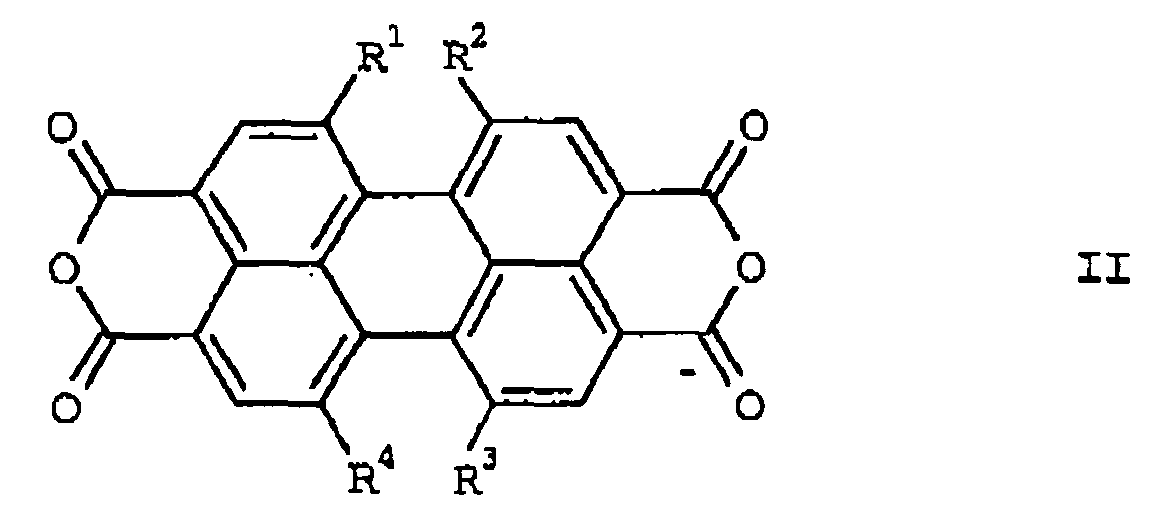
- Verfahren zur Herstellung von Perylen-3,4:9,10-tetracarbonsäurediimiden der Formel I gemäß den Ansprüchen 1 bis 3, dadurch gekennzeichnet, daß man ein Perylen-3,4:9,10-tetracarbonsäuredianhydrid der allgemeinen Formel II

- Verfahren zur Herstellung von Perylen-3,4:9,10-tetracarbonsäurediimiden der allgemeinen Formel Ia


H-Ar IV
umsetzt. - Verfahren zur Herstellung von Perylen-3,4:9,10-tetracarbonsäurediimiden der allgemeinen Formel Ib


H-Ar IV
umsetzt. - Verwendung von Perylen-3,4:9,10-tetracarbonsäurediimiden der Formel I gemäß den Ansprüchen 1 bis 3 als flüssigkristalline Materialien für elektronische, optoelektronische und photonische Anwendungen.
- Verwendung von Perylen-3,4:9,10-tetracarbonsäurediimiden der Formel I gemäß den Ansprüchen 1 bis 3 zum Einfärben von hochmolekularen organischen und von anorganischen Materialien, als Fluoreszenzfarbstoffe und als Laserfarbstoffe.
- Verwendung von Perlrlen-3,4:9,10-tetracarbonsäurediimiden der Formel I gemäß den Ansprüchen 1 bis 3 als organische Materialien für Solarkollektoren und Elektrolumineszenzanwendungen.
Applications Claiming Priority (3)
| Application Number | Priority Date | Filing Date | Title |
|---|---|---|---|
| DE10039232A DE10039232A1 (de) | 2000-08-11 | 2000-08-11 | Flüssigkristalline Perylen-3,4:9,10-tetracarbonsäurediimide |
| DE10039232 | 2000-08-11 | ||
| PCT/EP2001/008524 WO2002014318A1 (de) | 2000-08-11 | 2001-07-24 | Flüssigkristalline perylen-3,4:9,10-tetracarbonsäurediimide |
Publications (2)
| Publication Number | Publication Date |
|---|---|
| EP1313735A1 EP1313735A1 (de) | 2003-05-28 |
| EP1313735B1 true EP1313735B1 (de) | 2008-04-23 |
Family
ID=7652091
Family Applications (1)
| Application Number | Title | Priority Date | Filing Date |
|---|---|---|---|
| EP01969490A Expired - Lifetime EP1313735B1 (de) | 2000-08-11 | 2001-07-24 | Flüssigkristalline perylen-3,4:9,10-tetracarbonsäurediimide |
Country Status (8)
| Country | Link |
|---|---|
| US (1) | US6806368B2 (de) |
| EP (1) | EP1313735B1 (de) |
| JP (1) | JP2004506635A (de) |
| KR (1) | KR100845197B1 (de) |
| CN (1) | CN1239503C (de) |
| AU (1) | AU2001289734A1 (de) |
| DE (2) | DE10039232A1 (de) |
| WO (1) | WO2002014318A1 (de) |
Families Citing this family (51)
| Publication number | Priority date | Publication date | Assignee | Title |
|---|---|---|---|---|
| WO2000079617A1 (en) * | 1999-06-21 | 2000-12-28 | Cambridge University Technical Services Limited | Aligned polymers for an organic tft |
| JP4678983B2 (ja) * | 2001-05-14 | 2011-04-27 | 三井化学株式会社 | 有機電界発光素子 |
| DE10218618A1 (de) * | 2002-04-25 | 2003-11-06 | Basf Ag | Verfahren zur Herstellung von Perylen-3,4:9,10-tetracarbonsäuredimiden und Perylen-3,4:9,10-tetracarbonsäuredianhydrid sowie von Naphthalin-1,8-dicarbonsäureimiden |
| DE10225595A1 (de) * | 2002-06-07 | 2003-12-18 | Basf Ag | 1,6,9,14-Tetrasubstituierte Terrylentetracarbonsäurediimide |
| DE10226181A1 (de) * | 2002-06-12 | 2003-12-24 | Basf Ag | Verfahren zur Überführung von Perylen-3,4:9,10-tetracarbonsäurediimide in eine für die Anwendung als Fluoreszenzfarbmittel geeignete Form |
| GB0312067D0 (en) * | 2003-05-24 | 2003-07-02 | Avecia Ltd | Inks |
| KR101148868B1 (ko) * | 2004-01-26 | 2012-05-29 | 노오쓰웨스턴 유니버시티 | 페릴렌 n-형 반도체 및 관련된 소자 |
| DE102004018547A1 (de) * | 2004-04-14 | 2005-02-03 | Basf Ag | Verfahren zum Schweißverbinden von Kunststoffteilen mit Hilfe von Laserstrahlung |
| DE102005018241A1 (de) * | 2005-04-19 | 2006-10-26 | Basf Ag | Hexarylen- und Pentarylentetracarbonsäurediimide |
| CN1315829C (zh) * | 2005-05-10 | 2007-05-16 | 山东师范大学 | 1,7-二取代-3,4∶9,10-苝双二酰亚胺的合成方法 |
| CN100340558C (zh) * | 2005-10-17 | 2007-10-03 | 东南大学 | N,n'-二吡啶基-3,4,9,10-苝四甲酰二亚胺衍生物及其合成方法 |
| DE102005053995A1 (de) * | 2005-11-10 | 2007-05-24 | Basf Ag | Verwendung von Rylenderivaten als Photosensibilisatoren in Solarzellen |
| WO2007093643A1 (de) | 2006-02-17 | 2007-08-23 | Basf Se | Fluorierte rylentetracarbonsäurederivate und deren verwendung |
| EP1843407A1 (de) * | 2006-04-07 | 2007-10-10 | Basf Aktiengesellschaft | Flüssig-kristalline Rylentetracarbonsäurederivate und deren Verwendung |
| US20070259475A1 (en) * | 2006-05-04 | 2007-11-08 | Basf Aktiengesellschaft | Method for producing organic field-effect transistors |
| EP2022105B1 (de) | 2006-05-04 | 2011-08-10 | Basf Se | Verfahren zum herstellen organischer feldeffekttransistoren |
| US7569693B2 (en) * | 2006-06-12 | 2009-08-04 | Northwestern University | Naphthalene-based semiconductor materials and methods of preparing and use thereof |
| US20080054258A1 (en) * | 2006-08-11 | 2008-03-06 | Basf Aktiengesellschaft | Use of perylene diimide derivatives as air-stable n-channel organic semiconductors |
| WO2008051552A2 (en) * | 2006-10-25 | 2008-05-02 | Northwestern University | Organic semiconductor materials and methods of preparing and use thereof |
| JP5380296B2 (ja) * | 2006-11-17 | 2014-01-08 | ポリエラ コーポレイション | ジイミド系半導体材料ならびにジイミド系半導体材料を調製および使用する方法 |
| US7892454B2 (en) * | 2006-11-17 | 2011-02-22 | Polyera Corporation | Acene-based organic semiconductor materials and methods of preparing and using the same |
| EP2993197A1 (de) * | 2006-11-29 | 2016-03-09 | Sun Chemical Corporation | Phthalocyaninfarbstoffe und deren verwendung als fluoreszierende sicherheitsmarkierungsmittel |
| JP2010515684A (ja) * | 2007-01-08 | 2010-05-13 | ポリエラ コーポレイション | アレーン−ビス(ジカルボキシイミド)系半導体材料、およびそれを調製するための関連する中間体を調製する方法 |
| US8022214B2 (en) * | 2007-01-24 | 2011-09-20 | Polyera Corporation | Organic semiconductor materials and precursors thereof |
| CN102007198B (zh) * | 2008-03-07 | 2014-11-26 | 日东电工株式会社 | 溶致发色团化合物、液晶体系和光学各向异性膜 |
| US9701784B2 (en) | 2008-03-26 | 2017-07-11 | Yeda Research And Development Co. Ltd. | Supramolecular polymers derived from perylene-diimides |
| US8968886B2 (en) | 2008-03-26 | 2015-03-03 | Yeda Research And Development Co., Ltd. | Doubly reduced perylene-diimides and supramolecular polymers derived from perylene-diimides |
| KR101040729B1 (ko) | 2008-05-22 | 2011-06-13 | 서울대학교산학협력단 | 페릴렌 단위를 포함하는 수용성 적색염료 화합물, 그제조방법, 이를 포함한 잉크 조성물 및 컬러필터 |
| US8314325B2 (en) * | 2008-08-19 | 2012-11-20 | Sabic Innovative Plastics Ip B.V. | Luminescent solar collector |
| US8304647B2 (en) * | 2008-08-19 | 2012-11-06 | Sabic Innovative Plastics Ip B.V. | Luminescent solar collector |
| US8304645B2 (en) * | 2008-08-19 | 2012-11-06 | Sabic Innovative Plastics Ip B.V. | Luminescent solar collector |
| US8299354B2 (en) * | 2008-08-19 | 2012-10-30 | Sabic Innovative Plastics Ip B.V. | Luminescent solar collector |
| KR101012542B1 (ko) * | 2008-12-12 | 2011-02-07 | 재단법인대구경북과학기술원 | 고분자 화합물 및 그를 포함하는 태양전지 |
| US8486708B2 (en) | 2009-01-30 | 2013-07-16 | University Of Utah Research Foundation | Perylene nanofiber fluorescent sensor for highly sensitive and selective sensing of amines |
| WO2010099214A1 (en) * | 2009-02-27 | 2010-09-02 | Nitto Denko Corporation | Lyotropic chromophoric compounds, liquid crystal systems and optically anisotropic films |
| WO2011022141A1 (en) * | 2009-08-20 | 2011-02-24 | Nitto Denko Corporation | Method of synthesizing core-expanded perylene diimide dye and novel core-expanded perylene diimide dye |
| US8889420B2 (en) | 2009-12-23 | 2014-11-18 | University Of Utah Research Foundation | Photoconductive sensor materials for detection of explosive vapor |
| US8283469B2 (en) * | 2010-03-24 | 2012-10-09 | National Tsing Hua University | Perylene diimide derivative and organic semiconductor element using the same material |
| EP2608874A1 (de) | 2010-08-27 | 2013-07-03 | Yeda Research and Development Co. Ltd. | Trennung von nanopartikeln |
| US9623381B2 (en) | 2010-08-27 | 2017-04-18 | Yeda Research And Development Co. Ltd. | Separation of nanoparticles |
| CN103080116B (zh) * | 2010-09-10 | 2015-10-21 | 海洋王照明科技股份有限公司 | 一类苝四羧酸二酰亚胺有机半导体材料及其制备方法和应用 |
| WO2012094409A2 (en) | 2011-01-05 | 2012-07-12 | Nitto Denko Corporation | Wavelength conversion perylene diester chromophores and luminescent films |
| KR101844880B1 (ko) | 2011-09-26 | 2018-04-03 | 닛토덴코 가부시키가이샤 | 증대된 태양에너지 수확 효율을 위한 높은 형광 및 광-안정한 발색단 |
| JP2013084952A (ja) | 2011-10-05 | 2013-05-09 | Nitto Denko Corp | 太陽光捕集効率を向上させるための、感圧接着剤層を含む波長変換膜 |
| CN105461628B (zh) * | 2014-07-07 | 2020-05-15 | 江苏和成新材料有限公司 | 苯并菲-苝单酰亚胺二甲酸酯二元化合物及其制备方法及应用 |
| KR101992009B1 (ko) * | 2017-02-03 | 2019-06-21 | 동우 화인켐 주식회사 | 자발광 감광성 수지 조성물, 이를 이용한 색변환층을 포함하는 컬러필터 및 화상표시장치 |
| CN109096790B (zh) * | 2018-10-18 | 2020-11-24 | 西南科技大学 | 一种苝红染料苝红620的合成方法 |
| CN110003207A (zh) * | 2019-03-04 | 2019-07-12 | 天津大学 | 一类湾位苯氧基取代的苝酰亚胺荧光染料及其制备方法 |
| CN111909150B (zh) * | 2020-06-05 | 2022-05-10 | 北京文海阳工贸有限责任公司 | 一种近红外荧光染料及其在制备化学近红外辐射剂中的应用 |
| KR102401913B1 (ko) * | 2021-06-11 | 2022-05-25 | 최돈수 | 유기 전기 발광 소자용 발광 재료, 이를 이용한 유기 전기 발광 소자 및 유기 전기 발광 소자용 재료 |
| CN116606293A (zh) * | 2023-04-03 | 2023-08-18 | 中国船舶集团有限公司第七一八研究所 | 一种基于苝酰亚胺结构的化合物及其制备方法和应用 |
Family Cites Families (9)
| Publication number | Priority date | Publication date | Assignee | Title |
|---|---|---|---|---|
| US3294778A (en) | 1964-09-14 | 1966-12-27 | Gen Aniline & Film Corp | Fiber-reactive dyestuffs |
| US3554776A (en) * | 1967-11-24 | 1971-01-12 | Allied Chem | Novel perylenetetracarboxylic diimide compositions |
| DE3016764A1 (de) * | 1980-04-30 | 1981-11-05 | Heinz Dr. 5880 Lüdenscheid Langhals | Verfahren zur erhoehung der loeslichkeit aromatischer systeme |
| US4378302A (en) | 1980-12-16 | 1983-03-29 | General Electric Company | Red perylene dichroic dye containing liquid crystal formulations |
| DE3110955A1 (de) | 1981-03-20 | 1982-09-30 | Basf Ag, 6700 Ludwigshafen | Elektrophotographisches aufzeichnungsmaterial |
| DE3934329A1 (de) | 1989-10-13 | 1991-04-18 | Basf Ag | Polymerisierbare perylen-3,4,9,10-tetracarbonsaeurebisimide sowie deren polymerisate |
| EP0697027B1 (de) | 1993-05-04 | 1997-07-02 | Max-Planck-Gesellschaft zur Förderung der Wissenschaften e.V. | Tetraaroxyperylen-3,4,9,10-tetracarbonsäurepolyimide |
| DE19547209A1 (de) | 1995-12-18 | 1997-06-19 | Basf Ag | 1,7-Diaroxy-oder -arylthiosubstituierte Perylen-3,4,9,10-tetracarbonsäuren, deren Dianhydride und Diimide |
| DE19620746A1 (de) | 1996-05-23 | 1997-11-27 | Hoechst Ag | Farbige Monomere enthaltende chirale cLCPs |
-
2000
- 2000-08-11 DE DE10039232A patent/DE10039232A1/de not_active Withdrawn
-
2001
- 2001-07-24 JP JP2002519458A patent/JP2004506635A/ja not_active Withdrawn
- 2001-07-24 KR KR1020037001749A patent/KR100845197B1/ko not_active Expired - Fee Related
- 2001-07-24 CN CNB018140475A patent/CN1239503C/zh not_active Expired - Fee Related
- 2001-07-24 AU AU2001289734A patent/AU2001289734A1/en not_active Abandoned
- 2001-07-24 US US10/344,368 patent/US6806368B2/en not_active Expired - Fee Related
- 2001-07-24 EP EP01969490A patent/EP1313735B1/de not_active Expired - Lifetime
- 2001-07-24 WO PCT/EP2001/008524 patent/WO2002014318A1/de not_active Ceased
- 2001-07-24 DE DE50113895T patent/DE50113895D1/de not_active Expired - Lifetime
Also Published As
| Publication number | Publication date |
|---|---|
| KR100845197B1 (ko) | 2008-07-10 |
| DE50113895D1 (de) | 2008-06-05 |
| CN1446219A (zh) | 2003-10-01 |
| KR20030020448A (ko) | 2003-03-08 |
| US20030181721A1 (en) | 2003-09-25 |
| CN1239503C (zh) | 2006-02-01 |
| US6806368B2 (en) | 2004-10-19 |
| JP2004506635A (ja) | 2004-03-04 |
| WO2002014318A1 (de) | 2002-02-21 |
| WO2002014318A8 (de) | 2002-06-27 |
| AU2001289734A1 (en) | 2002-02-25 |
| DE10039232A1 (de) | 2002-02-21 |
| EP1313735A1 (de) | 2003-05-28 |
Similar Documents
| Publication | Publication Date | Title |
|---|---|---|
| US6806368B2 (en) | Liquid crystalline 3,4:9,10-perylenetetacarbocylic acid diimides | |
| US6143905A (en) | 1,7-diaroxy- or 1,7-arylthio-substituted perylene-3,4,9,10-tetracarboxylic acids, their dianhydrides and diimides | |
| US6063181A (en) | 1,7-disubstituted perylene-3,4,9, 10-tetracarboxylic acids, their dianhydrides and diimides of said acids | |
| EP0804507B1 (de) | Substituierte quaterrylentetracarbonsäurediimide | |
| EP1904497B1 (de) | Substituierte rylenderivate | |
| EP0804508B1 (de) | Verfahren zur herstellung und reinigung von perylen-3,4-dicarbonsäureimiden | |
| DE10148172B4 (de) | Fluoreszierende Naphthalin-1,4,5,8-tetracarbonsäurebisimide mit elektronenschiebendem Substituenten am Kern | |
| EP1206456B1 (de) | Thermochrome rylenfarbstoffe | |
| EP1373214B1 (de) | Rylenderivate und deren verwendung als farbstoffe | |
| EP1532210A1 (de) | Rylenfarbstoffe | |
| EP1802622A1 (de) | Halogenierung von rylencarbonsäureureimiden mit elementarem halogen in einem zweiphasengemisch bestehend aus organischem lösungsmittel und wasser, wobei der sich bildende halogenwasserstoff dem organischen lösungsmittel kontinuierlich entzogen wird | |
| EP1917311B1 (de) | Mehrfachchromophore auf rylenbasis | |
| WO1995030679A1 (de) | Oligothiophene |
Legal Events
| Date | Code | Title | Description |
|---|---|---|---|
| PUAI | Public reference made under article 153(3) epc to a published international application that has entered the european phase |
Free format text: ORIGINAL CODE: 0009012 |
|
| 17P | Request for examination filed |
Effective date: 20030311 |
|
| AK | Designated contracting states |
Designated state(s): AT BE CH CY DE DK ES FI FR GB GR IE IT LI LU MC NL PT SE TR |
|
| AX | Request for extension of the european patent |
Extension state: AL LT LV MK RO SI |
|
| RBV | Designated contracting states (corrected) |
Designated state(s): DE FR GB IT |
|
| 17Q | First examination report despatched |
Effective date: 20070321 |
|
| GRAP | Despatch of communication of intention to grant a patent |
Free format text: ORIGINAL CODE: EPIDOSNIGR1 |
|
| RAP1 | Party data changed (applicant data changed or rights of an application transferred) |
Owner name: BASF SE |
|
| GRAS | Grant fee paid |
Free format text: ORIGINAL CODE: EPIDOSNIGR3 |
|
| GRAA | (expected) grant |
Free format text: ORIGINAL CODE: 0009210 |
|
| AK | Designated contracting states |
Kind code of ref document: B1 Designated state(s): DE FR GB IT |
|
| REG | Reference to a national code |
Ref country code: GB Ref legal event code: FG4D Free format text: NOT ENGLISH |
|
| REF | Corresponds to: |
Ref document number: 50113895 Country of ref document: DE Date of ref document: 20080605 Kind code of ref document: P |
|
| ET | Fr: translation filed | ||
| PLBE | No opposition filed within time limit |
Free format text: ORIGINAL CODE: 0009261 |
|
| STAA | Information on the status of an ep patent application or granted ep patent |
Free format text: STATUS: NO OPPOSITION FILED WITHIN TIME LIMIT |
|
| GBPC | Gb: european patent ceased through non-payment of renewal fee |
Effective date: 20080724 |
|
| 26N | No opposition filed |
Effective date: 20090126 |
|
| PG25 | Lapsed in a contracting state [announced via postgrant information from national office to epo] |
Ref country code: GB Free format text: LAPSE BECAUSE OF NON-PAYMENT OF DUE FEES Effective date: 20080724 |
|
| PG25 | Lapsed in a contracting state [announced via postgrant information from national office to epo] |
Ref country code: IT Free format text: LAPSE BECAUSE OF FAILURE TO SUBMIT A TRANSLATION OF THE DESCRIPTION OR TO PAY THE FEE WITHIN THE PRESCRIBED TIME-LIMIT Effective date: 20080423 |
|
| PGFP | Annual fee paid to national office [announced via postgrant information from national office to epo] |
Ref country code: FR Payment date: 20090710 Year of fee payment: 9 |
|
| PGFP | Annual fee paid to national office [announced via postgrant information from national office to epo] |
Ref country code: DE Payment date: 20100930 Year of fee payment: 10 |
|
| REG | Reference to a national code |
Ref country code: FR Ref legal event code: ST Effective date: 20110331 |
|
| PG25 | Lapsed in a contracting state [announced via postgrant information from national office to epo] |
Ref country code: FR Free format text: LAPSE BECAUSE OF NON-PAYMENT OF DUE FEES Effective date: 20100802 |
|
| PG25 | Lapsed in a contracting state [announced via postgrant information from national office to epo] |
Ref country code: DE Free format text: LAPSE BECAUSE OF NON-PAYMENT OF DUE FEES Effective date: 20120201 |
|
| REG | Reference to a national code |
Ref country code: DE Ref legal event code: R119 Ref document number: 50113895 Country of ref document: DE Effective date: 20120201 |