EP1312623A1 - Pressure pipes - Google Patents
Pressure pipes Download PDFInfo
- Publication number
- EP1312623A1 EP1312623A1 EP01127005A EP01127005A EP1312623A1 EP 1312623 A1 EP1312623 A1 EP 1312623A1 EP 01127005 A EP01127005 A EP 01127005A EP 01127005 A EP01127005 A EP 01127005A EP 1312623 A1 EP1312623 A1 EP 1312623A1
- Authority
- EP
- European Patent Office
- Prior art keywords
- propylene
- propylene copolymer
- ethylene
- comprised
- copolymer
- Prior art date
- Legal status (The legal status is an assumption and is not a legal conclusion. Google has not performed a legal analysis and makes no representation as to the accuracy of the status listed.)
- Withdrawn
Links
- 229920001577 copolymer Polymers 0.000 claims abstract description 59
- 239000000203 mixture Substances 0.000 claims abstract description 47
- -1 polypropylene Polymers 0.000 claims abstract description 34
- 229920001155 polypropylene Polymers 0.000 claims abstract description 32
- 239000004743 Polypropylene Substances 0.000 claims abstract description 31
- 238000012986 modification Methods 0.000 claims abstract description 13
- 230000007774 longterm Effects 0.000 claims abstract description 10
- QQONPFPTGQHPMA-UHFFFAOYSA-N propylene Natural products CC=C QQONPFPTGQHPMA-UHFFFAOYSA-N 0.000 claims description 77
- VXNZUUAINFGPBY-UHFFFAOYSA-N 1-Butene Chemical compound CCC=C VXNZUUAINFGPBY-UHFFFAOYSA-N 0.000 claims description 43
- 229920000642 polymer Polymers 0.000 claims description 25
- VGGSQFUCUMXWEO-UHFFFAOYSA-N Ethene Chemical compound C=C VGGSQFUCUMXWEO-UHFFFAOYSA-N 0.000 claims description 23
- 125000004805 propylene group Chemical group [H]C([H])([H])C([H])([*:1])C([H])([H])[*:2] 0.000 claims description 23
- 238000012360 testing method Methods 0.000 claims description 23
- 239000005977 Ethylene Substances 0.000 claims description 19
- 239000002667 nucleating agent Substances 0.000 claims description 17
- 239000004711 α-olefin Substances 0.000 claims description 11
- 238000004519 manufacturing process Methods 0.000 claims description 10
- 229920005606 polypropylene copolymer Polymers 0.000 claims description 9
- NRCMAYZCPIVABH-UHFFFAOYSA-N Quinacridone Chemical compound N1C2=CC=CC=C2C(=O)C2=C1C=C1C(=O)C3=CC=CC=C3NC1=C2 NRCMAYZCPIVABH-UHFFFAOYSA-N 0.000 claims description 6
- 229910052751 metal Inorganic materials 0.000 claims description 6
- 239000002184 metal Substances 0.000 claims description 6
- KSLLMGLKCVSKFF-UHFFFAOYSA-N 5,12-dihydroquinolino[2,3-b]acridine-6,7,13,14-tetrone Chemical compound N1C2=CC=CC=C2C(=O)C2=C1C(=O)C(C(=O)C1=CC=CC=C1N1)=C1C2=O KSLLMGLKCVSKFF-UHFFFAOYSA-N 0.000 claims description 5
- 150000002739 metals Chemical class 0.000 claims description 5
- 230000000737 periodic effect Effects 0.000 claims description 5
- IAQRGUVFOMOMEM-UHFFFAOYSA-N butene Natural products CC=CC IAQRGUVFOMOMEM-UHFFFAOYSA-N 0.000 claims description 4
- 150000003839 salts Chemical class 0.000 claims description 4
- 239000013078 crystal Substances 0.000 claims description 3
- 150000001991 dicarboxylic acids Chemical class 0.000 claims description 3
- 125000004432 carbon atom Chemical group C* 0.000 claims description 2
- 239000000178 monomer Substances 0.000 description 27
- 239000003054 catalyst Substances 0.000 description 22
- 238000006116 polymerization reaction Methods 0.000 description 18
- 239000011347 resin Substances 0.000 description 18
- 229920005989 resin Polymers 0.000 description 18
- 150000001875 compounds Chemical class 0.000 description 14
- 238000000034 method Methods 0.000 description 14
- 229920001897 terpolymer Polymers 0.000 description 13
- VOITXYVAKOUIBA-UHFFFAOYSA-N triethylaluminium Chemical compound CC[Al](CC)CC VOITXYVAKOUIBA-UHFFFAOYSA-N 0.000 description 13
- XLYOFNOQVPJJNP-UHFFFAOYSA-N water Substances O XLYOFNOQVPJJNP-UHFFFAOYSA-N 0.000 description 13
- UFHFLCQGNIYNRP-UHFFFAOYSA-N Hydrogen Chemical compound [H][H] UFHFLCQGNIYNRP-UHFFFAOYSA-N 0.000 description 12
- 238000001816 cooling Methods 0.000 description 12
- 239000007788 liquid Substances 0.000 description 11
- 230000000052 comparative effect Effects 0.000 description 10
- 229910052739 hydrogen Inorganic materials 0.000 description 9
- 239000001257 hydrogen Substances 0.000 description 9
- 238000013329 compounding Methods 0.000 description 8
- 239000000049 pigment Substances 0.000 description 8
- 239000004594 Masterbatch (MB) Substances 0.000 description 7
- JKIJEFPNVSHHEI-UHFFFAOYSA-N Phenol, 2,4-bis(1,1-dimethylethyl)-, phosphite (3:1) Chemical compound CC(C)(C)C1=CC(C(C)(C)C)=CC=C1OP(OC=1C(=CC(=CC=1)C(C)(C)C)C(C)(C)C)OC1=CC=C(C(C)(C)C)C=C1C(C)(C)C JKIJEFPNVSHHEI-UHFFFAOYSA-N 0.000 description 7
- CJZGTCYPCWQAJB-UHFFFAOYSA-L calcium stearate Chemical compound [Ca+2].CCCCCCCCCCCCCCCCCC([O-])=O.CCCCCCCCCCCCCCCCCC([O-])=O CJZGTCYPCWQAJB-UHFFFAOYSA-L 0.000 description 7
- 229940078456 calcium stearate Drugs 0.000 description 7
- 235000013539 calcium stearate Nutrition 0.000 description 7
- 239000008116 calcium stearate Substances 0.000 description 7
- SJJCABYOVIHNPZ-UHFFFAOYSA-N cyclohexyl-dimethoxy-methylsilane Chemical compound CO[Si](C)(OC)C1CCCCC1 SJJCABYOVIHNPZ-UHFFFAOYSA-N 0.000 description 7
- 238000013213 extrapolation Methods 0.000 description 7
- 239000000843 powder Substances 0.000 description 7
- 239000000047 product Substances 0.000 description 7
- TWRXJAOTZQYOKJ-UHFFFAOYSA-L Magnesium chloride Chemical compound [Mg+2].[Cl-].[Cl-] TWRXJAOTZQYOKJ-UHFFFAOYSA-L 0.000 description 6
- JVQXFLGVYCKJMV-UHFFFAOYSA-N [3-hydroxy-2,2-bis(hydroxymethyl)propyl] 2,2,3,3-tetrakis(3,5-ditert-butyl-4-hydroxyphenyl)propanoate Chemical compound CC(C)(C)C1=C(O)C(C(C)(C)C)=CC(C(C=2C=C(C(O)=C(C=2)C(C)(C)C)C(C)(C)C)C(C(=O)OCC(CO)(CO)CO)(C=2C=C(C(O)=C(C=2)C(C)(C)C)C(C)(C)C)C=2C=C(C(O)=C(C=2)C(C)(C)C)C(C)(C)C)=C1 JVQXFLGVYCKJMV-UHFFFAOYSA-N 0.000 description 6
- 238000010586 diagram Methods 0.000 description 6
- 238000009826 distribution Methods 0.000 description 6
- 239000000155 melt Substances 0.000 description 5
- CTQNGGLPUBDAKN-UHFFFAOYSA-N O-Xylene Chemical compound CC1=CC=CC=C1C CTQNGGLPUBDAKN-UHFFFAOYSA-N 0.000 description 4
- USYJXNNLQOTDLW-UHFFFAOYSA-L calcium;heptanedioate Chemical compound [Ca+2].[O-]C(=O)CCCCCC([O-])=O USYJXNNLQOTDLW-UHFFFAOYSA-L 0.000 description 4
- 238000000113 differential scanning calorimetry Methods 0.000 description 4
- 238000012545 processing Methods 0.000 description 4
- LVTJOONKWUXEFR-FZRMHRINSA-N protoneodioscin Natural products O(C[C@@H](CC[C@]1(O)[C@H](C)[C@@H]2[C@]3(C)[C@H]([C@H]4[C@@H]([C@]5(C)C(=CC4)C[C@@H](O[C@@H]4[C@H](O[C@H]6[C@@H](O)[C@@H](O)[C@@H](O)[C@H](C)O6)[C@@H](O)[C@H](O[C@H]6[C@@H](O)[C@@H](O)[C@@H](O)[C@H](C)O6)[C@H](CO)O4)CC5)CC3)C[C@@H]2O1)C)[C@H]1[C@H](O)[C@H](O)[C@H](O)[C@@H](CO)O1 LVTJOONKWUXEFR-FZRMHRINSA-N 0.000 description 4
- 239000000126 substance Substances 0.000 description 4
- 239000008096 xylene Substances 0.000 description 4
- 125000006313 (C5-C8) alkyl group Chemical group 0.000 description 3
- GWEVSGVZZGPLCZ-UHFFFAOYSA-N Titan oxide Chemical compound O=[Ti]=O GWEVSGVZZGPLCZ-UHFFFAOYSA-N 0.000 description 3
- 238000004364 calculation method Methods 0.000 description 3
- 238000007872 degassing Methods 0.000 description 3
- 150000001470 diamides Chemical class 0.000 description 3
- 230000008020 evaporation Effects 0.000 description 3
- 238000001704 evaporation Methods 0.000 description 3
- 239000012530 fluid Substances 0.000 description 3
- 239000007789 gas Substances 0.000 description 3
- 238000004817 gas chromatography Methods 0.000 description 3
- 229910001629 magnesium chloride Inorganic materials 0.000 description 3
- 239000012071 phase Substances 0.000 description 3
- 230000002035 prolonged effect Effects 0.000 description 3
- 239000000725 suspension Substances 0.000 description 3
- 125000004400 (C1-C12) alkyl group Chemical group 0.000 description 2
- LIKMAJRDDDTEIG-UHFFFAOYSA-N 1-hexene Chemical compound CCCCC=C LIKMAJRDDDTEIG-UHFFFAOYSA-N 0.000 description 2
- KWKAKUADMBZCLK-UHFFFAOYSA-N 1-octene Chemical compound CCCCCCC=C KWKAKUADMBZCLK-UHFFFAOYSA-N 0.000 description 2
- WSSSPWUEQFSQQG-UHFFFAOYSA-N 4-methyl-1-pentene Chemical compound CC(C)CC=C WSSSPWUEQFSQQG-UHFFFAOYSA-N 0.000 description 2
- YEIYQKSCDPOVNO-UHFFFAOYSA-N 5,8,9,12-tetrahydroquinolino[2,3-b]acridine-7,14-dione Chemical class N1C2=CC=CC=C2C(=O)C(C=C2N3)=C1C=C2C(=O)C1=C3C=CCC1 YEIYQKSCDPOVNO-UHFFFAOYSA-N 0.000 description 2
- VTYYLEPIZMXCLO-UHFFFAOYSA-L Calcium carbonate Chemical compound [Ca+2].[O-]C([O-])=O VTYYLEPIZMXCLO-UHFFFAOYSA-L 0.000 description 2
- LFQSCWFLJHTTHZ-UHFFFAOYSA-N Ethanol Chemical compound CCO LFQSCWFLJHTTHZ-UHFFFAOYSA-N 0.000 description 2
- 230000002902 bimodal effect Effects 0.000 description 2
- IYYGCUZHHGZXGJ-UHFFFAOYSA-N but-1-ene;ethene;prop-1-ene Chemical compound C=C.CC=C.CCC=C IYYGCUZHHGZXGJ-UHFFFAOYSA-N 0.000 description 2
- 150000001990 dicarboxylic acid derivatives Chemical class 0.000 description 2
- 230000002349 favourable effect Effects 0.000 description 2
- 239000012467 final product Substances 0.000 description 2
- 238000010438 heat treatment Methods 0.000 description 2
- 229920001519 homopolymer Polymers 0.000 description 2
- 238000002347 injection Methods 0.000 description 2
- 239000007924 injection Substances 0.000 description 2
- 239000010410 layer Substances 0.000 description 2
- 238000005259 measurement Methods 0.000 description 2
- VNWKTOKETHGBQD-UHFFFAOYSA-N methane Chemical compound C VNWKTOKETHGBQD-UHFFFAOYSA-N 0.000 description 2
- YWAKXRMUMFPDSH-UHFFFAOYSA-N pentene Chemical compound CCCC=C YWAKXRMUMFPDSH-UHFFFAOYSA-N 0.000 description 2
- WLJVNTCWHIRURA-UHFFFAOYSA-N pimelic acid Chemical compound OC(=O)CCCCCC(O)=O WLJVNTCWHIRURA-UHFFFAOYSA-N 0.000 description 2
- 239000002861 polymer material Substances 0.000 description 2
- 239000000243 solution Substances 0.000 description 2
- YQYHOORHLHSQNF-UHFFFAOYSA-N 1-n,1-n'-dicyclohexyl-4-phenylcyclohexa-2,4-diene-1,1-dicarboxamide Chemical compound C1C=C(C=2C=CC=CC=2)C=CC1(C(=O)NC1CCCCC1)C(=O)NC1CCCCC1 YQYHOORHLHSQNF-UHFFFAOYSA-N 0.000 description 1
- FFNHCLMWSCRBCH-UHFFFAOYSA-N 1-n,1-n'-dicyclopentyl-4-phenylcyclohexa-2,4-diene-1,1-dicarboxamide Chemical compound C1C=C(C=2C=CC=CC=2)C=CC1(C(=O)NC1CCCC1)C(=O)NC1CCCC1 FFNHCLMWSCRBCH-UHFFFAOYSA-N 0.000 description 1
- QPQNATKKIIGERS-UHFFFAOYSA-N 1-n,3-n-dicyclohexylcyclopentane-1,3-dicarboxamide Chemical compound C1CC(C(=O)NC2CCCCC2)CC1C(=O)NC1CCCCC1 QPQNATKKIIGERS-UHFFFAOYSA-N 0.000 description 1
- BVXGBMBOZMRULW-UHFFFAOYSA-N 1-n,4-n-dicyclohexylbenzene-1,4-dicarboxamide Chemical compound C=1C=C(C(=O)NC2CCCCC2)C=CC=1C(=O)NC1CCCCC1 BVXGBMBOZMRULW-UHFFFAOYSA-N 0.000 description 1
- NZEOICMEPDOJKB-UHFFFAOYSA-N 1-n,4-n-dicyclohexylcyclohexane-1,4-dicarboxamide Chemical compound C1CC(C(=O)NC2CCCCC2)CCC1C(=O)NC1CCCCC1 NZEOICMEPDOJKB-UHFFFAOYSA-N 0.000 description 1
- QBJIQCVBXZDRSG-UHFFFAOYSA-N 1-n,4-n-dicyclopentylbenzene-1,4-dicarboxamide Chemical compound C=1C=C(C(=O)NC2CCCC2)C=CC=1C(=O)NC1CCCC1 QBJIQCVBXZDRSG-UHFFFAOYSA-N 0.000 description 1
- WQINSVOOIJDOLJ-UHFFFAOYSA-N 2-(1,3-dioxoisoindol-2-yl)acetic acid Chemical class C1=CC=C2C(=O)N(CC(=O)O)C(=O)C2=C1 WQINSVOOIJDOLJ-UHFFFAOYSA-N 0.000 description 1
- OZWUITKBAWTEAQ-UHFFFAOYSA-N 2-(1,3-dioxoisoindol-2-yl)propanoic acid Chemical class C1=CC=C2C(=O)N(C(C)C(O)=O)C(=O)C2=C1 OZWUITKBAWTEAQ-UHFFFAOYSA-N 0.000 description 1
- BLWYDFRIJMZNIA-UHFFFAOYSA-N 2-(carboxymethylcarbamoyl)-5-methylbenzoic acid Chemical class CC=1C=C(C(C(=O)NCC(=O)O)=CC=1)C(=O)O BLWYDFRIJMZNIA-UHFFFAOYSA-N 0.000 description 1
- HNVHGFRSJMKRDN-UHFFFAOYSA-N 2-(carboxymethylcarbamoyl)cyclohexane-1-carboxylic acid Chemical class OC(=O)CNC(=O)C1CCCCC1C(O)=O HNVHGFRSJMKRDN-UHFFFAOYSA-N 0.000 description 1
- IWUJLUPWTMGHPJ-UHFFFAOYSA-N 2-n,6-n-di(cyclooctyl)naphthalene-2,6-dicarboxamide Chemical compound C=1C=C2C=C(C(=O)NC3CCCCCCC3)C=CC2=CC=1C(=O)NC1CCCCCCC1 IWUJLUPWTMGHPJ-UHFFFAOYSA-N 0.000 description 1
- MBSRTKPGZKQXQR-UHFFFAOYSA-N 2-n,6-n-dicyclohexylnaphthalene-2,6-dicarboxamide Chemical compound C=1C=C2C=C(C(=O)NC3CCCCC3)C=CC2=CC=1C(=O)NC1CCCCC1 MBSRTKPGZKQXQR-UHFFFAOYSA-N 0.000 description 1
- FPRSHRPBZCFRSF-UHFFFAOYSA-N 4-(cyclohexanecarbonylamino)-n-cyclohexylbenzamide Chemical compound C1CCCCC1C(=O)NC(C=C1)=CC=C1C(=O)NC1CCCCC1 FPRSHRPBZCFRSF-UHFFFAOYSA-N 0.000 description 1
- OKTJSMMVPCPJKN-UHFFFAOYSA-N Carbon Chemical compound [C] OKTJSMMVPCPJKN-UHFFFAOYSA-N 0.000 description 1
- 239000006057 Non-nutritive feed additive Substances 0.000 description 1
- 239000004698 Polyethylene Substances 0.000 description 1
- XBDQKXXYIPTUBI-UHFFFAOYSA-M Propionate Chemical compound CCC([O-])=O XBDQKXXYIPTUBI-UHFFFAOYSA-M 0.000 description 1
- WGLPBDUCMAPZCE-UHFFFAOYSA-N Trioxochromium Chemical compound O=[Cr](=O)=O WGLPBDUCMAPZCE-UHFFFAOYSA-N 0.000 description 1
- 239000011954 Ziegler–Natta catalyst Substances 0.000 description 1
- 239000002253 acid Substances 0.000 description 1
- 150000007513 acids Chemical class 0.000 description 1
- 239000012790 adhesive layer Substances 0.000 description 1
- 238000007112 amidation reaction Methods 0.000 description 1
- 150000001408 amides Chemical class 0.000 description 1
- 150000003862 amino acid derivatives Chemical class 0.000 description 1
- 239000003963 antioxidant agent Substances 0.000 description 1
- 235000006708 antioxidants Nutrition 0.000 description 1
- 239000002216 antistatic agent Substances 0.000 description 1
- 238000010923 batch production Methods 0.000 description 1
- 229960003563 calcium carbonate Drugs 0.000 description 1
- 235000010216 calcium carbonate Nutrition 0.000 description 1
- 229910000019 calcium carbonate Inorganic materials 0.000 description 1
- 159000000007 calcium salts Chemical class 0.000 description 1
- JILYTPDQRCHWPA-UHFFFAOYSA-L calcium;octanedioate Chemical compound [Ca+2].[O-]C(=O)CCCCCCC([O-])=O JILYTPDQRCHWPA-UHFFFAOYSA-L 0.000 description 1
- 239000006229 carbon black Substances 0.000 description 1
- 125000003178 carboxy group Chemical group [H]OC(*)=O 0.000 description 1
- 239000011651 chromium Substances 0.000 description 1
- 229910000423 chromium oxide Inorganic materials 0.000 description 1
- 238000010276 construction Methods 0.000 description 1
- 238000010924 continuous production Methods 0.000 description 1
- 238000002425 crystallisation Methods 0.000 description 1
- 230000008025 crystallization Effects 0.000 description 1
- 230000003111 delayed effect Effects 0.000 description 1
- 230000001419 dependent effect Effects 0.000 description 1
- 150000004985 diamines Chemical class 0.000 description 1
- JWCYDYZLEAQGJJ-UHFFFAOYSA-N dicyclopentyl(dimethoxy)silane Chemical compound C1CCCC1[Si](OC)(OC)C1CCCC1 JWCYDYZLEAQGJJ-UHFFFAOYSA-N 0.000 description 1
- PWWSSIYVTQUJQQ-UHFFFAOYSA-N distearyl thiodipropionate Chemical compound CCCCCCCCCCCCCCCCCCOC(=O)CCSCCC(=O)OCCCCCCCCCCCCCCCCCC PWWSSIYVTQUJQQ-UHFFFAOYSA-N 0.000 description 1
- 229920001038 ethylene copolymer Polymers 0.000 description 1
- 239000000945 filler Substances 0.000 description 1
- 239000003365 glass fiber Substances 0.000 description 1
- PCHJSUWPFVWCPO-UHFFFAOYSA-N gold Chemical compound [Au] PCHJSUWPFVWCPO-UHFFFAOYSA-N 0.000 description 1
- 239000010931 gold Substances 0.000 description 1
- 229910052737 gold Inorganic materials 0.000 description 1
- 230000001976 improved effect Effects 0.000 description 1
- 230000001939 inductive effect Effects 0.000 description 1
- 239000003701 inert diluent Substances 0.000 description 1
- 238000011835 investigation Methods 0.000 description 1
- 239000007791 liquid phase Substances 0.000 description 1
- 239000000463 material Substances 0.000 description 1
- 238000000691 measurement method Methods 0.000 description 1
- 238000002844 melting Methods 0.000 description 1
- 230000008018 melting Effects 0.000 description 1
- 239000012968 metallocene catalyst Substances 0.000 description 1
- 238000002156 mixing Methods 0.000 description 1
- 230000004048 modification Effects 0.000 description 1
- ABRHLWPJYNIPHN-UHFFFAOYSA-N n-(4-benzamidophenyl)benzamide Chemical compound C=1C=CC=CC=1C(=O)NC(C=C1)=CC=C1NC(=O)C1=CC=CC=C1 ABRHLWPJYNIPHN-UHFFFAOYSA-N 0.000 description 1
- RERAAFUGYWIHFD-UHFFFAOYSA-N n-(5-anilino-5-oxopentyl)benzamide Chemical compound C=1C=CC=CC=1NC(=O)CCCCNC(=O)C1=CC=CC=C1 RERAAFUGYWIHFD-UHFFFAOYSA-N 0.000 description 1
- TVMXDCGIABBOFY-UHFFFAOYSA-N n-Octanol Natural products CCCCCCCC TVMXDCGIABBOFY-UHFFFAOYSA-N 0.000 description 1
- UXMBRQOBONMJIC-UHFFFAOYSA-N n-[4-(cyclohexanecarbonylamino)phenyl]cyclohexanecarboxamide Chemical compound C1CCCCC1C(=O)NC(C=C1)=CC=C1NC(=O)C1CCCCC1 UXMBRQOBONMJIC-UHFFFAOYSA-N 0.000 description 1
- 239000003345 natural gas Substances 0.000 description 1
- 230000000149 penetrating effect Effects 0.000 description 1
- 239000004033 plastic Substances 0.000 description 1
- 229920003023 plastic Polymers 0.000 description 1
- 238000009428 plumbing Methods 0.000 description 1
- 229920000573 polyethylene Polymers 0.000 description 1
- 229920000098 polyolefin Polymers 0.000 description 1
- 229920005630 polypropylene random copolymer Polymers 0.000 description 1
- 238000002360 preparation method Methods 0.000 description 1
- 229920005604 random copolymer Polymers 0.000 description 1
- 238000000611 regression analysis Methods 0.000 description 1
- 239000012744 reinforcing agent Substances 0.000 description 1
- 230000035945 sensitivity Effects 0.000 description 1
- 239000003381 stabilizer Substances 0.000 description 1
- 230000003068 static effect Effects 0.000 description 1
- 230000000707 stereoselective effect Effects 0.000 description 1
- 235000010215 titanium dioxide Nutrition 0.000 description 1
Images
Classifications
-
- F—MECHANICAL ENGINEERING; LIGHTING; HEATING; WEAPONS; BLASTING
- F16—ENGINEERING ELEMENTS AND UNITS; GENERAL MEASURES FOR PRODUCING AND MAINTAINING EFFECTIVE FUNCTIONING OF MACHINES OR INSTALLATIONS; THERMAL INSULATION IN GENERAL
- F16L—PIPES; JOINTS OR FITTINGS FOR PIPES; SUPPORTS FOR PIPES, CABLES OR PROTECTIVE TUBING; MEANS FOR THERMAL INSULATION IN GENERAL
- F16L9/00—Rigid pipes
- F16L9/12—Rigid pipes of plastics with or without reinforcement
- F16L9/127—Rigid pipes of plastics with or without reinforcement the walls consisting of a single layer
-
- C—CHEMISTRY; METALLURGY
- C08—ORGANIC MACROMOLECULAR COMPOUNDS; THEIR PREPARATION OR CHEMICAL WORKING-UP; COMPOSITIONS BASED THEREON
- C08F—MACROMOLECULAR COMPOUNDS OBTAINED BY REACTIONS ONLY INVOLVING CARBON-TO-CARBON UNSATURATED BONDS
- C08F210/00—Copolymers of unsaturated aliphatic hydrocarbons having only one carbon-to-carbon double bond
- C08F210/04—Monomers containing three or four carbon atoms
- C08F210/06—Propene
-
- C—CHEMISTRY; METALLURGY
- C08—ORGANIC MACROMOLECULAR COMPOUNDS; THEIR PREPARATION OR CHEMICAL WORKING-UP; COMPOSITIONS BASED THEREON
- C08F—MACROMOLECULAR COMPOUNDS OBTAINED BY REACTIONS ONLY INVOLVING CARBON-TO-CARBON UNSATURATED BONDS
- C08F210/00—Copolymers of unsaturated aliphatic hydrocarbons having only one carbon-to-carbon double bond
- C08F210/16—Copolymers of ethene with alpha-alkenes, e.g. EP rubbers
-
- F—MECHANICAL ENGINEERING; LIGHTING; HEATING; WEAPONS; BLASTING
- F16—ENGINEERING ELEMENTS AND UNITS; GENERAL MEASURES FOR PRODUCING AND MAINTAINING EFFECTIVE FUNCTIONING OF MACHINES OR INSTALLATIONS; THERMAL INSULATION IN GENERAL
- F16L—PIPES; JOINTS OR FITTINGS FOR PIPES; SUPPORTS FOR PIPES, CABLES OR PROTECTIVE TUBING; MEANS FOR THERMAL INSULATION IN GENERAL
- F16L9/00—Rigid pipes
- F16L9/12—Rigid pipes of plastics with or without reinforcement
-
- Y—GENERAL TAGGING OF NEW TECHNOLOGICAL DEVELOPMENTS; GENERAL TAGGING OF CROSS-SECTIONAL TECHNOLOGIES SPANNING OVER SEVERAL SECTIONS OF THE IPC; TECHNICAL SUBJECTS COVERED BY FORMER USPC CROSS-REFERENCE ART COLLECTIONS [XRACs] AND DIGESTS
- Y10—TECHNICAL SUBJECTS COVERED BY FORMER USPC
- Y10T—TECHNICAL SUBJECTS COVERED BY FORMER US CLASSIFICATION
- Y10T428/00—Stock material or miscellaneous articles
- Y10T428/13—Hollow or container type article [e.g., tube, vase, etc.]
-
- Y—GENERAL TAGGING OF NEW TECHNOLOGICAL DEVELOPMENTS; GENERAL TAGGING OF CROSS-SECTIONAL TECHNOLOGIES SPANNING OVER SEVERAL SECTIONS OF THE IPC; TECHNICAL SUBJECTS COVERED BY FORMER USPC CROSS-REFERENCE ART COLLECTIONS [XRACs] AND DIGESTS
- Y10—TECHNICAL SUBJECTS COVERED BY FORMER USPC
- Y10T—TECHNICAL SUBJECTS COVERED BY FORMER US CLASSIFICATION
- Y10T428/00—Stock material or miscellaneous articles
- Y10T428/13—Hollow or container type article [e.g., tube, vase, etc.]
- Y10T428/1352—Polymer or resin containing [i.e., natural or synthetic]
-
- Y—GENERAL TAGGING OF NEW TECHNOLOGICAL DEVELOPMENTS; GENERAL TAGGING OF CROSS-SECTIONAL TECHNOLOGIES SPANNING OVER SEVERAL SECTIONS OF THE IPC; TECHNICAL SUBJECTS COVERED BY FORMER USPC CROSS-REFERENCE ART COLLECTIONS [XRACs] AND DIGESTS
- Y10—TECHNICAL SUBJECTS COVERED BY FORMER USPC
- Y10T—TECHNICAL SUBJECTS COVERED BY FORMER US CLASSIFICATION
- Y10T428/00—Stock material or miscellaneous articles
- Y10T428/13—Hollow or container type article [e.g., tube, vase, etc.]
- Y10T428/1352—Polymer or resin containing [i.e., natural or synthetic]
- Y10T428/1355—Elemental metal containing [e.g., substrate, foil, film, coating, etc.]
- Y10T428/1359—Three or more layers [continuous layer]
-
- Y—GENERAL TAGGING OF NEW TECHNOLOGICAL DEVELOPMENTS; GENERAL TAGGING OF CROSS-SECTIONAL TECHNOLOGIES SPANNING OVER SEVERAL SECTIONS OF THE IPC; TECHNICAL SUBJECTS COVERED BY FORMER USPC CROSS-REFERENCE ART COLLECTIONS [XRACs] AND DIGESTS
- Y10—TECHNICAL SUBJECTS COVERED BY FORMER USPC
- Y10T—TECHNICAL SUBJECTS COVERED BY FORMER US CLASSIFICATION
- Y10T428/00—Stock material or miscellaneous articles
- Y10T428/13—Hollow or container type article [e.g., tube, vase, etc.]
- Y10T428/1352—Polymer or resin containing [i.e., natural or synthetic]
- Y10T428/139—Open-ended, self-supporting conduit, cylinder, or tube-type article
-
- Y—GENERAL TAGGING OF NEW TECHNOLOGICAL DEVELOPMENTS; GENERAL TAGGING OF CROSS-SECTIONAL TECHNOLOGIES SPANNING OVER SEVERAL SECTIONS OF THE IPC; TECHNICAL SUBJECTS COVERED BY FORMER USPC CROSS-REFERENCE ART COLLECTIONS [XRACs] AND DIGESTS
- Y10—TECHNICAL SUBJECTS COVERED BY FORMER USPC
- Y10T—TECHNICAL SUBJECTS COVERED BY FORMER US CLASSIFICATION
- Y10T428/00—Stock material or miscellaneous articles
- Y10T428/13—Hollow or container type article [e.g., tube, vase, etc.]
- Y10T428/1352—Polymer or resin containing [i.e., natural or synthetic]
- Y10T428/139—Open-ended, self-supporting conduit, cylinder, or tube-type article
- Y10T428/1393—Multilayer [continuous layer]
-
- Y—GENERAL TAGGING OF NEW TECHNOLOGICAL DEVELOPMENTS; GENERAL TAGGING OF CROSS-SECTIONAL TECHNOLOGIES SPANNING OVER SEVERAL SECTIONS OF THE IPC; TECHNICAL SUBJECTS COVERED BY FORMER USPC CROSS-REFERENCE ART COLLECTIONS [XRACs] AND DIGESTS
- Y10—TECHNICAL SUBJECTS COVERED BY FORMER USPC
- Y10T—TECHNICAL SUBJECTS COVERED BY FORMER US CLASSIFICATION
- Y10T428/00—Stock material or miscellaneous articles
- Y10T428/31504—Composite [nonstructural laminate]
- Y10T428/31855—Of addition polymer from unsaturated monomers
Definitions
- the invention relates to a pressure pipe with increased long-term pressure resistance which is comprised of a polypropylene composition.
- Polymer materials are frequently used for pipes for various purposes, such as fluid transport, i.e. transport of liquid or gas, e.g. water or natural gas, during which the fluid can be pressurized.
- the transported fluid may have varying temperatures, usually within the temperature range of about 0 °C to about 70 °C.
- Such pipes are preferably made of polyolefins, usually polyethylene or polypropylene.
- hot water pipes of polymer materials represent a particularly problematic type of polymer pipe. Not only must a hot water polymer pipe fulfill the requirements necessary for other ordinary polymer pipes, such as cold water pipes, but in addition it must withstand the strain associated with hot water.
- the temperatures of the hot water in a hot water pipe typically used for plumbing and heating purposes, range from 30-70 °C which means that the pipe must be able to withstand a higher temperature than that for a secure long term use. Peak temperatures may be as high as 100 °C.
- a hot water polypropylene pipe must meet the requirement of at least 1000 h before failure at 95 °C and 3.5 MPa pressure if it is a random copolymer.
- the Austrian patent AT 404 294 B discloses a pressure pipe which consists of a homopolymer of polypropylene which consists predominantly of the hexagonal ⁇ -form of polypropylene with a nucleating agent which is based on an amide. These pipes have an increased resistance to rapid crack propagation.
- a polypropylene composition which is comprised of a propylene copolymer which comprises 73.0 - 99.0 wt% of propylene and 1 to 20 wt% of one or more C 4 -C 8 ⁇ -olefins and/or up to 7 wt% of ethylene, where the propylene copolymer is at least partially crystallized in the ⁇ -modification.
- Long-term pressure resistance herein means a late occurrance of a knee-point when the pipe is tested according to ISO 1167:1996(E). Late means, that the occurance of a knee-point is shifted to a considerably higher failure time as for conventional polypropylene pipes. A late occurrance of a knee-point also usually encompasses that the slope of a regression line connecting the ductile failure points, in a log-log diagram, is flatter than compared with present art.
- a ductile failure is defined as a macroscopically visible deformation of the pipe geometry, e.g. a ruptured bubble.
- a brittle failure or a weeping failure, which both are in the following referred to as non-ductile (n.d.) is defined as a failure which does not result in a visible deformation of the pipe geometry, e.g. cracks, fissures.
- a weeping failure typically has such a small crack, that it needs to be visually inspected to see water penetrating out of the pipe wall.
- Brittle failures are detected by pressure loss in the pipe pressurising equipment.
- a knee-point at a given temperature is defined as the intersection of the regression line representing the ductile failures and the regression line representing the non-ductile failures.
- the calculation method is based on the combination of the set of failure data, where at a given temperature pipes are tested at different stress levels to get different failure times. Also pipes which are still "in progress", i.e. no pipe failure has been observed and the time under test at a given time and stress is known, may also be added to the set of data. This is particularly valid for pipes still under test at longer test times. Extrapolation time limits are also defined in this standard, e.g. when test results are available at 95 °C up to one year, these test results are allowed to be extrapolated to 55 °C (i.e. 95 minus 40) at 50 years. 50 years of extrapolation are relevant for building pipes, but also shorter times such as 10 to 20 years of extrapolation are relevant, e.g.
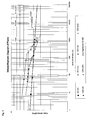
- the slopes of the lines of the non-ductile failures are steeper (i.e. more negative) than that of the ductile failures (when the same log(failure time) vs. log(hoop stress) diagram is used as given in Fig. 1). Since the point where the knee-point occurs, greatly influences the extrapolated stress at a given temperature, typically chosen between 30 to 70 °C, with extrapolated lifetimes from 10 to 50 years, it is desireable for the knee-point to be at long times. The claim of the invention is that the knee-point at a given temperature of the new product is shifted to longer times compared to present art.
- the polypropylene composition of this invention is a composition of a copolymer of propylene with ethylene and/or an ⁇ -olefin.
- This polypropylene copolymer is a copolymer which contains 73.0 to 99.0 wt%, preferably 83.0 - 99.0 wt%, more preferably 85.5 - 97.0 wt% of propylene and 1 to 20 wt%, preferably 1.0 - 12.0 wt%, more preferably 3.0 - 10.0 wt% of one or more C 4 -C 8 ⁇ -olefins and/or up to 7.0 wt%, preferably up to 5.0 wt% and more preferably up to 4.5 wt% of ethylene.
- the C 4 -C 8 ⁇ -olefin is preferably selected from 1-butene, 1-pentene, 1-hexene, 4-methyl-1-pentene and 1-octene. Particularly preferred is 1-butene
- the polymerisation process for the production of the polypropylene copolymer may be a continuous process or a batch process, utilizing known methods and operating in liquid phase, optionally in the presence of an inert diluent, or in gas phase, or by mixed liquid-gas techniques.
- the process is preferably carried out in the presence of a stereospecific Ziegler-Natta- or metallocene-catalyst system.
- the copolymer includes polypropylene copolymers with a monomodal as well as polypropylene copolymers with a bimodal or multimodal molecular weight distribution.
- the "modality" of a polymer refers to the shape of its molecular weight distribution curve, i.e. the appearance of the graph of the polymer weight fraction as function of its molecular weight. If the polymer is produced in a sequential step process, utilizing reactors coupled in series and using different conditions in each reactor, the different fractions produced in the different reactors will each have their own molecular weight distribution. When the molecular weight distribution curves from these fractions are superimposed into the molecular weight distribution curve for the total resulting polymer product, that curve will show two or more maxima or at least be distinctly broadened in comparison with the curves for the individual fractions.
- the molecular weight distribution of such a polymer product, produced in two or more serial steps is called bimodal or multimodal, depending on the number of steps.
- the pipe is comprised of a propylene copolymer which is comprised of 83.0 - 99.0 wt% of propylene and 1 to 12 wt% of one or more C 4 -C 8 ⁇ -olefins and/or up to 5.0 wt% of ethylene.
- Pipes from these polypropylene compositions exhibit still better long-term pressure resistances.
- the polypropylene composition has an MFR of 0.1 to 10 g/10 min at 230 °C/2.16 kg.
- MFR values 0.1 to 5, more preferably 0.1 to 2, and most preferably MFR values below 1 g/10 min at 230 °C/2.16 kg.
- the propylene copolymer is a random polymer.
- the amount of ⁇ -crystallinity of the polypropylene copolymer is at least 50 %, preferably at least 60 %, more preferably at least 70 % and most preferably at least 80 %.
- the propylene copolymer comprises a ⁇ -nucleating agent, of which any one or mixtures of a mixed crystal of 5,12-dihydroquino(2,3-b)acridine-7,14-dione with quino(2,3-b)acridine-6,7,13,14(5H, 12H)-tetrone, N,N'-dicyclohexyl-2,6-naphtalen dicarboxamide and salts of dicarboxylic acids with at least 7 carbon atoms with metals of group II of the periodic table are preferred.
- a ⁇ -nucleating agent of which any one or mixtures of a mixed crystal of 5,12-dihydroquino(2,3-b)acridine-7,14-dione with quino(2,3-b)acridine-6,7,13,14(5H, 12H)-tetrone, N,N'-dicyclohexyl-2,6-naphtalen di
- a preferred composition is comprised of a propylene copolymer which is comprised of 89.0 - 96.0 wt% of propylene and 3 to 10 wt% of butene and up to 1.0 wt% of ethylene.
- a polypropylene composition comprised of a propylene copolymer which comprises 73.0 - 99.0 wt% of propylene and 1 to 20 wt% of one or more C 4 -C 8 ⁇ -olefins and/or up to 7 wt% of ethylene, where the propylene copolymer is at least partially crystallized in the ⁇ -modification, for the production of pressure pipes whose failure time vs.
- a polypropylene composition comprised of a propylene copolymer which comprises 73.0 - 99.0 wt% of propylene and 1 to 20 wt% of one or more C 4 -C 8 ⁇ -olefins and/or up to 7 wt% of ethylene, where the propylene copolymer is at least partially crystallized in the ⁇ -modification, for the production of pressure pipes whose failure time vs.
- the propylene copolymer comprises 90.0 - 94.0 wt% of propylene and 6 to 10 wt% of 1-butene, where (slope) ⁇ -0.0250.
- Pressure pipes from the above compositions of propylene/1-butene copolymers have a very flat slope in their ductile failure region.
- the propylene copolymer comprises 89.4 - 95.9 wt% of propylene and 4 to 10 wt% of 1-butene and 0.1 to 0.6 wt% of ethylene, where (slope) ⁇ -0.0250.
- Pressure pipes from compositions comprising terpolymers of propylene, 1-butene and small amounts of ethylene also have very favourable flat slopes in their ductile failure region.
- the propylene copolymer comprises 95 - 97 wt% of propylene and 3 to 5 wt% of ethylene where (slope) ⁇ -0.0220.
- Pressure pipes from the above compostions comprising propylene/ethylene copolymers also have very favourable flat slopes in their ductile failure region.
- any nucleating agent can be used which is suitable for inducing crystallization of polypropylene homo- and copolymers in the hexagonal or pseudohexagonal modification. Mixtures of such nucleating agents may also be employed.
- Suitable types of ⁇ -nucleating agents are
- Preferred ⁇ -nucleating agents are any one or mixtures of N,N'-dicyclohexyl-2,6-naphtalene dicarboxamide, the ⁇ -nucleating agents of EP 170889 and those of EP 682066.
- the propylene copolymer which is at least partly crystallized in the ⁇ -modification is preferably produced by melt mixing the propylene copolymer base resin with 0.0001 to 2.0 wt% based on the propylene copolymer used, of ⁇ -nucleating agents at temperatures from 175 to 250 °C and cooling and crystallizing the melt according to procedures which are state of the art.
- Pipe as used herein is meant to encompass pipes in the narrower sense, as well as supplementary parts like fittings, valves and all parts which are commonly necessary for e.g. a hot water piping system.
- Pipes according to the invention also encompass single and multilayer pipes, where for example one or more of the layers is a metal layer and which may include an adhesive layer.
- Other constructions of pipes, e.g. corrugated pipes, are possible as well.
- the propylene compositions used for pipes according to the invention may contain usual auxiliary materials, e.g. up to 40 wt% fillers and/or 0.01 to 2.5 wt% stabilizers and/or 0.01 to 1 wt% processing aids and/or 0.1 to 1 wt% antistatic agents and/or 0.2 to 3 wt% pigments and/or reinforcing agents, e.g. glass fibres, in each case based on the propylene composition used.
- auxiliary materials e.g. up to 40 wt% fillers and/or 0.01 to 2.5 wt% stabilizers and/or 0.01 to 1 wt% processing aids and/or 0.1 to 1 wt% antistatic agents and/or 0.2 to 3 wt% pigments and/or reinforcing agents, e.g. glass fibres, in each case based on the propylene composition used.
- coloration of the propylene composition is largely irrelevant, however certain pigments, e.g. pigments which are
- Pipes according to the invention were produced by first plasticizing the propylene polymer in an extruder at temperatures in the range of from 200 to 250 °C and then extruding it through an annular die and cooling it.
- the extruders for producing the pipes can be single screw extruders with an L/D of 20 to 40 or twin screw extruders or extruder cascades of homogenizing extruders (single screw or twin screw).
- a melt pump and/or a static mixer can be used additionally between the extruder and the ring die head. Ring shaped dies with diameters ranging from approximately 16 to 2000 mm and even grater are possible.
- the melt arriving from the extruder is first distributed over an annular cross-section via conically arranged holes and then fed to the core/die combination via a coil distributor or screen. If necessary, restrictor rings or other structural elements for ensuring uniform melt flow may additionally be installed before the die outlet.
- the pipe After leaving the annular die, the pipe is taken off over a calibrating mandrel, usually accompanied by cooling of the pipe by air cooling and/or water cooling, optionally also with inner water cooling.
- Propene-1-butene-copolymer was polymerized in a continuous working polymerization system by using propene, 1-butene, the catalyst compound C and cocatalysts (Triethylaluminium (TEAI), Electron donor (CMDMS)).
- TEAI Triethylaluminium
- CDMS Electron donor
- catalyst compound C a commercial available Ziegler/Natta-catalyst (Titaniumchloride catalyst supported on MgCl 2 ), suitable for the production of polypropylene-copolymers in a monomer suspension is used.
- the polymerization is performed continuously in a prepolymerization reactor and a main polymerization reactor. Temperatures, pressures, catalyst-, monomer- and hydrogen feed in the separate polymerization steps as well as the polymer concentration in the main reactor are kept constant.
- the molar mass of the copolymer is controlled by adding hydrogen gas.
- the concentration of hydrogen in the mixture of liquid monomers is continuously measured by gas chromatography. The relevant processing parameters and the analytical results of the resulting polymer are listed in table 1.
- the first polymerization step is performed in a small reactor (equipped with stirrer and cooling system), where an excess of a liquid mixture of the monomers propene and 1-butene is prepolymerized for 9 minutes at 20 °C. Therefore catalyst compound C, mixed with the cocatalyst compounds Triethylaluminium (TEAI) and Cyclohexyl-methyl-dimethoxysilane (CMDMS) as external electron donor, are continuously poured into the prepolymerization unit.
- TEAI Triethylaluminium
- CDMS Cyclohexyl-methyl-dimethoxysilane
- the prepolymer (product A) is continuously removed from the prepolymerization unit and passed over into the main reactor system (equipped with stirrer and cooling system), where under excess of a liquid mixture of the monomers propene and 1-butene, the final copolymer (B) is formed. Further a mixture of monomers (propene/1-butene) and hydrogen (for molar mass control) are continuously fed into the main reactor. The polymer concentration is kept constant at 517 g/l. A part of the reactor content (polymer- / monomer excess) is continuously removed from the reactor into a degassing unit to separate the formed copolymer (B) from unreacted monomer mixture by evaporation.
- the separated copolymer (B), Base resin I was subjected to a steam treatment, to remove the unreacted monomers and volatile substances, and then dried.
- Propene-1-butene-copolymer was polymerized in a continuous working polymerization system by using propene, 1-butene, the catalyst compound F and cocatalysts (Triethylaluminium (TEAI), Electron donor (DCPDMS)).
- TEAI Triethylaluminium
- DCPDMS Electron donor
- catalyst compound F a commercial available Zlegler/Natta-catalyst (Titaniumchloride catalyst supported on MgCl 2 ), suitable for the production of polypropylene-copolymers in a monomer suspension is used.
- the polymerization is performed continuously in a prepolymerization reactor and a main polymerization reactor. Temperatures, pressures, catalyst-, monomer- and hydrogen feed in the separate polymerization steps as well as the polymer concentration in the main reactor are kept constant.
- the molar mass of the copolymer is controlled by adding hydrogen gas.
- the concentration of hydrogen in the mixture of liquid monomers is continuously measured by gas chromatography. The relevant processing parameters and the analytical results of the resulting polymer are listed in table 1.
- the first polymerization step is performed in a small reactor (equipped with stirrer and cooling system), where an excess of propene and 1-butene is prepolymerized for 9 minutes at 20 °C.
- Catalyst compound F mixed with the cocatalyst compounds Triethylaluminium (TEAI) and Dicyclopentyl-dimethoxysilan (DCPDMS) as external electron donor, are continuously poured into the prepolymerization unit.
- TEAI Triethylaluminium
- DCPDMS Dicyclopentyl-dimethoxysilan
- the prepolymer (product D) is continuously removed from the prepolymerization unit and passed over into the main reactor system (equipped with stirrer and cooling system), where under excess of a liquid mixture of the monomers propene and 1-butene, the final copolymer (E) is formed. Further a mixture of monomers (propene/ethene) and hydrogen (for molar mass control) are continuously fed into the main reactor. The polymer concentration is kept constant at 513 g/l. A part of the reactor content (polymer- / monomer excess) is continuously removed from the reactor into a degassing unit to separate the formed copolymer (E) from unreacted monomer mixture by evaporation.
- the Propene-ethene-1-butene-terpolymer was polymerized in a continuous working polymerization system by using propene, ethene, 1-butene, the catalyst compound J and cocatalysts (Triethylaluminium (TEAI), Electron donor (CMDMS)).
- TEAI Triethylaluminium
- CDMS Electron donor
- catalyst compound J a commercial available Zlegler/Natta-catalyst (Titaniumchloride catalyst supported on MgCl 2 ), suitable for the production of polypropylene terpolymers in a monomer suspension is used.
- the polymerization is performed continuously in a prepolymerization reactor and a main polymerization reactor. Temperatures, pressures, catalyst-, monomer- and hydrogen feed in the separate polymerization steps as well as the polymer concentration in the main reactor are kept constant.
- the molar mass of the terpolymer is controlled by adding hydrogen gas.
- the concentration of hydrogen in the mixture of liquid monomers is continuously measured by gas chromatography. The relevant processing parameters and the analytical results of the resulting polymer are listed in tables 1 and 2.
- the first polymerization step is performed in a small reactor (equipped with stirrer and cooling system), where an excess of a liquid mixture of the monomers propene and 1-butene is prepolymerized for 9 minutes at 20 °C. Therefore catalyst compound J mixed with the cocatalyst compounds Triethylaluminium (TEAI) and Cyclohexyl-methyl-dimethoxysilane (CMDMS) as external electron donor, are continuously poured into the prepolymerization unit.
- TEAI Triethylaluminium
- CDMS Cyclohexyl-methyl-dimethoxysilane
- the prepolymer (product K) is continuously removed from the prepolymerization unit and passed over into the main reactor system (equipped with stirrer and cooling system), where under excess of a liquid mixture of the monomers propene and 1-butene, under addition of ethene, the final terpolymer (L) is formed. Further a mixture of monomers (propene/1-butene/ethene) and hydrogen (for molar mass control) are continuously fed into the main reactor. The polymer concentration is kept constant at 542 g/l. A part of the reactor content (polymer- / monomer excess) continuously is removed from the reactor into a degassing unit to separate the formed terpolymer (L) from unreacted monomer mixture by evaporation.
- the Propene-1-butene-copolymer powder (Base resin I) was mixed with 0.07 % Calciumstearate, 0.25 % Pentaerythritol-tetrakis(3,5-di-tert-butyl-4-hydroxyphenyl)propionate, 0.1 % Tris(2,4-ditert-butylphenyl)phosphite, 0.25 % 3,3',3',5,5',5'-hexa-tert-butyl-a,a',a'-(mesitylene-2,4,6-triyl)tri-p-cresol and 2 % Masterbatch A and pelletized in a conventional compounding line.
- the Propene-1-butene-copolymer powder (Base resin II) was mixed with 0.07 % Calciumstearate, 0.25 % Pentaerythritol-tetrakis(3,5-di-tert-butyl-4-hydroxyphenyl)propionate, 0.1 % Tris(2,4-ditert-butylphenyl)phosphite, 0.25 % 3,3',3',5,5',5'-hexa-tert-butyl-a,a',a'-(mesitylene-2,4,6-triyl)tri-p-cresol and 2 % Masterbatch A and pelletized in a conventional compounding line.
- the Propene-ethene-1-butene-terpolymer powder (Base resin III) was mixed with 0.07 % Calciumstearate, 0.25 % Pentaerythritol-tetrakls(3,5-di-tert-butyl-4-hydroxyphenyl)propionate, 0.1 % Tris(2,4-ditert-butylphenyl)phosphite, 0.25 % 3,3',3',5,5',5'-hexa-tert-butyl-a,a',a'-(mesitylene-2,4,6-triyl)tri-p-cresol and 2 % Masterbatch A and pelletized in a conventional compounding line.
- the Propene-ethene-1-butene-terpolymer powder (Base resin III) was mixed with 0.07 % Calciumstearate, 0.25 % Pentaerythritol-tetrakis(3,5-di-tert-butyl-4-hydroxyphenyl)propionate, 0.1 % Tris(2,4-ditert-butylphenyl)phosphite, 0.25 % 3,3',3',5,5',5'-hexa-tert-butyl-a,a',a'-(mesltylene-2,4,6-trlyl)tri-p-cresol and 0.1 % Calciumpimelate and pelletized in a conventional compounding line.
- the Propene-1-butene-copolymer powder (Base resin I) was mixed with 0.07 % Calciumstearate, 0.25 % Pentaerythritol-tetrakis(3,5-di-tert-butyl-4-hydroxyphenyl)propionate, 0.1 % Tris(2,4-ditert-butylphenyl)phosphite, 0.25 % 3,3',3',5,5',5'-hexa-tert-butyl-a,a',a'-(mesitylene-2,4,6-triyl)tri-p-cresol and pelletized in a conventional compounding line.
- the Propene-1-butene-copolymer powder (Base resin II) was mixed with 0.07% Calciumstearate, 0.25 % Pentaerythritol-tetrakis(3,5-di-tert-butyl-4-hydroxyphenyl)propionate, 0.1 % Tris(2,4-ditert-butylphenyl)phosphite, 0.25 % 3,3',3',5,5',5'-hexa-tert-butyl-a,a',a'-(mesitylene-2,4,6-triyl)tri-p-cresol and pelletized in a conventional compounding line.
- the Propene-ethene-1-butene-terpolymer powder (Base resin III) was mixed with 0.07 % Calciumstearate, 0.25 % Pentaerythritol-tetrakis(3,5-di-tert-butyl-4-hydroxyphenyl)propionate, 0.1 % Tris(2,4-ditert-butylphenyl)phosphite, 0.25 % 3,3',3',5,5',5'-hexa-tert-butyl-a,a',a'-(mesitylene-2,4,6-triyl)tri-p-cresol and pelletized in a conventional compounding line.
- Masterbatch A is a commercially available product based on polypropylene and containing the quinacridone pigment "Chinquasia gold" as ⁇ -nucleating agent.
- the ⁇ -crystallinity was determined by Differential Scanning Calorimetry (DSC). DSC was run according to ISO 3146 / part 3 / method C2 with a scan rate of 10 °C/min. The amount of ⁇ -modification was calculated from the second heat by the following formula: ⁇ -area / ( ⁇ -area + ⁇ -area) Since the thermodynamical instable ⁇ -modification starts to be changed into the more stable ⁇ -modification at temperatures above 150 °C, a part of the ⁇ -modification is transferred within the heating process of DSC-measurement. Therefore the amount of ⁇ -PP determined by DSC is lower as when measured according to the method of Turner-Jones by WAXS (A. Turner-Jones et.
- "Second heat” means, that the sample is heated according to ISO 3146 / part 3 / method C2 for a first time and then cooled to room temperature at a rate of 20 °C/min. The sample is then heated a second time, also according to ISO 3146 / part 3 / method C2. This second heat is relevant for measurement and calculation. During the "first heat” all thermal history of the sample giving rise to different crystalline structure, which typically comes from different processing conditions and/or methods, is destroyed. Using the second heat for determination of ⁇ -crystallinity, it is possible to compare samples regardless of the way the samples were originally manufactured.
- Xylene solubles were determined at 23 °C according to ISO 6427. Xylene solubles are defined as the percent by weight that stays in solution after the polymer sample is dissolved in hot xylene and the solution is allowed to cool to 23 °C.
- the melt flow rates were measured with a load of 2.16 kg at 230 °C.
- the melt flow rate is that quantity of polymer in grams which the test apparatus standardized to DIN 53 735 extrudes within 10 minutes at a temperature of 230 °C under a weight of 2.16 kg.
- the flexural test was carried out according to the method of ISO 178 by using injection molded test specimens as described in EN ISO 1873-2 (80 x 10 x 4 mm).
- the notched charpy impact strength was carried out according to ISO 179 / 1eA at 23 °C by using injection molded test specimens as described in EN ISO 1873-2 (80 x 10 x 4 mm)
- Comparative examples CE4 and CE5 show both ductile and non-ductile failures at 95 °C.
- a regression line through the non-ductile failure points, when put into a log/log diagram as explained earlier, is steeper than one through the ductile failure points (for each example), when put into a log/log diagram. Therefore all of the comparative examples CE4 and CE5 display a knee-point.
- examples E1-E4 according to the invention do not show any non-ductile failure points, all failure points, including the "ip - in progress" pipes lay on a straight line. Testing is under way for more than one year (i.e.
- the longest knee-points at 95 °C for present art are at the following times: CE1 ⁇ 1151 h (nD); CE2 ⁇ 866 h (nD); CE3 ⁇ 1022 h (nD); CE4: between 220 h (D) and 684 h (nD); CE5: between 726 h (D) and 1939 h (nD).
- E1 to E4 do not show knee-points at times > 5885 h (D) for E1; > 10558 h (D) for E2; > 5269 h (D) for E3 and > 5217 h (D) for E4 and at times of > 12000 h and > 13000 h all pipes are still in progress. Only one straight line is present for E1 to E4, thus higher stress levels will be achieved when extrapolated to lower temperatures to 10 to 50 years. Comparing the slopes of CE1 to CE5 it is evident that they are steeper than the slopes of E1 to E4 in their ductile region.
- E3 and E4 two beta-nucleated ethene-propene-butene terpolymers, show, when compared to CE3, a non beta-nucleated terpolymer of the same base resin, that the same phenomena like much prolonged or non-present knee-point and flatter ductile line also hold for ethene-propene-butene terpolymers.
- E1 and E2 two beta-nucleated propene-butene copolymers, show, when compared to CE1 and CE2, non beta-nucleated propene-butene copolymers of the same base resin, that the same phenomena like much prolonged or non-present knee-point and flatter ductile line also hold for propene-butene copolymers.
- E5 a beta-nucleated ethene-propene copolymer, show, when compared to CE4, a non beta-nucleated ethene-propene copolymer of the same base resin, that the same phenomena like much prolonged or non-present knee-point and flatter ductile line also hold for ethene-propene copolymers.
- the diagram in Fig. 1 is a log/log representation of comparative examples CE4 and CE5 and of inventive example E2.
- the lines which are drawn through the data points of CE4 and CE5 are drawn by hand. It is however clearly visible, that for each set of data - with the exception of E2 - a distinctive knee-point is present at the intersection of the respective ductile and non-ductile regression lines. It is also clearly visible that the slopes of the regression lines of CE4 and CE5 in their ductile region is steeper than the slope of the regression line of E2.
- the number of data points in the non-ductile region of CE4 and CE5 is different from the number of data presented in table 2.
Landscapes
- Chemical & Material Sciences (AREA)
- Engineering & Computer Science (AREA)
- General Engineering & Computer Science (AREA)
- Medicinal Chemistry (AREA)
- Polymers & Plastics (AREA)
- Organic Chemistry (AREA)
- Health & Medical Sciences (AREA)
- Chemical Kinetics & Catalysis (AREA)
- Mechanical Engineering (AREA)
- Rigid Pipes And Flexible Pipes (AREA)
- Compositions Of Macromolecular Compounds (AREA)
- Addition Polymer Or Copolymer, Post-Treatments, Or Chemical Modifications (AREA)
- Manufacture Of Macromolecular Shaped Articles (AREA)
- External Artificial Organs (AREA)
Priority Applications (17)
| Application Number | Priority Date | Filing Date | Title |
|---|---|---|---|
| EP01127005A EP1312623A1 (en) | 2001-11-14 | 2001-11-14 | Pressure pipes |
| US10/495,539 US7799397B2 (en) | 2001-11-14 | 2002-11-06 | Pressure pipes |
| AU2002346828A AU2002346828B2 (en) | 2001-11-14 | 2002-11-06 | Pressure pipes |
| IL16197302A IL161973A0 (en) | 2001-11-14 | 2002-11-06 | Pressure pipes |
| EP02783073A EP1448631B1 (en) | 2001-11-14 | 2002-11-06 | Pressure pipes |
| PCT/EP2002/012368 WO2003042260A1 (en) | 2001-11-14 | 2002-11-06 | Pressure pipes |
| DE60208712T DE60208712T2 (de) | 2001-11-14 | 2002-11-06 | Druckrohre |
| RU2004117865/04A RU2310789C2 (ru) | 2001-11-14 | 2002-11-06 | Напорная труба |
| CNB028251105A CN1249110C (zh) | 2001-11-14 | 2002-11-06 | 压力管 |
| PL371417A PL206543B1 (pl) | 2001-11-14 | 2002-11-06 | Rura ciśnieniowa z kompozycji polipropylenowej i zastosowanie kompozycji polipropylenowej |
| HU0402369A HUP0402369A3 (en) | 2001-11-14 | 2002-11-06 | Pressure pipes |
| PT02783073T PT1448631E (pt) | 2001-11-14 | 2002-11-06 | Tubos de pressao |
| ES02783073T ES2258163T3 (es) | 2001-11-14 | 2002-11-06 | Tubos de presion. |
| KR1020047007460A KR101110087B1 (ko) | 2001-11-14 | 2002-11-06 | 압력 파이프, 당해 압력 파이프를 제조하기 위한 폴리프로필렌 조성물 및 다층 파이프 |
| AT02783073T ATE315592T1 (de) | 2001-11-14 | 2002-11-06 | Druckrohre |
| JP2003544094A JP4208718B2 (ja) | 2001-11-14 | 2002-11-06 | 圧力管 |
| IL161973A IL161973A (en) | 2001-11-14 | 2004-05-13 | Pressure pipes |
Applications Claiming Priority (1)
| Application Number | Priority Date | Filing Date | Title |
|---|---|---|---|
| EP01127005A EP1312623A1 (en) | 2001-11-14 | 2001-11-14 | Pressure pipes |
Publications (1)
| Publication Number | Publication Date |
|---|---|
| EP1312623A1 true EP1312623A1 (en) | 2003-05-21 |
Family
ID=8179231
Family Applications (2)
| Application Number | Title | Priority Date | Filing Date |
|---|---|---|---|
| EP01127005A Withdrawn EP1312623A1 (en) | 2001-11-14 | 2001-11-14 | Pressure pipes |
| EP02783073A Expired - Lifetime EP1448631B1 (en) | 2001-11-14 | 2002-11-06 | Pressure pipes |
Family Applications After (1)
| Application Number | Title | Priority Date | Filing Date |
|---|---|---|---|
| EP02783073A Expired - Lifetime EP1448631B1 (en) | 2001-11-14 | 2002-11-06 | Pressure pipes |
Country Status (15)
| Country | Link |
|---|---|
| US (1) | US7799397B2 (enExample) |
| EP (2) | EP1312623A1 (enExample) |
| JP (1) | JP4208718B2 (enExample) |
| KR (1) | KR101110087B1 (enExample) |
| CN (1) | CN1249110C (enExample) |
| AT (1) | ATE315592T1 (enExample) |
| AU (1) | AU2002346828B2 (enExample) |
| DE (1) | DE60208712T2 (enExample) |
| ES (1) | ES2258163T3 (enExample) |
| HU (1) | HUP0402369A3 (enExample) |
| IL (2) | IL161973A0 (enExample) |
| PL (1) | PL206543B1 (enExample) |
| PT (1) | PT1448631E (enExample) |
| RU (1) | RU2310789C2 (enExample) |
| WO (1) | WO2003042260A1 (enExample) |
Cited By (12)
| Publication number | Priority date | Publication date | Assignee | Title |
|---|---|---|---|---|
| EP1749843A1 (de) * | 2005-08-01 | 2007-02-07 | KE-KELIT Kunststoffwerk Gesellschaft m.b.H. | Verfahren zum Herstellen eines Leitungsrohres |
| US7521104B2 (en) * | 2002-12-20 | 2009-04-21 | Basell Poliolefine Italia S.R.L. | Molding compositions made from a high-molecular-weight-propylene polymer |
| EP2067798A1 (en) * | 2007-12-04 | 2009-06-10 | Borealis Technology Oy | Process for producing coloured polypropylene composition having a high content of ß-modification |
| EP2083042A1 (en) * | 2008-01-21 | 2009-07-29 | Borealis Technology OY | Coloured polypropylene composition having a high content of ß-modification |
| GR20080100806A (el) * | 2008-12-18 | 2010-02-24 | Νικολαος Κυραδης | Πολυστρωματικος πλαστικος σωληνας βελτιωμενης διαστρωματικης συνδεσης, βελτιωμενων μηχανικων ιδιοτητων και χαμηλης γραμμικης διαστολης με αντιδραστικη συνεξωθηση |
| WO2010057841A1 (en) * | 2008-11-18 | 2010-05-27 | Borealis Ag | Propylene-butene random copolymer produced in the presence of a mettalocene catalyst |
| WO2011101091A1 (en) * | 2010-02-18 | 2011-08-25 | Borealis Ag | Stabilized polypropylene composition with improved lifetime and ageing properties |
| EP3063194A4 (en) * | 2013-10-29 | 2017-07-05 | W.R. Grace & CO. - CONN. | Propylene ethylene random copolymer suitable for pipe |
| EP3307821A1 (en) * | 2015-06-12 | 2018-04-18 | Borealis AG | Process for producing propylene polymer compositions |
| WO2018069263A1 (en) | 2016-10-12 | 2018-04-19 | Borealis Ag | Beta-nucleated propylene terpolymer composition with good toughness |
| US11220593B2 (en) | 2016-05-27 | 2022-01-11 | Sabic Global Technologies B.V. | Propylene copolymer composition |
| WO2024013128A1 (en) * | 2022-07-11 | 2024-01-18 | Borealis Ag | A propylene-ethylene random copolymer for pipe applications |
Families Citing this family (21)
| Publication number | Priority date | Publication date | Assignee | Title |
|---|---|---|---|---|
| WO2004056922A1 (en) * | 2002-12-20 | 2004-07-08 | Basell Poliolefine Italia S.P.A | Molding compositions made from a high-molecular-weight propylene polymer |
| BRPI0713834B1 (pt) * | 2006-07-28 | 2018-12-26 | Basell Poliolefine Italia Srl | polímeros de propileno |
| ATE440924T1 (de) * | 2006-10-13 | 2009-09-15 | Borealis Tech Oy | Hochtemperatur pp klebstoff |
| EP1980577A1 (en) * | 2007-04-10 | 2008-10-15 | Borealis Technology OY | Pipes comprising ß-nucleated propylene copolymers |
| DE102007030914A1 (de) | 2007-07-03 | 2009-01-08 | Bänninger Kunststoff-Produkte GmbH | Formstück aus Kunststoff |
| ATE450571T1 (de) * | 2007-07-12 | 2009-12-15 | Borealis Tech Oy | ß-NUKLEIERTE POLYPROPYLEN-ZUSAMMENSETZUNG |
| WO2009124613A1 (en) * | 2008-04-11 | 2009-10-15 | Borealis Technology Oy | Flexible polypropylene with high impact strength |
| EP2279216B1 (en) * | 2008-05-28 | 2011-09-28 | Borealis AG | Propylene-hexene random copolymer produced in the presence of a ziegler natta catalyst |
| ATE514743T1 (de) | 2008-08-01 | 2011-07-15 | Borealis Ag | Polypropylenzusammensetzung mit geringem anteil an flüchtigen elementen |
| PL2344585T3 (pl) * | 2008-10-01 | 2018-10-31 | Borealis Ag | Nowy materiał do rur kanalizacyjnych o polepszonych właściwościach |
| DE602008004558D1 (de) | 2008-11-18 | 2011-02-24 | Borealis Ag | Statistisches Propylen/Hexen-Copolymer, das in Gegenwart eines Metallocen-Katalysators hergestellt wird |
| US20100143687A1 (en) * | 2008-12-02 | 2010-06-10 | Philip Jacoby | Polypropylene-based tape yarn produced from extruded film containing beta spherulites and methods of making and using thereof |
| EP2562215B1 (en) | 2011-08-26 | 2016-03-30 | Borealis AG | Polypropylene blend for pipes |
| JP6223149B2 (ja) * | 2012-11-30 | 2017-11-01 | 旭化成株式会社 | 配管材料 |
| ES2629896T3 (es) | 2012-12-20 | 2017-08-16 | Borealis Ag | Mezcla de polipropileno para tuberías a presión |
| CN103130939A (zh) * | 2013-03-18 | 2013-06-05 | 中国石油化工股份有限公司 | 一种丙烯/1-丁烯无规共聚物的生产方法 |
| EP3124537B1 (en) | 2015-07-31 | 2020-01-08 | Borealis AG | Low volatile polypropylene composition |
| CN114728463A (zh) * | 2019-11-20 | 2022-07-08 | Sabic环球技术有限责任公司 | 双轴取向管材 |
| JP2023049179A (ja) * | 2021-09-29 | 2023-04-10 | 積水化学工業株式会社 | 多口継手及び配管システム |
| KR102842290B1 (ko) | 2022-11-09 | 2025-08-04 | 한화토탈에너지스 주식회사 | 기계적 물성의 균형 및 저속 균열 성장 저항성이 우수한 폴리프로필렌 수지 조성물 및 그로부터 제조된 성형품 |
| EP4644437A1 (en) * | 2024-04-30 | 2025-11-05 | Borealis GmbH | Pipe material based on c3c2c6 terpolymer with specific structure |
Citations (8)
| Publication number | Priority date | Publication date | Assignee | Title |
|---|---|---|---|---|
| DE3319515A1 (de) * | 1983-05-28 | 1984-11-29 | kabelmetal electro GmbH, 3000 Hannover | Leitungsrohr fuer den transport erwaermter medien |
| JPH05170932A (ja) * | 1991-12-26 | 1993-07-09 | Mitsubishi Petrochem Co Ltd | ポリプロピレン樹脂製給排水用管状成形体 |
| WO1996011216A1 (en) * | 1994-10-11 | 1996-04-18 | Borealis A/S | New polypropylene composition with broad mwd |
| WO1996024623A1 (en) * | 1995-02-09 | 1996-08-15 | Sastech (Proprietary) Limited | Propylene pentene-1 copolymers, method of preparation thereof and composition containing them |
| EP0791609A2 (de) * | 1996-02-22 | 1997-08-27 | Hoechst Aktiengesellschaft | Hochmolekulares Polypropylen mit breiter Molmassenverteilung |
| AT404294B (de) * | 1997-01-09 | 1998-10-27 | Danubia Petrochem Polymere | Rohr, insbesondere druckrohr |
| WO1999024479A1 (en) * | 1997-11-07 | 1999-05-20 | Borealis A/S | Novel propylene polymers and products thereof |
| WO1999040151A1 (de) * | 1998-02-04 | 1999-08-12 | Pcd Polymere Gesellschaft Mbh | Rohr, insbesondere druckrohr |
Family Cites Families (15)
| Publication number | Priority date | Publication date | Assignee | Title |
|---|---|---|---|---|
| AT381110B (de) | 1984-10-11 | 1986-08-25 | Danubia Petrochemie | Polypropylen, kristalline copolymere desselben oder mischungen mit anderen polyolefinen mit ueberwiegendem polypropylenanteil mit hoher schlagzaehigkeit und spannungsrissbestaendigkeit und dessen verwendung |
| JPH082998B2 (ja) * | 1985-04-09 | 1996-01-17 | 住友化学工業株式会社 | ポリオレフィン樹脂の酸化窒素ガス黄変を防止する方法 |
| US6235823B1 (en) | 1992-01-24 | 2001-05-22 | New Japan Chemical Co., Ltd. | Crystalline polypropylene resin composition and amide compounds |
| US5310584B1 (en) * | 1992-04-14 | 1999-02-16 | Amoco Corp | Thermoformable polypropylene-based sheet |
| JP3390230B2 (ja) | 1993-10-26 | 2003-03-24 | ビーピー・コーポレイション・ノース・アメリカ・インコーポレイテッド | 改良された熱成形可能なポリプロピレンをベースとするシート及びその製造方法 |
| EP0883769B1 (en) | 1996-03-04 | 2003-05-02 | Borealis A/S | Method of preparing a multilayer pipe |
| SE505937C2 (sv) | 1996-03-04 | 1997-10-27 | Borealis As | Flerskiktat rör |
| JP3643671B2 (ja) | 1997-04-01 | 2005-04-27 | 三井化学株式会社 | 自動車外装用部品の成形方法、その成形方法で使用される積層フィルムまたはシート、およびその自動車外装用部品 |
| US20030008091A1 (en) * | 1998-02-04 | 2003-01-09 | Roland Konrad | Pipe, especially pressure pipe |
| JP2001233923A (ja) | 1999-12-17 | 2001-08-28 | Idemitsu Petrochem Co Ltd | プロピレン−エチレンブロック共重合体、樹脂組成物及びブロー成形体 |
| DE10114485B4 (de) | 2001-03-24 | 2009-05-07 | Ivt Installations- Und Verbindungstechnik Gmbh & Co. Kg | Verfahren und Vorrichtung zur Herstellung von endlosen Kunststoff-Hohlprofilen |
| EP1260546A1 (en) * | 2001-05-21 | 2002-11-27 | Borealis Technology OY | Polyolefin multilayer pipe |
| EP1260545A1 (en) * | 2001-05-21 | 2002-11-27 | Borealis Technology OY | Industrial polyolefin piping system |
| EP1260528A1 (en) | 2001-05-21 | 2002-11-27 | Borealis Technology OY | Propylene polymer pipes for pipelines |
| EP1260547A1 (en) | 2001-05-21 | 2002-11-27 | Borealis Technology OY | Polyolefin coated steel pipes |
-
2001
- 2001-11-14 EP EP01127005A patent/EP1312623A1/en not_active Withdrawn
-
2002
- 2002-11-06 JP JP2003544094A patent/JP4208718B2/ja not_active Expired - Lifetime
- 2002-11-06 US US10/495,539 patent/US7799397B2/en not_active Expired - Lifetime
- 2002-11-06 CN CNB028251105A patent/CN1249110C/zh not_active Expired - Lifetime
- 2002-11-06 EP EP02783073A patent/EP1448631B1/en not_active Expired - Lifetime
- 2002-11-06 PL PL371417A patent/PL206543B1/pl unknown
- 2002-11-06 KR KR1020047007460A patent/KR101110087B1/ko not_active Expired - Lifetime
- 2002-11-06 IL IL16197302A patent/IL161973A0/xx active IP Right Grant
- 2002-11-06 AT AT02783073T patent/ATE315592T1/de active
- 2002-11-06 DE DE60208712T patent/DE60208712T2/de not_active Expired - Lifetime
- 2002-11-06 ES ES02783073T patent/ES2258163T3/es not_active Expired - Lifetime
- 2002-11-06 RU RU2004117865/04A patent/RU2310789C2/ru active
- 2002-11-06 WO PCT/EP2002/012368 patent/WO2003042260A1/en not_active Ceased
- 2002-11-06 HU HU0402369A patent/HUP0402369A3/hu unknown
- 2002-11-06 PT PT02783073T patent/PT1448631E/pt unknown
- 2002-11-06 AU AU2002346828A patent/AU2002346828B2/en not_active Expired
-
2004
- 2004-05-13 IL IL161973A patent/IL161973A/en unknown
Patent Citations (8)
| Publication number | Priority date | Publication date | Assignee | Title |
|---|---|---|---|---|
| DE3319515A1 (de) * | 1983-05-28 | 1984-11-29 | kabelmetal electro GmbH, 3000 Hannover | Leitungsrohr fuer den transport erwaermter medien |
| JPH05170932A (ja) * | 1991-12-26 | 1993-07-09 | Mitsubishi Petrochem Co Ltd | ポリプロピレン樹脂製給排水用管状成形体 |
| WO1996011216A1 (en) * | 1994-10-11 | 1996-04-18 | Borealis A/S | New polypropylene composition with broad mwd |
| WO1996024623A1 (en) * | 1995-02-09 | 1996-08-15 | Sastech (Proprietary) Limited | Propylene pentene-1 copolymers, method of preparation thereof and composition containing them |
| EP0791609A2 (de) * | 1996-02-22 | 1997-08-27 | Hoechst Aktiengesellschaft | Hochmolekulares Polypropylen mit breiter Molmassenverteilung |
| AT404294B (de) * | 1997-01-09 | 1998-10-27 | Danubia Petrochem Polymere | Rohr, insbesondere druckrohr |
| WO1999024479A1 (en) * | 1997-11-07 | 1999-05-20 | Borealis A/S | Novel propylene polymers and products thereof |
| WO1999040151A1 (de) * | 1998-02-04 | 1999-08-12 | Pcd Polymere Gesellschaft Mbh | Rohr, insbesondere druckrohr |
Non-Patent Citations (1)
| Title |
|---|
| PATENT ABSTRACTS OF JAPAN vol. 017, no. 582 (C - 1123) 22 October 1993 (1993-10-22) * |
Cited By (28)
| Publication number | Priority date | Publication date | Assignee | Title |
|---|---|---|---|---|
| US7521104B2 (en) * | 2002-12-20 | 2009-04-21 | Basell Poliolefine Italia S.R.L. | Molding compositions made from a high-molecular-weight-propylene polymer |
| EP1749843A1 (de) * | 2005-08-01 | 2007-02-07 | KE-KELIT Kunststoffwerk Gesellschaft m.b.H. | Verfahren zum Herstellen eines Leitungsrohres |
| CN104151698A (zh) * | 2007-12-04 | 2014-11-19 | 博里利斯技术有限公司 | 制备具有高β-改性含量的着色聚丙烯组合物的方法 |
| WO2009071471A1 (en) * | 2007-12-04 | 2009-06-11 | Borealis Technology Oy | PROCESS FOR PRODUCING COLOURED POLYPROPYLENE COMPOSITION HAVING A HIGH CONTENT OF ß-MODIFICATION |
| US8318884B2 (en) | 2007-12-04 | 2012-11-27 | Borealis Technology Oy | Process for producing coloured polypropylene composition having a high content of β-modification |
| EP2067798A1 (en) * | 2007-12-04 | 2009-06-10 | Borealis Technology Oy | Process for producing coloured polypropylene composition having a high content of ß-modification |
| EP2684902A1 (en) * | 2007-12-04 | 2014-01-15 | Borealis Technology Oy | Process for producing coloured polypropylene composition having a high content of ß-modification |
| AU2008333319B2 (en) * | 2007-12-04 | 2012-02-23 | Borealis Technology Oy | Process for producing coloured polypropylene composition having a high content of beta-modification |
| RU2452741C2 (ru) * | 2007-12-04 | 2012-06-10 | Бореалис Текнолоджи Ой | Способ получения композиции окрашенного полипропилена, имеющей высокое содержание бета-модификации |
| EP2083042A1 (en) * | 2008-01-21 | 2009-07-29 | Borealis Technology OY | Coloured polypropylene composition having a high content of ß-modification |
| WO2009092700A1 (en) * | 2008-01-21 | 2009-07-30 | Borealis Technology Oy | COLOURED POLYPROPYLENE COMPOSITION HAVING A HIGH CONTENT OF ß-MODIFICATION |
| AU2009207719B2 (en) * | 2008-01-21 | 2011-06-02 | Borealis Technology Oy | Coloured polypropylene composition having a high content of beta-modification |
| US8383707B2 (en) | 2008-01-21 | 2013-02-26 | Borealis Technology Oy | Coloured polypropylene composition having a high content of β-modification |
| WO2010057841A1 (en) * | 2008-11-18 | 2010-05-27 | Borealis Ag | Propylene-butene random copolymer produced in the presence of a mettalocene catalyst |
| US8637625B2 (en) | 2008-11-18 | 2014-01-28 | Borealis Ag | Propylene-butene random copolymer produced in the presence of a metallocene catalyst |
| GR20080100806A (el) * | 2008-12-18 | 2010-02-24 | Νικολαος Κυραδης | Πολυστρωματικος πλαστικος σωληνας βελτιωμενης διαστρωματικης συνδεσης, βελτιωμενων μηχανικων ιδιοτητων και χαμηλης γραμμικης διαστολης με αντιδραστικη συνεξωθηση |
| EP2361951A1 (en) * | 2010-02-18 | 2011-08-31 | Borealis AG | Stabilized polypropylene composition with improved lifetime and ageing properties |
| WO2011101091A1 (en) * | 2010-02-18 | 2011-08-25 | Borealis Ag | Stabilized polypropylene composition with improved lifetime and ageing properties |
| EA023701B1 (ru) * | 2010-02-18 | 2016-07-29 | Бореалис Аг | Стабилизирующая смесь и ее применение для получения полипропиленовой композиции; способ получения указанной композиции, изделие, изготовленное из нее, и применение трубы, полученной из нее |
| US10336840B2 (en) | 2013-10-29 | 2019-07-02 | W. R. Grace & Co.-Conn. | Propylene ethylene random copolymer suitable for pipe |
| EP3063194A4 (en) * | 2013-10-29 | 2017-07-05 | W.R. Grace & CO. - CONN. | Propylene ethylene random copolymer suitable for pipe |
| EP3063194B1 (en) | 2013-10-29 | 2021-12-08 | W.R. Grace & CO. - CONN. | Propylene ethylene random copolymer suitable for pipe |
| EP3307821A1 (en) * | 2015-06-12 | 2018-04-18 | Borealis AG | Process for producing propylene polymer compositions |
| US11220593B2 (en) | 2016-05-27 | 2022-01-11 | Sabic Global Technologies B.V. | Propylene copolymer composition |
| WO2018069263A1 (en) | 2016-10-12 | 2018-04-19 | Borealis Ag | Beta-nucleated propylene terpolymer composition with good toughness |
| CN109790230A (zh) * | 2016-10-12 | 2019-05-21 | 北欧化工公司 | 具有良好韧性的β-成核的丙烯三元共聚物组合物 |
| RU2721727C1 (ru) * | 2016-10-12 | 2020-05-21 | Бореалис Аг | Композиция бета-нуклеированного пропиленового терполимера с хорошей ударопрочностью |
| WO2024013128A1 (en) * | 2022-07-11 | 2024-01-18 | Borealis Ag | A propylene-ethylene random copolymer for pipe applications |
Also Published As
| Publication number | Publication date |
|---|---|
| ATE315592T1 (de) | 2006-02-15 |
| DE60208712T2 (de) | 2006-11-02 |
| US7799397B2 (en) | 2010-09-21 |
| DE60208712D1 (de) | 2006-04-06 |
| IL161973A (en) | 2007-05-15 |
| HUP0402369A2 (hu) | 2005-02-28 |
| EP1448631A1 (en) | 2004-08-25 |
| ES2258163T3 (es) | 2006-08-16 |
| PT1448631E (pt) | 2006-05-31 |
| RU2004117865A (ru) | 2006-01-10 |
| WO2003042260A1 (en) | 2003-05-22 |
| EP1448631B1 (en) | 2006-01-11 |
| AU2002346828B2 (en) | 2007-06-21 |
| KR20040075865A (ko) | 2004-08-30 |
| US20050053741A1 (en) | 2005-03-10 |
| CN1249110C (zh) | 2006-04-05 |
| HUP0402369A3 (en) | 2008-06-30 |
| CN1604922A (zh) | 2005-04-06 |
| IL161973A0 (en) | 2005-11-20 |
| JP2005509121A (ja) | 2005-04-07 |
| PL206543B1 (pl) | 2010-08-31 |
| RU2310789C2 (ru) | 2007-11-20 |
| KR101110087B1 (ko) | 2012-02-17 |
| PL371417A1 (en) | 2005-06-13 |
| JP4208718B2 (ja) | 2009-01-14 |
Similar Documents
| Publication | Publication Date | Title |
|---|---|---|
| EP1448631B1 (en) | Pressure pipes | |
| AU2002346828A1 (en) | Pressure pipes | |
| AU2003233323B2 (en) | Polypropylene compositions especially for pipes | |
| AU2008274379B2 (en) | Beta-nucleated polypropylene composition | |
| US7091277B2 (en) | Syntactic polyolefin composition for pipe coating | |
| CN101842437B (zh) | β-成核的丙烯共聚物 | |
| PL204334B1 (pl) | Wielowarstwowe rury poliolefinowe, sposób ich wytwarzania i zastosowanie wielowarstwowych rur poliolefinowych | |
| US20110123751A1 (en) | Propylene polymer pipes for pipelines | |
| EP2134755B1 (en) | Pipes comprising b-nucleated propylene copolymers | |
| AU2002338997A1 (en) | Propylene polymer pipes for pipelines |
Legal Events
| Date | Code | Title | Description |
|---|---|---|---|
| PUAI | Public reference made under article 153(3) epc to a published international application that has entered the european phase |
Free format text: ORIGINAL CODE: 0009012 |
|
| AK | Designated contracting states |
Designated state(s): AT BE CH CY DE DK ES FI FR GB GR IE IT LI LU MC NL PT SE TR |
|
| AX | Request for extension of the european patent |
Extension state: AL LT LV MK RO SI |
|
| STAA | Information on the status of an ep patent application or granted ep patent |
Free format text: STATUS: THE APPLICATION IS DEEMED TO BE WITHDRAWN |
|
| 18D | Application deemed to be withdrawn |
Effective date: 20030315 |