EP1310476A1 - Verfahren zur Herstellung von 2,3-Pentandion - Google Patents
Verfahren zur Herstellung von 2,3-Pentandion Download PDFInfo
- Publication number
- EP1310476A1 EP1310476A1 EP02024496A EP02024496A EP1310476A1 EP 1310476 A1 EP1310476 A1 EP 1310476A1 EP 02024496 A EP02024496 A EP 02024496A EP 02024496 A EP02024496 A EP 02024496A EP 1310476 A1 EP1310476 A1 EP 1310476A1
- Authority
- EP
- European Patent Office
- Prior art keywords
- pentanedione
- paraldehyde
- hydroxyacetone
- amount
- mixture
- Prior art date
- Legal status (The legal status is an assumption and is not a legal conclusion. Google has not performed a legal analysis and makes no representation as to the accuracy of the status listed.)
- Granted
Links
Classifications
-
- C—CHEMISTRY; METALLURGY
- C07—ORGANIC CHEMISTRY
- C07C—ACYCLIC OR CARBOCYCLIC COMPOUNDS
- C07C45/00—Preparation of compounds having >C = O groups bound only to carbon or hydrogen atoms; Preparation of chelates of such compounds
- C07C45/56—Preparation of compounds having >C = O groups bound only to carbon or hydrogen atoms; Preparation of chelates of such compounds from heterocyclic compounds
- C07C45/57—Preparation of compounds having >C = O groups bound only to carbon or hydrogen atoms; Preparation of chelates of such compounds from heterocyclic compounds with oxygen as the only heteroatom
- C07C45/60—Preparation of compounds having >C = O groups bound only to carbon or hydrogen atoms; Preparation of chelates of such compounds from heterocyclic compounds with oxygen as the only heteroatom in six-membered rings
Definitions
- the invention relates to a new manufacturing process for 2,3-pentanedione starting of hydroxyacetone and paraldehyde.
- 2,3-pentanedione is an important flavoring agent (Allured's Flavor and Fragrance Materials - 1995, Allured Publishing Corporation, 1995, p. 22). It is also 2,3-pentanedione an important raw material for the production of alkyl-substituted pyrazines (DE 100 22 361 C1).
- 2,3-pentanedione is known per se.
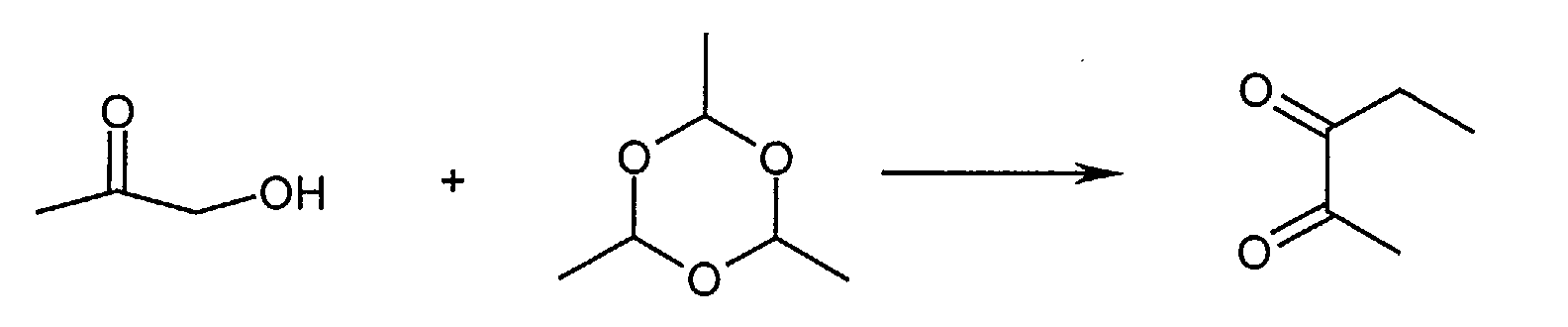
- the production takes place, for example, starting from hydroxyacetone and paraldehyde in a one-step process and can be illustrated by the following scheme:
- the present invention therefore relates to a method for producing 2,3-pentanedione from hydroxyacetone and paraldehyde, characterized in that the reaction in the presence of an aqueous phase containing a strong organic or inorganic acid with a pKa value of less than or equal to 4 in the presence a phase transfer catalyst is carried out.
- a dosing mixture containing hydroxyacetone and Paraldehyde and optionally a diluent to an aqueous solution containing an acid with a pKa value of less than or equal to 4 and a phase transfer catalyst.
- Acids according to the invention with a pKa value that is less than or equal to 4 can be inorganic and organic acids. Acids with a pKs value of less than or equal to 1. Inorganic acids are preferred. Especially HCl, HBr, sulfuric acid and nitric acid are preferred.
- the amount of acid is 5 to 50 wt .-% based on the amount of aqueous Phase, preferably at 10 to 30 wt .-% based on the amount of the aqueous phase.
- the amount of paraldehyde is typically based on the hydroxyacetone used at 40 to 200 wt .-%, preferably at 50 to 100 wt .-%.
- the amount of paraldehyde in the metering mixture is typically 40 to 200 wt .-% based on the amount of hydroxyacetone, preferably 50 to 100% by weight.
- the dosing mixture is dosed at a reaction temperature (bottom temperature) in the range from 35 to 100 ° C., preferably at 40 to 75 ° C., particularly preferred at 45 to 60 ° C.
- the temperature of the dosing mixture is usually in the Range from 0 to 40 ° C, preferably in the range from 10 to 30 ° C.
- the dosing time is usually 1 to 30 hours, preferably 5 to 20 hours.
- the process according to the invention can be carried out in the presence of diluents be performed. It is preferred to add inert organic diluents waived.
- the preferred diluent is water.
- a post-reaction time in the range of 0.05 to 3 is preferred Hours, particularly preferably in the range from 0.1 to 1 hour.
- This distillation can be carried out under normal pressure or under vacuum become.
- this distillation can also be carried out using superheated steam the reactor is introduced to be carried out.
- the pressure is usually of water vapor in the range of 3 to 10 bar.
- the chemical yield is typically around 85% of that used in the deficit Educt, which enables an economical production of 2,3-pentanedione becomes.
- the process according to the invention can be carried out under gentle reaction conditions without the use of complex special equipment from industrially available Starting materials 2,3-pentanedione can be produced in good yield.
- the method according to the invention is therefore particularly suitable for economical production of 2,3-pentanedione on a technical and industrial scale.
- the method according to the invention can be carried out, for example, as follows become:
- a dosing mixture containing hydroxyacetone and paraldehyde and optionally a diluent becomes an aqueous solution containing an acid with a pKs value of less than or equal to 4 and a phase transfer catalyst are added dropwise.
- the reaction temperature is kept largely constant, it is usually in the range from 35 to 100 ° C.
Landscapes
- Chemical & Material Sciences (AREA)
- Organic Chemistry (AREA)
- Organic Low-Molecular-Weight Compounds And Preparation Thereof (AREA)
- Saccharide Compounds (AREA)
- Low-Molecular Organic Synthesis Reactions Using Catalysts (AREA)
Abstract
Description
- R1 bis R4
- -unabhängig voneinander- C-1 bis C-18-Alkyl oder Benzyl und
- X-
- Iodid, Chlorid, Hydroxid oder Hydrogensulfat
Claims (6)
- Verfahren zur Herstellung von 2,3-Pentandion aus Hydroxyaceton und Paraldehyd, dadurch gekennzeichnet, dass die Umsetzung in Gegenwart einer wässrigen Phase enthaltend eine starke organische oder anorganische Säure mit einem pKs-Wert von kleiner oder gleich 4 in Gegenwart eines Phasentransferkatalysators durchgeführt wird.
- Verfahren nach Anspruch 1, dadurch gekennzeichnet, dass als Phasentransferkatalysatoren Phosphonium-, Sulfonium- oder Ammoniumverbindungen verwendet werden.
- Verfahren nach einem der Ansprüche 1 oder 2, dadurch gekennzeichnet, dass die Säuremenge 5 bis 50 Gew.-% bezogen auf die Menge der wässrigen Phase beträgt.
- Verfahren nach mindestens einem der Ansprüche 1 bis 3, dadurch gekennzeichnet, dass eine anorganische Säure mit einem pKs-Wert von kleiner oder gleich 1 verwendet wird.
- Verfahren nach mindestens einem der Ansprüche 1 bis 4, dadurch gekennzeichnet, dass die Menge an Paraldehyd bei 40 bis 200 Gew.-% bezogen auf die Menge an eingesetztem Hydroxyaceton liegt.
- Verfahren nach einem der Ansprüche 1 bis 5, dadurch gekennzeichnet, dass die Dosierung bei einer Reaktionstemperatur von 35°C bis 100°C erfolgt.
Applications Claiming Priority (2)
| Application Number | Priority Date | Filing Date | Title |
|---|---|---|---|
| DE10155553A DE10155553A1 (de) | 2001-11-12 | 2001-11-12 | Verfahren zur Herstellung von 2,3-Pentandion |
| DE10155553 | 2001-11-12 |
Publications (2)
| Publication Number | Publication Date |
|---|---|
| EP1310476A1 true EP1310476A1 (de) | 2003-05-14 |
| EP1310476B1 EP1310476B1 (de) | 2005-09-28 |
Family
ID=7705496
Family Applications (1)
| Application Number | Title | Priority Date | Filing Date |
|---|---|---|---|
| EP02024496A Expired - Lifetime EP1310476B1 (de) | 2001-11-12 | 2002-10-30 | Verfahren zur Herstellung von 2,3-Pentandion |
Country Status (7)
| Country | Link |
|---|---|
| US (1) | US6720456B2 (de) |
| EP (1) | EP1310476B1 (de) |
| JP (1) | JP2003146930A (de) |
| AT (1) | ATE305445T1 (de) |
| DE (2) | DE10155553A1 (de) |
| IL (1) | IL152707A (de) |
| MX (1) | MXPA02011064A (de) |
Families Citing this family (1)
| Publication number | Priority date | Publication date | Assignee | Title |
|---|---|---|---|---|
| CN117924056B (zh) * | 2024-03-25 | 2024-06-11 | 山东新和成药业有限公司 | 一种共轭二酮类化合物的合成方法 |
Citations (2)
| Publication number | Priority date | Publication date | Assignee | Title |
|---|---|---|---|---|
| US2799707A (en) * | 1956-05-14 | 1957-07-16 | Dow Chemical Co | Preparation of alpha-diketones |
| EP0983987A1 (de) * | 1998-08-21 | 2000-03-08 | Basf Aktiengesellschaft | Verfahren zur Herstellung von alpha-Diketonen aus Ketolen oder Ketalen von Ketolen |
Family Cites Families (3)
| Publication number | Priority date | Publication date | Assignee | Title |
|---|---|---|---|---|
| DE573722C (de) * | 1931-05-13 | 1933-04-05 | Knoll Ag | Verfahren zur Darstellung von ª‡-Dicarbonylverbindungen |
| US4107210A (en) * | 1976-09-07 | 1978-08-15 | The Dow Chemical Company | Synthesis of alpha-diketones |
| US5831130A (en) * | 1997-04-24 | 1998-11-03 | Board Of Trustees Operating Michigan State University | Condensed phase preparation of 2,3-pentanedione |
-
2001
- 2001-11-12 DE DE10155553A patent/DE10155553A1/de not_active Withdrawn
-
2002
- 2002-10-30 EP EP02024496A patent/EP1310476B1/de not_active Expired - Lifetime
- 2002-10-30 AT AT02024496T patent/ATE305445T1/de not_active IP Right Cessation
- 2002-10-30 DE DE50204384T patent/DE50204384D1/de not_active Expired - Lifetime
- 2002-11-07 US US10/289,546 patent/US6720456B2/en not_active Expired - Fee Related
- 2002-11-07 IL IL152707A patent/IL152707A/en not_active IP Right Cessation
- 2002-11-08 JP JP2002325063A patent/JP2003146930A/ja active Pending
- 2002-11-11 MX MXPA02011064A patent/MXPA02011064A/es not_active Application Discontinuation
Patent Citations (2)
| Publication number | Priority date | Publication date | Assignee | Title |
|---|---|---|---|---|
| US2799707A (en) * | 1956-05-14 | 1957-07-16 | Dow Chemical Co | Preparation of alpha-diketones |
| EP0983987A1 (de) * | 1998-08-21 | 2000-03-08 | Basf Aktiengesellschaft | Verfahren zur Herstellung von alpha-Diketonen aus Ketolen oder Ketalen von Ketolen |
Non-Patent Citations (2)
| Title |
|---|
| DATABASE CROSSFIRE BEILSTEIN [online] Beilstein Institut zur Förderung der chemischen Wissenschaften, Frankfurt am Main, DE; XP002230743, Database accession no. 643575 * |
| NEUBERG ET AL., BIOCHEM. Z., vol. 275, 1935, pages 342 * |
Also Published As
| Publication number | Publication date |
|---|---|
| DE10155553A1 (de) | 2003-05-22 |
| EP1310476B1 (de) | 2005-09-28 |
| IL152707A (en) | 2007-08-19 |
| US6720456B2 (en) | 2004-04-13 |
| JP2003146930A (ja) | 2003-05-21 |
| ATE305445T1 (de) | 2005-10-15 |
| MXPA02011064A (es) | 2005-08-16 |
| US20030092942A1 (en) | 2003-05-15 |
| DE50204384D1 (de) | 2006-02-09 |
| IL152707A0 (en) | 2003-06-24 |
Similar Documents
| Publication | Publication Date | Title |
|---|---|---|
| EP0133913B1 (de) | Verfahren zur Herstellung von 3,3-Dichlor-2-methyl-propen | |
| DE2537975A1 (de) | Verfahren zur herstellung von 2,5-dibrom-p-xylol | |
| DE69402529T2 (de) | Verfahren zur herstellung von n-phosphonomethylimino-diessigsäure | |
| DE2526381A1 (de) | Verfahren zur herstellung von hydroxyessigsaeure | |
| EP1310476B1 (de) | Verfahren zur Herstellung von 2,3-Pentandion | |
| DE69707825T2 (de) | Verfahren zur Herstellung von alicyclischen Hydrazin-derivaten. | |
| DE69803252T2 (de) | Verfahren zur Herstellung eines polyhydrischen Alkohols | |
| DE60107121T2 (de) | Verfahren zur herstellung von fluormethylhexafluorisopropyl-ether | |
| DE2443142C2 (de) | Verfahren zur Herstellung von Cyclopropancarbonsäurenitril | |
| DE60204014T2 (de) | Chlormethylierung von thiophen | |
| DE3885823T2 (de) | Verfahren zur herstellung von 3-chlor-4-fluornitrobenzol. | |
| DE60114482T2 (de) | Verfahren zur Herstellung von 1,1,1-Trifluoraceton | |
| DE60014347T2 (de) | Verfahren zur herstellung von cyclopropylacetonitril | |
| CH632480A5 (de) | Verfahren zur herstellung von 4-heptinal. | |
| EP0003052B1 (de) | Verfahren zur Herstellung von 4-Methyl-5-chlormethylimidazol | |
| DE3509911C2 (de) | Verfahren zur Herstellung von Trifluoressigsäure aus Trichlortrifluorethan | |
| DE3106169C2 (de) | Verfahren zur Herstellung von 3,3,3,-trifluorpropylierten Benzolderivaten | |
| DE69903914T2 (de) | Herstellung von 3-buten-1-ol aus 3,4-epoxy-1-buten | |
| DE69104782T2 (de) | Verfahren zur Herstellung von ungesättigten Bromiden. | |
| DE3726890C2 (de) | ||
| DE2651371A1 (de) | Quaternaere ammoniumsalze | |
| DE3131735C1 (de) | Verfahren zur Herstellung von kernfluorierten aromatischen 6-Ring-Stickstoffheterocyclen | |
| DE2306335C3 (de) | Verfahren zur Herstellung von Dichloracetaldehyd | |
| EP0653414B1 (de) | Verfahren zur Herstellung von Fluorbenzoesäurealkylestern durch Reaktion eines Fluorbenzoylchlorids mit einem Alkohol in Gegenwart eines Alkalimetallalkoholates | |
| DE2211231A1 (de) | Verfahren zur herstellung von jodwasserstoff und/oder alkyljodiden |
Legal Events
| Date | Code | Title | Description |
|---|---|---|---|
| PUAI | Public reference made under article 153(3) epc to a published international application that has entered the european phase |
Free format text: ORIGINAL CODE: 0009012 |
|
| AK | Designated contracting states |
Designated state(s): AT BE BG CH CY CZ DE DK EE ES FI FR GB GR IE IT LI LU MC NL PT SE SK TR |
|
| AX | Request for extension of the european patent |
Extension state: AL LT LV MK RO SI |
|
| RAP1 | Party data changed (applicant data changed or rights of an application transferred) |
Owner name: SYMRISE GMBH & CO. KG |
|
| 17P | Request for examination filed |
Effective date: 20031114 |
|
| AKX | Designation fees paid |
Designated state(s): AT BE BG CH CY CZ DE DK EE ES FI FR GB GR IE IT LI LU MC NL PT SE SK TR |
|
| GRAP | Despatch of communication of intention to grant a patent |
Free format text: ORIGINAL CODE: EPIDOSNIGR1 |
|
| GRAS | Grant fee paid |
Free format text: ORIGINAL CODE: EPIDOSNIGR3 |
|
| GRAA | (expected) grant |
Free format text: ORIGINAL CODE: 0009210 |
|
| AK | Designated contracting states |
Kind code of ref document: B1 Designated state(s): AT BE BG CH CY CZ DE DK EE ES FI FR GB GR IE IT LI LU MC NL PT SE SK TR |
|
| PG25 | Lapsed in a contracting state [announced via postgrant information from national office to epo] |
Ref country code: IT Free format text: LAPSE BECAUSE OF FAILURE TO SUBMIT A TRANSLATION OF THE DESCRIPTION OR TO PAY THE FEE WITHIN THE PRESCRIBED TIME-LIMIT;WARNING: LAPSES OF ITALIAN PATENTS WITH EFFECTIVE DATE BEFORE 2007 MAY HAVE OCCURRED AT ANY TIME BEFORE 2007. THE CORRECT EFFECTIVE DATE MAY BE DIFFERENT FROM THE ONE RECORDED. Effective date: 20050928 Ref country code: CZ Free format text: LAPSE BECAUSE OF FAILURE TO SUBMIT A TRANSLATION OF THE DESCRIPTION OR TO PAY THE FEE WITHIN THE PRESCRIBED TIME-LIMIT Effective date: 20050928 Ref country code: SK Free format text: LAPSE BECAUSE OF FAILURE TO SUBMIT A TRANSLATION OF THE DESCRIPTION OR TO PAY THE FEE WITHIN THE PRESCRIBED TIME-LIMIT Effective date: 20050928 Ref country code: NL Free format text: LAPSE BECAUSE OF FAILURE TO SUBMIT A TRANSLATION OF THE DESCRIPTION OR TO PAY THE FEE WITHIN THE PRESCRIBED TIME-LIMIT Effective date: 20050928 Ref country code: TR Free format text: LAPSE BECAUSE OF FAILURE TO SUBMIT A TRANSLATION OF THE DESCRIPTION OR TO PAY THE FEE WITHIN THE PRESCRIBED TIME-LIMIT Effective date: 20050928 Ref country code: EE Free format text: LAPSE BECAUSE OF FAILURE TO SUBMIT A TRANSLATION OF THE DESCRIPTION OR TO PAY THE FEE WITHIN THE PRESCRIBED TIME-LIMIT Effective date: 20050928 Ref country code: FI Free format text: LAPSE BECAUSE OF FAILURE TO SUBMIT A TRANSLATION OF THE DESCRIPTION OR TO PAY THE FEE WITHIN THE PRESCRIBED TIME-LIMIT Effective date: 20050928 Ref country code: IE Free format text: LAPSE BECAUSE OF FAILURE TO SUBMIT A TRANSLATION OF THE DESCRIPTION OR TO PAY THE FEE WITHIN THE PRESCRIBED TIME-LIMIT Effective date: 20050928 |
|
| REG | Reference to a national code |
Ref country code: GB Ref legal event code: FG4D Free format text: NOT ENGLISH |
|
| REG | Reference to a national code |
Ref country code: CH Ref legal event code: EP Ref country code: CH Ref legal event code: NV Representative=s name: E. BLUM & CO. PATENTANWAELTE |
|
| GBT | Gb: translation of ep patent filed (gb section 77(6)(a)/1977) |
Effective date: 20050928 |
|
| REG | Reference to a national code |
Ref country code: IE Ref legal event code: FG4D Free format text: LANGUAGE OF EP DOCUMENT: GERMAN |
|
| PG25 | Lapsed in a contracting state [announced via postgrant information from national office to epo] |
Ref country code: CY Free format text: LAPSE BECAUSE OF FAILURE TO SUBMIT A TRANSLATION OF THE DESCRIPTION OR TO PAY THE FEE WITHIN THE PRESCRIBED TIME-LIMIT Effective date: 20051030 Ref country code: AT Free format text: LAPSE BECAUSE OF NON-PAYMENT OF DUE FEES Effective date: 20051030 |
|
| PG25 | Lapsed in a contracting state [announced via postgrant information from national office to epo] |
Ref country code: MC Free format text: LAPSE BECAUSE OF NON-PAYMENT OF DUE FEES Effective date: 20051031 Ref country code: BE Free format text: LAPSE BECAUSE OF NON-PAYMENT OF DUE FEES Effective date: 20051031 |
|
| PG25 | Lapsed in a contracting state [announced via postgrant information from national office to epo] |
Ref country code: LU Free format text: LAPSE BECAUSE OF NON-PAYMENT OF DUE FEES Effective date: 20051128 |
|
| PG25 | Lapsed in a contracting state [announced via postgrant information from national office to epo] |
Ref country code: GR Free format text: LAPSE BECAUSE OF FAILURE TO SUBMIT A TRANSLATION OF THE DESCRIPTION OR TO PAY THE FEE WITHIN THE PRESCRIBED TIME-LIMIT Effective date: 20051228 Ref country code: SE Free format text: LAPSE BECAUSE OF FAILURE TO SUBMIT A TRANSLATION OF THE DESCRIPTION OR TO PAY THE FEE WITHIN THE PRESCRIBED TIME-LIMIT Effective date: 20051228 Ref country code: BG Free format text: LAPSE BECAUSE OF FAILURE TO SUBMIT A TRANSLATION OF THE DESCRIPTION OR TO PAY THE FEE WITHIN THE PRESCRIBED TIME-LIMIT Effective date: 20051228 Ref country code: DK Free format text: LAPSE BECAUSE OF FAILURE TO SUBMIT A TRANSLATION OF THE DESCRIPTION OR TO PAY THE FEE WITHIN THE PRESCRIBED TIME-LIMIT Effective date: 20051228 |
|
| PG25 | Lapsed in a contracting state [announced via postgrant information from national office to epo] |
Ref country code: ES Free format text: LAPSE BECAUSE OF FAILURE TO SUBMIT A TRANSLATION OF THE DESCRIPTION OR TO PAY THE FEE WITHIN THE PRESCRIBED TIME-LIMIT Effective date: 20060108 |
|
| REF | Corresponds to: |
Ref document number: 50204384 Country of ref document: DE Date of ref document: 20060209 Kind code of ref document: P |
|
| PG25 | Lapsed in a contracting state [announced via postgrant information from national office to epo] |
Ref country code: PT Free format text: LAPSE BECAUSE OF FAILURE TO SUBMIT A TRANSLATION OF THE DESCRIPTION OR TO PAY THE FEE WITHIN THE PRESCRIBED TIME-LIMIT Effective date: 20060228 |
|
| NLV1 | Nl: lapsed or annulled due to failure to fulfill the requirements of art. 29p and 29m of the patents act | ||
| REG | Reference to a national code |
Ref country code: IE Ref legal event code: FD4D |
|
| ET | Fr: translation filed | ||
| PLBE | No opposition filed within time limit |
Free format text: ORIGINAL CODE: 0009261 |
|
| STAA | Information on the status of an ep patent application or granted ep patent |
Free format text: STATUS: NO OPPOSITION FILED WITHIN TIME LIMIT |
|
| 26N | No opposition filed |
Effective date: 20060629 |
|
| REG | Reference to a national code |
Ref country code: CH Ref legal event code: PFA Owner name: SYMRISE GMBH & CO. KG Free format text: SYMRISE GMBH & CO. KG#MUEHLENFELDSTRASSE 1#37603 HOLZMINDEN (DE) -TRANSFER TO- SYMRISE GMBH & CO. KG#MUEHLENFELDSTRASSE 1#37603 HOLZMINDEN (DE) |
|
| BERE | Be: lapsed |
Owner name: SYMRISE G.M.B.H. & CO. KG Effective date: 20051031 |
|
| PGFP | Annual fee paid to national office [announced via postgrant information from national office to epo] |
Ref country code: CH Payment date: 20081027 Year of fee payment: 7 |
|
| PGFP | Annual fee paid to national office [announced via postgrant information from national office to epo] |
Ref country code: FR Payment date: 20081021 Year of fee payment: 7 |
|
| PGFP | Annual fee paid to national office [announced via postgrant information from national office to epo] |
Ref country code: GB Payment date: 20081024 Year of fee payment: 7 |
|
| REG | Reference to a national code |
Ref country code: CH Ref legal event code: PL |
|
| REG | Reference to a national code |
Ref country code: FR Ref legal event code: ST Effective date: 20100630 |
|
| PG25 | Lapsed in a contracting state [announced via postgrant information from national office to epo] |
Ref country code: FR Free format text: LAPSE BECAUSE OF NON-PAYMENT OF DUE FEES Effective date: 20091102 |
|
| PG25 | Lapsed in a contracting state [announced via postgrant information from national office to epo] |
Ref country code: LI Free format text: LAPSE BECAUSE OF NON-PAYMENT OF DUE FEES Effective date: 20091031 Ref country code: CH Free format text: LAPSE BECAUSE OF NON-PAYMENT OF DUE FEES Effective date: 20091031 |
|
| PG25 | Lapsed in a contracting state [announced via postgrant information from national office to epo] |
Ref country code: GB Free format text: LAPSE BECAUSE OF NON-PAYMENT OF DUE FEES Effective date: 20091030 |
|
| PGFP | Annual fee paid to national office [announced via postgrant information from national office to epo] |
Ref country code: DE Payment date: 20211020 Year of fee payment: 20 |
|
| REG | Reference to a national code |
Ref country code: DE Ref legal event code: R071 Ref document number: 50204384 Country of ref document: DE |