EP1293583B1 - Nickelbasislegierung, Herstellungsverfahren und Schmiedewerkzeug - Google Patents
Nickelbasislegierung, Herstellungsverfahren und Schmiedewerkzeug Download PDFInfo
- Publication number
- EP1293583B1 EP1293583B1 EP02256464A EP02256464A EP1293583B1 EP 1293583 B1 EP1293583 B1 EP 1293583B1 EP 02256464 A EP02256464 A EP 02256464A EP 02256464 A EP02256464 A EP 02256464A EP 1293583 B1 EP1293583 B1 EP 1293583B1
- Authority
- EP
- European Patent Office
- Prior art keywords
- based alloy
- precipitates
- die
- diameter
- less
- Prior art date
- Legal status (The legal status is an assumption and is not a legal conclusion. Google has not performed a legal analysis and makes no representation as to the accuracy of the status listed.)
- Expired - Lifetime
Links
- 229910045601 alloy Inorganic materials 0.000 title claims description 97
- 239000000956 alloy Substances 0.000 title claims description 97
- 238000005242 forging Methods 0.000 title claims description 39
- 238000004519 manufacturing process Methods 0.000 title claims description 18
- 239000002244 precipitate Substances 0.000 claims description 105
- 238000011282 treatment Methods 0.000 claims description 40
- 230000032683 aging Effects 0.000 claims description 29
- 230000005540 biological transmission Effects 0.000 claims description 24
- 239000013078 crystal Substances 0.000 claims description 12
- 238000000034 method Methods 0.000 claims description 12
- 239000010953 base metal Substances 0.000 claims description 11
- 238000010894 electron beam technology Methods 0.000 claims description 8
- 229910052758 niobium Inorganic materials 0.000 claims description 8
- 229910052748 manganese Inorganic materials 0.000 claims description 7
- 229910052804 chromium Inorganic materials 0.000 claims description 6
- 229910052802 copper Inorganic materials 0.000 claims description 6
- 229910052759 nickel Inorganic materials 0.000 claims description 6
- 239000012535 impurity Substances 0.000 claims description 5
- 229910052750 molybdenum Inorganic materials 0.000 claims description 5
- 229910052715 tantalum Inorganic materials 0.000 claims description 5
- 229910052742 iron Inorganic materials 0.000 claims description 4
- 239000002184 metal Substances 0.000 description 27
- 229910052751 metal Inorganic materials 0.000 description 27
- 239000000203 mixture Substances 0.000 description 14
- 229910000816 inconels 718 Inorganic materials 0.000 description 12
- 239000000463 material Substances 0.000 description 7
- 239000000047 product Substances 0.000 description 6
- 239000000243 solution Substances 0.000 description 6
- 230000035882 stress Effects 0.000 description 5
- 230000008646 thermal stress Effects 0.000 description 5
- 239000012467 final product Substances 0.000 description 3
- 238000004881 precipitation hardening Methods 0.000 description 3
- 230000002035 prolonged effect Effects 0.000 description 3
- 239000002994 raw material Substances 0.000 description 3
- 230000000007 visual effect Effects 0.000 description 3
- 229910000831 Steel Inorganic materials 0.000 description 2
- 238000005299 abrasion Methods 0.000 description 2
- 230000003247 decreasing effect Effects 0.000 description 2
- 238000003754 machining Methods 0.000 description 2
- 238000005259 measurement Methods 0.000 description 2
- 239000010959 steel Substances 0.000 description 2
- 229910000601 superalloy Inorganic materials 0.000 description 2
- 229910001315 Tool steel Inorganic materials 0.000 description 1
- 238000001389 atom probe field ion microscopy Methods 0.000 description 1
- 238000010273 cold forging Methods 0.000 description 1
- 230000002950 deficient Effects 0.000 description 1
- 238000009826 distribution Methods 0.000 description 1
- 238000011835 investigation Methods 0.000 description 1
- 238000012986 modification Methods 0.000 description 1
- 230000004048 modification Effects 0.000 description 1
- 238000001556 precipitation Methods 0.000 description 1
- 238000003825 pressing Methods 0.000 description 1
- 238000001953 recrystallisation Methods 0.000 description 1
- 239000006104 solid solution Substances 0.000 description 1
- 239000010935 stainless steel Substances 0.000 description 1
- 229910001220 stainless steel Inorganic materials 0.000 description 1
- 238000005482 strain hardening Methods 0.000 description 1
- 239000000126 substance Substances 0.000 description 1
- 238000012360 testing method Methods 0.000 description 1
Images


Classifications
-
- C—CHEMISTRY; METALLURGY
- C22—METALLURGY; FERROUS OR NON-FERROUS ALLOYS; TREATMENT OF ALLOYS OR NON-FERROUS METALS
- C22C—ALLOYS
- C22C19/00—Alloys based on nickel or cobalt
- C22C19/03—Alloys based on nickel or cobalt based on nickel
- C22C19/05—Alloys based on nickel or cobalt based on nickel with chromium
- C22C19/051—Alloys based on nickel or cobalt based on nickel with chromium and Mo or W
- C22C19/056—Alloys based on nickel or cobalt based on nickel with chromium and Mo or W with the maximum Cr content being at least 10% but less than 20%
-
- B—PERFORMING OPERATIONS; TRANSPORTING
- B21—MECHANICAL METAL-WORKING WITHOUT ESSENTIALLY REMOVING MATERIAL; PUNCHING METAL
- B21K—MAKING FORGED OR PRESSED METAL PRODUCTS, e.g. HORSE-SHOES, RIVETS, BOLTS OR WHEELS
- B21K1/00—Making machine elements
- B21K1/28—Making machine elements wheels; discs
- B21K1/30—Making machine elements wheels; discs with gear-teeth
-
- B—PERFORMING OPERATIONS; TRANSPORTING
- B21—MECHANICAL METAL-WORKING WITHOUT ESSENTIALLY REMOVING MATERIAL; PUNCHING METAL
- B21K—MAKING FORGED OR PRESSED METAL PRODUCTS, e.g. HORSE-SHOES, RIVETS, BOLTS OR WHEELS
- B21K5/00—Making tools or tool parts, e.g. pliers
- B21K5/20—Making working faces of dies, either recessed or outstanding
-
- C—CHEMISTRY; METALLURGY
- C22—METALLURGY; FERROUS OR NON-FERROUS ALLOYS; TREATMENT OF ALLOYS OR NON-FERROUS METALS
- C22C—ALLOYS
- C22C19/00—Alloys based on nickel or cobalt
- C22C19/03—Alloys based on nickel or cobalt based on nickel
- C22C19/05—Alloys based on nickel or cobalt based on nickel with chromium
- C22C19/051—Alloys based on nickel or cobalt based on nickel with chromium and Mo or W
- C22C19/055—Alloys based on nickel or cobalt based on nickel with chromium and Mo or W with the maximum Cr content being at least 20% but less than 30%
-
- C—CHEMISTRY; METALLURGY
- C22—METALLURGY; FERROUS OR NON-FERROUS ALLOYS; TREATMENT OF ALLOYS OR NON-FERROUS METALS
- C22F—CHANGING THE PHYSICAL STRUCTURE OF NON-FERROUS METALS AND NON-FERROUS ALLOYS
- C22F1/00—Changing the physical structure of non-ferrous metals or alloys by heat treatment or by hot or cold working
- C22F1/10—Changing the physical structure of non-ferrous metals or alloys by heat treatment or by hot or cold working of nickel or cobalt or alloys based thereon
Definitions
- the present invention relates to a Ni based alloy having excellent strength, hardness, and toughness, a method for producing the Ni based alloy, and a forging die of the Ni based alloy.
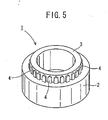
- FIG. 5 shows a gear 1 to be used, for example, for an automobile transmission.
- the gear 1 has a large diameter section 2 and a small diameter section 3 which has a diameter smaller than that of the large diameter section 2.
- Outer teeth 4 are provided on a side circumferential wall of the small diameter section 3.
- the gear 1 is produced, for example, by hot forging.
- an unillustrated ring-shaped workpiece made of SCR420H, SCM420H, HNCM (according to JIS (Japanese Industrial Standard)) or the like is heated to about 1100 to 1200 °C.
- the ring-shaped workpiece is arranged in a die.
- the workpiece is pressed by a punch or the like, and the workpiece is plastically deformed to have a shape corresponding to the gear 1.
- the outer teeth 4 are formed on the side circumferential wall of the ring-shaped workpiece by a teeth-forming section provided on the die.
- the workpiece is softened by recrystallization. Therefore, no work hardening is caused. Accordingly, the ductility of the workpiece is increased, and hence the workpiece can be machined with ease.
- Die steel for hot working including high speed tool steel and maraging stainless steel is widely used as a raw material of the die for hot forging, because the die steel for hot working is inexpensive and can be easily formed to various shapes.
- the temperature of the die is increased, because the heat is transmitted from the ring-shaped workpiece to the die.
- the temperature of the die is about 725 °C, and instantaneously about 1100 °C.
- the die is abraded and chipped. If such a die is used, defective gears each having a size deviating from a predetermined standard are formed. Therefore, the forging machine is stopped, and then the die is replaced with a new die.
- JP 10 237609A discloses a precipitation hardening superalloy comprising about 0.005% C, about 0.02% Si, about 0.02% Mn, about 0.003% P, about 0.0005% S, 42.00% Ni, about 16.08% Cr, about 2.85% Nb, about 1.75% Ti, about 0.30% Al, about 0.0048% B and the balance Fe.
- the alloy is aged firstly at about 720°C and then subsequently at 620°C.
- a principal object of the present invention is to provide a Ni based alloy in which hardness, strength, and toughness are improved because of the presence of precipitates, and which is preferably used as a raw material of a forging die; a method for producing the Ni based alloy; and a forging die of the Ni based alloy.
- a Ni based alloy containing 50 to 55 wt % Ni, 17 to 21 wt % Cr, 2.8 to 3.3 wt % Mo, 4.75 to 5.5 wt % Ta and Nb in total provided that Ta is not more than 0.1 wt %, 0.65 to 1.15 wt % Ti, 0.2 to 0.8 wt % Al, and Fe and unavoidable impurity as a residue, wherein the Ni based alloy includes 700 to 1100 precipitates per ⁇ m 2 when observed two-dimensionally with a transmission electron microscope provided that an electron beam transmission thickness is normalized to 10 nm, wherein a ⁇ " phase is present in said precipitates and each of the precipitates has a longer diameter of not less than 0.5 nm; and wherein the precipitates include a number of large precipitates having an average diameter of 25 nm to 1 ⁇ m, the average diameter is defined as: (longer diameter + shorter diameter)/2.
- the composition of the Ni based alloy is equivalent to the composition of the major component of Inconel 718 (registered trademark). It is noted that the large precipitates as described above are absent in the metal microstructure of the commercially available Ni based alloy having the composition equivalent to that of Inconel 718.
- the Ni based alloy of the present invention is excellent in strength, hardness, and toughness.
- the Ni based alloy of the present invention is a precipitation hardening alloy.
- the Ni based alloy according to the present invention may further contain not more than 0.08 wt % Co, not more than 0.01 wt % B, not more than 0.08 wt % Cu, not more than 0.08 wt % C, not more than 0.35 wt % Si, not more than 0.35 wt % Mn, not more than 0.015 wt % P, and not more than 0.015 wt % S.
- the composition of the precipitates and the large precipitates is principally Ni 3 Nb, i.e., the ⁇ " phase.
- the respective characteristics of the Ni based alloy equivalent to Inconel 718 are improved by the ⁇ " phase.
- Ni 3 (Al, Ti), i.e., the ⁇ ' phase may be included in the precipitates or the large precipitates.
- a crystal grain size of base metal in the metal microstructure is not less than No. 8 according to ASTM (American Society for Testing and Materials).
- the average cross-sectional area of the crystal grain of the base metal in the metal microstructure is small. On this condition, it is more difficult for the stress to cause transmission through the metal microstructure. Consequently, the respective characteristics are further improved. Specifically, in many cases, Rockwell C scale hardness is above 40 in the Ni based alloy.
- a method of producing a Ni based alloy wherein said Ni based alloy includes not less than 700 precipitates per ⁇ m 2 when observed two-dimensionally with a transmission electron microscope provided that an electron beam transmission thickness is normalized to 10 nm, wherein a ⁇ " phase is present in said precipitates and each of said precipitates has a longer diameter of not less than 0.5 nm, and wherein said precipitates include a number of large precipitates having an average diameter of 25 nm to 1 ⁇ m, said average diameter is defined as: (longer diameter + shorter diameter)/2, said method for producing said Ni based alloy comprising:
- the non-heat-treated Ni based alloy which has the composition equivalent to the composition of the major component of Inconel 718 (registered trademark), is used as a raw material.
- the primary aging treatment is performed at the low temperature after the solution treatment, and the secondary aging treatment is performed at the high temperature.
- the primary aging treatment is performed at a high temperature, and the secondary aging treatment is performed at a low temperature.
- the primary aging treatment is performed at the low temperature, and the secondary aging treatment is performed at the high temperature.
- the Ni based alloy in which there are 700 or more precipitates having the longer diameters of not less than 0.5 nm per ⁇ m 2 in the metal microstructure, and some of the precipitates are the large precipitates of 25 nm to 1 ⁇ m.
- the large precipitates as described above do not exist in the metal microstructure of the commercially available Ni based alloy having the composition equivalent to that of Inconel 718.
- the non-heat-treated Ni based alloy may further contain not more than 0.08 wt % Co, not more than 0.01 wt % B, not more than 0.08 wt % Cu, not more than 0.08 wt % C, not more than 0.35 wt % Si, not more than 0.35 wt % Mn, not more than 0.015 wt % P, and not more than 0.015 wt % S.
- the aging treatment temperatures given above will generally provide large precipitates in a density not less than 10/ ⁇ m 2 in the metal microstructure.
- the composition of the precipitates and the large precipitates is principally Ni 3 Nb, i.e., the ⁇ " phase.
- the respective characteristics of the Ni based alloy equivalent to Inconel 718 are improved by the ⁇ " phase.
- Ni 3 (Al, Ti) i.e., the ⁇ ' phase may be included in the precipitates or the large precipitates.
- a crystal grain size of base metal in the non-heat-treated Ni based alloy is not less than No. 8 according to ASTM.
- a forging die made of a Ni based alloy of the type described above.
- the die is excellent in strength, hardness, and toughness. Accordingly, even when the forging is repeatedly performed, the die is hardly abraded and chipped. Therefore, the frequency to replace the die is remarkably decreased. Accordingly, the cost required for the die is reduced. Consequently, it is possible to reduce the equipment cost for performing the forging. Further, the frequency to interrupt the forging operation is also decreased. Therefore, the production efficiency of the forged product is also improved.
- the Ni based alloy of the forging die according to the present invention may further contain not more than 0.08 wt % Co, not more than 0.01 wt % B, not more than 0.08 wt % Cu, not more than 0.08 wt % C, not more than 0.35 wt % Si, not more than 0.35 wt % Mn, not more than 0.015 wt % P, and not more than 0.015 wt % S.
- the ⁇ " phase is contained in the precipitates and the large precipitates.
- the ⁇ ' phase may be contained.
- a crystal grain size of base metal in the metal microstructure is not less than No. 8 according to ASTM in the Ni based alloy of the die. On this condition, the respective characteristics of the die are more excellent. For example, Rockwell C scale hardness of the die is above 40.
- the die may be used for hot forging. In this case, since new precipitates are precipitated in the metal microstructure of the Ni based alloy, the respective good characteristics of the die are maintained. Accordingly, the service life of the die is prolonged.
- FIG. 1 is a schematic perspective view with a vertical cross section illustrating a forging die 10, and FIG. 2 shows a plan view illustrating the forging die 10 shown in FIG. 1 .
- the die 10, which is substantially cylindrical, is a die for forming a gear 1 shown in FIG. 5 .
- the die 10 is preferably used for hot forging.
- the die 10 has a large central through-hole 12 which has a large diameter and is open at the lower end surface of the die 10, and a small through-hole 14 which has a small diameter as compared with the large through-hole 12 such that the large through-hole 12 vertically communicates with the small through-hole 14.
- a cylindrical recess 16 for attaching the die 10 to an unillustrated forging machine is formed on the upper end surface of the die 10.
- a plurality of teeth-forming grooves 18, which are separated from each other at equal intervals, are provided at the lower end of the inner circumferential wall of the small through-hole 14.
- Outer teeth 4 of the gear 1 are formed such that the material of the ring-shaped workpiece flows into the teeth-forming grooves 18 (see FIGS. 1 and 2 ).
- the die 10 is made from a Ni based alloy having a composition equivalent to that of Inconel 718.
- the Ni based alloy contains 50 to 55 wt % Ni, 17 to 21 wt % Cr, 2.8 to 3.3 wt % Mo, 4.75 to 5.5 wt % Ta and Nb in total provided that Ta is not more than 0.1 wt %, 0.65 to 1.15 wt % Ti, 0.2 to 0.8 wt % Al, not more than 0.08 wt % Co, not more than 0.01 wt % B, not more than 0.08 wt % Cu, not more than 0.08 wt % C, not more than 0.35 wt % Si, not more than 0.35 wt % Mn, not more than 0.015 wt % P, and not more than 0.015 wt % S, and Fe and unavoidable impurity as a residue. According to a result of observation with an electron microscope or the like, precipitates which
- the crystal grain size of the base metal is No. 8 as prescribed by ASTM.
- an average cross-sectional area of the crystal grain is about 0.00049 mm 2 .
- the precipitates in the embodiment of the present invention there are about 1100 precipitates having longer diameters of not less than 0.5 nm per ⁇ m 2 (square micrometer) in metal microstructure. This value of the number of precipitates is slightly smaller in comparison with a Ni based alloy equivalent to Inconel 718 as a commercially available product in which there are about 2100 precipitates per ⁇ m 2 .
- the rate of the precipitates is determined from a result of observation with a transmission electron microscope.
- the rate is calculated from a density of precipitates in the metal microstructure appeared in a visual field as a two-dimensional plane when a sample of the Ni based alloy is observed with the transmission electron microscope.
- the density of the precipitates varies depending on the thickness of a sample for the following reason. All of the precipitates, which are located at mutually different heights in the thickness direction of the sample (direction of transmission of the electron beam), appear in the visual field. For example, when the thickness of the sample is doubled, the density of precipitates is also doubled.
- the density is calculated by normalizing the sample thickness (electron beam transmission thickness) to 10 nm.
- the rate of precipitates is calculated by dividing the density of precipitates in the metal microstructure appeared in the visual field of the transmission electron microscope by 1.5.
- the electron beam transmission thickness is 20 nm, the density of precipitates in the metal microstructure may be divided by 2.
- a longer diameter referred to herein is defined as the value obtained by dividing the spacing distance x by the measurement magnification, wherein the spacing distance x is given as the maximum distance obtained when the both ends of the precipitate in the longitudinal direction photographed by the transmission electron microscope (TEM) are interposed between two parallel lines L1, L2.
- y in FIG. 3 is the spacing distance which is given as the maximum distance obtained when the precipitate is interposed between parallel lines M1, M2 perpendicular to the parallel lines L1, L2.
- the value, which is obtained by dividing y by the measurement magnification, is a shorter diameter.
- Some of the precipitates are large precipitates having average diameters of 25 nm to 1 ⁇ m as defined by the following expression (1).
- Average diameter Longer diameter + shorter diameter / 2
- the grain size distribution of the large precipitates is relatively narrow. In other words, the average diameters of the large precipitates are substantially equivalent to one another.
- the large precipitates which have the large average diameters, do not exist at all in the commercially available product made from the Ni based alloy equivalent to Inconel 718.
- the ⁇ ' phase which has the composition represented as Ni 3 (Al, Ti), may be contained in the precipitates and the large precipitates.
- the die 10 according to the embodiment of the present invention is made of the Ni based alloy containing, in the metal microstructure, the precipitates which grow greatly as compared with the precipitates in the commercially available product and which are principally the ⁇ " phase.
- the Ni based alloy is a precipitation hardening alloy, and the alloy is provided with excellent hardness, strength, and toughness.
- the rate of the precipitates in the metal microstructure of the Ni based alloy is slightly lower than that of the commercially available product.
- the Rockwell C scale hardness (HRC) of the die 10 is high as compared with the die in which a crystal grain size of the base metal grain is less than No. 8 of ASTM, i.e., the die having the large grain size density. Specifically, HRC of the die having the large grain size density is 40 at maximum. In contrast, HRC of the die 10 according to the embodiment of the present invention exceeds 40.
- the die having the high hardness has good abrasion resistance. Therefore, such a die has a long service life.
- the production method comprises a first step S1 of performing a solution treatment for a non-heat-treated Ni based alloy, a second step S2 of performing a primary aging treatment, and a third step S3 of performing a secondary aging treatment.
- a non-heat-treated Ni based alloy in which the crystal grain size in ASTM is No. 8 and which has the composition equivalent to that of Inconel 718.
- the solution treatment is performed in the first step S1 for the non-heat-treated Ni based alloy to make a solid solution of solute atoms in the base metal in the alloy.
- the treatment condition in this procedure may be such that the temperature is about 980 to 1000 °C and the holding time is about 1.5 to 2 hours.
- the preferred temperature range of the primary aging treatment for the non-heat-treated Ni based alloy having the composition equivalent to that of Inconel 718 is 610 to 660 °C.
- small precipitates principally the ⁇ " phase
- the precipitates are densely precipitated in the base metal grains and grain boundaries. If the temperature is less than 610 °C, the precipitates are sparsely precipitated, because the number of generated nuclei is small.
- the density of the large precipitates in the metal microstructure of the Ni based alloy as the final product is 10/ ⁇ m 2 , and it is not easy to improve the respective characteristics of the Ni based alloy and consequently those of the die 10.
- the temperature exceeds 660 °C, large nuclei are formed.
- the rate of giant precipitates having average diameters exceeding 1 ⁇ m is increased.
- the giant precipitates do not contribute to the improvement in respective characteristics of the Ni based alloy (die 10) so much. Also in this case, it is not easy to improve the respective characteristics of the Ni based alloy (die 10).
- the preferred temperature is 630 °C.
- the holding time in the primary aging treatment is 5 to 10 hours. If the holding time is less than 5 hours, the number of formed nuclei is small. On the other hand, even if the treatment is performed for a period exceeding 10 hours, the respective characteristics of the Ni based alloy are not improved so much. Therefore, such a treatment is uneconomic. Further, the production efficiency of the die 10 as the final product is lowered.
- the preferred holding time is 8 hours.
- the secondary aging treatment is performed in the third step S3. Because of the secondary aging treatment, the precipitates, which have been precipitated in the first aging treatment, are grown to form the large precipitates. Further, new nuclei are formed and grown. Accordingly, it is possible to obtain the Ni based alloy in which the precipitates and the large precipitates as defined above are dispersed in the metal microstructure.
- the preferred temperature range is 710 to 760 °C, and the preferred holding time is 5 to 10 hours. If the temperature is less than 710 °C, and/or if the holding time is less than 5 hours, then it is not easy to obtain the large precipitates, because the precipitates are not grown sufficiently. If the temperature exceeds 760 °C, and/or if the holding time exceeds 10 hours, then the rate of the giant precipitates having the average diameters exceeding 1 ⁇ m is large, because the nuclei are greatly grown. In any case, it is not easy to improve the respective characteristics of the Ni based alloy (die 10). The preferred temperature is 740 °C, and the preferred holding time is 8 hours.
- the die 10 can be manufactured by performing various machining procedures for the Ni based alloy obtained as described above.
- the hot forging by using the forging machine equipped with the die 10 is performed as follows. At first, a ring-shaped workpiece (not shown) made of SCR420H, SCM420H, HNCM, or the like is heated to about 1100 to 1200 °C, and then the ring-shaped workpiece is arranged in the large through-hole 12 of the die 10. In this procedure, the ring-shaped workpiece is placed on the bottom of the large through-hole 12.
- the ring-shaped workpiece is pressed with a punch (not shown).
- a punch (not shown).
- the material of the ring-shaped workpiece flows into the small through-hole 14.
- a part of the material into the small through-hole 14 flows into the teeth-forming grooves 18.
- the flow of the material is stopped by an unillustrated pin inserted into the small through-hole 14.
- the heat is transmitted to the die 10 from the ring-shaped workpiece. It is difficult for the die 10 to cause expansion, because the die 10 is surrounded by closely disposed support members in the forging machine. Therefore, the thermal stress is generated in the die 10.
- the large precipitates which have the substantially equivalent average diameters, are dispersed in the metal microstructure of the Ni based alloy of the die 10. Further, the precipitates are contained at the appropriate density in the metal microstructure. Therefore, the transmission of thermal stress is remarkably suppressed in the Ni based alloy (die 10) by the precipitates and the large precipitates (principally the ⁇ " phase).
- the die 10 is made of the Ni based alloy in which hardness, strength, and toughness are improved because the precipitates and the large precipitates are contained in the metal microstructure. Accordingly, the resistance to the thermal stress is high, and the die is scarcely abraded or chipped. Specifically, the hot forging can be repeated about 14700 times.
- the die 10 made from the Ni based alloy obtained by the production method according to the embodiment of the present invention has a service life which is about five times as long as that of ordinary dies.
- the temperature of the die 10 is raised by the transmission of the heat from the ring-shaped workpiece during the process of the hot forging.
- the Ni based alloy of the die 10 is the alloy obtained by performing the primary aging treatment at 610 to 660 °C for 5 to 10 hours and the secondary aging treatment at 710 to 760 °C for 5 to 10 hours. Therefore, the precipitates are incompletely precipitated. Accordingly, additional precipitates are newly precipitated in the metal microstructure of the Ni based alloy during the hot forging. Because of the newly precipitated precipitates, the hardness, the strength, and the toughness of the Ni based alloy are further improved. The service life of the die 10 is remarkably prolonged.
- the die 10 has the high abrasion resistance resulting from the fact that HRC exceeds 40. Therefore, the service life is further prolonged.
- the die 10 made from the Ni based alloy obtained by the production method according to the embodiment of the present invention is scarcely abraded and chipped. Therefore, the frequency to replace the die 10 is extremely small. Accordingly, it is unnecessary to prepare a large number of spare dies. Therefore, it is possible to reduce the cost required for the forging operation.
- the frequency to interrupt the forging operation is also small, because the frequency to replace the die 10 is small. Therefore, the production efficiency of the gear 1 is high.
- the material flowing into the small through-hole 14 forms the small diameter section 3
- the material flowing into the teeth-forming grooves 18 forms the outer teeth 4.
- the large diameter section 2 having the diameter widened up to the diameter of the through-hole 12 is formed in the large through-hole 12. Accordingly, the gear 1 is obtained as a final product.
- the die 10 is used for hot forging.
- the die 10 may be used for cold forging.
- the Ni based alloy is applied to the die 10.
- the Ni based alloy may be used to manufacture a structural element such as a turbine blade or other structural elements.
- the Ni based alloy includes an array of not less than 700 precipitates per ⁇ m 2 when observed two-dimensionally with a transmission electron microscope provided that an electron beam transmission thickness is normalised to 10 nm, and each of said precipitates has a longer diameter of not less than 0.5 nm; and wherein said array of precipitates includes a plurality of larger precipitates having an average diameter of 25 nm to 1 ⁇ m, the average diameter being defined as: (longer diameter + shorter diameter)/2.
Landscapes
- Chemical & Material Sciences (AREA)
- Engineering & Computer Science (AREA)
- Mechanical Engineering (AREA)
- Materials Engineering (AREA)
- Metallurgy (AREA)
- Organic Chemistry (AREA)
- Physics & Mathematics (AREA)
- Thermal Sciences (AREA)
- Crystallography & Structural Chemistry (AREA)
- Forging (AREA)
- Heat Treatment Of Steel (AREA)
Claims (10)
- Ni-Basis-Legierung, die 50 bis 55 Gew.-% Ni, 17 bis 21 Gew.-% Cr, 2,8 bis 3,3 Gew.-% Mo, 4,75 bis 5,5 Gew.-% Ta und Nb insgesamt, wobei Ta nicht mehr als 0,1 Gew.-% ausmacht, 0,65 bis 1,15 Gew.-% Ti, 0,2 bis 0,8 Gew.-% Al, sowie Fe und unvermeidbare Verunreinigungen als Rest enthält,
wobei die Ni-Basis-Legierung bei zweidimensionaler Betrachtung mit einem Transmissionselektronenmikroskop, vorausgesetzt, dass eine Elektronenstrahltransmissionsdicke auf 10 nm normalisiert ist, 700 bis 1.100 Ausfällungen pro µm2 enthält, wobei eine y"-Phase in den Ausfällungen vorhanden ist und jede der Ausfällungen einen längeren Durchmesser von nicht weniger als 0,5 nm aufweist; und
wobei die Ausfällungen eine Anzahl großer Ausfällungen mit einem mittleren Durchmesser von 25 nm bis 1 µm enthalten, wobei der mittlere Durchmesser definiert ist als: (langer Durchmesser + kurzer Durchmesser)/2. - Ni-Basis-Legierung nach Anspruch 1, ferner enthaltend: nicht mehr als 0,08 Gew.-% Co, nicht mehr als 0,01 Gew.-% B, nicht mehr als 0,08 Gew.-% Cu, nicht mehr als 0,08 Gew.-% C, nicht mehr als 0,35 Gew.-% Si, nicht mehr als 0,35 Gew.-% Mn, nicht mehr als 0,015 Gew.-% P und nicht mehr als 0,015 Gew.-% S.
- Ni-Basis-Legierung nach Anspruch 1 oder 2, wobei von den großen Ausfällungen nicht weniger als zehn pro µm2 der Legierung vorhanden sind.
- Ni-Basis-Legierung nach irgendeinem der vorangehenden Ansprüche, wobei eine Kristallkorngröße des Basismetalls in der Ni-Basis-Legierung nicht kleiner als Nr. 8 gemäß ASTM ist.
- Ni-Basis-Legierung nach irgendeinem der vorangehenden Ansprüche, wobei eine Rockwell-C-Skala-Härte größer als 40 ist.
- Verfahren der Herstellung einer Ni-Basis-Legierung, wobei die Ni-Basis-Legierung bei zweidimensionaler Betrachtung mit einem Transmissionselektronenmikroskop, vorausgesetzt, dass eine Elektronenstrahltransmissionsdicke auf 10 nm normalisiert ist, 700 bis 1.100 Ausfällungen pro µm2 enthält, wobei eine y"-Phase in den Ausfällungen vorhanden ist und jede der Ausfällungen einen längeren Durchmesser von nicht weniger als 0,5 nm aufweist; und wobei die Ausfällungen eine Anzahl großer Ausfällungen mit einem mittleren Durchmesser von 25 nm bis 1 µm enthalten, wobei der mittlere Durchmesser definiert ist als: (langer Durchmesser + kurzer Durchmesser)/2; wobei das Verfahren der Herstellung der Ni-Basis-Legierung umfasst:Anwenden einer Lösungsbehandlung auf eine nicht-wärmebehandelte Ni-Basis-Legierung, die 50 bis 55 Gew.-% Ni, 17 bis 21 Gew.-% Cr, 2,8 bis 3,3 Gew.-% Mo, 4,75 bis 5,5 Gew.-% Ta und Nb insgesamt, wobei Ta nicht mehr als 0,1 Gew.-% ausmacht, 0,65 bis 1,15 Gew.-% Ti, 0,2 bis 0,8 Gew.-% Al, sowie Fe und unvermeidbare Verunreinigungen als Rest enthält;Durchführen einer Härtungsbehandlung bei einer ersten Temperatur nach der Lösungsbehandlung; undDurchführen einer zweiten Härtungsbehandlung bei einer zweiten Temperatur, die höher als die erste Temperatur ist;wobei die erste Temperatur 610 bis 660 °C beträgt und die zweite Temperatur 710 bis 760 °C beträgt; und
wobei jeweils die Verweilzeit in der primären Härtungsbehandlung und in der sekundären Härtungsbehandlung 5 bis 10 Stunden beträgt. - Verfahren nach Anspruch 6, wobei die nicht-wärmebehandelte Ni-Basis-Legierung ferner enthält: nicht mehr als 0,08 Gew.-% Co, nicht mehr als 0,01 Gew.-% B, nicht mehr als 0,08 Gew.-% Cu, nicht mehr als 0,08 Gew.-% C, nicht mehr als 0,35 Gew.-% Si, nicht mehr als 0,35 Gew.-% Mn, nicht mehr als 0,015 Gew.-% P und nicht mehr als 0,015 Gew.-% S.
- Verfahren nach Anspruch 6 oder 7, wobei eine Kristallkorngröße eines Basismetalls in der nicht-wärmebehandelten Ni-Basis-Legierung nicht kleiner als Nr. 8 gemäß ASTM ist.
- Schmiedegesenk (10), das aus einer Ni-Basis-Legierung nach irgendeinem der Ansprüche 1 bis 5 gefertigt ist.
- Schmiedegesenk (10) nach Anspruch 9, wobei das Gesenk (10) zum Warmschmieden verwendet wird.
Applications Claiming Priority (4)
| Application Number | Priority Date | Filing Date | Title |
|---|---|---|---|
| JP2001284046A JP4512299B2 (ja) | 2001-09-18 | 2001-09-18 | Ni基合金の製造方法 |
| JP2001284055 | 2001-09-18 | ||
| JP2001284046 | 2001-09-18 | ||
| JP2001284055A JP2003089836A (ja) | 2001-09-18 | 2001-09-18 | Ni基合金および鍛造加工用金型 |
Publications (2)
| Publication Number | Publication Date |
|---|---|
| EP1293583A1 EP1293583A1 (de) | 2003-03-19 |
| EP1293583B1 true EP1293583B1 (de) | 2008-12-31 |
Family
ID=26622452
Family Applications (1)
| Application Number | Title | Priority Date | Filing Date |
|---|---|---|---|
| EP02256464A Expired - Lifetime EP1293583B1 (de) | 2001-09-18 | 2002-09-18 | Nickelbasislegierung, Herstellungsverfahren und Schmiedewerkzeug |
Country Status (5)
| Country | Link |
|---|---|
| US (2) | US6997994B2 (de) |
| EP (1) | EP1293583B1 (de) |
| CN (1) | CN1179059C (de) |
| CA (1) | CA2403545C (de) |
| HK (1) | HK1054056B (de) |
Families Citing this family (17)
| Publication number | Priority date | Publication date | Assignee | Title |
|---|---|---|---|---|
| US7156932B2 (en) * | 2003-10-06 | 2007-01-02 | Ati Properties, Inc. | Nickel-base alloys and methods of heat treating nickel-base alloys |
| US7531054B2 (en) * | 2005-08-24 | 2009-05-12 | Ati Properties, Inc. | Nickel alloy and method including direct aging |
| EP2059620B1 (de) * | 2006-08-08 | 2013-01-16 | Huntington Alloys Corporation | Schweisslegierung und gegenstände zur verwendung beim schweissen, schweisskonstruktionen und verfahren zur herstellung von schweisskonstruktionen |
| US7985304B2 (en) * | 2007-04-19 | 2011-07-26 | Ati Properties, Inc. | Nickel-base alloys and articles made therefrom |
| JP2010138476A (ja) * | 2008-12-15 | 2010-06-24 | Toshiba Corp | ジェットポンプビームおよびその製造方法 |
| CN102181752A (zh) * | 2011-04-21 | 2011-09-14 | 江苏新华合金电器有限公司 | 核电站蒸汽发生器用手孔封盖弹簧材料及其制备方法 |
| CN102304688A (zh) * | 2011-09-28 | 2012-01-04 | 贵州红林机械有限公司 | 高温合金gh23228材料的时效处理方法 |
| JP5670929B2 (ja) * | 2012-02-07 | 2015-02-18 | 三菱マテリアル株式会社 | Ni基合金鍛造材 |
| DE102012024130B4 (de) * | 2012-12-11 | 2014-09-11 | Klaus Union Gmbh & Co. Kg | Spalttopf für magnetgekuppelte Pumpen sowie Herstellungsverfahren |
| CN103381459B (zh) * | 2013-06-03 | 2015-03-04 | 上海齐耀动力技术有限公司 | 一种高温合金钢加热器筒体的模锻工艺 |
| CN103526124B (zh) * | 2013-10-28 | 2015-10-21 | 江西省萍乡市三善机电有限公司 | 一种新型高耐热涡轮增压器密封环及其制备方法 |
| US11207725B2 (en) * | 2015-09-29 | 2021-12-28 | Hitachi Metals, Ltd. | Hot forging die and manufacturing process for forged product using the same, and manufacturing process for hot forging die |
| US10563293B2 (en) | 2015-12-07 | 2020-02-18 | Ati Properties Llc | Methods for processing nickel-base alloys |
| CN110153350A (zh) * | 2019-06-24 | 2019-08-23 | 重庆大学 | 一种大型热锻模具及其制造方法 |
| CN111187999B (zh) * | 2020-02-17 | 2020-12-08 | 河北工业大学 | 一种增强多晶Ni-Cr-Al基合金抗燃气腐蚀性能的热处理方法 |
| CN112593120A (zh) * | 2020-12-09 | 2021-04-02 | 上海蓝铸特种合金材料有限公司 | 一种镍基多元合金及其制成的管材和制备方法 |
| CN119281998B (zh) * | 2024-11-12 | 2025-10-31 | 中国机械总院集团郑州机械研究所有限公司 | 一种全齿高超大模数直齿轮锻件及其成形装置 |
Family Cites Families (12)
| Publication number | Priority date | Publication date | Assignee | Title |
|---|---|---|---|---|
| US3660177A (en) | 1970-05-18 | 1972-05-02 | United Aircraft Corp | Processing of nickel-base alloys for improved fatigue properties |
| US3705827A (en) * | 1971-05-12 | 1972-12-12 | Carpenter Technology Corp | Nickel-iron base alloys and heat treatment therefor |
| US3871928A (en) * | 1973-08-13 | 1975-03-18 | Int Nickel Co | Heat treatment of nickel alloys |
| JPS60221542A (ja) | 1984-04-17 | 1985-11-06 | Hitachi Metals Ltd | 大気中で使用可能な高温鍛造金型用ニツケル基鋳造合金 |
| US5059257A (en) * | 1989-06-09 | 1991-10-22 | Carpenter Technology Corporation | Heat treatment of precipitation hardenable nickel and nickel-iron alloys |
| JPH06240427A (ja) | 1993-02-16 | 1994-08-30 | Japan Steel Works Ltd:The | 析出硬化型超耐熱合金の製造方法 |
| US5725692A (en) * | 1995-10-02 | 1998-03-10 | United Technologies Corporation | Nickel base superalloy articles with improved resistance to crack propagation |
| JPH09184053A (ja) | 1996-01-08 | 1997-07-15 | Ishikawajima Harima Heavy Ind Co Ltd | 粉末冶金製品の熱処理方法 |
| JPH10237609A (ja) | 1997-02-24 | 1998-09-08 | Japan Steel Works Ltd:The | 析出強化型Ni−Fe基超合金の製造方法 |
| JPH10265878A (ja) | 1997-03-24 | 1998-10-06 | Hitachi Metals Ltd | 高靭性Ni基合金およびその製造方法 |
| US6063212A (en) | 1998-05-12 | 2000-05-16 | United Technologies Corporation | Heat treated, spray formed superalloy articles and method of making the same |
| US6730264B2 (en) * | 2002-05-13 | 2004-05-04 | Ati Properties, Inc. | Nickel-base alloy |
-
2002
- 2002-09-17 US US10/245,220 patent/US6997994B2/en not_active Expired - Fee Related
- 2002-09-17 CA CA002403545A patent/CA2403545C/en not_active Expired - Fee Related
- 2002-09-18 EP EP02256464A patent/EP1293583B1/de not_active Expired - Lifetime
- 2002-09-18 CN CNB021545103A patent/CN1179059C/zh not_active Expired - Fee Related
-
2003
- 2003-09-09 HK HK03106398.2A patent/HK1054056B/zh not_active IP Right Cessation
-
2005
- 2005-11-29 US US11/288,788 patent/US20060081315A1/en not_active Abandoned
Also Published As
| Publication number | Publication date |
|---|---|
| HK1054056A1 (en) | 2003-11-14 |
| CA2403545A1 (en) | 2003-03-18 |
| CN1179059C (zh) | 2004-12-08 |
| CA2403545C (en) | 2007-04-17 |
| US20060081315A1 (en) | 2006-04-20 |
| CN1415772A (zh) | 2003-05-07 |
| EP1293583A1 (de) | 2003-03-19 |
| US6997994B2 (en) | 2006-02-14 |
| HK1054056B (zh) | 2005-06-03 |
| US20030051777A1 (en) | 2003-03-20 |
Similar Documents
| Publication | Publication Date | Title |
|---|---|---|
| CA2403545C (en) | Ni based alloy, method for producing the same, and forging die | |
| EP3133179B1 (de) | Austenitischer edelstahl und verfahren zur herstellung davon | |
| US5649280A (en) | Method for controlling grain size in Ni-base superalloys | |
| US20200377987A1 (en) | Method for manufacturing super-refractory nickel-based alloy and super-refractory nickel-based alloy | |
| EP2152922B1 (de) | Nickelbasislegierungen und daraus hergestellte gegenstände | |
| US20210348252A1 (en) | α+β type titanium alloy wire and manufacturing method of α+β type titanium alloy wire | |
| EP2481824B1 (de) | Reines Titanblech mit hervorragender Balance zwischen Stanzformbarkeit und Festigkeit | |
| CA2151500C (en) | Thermomechanical processing of metallic materials | |
| KR100562761B1 (ko) | 열간 가공툴용 강재료 | |
| JP5103107B2 (ja) | 高弾性合金 | |
| EP3710608B1 (de) | Verfahren zur herstellung eines metallringes aus einer beryllium-kupfer-legierung, metallring aus einer beryllium-kupfer-legierung, vorrichtung zum giessen von amorphem metall | |
| CN108118193A (zh) | Ni基超合金材料的制造方法 | |
| KR101743380B1 (ko) | 티타늄판 | |
| EP3815809B1 (de) | Blindnietmutter und herstellungsverfahren dafür | |
| WO2023145423A1 (ja) | 析出硬化型オーステナイト系合金鋼材およびその製造方法、ならびに析出硬化型オーステナイト系合金熱処理鋼材およびその製造方法 | |
| JP4512299B2 (ja) | Ni基合金の製造方法 | |
| JP2003089836A (ja) | Ni基合金および鍛造加工用金型 | |
| US11971063B2 (en) | Titanium alloy fastener and manufacturing method | |
| CN105274444A (zh) | 冷加工工具用钢 | |
| EP4640863A1 (de) | Rohr aus austenitischem edelstahl und verfahren zur herstellung davon | |
| WO2025028641A1 (ja) | 析出硬化型オーステナイト系合金鋼材の製造方法、析出硬化型オーステナイト系合金熱間加工材および析出硬化型オーステナイト系合金鋼材 | |
| CN121605204A (zh) | 析出硬化型奥氏体系合金钢材的制造方法、析出硬化型奥氏体系合金热加工材及析出硬化型奥氏体系合金钢材 | |
| CN118613597A (zh) | 析出硬化型奥氏体系合金钢材及其制造方法、以及析出硬化型奥氏体系合金热处理钢材及其制造方法 | |
| WO2025258674A1 (ja) | オーステナイト系ステンレス鋼管及びその製造方法 | |
| WO2025258673A1 (ja) | オーステナイト系ステンレス鋼管及びその製造方法 |
Legal Events
| Date | Code | Title | Description |
|---|---|---|---|
| PUAI | Public reference made under article 153(3) epc to a published international application that has entered the european phase |
Free format text: ORIGINAL CODE: 0009012 |
|
| AK | Designated contracting states |
Kind code of ref document: A1 Designated state(s): AT BE BG CH CY CZ DE DK EE ES FI FR GB GR IE IT LI LU MC NL PT SE SK TR Designated state(s): AT BE BG CH CY CZ DE DK EE ES FI FR GB GR IE IT LI LU MC NL PT SE SK TR |
|
| AX | Request for extension of the european patent |
Extension state: AL LT LV MK RO SI |
|
| 17P | Request for examination filed |
Effective date: 20030721 |
|
| AKX | Designation fees paid |
Designated state(s): FR |
|
| REG | Reference to a national code |
Ref country code: DE Ref legal event code: 8566 |
|
| 17Q | First examination report despatched |
Effective date: 20040721 |
|
| GRAP | Despatch of communication of intention to grant a patent |
Free format text: ORIGINAL CODE: EPIDOSNIGR1 |
|
| GRAS | Grant fee paid |
Free format text: ORIGINAL CODE: EPIDOSNIGR3 |
|
| GRAA | (expected) grant |
Free format text: ORIGINAL CODE: 0009210 |
|
| AK | Designated contracting states |
Kind code of ref document: B1 Designated state(s): FR |
|
| PLBE | No opposition filed within time limit |
Free format text: ORIGINAL CODE: 0009261 |
|
| STAA | Information on the status of an ep patent application or granted ep patent |
Free format text: STATUS: NO OPPOSITION FILED WITHIN TIME LIMIT |
|
| 26N | No opposition filed |
Effective date: 20091001 |
|
| REG | Reference to a national code |
Ref country code: FR Ref legal event code: ST Effective date: 20100531 |
|
| PG25 | Lapsed in a contracting state [announced via postgrant information from national office to epo] |
Ref country code: FR Free format text: LAPSE BECAUSE OF NON-PAYMENT OF DUE FEES Effective date: 20090930 |