EP1273577B1 - Verfahren zur Erzeugung von o-Xylol-Luft-Gemischen für die Phthalsäureanhydrid-Herstellung - Google Patents
Verfahren zur Erzeugung von o-Xylol-Luft-Gemischen für die Phthalsäureanhydrid-Herstellung Download PDFInfo
- Publication number
- EP1273577B1 EP1273577B1 EP02011791A EP02011791A EP1273577B1 EP 1273577 B1 EP1273577 B1 EP 1273577B1 EP 02011791 A EP02011791 A EP 02011791A EP 02011791 A EP02011791 A EP 02011791A EP 1273577 B1 EP1273577 B1 EP 1273577B1
- Authority
- EP
- European Patent Office
- Prior art keywords
- xylene
- air
- evaporator
- bar
- steam
- Prior art date
- Legal status (The legal status is an assumption and is not a legal conclusion. Google has not performed a legal analysis and makes no representation as to the accuracy of the status listed.)
- Expired - Lifetime
Links
Images

Classifications
-
- C—CHEMISTRY; METALLURGY
- C07—ORGANIC CHEMISTRY
- C07D—HETEROCYCLIC COMPOUNDS
- C07D307/00—Heterocyclic compounds containing five-membered rings having one oxygen atom as the only ring hetero atom
- C07D307/77—Heterocyclic compounds containing five-membered rings having one oxygen atom as the only ring hetero atom ortho- or peri-condensed with carbocyclic rings or ring systems
- C07D307/87—Benzo [c] furans; Hydrogenated benzo [c] furans
- C07D307/89—Benzo [c] furans; Hydrogenated benzo [c] furans with two oxygen atoms directly attached in positions 1 and 3
-
- C—CHEMISTRY; METALLURGY
- C07—ORGANIC CHEMISTRY
- C07C—ACYCLIC OR CARBOCYCLIC COMPOUNDS
- C07C15/00—Cyclic hydrocarbons containing only six-membered aromatic rings as cyclic parts
- C07C15/02—Monocyclic hydrocarbons
- C07C15/067—C8H10 hydrocarbons
- C07C15/08—Xylenes
Definitions
- the invention relates to a process for producing a homogeneous gas mixture (feed gas) from ortho-xylene (o-xylene) and air, which is the basis for the production of phthalic anhydride (PSA) by gas phase oxidation in the so-called PSA process.
- feed gas ortho-xylene
- o-xylene ortho-xylene
- air air
- PSA phthalic anhydride
- DE-A-2839831 discloses a process for preparing a gas mixture for naphthalene oxidation in which the naphthalene is evaporated in the absence of oxygen, the vaporized naphthalene mixed with oxygen and the mixing ratio is controlled by naphthalene to oxygen by measuring the flow rate. In this process using naphthalene, a capacity of 40 g naphthalene / Nm 3 air is achieved.
- EP-B-0483645 describes a process for producing a feed gas mixture of naphthalene, o-xylene and air.
- o-xylene is first evaporated with the completion of oxygen and then passed through liquid naphthalene, so that saturate the o-xylene vapors with naphthalene. This mixture is then fed to the process air.
- contact of the naphthalene to be evaporated with atmospheric oxygen is avoided, which would otherwise lead to the continuous formation of tarry by-products in the naphthalene evaporator and would have a much more frequent need for its purification.
- the capacity is limited to 100 g hydrocarbons / Nm 3 air.
- the invention has for its object to provide a process for preparing o-xylene-air mixtures for phthalic anhydride production, with a load of 80 g of o-xylene per Nm 3 of air to 120 g of o-xylene per Nm 3 of air can be reached.
- the object is achieved in that o-xylene is completely evaporated with the exclusion of oxygen, then superheated and then mixed with oxygen-containing air and this mixture is fed to the PSA reactor.
- a gas-gas mixing device is provided at the point of admixture of the o-xylene vapor to the process air, which is designed as Spargersystem.
- the evaporator can be a kettle-type evaporator or a natural circulation evaporator.
- the Kettle-Type Evaporator is the technically simpler and therefore more cost-effective solution and is therefore to be preferred as a rule. If the o-xylene has high contents of byproducts with styrene or cumene, deposits may form on the evaporator surfaces which hinder the heat transfer; this can be done Avoid using a circulation evaporator, since here higher flow velocities are present in the area of the evaporator surfaces.
- the o-xylene must be evaporated at a temperature of at least 175 ° C, which corresponds to a vapor pressure of 2.3 bar absolute.
- a sufficient pressure gradient for the addition of o-xylene to the process air is given, which has a pressure of about 1.5 bar absolute at the admixing point of the vaporous o-xylene.
- a temperature of 180 ° C to 205 ° C is selected for o-xylene evaporation, which corresponds to vapor pressures of 2.4 bar to 4 bar absolute.
- An important requirement of the evaporation system is that the flow of o-xylene vapor remains constant, because the catalyst in the PA reactor can be damaged in fluctuations of the o-xylene loading in the air stream within short operating periods; This is especially true at high o-xylene loadings.
- the steam supply to the o-xylene evaporator normally varies within certain limits, which causes fluctuations of the o-xylene stream to be vaporized. This can be at least largely avoided by using a sufficiently large steam accumulator for the steam supply to the o-xylene evaporator. In addition, fluctuations are reduced the more the higher the pressure in the o-xylene evaporator.
- the o-xylene pump (4) supplies one on the pressure side absolute pressure of 2.5 bar.
- the liquid o-xylene (15) enters the kettle-type evaporator (7).
- This kettle-type evaporator has not shown steam-heated coils inside.
- the o-xylene (15) is evaporated at absolute pressures of 2.4 bar to 4 bar, which corresponds to an evaporation temperature of 180 ° C to 205 ° C.
- Saturated steam (14) between 18 and 30 bar is used as the heating medium, which at a temperature of 210 ° C. at 18 bar or 234 ° C. at 30 bar has sufficient temperature difference to the medium to be evaporated.
- a steam storage (12) is used, which is positioned between the steam supply from the steam network and the o-xylene evaporator (7).
- the thus generated o-xylene vapor (18) is withdrawn from the vapor space of the Kettletype evaporator (7) and passed through a superheater (8) which overheats the o-xylene vapor (18) by 10 ° C to a To avoid condensation of the steam. Excess condensate (27) is withdrawn from the evaporator (7).
- the avoidance of the condensation of o-xylene vapor is of decisive importance for the control of the o-xylene, since this takes place via the quantitative measurement of the o-xylene vapor and, in the case of condensation of o-xylene vapor, to fluctuations in the o-xylene. Xylene loading would come in the process air stream.
- the mixing device (10) is designed so that at the mixing point already a good mixing of the superheated o-xylene vapor (19) with the process air (16) is achieved.
- sparger rings are used, which distribute the o-xylene vapor over the entire pipe cross-section of the process air line.
- the process air (16) is heated in the preheaters (2, 3) to about 150 ° C.
- the combined feed gas stream (17) passes through a static mixer (11) for homogenization of concentration and temperature, which is of the utmost importance for the safe and efficient operation of the oxidation reactor in these high loading areas.
- the most homogeneous possible premixing of the superheated o-xylene vapor (19) in the mixing device (10) (see also Fig. 3) is required because the static mixer (11) only can mix with a fixed efficiency and therefore already requires a well-homogenized mixture at its entrance to ensure the required mixing quality for the reactor can.
- a natural circulation can be used as the evaporation principle, as shown in FIG.
- the o-xylene (15) passes after preheating (5, 6) in the o-xylene steam drum (9).
- This o-xylene steam drum (9) is fed by a natural circulation.
- Through the downpipe (20) enters the boiling o-xylene (15) in a steam-heated evaporator (21), which operates as a reboiler.
- a portion of the flowing o-xylene evaporated at absolute pressures of about 2.4 to 4 bar and is then promoted again by the natural circulation in the o-xylene steam drum (9). From the steam room, the vapors enter the superheater (8).
- FIG. 3 shows a sparger ring system, with which the superheated o-xylene vapor (19) is mixed with the process air.
- a plurality of rings (22) are arranged concentrically with each other within the process air piping (23).
- the rings (22) consist of bent and welded tubes.
- the distance between the rings (22) is determined by radial retaining plates (24).
- Via a pipe (25) superheated o-xylene vapor (19) is passed under pressure in all rings.
- the rings have evenly distributed over the circumference a plurality of outlet holes (26) through which the o-xylene vapor exits and mixes with the process air.
- the superheated o-xylene vapors have at the outlet of the evaporator to a pressure of 1.3 bar. These vapors are then released into the process air stream, the pressure at this point is about 0.5 bar.
Landscapes
- Chemical & Material Sciences (AREA)
- Organic Chemistry (AREA)
- Furan Compounds (AREA)
- Organic Low-Molecular-Weight Compounds And Preparation Thereof (AREA)
Description
- Die Erfindung betrifft ein Verfahren zur Erzeugung eines homogenen Gasgemisches (Feedgas) aus ortho-Xylol (o-Xylol) und Luft, das die Basis zur Herstellung von Phthalsäureanhydrid (PSA) durch Gasphasenoxidation im sogenannten PSA-Prozeß ist.
- Die Feedgas-Erzeugung für den mit o-Xylol als Einsatzprodukt betriebenen PSA-Prozeß wird bislang wie folgt durchgeführt:
- Die Prozeßluft wird mit Hilfe eines Gebläses aus der Umgebung angesaugt, filtriert, und anschließend auf ein Druckniveau verdichtet, das die Förderung des Luftstroms durch den Prozeßgas-Strang der PSA-Anlage erlaubt. Dieser Prozeßluftstrom wird in einem dem Gebläse nachgeschalteten Wärmetauscher in seinem Temperatumiveau angehoben. Parallel dazu wird flüssiges o-Xylol aus einem Vorratstank mit Hilfe einer Pumpe auf einen bestimmten Vordruck gebracht und durch einen Vorwärmer gefördert. In einem sogenannten Verdampfer wird das vorgewärmte o-Xylol parallel zur Luftströmung mit Hilfe eines Düsensystems in flüssiger Form in den Luftstrom eingesprüht. Die feinen o-Xylol-Tropfen verdunsten im Luftstrom vollständig, und schließlich wird durch eine Homogenisierungs-Stufe (z.B. einem statischen Mischer) eine Vergleichmäßigung der Konzentrations- und Temperaturverteilung im Gasstrom erreicht. Dieses Feedgas tritt anschließend in den mit Katalysator gefüllten Röhrenreaktor ein, wo eine partielle Oxidation von o-Xylol und Luftsauerstoff zu Phthalsäureanhydrid stattfindet.
- Das oben beschriebene Verfahrensprinzip zur Feedgaserzeugung hat sich über Jahrzehnte im PSA-Prozeß bewährt, jedoch mit der sukzessiven Einführung von höheren o-Xylol-Beladungen im Luftstrom (> 80 g o-Xylol pro Nm3 Luft) auch potentielle Schwächen im Hinblick auf die Explosionssicherheit des Feedgasteils der PSA-Anlage gezeigt, die im folgenden dargelegt werden.
Die untere Explosionsgrenze eines gasförmigen Gemisches aus o-Xylol und Luft liegt bei 44 g/Nm3. Man hat festgestellt, daß die minimal erforderliche Energie zur Zündung des Gemisches mit zunehmender o-Xylol-Beladung stark herabgesetzt wird und daher eine erhöhte Sensibilität im Hinblick auf die Möglichkeit einer Explosion gegeben ist. Die Wirtschaftlichkeit des PSA-Verfahrens hängt in hohem Maße von der Beladung an o-Xylol pro Nm3 Luft ab. Grundsätzlich besteht die Forderungen, Anlagen mit einer Kapazität von 80 g o-Xylol/Nm3 Luft bis 120 g o-Xylol/Nm3 sicher zu betreiben.
Bezüglich der möglichen Ursachen einer Zündung im Feedgasteil einer PSA-Anlage speziell bei Einsatz des oben beschriebenen Verfahrens zur Feedgaserzeugung ist folgendes festzuhalten: - Bei der Zerstäubung des flüssigen o-Xylols in den Sprühdüsen kommt es zum Aufbau statischer Elektrizität im o-Xylol-Tropfen selbst, deren Entladung über Einbauten im Verdampfer zu einem Funken führen kann, der wiederum Ursache einer Explosion sein kann.
- Die Ablagerung von Abdampfrückständen aus dem verdunsteten o-Xylol an Inneneinbauten des Verdampfers kann zum Aufbau von Feststoffschichten führen, die durch chemische Reaktion mit Sauerstoff aus der Prozeßluft pyrophore Substanzen bilden können, die wiederum potentielle Zündquellen für eine Explosion darstellen.
- In der DE-A-2839831 wird ein Verfahren zur Herstellung eines Gasgemisches für die Naphthalin-Oxidation beschrieben, bei dem das Naphthalin in Abwesenheit von Sauerstoff verdampft, das verdampfte Naphthalin mit Sauerstoff gemischt und das Mischungsverhältnis von Naphthalin zum Sauerstoff durch Messung der Strömungsgeschwindigkeit geregelt wird. Bei diesem Verfahren unter Verwendung von Naphthalin wird eine Kapazität von 40 g Naphthalin /Nm3 Luft erreicht.
In der EP-B-0483645 wird ein Verfahren zur Erzeugung eines Feedgas-Gemisches aus Naphthalin, o-Xylol und Luft beschrieben. Hierbei wird o-Xylol zunächst unter Sauerstoffabschluß verdampft und anschließend durch flüssiges Naphthalin geleitet, damit sich die o-Xylol-Dämpfe mit Naphthalin aufsättigen. Dieses Gemisch wird dann der Prozeßluft zugeführt. Hierbei wird ein Kontakt des zu verdampfenden Naphthalins mit Luftsauerstoff vermieden, was sonst zur kontinuierlichen Bildung von teerartigen Nebenprodukten im Naphthalinverdampfer führen würde und eine gehäufte Notwendigkeit zu dessen Reinigung zur Folge hätte. Bei diesem Verfahren ist die Kapazität auf 100 g Kohlenwasserstoffe / Nm3 Luft begrenzt. - Der Erfindung liegt die Aufgabe zugrunde, ein Verfahren zur Herstellung o-Xylol-Luft-Gemische für die Phthalsäureanhydrid-Herstellung zu schaffen, mit dem eine Beladung von 80 g o-Xylol pro Nm3 Luft bis 120 g o-Xylol pro Nm3 Luft zu erreichen ist.
Erfindungsgemäß wird die Aufgabe dadurch gelöst, dass o-Xylol vollständig unter Ausschluss von Sauerstoff verdampft, danach überhitzt und dann mit sauerstoffhaltiger Luft vermischt wird und dieses Gemisch dem PSA-Reaktor zugeführt wird.
Um eine homogene Vormischung der beiden Komponenten zu bewirken, wird an der Stelle der Beimischung des o-Xylol-Dampfs zur Prozeßluft eine Gas-Gas-Mischeinrichtung vorgesehen, die als Spargersystem ausgeführt ist. Eine nachgeschaltete statische Mischeinrichtung stellt die vollständige Homogenisierung des Gemisches sicher.
Als Verdampfer kann ein Kettle-Type Verdampfer oder ein Naturumlauf-Verdampfer zum Einsatz kommen. Der Kettle-Type-Verdampfer stellt die technisch einfachere und damit kostengünstigere Lösung dar und ist daher im Regelfall vorzuziehen. Falls das o-Xylol hohe Gehalte an Nebenprodukten mit Styrol oder Cumol aufweist, kann es an den Verdampferflächen zu Ablagerungen kommen, die den Wärmeübergang behindern; dies läßt sich durch Einsatz eines Umlaufverdampfers vermeiden, da hier höhere Strömungsgeschwindigkeiten im Bereich der Verdampferflächen vorliegen.
Das o-Xylol muß bei einer Temperatur von mindestens 175°C verdampft werden, die einem Dampfdruck von 2,3 bar absolut entspricht. Damit wird sichergestellt, daß ein ausreichendes Druckgefälle zur Beimischung des o-Xylols zur Prozeßluft gegeben ist, die an der Zumischungsstelle des dampfförmigen o-Xylols einen Druck von ca. 1,5 bar absolut aufweist. Für die praktische Anlagenausführung wird für die o-Xylol-Verdampfung eine Temperatur von 180°C bis 205°C gewählt, was Dampfdrücken von 2,4 bar bis 4 bar absolut entspricht.
Eine wichtige Forderung an das Verdampfungssystem besteht darin, daß der Strom an o-Xylol-Dampf konstant bleibt, denn der Katalysator im PA-Reaktor kann bei Schwankungen der o-Xylol-Beladung im Luftstrom innerhalb kurzer Betriebszeiträume Schaden nehmen; dies trifft insbesondere bei hohen o-Xylol-Beladungen zu. Die Dampfzufuhr zum o-Xylol-Verdampfer schwankt normalerweise in gewissen Grenzen, was Schwankungen des zu verdampfenden o-Xylol-Stroms nach sich zieht. Dies kann durch Verwendung eines ausreichend dimensionierten Dampfspeichers für die Dampfzufuhr zum o-Xylol-Verdampfer zumindest weitgehend vermieden werden. Außerdem werden Schwankungen umso mehr gemindert, je höher der Druck im o-Xylol-Verdampfer ist. - Beispielhaft werden die Ausgestaltungsmöglichkeiten des Verfahrens mit Hilfe von Abbildungen erläutert.
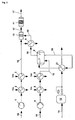
Dabei zeigt - Fig. 1 ein Fließschema des Verfahrens mit einem Kettletype-Verdampfer,
- Fig. 2 die o-Xylol-Verdampfung mit einem Natummlaufverdampfer
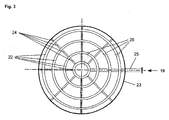
- Fig 3 ein Spargerringsystem
- Nach Fig. 1 wird aus einem Vorratstank o-Xylol (15) mit Hilfe der o-Xylol-Pumpe (4) durch die beiden o-Xylol-Vorwärmer (5) und (6) gefördert, wo das o-Xylol mit Hilfe von Dampf (13c, 13d) auf 180°C erwärmt wird. Die o-Xylol-Pumpe (4) liefert dabei auf der Druckseite einen absoluten Druck von 2,5 bar. Anschließend gelangt das flüssige o-Xylol (15) in den Kettle-Type-Verdampfer (7). Dieser Kettle-Type-Verdampfer weist im Innern nicht dargestellte dampfbeheizte Rohrschlangen auf. Das o-Xylol (15) wird bei absoluten Drücken von 2,4 bar bis 4 bar verdampft, was einer Verdampfungstemperatur von 180°C bis 205°C entspricht. Als Heizmedium wird Sattdampf (14) zwischen 18 und 30 bar verwendet, der mit einer Temperatur von 210°C bei 18 bar bzw. 234°C bei 30 bar genügend Temperaturdifferenz zum zu verdampfenden Medium aufweist. Um den Sattdampfstrom zum o-Xylol-Verdampfer (7) konstant zu halten, kommt ein Dampfspeicher (12) zum Einsatz, der zwischen der Dampfzufuhr vom Dampfnetz und dem o-Xylol-Verdampfer (7) positioniert ist.
Der so erzeugte o-Xylol-Dampf (18) wird aus dem Dampfraum des Kettletype-Verdampfers (7) abgezogen und durch einen Überhitzer (8) geleitet, der den o-Xylol-Dampf (18) um 10°C überhitzt, um eine Kondensation des Dampfes zu vermeiden. Überschüssiges Kondensat (27) wird aus dem Verdampfer (7) abgezogen. Die Vermeidung der Kondensation von o-Xylol-Dampf ist für die Mengenregelung des o-Xylols von entscheidender Bedeutung, da diese über die Mengenmessung des o-Xylol-Dampfs erfolgt und es bei Kondensation von o-Xylol-Dampf zu Schwankungen in der o-Xylol-Beladung im Prozeßluftstrom kommen würde. Schließlich wird der überhitzte o-Xylol-Dampf (19) mit der Prozeßluft (16) in einer speziellen Mischeinrichtung (10) gemischt, die vom Prozeßluftgebläse (1) durch die zweistufig ausgeführten Vorwärmer (2) und (3) zum Reaktor hin gefördert wird. Die Mischeinrichtung (10) ist so konzipiert, daß an der Zumischstelle bereits eine gute Vermischung des überhitzten o-Xylols-Dampfes (19) mit der Prozeßluft (16) erreicht wird. Hierfür kommen Spargerringe zum Einsatz, die den o-Xylol-Dampf über den gesamten Rohrleitungsquerschnitt der Prozeßluftleitung verteilen. Die Prozeßluft (16) wird in den Vorwärmern (2, 3) auf ca. 150°C erwärmt. Der zusammengeführte Feedgasstrom (17) passiert einen statischen Mischer (11) zwecks Homogenisierung von Konzentration und Temperatur, was für den sicheren und effizienten Betrieb des Oxidationsreaktors in diesen hohen Beladungsbereichen von größter Bedeutung ist. Die möglichst homogene Vormischung des überhitzten o-Xylol-Dampfes (19) in der Mischeinrichtung (10) (siehe auch Fig. 3) ist erforderlich, da der statische Mischer (11) nur mit einer festliegenden Effizienz mischen kann und daher bereits ein gut homogenisiertes Gemisch an seinem Eintritt benötigt, um die erforderliche Mischungsgüte für den Reaktor gewährleisten zu können.
Anstelle der Verdampfung des o-Xylols in einem Kettle-Type-Verdampfer kann als Verdampfungsprinzip ein Naturumlauf eingesetzt werden, wie in Fig. 2 dargestellt:
Das o-Xylol (15) gelangt nach der Vorwärmung (5, 6) in die o-Xylol-Dampftrommel (9). Diese o-Xylol-Dampftrommel (9) wird von einem Naturumlauf gespeist.
Durch das Fallrohr (20) gelangt das siedende o-Xylol (15) in einen dampfbeheizten Verdampfer (21), der als Reboiler arbeitet. Dort verdampft ein Teil des durchströmenden o-Xylols bei absoluten Drücken von ca. 2,4 bis 4 bar und wird dann wieder durch den Naturumlauf in die o-Xylol-Dampftrommel (9) gefördert. Aus dem Dampfraum gelangen die Dämpfe in den Überhitzer (8). Hier wird der o-Xylol Dampf (18) um 10°C überhitzt, um eine Kondensation des Dampfes, wie zuvor beschrieben, zu vermeiden. Das weitere Verfahren ist identisch mit dem in Fig 1 beschriebenen Ablauf.
Fig. 3 zeigt ein Spargerringsystem, mit dem eine Vermischung des überhitzten o-Xylol-Dampfes (19) mit der Prozessluft erfolgt. Mehrere Ringe (22) sind konzentrisch zueinander innerhalb der Prozeßluft-Rohrleitung (23) angeordnet. Die Ringe (22) bestehen aus gebogenen und geschweißten Rohren. Der Abstand zwischen den Ringen (22) wird durch radiale Haltebleche (24) festgelegt. Über eine Rohrleitung (25) wird unter Druck überhitzter o-Xylol-Dampf (19) in alle Ringe geleitet. Die Ringe besitzen gleichmäßig über den Umfang verteilt eine Vielzahl von Austrittsbohrungen (26), über die der o-Xylol-Dampf austritt und sich dabei mit der Prozeßluft vermischt. - Für eine PSA-Anlage mit einer Jahreskapazität von 50000 Tonnen pro Jahr wird die o-Xylol-Verdampfung nach vorstehend genannten Prinzip durchgeführt, wobei die Anlage 8000 h im Jahr in Betrieb ist. Das o-Xylol weist eine Reinheit von 98 % auf. Da die Anlage bei einer Beladung von 100 g o-Xylol pro Nm3 Luft arbeitet und die Anlage einen Yield von 112 % (kg erzeugtes Rein PSA pro kg eingesetztes o-Xylol) erzielt, ist ein o-Xylol-Strom von 50000 to/a PSA x 1,12/8000 / 0.98 = 7143 kg o-Xylol / h erforderlich.
Der Luftstrom, den die Anlage zur Oxidation benötigt, beträgt 71430 Nm3/h.
Die o-Xylol-Pumpe fördert den o-Xylolstrom (20°C, atmosph. Druck), der am Pumpenaustritt einen Druck von 1,8 bar und eine Temperatur von 40°C aufweist. Im ersten mit Niederdruckdampf von 2,5 bar beheizten Wärmetauscher erreicht das o-Xylol eine Temperatur von 135°C. Im zweiten mit 18 bar beheizten Wärmetauscher wird der o-Xylol-Strom auf 175°C aufgeheizt. Beim Eintritt in den Verdampfer weist das o-Xylol einen Druck von 1,4 bar auf, wenn die Wärmetauscher und die Rohrleitungen einen Druckverlust von 0,4 bar aufweisen.
Die Dampfverbräuche der beiden Vorwärmer sind folgende: - 1. Vorwärmer:
Wärmestrom: 7143 kg / h / 3600 s/h x 2,1 kJ / kg K x (135°C - 40°C) = 396 kW
Dampfbedarf: 396 kW / 2153 kJ / kg x 3600 s/h = 662 kg / h (2.5 bar) - 2. Vorwärmer:
Wärmestrom: 7143 kg / h / 3600 s/h x 2,1 kJ / kg K x (175°C - 135°C) = 167 kW
Dampfbedarf: 167 kW / 1900 kJ / kg K x 3600 s/h = 316 kg / h (18 bar)
Der Verdampfer muß in der Stunde 7143 kg o-Xylol verdampfen. Hierfür ist ein Wärmestrom von: 7143 kg/h / 3600 s/h x [315 KJ/kg + (180 °C - 175 °C) x 2,15 kJ/kg K] = 1365 kW
erforderlich, was einer Heizdampfmenge (18 bar) von
1365 kW / 1900 kJ/kg x 3600 s /h = 2586 kg/h bedarf. - Der Überhitzer benötigt dafür eine Wärmeleistung von
7143 kg/h / 3600 s/h x 1.9 kJ/kg K x (190°C - 180°C) = 38 kW
was einer Heizdampfmenge von 38 kW / 1900 kJ/kg x 3600 s/h = 72 kg/h (18 bar)
entspricht.
Die überhitzten o-Xylol-Dämpfe weisen am Austritt des Verdampfers einen Druck von 1,3 bar auf. Diese Dämpfe werden anschließend in den Prozeßluftstrom entspannt, dessen Druck an dieser Stelle ca. 0,5 bar beträgt.
7143 kg / h / 0,15 = 47620 kg /h o-Xylol im Verdampferkreislauf.
Die aus der Dampftrommel austretenden o-Xylol Dämpfe werden im Überhitzer um 10 K erhitzt, so daß sie am Überhitzeraustritt eine Temperatur von 190 °C aufweisen.
Claims (5)
- Verfahren zur Herstellung eines o-Xylol-Luft-Gemisches für die Phthalsäureanhydrid-Herstellung, dadurch gekennzeichnet,
dass o-Xylol vollständig unter Ausschluss von Sauerstoff verdampft, danach überhitzt und dann mit der Prozeßluft vermischt wird und dieses Gemisch dem PSA-Reaktor zugeführt wird. - Verfahren nach Anspruch 1, dadurch gekennzeichnet, daß der Verdampfer für das o-Xylol ein Naturumlauf-Verdampfer (9) oder ein Kettle-Type-Verdampfer (7) ist.
- Verfahren nach Anspruch 1, dadurch gekennzeichnet, daß die Anlage eine Beladung von 80 g o-Xylol pro Nm3 Luft bis 120 g o-Xylol pro Nm3 Luft hat.
- Verfahren nach Anspruch 1, dadurch gekennzeichnet, daß zur Heizdampfversorgung ein Dampfspeicher (12) dem o-Xylol-Verdampfer (7, 9) vorgeschaltet ist.
- Verfahren nach Anspruch 1, dadurch gekennzeichnet, daß die Beimischung des o-Xylol-Dampfes mit der Prozessluft durch eine Mischeinrichtung erfolgt, die als Spargerringsystem ausgeführt ist.
Applications Claiming Priority (2)
| Application Number | Priority Date | Filing Date | Title |
|---|---|---|---|
| DE10132627A DE10132627A1 (de) | 2001-07-05 | 2001-07-05 | Verfahren zur Erzeugung o-Xylol-Luft-Gemische für die Phthalsäureanhydrid-Herstellung |
| DE10132627 | 2001-07-05 |
Publications (2)
| Publication Number | Publication Date |
|---|---|
| EP1273577A1 EP1273577A1 (de) | 2003-01-08 |
| EP1273577B1 true EP1273577B1 (de) | 2006-12-20 |
Family
ID=7690724
Family Applications (1)
| Application Number | Title | Priority Date | Filing Date |
|---|---|---|---|
| EP02011791A Expired - Lifetime EP1273577B1 (de) | 2001-07-05 | 2002-05-28 | Verfahren zur Erzeugung von o-Xylol-Luft-Gemischen für die Phthalsäureanhydrid-Herstellung |
Country Status (9)
| Country | Link |
|---|---|
| US (1) | US6984289B2 (de) |
| EP (1) | EP1273577B1 (de) |
| JP (1) | JP4383023B2 (de) |
| KR (1) | KR100860443B1 (de) |
| AT (1) | ATE348823T1 (de) |
| DE (2) | DE10132627A1 (de) |
| RU (1) | RU2299204C2 (de) |
| SG (1) | SG102684A1 (de) |
| TW (1) | TWI244482B (de) |
Families Citing this family (2)
| Publication number | Priority date | Publication date | Assignee | Title |
|---|---|---|---|---|
| GB0718995D0 (en) * | 2007-09-28 | 2007-11-07 | Exxonmobil Chem Patents Inc | Improved vaporisation in oxidation to phthalic anhydride |
| GB0718994D0 (en) * | 2007-09-28 | 2007-11-07 | Exxonmobil Chem Patents Inc | Improved mixing in oxidation to phthalic anhydride |
Family Cites Families (12)
| Publication number | Priority date | Publication date | Assignee | Title |
|---|---|---|---|---|
| GB1063152A (en) * | 1965-02-26 | 1967-03-30 | Ici Ltd | Catalytic process for the manufacture of phthalic anyhdride |
| US3480408A (en) * | 1967-05-15 | 1969-11-25 | Foster Wheeler Corp | Phthalic anhydride reactor |
| US3535345A (en) * | 1967-08-15 | 1970-10-20 | Badger Co | Method of producing phthalic anhydride |
| US4119645A (en) * | 1973-04-11 | 1978-10-10 | Rhone-Progil | Method of preparing phthalic anhydride |
| DE2602895B2 (de) * | 1976-01-27 | 1978-06-15 | Davy Powergas Gmbh, 5000 Koeln | Verfahren zur Verwertung der bei der katalytischen Oxidation von o-Xylol zu Phthalsäureanhydrid anfallenden Reaktionswärme |
| DE2839831C2 (de) * | 1978-09-13 | 1985-04-11 | Nippon Steel Chemical Co., Ltd., Tokyo | Verfahren zur kontinuierlichen Herstellung eines Naphthalin und molekularen Sauerstoff enthaltenden Gasgemisches für die Oxidation von Naphthalin zu Phthalsäureanhydrid und/oder 1,4-Naphthochinon |
| US4261899A (en) * | 1980-04-28 | 1981-04-14 | Chem Systems Inc. | Phthalic anhydride reaction system |
| DE3336022A1 (de) * | 1983-10-04 | 1985-04-18 | Metallgesellschaft Ag, 6000 Frankfurt | Verfahren zum vermischen einer fein verduesten fluessigkeit mit einem gas und erzeugen einer explosiven mischung |
| DE3431028A1 (de) * | 1983-10-04 | 1986-03-06 | Metallgesellschaft Ag, 6000 Frankfurt | Verfahren zum vermischen einer fein zerteilten fluessigkeit mit einem gas und erzeugen einer explosiven mischung |
| DE3719476A1 (de) * | 1987-06-11 | 1988-12-29 | Huels Chemische Werke Ag | Verfahren zur herstellung von phthalsaeureanhydrid durch gasphasenoxidation eines o-xylol-naphthalin-gemisches |
| SU1625875A1 (ru) * | 1988-11-28 | 1991-02-07 | Предприятие П/Я А-7850 | Способ получени фталевого ангидрида |
| DE4034787A1 (de) * | 1990-11-02 | 1992-05-07 | Zimmer Ag | Verfahren zur erzeugung homogener o-xylol-naphthalin-luft-gemische fuer die phthalsaeureanhydrid-herstellung |
-
2001
- 2001-07-05 DE DE10132627A patent/DE10132627A1/de not_active Withdrawn
-
2002
- 2002-05-28 AT AT02011791T patent/ATE348823T1/de not_active IP Right Cessation
- 2002-05-28 EP EP02011791A patent/EP1273577B1/de not_active Expired - Lifetime
- 2002-05-28 DE DE50208986T patent/DE50208986D1/de not_active Expired - Lifetime
- 2002-06-07 TW TW091112354A patent/TWI244482B/zh not_active IP Right Cessation
- 2002-06-10 SG SG200203422A patent/SG102684A1/en unknown
- 2002-06-14 JP JP2002174544A patent/JP4383023B2/ja not_active Expired - Fee Related
- 2002-06-25 US US10/179,864 patent/US6984289B2/en not_active Expired - Fee Related
- 2002-06-28 KR KR1020020036665A patent/KR100860443B1/ko not_active Expired - Fee Related
- 2002-07-04 RU RU2002117889/04A patent/RU2299204C2/ru not_active IP Right Cessation
Also Published As
| Publication number | Publication date |
|---|---|
| US6984289B2 (en) | 2006-01-10 |
| KR20030005004A (ko) | 2003-01-15 |
| SG102684A1 (en) | 2004-03-26 |
| TWI244482B (en) | 2005-12-01 |
| US20030089460A1 (en) | 2003-05-15 |
| JP2003040883A (ja) | 2003-02-13 |
| DE50208986D1 (de) | 2007-02-01 |
| RU2299204C2 (ru) | 2007-05-20 |
| DE10132627A1 (de) | 2003-01-16 |
| KR100860443B1 (ko) | 2008-09-25 |
| EP1273577A1 (de) | 2003-01-08 |
| JP4383023B2 (ja) | 2009-12-16 |
| ATE348823T1 (de) | 2007-01-15 |
| RU2002117889A (ru) | 2004-01-20 |
Similar Documents
| Publication | Publication Date | Title |
|---|---|---|
| DE69325905T2 (de) | Verfahren zur herstellung von gereinigter terphthalsäure | |
| EP0925272B1 (de) | Verfahren zur entsorgung von bei der acrylsäure- oder methacrylsäure-herstellung anfallenden nebenkomponenten | |
| EP0696574B1 (de) | Verfahren zur Herstellung von aromatischen Aminen | |
| EP3122719B1 (de) | Verfahren zum betreiben einer gasphasenphosgenierungsanlage | |
| DE3002829A1 (de) | Zweistufiges verfahren zur herstellung von acrylsaeure | |
| WO2010037441A1 (de) | Verfahren und anlage zur herstellung von methanol | |
| DE2617340A1 (de) | Nassoxydationsvorrichtung | |
| EP0455285A1 (de) | Verfahren zum Reinigen eines H2S und CO2 enthaltenden Gases | |
| EP1239944B1 (de) | Verfahren und vorrichtung zur erzeugung eines homogenen gemisches aus einem dampfförmigen aromatischen kohlenwasserstoff und einem sauerstoff enthaltenden gas | |
| EP3416916B1 (de) | Nh3 synthesenkonfiguration für grossanlagen | |
| EP3122720A1 (de) | Verfahren zum betreiben einer gasphasenphosgenierungsanlage | |
| EP1273577A1 (de) | Verfahren zur Erzeugung von o-Xylol-Luft-Gemischen für die Phthalsäureanhydrid-Herstellung | |
| EP1670746B1 (de) | Verfahren zur regelung der reaktoreintrittstemperatur bei der methylaminherstellung | |
| EP3786146A1 (de) | Verfahren zur herstellung von methacrolein aus formaldehyd und propionaldehyd sowie herstellanlage hierfür | |
| EP0044071B1 (de) | Verfahren zur Konvertierung eines Kohlenmonoxid enthaltenden Gasstroms | |
| EP4253365A2 (de) | Verfahren zur aufarbeitung von mischsäure und abwasser aus der nitrierung von aromaten | |
| EP3781541B1 (de) | Verfahren zur herstellung von acetylen und synthesegas | |
| EP1242354B1 (de) | Verfahren und vorrichtung zur kühlung eines heissen reaktionsgases, z.b. bei der herstellung von phthalsäureanhydrid | |
| DE2814437A1 (de) | Verfahren zur katalytischen oxadation von schwefeldioxid | |
| EP4461701A1 (de) | Verfahren und anlage zur erzeugung eines oder mehrerer verfahrensprodukte | |
| DE1443988C (de) | Verfahren zur kontinuierlichen Her Stellung von Monochlorbenzol | |
| DE1939730A1 (de) | Verfahren zum katalytischen Reformen | |
| WO2009053341A2 (de) | Verfahren zur oxidation von cycloaliphatischen alkoholen, cycloaliphatischen ketonen oder deren gemische mit wässriger salpetersäure und aufarbeitung der dicarbonsäuren | |
| DE1401358B2 (de) | Einrichtung zur Erhöhung der Abhitze-Dampfausbeute bei katalytischen Hochdruck-Synthesen | |
| DE3431028A1 (de) | Verfahren zum vermischen einer fein zerteilten fluessigkeit mit einem gas und erzeugen einer explosiven mischung |
Legal Events
| Date | Code | Title | Description |
|---|---|---|---|
| PUAI | Public reference made under article 153(3) epc to a published international application that has entered the european phase |
Free format text: ORIGINAL CODE: 0009012 |
|
| AK | Designated contracting states |
Kind code of ref document: A1 Designated state(s): AT BE CH CY DE DK ES FI FR GB GR IE IT LI LU MC NL PT SE TR |
|
| AX | Request for extension of the european patent |
Free format text: AL;LT;LV;MK;RO;SI |
|
| 17P | Request for examination filed |
Effective date: 20030708 |
|
| AKX | Designation fees paid |
Designated state(s): AT BE CH CY DE DK ES FI FR GB GR IE IT LI LU MC NL PT SE TR |
|
| GRAP | Despatch of communication of intention to grant a patent |
Free format text: ORIGINAL CODE: EPIDOSNIGR1 |
|
| GRAS | Grant fee paid |
Free format text: ORIGINAL CODE: EPIDOSNIGR3 |
|
| GRAA | (expected) grant |
Free format text: ORIGINAL CODE: 0009210 |
|
| AK | Designated contracting states |
Kind code of ref document: B1 Designated state(s): AT BE CH CY DE DK ES FI FR GB GR IE IT LI LU MC NL PT SE TR |
|
| PG25 | Lapsed in a contracting state [announced via postgrant information from national office to epo] |
Ref country code: FI Free format text: LAPSE BECAUSE OF FAILURE TO SUBMIT A TRANSLATION OF THE DESCRIPTION OR TO PAY THE FEE WITHIN THE PRESCRIBED TIME-LIMIT Effective date: 20061220 Ref country code: DK Free format text: LAPSE BECAUSE OF FAILURE TO SUBMIT A TRANSLATION OF THE DESCRIPTION OR TO PAY THE FEE WITHIN THE PRESCRIBED TIME-LIMIT Effective date: 20061220 Ref country code: NL Free format text: LAPSE BECAUSE OF FAILURE TO SUBMIT A TRANSLATION OF THE DESCRIPTION OR TO PAY THE FEE WITHIN THE PRESCRIBED TIME-LIMIT Effective date: 20061220 Ref country code: IE Free format text: LAPSE BECAUSE OF FAILURE TO SUBMIT A TRANSLATION OF THE DESCRIPTION OR TO PAY THE FEE WITHIN THE PRESCRIBED TIME-LIMIT Effective date: 20061220 |
|
| REG | Reference to a national code |
Ref country code: GB Ref legal event code: FG4D Free format text: NOT ENGLISH |
|
| REG | Reference to a national code |
Ref country code: CH Ref legal event code: EP |
|
| REF | Corresponds to: |
Ref document number: 50208986 Country of ref document: DE Date of ref document: 20070201 Kind code of ref document: P |
|
| REG | Reference to a national code |
Ref country code: IE Ref legal event code: FG4D Free format text: LANGUAGE OF EP DOCUMENT: GERMAN |
|
| PG25 | Lapsed in a contracting state [announced via postgrant information from national office to epo] |
Ref country code: SE Free format text: LAPSE BECAUSE OF FAILURE TO SUBMIT A TRANSLATION OF THE DESCRIPTION OR TO PAY THE FEE WITHIN THE PRESCRIBED TIME-LIMIT Effective date: 20070320 |
|
| PG25 | Lapsed in a contracting state [announced via postgrant information from national office to epo] |
Ref country code: ES Free format text: LAPSE BECAUSE OF FAILURE TO SUBMIT A TRANSLATION OF THE DESCRIPTION OR TO PAY THE FEE WITHIN THE PRESCRIBED TIME-LIMIT Effective date: 20070331 |
|
| PG25 | Lapsed in a contracting state [announced via postgrant information from national office to epo] |
Ref country code: PT Free format text: LAPSE BECAUSE OF FAILURE TO SUBMIT A TRANSLATION OF THE DESCRIPTION OR TO PAY THE FEE WITHIN THE PRESCRIBED TIME-LIMIT Effective date: 20070423 |
|
| NLV1 | Nl: lapsed or annulled due to failure to fulfill the requirements of art. 29p and 29m of the patents act | ||
| ET | Fr: translation filed | ||
| GBV | Gb: ep patent (uk) treated as always having been void in accordance with gb section 77(7)/1977 [no translation filed] |
Effective date: 20061220 |
|
| REG | Reference to a national code |
Ref country code: IE Ref legal event code: FD4D |
|
| PLBE | No opposition filed within time limit |
Free format text: ORIGINAL CODE: 0009261 |
|
| STAA | Information on the status of an ep patent application or granted ep patent |
Free format text: STATUS: NO OPPOSITION FILED WITHIN TIME LIMIT |
|
| PG25 | Lapsed in a contracting state [announced via postgrant information from national office to epo] |
Ref country code: GB Free format text: LAPSE BECAUSE OF FAILURE TO SUBMIT A TRANSLATION OF THE DESCRIPTION OR TO PAY THE FEE WITHIN THE PRESCRIBED TIME-LIMIT Effective date: 20061220 |
|
| 26N | No opposition filed |
Effective date: 20070921 |
|
| BERE | Be: lapsed |
Owner name: LURGI A.G. Effective date: 20070531 |
|
| REG | Reference to a national code |
Ref country code: CH Ref legal event code: PL |
|
| PG25 | Lapsed in a contracting state [announced via postgrant information from national office to epo] |
Ref country code: MC Free format text: LAPSE BECAUSE OF NON-PAYMENT OF DUE FEES Effective date: 20070531 |
|
| PG25 | Lapsed in a contracting state [announced via postgrant information from national office to epo] |
Ref country code: CH Free format text: LAPSE BECAUSE OF NON-PAYMENT OF DUE FEES Effective date: 20070531 Ref country code: LI Free format text: LAPSE BECAUSE OF NON-PAYMENT OF DUE FEES Effective date: 20070531 |
|
| PG25 | Lapsed in a contracting state [announced via postgrant information from national office to epo] |
Ref country code: BE Free format text: LAPSE BECAUSE OF NON-PAYMENT OF DUE FEES Effective date: 20070531 |
|
| PG25 | Lapsed in a contracting state [announced via postgrant information from national office to epo] |
Ref country code: GR Free format text: LAPSE BECAUSE OF FAILURE TO SUBMIT A TRANSLATION OF THE DESCRIPTION OR TO PAY THE FEE WITHIN THE PRESCRIBED TIME-LIMIT Effective date: 20070321 |
|
| PG25 | Lapsed in a contracting state [announced via postgrant information from national office to epo] |
Ref country code: AT Free format text: LAPSE BECAUSE OF NON-PAYMENT OF DUE FEES Effective date: 20070528 |
|
| PG25 | Lapsed in a contracting state [announced via postgrant information from national office to epo] |
Ref country code: LU Free format text: LAPSE BECAUSE OF NON-PAYMENT OF DUE FEES Effective date: 20070528 Ref country code: CY Free format text: LAPSE BECAUSE OF FAILURE TO SUBMIT A TRANSLATION OF THE DESCRIPTION OR TO PAY THE FEE WITHIN THE PRESCRIBED TIME-LIMIT Effective date: 20061220 |
|
| PG25 | Lapsed in a contracting state [announced via postgrant information from national office to epo] |
Ref country code: TR Free format text: LAPSE BECAUSE OF FAILURE TO SUBMIT A TRANSLATION OF THE DESCRIPTION OR TO PAY THE FEE WITHIN THE PRESCRIBED TIME-LIMIT Effective date: 20061220 |
|
| REG | Reference to a national code |
Ref country code: DE Ref legal event code: R081 Ref document number: 50208986 Country of ref document: DE Owner name: AIR LIQUIDE GLOBAL E&C SOLUTIONS GERMANY GMBH, DE Free format text: FORMER OWNER: LURGI GMBH, 60439 FRANKFURT, DE Effective date: 20140505 |
|
| REG | Reference to a national code |
Ref country code: FR Ref legal event code: PLFP Year of fee payment: 14 |
|
| PGFP | Annual fee paid to national office [announced via postgrant information from national office to epo] |
Ref country code: DE Payment date: 20150521 Year of fee payment: 14 |
|
| PGFP | Annual fee paid to national office [announced via postgrant information from national office to epo] |
Ref country code: IT Payment date: 20150513 Year of fee payment: 14 Ref country code: FR Payment date: 20150521 Year of fee payment: 14 |
|
| REG | Reference to a national code |
Ref country code: DE Ref legal event code: R119 Ref document number: 50208986 Country of ref document: DE |
|
| PG25 | Lapsed in a contracting state [announced via postgrant information from national office to epo] |
Ref country code: IT Free format text: LAPSE BECAUSE OF NON-PAYMENT OF DUE FEES Effective date: 20160528 |
|
| REG | Reference to a national code |
Ref country code: FR Ref legal event code: ST Effective date: 20170131 |
|
| PG25 | Lapsed in a contracting state [announced via postgrant information from national office to epo] |
Ref country code: FR Free format text: LAPSE BECAUSE OF NON-PAYMENT OF DUE FEES Effective date: 20160531 Ref country code: DE Free format text: LAPSE BECAUSE OF NON-PAYMENT OF DUE FEES Effective date: 20161201 |