EP1256560A2 - Verfahren zur Herstellung von höheren, alpha,beta-ungesättigten Alkoholen - Google Patents
Verfahren zur Herstellung von höheren, alpha,beta-ungesättigten Alkoholen Download PDFInfo
- Publication number
- EP1256560A2 EP1256560A2 EP02007807A EP02007807A EP1256560A2 EP 1256560 A2 EP1256560 A2 EP 1256560A2 EP 02007807 A EP02007807 A EP 02007807A EP 02007807 A EP02007807 A EP 02007807A EP 1256560 A2 EP1256560 A2 EP 1256560A2
- Authority
- EP
- European Patent Office
- Prior art keywords
- general formula
- ketone
- reaction
- hydrogenation
- distillation
- Prior art date
- Legal status (The legal status is an assumption and is not a legal conclusion. Google has not performed a legal analysis and makes no representation as to the accuracy of the status listed.)
- Withdrawn
Links
Classifications
-
- C—CHEMISTRY; METALLURGY
- C07—ORGANIC CHEMISTRY
- C07C—ACYCLIC OR CARBOCYCLIC COMPOUNDS
- C07C49/00—Ketones; Ketenes; Dimeric ketenes; Ketonic chelates
- C07C49/20—Unsaturated compounds containing keto groups bound to acyclic carbon atoms
- C07C49/203—Unsaturated compounds containing keto groups bound to acyclic carbon atoms with only carbon-to-carbon double bonds as unsaturation
-
- B—PERFORMING OPERATIONS; TRANSPORTING
- B01—PHYSICAL OR CHEMICAL PROCESSES OR APPARATUS IN GENERAL
- B01J—CHEMICAL OR PHYSICAL PROCESSES, e.g. CATALYSIS OR COLLOID CHEMISTRY; THEIR RELEVANT APPARATUS
- B01J23/00—Catalysts comprising metals or metal oxides or hydroxides, not provided for in group B01J21/00
- B01J23/38—Catalysts comprising metals or metal oxides or hydroxides, not provided for in group B01J21/00 of noble metals
- B01J23/40—Catalysts comprising metals or metal oxides or hydroxides, not provided for in group B01J21/00 of noble metals of the platinum group metals
- B01J23/44—Palladium
-
- B—PERFORMING OPERATIONS; TRANSPORTING
- B01—PHYSICAL OR CHEMICAL PROCESSES OR APPARATUS IN GENERAL
- B01J—CHEMICAL OR PHYSICAL PROCESSES, e.g. CATALYSIS OR COLLOID CHEMISTRY; THEIR RELEVANT APPARATUS
- B01J23/00—Catalysts comprising metals or metal oxides or hydroxides, not provided for in group B01J21/00
- B01J23/38—Catalysts comprising metals or metal oxides or hydroxides, not provided for in group B01J21/00 of noble metals
- B01J23/48—Silver or gold
- B01J23/50—Silver
-
- B—PERFORMING OPERATIONS; TRANSPORTING
- B01—PHYSICAL OR CHEMICAL PROCESSES OR APPARATUS IN GENERAL
- B01J—CHEMICAL OR PHYSICAL PROCESSES, e.g. CATALYSIS OR COLLOID CHEMISTRY; THEIR RELEVANT APPARATUS
- B01J35/00—Catalysts, in general, characterised by their form or physical properties
- B01J35/50—Catalysts, in general, characterised by their form or physical properties characterised by their shape or configuration
- B01J35/58—Fabrics or filaments
-
- B—PERFORMING OPERATIONS; TRANSPORTING
- B01—PHYSICAL OR CHEMICAL PROCESSES OR APPARATUS IN GENERAL
- B01J—CHEMICAL OR PHYSICAL PROCESSES, e.g. CATALYSIS OR COLLOID CHEMISTRY; THEIR RELEVANT APPARATUS
- B01J37/00—Processes, in general, for preparing catalysts; Processes, in general, for activation of catalysts
- B01J37/02—Impregnation, coating or precipitation
- B01J37/0215—Coating
- B01J37/0225—Coating of metal substrates
-
- C—CHEMISTRY; METALLURGY
- C07—ORGANIC CHEMISTRY
- C07C—ACYCLIC OR CARBOCYCLIC COMPOUNDS
- C07C29/00—Preparation of compounds having hydroxy or O-metal groups bound to a carbon atom not belonging to a six-membered aromatic ring
- C07C29/17—Preparation of compounds having hydroxy or O-metal groups bound to a carbon atom not belonging to a six-membered aromatic ring by hydrogenation of carbon-to-carbon double or triple bonds
-
- C—CHEMISTRY; METALLURGY
- C07—ORGANIC CHEMISTRY
- C07C—ACYCLIC OR CARBOCYCLIC COMPOUNDS
- C07C29/00—Preparation of compounds having hydroxy or O-metal groups bound to a carbon atom not belonging to a six-membered aromatic ring
- C07C29/36—Preparation of compounds having hydroxy or O-metal groups bound to a carbon atom not belonging to a six-membered aromatic ring increasing the number of carbon atoms by reactions with formation of hydroxy groups, which may occur via intermediates being derivatives of hydroxy, e.g. O-metal
- C07C29/38—Preparation of compounds having hydroxy or O-metal groups bound to a carbon atom not belonging to a six-membered aromatic ring increasing the number of carbon atoms by reactions with formation of hydroxy groups, which may occur via intermediates being derivatives of hydroxy, e.g. O-metal by reaction with aldehydes or ketones
- C07C29/42—Preparation of compounds having hydroxy or O-metal groups bound to a carbon atom not belonging to a six-membered aromatic ring increasing the number of carbon atoms by reactions with formation of hydroxy groups, which may occur via intermediates being derivatives of hydroxy, e.g. O-metal by reaction with aldehydes or ketones with compounds containing triple carbon-to-carbon bonds, e.g. with metal-alkynes
-
- C—CHEMISTRY; METALLURGY
- C07—ORGANIC CHEMISTRY
- C07C—ACYCLIC OR CARBOCYCLIC COMPOUNDS
- C07C45/00—Preparation of compounds having >C = O groups bound only to carbon or hydrogen atoms; Preparation of chelates of such compounds
- C07C45/61—Preparation of compounds having >C = O groups bound only to carbon or hydrogen atoms; Preparation of chelates of such compounds by reactions not involving the formation of >C = O groups
- C07C45/62—Preparation of compounds having >C = O groups bound only to carbon or hydrogen atoms; Preparation of chelates of such compounds by reactions not involving the formation of >C = O groups by hydrogenation of carbon-to-carbon double or triple bonds
-
- C—CHEMISTRY; METALLURGY
- C07—ORGANIC CHEMISTRY
- C07C—ACYCLIC OR CARBOCYCLIC COMPOUNDS
- C07C45/00—Preparation of compounds having >C = O groups bound only to carbon or hydrogen atoms; Preparation of chelates of such compounds
- C07C45/61—Preparation of compounds having >C = O groups bound only to carbon or hydrogen atoms; Preparation of chelates of such compounds by reactions not involving the formation of >C = O groups
- C07C45/67—Preparation of compounds having >C = O groups bound only to carbon or hydrogen atoms; Preparation of chelates of such compounds by reactions not involving the formation of >C = O groups by isomerisation; by change of size of the carbon skeleton
- C07C45/673—Preparation of compounds having >C = O groups bound only to carbon or hydrogen atoms; Preparation of chelates of such compounds by reactions not involving the formation of >C = O groups by isomerisation; by change of size of the carbon skeleton by change of size of the carbon skeleton
- C07C45/676—Preparation of compounds having >C = O groups bound only to carbon or hydrogen atoms; Preparation of chelates of such compounds by reactions not involving the formation of >C = O groups by isomerisation; by change of size of the carbon skeleton by change of size of the carbon skeleton by elimination of carboxyl groups
Definitions
- the present invention relates to a process for the preparation of higher, .alpha.,. Beta.-unsaturated alcohols by monoethynylation of a ketone by the NH 3 / KOH process, optionally hydrogenation of the acetylene alcohol in the presence of hydrogen on a Pd-containing thin-film catalyst, pure distillation of the hydrogenation output preferably in a dividing wall column with recycling of unconverted ketones to the ethynylation stage, and optionally the production of higher alcohols which are longer by 5 C atoms each, by subsequently converting the alcohols produced by monoethynylation and optionally partial hydrogenation with acetoacetic acid alkyl esters or diketene in a Carroll reaction to give ketones and these in the stages of ethynylation, optionally hydrogenation and separation by distillation.
- the mono-acetylene alcohol is generally obtained selectively.
- the recycling of the solvent NH 3 and of unreacted acetylene are also state of the art. They are essential for the economics of the level.
- Partition columns offer a remedy.
- This Column type is described, for example, in U.S. No. 2,471,134; U.S. 4,230,533; EP 0 122 367; EP 0 126 288 and EP 0 133 510.
- a process for the preparation of 2-methyl-2-hepten-6-one is in AS 2652863 (1978).
- acetoacetic acid alkyl esters, Methylbutenol and catalyst in one Reaction vessel with attached fractionation column and then a mixture of alkyl acetoacetate and methylbutenol added.
- the content of alkyl acetoacetate in the reaction mixture not more than 15% by weight amount to avoid side reactions.
- One disadvantage of this The method is that a simple metering in of alkyl acetoacetate not in excess methylbutenol is possible because the boiling point of methylbutenol is far below the reaction temperature.
- solvent reduces the space-time yield.
- an intermediate boiler has the following Disadvantage. Reduced when using an inert intermediate boiler the reactor volume available for the starting materials, i.e. the achievable space-time yield is reduced inevitably.
- the use of the reactive intermediate boiler 3-methyl-1-buten-3-ol leads to forced coupling production of 2-methyl-2-hepten-6-one, which may be undesirable can.
- the process is limited to systems where the ⁇ , ⁇ -unsaturated alcohol boils higher than that alkyl acetoacetate used.
- the invention relates to a method for producing higher, ⁇ , ⁇ -unsaturated alcohols, the particularly high space-time yields and delivers selectivities and deals with little can implement technical effort.
- the hydrogenation output obtained according to b) and predominantly from Ally alcohol and ketone, is distilled according to c) separated, the ketone not converted in a) being separated off and is returned to a).
- the benefits of according to a) and b) High selectivity obtained is increased if that Obtain ketone in high purity and recycled. there is on the one hand a low content of corresponding alcohol essential how it is obtained according to b). This can be done by distillation only incomplete and / or with very high technical effort simultaneous loss of ketone can be separated, since it together with the ketone returns to stage a), there as an inert Ballast levels up and the capacity of the system reduced.
- distillative Separation of the mixture obtained according to a) and b) is preferred in a dividing wall column e.g. according to EP 0 122 367 or U.S. 2,471,134 to make the required purity of allyl alcohol and ketone with the least possible technical Effort can be achieved.
- the hydrogenation discharge before distillation via short path evaporation separate from high-boiling components and only the distillate freed from high boilers into the side of the separation column entered. This is done at normal pressure, preferably at reduced pressure, the lowest being advantageous here technically achievable and economically justifiable printing is applied.
- short-path evaporation the evaporation process takes place at the location the lowest possible pressure with minimal Pressure loss achieved because between the vacuum unit and the evaporator surface no internals causing pressure loss are required are used and sufficiently large wire cross-sections can be.
- a particularly advantageous structure is the simultaneous use this short path evaporator for high boiler separation the distillation bottoms of the separation column by a partial stream of Distillation sump the fresh feed to the short path evaporator is fed and is freed together from the high boilers.
- the particular advantage is that the distillation column only with vaporizable under the distillation conditions Components is loaded and the boiling temperature in the sump is minimal can be held. This is particularly economical Benefit, especially in the case of high-boiling mixtures thermal load can be minimized and thus the Losses due to thermal decomposition or condensation to high-boiling Ingredients.
- stage (d) The subsequent combination with stage (d) and the use of the discharge from stage (d) as starting material for stage (e) is particularly advantageous according to the process according to the invention, since the ketone from stage d) is one due to the process disclosed therein contains a particularly low content of the alcohol produced by the Meerwein-Ponndorf-Verley reduction.
- This low alcohol content also makes the sequential build-up of longer allyl alcohols, each extended by a pentan-2-one-5-ylidene group according to d) and e), particularly economically interesting, since, because of the low by-product rate within this sequence, each by C 5 , C 10 , C 15 etc. desired alcohol is obtained in a good yield.
- the method can also be carried out so that one by one Pentan-2-one-5-ylidene group extended alcohol of the general Formula Ia or Ib in sequence of steps d), and e) obtained becomes.
- Another object of the invention is a method for Preparation of an alcohol of the general formula Ia, which is characterized in that only pass through stages a) to c) become.
- the preferred method variant according to the invention is Preparation of an allyl alcohol of the general formula I by the implementation of stages a) to e), the sequence of the stages a) to e) can also be run through several times.
- a C 1 -C 4 alkyl radical means a methyl, ethyl, propyl, i-propyl, butyl or t-butyl radical.
- a cycloalkyl radical means a 3- to 7-membered group Ring which can be unsaturated once or more, for example a cyclopropyl, cyclobutyl, cyclopentyl, cyclohexyl or a cycloheptenyl radical.
- a cycloalkylalkyl radical is understood to mean a cycloalkyl radical bonded via a C 1 -C 30 -alkyl radical.
- the process can be carried out either continuously or in a batch process be performed. However, the is preferred continuous driving style.
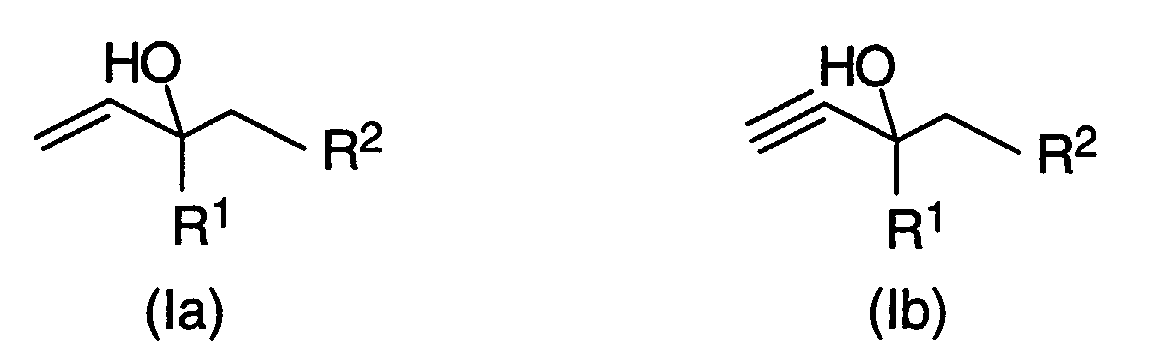
- ⁇ , ⁇ -unsaturated alcohols of the general Formula Ia means alkyl alcohols, among the alcohols of the formula Ib propargyl alcohols, preferably with the Process according to the invention alkyl alcohols of the general Formula Ia manufactured.
- ketones of the general formula IV except those corresponding to the preparation of the above alcohols Ketones are acetone, diethyl ketone, methyl ethyl ketone, Cyclohexanone, methyl isobutyl ketone, methyl vinyl ketone.
- the acetylene alcohols can be pure substances or mixed with one another be implemented in the hydrogenation. Furthermore disturbs it is not the hydrogenation if ketone has not reacted in stage a) is present in a mixture with the corresponding acetylene alcohol, because the ketone also under the process conditions according to the invention is not attacked in high concentration in the hydrogenation.
- Partition wall columns and thermally coupled columns are particularly suitable for the separation by distillation of the reaction product from stages a) and b) and stage d) by the process according to the invention.
- the valuable product the allyl alcohol
- the unreacted ketone is obtained at the top or at a side draw in the upper third of the column and is returned to stage a), if appropriate after a partial stream has been discharged. High-boiling by-products are discharged through the bottom of the column.
- the dividing wall column can be provided with 2 side deductions become. In this way, by-products that can Boiling point between product of value and low boilers or between Product of value and high boilers have been removed in high concentration become.
- H-nerolidol For example, in the production of H-nerolidol this can be done Value product via the side draw in a purity of over 98% be removed.
- the unreacted H-geranylacetone falls on Top of the column and can be recycled in stage a).
- the high boilers are removed via the bottom of the column. It is particularly advantageous to remove the high boilers from the sump the distillation column continuously on an external one Separate short path evaporator, which in one compared to Distillation column operated lower pressure.
- the Distillate from the short path evaporator is returned to the dividing wall column recycled. This allows a minimum sump temperature can be achieved, which minimizes the decomposition of valuable product and the distillation yield increases.
- the distillation according to c) can alternatively to dividing wall columns also carried out in two thermally coupled columns become. become. With thermally coupled columns, it can be from Be advantageous to add the bottom stream of the first column Vaporizer partially or completely and then fed to the second column.
- This pre-evaporation lends itself particularly well in the present case because the bottom stream of the first column larger amounts of medium boilers contains.
- pre-evaporation can take place on one lower temperature level and the evaporator of the second column are relieved. This measure continues the stripping section of the second column is substantially relieved.
- the pre-evaporated stream can be two-phase to the second column or in the form of two separate streams.
- the feed stream undergo pre-evaporation and then two-phase or in the form of two streams to the column.
- This pre-evaporation is particularly useful when the inlet flow contains larger amounts of low boilers. In the present case this is the case with low sales.
- the stripping section of the column can be substantially relieved.
- Partition wall columns and thermally coupled columns can be designed both as packed columns with packing or ordered packings or as tray columns.
- ordered sheet metal packs with a specific surface area of 100 to 500 m 2 / m 3 , preferably about 250 to 300 m 2 / m 3, are particularly suitable.
- DHNER dehydro-dihydronerolidol
- stage a The production of, for example, dehydro-dihydronerolidol (DHNER) (stage a)) and the other acetylene alcohols is preferably carried out continuously (20 bar, 20 to 50 ° C.; NH 3 (1) as solvent). It is particularly advantageous to carry out the ethynylation in a non-backmixed tubular reactor with plug-flow characteristics. This characteristic is given if the number of boilers (definition see Baerns, Hofmann, Renken, Chemical Reaction Technology, Textbook of Technical Chemistry, Volume 1, 2nd Edition, Thieme Verlag Stuttgart 1992, pp. 328-330) is greater than 50.
- reaction discharge is hydrolyzed and neutralized in a mixing device such as a static mixer or a reaction mixing pump, as described in DE 4220239.
- a mixing device such as a static mixer or a reaction mixing pump, as described in DE 4220239.
- the phase separation takes place with the help of a coalescence filter.
- the residual water is separated from the organic raw DHNER solution (depletion from 1.5% by weight to> 0.5% by weight) in a thin-film evaporator operated under vacuum.
- DHNER is formed in a one-step reaction from HGAC and acetylene using catalytic amounts of base.
- the base generally referred to as MOR, can consist of alkali hydroxides, dissolved in an aliphatic C 1 -C 8 alcohol, such as methanol, ethanol, propanol, i-propanol, butanol, preferably KOH in methanol, alkali alcoholates in the corresponding alcohol, preferably Potassium methylate in methanol or any primary, secondary or tertiary amine, but particularly preferably the base consists of potassium methylate in methanol.
- an aliphatic C 1 -C 8 alcohol such as methanol, ethanol, propanol, i-propanol, butanol, preferably KOH in methanol, alkali alcoholates in the corresponding alcohol, preferably Potassium methylate in methanol or any primary, secondary or tertiary amine, but particularly preferably the base consists
- the ethynylation part consists of a tubular reactor with three liquid and a gaseous feed in a mixer be intimately mixed. Ammonia, the ketone and the basic Catalyst solution are continuously fed into the reactor. Acetylene is metered into the reactor in a controlled manner. Especially It is advantageous if work is carried out without a gaseous feed, by adding the required acetylene in an upstream saturator dissolved in ammonia and as an ammoniacal solution to the mixer is fed. Another preferred embodiment exists in the acetylene content consumed by the reaction a section of the reactor by feeding acetylene or replaced by acetylene dissolved in ammonia. The reaction takes place at 20 bar pressure and temperatures of approx. 20 - 50 ° C.
- the molar ratio of the reactants is preferably set as follows: ketone acetylene base NH3 Mol: mol mol: mol mol: mol mol: mol 1 2.5-3.5 00:01 to 00:03 12-25
- the conversion of ketone in the ethynylation can be complete, however, the ethynylation is particularly advantageous if only a partial turnover is allowed.
- the ammonia used in the reaction and not in Acetylene consumed in the reaction is recycled.
- the ammonia and the acetylene are separated off together from the reaction mixture by flash evaporation.
- the exhaust gas flows are collected and via an absorption and Desorption column passed.
- Ammonia is added to these columns from the exhaust gas flow with water or low glycols such as Ethylene glycol separated from the acetylene and pure by distillation Form regained while the unused acetylene compressed again and returned to the reaction.
- the degassed organic raw solution is metered into a mixing unit such as a static mixer or a reaction mixing pump for neutralization.
- the raw discharge is mixed intensively with water and CO 2 and neutralized, it being possible to work here under normal pressure as well as under increased pressure.
- a 3-phase mixture is present during the neutralization process: organic phase, aqueous phase and gas phase, while under pressure the neutralization is in a 2-phase mixture - organic phase (liquid) and aqueous phase (liquid).
- the two-phase process variant is preferably used under pressure, since this makes the process easier to control and no significant excess of gas phase is required.
- the discharge is separated into the aqueous and organic phases.
- the organic phase is passed through a thin-film evaporator for dewatering and the remaining water is drawn off overhead.
- the dewatered discharge which, for example, can also contain the unreacted ketone HGAC in addition to DHNER, is passed on directly to the hydrogenation.
- HNER is obtained in a one-step reaction by reacting the DHNER with hydrogen on a Pd-containing thin-film catalyst (step b)).
- the ketone contained in the feed is not attacked.
- the thin film catalyst can be produced by vapor deposition, sputtering (EP564830, EP 412415) or preferably by impregnation (EP 827 944).
- the active components mentioned in EP 827 944 in the concentrations given therein are useful.
- the external shape of the catalysts is also described in EP 827 944. CO is added to the hydrogen to increase the selectivity.
- the one advantageously carries out in the reactor is the catalyst ready for use for the partial hydrogenation according to the invention.
- the catalysts used have good selectivity and activity also have a long service life. Especially for continuous operated single-line systems, this is of great advantage, because this means shutdown times for frequent catalyst changes be minimized.
- the conversion of the DHNER to the HNER takes place in at least two reactors connected in series. 90 to 95% of the conversion is achieved in the first and possibly in a further reactor equipped with a liquid circuit and gas circuit, and the remaining conversion is achieved in the second and possibly in a further reactor with plug-flow characteristics.
- the feed to the second reactor is level-controlled from the gas-liquid separator in the circuit of the first reactor.
- the hydrogenation is advantageously achieved if the cross-sectional loads of the gas and the liquid in the first reactor are set in the range from 20 to 500 m 3 / m 2 h, preferably 100 to 300 m 3 / m 2 * h.
- Each of the two reactors can also be designed in duplicate, which can be operated both in series and in parallel.
- the partial hydrogenation in is particularly advantageous technical scale when the cycle gas by means of the liquid flow and a suitable device, such as a liquid-gas compressor injected into the reactor in finest distribution. Together with the shape of the catalyst monoliths and the Gassing of the reactor described achieves high space-time yields through optimal cross-mixing and good hydrodynamics at the catalyst interface.
- the partial hydrogenations are depending on the substance, at temperatures of 20 to 250 ° C, preferably 60 to 200 ° C carried out.
- the hydrogenation is in the range of 0.3 to 200 bar, preferably 0.5 to 20 bar operated.
- the gas supply of the two reactors with hydrogen and oxogas (Mixture of hydrogen and CO 1: 1) is volume-controlled. about A continuous IR measurement shows the CO content in the exhaust gas stream determine. This value can be used to regulate the inflow be used on oxogas.
- the levels of CO in hydrogen should in the range of 10 to 2000 ppm, preferably 300 to 1800 ppm CO lie.
- the CO in the liquid phase can also be reduced slightly Decomposition of a compound admixed with the acetylene alcohol, which releases CO, with the proviso that that the above ranges of CO concentration in the Gas phase must not be exceeded.
- the pure distillation column is a packed column with Partition and is at a head pressure of 20 to 300 mbar, preferably operated 150 mbar.
- the hydrogenated mixture is in the side inlet of the column given.
- the low boilers go overhead - mainly unconverted ketone ex level 2 (here HGAC) - and are in Top condenser or condensed out via the side deduction above.
- the condensed vapors are collected and returned to the ketone charge of step (a).
- the possibility for removal is provided.
- the ketone can be more advantageous in higher purity from a second side print in the upper Area of the dividing wall column are withdrawn, overhead a lower stream of low boilers is obtained.
- the cleaned HNER is in the area of the partition in the side fume cupboard won fluently.
- H-NER H-NER obtained after steps a) -c) if necessary after stage d) to H-farnesylacetone (6,10,14 Trimethyl-5,9-pentadecadien-2-one
- the preparation takes place advantageously continuously in a reaction column 500 mbar.
- the resultant are at the top of the reaction column Separated methanol and carbon dioxide.
- the bottom stream of the reaction column which contains the product of value together with high boilers, is operated in a dividing wall column operated at 100 mbar worked up.
- the bottom of the dividing wall column is in one downstream thin film evaporator of residual valuable product freed that to increase the yield in the column is returned. Unreacted reactants are in the Reaction column returned.
- the H-farnesylacetone is obtained by reacting H-NER with methyl acetoacetate (AME) after a so-called Carroll reaction manufactured using the methanol and carbon dioxide as By-products arise.
- the reaction can be thermal be carried out, however, in the presence of aluminum alcoholates or aluminum triacetoacetates much higher Yields achieved.
- a side reaction of the H-farnesylacetone synthesis is a Meerwein-Ponndorf-Verley reduction from which the H-farnesylacetone isomers be reduced to the corresponding alcohols.
- H-Farnesylaceton-ole are undesirable secondary components.
- the Meerwein-Ponndorf-Verley reduction is due to Catalyzed aluminum alcoholates. For this reason, the Carroll reaction the use of aluminum triacetoacetates from Advantage.
- the method according to the invention is expediently carried out in such a way that that the reactants together with the catalyst in a fractionation column metered. It is an advantage if to separate the higher boiling reactants (H-NER) or together with the liquid catalyst above the lower boiling reactant (AME) continuously feeds into the fractionation column. The reaction with a superimposed one now takes place in the fractionation column Distillation instead. This will make it during the reaction released carbon dioxide and that from the acetoacetic acid alkyl ester Originating alcohol (methanol) constantly from the reaction mixture away.
- H-NER higher boiling reactants
- AME lower boiling reactant
- the carbon dioxide and the methanol leave the column together with the low boilers over the top stream and get into the Condenser where the condensable components of the vapor stream be condensed out.
- Part of the condensate is called the return added to the column and the other part removed. It should a reflux ratio between 1 and 10, preferably between 2 and 4 can be set. But it is also possible to use the condensate to subtract completely when the higher boiling reactant is on one of the top levels is abandoned.
- the pressure at the top of the column is set so that the temperature in the swamp between 100 and 300 ° C, preferably between 180 and 220 ° C. Depending on Material system and desired bottom temperature can do this with a Vacuum pump and / or a control valve happen.
- the reaction product collects in the bottom of the column and is by means of a Pump together with the unreacted reactants (H-NER, AME) deducted from the bottom stream.
- the crude product (H-farnesylacetone) is discharged via the product line using a control valve and further processing.
- the dosage amounts are chosen so that the stoichiometric Ratio of reactants between 0.8 and 1.2, preferably is between 0.95 and 1.05 and the catalyst content is 0.1 to 5 mol%, preferably from 1 to 3 mol%, based on the to be converted alkyl acetoacetate.
- the dwell time of the reaction mixture in the reactor system consisting of evaporator and fractionation column should be 15 minutes to 6 hours, preferably 0.5 to 2 hours. To carry out the implementation are 10 to 100 theoretical levels, preferably between 20 and 40 steps required. In the upper part of the column, 0 to 5 steps above the feed stream and in the lower part of the column 0 to 5 steps below the feed flow can be provided.
- the bottom stream of the reaction column it is possible to use the bottom stream of the reaction column to be worked up directly in the dividing wall column.
- the bottom stream should be placed in a downstream thin film evaporator in which the separation of the High boilers take place.
- the vapor stream of the thin film evaporator is returned to the dividing wall column.
- the so won H-Farnesylacetone can then again in stage a) for further Implementation to be used isophytol (stage e)).
- DHNER dehydro-dihydro-nerolidol
- HGAC hexageranylacetone
- a 1.8 1 stainless steel reactor with 'plug flow characteristics' serves as the reactor (Reaction tube with 6 mm inner diameter).
- Approx. 190 g / h of the recycled material come from the metered-in HGAC from the distillation after the hydrogenation.
- the residence time in the reactor is 42 min.
- the neutralization and hydrolysis are carried out with 500 g / h water and 10 nl / h CO 2 gas in a reaction mixing pump at 70 ° C.
- a coalescence filter 50 ⁇ m
- the organic phase is dried in a further thin-film evaporator, which is operated at 90 ° C and 150 mbar.
- 950 +/- 30 g / h of raw organic discharge are passed on to stage 3 (hydrogenation) ( ⁇ 15% by weight of unconverted HGAC and ⁇ 82% by weight of DHNER).
- the aqueous phase also contains traces of ammonium hydrogen carbonate (> 0.5 g / 100 g).
- a smooth Kanthal fabric (material number 1.4767) with a mesh size of 180 ⁇ m and a wire diameter of 112 ⁇ m is heat-treated in air for 5 hours (h) at 950 ° C.
- a 20 cm wide strip of fabric was stretched on a winding device and then continuously transported through an impregnation bath which contained an aqueous metal salt solution of palladium nitrate and silver nitrate.
- the then dried fabric tape had a coating of 280 mg Pd / m 2 and 70 mg Ag / m 2 .
- the catalyst precursor was formed in an electric muffle for 3 hours (h) at 300 ° C.
- the fabric was then corrugated, wound up and thus shaped into monoliths.
- the exhaust gas which corresponds in composition to the cycle gas, contained a CO concentration of 1200 to 1500 ppm.
- the temperature in the first reactor was 115 ° C.
- the amount of raw organic discharge was 950 +/- 30 g / h.
- the second reactor is operated in the bottom pass in a single pass at a pressure of 4 bar, a temperature of 91 ° C. and a CO concentration in hydrogen of 225 ppm.
- the feed quantity to the second reactor is regulated via the level of the gas-liquid separator in the circuit of the first reactor. Its discharge is continuously passed on to the distillative workup.
- the discharge contains about 15% by weight of unreacted HGAC from stage 2, about 78.5% by weight of HNER, 2% of unknown high-boiling components and 1% of tetrahydronerolidol (overhydrated alcohol).
- the purifying distillation was carried out in a dividing wall column 30 theoretical levels and a diameter of 80 mm.
- Column internals packs of the type Montz A3-1000 were used.
- the column was at a top pressure of 150 mbar operated.
- stage (b) The hydrogenated mixture from stage (b) was continuously fed into the side inflow of the column given at level 14. Over head the low boilers, mainly HGAC, were separated and in Condenser condensed out. The condensed vapors are caught and completely in the ketone template Ethinylation recycled.
- the cleaned HNER was the dividing wall column over a liquid side draw with a purity of 98.5%. Temperatures of 180 ° C to 190 ° C were in the bottom of the column reached. At these temperatures there were only small amounts HNER included in the swamp.
- the swamp was used to separate this HNER content in a thin film evaporator operated at 10 mbar given and its top product returned to the column. The bottom of the thin film evaporator was from the Process diverted.
- the H-nerolidol obtained in this way can then optionally in a continuous Carroll reaction continues to H-farnesylacetone be implemented.
- a fractionation column with 30 bubble trays is used as the apparatus (approx. 20 theoretical levels) and an inner diameter of 30 mm used.
- the floors are numbered from bottom to top, i.e. the bottom floor is floor 1 and the top floor is Tray 30.
- the column is at regular intervals with thermocouples equipped so that except at the bottom and at the top of the column the temperature is measured at every 3rd to 4th theoretical stage can be. In addition to the temperature profile, you can use the appropriate Sampling points the concentration profile in the Column can be determined.
- the vaporizer which uses a Thermostats can be heated to 250 ° C, has a volume of approx. 350 ml, the filling level during operation approx. 225 ml is.
- a cooler is placed on the column, with a Cryostat is operated.
- the column is with a Vacuum unit and a cold trap equipped. All closed and flowing currents are recorded and recorded using scales.
- the example shows that the Carroll reaction according to the invention Process with high space-time yield and high Selectivity can be carried out.
- stage e) The ketone obtained in stage d) can then be returned to the Stage a) are used (stage e)).
Landscapes
- Chemical & Material Sciences (AREA)
- Organic Chemistry (AREA)
- Chemical Kinetics & Catalysis (AREA)
- Engineering & Computer Science (AREA)
- Materials Engineering (AREA)
- Organic Low-Molecular-Weight Compounds And Preparation Thereof (AREA)
- Low-Molecular Organic Synthesis Reactions Using Catalysts (AREA)
Abstract
Description
- In der Ethinylierung wird quantitativer Umsatz erzeugt, wodurch nur schlechte Selektivitäten erzielt werden. Die Verweilzeiten sind mit 2-10 h sehr hoch, was geringe Raum-Zeit-Ausbeuten und damit große Reaktoren bedingt. Die Neutralisation wird mit Ammoniumsulfat durchgeführt, was einen zusätzlichen Salzanfall im Abwasser bedeutet.
- Die beschriebene Partialhydrierung weist ebenfalls schlechte Raum-Zeit-Ausbeuten und Selektivitäten auf. Zudem ist sie aufwendig, da mit einem Suspensionskatalysator gearbeitet wird, dessen vollständige Abtrennung vom Produkt nur mit hohem technischen Aufwand realisierbar ist.
- Die Carroll-Reaktion führt in der beschriebenen technischen Ausführung ebenfalls zu für ein technisches Verfahren geringen Selektivitäten und Raum-Zeit-Ausbeuten.
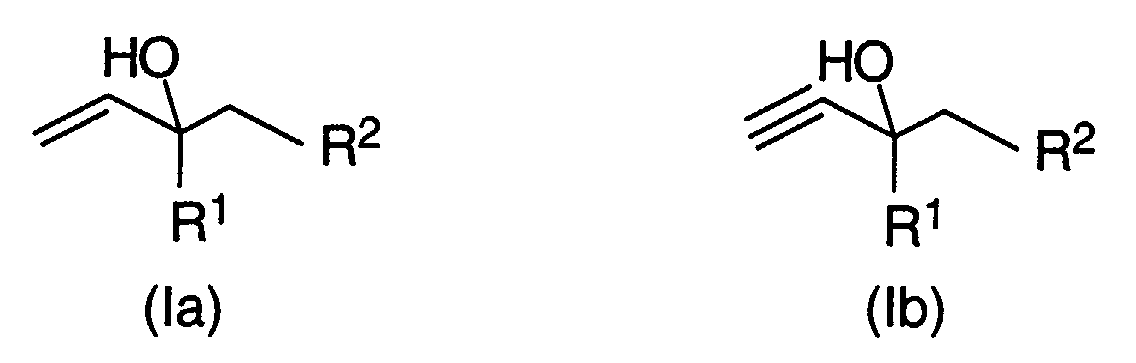
- R1
- Wasserstoff oder einen C1-C4-Alkylrest bedeutet
- R2
- die Gruppe der allgemeinen Formel II
Wasserstoff einen gesättigten oder einen ein- oder mehrfach ungesättigten C1-C30-Alkyl-, Cycloalkylalkyl- oder Cycloalkylrest bedeuten, die gegebenenfalls mit C1-C4-Alkyl substituiert sein können

- R3
- Wasserstoff oder einen C1-C4-Alkylrest bedeutet,
und die gestrichelte Linie eine zusätzliche Doppelbindung bedeuten kann, durch - n
- die Zahl 0 oder 1 bis 6 bedeutet, durch
- a) basekatalysierte Monoethinylierung eines Ketons der allgemeinen Formel R1-CO-CH2-R2 in flüssigem Ammoniak (NH3/KOH-Verfahren, bzw. NH3/MOR-Verfahren), wobei R1 und R2 die oben angegebene Bedeutung besitzen,
- b) gegebenenfalls anschließender Hydrierung des Acetylenalkohols der allgemeinen Formel Ib in Gegenwart von Wasserstoff an einem Pd-haltigen Dünnschichtkatalysator und
- c) anschließender Reindestillation des Hydrieraustrages, sowie gegebenenfalls
- d) Umsetzen des in den Stufen a) bis c) oder a) und c)
erzeugten Alkohols der allgemeinen Formel Ia bzw. Ib
mit Diketen oder Acetessigsäurealkylestern der allgemeinen Formel IV
 in der R5 für C1-C4-Alkyl steht,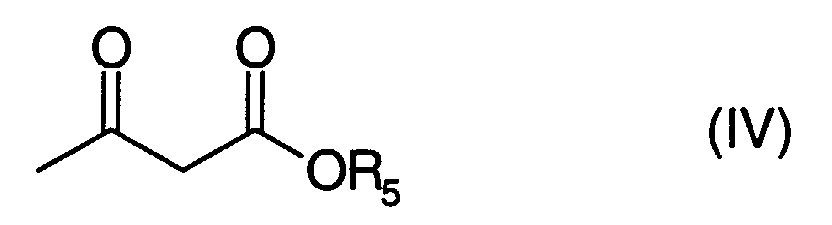
in Gegenwart von 0,1 bis 0,5 Mol-% einer organischen Aluminiumverbindung bezogen auf den umzusetzenden Acetessigsäurealkylester zur Herstellung des korrespondierenden um 3 C-Atome verlängerten Methylketons, - e) und Einsatz des gegebenenfalls in Stufe d) gewonnenen Ketons in die Stufen a) bis c),

Das nicht umgesetzte Keton fällt am Kopf oder an einem im oberen Drittel der Kolonne liegenden Seitenabzug an und wird, gegebenenfalls nach Ausschleusung eines Teilstroms, in Stufe a) zurückgeführt. Hochsiedende Nebenprodukte werden über den Sumpf der Kolonne ausgeschleust.

| Keton | Acetylen | Base | NH3 |
| Mol:mol | mol:mol | mol:mol | mol:mol |
| 1 | 2.5-3.5 | 0.01-0.03 | 12-25 |
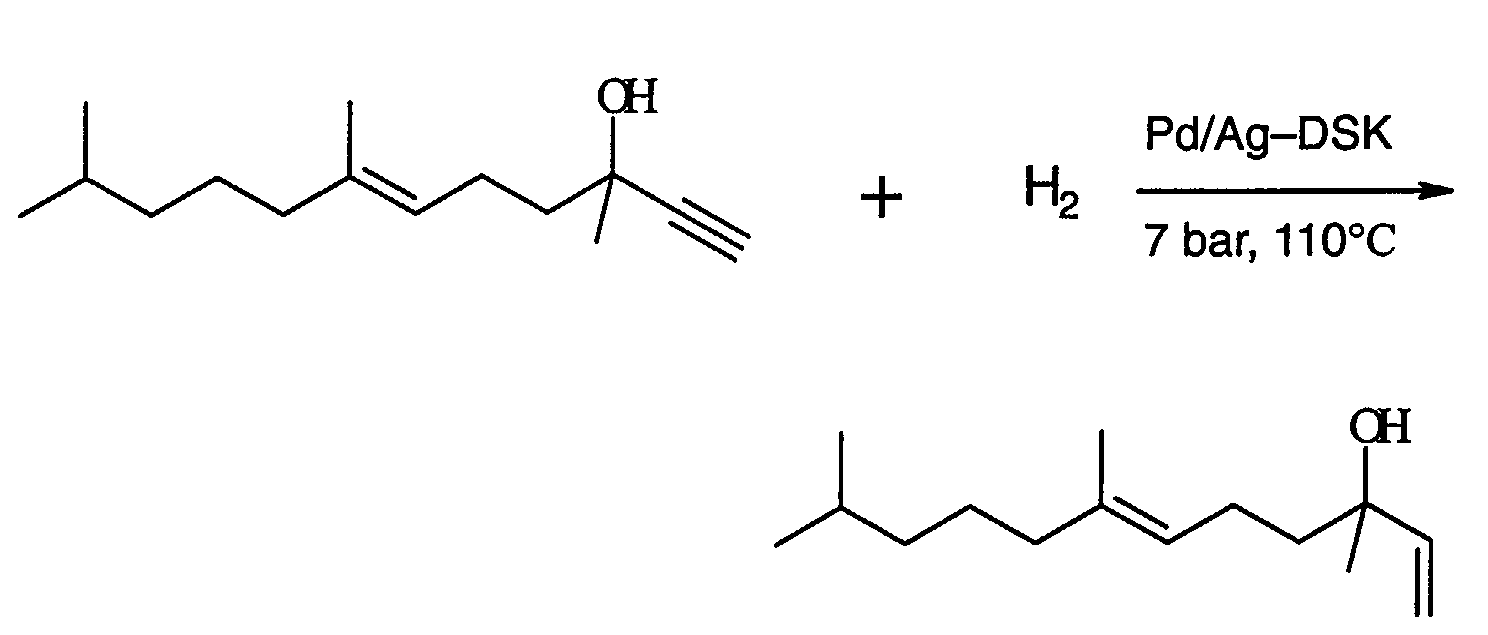
Claims (20)
- Verfahren zur Herstellung von höheren, α,β-ungesättigten Alkoholen der allgemeinen Formel Ia bzw. Ibwobei
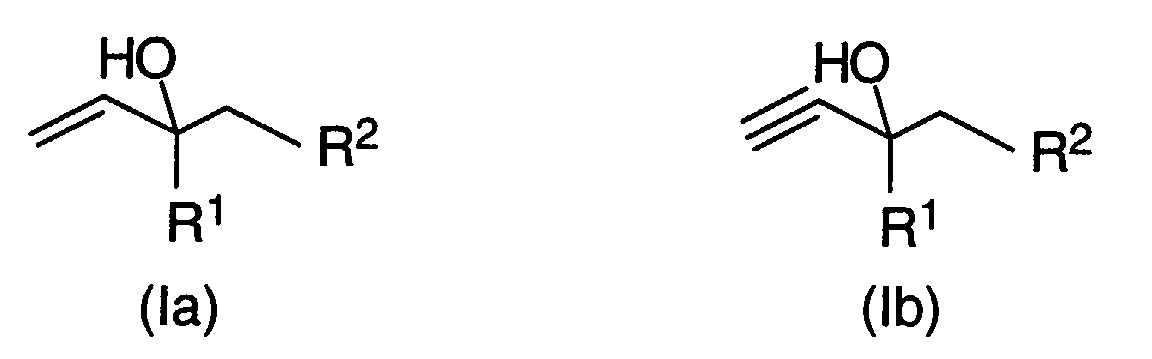
- R1
- Wasserstoff oder einen C1-C4-Alkylrest bedeutet
- R2
- die Gruppe der allgemeinen Formel II
Wasserstoff einen gesättigten oder einen ein- oder mehrfach ungesättigten C1-C30-Alkyl-, Cycloalkylalkyl-oder Cycloalkylrest bedeuten, die gegebenenfalls mit C1-C4-Alkyl substituiert sein können
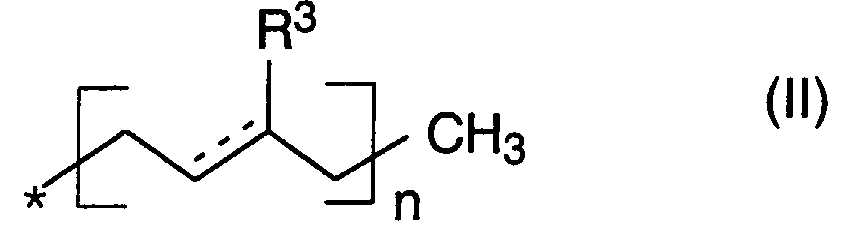
- R3
- Wasserstoff oder einen C1-C4-Alkylrest bedeutet,
und die gestrichelte Linie eine zusätzliche Doppelbindung bedeuten kann, durch - n
- die Zahl 0 oder 1 bis 6 bedeutet, durch
- a) basekatalysierte Monoethinylierung eines Ketons der allgemeinen Formel R1-CO-CH2-R2 in flüssigem Ammoniak (NH3/KOH-Verfahren, bzw. NH3/MOR-Verfahren), wobei R1 und R2 die oben angegebene Bedeutung besitzen,
- b) gegebenenfalls anschließender Hydrierung des Acetylenalkohols der allgemeinen Formel Ib in Gegenwart von Wasserstoff an einem Pd-haltigen Dünnschichtkatalysator und
- c) anschließender Reindestillation des Hydrieraustrages, sowie gegebenenfalls
- d) Umsetzen des in den Stufen a) bis c) oder a) und c)
erzeugten Alkohols der allgemeinen Formel Ia bzw. Ib
mit Diketen oder Acetessigsäurealkylestern der allgemeinen Formel IV
 in der R5 für C1-C4-Alkyl steht,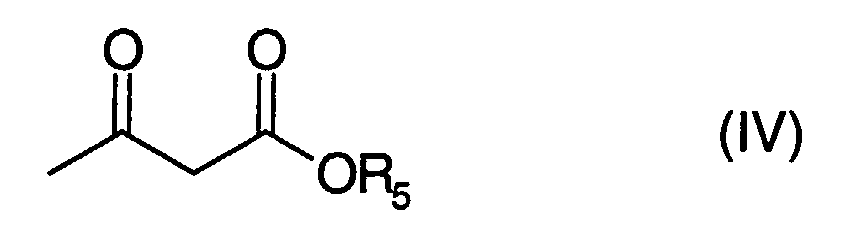
in Gegenwart von 0,1 bis 0,5 Mol-% einer organischen Aluminiumverbindung bezogen auf den umzusetzenden Acetessigsäurealkylester zur Herstellung des korrespondierenden um 3 C-Atome verlängerten Methylketons, - e) und Einsatz des gegebenenfalls in Stufe d) gewonnenen Ketons in die Stufen a) bis c),
- Verfahren gemäß Anspruch 1, dadurch gekennzeichnet, daß der Teilumsatz des Ketons bei 50 bis 95 % liegt.
- Verfahren zur Herstellung von höheren Alkoholen der allgemeinen Formel Ia bzw. Ib, gemäß einem der Ansprüche 1 oder 2, dadurch gekennzeichnet, daß R2 die Gruppe der allgemeinen Formel II bedeutet.
- Verfahren gemäß einem der Ansprüche 1 bis 3, dadurch gekennzeichnet, daß im Anschluß an die Umsetzung der Stufen a) bis c) eine Umsetzung gemäß den Stufen d) und e) stattfindet.
- Verfahren gemäß Anspruch 4, dadurch gekennzeichnet, daß die Sequenz der Stufen a) bis d) mehrfach durchlaufen werden kann.
- Verfahren gemäß einem der Ansprüche 1 bis 5, dadurch gekennzeichnet, daß ein entsprechender, um eine Penten-2-on-5-yliden-Gruppe erweiterter Alkohol der allgemeinen Formel Ia bzw. Ib, in Abfolge der Schritte d), und e) erhalten wird.
- Verfahren gemäß einem der Ansprüche 1 bis 6, dadurch gekennzeichnet, daß der in Stufe a) gewonnene Acetylenalkohol der allgemeinen Formel III unter Umgehung der Stufe b) direkt der Reindestillation der Stufe c) unterworfen wird.
- Verfahren gemäß Anspruch 7, dadurch gekennzeichnet, daß im Anschluß an die Umsetzung der Stufen a) und c) eine Umsetzung gemäß den Stufen d) und e) stattfindet.
- Verfahren gemäß einem der Ansprüche 1 bis 6, dadurch gekennzeichnet, daß die höheren Alkohole der allgemeinen Formel Ia, ausgewählt sind aus der Gruppe 3,7,11-Trimethyl-1,6,10-dodekatrien-3-ol (2-NER), 3,7,11-Trimethyl-1,6-dodekadien-3-ol (HNER), 3,7,11-Trimethyldodec-1-en-3-ol (THNER), 3,7,11,15- Tetramethyl-1-hexadecen-3-ol (IP), 3,7-Dimethylocta-1,6-dien- 3-ol (2-LIN), 3,7-Dimethyloct-1-en-3-ol (HLIN), 3-Methyl-1- (2,6,6-trimethyl-1-cyclohexen-1-yl)-penta-1,4-dien-3-ol, 3-Methyl-3-hydroxybuten (MBE).
- Verfahren gemäß einem der Ansprüche 1 bis 8, dadurch gekennzeichnet, daß die Acetylenalkohole der allgemeinen Formel Ib, ausgewählt sind aus der Gruppe 3,7,11-Trimethyldodec-1-yn-3-ol (TMD) 3,7,11,15-Tetramethyl-hexadec-1-yn-3-ol (DIP3,7,11-Trimethyl-6,10-dodekadien-1-yn-3-ol (2-DHNER), 3,7,11-Trimethyl-6-dodecen-1-yn-3-ol (DHNER), 3,7-Dimethylocta-6-en-1-yn-3-ol (2-DHL), 3,7-Dimethyloct-1-yn-3-ol (HDHL), 3-Methyl-1-(2,6,6-trimethyl-1-cyclohexen-1-yl)-penta-4-en-1-yn-3-ol, 3-Methyl-3-hydroxybutin (MBI).
- Verfahren gemäß einem der Ansprüche 1 bis 10, dadurch gekennzeichnet, dass die in Stufe (a) eingesetzten Ketone der allgemeinen Formel R1-CO-R2 sowohl als Reinsubstanzen als auch gemischt miteinander in die Stufe (a) eingesetzt werden können.
- Verfahren nach einem der Ansprüche 1 bis 11, dadurch gekennzeichnet, dass die Ethinylierung in einem Rohrreaktor mit einer Kesselzahl größer 50 durchgeführt wird.
- Verfahren nach einem der Ansprüche 1 bis 12, dadurch gekennzeichnet, dass das in Stufe (a) nach einer Teilstrecke des Reaktors umgesetzte Acetylen durch frisches Acetylen oder durch frisches Acetylen gelöst in Ammoniak nach dieser Teilstrecke ersetzt wird.
- Verfahren nach einem der Ansprüche 1 bis 13, dadurch gekennzeichnet, dass in Stufe (a) Kaliummethanolat in Methanol als Katalysator verwendet wird.
- Verfahren gemäß einem der Ansprüche 1 bis 14, dadurch gekennzeichnet, dass die Acetylenalkohole der allgemeinen Formel Ib sowohl als Reinsubstanzen als auch gemischt miteinander in der Hydrierung umgesetzt werden können.
- Verfahren gemäß einem der Ansprüche 1 bis 15, dadurch gekennzeichnet, dass vor der destillativen Auftrennung des Reaktionsaustrages aus Stufe a) und b) eine Kurzwegverdampfung zur schonenden Abtrennung hochsiedender Nebenprodukte durchgeführt wird.
- Verfahren gemäß einem der Ansprüche 1 bis 16, dadurch gekennzeichnet, daß zur destillativen Auftrennung des Reaktionsaustrages aus Stufe a), b) und d) thermisch gekoppelte Kolonnen verwendet werden.
- Verfahren gemäß Anspruch 17, dadurch gekennzeichnet, daß als Kolonnen Trennwandkolonnen verwendet werden.
- Verfahren nach Anspruch 18, dadurch gekennzeichnet, daß die Trennwandkolonne mit mehr als einem Seitenabzug ausgestattet ist.
- Verfahren gemäß einem der Ansprüche 1 bis 19, dadurch gekennzeichnet, daß in die Ethinylierung der Stufe (a) Ketone eingesetzt werden, die durch partielle oder vollständige selektive C=C-Hydrierung von 6,10-Dimethylundeca-3,5,9-trien-2-on (Pseudoionon) oder 6,10,14-Trimethylpenta-5,9,13-trien-2-on erhalten werden.
Applications Claiming Priority (2)
| Application Number | Priority Date | Filing Date | Title |
|---|---|---|---|
| DE10123066A DE10123066A1 (de) | 2001-05-11 | 2001-05-11 | Verfahren zur Herstellung von höheren alpha,beta-ungesättigten Alkoholen |
| DE10123066 | 2001-05-11 |
Publications (2)
| Publication Number | Publication Date |
|---|---|
| EP1256560A2 true EP1256560A2 (de) | 2002-11-13 |
| EP1256560A3 EP1256560A3 (de) | 2003-12-03 |
Family
ID=7684502
Family Applications (1)
| Application Number | Title | Priority Date | Filing Date |
|---|---|---|---|
| EP02007807A Withdrawn EP1256560A3 (de) | 2001-05-11 | 2002-04-06 | Verfahren zur Herstellung von höheren, alpha, beta-ungesättigten Alkoholen |
Country Status (5)
| Country | Link |
|---|---|
| US (1) | US6828468B2 (de) |
| EP (1) | EP1256560A3 (de) |
| JP (1) | JP2003026620A (de) |
| CN (1) | CN100480221C (de) |
| DE (1) | DE10123066A1 (de) |
Cited By (5)
| Publication number | Priority date | Publication date | Assignee | Title |
|---|---|---|---|---|
| WO2004018400A1 (en) * | 2002-08-16 | 2004-03-04 | Dsm Ip Assets B.V. | Ethynylation process |
| WO2005082822A1 (de) * | 2004-02-26 | 2005-09-09 | Basf Aktiengesellschaft | Verfahren zur herstellung eines propargylalkohols und eines allylalkohols |
| WO2007006556A1 (de) * | 2005-07-12 | 2007-01-18 | Basf Aktiengesellschaft | Verfahren zur herstellung von polyisobuten hoher qualität |
| WO2007071329A1 (en) * | 2005-12-20 | 2007-06-28 | Dsm Ip Assets B.V. | Process for ubiquinone intermediates |
| EP4549617A1 (de) | 2023-10-31 | 2025-05-07 | Basf Se | Herstellung von gesättigten oder ethylenisch ungesättigten (cyclo)aliphatischen verbindungen durch hydrierung ethylenisch oder acetylenisch ungesättigter (cyclo)aliphatischer verbindungen unter verwendung von wasserstoff mit niedrigem deuteriumgehalt |
Families Citing this family (23)
| Publication number | Priority date | Publication date | Assignee | Title |
|---|---|---|---|---|
| US7410495B2 (en) | 2002-08-21 | 2008-08-12 | Kci Licensing, Inc. | Medical closure clip system and method |
| US7413570B2 (en) | 2002-08-21 | 2008-08-19 | Kci Licensing, Inc. | Medical closure screen installation systems and methods |
| US8062331B2 (en) | 2002-08-21 | 2011-11-22 | Kci Licensing, Inc. | Internal and external medical closure screen systems and methods |
| US7413571B2 (en) | 2002-08-21 | 2008-08-19 | Kci Licensing, Inc. | Flexible medical closure screen and method |
| US7381211B2 (en) | 2002-08-21 | 2008-06-03 | Kci Licensing, Inc. | Medical closure screen device and method |
| US7351250B2 (en) | 2002-08-21 | 2008-04-01 | Kci Licensing, Inc. | Circumferential medical closure device and method |
| US10363344B2 (en) | 2002-12-31 | 2019-07-30 | Kci Licensing, Inc. | Externally-applied patient interface system and method with a controlled region for implanted or buried bio-reactor |
| US6951553B2 (en) | 2002-12-31 | 2005-10-04 | Kci Licensing, Inc | Tissue closure treatment system and method with externally-applied patient interface |
| US7976519B2 (en) | 2002-12-31 | 2011-07-12 | Kci Licensing, Inc. | Externally-applied patient interface system and method |
| DE10319159A1 (de) * | 2003-04-29 | 2004-11-18 | Basf Ag | Verfahren zur destillativen Gewinnung von hochreinem Triethylendiamin (TEDA) |
| US7326217B2 (en) * | 2003-11-28 | 2008-02-05 | Bubb Stephen K | Orthopedic and dental implant system and method |
| US20050268425A1 (en) * | 2004-04-20 | 2005-12-08 | Clemons William E Sr | Surface cleaner |
| CN100371308C (zh) * | 2004-10-29 | 2008-02-27 | 中国石油化工股份有限公司 | 由酮和乙炔合成炔醇的方法 |
| US9408956B2 (en) | 2010-09-24 | 2016-08-09 | Kci Licensing, Inc. | Cellular control and tissue regeneration systems and methods |
| US9569566B2 (en) | 2011-12-12 | 2017-02-14 | Zam Research Llc | Simulation and control system and method using contact, pressure waves and factor controls for cell regeneration, tissue closure and related applications |
| EP3372208B1 (de) | 2012-11-12 | 2022-07-20 | 3M Innovative Properties Company | Äusserlich angebrachte wundverbände und -verschlüsse |
| US10492956B2 (en) | 2013-03-15 | 2019-12-03 | Kci Licensing, Inc. | Topical vacuum-press surgical incisional dressings, surgical adjuncts, hybrids and composites |
| WO2014145993A2 (en) | 2013-03-15 | 2014-09-18 | Kci Licensing Inc. | Topical vacuum-press surgical incisional dressings, surgical adjuncts, hybrids and composites |
| CN107876047B (zh) * | 2017-11-19 | 2021-01-05 | 西安凯立新材料股份有限公司 | 一种α,β-不饱和醛/酮加氢用Pd/C催化剂的制备方法 |
| CN110143849B (zh) * | 2019-06-05 | 2020-01-10 | 山东新和成维生素有限公司 | 一种炔醇的制备方法 |
| KR102656545B1 (ko) * | 2019-09-17 | 2024-04-09 | 아심켐 라이프 사이언스 (톈진) 컴퍼니, 리미티드 | 아세틸렌과 케톤계 화합물의 부가 반응 방법 |
| EP4288402A1 (de) * | 2021-02-08 | 2023-12-13 | DSM IP Assets B.V. | Herstellung von allenketonen unter verwendung von ammonium(thio)sulfaten oder wasserstoff(thio)sulfaten |
| CN117304005B (zh) * | 2023-08-11 | 2025-08-12 | 宁夏天新药业有限公司 | 甲基丁炔醇的后处理精制方法和应用与甲基丁炔醇的精制方法 |
Family Cites Families (35)
| Publication number | Priority date | Publication date | Assignee | Title |
|---|---|---|---|---|
| US3023246A (en) * | 1962-02-27 | Production of branched unsaturated | ||
| US2795617A (en) * | 1957-06-11 | |||
| US3283014A (en) * | 1966-11-01 | Acetylenic alcohols from ketones and acetylene using aqueous alkaline hy- droxide catalyst | ||
| DE1068696B (de) | 1959-11-12 | Badische Anilin- £x Soda-Fabrik Aktiengesellschaft, Ludwigshafen/Rhein | Verfahren zur Herstellung von in d-Stellung verzweigten, /, ö-olefindsch-ungesättigten Ketonen | |
| US2471134A (en) * | 1946-07-17 | 1949-05-24 | Standard Oil Dev Co | Fractionation apparatus |
| GB788302A (en) * | 1955-02-18 | 1957-12-23 | Hoffmann La Roche | The manufacture of geranyl-acetone and dihydrogeranyl-acetone and of hexahydro-pseudoionone therefrom |
| CH342947A (de) | 1955-04-19 | 1959-12-15 | Hoffmann La Roche | Verfahren zur Herstellung von ungesättigten Ketonen |
| DE1053498B (de) | 1955-04-19 | 1959-03-26 | Hoffmann La Roche | Verfahren zur Herstellung von ungesaettigten Ketonen |
| US2839579A (en) * | 1956-06-27 | 1958-06-17 | Hoffmann La Roche | Process for the production of ketones |
| DE1078112B (de) | 1956-06-27 | 1960-03-24 | Hoffmann La Roche | Verfahren zur Herstellung von diolefinisch-ungesaettigten Ketonen |
| FR1219166A (fr) | 1958-03-24 | 1960-05-16 | Spofa Vereinigte Pharma Werke | Procédé de préparation de la déhydrophytone |
| NL290214A (de) | 1962-03-15 | |||
| GB1101624A (en) * | 1965-01-25 | 1968-01-31 | Hoffmann La Roche | A process for the manufacture of acetylenic carbinols |
| US4179579A (en) * | 1975-12-02 | 1979-12-18 | Kuraray Co., Ltd. | Substituted propargyl alcohols, allylic alcohols and unsaturated ketones, and methods for the production thereof |
| IT1089011B (it) * | 1976-11-20 | 1985-06-10 | Basf Ag | Processo per la preparazione di 2-metil-1-epten-6-one |
| US4230533A (en) * | 1978-06-19 | 1980-10-28 | Phillips Petroleum Company | Fractionation method and apparatus |
| DE2928944A1 (de) | 1979-07-18 | 1981-02-12 | Basf Ag | Verbessertes verfahren zur herstellung von hoeheren ungesaettigten ketonen |
| DE3302525A1 (de) | 1983-01-26 | 1984-07-26 | Basf Ag, 6700 Ludwigshafen | Destillationskolonne zur destillativen zerlegung eines aus mehreren fraktionen bestehenden zulaufproduktes |
| DE3314395A1 (de) | 1983-04-21 | 1984-10-25 | Basf Ag, 6700 Ludwigshafen | Verfahren zur durchfuehrung von chemischen reaktionen und gleichzeitiger destillativer zerlegung eines produktgemisches in mehrere fraktionen mittels einer destillationskolonne |
| DE3327952A1 (de) | 1983-08-03 | 1985-02-14 | Basf Ag, 6700 Ludwigshafen | Verfahren zur destillativen zerlegung eines azeotropen stoffgemisches - analog einer extraktivdestillation - mittels einer destillationskolonne |
| DE3522234C2 (de) | 1985-06-21 | 1994-02-17 | Basf Ag | Verfahren zum energiegünstigen Betreiben einer Destillationskolonne |
| DE3926561A1 (de) | 1989-08-11 | 1991-02-14 | Basf Ag | Palladiumkatalysatoren |
| DE4209631A1 (de) | 1992-03-25 | 1993-09-30 | Basf Ag | Monolithischer Trägerkatalysator, Verfahren zu seiner Herstellung und seine Verwendung |
| DE4220239C2 (de) | 1992-06-20 | 1996-03-07 | Basf Ag | Mischvorrichtung |
| DE19547450A1 (de) | 1995-12-19 | 1997-06-26 | Basf Ag | Verfahren zur Regelung einer Trennwandkolonne oder einer thermisch gekoppelten Destillationskolonne |
| US5955636A (en) * | 1996-07-05 | 1999-09-21 | Kuraray Co., Ltd. | Process for producing 6-methyl-3-hepten-2-one and 6-methyl-2-heptanone analogues, and process for producing phyton or isophytol |
| DE19635703A1 (de) * | 1996-09-03 | 1998-03-05 | Basf Ag | Verfahren zur Herstellung von Alkindiolen oder Gemischen von Alkindiolen mit Alkinmonoolen |
| DE19636064A1 (de) | 1996-09-05 | 1998-03-12 | Basf Ag | Verfahren zur Hydrierung |
| DE19840747A1 (de) | 1998-09-07 | 2000-03-09 | Basf Ag | Kontinuierliches Verfahren zur Herstellung von ungesättigten Ketonen |
| DE19852691A1 (de) | 1998-11-16 | 2000-05-18 | Basf Ag | Verfahren zur Herstellung von höheren ungesättigten Ketonen |
| DE19853908A1 (de) * | 1998-12-07 | 2000-06-08 | Basf Ag | Verfahren zur Herstellung von ungesättigten Ketonen |
| DE19907532A1 (de) * | 1999-02-22 | 2000-08-31 | Basf Ag | Verfahren zur Herstellung von Acetylenalkoholen und deren Folgeprodukten |
| US6631128B1 (en) * | 1999-05-27 | 2003-10-07 | Telefonaktiebolaget L M Ericcson (Publ) | Core network optimization of topology and technology for traffic handling |
| US6567856B1 (en) * | 1999-06-02 | 2003-05-20 | Sun Microsystems, Inc. | Deadlock-free routing |
| US7269157B2 (en) * | 2001-04-10 | 2007-09-11 | Internap Network Services Corporation | System and method to assure network service levels with intelligent routing |
-
2001
- 2001-05-11 DE DE10123066A patent/DE10123066A1/de not_active Withdrawn
-
2002
- 2002-04-06 EP EP02007807A patent/EP1256560A3/de not_active Withdrawn
- 2002-04-30 CN CNB021167389A patent/CN100480221C/zh not_active Expired - Fee Related
- 2002-05-02 JP JP2002130876A patent/JP2003026620A/ja active Pending
- 2002-05-06 US US10/138,338 patent/US6828468B2/en not_active Expired - Fee Related
Cited By (7)
| Publication number | Priority date | Publication date | Assignee | Title |
|---|---|---|---|---|
| WO2004018400A1 (en) * | 2002-08-16 | 2004-03-04 | Dsm Ip Assets B.V. | Ethynylation process |
| US7638658B2 (en) | 2002-08-16 | 2009-12-29 | Dsm Ip Assets B.V. | Ethynylation process |
| WO2005082822A1 (de) * | 2004-02-26 | 2005-09-09 | Basf Aktiengesellschaft | Verfahren zur herstellung eines propargylalkohols und eines allylalkohols |
| WO2007006556A1 (de) * | 2005-07-12 | 2007-01-18 | Basf Aktiengesellschaft | Verfahren zur herstellung von polyisobuten hoher qualität |
| WO2007071329A1 (en) * | 2005-12-20 | 2007-06-28 | Dsm Ip Assets B.V. | Process for ubiquinone intermediates |
| US7897822B2 (en) | 2005-12-20 | 2011-03-01 | Dsm Ip Assets B.V. | Process for ubiquinone intermediates |
| EP4549617A1 (de) | 2023-10-31 | 2025-05-07 | Basf Se | Herstellung von gesättigten oder ethylenisch ungesättigten (cyclo)aliphatischen verbindungen durch hydrierung ethylenisch oder acetylenisch ungesättigter (cyclo)aliphatischer verbindungen unter verwendung von wasserstoff mit niedrigem deuteriumgehalt |
Also Published As
| Publication number | Publication date |
|---|---|
| US20020183565A1 (en) | 2002-12-05 |
| CN100480221C (zh) | 2009-04-22 |
| DE10123066A1 (de) | 2002-11-14 |
| JP2003026620A (ja) | 2003-01-29 |
| EP1256560A3 (de) | 2003-12-03 |
| US6828468B2 (en) | 2004-12-07 |
| CN1385408A (zh) | 2002-12-18 |
Similar Documents
| Publication | Publication Date | Title |
|---|---|---|
| DE10123066A1 (de) | Verfahren zur Herstellung von höheren alpha,beta-ungesättigten Alkoholen | |
| DE69314846T2 (de) | Verfahren zur Herstellung von Acetaldehyddimethylacetal | |
| EP0634386B1 (de) | Verfahren zur Herstellung von Dimethylcarbonat | |
| EP2625158B1 (de) | Verfahren zur herstellung von ketonen, insbesondere makrocyclischer ketone | |
| EP1456158B1 (de) | Verfahren zur isomerisierung von allylalkoholen | |
| EP1220824B1 (de) | Kontinuierliches verfahren zur herstellung von zimtaldehyd- und dihydrozimtaldehydderivaten | |
| EP2675780B1 (de) | Verfahren zur herstellung von divinylethern | |
| DE2715209B2 (de) | Verfahren zur Herstellung von 3-Alkyl-buten-l-alen | |
| EP0983988B1 (de) | Kontinuierliches Verfahren zur Herstellung von ungesättigten Ketonen | |
| EP1161407A1 (de) | Verfahren zur herstellung von acetylenalkoholen und deren folgeprodukten | |
| DE69936137T2 (de) | Verfahren zur herstellung von essigsäure | |
| EP0022955A1 (de) | Verbessertes Verfahren zur Herstellung von höheren ungesättigten Ketonen | |
| EP1697292A1 (de) | Verfahren zur herstellung von tetrahydrogeranylaceton | |
| EP1008582B1 (de) | Verfahren zur Herstellung von ungesättigten Ketonen | |
| EP1432670A1 (de) | Verfahren zum herstellen von estern einer hydroxysäure | |
| DE102019209233A1 (de) | Verfahren zur Herstellung eines β-Hydroxyketons | |
| EP0008013B1 (de) | Verfahren zur Herstellung von Carbonylverbindungen | |
| DE2824976C2 (de) | Verfahren zur Herstellung von Cycloalkanoläthern | |
| DE19852691A1 (de) | Verfahren zur Herstellung von höheren ungesättigten Ketonen | |
| WO2004046072A1 (de) | Verfahren zur herstellung von 1,6-hexandiol in einer reinheit von über 99,5% | |
| DE2625074C3 (de) | Verfahren zur Herstellung von Acetalen | |
| DE10238140A1 (de) | Kontinuierliches Verfahren zur Herstellung von Carbonylverbindungen | |
| WO2012055716A2 (de) | Verfahren zur herstellung von 1-methyl-1-alkoxycyclopentanen | |
| DE3701304A1 (de) | Verfahren zur oxidehydrierung von polyglykolmonoethern zu den entsprechenden aldehyden | |
| WO2024125775A1 (de) | Verbessertes verfahren zur herstellung von metallalkoholatverbindungen |
Legal Events
| Date | Code | Title | Description |
|---|---|---|---|
| PUAI | Public reference made under article 153(3) epc to a published international application that has entered the european phase |
Free format text: ORIGINAL CODE: 0009012 |
|
| AK | Designated contracting states |
Kind code of ref document: A2 Designated state(s): AT BE CH CY DE DK ES FI FR GB GR IE IT LI LU MC NL PT SE TR |
|
| AX | Request for extension of the european patent |
Free format text: AL;LT;LV;MK;RO;SI |
|
| PUAL | Search report despatched |
Free format text: ORIGINAL CODE: 0009013 |
|
| AK | Designated contracting states |
Kind code of ref document: A3 Designated state(s): AT BE CH CY DE DK ES FI FR GB GR IE IT LI LU MC NL PT SE TR |
|
| AX | Request for extension of the european patent |
Extension state: AL LT LV MK RO SI |
|
| 17P | Request for examination filed |
Effective date: 20040603 |
|
| AKX | Designation fees paid |
Designated state(s): AT BE CH CY DE DK ES FI FR GB GR IE IT LI LU MC NL PT SE TR |
|
| AXX | Extension fees paid |
Extension state: SI Payment date: 20040603 Extension state: RO Payment date: 20040603 |
|
| RAP1 | Party data changed (applicant data changed or rights of an application transferred) |
Owner name: BASF SE |
|
| GRAP | Despatch of communication of intention to grant a patent |
Free format text: ORIGINAL CODE: EPIDOSNIGR1 |
|
| STAA | Information on the status of an ep patent application or granted ep patent |
Free format text: STATUS: THE APPLICATION IS DEEMED TO BE WITHDRAWN |
|
| 18D | Application deemed to be withdrawn |
Effective date: 20090923 |