EP1250299B1 - Chirale ionische flüssigkeiten - Google Patents
Chirale ionische flüssigkeiten Download PDFInfo
- Publication number
- EP1250299B1 EP1250299B1 EP01925322A EP01925322A EP1250299B1 EP 1250299 B1 EP1250299 B1 EP 1250299B1 EP 01925322 A EP01925322 A EP 01925322A EP 01925322 A EP01925322 A EP 01925322A EP 1250299 B1 EP1250299 B1 EP 1250299B1
- Authority
- EP
- European Patent Office
- Prior art keywords
- group
- ionic liquids
- aryl
- alkyl
- groups
- Prior art date
- Legal status (The legal status is an assumption and is not a legal conclusion. Google has not performed a legal analysis and makes no representation as to the accuracy of the status listed.)
- Expired - Lifetime
Links
- 239000002608 ionic liquid Substances 0.000 title claims abstract description 70
- 125000004432 carbon atom Chemical group C* 0.000 claims abstract description 27
- 238000000034 method Methods 0.000 claims abstract description 22
- 150000001450 anions Chemical class 0.000 claims abstract description 21
- 229910052739 hydrogen Inorganic materials 0.000 claims abstract description 18
- 239000001257 hydrogen Substances 0.000 claims abstract description 18
- 150000001768 cations Chemical class 0.000 claims abstract description 13
- 238000006555 catalytic reaction Methods 0.000 claims abstract description 11
- 239000002253 acid Substances 0.000 claims abstract description 10
- QGZKDVFQNNGYKY-UHFFFAOYSA-O Ammonium Chemical compound [NH4+] QGZKDVFQNNGYKY-UHFFFAOYSA-O 0.000 claims abstract description 9
- 125000000524 functional group Chemical group 0.000 claims abstract description 9
- 238000011914 asymmetric synthesis Methods 0.000 claims abstract description 7
- 238000004519 manufacturing process Methods 0.000 claims abstract description 6
- -1 heteroaryl radical Chemical class 0.000 claims description 50
- RTZKZFJDLAIYFH-UHFFFAOYSA-N Diethyl ether Chemical compound CCOCC RTZKZFJDLAIYFH-UHFFFAOYSA-N 0.000 claims description 37
- 239000002904 solvent Substances 0.000 claims description 28
- 125000004169 (C1-C6) alkyl group Chemical group 0.000 claims description 24
- 125000003118 aryl group Chemical group 0.000 claims description 20
- UFHFLCQGNIYNRP-UHFFFAOYSA-N Hydrogen Chemical compound [H][H] UFHFLCQGNIYNRP-UHFFFAOYSA-N 0.000 claims description 18
- 239000000203 mixture Substances 0.000 claims description 17
- 125000005843 halogen group Chemical group 0.000 claims description 16
- 125000000217 alkyl group Chemical group 0.000 claims description 15
- 125000005842 heteroatom Chemical group 0.000 claims description 15
- 125000001072 heteroaryl group Chemical group 0.000 claims description 14
- 125000001931 aliphatic group Chemical group 0.000 claims description 13
- 238000003786 synthesis reaction Methods 0.000 claims description 13
- 230000015572 biosynthetic process Effects 0.000 claims description 12
- 229910052760 oxygen Inorganic materials 0.000 claims description 11
- 239000003153 chemical reaction reagent Substances 0.000 claims description 10
- 229910052717 sulfur Inorganic materials 0.000 claims description 10
- VEXZGXHMUGYJMC-UHFFFAOYSA-M Chloride anion Chemical compound [Cl-] VEXZGXHMUGYJMC-UHFFFAOYSA-M 0.000 claims description 9
- KRHYYFGTRYWZRS-UHFFFAOYSA-M Fluoride anion Chemical compound [F-] KRHYYFGTRYWZRS-UHFFFAOYSA-M 0.000 claims description 9
- XYFCBTPGUUZFHI-UHFFFAOYSA-N Phosphine Chemical compound P XYFCBTPGUUZFHI-UHFFFAOYSA-N 0.000 claims description 9
- 238000006243 chemical reaction Methods 0.000 claims description 9
- 229920006395 saturated elastomer Polymers 0.000 claims description 9
- 125000002723 alicyclic group Chemical group 0.000 claims description 8
- 229910052757 nitrogen Inorganic materials 0.000 claims description 7
- IJGRMHOSHXDMSA-UHFFFAOYSA-N nitrogen Substances N#N IJGRMHOSHXDMSA-UHFFFAOYSA-N 0.000 claims description 7
- CPELXLSAUQHCOX-UHFFFAOYSA-M Bromide Chemical compound [Br-] CPELXLSAUQHCOX-UHFFFAOYSA-M 0.000 claims description 6
- 150000001412 amines Chemical class 0.000 claims description 6
- 125000003178 carboxy group Chemical group [H]OC(*)=O 0.000 claims description 6
- XMBWDFGMSWQBCA-UHFFFAOYSA-N hydrogen iodide Chemical compound I XMBWDFGMSWQBCA-UHFFFAOYSA-N 0.000 claims description 6
- 125000001997 phenyl group Chemical group [H]C1=C([H])C([H])=C(*)C([H])=C1[H] 0.000 claims description 6
- 125000003808 silyl group Chemical group [H][Si]([H])([H])[*] 0.000 claims description 6
- NINIDFKCEFEMDL-UHFFFAOYSA-N Sulfur Chemical group [S] NINIDFKCEFEMDL-UHFFFAOYSA-N 0.000 claims description 5
- 150000001299 aldehydes Chemical class 0.000 claims description 5
- 150000005840 aryl radicals Chemical class 0.000 claims description 5
- 150000001540 azides Chemical class 0.000 claims description 5
- 150000001732 carboxylic acid derivatives Chemical class 0.000 claims description 5
- 150000001733 carboxylic acid esters Chemical class 0.000 claims description 5
- 125000002887 hydroxy group Chemical group [H]O* 0.000 claims description 5
- 150000002576 ketones Chemical class 0.000 claims description 5
- 150000002825 nitriles Chemical class 0.000 claims description 5
- 125000000449 nitro group Chemical group [O-][N+](*)=O 0.000 claims description 5
- 239000001301 oxygen Chemical group 0.000 claims description 5
- 150000003568 thioethers Chemical class 0.000 claims description 5
- HBAQYPYDRFILMT-UHFFFAOYSA-N 8-[3-(1-cyclopropylpyrazol-4-yl)-1H-pyrazolo[4,3-d]pyrimidin-5-yl]-3-methyl-3,8-diazabicyclo[3.2.1]octan-2-one Chemical class C1(CC1)N1N=CC(=C1)C1=NNC2=C1N=C(N=C2)N1C2C(N(CC1CC2)C)=O HBAQYPYDRFILMT-UHFFFAOYSA-N 0.000 claims description 4
- QVGXLLKOCUKJST-UHFFFAOYSA-N atomic oxygen Chemical group [O] QVGXLLKOCUKJST-UHFFFAOYSA-N 0.000 claims description 4
- 239000011593 sulfur Chemical group 0.000 claims description 4
- 238000005698 Diels-Alder reaction Methods 0.000 claims description 3
- 229910002651 NO3 Inorganic materials 0.000 claims description 3
- NHNBFGGVMKEFGY-UHFFFAOYSA-N Nitrate Chemical compound [O-][N+]([O-])=O NHNBFGGVMKEFGY-UHFFFAOYSA-N 0.000 claims description 3
- 239000005922 Phosphane Substances 0.000 claims description 3
- 238000005984 hydrogenation reaction Methods 0.000 claims description 3
- QJGQUHMNIGDVPM-UHFFFAOYSA-N nitrogen group Chemical group [N] QJGQUHMNIGDVPM-UHFFFAOYSA-N 0.000 claims description 3
- 230000003287 optical effect Effects 0.000 claims description 3
- 229910000064 phosphane Inorganic materials 0.000 claims description 3
- BVKZGUZCCUSVTD-UHFFFAOYSA-L Carbonate Chemical compound [O-]C([O-])=O BVKZGUZCCUSVTD-UHFFFAOYSA-L 0.000 claims description 2
- QAOWNCQODCNURD-UHFFFAOYSA-L Sulfate Chemical compound [O-]S([O-])(=O)=O QAOWNCQODCNURD-UHFFFAOYSA-L 0.000 claims description 2
- 238000007193 benzoin condensation reaction Methods 0.000 claims description 2
- UQSQSQZYBQSBJZ-UHFFFAOYSA-M fluorosulfonate Chemical compound [O-]S(F)(=O)=O UQSQSQZYBQSBJZ-UHFFFAOYSA-M 0.000 claims description 2
- 150000002431 hydrogen Chemical class 0.000 claims description 2
- JCXJVPUVTGWSNB-UHFFFAOYSA-N Nitrogen dioxide Chemical compound O=[N]=O JCXJVPUVTGWSNB-UHFFFAOYSA-N 0.000 claims 2
- 150000002222 fluorine compounds Chemical group 0.000 claims 2
- 150000003573 thiols Chemical class 0.000 claims 2
- 229910017048 AsF6 Inorganic materials 0.000 claims 1
- CEIPQQODRKXDSB-UHFFFAOYSA-N ethyl 3-(6-hydroxynaphthalen-2-yl)-1H-indazole-5-carboximidate dihydrochloride Chemical compound Cl.Cl.C1=C(O)C=CC2=CC(C3=NNC4=CC=C(C=C43)C(=N)OCC)=CC=C21 CEIPQQODRKXDSB-UHFFFAOYSA-N 0.000 claims 1
- 239000007788 liquid Substances 0.000 claims 1
- XPDWGBQVDMORPB-UHFFFAOYSA-N trifluoromethane acid Natural products FC(F)F XPDWGBQVDMORPB-UHFFFAOYSA-N 0.000 claims 1
- 239000003574 free electron Substances 0.000 abstract 1
- YMWUJEATGCHHMB-UHFFFAOYSA-N Dichloromethane Chemical compound ClCCl YMWUJEATGCHHMB-UHFFFAOYSA-N 0.000 description 39
- HEMHJVSKTPXQMS-UHFFFAOYSA-M Sodium hydroxide Chemical compound [OH-].[Na+] HEMHJVSKTPXQMS-UHFFFAOYSA-M 0.000 description 24
- 239000000243 solution Substances 0.000 description 18
- OKKJLVBELUTLKV-UHFFFAOYSA-N Methanol Chemical compound OC OKKJLVBELUTLKV-UHFFFAOYSA-N 0.000 description 12
- HEDRZPFGACZZDS-MICDWDOJSA-N Trichloro(2H)methane Chemical compound [2H]C(Cl)(Cl)Cl HEDRZPFGACZZDS-MICDWDOJSA-N 0.000 description 12
- 239000011541 reaction mixture Substances 0.000 description 11
- VEXZGXHMUGYJMC-UHFFFAOYSA-N Hydrochloric acid Chemical group Cl VEXZGXHMUGYJMC-UHFFFAOYSA-N 0.000 description 10
- QTBSBXVTEAMEQO-UHFFFAOYSA-N Acetic acid Chemical compound CC(O)=O QTBSBXVTEAMEQO-UHFFFAOYSA-N 0.000 description 9
- YXFVVABEGXRONW-UHFFFAOYSA-N Toluene Chemical compound CC1=CC=CC=C1 YXFVVABEGXRONW-UHFFFAOYSA-N 0.000 description 9
- XLYOFNOQVPJJNP-UHFFFAOYSA-N water Substances O XLYOFNOQVPJJNP-UHFFFAOYSA-N 0.000 description 9
- NWYYWIJOWOLJNR-UHFFFAOYSA-N 2-Amino-3-methyl-1-butanol Chemical compound CC(C)C(N)CO NWYYWIJOWOLJNR-UHFFFAOYSA-N 0.000 description 8
- KZSNJWFQEVHDMF-BYPYZUCNSA-N L-valine Chemical compound CC(C)[C@H](N)C(O)=O KZSNJWFQEVHDMF-BYPYZUCNSA-N 0.000 description 8
- QAOWNCQODCNURD-UHFFFAOYSA-N Sulfuric acid Chemical compound OS(O)(=O)=O QAOWNCQODCNURD-UHFFFAOYSA-N 0.000 description 8
- 238000003756 stirring Methods 0.000 description 7
- 238000002360 preparation method Methods 0.000 description 6
- 238000000926 separation method Methods 0.000 description 6
- 125000003396 thiol group Chemical class [H]S* 0.000 description 6
- FOPMZVNMDQVZKG-SSDOTTSWSA-N (4s)-2-methyl-4-propan-2-yl-4,5-dihydro-1,3-oxazole Chemical compound CC(C)[C@H]1COC(C)=N1 FOPMZVNMDQVZKG-SSDOTTSWSA-N 0.000 description 5
- 238000005481 NMR spectroscopy Methods 0.000 description 5
- 230000002152 alkylating effect Effects 0.000 description 5
- 239000000047 product Substances 0.000 description 5
- 150000003839 salts Chemical class 0.000 description 5
- 238000001644 13C nuclear magnetic resonance spectroscopy Methods 0.000 description 4
- 238000005160 1H NMR spectroscopy Methods 0.000 description 4
- 239000012230 colorless oil Substances 0.000 description 4
- 238000001816 cooling Methods 0.000 description 4
- 238000004821 distillation Methods 0.000 description 4
- 229910000033 sodium borohydride Inorganic materials 0.000 description 4
- 239000012279 sodium borohydride Substances 0.000 description 4
- 239000007858 starting material Substances 0.000 description 4
- 229960004295 valine Drugs 0.000 description 4
- WSFSSNUMVMOOMR-UHFFFAOYSA-N Formaldehyde Chemical compound O=C WSFSSNUMVMOOMR-UHFFFAOYSA-N 0.000 description 3
- 230000029936 alkylation Effects 0.000 description 3
- 238000005804 alkylation reaction Methods 0.000 description 3
- 239000008346 aqueous phase Substances 0.000 description 3
- 229910052799 carbon Inorganic materials 0.000 description 3
- 125000001153 fluoro group Chemical group F* 0.000 description 3
- 239000012074 organic phase Substances 0.000 description 3
- 229910000073 phosphorus hydride Inorganic materials 0.000 description 3
- 238000010992 reflux Methods 0.000 description 3
- 125000000999 tert-butyl group Chemical group [H]C([H])([H])C(*)(C([H])([H])[H])C([H])([H])[H] 0.000 description 3
- KWGRBVOPPLSCSI-WPRPVWTQSA-N (-)-ephedrine Chemical compound CN[C@@H](C)[C@H](O)C1=CC=CC=C1 KWGRBVOPPLSCSI-WPRPVWTQSA-N 0.000 description 2
- WCAUOOZEHUQYEX-RFVHGSKJSA-M (4s)-3-butyl-2-methyl-4-propan-2-yl-4,5-dihydro-1,3-oxazol-3-ium;bromide Chemical compound [Br-].CCCC[N+]1=C(C)OC[C@@H]1C(C)C WCAUOOZEHUQYEX-RFVHGSKJSA-M 0.000 description 2
- MPPPKRYCTPRNTB-UHFFFAOYSA-N 1-bromobutane Chemical compound CCCCBr MPPPKRYCTPRNTB-UHFFFAOYSA-N 0.000 description 2
- UWNADWZGEHDQAB-UHFFFAOYSA-N 2,5-dimethylhexane Chemical group CC(C)CCC(C)C UWNADWZGEHDQAB-UHFFFAOYSA-N 0.000 description 2
- IMSODMZESSGVBE-UHFFFAOYSA-N 2-Oxazoline Chemical compound C1CN=CO1 IMSODMZESSGVBE-UHFFFAOYSA-N 0.000 description 2
- CURLTUGMZLYLDI-UHFFFAOYSA-N Carbon dioxide Chemical compound O=C=O CURLTUGMZLYLDI-UHFFFAOYSA-N 0.000 description 2
- 239000000370 acceptor Substances 0.000 description 2
- 229910052784 alkaline earth metal Inorganic materials 0.000 description 2
- 150000001336 alkenes Chemical class 0.000 description 2
- 150000003863 ammonium salts Chemical class 0.000 description 2
- 239000007864 aqueous solution Substances 0.000 description 2
- 238000006254 arylation reaction Methods 0.000 description 2
- 125000001246 bromo group Chemical group Br* 0.000 description 2
- 125000001309 chloro group Chemical group Cl* 0.000 description 2
- 230000001419 dependent effect Effects 0.000 description 2
- 125000001495 ethyl group Chemical group [H]C([H])([H])C([H])([H])* 0.000 description 2
- 125000001449 isopropyl group Chemical group [H]C([H])([H])C([H])(*)C([H])([H])[H] 0.000 description 2
- 238000002844 melting Methods 0.000 description 2
- 230000008018 melting Effects 0.000 description 2
- BDAGIHXWWSANSR-UHFFFAOYSA-N methanoic acid Natural products OC=O BDAGIHXWWSANSR-UHFFFAOYSA-N 0.000 description 2
- 125000002496 methyl group Chemical group [H]C([H])([H])* 0.000 description 2
- 239000012071 phase Substances 0.000 description 2
- XYFCBTPGUUZFHI-UHFFFAOYSA-O phosphonium Chemical class [PH4+] XYFCBTPGUUZFHI-UHFFFAOYSA-O 0.000 description 2
- JUJWROOIHBZHMG-UHFFFAOYSA-O pyridinium Chemical class C1=CC=[NH+]C=C1 JUJWROOIHBZHMG-UHFFFAOYSA-O 0.000 description 2
- MHOVAHRLVXNVSD-UHFFFAOYSA-N rhodium atom Chemical compound [Rh] MHOVAHRLVXNVSD-UHFFFAOYSA-N 0.000 description 2
- 238000006884 silylation reaction Methods 0.000 description 2
- 239000011734 sodium Substances 0.000 description 2
- PNGLEYLFMHGIQO-UHFFFAOYSA-M sodium;3-(n-ethyl-3-methoxyanilino)-2-hydroxypropane-1-sulfonate;dihydrate Chemical compound O.O.[Na+].[O-]S(=O)(=O)CC(O)CN(CC)C1=CC=CC(OC)=C1 PNGLEYLFMHGIQO-UHFFFAOYSA-M 0.000 description 2
- SNICXCGAKADSCV-JTQLQIEISA-N (-)-Nicotine Chemical compound CN1CCC[C@H]1C1=CC=CN=C1 SNICXCGAKADSCV-JTQLQIEISA-N 0.000 description 1
- IJCTUOXPCFLJLV-SSDOTTSWSA-N (2s)-2-(dimethylamino)-3-methylbutan-1-ol Chemical compound CC(C)[C@@H](CO)N(C)C IJCTUOXPCFLJLV-SSDOTTSWSA-N 0.000 description 1
- INTCGJHAECYOBW-APWZRJJASA-N (2s,3r)-4-(dimethylamino)-3-methyl-1,2-diphenylbutan-2-ol Chemical compound C([C@](O)([C@@H](CN(C)C)C)C=1C=CC=CC=1)C1=CC=CC=C1 INTCGJHAECYOBW-APWZRJJASA-N 0.000 description 1
- 125000006273 (C1-C3) alkyl group Chemical group 0.000 description 1
- 0 *C1[N+](*)(*)C(*)C(*)*C1 Chemical compound *C1[N+](*)(*)C(*)C(*)*C1 0.000 description 1
- ZFFMLCVRJBZUDZ-UHFFFAOYSA-N 2,3-dimethylbutane Chemical group CC(C)C(C)C ZFFMLCVRJBZUDZ-UHFFFAOYSA-N 0.000 description 1
- KEVMYFLMMDUPJE-UHFFFAOYSA-N 2,7-dimethyloctane Chemical group CC(C)CCCCC(C)C KEVMYFLMMDUPJE-UHFFFAOYSA-N 0.000 description 1
- OSWFIVFLDKOXQC-UHFFFAOYSA-N 4-(3-methoxyphenyl)aniline Chemical compound COC1=CC=CC(C=2C=CC(N)=CC=2)=C1 OSWFIVFLDKOXQC-UHFFFAOYSA-N 0.000 description 1
- QTBSBXVTEAMEQO-UHFFFAOYSA-M Acetate Chemical compound CC([O-])=O QTBSBXVTEAMEQO-UHFFFAOYSA-M 0.000 description 1
- 229910016467 AlCl 4 Inorganic materials 0.000 description 1
- 229910017008 AsF 6 Inorganic materials 0.000 description 1
- FERIUCNNQQJTOY-UHFFFAOYSA-M Butyrate Chemical compound CCCC([O-])=O FERIUCNNQQJTOY-UHFFFAOYSA-M 0.000 description 1
- ZAMOUSCENKQFHK-UHFFFAOYSA-N Chlorine atom Chemical group [Cl] ZAMOUSCENKQFHK-UHFFFAOYSA-N 0.000 description 1
- KRKNYBCHXYNGOX-UHFFFAOYSA-K Citrate Chemical compound [O-]C(=O)CC(O)(CC([O-])=O)C([O-])=O KRKNYBCHXYNGOX-UHFFFAOYSA-K 0.000 description 1
- FEWJPZIEWOKRBE-JCYAYHJZSA-N Dextrotartaric acid Chemical compound OC(=O)[C@H](O)[C@@H](O)C(O)=O FEWJPZIEWOKRBE-JCYAYHJZSA-N 0.000 description 1
- MYMOFIZGZYHOMD-UHFFFAOYSA-N Dioxygen Chemical compound O=O MYMOFIZGZYHOMD-UHFFFAOYSA-N 0.000 description 1
- LFQSCWFLJHTTHZ-UHFFFAOYSA-N Ethanol Chemical compound CCO LFQSCWFLJHTTHZ-UHFFFAOYSA-N 0.000 description 1
- RAXXELZNTBOGNW-UHFFFAOYSA-O Imidazolium Chemical compound C1=C[NH+]=CN1 RAXXELZNTBOGNW-UHFFFAOYSA-O 0.000 description 1
- JVTAAEKCZFNVCJ-UHFFFAOYSA-M Lactate Chemical compound CC(O)C([O-])=O JVTAAEKCZFNVCJ-UHFFFAOYSA-M 0.000 description 1
- 241001274216 Naso Species 0.000 description 1
- 229910018286 SbF 6 Inorganic materials 0.000 description 1
- PMZURENOXWZQFD-UHFFFAOYSA-L Sodium Sulfate Chemical compound [Na+].[Na+].[O-]S([O-])(=O)=O PMZURENOXWZQFD-UHFFFAOYSA-L 0.000 description 1
- 239000003513 alkali Substances 0.000 description 1
- 239000002168 alkylating agent Substances 0.000 description 1
- 229940100198 alkylating agent Drugs 0.000 description 1
- 229940024606 amino acid Drugs 0.000 description 1
- 150000001413 amino acids Chemical class 0.000 description 1
- 238000005349 anion exchange Methods 0.000 description 1
- 230000002051 biphasic effect Effects 0.000 description 1
- 238000009835 boiling Methods 0.000 description 1
- 150000001649 bromium compounds Chemical class 0.000 description 1
- 125000000484 butyl group Chemical group [H]C([*])([H])C([H])([H])C([H])([H])C([H])([H])[H] 0.000 description 1
- 239000006227 byproduct Substances 0.000 description 1
- 239000001569 carbon dioxide Substances 0.000 description 1
- 229910002092 carbon dioxide Inorganic materials 0.000 description 1
- 239000003054 catalyst Substances 0.000 description 1
- 239000002738 chelating agent Substances 0.000 description 1
- 239000000460 chlorine Chemical group 0.000 description 1
- 229910052801 chlorine Chemical group 0.000 description 1
- 150000001805 chlorine compounds Chemical class 0.000 description 1
- XLJKHNWPARRRJB-UHFFFAOYSA-N cobalt(2+) Chemical class [Co+2] XLJKHNWPARRRJB-UHFFFAOYSA-N 0.000 description 1
- 150000001875 compounds Chemical class 0.000 description 1
- 238000002425 crystallisation Methods 0.000 description 1
- 230000008025 crystallization Effects 0.000 description 1
- 125000004122 cyclic group Chemical group 0.000 description 1
- KWGRBVOPPLSCSI-UHFFFAOYSA-N d-ephedrine Natural products CNC(C)C(O)C1=CC=CC=C1 KWGRBVOPPLSCSI-UHFFFAOYSA-N 0.000 description 1
- 238000001212 derivatisation Methods 0.000 description 1
- RNMJTINNUPOKED-UHFFFAOYSA-N dicyclohexyl sulfate Chemical compound C1CCCCC1OS(=O)(=O)OC1CCCCC1 RNMJTINNUPOKED-UHFFFAOYSA-N 0.000 description 1
- 125000004177 diethyl group Chemical group [H]C([H])([H])C([H])([H])* 0.000 description 1
- QUJIVWINNPEYAS-UHFFFAOYSA-N dihexyl sulfate Chemical compound CCCCCCOS(=O)(=O)OCCCCCC QUJIVWINNPEYAS-UHFFFAOYSA-N 0.000 description 1
- 125000000118 dimethyl group Chemical group [H]C([H])([H])* 0.000 description 1
- 229960002179 ephedrine Drugs 0.000 description 1
- 238000011156 evaluation Methods 0.000 description 1
- 239000000284 extract Substances 0.000 description 1
- 229910052731 fluorine Inorganic materials 0.000 description 1
- 239000011737 fluorine Substances 0.000 description 1
- 235000019253 formic acid Nutrition 0.000 description 1
- 125000002485 formyl group Chemical group [H]C(*)=O 0.000 description 1
- 125000003187 heptyl group Chemical group [H]C([*])([H])C([H])([H])C([H])([H])C([H])([H])C([H])([H])C([H])([H])C([H])([H])[H] 0.000 description 1
- FUZZWVXGSFPDMH-UHFFFAOYSA-N hexanoic acid Chemical compound CCCCCC(O)=O FUZZWVXGSFPDMH-UHFFFAOYSA-N 0.000 description 1
- 125000004051 hexyl group Chemical group [H]C([H])([H])C([H])([H])C([H])([H])C([H])([H])C([H])([H])C([H])([H])* 0.000 description 1
- 238000007037 hydroformylation reaction Methods 0.000 description 1
- 238000006267 hydrovinylation reaction Methods 0.000 description 1
- 238000007130 inorganic reaction Methods 0.000 description 1
- 125000002346 iodo group Chemical group I* 0.000 description 1
- INQOMBQAUSQDDS-UHFFFAOYSA-N iodomethane Chemical compound IC INQOMBQAUSQDDS-UHFFFAOYSA-N 0.000 description 1
- 125000000959 isobutyl group Chemical group [H]C([H])([H])C([H])(C([H])([H])[H])C([H])([H])* 0.000 description 1
- 125000000896 monocarboxylic acid group Chemical group 0.000 description 1
- 125000004108 n-butyl group Chemical group [H]C([H])([H])C([H])([H])C([H])([H])C([H])([H])* 0.000 description 1
- 125000004123 n-propyl group Chemical group [H]C([H])([H])C([H])([H])C([H])([H])* 0.000 description 1
- 125000001624 naphthyl group Chemical group 0.000 description 1
- 229960002715 nicotine Drugs 0.000 description 1
- SNICXCGAKADSCV-UHFFFAOYSA-N nicotine Natural products CN1CCCC1C1=CC=CN=C1 SNICXCGAKADSCV-UHFFFAOYSA-N 0.000 description 1
- 125000002347 octyl group Chemical group [H]C([*])([H])C([H])([H])C([H])([H])C([H])([H])C([H])([H])C([H])([H])C([H])([H])C([H])([H])[H] 0.000 description 1
- 238000006053 organic reaction Methods 0.000 description 1
- 150000002918 oxazolines Chemical class 0.000 description 1
- 125000001147 pentyl group Chemical group C(CCCC)* 0.000 description 1
- 150000004714 phosphonium salts Chemical class 0.000 description 1
- 239000002243 precursor Substances 0.000 description 1
- 125000001436 propyl group Chemical group [H]C([*])([H])C([H])([H])C([H])([H])[H] 0.000 description 1
- 238000005956 quaternization reaction Methods 0.000 description 1
- 229910052703 rhodium Inorganic materials 0.000 description 1
- 239000010948 rhodium Substances 0.000 description 1
- YAYGSLOSTXKUBW-UHFFFAOYSA-N ruthenium(2+) Chemical compound [Ru+2] YAYGSLOSTXKUBW-UHFFFAOYSA-N 0.000 description 1
- 229910052938 sodium sulfate Inorganic materials 0.000 description 1
- 235000011152 sodium sulphate Nutrition 0.000 description 1
- 229910001495 sodium tetrafluoroborate Inorganic materials 0.000 description 1
- 239000000126 substance Substances 0.000 description 1
- 238000010189 synthetic method Methods 0.000 description 1
- 229940095064 tartrate Drugs 0.000 description 1
- 150000003549 thiazolines Chemical class 0.000 description 1
- 229910052723 transition metal Inorganic materials 0.000 description 1
- 150000003624 transition metals Chemical class 0.000 description 1
- 238000010626 work up procedure Methods 0.000 description 1
Classifications
-
- C—CHEMISTRY; METALLURGY
- C07—ORGANIC CHEMISTRY
- C07B—GENERAL METHODS OF ORGANIC CHEMISTRY; APPARATUS THEREFOR
- C07B57/00—Separation of optically-active compounds
-
- C—CHEMISTRY; METALLURGY
- C07—ORGANIC CHEMISTRY
- C07B—GENERAL METHODS OF ORGANIC CHEMISTRY; APPARATUS THEREFOR
- C07B53/00—Asymmetric syntheses
-
- C—CHEMISTRY; METALLURGY
- C07—ORGANIC CHEMISTRY
- C07C—ACYCLIC OR CARBOCYCLIC COMPOUNDS
- C07C215/00—Compounds containing amino and hydroxy groups bound to the same carbon skeleton
- C07C215/74—Compounds containing amino and hydroxy groups bound to the same carbon skeleton having hydroxy groups and amino groups bound to carbon atoms of six-membered aromatic rings of the same carbon skeleton
- C07C215/90—Compounds containing amino and hydroxy groups bound to the same carbon skeleton having hydroxy groups and amino groups bound to carbon atoms of six-membered aromatic rings of the same carbon skeleton with quaternised amino groups bound to the carbon skeleton
-
- C—CHEMISTRY; METALLURGY
- C07—ORGANIC CHEMISTRY
- C07D—HETEROCYCLIC COMPOUNDS
- C07D263/00—Heterocyclic compounds containing 1,3-oxazole or hydrogenated 1,3-oxazole rings
- C07D263/02—Heterocyclic compounds containing 1,3-oxazole or hydrogenated 1,3-oxazole rings not condensed with other rings
- C07D263/30—Heterocyclic compounds containing 1,3-oxazole or hydrogenated 1,3-oxazole rings not condensed with other rings having two or three double bonds between ring members or between ring members and non-ring members
- C07D263/32—Heterocyclic compounds containing 1,3-oxazole or hydrogenated 1,3-oxazole rings not condensed with other rings having two or three double bonds between ring members or between ring members and non-ring members with only hydrogen atoms, hydrocarbon or substituted hydrocarbon radicals, directly attached to ring carbon atoms
-
- C—CHEMISTRY; METALLURGY
- C07—ORGANIC CHEMISTRY
- C07B—GENERAL METHODS OF ORGANIC CHEMISTRY; APPARATUS THEREFOR
- C07B2200/00—Indexing scheme relating to specific properties of organic compounds
- C07B2200/07—Optical isomers
Definitions
- the invention relates to chiral ionic liquids, a process for their preparation and their use in asymmetric synthesis processes, asymmetric catalysis and separation of racemates.
- Ionic liquids are generally understood to mean salts or mixtures of salts whose melting points are below 80 ° C. These salts consist of anions such as halostannates, haloaluminates, hexafluorophosphates or tetrafluoroborates combined with substituted ammonium, phosphonium, pyridinium or imidazolium cations.
- ionic liquids as solvents for transition metal catalyzed reactions (T. Welton, Chem. Rev. 1999, 99, 2071, JD Holbry, KR Seddon, Clean Products and Processes, 1999, 223).
- This class of chiral ionic liquids is very expensive and expensive to synthesize enantiomerically pure or enantiomerically enriched, since as precursor an enantiomerically pure or enantiomerenangereicherte chlorine compound or another enantiomerically pure or an enantiomerically enriched alkylating agent must be used.
- the object of the present invention was the provision of ionic liquids, which in asymmetric synthesis, asymmetric Catalysis and in the resolution can be used.
- the ehiral ionic liquids according to the invention have a melting point of up to 100 ° C. and preferably up to 80 ° C.
- any protic acid is suitable, but in particular those having an acid constant pk s ⁇ 13, preferably having an acid constant pk s ⁇ 8, particularly preferably having an acid constant pk s ⁇ 5
- the chiral ionic liquids according to the invention can also consist of mixtures of said cations and anions, in particular of one. Mixture of at least two different cations and an anion, a cation and at least two different anions or at least two different anions and at least two different anions exist.
- the chiral ionic liquids according to the invention are characterized in that the anion [Y] n- of the organic or inorganic protic acid is selected from the group consisting of fluoride, chloride, bromide, iodide, nitrate, HSO 4 - , H 2 PO 4 - , HPO 4 2- , bis (trifluoromethanesulfone) -imidate, tetrafluoroborate ([BF 4 ] - ), tetrachloroborate ([BCl 4 ] - ), hexafluorophosphate ([PF 6 ] - ), hexafluoroantimonate ([SbF 6 ] -) ), Hexafluoroarsenate ([AsF 6 ] - ), tetrachloroaluminate ([AlCl 4 ] - ), trichlorozincate [(ZnCl 3 ] - ),
- R ' may have at least one chiral center.
- anions of the general formula R'-COO - may be mentioned butanoate, hexanoate, citrate, tartrate, lactate or succinate anions.
- the at least one chiral center containing chiral (optically active) ammonium cation [A] + preferably has up to 40, more preferably up to 25 carbon atoms, preferably at least 3, most preferably at least 5 carbon atoms.
- the cation [A] + preferably has an alcohol (OH), ether (OR), thiol (SH), thioether (SR), nitrile (CN), carboxylic acid (COOH), carboxylic acid ester (COOR ), Phosphine (PR 2 ), ketone (COR), aldehyde (CHO), nitro (NO 2 ), azide (N 3 ), phenyl, fluoride or chloride group as the functional group G.
- These groups are capable of coordination with other molecules having hydrogen bonding acceptors and / or acceptors of lone pair electrons by hydrogen bonding or by providing lone pair electrons.
- At least one chiral center has a spacing of 1 to 5 atomic bonds, preferably up to 3 atomic bonds from the functional group.
- the linear or branched, saturated or unsaturated, aliphatic or alicyclic alkyl groups preferably have up to 20 carbon atoms, more preferably up to 8 carbon atoms and are exemplified selected from the group consisting of the methyl, ethyl, propyl, iso-propyl , n-, iso-, sec-, tert-butyl, the various isomers of the pentyl, hexyl, heptyl and octyl groups, which may optionally be substituted by a hydroxyl group and the corresponding unsaturated and or cyclic groups if they exist.
- R, R 1 , R 2 , R 3 , R 4 and R 5 are independently hydrogen or said alkyl groups.
- the chiral ionic liquids are characterized in that R, R 1 , R 2 , R 3 , R 4 , R 5 R 6 , R 7 and R 8 can independently have at least one center of chirality.
- halo or “halo” means fluoro (id), chloro (id), bromo (id) or iodo (id), preferably fluoro, chloro or bromo.
- C 1 -C 6 alkyl group is meant linear, branched or alicyclic groups, but especially the methyl, ethyl, n-propyl, iso-propyl, n-butyl, iso-butyl, sec. Butyl or tert-butyl group.
- C 5 -C 12 -aryl group is meant in particular the phenyl or the naphthyl group.
- the invention relates to a method for producing the above chiral ionic liquids.
- the inventive method allows much easier and cheaper access to ionic liquids with chiral cations. This is made possible by a new concept for the synthesis of chiral ionic liquids. It will not like that in the chiral ionic liquids published by Howarth et al Chirality introduced into the cation in the alkylation step. Also, not like that hitherto the commonly used for the synthesis of ionic liquids ammonium, Phosphonium, pyridinium or imidazolium cations used.
- the invention relates to a process for the preparation of the abovementioned chiral ionic liquids by alkylating an amine NR x R y R z on which the ammonium cation [A] + of the general formula [NR w R x R y R z ] + is based with an alkylating reagent of the formula R w X 1 , R w SO 4 R w , R'SO 3 R w or [R w 3 O] + BF 4 - , wherein X 1 is fluoride, chloride, bromide or iodide, R w is the has the abovementioned meaning but is not hydrogen, R x , R y and R z have the meanings given above, with the proviso that not more than two, preferably not more than one of the groups R x , R y and R z are simultaneously hydrogen.
- alkylation used above is to be replaced by "(hetero) arylation
- the invention relates to a process for preparing the abovementioned chiral ionic liquids by reaction [alkylation, (hetero) arylation or silylation] of the optically active amines with a reagent [alkylating reagent, (hetero) arylating reagent, silylating reagent) of the formula R 3 X 1 , R 3 SO 4 R 3 ' , R'SO 3 R 3 or [R 3 3 O] + BF 4 - , where X 1 Fluoride, chloride, bromide or iodide, R 'has the meaning given above, R 3 has the meaning given above and R 3' is selected from the group of R 3 , but may be different from R 3 .
- R 3 is preferably R 3 ' .
- Preference is given to using di-R 3 -sulfates of the general formula R 3 -SO 4 -R 3 , ie symmetrical organodisulfates in which R 3 has the abovementioned meaning.
- di-C 1 -C 6 -alkyl sulfates in particular dimethyl, diethyl, di-n-propyl, diisopropyl, di-n-butyl, diisobutyl, di-tert-butyl, di-n-pentyl , Diisopentyl, di-neo-pentyl, di-n-hexylsulfate and dicyclohexylsulfate.
- C 1 -C 6 -alkyl iodides and bromides as well as the [(C 1 -C 6 -) 3 O] + BF 4 - -merwein salts.
- the anion X 1- , R 3 ' SO 4 - , R'SO 3 - and BF 4 - be converted by literature exchange reactions in a different anion [Y] - or [Y] 2- .
- the optically active amines Ia, IIa and IIIa are known in the art, partially commercially available or readily prepared by known synthetic methods. Simple starting materials are, for example, compounds derived from amino acids, oxazolines, dihydroimidazolines, thiazolines, dihydrothiazolines, nicotine, ephedrine, 2-hydroxyalkylamines, 2-alkoxyalkylamines, etc.
- the optical purity of the ionic liquids according to the invention is essentially of the optical purity of dependent on chiral starting compounds.
- No expensive enantiomerically pure or enantiomerically enriched alkylating reagent is required according to the invention for the synthesis of the chiral ionic liquids in enantiomerically pure or enantiomerically enriched form.
- all cations are accessible by simple, organic synthesis steps known from the literature directly from naturally available, enantiomerically pure starting materials in enantiomerically pure or enantiomerically enriched form ("chiral pool").
- the novel chiral ionic liquids in large quantities enantiomerically pure or enantiomerically enriched inexpensive accessible.
- the reaction is carried out at temperatures of -196 ° C to +150 ° C, preferably between -80 ° C and +80 ° C, most preferably between 0 ° C and +60 ° C.
- the preparation and workup of the ionic liquids can be carried out in suitable solvents or in substance.
- the processes for producing ionic liquids, including anion exchange, are dependent upon the particular systems and known in the art. In that regard, reference may be made to the references cited in the introduction.
- the abovementioned chiral ionic liquids according to the invention can be used for the separation of racemates into the individual enantiomers, as solvents for asymmetric inorganic and organic synthesis, and as solvents for asymmetric catalysis in organic and inorganic reactions.
- the separation of the racemates takes place via the formation of a two-phase system wherein one phase is formed by the racemate, the other by the chiral ionic liquid. Due to the different solubility of the enantiomers in the chiral ionic liquid, an enrichment of the more soluble enantiomer in the chiral ionic liquid occurs.
- the racemate can be dissolved in a suitable solvent. This solution of the racemate then forms the biphasic system with the chiral ionic liquid. Again, due to the different solubility of the enantiomers in the chiral ionic liquid, an enrichment of the enantiomer more soluble in the chiral ionic liquid in this chiral ionic liquid occurs.
- the chiral ionic liquids of this invention can be used as a chelating agent in racemate resolution or enantiomeric separation by extractive crystallization or as a solvent for extractive racemate resolution or enantiomer separation.
- Further areas of use of the ionic liquids according to the invention are to be seen in their use as solvents for asymmetric organic and inorganic synthesis, for example in Diels-Alder reactions and benzoin reactions and in asymmetric catalysis, in particular in hydrogenation and hydrovinylation.
- the invention also relates to methods for racemate resolution and enantiomer separation, asymmetric synthesis and asymmetric catalysis using the chiral ionic liquids of the invention.
- racemate resolution, asymmetric synthesis and asymmetric catalysis proceed with high enantiomeric yields.
- the following examples serve to illustrate the invention without, however, limiting it.
- valinol is 86.5 g (84%). 20 g (0.194 mol) of valinol are dissolved with 11.64 g (0.194 mol) of acetic acid in 60 ml of toluene and boiled under reflux for 24 h in a water separator. After cooling, the solution is extracted with 10% hydrochloric acid. The aqueous phase is neutralized with 40% sodium hydroxide solution and extracted with diethyl ether. The organic phase is dried over Na 2 SO 4 and the solvent is removed.
- the solution is extracted with dichloromethane.
- the dichloromethane is removed in vacuo.
- the yield of valinol is 86.5 g (84%).
- 20 g (0.194 mol) of valinol are dissolved with 11.64 g (0.194 mol) of acetic acid in 60 ml of toluene and boiled for 24 h under reflux at the water.
- the solution is extracted with 10% hydrochloric acid.
- the aqueous phase is neutralized with 40% sodium hydroxide solution and extracted with diethyl ether.
- the organic phase is dried over Na 2 SO 4 and the solvent is removed.
- the solvents are distilled off to 100 ° C, then refluxed for 3h.
- the solution is extracted with dichloromethane.
- the dichloromethane is removed in vacuo.
- the yield of valinol is 86.5 g (84%).
- 20 g (0.194 mol) of valinol are dissolved with 11.64 g (0.194 mol) of acetic acid in 60 ml of toluene and boiled under reflux for 24 h in a water separator. After cooling, the solution is extracted with 10% hydrochloric acid.
- the aqueous phase is neutralized with 40% sodium hydroxide solution and extracted with diethyl ether.
- the organic phase is dried over NaSO 4 and the solvent is removed.
- the solution is extracted with dichloromethane.
- the dichloromethane is removed in vacuo.
- the yield of valinol is 86.5 g (84%).
- 58.5 g (0.5 mol) of valinol are dissolved in 115 g (2.5 mol) of formic acid and cooled to 0 ° C. 1.2 moles of formaldehyde are added to this mixture and heated on the boiling water bath until carbon dioxide evolution ceases.
- the solution is acidified with hydrochloric acid and the solvents removed under vacuum.
- the residue is dissolved in 50 ml of water, basified with 25% sodium hydroxide solution and extracted with diethyl ether.
- the extracts are dried over sodium sulfate and the solvent removed in vacuo.
- N, N-dimethylvalinot as a colorless oil 50 g (0.38 mol) of N, N-dimethylvalinol are dissolved in 100 ml of dichloromethane, mixed with 56.8 g (0.4 mol) of methyl iodide and stirred at room temperature for 12 h. The solvent is removed under vacuum, the residue dissolved in 200 ml of water and treated with ice cooling with 0.4 mol of hexafluorophosphoric acid in aqueous solution. The reaction mixture is washed several times with water and the solvent removed in vacuo. The yield of (1-hydroxymethyl-2-methyl-propyl) -trimethylammonium hexafluorophosphate is 107 g. The enantiomeric excess in the product is> 95%.
Landscapes
- Chemical & Material Sciences (AREA)
- Organic Chemistry (AREA)
- Organic Low-Molecular-Weight Compounds And Preparation Thereof (AREA)
Description
Zur Synthese von binären ionischen Flüssigkeiten vom Typ [A]+[Y]- kann ein zweistufiges Verfahren angewendet werden (J. S. Wilkes, M. J. Zaworotko, J. Chem. Soc., Chem. Commun., 13, 1992, 965). Dabei wird zunächst durch Reaktion eines Alkylierungsreagenz RX und eines Amins. NR1R2R3 oder eines Phosphans PR1R2R3 in einer Quarternisierungsreaktion das organische Ammoniumsalz [NR1R2R3R]+ X- oder das organische Phosphoniumsalz [PR1R2R3R]+ X- aufgebaut. X' ist dabei in der Regel ein Halogenidion. Das organische Halogenidsalz wird isoliert und in einer nachfolgenden, zweiten Reaktionsstufe in einer Austauschreaktion mit dem Alkali- oder Erdalkalisalz des Typs M+[Y]- umgesetzt. Dies geschieht in einem Lösungsmittel in dem das Nebenprodukt M+ X- schwerlöslich, die zu synthetisierende ionische Flüssigkeit [A]+[Y]- dagegen gut löslich ist.
Dieses zweistufige Verfahren wurde in der Literatur zur Darstellung von ionischen Flüssigkeiten mit [BF4]--, [PF6]--, Acetat-, Nitrat-, HSO4 --, SO4 2--Ionen erfolgreich verwendet (J. S. Wilkes, M. J. Zaorotko, J. Chem. Soc., Chem. Commun., 13, 1992, 965, B. Ellis, WO 9618459 A1 960620, 1996 J. Fuller, R. T. Carlin, H. C. de Long, D. Haworth, J. Chem. Soc., Chem. Commun., 3, 1994, 299).
Ein einstufiges Verfahren zur Herstellung von ionischen Flüssigkeiten ist in der europäischen Patentanmeldung EP 00118442.3, ein Verfahren zur halogenidfreien Herstellung ist in der europäischen Patentanmeldung EP 00118441.5 beschrieben.
Zu ionischen Flüssigkeiten, deren Eigenschaften und Herstellung kann ferner auf P. Wasserscheid in Nachrichten aus der Chemie, 2001 (49), Seiten 12 - 16 und P. Wasserscheid und W. Keim in Angewandte Chemie, 2000 (112), 3926 - 3945 verwiesen werden.
Die bisher in ionischen Flüssigkeiten verwendeten Kationen besitzen jedoch mit Ausnahme von einem Fall keine chiralen Zentren. Die einzige ionische Flüssigkeit mit Chiralität im Kation [N,N-di-(2'S-2'-methanbutan) imidazolizumbromid] wurde von Howarth et al. beschrieben (J. Howarth, K. Hanlon, D. Fayne, P. McCormac, Tetrahedron Letters 1997, 17, 3097-3100). Diese chirale ionische Flüssigkeit besitzt ein Imidazoliumion mit einer chiralen Seitenkette und wurde bei der katalysierten asymmetrischen Diels-Alder-Reaktion verwendet, was jedoch nur zu geringen Enantiomerenüberschüssen führte. Diese Klasse chiraler ionischer Flüssigkeiten ist nur sehr aufwendig und teuer enantiomerenrein oder enantiomerenangereichert zu synthetisieren, da als Vorstufe eine enantiomerenreine oder eine enantiomerenangereicherte Chlorverbindung oder ein anderes enantiomerenreines oder ein enantiomerenangereichertes Alkylierungsmittel eingesetzt werden muss.
das Anion [Y]n- das Anion einer organischen oder anorganischen Protonensäure ist und
das Kation [A]+ ein optisch aktives organisches Ammonium-Kation mit bis zu 50 Kohlenstoffatomen ist, wobei das Ammonium-Kation [A]+ die allgemeine Formel
Rw, Rx, Ry und Rz unabhängig voneinander ausgewählt sind aus der Gruppe bestehend aus
- Wasserstoff;
- linearen oder verzweigten, gesättigten oder ungesättigten, aliphatischen oder alicyclischen Alkylgruppen mit 1 bis 30 Kohlenstoffatomen;
- Heteroaryl-, Heteroaryl-C1-C6-Alkylgruppen mit 3 bis 8 Kohlenstoffatoman im Heteroaryl-Rest und wenigstens einem Heteroatom ausgewählt aus N, O und S, die mit wenigstens einer Gruppe ausgewählt aus C1-C6-Alkylgruppen und/oder Halogenatomen substituiert sein kann;
- Aryl-, Aryl-C1-C6-Alkylgruppen mit 5 bis 12 Kohlenstoffatomen; und
- Silyl-Gruppen der allgemeinen Formel -SiRtRuRv, wobei Rt, Ru und Rv unabhängig voneinander ausgewählt sind aus der Gruppe bestehend aus C1-C6-Alkyl und C5-C12-Aryl;
wenigstens eine der Gruppen Rw, Rx, Ry und Rz mit wenigstens einer funktioneilen Gruppe entweder substituiert ist oder diese enthält und diese funktionelle Gruppe ausgewählt ist aus der Gruppe bestehend aus -OH, Ether- (-OR), Thiol- (-SH), Thioether- (-SR), Nitril- (-CN), Carbonsäure- (-COOH), Carbonsäureester- (-COOR), Phosphan- (-PR2), Keton- (-COR), Aldehyd- (-CHO), Nitro- (-NO2), Azid- (-N3), Phenyl-, Fluorid- oder Chtorid-, wobei R ausgewählt ist aus der Gruppe bestehend aus
- Wasserstoff;
- linearen oder verzweigten, gesättigten oder ungesättigten, aliphatischen oder alicyclischen Alkylgruppen mit 1 bis 30 Kohlenstoffatomen, wobei die linearen oder verzweigten aliphatischen Alkylgruppen mit einer Hydroxylgruppe substituiert sein können;
- Heteroaryl-, Heteroaryl-C1-C6-Alkylgruppen mit 3 bis 8 Kohlenstoffatomen im Heteroaryl-Rest und wenigstens einem Heteroatom ausgewählt aus N, O und S, der mit wenigstens einer Gruppe ausgewählt aus C1-C6-Alkylgruppen und/oder Halogenatomen substituiert sein kann;
- Aryl-, Aryl-C1-C6-Alkylgruppen mit 5 bis 12 Kohlenstoffatomen im Arylrest, der gegebenenfalls mit wenigstens einer C1-C6-Alkylgruppe und/oder einem Halogenatom substituiert sein kann, und
- Silyl-Gruppen der allgemeinen Formel -SiR6R7R8, wobei R6, R7 und R8 unabhängig voneinander ausgewählt sind aus der Gruppe bestehend aus C1-C6-Alkyl und C5-C12-Aryl;
wobei wenigstens ein Chiralitätszentrum einen Abstand von bis zu 5 Atombindungen von der funktionellen Gruppe hat;
mit der Maßgabe, dass nicht mehr als ein, vorzugsweise nicht mehr als zwei, besonders bevorzugt nicht mehr als drei der Gruppen Rw, Rx, Ry und Rz gleichzeitig Wasserstoff sind.
Als Protonensäure deren Anion das Anion [Y]n- bilden kann, kommt grundsätzlich jede Protonensäure in Frage, insbesondere jedoch solche mit einer Säurekonstante pks ≤13, vorzugsweise mit einer Säurekonstante pks ≤ 8, besonders bevorzugt mit einer Säurekonstante pks≤5.
Die erfindungsgemäßen chiralen ionischen Flüssigkeiten können auch aus Gemischen der genannten Kationen und Anionen bestehen, insbesondere aus einem . Gemisch von wenigstens zwei unterschiedlichen Kationen und einem Anion, einem Kation und wenigstens zwei unterschiedlichen Anionen oder wenigstens zwei unterschiedlichen Anionen und wenigstens zwei unterschiedlichen Anionen bestehen.
Ferner weist das Kation [A]+ vorzugsweise eine Alkohol- (OH), Ether- (OR), Thiol- (SH), Thioether- (SR), Nitril- (CN), Carbonsäure- (COOH), Carbonsäureester- (COOR), Phosphan- (PR2), Keton- (COR), Aldehyd- (CHO), Nitro- (NO2), Azid- (N3), Phenyl-, Fluorid- oder Chlorid-Gruppe als funktionelle Gruppe G auf. Diese Gruppen sind durch Ausbildung von Wasserstoffbrücken oder durch Zurverfügungstellung von freien Elektronenpaaren zur einer Koordination mit anderen Molekülen, weiche Wasserstoffbrücken-Acceptoren und/oder Acceptoren für freie Elektronenpaare aufweisen, befähigt. Wenigstens ein Chiralitätszentrum weist einen Abstand von 1 bis 5 Atombindungen, vorzugsweise bis zu drei Atombindungen von der funktionellen Gruppe auf.


X aus gewählt ist aus der Gruppe bestehend aus Stickstoff, Sauerstoff und Schwefel,
R, R1, R2, R3, R4 und R5 unabhängig voneinander ausgewählt sind aus der Gruppe bestehend aus
- Wasserstoff;
- linearen oder verzweigten, gesättigten oder ungesättigten, aliphatischen oder alicyclischen Alkylgruppen mit 1 bis 30 Kohlenstoffatomen, wobei die linearen oder verzweigten aliphatischen Alkylgruppen mit einer Hydroxyl- oder Thiolgruppe substituiert sein können;
- Heteroaryl-, Heteroaryl-C1-C6-Alkylgruppen mit 3 bis 8 Kohlenstoffatomen im Heteroaryl-Rest und wenigstens einem Heteroatom ausgewählt aus N, O und S, der mit wenigstens einer Gruppe ausgewählt aus C1-C6-Alkylgruppen und/oder Halogenatomen substituiert sein kann;
- Aryl-, Aryl-C1-C6-Alkylgruppen mit 5 bis 12 Kohlenstoffatomen im Arylrest, der gegebenenfalls mit wenigstens einer C1-C6-Alkylgruppe und/oder einem Halogenatom substituiert sein kann, und
- Silyl-Gruppen der allgemeinen Formel -SiR6R7R8, wobei R6, R7 und R8 unabhängig voneinander ausgewählt sind aus der Gruppe bestehend aus C1-C6-Alkyl und C5-C12-Aryl, vorzugsweise C1-C3-Alkyl, sowie
mit der Maßgabe, dass nicht mehr als zwei, vorzugsweise nicht mehr als eine der Gruppen Rx, Ry und Rz gleichzeitig Wasserstoff sind.
Der oben verwendete Begriff "Alkylierung" ist sinngemäß durch "(Hetero-) Arylierung" oder "Silylierung" zu ersetzen, wenn entsprechende, oben erwähnte Gruppen eingeführt werden.


In einem nachfolgenden Reaktionsschritt kann das Anion X1-, R3'SO4 -, R'SO3 - und BF4 - durch literaturbekannte Austauschreaktionen in ein davon verschiedenes Anion [Y]- oder [Y]2- überführt werden.
Die optisch aktiven Amine Ia, IIa und IIIa sind im Stand der Technik bekannt, teilweise im Handel erhältlich oder ohne weiteres durch bekannte Syntheseverfahren herstellbar. Einfach Ausgangsprodukte sind beispielsweise Verbindungen, die sich von Aminosäuren ableiten, Oxazoline, Dihydroimidazoline, Thiazoline, Dihydrothiazoline, Nicotin, Ephedrin, 2-Hydroxyalkylamine, 2-Alkoxyalkylamine, etc.. Die optische Reinheit der erfindungsgemäßen ionischen Flüssigkeiten ist im wesentlichen von der optischen Reinheit der chiralen Ausgangsverbindungen abhängig.
Im Gegensatz zu den von Howarth et al beschriebenen chiralen ionischen Flüssigkeit wird erfindungsgemäß zur Synthese der chiralen ionischen Flüssigkeiten in enantiomerenreiner oder enantiomerenangereicherter Form kein teures enantiomerenreines oder enantiomerenangereichertes Alkylierungsreagenz benötigt. Vielmehr sind erfindungsgemäß alle Kationen durch einfache, literaturbekannte organische Syntheseschritte direkt aus natürlich verfügbaren, enantiomerenreinen Ausgangsstoffen in enantiomerenreiner oder enantiomerenangereicherter Form zugänglich ("chiral pool"). Dadurch sind die neuartigen chiralen ionischen Flüssigkeiten in großen Mengen enantiomerenrein oder enantiomerenangereichert preiswert zugänglich.
Die Verfahren zur Herstellung ionischer Flüssigkeiten einschließlich des Anionenaustausches sind von den einzelnen Systemen abhängig und im Stand der Technik bekannt. Insoweit kann auf die in der Einleitung erwähnten Literaturzitate verwiesen werden.
Die obengenannten erfindungsgemäßen chiralen ionischen Flüssigkeiten können zur Trennung von Racematen in die einzelnen Enantiomere, als Lösungsmittel für die asymmetrische anorganische und organische Synthese, als auch als Lösungsmittel für die asymmetrische Katalyse bei organischen und anorganischen Reaktionen verwendet werden.
Die Trennung der Racemate erfolgt über die Ausbildung eines zweiphasigen Systems wobei eine Phase durch das Racemat, die andere durch die chirale ionische Flüssigkeit gebildet wird. Bedingt durch die unterschiedliche Löslichkeit der Enantiomere in der chiralen ionischen Flüssigkeit kommt es zu einer Anreicherung des besser löslichen Enantiomers in der chiralen ionischen Flüssigkeit.
Alternativ kann das Racemat in einem geeigneten Lösungsmittel gelöst werden. Diese Lösung des Racemats bildet dann mit der chiralen ionischen Flüssigkeit das zweiphasige System aus. Wiederum bedingt durch die unterschiedliche Löslichkeit der Enantiomere in der chiralen ionischen Flüssigkeit kommt es zu einer Anreicherung des in der chiralen ionischen Flüssigkeit besser löslichen Enantiomers in dieser chiralen ionischen Flüssigkeit.
Dementsprechend können die chiralen ionischen Flüssigkeiten gemäß dieser Erfindung als Chlatratbildner bei der Racematspaltung oder Enantiomerentrennung durch Extraktivkristallisation oder als Lösungsmittel für die extraktive Racematspaltung oder Enantiomerentrennung verwendet werden.
Weitere Verwendungsgebiete der erfindungsgemäßen ionischen Flüssigkeiten sind in deren Verwendung als Lösungsmittel für die asymmetrische organischen und anorganischen Synthese, beispielsweise bei Diels-Alder Reaktionen und Benzoin-Reaktionen und die asymmetrische Katalyse, insbesondere bei der Hydrierung und der Hydrovinylierung zu sehen.
In Gegenwart der erfindungsgemäßen chiralen ionischen Flüssigkeiten verlaufen die Racemattrennung, die asymmetrische Synthese und die asymmetrische Katalyse unter hohen Enantiomerenausbeuten.
Die nachfolgenden Beispiele dienen der Erläuterung der Erfindung ohne sie jedoch zu beschränken.
Der Enantiomerenüberschuss wurde bestimmt durch Derivatisierung der erhaltenen chiralen ionischen Flüssigkeit mit Mosher's Reagenz und anschließender NMR-spektroskopischer Auswertung der Enantiomerenpeaks.
20 g (0.194 mol) Valinol werden mit 11,64 g (0,194 mol) Essigsäure in 60 ml Toluol gelöst und 24h unter Rückfluss am Wasserabscheider gekocht. Nach dem Abkühlen wird die Lösung mit 10% Salzsäure extrahiert. Die wässrige Phase wird mit 40% Natronlauge neutralisiert und mit Diethylether extrahiert. Die organische Phase wird über Na2SO4 getrocknet und das Lösungsmittel entfernt. Destillation (112°C) ergibt 19,2 g (78%) 4-(S)-Isopropyl-2-methyloxazolin als farbloses Öl.
15 g (0,12 mol) 4-(S)-Isopropyl-2-methyloxazolin werden in 50 ml Dichlormethan gelöst und auf -20°C gekühlt. 18 g (0,122 mol) Meerwein's Reagenz werden in Portionen zugegeben. Die Reaktionsmischung wird nach beendeter Zugabe 2h bei Raumtemperatur gerührt. Das Lösungsmittel wird im Vakuum entfernt und der Rückstand mit Diethylether gewaschen. Die Ausbeute an 4-(S)-Isopropyl-2,3-dimethyl-oxazoliniumtetrafluoroborat beträgt 27 g. Der Enantiomerenüberschuss im Produkt beträgt >95 %.
1H-NMR (CDCl3): 5,22 (ddd, 1H); 4,69 (d, 2H); 3,53 (s, 3H); 2,41(m, 1H); 2,17 (s, 3H); 0,99 (d, 3H); 0,93 (d, 3H).
13C-NMR (CDCl3): 176,4; 72,1; 68,4; 53,8; 26,7; 18,0; 15,6; 15,0.
20 g (0,194 mol) Valinol werden mit 11,64 g (0,194 mol) Essigsäure in 60 ml Toluol gelöst und 24h unter Rückfluss am Wasserabscheider gekocht. Nach dem Abkühlen wird die Lösung mit 10% Salzsäure extrahiert. Die wässrige Phase wird mit 40% Natronlauge neutralisiert und mit Diethylether extrahiert. Die organische Phase wird über Na2SO4 getrocknet und das Lösungsmittel entfernt. Destillation (112°C) ergibt 19,2 g (78%) 4-(S)-Isopropyl-2-methyloxazolin als farbloses Öl.
15 g (0,12 mol) 4-(S)-Isopropyl-2-methyloxazolin werden in 50 ml Dichlormethan gelöst und bei Raumtemperatur unter Rühren mit 17,8 g (0,13 mol) Butylbromid versetzt. Nach beendeter Zugabe wird 2h auf 50°C erwärmt. Nach Entfernen des Lösungsmittels unter Vakuum erhält man 31,4 g (99%) 3-Butyl-4-(S)-isopropyl-2-methyl-oxazotiniumbromid.
Dieses wird in 50 ml Dichlormethan gelöst und mit 22 g (0,2 mol) Natriumtetrafluoroborat versetzt. Diese Mischung wird 5 Tage bei Raumtemperatur gerührt. Die Salze werden abfiltriert und das Lösungsmittel im Vakuum entfernt. Die Ausbeute an 3-Butyl-4-(S)-isopropyl-2-methyloxazolinium-tetrafiluoroborat beträgt 29,5 g. Der Enantiomerenüberschuss im Produkt beträgt >95 %.
1H-NMR (CDCl3): 5,13 (ddd, 1H); 4,72 (dd, 2H); 4,42 (t, 2H); 2,43 (m, 1H); 2,22 (s, 3H); 1,99 (tt, 2H); 1,39 (tt, 2H); 1,05 (d, 3H), 0,99 (t, 3H); 0,95 (d, 3H).
13C-NMR (CDCl3): 175,3; 71,0; 67,8; 54,3; 50,1; 31,4; 25,5; 19,2; 17,2; 14,8; 12,9.
20 g (0.194 mol) Valinol werden mit 11.64 g (0.194 mol) Essigsäure in 60 ml Toluol gelöst und 24h unter Rückfluss am Wasserabscheider gekocht. Nach dem Abkühlen wird die Lösung mit 10% Salzsäure extrahiert. Die wässrige Phase wird mit 40% Natronlauge neutralisiert und mit Diethylether extrahiert. Die organische Phase wird über NaSO4 getrocknet und das Lösungsmittel entfernt. Destillation (112°C) ergibt 19.2 g (78%) 4-(S)-Isopropyl-2-methyloxazolin als farbloses Öl.
15 g (0.12 mol) des Oxazolins werden in 50 ml Dichlormethan gelöst. und bei Raumtemperatur unter Rühren mit 17.8 g (0.13 mol) Butylbromid versetzt. Nach beendeter Zugabe wird 2h auf 50°C erwärmt. Nach Entfernen des Lösungsmittels unter Vakuum erhält man 31.4 g (99%) 3-Butyl-4-(S)-isopropyl-2-methyl-oxazoliniumbromid.
20 g (0.074 mol) Oxazoliniumsalz werden in 100 ml Wasser gelöst und bei Raumtemperatur unter Rühren mit 0.1 mol Hexafluorophosphorsäure in wässriger Lösung versetzt. Die Reaktionsmischung wird mehrfach mit Wasser gewaschen und das Lösungsmittel im Vakuum entfernt. Die Ausbeute an 3-Butyl-4-(S)-isopropyl-2-methyl-oxazoliniumhexafluorophosphat beträgt 24 g. Der Enantiomerenüberschuss im Produkt beträgt >95 %.
1H-NMR (CDCl3): 5,22 (ddd, 1H); 4,69 (dd, 2H); 4,40 (t, 2H); 2,41 (m, 1H); 2,17 (s, 3H); 1,93 (tt, 2H); 1,35 (tq, 2H); 0,99 (d, 3H), 0,96 (t, 3H); 0,93 (d, 3H)
13C-NMR (CDCl3): 176,4; 72,1; 68,4; 53,8; 49,6; 32,1; 26,7; 19,4; 18,0; 15,0; 13,4
58,5 g (0,5 mol) Valinol werden in 115 g (2,5 mol) Ameisensäure gelöst und auf 0°C gekühlt. Zu dieser Mischung werden 1,2 mol Formaldehyd gegeben und bis zur Beendigung der Kohlendioxidentwicklung auf dem siedenden Wasserbad erwärmt. Die Lösung wird mit Salzsäure angesäuert und die Lösungsmittel unter Vakuum entfernt. Der Rückstand wird in 50 ml Wasser gelöst, mit 25% Natronlauge basisch gemacht und mit Diethylether extrahiert. Die Extrakte werden über Natriumsulfat getrocknet und das Lösungsmittel im Vakuum entfernt. Destillation (33mbar/80°C) ergibt 53,7 g (82%) N,N-Dimethylvalinot als farbloses Öl. 50 g (0,38 mol) N,N-Dimethylvalinol werden in 100 ml Dichlormethan gelöst, mit 56,8 g (0,4 mol) Methyliodid versetzt und bei Raumtemperatur 12h gerührt. Das Lösungsmittel wird unter Vakuum entfernt, der Rückstand in 200 ml Wasser gelöst und unter Eiskühlung mit 0,4 mol Hexafluorophosphorsäure in wässriger Lösung versetzt. Die Reaktionsmischung wird mehrfach mit Wasser gewaschen und das Lösungsmittel im Vakuum entfernt. Die Ausbeute an (1-Hydroxymethyl-2-methyl-propyl)-trimethylammonium-hexafluorophosphat beträgt 107 g. Der Enantiomerenüberschuss im Produkt beträgt >95 %.
Claims (21)
- Chirale ionische Flüssigkeiten der allgemeinen Formel
n = 1 oder 2 ist,
das Anion [Y]n- das Anion einer organischen oder anorganischen Protonensäure ist; und
das Kation [A]+ ein optisch aktives organisches Ammonium-Kation mit bis zu 50 Kohlenstoffatomen ist, wobei das Ammonium-Kation [A]+ die allgemeine Formel
Rw, Rx, Ry und Rz unabhängig voneinander ausgewählt sind aus der Gruppe bestehend auswobei wenigstens eine dieser Gruppen Rw, Rx, Ry und Rz wenigstens ein Chiralitätszentrum aufweist;Wasserstoff;linearen oder verzweigten, gesättigten oder ungesättigten, aliphatischen oder alicyclischen Alkylgruppen mit 1 bis 30 Kohlenstoffatomen;Heteroaryl-, Heteroaryl-C1-C6-Alkylgruppen mit 3 bis 8 Kohlenstoffatomen im Heteroaryl-Rest und wenigstens einem Heteroatom ausgewählt aus N, O und S, die mit wenigstens einer Gruppe ausgewählt aus C1-C6-Alkylgruppen und/oder Halogenatomen substituiert sein kann;Aryl-, Aryl-C1-C6-Alkylgruppen mit 5 bis 12 Kohlenstoffatomen; undSilyl-Gruppen der allgemeinen Formel -SiRtRuRv, wobei Rt, Ru und Rv unabhängig voneinander ausgewählt sind aus der Gruppe bestehend aus C1-C6-Alkyl und C5-C12-Aryl;
wenigstens eine der Gruppen Rw, Rx, Ry und Rz mit wenigstens einer funktionellen Gruppe entweder substituiert ist oder diese enthält und diese funktionelle Gruppe ausgewählt ist aus der Gruppe bestehend aus -OH, Ether- (-OR), Thiol- (-SH), Thioether- (-SR), Nitril- (-CN), Carbonsäure- (-COOH), Carbonsäureester- (-COOR), Phosphan- (-PR2), Keton- (-COR), Aldehyd- (-CHO), Nitro- (-NO2), Azid- (-N3), Phenyl-, Fluorid- oder Chlorid-, wobei R ausgewählt ist aus der Gruppe bestehend auszwei der Gruppen Rw, Rx, Ry und Rz unter Bildung eines 4, 5, 6 oder 7-gliedrigen gesättigten oder ungesättigten Ringes, der zusätzlich wenigstens ein Heteroatom, ausgewählt aus Stickstoff, Sauerstoff oder Schwefel enthalten kann, verknüpft sein können, und dieser Ring mit wenigstens einer der obengenannten Alkyl-, Aryl- oder Heteroaryl-Gruppen substituiert sein kann;Wasserstoff;linearen oder verzweigten, gesättigten oder ungesättigten, aliphatischen oder alicyclischen Alkylgruppen mit 1 bis 30 Kohlenstoffatomen, wobei die linearen oder verzweigten aliphatischen Alkylgruppen mit einer Hydroxylgruppe substituiert sein können;Heteroaryl-, Heteroaryl-C1-C6-Alkylgruppen mit 3 bis 8 Kohlenstoffatomen im Heteroaryl-Rest und wenigstens einem Heteroatom ausgewählt aus N, O und S, der mit wenigstens einer Gruppe ausgewählt aus C1-C6-Alkylgruppen und/oder Halogenatomen substituiert sein kann;Aryl-, Aryl-C1-C6-Alkylgruppen mit 5 bis 12 Kohlenstoffatomen im Arylrest, der gegebenenfalls mit wenigstens einer C1-C6-Alkylgruppe und/oder einem Halogenatom substituiert sein kann, undSilyl-Gruppen der allgemeinen Formel -SiR6R7R8, wobei R6, R7 und R8 unabhängig voneinander ausgewählt sind aus der Gruppe bestehend aus C1-C6-Alkyl und C5-C12-Aryl;
wobei wenigstens ein Chiralitätszentrum einen Abstand von bis zu 5 Atombindungen von der funktionellen Gruppe hat;
mit der Maßgabe, dass nicht mehr als ein, vorzugsweise nicht mehr als zwei, besonders bevorzugt nicht mehr als drei der Gruppen Rw, Rx, Ry und Rz gleichzeitig Wasserstoff sind. - Chirale ionische Flüssigkeiten nach Anspruch 1, dadurch gekennzeichnet, dass sie aus einem Gemisch von wenigstens zwei unterschiedlichen Kationen und Anionen bestehen.
- Chirale ionische Flüssigkeiten nach irgendeinem der vorangehenden Ansprüche, dadurch gekennzeichnet, dass das Anion [Y]n- der organischen oder anorganischen Protonensäure ausgewählt ist aus der Gruppe bestehend aus, Fluorid, Chlorid, Bromid, Iodid, Nitrat, HSO4 -, H2PO4 -,HPO4 2-, Bis-(trifluormethansulfon)-imidat, Tetrafluoroborat ([BF4]-), Tetrachloroborat ([BCl4]-), Hexafluorophosphat ([PF6]-), Hexafluoroantimonat ([SbF6]-), Hexafluoroarsenat ([AsF6]-), Tetrachloroaluminat ([AlCl4]-), Trichlorozinkat [(ZnCl3]-), Dichlorocuprat, Sulfat ([SO4]2-), Carbonat ([CO3]2-), Fluorosulfonat, [R'-COO]-, [R'-SO3]- oder [(R'-SO2)2N]-, und R' ein linearer oder verzweigter 1 bis 12 Kohlenstoffatome enthaltender aliphatischer oder alicyclischer Alkyloder ein C5-C18-Aryl-, C5-C18-Aryl-C1-C6-alkyl- oder C1-C6-Alkyl-C5-C18-aryl-Rest ist, der durch Halogenatome substituiert sein kann.
- Chirale ionische Flüssigkeiten nach Anspruch 3, dadurch gekennzeichnet, dass die Gruppe R' wenigstens ein Chiralitätszentrum aufweist.
- Chirale ionische Flüssigkeiten nach irgendeinem der vorangehenden Ansprüche, dadurch gekennzeichnet, dass [A]+ ausgewählt ist aus der Gruppe bestehend aus
 wobei
wobei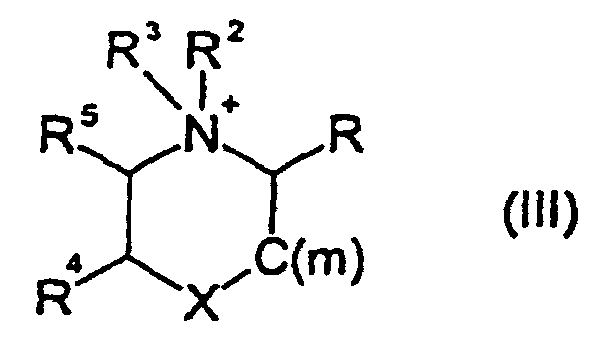
m = 0 oder 1 ist,
X aus gewählt ist aus der Gruppe bestehend aus Stickstoff, Sauerstoff und Schwefel,
R, R1, R2, R3, R4 und R5 unabhängig voneinander ausgewählt sind aus der Gruppe bestehend ausG ausgewählt ist aus der Gruppe bestehend aus -OH, Ether- (-OR), Thiol- (-SH), Thioether- (-SR), Nitril- (-CN), Carbonsäure- (-COOH), Carbonsäureester- (-COOR), Phosphan- (-PR2), Keton- (-COR), Aldehyd- (-CHO), Nitro- (-NO2), Azid- (-N3), Phenyl-, Fluorid- oder Chlorid-, wobei, R die obengenannten Bedeutungen hat,Wasserstoff;linearen oder verzweigten, gesättigten oder ungesättigten, aliphatischen oder alicyclischen Alkylgruppen mit 1 bis 30 Kohlenstoffatomen, wobei die linearen oder verzweigten aliphatischen Alkylgruppen mit einer Hydroxylgruppe substituiert sein können;Heteroaryl-, Heteroaryl-C1-C6-Alkylgruppen mit 3 bis 8 Kohlenstoffatomen im Heteroaryl-Rest und wenigstens einem Heteroatom ausgewählt aus N, O und S, der mit wenigstens einer Gruppe ausgewählt aus C1-C6-Alkylgruppen und/oder Halogenatomen substituiert sein kann;Aryl-, Aryl-C1-C6-Alkylgruppen mit 5 bis 12 Kohlenstoffatomen im Arylrest, der gegebenenfalls mit wenigstens einer C1-C6-Alkylgruppe und/oder einem Halogenatom substituiert sein kann, undSilyl-Gruppen der allgemeinen Formel -SiR6R7R8, wobei R6, R7 und R8 unabhängig voneinander ausgewählt sind aus der Gruppe bestehend aus C1-C6-Alkyl und C5-C12-Aryl, sowie
mit der Maßgabe, dass R4 und R5 nicht gleichzeitig Wasserstoff sind. - Chirale ionische Flüssigkeiten nach Anspruch 5 dadurch gekennzeichnet, dass R, R1, R2, R3, R4, R5 R6, R7 und R8 unabhängig voneinander wenigstens ein Chiralitätszentrum aufweisen können.
- Chirale Flüssigkeit nach Anspruch 1 ausgewählt aus der Gruppe bestehend aus 4-(S)-Isopropyl-2,3-dimethyl-oxazoliniumtetrafluoroborat, 3-Butyl-4-(S)-isopropyl-2-methyl-oxazoliniumtetrafluoroborat, 3-Butyl-4-(S)-isopropyl-2-methyl-oxazolinium-hexafluorophosphat, (1-Hydroxymethyl-2-methylpropyl)-tri-methylammonium-hexafluorophosphat
- Verfahren zur Herstellung der ionischen Flüssigkeiten nach irgendeinem der Ansprüche 1 bis 7 durch Umsetzung eines dem Ammonium-Kation [A]+ der allgemeinen Formel [NRwRxRyRz]+ zugrunde liegenden Amines NRxRyRz mit einem Reagenz der Formel RwX1, RwSO4Rw, R'SO3Rw oder [Rw 3O]+BF4 -, wobei X1 Fluorid, Chlorid, Bromid oder Iodid ist, Rw, Rx, Ry und Rz die in Anspruch 1 angegebenen Bedeutungen haben, Rw jedoch nicht Wasserstoff ist, mit der Maßgabe, dass nicht mehr als zwei, vorzugsweise nicht mehr als eine der Gruppen Rx, Ry und Rz gleichzeitig Wasserstoff sind.
- Verfahren zur Herstellung der ionischen Flüssigkeiten nach Anspruch 8 durch Umsetzung der optisch aktiven Amine
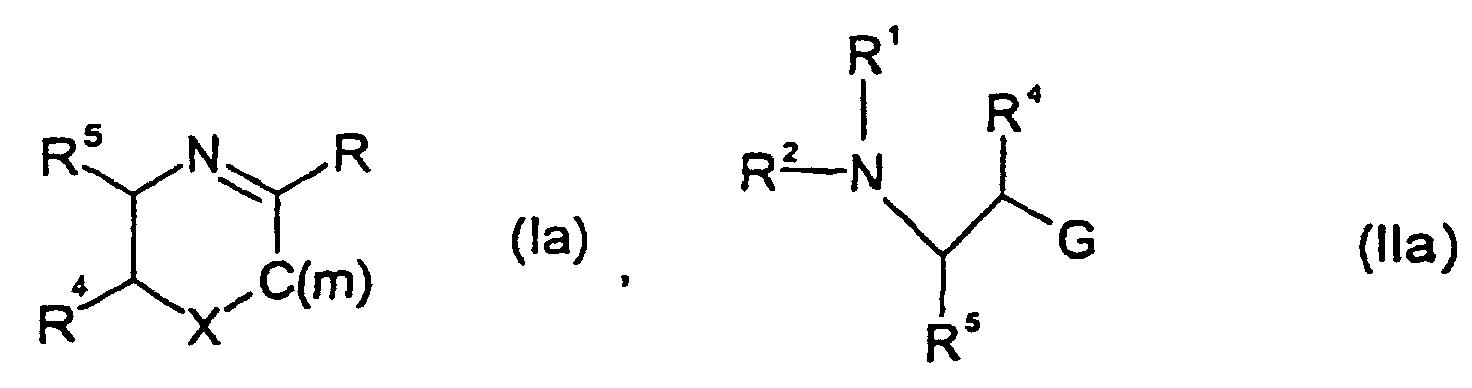 mit einem Reagenz der Formel R3X1, R3SO4R3', R'SO3R3 oder [R3 3O]+BF4 -, wobei X1 Fluorid, Chlorid, Bromid oder Iodid ist, R' die in Anspruch 4 angegebene Bedeutung hat, R3 die in Anspruch 5 angegebene Bedeutung hat und R3' aus der Gruppe von R3 ausgewählt ist, jedoch von R3 verschieden sein kann.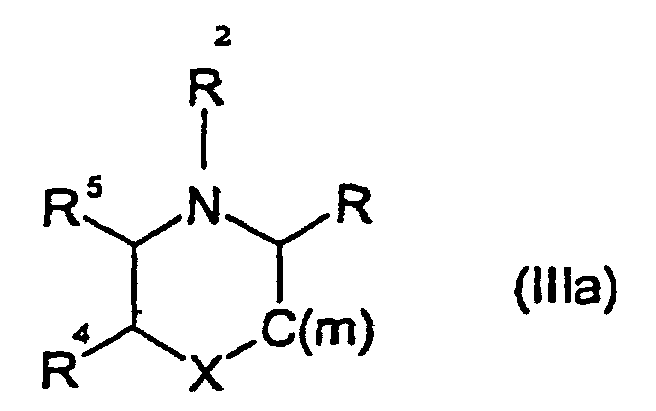
- Verfahren nach Anspruch 8 oder 9, dadurch gekennzeichnet, dass die Reaktion bei Temperaturen von -196 °C bis +150 °C durchgeführt wird.
- Verwendung der chiralen ionischen Flüssigkeiten, wie in irgendeinem der Ansprüche 1 bis 7 definiert, zur Trennung von Racematen.
- Verwendung der chiralen ionischen Flüssigkeiten, wie in irgendeinem der Ansprüche 1 bis 7 definiert, als Lösungsmittel für die asymmetrische Synthese.
- Verwendung der chiralen ionischen Flüssigkeiten, wie in- irgendeinem der Ansprüche 1 bis 7 definiert, als Lösungsmittel für die asymmetrische Katalyse.
- Verfahren zur Trennung von Enantiomerengemischen in deren Enantiomere in Gegenwart von chiralen ionischen Flüssigkeiten, wie in irgendeinem der Ansprüche 1 bis 7 definiert.
- Verfahren nach Anspruch 14, dadurch gekennzeichnet, dass das Enantiomerengemisch in einem Lösungsmittel gelöst eingesetzt wird.
- Verfahren zur Anreicherung eines Enantiomeren eines Enantiornerengemisches durch In-Kontakt-Bringen des Enantiomerengemisches mit chiralen ionischen Flüssigkeiten, wie in irgendeinem der Ansprüche 1 bis 7 definiert.
- Verfahren nach Anspruch 16, dadurch gekennzeichnet, dass das Enantiomerengemisch in einem Lösungsmittel gelöst eingesetzt wird.
- Verfahren zur asymmetrischen Synthese in Gegenwart von chiralen ionischen Flüssigkeiten, wie in irgendeinem der Ansprüche 1 bis 7 definiert.
- Verfahren nach Anspruch 18, dadurch gekennzeichnet, dass die Synthese eine Diels-Alder Reaktion oder eine Benzoin-Synthese ist.
- Verfahren zur asymmetrischen Katalyse in Gegenwart von chiralen ionischen Flüssigkeiten, wie in irgendeinem der Ansprüche 1 bis 7 definiert.
- Verfahren nach Anspruch 20, dadurch gekennzeichnet, dass die Katalyse eine Hydrierung oder eine Hydroxyvinylierung ist.
Applications Claiming Priority (3)
| Application Number | Priority Date | Filing Date | Title |
|---|---|---|---|
| DE10003708A DE10003708A1 (de) | 2000-01-28 | 2000-01-28 | Neuartige chirale ionische Flüssigkeiten und Verfahren zu ihrer Darstellung in enantiomerenreiner oder enantiomerenangereicherter Form |
| DE10003708 | 2000-01-28 | ||
| PCT/EP2001/000924 WO2001055060A2 (de) | 2000-01-28 | 2001-01-29 | Chirale ionische flüssigkeiten |
Publications (2)
| Publication Number | Publication Date |
|---|---|
| EP1250299A2 EP1250299A2 (de) | 2002-10-23 |
| EP1250299B1 true EP1250299B1 (de) | 2005-04-06 |
Family
ID=7629031
Family Applications (1)
| Application Number | Title | Priority Date | Filing Date |
|---|---|---|---|
| EP01925322A Expired - Lifetime EP1250299B1 (de) | 2000-01-28 | 2001-01-29 | Chirale ionische flüssigkeiten |
Country Status (6)
| Country | Link |
|---|---|
| US (1) | US6900313B2 (de) |
| EP (1) | EP1250299B1 (de) |
| AT (1) | ATE292609T1 (de) |
| AU (1) | AU2001252120A1 (de) |
| DE (2) | DE10003708A1 (de) |
| WO (1) | WO2001055060A2 (de) |
Families Citing this family (45)
| Publication number | Priority date | Publication date | Assignee | Title |
|---|---|---|---|---|
| GB9906829D0 (en) | 1999-03-24 | 1999-05-19 | Univ Leicester | Ionic liquids |
| GB2383962B (en) * | 2001-08-31 | 2005-06-01 | Inst Francais Du Petrole | Catalytic composition and use therefor |
| DE10155281A1 (de) | 2001-11-08 | 2003-06-05 | Solvent Innovation Gmbh | Verfahren zur Entfernung polarisierbarer Verunreinigungen aus Kohlenwasserstoffen und Kohlenwasserstoffgemischen durch Extraktion mit ionischen Flüssigkeiten |
| US6953787B2 (en) | 2002-04-12 | 2005-10-11 | Arena Pharmaceuticals, Inc. | 5HT2C receptor modulators |
| DE10247578A1 (de) * | 2002-10-13 | 2004-04-22 | Solvent Innovation Gmbh | Neuartige, funktionalisierte ionische Flüssigkeiten und Verfahren zu ihrer Herstellung |
| GB0300595D0 (en) * | 2003-01-10 | 2003-02-12 | Univ Cambridge Tech | Ionic liquids |
| US7704993B2 (en) * | 2003-06-17 | 2010-04-27 | Arena Pharmaceuticals, Inc. | Benzazepine derivatives and methods of prophylaxis or treatment of 5ht2c receptor associated diseases |
| MXPA05013364A (es) | 2003-06-17 | 2006-03-17 | Arena Pharm Inc | Procedimiento para preparar 3-benzazepinas. |
| US20070275949A1 (en) * | 2003-10-22 | 2007-11-29 | Arena Pharmaceuticals, Inc. | Benzazepine Derivatives and Methods of Prophylaxis or Treatment of 5Ht2C Receptor Associated Diseases |
| US20080009478A1 (en) * | 2003-10-22 | 2008-01-10 | Arena Pharmaceuticals, Inc. | Benzazepine Derivatives and Methods of Prophylaxis or Treatment of 5Ht2c Receptor Associated Diseases |
| US7423164B2 (en) * | 2003-12-31 | 2008-09-09 | Ut-Battelle, Llc | Synthesis of ionic liquids |
| GB0407908D0 (en) * | 2004-04-07 | 2004-05-12 | Univ York | Ionic liquids |
| EP1765781A2 (de) * | 2004-07-09 | 2007-03-28 | Sigma-Aldrich Co. | Optisch verbesserte chirale ionische flüssigkeiten |
| US8168830B2 (en) * | 2004-07-23 | 2012-05-01 | Sigma-Aldrich Co. Llc | High stability diionic liquid salts |
| CN101061099B (zh) * | 2004-07-23 | 2013-10-30 | 西格马-奥利奇有限公司 | 高稳定性双离子液体盐 |
| US20060090777A1 (en) * | 2004-11-01 | 2006-05-04 | Hecht Stacie E | Multiphase cleaning compositions having ionic liquid phase |
| US7737102B2 (en) * | 2004-11-01 | 2010-06-15 | The Procter & Gamble Company | Ionic liquids derived from functionalized anionic surfactants |
| US7939485B2 (en) * | 2004-11-01 | 2011-05-10 | The Procter & Gamble Company | Benefit agent delivery system comprising ionic liquid |
| BRPI0519726B8 (pt) | 2004-12-21 | 2021-05-25 | Arena Pharm Inc | composto de hemidrato de (r)-8-cloro-1-metil-2,3,4,5-tetraidro-1h-3-benzazepina, composição compreendendo o referido composto e seus usos |
| BRPI0515862A2 (pt) * | 2004-12-23 | 2011-10-11 | Arena Pharm Inc | uso de fentermina e agonista seletivo do receptor de 5ht-2c na preparação de composições, composições moduladoras do receptor de 5ht-2c e forma de dosagem unitária compreendendo as mesmas |
| US8715521B2 (en) * | 2005-02-04 | 2014-05-06 | E I Du Pont De Nemours And Company | Absorption cycle utilizing ionic liquid as working fluid |
| US7638058B2 (en) | 2005-04-07 | 2009-12-29 | Matheson Tri-Gas | Fluid storage and purification method and system |
| GB0519898D0 (en) * | 2005-09-30 | 2005-11-09 | Bioniqs Ltd | Liquids |
| WO2007106943A1 (en) * | 2006-03-22 | 2007-09-27 | Ultraclean Fuel Pty Ltd | Process for removing sulphur from liquid hydrocarbons |
| JP5199997B2 (ja) | 2006-04-03 | 2013-05-15 | アリーナ ファーマシューティカルズ, インコーポレイテッド | 8−クロロ−1−メチル−2,3,4,5−テトラヒドロ−1h−3−ベンズアゼピンおよびこれに関連する中間体を調製するためのプロセス |
| US8357734B2 (en) | 2006-11-02 | 2013-01-22 | Georgia-Pacific Consumer Products Lp | Creping adhesive with ionic liquid |
| JP5404414B2 (ja) * | 2006-12-05 | 2014-01-29 | アリーナ ファーマシューティカルズ, インコーポレイテッド | (r)−8−クロロ−1−メチル−2,3,4,5−テトラヒドロ−1h−3−ベンゾアゼピンおよびその中間体を調製するための方法 |
| US7998313B2 (en) * | 2006-12-07 | 2011-08-16 | Georgia-Pacific Consumer Products Lp | Inflated fibers of regenerated cellulose formed from ionic liquid/cellulose dope and related products |
| EP1950196A1 (de) * | 2007-01-29 | 2008-07-30 | Boehringer Ingelheim Pharma GmbH & Co. KG | Verfahren zur Herstellung von Ammoniumhexafluorophosphaten |
| JP5528815B2 (ja) | 2007-01-31 | 2014-06-25 | シグマ−アルドリッチ・カンパニー、エルエルシー | 安定性の高いポリイオン液体塩 |
| US8778689B1 (en) | 2007-05-23 | 2014-07-15 | The University Of The West Indies | Synthesis and use of chiral ionic liquids |
| DE102007040333A1 (de) * | 2007-08-24 | 2009-02-26 | Rheinisch-Westfälische Technische Hochschule Aachen | Katalysatorzusammensetzung für die enantioselektive Katalyse |
| US8822727B2 (en) * | 2008-03-04 | 2014-09-02 | Arena Pharmaceuticals, Inc. | Processes for the preparation of intermediates related to the 5-HT2C agonist (R)-8-chloro-1-methyl-2,3,4,5-tetrahydro-1H-3-benzazepine |
| EP2223915A1 (de) | 2009-02-25 | 2010-09-01 | Dublin City University | Ionische, flüssige Lösemittel |
| WO2010148207A2 (en) | 2009-06-18 | 2010-12-23 | Arena Pharmaceuticals, Inc. | Processes for the preparation of 5-ht2c receptor agonists |
| KR20130112848A (ko) | 2010-06-02 | 2013-10-14 | 아레나 파마슈티칼스, 인크. | 5-ht2c 수용체 아고니스트의 제조 방법 |
| KR20130138770A (ko) | 2010-09-01 | 2013-12-19 | 아레나 파마슈티칼스, 인크. | 광학적으로 활성 산을 갖는 로르카세린의 염 |
| SG188361A1 (en) | 2010-09-01 | 2013-04-30 | Arena Pharm Inc | Non-hygroscopic salts of 5-ht2c agonists |
| US8999970B2 (en) | 2010-09-01 | 2015-04-07 | Arena Pharmaceuticals, Inc. | Administration of an anti-obesity compound to individuals with renal impairment |
| EP3485878A1 (de) | 2010-09-01 | 2019-05-22 | Arena Pharmaceuticals, Inc. | Darreichungsformen von 5-ht2c-agonisten, die nützlich für gewichtskontrolle sind |
| US9130240B2 (en) | 2010-10-12 | 2015-09-08 | Toyota Jidosha Kabushiki Kaisha | Ionic liquid, lithium secondary battery electrolyte comprising the ionic liquid, and lithium secondary battery comprising the electrolyte |
| CA2886875A1 (en) | 2012-10-09 | 2014-04-17 | Arena Pharmaceuticals, Inc. | Method of weight management |
| US9441169B2 (en) | 2013-03-15 | 2016-09-13 | Ultraclean Fuel Pty Ltd | Process for removing sulphur compounds from hydrocarbons |
| US10214697B2 (en) | 2013-03-15 | 2019-02-26 | Ultraclean Fuel Pty Limited | Process for removing sulphur compounds from hydrocarbons |
| CN113185434B (zh) * | 2021-04-14 | 2023-03-21 | 新疆大学 | 一种二芳基砜类化合物的合成方法 |
-
2000
- 2000-01-28 DE DE10003708A patent/DE10003708A1/de not_active Withdrawn
-
2001
- 2001-01-29 DE DE50105828T patent/DE50105828D1/de not_active Expired - Lifetime
- 2001-01-29 EP EP01925322A patent/EP1250299B1/de not_active Expired - Lifetime
- 2001-01-29 US US10/182,388 patent/US6900313B2/en not_active Expired - Fee Related
- 2001-01-29 AU AU2001252120A patent/AU2001252120A1/en not_active Abandoned
- 2001-01-29 AT AT01925322T patent/ATE292609T1/de active
- 2001-01-29 WO PCT/EP2001/000924 patent/WO2001055060A2/de not_active Ceased
Also Published As
| Publication number | Publication date |
|---|---|
| WO2001055060A3 (de) | 2002-01-31 |
| AU2001252120A1 (en) | 2001-08-07 |
| US6900313B2 (en) | 2005-05-31 |
| ATE292609T1 (de) | 2005-04-15 |
| WO2001055060A2 (de) | 2001-08-02 |
| US20030149264A1 (en) | 2003-08-07 |
| DE50105828D1 (de) | 2005-05-12 |
| EP1250299A2 (de) | 2002-10-23 |
| DE10003708A1 (de) | 2001-08-02 |
Similar Documents
| Publication | Publication Date | Title |
|---|---|---|
| EP1250299A2 (de) | Chirale ionische flüssigkeiten | |
| EP0822935B1 (de) | Verfahren zur herstellung von enantiomerenreinen tropasäureestern | |
| DE69814608T2 (de) | Verfahren zur herstellung von 2-thienylamin-derivaten | |
| DE1795808B1 (de) | Verfahren zur Herstellung von 2,2,6,6-Tetramethyl-4-oxopiperidin | |
| DE69104402T2 (de) | Herstellungsverfahren für optisch aktive 3-Hydroxypyrrolidinderivate. | |
| DE1795841B2 (de) | l-a'-Chlort-benzyl^-di-sec-butylamino-acetyl-pyiTol, seine Salze und Verfahren zu deren Herstellung | |
| DE3514450A1 (de) | Verfahren zur herstellung von imidaten sowie neue arylsubstituierte imidate | |
| EP1339705B1 (de) | Verfahren zur herstellung von liponsäure und dihydroliponsaüre | |
| EP0056981A1 (de) | Verfahren zur Herstellung von optisch aktiven 2-Chlorpropionsäureestern | |
| DE69715846T2 (de) | Optische auflösung von narwedin-ähnlichen verbindungen | |
| DE3019069C2 (de) | ||
| DE2919974A1 (de) | Verfahren zur herstellung von cyanhydrinacylaten von aldehyden | |
| DE69114024T2 (de) | Herstellung von 2-(2'-Thienyl)alkylaminen und deren Derivaten zur Synthese von 4,5,6,7-Thieno[3,2-c]pyridinderivaten. | |
| DE3714602C2 (de) | ||
| EP1504002A1 (de) | Optisch aktive [beta]-aminoketone, optisch aktive 1.3-aminoalkohole und verfahren zu deren herstellung | |
| DD202427A5 (de) | Verfahren zur herstellung von alpha-halogenalkylamiden | |
| DE3314029C2 (de) | ||
| DE3223973A1 (de) | Verfahren zur herstellung von ss-mercaptopropionsaeurederivaten | |
| DE1643487C3 (de) | Cysteaminderivate, Verfahren zur Herstellung und ihre Verwendung | |
| EP4028390A1 (de) | Verbessertes verfahren zur herstellung von epoxiden aus aldehyden oder ketonen | |
| WO2005005375A1 (de) | Verfahren zur herstellung von 4-cyano-3-hydroxybuttersäureestern | |
| DE69825556T2 (de) | Verfahren zu Herstellung von 2-Mercaptothiazol | |
| EP0325126B1 (de) | Fluor enthaltende 1-Arylalkoxytris(dialkylamino)-phosphonium-salze, Verfahren zu deren Herstellung und ihre Verwendung | |
| DE102007062282A1 (de) | Verfahren zur Herstellung von Thiodiglycolsäuredialkylestern | |
| DE2337610C3 (de) | Verfahren zur Herstellung von Acetylsalicylsäure-N,N-dimethylaminoäthylester bzw. dessen Salzen |
Legal Events
| Date | Code | Title | Description |
|---|---|---|---|
| PUAI | Public reference made under article 153(3) epc to a published international application that has entered the european phase |
Free format text: ORIGINAL CODE: 0009012 |
|
| 17P | Request for examination filed |
Effective date: 20020718 |
|
| AK | Designated contracting states |
Kind code of ref document: A2 Designated state(s): AT BE CH CY DE DK ES FI FR GB GR IE IT LI LU MC NL PT SE TR |
|
| AX | Request for extension of the european patent |
Free format text: AL;LT;LV;MK;RO;SI |
|
| 17Q | First examination report despatched |
Effective date: 20030806 |
|
| RAP1 | Party data changed (applicant data changed or rights of an application transferred) |
Owner name: SOLVENT INNOVATION GMBH |
|
| GRAP | Despatch of communication of intention to grant a patent |
Free format text: ORIGINAL CODE: EPIDOSNIGR1 |
|
| GRAS | Grant fee paid |
Free format text: ORIGINAL CODE: EPIDOSNIGR3 |
|
| GRAA | (expected) grant |
Free format text: ORIGINAL CODE: 0009210 |
|
| AK | Designated contracting states |
Kind code of ref document: B1 Designated state(s): AT BE CH CY DE DK ES FI FR GB GR IE IT LI LU MC NL PT SE TR |
|
| PG25 | Lapsed in a contracting state [announced via postgrant information from national office to epo] |
Ref country code: IT Free format text: LAPSE BECAUSE OF FAILURE TO SUBMIT A TRANSLATION OF THE DESCRIPTION OR TO PAY THE FEE WITHIN THE PRESCRIBED TIME-LIMIT;WARNING: LAPSES OF ITALIAN PATENTS WITH EFFECTIVE DATE BEFORE 2007 MAY HAVE OCCURRED AT ANY TIME BEFORE 2007. THE CORRECT EFFECTIVE DATE MAY BE DIFFERENT FROM THE ONE RECORDED. Effective date: 20050406 Ref country code: IE Free format text: LAPSE BECAUSE OF FAILURE TO SUBMIT A TRANSLATION OF THE DESCRIPTION OR TO PAY THE FEE WITHIN THE PRESCRIBED TIME-LIMIT Effective date: 20050406 Ref country code: FI Free format text: LAPSE BECAUSE OF FAILURE TO SUBMIT A TRANSLATION OF THE DESCRIPTION OR TO PAY THE FEE WITHIN THE PRESCRIBED TIME-LIMIT Effective date: 20050406 Ref country code: NL Free format text: LAPSE BECAUSE OF FAILURE TO SUBMIT A TRANSLATION OF THE DESCRIPTION OR TO PAY THE FEE WITHIN THE PRESCRIBED TIME-LIMIT Effective date: 20050406 |
|
| REG | Reference to a national code |
Ref country code: GB Ref legal event code: FG4D Free format text: NOT ENGLISH |
|
| REG | Reference to a national code |
Ref country code: CH Ref legal event code: EP |
|
| REG | Reference to a national code |
Ref country code: IE Ref legal event code: FG4D Free format text: LANGUAGE OF EP DOCUMENT: GERMAN |
|
| REF | Corresponds to: |
Ref document number: 50105828 Country of ref document: DE Date of ref document: 20050512 Kind code of ref document: P |
|
| PG25 | Lapsed in a contracting state [announced via postgrant information from national office to epo] |
Ref country code: GR Free format text: LAPSE BECAUSE OF FAILURE TO SUBMIT A TRANSLATION OF THE DESCRIPTION OR TO PAY THE FEE WITHIN THE PRESCRIBED TIME-LIMIT Effective date: 20050706 Ref country code: DK Free format text: LAPSE BECAUSE OF FAILURE TO SUBMIT A TRANSLATION OF THE DESCRIPTION OR TO PAY THE FEE WITHIN THE PRESCRIBED TIME-LIMIT Effective date: 20050706 Ref country code: SE Free format text: LAPSE BECAUSE OF FAILURE TO SUBMIT A TRANSLATION OF THE DESCRIPTION OR TO PAY THE FEE WITHIN THE PRESCRIBED TIME-LIMIT Effective date: 20050706 |
|
| PG25 | Lapsed in a contracting state [announced via postgrant information from national office to epo] |
Ref country code: ES Free format text: LAPSE BECAUSE OF FAILURE TO SUBMIT A TRANSLATION OF THE DESCRIPTION OR TO PAY THE FEE WITHIN THE PRESCRIBED TIME-LIMIT Effective date: 20050717 |
|
| GBT | Gb: translation of ep patent filed (gb section 77(6)(a)/1977) |
Effective date: 20050808 |
|
| PG25 | Lapsed in a contracting state [announced via postgrant information from national office to epo] |
Ref country code: PT Free format text: LAPSE BECAUSE OF FAILURE TO SUBMIT A TRANSLATION OF THE DESCRIPTION OR TO PAY THE FEE WITHIN THE PRESCRIBED TIME-LIMIT Effective date: 20050908 |
|
| NLV1 | Nl: lapsed or annulled due to failure to fulfill the requirements of art. 29p and 29m of the patents act | ||
| REG | Reference to a national code |
Ref country code: IE Ref legal event code: FD4D |
|
| PG25 | Lapsed in a contracting state [announced via postgrant information from national office to epo] |
Ref country code: MC Free format text: LAPSE BECAUSE OF NON-PAYMENT OF DUE FEES Effective date: 20060131 Ref country code: CH Free format text: LAPSE BECAUSE OF NON-PAYMENT OF DUE FEES Effective date: 20060131 Ref country code: LU Free format text: LAPSE BECAUSE OF NON-PAYMENT OF DUE FEES Effective date: 20060131 Ref country code: LI Free format text: LAPSE BECAUSE OF NON-PAYMENT OF DUE FEES Effective date: 20060131 Ref country code: BE Free format text: LAPSE BECAUSE OF NON-PAYMENT OF DUE FEES Effective date: 20060131 |
|
| PLBE | No opposition filed within time limit |
Free format text: ORIGINAL CODE: 0009261 |
|
| STAA | Information on the status of an ep patent application or granted ep patent |
Free format text: STATUS: NO OPPOSITION FILED WITHIN TIME LIMIT |
|
| 26N | No opposition filed |
Effective date: 20060110 |
|
| EN | Fr: translation not filed | ||
| REG | Reference to a national code |
Ref country code: CH Ref legal event code: PL |
|
| BERE | Be: lapsed |
Owner name: SOLVENT INNOVATION G.M.B.H. Effective date: 20060131 |
|
| REG | Reference to a national code |
Ref country code: GB Ref legal event code: 732E |
|
| PG25 | Lapsed in a contracting state [announced via postgrant information from national office to epo] |
Ref country code: TR Free format text: LAPSE BECAUSE OF FAILURE TO SUBMIT A TRANSLATION OF THE DESCRIPTION OR TO PAY THE FEE WITHIN THE PRESCRIBED TIME-LIMIT Effective date: 20050406 |
|
| PG25 | Lapsed in a contracting state [announced via postgrant information from national office to epo] |
Ref country code: FR Free format text: LAPSE BECAUSE OF FAILURE TO SUBMIT A TRANSLATION OF THE DESCRIPTION OR TO PAY THE FEE WITHIN THE PRESCRIBED TIME-LIMIT Effective date: 20050406 Ref country code: CY Free format text: LAPSE BECAUSE OF FAILURE TO SUBMIT A TRANSLATION OF THE DESCRIPTION OR TO PAY THE FEE WITHIN THE PRESCRIBED TIME-LIMIT Effective date: 20050406 |
|
| PGFP | Annual fee paid to national office [announced via postgrant information from national office to epo] |
Ref country code: DE Payment date: 20150120 Year of fee payment: 15 |
|
| PGFP | Annual fee paid to national office [announced via postgrant information from national office to epo] |
Ref country code: AT Payment date: 20141222 Year of fee payment: 15 Ref country code: GB Payment date: 20150128 Year of fee payment: 15 |
|
| REG | Reference to a national code |
Ref country code: DE Ref legal event code: R119 Ref document number: 50105828 Country of ref document: DE |
|
| REG | Reference to a national code |
Ref country code: AT Ref legal event code: MM01 Ref document number: 292609 Country of ref document: AT Kind code of ref document: T Effective date: 20160129 |
|
| GBPC | Gb: european patent ceased through non-payment of renewal fee |
Effective date: 20160129 |
|
| PG25 | Lapsed in a contracting state [announced via postgrant information from national office to epo] |
Ref country code: DE Free format text: LAPSE BECAUSE OF NON-PAYMENT OF DUE FEES Effective date: 20160802 Ref country code: GB Free format text: LAPSE BECAUSE OF NON-PAYMENT OF DUE FEES Effective date: 20160129 |
|
| PG25 | Lapsed in a contracting state [announced via postgrant information from national office to epo] |
Ref country code: AT Free format text: LAPSE BECAUSE OF NON-PAYMENT OF DUE FEES Effective date: 20160129 |