EP1246692B1 - Beschichtung von ungeladen soliden teilchen durch polymermehrlagen - Google Patents
Beschichtung von ungeladen soliden teilchen durch polymermehrlagen Download PDFInfo
- Publication number
- EP1246692B1 EP1246692B1 EP01903643A EP01903643A EP1246692B1 EP 1246692 B1 EP1246692 B1 EP 1246692B1 EP 01903643 A EP01903643 A EP 01903643A EP 01903643 A EP01903643 A EP 01903643A EP 1246692 B1 EP1246692 B1 EP 1246692B1
- Authority
- EP
- European Patent Office
- Prior art keywords
- process according
- polyelectrolyte
- capsules
- polymers
- capsule
- Prior art date
- Legal status (The legal status is an assumption and is not a legal conclusion. Google has not performed a legal analysis and makes no representation as to the accuracy of the status listed.)
- Expired - Lifetime
Links
Images



Classifications
-
- A—HUMAN NECESSITIES
- A61—MEDICAL OR VETERINARY SCIENCE; HYGIENE
- A61K—PREPARATIONS FOR MEDICAL, DENTAL OR TOILETRY PURPOSES
- A61K8/00—Cosmetics or similar toiletry preparations
- A61K8/02—Cosmetics or similar toiletry preparations characterised by special physical form
- A61K8/11—Encapsulated compositions
-
- A—HUMAN NECESSITIES
- A23—FOODS OR FOODSTUFFS; TREATMENT THEREOF, NOT COVERED BY OTHER CLASSES
- A23P—SHAPING OR WORKING OF FOODSTUFFS, NOT FULLY COVERED BY A SINGLE OTHER SUBCLASS
- A23P10/00—Shaping or working of foodstuffs characterised by the products
- A23P10/30—Encapsulation of particles, e.g. foodstuff additives
-
- A—HUMAN NECESSITIES
- A61—MEDICAL OR VETERINARY SCIENCE; HYGIENE
- A61K—PREPARATIONS FOR MEDICAL, DENTAL OR TOILETRY PURPOSES
- A61K9/00—Medicinal preparations characterised by special physical form
- A61K9/48—Preparations in capsules, e.g. of gelatin, of chocolate
- A61K9/50—Microcapsules having a gas, liquid or semi-solid filling; Solid microparticles or pellets surrounded by a distinct coating layer, e.g. coated microspheres, coated drug crystals
- A61K9/5089—Processes
-
- A—HUMAN NECESSITIES
- A61—MEDICAL OR VETERINARY SCIENCE; HYGIENE
- A61P—SPECIFIC THERAPEUTIC ACTIVITY OF CHEMICAL COMPOUNDS OR MEDICINAL PREPARATIONS
- A61P3/00—Drugs for disorders of the metabolism
- A61P3/02—Nutrients, e.g. vitamins, minerals
-
- A—HUMAN NECESSITIES
- A61—MEDICAL OR VETERINARY SCIENCE; HYGIENE
- A61P—SPECIFIC THERAPEUTIC ACTIVITY OF CHEMICAL COMPOUNDS OR MEDICINAL PREPARATIONS
- A61P31/00—Antiinfectives, i.e. antibiotics, antiseptics, chemotherapeutics
- A61P31/04—Antibacterial agents
-
- A—HUMAN NECESSITIES
- A61—MEDICAL OR VETERINARY SCIENCE; HYGIENE
- A61P—SPECIFIC THERAPEUTIC ACTIVITY OF CHEMICAL COMPOUNDS OR MEDICINAL PREPARATIONS
- A61P43/00—Drugs for specific purposes, not provided for in groups A61P1/00-A61P41/00
-
- A—HUMAN NECESSITIES
- A61—MEDICAL OR VETERINARY SCIENCE; HYGIENE
- A61P—SPECIFIC THERAPEUTIC ACTIVITY OF CHEMICAL COMPOUNDS OR MEDICINAL PREPARATIONS
- A61P5/00—Drugs for disorders of the endocrine system
-
- A—HUMAN NECESSITIES
- A61—MEDICAL OR VETERINARY SCIENCE; HYGIENE
- A61Q—SPECIFIC USE OF COSMETICS OR SIMILAR TOILETRY PREPARATIONS
- A61Q19/00—Preparations for care of the skin
-
- B—PERFORMING OPERATIONS; TRANSPORTING
- B01—PHYSICAL OR CHEMICAL PROCESSES OR APPARATUS IN GENERAL
- B01J—CHEMICAL OR PHYSICAL PROCESSES, e.g. CATALYSIS OR COLLOID CHEMISTRY; THEIR RELEVANT APPARATUS
- B01J13/00—Colloid chemistry, e.g. the production of colloidal materials or their solutions, not otherwise provided for; Making microcapsules or microballoons
- B01J13/02—Making microcapsules or microballoons
- B01J13/06—Making microcapsules or microballoons by phase separation
- B01J13/10—Complex coacervation, i.e. interaction of oppositely charged particles
-
- B—PERFORMING OPERATIONS; TRANSPORTING
- B01—PHYSICAL OR CHEMICAL PROCESSES OR APPARATUS IN GENERAL
- B01J—CHEMICAL OR PHYSICAL PROCESSES, e.g. CATALYSIS OR COLLOID CHEMISTRY; THEIR RELEVANT APPARATUS
- B01J13/00—Colloid chemistry, e.g. the production of colloidal materials or their solutions, not otherwise provided for; Making microcapsules or microballoons
- B01J13/02—Making microcapsules or microballoons
- B01J13/20—After-treatment of capsule walls, e.g. hardening
- B01J13/22—Coating
-
- A—HUMAN NECESSITIES
- A61—MEDICAL OR VETERINARY SCIENCE; HYGIENE
- A61K—PREPARATIONS FOR MEDICAL, DENTAL OR TOILETRY PURPOSES
- A61K2800/00—Properties of cosmetic compositions or active ingredients thereof or formulation aids used therein and process related aspects
- A61K2800/40—Chemical, physico-chemical or functional or structural properties of particular ingredients
- A61K2800/41—Particular ingredients further characterized by their size
- A61K2800/412—Microsized, i.e. having sizes between 0.1 and 100 microns
-
- A—HUMAN NECESSITIES
- A61—MEDICAL OR VETERINARY SCIENCE; HYGIENE
- A61K—PREPARATIONS FOR MEDICAL, DENTAL OR TOILETRY PURPOSES
- A61K2800/00—Properties of cosmetic compositions or active ingredients thereof or formulation aids used therein and process related aspects
- A61K2800/40—Chemical, physico-chemical or functional or structural properties of particular ingredients
- A61K2800/42—Colour properties
- A61K2800/43—Pigments; Dyes
- A61K2800/434—Luminescent, Fluorescent; Optical brighteners; Photosensitizers
Definitions
- the invention is directed to (i) the encapsulation of uncharged organic substances in polymeric capsules by using a multi-step strategy that involves the introduction of charge to the surface of the microcrystals with an amphiphilic substance, followed by consecutively depositing polyelectrolytes of opposite charge to assemble a multilayered shell of polymeric material around the microcrystal template, and (ii) the formation of polymer multilayer cages derived from the coated crystals by facile removal of the crystalline template.
- microcapsules have received considerable attention because of their technological importance in the fields of medicine, pharmaceutics, agriculture and cosmetics. 1-7
- encapsulated active ingredients e.g. drugs, vaccines, antibodies, hormones, pesticides and fragrances
- encapsulation technologies including those based on liposomes, microparticles and microemulsions, there has been an intense interest in strategies to encapsulate and deliver water-insoluble pharmaceutical drugs in stable and aqueous forms.
- the coupling of self-assembly and colloidal templating provides an elegant and versatile means to encapsulate a variety of functional materials including biological macromolecules and to create core-shell structures for potential use in the fields of medicine, pharmaceutics, catalysis and separations.
- 10-18 The method entails coating colloidal particles dispersed in aqueous media by the nanoscale electrostatic self-assembly of charged polymeric materials. This strategy exploits the fact that the colloidal entities, which serve as the templates, have an inherent surface charge, thus rendering them water dispersible and providing the necessary charge essential for adsorption of subsequent layers and polyelectrolyte multilayer encapsulation. Recently, this approach has been employed to entrap proteins 18 and construct new classes of composite colloids. 11-17 The colloids employed have ranged from charged polymer latices 11-17 to biological templates, e.g. cells 10 and protein crystals 18 .
- Solid crystalline organic compounds are an important class of materials that are widely employed in pharmaceutics as drugs.
- the controlled coating of such compounds is of widespread interest.
- many crystalline materials that are of significance in medicine for example crystals composed of low molecular weight drugs, are uncharged and have a low solubility in water.
- their encapsulation and application in an aqueous medium often represents a substantial problem.
- An object of the invention was therefore to provide a method for the encapsulation of uncharged materials.
- the process according to the invention it is surprisingly possible to encapsulate uncharged solid particle materials, in particular, organic crystalline templates that are largely water insoluble and/or hydrophobic.
- the method is applicable to a wide variety of substances and in particular to substances which are of high pharmaceutical interest.
- the uncharged crystalline solid particle materials are treated with an amphiphilic substance, which imparts charge on the surface of the particle materials.
- the material coated with amphiphilic substance is coated again with a polyelectrolyte which is oppositely charged to the surface of the coated particle materials.
- the material is subsequently treated with oppositely charged polyelectrolytes, i.e. alternately with cationic and anionic polyelectrolytes.
- Polymer layers self-assemble onto the pre-charged solid templates by means of electrostatic layer-by-layer deposition, thus forming a multilayered polymeric shell around the solid cores.
- the process according to the invention thus provides a novel and facile pathway to the fabrication of polymer multilayered microcapsules as well as superior strategy for the encapsulation of hydrophobic compounds such as drugs.
- drugs are solid crystalline substances, containing non-polar aromatic groups (amphetamines) and/or heterocyclic groups (1.4-benzodiazepime), or condensed aromatic or alicyclic groups (isoprenoids: steroid, vitamin A, vitamin E) and mostly one or more polar functional group (e.g. amine, hydroxy, carboxy, phenolic, aldehyde, ketone).
- non-polar aromatic groups amphetamines
- heterocyclic groups 1.4-benzodiazepime
- condensed aromatic or alicyclic groups isoprenoids: steroid, vitamin A, vitamin E
- polar functional group e.g. amine, hydroxy, carboxy, phenolic, aldehyde, ketone
- the here-described method provides a strategy for:
- the starting material is the solid substance itself. Due to the uncharged and hydrophobic character of these materials, they cannot be directly coated with polyelectrolytes.
- the described method makes it possible to introduce a surface charge to the crystal by treatment with a charged amphiphilic species (e.g. ionic surfactants). This leads to the formation of a stable suspension of the coated substance in water.
- Typical surface potentials after treatment with an amphiphile e.g. sodium dodecyl sulfate, SDS
- SDS sodium dodecyl sulfate
- the charged crystals are then suitable templates for coating with polyelectrolytes.
- One advantage of this innovation is the possibility to create a drug release system with a constant release rate over a long time period. This is possible because of the solid phase in the interior of the capsule.
- a liquid such as a buffer or body fluid
- a two-phase system will be established by the crystal itself and a saturated solution of the crystal material in the interior of the capsule.
- the amount of substance released from the capsule is continuously replenished by further solubilization of solid material within the capsule. Therefore the concentration of the substance in the liquid within the capsule remains almost constant. Consequently, a constant release of the substance over a long period of time can be achieved.
- the process of the invention is particularly suitable to prepare release systems, which release a small amount of active substance constantly over an extended period of time.
- a system advantageously comprises a high diffusion barrier across the wall of the capsule, which results in a small amount of released substance with respect to the amount of substance which can be supplemented in the same period of time by solubilization of solid material within the capsule.
- release systems are particularly useful in hormone therapy wherein the constant release of small amounts of active substance is required.
- the release rate of a substance is a function of the difference in its concentration in and outside of the capsule.
- the described approach provides a method to keep this concentration gradient constant as long as the solid material is not dissolved completely. This would lead to a constant release rate of the substance over a long time period.
- This method provides an advantage over other release systems that use a dissolved substance in a capsule or liposome. The concentration of the dissolved substance in those capsules or liposomes is decreased from the first moment of the release, and the release rate is not constant.
- a solid uncharged material is encapsulated in two steps.
- the solid uncharged material is treated with an amphiphilic substance. This treatment preferably results in an aqueous dispersion of the solid material.
- the amphiphilic substance is arranged on the surface of the solid material, rendering the material susceptible to the subsequent coating with a charged polyelectrolyte.
- the uncharged material used in the present invention is preferably a material which has no charges and also has no ionizable groups. It is also possible, however, to use an uncharged material having ionizable groups, whereby this material can be used under conditions, under which the ionizable groups are not ionized.
- the encapsulation process according to the invention is therefore applicable to a wide range of materials, whose encapsulation in a solid form has previously not been possible or possible only under very specific conditions.
- the solid particle material having the amphiphilic substance assembled on its surface is coated with a layer of a charged polyelectrolyte or with a multilayer comprising alternating layers of oppositely charged polylectrolytes.
- the coating of the charged polyelectrolyte onto the surface is made possible by the amphiphilic substance.
- capsules are prepared having at least two, more preferably at least three, still more preferably at least five and most preferably at least eight layers of polyelectrolytes having alternating charge.
- thicker shells having e.g. up to 100 or more polyelectrolyte layers, preferably up to 50 and most preferably up to 20 layers.
- the assembly of thicker shells has the effect of smoothing out the outer surface and at the same time reducing the porosity of the shells.
- the porosity of the capsules can be influenced.
- pore sizes specifically designed for the respective application can be obtained.
- Monomeric detergents such as SDS, for example, lead to small pores, whereas by polymeric detergents such as PSS larger pores are obtained in the capsule wall.
- the conditions applied when charging the solid material with the amphiphilic substance can influence pore size, e.g., if polymeric detergents are used, by determining the shape of the polymeric detergent. Ionic strength and pH value, for example, can determine whether the polymeric detergent is present in elongated or coiled form.
- pores having a diameter of about 20 nm to > 100 nm can be obtained in the capsule walls, if an amphiphilic polyelectrolyte is used as the amphiphilic substance.
- an ionic surfactant is used as the amphiphilic substance, smaller pore sizes of less than about 5 to 10 nm can be obtained.
- the porosity of the capsule can be decreased by a further cross-linking step, in which a reagent is used to introduce inter- and intra-crosslinks of polyelectrolytes in the shells.
- the thickness of the capsule shell preferably is about 2 to 100 nm, more preferably 5 to 50 nm.
- the size of the capsules themselves preferably is ⁇ 50 ⁇ m, in particular, ⁇ 20 ⁇ m and more preferably ⁇ 15 ⁇ m; however, it is also possible to prepare larger capsules.
- the minimum size of the capsules preferably is at least 10 nm, more preferably at least 50 nm.
- the capsule size basically depends on the size of the solid material used.
- the method of the invention is especially suitable for uncharged solid material which has a low solubility in water or is water-insoluble or not dispersible in water.
- the encapsulation of such materials was difficult in the prior art and can now be managed easily according to the invention.
- the uncharged solid material used as core for the encapsulation can be an organic material, a biomaterial or/and an inorganic material.
- Organic materials in particular, solid materials from low-molecular weight organic compounds can be encapsulated especially favorably.
- encapsulation of uncharged solid organic crystalline templates that are largely water-insoluble is possible.
- Suitable,materials which can be encapsulated according to the method of the invention for example, are drugs, vitamins, nutrients, hormones, growth factors, pesticides, antibiotics and preservatives. According to the invention it is not necessary thereby for the materials to have a charged or ionizable group.
- the shape of the capsules largely depends on the shape of the solid material used.
- the solid material is employed as crystalline material, e.g. in the form of single crystals. It is particularly preferred to use microcrystals of the uncharged compounds to be encapsulated.
- any uncharged solid material can be encapsulated, e.g. a synthetic material, a material isolated from natural sources or a chemically modified isolated material.
- amphiphilic substance any substance can be used which has ionic hydrophilic and hydrophobic groups. It is important that the amphiphilic substance has at least one electrically charged group to provide the solid material with electrical charges. Therefore, the amphiphilic substance used also can be referred to as ionic amphiphilic substance or ionic detergent.
- ionic surfactants, phospholipids and/or amphiphilic polyelectrolytes are used.
- Amphiphilic polyelectrolytes for example, are polyelectrolytes comprising a charged group as hydrophilic group and a hydrophobic group, e.g. aromatic groups. It is preferred to use a cationic or/and anionic surfactant.
- Suitable cationic surfactants are quaternary ammonium salts (R 4 N + X - ), especially didodecyldimethylammonium bromide (DDDAB), alkyltrimethylammonium bromides, especially dodecyltrimethylammonium bromide or palmityl trimethylammonium bromide or N-alkylpyridinium salts or tertiary amines (R 3 NH + )X - ), especially cholesteryl-3 ⁇ -N-(dimethyl-aminoethyl)-carbamateor secondary amines ((R 2 NH 2 + )x - ) or primary amines ((RNH 3 + )x - ) or mixtures thereof, wherein X - means a counteranion, e.g.
- Suitable anionic surfactants are alkyl sulfonate (R-SO 3 M), especially dodecyl sulfate, e.g. sodium dodecyl sulfate (SDS), lauryl sulfate or olefin sulfonate (R-SO 3 M), especially sodium-n-dodecyl-benzene sulfonate or alkyl sulfates (R-OSO 3 M) or fatty acids (R-COOM), especially dodecanoic acid sodium salt or phosphoric acid or cholic acids or fluoroorganics, especially lithium-3-[2-(perfluoroalkyl)ethylthio] propionate or mixtures thereof.
- Particularly preferred are surfactants having 1 to 30 carbons in their alkyl or olefin group.
- poly(styrene sulfonate) PSS
- PEE-PSS poly(ethylene)-block-styrene sulfonic acid
- Polyelectrolytes generally, are understood as polymers having ionically dissociable groups, which can be a component or substituent of the polymer chain. Usually, the number of these ionically dissociable groups in polyelectrolytes is so large that the polymers in dissociated form (also called polyions) are water-soluble.
- the term polyelectrolytes is understood in this context to cover also ionomers, wherein the concentration of ionic groups is not sufficient for water-solubility, however, which have sufficient charges for undergoing self-assembly.
- the shell preferably comprises "true" polyelectrolytes, i.e. water-soluble polyelectrolytes.
- polyelectrolytes are classified as polyacids and polybases.
- polyacids When dissociated polyacids form polyanions, with protons being split off, which can be inorganic, organic and biopolymers.
- polyacids are polyphosphoric acid, polyvinylsulfuric acid, polyvinylsulfonic acid, polyvinylphosphonic acid and polyacrylic acid.
- the corresponding salts which are also called polysalts are polyphosphate, polysulfate, polysulfonate, polyphosphonate and polyacrylate.
- Polybases contain groups which are capable of accepting protons, e.g. by reaction with acids, with a salt being formed.
- Examples of polybases having dissociable groups within their backbone and/or side groups are polyallylamine, polyethylimine, polyvinylamine and polyvinylpyridine. By accepting protons polybases form polycations.
- Suitable polyelectrolytes according to the invention are organic polymers, bio-polymers, inorganic polymers and mixtures thereof.
- Suitable polyelectrolytes according to the invention are also biopolymers such as alginic acid, gummi arabicum, nucleic acids, pectins, proteins and others as well as chemically modified biopolymers such as carboxymethyl cellulose and lignin sulfonates as well as synthetic polymers such as polymethacryl acid, polyvinylsulfonic acid, polyvinylphosphonic acid and polyethylenimine.
- Linear or branched polyelectrolytes can be used. Using branched polyelectrolytes leads to less compact polyelectrolyte multilayers having a higher degree of wall porosity.
- polyelectrolyte molecules can be crosslinked within or/and between the individual layers, e.g. by crosslinking amino groups with aldehydes. Preferably, the polyelectrolyte is cross-linked after templating.
- amphiphilic polyelectrolytes e.g. amphiphilic block or random copolymers having partial polyelectrolyte character, can be used to reduce permeability towards polar small molecules. Such amphiphilic copolymers consist of units having different functionality, e.g.
- copolymers which due to outside conditions change their structure the permeability or other properties of the capsule walls can be controlled in a defined manner.
- copolymers having a poly(N-isopropyl-acrylamide) part e.g. poly(N-isopropylacrylamide-acrylic acid) are possible which, via the equilibrium of hydrogen bonds, change their water solubility as a function of temperature, which is accompanied by swelling.
- polyelectrolytes which are degradable under certain conditions e.g. photo-, acid- or base-labile
- the release of enclosed active substance can be further controlled via the dissolution of the capsule walls.
- conductive polyelectrolytes or polyelectrolytes having optically active groups can be used as capsule components.
- the polyelectrolytes and ionomers, respectively, to be used as long as the molecules used have sufficiently high charge or/and are capable of binding with the layer beneath via other kinds of interaction, e.g. hydrogen bonds and/or hydrophobic interactions.
- Suitable polyelectrolytes are both low-molecular polyelectrolytes and polyions, respectively, e.g. having molecular weights of a few hundred Daltons, up to macromolecular polyelectrolytes, e.g. polyelectrolytes of biological origin, having a molecular weight of several million Daltons.
- an organic polymer as bioelectrolyte are bio-degradable polymers such as polyglycolic acid (PGA), polylactic acid (PLA), polyamides, poly-2-hydroxy-butyrate (PHB), polycaprolactone (PCL), poly(lactic-co-glycolic)acid (PLGA), fluorescent-labelled polymers, conducting polymers, liquid crystal polymers, photocontacting polymers, photochromic polymers and their copolymers and/or mixtures thereof.
- bio-degradable polymers such as polyglycolic acid (PGA), polylactic acid (PLA), polyamides, poly-2-hydroxy-butyrate (PHB), polycaprolactone (PCL), poly(lactic-co-glycolic)acid (PLGA), fluorescent-labelled polymers, conducting polymers, liquid crystal polymers, photocontacting polymers, photochromic polymers and their copolymers and/or mixtures thereof.
- biopolymers preferred as polyelectrolyte are polyamino acids, in particular, peptides, S-layer proteins, polycarbohydrates such as dextrin, pectin, alginate, glycogen, amylose, chitin, chondroitin, hyaluronic acid, polynucleotides, such as DNA, RNA, oligonucleotides or/and modified biopolymers such carboxymethyl cellulose, carboxymethyl dextran or lignin sulfonates.
- Preferred examples of inorganic polymers as polyelectrolyte are polysilanes, polysilanoles, polyphosphazenes, polysulfazenes, polysulfides and/or polyphosphates.
- the method of the invention preferably is carried out so that excess material of the starting substances used in the individual steps are separated after each treatment step.
- an aqueous dispersion of the template particles is formed first by adding an aqueous solution of the amphiphilic substance. After separating any excess amphiphilic molecules a first polyelectrolyte species is then added to build up the first polyelectrolyte shell. After separating any excess polyelectrolyte molecules the oppositely charged polyelectrolyte species used for building up the next layer is then added. Subsequently, oppositely charged layers of polyelectrolyte molecules are applied in turn. It is possible to select identical or different polyelectrolyte species or mixtures of polyelectrolyte species for each layer having the same charge, i.e. every second layer. Between each incubation step a purification step is carried out.
- the encapsulated material prepared preferably forms a stable, suspension in an aqueous phase.
- An advantage of the invention lies in that the capsule thickness and permeability for the controlled release of the encapsulated material can be controlled in a predetermined manner, e.g. by the number of layers, the nature of the polyelectrolytes used, the nature of the amphiphilic substances used, the nature of the nanoparticles or biomolecules, if used, an optional additional cross-linking step and conditions of polyelectrolyte assembly.
- the now encapsulated template particles can be disintegrated, if desired, leading to the formation of hollow capsules.
- the invention also encompasses a process for the preparation of hollow capsules having a polyelectrolyte shell, comprising the steps: (a) treating an uncharged crystalline solid particle material with an amphiphilic substance, (b) subsequently coating the crystalline solid material with a layer of a charged polyelectrolyte or with a multilayer comprising alternating layers of oppositely charged polyelectrolytes and (c) removing the core of crystalline uncharged solid particle material by its solubilization.
- Disintegration can be effected by adding reagents which are suitable for dissolving the uncharged solid core material, e.g. an organic solvent, preferably a mild organic solvent, in which the material is soluble or an acid or alkaline solvent in which the material forms a soluble salt.
- the organic solvent can be used in anhydrous, pure form or as H 2 O/solvent mixtures. Representatives of suitable organic solvents are e.g. ethanol, chloroform etc.
- dissolution of the template particles can be effected in a gentle manner during a short incubation period, e.g. 1 min to 1 h at room temperature.
- the templates disintegrate almost completeley, as no residues of tha particles can be detected any longer even when inspecting the remaining shells by an electron microscope.
- the hollow capsules are redispersed in an aqueous solvent or in an organic solvent. Inside the capsules there is then preferably pure solvent.
- polyelectrolyte capsules obtainable by the method of the invention.
- these capsules contain a core of uncharged solid material which served as template.
- the structure of such capsules thus, viewed from inside to outside, consists of the following layers: active substance, amphiphilic substance and one or more layers of polyelectrolyte.
- the polyelectrolyte capsules have no detectable residues of the uncharged solid core material any longer, i.e. they are without core.
- Such hollow polyelectrolyte capsule has the following structure: hollow space, amphiphilic substance, one or more layers of polyelectrolyte.
- amphiphilic material contained in the polyelectrolyte capsules is that porosity can be controlled and determined thereby. Furthermore, by using the amphiphilic substance an even covering of the core material is achieved so that the polyelectrolyte capsules preferably have an outer shape determined by the core. It is especially preferred that the polyelectrolyte capsules according to the invention contain an active substance, especially a pharmaceutically active substance.
- the encapsulated active substance thereby can be identical to the encapsulated uncharged solid particle material, however, it may also have been introduced into the empty polyelectrolyte shells later on.
- the capsules according to the invention preferably have a diameter in the range of from 10 nm to 50 ⁇ m, preferably from 50 nm to 10 ⁇ m.
- suitable selection of the templates capsule compositions can be obtained having high monodispersity, i.e. compositions, wherein the amount of capsules, the deviation of which from the mean diameter is > 50%, is less than 10% and preferably less than 1%.
- the capsules according to the invention also can be dried, in particular, freeze-dried and then redispersed in suitable solvents again.
- amphiphile used to pre-charge the solid material, in particular, microcrystals, determined the porosity of the resulting capsules.
- amphiphilic substances in particular, phospholipids, ionic surfactants or amphiphilic polyelectrolytes between the polyelectrolyte shells.
- the capsules prepared by the method of the invention can be used for encapsulating active substance.
- active substances can be both inorganic and organic substances.
- active substances are catalysts, in particular, enyzmes, pharmaceutically active substances, polymers, colorants such as fluorescent compounds, sensor molecules, i.e. molecules reacting detectably to the change of ambient conditions such as temperature or pH, plant protection agents and aromatics.
- the active substances thereby can form the encapsulated uncharged solid materials themselves, or be introduced subsequently into the hollow polyelectrolyte shells obtained by dissolving the core under mild conditions, e.g. by means of an organic solvent.
- the capsules also can be used as reaction chambers, especially as microreaction chambers, for chemical reactions. Due to the fact that the permeability of the capsule walls is controllable so as to let pass, for example, low-molecular substances, however, largely retain macromolecular molecules, high-molecular products forming in a reaction, e.g. polymers forming upon polymerization, can be retained easily in the interior during synthesis.
- the capsules also can be used in a variety of other applications, e.g. in sensorics, surface analytics, pharmacy, medicine, food technology, biotechnology, cosmetics, information technology and printing industry (e.g. encapsulation of coloring materials).
- PYR Pyrene
- FDA fluorescein diacetate
- the first and significant step in the encapsulation involved imparting a charge on the crystal surface by self-assembly of an amphiphilic substance, in particular a ionic surfactant, a phospholipid or polyelectrolyte having an amphiphilic nature such as charged polymer that is amphiphatic.
- an amphiphilic substance in particular a ionic surfactant, a phospholipid or polyelectrolyte having an amphiphilic nature such as charged polymer that is amphiphatic.
- the micrometer-sized crystals were dispersed in water, e.g. by sonicating them in the presence of ionic surfactant.
- the amphiphilic film stabilizes the microcrystal by both hydrophobic and hydrophilic interactions, coating and enveloping it and thus protecting it from aggregation.
- the stable and charged microcrystals coated with the amphiphilic substance, in particular, a charged surfactant, were then exposed to polyelectrolyte (bearing an opposite charge to the amphiphilic substance adsorbed on the crystalline template), resulting in their additional coating with a polymer layer. Subsequent consecutive adsorption of oppositely charged polyelectrolytes resulted in the formation of polymer multilayers on the microcrystal colloidal core.
- the assembly of polymer multilayers onto the coated microcrystal templates can be achieved by a layer-by-layer adsorption of cationic and anionic polyelectrolytes.
- Figure 2 shows the ⁇ -potential as a function of the polymer coating layer number for PYR and FDA microcrystals pre-exposed to surfactant (DDDAB or SDS, Figure 2a), DPPC or PSS ( Figure 2b).
- PYR crystals exposed to DDDAB positively charged
- SDS negatively charged
- FDA crystals dispersed with DPPC yielded a ⁇ -potential of + 20 mV and those exposed to PSS a value of -40 mV.
- microcrystal dispersion and stabilization can be explained by the hydrophobic interactions between the amphiphiles and the microcrystals. Since both PYR and FDA are hydrophobic, the hydrophobic chains of the surfactants and those on DPPC are expected to be associated with the microcrystal surface, while the ionic groups on these amphiphiles project away from the surface. 26 It is worthy to note that neither the PYR nor FDA microcrystals could be readily dispersed with the polyelectrolytes PAH, poly(diallyldimethylammonium chloride) (PDADMAC), or copolymers of DADMAC and acrylamide with varying DADMAC contents (8-73 mol%).
- PDADMAC poly(diallyldimethylammonium chloride)
- microcrystals could be dispersed by exposure to PSS.
- the amphiphilic nature of PSS owing to the aromatic group on the polymer backbone (and the charged groups), may be responsible for the successful adsorption and consequent charging of the crystal surface.
- the coated microcrystals are prevented from further growth (i.e. aggregation) by the ionic and/or steric interactions of the thin coating that is tightly associated with each microcrystal particle.
- These surface modified microcrystals represent stable and charged colloids suitable for polyelectrolyte multilayer coating.
- charged surfactants, lipids or amphiphilic polymers can be used to charge hydrophobic crystalline templates, thus facilitating their encapsulation with polyelectrolyte multilayers.
- the amphiphilic substances are not removed from the surfaces of the uncharged solid material when a polyelectrolyte is added, but serve as linkers for the attachment of the polyelectrolyte onto the uncharged solid material.
- CLSM transmission and fluorescence confocal laser scanning microscopy
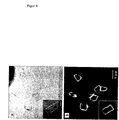
- Figure 3 displays a CLSM image (in transmission mode) of a FDA microcrystal that has been dispersed as a result of coating with PSS and additionally coated with nine polyelectrolytes layers (the last layer was PAH-FITC).
- the inset shows the corresponding CLSM fluorescence micrograph. It is evident from the transmission image the microcrystal possesses a solid core. The microcrystals had various shapes, ranging from near-spherical to rod-like, square and rectangular. Direct evidence for polymer coating of FDA is provided in the CLSM fluorescence image (inset). This displays fluorescence due to PAH-FITC present in the outer layer of a coated microcrystal. Similar CLSM images were observed for predispersed FDA and PYR crystals coated with polymer. Studies showed that the coated microcrystal suspensions were stable for days when stored in an aqueous medium, reflecting the stability of the adsorbed layers.
- the layer-by-layer assembly of polycations and polyanions displays a remarkable self-regularity: For films grown on poorly charged and/or rough planar substrates, irregular growth has often been observed for the first few layers with regular growth achieved after the deposition of a number of layer pairs. 30-32
- the CLSM micrographs of polymer-coated FDA microcrystals after being exposed to ethanol solution and dispersed in water are displayed in Figure 4.
- the transmission image (a) shows a number of the hollow colloidal entities produced. There is no evidence of a solid core, indicating dissolution and removal of the microcrystal. Ethanol solubilizes the core material and the individual molecules are then able to diffuse through the semi-permeable polymer capsule walls.
- the structures seen in the transmission image are due to the contrast of the remaining polymer layers from the original coating of the microcrystals, indicating the successful formation of hollow polmyer capsules.
- the above results are consistent with the visual observation that the polymer-coated microcrystal suspensions lost their turbidity upon the addition of ethanol.
- CLSM fluorscence image (b) shows the fluorescence from the PAH-FITC layers.
- the different morphologies observed are due to the diversity of the microcrystal shapes. Some indentations on the polymer capsule walls may also be due to the centrifugation process used in their preparation. There was no evidence of rupturing of the capsule walls as a result of the facile removal of the microcrystal core by treatment with ethanol.
- the CLSM results demonstrate that polymer multilayers can be deposited onto pre-charged microcrystal templates and that the core can be removed by treatment with an appropriate solvent, leaving behing hollow polymer capsules.
- the polyelectrolyte capsules produced were further characterized using TEM and AFM.
- TEM images of air-dried hollow polymer capsules obtained from SDS-dispersed PYR microcrystals coated with eleven polymer layers, and FDA crystals dispersed with PSS and additionally coated with nine polyelectrolyte layers, are illustrated in Figure 5 (a and b, respectively).
- the insets are higher magnifications.
- the folds and creases seen in the polymer capsules are a result of evaporation of the aqueous content by air-drying. 10 .
- the striking difference between Figure 5a and Figure 5b is the wall porosity.
- the differences seen may be ascribed to the initial conformation of the first adsorbed layer (in terms of homogeneity) used to disperse the crystals. Nevertheless, the above illustrates the importance of the first adsorbed layer in determining the porosity of the resulting thin-walled hollow polymer capsules. Control over the pore size in such hollow microcapsules is expected to have important implications in technology as it allows regulation of the release rate of encapsulated materials.
- the colloid-template approach based on uncharged organic microcrystals complements other strategies we have been developing for encapsulating various materials.
- This method is of particular relevance and importance because of its potential to encapsulate a wide range of uncharged crystalline drugs.
- its versatility and the control that it permits over the polymer multilayer wall thickness and composition allows for the creation of a drug release system with a tailored release rate.
- the systems prepared provide excellent model drug release systems to study various parameters on the release rate of encapsuied low molecular weight compounds.
- An interesting strategy is to control the release rate by varying the thickness and composition of the polymer capsule walls.
- FIG. 1 is a schematic representation of a preferred embodiment of the process used to encapsulate organic microcrystals and to create hollow polymer cages.
- the uncharged microcrystals are coated by the self-assembly of charged surfactant molecules (step 1), rendering them water dispersible and hence amenable to subsequent coating with polyelectrolyte multilayers (step 2).
- step 1 Each polyelectrolyte layer deposited has an opposite charge to that already adsorbed.
- Hollow polymer multilayer cages are formed by direct exposure of the encapsulated microcrystals to ethanol, causing their solubilisation and removal (step 3).
- Some surfactant may be electrostatically bound to the hollow polymer cages.
- Step 1 of Fig.1 can, of course, be varied, e.g. by use of a polyelectrolyte (e.g. PSS) or phospholipids to coat and pre-charge the microcrystals.
- a polyelectrolyte e.g. PSS
- phospholipids to coat and pre-charge the microcrystals.
- Figure 2 shows the ⁇ -potential of amphiphile-stabilised PYR and FDA microcrystals as a function of polyelectrolyte layer number: (a) PYR-DDDAB (filled squared), FDA-SDS (open circles); (b) FDA-DPPC (filled circles); FDA-PSS (open squares).
- Layer 9 and 11 for the PYR-DDDAB system and layer 10 for the FDA-PSS system correspond to PAH-FITC adsorption.
- Figure 3 shows the transmission and fluorescence (inset) CLSM micrographs of an FDA crystal dispersed by adsorption of PSS and further coated with nine polyelectrolyte layers, with the outermost layer being PAH-FITC, [(PAH/PSS) 4 /PAH-FITC].
- Figure 4 shows the CLSM transmission (a) and fluorescence (b) micographs of hollow polymer capsules derived from polymer-coated FDA microcrystals.
- the polymer cages were obtained from polymer-coated FDA microcrystals.
- the FDA microcrystals were dispersed by adsorption of PSS and additionally coated with nine polyelectrolyte layers with the outermost layer being PAH-FITC, [(PAH/PSS) 4 /PAH-FlTC].
- the insets show an individual hollow polymer cage, obtained after dissolution of the core from FDA dispersed with SDS and coated with eleven polyelectrolyte layers [(PAH/PSS) 4 /PAH-FITC].
- the scale bars in the insets correspond to 2 ⁇ m.
- Figure 5 shows the TEM images of air-dried hollow polymer capsules, obtained after removal of the templated microcrystal core with ethanol.
- the PYR core was dispersed by SDS and coated with eleven polyelectrolyte layers.
- FDA was dispersed by PSS and coated with nine polyelectrolyte layers. The polymer capsules flattened as a result of drying and folds and creases are seen. A significant difference in porosity was observed for the polymer capsules, depending on whether surfactant (a, less porous) or PSS (b, more porous) was used to disperse the microcrystals. Similar differences were observed for both the PYR and FDA systems.
- the scale bars in the insets correspond to 200 nm.
- PYR Pyrene
- FDA fluorescein diacetate
- the positively charged surfactants didodecyldimethylammonium bromide (DDDAB), hexadecyltrimethylammonium bromide (HDTAB), dodecyltrimethylammonium bromide (DTMAB), myristyltrimethylammonium bromide (MTMAB), and the negatively charged surfactant sodium dodecylsulfate (SDS) were all from Aldrich.
- Dipalmitoyl-DL- ⁇ -phosphatidylcholine (DPPC) was purchased from Sigma. All reagents were used as received, except for the PSS, which was dialyzed against Milli-Q water (M w cut-off 14,000) and lyophilized before use.
- the layer-by-layer assembly of polyelectrolytes onto FDA or PYR microcrystals was carried out as follows: 50 mg of finely milled core particles (FDA or PYR) were first thoroughly mixed with 12 mL of 0.2-0.4 wt% of the dispersing agent (ionic surfactant, lipid or charged polymer). Crystalline fluorescein diacetate or pyrene can be milled to fine particles using e.g. a mortar and pestle. However, also advanced ball milling procedures can be used.
- FDA or PYR finely milled core particles
- the dispersing agent ionic surfactant, lipid or charged polymer
- Crystalline fluorescein diacetate or pyrene can be milled to fine particles using e.g. a mortar and pestle. However, also advanced ball milling procedures can be used.
- the crystals were suspended by their immediate sonication for 5 min. The suspension was allowed to stand for 30 min, thus allowing the larger crystals to sediment, or gently centrifuged. The turbid white supernatant was then extracted, centrifuged and washed several times, and finally resuspended in water.
- microcrystal particles were then layer-by-layer coated with PSS and PAH.
- PSS solution 5 mg mL -1 , containing 0.5 M NaCl
- PAH solution 1 mL of 5 mg mL -1 , containing 0.5 M NaCl
- the suspension was centrifuged at 3000 g for 5 min.
- the supernatant was then removed and three cycles of water washing and redispersing were applied to remove the excess unadsorbed polyelectrolyte in solution.
- the fluorescently labeled polyelectrolyte, PAH-FITC was applied (as a 2 mg mL -1 solution containing 0.5 M NaCl) to form a fluorescent layer on the microcrystal surface.
- the treatment of the crystals with the SDS solution leads to a high negative surface charge (see layer No. 1 in Tables 1 and 2).
- the resulting suspensions are highly stable and ideally suitable as templates for the coating with polyelectrolytes.
- the alternating charge of the zeta-potential indicates the successful coating.
- the coating was also confirmed by the application of FITC conjugated PAH, and its visualisation by fluorescent microscopy.
- the morphology of the crystals is not changed during the coating procedures.
- the yield of coated substance is only decreased by a small loss in the centrifugation/washing step, and can be optimised to high rates, around 98 %.
- microcrystal core was removed by exposing 0.2 mL of the coated particle suspension of Example 3 to 1 mL of ethanol (or chloroform) and allowing 30 min for core dissolution.
- the resulting hollow polymer capsules were then centrifuged at 10000 g for 10 min, exposed to ethanol again, washed a further two times with water, and finally resuspended in water.
- the resuspended shells were analysed by confocal fluorescence microscopy demonstrating that hollow shells are obtained by the method.
- the shape of the shells is irregular due to initial shape of the template. This can be optimized or tailored by suitable choice of the template.
- microelectrophoretic mobility of coated organic microcrystals was measured with a malvern Zetasizer 4 by taking the average of 5 measurements at the stationary level.
- CLSM images were taken on a confocal laser scanning Aristoplan microscope from Leica with a 40 x oil immersion objective.
- TEM measurements were performed on a Philips CM 12 microscope operating at 120 kV. TEM samples were prepared by deposition of a diluted particle suspension onto a carbon-coated copper grid. The mixture was allowed to air dry for one minute, after which the time exces solution was removed by blotting with filtered paper.
- AFM images were obtained using a Nanoscope IIIa AFM (Digital Instruments, CA) in tapping mode. Samples were prepared by applying a drop of a diluted solution onto a freshly cleaved mica surface, allowing 1 min for air drying, and then blotting off the extra solution.
Landscapes
- Health & Medical Sciences (AREA)
- Chemical & Material Sciences (AREA)
- Life Sciences & Earth Sciences (AREA)
- Organic Chemistry (AREA)
- General Health & Medical Sciences (AREA)
- Public Health (AREA)
- Veterinary Medicine (AREA)
- Animal Behavior & Ethology (AREA)
- Chemical Kinetics & Catalysis (AREA)
- Engineering & Computer Science (AREA)
- Medicinal Chemistry (AREA)
- Pharmacology & Pharmacy (AREA)
- Bioinformatics & Cheminformatics (AREA)
- General Chemical & Material Sciences (AREA)
- Nuclear Medicine, Radiotherapy & Molecular Imaging (AREA)
- Epidemiology (AREA)
- Dispersion Chemistry (AREA)
- Diabetes (AREA)
- Dermatology (AREA)
- Birds (AREA)
- Food Science & Technology (AREA)
- Polymers & Plastics (AREA)
- Endocrinology (AREA)
- Hematology (AREA)
- Obesity (AREA)
- Nutrition Science (AREA)
- Communicable Diseases (AREA)
- Oncology (AREA)
- Manufacturing Of Micro-Capsules (AREA)
- Medicinal Preparation (AREA)
- Paints Or Removers (AREA)
- Glanulating (AREA)
- Medical Preparation Storing Or Oral Administration Devices (AREA)
- Medicines That Contain Protein Lipid Enzymes And Other Medicines (AREA)
Claims (40)
- Verfahren zur Einkapselung eines ungeladenen kristallinen Feststoffmaterials in der Form von Partikeln, umfassend:(a) Behandeln des kristallinen Festsioffparzikelmaterials mit einer amphiphilen Substanz und(b) anschließendes Beschichten des Materials mit einer Schicht eines geladenen Polyelektrolyten oder mit einer Multischicht umfassend abwechselnde Schichten von entgegensetzt geladenen Polyelektrolyten.
- Verfahren nach Anspruch 1, worin das Feststoffmaterial eine geringe Löslichkeit in Wasser aufweist, in Wasser unlöslich ist oder in Wasser nicht dispergierbar ist.
- Verfahren nach Anspruch 1 oder 2, worin das Feststoffmaterial ein organisches Material, ein Biomaterial oder ein anorganisches Material ist.
- Verfahren nach einem der vorhergehenden Ansprüche, worin das Feststoffmaterial ausgewählt wird aus der Gruppe bestehend aus Arzneimitteln, Vitaminen, Nährstoffen, Hormonen, Wachstumsfaktoren, Pestiziden, Antibiotika und Konservierungsmitteln oder Gemischen davon.
- Verfahren nach einem der vorhergehenden Ansprüche, worin das Feststoffmaterial ausgewählt wird aus der Gruppe bestehend aus Einzelkristallen.
- Verfahren nach einem der vorhergehenden Ansprüche, worin das Feststoffmaterial ein synthetisches Material oder ein aus natürlichen Quellen isoliertes Material oder ein chemisch modifiziertes isoliertes Material ist.
- Verfahren nach einem der vorhergehenden Ansprüche, worin die amphiphile Substanz ausgewählt wird aus ionischen oberflächenaktiven Mitteln, Phospholipiden und amphiphilen Polyelektrolyten.
- Verfahren nach einem der vorhergehenden Ansprüche, worin ein kationisches oder ein anionisches oberflächenaktives Mittel oder eine Kombination von anionischen und kationischen oberflächenaktiven Mitteln verwendet wird.
- Verfahren nach Anspruch 8, worin das kationische oberflächenaktive Mittel ausgewählt wird aus der Substanzklasse von quaternären Ammoniumsalzen ((R4N+)X-), insbesondere Didodecyldimethylammoniumbromid (DDDAB), Alkyltrimethylammoniumbromiden, insbesondere Dodecyltrimethylammoniumbromid oder Palmityltrimethylammoniumbromid oder N-Alkylpyridiniumsalzen oder tertiären Aminen ((R3NH+)X-), insbesondere Cholesteryl-3β-N-(dimethyl-aminoethyl)-carbamat oder sekundären Aminen ((R2NH2 +)X-) oder primären Aminen ((RNH3 +)X-) oder Mischungen davon.
- Verfahren nach Anspruch 8, worin das anionische oberflächenaktive Mittel ausgewählt wird aus der Substanzklasse von Alkylsulfonaten (R-SO3M), insbesondere Dodecylsulfat, Laurylsulfat oder Olefinsulfonaten (R-SO3M), insbesondere Natrium-n-dodecylbenzolsulfonat oder Alkylsulfaten R-OSO3M oder Fettsäuren (R-COOM), insbesondere Dodecansäurenatriumsalz oder Phosphorsäuren oder Cholinsäuren oder Fluororganika, insbesondere Lithium-3-[2-(perfluoralkyl)-ethylthio]-propionat oder Mischungen davon.
- Verfahren nach Anspruch 8, worin die amphiphile Substanz eine polymere Substanz ist, welche geladene Gruppen und hydrophobe Seiten aufweist, insbesondere Poly(styrolsulfonat) (PSS), oder ein Blockcopolymer ist, insbesondere Poly(ethylethylen-blockstyrolsulfonsäure (PEE-PSS).
- Verfahren nach einem der vorhergehenden Ansprüche, worin der Polyelektrolyt ausgewählt wird aus organischen Polymeren, Biopolymeren, anorganischen Polymeren und Gemischen davon.
- Verfahren nach einem der vorhergehenden Ansprüche, worin der Polyelektrolyt ein lineares oder ein nicht lineares Polymer oder Gemische von diesen ist.
- Verfahren nach einem der vorhergehenden Ansprüche, worin der Polyelektrolyt ein Blockcopolymer ist.
- Verfahren nach einem der vorhergehenden Ansprüche, worin der Polyelektrolyt nach dem Templatieren quervernetzt wird.
- Verfahren nach Anspruch 15, worin die Quervemetzung zwischen den Polymeren in einer Schicht oder/und zwischen den Schichten bereitgestellt wird.
- Verfahren nach Anspruch 12, worin der Polyelektrolyt ein organisches Polymer ist, ausgewählt aus bioabbaubaren Polymeren, insbesondere Polyglykolsäure (PGA), Polymilchsäure (PLA), Polyamiden, Poly-2-hydroxybutyrat (PHB), Polycaprolacton (PCL), Poly(milch-co-glykol) säure (PLGA), fluoreszenzmarkierten Polymeren, leitfähigen Polymeren, Flüssigkristallpolymeren, photoleitfähigen Polymeren, photochromen Polymeren und Copolymeren und/oder Gemischen von diesen.
- Verfahren nach Anspruch 12, worin der Polyelektrolyt ein Biopolymer ist, ausgewählt aus Polyaminosäuren, insbesondere Peptiden, S-Layer-Proteinen, Polykohlenwasserstoffen, insbesondere Dextrin, Pektin, Alginat, Glykogen, Amylose, Chitin, Chondroitin, Hyaluronsäure, Polynukleotiden, insbesondere DNA, RNA, Oligonukleotiden oder/und modifizierten Biopolymeren, insbesondere Carboxymethylcellulose, Carboxymethyldextran oder Ligninsulfonaten.
- Verfahren nach Anspruch 12, worin der Polyelektrolyt ein anorganisches Polymer ist, ausgewählt aus Polysilanen, Polysilanolen, Polyphosphazenen, Polysulfazenen, Polysulfiden und Polyphosphaten und Gemischen davon.
- Verfahren nach einem der vorhergehenden Ansprüche, worin geladene Nanopartikel und/oder Biomoleküle als Kapselmaterialien abgelagert werden.
- Verfahren nach einem der vorhergehenden Ansprüche, worin das überschüssige Material an amphiphilen Substanzen, Polyelektrolyten und/oder Nanopartikeln und Biomolekülen, die nicht zur Bildung der Beschichtung beitragen, nach jedem Beschichtungsschritt abgetrennt werden.
- Verfahren nach einem der vorhergehenden Ansprüche, worin das eingekapselte Material eine stabile. Suspension in einer wässrigen Phase bildet.
- Verfahren nach einem der vorhergehenden Ansprüche, worin die Kapseldicke und Durchlässigkeit für die kontrollierte Freisetzung des eingekapselten Materials durch mindestens eines der folgenden Merkmale kontrolliert wird: die Art des oberflächenaktiven Mittels, die Anzahl der Schichten, die Art des Polyelektrolyten, die Art der Nanopartikel oder Biomoleküle, einen zusätzlichen Quervernetzungsschritt, die Bedingungen der Polyelektrolyt-Assemblierung und die Art der amphiphilen Beschichtung.
- Verfahren zur Herstellung von Kapseln mit einer Polyelektrolytschale, umfassend die Schritte:(a) Behandeln eines ungeladenen kristallinen festen Templatmaterials mit einer amphiphilen Substanz,(b) anschließendes Beschichten des kristallinen Feststoffmaterials mit einer Schicht eines geladenen Polyelektrolyten oder mit einer Multischicht umfassend abwechselnde Schichten von entgegengesetzt geladenen Polyelektrolyten und(c) Entfernen des Kerns aus ungeladenem kristallinem festem Templatmaterial.
- Verfahren nach Anspruch 24, worin aus dem eingekapselten Material hohle Kapseln gebildet werden, indem das Kemmaterial durch Behandeln mit einem organischen Lösungsmittel, in welchem das Material löslich ist oder mit einem sauren oder alkalischen Lösungsmittel, in welchem das Material ein lösliches Salz bildet oder mit Gemischen davon, entfernt wird.
- Verfahren nach Anspruch 24 oder 25, worin die hohlen Kapseln in einem wässrigen Lösungsmittel oder einem organischen Lösungsmittel oder Gemischen davon redispergiert werden.
- Verfahren nach einem der Ansprüche 24-26, worin ferner ein Wirkstoff in die Kapseln eingebracht wird.
- Verfahren nach einem der vorhergehenden Ansprüche, worin die Größe der Poren innerhalb der Kapselwand durch die Art der verwendeten amphiphilen Substanz und/oder die Beschichtungsbedingungen der amphiphilen Substanz kontrolliert wird.
- Polyelektrolytkapsel, erhältlich durch ein Verfahren nach einem der Ansprüche 1-28.
- Kapsel nach Anspruch 29, umfassend einen Kern, der aus ungeladenem Feststoffmaterial besteht.
- Kapsel nach Anspruch 29, weiche keinen nachweisbaren Rückstand des festen Kemmaterials umfasst.
- Kapsel nach einem der Ansprüche 29-31, die eine endgültige Form aufweist, die durch das ungeladene feste Kemmaterial bestimmt ist.
- Kapsel nach einem der Ansprüche 29-32, umfassend einen Wirkstoff.
- Verwendung von Kapseln nach einem der Ansprüche 29-33 für die Einkapselung von Wirkstoffen.
- Verwendung von Kapseln nach einem der Ansprüche 29-33 als Reaktionskammem.
- Verwendung von Kapseln nach einem der Ansprüche 29-33 in der Sensorik, Oberflächenanalytik oder in Informationstechnologieanwendungen.
- Verwendung von Kapseln nach einem der Ansprüche 29-33 in Pharmazie, Medizin, Lebensmitteltechnologie, Biotechnologie, Kosmetik oder in Druckanwendungen.
- Verwendung von Kapseln nach einem der Ansprüche 29-33 als langsame, gezielte oder kontrollierte Freisetzungssysteme.
- Zusammensetzung, welche Kapseln nach einem der Ansprüche 29-33 in getrockneter Form enthält.
- Zusammensetzung, welche Kapseln nach einem der Ansprüche 29-33 mit einer monodispersen Größenverteilung umfasst.
Priority Applications (2)
| Application Number | Priority Date | Filing Date | Title |
|---|---|---|---|
| DK01903643T DK1246692T3 (da) | 2000-01-13 | 2001-01-12 | Overtrækning af faste partikler med polymermultilag |
| EP01903643A EP1246692B1 (de) | 2000-01-13 | 2001-01-12 | Beschichtung von ungeladen soliden teilchen durch polymermehrlagen |
Applications Claiming Priority (6)
| Application Number | Priority Date | Filing Date | Title |
|---|---|---|---|
| DE10001172 | 2000-01-13 | ||
| DE10001172A DE10001172A1 (de) | 2000-01-13 | 2000-01-13 | Templatieren von Feststoffpartikeln mit Polymermultischichten |
| EP00111523A EP1116516A1 (de) | 2000-01-13 | 2000-05-29 | Beschichtung von soliden Partikeln durch Mehrlegen von Polymeren |
| EP00111523 | 2000-05-29 | ||
| EP01903643A EP1246692B1 (de) | 2000-01-13 | 2001-01-12 | Beschichtung von ungeladen soliden teilchen durch polymermehrlagen |
| PCT/EP2001/000329 WO2001051196A1 (en) | 2000-01-13 | 2001-01-12 | Templating of solid particles by polymer multilayers |
Publications (2)
| Publication Number | Publication Date |
|---|---|
| EP1246692A1 EP1246692A1 (de) | 2002-10-09 |
| EP1246692B1 true EP1246692B1 (de) | 2005-03-30 |
Family
ID=7627403
Family Applications (2)
| Application Number | Title | Priority Date | Filing Date |
|---|---|---|---|
| EP00111523A Withdrawn EP1116516A1 (de) | 2000-01-13 | 2000-05-29 | Beschichtung von soliden Partikeln durch Mehrlegen von Polymeren |
| EP01903643A Expired - Lifetime EP1246692B1 (de) | 2000-01-13 | 2001-01-12 | Beschichtung von ungeladen soliden teilchen durch polymermehrlagen |
Family Applications Before (1)
| Application Number | Title | Priority Date | Filing Date |
|---|---|---|---|
| EP00111523A Withdrawn EP1116516A1 (de) | 2000-01-13 | 2000-05-29 | Beschichtung von soliden Partikeln durch Mehrlegen von Polymeren |
Country Status (8)
| Country | Link |
|---|---|
| US (1) | US7045146B2 (de) |
| EP (2) | EP1116516A1 (de) |
| JP (1) | JP2003519565A (de) |
| AT (1) | ATE291958T1 (de) |
| DE (2) | DE10001172A1 (de) |
| DK (1) | DK1246692T3 (de) |
| ES (1) | ES2236175T3 (de) |
| WO (1) | WO2001051196A1 (de) |
Families Citing this family (128)
| Publication number | Priority date | Publication date | Assignee | Title |
|---|---|---|---|---|
| US7101575B2 (en) | 1998-03-19 | 2006-09-05 | Max-Planck-Gesellschaft Zur Forderung Der Wissenschaften E.V. | Production of nanocapsules and microcapsules by layer-wise polyelectrolyte self-assembly |
| CA2417792C (en) * | 2000-08-02 | 2009-09-08 | Max-Planck-Gesellschaft Zur Forderung Der Wissenschaften E.V. | Production of polyelectrolyte capsules by surface precipitation |
| US7112361B2 (en) * | 2001-10-25 | 2006-09-26 | Massachusetts Institute Of Technology | Methods of making decomposable thin films of polyelectrolytes and uses thereof |
| US7504364B2 (en) * | 2002-03-01 | 2009-03-17 | Receptors Llc | Methods of making arrays and artificial receptors |
| TW200304385A (en) | 2002-03-13 | 2003-10-01 | Novartis Ag | Materials containing multiple layers of vesicles |
| EP1488006B1 (de) * | 2002-03-20 | 2008-05-28 | InnovativeBio.Biz | Mikrokapseln mit kontrollierter durchlässigkeit die ein nukleinsäureamplifizierungsreaktionsgemisch enthalten und deren benutzung als reaktionsgefäss für parallele reaktionen |
| US6974592B2 (en) | 2002-04-11 | 2005-12-13 | Ocean Nutrition Canada Limited | Encapsulated agglomeration of microcapsules and method for the preparation thereof |
| US7101947B2 (en) | 2002-06-14 | 2006-09-05 | Florida State University Research Foundation, Inc. | Polyelectrolyte complex films for analytical and membrane separation of chiral compounds |
| US7235164B2 (en) | 2002-10-18 | 2007-06-26 | Eksigent Technologies, Llc | Electrokinetic pump having capacitive electrodes |
| EP1393706A1 (de) * | 2002-08-14 | 2004-03-03 | Quest International B.V. | Duftende Zusammensetzungen, eingekapselte Stoffe enthaltend |
| BRPI0305777B1 (pt) | 2002-08-14 | 2018-04-03 | Givaudan Sa | Composição compreendendo um tensoativo e um material encapsulado em uma cápsula, e, cápsulas |
| US20060057625A1 (en) * | 2002-09-16 | 2006-03-16 | Carlson Robert E | Scaffold-based artificial receptors and methods |
| US7469076B2 (en) * | 2003-09-03 | 2008-12-23 | Receptors Llc | Sensors employing combinatorial artificial receptors |
| US20050037428A1 (en) * | 2002-09-16 | 2005-02-17 | Receptors Llc | Artificial receptors including reversibly immobilized building blocks, the building blocks, and methods |
| US20050170385A1 (en) * | 2002-09-16 | 2005-08-04 | Receptors Llc | Artificial receptors including gradients |
| US20050037381A1 (en) * | 2002-09-16 | 2005-02-17 | Receptors Llc | Artificial receptors, building blocks, and methods |
| US20050136483A1 (en) * | 2003-09-03 | 2005-06-23 | Receptors Llc | Nanodevices employing combinatorial artificial receptors |
| US20050037429A1 (en) * | 2003-03-28 | 2005-02-17 | Receptors Llc | Artificial receptors including reversibly immobilized building blocks and methods |
| WO2005003326A2 (en) * | 2003-03-28 | 2005-01-13 | Receptors Llc. | Artificial receptors including reversibly immobilized building blocks and methods |
| US20040137481A1 (en) * | 2002-09-16 | 2004-07-15 | Receptors Llc | Artificial receptor building blocks, components, and kits |
| DE10244504A1 (de) * | 2002-09-25 | 2004-04-08 | Capsulution Nanoscience Ag | Schnellfreisetzende Darreichungsform mit schwerlöslichem Wirkstoff |
| DE10244503A1 (de) * | 2002-09-25 | 2004-04-08 | Capsulution Nanoscience Ag | Methode zur Herstellung und Stabilisierung von Mikro- und Nanosuspensionen mit Amphiphilen und Polyelektrolyten |
| US6740336B2 (en) | 2002-10-04 | 2004-05-25 | Mirus Corporation | Process for generating multilayered particles |
| US8105652B2 (en) | 2002-10-24 | 2012-01-31 | Massachusetts Institute Of Technology | Methods of making decomposable thin films of polyelectrolytes and uses thereof |
| JP4833553B2 (ja) | 2002-11-04 | 2011-12-07 | オーシャン・ニュートリション・カナダ・リミテッド | 複数の殻を有するマイクロカプセル及びそれらの調製方法 |
| JP4684991B2 (ja) | 2003-01-31 | 2011-05-18 | ボストン サイエンティフィック リミテッド | 薬物添加ナノカプセルを用いる局所的薬物デリバリー |
| GB0308937D0 (en) | 2003-04-17 | 2003-05-28 | Eastman Kodak Co | Inkjet recording element comprising particles and polymers |
| DE10361084A1 (de) | 2003-06-13 | 2005-01-05 | Henkel Kgaa | Lagerstabile Bleichmittelzusammensetzungen auf Basis von Peroxycarbonsäuren |
| US7364585B2 (en) | 2003-08-11 | 2008-04-29 | Boston Scientific Scimed, Inc. | Medical devices comprising drug-loaded capsules for localized drug delivery |
| US7544770B2 (en) | 2003-08-29 | 2009-06-09 | Louisiana Tech Foundation, Inc. | Multilayer films, coatings, and microcapsules comprising polypeptides |
| US7348399B2 (en) | 2003-08-29 | 2008-03-25 | Louisiana Tech University Foundation, Inc. | Nanofabricated polypeptide multilayer films, coatings, and microcapsules |
| US7550557B2 (en) | 2003-08-29 | 2009-06-23 | Louisiana Tech University Foundation, Inc. | Multilayer films, coatings, and microcapsules comprising polypeptides |
| US20050170004A1 (en) * | 2003-10-31 | 2005-08-04 | Vered Rosenberger | Nanoparticles for drug delivery |
| DE102004013637A1 (de) | 2004-03-19 | 2005-10-13 | Capsulution Nanoscience Ag | Verfahren zur Herstellung von CS-Partikeln und Mikrokapseln unter Verwendung poröser Template sowie CS-Partikel und Mikrokapseln |
| US8728525B2 (en) | 2004-05-12 | 2014-05-20 | Baxter International Inc. | Protein microspheres retaining pharmacokinetic and pharmacodynamic properties |
| WO2005110592A1 (en) * | 2004-05-17 | 2005-11-24 | Yki, Ytkemiska Institutet Ab | Mesoporous particles loaded with active substance |
| US8119153B2 (en) | 2004-08-26 | 2012-02-21 | Boston Scientific Scimed, Inc. | Stents with drug eluting coatings |
| WO2006029234A1 (en) | 2004-09-03 | 2006-03-16 | Receptors Llc | Combinatorial artificial receptors including tether building blocks |
| WO2006029383A2 (en) * | 2004-09-11 | 2006-03-16 | Receptors Llc | Combinatorial artificial receptors including peptide building blocks |
| EP1808225B1 (de) | 2004-10-18 | 2014-04-16 | Seiko Epson Corporation | Verkapselungsprodukt, herstellungsverfahren dafür und tintenzusammensetzung |
| WO2007018570A2 (en) * | 2004-11-03 | 2007-02-15 | Massachusetts Institute Of Technology | Absorbing film |
| CA2588449A1 (en) * | 2004-11-24 | 2006-06-01 | Therakine Corporation | An implant for intraocular drug delivery |
| US7651557B2 (en) * | 2004-12-17 | 2010-01-26 | Cabot Corporation | Inkjet inks comprising multi-layer pigments |
| GB0428261D0 (en) * | 2004-12-23 | 2005-01-26 | Eastman Kodak Co | Control of lattice spacing within crystals |
| US8034450B2 (en) | 2005-01-21 | 2011-10-11 | Ocean Nutrition Canada Limited | Microcapsules and emulsions containing low bloom gelatin and methods of making and using thereof |
| US6969530B1 (en) | 2005-01-21 | 2005-11-29 | Ocean Nutrition Canada Ltd. | Microcapsules and emulsions containing low bloom gelatin and methods of making and using thereof |
| JP5080445B2 (ja) * | 2005-04-13 | 2012-11-21 | アボット ゲーエムベーハー ウント コー. カーゲー | 超微粒子懸濁液及び超微粒子を穏やかに製造する方法並びにその使用 |
| MX2007013356A (es) * | 2005-04-27 | 2008-03-26 | Baxter Int | Microparticulas modificadas en la superficie y metodos de formacion y uso de las mismas. |
| US9968120B2 (en) | 2006-05-17 | 2018-05-15 | Dsm Nutritional Products Ag | Homogenized formulations containing microcapsules and methods of making and using thereof |
| WO2008039163A2 (en) * | 2005-07-08 | 2008-04-03 | Wisconsin Alumni Research Foundation | Polyelectrolyte multilayer films at liquid-liquid interfaces and methods for providing and using same |
| AU2006274541B2 (en) | 2005-08-02 | 2012-12-13 | Sol-Gel Technologies Ltd. | Metal oxide coating of water insoluble ingredients |
| US20070048383A1 (en) * | 2005-08-25 | 2007-03-01 | Helmus Michael N | Self-assembled endovascular structures |
| DE102005044400A1 (de) * | 2005-09-16 | 2007-03-22 | Capsulution Nanoscience Ag | Verfahren zur Verkapselung und kontrollierten Freisetzung von schwer wasserlöslichen (hydrophoben) flüssigen und festen Wirkstoffen |
| AU2006301847B2 (en) * | 2005-10-14 | 2011-11-17 | Vive Nano Inc. | Composite nanoparticles, nanoparticles and methods for producing same |
| EP2308900B1 (de) * | 2005-10-25 | 2014-02-12 | Artificial Cell Technologies, Inc. | Immunogene Zusammensetzungen und Verfahren zur Verwendung |
| EP1957794B1 (de) | 2005-11-23 | 2014-07-02 | Eksigent Technologies, LLC | Elektrokinetische pumpenausführungen und arzneimittelabgabesysteme |
| RU2300369C1 (ru) * | 2005-12-27 | 2007-06-10 | Наталья Ивановна Ларионова | Способ получения полиэлектролитных микрочастиц, содержащих инкапсулируемое вещество, чувствительных к изменению состава окружающей среды |
| AU2012200366B8 (en) * | 2006-05-03 | 2014-03-20 | Terapia Celular, Ln, Inc. | Systems and methods for producing multilayered particles, fibers and sprays and methods for administering the same |
| CA2654031C (en) | 2006-06-05 | 2016-05-24 | Ocean Nutrition Canada Limited | Microcapsules with improved shells |
| EP2647712A3 (de) | 2006-08-04 | 2013-11-20 | Baxter International Inc | Zusammensetzung auf Mikrokügelchenbasis zur Vorbeugung und/oder Umkehrung einer Neuerkrankung an autoimmun bedingter Diabetes |
| US8183184B2 (en) * | 2006-09-05 | 2012-05-22 | University Of Kansas | Polyelectrolyte complexes for oil and gas applications |
| WO2008042748A2 (en) * | 2006-09-29 | 2008-04-10 | Surmodics, Inc. | Polyelectrolyte media for bioactive agent delivery |
| WO2008045745A2 (en) * | 2006-10-06 | 2008-04-17 | President And Fellows Of Harvard College | Chemically-directed electrostatic self-assembly of materials |
| JP2008120767A (ja) * | 2006-11-15 | 2008-05-29 | Ebara Corp | カプセルとその製造方法及び医薬 |
| WO2008085997A2 (en) | 2007-01-10 | 2008-07-17 | Ocean Nutrition Canada, Ltd. | Vegetarian microcapsules |
| US7867592B2 (en) | 2007-01-30 | 2011-01-11 | Eksigent Technologies, Inc. | Methods, compositions and devices, including electroosmotic pumps, comprising coated porous surfaces |
| BRPI0808163A2 (pt) | 2007-02-01 | 2014-11-04 | Sol Gel Technologies Ltd | Composição para aplicação tópica, métodos para tratar uma condição de superfície em um indivíduo, para preparar uma composição, e para usar o kit, e, kit |
| KR20090121291A (ko) | 2007-02-01 | 2009-11-25 | 솔-겔 테크놀로지스 리미티드 | 산화금속 코팅을 포함한 입자의 제조방법 및 산화금속 코팅을 포함한 입자 |
| US9254266B2 (en) * | 2007-03-21 | 2016-02-09 | Wisconsin Alumni Research Foundation | Inhibiting surface enhanced crystallization of amorphous pharmaceuticals with ultrathin coatings |
| US8093039B2 (en) | 2007-04-10 | 2012-01-10 | The Trustees Of The Stevens Institute Of Technology | Surfaces differentially adhesive to eukaryotic cells and non-eukaryotic cells |
| CN101663581A (zh) * | 2007-04-19 | 2010-03-03 | 3M创新有限公司 | 水分散性二氧化硅纳米颗粒在连接生物分子方面的用途 |
| WO2008131063A1 (en) * | 2007-04-19 | 2008-10-30 | 3M Innovative Properties Company | Methods of use of solid support material for binding biomolecules |
| DE102007024642A1 (de) | 2007-05-24 | 2008-11-27 | Eyesense Ag | Hydrogel-Implantat für Sensorik von Metaboliten am Auge |
| US20080311177A1 (en) | 2007-06-14 | 2008-12-18 | Massachusetts Institute Of Technology | Self Assembled Films for Protein and Drug Delivery Applications |
| WO2009016091A1 (en) * | 2007-08-01 | 2009-02-05 | Unilever Plc | Coated particles |
| US20090043276A1 (en) * | 2007-08-09 | 2009-02-12 | Boston Scientific Scimed, Inc. | Drug delivery device, compositions and methods relating thereto |
| CA2700617C (en) | 2007-09-28 | 2018-11-06 | Celgene Cellular Therapeutics | Tumor suppression using human placental perfusate and human placenta-derived intermediate natural killer cells |
| US20090117039A1 (en) * | 2007-11-02 | 2009-05-07 | Boston Scientific Scimed, Inc. | Charged biodegradable polymers for medical applications |
| JP2009138014A (ja) * | 2007-12-03 | 2009-06-25 | Toyota Central R&D Labs Inc | ナノ構造材料の製造方法 |
| US8251672B2 (en) | 2007-12-11 | 2012-08-28 | Eksigent Technologies, Llc | Electrokinetic pump with fixed stroke volume |
| WO2009081287A2 (en) * | 2007-12-21 | 2009-07-02 | University Of Guelph | Polysaccharide nanoparticles |
| KR101415994B1 (ko) * | 2007-12-27 | 2014-07-08 | (주)아모레퍼시픽 | 카로티노이드를 안정화한 이중층 구조의 고분자 캡슐, 그 제조 방법 및 이를 함유하는 화장료 조성물 |
| IL188647A0 (en) * | 2008-01-08 | 2008-11-03 | Orina Gribova | Adaptable structured drug and supplements administration system (for oral and/or transdermal applications) |
| WO2009097508A2 (en) * | 2008-01-30 | 2009-08-06 | Mcanulty, Jonathan | Methods and compositions for wound healing |
| US9174839B2 (en) * | 2008-01-30 | 2015-11-03 | Imbed Biosciences, Inc. | Methods and compositions for wound healing |
| JP5681626B2 (ja) | 2008-07-14 | 2015-03-11 | ポリーペイド リミテッドPolypid Ltd. | 徐放性薬剤キャリア組成物 |
| US9198875B2 (en) | 2008-08-17 | 2015-12-01 | Massachusetts Institute Of Technology | Controlled delivery of bioactive agents from decomposable films |
| US8323615B2 (en) | 2008-08-20 | 2012-12-04 | Baxter International Inc. | Methods of processing multi-phasic dispersions |
| US8323685B2 (en) | 2008-08-20 | 2012-12-04 | Baxter International Inc. | Methods of processing compositions containing microparticles |
| US8367427B2 (en) | 2008-08-20 | 2013-02-05 | Baxter International Inc. | Methods of processing compositions containing microparticles |
| FR2937259B1 (fr) * | 2008-10-20 | 2010-12-24 | Commissariat Energie Atomique | Vesicules catanioniques, leur procede de preparation et leurs applications |
| FR2939313B1 (fr) * | 2008-12-10 | 2012-03-23 | St Hubert | Procede de preparation de vesicules a caractere hydrophobe comprenant une cavite interne hydrophobe. |
| US8685538B2 (en) * | 2009-03-25 | 2014-04-01 | Northeastern University | Stable polyelectrolyte coated nanoparticles |
| SG10201403918RA (en) | 2009-07-09 | 2014-10-30 | Oshadi Drug Administration Ltd | Matrix carrier compositions, methods and uses |
| CN102470105B (zh) | 2009-07-14 | 2015-07-29 | 波利皮得有限公司 | 持续释放药物载体组合物 |
| AU2011208374B2 (en) | 2010-01-19 | 2016-09-08 | Polypid Ltd. | Sustained-release nucleic acid matrix compositions |
| WO2011115165A1 (ja) * | 2010-03-18 | 2011-09-22 | 株式会社豊田中央研究所 | ナノヘテロ構造体およびその製造方法 |
| KR101809771B1 (ko) | 2010-05-14 | 2017-12-15 | 바스프 에스이 | 그래핀에 의한 금속 및 금속 산화물의 캡슐화 방법 및 상기 물질의 용도 |
| EP2697162B1 (de) | 2011-04-14 | 2020-12-02 | The Regents of The University of California | Entwürfe und anwendungen für multifunktionelle nanopartikel |
| DE102011018716A1 (de) * | 2011-04-26 | 2012-10-31 | Fraunhofer-Gesellschaft zur Förderung der angewandten Forschung e.V. | Mikrokapsel, Stoffgemisch, technische Einrichtung und Verfahren zur Herstellung einer vereisungshemmenden Schicht |
| EP2704759A4 (de) | 2011-05-05 | 2015-06-03 | Eksigent Technologies Llc | Gelkupplung für elektrokinetische abgabesysteme |
| JP6037607B2 (ja) * | 2011-11-10 | 2016-12-07 | 株式会社日本触媒 | 有機結晶 |
| EP4062772A3 (de) * | 2012-01-26 | 2022-12-14 | Incredible Foods, Inc. | Materialverkapselung in natürlichen transportsystemen |
| US9433671B2 (en) | 2012-03-30 | 2016-09-06 | Artificial Cell Technologies, Inc. | Anti-malaria compositions and methods |
| US8883717B2 (en) | 2012-03-30 | 2014-11-11 | Artificial Cell Technologies, Inc. | Antigenic compositions and methods |
| EP2841056A4 (de) | 2012-04-23 | 2015-09-16 | Massachusetts Inst Technology | Stabile schichtweise beschichtete teilchen |
| WO2014062689A1 (en) * | 2012-10-15 | 2014-04-24 | Ultra Ink, Llc | Removable tattoo ink and the use thereof |
| US9687465B2 (en) | 2012-11-27 | 2017-06-27 | Sol-Gel Technologies Ltd. | Compositions for the treatment of rosacea |
| AU2014215458A1 (en) | 2013-02-05 | 2015-08-13 | Anthrogenesis Corporation | Natural killer cells from placenta |
| WO2014134029A1 (en) | 2013-02-26 | 2014-09-04 | Massachusetts Institute Of Technology | Nucleic acid particles, methods and use thereof |
| WO2014150074A1 (en) | 2013-03-15 | 2014-09-25 | Massachusetts Institute Of Technology | Compositions and methods for nucleic acid delivery |
| US9757342B2 (en) | 2013-03-22 | 2017-09-12 | Pusan National University Industry-University Cooperation Foundation | Method for preparing protein cage, and in situ method for preparing hydrophobic additive-supported core-shell structured polymer-protein particles |
| CN103170648B (zh) * | 2013-04-09 | 2014-11-12 | 厦门大学 | 一种中空金属微球的制备方法 |
| CN113679740A (zh) | 2013-11-15 | 2021-11-23 | 人类起源公司 | 包含人胎盘灌注液细胞、其亚群的组合物及其用途 |
| US9622506B2 (en) | 2014-02-19 | 2017-04-18 | Incredible Foods, Inc. | Encapsulated soft food compositions and methods of making |
| CN103962076B (zh) * | 2014-04-28 | 2017-05-17 | 江南大学 | 一种聚氨酯-壳聚糖双壳光致变色微胶囊的制备方法 |
| US9968665B2 (en) | 2015-09-16 | 2018-05-15 | Artificial Cell Technologies, Inc. | Anti-malaria compositions and methods |
| CN108603042B (zh) * | 2015-11-30 | 2020-07-14 | 阿诺米拉公司 | 纤维素基有机颜料 |
| KR102899445B1 (ko) | 2016-07-29 | 2025-12-15 | 임베드 바이오사이언시스 아이엔씨. | 상처 치유를 위한 방법 및 조성물 |
| US20200085705A1 (en) * | 2016-12-22 | 2020-03-19 | Agency For Science, Technology And Research | Method of Encapsulating Compounds |
| WO2019012537A1 (en) | 2017-07-12 | 2019-01-17 | Sol-Gel Technologies Ltd | COMPOSITIONS COMPRISING ENCAPSULATED TRETTINOIN |
| CA3077325A1 (en) | 2017-09-28 | 2019-04-04 | Celularity Inc. | Tumor suppression using human placenta-derived intermediate natural killer (pink) cells in combination with an antibody |
| US11419947B2 (en) | 2017-10-30 | 2022-08-23 | Massachusetts Institute Of Technology | Layer-by-layer nanoparticles for cytokine therapy in cancer treatment |
| AU2019257320B2 (en) | 2018-04-20 | 2022-04-07 | Illumina, Inc. | Methods of encapsulating single cells, the encapsulated cells and uses thereof |
| CA3113271A1 (en) | 2018-10-26 | 2020-04-30 | Illumina, Inc. | Modulating polymer beads for dna processing |
| EP3975841A1 (de) | 2019-05-30 | 2022-04-06 | Massachusetts Institute of Technology | Peptid-nukleinsäurefunktionalisierte hydrogelmikronadeln zur probenahme und detektion von nukleinsäuren in interstitieller flüssigkeit |
| JP6843401B1 (ja) * | 2019-11-27 | 2021-03-17 | エレテン株式会社 | ブドウ状微粒集合体及びその製造方法並びに衛生用紙 |
| CN113368041B (zh) * | 2020-07-17 | 2023-01-03 | 丽珠医药集团股份有限公司 | 药物组合物、缓释制剂及其制备方法 |
Family Cites Families (7)
| Publication number | Priority date | Publication date | Assignee | Title |
|---|---|---|---|---|
| FR2702160B1 (fr) * | 1993-03-02 | 1995-06-02 | Biovecteurs As | Vecteurs particulaires synthétiques et procédé de préparation. |
| ATE524165T1 (de) * | 1998-03-19 | 2011-09-15 | Max Planck Gesellschaft | Verfahren zur herstellung von kapseln mit einer polyelektrolythülle |
| DE19812083A1 (de) * | 1998-03-19 | 1999-09-30 | Max Planck Gesellschaft | Herstellung von Nano- und Mikrokapseln durch schichtweise Polyelektrolyt-Selbstassemblierung |
| DE19907552A1 (de) * | 1999-02-22 | 2000-08-31 | Max Planck Gesellschaft | Polyelektrolythüllen auf biologischen Templaten |
| WO1999047253A1 (en) * | 1998-03-19 | 1999-09-23 | MAX-PLANCK-Gesellschaft zur Förderung der Wissenschaften e.V. | Fabrication of multilayer-coated particles and hollow shells via electrostatic self-assembly of nanocomposite multilayers on decomposable colloidal templates |
| ES2292250T5 (es) * | 1998-07-15 | 2010-09-14 | Max-Planck-Gesellschaft Zur Forderung Der Wissenschaften E.V. | Envolventes de polielectrolitos sobre plantillas (templates) biologicas. |
| WO2000077281A1 (en) * | 1999-06-10 | 2000-12-21 | MAX-PLANCK-Gesellschaft zur Förderung der Wissenschaften e.V. | Encapsulation of crystals via multilayer coatings |
-
2000
- 2000-01-13 DE DE10001172A patent/DE10001172A1/de not_active Withdrawn
- 2000-05-29 EP EP00111523A patent/EP1116516A1/de not_active Withdrawn
-
2001
- 2001-01-12 JP JP2001551606A patent/JP2003519565A/ja active Pending
- 2001-01-12 DK DK01903643T patent/DK1246692T3/da active
- 2001-01-12 ES ES01903643T patent/ES2236175T3/es not_active Expired - Lifetime
- 2001-01-12 DE DE60109732T patent/DE60109732T2/de not_active Expired - Lifetime
- 2001-01-12 WO PCT/EP2001/000329 patent/WO2001051196A1/en not_active Ceased
- 2001-01-12 AT AT01903643T patent/ATE291958T1/de active
- 2001-01-12 EP EP01903643A patent/EP1246692B1/de not_active Expired - Lifetime
- 2001-01-12 US US10/148,890 patent/US7045146B2/en not_active Expired - Fee Related
Also Published As
| Publication number | Publication date |
|---|---|
| EP1246692A1 (de) | 2002-10-09 |
| US7045146B2 (en) | 2006-05-16 |
| US20020187197A1 (en) | 2002-12-12 |
| ATE291958T1 (de) | 2005-04-15 |
| EP1116516A1 (de) | 2001-07-18 |
| DE10001172A1 (de) | 2001-07-26 |
| JP2003519565A (ja) | 2003-06-24 |
| ES2236175T3 (es) | 2005-07-16 |
| DE60109732D1 (de) | 2005-05-04 |
| DE60109732T2 (de) | 2005-08-25 |
| DK1246692T3 (da) | 2005-07-25 |
| WO2001051196A1 (en) | 2001-07-19 |
Similar Documents
| Publication | Publication Date | Title |
|---|---|---|
| US7045146B2 (en) | Templating of solid particles by polymer multilayers | |
| CA2420523C (en) | Controlled and sustained release properties of polyelectrolyte multilayer capsules | |
| Radtchenko et al. | Incorporation of macromolecules into polyelectrolyte micro-and nanocapsules via surface controlled precipitation on colloidal particles | |
| Shi et al. | Release behavior of thin-walled microcapsules composed of polyelectrolyte multilayers | |
| US6699501B1 (en) | Polyelectrolyte coverings on biological templates | |
| Sukhorukov et al. | Microencapsulation by means of step-wise adsorption of polyelectrolytes | |
| US8168226B2 (en) | Production of nanocapsules and microcapsules by layer-wise polyelectrolyte self-assembly | |
| Sharipova et al. | Polymer–surfactant complexes for microencapsulation of vitamin E and its release | |
| Wang et al. | Fabrication of drug-loaded biodegradable microcapsules for controlled release by combination of solvent evaporation and layer-by-layer self-assembly | |
| Donath et al. | Novel hollow polymer shells by colloid‐templated assembly of polyelectrolytes | |
| De Geest et al. | Layer-by-layer coating of degradable microgels for pulsed drug delivery | |
| Bazylińska et al. | Influence of dicephalic ionic surfactant interactions with oppositely charged polyelectrolyte upon the in vitro dye release from oil core nanocapsules | |
| US11040324B2 (en) | Polyelectrolyte microcapsules and methods of making the same | |
| US20090304756A1 (en) | Method for the Encapsulation and Controlled Release of Poorly Water-Soluble (Hyprophobic) Liquid and Solid Active Ingredients | |
| JP2003522781A (ja) | コロイド系を含むミクロスフェアの調製のための方法 | |
| WO1999047252A2 (de) | Herstellung von nano- und mikrokapseln durch schichtweise polyelektrolyt-selbstassemblierung | |
| Tsirigotis-Maniecka et al. | Colloidal characteristics and functionality of rationally designed esculin-loaded hydrogel microcapsules | |
| PL229276B1 (pl) | Nanokapsuła do przenoszenia związku lipofilowego i sposób jej wytwarzania | |
| Tao et al. | Formulation and cytotoxicity of doxorubicin loaded in self-assembled bio-polyelectrolyte microshells | |
| US7348031B2 (en) | Method for preparing colloidal particles in the form of nanocapsules | |
| Haufová et al. | Towards the inkjet fabrication of artificial cells | |
| Xiao et al. | pH-Dependent intestine-targeted delivery potency of the O-carboxymethyl chitosan–gum Arabic coacervates | |
| Srivastava et al. | Application of self-assembled ultra-thin film coatings to stabilize macromolecule encapsulation in alginate microspheres | |
| Danarto et al. | Microencapsulation of riboflavin (vitamin B2) using alginate and chitosan: effect of alginate and chitosan concentration upon encapsulation efficiency | |
| Merir | Conception de nouveaux systèmes nano/micro encapsulés pour la vectorisation des médicaments |
Legal Events
| Date | Code | Title | Description |
|---|---|---|---|
| PUAI | Public reference made under article 153(3) epc to a published international application that has entered the european phase |
Free format text: ORIGINAL CODE: 0009012 |
|
| 17P | Request for examination filed |
Effective date: 20020521 |
|
| AK | Designated contracting states |
Kind code of ref document: A1 Designated state(s): AT BE CH CY DE DK ES FI FR GB GR IE IT LI LU MC NL PT SE TR |
|
| 17Q | First examination report despatched |
Effective date: 20030110 |
|
| GRAP | Despatch of communication of intention to grant a patent |
Free format text: ORIGINAL CODE: EPIDOSNIGR1 |
|
| RTI1 | Title (correction) |
Free format text: TEMPLATING OF UNCHARGED SOLID PARTICLES BY POLYMER MULTILAYERS |
|
| RIN1 | Information on inventor provided before grant (corrected) |
Inventor name: TRAU, DIETER,THE HONG KONG UNIVERSITY Inventor name: RENNEBERG, REINHARD,THE HONG KONG UNIVERSITY Inventor name: MOEHWALD, HELMUTH Inventor name: CARUSO, FRANK |
|
| GRAS | Grant fee paid |
Free format text: ORIGINAL CODE: EPIDOSNIGR3 |
|
| GRAA | (expected) grant |
Free format text: ORIGINAL CODE: 0009210 |
|
| AK | Designated contracting states |
Kind code of ref document: B1 Designated state(s): AT BE CH CY DE DK ES FI FR GB GR IE IT LI LU MC NL PT SE TR |
|
| REG | Reference to a national code |
Ref country code: GB Ref legal event code: FG4D |
|
| REG | Reference to a national code |
Ref country code: CH Ref legal event code: EP |
|
| REG | Reference to a national code |
Ref country code: CH Ref legal event code: NV Representative=s name: A. BRAUN, BRAUN, HERITIER, ESCHMANN AG PATENTANWAE |
|
| REF | Corresponds to: |
Ref document number: 60109732 Country of ref document: DE Date of ref document: 20050504 Kind code of ref document: P |
|
| REG | Reference to a national code |
Ref country code: IE Ref legal event code: FG4D |
|
| REG | Reference to a national code |
Ref country code: SE Ref legal event code: TRGR |
|
| PG25 | Lapsed in a contracting state [announced via postgrant information from national office to epo] |
Ref country code: GR Free format text: LAPSE BECAUSE OF FAILURE TO SUBMIT A TRANSLATION OF THE DESCRIPTION OR TO PAY THE FEE WITHIN THE PRESCRIBED TIME-LIMIT Effective date: 20050630 |
|
| REG | Reference to a national code |
Ref country code: ES Ref legal event code: FG2A Ref document number: 2236175 Country of ref document: ES Kind code of ref document: T3 |
|
| REG | Reference to a national code |
Ref country code: DK Ref legal event code: T3 |
|
| PG25 | Lapsed in a contracting state [announced via postgrant information from national office to epo] |
Ref country code: PT Free format text: LAPSE BECAUSE OF FAILURE TO SUBMIT A TRANSLATION OF THE DESCRIPTION OR TO PAY THE FEE WITHIN THE PRESCRIBED TIME-LIMIT Effective date: 20050908 |
|
| PG25 | Lapsed in a contracting state [announced via postgrant information from national office to epo] |
Ref country code: LU Free format text: LAPSE BECAUSE OF NON-PAYMENT OF DUE FEES Effective date: 20060131 Ref country code: MC Free format text: LAPSE BECAUSE OF NON-PAYMENT OF DUE FEES Effective date: 20060131 |
|
| PLBE | No opposition filed within time limit |
Free format text: ORIGINAL CODE: 0009261 |
|
| STAA | Information on the status of an ep patent application or granted ep patent |
Free format text: STATUS: NO OPPOSITION FILED WITHIN TIME LIMIT |
|
| ET | Fr: translation filed | ||
| 26N | No opposition filed |
Effective date: 20060102 |
|
| REG | Reference to a national code |
Ref country code: CH Ref legal event code: PFA Owner name: MAX-PLANCK-GESELLSCHAFT ZUR FOERDERUNG DER WISSEN Free format text: MAX-PLANCK-GESELLSCHAFT ZUR FOERDERUNG DER WISSENSCHAFTEN E.V.#HOFGARTENSTRASSE 8#80539 MUENCHEN (DE) -TRANSFER TO- MAX-PLANCK-GESELLSCHAFT ZUR FOERDERUNG DER WISSENSCHAFTEN E.V.#HOFGARTENSTRASSE 8#80539 MUENCHEN (DE) |
|
| PG25 | Lapsed in a contracting state [announced via postgrant information from national office to epo] |
Ref country code: TR Free format text: LAPSE BECAUSE OF FAILURE TO SUBMIT A TRANSLATION OF THE DESCRIPTION OR TO PAY THE FEE WITHIN THE PRESCRIBED TIME-LIMIT Effective date: 20050330 |
|
| PG25 | Lapsed in a contracting state [announced via postgrant information from national office to epo] |
Ref country code: CY Free format text: LAPSE BECAUSE OF FAILURE TO SUBMIT A TRANSLATION OF THE DESCRIPTION OR TO PAY THE FEE WITHIN THE PRESCRIBED TIME-LIMIT Effective date: 20050330 |
|
| PGFP | Annual fee paid to national office [announced via postgrant information from national office to epo] |
Ref country code: FI Payment date: 20100115 Year of fee payment: 10 |
|
| PGFP | Annual fee paid to national office [announced via postgrant information from national office to epo] |
Ref country code: IE Payment date: 20110125 Year of fee payment: 11 Ref country code: DK Payment date: 20110124 Year of fee payment: 11 |
|
| PGFP | Annual fee paid to national office [announced via postgrant information from national office to epo] |
Ref country code: SE Payment date: 20110121 Year of fee payment: 11 Ref country code: AT Payment date: 20110121 Year of fee payment: 11 Ref country code: NL Payment date: 20110125 Year of fee payment: 11 Ref country code: IT Payment date: 20110121 Year of fee payment: 11 |
|
| PGFP | Annual fee paid to national office [announced via postgrant information from national office to epo] |
Ref country code: BE Payment date: 20110124 Year of fee payment: 11 |
|
| PGFP | Annual fee paid to national office [announced via postgrant information from national office to epo] |
Ref country code: ES Payment date: 20110119 Year of fee payment: 11 |
|
| PG25 | Lapsed in a contracting state [announced via postgrant information from national office to epo] |
Ref country code: FI Free format text: LAPSE BECAUSE OF NON-PAYMENT OF DUE FEES Effective date: 20110112 |
|
| BERE | Be: lapsed |
Owner name: *MAX-PLANCK-GESELLSCHAFT ZUR FORDERUNG DER WISSENS Effective date: 20120131 |
|
| REG | Reference to a national code |
Ref country code: NL Ref legal event code: V1 Effective date: 20120801 |
|
| REG | Reference to a national code |
Ref country code: SE Ref legal event code: EUG |
|
| REG | Reference to a national code |
Ref country code: DK Ref legal event code: EBP |
|
| REG | Reference to a national code |
Ref country code: IE Ref legal event code: MM4A |
|
| PG25 | Lapsed in a contracting state [announced via postgrant information from national office to epo] |
Ref country code: SE Free format text: LAPSE BECAUSE OF NON-PAYMENT OF DUE FEES Effective date: 20120113 |
|
| PG25 | Lapsed in a contracting state [announced via postgrant information from national office to epo] |
Ref country code: IT Free format text: LAPSE BECAUSE OF NON-PAYMENT OF DUE FEES Effective date: 20120112 |
|
| REG | Reference to a national code |
Ref country code: AT Ref legal event code: MM01 Ref document number: 291958 Country of ref document: AT Kind code of ref document: T Effective date: 20120112 |
|
| PG25 | Lapsed in a contracting state [announced via postgrant information from national office to epo] |
Ref country code: BE Free format text: LAPSE BECAUSE OF NON-PAYMENT OF DUE FEES Effective date: 20120131 |
|
| PG25 | Lapsed in a contracting state [announced via postgrant information from national office to epo] |
Ref country code: AT Free format text: LAPSE BECAUSE OF NON-PAYMENT OF DUE FEES Effective date: 20120112 Ref country code: NL Free format text: LAPSE BECAUSE OF NON-PAYMENT OF DUE FEES Effective date: 20120801 Ref country code: DK Free format text: LAPSE BECAUSE OF NON-PAYMENT OF DUE FEES Effective date: 20120131 Ref country code: IE Free format text: LAPSE BECAUSE OF NON-PAYMENT OF DUE FEES Effective date: 20120112 |
|
| REG | Reference to a national code |
Ref country code: ES Ref legal event code: FD2A Effective date: 20130708 |
|
| PG25 | Lapsed in a contracting state [announced via postgrant information from national office to epo] |
Ref country code: ES Free format text: LAPSE BECAUSE OF NON-PAYMENT OF DUE FEES Effective date: 20120113 |
|
| PGFP | Annual fee paid to national office [announced via postgrant information from national office to epo] |
Ref country code: CH Payment date: 20130731 Year of fee payment: 13 Ref country code: DE Payment date: 20130730 Year of fee payment: 13 |
|
| PGFP | Annual fee paid to national office [announced via postgrant information from national office to epo] |
Ref country code: FR Payment date: 20130731 Year of fee payment: 13 Ref country code: GB Payment date: 20130731 Year of fee payment: 13 |
|
| REG | Reference to a national code |
Ref country code: DE Ref legal event code: R119 Ref document number: 60109732 Country of ref document: DE |
|
| REG | Reference to a national code |
Ref country code: CH Ref legal event code: PCAR Free format text: NEW ADDRESS: HOLBEINSTRASSE 36-38, 4051 BASEL (CH) |
|
| REG | Reference to a national code |
Ref country code: CH Ref legal event code: PL |
|
| GBPC | Gb: european patent ceased through non-payment of renewal fee |
Effective date: 20140112 |
|
| REG | Reference to a national code |
Ref country code: DE Ref legal event code: R119 Ref document number: 60109732 Country of ref document: DE Effective date: 20140801 |
|
| PG25 | Lapsed in a contracting state [announced via postgrant information from national office to epo] |
Ref country code: CH Free format text: LAPSE BECAUSE OF NON-PAYMENT OF DUE FEES Effective date: 20140131 Ref country code: DE Free format text: LAPSE BECAUSE OF NON-PAYMENT OF DUE FEES Effective date: 20140801 Ref country code: LI Free format text: LAPSE BECAUSE OF NON-PAYMENT OF DUE FEES Effective date: 20140131 |
|
| REG | Reference to a national code |
Ref country code: FR Ref legal event code: ST Effective date: 20140930 |
|
| PG25 | Lapsed in a contracting state [announced via postgrant information from national office to epo] |
Ref country code: GB Free format text: LAPSE BECAUSE OF NON-PAYMENT OF DUE FEES Effective date: 20140112 Ref country code: FR Free format text: LAPSE BECAUSE OF NON-PAYMENT OF DUE FEES Effective date: 20140131 |