EP1245552A1 - Procédé de coproduction de para-xylène et de méta-xylène comprenant deux étapes de séparation - Google Patents
Procédé de coproduction de para-xylène et de méta-xylène comprenant deux étapes de séparation Download PDFInfo
- Publication number
- EP1245552A1 EP1245552A1 EP02290655A EP02290655A EP1245552A1 EP 1245552 A1 EP1245552 A1 EP 1245552A1 EP 02290655 A EP02290655 A EP 02290655A EP 02290655 A EP02290655 A EP 02290655A EP 1245552 A1 EP1245552 A1 EP 1245552A1
- Authority
- EP
- European Patent Office
- Prior art keywords
- metaxylene
- desorbent
- raffinate
- separation
- extract
- Prior art date
- Legal status (The legal status is an assumption and is not a legal conclusion. Google has not performed a legal analysis and makes no representation as to the accuracy of the status listed.)
- Granted
Links
Images
Classifications
-
- C—CHEMISTRY; METALLURGY
- C07—ORGANIC CHEMISTRY
- C07C—ACYCLIC OR CARBOCYCLIC COMPOUNDS
- C07C15/00—Cyclic hydrocarbons containing only six-membered aromatic rings as cyclic parts
- C07C15/02—Monocyclic hydrocarbons
- C07C15/067—C8H10 hydrocarbons
- C07C15/08—Xylenes
-
- C—CHEMISTRY; METALLURGY
- C07—ORGANIC CHEMISTRY
- C07C—ACYCLIC OR CARBOCYCLIC COMPOUNDS
- C07C7/00—Purification; Separation; Use of additives
- C07C7/005—Processes comprising at least two steps in series
-
- C—CHEMISTRY; METALLURGY
- C07—ORGANIC CHEMISTRY
- C07C—ACYCLIC OR CARBOCYCLIC COMPOUNDS
- C07C7/00—Purification; Separation; Use of additives
- C07C7/12—Purification; Separation; Use of additives by adsorption, i.e. purification or separation of hydrocarbons with the aid of solids, e.g. with ion-exchangers
- C07C7/13—Purification; Separation; Use of additives by adsorption, i.e. purification or separation of hydrocarbons with the aid of solids, e.g. with ion-exchangers by molecular-sieve technique
Definitions
- the invention relates to a process for the co-production of paraxylene and metaxylene from of a charge of hydrocarbons containing them, the process comprising two stages of separation.
- the quantity of paraxylene must be greater than that of metaxylene: typically 2 to 40 times larger, the paraxylene must be very pure, typically at least 99.6% and the metaxylene must be of reasonable purity, typically at least 99.0%.
- WO 93/22022 describes different cases of charge separation of three constituents in three effluents, however the technology implemented which involves both very high pressures, pressure regulation and flow regulation in each three or four process areas and separate beds each in a column is not justified economically only for products with very high added value.
- US Patent 4,306,107 describes a simulated moving bed process in the liquid phase in which metaxylene is taken in the form of an extract, paraxylene, orthoxylene and a fraction of ethylbenzene are taken out as an intermediate raffinate, finally l ethylbenzene is taken as a raffinate.
- This process allowing the co-production of metaxylene and ethylbenzene naturally does not make it possible to co-produce a majority of paraxylene and an additional stream of metaxylene.
- US Pat. No. 4,313,015 describes a process for the continuous co-production of paraxylene and metaxylene from a charge of hydrocarbons in a simulated moving bed in the liquid phase comprising three samples.
- a process for the continuous co-production of paraxylene and metaxylene from a charge of hydrocarbons in a simulated moving bed in the liquid phase comprising three samples is also described in patent FR 2 782 714.
- the chromatographic column described contains at least twenty-five beds spread over five areas. At least five beds must be located in zone 3B between the draw point of an intermediate raffinate containing metaxylene, orthoxylene, ethylbenzene, solvent and paraxylene and the draw point of a raffinate containing metaxylene, orthoxylene and solvent. Metaxylene with a purity greater than 99% is then obtained by distillation of the raffinate.
- the hydrocarbon charge has an ethylbenzene content of less than 5%, which is restrictive.
- Document US 5,510,562 also describes a process for the separation of C8 aromatics where the mixture of orthoxylene, metaxylene, paraxylene, and ethylbenzene is first divided into two streams containing paraxylene and ethylbenzene respectively, and metaxylene and orthoxylene. Paraxylene is then separated from ethylbenzene by distillation followed by crystallization and metaxylene is separated from orthoxylene by distillation.
- metaxylene is separated from orthoxylene by distillation.
- Example E The document of the prior art which most closely resembles the invention is US patent 5,900,523. This document describes in Example E a process for the production of xylenes where a first separation zone by paraselective adsorption produces an extract enriched in paraxylene and a raffinate which comprises at least the majority of the ortho- and metaxylene present in the feed stream and which contains more than 10 percent orthoxylene. The extract is distilled to recover high purity paraxylene.
- the raffinate of the first separation zone is then introduced into a second separation zone by metaselective adsorption where the adsorbent is a Y zeolite with a SiO 2 / Al 2 O 3 molar ratio between 4.0 and 6.0 exchanged with sodium and having a water content equivalent to an LOI at 500 ° C of about 1.5 to about 2.5% by weight and where the separation is carried out in the liquid phase at a temperature between 100 ° C and 150 ° C.
- the second separation zone by metaselective adsorption produces an extract enriched in metaxylene and a raffinate which comprises the non-adsorbed compounds of the first raffinate, in particular orthoxylene. High purity metaxylene is recovered from the extract. It appears clearly in this description that the two adsorptions are placed in series without any synergy can be found for the co-production of the two isomers.
- the object of the invention is the co-production of paraxylene and metaxylene marketable at from a load of hydrocarbons.
- a second object of the invention is to obtain paraxylene at a purity of at least 99.6%, (with a minimum yield of 98%) and metaxylene of purity at least equal to 99% after distillation.
- a third object of the invention is to produce paraxylene and metaxylene with two separation units where the size of the second unit is reduced.
- the invention relates to a process for the co-production of paraxylene and metaxylene from a hydrocarbon feed which comprises them, the process comprising a first step of separation of the charge in simulated moving bed in at least one first chromatographic column (6) containing a plurality of beds of at least one adsorbent interconnected in a loop, said column comprising an injection of the charge (1), a racking of a first raffinate (4), a racking of a second raffinate (5) comprising desorbent, and a mixture containing substantially free metaxylene and orthoxylene ethylbenzene and paraxylene, an injection of desorbent (2) and a withdrawal of an extract delivering very high purity paraxylene, the process comprising the periodic shift of the positions of charge and desorbent injections and of the withdrawal position of the extract, from a bed in the direction of flow of a main flow flowing in said first column (6), the method being characterized in that the second raffinate is distilled
- the second separation step can be carried out in batch. It can also be done in continuous using the simulated moving bed technique, preferably with a simulated moving bed against the current. To do this, the positions of the injections of the mixture and the desorbent and the position of the withdrawals of the extract and the raffinate relating to the second chromatographic column of a bed in the direction of flow main circulating in said second column.
- the first and the second raffinate can be drawn off continuously or discontinuously.
- the second raffinate By withdrawing the second raffinate preferably continuously, it can be injected continuously in the distillation stage, without an intermediate buffer tank.
- the adsorbent used in the first separation step can comprise a zeolite X exchanged at the barium or a zeolite Y exchanged at potassium or a zeolite Y exchanged at barium and potassium.
- the preferred desorbent is paradiethylbenzene, however other desorbents such as toluene, paradifluorobenzene or mixed diethylbenzenes may also be suitable. Paradiethylbenzene is preferably recommended for its ease of recovery by distillation and for its strong affinity for the adsorbent.
- an adsorbent can be used in the second step of separation of the ortho- and metaxylene compounds from the second raffinate which is metaselective.
- the extract extracted contains desorbent and substantially pure metaxylene, the most adsorbed compound.
- an adsorbent in which the raffinate delivers substantially pure metaxylene and in which the extract delivers orthoxylene, in solution in the desorbent with the remaining impurities is toluene, however other desorbents such as indane, 1, 2, 4 Trimethylbenzene, para methyl ethylbenzene or cumene, pure or as a mixture may also be suitable.
- the adsorbent of the second separation step can comprise at least one zeolite chosen from the group consisting essentially of a zeolite X exchanged with calcium, a zeolite X exchanged with cesium, a zeolite Y exchanged with sodium or a zeolite Y exchanged with sodium and lithium.
- a zeolite Y containing substantially only sodium is recommended. Examples of metaselective zeolites containing sodium are described in US patents 4,326,092, US 5,382,747, US 5,900,523 and EP.A.712821.
- the volume ratio of desorbent to charge in the first separation step can be between 0.5 and 2.5, preferably between 1 and 2.
- each of the steps of the process can be carried out.
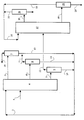
- a feed of xylenes comprising metaxylene, orthoxylene, ethylbenzene and paraxylene is introduced continuously by a line (1) into at least one chromatographic column (6) with at least five zones containing a plurality of beds of 'An adsorbent comprising a zeolite, a zeolite X exchanged with barium for example and operating in the liquid phase in a simulated moving bed and against the current according to US Pat. No. 4,331,015 and the patent already cited by the applicant.
- a first raffinate R1 is continuously withdrawn by a line (4) at a point located downstream of the point of introduction of the charge, while a second raffinate R2 containing metaxylene and orthoxylene is continuously withdrawn by a line (5) downstream of the first raffinate with respect to the direction of flow of the fluids in the column (specifically from bottom to top).
- a desorbent, paradiethylbenzene is injected continuously by a line (2) at a point in the column located upstream from the injection point of the load while an extract containing desorbent and substantially pure paraxylene is continuously withdrawn by a line (3) at a point downstream of the desorbent injection point.
- This extract is distilled in a distillation column (7), from which the substantially pure paraxylene (greater than 99.7%) is drawn off at the head by a line (10) and at the bottom by a line (13) the desorbent which can be recycled.
- the first raffinate is introduced into a distillation column (8) from which the desorbent which can be recycled is drawn off at the bottom by a line (14) and, at the top, a mixture containing xylenes and ethylbenzene by a line (11 ). This mixture can be sent to an isomerization unit.
- the second raffinate is introduced into a distillation column (9) from which the desorbent which can be recycled and at the top is drawn off at the bottom by a line (15), a mixture essentially containing metaxylene and orthoxylene and substantially free of paraxylene and ethylbenzene via a line (12).
- This line (12) is connected to the inlet of at least a second chromatographic column (17) comprising a plurality of beds of a zeolitic adsorbent, a NaY zeolite for example, and which is operated in the liquid phase in a simulated moving bed against the current, for example according to patent US 4326092 or US 5382747 with a Y zeolite containing sodium.
- a desorbent for example toluene, is introduced continuously by a line (16) into the chromatographic column (17) at a point situated upstream from the point of introduction of the charge, while an extract containing substantially pure metaxylene and desorbent is continuously withdrawn by a line (18) downstream of the point of introduction of the desorbent and upstream of the point of introduction of the charge.
- the extract line (18) is connected to the inlet of a distillation column (20) from which the desorbent is conventionally drawn off by a line (22) at the head, while at the bottom of the column is recovered metaxylene with a purity for example greater than 99%, by a line (24).
- Orthoxylene containing impurities is collected at the bottom of the column (21) by a line (25) to be optionally isomerized with that of line 11 while the desorbent is recovered at the top of the column (21) by a line ( 23).
- the charge and desorbent introduction points and the extract and raffinate withdrawal points are shifted periodically and simultaneously in the direction of flow of the fluid circulating in the columns.
- the valve changeover time (or period) is 70.8 seconds.
- the extract obtained delivers paraxylene at 99.7% of purity and a yield of 96.7%.
- the valve changeover time (or period) is 90 seconds.
- the extract obtained After distilling off the toluene, the extract obtained delivers 0.208 m 3 .h -1 of metaxylene with 99.03% purity.
- the production of paraxylene is 10 times greater than that of metaxylene.
- the valve changeover time (or period) is 70.8 seconds.
- the valve changeover time (or period) is 82 seconds.
- the extract obtained After distilling off the toluene, the extract obtained delivers 0.208 m 3 .h -1 of metaxylene with 99.04% purity, ie a production of paraxylene 10 times greater than that of metaxylene.
- the first unit is operated with a number of beds limited to 24.
- the quantities of adsorbent and solvent required in the second unit adsorption in simulated moving bed for identical metaxylene production are approximately 10% lower than in Example 1.
- the valve changeover time (or period) is 70.8 seconds.
- the extract obtained delivers paraxylene at 99.7% of purity and a yield of 96.0%.
- the valve changeover time (or period) is 82 seconds.
- the extract obtained After distilling off the toluene, the extract obtained delivers 0.208 m 3 .h -1 of metaxylene with 99.05% purity, ie a production of paraxylene 10 times greater than that of metaxylene.
Landscapes
- Chemical & Material Sciences (AREA)
- Organic Chemistry (AREA)
- Engineering & Computer Science (AREA)
- Analytical Chemistry (AREA)
- Oil, Petroleum & Natural Gas (AREA)
- Water Supply & Treatment (AREA)
- Organic Low-Molecular-Weight Compounds And Preparation Thereof (AREA)
- Treatment Of Liquids With Adsorbents In General (AREA)
Abstract
Description
Le brevet US 4 313 015 décrit un procédé de coproduction en continu de paraxylène et de métaxylène à partir d'une charge d'hydrocarbures en lit mobile simulé en phase liquide comprenant trois prélèvements. L'extrait est constitué de paraxylène trop impur (99,44%) pour être commercialisé aux normes actuelles (standard actuel = 99,7 mini) et avec un rendement de 97,5%, le raffinat intermédiaire est constitué d'éthylbenzène, d'ortho et de métaxylène et d'un peu de paraxylène, enfin le raffinat est constitué principalement d'un mélange d'orthoxylène et de métaxylène. Du métaxylène pur est alors obtenu par distillation du raffinat.
Un procédé de coproduction continue de paraxylène et de métaxylène à partir d'une charge d'hydrocarbures en lit mobile simulé en phase liquide comprenant trois prélèvements est également décrit dans le brevet FR 2 782 714. La colonne chromatographique décrite contient au moins vingt-cinq lits répartis sur cinq zones. Au moins cinq lits doivent se situer dans la zone 3B comprise entre le point de soutirage d'un raffinat intermédiaire contenant du métaxylène, de l'orthoxylène, de l'éthylbenzène, du solvant et du paraxylène et le point de soutirage d'un raffinat contenant du métaxylène, de l'orthoxylène et du solvant. Du métaxylène d'une pureté supérieure à 99% est alors obtenu par distillation du raffinat. Outre le grand nombre de lits nécessaires à la mise en oeuvre du procédé (30 par exemple), la charge d'hydrocarbures présente une teneur en éthylbenzène inférieure à 5%, ce qui est contraignant.
La demanderesse a déposé une demande de brevet FR 2 808 270 qui décrit un procédé de coproduction en lit mobile simulé de paraxylène et de métaxylène dans une colonne chromatographique comprenant trois prélèvements à partir d'une charge non limitée en éthylbenzène où un extrait contenant du paraxylène est soutiré de manière continue, le premier raffinat est soutiré de manière continue ou discontinue et où le second raffinat comprenant de l'orthoxylène et du métaxylène est soutiré de manière discontinue, le procédé étant en outre caractérisé en ce qu'on distille le second raffinat de façon à récupérer de l'orthoxylène et du métaxylène à au moins 99% de pureté.
Le document US 5 510 562 décrit également un procédé de séparation des aromatiques en C8 où le mélange d'orthoxylène, de métaxylène, de paraxylène, et d'éthylbenzène est d'abord divisé en deux flux contenant respectivement le paraxylène et l'éthylbenzène, et le métaxylène et l'orthoxylène. Le paraxylène est ensuite séparé de l'ethylbenzène par une distillation suivie d'une cristallisation et le métaxylène est séparé de l'orthoxylène par distillation.
Dans tous les procédés décrits dans les brevets US 4 313 015, FR 2 782 714 et US 5 510 562 ainsi que dans la demande de brevet FR 2 808 270, le métaxylène est séparé de l'orthoxylène par distillation. Or, les points d'ébullition de ces deux composés sont très proches (i.e. respectivement 139,12 et 144,41) ce qui rend la séparation de ces deux composés par distillation très difficile et nécessite une colonne importante avec au moins environ 150 à 200 plateaux. De plus, si le flux de mélange de métaxylène et d'orthoxylène que l'on cherche à séparer contient du paraxylène et de l'éthylbenzène en impureté, ces impuretés vont se concentrer dans le métaxylène rendant difficile l'obtention d'une pureté supérieure à 99,0%.
- Le métaxylène n'est pas séparé de l'orthoxylène par distillation, distillation difficile et coûteuse.
- Pour une production donnée et à isopureté du métaxylène, les dimensions de colonnes de la seconde étape d'adsorption sont réduites par rapport à celles nécessitées par l'art antérieur, par exemple 10% à 20% plus petites.
- On peut produire du paraxylène et du méthaxylène sans contrainte sévère sur le nombre de lits d'adsorbant et sur la teneur en éthylbenzène de la charge.
Selon une caractéristique du procédé, l'adsorbant utilisé dans la première étape de séparation peut comprendre une zéolithe X échangée au barium ou une zéolithe Y échangée au potassium ou une zéolithe Y échangée au barium et au potassium.
Le désorbant préféré est le paradiéthylbenzène, cependant d'autres désorbants tels que le toluène, le paradifluorobenzène ou des diéthylbenzènes en mélange peuvent également convenir. On préconise de préférence le paradiéthylbenzène pour sa facilité à le récupérer par distillation et pour sa forte affinité pour l'adsorbant.
Le désorbant préféré dans la deuxième étape de séparation est le toluène, cependant d'autres désorbants tels que l'indane, le 1, 2, 4 Triméthylbenzène, le para méthyl éthylbenzène ou le cumène, purs ou en mélange peuvent également convenir.
L'adsorbant de la deuxième étape de séparation peut comprendre au moins une zéolithe choisie dans le groupe consistant essentiellement en une zéolithe X échangée au calcium, une zéolithe X échangée au césium, une zéolithe Y échangée au sodium ou une zéolithe Y échangée au sodium et au lithium. De préférence on préconise l'utilisation d'une zéolithe Y ne contenant sensiblement que du sodium. Des exemples de zéolithes métasélectives contenant du sodium sont décrits dans les brevets US 4326092, US 5382747, US 5900523 et EP.A.712821.
Une charge de xylènes comprenant du métaxylène, de l'orthoxylène, de l'éthylbenzène et du paraxylène est introduite en continu par une ligne (1) dans au moins une colonne (6) chromatographique à au moins cinq zones contenant une pluralité de lits d'un adsorbant comprenant une zéolithe, une zéolithe X échangée au baryum par exemple et fonctionnant en phase liquide en lit mobile simulé et à contre-courant selon le brevet US 4313015 et le brevet déjà cité de la demanderesse. Un premier raffinat R1 est soutiré en continu par une ligne (4) en un point situé en aval du point d'introduction de la charge, tandis qu'un deuxième raffinat R2 contenant du métaxylène et de l'orthoxylène est soutiré en continu par une ligne (5) en aval du premier raffinat par rapport au sens d'écoulement des fluides dans la colonne (spécifiquement de bas en haut). Un désorbant, le paradiéthylbenzène est injecté en continu par une ligne (2) en un point de la colonne situé en amont du point d'injection de la charge alors qu'un extrait contenant du désorbant et du paraxylène sensiblement pur est soutiré en continu par une ligne (3) en un point situé en aval du point d'injection du désorbant. Cet extrait est distillé dans une colonne de distillation (7), de laquelle on soutire en tête le paraxylène sensiblement pur (supérieur à 99,7%) par une ligne (10) et en fond, par une ligne (13) le désorbant qui peut être recyclé.
Le premier raffinat est introduit dans une colonne de distillation (8) de laquelle on soutire en fond par une ligne (14) le désorbant qui peut être recyclé et en tête, un mélange contenant des xylènes et de l'éthylbenzène par une ligne (11). Ce mélange peut être envoyé vers une unité d'isomérisation.
Un désorbant, du toluène par exemple est introduit en continu par une ligne (16) dans la colonne chromatographique (17) en un point situé en amont du point d'introduction de la charge tandis qu'un extrait contenant du métaxylène sensiblement pur et du désorbant est soutiré en continu par une ligne (18) en aval du point d'introduction du désorbant et en amont du point d'introduction de la charge. La ligne (18) d'extrait est connectée à l'entrée d'une colonne de distillation (20) de laquelle on soutire de manière classique le désorbant par une ligne (22) en tête, tandis qu'en fond de colonne on récupère le métaxylène avec une pureté par exemple supérieure à 99%, par une ligne (24).
En aval du point d'injection de ladite charge dans le sens de l'écoulement du fluide principal circulant dans la colonne, on soutire en continu par une ligne (19) un raffinat contenant de l'orthoxylène, des impuretés et du désorbant que l'on distille dans une colonne (21) de distillation. De l'orthoxylène contenant des impuretés est recueilli en fond de colonne (21) par une ligne (25) pour être éventuellement isomérisé avec celui de la ligne 11 tandis que le désorbant est récupéré en tête de la colonne (21) par une ligne (23).
Les points d'introduction de charge et de désorbant et les points de soutirage d'extrait et de raffinat sont décalés périodiquement et simultanément dans le sens de l'écoulement du fluide circulant dans les colonnes.
Les conditions opératoires sont les suivantes :
Les conditions opératoires (débits) optimisés sont les suivantes :
Les conditions opératoires (débits) optimisés sont les suivantes :
- Charge : 0,595 m3.h-1
- Solvant : 0,952 m3.h-1 de toluène
- Extrait : 0,684 m3.h-1
- Raffinat : 0,863 m3.h-1
- Débit de recyclage (en zone 1) : 4,028 m3.h-1
Claims (10)
- Procédé de coproduction de paraxylène et de métaxylène à partir d'une charge d'hydrocarbures qui les comprend, le procédé comprenant une première étape de séparation de la charge en lit mobile simulé dans au moins une première colonne (6) chromatographique contenant une pluralité de lits d'au moins un adsorbant interconnectés en boucle, ladite colonne comprenant une injection de la charge (1), un soutirage d'un premier raffinat (4), un soutirage d'un second raffinat (5) comprenant du désorbant, et un mélange contenant du métaxylène et de l'orthoxylène sensiblement exempt d'éthylbenzène et de paraxylène, une injection de désorbant (2) et un soutirage d'un extrait (3) délivrant du paraxylène de très haute pureté, le procédé comportant le décalage périodique simultané des positions d'injections de charge et de désorbant et de la position de soutirage de l'extrait, d'un lit dans le sens de l'écoulement d'un flux principal circulant dans ladite première colonne (6), le procédé étant caractérisé en ce qu'on distille le second raffinat pour en éliminer le désorbant, on récupère le mélange (12) contenant du métaxylène et de l'orthoxylène, on réalise une deuxième étape de séparation d'une partie au moins du mélange d'orthoxylène et de métaxylène dans au moins une deuxième colonne (17) chromatographique contenant au moins un adsorbant et comprenant au moins une injection du mélange (12), une injection d'un désorbant (16), un soutirage d'un extrait (18) contenant du désorbant et enrichi en un composé le plus adsorbé sur l'adsorbant et un soutirage d'un raffinat (19) contenant du désorbant et enrichi en un composé le moins adsorbé sur l'adsorbant, le procédé étant en outre caractérisé en ce qu'on distille l'extrait contenant le métaxylène ou le raffinat contenant le métaxylène, pour en éliminer le désorbant et récupérer du métaxylène avec une pureté supérieure à 99%.
- Procédé selon la revendication 1 dans lequel la deuxième étape de séparation est réalisée en lit mobile simulé, de préférence à contre courant simulé.
- Procédé selon l'une des revendications 1 et 2 dans lequel l'adsorbant de la deuxième étape de séparation est métasélectif et dans lequel l'extrait contient le métaxylène sensiblement pur.
- Procédé selon l'une des revendications 1 à 3, dans lequel on soutire le premier et le second raffinat de manière continue, lors de la première étape de séparation.
- Procédé selon l'une des revendications 1 à 4, dans lequel le désorbant de la première étape de séparation est le paradiéthylbenzène.
- Procédé selon l'une des revendications 1 à 5, dans lequel l'adsorbant de la première étape de séparation comprend une zéolithe X échangée au barium, une zéolithe Y échangée au potassium ou une zéolithe Y échangée au barium et au potassium.
- Procédé selon l'une des revendications 1 à 6, dans lequel le désorbant de la deuxième étape de séparation est le toluène ou l'indane.
- Procédé selon l'une des revendications 1 à 7, dans lequel l'adsorbant de la deuxième étape de séparation comprend une zéolithe Y contenant du sodium ou une zéolithe Y contenant du sodium et du lithium.
- Procédé selon l'une des revendications 1 à 8, dans lequel le rapport désorbant sur charge dans les première et deuxième étapes de séparation est compris entre 0,5 et 2,5, de préférence entre 1 et 2.
- Procédé selon l'une des revendications 1 à 9, dans lequel la température des étapes d'adsorption est comprise entre 20 et 250°C à une pression de 1 bar à 20 bar.
Applications Claiming Priority (2)
| Application Number | Priority Date | Filing Date | Title |
|---|---|---|---|
| FR0104296A FR2822820B1 (fr) | 2001-03-29 | 2001-03-29 | Procede de coproduction de paraxylene et de metaxylene comprenant deux etapes de separation |
| FR0104296 | 2001-03-29 |
Publications (2)
| Publication Number | Publication Date |
|---|---|
| EP1245552A1 true EP1245552A1 (fr) | 2002-10-02 |
| EP1245552B1 EP1245552B1 (fr) | 2007-06-13 |
Family
ID=8861722
Family Applications (1)
| Application Number | Title | Priority Date | Filing Date |
|---|---|---|---|
| EP02290655A Expired - Lifetime EP1245552B1 (fr) | 2001-03-29 | 2002-03-15 | Procédé de coproduction de para-xylène et de méta-xylène comprenant deux étapes de séparation |
Country Status (10)
| Country | Link |
|---|---|
| US (1) | US6838588B2 (fr) |
| EP (1) | EP1245552B1 (fr) |
| JP (1) | JP4449027B2 (fr) |
| KR (1) | KR100857866B1 (fr) |
| CN (1) | CN1243701C (fr) |
| DE (1) | DE60220571T2 (fr) |
| ES (1) | ES2287226T3 (fr) |
| FR (1) | FR2822820B1 (fr) |
| MY (1) | MY137242A (fr) |
| TW (1) | TW555731B (fr) |
Cited By (2)
| Publication number | Priority date | Publication date | Assignee | Title |
|---|---|---|---|---|
| FR2919604A1 (fr) * | 2007-07-30 | 2009-02-06 | Inst Francais Du Petrole | Procede et dispositif de separation ameliore de metaxylene en lit mobile simule |
| CN115721964A (zh) * | 2021-08-31 | 2023-03-03 | 中国石油化工股份有限公司 | 模拟移动床吸附分离系统和从原料中同时分离三种组分的方法 |
Families Citing this family (20)
| Publication number | Priority date | Publication date | Assignee | Title |
|---|---|---|---|---|
| FR2833592B1 (fr) * | 2001-12-19 | 2004-02-13 | Inst Francais Du Petrole | Procede de coproduction de paraxylene et d'orthoxylene comprenant deux etapes de separation |
| FR2862638B1 (fr) * | 2003-11-26 | 2005-12-30 | Inst Francais Du Petrole | Procede de production de paraxylene comprenant une etape d'adsorption et deux etapes d'isomerisation |
| FR2919603B1 (fr) * | 2007-07-30 | 2012-09-21 | Inst Francais Du Petrole | Procede et dispositif de separation ameliore de paraxylene en lit mobile simule |
| EP2276720B1 (fr) * | 2008-03-18 | 2015-07-29 | Gtc Technology, Lp | Systèmes et procédés améliorés pour la production d'acide isophtalique et d'acide téréphtalique |
| CN102076826B (zh) * | 2008-06-26 | 2013-10-09 | 环球油品公司 | 用于从c8和c9芳烃的混合物中分离对二甲苯的方法和装置 |
| US7728187B2 (en) * | 2008-06-30 | 2010-06-01 | Uop Llc | Adsorbent and process for the separation of meta-xylene from aromatic hydrocarbons |
| GB201111589D0 (en) * | 2011-07-06 | 2011-08-24 | Equateq Ltd | New modified process |
| GB201111591D0 (en) * | 2011-07-06 | 2011-08-24 | Equateq Ltd | Further new process |
| CN102895800B (zh) * | 2011-07-28 | 2016-05-25 | 中国石油化工股份有限公司 | 模拟移动床吸附分离方法和设备 |
| CN103012045B (zh) * | 2011-09-28 | 2015-09-23 | 中国石油化工股份有限公司 | 从碳八芳烃中吸附分离间二甲苯的方法 |
| FR2998807B1 (fr) * | 2012-12-03 | 2015-10-16 | IFP Energies Nouvelles | Procede et dispositif de separation chromatographique a contre-courant simule pour la production de paraxylene a haute productivite |
| CN104974007B (zh) * | 2014-04-11 | 2017-07-25 | 中国石油化工股份有限公司 | 回收对二甲苯生产工艺中吸附分离装置的低温余热的方法 |
| CN104974002B (zh) * | 2014-04-11 | 2017-07-11 | 中国石油化工股份有限公司 | 由c8混合芳烃分离生产对二甲苯的方法 |
| US10815171B2 (en) * | 2018-08-10 | 2020-10-27 | Uop Llc | Process for the production of high purity para-xylene and high purity toluene |
| US10703691B1 (en) * | 2019-02-01 | 2020-07-07 | Uop Llc | Process for producing para-xylene using two feed raffinate column |
| CN110893285B (zh) * | 2019-12-18 | 2021-05-18 | 大连福佳·大化石油化工有限公司 | 利用解吸剂再生塔中低耗解吸剂解析px的方法 |
| CN114105725B (zh) | 2020-08-26 | 2025-01-03 | 中国石油化工股份有限公司 | 吸附精馏分离乙苯的复合吸附剂及应用 |
| CN112967762B (zh) * | 2021-03-15 | 2024-06-28 | 中国石油天然气集团有限公司 | Mx氧化过程优化的模拟方法及模拟系统 |
| TWI826944B (zh) * | 2022-03-04 | 2023-12-21 | 達諾生技股份有限公司 | 移除乙酯化魚油中塑化劑的方法 |
| CN117430479A (zh) | 2022-07-12 | 2024-01-23 | 中国石油化工股份有限公司 | 一种利用重质解吸剂分离高纯度间二甲苯的方法 |
Citations (2)
| Publication number | Priority date | Publication date | Assignee | Title |
|---|---|---|---|---|
| FR2782714A1 (fr) * | 1998-08-26 | 2000-03-03 | Inst Francais Du Petrole | Procede de coproduction de metaxylene et de paraxylene |
| FR2808270A1 (fr) * | 2000-04-27 | 2001-11-02 | Inst Francais Du Petrole | Procede de coproduction de metaxylene et de paraxylene |
Family Cites Families (8)
| Publication number | Priority date | Publication date | Assignee | Title |
|---|---|---|---|---|
| US4306107A (en) * | 1980-02-07 | 1981-12-15 | Uop Inc. | Production of pure M-xylene and pure ethyl benzene from a mixture of C8 aromatic isomers |
| US4326092A (en) * | 1980-07-17 | 1982-04-20 | Uop Inc. | Process for the separation of meta-xylene |
| IT1132538B (it) * | 1980-08-07 | 1986-07-02 | Sisas Spa Soc Italiana Serie A | Procedimento per la separazione di metaxilene da miscele di idrocarburi aromatici |
| US4382038A (en) * | 1981-10-01 | 1983-05-03 | E. I. Du Pont De Nemours And Company | Hydrocyanation of olefins |
| KR840001305A (ko) * | 1982-08-11 | 1984-04-30 | 엄용태 | 무한동력장치 |
| TW200454B (fr) * | 1991-09-05 | 1993-02-21 | Inst Of France Petroleum | |
| US5900523A (en) * | 1993-08-23 | 1999-05-04 | Uop Llc | Process for adsorptive separation of metaxylene from xylene mixtures |
| FR2743002B1 (fr) * | 1995-12-27 | 1998-01-30 | Inst Francais Du Petrole | Procede de regulation d'au moins un debit de fluide circulant dans une boucle de separation chromatographique en lit mobile simule |
-
2001
- 2001-03-29 FR FR0104296A patent/FR2822820B1/fr not_active Expired - Fee Related
-
2002
- 2002-03-15 DE DE60220571T patent/DE60220571T2/de not_active Expired - Lifetime
- 2002-03-15 EP EP02290655A patent/EP1245552B1/fr not_active Expired - Lifetime
- 2002-03-15 ES ES02290655T patent/ES2287226T3/es not_active Expired - Lifetime
- 2002-03-27 MY MYPI20021111A patent/MY137242A/en unknown
- 2002-03-28 KR KR1020020017110A patent/KR100857866B1/ko not_active Expired - Fee Related
- 2002-03-28 CN CNB021082510A patent/CN1243701C/zh not_active Expired - Fee Related
- 2002-03-29 JP JP2002093775A patent/JP4449027B2/ja not_active Expired - Fee Related
- 2002-03-29 US US10/108,392 patent/US6838588B2/en not_active Expired - Lifetime
- 2002-03-29 TW TW091106300A patent/TW555731B/zh not_active IP Right Cessation
Patent Citations (2)
| Publication number | Priority date | Publication date | Assignee | Title |
|---|---|---|---|---|
| FR2782714A1 (fr) * | 1998-08-26 | 2000-03-03 | Inst Francais Du Petrole | Procede de coproduction de metaxylene et de paraxylene |
| FR2808270A1 (fr) * | 2000-04-27 | 2001-11-02 | Inst Francais Du Petrole | Procede de coproduction de metaxylene et de paraxylene |
Cited By (4)
| Publication number | Priority date | Publication date | Assignee | Title |
|---|---|---|---|---|
| FR2919604A1 (fr) * | 2007-07-30 | 2009-02-06 | Inst Francais Du Petrole | Procede et dispositif de separation ameliore de metaxylene en lit mobile simule |
| WO2009019337A1 (fr) * | 2007-07-30 | 2009-02-12 | Ifp | Procede et dispositif de separation ameliore de metaxylene en lit mobile simule |
| US7838714B2 (en) | 2007-07-30 | 2010-11-23 | IFP Energies Nouvelles | Process and device for improved separation of metaxylene in a simulated moving bed |
| CN115721964A (zh) * | 2021-08-31 | 2023-03-03 | 中国石油化工股份有限公司 | 模拟移动床吸附分离系统和从原料中同时分离三种组分的方法 |
Also Published As
| Publication number | Publication date |
|---|---|
| JP4449027B2 (ja) | 2010-04-14 |
| FR2822820B1 (fr) | 2003-05-30 |
| DE60220571T2 (de) | 2007-09-27 |
| KR20020077204A (ko) | 2002-10-11 |
| US6838588B2 (en) | 2005-01-04 |
| US20020143223A1 (en) | 2002-10-03 |
| TW555731B (en) | 2003-10-01 |
| CN1243701C (zh) | 2006-03-01 |
| ES2287226T3 (es) | 2007-12-16 |
| CN1379007A (zh) | 2002-11-13 |
| MY137242A (en) | 2009-01-30 |
| FR2822820A1 (fr) | 2002-10-04 |
| EP1245552B1 (fr) | 2007-06-13 |
| JP2002308803A (ja) | 2002-10-23 |
| DE60220571D1 (de) | 2007-07-26 |
| KR100857866B1 (ko) | 2008-09-10 |
Similar Documents
| Publication | Publication Date | Title |
|---|---|---|
| EP1245552B1 (fr) | Procédé de coproduction de para-xylène et de méta-xylène comprenant deux étapes de séparation | |
| EP1689695B1 (fr) | Procede de production de paraxylene comprenant une etape d'adsorption et deux etapes d' isomerisation | |
| EP0800499B1 (fr) | Procede de separation de paraxylene comportant au moins deux etages de cristallisation a haute temperature | |
| EP0765850B1 (fr) | Production de paraxylène à partir d'un effluent de dismutation parasélective du toluène par un procédé de cristallisation associé à une adsorption en lit mobile simulé | |
| EP0531191B1 (fr) | Procédé et dispositif de séparation du paraxylène dans des hydrocarbures aromatiques avec une adsorption en lit mobile simulé et une cristallisation | |
| EP1861344B1 (fr) | Procede de production combinee de paraxylene et de benzene de productivite amelioree | |
| FR2915481A1 (fr) | Procede de production de metaxylene a haute purete comprenant une adsorption en lit mobile simule et une cristallisation | |
| JP6085002B2 (ja) | 溶融結晶化分離及び精製方法 | |
| FR2729660A1 (fr) | Procede de production de paraxylene comportant une cristallisation a haute temperature a au moins un etage et une fusion partielle des cristaux | |
| FR2829758A1 (fr) | Procede de coproduction de paraxylene de metaxylene et/ou d'orthoxylene | |
| FR2795407A1 (fr) | Procede de production d'au moins un isomere des xylenes comprenant une etape d'adsorption et une etape d'isomerisation avec un catalyseur de type structural euo | |
| EP2970048B1 (fr) | Procédé de récupération de paraxylène à partir d'au moins deux courants d'alimentation contenant des isomères de xylène | |
| FR2782714A1 (fr) | Procede de coproduction de metaxylene et de paraxylene | |
| FR2773149A1 (fr) | Procede de coproduction et de separation d'ethylbenzene et de paraxylene | |
| EP3587384B1 (fr) | Procédé de production de paraxylène utilisant une étape en lit mobile simulé, et une étape de fractionnement via une colonne de 3 coupes | |
| EP0800498B1 (fr) | Procede de separation de paraxylene comportant au moins un etage de cristallisation a haute temperature et au moins un traitement a la terre situe en amont de la zone d'adsorption | |
| FR2808270A1 (fr) | Procede de coproduction de metaxylene et de paraxylene | |
| FR2681066A1 (fr) | Procede et dispositif de separation des paraxylenes dans une charge d'hydrocarbures aromatiques en c8. | |
| FR2833592A1 (fr) | Procede de coproduction de paraxylene et d'orthoxylene comprenant deux etapes de separation | |
| FR2743068A1 (fr) | Procede de production de paraxylene en deux etapes d'adsorption combinees |
Legal Events
| Date | Code | Title | Description |
|---|---|---|---|
| PUAI | Public reference made under article 153(3) epc to a published international application that has entered the european phase |
Free format text: ORIGINAL CODE: 0009012 |
|
| AK | Designated contracting states |
Kind code of ref document: A1 Designated state(s): AT BE CH CY DE DK ES FI FR GB GR IE IT LI LU MC NL PT SE TR |
|
| AX | Request for extension of the european patent |
Free format text: AL;LT;LV;MK;RO;SI |
|
| 17P | Request for examination filed |
Effective date: 20030402 |
|
| AKX | Designation fees paid |
Designated state(s): DE ES GB IT NL |
|
| 17Q | First examination report despatched |
Effective date: 20050331 |
|
| GRAP | Despatch of communication of intention to grant a patent |
Free format text: ORIGINAL CODE: EPIDOSNIGR1 |
|
| GRAS | Grant fee paid |
Free format text: ORIGINAL CODE: EPIDOSNIGR3 |
|
| GRAA | (expected) grant |
Free format text: ORIGINAL CODE: 0009210 |
|
| AK | Designated contracting states |
Kind code of ref document: B1 Designated state(s): DE ES GB IT NL |
|
| REG | Reference to a national code |
Ref country code: GB Ref legal event code: FG4D Free format text: NOT ENGLISH |
|
| REF | Corresponds to: |
Ref document number: 60220571 Country of ref document: DE Date of ref document: 20070726 Kind code of ref document: P |
|
| GBT | Gb: translation of ep patent filed (gb section 77(6)(a)/1977) |
Effective date: 20070720 |
|
| REG | Reference to a national code |
Ref country code: ES Ref legal event code: FG2A Ref document number: 2287226 Country of ref document: ES Kind code of ref document: T3 |
|
| PLBE | No opposition filed within time limit |
Free format text: ORIGINAL CODE: 0009261 |
|
| STAA | Information on the status of an ep patent application or granted ep patent |
Free format text: STATUS: NO OPPOSITION FILED WITHIN TIME LIMIT |
|
| 26N | No opposition filed |
Effective date: 20080314 |
|
| REG | Reference to a national code |
Ref country code: DE Ref legal event code: R081 Ref document number: 60220571 Country of ref document: DE Owner name: IFP ENERGIES NOUVELLES, FR Free format text: FORMER OWNER: INSTITUT FRANCAIS DU PETROLE, RUEIL-MALMAISON, FR Effective date: 20110331 Ref country code: DE Ref legal event code: R081 Ref document number: 60220571 Country of ref document: DE Owner name: IFP ENERGIES NOUVELLES, FR Free format text: FORMER OWNER: INSTITUT FRANCAIS DU PETROLE, RUEIL-MALMAISON, HAUTS-DE-SEINE, FR Effective date: 20110331 |
|
| PGFP | Annual fee paid to national office [announced via postgrant information from national office to epo] |
Ref country code: NL Payment date: 20180319 Year of fee payment: 17 Ref country code: GB Payment date: 20180319 Year of fee payment: 17 |
|
| PGFP | Annual fee paid to national office [announced via postgrant information from national office to epo] |
Ref country code: DE Payment date: 20180329 Year of fee payment: 17 Ref country code: ES Payment date: 20180420 Year of fee payment: 17 |
|
| PGFP | Annual fee paid to national office [announced via postgrant information from national office to epo] |
Ref country code: IT Payment date: 20180330 Year of fee payment: 17 |
|
| REG | Reference to a national code |
Ref country code: DE Ref legal event code: R119 Ref document number: 60220571 Country of ref document: DE |
|
| REG | Reference to a national code |
Ref country code: NL Ref legal event code: MM Effective date: 20190401 |
|
| GBPC | Gb: european patent ceased through non-payment of renewal fee |
Effective date: 20190315 |
|
| PG25 | Lapsed in a contracting state [announced via postgrant information from national office to epo] |
Ref country code: DE Free format text: LAPSE BECAUSE OF NON-PAYMENT OF DUE FEES Effective date: 20191001 Ref country code: GB Free format text: LAPSE BECAUSE OF NON-PAYMENT OF DUE FEES Effective date: 20190315 Ref country code: NL Free format text: LAPSE BECAUSE OF NON-PAYMENT OF DUE FEES Effective date: 20190401 |
|
| PG25 | Lapsed in a contracting state [announced via postgrant information from national office to epo] |
Ref country code: IT Free format text: LAPSE BECAUSE OF NON-PAYMENT OF DUE FEES Effective date: 20190315 |
|
| REG | Reference to a national code |
Ref country code: ES Ref legal event code: FD2A Effective date: 20200727 |
|
| PG25 | Lapsed in a contracting state [announced via postgrant information from national office to epo] |
Ref country code: ES Free format text: LAPSE BECAUSE OF NON-PAYMENT OF DUE FEES Effective date: 20190316 |