EP1242343B1 - Aromatics alkylation - Google Patents
Aromatics alkylation Download PDFInfo
- Publication number
- EP1242343B1 EP1242343B1 EP00967735A EP00967735A EP1242343B1 EP 1242343 B1 EP1242343 B1 EP 1242343B1 EP 00967735 A EP00967735 A EP 00967735A EP 00967735 A EP00967735 A EP 00967735A EP 1242343 B1 EP1242343 B1 EP 1242343B1
- Authority
- EP
- European Patent Office
- Prior art keywords
- alkylation
- benzene
- mcm
- mww
- delayered
- Prior art date
- Legal status (The legal status is an assumption and is not a legal conclusion. Google has not performed a legal analysis and makes no representation as to the accuracy of the status listed.)
- Expired - Lifetime
Links
Images

Classifications
-
- B—PERFORMING OPERATIONS; TRANSPORTING
- B01—PHYSICAL OR CHEMICAL PROCESSES OR APPARATUS IN GENERAL
- B01J—CHEMICAL OR PHYSICAL PROCESSES, e.g. CATALYSIS OR COLLOID CHEMISTRY; THEIR RELEVANT APPARATUS
- B01J29/00—Catalysts comprising molecular sieves
- B01J29/04—Catalysts comprising molecular sieves having base-exchange properties, e.g. crystalline zeolites
-
- C—CHEMISTRY; METALLURGY
- C07—ORGANIC CHEMISTRY
- C07C—ACYCLIC OR CARBOCYCLIC COMPOUNDS
- C07C2/00—Preparation of hydrocarbons from hydrocarbons containing a smaller number of carbon atoms
- C07C2/54—Preparation of hydrocarbons from hydrocarbons containing a smaller number of carbon atoms by addition of unsaturated hydrocarbons to saturated hydrocarbons or to hydrocarbons containing a six-membered aromatic ring with no unsaturation outside the aromatic ring
- C07C2/64—Addition to a carbon atom of a six-membered aromatic ring
- C07C2/66—Catalytic processes
-
- C—CHEMISTRY; METALLURGY
- C07—ORGANIC CHEMISTRY
- C07C—ACYCLIC OR CARBOCYCLIC COMPOUNDS
- C07C2529/00—Catalysts comprising molecular sieves
- C07C2529/04—Catalysts comprising molecular sieves having base-exchange properties, e.g. crystalline zeolites, pillared clays
- C07C2529/06—Crystalline aluminosilicate zeolites; Isomorphous compounds thereof
- C07C2529/70—Crystalline aluminosilicate zeolites; Isomorphous compounds thereof of types characterised by their specific structure not provided for in groups C07C2529/08 - C07C2529/65
-
- Y—GENERAL TAGGING OF NEW TECHNOLOGICAL DEVELOPMENTS; GENERAL TAGGING OF CROSS-SECTIONAL TECHNOLOGIES SPANNING OVER SEVERAL SECTIONS OF THE IPC; TECHNICAL SUBJECTS COVERED BY FORMER USPC CROSS-REFERENCE ART COLLECTIONS [XRACs] AND DIGESTS
- Y02—TECHNOLOGIES OR APPLICATIONS FOR MITIGATION OR ADAPTATION AGAINST CLIMATE CHANGE
- Y02P—CLIMATE CHANGE MITIGATION TECHNOLOGIES IN THE PRODUCTION OR PROCESSING OF GOODS
- Y02P20/00—Technologies relating to chemical industry
- Y02P20/10—Process efficiency
-
- Y—GENERAL TAGGING OF NEW TECHNOLOGICAL DEVELOPMENTS; GENERAL TAGGING OF CROSS-SECTIONAL TECHNOLOGIES SPANNING OVER SEVERAL SECTIONS OF THE IPC; TECHNICAL SUBJECTS COVERED BY FORMER USPC CROSS-REFERENCE ART COLLECTIONS [XRACs] AND DIGESTS
- Y10—TECHNICAL SUBJECTS COVERED BY FORMER USPC
- Y10S—TECHNICAL SUBJECTS COVERED BY FORMER USPC CROSS-REFERENCE ART COLLECTIONS [XRACs] AND DIGESTS
- Y10S585/00—Chemistry of hydrocarbon compounds
- Y10S585/8995—Catalyst and recycle considerations
- Y10S585/906—Catalyst preservation or manufacture, e.g. activation before use
Definitions
- the present invention concerns aromatics alkylation using zeolitic-related material.
- Zeolites are microporous aluminosilicate crystalline materials having a uniform three dimensional structure. Because of their uniform crystalline structure they have found wide-ranging use in industry where shape selectivity is required or advantageous. Therefore zeolites are proposed for use inter alia as adsorbents, e.g. for purification, as catalysts for chemical and petrochemical processes, and as ion-exchangers, e.g. as water-softening agents.
- Nomenclature for zeolitic materials is determined by the Structure Commission of the International Zeolite Association (IZA-SC) which has been given the authority by IUPAC to assign structure type codes to all unique and confirmed framework topologies.
- IZA-SC Structure Commission of the International Zeolite Association
- IUPAC International Zeolite Association
- Atlas of Zeolite Structure Types (4th Edition, authors W.M. Meier, D.H. Olson and Ch. Baelocher, or accessible, in regularly updated form, on website www.iza-sc.ethz.ch/IZA-SC/Atlas/ AtlasHome.html).
- This handbook logs the topology of each zeolite type deemed to be of new and independent structure and currently quotes some 125 independent zeolite structures.
- zeolitic materials typically include organic structure directing agents (also known as templates) in the synthesis gel. These chemicals are used to ensure a particular pore size within a zeolite structure following drying and calcination, and thence removal of, inter alia, the template from the formed crystalline structure.
- organic structure directing agents also known as templates
- the zeolitic materials designated by the IZA-SC as being of the MWW topology are multi-layered materials which have two pore systems arising from the presence of both 10 and 12 membered rings.
- the Atlas of Zeolite Structure Types classes five differently named materials as having this same topology: MCM-22, ERB-1, ITQ-1, PSH-3, and SSZ-25.
- the zeolites of the MWW type are described as having varied uses. US Patent Specification No.
- 4,826,667 describes zeolite SSZ-25 as useful primarily for catalysed hydrocarbon conversion reactions, such as catalytic cracking, hydrocracking, hydrodewaxing, olefin and aromatics formation reactions such as xylene isomerisation, but also as an adsorbent, as a filler and as a water-softening agent.
- US Patent Specification No. 4,954,325 lists 16 different uses for the material now known as MCM-22.
- Aromatics alkylation is one such use. Many of the important alkyl aromatic compounds used for petrochemical intermediates are produced by alkylating benzene with monoolefins. The synthesis of ethylbenzene and of cumene are two commercially important examples. In the former benzene is catalytically converted to ethylbenzene with ethylene, in cumene production benzene is reacted with propylene. In particular most of the ethylbenzene required for styrene production is made synthetically.
- zeolites and zeolite-related materials have been proposed for aromatics alkylation (zeolite beta (US-A-4,891,458), ZSM-5, ZSM-12 (US-A-3,755,483, US-A-4,393,262, US-A-4,469,908), SSZ-25 (US-A-5,149,894), MCM-49 (US-A-5,493,065), MCM-36 (US-A-5,229,341), MCM-56 (US-A-5,453,554)) but few have actually proved of use commercially.
- MCM-49 commonly considered to be an at least partially template-filled form of MCM-22
- MCM-36 which is a pillared form of MCM-22 prepared by pillaring swollen, layered MCM-22 precursor in order to increase the distance between the layers and so increase the catalytically active available surface area
- MCM-56 another multi-layered material related to MCM-22.
- oxide material which is the delayered form of the MWW-type layered zeolites not only exhibits useful aromatics alkylation activity but also has increased activity and catalyst life over the most successful commercial alkylation catalyst of the MWW type, MCM-22.
- the present invention provides a process of alkylating an aromatic compound with an olefin alkylating agent which comprises contacting the aromatic compound with the olefin alkylating agent in the presence of calcined oxide material which is a delayered MWW zeolite.
- Delayering of MWW zeolite may be achieved by delamination of the layered intermediate (formed from a synthesis gel including a structure directing agent), in which the layers are split apart before the drying or calcination stage which would set the layered material into a solid, multi-layered crystal structure.
- the layered intermediate Normally for the MWW form of zeolite the layered intermediate has been swollen with a surfactant at a high pH (normally above 11); delamination therefore causes delayering of this swollen layered intermediate.
- the structure directing agent contains adamantane quaternary ammonium ions, and is e.g. the hydroxide.
- the template material utilised is hexamethyleneimine.
- the template material is a mixture of adamantane quaternary ammonium ions and hexamethyleneimine.
- the delaminated material exemplified in WO 97/17290 had been prepared from swollen MCM-22 precursor and was compared against MCM-22 and found to have an increased surface area, a reduced Bronsted acidity and a similar or slightly increased Lewis acidity.
- Delamination may be achieved by any technique that is capable of subjecting the layered swollen MWW-intermediate material to an adequately high stress at the molecular level to split the layers apart without damaging the microporous structure of the individual layers.
- Two examples of such techniques are ultrasonic disruption and high shear, high speed stirring (also termed hydrodynamic cavitation).
- Catalytic cracking requires an acidic catalyst that can accommodate large molecules that are present in a mixed hydrocarbon feed but most particularly allow rapid exit of molecules once cracked. In this situation acidity is less important than a reduced diffusion path to avoid overcracking to the less useful gaseous hydrocarbons.
- the delayered material ITQ-2 although of similar or lower acidity and having the same 10 MR microporous structure, exhibits a significantly higher activity for ethylbenzene production and for cumene production, and a longer catalyst life particularly for benzene-propylene conversion to cumene.
- the delamination technique can be applied to a swollen, layered intermediate of any of the MWW-type zeolites.
- Such material is often termed "as-synthesised” material.
- "as-synthesised” materials are suitably prepared as described in the literature; the synthesis of zeolite PSH-3 is described in US-A-4,439,409, of ERB-1 in EP-A-293032, of SSZ-25 in US-A-4,826,667, of ITQ-1 in WO 97/19021, and of MCM-22 in US-A-4,954,325 - additionally the swollen oxide intermediate of MCM-22 is described in WO 92/11934.
- delamination is then carried out. It is however also possible for the delamination to be performed on the synthesis mixture while the intermediate is being synthesised.
- the material is then dried and calcined to remove the organic materials and water and in order to set the oxide material into a solid form. It can be advantageous additionally to perform an acid treatment prior to drying and calcination, as described in WO 97/17290 to assist with flocculation of the delaminated solid.
- the delayered material in its calcined form can be readily identified in its distinctive predominantly single layer structure of exposed, open chalice-shaped 12 MR cups and interconnecting 10 MR channels or pores, through TEM (transmission electron microscopy), very suitably HRTEM (high resolution transmission electron microscopy), see "What can we observe in zeolite related materials by HRTEM” by Terasaki and Ohsuna, Catalysis Today, 23 (1995), 201-218 and also by argon adsorption at low relative pressure (P/P o ), see Analytical Methods in Fine Particle Technology by Webb and Orr (1997), ISBN O-9656783-O-X, section 3.6.7.2, page 134.
- the delayered zeolitic material has a silicon to aluminium atomic ratio in the range of from 10 to 100, preferably 15 to 70, more preferably of from 20 to 70.
- Very useful aromatics alkylation activity has been shown by delayered materials having a silicon to aluminium atomic ratio of 50.
- aromatic when used herein has its normal meaning in the art, and will be understood to include unsubstituted and substituted mono, di- or poly-nuclear compounds of aromatic character. Hetero atom containing aromatic compounds are also included.
- olefin alkylation agent there is to be understood a monoolefin having from 2 to 22 carbon atoms; said olefins may be straight chain or branched chain compounds which may also have other functional groups, for example hydroxy groups provided they do not interfere with the alkylation process. Mixtures of alkylating agents such as are found in refinery gas streams are also included.
- the process of the invention can very suitably be used for the preparation of a wide range of alkyl-substituted aromatics including alkyl-substituted benzenes, toluenes, xylenes, phenols (for example the alkylphenolic synthetic detergents), naphthalenes, naphthols, anthracenes, anthranols, and phenanthranols.
- alkyl-substituted aromatics including alkyl-substituted benzenes, toluenes, xylenes, phenols (for example the alkylphenolic synthetic detergents), naphthalenes, naphthols, anthracenes, anthranols, and phenanthranols.
- the process finds use in the alkylation of benzene with a monoolefin of from 2 to 8 carbon atoms, more preferably from 2 to 4 carbon atoms, and especially in the alkylation of benzene with ethylene and/or propylene.
- the alkylation process is suitably carried out at the conventional conditions of temperature and pressure as appropriate for the reactants, and generally this will be at a temperature in the range of from 0 to 500 °C, a pressure in the range of from 20 to 25,000 kPa, a molar ratio of aromatics compound to alkylating agent of from 0.1:1 to 50:1, preferably at least 2:1, and a feed weight hourly space velocity (WHSV) of from 0.1 to 100, preferably from 0.5 to 20.
- WHSV feed weight hourly space velocity
- the alkylation may be operated on a batch, semi-batch or continuous basis, continuous operation being the most preferred from a commercial viewpoint, and in a fixed bed, fluidised bed or moving bed vessel.
- the process be applied in the production of ethylbenzene and cumene.
- alkylations are conventionally operated as either a vapour phase alkylation or as a liquid phase alkylation.
- the conventional operating conditions known in the art may be applied in each case.
- vapour phase alkylation is normally carried out at a temperature in the range of from 350 °C to 500 °C, preferably 370 to 450 °C, combined with a pressure in the range of from 1 to 5 MPa, preferably 1.5 to 3 MPa, with a molar ratio of benzene to olefin alkylation agent in the range of from 1:1 to 25:1, preferably about 5:1.
- Such vapour phase alkylations are suitably carried out using at least two fixed bed swing reactors, each with one or more beds of alkylation catalyst, operating in tandem to allow simultaneous processing and catalyst regeneration.
- a very suitable process for the production of ethylbenzene is that known as the Mobil-Badger process which was developed and commercialised particularly for the use of ZSM-5.
- the alkylation process of the invention be applied for the production of ethylbenzene or especially of cumene in liquid phase alkylation.
- Liquid phase process systems can be operated for the production of either commodity, unlike vapour phase systems which have to be designed specifically for one of the two alkylated benzenes.
- liquid phase systems operate at a temperature in the range of from 100 to 350 °C, preferably 130 to 270 °C, a pressure in the range of from about 2 to 6 MPa, preferably from 2 to 4 MPa, a molar ratio of benzene to olefin of 1:1 to 30:1, but preferably a ratio of from 2:1 to 10:1, and a WHSV of the order of from 0.1 to 20, preferably in the range of from 0.5 to 10.
- Liquid phase systems that are suitable for the alkylation process of the present invention are the conventional fixed bed systems and the more recent catalytic distillation system developed by the companies CR&L and CDTECH. Such systems usefully operate with a downstream transalkylation reactor utilising a suitable transalkylation catalyst which produces additional desired product from isomeric by-products and so maximises yield.
- reaction and separation operates at the same time normally in the same (distillation) vessel.
- catalytic distillation can actually be effected at low temperature and pressure using a single vessel and may usefully incorporate a second fractionator to operate with the reaction vessel as a distillation column.
- a single reaction/distillation system has been proposed in which alkylation occurs and the reaction products are continuously distilled off; this system actually operates as a mixed-phase system which requires a low propylene concentration in the liquid phase (less than 0.1 wt%) and minimises propylene oligomerisation, a major cause of catalyst deactivation in cumene production.
- the catalytic distillation system In ethylbenzene production, the catalytic distillation system currently proposed is a combination of alkylation reactor in which both alkylation and distillation occurs and a second fractionator operating with the alkylator as one distillation unit; thus unreacted vapour reactants are recovered from the top of the alkylator and the desired product is recovered from the bottom of the second fractionator.
- the alkylation process of the present invention may be applied not just for the petrochemical production of alkylation products, e.g. ethylbenzene and cumene, from pure reactants but may also find use in the removal of benzene from gasoline products.
- alkylation products e.g. ethylbenzene and cumene
- gasoline products are subjected to alkylation with a source of ethylene and/or propylene, for example refinery gases, fuel gases and any plant off-gases which contain C2 to C4 olefins, in order to remove benzene as alkylaromatic product.
- a source of ethylene and/or propylene for example refinery gases, fuel gases and any plant off-gases which contain C2 to C4 olefins, in order to remove benzene as alkylaromatic product. This may conveniently be carried out in fixed bed liquid phase alkylation or by catalytic distillation.
- the delayered oxide material When used in the process of the invention the delayered oxide material may be used alone or in combination with a binder, a material which is resistant to the alkylation conditions and acts as a support.
- a binder a material which is resistant to the alkylation conditions and acts as a support.
- Such materials are well known in the art and include refractory oxides such as clays, alumina, silica and silica-alumina.
- the catalyst may be used in the form of pellets in which the oxide material, plus optional binder, in the form of powder, granules or small particles are compressed and pressed together into larger pellets, or may be used in the form of extrudates, wherein the oxide material and optional binder and/or extrusion aids, are extruded at elevated temperature under high shear pressure. Such techniques are very well known in the art.
- the delayered oxide material may be used in all beds or in a mixed catalyst system conjunction with zeolitic alkylation catalysts, such as ZSM-5, zeolite Y and MCM-22 or closely related forms thereof.
- zeolitic alkylation catalysts such as ZSM-5, zeolite Y and MCM-22 or closely related forms thereof.
- Catalyst regeneration may be carried out by any conventional system.
- a zeolite precursor of the MWW-type structure in this case MCM-22(P), which consists of inorganic layers connected together by a layer of organic template material (hexamethyleneimine or HMI) was synthesised in conventional manner.
- 0.46 g of sodium aluminate (56% Al 2 O 3 , 37% Na 2 O, Carlo Erba) and 1.62 g of sodium hydroxide (98%, from Prolabo) were dissolved in 203.90 g of distilled water, after which 12.70 g HMI (98%, from Aldrich) and 15.72 g silica (Aerosil 200, from Degussa) were added consecutively.
- the mixture was stirred vigorously for 30 minutes at room temperature, producing a gel with a silicon to aluminium atomic ratio of 50 (corresponding to a silica to alumina molar ratio of 100).
- the crystallization of the lamellar precursor was carried out at 408 K (135 °C) over 11 days in a stirred PTFE-lined stainless-steel autoclave under autogeneous pressure.
- the crystalline product was filtered and washed with distilled water until the pH of the washing water of less than 9 was reached.
- the material was filtered and dried at 333 K (60 °C) for 12 hours, and showed the XRD characteristic of the laminar precursor of the MWW structure, of the type described in WO 92/11934.
- the prepared lamellar precursor were dispersed in 40 g of H 2 O milliQ, and 200 g of a cetyltrimethylammonium hydroxide solution (29 %wt) and 60 g of a solution of tetrapropylammonium hydroxide (40 %wt) were added, giving a final pH of 12.5.
- the resultant mixture was heated at 353 K (80 °C), stirring vigorously, for 16 hours in order to facilitate the swelling of the layers of the precursor material.
- the suspension was delayered by subjecting the suspension in an ultrasound bath to ultrasound treatment at a frequency of 40 kHz and a power of 50 W over 1 hour to disperse the individual sheets.
- the pH was decreased to 3.0 by adding HCl (6 M) in order to facilitate the flocculation of the delaminated solid. This was recovered by centrifugation and washed with distilled water. After drying at 333 K (60 °C) for 12 hours, the solid was calcined for 3 hours at 813 K (540 °C) in a flow of gaseous nitrogen and then for 6 hours in air. With this calcination treatment all the organic material was decomposed yielding the delaminated MWW-type zeolite which was identified as having the structural characteristics of ITQ-2 by transmission electron microscopy (TEM) and argon adsorption.
- TEM transmission electron microscopy
- the ITQ-2 powder prepared in Example 1 was pressed into tablets, which were then crushed and sieved to obtain 0.42-0.25 mm diameter granules.
- the MCM-22 sample from the Comparison Example was formed into comparable granules.
- the resulting catalysts were tested for ethylbenzene synthesis activity using a down-flow fixed bed stainless-steel tubular microreactor, internal diameter 4.1 mm and 172 mm long, equipped with a 1.6 mm (outer diameter) axial Thermowell and heated by a two zone electric furnace. In each case the reactor was charged with 1.7 grams of the test catalyst diluted with SiC of 0.84-0.59 mm particle size in a SiC/zeolite mass ratio of 4.
- the reaction conditions used in the catalytic test were 3.5 MPa total pressure, 240 °C temperature, and a benzene to ethylene mole ratio of 8. Under these conditions the reaction takes place as a liquid phase alkylation.
- the fresh catalyst was treated at a temperature of 150 °C and an atmospheric pressure of 100 cc/min in a stream of gaseous N 2 flowing for 3 hours.
- benzene was fed into the reactor at a rate of 100 ml/hour while the reactor temperature and pressure were increased to the desired reaction conditions noted above.
- the benzene flow was decreased to 96 ml/hour and finally ethylene was introduced from a mass flow controller at a weight hourly space velocity (WHSV) of 1.66.
- WHSV weight hourly space velocity
- a small amount of gaseous N 2 (5-10 ml/min at standard temperature and pressure) was also introduced in order to aid in controlling pressure.
- liquid effluent samples were collected in a cold trap and periodically analysed off-line in a Varian 3400 GC (gas chromatograph) analyser.
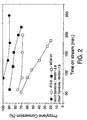
- ITQ-2 and MCM-22 materials prepared as in Example 1 and the Comparison Example were also tested utilising the same equipment and test method in the alkylation of benzene with propylene to form cumene.
- reaction conditions in this test were 3.5 MPa total pressure, 220 °C temperature and a benzene to propylene molar ratio of 6.
- the reaction was carried out using a propylene flow giving a WHSV of 3.8, and repeated (with fresh catalysts) with the propylene flow adjusted to give a WHSV of 7.6.
Landscapes
- Chemical & Material Sciences (AREA)
- Organic Chemistry (AREA)
- Chemical Kinetics & Catalysis (AREA)
- Crystallography & Structural Chemistry (AREA)
- Engineering & Computer Science (AREA)
- Materials Engineering (AREA)
- Organic Low-Molecular-Weight Compounds And Preparation Thereof (AREA)
- Low-Molecular Organic Synthesis Reactions Using Catalysts (AREA)
- Silicates, Zeolites, And Molecular Sieves (AREA)
- Catalysts (AREA)
- Fats And Perfumes (AREA)
Priority Applications (1)
| Application Number | Priority Date | Filing Date | Title |
|---|---|---|---|
| EP00967735A EP1242343B1 (en) | 1999-09-20 | 2000-09-20 | Aromatics alkylation |
Applications Claiming Priority (4)
| Application Number | Priority Date | Filing Date | Title |
|---|---|---|---|
| EP99307421 | 1999-09-20 | ||
| EP99307421 | 1999-09-20 | ||
| PCT/EP2000/009255 WO2001021562A1 (en) | 1999-09-20 | 2000-09-20 | Aromatics alkylation |
| EP00967735A EP1242343B1 (en) | 1999-09-20 | 2000-09-20 | Aromatics alkylation |
Publications (2)
| Publication Number | Publication Date |
|---|---|
| EP1242343A1 EP1242343A1 (en) | 2002-09-25 |
| EP1242343B1 true EP1242343B1 (en) | 2004-06-23 |
Family
ID=8241627
Family Applications (1)
| Application Number | Title | Priority Date | Filing Date |
|---|---|---|---|
| EP00967735A Expired - Lifetime EP1242343B1 (en) | 1999-09-20 | 2000-09-20 | Aromatics alkylation |
Country Status (9)
| Country | Link |
|---|---|
| US (1) | US6855855B2 (enExample) |
| EP (1) | EP1242343B1 (enExample) |
| JP (1) | JP4810037B2 (enExample) |
| AT (1) | ATE269840T1 (enExample) |
| AU (1) | AU7779700A (enExample) |
| CA (1) | CA2385328C (enExample) |
| DE (1) | DE60011814T2 (enExample) |
| ES (1) | ES2223590T3 (enExample) |
| WO (1) | WO2001021562A1 (enExample) |
Cited By (1)
| Publication number | Priority date | Publication date | Assignee | Title |
|---|---|---|---|---|
| EP1856012A4 (en) * | 2005-02-28 | 2012-01-11 | Exxonmobil Res & Eng Co | AROMATIC ALKYLATION PROCESS IN STEAM PHASE |
Families Citing this family (36)
| Publication number | Priority date | Publication date | Assignee | Title |
|---|---|---|---|---|
| US7084087B2 (en) * | 1999-09-07 | 2006-08-01 | Abb Lummus Global Inc. | Zeolite composite, method for making and catalytic application thereof |
| US20040030211A1 (en) * | 2000-09-25 | 2004-02-12 | Chung-Ming Chi | Maximizing meta-isomers in the production of dialkylbenzene compounds |
| US6518471B1 (en) * | 2001-06-25 | 2003-02-11 | Exxonmobil Chemical Patents Inc. | Selective production of meta-diisopropylbenzene |
| US6995295B2 (en) | 2002-09-23 | 2006-02-07 | Exxonmobil Chemical Patents Inc. | Alkylaromatics production |
| US7019185B2 (en) * | 2002-12-06 | 2006-03-28 | Exxonmobil Chemical Patents Inc. | Aromatic alkylation process |
| CN100368290C (zh) * | 2003-02-03 | 2008-02-13 | 昭和电工株式会社 | 改性层状金属硅酸盐材料及其制备方法 |
| US7498474B2 (en) * | 2005-02-28 | 2009-03-03 | Exxonmobil Research And Engineering Company | Vapor phase aromatics alkylation process |
| US7525002B2 (en) * | 2005-02-28 | 2009-04-28 | Exxonmobil Research And Engineering Company | Gasoline production by olefin polymerization with aromatics alkylation |
| US20060194998A1 (en) * | 2005-02-28 | 2006-08-31 | Umansky Benjamin S | Process for making high octane gasoline with reduced benzene content |
| US7923589B2 (en) | 2005-03-31 | 2011-04-12 | Exxonmobil Chemical Patents Inc. | Alkylaromatics production using dilute alkene |
| EP1866391B1 (en) | 2005-03-31 | 2019-05-22 | Badger Licensing LLC | Multiphase production of ethylbenzene or cumene |
| US8524965B2 (en) * | 2005-12-21 | 2013-09-03 | Chevron Oronite Company Llc | Method of making an alkylated aromatic using acidic ionic liquid catalyst |
| US7425659B2 (en) | 2006-01-31 | 2008-09-16 | Exxonmobil Chemical Patents Inc. | Alkylaromatics production |
| US8222468B2 (en) | 2006-05-08 | 2012-07-17 | Exxonmobil Chemical Patents Inc. | Organic compound conversion process |
| US7501547B2 (en) | 2006-05-10 | 2009-03-10 | Exxonmobil Chemical Patents Inc. | Alkylaromatics production |
| BRPI0712216B1 (pt) | 2006-05-24 | 2017-04-04 | Exxonmobil Chemical Patents Inc | processo de produção de composto aromático monoalquilado em uma zona de reação de alquilação |
| BRPI0713674A2 (pt) | 2006-07-28 | 2012-10-23 | Exxonmobil Chemical Patents Inc. | formulações farmarcêuticas e composições de um antagonista seletivo cxcr2 ou cxcr1 e métodos para o uso do mesmo visando o tratamento de distúrbios inflamatórios |
| US7959899B2 (en) | 2006-07-28 | 2011-06-14 | Exxonmobil Chemical Patents Inc. | Molecular sieve composition (EMM-10-P), its method of making, and use for hydrocarbon conversions |
| CN101489677B (zh) * | 2006-07-28 | 2012-12-26 | 埃克森美孚化学专利公司 | Mcm-22家族分子筛组合物,其制造方法和用于烃转化的用途 |
| US20080029435A1 (en) * | 2006-08-02 | 2008-02-07 | Exxonmobil Research And Engineering Company | Rejuvenation process for olefin polymerization and alkylation catalyst |
| CA2675264C (en) | 2007-02-09 | 2013-04-02 | Exxonmobil Chemical Patents Inc. | Improved alkylaromatic production process |
| US7790940B2 (en) * | 2007-06-21 | 2010-09-07 | Exxonmobil Chemical Patents Inc. | Liquid phase alkylation process |
| US8816145B2 (en) | 2007-06-21 | 2014-08-26 | Exxonmobil Chemical Patents Inc. | Liquid phase alkylation process |
| EP2060550A1 (en) | 2007-11-16 | 2009-05-20 | BP p.l.c. | Process for producing triptane |
| EP2060551A1 (en) | 2007-11-16 | 2009-05-20 | BP p.l.c. | Process for producing triptane |
| US8101810B2 (en) * | 2008-08-20 | 2012-01-24 | Catalytic Distillation Technologies | Reformate benzene reduction via alkylation |
| US8395006B2 (en) * | 2009-03-13 | 2013-03-12 | Exxonmobil Research And Engineering Company | Process for making high octane gasoline with reduced benzene content by benzene alkylation at high benzene conversion |
| US9522390B2 (en) * | 2010-12-10 | 2016-12-20 | The Regents Of The University Of California | Oxide materials and synthesis by fluoride/chloride anion promoted exfoliation |
| JP6045890B2 (ja) * | 2012-11-28 | 2016-12-14 | 水澤化学工業株式会社 | 新規な結晶構造を有するmcm−22型ゼオライト及び該ゼオライトからなる芳香族炭化水素精製触媒 |
| CA2913922A1 (en) * | 2013-05-31 | 2014-12-04 | Chevron U.S.A. Inc. | Delamination of borosilicate layered zeolite |
| WO2015066539A1 (en) * | 2013-11-01 | 2015-05-07 | Chevron U.S.A. Inc. | Delaminated zeolite catalyzed aromatic alkylation |
| CN111099621B (zh) * | 2018-10-25 | 2021-10-01 | 中国石油化工股份有限公司 | Mww结构超薄纳米片分子筛的合成方法 |
| KR102267465B1 (ko) * | 2019-08-14 | 2021-06-22 | 고려대학교 산학협력단 | 단순 소성을 통한 나노판형 제올라이트의 제조방법과 이로부터 제조된 나노판형 제올라이트 입자 |
| CN115872824B (zh) * | 2021-09-27 | 2025-07-25 | 中国石油化工股份有限公司 | 一种对叔丁基乙苯的制备方法 |
| CN115845913B (zh) * | 2021-09-27 | 2025-03-07 | 中国石油化工股份有限公司 | 一种烷基化生产取代芳烃的方法及其催化剂和制备方法 |
| WO2023196729A1 (en) * | 2022-04-05 | 2023-10-12 | Exxonmobil Chemical Patents Inc. | Mww zeolite precursor nanoparticles having an uncondensed layer structure and methods for production thereof |
Family Cites Families (22)
| Publication number | Priority date | Publication date | Assignee | Title |
|---|---|---|---|---|
| US3755483A (en) | 1972-04-28 | 1973-08-28 | Mobil Oil | Vapor phase alkylation in presence of crystalline aluminosilicate catalyst |
| US4358395A (en) * | 1978-09-11 | 1982-11-09 | Mobil Oil Corporation | Hydrogen regeneration of coke-selectivated crystalline aluminosilicate catalyst |
| US4393262A (en) | 1978-12-14 | 1983-07-12 | Mobil Oil Corporation | Production of isopropylbenzene |
| US4469908A (en) | 1978-12-14 | 1984-09-04 | Mobil Oil Corporation | Alkylation of aromatic hydrocarbons |
| DE3117135A1 (de) | 1981-04-30 | 1982-11-18 | Bayer Ag, 5090 Leverkusen | Kristallines alumosilicat, verfahren zu dessen herstellung sowie dessen verwendung zur katalytischen umwandlung von methanol und/oder dimethylether in kohlenwasserstoffe |
| US5421992A (en) * | 1987-02-17 | 1995-06-06 | Chevron U.S.A. Inc. | Hydrocarbon conversion process using zeolite SSZ-25 |
| US4826667A (en) | 1986-01-29 | 1989-05-02 | Chevron Research Company | Zeolite SSZ-25 |
| US5149894A (en) | 1986-01-29 | 1992-09-22 | Chevron Research And Technology Company | Alkylation using zeolite SSZ-25 |
| US4962256A (en) * | 1988-10-06 | 1990-10-09 | Mobil Oil Corp. | Process for preparing long chain alkyl aromatic compounds |
| US4983276A (en) * | 1988-10-06 | 1991-01-08 | Mobil Oil Corp. | Octane improvement in catalytic cracking and cracking catalyst composition therefor |
| US4954325A (en) * | 1986-07-29 | 1990-09-04 | Mobil Oil Corp. | Composition of synthetic porous crystalline material, its synthesis and use |
| IT1205681B (it) | 1987-05-26 | 1989-03-31 | Eniricerche Spa | Materiale sintetico cristallino poroso contenente ossidi di silicio e boro |
| US4891458A (en) | 1987-12-17 | 1990-01-02 | Innes Robert A | Liquid phase alkylation or transalkylation process using zeolite beta |
| AU639236B2 (en) * | 1990-01-25 | 1993-07-22 | Mobil Oil Corporation | Alkylation of aromatics in the presence of a zeolite catalyst |
| CA2098395A1 (en) * | 1991-01-11 | 1992-07-12 | Charles Theodore Kresge | Method of preparing a pillared layered oxide material |
| US5229341A (en) | 1991-01-11 | 1993-07-20 | Mobil Oil Corp. | Crystalline oxide material |
| DE69225311T2 (de) | 1991-01-11 | 1998-08-20 | Mobil Oil Corp., Fairfax, Va. | Schichtenförmige oxide sowie geschwollene und saeulenartige formen dieser materialien |
| US5362697A (en) | 1993-04-26 | 1994-11-08 | Mobil Oil Corp. | Synthetic layered MCM-56, its synthesis and use |
| WO1994029245A1 (en) | 1993-06-16 | 1994-12-22 | Mobil Oil Corporation | Liquid phase ethylbenzene synthesis |
| US5600048A (en) * | 1994-12-27 | 1997-02-04 | Mobil Oil Corporation | Continuous process for preparing ethylbenzene using liquid phase alkylation and vapor phase transalkylation |
| ES2124154B1 (es) * | 1995-11-08 | 1999-12-01 | Univ Politecnica De Valencia C | Metodo de preparaciion y propiedades cataliticas de un solido microporoso con alta superficie externa. |
| ES2105982B1 (es) | 1995-11-23 | 1998-07-01 | Consejo Superior Investigacion | Zeolita itq-1 |
-
2000
- 2000-09-20 EP EP00967735A patent/EP1242343B1/en not_active Expired - Lifetime
- 2000-09-20 WO PCT/EP2000/009255 patent/WO2001021562A1/en not_active Ceased
- 2000-09-20 JP JP2001524945A patent/JP4810037B2/ja not_active Expired - Fee Related
- 2000-09-20 AU AU77797/00A patent/AU7779700A/en not_active Abandoned
- 2000-09-20 ES ES00967735T patent/ES2223590T3/es not_active Expired - Lifetime
- 2000-09-20 AT AT00967735T patent/ATE269840T1/de not_active IP Right Cessation
- 2000-09-20 DE DE60011814T patent/DE60011814T2/de not_active Expired - Lifetime
- 2000-09-20 CA CA002385328A patent/CA2385328C/en not_active Expired - Lifetime
-
2002
- 2002-03-20 US US10/102,512 patent/US6855855B2/en not_active Expired - Lifetime
Cited By (1)
| Publication number | Priority date | Publication date | Assignee | Title |
|---|---|---|---|---|
| EP1856012A4 (en) * | 2005-02-28 | 2012-01-11 | Exxonmobil Res & Eng Co | AROMATIC ALKYLATION PROCESS IN STEAM PHASE |
Also Published As
| Publication number | Publication date |
|---|---|
| ES2223590T3 (es) | 2005-03-01 |
| AU7779700A (en) | 2001-04-24 |
| CA2385328C (en) | 2009-10-13 |
| WO2001021562A1 (en) | 2001-03-29 |
| DE60011814D1 (de) | 2004-07-29 |
| ATE269840T1 (de) | 2004-07-15 |
| DE60011814T2 (de) | 2005-07-07 |
| US20030004382A1 (en) | 2003-01-02 |
| JP2003509479A (ja) | 2003-03-11 |
| US6855855B2 (en) | 2005-02-15 |
| EP1242343A1 (en) | 2002-09-25 |
| CA2385328A1 (en) | 2001-03-29 |
| JP4810037B2 (ja) | 2011-11-09 |
Similar Documents
| Publication | Publication Date | Title |
|---|---|---|
| CA2385328C (en) | Aromatics alkylation | |
| RU2133639C1 (ru) | Катализатор для преобразования углеводородов и способ получения низших олефинов и моноциклических ароматических углеводородов | |
| US4870222A (en) | Alkylation/transalkylation process | |
| EP1140739B1 (en) | Improved aromatic alkylation process | |
| US7420098B2 (en) | Dual zone aromatic alkylation process | |
| SG180016A1 (en) | Process for producing cumene | |
| CN101535221A (zh) | 在固体酸催化剂上以低的苯与烯烃比例和低的重物质产生来制备烷基苯的方法 | |
| EP0272830B1 (en) | Alkylation catalysts and processes | |
| JP6014659B2 (ja) | オレフィンによる芳香族炭化水素のアルキル化法 | |
| US7371910B2 (en) | Process for benzene alkylation and transalkylation of polyalkylated aromatics over improved zeolite beta catalyst | |
| KR101512860B1 (ko) | 프로필렌의 제조 방법 | |
| KR100714257B1 (ko) | 저급 올레핀의 제조 방법 | |
| EP0949227B1 (en) | Process for the alkylation of aromatic compounds or for preparation of monoalkylated aromatic compounds | |
| CN103562161B (zh) | 通过在烷烃稀释剂存在下使用较低烯烃烷基化苯降低汽油的苯含量的方法 | |
| CA1198102A (en) | Alkylation of aromatics employing silicalite catalysts | |
| AU2011375417A1 (en) | Process for reducing the benzene content of gasoline | |
| US6429345B1 (en) | Process for production phenylalkanes using a catalyst based on a zeolite with structure type EUO | |
| EP2321040A1 (en) | Preparation of molecular sieve containing catalyst and its use in the production of alkylaromatic hydrocarbons | |
| WO2017222767A1 (en) | Isoparaffin-olefin aklylation | |
| WO2017222768A1 (en) | Isoparaffin-olefin alkylation | |
| EP0725770B1 (en) | Process for upgrading a paraffinic feedstock | |
| WO2021076259A1 (en) | Production of alkylaromatic compounds | |
| US20170369396A1 (en) | Isoparaffin-olefin alkylation | |
| Peregoa et al. | The development of a new zeolite catalyst for the production of cumene: a case history | |
| WO2017222766A1 (en) | Isoparaffin-olefin aklylation |
Legal Events
| Date | Code | Title | Description |
|---|---|---|---|
| PUAI | Public reference made under article 153(3) epc to a published international application that has entered the european phase |
Free format text: ORIGINAL CODE: 0009012 |
|
| 17P | Request for examination filed |
Effective date: 20020419 |
|
| AK | Designated contracting states |
Kind code of ref document: A1 Designated state(s): AT BE CH CY DE DK ES FI FR GB GR IE IT LI LU MC NL PT SE |
|
| AX | Request for extension of the european patent |
Free format text: AL;LT;LV;MK;RO;SI |
|
| RIN1 | Information on inventor provided before grant (corrected) |
Inventor name: VAN DEN BRINK, PETER, JOHN Inventor name: FORNES SEGUI, VICENTE,UNI POLITECNICA DE VALENCIA Inventor name: MARTINEZ SORIA, VICENTE,UNI POLITEC. DE VALENCIA Inventor name: CORMA CANOS, AVELINO,UNI POLITECNICA DE VALENCIA Inventor name: CREYGHTON, EDWARD, JULIUS |
|
| GRAP | Despatch of communication of intention to grant a patent |
Free format text: ORIGINAL CODE: EPIDOSNIGR1 |
|
| GRAS | Grant fee paid |
Free format text: ORIGINAL CODE: EPIDOSNIGR3 |
|
| GRAA | (expected) grant |
Free format text: ORIGINAL CODE: 0009210 |
|
| AK | Designated contracting states |
Kind code of ref document: B1 Designated state(s): AT BE CH CY DE DK ES FI FR GB GR IE IT LI LU MC NL PT SE |
|
| PG25 | Lapsed in a contracting state [announced via postgrant information from national office to epo] |
Ref country code: LI Free format text: LAPSE BECAUSE OF FAILURE TO SUBMIT A TRANSLATION OF THE DESCRIPTION OR TO PAY THE FEE WITHIN THE PRESCRIBED TIME-LIMIT Effective date: 20040623 Ref country code: AT Free format text: LAPSE BECAUSE OF FAILURE TO SUBMIT A TRANSLATION OF THE DESCRIPTION OR TO PAY THE FEE WITHIN THE PRESCRIBED TIME-LIMIT Effective date: 20040623 Ref country code: FI Free format text: LAPSE BECAUSE OF FAILURE TO SUBMIT A TRANSLATION OF THE DESCRIPTION OR TO PAY THE FEE WITHIN THE PRESCRIBED TIME-LIMIT Effective date: 20040623 Ref country code: CH Free format text: LAPSE BECAUSE OF FAILURE TO SUBMIT A TRANSLATION OF THE DESCRIPTION OR TO PAY THE FEE WITHIN THE PRESCRIBED TIME-LIMIT Effective date: 20040623 Ref country code: CY Free format text: LAPSE BECAUSE OF FAILURE TO SUBMIT A TRANSLATION OF THE DESCRIPTION OR TO PAY THE FEE WITHIN THE PRESCRIBED TIME-LIMIT Effective date: 20040623 |
|
| REG | Reference to a national code |
Ref country code: GB Ref legal event code: FG4D |
|
| REG | Reference to a national code |
Ref country code: CH Ref legal event code: EP |
|
| REG | Reference to a national code |
Ref country code: IE Ref legal event code: FG4D |
|
| REF | Corresponds to: |
Ref document number: 60011814 Country of ref document: DE Date of ref document: 20040729 Kind code of ref document: P |
|
| PG25 | Lapsed in a contracting state [announced via postgrant information from national office to epo] |
Ref country code: LU Free format text: LAPSE BECAUSE OF NON-PAYMENT OF DUE FEES Effective date: 20040920 Ref country code: IE Free format text: LAPSE BECAUSE OF NON-PAYMENT OF DUE FEES Effective date: 20040920 |
|
| PG25 | Lapsed in a contracting state [announced via postgrant information from national office to epo] |
Ref country code: GR Free format text: LAPSE BECAUSE OF FAILURE TO SUBMIT A TRANSLATION OF THE DESCRIPTION OR TO PAY THE FEE WITHIN THE PRESCRIBED TIME-LIMIT Effective date: 20040923 Ref country code: DK Free format text: LAPSE BECAUSE OF FAILURE TO SUBMIT A TRANSLATION OF THE DESCRIPTION OR TO PAY THE FEE WITHIN THE PRESCRIBED TIME-LIMIT Effective date: 20040923 Ref country code: SE Free format text: LAPSE BECAUSE OF FAILURE TO SUBMIT A TRANSLATION OF THE DESCRIPTION OR TO PAY THE FEE WITHIN THE PRESCRIBED TIME-LIMIT Effective date: 20040923 |
|
| PG25 | Lapsed in a contracting state [announced via postgrant information from national office to epo] |
Ref country code: MC Free format text: LAPSE BECAUSE OF NON-PAYMENT OF DUE FEES Effective date: 20040930 |
|
| LTIE | Lt: invalidation of european patent or patent extension |
Effective date: 20040623 |
|
| REG | Reference to a national code |
Ref country code: CH Ref legal event code: PL |
|
| REG | Reference to a national code |
Ref country code: ES Ref legal event code: FG2A Ref document number: 2223590 Country of ref document: ES Kind code of ref document: T3 |
|
| ET | Fr: translation filed | ||
| PLBE | No opposition filed within time limit |
Free format text: ORIGINAL CODE: 0009261 |
|
| STAA | Information on the status of an ep patent application or granted ep patent |
Free format text: STATUS: NO OPPOSITION FILED WITHIN TIME LIMIT |
|
| 26N | No opposition filed |
Effective date: 20050324 |
|
| REG | Reference to a national code |
Ref country code: IE Ref legal event code: MM4A |
|
| PG25 | Lapsed in a contracting state [announced via postgrant information from national office to epo] |
Ref country code: PT Free format text: LAPSE BECAUSE OF NON-PAYMENT OF DUE FEES Effective date: 20041123 |
|
| REG | Reference to a national code |
Ref country code: FR Ref legal event code: PLFP Year of fee payment: 17 |
|
| REG | Reference to a national code |
Ref country code: FR Ref legal event code: PLFP Year of fee payment: 18 |
|
| REG | Reference to a national code |
Ref country code: FR Ref legal event code: PLFP Year of fee payment: 19 |
|
| PGFP | Annual fee paid to national office [announced via postgrant information from national office to epo] |
Ref country code: NL Payment date: 20190828 Year of fee payment: 20 |
|
| PGFP | Annual fee paid to national office [announced via postgrant information from national office to epo] |
Ref country code: DE Payment date: 20190813 Year of fee payment: 20 Ref country code: IT Payment date: 20190924 Year of fee payment: 20 Ref country code: FR Payment date: 20190819 Year of fee payment: 20 |
|
| PGFP | Annual fee paid to national office [announced via postgrant information from national office to epo] |
Ref country code: BE Payment date: 20190815 Year of fee payment: 20 |
|
| PGFP | Annual fee paid to national office [announced via postgrant information from national office to epo] |
Ref country code: GB Payment date: 20190827 Year of fee payment: 20 |
|
| PGFP | Annual fee paid to national office [announced via postgrant information from national office to epo] |
Ref country code: ES Payment date: 20191001 Year of fee payment: 20 |
|
| REG | Reference to a national code |
Ref country code: DE Ref legal event code: R071 Ref document number: 60011814 Country of ref document: DE |
|
| REG | Reference to a national code |
Ref country code: NL Ref legal event code: MK Effective date: 20200919 |
|
| REG | Reference to a national code |
Ref country code: GB Ref legal event code: PE20 Expiry date: 20200919 |
|
| REG | Reference to a national code |
Ref country code: BE Ref legal event code: MK Effective date: 20200920 |
|
| PG25 | Lapsed in a contracting state [announced via postgrant information from national office to epo] |
Ref country code: GB Free format text: LAPSE BECAUSE OF EXPIRATION OF PROTECTION Effective date: 20200919 |
|
| REG | Reference to a national code |
Ref country code: ES Ref legal event code: FD2A Effective date: 20210108 |
|
| PG25 | Lapsed in a contracting state [announced via postgrant information from national office to epo] |
Ref country code: ES Free format text: LAPSE BECAUSE OF EXPIRATION OF PROTECTION Effective date: 20200921 |