EP1230330B1 - Verwendung von fettsäuresalzen von alkoxylierten oligoaminen als schmierfähigkeitsverbesserer für mineralölprodukte - Google Patents
Verwendung von fettsäuresalzen von alkoxylierten oligoaminen als schmierfähigkeitsverbesserer für mineralölprodukte Download PDFInfo
- Publication number
- EP1230330B1 EP1230330B1 EP00977522A EP00977522A EP1230330B1 EP 1230330 B1 EP1230330 B1 EP 1230330B1 EP 00977522 A EP00977522 A EP 00977522A EP 00977522 A EP00977522 A EP 00977522A EP 1230330 B1 EP1230330 B1 EP 1230330B1
- Authority
- EP
- European Patent Office
- Prior art keywords
- fatty acid
- acid salts
- formula
- alkoxylated
- lubricity
- Prior art date
- Legal status (The legal status is an assumption and is not a legal conclusion. Google has not performed a legal analysis and makes no representation as to the accuracy of the status listed.)
- Expired - Lifetime
Links
- VQMPTVQCADWACQ-UHFFFAOYSA-N CCC(C)(CC)N Chemical compound CCC(C)(CC)N VQMPTVQCADWACQ-UHFFFAOYSA-N 0.000 description 1
- 0 CCC(CC)(*(C)C)N(C)* Chemical compound CCC(CC)(*(C)C)N(C)* 0.000 description 1
Classifications
-
- C—CHEMISTRY; METALLURGY
- C10—PETROLEUM, GAS OR COKE INDUSTRIES; TECHNICAL GASES CONTAINING CARBON MONOXIDE; FUELS; LUBRICANTS; PEAT
- C10L—FUELS NOT OTHERWISE PROVIDED FOR; NATURAL GAS; SYNTHETIC NATURAL GAS OBTAINED BY PROCESSES NOT COVERED BY SUBCLASSES C10G OR C10K; LIQUIFIED PETROLEUM GAS; USE OF ADDITIVES TO FUELS OR FIRES; FIRE-LIGHTERS
- C10L10/00—Use of additives to fuels or fires for particular purposes
- C10L10/08—Use of additives to fuels or fires for particular purposes for improving lubricity; for reducing wear
-
- C—CHEMISTRY; METALLURGY
- C10—PETROLEUM, GAS OR COKE INDUSTRIES; TECHNICAL GASES CONTAINING CARBON MONOXIDE; FUELS; LUBRICANTS; PEAT
- C10L—FUELS NOT OTHERWISE PROVIDED FOR; NATURAL GAS; SYNTHETIC NATURAL GAS OBTAINED BY PROCESSES NOT COVERED BY SUBCLASSES C10G OR C10K; LIQUIFIED PETROLEUM GAS; USE OF ADDITIVES TO FUELS OR FIRES; FIRE-LIGHTERS
- C10L1/00—Liquid carbonaceous fuels
- C10L1/10—Liquid carbonaceous fuels containing additives
- C10L1/14—Organic compounds
- C10L1/22—Organic compounds containing nitrogen
-
- C—CHEMISTRY; METALLURGY
- C10—PETROLEUM, GAS OR COKE INDUSTRIES; TECHNICAL GASES CONTAINING CARBON MONOXIDE; FUELS; LUBRICANTS; PEAT
- C10L—FUELS NOT OTHERWISE PROVIDED FOR; NATURAL GAS; SYNTHETIC NATURAL GAS OBTAINED BY PROCESSES NOT COVERED BY SUBCLASSES C10G OR C10K; LIQUIFIED PETROLEUM GAS; USE OF ADDITIVES TO FUELS OR FIRES; FIRE-LIGHTERS
- C10L1/00—Liquid carbonaceous fuels
- C10L1/10—Liquid carbonaceous fuels containing additives
- C10L1/14—Organic compounds
- C10L1/22—Organic compounds containing nitrogen
- C10L1/222—Organic compounds containing nitrogen containing at least one carbon-to-nitrogen single bond
- C10L1/2222—(cyclo)aliphatic amines; polyamines (no macromolecular substituent 30C); quaternair ammonium compounds; carbamates
- C10L1/2225—(cyclo)aliphatic amines; polyamines (no macromolecular substituent 30C); quaternair ammonium compounds; carbamates hydroxy containing
-
- C—CHEMISTRY; METALLURGY
- C10—PETROLEUM, GAS OR COKE INDUSTRIES; TECHNICAL GASES CONTAINING CARBON MONOXIDE; FUELS; LUBRICANTS; PEAT
- C10L—FUELS NOT OTHERWISE PROVIDED FOR; NATURAL GAS; SYNTHETIC NATURAL GAS OBTAINED BY PROCESSES NOT COVERED BY SUBCLASSES C10G OR C10K; LIQUIFIED PETROLEUM GAS; USE OF ADDITIVES TO FUELS OR FIRES; FIRE-LIGHTERS
- C10L1/00—Liquid carbonaceous fuels
- C10L1/10—Liquid carbonaceous fuels containing additives
- C10L1/14—Organic compounds
- C10L1/22—Organic compounds containing nitrogen
- C10L1/222—Organic compounds containing nitrogen containing at least one carbon-to-nitrogen single bond
- C10L1/223—Organic compounds containing nitrogen containing at least one carbon-to-nitrogen single bond having at least one amino group bound to an aromatic carbon atom
- C10L1/2235—Organic compounds containing nitrogen containing at least one carbon-to-nitrogen single bond having at least one amino group bound to an aromatic carbon atom hydroxy containing
-
- C—CHEMISTRY; METALLURGY
- C10—PETROLEUM, GAS OR COKE INDUSTRIES; TECHNICAL GASES CONTAINING CARBON MONOXIDE; FUELS; LUBRICANTS; PEAT
- C10L—FUELS NOT OTHERWISE PROVIDED FOR; NATURAL GAS; SYNTHETIC NATURAL GAS OBTAINED BY PROCESSES NOT COVERED BY SUBCLASSES C10G OR C10K; LIQUIFIED PETROLEUM GAS; USE OF ADDITIVES TO FUELS OR FIRES; FIRE-LIGHTERS
- C10L1/00—Liquid carbonaceous fuels
- C10L1/10—Liquid carbonaceous fuels containing additives
- C10L1/14—Organic compounds
- C10L1/22—Organic compounds containing nitrogen
- C10L1/234—Macromolecular compounds
- C10L1/238—Macromolecular compounds obtained otherwise than by reactions involving only carbon-to-carbon unsaturated bonds
Definitions
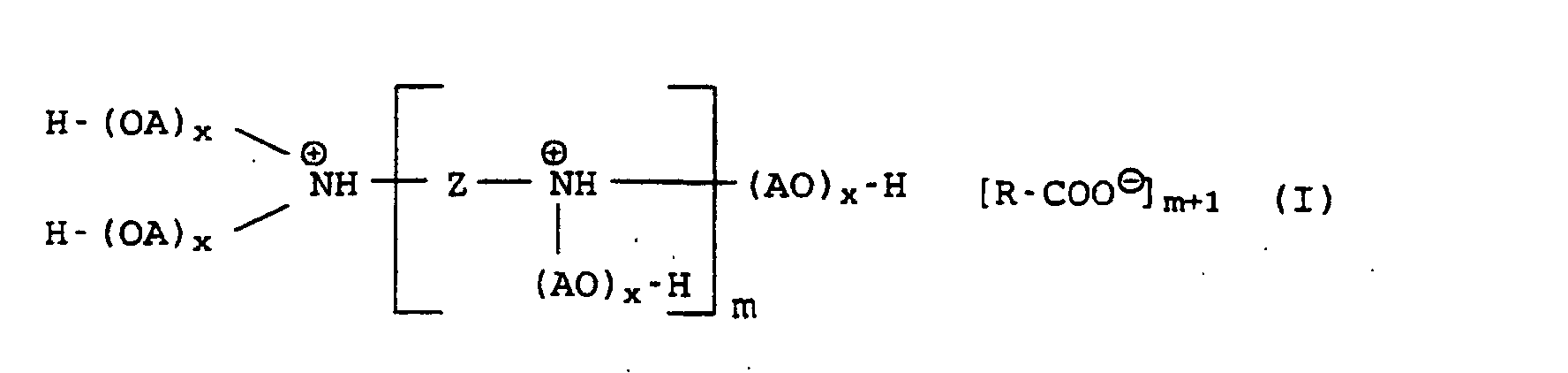
- the present invention relates to the use of fatty acid salts of alkoxylated oligoamines as lubricity improvers for petroleum products, especially for petrol and Middle distillates, especially diesel fuels, and such Mineral oil products themselves, which contain special fatty acid salts from alkoxylated Contain oligoamines.
- Carburetors and intake systems of gasoline engines are increasing contaminated by dust particles from the Air, unburned hydrocarbon residues from the combustion chamber and the crankcase ventilation gases led into the carburetor caused.
- Such pure fuel additives which one Numerous classes of chemical substances such as polyalkenamines, polyetheramines, Polybutene Mannich bases or polybutene succinimides can generally come in combination with Carrier oils and some other additive components such as corrosion inhibitors and demulsifiers for use.
- Lubricity-improving agents previously known for petrol Additives are, for example, fatty acids, such as. B. in the WO 98/11175 describes alkenyl succinic acid esters, bis (hydroxyalkyl) fatty amines and hydroxyacetamides.
- fatty acids and fatty acid derivatives e.g. B. esters of glycerin with unsaturated fatty acids, or castor oil, as in EP-B 605 857 as lubricity-improving Additives used.
- the present invention has the object of being more effective Lubricity improver for mineral oil products, in particular for petrol and middle distillates.
- N, N, N ', N'-tetrakis (2-hydroxypropyl) ethylenediamine in the presence of fatty acids such as stearic acid or oleic acid in aqueous lubricating oil compositions such as Cutting oil or grinding oil prevents the formation of rust and fungus and stabilizes the composition.
- fatty acids such as stearic acid or oleic acid
- aqueous lubricating oil compositions such as Cutting oil or grinding oil prevents the formation of rust and fungus and stabilizes the composition.
- An improvement in Lubrication is not mentioned here.
- JP-A 11/209773 describes aqueous lubricants for conveyor belts known when filling bottles with drinks, which Fatty acid salts of alkanolamines such as N, N, N ', N'-tetrakis (2-hydroxypropyl) ethylenediamine contain.
- alkanolamines such as N, N, N ', N'-tetrakis (2-hydroxypropyl) ethylenediamine contain.
- fatty acids for example Palmitic acid, tetradecanoic acid, oleic acid and lauric acid called.
- DE-B 1 047 526 recommends fatty acid salts of alkoxylated oligoamines as a remedy against the icing of the gasifier of gasoline engines.
- the mononaphthenate salt of N, N, N ', N'-tetrakis (2-oxypropyl) ethylenediamine called.
- US-A 3 429 673 discloses carboxylic acid salts of alkoxylated monoamines as corrosion inhibitors in fuel oils.
- mineral oil products fuels, operating materials, Fuels and lubricating oils are understood, but not only on petroleum but also partly or completely on synthetic and / or naturally occurring raw materials.
- raw materials are natural gas, methanol, ethanol, Coal liquefaction products or rapeseed oil, which are used as fuels processed or incorporated into petroleum-based fuels become.
- the designated mineral oil products are usually practically anhydrous or at least only contain water in minor amounts.
- water-containing mineral oil products are fuel emulsions like diesel / water emulsions that can usually contain up to about 35% by weight of water.
- preferred mineral oil products are for one petrol and the other middle distillates such as in particular Diesel fuels.
- the alkylene group A is preferably derived from the corresponding ones Alkylene oxides such as ethylene oxide, 1,2-propylene oxide, 1,2-butylene oxide and cis or trans-2,3-butylene oxide. However, it can also for 1,3-propylene, 1,4-butylene, 1,6-hexylene or 1,8-octylene stand. A can also be a mixture of various of the above Represent groupings. Are particularly preferred for A ethylene, 1,2-propylene or 1,2-butylene groups.
- the longer-chain radical R occurring in the carboxylate anion denotes, for example, branched or preferably linear C 7 - to C 23 -, preferably C 11 - to C 21 -, especially C 15 - to C 19 -alkyl groups, which can additionally carry hydroxyl groups.
- Examples of underlying carboxylic acids are octanoic acid, 2-ethylhexanoic acid, nonanoic acid, decanoic acid, undecanoic acid, dodecanoic acid (lauric acid), tridecanoic acid, iso-tridecanoic acid, tetradecanoic acid (myristic acid), hexadecanoic acid (palmitic acid), octadecanoic acid (stearic acid) and e.
- the acids mentioned can be of natural or synthetic origin. Mixtures of the acids mentioned can also form the basis of the carboxylate anions.
- the longer-chain radical R occurring in the carboxylate anion preferably denotes mono- or polyunsaturated C 7 to C 23 radicals, in particular mono- or poly-unsaturated C 11 to C 21 , especially C 15 to C 19 alkenyl groups , which can also carry hydroxyl groups.
- These unsaturated residues are preferably linear.
- polyunsaturated alkenyl groups these preferably contain two or three double bonds.
- Examples of underlying carboxylic acids are elaidic acid, ricinoleic acid, linoleic acid and linolenic acid. Particularly good results are achieved with oleic acid.
- Mixtures of such unsaturated carboxylic acids with one another and with the above-mentioned saturated carboxylic acids can also form the basis of the carboxylate anions.
- Such mixtures are, for example, tall oil, tall oil fatty acid and rapeseed oil fatty acid.
- the unsaturated carboxylic acids and the mixtures mentioned are generally of natural origin.
- variable Z means in particular C 1 - to C 4 -alkylene groupings such as methylene, 1,2-propylene, 1,2-butylene, 1,3-butylene or 2,3-butylene, C 5 - to C 6 -cycloalkylene groupings such as 1 , 3-cyclopentylidene or 1,3- or 1,4-cyclohexylidene or C 6 - to C 8 -arylene or -arylalkylene groupings such as 1,3- or 1,4-phenylene, 2-methyl-1,4-phenylene or 1,3- or 1,4-bismethylene phenylene.
- C 1 - to C 4 -alkylene groupings such as methylene, 1,2-propylene, 1,2-butylene, 1,3-butylene or 2,3-butylene, C 5 - to C 6 -cycloalkylene groupings such as 1 , 3-cyclopentylidene or 1,3- or 1,4-cyclohexylidene
- variable m stands for 0, it is usually dependent on the Sum ( ⁇ ) of all variables x, mixtures of mono-, di- and / or Trialkanolamines or pure trialkanolamines according to the invention used fatty acid salts as a cationic component.
- alkanolamines are monoethanolamine, diethanolamine, Triethanolamine, monoisopropanolamine, diisopropanolamine, Triisopropanolamine and the corresponding mixtures.
- oleic acid salt of triethanolamine ( ⁇ x 3) is of particular importance Interest.
- variable m preferably stands for the number 1 or 2.
- superstoichiometric Incorporation is a triple alkoxylation per N-H bond [300% of (m + 3)] with regard to the properties of the resulting fatty acid salts an upper limit.
- With sub-stoichiometric installation a statistical average 50% alkoxylation [50% of (m + 3)] a corresponding lower limit, usually mixtures from species with different degrees of alkoxylation in front.
- the sum ( ⁇ ) of all variables x a value from 75% to 125% of (m + 3).
- the general fatty acid salts used according to the invention Formula I can usually be easily by alkoxylation of the underlying amines by conventional methods and subsequent Establish neutralization with the fatty acids of the formula R-COOH.
- the alkoxylation is expediently used for introducing the first alkylene oxide unit into the NH bond in the presence of small amounts of water (usually 0.5 to 5% by weight, based on the amount on amine used) without catalyst at temperatures from 80 to 140 ° C and for the introduction of further alkylene oxide units with the exclusion of water in the presence of basic catalysts such as alkali metal hydroxides, for. As sodium or potassium hydroxide, carried out at temperatures from 100 to 150 ° C.
- the neutralization is usually carried out by heating the thus obtained alkoxylated amine with the corresponding stoichiometric or slightly sub-stoichiometric amount (i.e. 90 to 100 %, in particular 95 to 100% of theory) of fatty acid at temperatures from 30 to 100 ° C, especially 40 to 80 ° C, for a period of time from 15 minutes to 10 hours, especially 30 minutes to 5 hours.
- the neutralization reaction should be carried out that no carboxylic acid ester portions arise in the product.
- many Cases can include both the alkoxylated amine and the fatty acid be used as liquids, which is the implementation of corresponding fatty acid salt designed particularly simple.
- the Order of combining alkoxylated amine and fatty acid is not critical, i.e. one can use both the alkoxylated amine and add the fatty acid as well as the fatty acid and add the alkoxylated amine.
- the additive concentrates or add to the mineral oil products and salt formation takes place there allow.
- the general formula I usually requires significantly less effort and energy than with conventional lubricity improvers State of the art, especially in those based on amides or esters, which are usually produced at higher temperatures, longer reaction times and time-consuming refurbishment work to separate unwanted by-products, in particular occur in condensation reactions are necessary.
- the fatty acid salts of general formula I described are suitable excellently as a lubricity improver ("Lubricity Additive", “Friction Modifier”) in mineral oil products, especially in petrol and middle distillates, especially diesel fuels.
- the fatty acid salts I are general highly effective and therefore widely applicable. When using the Fatty acid salts I will tend to wear in the parts of the machines operated with the mineral oil products and aggregates significantly reduced.
- the fatty acid salts used in petrol according to the invention of the general formula I can advantageously with In principle, all common gasoline additives are used in combination become.
- Base hydroogenated or non-hydrogenated
- mineral carrier oils and / or dilution or Solvents for petrol additives are also available at Fractions such as kerosene, naphtha or petroleum processing Brightstock suitable.
- Aromatic are also suitable for this Paraffinic (aliphatic) hydrocarbons Hydrocarbons and alkoxyalkanols.
- carrier oils for gasoline fuel additives are polyetherols which, by reacting C 2 -C 30 -alkanols, C 6 -C 30 -alkanediols, mono-, di- or tri-C 2 -C 30 -alkylamines, C 1 to C 30 alkylcyclohexanols or C 1 to C 30 alkylphenols with 1 to 30 mol ethylene oxide and / or propylene oxide and / or butylene oxide per hydroxyl or amino group are available.
- alcohol-initiated polyetherols with about 10 to 35, in particular 15 to 30, propylene and / or butylene oxide units are to be mentioned here; linear or branched C 6 -C 15 -alkanols are particularly suitable as starter alcohols.
- ⁇ - ⁇ - ⁇ - ⁇ - ⁇ - ⁇ - ⁇ - ⁇ - ⁇ - ⁇ - ⁇ - ⁇ - ⁇ - ⁇ - ⁇ - ⁇ - ⁇ - ⁇ - ⁇ - ⁇ - ⁇ - ⁇ - ⁇ - ⁇ - ⁇ - ⁇ - ⁇ - ⁇ - ⁇ - ⁇ - ⁇ - ⁇ - ⁇ - ⁇ - ⁇ - ⁇ - ⁇ - ⁇ - ⁇ - ⁇ - ⁇ - ⁇ - ⁇ - ⁇ - ⁇ - ⁇ - ⁇ - ⁇ - ⁇ - ⁇ - ⁇ - ⁇ - ⁇ - ⁇ - ⁇ - ⁇ -butyl-4-hydroxyphenylpropionic acid demulsifiers
- Antistatic agents metallocenes such as ferrocene or methylcyclopentadienylmanganese tricarbonyl and dyes (markers).
- a mediator As a mediator are often medium chain linear or branched Alkanols (with about 6 to 12 carbon atoms) are used, e.g. B. 2-ethylhexanol. Sometimes amines are also used to lower the pH of the Added fuel.
- fatty acid salts used in petrol according to the invention of the general formula I can also be used together with others usual lubricity improvers such as certain Fatty acids, alkenyl succinic acid esters, bis (hydroxyalkyl) fatty amines or hydroxyacetamides can be used.
- Carboxylic acids or fatty acids used can be used as monomers or oligomeric, in particular dimeric, species are present. It can also mixtures of monomeric and dimeric and possibly higher ones oligomeric species are present.
- Combinations of the gasoline fuels according to the invention are preferred used fatty acid salts of the general formula I with the detergents of groups (a), (d) and (g) mentioned above, especially with polyisobutenamines of group (a).
- Particularly suitable Polyisobutenamines (a) are those which are produced by hydroformylation of highly reactive polyisobutenes of the number average Molecular weight of 500 to 2300, especially 800 to 1500, especially 900 to 1200, and subsequent reductive amination be made with ammonia.
- the polyisobutenamines (a) are preferably used together with carrier oils, for example polyetherols or aliphatic or aromatic hydrocarbons, and optionally with the aforementioned corrosion inhibitors, Antioxidants or stabilizers, demulsifiers, antistatic agents, Metallocenes and / or dyes used.
- carrier oils for example polyetherols or aliphatic or aromatic hydrocarbons
- Antioxidants or stabilizers demulsifiers
- demulsifiers demulsifiers
- antistatic agents Metallocenes and / or dyes used.
- a typical example of such a polyisobutenamine (a) is under the trade name Kerocom® PIBA from BASF Aktiengesellschaft to name distributed product.
- fatty acid salts used according to the invention in middle distillates of the general formula I can advantageously in all common middle distillates are used.
- middle distillates of which diesel fuels are the most important group, include petroleum refines, which are usually have a boiling range of 100 to 400 ° C. these are mostly distillates with a 95% point up to 360 ° C or above out. But this can also be called “ultra low sulfur” Diesel “or” City Diesel ", identified by a 95% point of, for example, a maximum of 345 ° C and a sulfur content of at most 0.005% by weight or by a 95% point of, for example 285 ° C and a maximum sulfur content of 0.001 Wt .-%.
- these middle distillates can also use heating oils with a maximum sulfur content of 0.20% by weight, in particular a maximum of 0.10% by weight, as well as aviation fuels.
- distillates mentioned usually consist of components together that one from atmospheric or vacuum distillation from oil or from conversion processes, z. B. cracker, koker or visbreaker gas oil.
- the middle distillates mentioned, especially diesel fuels, are characterized by a low sulfur content, in which Rule of at most 0.05% by weight, in particular at most 0.02% by weight, above all at most 0.005% by weight, very particularly preferably at most 0.001% by weight.
- middle distillates especially diesel fuels, fatty acid salts of the general formula I used herein as pure liquid substances or as liquid concentrates be incorporated in a solvent or diluent.
- solvents or diluents all as such means for use with gasoline additives mentioned substances are used.
- mineral oil cuts such as naphtha, kerosene, Diesel fuel and aromatic hydrocarbons such as solvents Heavy naphtha, Solvesso® or Shellsol®.
- These concentrates can Be solutions or dispersions, with clear solutions preferred become. Mixtures of the solutions mentioned or Thinners are used.
- the solubility of the fatty acid salts used according to the invention of the general formula I can be improved.
- Such solutions or dilutions are advantageous if the middle distillate already contains other additives when the mixing temperatures be low if the dosing device is not on low doses or if mixtures with other middle distillates to be produced.
- fatty acid salts used according to the invention in middle distillates of the general formula I can advantageously with in principle all common middle distillate or diesel fuel additives can be used in combination.
- Common middle distillate or diesel fuel additives are in this connection especially detergents, corrosion inhibitors, Dehazer, demulsifiers, anti-foaming agents ("Antifoam”), antioxidants, Metal deactivators, multifunctional stabilizers, Cetane number improvers, combustion improvers, dyes, Markers, solubilizers, antistatic agents, other common lubricity Additives as well as additives improving the cold properties such as Flow improvers (“MDFI”), paraffin dispersants (“WASA”) and their Combination (“WAFI").
- MDFI Flow improvers
- WASA paraffin dispersants
- WAFI Combination
- the present application also relates to a method for Improve the lubricity of mineral oil products, in particular of petrol and middle distillates, which thereby is characterized in that the mineral oil products are effective Amounts of fatty acid salts of alkoxylated oligoamines of the general Formula I 1 to 6 admits.
- Additive concentrates for mineral oil products especially for petrol and middle distillates, the fatty acid salts of alkoxylated oligoamines of the general formula I in amounts of 0.05 to 50, in particular 0.1 to 30 wt .-%, based on the total amount of the concentrates.
- concentrates usually also the other additives, carrier oils, solution or Diluents and / or auxiliaries.
- additive concentrates for petrol these are especially detergents and / or valve seat anti-wear agents, especially the additives (a) to (m) listed above, and others therefor usual components and auxiliaries, in particular carrier oils, Corrosion inhibitors, antioxidants or stabilizers, demulsifiers, Antistatic agents, metallocenes and dyes.
- the present invention furthermore relates to mineral oil products, in particular gasoline and middle distillate compositions, which is the bis-oleic acid salt of N, N, N ', N'-tetrakis (2'-hydroxyethyl) -1,2-ethylenediamine or N, N, N ', N'-tetrakis (2'-hydroxypropyl) -1,2-ethylenediamine contained in effective amounts.
- Effective amounts are usually both at Ottoals also with diesel fuel compositions 1 to 1000 ppm by weight, in particular 5 to 500 ppm by weight, especially 10 to 250 ppm by weight, particularly preferably 20 to 100 ppm by weight, in each case based on to understand the total amount of the composition.
- These petroleum products, especially the gasoline and middle distillate compositions usually contain in addition to the invention fatty acid salts used in them include those listed above Additives, additive components and auxiliaries.
- the fatty acid salts of alkoxylated oligoamines of the general Formula I are already in low concentrations in the mineral oil products highly effective as a lubricity improver and prevent wear in the parts of those with the mineral oil products operated machines and units, for example in Fuel intake systems or injection pumps, effectively before.
- the fatty acid salts of alkoxylated oligoamines general formula I has good lubricating oil compatibility, which is particularly important when used in diesel fuels is.
- acidic lubricity improvers such as dimeric fatty acids
- basic components of lubricating oil which is used in petrol and diesel engines is known to be in contact with the fuel, can corresponding salts in the fuel and undesirable Separate the engine or the injection system and Cause interference.
- This disadvantage is caused by the invention Use of the fatty acid salts of alkoxylated oligoamines of the general formula I avoided.
- the fatty acid salts used according to the invention also tend to alkoxylated oligoamines of general formula I practically not to unwanted emulsion formation in the mineral oil products and are sufficiently stable to hydrolysis.
- the petrol used here (OK) (typical petrol according to EN 228) were distilled before the measurements gently concentrated to 50% by volume. This 50% residue served when checking in the wear measuring device to determine the Blank value.
- This backlog was made according to the below given examples given the other additives and the Friction wear values were determined using the method given above.
- the resulting friction wear values (R) are in micrometers ( ⁇ m) specified; the lower this value is, the lower is the wear that occurs.
- Frictional wear values R in petrol added additives OK R [ ⁇ m] no OK1 873 500 mg / kg package P1 OK1 853 500 mg / kg package P1 + 50 mg / kg product from example 2 OK1 686 no OK2 754 500 mg / kg package P1 OK2 717 500 mg / kg package P1 + 50 mg / kg product from example 1 OK2 593 500 mg / kg package P1 + 50 mg / kg product from example 2 OK2 634 500 mg / kg package P1 + 50 mg / kg comparison product OK2 659 500 mg / kg package P2 OK2 775 500 mg / kg package P2 + 50 mg / kg product from example 1 OK2 680 500 mg / kg package P2 + 50 mg / kg product from example 2 OK2 633 500 mg / kg package P2 + 50 mg / kg comparative product OK2 684
- Standard lubricity tests were carried out with an HFRR device from PCS Instruments, London, performed on a steel ball a steel plate in the test fuel rubs.
- ISO 12156-1 describes this method and has found its way into the diesel standard EN 590-1999. The limit here is abrasion on the steel ball from maximum of 460 ⁇ m.
- test diesel fuels (DK1 to DK4) listed in Table 2 below had the characteristics indicated. Characteristics of the test diesel fuel DK 1 DK 2 DK 3 DK 4 quality [Mg / kg] EN 590 EN 590 EN 590 C-DK MK 1 sulfur content [kg / m 3 ] 180 700 430 6 density [° C] 841.3 835.6 830.6 810.6 CP [° C] -6 -6 -7 -31 CFPP [° C] -9 -10 -10 -32 Siedesweeping [° C] 170 176 175 184 20% by volume [° C] 235 214 218 219 95% by volume [° C] 363 352 343 280 Final boiling point [° C] 371 370 356 289
- the sulfur content was determined in accordance with EN ISO 14 596.
- Tear wear values R [ ⁇ m] in diesel fuel (WS 1.4 values according to HFRR according to ISO 12 156-1 at 60 ° C) added additive DK1 DK2 DK3 DK 4 none 532 (0) 624 (0) 615 (0) 564 (0) Additive A 389 (50) 375 (50) 399 (75) 358 (200) 363 (100) Additive B 355 (50) 471 (50) 401 (75) 388 (200) 359 (100) Additive C 436 (50) 455 (50) - 435 (200) 330 (100) 453 (250) Additive D 517 (50) 474 (150) - 518 (150) 252 (200) 387 (200) added additive DK1 DK2 DK3 DK 4 Additive E 471 (WS 1.4 values according to HFRR according to ISO 12 156-1 at 60 ° C) added additive DK1 DK2 DK3 DK 4 none 532 (0) 624 (0) 615
Landscapes
- Chemical & Material Sciences (AREA)
- Oil, Petroleum & Natural Gas (AREA)
- Engineering & Computer Science (AREA)
- Organic Chemistry (AREA)
- Chemical Kinetics & Catalysis (AREA)
- General Chemical & Material Sciences (AREA)
- Combustion & Propulsion (AREA)
- Liquid Carbonaceous Fuels (AREA)
- Solid Fuels And Fuel-Associated Substances (AREA)
- Organic Low-Molecular-Weight Compounds And Preparation Thereof (AREA)
- Lubricants (AREA)
- Production Of Liquid Hydrocarbon Mixture For Refining Petroleum (AREA)
Description
- A
- für Alkylengruppen mit 2 bis 8 C-Atomen stehen,
- R
- C7- bis C23-Alkylgruppen oder ein- oder mehrfach ungesättigte C7- bis C23-Alkenylgruppen, welche zusätzlich Hydroxylgruppen tragen können, bezeichnen,
- Z
- C1- bis C8-Alkylengruppierungen, C3- bis C8-Cycloalkylengruppierungen oder C6- bis C12-Arylen- oder -Arylalkylengruppierungen bedeuten,
- m
- für 0 oder eine ganze Zahl von 1 bis 5 steht und
als Schmierfähigkeitsverbesserer für Mineralölprodukte gefunden.
Übliche Ottokraftstoffadditive mit ventilsitzverschleißhemmender Wirkung sind beispielsweise:
| Reibverschleißwerte R in Ottokraftstoff | ||
| zugegebene Additive | OK | R [µm] |
| keine | OK1 | 873 |
| 500 mg/kg Paket P1 | OK1 | 853 |
| 500 mg/kg Paket P1 + 50 mg/kg Produkt aus Beispiel 2 | OK1 | 686 |
| keine | OK2 | 754 |
| 500 mg/kg Paket P1 | OK2 | 717 |
| 500 mg/kg Paket P1 + 50 mg/kg Produkt aus Beispiel 1 | OK2 | 593 |
| 500 mg/kg Paket P1 + 50 mg/kg Produkt aus Beispiel 2 | OK2 | 634 |
| 500 mg/kg Paket P1 + 50 mg/kg Vergleichsprodukt | OK2 | 659 |
| 500 mg/kg Paket P2 | OK2 | 775 |
| 500 mg/kg Paket P2 + 50 mg/kg Produkt aus Beispiel 1 | OK2 | 680 |
| 500 mg/kg Paket P2 + 50 mg/kg Produkt aus Beispiel 2 | OK2 | 633 |
| 500 mg/kg Paket P2 + 50 mg/kg vergleichsprodukt | OK2 | 684 |
| Charakteristika der Test-Dieselkraftstoff | |||||
| DK 1 | DK 2 | DK 3 | DK 4 | ||
| Qualität | [mg/kg] | EN 590 | EN 590 | EN 590 | C-DK MK 1 |
| Schwefelgehalt | [kg/m3] | 180 | 700 | 430 | 6 |
| Dichte | [°C] | 841,3 | 835,6 | 830,6 | 810,6 |
| CP | [°C] | -6 | -6 | -7 | -31 |
| CFPP | [°C] | -9 | -10 | -10 | -32 |
| Siedeanfang | [°C] | 170 | 176 | 175 | 184 |
| 20%-Vol | [°C] | 235 | 214 | 218 | 219 |
| 95%-Vol | [°C] | 363 | 352 | 343 | 280 |
| Siedeende | [°C] | 371 | 370 | 356 | 289 |
erfindungsgemäß eingesetztes Produkt aus Beispiel 2 (unverdünnt)
erfindungsgemäß eingesetztes Produkt aus Beispiel 1 (unverdünnt)
als Vergleich handelsüblicher Schmierfähigkeitsverbesserer auf Basis einer Mischung aus einem sterisch gehinderten Alkylphenol und einer langkettigen Carbonsäure
als Vergleich handelsüblicher Schmierfähigkeitsverbesserer auf Basis einer Mischung aus einem Carbonsäureamid und einem natürlichen Fettsäureester
als Vergleich handelsüblicher Schmierfähigkeitsverbesserer auf Basis einer Mischung aus Glycerinmonooleat und Glycerinmonolinolat
als Vergleich handelsüblicher Schmierfähigkeitsverbesserer auf Basis einer Mischung langkettiger Carbonsäuren
| Reißverschleißwerte R [µm] in Dieselkraftstoff (WS 1,4-Werte gemäß HFRR nach ISO 12 156-1 bei 60°C) | ||||
| zugegebenes Additiv | DK1 | DK2 | DK3 | DK4 |
| keines | 532 (0) | 624 (0) | 615 (0) | 564 (0) |
| Additiv A | 389 (50) | 375 (50) | 399 (75) | 358 (200) |
| 363 (100) | ||||
| Additiv B | 355 (50) | 471 (50) | 401 (75) | 388 (200) |
| 359 (100) | ||||
| Additiv C | 436 (50) | 455 (50) | - | 435 (200) |
| 330 (100) | 453 (250) | |||
| Additiv D | 517 (50) | 474 (150) | - | 518 (150) |
| 252 (200) | 387 (200) | |||
| zugegebenes Additiv | DK1 | DK2 | DK3 | DK4 |
| Additiv E | 471 (50) | 473 (100) | 578 (250) | |
| 282 (50) | 350 (350) | |||
| Additiv F | - | - | 421 (75) | - |
| Schmierölverträglichkeitstests nach DGMK FB 531 | |||
| Additiv | nach 72 h bei 90°C | Filtrationszeit [sec] | Bewertung |
| ohne | - | 112 | - |
| Additiv A | klar | 86 | Pass |
| Additiv B | klar | 89 | Pass |
| Additiv D (zum Vergleich) | trüb | > 300 | Fail |
| Additiv G (zum Vergleich) | trüb, nich homogen, gelartige Teilchen | > 1800 | Fail |
Claims (9)
- Verwendung von Fettsäuresalzen von alkoxylierten Oligoaminen der allgemeinen Formel Iin der die Variablen

- A
- für Alkylengruppen mit 2 bis 8 C-Atomen stehen,
- R
- C7- bis C23-Alkylgruppen oder ein- oder mehrfach ungesättigte C7- bis C23-Alkenylgruppen, welche zusätzlich Hydroxylgruppen tragen können, bezeichnen,
- Z
- C1- bis C8-Alkylengruppierungen, C3- bis C8-Cycloalkylengruppierungen oder C6- bis C12-Arylen- oder -Arylalkylengruppierungen bedeuten,
- m
- für 0 oder eine ganze Zahl von 1 bis 5 steht und
als Schmierfähigkeitsverbesserer für Mineralölprodukte. - Verwendung von Fettsäuresalzen von alkoxylierten Oligoaminen der allgemeinen Formel I nach Anspruch 1, bei denen die Variablen A für 1,2-Ethylen-, 1,2-Propylen- oder 1,2-Butylen-Gruppen stehen.
- Verwendung von Fettsäuresalzen von alkoxylierten Oligoaminen der allgemeinen Formel I nach Anspruch 1 oder 2, bei denen die Variablen R ein- oder mehrfach ungesättigte C15- bis C19-Alkenylgruppen, welche zusätzlich Hydroxylgruppen tragen können, bezeichnen.
- Verwendung von Fettsäuresalzen von alkoxylierten Oligoaminen der allgemeinen Formel I nach den Ansprüchen 1 bis 3, bei denen die Variablen Z Polymethylengruppierungen der Formel - (CH2)n- mit n = 2 bis 6 bedeuten.
- Verwendung von Fettsäuresalzen von alkoxylierten Oligoaminen der allgemeinen Formel I nach den Ansprüchen 1 bis 4, bei denen die Variable m für die Zahl 1 oder 2 steht.
- Verwendung von Fettsäuresalzen von alkoxylierten Oligoaminen der allgemeinen Formel I nach den Ansprüchen 1 bis 5, bei denen die Summe aller Variablen x einen Wert von 75% bis 125% von (m+3) hat.
- Verwendung von Fettsäuresalzen von alkoxylierten Oligoaminen der allgemeinen Formel I nach den Ansprüchen 1 bis 6 als Schmierfähigkeitsverbesserer in Ottokraftstoffen und Mitteldestillaten.
- Verfahren zur Verbesserung der Schmierfähigkeit von Mineralölprodukten, insbesondere von Ottokraftstoffen und Mitteldestillaten, dadurch gekennzeichnet, daß man den Mineralölprodukten wirksame Mengen an Fettsäuresalzen von alkoxylierten Oligoaminen der allgemeinen Formel I gemäß den Ansprüchen 1 bis 6 zugibt.
- Mineralölprodukte, insbesondere Ottokraftstoff- und Mitteldestillatzusammensetzungen, enthaltend in wirksamen Mengen das Bis-Ölsäuresalz von N,N,N',N'-Tetrakis-(2'-hydroxyethyl)-1,2-ethylendiamin oder N,N,N',N'-Tetrakis-(2'-hydroxypropyl)-1,2-ethylendiamin.
Priority Applications (1)
| Application Number | Priority Date | Filing Date | Title |
|---|---|---|---|
| SI200030410T SI1230330T1 (en) | 1999-11-19 | 2000-11-10 | Use of fatty acid salts of alkoxylated oligoamines as lubricity improvers for petroleum products |
Applications Claiming Priority (3)
| Application Number | Priority Date | Filing Date | Title |
|---|---|---|---|
| DE19955651 | 1999-11-19 | ||
| DE19955651A DE19955651A1 (de) | 1999-11-19 | 1999-11-19 | Verwendung von Festsäuresalzen von alkoxylierten Oligoaminen als Schmierfähigkeitsverbesserer für Mineralölprodukte |
| PCT/EP2000/011102 WO2001038463A1 (de) | 1999-11-19 | 2000-11-10 | Verwendung von fettsäuresalzen von alkoxylierten oligoaminen als schmierfähigkeitsverbesserer für mineralölprodukte |
Publications (2)
| Publication Number | Publication Date |
|---|---|
| EP1230330A1 EP1230330A1 (de) | 2002-08-14 |
| EP1230330B1 true EP1230330B1 (de) | 2004-04-07 |
Family
ID=7929589
Family Applications (1)
| Application Number | Title | Priority Date | Filing Date |
|---|---|---|---|
| EP00977522A Expired - Lifetime EP1230330B1 (de) | 1999-11-19 | 2000-11-10 | Verwendung von fettsäuresalzen von alkoxylierten oligoaminen als schmierfähigkeitsverbesserer für mineralölprodukte |
Country Status (27)
| Country | Link |
|---|---|
| EP (1) | EP1230330B1 (de) |
| JP (1) | JP4713804B2 (de) |
| KR (1) | KR20020051935A (de) |
| AR (1) | AR028188A1 (de) |
| AT (1) | ATE263825T1 (de) |
| AU (1) | AU774943B2 (de) |
| BR (1) | BR0015682A (de) |
| CA (1) | CA2388065A1 (de) |
| CZ (1) | CZ20021730A3 (de) |
| DE (2) | DE19955651A1 (de) |
| DK (1) | DK1230330T3 (de) |
| EE (1) | EE200200256A (de) |
| ES (1) | ES2219415T3 (de) |
| HR (1) | HRP20020530B1 (de) |
| HU (1) | HUP0204038A2 (de) |
| IL (1) | IL149198A (de) |
| MX (1) | MXPA02003836A (de) |
| MY (1) | MY123415A (de) |
| NO (1) | NO20022319L (de) |
| NZ (1) | NZ519236A (de) |
| PL (1) | PL357473A1 (de) |
| PT (1) | PT1230330E (de) |
| RU (1) | RU2237081C2 (de) |
| SK (1) | SK7002002A3 (de) |
| TR (1) | TR200201313T2 (de) |
| WO (1) | WO2001038463A1 (de) |
| ZA (1) | ZA200204851B (de) |
Families Citing this family (18)
| Publication number | Priority date | Publication date | Assignee | Title |
|---|---|---|---|---|
| PE20030998A1 (es) * | 2002-02-12 | 2004-01-30 | Shell Int Research | Composiciones de gasolina |
| US7435272B2 (en) | 2002-04-24 | 2008-10-14 | Afton Chemical Intangibles | Friction modifier alkoxyamine salts of carboxylic acids as additives for fuel compositions and methods of use thereof |
| US7846224B2 (en) | 2002-04-24 | 2010-12-07 | Afton Chemical Intangibles, Llc | Methods to improve the low temperature compatibility of amide friction modifiers in fuels and amide friction modifiers |
| US7402185B2 (en) | 2002-04-24 | 2008-07-22 | Afton Chemical Intangibles, Llc | Additives for fuel compositions to reduce formation of combustion chamber deposits |
| DE10239841A1 (de) * | 2002-08-29 | 2004-03-11 | Basf Ag | Additivgemische für Kraft- und Schmierstoffe |
| EP1408101A1 (de) | 2002-10-04 | 2004-04-14 | Infineum International Limited | Additive und Brennstoffölzusammensetzungen |
| DE10251312A1 (de) * | 2002-11-04 | 2004-05-19 | Basf Ag | Kraftstoffe mit verbesserter Additivwirkung |
| MY146021A (en) | 2003-06-18 | 2012-06-15 | Shell Int Research | Gasoline composition |
| FR2888248B1 (fr) * | 2005-07-05 | 2010-02-12 | Total France | Composition lubrifiante pour melange hydrocarbone et produits obtenus |
| AR056079A1 (es) * | 2005-09-20 | 2007-09-19 | Shell Int Research | Composiciones de combustible |
| WO2007039488A1 (en) * | 2005-09-23 | 2007-04-12 | Basf Se | Hydroxyalkyl-substituted aminoalkylamides of fatty acids as friction modifying agents |
| US8486876B2 (en) | 2007-10-19 | 2013-07-16 | Shell Oil Company | Functional fluids for internal combustion engines |
| GB2486255A (en) * | 2010-12-09 | 2012-06-13 | Innospec Ltd | Improvements in or relating to additives for fuels and lubricants |
| JP2019533045A (ja) | 2016-10-03 | 2019-11-14 | シエル・インターナシヨネイル・リサーチ・マーチヤツピイ・ベー・ウイShell Internationale Research Maatschappij Beslotenvennootshap | 潤滑組成物の酸化安定性を向上させる方法 |
| EP3635079B1 (de) * | 2017-06-02 | 2024-04-17 | Hindustan Petroleum Corporation Limited | Formulierung zur verbesserung der schmierfähigkeit von kraftstoffen |
| CN111556890A (zh) | 2018-01-10 | 2020-08-18 | 国际壳牌研究有限公司 | 减少颗粒排放物的方法 |
| JP7357016B2 (ja) | 2018-07-02 | 2023-10-05 | シエル・インターナシヨネイル・リサーチ・マーチヤツピイ・ベー・ウイ | 液体燃料組成物 |
| KR102759004B1 (ko) | 2018-11-07 | 2025-01-24 | 셰브런 유.에스.에이.인크. | 연료 효율 향상을 위한 첨가제로서의 아미노 알칸디올 및 카르복실산염 |
Family Cites Families (10)
| Publication number | Priority date | Publication date | Assignee | Title |
|---|---|---|---|---|
| US2345199A (en) * | 1942-07-01 | 1944-03-28 | Hodson Corp | Emulsifiable lubricant |
| GB767596A (en) * | 1954-02-19 | 1957-02-06 | Dow Chemical Co | Fatty acid salts of polyalkylol polyalkylene polyamine compounds |
| DE1047526B (de) * | 1956-06-29 | 1958-12-24 | Socony Mobil Oil Co Inc | Treibstoff fuer Verbrennungskraftmaschinen auf Benzinbasis |
| US3463622A (en) * | 1965-12-30 | 1969-08-26 | Hugh Frederick Stevens | Fuel oils |
| DE1521777A1 (de) * | 1966-04-05 | 1969-09-18 | Henkel & Cie Gmbh | Korrosionsschutzmittel,insbesondere korrosionsverhindernde Additive fuer Heizoele |
| GB1241327A (en) * | 1968-09-19 | 1971-08-04 | Exxon Research Engineering Co | Fuel or lubricating oil compositions |
| FR2231739B1 (de) * | 1973-05-29 | 1980-04-04 | Exxon Research Engineering Co | |
| US4131583A (en) * | 1977-12-01 | 1978-12-26 | Northern Instruments Corporation | Corrosion inhibiting compositions |
| SU1384571A1 (ru) * | 1986-10-15 | 1988-03-30 | Войсковая Часть 74242 | @ -Метилбензилиденоктадециламин в качестве противоизносной и антиокислительной присадки к углеводородным топливам |
| JPH11209773A (ja) * | 1998-01-29 | 1999-08-03 | Asahi Denka Kogyo Kk | コンベア用潤滑剤 |
-
1999
- 1999-11-19 DE DE19955651A patent/DE19955651A1/de not_active Withdrawn
-
2000
- 2000-10-27 MY MYPI20005045A patent/MY123415A/en unknown
- 2000-11-10 HU HU0204038A patent/HUP0204038A2/hu unknown
- 2000-11-10 MX MXPA02003836A patent/MXPA02003836A/es not_active Application Discontinuation
- 2000-11-10 SK SK700-2002A patent/SK7002002A3/sk unknown
- 2000-11-10 RU RU2002116125/04A patent/RU2237081C2/ru not_active IP Right Cessation
- 2000-11-10 CZ CZ20021730A patent/CZ20021730A3/cs unknown
- 2000-11-10 EE EEP200200256A patent/EE200200256A/xx unknown
- 2000-11-10 KR KR1020027006328A patent/KR20020051935A/ko not_active Ceased
- 2000-11-10 DE DE50006014T patent/DE50006014D1/de not_active Expired - Lifetime
- 2000-11-10 CA CA002388065A patent/CA2388065A1/en not_active Abandoned
- 2000-11-10 TR TR2002/01313T patent/TR200201313T2/xx unknown
- 2000-11-10 ES ES00977522T patent/ES2219415T3/es not_active Expired - Lifetime
- 2000-11-10 PT PT00977522T patent/PT1230330E/pt unknown
- 2000-11-10 JP JP2001540219A patent/JP4713804B2/ja not_active Expired - Fee Related
- 2000-11-10 AT AT00977522T patent/ATE263825T1/de not_active IP Right Cessation
- 2000-11-10 NZ NZ519236A patent/NZ519236A/en unknown
- 2000-11-10 IL IL14919800A patent/IL149198A/en not_active IP Right Cessation
- 2000-11-10 DK DK00977522T patent/DK1230330T3/da active
- 2000-11-10 HR HR20020530A patent/HRP20020530B1/xx not_active IP Right Cessation
- 2000-11-10 AU AU15205/01A patent/AU774943B2/en not_active Ceased
- 2000-11-10 WO PCT/EP2000/011102 patent/WO2001038463A1/de not_active Ceased
- 2000-11-10 EP EP00977522A patent/EP1230330B1/de not_active Expired - Lifetime
- 2000-11-10 BR BR0015682-5A patent/BR0015682A/pt not_active IP Right Cessation
- 2000-11-10 PL PL00357473A patent/PL357473A1/xx unknown
- 2000-11-15 AR ARP000106012A patent/AR028188A1/es active IP Right Grant
-
2002
- 2002-05-15 NO NO20022319A patent/NO20022319L/no unknown
- 2002-06-18 ZA ZA200204851A patent/ZA200204851B/xx unknown
Also Published As
| Publication number | Publication date |
|---|---|
| BR0015682A (pt) | 2002-08-06 |
| JP2003514979A (ja) | 2003-04-22 |
| DE50006014D1 (de) | 2004-05-13 |
| CZ20021730A3 (cs) | 2002-10-16 |
| IL149198A (en) | 2004-12-15 |
| DK1230330T3 (da) | 2004-05-10 |
| KR20020051935A (ko) | 2002-06-29 |
| NZ519236A (en) | 2004-07-30 |
| AR028188A1 (es) | 2003-04-30 |
| TR200201313T2 (tr) | 2002-08-21 |
| SK7002002A3 (en) | 2002-10-08 |
| HRP20020530B1 (en) | 2006-07-31 |
| DE19955651A1 (de) | 2001-05-23 |
| WO2001038463A1 (de) | 2001-05-31 |
| HRP20020530A2 (en) | 2004-08-31 |
| AU1520501A (en) | 2001-06-04 |
| MXPA02003836A (es) | 2002-09-30 |
| EE200200256A (et) | 2003-06-16 |
| CA2388065A1 (en) | 2001-05-31 |
| NO20022319D0 (no) | 2002-05-15 |
| AU774943B2 (en) | 2004-07-15 |
| ES2219415T3 (es) | 2004-12-01 |
| EP1230330A1 (de) | 2002-08-14 |
| IL149198A0 (en) | 2002-11-10 |
| ATE263825T1 (de) | 2004-04-15 |
| ZA200204851B (en) | 2003-06-18 |
| NO20022319L (no) | 2002-05-15 |
| RU2237081C2 (ru) | 2004-09-27 |
| PL357473A1 (en) | 2004-07-26 |
| MY123415A (en) | 2006-05-31 |
| HUP0204038A2 (en) | 2003-04-28 |
| PT1230330E (pt) | 2004-08-31 |
| JP4713804B2 (ja) | 2011-06-29 |
Similar Documents
| Publication | Publication Date | Title |
|---|---|---|
| US7402185B2 (en) | Additives for fuel compositions to reduce formation of combustion chamber deposits | |
| DE69601458T2 (de) | Zusätze und ölzusammenetzungen | |
| US7435272B2 (en) | Friction modifier alkoxyamine salts of carboxylic acids as additives for fuel compositions and methods of use thereof | |
| WO2001038463A1 (de) | Verwendung von fettsäuresalzen von alkoxylierten oligoaminen als schmierfähigkeitsverbesserer für mineralölprodukte | |
| WO2015114053A1 (de) | Korrosionsinhibitoren für kraft- und schmierstoffe | |
| EP1277828A2 (de) | Kraftstoffzusammensetzung | |
| DE69202642T2 (de) | Zusammensetzungen für die Oktanzahlbedarfssteigerungenkontrolle. | |
| DE69807448T2 (de) | Brennölzusammensetzungen | |
| EP1278814A2 (de) | Kraftstoffadditivpakete für ottokraftstoffe mit verbesserten viskositätseigenschaften und guter ivd performance | |
| EP1157086A1 (de) | Polyalkenalkohol-polyalkoxylate und deren verwendung in kraft- und schmierstoffen | |
| DE60020783T2 (de) | Brennstoffdispergiermittel mit erhöhter Schmiereigenschaft | |
| WO2004024851A1 (de) | Additivgemisch für kraft- und schmierstoffe | |
| DE69317614T2 (de) | Benzinzusammensetzung | |
| EP2646530B1 (de) | Verwendung des reaktionsproduktes aus einer hydrocarbylsubstituierten dicarbonsäure und einer stickstoffverbindung zur reduktion des kraftstoffverbrauches | |
| EP1177270B1 (de) | Polyalkenalkohol-polyetheramine und deren verwendung in kraft- und schmierstoffen | |
| DE69101603T2 (de) | Treibstoffadditivzusammensetzung. | |
| EP1230328B1 (de) | Schmierfähigkeitsverbesserer und diese enthaltende kraftstoff- und schmierstoffzusammensetzungen |
Legal Events
| Date | Code | Title | Description |
|---|---|---|---|
| PUAI | Public reference made under article 153(3) epc to a published international application that has entered the european phase |
Free format text: ORIGINAL CODE: 0009012 |
|
| 17P | Request for examination filed |
Effective date: 20020504 |
|
| AK | Designated contracting states |
Kind code of ref document: A1 Designated state(s): AT BE CH CY DE DK ES FI FR GB GR IE IT LI LU MC NL PT SE |
|
| AX | Request for extension of the european patent |
Free format text: AL;LT PAYMENT 20020504;LV PAYMENT 20020504;MK;RO;SI PAYMENT 20020504 |
|
| 17Q | First examination report despatched |
Effective date: 20030318 |
|
| GRAP | Despatch of communication of intention to grant a patent |
Free format text: ORIGINAL CODE: EPIDOSNIGR1 |
|
| GRAS | Grant fee paid |
Free format text: ORIGINAL CODE: EPIDOSNIGR3 |
|
| GRAA | (expected) grant |
Free format text: ORIGINAL CODE: 0009210 |
|
| AK | Designated contracting states |
Kind code of ref document: B1 Designated state(s): AT BE CH CY DE DK ES FI FR GB GR IE IT LI LU MC NL PT SE TR |
|
| AX | Request for extension of the european patent |
Extension state: LT LV SI |
|
| PG25 | Lapsed in a contracting state [announced via postgrant information from national office to epo] |
Ref country code: TR Free format text: LAPSE BECAUSE OF FAILURE TO SUBMIT A TRANSLATION OF THE DESCRIPTION OR TO PAY THE FEE WITHIN THE PRESCRIBED TIME-LIMIT Effective date: 20040407 Ref country code: CY Free format text: LAPSE BECAUSE OF FAILURE TO SUBMIT A TRANSLATION OF THE DESCRIPTION OR TO PAY THE FEE WITHIN THE PRESCRIBED TIME-LIMIT Effective date: 20040407 |
|
| REG | Reference to a national code |
Ref country code: GB Ref legal event code: FG4D Free format text: NOT ENGLISH |
|
| REG | Reference to a national code |
Ref country code: CH Ref legal event code: EP |
|
| REG | Reference to a national code |
Ref country code: DK Ref legal event code: T3 |
|
| REF | Corresponds to: |
Ref document number: 50006014 Country of ref document: DE Date of ref document: 20040513 Kind code of ref document: P |
|
| REG | Reference to a national code |
Ref country code: IE Ref legal event code: FG4D Free format text: GERMAN |
|
| GBT | Gb: translation of ep patent filed (gb section 77(6)(a)/1977) |
Effective date: 20040517 |
|
| REG | Reference to a national code |
Ref country code: GR Ref legal event code: EP Ref document number: 20040401493 Country of ref document: GR |
|
| REG | Reference to a national code |
Ref country code: SE Ref legal event code: TRGR |
|
| REG | Reference to a national code |
Ref country code: PT Ref legal event code: SC4A Free format text: AVAILABILITY OF NATIONAL TRANSLATION Effective date: 20040624 |
|
| PG25 | Lapsed in a contracting state [announced via postgrant information from national office to epo] |
Ref country code: MC Free format text: LAPSE BECAUSE OF NON-PAYMENT OF DUE FEES Effective date: 20041130 |
|
| REG | Reference to a national code |
Ref country code: ES Ref legal event code: FG2A Ref document number: 2219415 Country of ref document: ES Kind code of ref document: T3 |
|
| ET | Fr: translation filed | ||
| REG | Reference to a national code |
Ref country code: SI Ref legal event code: IF |
|
| PLBE | No opposition filed within time limit |
Free format text: ORIGINAL CODE: 0009261 |
|
| STAA | Information on the status of an ep patent application or granted ep patent |
Free format text: STATUS: NO OPPOSITION FILED WITHIN TIME LIMIT |
|
| 26N | No opposition filed |
Effective date: 20050110 |
|
| PGFP | Annual fee paid to national office [announced via postgrant information from national office to epo] |
Ref country code: GR Payment date: 20051012 Year of fee payment: 6 |
|
| PGFP | Annual fee paid to national office [announced via postgrant information from national office to epo] |
Ref country code: NL Payment date: 20051106 Year of fee payment: 6 |
|
| PGFP | Annual fee paid to national office [announced via postgrant information from national office to epo] |
Ref country code: SE Payment date: 20051107 Year of fee payment: 6 |
|
| PGFP | Annual fee paid to national office [announced via postgrant information from national office to epo] |
Ref country code: FR Payment date: 20051108 Year of fee payment: 6 |
|
| PGFP | Annual fee paid to national office [announced via postgrant information from national office to epo] |
Ref country code: PT Payment date: 20051110 Year of fee payment: 6 |
|
| PGFP | Annual fee paid to national office [announced via postgrant information from national office to epo] |
Ref country code: AT Payment date: 20051111 Year of fee payment: 6 Ref country code: IE Payment date: 20051111 Year of fee payment: 6 |
|
| PGFP | Annual fee paid to national office [announced via postgrant information from national office to epo] |
Ref country code: FI Payment date: 20051114 Year of fee payment: 6 |
|
| PGFP | Annual fee paid to national office [announced via postgrant information from national office to epo] |
Ref country code: DK Payment date: 20051115 Year of fee payment: 6 Ref country code: CH Payment date: 20051115 Year of fee payment: 6 |
|
| PGFP | Annual fee paid to national office [announced via postgrant information from national office to epo] |
Ref country code: LU Payment date: 20051125 Year of fee payment: 6 |
|
| PGFP | Annual fee paid to national office [announced via postgrant information from national office to epo] |
Ref country code: ES Payment date: 20051219 Year of fee payment: 6 |
|
| PGFP | Annual fee paid to national office [announced via postgrant information from national office to epo] |
Ref country code: BE Payment date: 20060117 Year of fee payment: 6 |
|
| PG25 | Lapsed in a contracting state [announced via postgrant information from national office to epo] |
Ref country code: FI Free format text: LAPSE BECAUSE OF NON-PAYMENT OF DUE FEES Effective date: 20061110 Ref country code: IE Free format text: LAPSE BECAUSE OF NON-PAYMENT OF DUE FEES Effective date: 20061110 Ref country code: AT Free format text: LAPSE BECAUSE OF NON-PAYMENT OF DUE FEES Effective date: 20061110 |
|
| PG25 | Lapsed in a contracting state [announced via postgrant information from national office to epo] |
Ref country code: SE Free format text: LAPSE BECAUSE OF NON-PAYMENT OF DUE FEES Effective date: 20061111 |
|
| PG25 | Lapsed in a contracting state [announced via postgrant information from national office to epo] |
Ref country code: BE Free format text: LAPSE BECAUSE OF NON-PAYMENT OF DUE FEES Effective date: 20061130 Ref country code: LI Free format text: LAPSE BECAUSE OF NON-PAYMENT OF DUE FEES Effective date: 20061130 Ref country code: DK Free format text: LAPSE BECAUSE OF NON-PAYMENT OF DUE FEES Effective date: 20061130 Ref country code: CH Free format text: LAPSE BECAUSE OF NON-PAYMENT OF DUE FEES Effective date: 20061130 |
|
| PGFP | Annual fee paid to national office [announced via postgrant information from national office to epo] |
Ref country code: IT Payment date: 20061130 Year of fee payment: 7 |
|
| PG25 | Lapsed in a contracting state [announced via postgrant information from national office to epo] |
Ref country code: PT Free format text: LAPSE BECAUSE OF NON-PAYMENT OF DUE FEES Effective date: 20070510 |
|
| REG | Reference to a national code |
Ref country code: PT Ref legal event code: MM4A Free format text: LAPSE DUE TO NON-PAYMENT OF FEES Effective date: 20070510 |
|
| PG25 | Lapsed in a contracting state [announced via postgrant information from national office to epo] |
Ref country code: NL Free format text: LAPSE BECAUSE OF NON-PAYMENT OF DUE FEES Effective date: 20070601 |
|
| LTLA | Lt: lapse of european patent or patent extension |
Effective date: 20061110 |
|
| REG | Reference to a national code |
Ref country code: DK Ref legal event code: EBP |
|
| REG | Reference to a national code |
Ref country code: CH Ref legal event code: PL |
|
| EUG | Se: european patent has lapsed | ||
| NLV4 | Nl: lapsed or anulled due to non-payment of the annual fee |
Effective date: 20070601 |
|
| REG | Reference to a national code |
Ref country code: FR Ref legal event code: ST Effective date: 20070731 |
|
| REG | Reference to a national code |
Ref country code: IE Ref legal event code: MM4A |
|
| BERE | Be: lapsed |
Owner name: *BASF A.G. Effective date: 20061130 |
|
| REG | Reference to a national code |
Ref country code: ES Ref legal event code: FD2A Effective date: 20061111 |
|
| PG25 | Lapsed in a contracting state [announced via postgrant information from national office to epo] |
Ref country code: FR Free format text: LAPSE BECAUSE OF NON-PAYMENT OF DUE FEES Effective date: 20061130 Ref country code: ES Free format text: LAPSE BECAUSE OF NON-PAYMENT OF DUE FEES Effective date: 20061111 |
|
| PG25 | Lapsed in a contracting state [announced via postgrant information from national office to epo] |
Ref country code: LU Free format text: LAPSE BECAUSE OF NON-PAYMENT OF DUE FEES Effective date: 20061110 |
|
| PG25 | Lapsed in a contracting state [announced via postgrant information from national office to epo] |
Ref country code: GR Free format text: LAPSE BECAUSE OF NON-PAYMENT OF DUE FEES Effective date: 20070604 |
|
| PG25 | Lapsed in a contracting state [announced via postgrant information from national office to epo] |
Ref country code: IT Free format text: LAPSE BECAUSE OF NON-PAYMENT OF DUE FEES Effective date: 20071110 |
|
| PGFP | Annual fee paid to national office [announced via postgrant information from national office to epo] |
Ref country code: GB Payment date: 20151130 Year of fee payment: 16 |
|
| PGFP | Annual fee paid to national office [announced via postgrant information from national office to epo] |
Ref country code: DE Payment date: 20160129 Year of fee payment: 16 |
|
| REG | Reference to a national code |
Ref country code: DE Ref legal event code: R119 Ref document number: 50006014 Country of ref document: DE |
|
| GBPC | Gb: european patent ceased through non-payment of renewal fee |
Effective date: 20161110 |
|
| PG25 | Lapsed in a contracting state [announced via postgrant information from national office to epo] |
Ref country code: DE Free format text: LAPSE BECAUSE OF NON-PAYMENT OF DUE FEES Effective date: 20170601 Ref country code: GB Free format text: LAPSE BECAUSE OF NON-PAYMENT OF DUE FEES Effective date: 20161110 |