EP1229998B1 - Osmotic distillation process - Google Patents
Osmotic distillation process Download PDFInfo
- Publication number
- EP1229998B1 EP1229998B1 EP00965570A EP00965570A EP1229998B1 EP 1229998 B1 EP1229998 B1 EP 1229998B1 EP 00965570 A EP00965570 A EP 00965570A EP 00965570 A EP00965570 A EP 00965570A EP 1229998 B1 EP1229998 B1 EP 1229998B1
- Authority
- EP
- European Patent Office
- Prior art keywords
- membrane
- strip solution
- mixture
- feed
- juice
- Prior art date
- Legal status (The legal status is an assumption and is not a legal conclusion. Google has not performed a legal analysis and makes no representation as to the accuracy of the status listed.)
- Expired - Lifetime
Links
- 238000004821 distillation Methods 0.000 title claims description 57
- 230000003204 osmotic effect Effects 0.000 title claims description 57
- 239000012528 membrane Substances 0.000 claims description 92
- 239000007788 liquid Substances 0.000 claims description 54
- 239000000203 mixture Substances 0.000 claims description 51
- 238000000034 method Methods 0.000 claims description 27
- XLYOFNOQVPJJNP-UHFFFAOYSA-N water Substances O XLYOFNOQVPJJNP-UHFFFAOYSA-N 0.000 claims description 21
- 229920000642 polymer Polymers 0.000 claims description 19
- 230000008569 process Effects 0.000 claims description 17
- 239000012510 hollow fiber Substances 0.000 claims description 14
- 235000002639 sodium chloride Nutrition 0.000 claims description 13
- -1 vaccine Substances 0.000 claims description 11
- 229920001577 copolymer Polymers 0.000 claims description 10
- 150000003839 salts Chemical class 0.000 claims description 9
- 239000000758 substrate Substances 0.000 claims description 9
- 235000015203 fruit juice Nutrition 0.000 claims description 8
- 239000000126 substance Substances 0.000 claims description 7
- NLKNQRATVPKPDG-UHFFFAOYSA-M potassium iodide Chemical compound [K+].[I-] NLKNQRATVPKPDG-UHFFFAOYSA-M 0.000 claims description 6
- FVAUCKIRQBBSSJ-UHFFFAOYSA-M sodium iodide Chemical compound [Na+].[I-] FVAUCKIRQBBSSJ-UHFFFAOYSA-M 0.000 claims description 6
- YSYRISKCBOPJRG-UHFFFAOYSA-N 4,5-difluoro-2,2-bis(trifluoromethyl)-1,3-dioxole Chemical compound FC1=C(F)OC(C(F)(F)F)(C(F)(F)F)O1 YSYRISKCBOPJRG-UHFFFAOYSA-N 0.000 claims description 4
- UXVMQQNJUSDDNG-UHFFFAOYSA-L Calcium chloride Chemical compound [Cl-].[Cl-].[Ca+2] UXVMQQNJUSDDNG-UHFFFAOYSA-L 0.000 claims description 4
- LFQSCWFLJHTTHZ-UHFFFAOYSA-N Ethanol Chemical compound CCO LFQSCWFLJHTTHZ-UHFFFAOYSA-N 0.000 claims description 4
- TWRXJAOTZQYOKJ-UHFFFAOYSA-L Magnesium chloride Chemical compound [Mg+2].[Cl-].[Cl-] TWRXJAOTZQYOKJ-UHFFFAOYSA-L 0.000 claims description 4
- CSNNHWWHGAXBCP-UHFFFAOYSA-L Magnesium sulfate Chemical compound [Mg+2].[O-][S+2]([O-])([O-])[O-] CSNNHWWHGAXBCP-UHFFFAOYSA-L 0.000 claims description 4
- FAPWRFPIFSIZLT-UHFFFAOYSA-M Sodium chloride Chemical compound [Na+].[Cl-] FAPWRFPIFSIZLT-UHFFFAOYSA-M 0.000 claims description 4
- 239000001110 calcium chloride Substances 0.000 claims description 4
- 229910001628 calcium chloride Inorganic materials 0.000 claims description 4
- AMXOYNBUYSYVKV-UHFFFAOYSA-M lithium bromide Chemical compound [Li+].[Br-] AMXOYNBUYSYVKV-UHFFFAOYSA-M 0.000 claims description 4
- KWGKDLIKAYFUFQ-UHFFFAOYSA-M lithium chloride Chemical compound [Li+].[Cl-] KWGKDLIKAYFUFQ-UHFFFAOYSA-M 0.000 claims description 4
- HSZCZNFXUDYRKD-UHFFFAOYSA-M lithium iodide Chemical compound [Li+].[I-] HSZCZNFXUDYRKD-UHFFFAOYSA-M 0.000 claims description 4
- 235000015205 orange juice Nutrition 0.000 claims description 3
- 239000003513 alkali Substances 0.000 claims description 2
- 229910001615 alkaline earth metal halide Inorganic materials 0.000 claims description 2
- 210000001124 body fluid Anatomy 0.000 claims description 2
- 239000010839 body fluid Substances 0.000 claims description 2
- ZPWVASYFFYYZEW-UHFFFAOYSA-L dipotassium hydrogen phosphate Chemical compound [K+].[K+].OP([O-])([O-])=O ZPWVASYFFYYZEW-UHFFFAOYSA-L 0.000 claims description 2
- 150000004676 glycans Chemical class 0.000 claims description 2
- 229920000126 latex Polymers 0.000 claims description 2
- 229910001629 magnesium chloride Inorganic materials 0.000 claims description 2
- 229910052943 magnesium sulfate Inorganic materials 0.000 claims description 2
- 235000019341 magnesium sulphate Nutrition 0.000 claims description 2
- 229910000402 monopotassium phosphate Inorganic materials 0.000 claims description 2
- 235000019796 monopotassium phosphate Nutrition 0.000 claims description 2
- 239000012466 permeate Substances 0.000 claims description 2
- 229920001282 polysaccharide Polymers 0.000 claims description 2
- 239000005017 polysaccharide Substances 0.000 claims description 2
- GNSKLFRGEWLPPA-UHFFFAOYSA-M potassium dihydrogen phosphate Chemical compound [K+].OP(O)([O-])=O GNSKLFRGEWLPPA-UHFFFAOYSA-M 0.000 claims description 2
- LWIHDJKSTIGBAC-UHFFFAOYSA-K potassium phosphate Substances [K+].[K+].[K+].[O-]P([O-])([O-])=O LWIHDJKSTIGBAC-UHFFFAOYSA-K 0.000 claims description 2
- 239000011780 sodium chloride Substances 0.000 claims description 2
- 235000009518 sodium iodide Nutrition 0.000 claims description 2
- 235000014347 soups Nutrition 0.000 claims description 2
- 235000000346 sugar Nutrition 0.000 claims description 2
- 150000008163 sugars Chemical class 0.000 claims description 2
- 102000004190 Enzymes Human genes 0.000 claims 1
- 108090000790 Enzymes Proteins 0.000 claims 1
- 108010002537 Fruit Proteins Proteins 0.000 claims 1
- 108010038807 Oligopeptides Proteins 0.000 claims 1
- 102000015636 Oligopeptides Human genes 0.000 claims 1
- 102000007056 Recombinant Fusion Proteins Human genes 0.000 claims 1
- 108010008281 Recombinant Fusion Proteins Proteins 0.000 claims 1
- 244000269722 Thea sinensis Species 0.000 claims 1
- 240000001717 Vaccinium macrocarpon Species 0.000 claims 1
- 235000012545 Vaccinium macrocarpon Nutrition 0.000 claims 1
- 235000002118 Vaccinium oxycoccus Nutrition 0.000 claims 1
- 235000015197 apple juice Nutrition 0.000 claims 1
- 230000003115 biocidal effect Effects 0.000 claims 1
- 235000004634 cranberry Nutrition 0.000 claims 1
- 230000000855 fungicidal effect Effects 0.000 claims 1
- 239000000417 fungicide Substances 0.000 claims 1
- 235000019674 grape juice Nutrition 0.000 claims 1
- 108020004707 nucleic acids Proteins 0.000 claims 1
- 102000039446 nucleic acids Human genes 0.000 claims 1
- 150000007523 nucleic acids Chemical class 0.000 claims 1
- 235000015206 pear juice Nutrition 0.000 claims 1
- 239000000813 peptide hormone Substances 0.000 claims 1
- 235000013997 pineapple juice Nutrition 0.000 claims 1
- 229960005486 vaccine Drugs 0.000 claims 1
- 235000015192 vegetable juice Nutrition 0.000 claims 1
- 239000000243 solution Substances 0.000 description 53
- 239000007789 gas Substances 0.000 description 16
- 230000004907 flux Effects 0.000 description 14
- 239000007787 solid Substances 0.000 description 14
- 239000003921 oil Substances 0.000 description 11
- 230000005540 biological transmission Effects 0.000 description 9
- 239000012267 brine Substances 0.000 description 9
- 239000012141 concentrate Substances 0.000 description 9
- HPALAKNZSZLMCH-UHFFFAOYSA-M sodium;chloride;hydrate Chemical compound O.[Na+].[Cl-] HPALAKNZSZLMCH-UHFFFAOYSA-M 0.000 description 9
- 239000000835 fiber Substances 0.000 description 8
- XMGQYMWWDOXHJM-UHFFFAOYSA-N limonene Chemical compound CC(=C)C1CCC(C)=CC1 XMGQYMWWDOXHJM-UHFFFAOYSA-N 0.000 description 8
- 239000000463 material Substances 0.000 description 8
- 229940087305 limonene Drugs 0.000 description 7
- 239000011148 porous material Substances 0.000 description 7
- 229930006000 Sucrose Natural products 0.000 description 6
- CZMRCDWAGMRECN-UGDNZRGBSA-N Sucrose Chemical compound O[C@H]1[C@H](O)[C@@H](CO)O[C@@]1(CO)O[C@@H]1[C@H](O)[C@@H](O)[C@H](O)[C@@H](CO)O1 CZMRCDWAGMRECN-UGDNZRGBSA-N 0.000 description 6
- 239000005720 sucrose Substances 0.000 description 6
- 230000000052 comparative effect Effects 0.000 description 5
- 239000004743 Polypropylene Substances 0.000 description 4
- 239000008280 blood Substances 0.000 description 4
- 210000004369 blood Anatomy 0.000 description 4
- 239000002131 composite material Substances 0.000 description 4
- 235000001510 limonene Nutrition 0.000 description 4
- 229920001155 polypropylene Polymers 0.000 description 4
- 238000000926 separation method Methods 0.000 description 4
- 239000002904 solvent Substances 0.000 description 4
- IJGRMHOSHXDMSA-UHFFFAOYSA-N Atomic nitrogen Chemical compound N#N IJGRMHOSHXDMSA-UHFFFAOYSA-N 0.000 description 3
- 230000002411 adverse Effects 0.000 description 3
- 235000013361 beverage Nutrition 0.000 description 3
- 239000012530 fluid Substances 0.000 description 3
- 235000011389 fruit/vegetable juice Nutrition 0.000 description 3
- 230000009477 glass transition Effects 0.000 description 3
- BFKJFAAPBSQJPD-UHFFFAOYSA-N tetrafluoroethene Chemical group FC(F)=C(F)F BFKJFAAPBSQJPD-UHFFFAOYSA-N 0.000 description 3
- 238000009736 wetting Methods 0.000 description 3
- 0 CCCC(C(CC(*)CC)CC1NC1)N=C Chemical compound CCCC(C(CC(*)CC)CC1NC1)N=C 0.000 description 2
- QVGXLLKOCUKJST-UHFFFAOYSA-N atomic oxygen Chemical compound [O] QVGXLLKOCUKJST-UHFFFAOYSA-N 0.000 description 2
- 230000008901 benefit Effects 0.000 description 2
- 235000020971 citrus fruits Nutrition 0.000 description 2
- 239000011248 coating agent Substances 0.000 description 2
- 238000000576 coating method Methods 0.000 description 2
- 239000002537 cosmetic Substances 0.000 description 2
- 235000013399 edible fruits Nutrition 0.000 description 2
- 235000019441 ethanol Nutrition 0.000 description 2
- 239000003205 fragrance Substances 0.000 description 2
- 238000007689 inspection Methods 0.000 description 2
- 238000005259 measurement Methods 0.000 description 2
- 239000012982 microporous membrane Substances 0.000 description 2
- 239000000178 monomer Substances 0.000 description 2
- 239000001301 oxygen Substances 0.000 description 2
- 230000035699 permeability Effects 0.000 description 2
- 239000000825 pharmaceutical preparation Substances 0.000 description 2
- 229940127557 pharmaceutical product Drugs 0.000 description 2
- 230000004580 weight loss Effects 0.000 description 2
- BLTXWCKMNMYXEA-UHFFFAOYSA-N 1,1,2-trifluoro-2-(trifluoromethoxy)ethene Chemical compound FC(F)=C(F)OC(F)(F)F BLTXWCKMNMYXEA-UHFFFAOYSA-N 0.000 description 1
- BQCIDUSAKPWEOX-UHFFFAOYSA-N 1,1-Difluoroethene Chemical compound FC(F)=C BQCIDUSAKPWEOX-UHFFFAOYSA-N 0.000 description 1
- ABADUMLIAZCWJD-UHFFFAOYSA-N 1,3-dioxole Chemical class C1OC=CO1 ABADUMLIAZCWJD-UHFFFAOYSA-N 0.000 description 1
- 101100043261 Caenorhabditis elegans spop-1 gene Proteins 0.000 description 1
- 241000207199 Citrus Species 0.000 description 1
- 239000002033 PVDF binder Substances 0.000 description 1
- 239000004698 Polyethylene Substances 0.000 description 1
- 229920006362 Teflon® Polymers 0.000 description 1
- 238000013019 agitation Methods 0.000 description 1
- 235000013334 alcoholic beverage Nutrition 0.000 description 1
- 230000001476 alcoholic effect Effects 0.000 description 1
- 229910001854 alkali hydroxide Inorganic materials 0.000 description 1
- 150000008044 alkali metal hydroxides Chemical class 0.000 description 1
- 239000012620 biological material Substances 0.000 description 1
- 230000000903 blocking effect Effects 0.000 description 1
- 150000001734 carboxylic acid salts Chemical class 0.000 description 1
- 210000001175 cerebrospinal fluid Anatomy 0.000 description 1
- 230000008859 change Effects 0.000 description 1
- 238000003889 chemical engineering Methods 0.000 description 1
- UUAGAQFQZIEFAH-UHFFFAOYSA-N chlorotrifluoroethylene Chemical group FC(F)=C(F)Cl UUAGAQFQZIEFAH-UHFFFAOYSA-N 0.000 description 1
- 238000004140 cleaning Methods 0.000 description 1
- 230000000295 complement effect Effects 0.000 description 1
- 238000011109 contamination Methods 0.000 description 1
- 230000003247 decreasing effect Effects 0.000 description 1
- 238000010586 diagram Methods 0.000 description 1
- 238000007865 diluting Methods 0.000 description 1
- 229910001873 dinitrogen Inorganic materials 0.000 description 1
- 229910001882 dioxygen Inorganic materials 0.000 description 1
- 239000012153 distilled water Substances 0.000 description 1
- 230000000694 effects Effects 0.000 description 1
- 239000003792 electrolyte Substances 0.000 description 1
- 238000005516 engineering process Methods 0.000 description 1
- 239000003822 epoxy resin Substances 0.000 description 1
- 230000001747 exhibiting effect Effects 0.000 description 1
- 230000002349 favourable effect Effects 0.000 description 1
- JEGUKCSWCFPDGT-UHFFFAOYSA-N h2o hydrate Chemical compound O.O JEGUKCSWCFPDGT-UHFFFAOYSA-N 0.000 description 1
- 239000012456 homogeneous solution Substances 0.000 description 1
- 235000021579 juice concentrates Nutrition 0.000 description 1
- 239000007791 liquid phase Substances 0.000 description 1
- 238000002156 mixing Methods 0.000 description 1
- 229910052757 nitrogen Inorganic materials 0.000 description 1
- 230000009972 noncorrosive effect Effects 0.000 description 1
- 231100000252 nontoxic Toxicity 0.000 description 1
- 230000003000 nontoxic effect Effects 0.000 description 1
- 239000004745 nonwoven fabric Substances 0.000 description 1
- 239000003960 organic solvent Substances 0.000 description 1
- 229910052760 oxygen Inorganic materials 0.000 description 1
- 238000005373 pervaporation Methods 0.000 description 1
- 239000003495 polar organic solvent Substances 0.000 description 1
- 229920002492 poly(sulfone) Polymers 0.000 description 1
- 229920000647 polyepoxide Polymers 0.000 description 1
- 229920000573 polyethylene Polymers 0.000 description 1
- 229920006254 polymer film Polymers 0.000 description 1
- 229920000098 polyolefin Polymers 0.000 description 1
- 229920001343 polytetrafluoroethylene Polymers 0.000 description 1
- 239000004810 polytetrafluoroethylene Substances 0.000 description 1
- 229920002981 polyvinylidene fluoride Polymers 0.000 description 1
- 239000000047 product Substances 0.000 description 1
- 108090000623 proteins and genes Proteins 0.000 description 1
- 102000004169 proteins and genes Human genes 0.000 description 1
- 230000009467 reduction Effects 0.000 description 1
- 238000009877 rendering Methods 0.000 description 1
- 238000001223 reverse osmosis Methods 0.000 description 1
- 229920006395 saturated elastomer Polymers 0.000 description 1
- 230000035945 sensitivity Effects 0.000 description 1
- 229920002379 silicone rubber Polymers 0.000 description 1
- 239000004945 silicone rubber Substances 0.000 description 1
- 239000002002 slurry Substances 0.000 description 1
- 239000008279 sol Substances 0.000 description 1
- 239000007858 starting material Substances 0.000 description 1
- 239000004094 surface-active agent Substances 0.000 description 1
- 239000000725 suspension Substances 0.000 description 1
- 238000000108 ultra-filtration Methods 0.000 description 1
- 210000002700 urine Anatomy 0.000 description 1
- 239000002759 woven fabric Substances 0.000 description 1
Images


Classifications
-
- B—PERFORMING OPERATIONS; TRANSPORTING
- B01—PHYSICAL OR CHEMICAL PROCESSES OR APPARATUS IN GENERAL
- B01D—SEPARATION
- B01D61/00—Processes of separation using semi-permeable membranes, e.g. dialysis, osmosis or ultrafiltration; Apparatus, accessories or auxiliary operations specially adapted therefor
- B01D61/36—Pervaporation; Membrane distillation; Liquid permeation
- B01D61/365—Osmotic distillation or osmotic evaporation
Definitions
- This invention relates to an osmotic distillation process for concentrating a liquid. More specifically, it relates to an osmotic distillation process in which a nonporous membrane of a high free volume polymer composition is utilized to transfer a volatile component from a liquid to be concentrated into a strip solution.
- Osmotic distillation is a type of membrane separation process in which a component of a liquid on one side of a porous or microporous membrane is transported through the membrane to another liquid on the opposite side of the membrane. It differs from other more widely recognized types of membrane separation processes, such as reverse osmosis, ultrafiltration, and pervaporation in that the membrane is not wettable by either of the two liquids, and that the volatile component passes through the membrane in a vapor state. Accordingly, the driving force for transfer of the volatile component is the difference between the vapor pressure of the volatile component over the "sending" liquid and the lower vapor pressure of the component over the "receiving" liquid.
- a significant feature of osmotic distillation is that the transfer of the volatile component does not require a substantial system pressure or temperature gradient across the membrane. Therefore, this process advantageously can be carried out at ambient temperatures and pressures.
- Such low temperature and low pressure process conditions render osmotic distillation ideal for increasing the concentration in an initially dilute liquid phase of a temperature and/or pressure sensitive component.
- These are materials which have limited stability to elevated temperatures and shear stresses.
- Such a component is one which would likely be adversely affected or destroyed if concentrated at elevated temperatures or pressures required by other processes.
- osmotic distillation recently has gained much favorable attention in particular for the potential to concentrate liquid foodstuffs, cosmetics (e.g.
- the concentration of beverages such as fruit juices and alcoholic beverages is a primary application for osmotic distillation. Perhaps the most notable reasons for concentrating beverages are that the concentrates do not contain large amounts of solvent and they are stable much longer than in the dilute state. The concentrates thus can be slipped less expensively for long distances and remain fresh far longer than if diluted.
- oils or other components that reduce the surface tension of the juice e . g ., surfactants.
- These oils and other surface tension reducing components are collectively referred to herein as “oils” or “oily components”.
- orange juice contains a substantial amount of dissolved limonene oils.
- the presence of dissolved oils in a primarily aqueous juice solution can be problematic for osmotic distillation because the oily components tend to wet the membrane surface, fill the pores and reduce or altogether block desired transmission of the volatile component, thereby preventing further concentration of the starting material. Oils may also eventually penetrate the membrane and allow the fluids on either side of the membrane to mix, which is undesirable.
- Fruit juices as well as other liquids can be pulpy. That is, they contain solids suspended in the liquid. As the juice concentrates, the solid concentration increases. Solids can also block substantial portions of the membrane surface so as to occlude the pores and hinder osmotic distillation to the extent that the rate of transmission of the volatile component is greatly reduced.
- the novel osmotic distillation process basically calls for transferring a volatile component from a first liquid through a nonporous membrane to a second liquid, thereby concentrating the residual components which remain in the first liquid and diluting the second liquid by addition of the transferred volatile component. Often the principal product of this process is the residual-enriched first liquid rather than the diluted second liquid.
- the first liquid which is the liquid from which the volatile component is removed, i.e. , the concentrating liquid, as the "feed” and further, to refer to the second, or liquid diluted by the volatile component, as the "strip solution".
- the latter term may be deemed to have been derived from its function of stripping the volatile component from the feed.
- the feed is a liquid state mixture comprising at least one volatile component and at least one other component which becomes concentrated by removing some of the volatile component.
- Solids can be present in the feed mixture, which thus will be a slurry or suspension.
- the proportion of solids to liquid is not critical provided that the feed mixture remains a freely flowing fluid.
- the solids are usually uniformly, or at least well dispersed in the feed mixture.
- Fruit juice with pulp, i.e, pieces of fruit, is a typical example of a solids-containing feed.
- the feed mixture can have one or more residual components which are concentrated by operation of the osmotic distillation process.
- Reference herein to the concentrating component in singular is intended to encompass the plural unless stated otherwise.
- the concentrating component can be a liquid or a solid.
- the concentrating component should be miscible with the volatile component.
- the vapor pressure of the concentrating component should be low compared to that of the volatile component to prevent substantial transfer of the former to the strip solution. If the concentrating component is a solid, it can be completely or partially soluble in the volatile component.
- the feed mixture is selected from such compositions as liquid foodstuffs, including soups and fruit, alcoholic, or caffeinated beverages, cosmetics ( e . g ., fragrances), pharmaceutical products, neutriceuticals, latices and thermally labile biological substances, such as animal body fluids including, blood, urine, cerebrospinal fluid, and the like.
- the strip solution When water is the solvent, the strip solution should be a solution of preferably a high osmotic activity, nonvolatile solute dissolved in the volatile component. That is, the nonvolatile solute should have a low equivalent weight and high solubility in the volatile component.
- the strip solution should be maintained at a relatively high concentration of the nonvolatile solute so as to depress the vapor pressure of the volatile component at the strip solution side of the membrane. This promotes the rapid transfer of the volatile component to the strip solution.
- the vapor pressure of the volatile component in the strip solution will increase as transfer through the membrane progresses.
- the volatile component concentration in the strip solution should be kept low. This can be accomplished by restocking the strip solution with virgin, low volatile component concentration strip solution.
- the strip solution can be reconcentrated by removing excess volatile component and reused.
- the nonvolatile solute preferably should be stable at high temperatures which may be used to accelerate reconcentration.
- the strip solution can also be restocked from brine wells or bodies of water with high salt concentration. It is also desirable for the nonvolatile solute of the strip solution to be nontoxic, noncorrosive and inexpensive.
- the nonvolatile strip solution solute is an alkali hydroxide, a water soluble salt selected from the group consisting of alkali halide salt, and alkaline earth metal halide salt or mixtures thereof.
- Representative water soluble salts include sodium chloride, calcium chloride, magnesium chloride, monopotassium phosphate, dipotassium orthophosphate, magnesium sulfate, lithium chloride, lithium bromide, lithium iodide, potassium iodide, sodium iodide and mixtures thereof
- the osmotic distillation process utilizes a membrane structure comprising a nonporous gas permeable membrane in contrast to a porous membrane that has heretofore been used in conventional osmotic distillation.
- This feature renders the novel process exceptionally useful to concentrate liquid mixtures which have oily components and/or suspended solids.
- Membrane pores can be wetted by oils in the feed mixture, especially as the mixture concentrates. When a porous membrane becomes "wetted out", i . e ., saturated with the oily components, the oils can penetrate the membrane to occlude and/or coat the pores.
- nonporous membranes were not thought suitable for use in osmotic distillation.
- transfer of the volatile component charactistically occurs by permeation of a gas through a membrane.
- Conventional materials for nonporous membranes generally do not have high gas permeabilities. Therefore, it has been traditionally observed in the art that transmission of a volatile component through a nonporous membrane would be too slow to make osmotic distillation practicable. It has now been found that certain materials can be formed into nonporous membranes which provide acceptable transmission rates for osmotic distillation and thus permit the benefit of reduced wetting derived from utilizing nonporous membranes in osmotic distillation to be achieved.
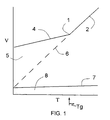
- Free volume is a characteristic of a polymer which can be understood by inspection of a plot of specific volume V versus temperature T as seen in the Fig 1.
- the term "free volume" refers to the volume of the polymer not actually occupied by the molecules.
- the volume of polymer occupied by the molecules is represented by region 8 below line 7 that defines the volume-temperature relationship of molecules which make up a polymeric article.
- Line 4 defines the volume-temperature relationship of the article formed of the polymer. Therefore, the region between line 4 and line 7 represents the space between molecules within the physical dimensions of the polymeric article. Further, the region above line 4 represents the volume of space outside the bounds of the article. This uppermost region would include the volume of the pores throughout a porous article of polymer.
- V vs. T defines a linear relationship 4 .
- a discontinuity 1 in the V-T plot is seen at the glass transition temperature, Tg. That is, below the Tg, where the polymer is glassy, specific volume increases linearly with increasing temperature along line 4 .
- Tg glass transition temperature
- specific volume increases linearly with increasing temperature along line 4 .
- the rate of increase is higher. That is, the slope of the specific volume vs. temperature line 2 above the Tg, is steeper than line 4 below the Tg.
- Tg glass transition temperature
- High free volume polymers are preferred for use as nonporous membranes for osmotic distillation.
- high free volume is meant that the free volume of the polymer at the temperature of use is at least about 15% and preferably at least about 28%.
- the temperature of use will be the temperature at which osmotic distillation is performed. It is desirable for the high free volume polymer to have a glass transition temperature above normal room temperature, preferably above about 30°C, and more preferably above about 115°C.
- High free volume polymers which are particularly preferred for carrying out osmotic distillation are polytrimethylsilylpropyne, silicone rubber, and certain amorphous copolymers of perfluoro-2,2- dimethyl-1,3-dioxole, the latter being especially favored.
- dipolymers examples include dipolymers and dipolymers.
- dipolymers examples include U.S. Patents Nos. 4,754,009 ofE. N. Squire, which issued on June 28, 1988; and 4,530,569 ofE. N. Squire, which issued on July 23, 1985.
- Perfluorinated dioxole monomers are disclosed in U.S. Patent No. 4,565,855 of B.C. Anderson, D.C. England and P.R. Resnick, which issued January 21, 1986.
- the amorphous copolymer can be characterized by its glass transition temperature which will depend on the composition of the specific copolymer of the membrane, especially the amount of TFE or other comonomer that may be present.
- Tg are shown in FIG. 1 of the aforementioned U.S. Patent No. 4,754,009 of E.N. Squire as ranging from about 260°C for dipolymers with 15% tetrafluoroethylene comonomer down to less than 100°C for the dipolymers containing at least 60 mole % tetrafluoroethylene.
- the gas permeable membrane is nonporous. Absence of porosity can be measured by various methods known in the art, including for example, microscopic inspection of the membrane surface.
- PDD copolymers are particularly advantageous in this regard because they are intrinsically selectively gas permeable. Specifically, nonporous membranes of PDD copolymers exhibit an oxygen/nitrogen gas selectivity of greater than about 1.4. Hence it is possible to measure the difference in flux rates of two gases, for example oxygen and nitrogen, through a PDD copolymer membrane to verify that it is selectively gas permeable, and therefore, intact and nonporous over the membrane surface.
- the nonporous membrane can be an unsupported monolithic gas permeable membrane structure.
- a multilayer composite of a nonporous gas permeable layer supported on a porous or microporous substrate layer is utilized in which the nonporous membrane is adjacent and coextensive with the supporting porous substrate.
- the porous support provides structural integrity for the nonporous membrane. Any porous substrate material which is nonwettable by the strip solution and feed and that offers such support is suitable provided that it also is not degraded by the feed mixture, the volatile component or the strip solution and does not impede the transmission of the volatile component through the nonporous membrane. Additionally, materials that are by themselves wettable by the strip solution or feed can be treated to be made nonwettable.
- porous substrate materials include polyolefins, such as polyethylene and polypropylene, polytetrafluoroethylene, polysulfone, and polyvinylidene fluoride.
- the shape of the membrane can be in a diverse variety of forms and typically can be in sheet form, such as a perforated sheet; porous woven or nonwoven fabric; microporous polymer film.
- the sheet can be deployed as a flat sheet, or the sheet can be pleated or rolled into a spiral to increase the surface to volume ratio of the separation unit.
- the membrane can also be in tube or tube ribbon form. Membrane tubes and tube ribbons are disclosed in U.S. Patent No. 5,565,166.
- the nonporous gas permeable membrane for use in osmotic distillation is applied as a thin layer on a support of a microporous hollow fiber.
- Such composite hollow fibers beneficially provide a very large surface area per unit of membrane structure volume and thus are able to produce extremely high gas flux in small occupied space.
- This surface to volume ratio benefit can be exploited further by assembling a plurality of composite hollow fibers in a so-called fiber module.
- Such module typically includes a bundle of many hollow fibers in substantially parallel alignment. The ends of the fibers are potted in a fixation medium, for example an epoxy resin. The bundle is then sliced through the potted ends and the bundles can be mounted within a casing to form a shell and tube modular unit.
- nonporous membrane can be formed on the hollow fibers before bundling and assembling the module, it is preferred to form the membrane on the hollow fibers after installing them within a module.
- U.S. Patent 5,914,154 of Stuart M. Nemser discloses especially effective methods to produce such composite hollow fiber modules.
- the latter step was accomplished by passing the strip solution through the side of the oxygenator which normally receives blood while drawing about 25 inches Hg (85 N/m 2 ) vacuum gauge on the side of the oxygenator which normally receives gas with a Welch Duo-SealTM model 1400 vacuum pump. Temperature of the circulating strip solution was measured at thermocouple 27 prior to entry into membrane module 30. Pressure of the circulating strip solution at pressure gauge 28 was controlled by manually throttling valve 29 at return of the solution to the feed tank.
- the feed was circulated in a feed loop 41 from supply tank 40 through the membrane module 30 via another Cole-Parmer Model 7144-05 pump 42 and a second heat exchanger in the same VWR model 1140 constant temperature bath 43 . Temperature 44 and pressure 45 were monitored prior to entry into the module. In all examples, brine and feed temperatures entering the module were kept within a narrow range of each other that did not exceed about 2°C and was typically about 0.5°C. Conductance of the feed was continuously measured by a Yellow Springs Instrument Model 32 conductance meter 46. Hence, a breakthrough of electrically conductive strip solution could be detected by an increase in conductivity of the feed. Mass of the concentrating solution in the supply tank was determine from mass balance calculations based on weight measurements taken using an Acculab® Model V-4800 electronic balance (0.1 g sensitivity) 47 placed under the supply tank. Flow of the feed stream entering the feed tank provided agitation.
- the membrane module 30 also was a Avecor AffinityTM blood oxygenator.
- This unit contained within a cylindrical case 33 multiple, microporous, polypropylene hollow fibers with a total of about 25 square feet of membrane transfer area which are collectively represented by schematic element 32. Pore size was believed to be about 0.04 ⁇ m and the hollow fibers had a bore diameter of about 230 ⁇ m and an outer diameter of about 300 ⁇ m.
- the apparatus was configured to direct the strip solution through the fiber bores and feed over the outer surface of the fibers to so as to pass these fluids through separate zones 34 and 36 on opposite sides of the membrane while in the module.
- Osmotic distillation was conducted using four membranes alternately.
- the stock oxygenator module with uncoated microporous polypropylene hollow fibers was used in Comparative Example 1.
- Comparative Example 1 an identical type of oxygenator module was used in which the hollow fibers were overlaid with different thicknesses of a nonporous layer of a perfluoro-2, 2-dimethyl-1, 3-dioxole (“PDD")/tetrafluoroethylene copolymer (Teflon® AF 2400, E. I. du Pont de Nemours & Co.) applied to the outside of the fibers according to the method disclosed in U.S. Patent No. 5,914,154.
- the effective membrane thicknesses on the fibers was 1.3 ⁇ m, 2.5 ⁇ m and 3.7 ⁇ m respectively for Exs. 1-3.
- Membrane thickness was calculated from gas permeability measurements..
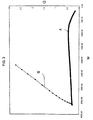
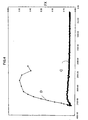
- Fig. 3 shows a plot of conductivity, Q, in millisiemens vs. weight of feed tank contents, W, in grams for Ex. 4 (data “A”) and Comp. Ex. 2 (data “B”).
- the figure reveals that conductivity increased only slightly then gradually declined as mass of feed in the feed tank declined due to water vapor transferred to the strip solution. This is behavior expected during normal concentration by osmotic distillation of a slightly conductive solution such as sucrose.
- data B in the figure shows conductivity rose rapidly which indicates contamination of the feed stream by the brine.
- Comp. Ex. 2 was terminated while a substantial amount of feed remained in the supply tank because of the significant amount of mixing of strip solution in the feed stream.
Landscapes
- Engineering & Computer Science (AREA)
- Water Supply & Treatment (AREA)
- Chemical & Material Sciences (AREA)
- Chemical Kinetics & Catalysis (AREA)
- Separation Using Semi-Permeable Membranes (AREA)
- Tea And Coffee (AREA)
- Detergent Compositions (AREA)
- Non-Alcoholic Beverages (AREA)
Applications Claiming Priority (3)
| Application Number | Priority Date | Filing Date | Title |
|---|---|---|---|
| US375898 | 1999-08-17 | ||
| US09/375,898 US6299777B1 (en) | 1999-08-17 | 1999-08-17 | Osmotic distillation process |
| PCT/US2000/040493 WO2001012304A1 (en) | 1999-08-17 | 2000-07-28 | Osmotic distillation process |
Publications (3)
| Publication Number | Publication Date |
|---|---|
| EP1229998A1 EP1229998A1 (en) | 2002-08-14 |
| EP1229998A4 EP1229998A4 (en) | 2003-07-02 |
| EP1229998B1 true EP1229998B1 (en) | 2005-12-28 |
Family
ID=23482820
Family Applications (1)
| Application Number | Title | Priority Date | Filing Date |
|---|---|---|---|
| EP00965570A Expired - Lifetime EP1229998B1 (en) | 1999-08-17 | 2000-07-28 | Osmotic distillation process |
Country Status (8)
| Country | Link |
|---|---|
| US (2) | US6299777B1 (enExample) |
| EP (1) | EP1229998B1 (enExample) |
| JP (1) | JP4541621B2 (enExample) |
| AU (1) | AU781648C (enExample) |
| BR (1) | BR0013361A (enExample) |
| CA (1) | CA2379440C (enExample) |
| DE (1) | DE60025256T2 (enExample) |
| WO (1) | WO2001012304A1 (enExample) |
Families Citing this family (37)
| Publication number | Priority date | Publication date | Assignee | Title |
|---|---|---|---|---|
| US6517725B2 (en) * | 1999-05-27 | 2003-02-11 | Porous Media | Oil dehydrator |
| US6299777B1 (en) * | 1999-08-17 | 2001-10-09 | Cms Technology Holdings, Inc. | Osmotic distillation process |
| FR2839656B1 (fr) * | 2002-05-15 | 2005-03-25 | Cirad | Procede d'extraction d'au moins un compose contenu dans un fluide par diffusion a travers une membrane poreuse |
| US20040173529A1 (en) * | 2003-03-07 | 2004-09-09 | Membrane Technology And Research, Inc. | Liquid-phase separation of low molecular weight organic compounds |
| GB0310957D0 (en) * | 2003-05-13 | 2003-06-18 | Spinox Ltd | Apparatus and method of water extraction |
| US6949132B2 (en) * | 2003-11-05 | 2005-09-27 | Systel, Llc | Axial degassing transfer lines |
| US7713331B2 (en) * | 2003-11-05 | 2010-05-11 | Rheodyne, Llc | Axial transfer line degassing |
| US20050136143A1 (en) * | 2003-12-22 | 2005-06-23 | Council Of Scientific And Industrial Research | Athermal process for the concentration of Garcinia extract |
| CA2469769A1 (en) * | 2004-06-04 | 2005-12-04 | Aker Kvaerner Canada Inc. | Apparatus and method for spent alkali metal halide solution concentration using osmotic membrane distillation |
| US7608188B2 (en) * | 2004-12-03 | 2009-10-27 | Board Of Regents Of The Nevada System Of Higher Education | Vacuum enhanced direct contact membrane distillation |
| US8029671B2 (en) | 2006-06-13 | 2011-10-04 | Board Of Regents Of The Nevada System Of Higher Education, On Behalf Of The University Of Nevada, Reno | Combined membrane-distillation-forward-osmosis systems and methods of use |
| CA2669279C (en) * | 2006-10-27 | 2017-01-03 | Cms Technologies Holdings, Inc. | Removal of water and methanol from fluids |
| WO2008089217A2 (en) * | 2007-01-18 | 2008-07-24 | Putzmeister America, Inc. | Hydraulic fluid dehydration system and method including pre-heating |
| US7871520B2 (en) * | 2007-12-18 | 2011-01-18 | Milton Roy Company | High-temperature membrane distillation |
| FR2943926B1 (fr) * | 2009-04-02 | 2011-05-06 | Ederna | Procede et dispositif d'evaporation osmotique |
| JP2011050860A (ja) * | 2009-09-02 | 2011-03-17 | Hitachi Zosen Corp | 含水有機物の無水化方法 |
| KR101743336B1 (ko) * | 2010-08-24 | 2017-06-15 | 아사히 가세이 케미칼즈 가부시키가이샤 | 내연 기관의 질소 산화물의 삭감 방법 및 그 장치 |
| TW201217045A (en) * | 2010-09-27 | 2012-05-01 | Sumitomo Electric Industries | Method for cleaning filter membrane, and membrane filter |
| WO2013039967A1 (en) | 2011-09-12 | 2013-03-21 | Idex Health & Science Llc | Supersaturated fluid degassing |
| US9403102B2 (en) * | 2012-02-13 | 2016-08-02 | United Technologies Corporation | Heat exchange system configured with a membrane contactor |
| JPWO2013179414A1 (ja) * | 2012-05-30 | 2016-01-14 | 旭化成ケミカルズ株式会社 | 浄化水を得る方法およびその装置 |
| US9782730B2 (en) | 2013-05-14 | 2017-10-10 | Honeywell International Inc. | 1234YF- and 1234ZE-based polymeric membrane materials, membrane preparations and uses thereof |
| US9381449B2 (en) | 2013-06-06 | 2016-07-05 | Idex Health & Science Llc | Carbon nanotube composite membrane |
| US9403121B2 (en) | 2013-06-06 | 2016-08-02 | Idex Health & Science, Llc | Carbon nanotube composite membrane |
| US20150096935A1 (en) * | 2013-10-04 | 2015-04-09 | Somenath Mitra | Nanocarbon immobilized membranes |
| CN103706253A (zh) * | 2013-12-16 | 2014-04-09 | 南昌大学 | 一种大体积高效动态透析方法及其装置 |
| WO2016182886A1 (en) * | 2015-05-11 | 2016-11-17 | Compact Membrane Systems, Inc. | Improved membranes for separation of alkenes from alkanes |
| US10596527B2 (en) | 2015-06-12 | 2020-03-24 | Compact Membrane Systems, Inc. | Amorphous fluorinated copolymer gas separation membranes |
| WO2017001513A1 (de) | 2015-07-01 | 2017-01-05 | Covestro Deutschland Ag | Osmotisches destillationsverfahren zum konzentrieren einer kochsalzhaltigen flüssigkeit |
| US10323965B2 (en) * | 2015-11-10 | 2019-06-18 | Pratt & Whitney Canada Corp. | Estimating system parameters from sensor measurements |
| CN108587789A (zh) * | 2018-02-11 | 2018-09-28 | 刘召柱 | 一种浸提法萃取玫瑰精油的综合工艺处理系统 |
| CN108586569A (zh) * | 2018-05-11 | 2018-09-28 | 吉尔生化(上海)有限公司 | 一种全保护多肽的处理方法 |
| CN110252144A (zh) * | 2019-05-22 | 2019-09-20 | 南京航空航天大学 | 双侧回收式热泵膜蒸馏蒸发系统及其工作方法 |
| KR102846518B1 (ko) * | 2019-09-06 | 2025-08-13 | 엘지디스플레이 주식회사 | 유기 화합물, 이를 포함하는 유기발광다이오드 및 유기발광장치 |
| US11905350B2 (en) * | 2019-09-09 | 2024-02-20 | Compact Membrane Systems, Inc. | Gas permeable fluoropolymers and ionomers |
| CA3157542C (en) * | 2019-10-11 | 2023-09-26 | Asahi Kasei Kabushiki Kaisha | Raw-material liquid concentration system and concentration apparatus |
| WO2025012681A1 (es) * | 2023-07-11 | 2025-01-16 | Universidad Católica De La Santísima Concepción | Sistema y método para concentración de salmueras de litio y purificación de agua |
Family Cites Families (22)
| Publication number | Priority date | Publication date | Assignee | Title |
|---|---|---|---|---|
| ZA858921B (en) | 1984-11-21 | 1986-07-30 | Syrinx Res Pty Ltd | Osmotic concentration by membrane |
| JPH01503282A (ja) * | 1986-05-05 | 1989-11-09 | シリンクス、リサーチ、インスチツート、プロプライエタリ、リミテッド | 浸透蒸溜法およびその半透性バリヤー |
| JPH0634900B2 (ja) * | 1988-06-15 | 1994-05-11 | リグナイト株式会社 | 混合溶液の分離方法 |
| EP0477224B1 (en) * | 1989-06-15 | 1993-03-17 | Du Pont Canada Inc. | Perfluorodioxole membranes |
| US5075006A (en) * | 1989-08-09 | 1991-12-24 | Exxon Research And Engineering Company | Isocyanurate crosslinked polyurethane membranes and their use for the separation of aromatics from non-aromatics |
| CA2046332A1 (en) * | 1989-12-01 | 1991-06-02 | Jean Maurice Leon Neel | Composite membrane for separating water from fluids containing organic compounds by pervaporation |
| US4971699A (en) * | 1990-01-02 | 1990-11-20 | Texaco Inc. | Separation of compositions containing water and organic oxygenates |
| US5938928A (en) | 1991-08-01 | 1999-08-17 | Nonap Pty. Ltd. | Osmotic distillation process using a membrane laminate |
| JP3171947B2 (ja) * | 1991-09-03 | 2001-06-04 | ダイセル化学工業株式会社 | ポリアクリロニトリル共重合体選択透過膜およびその製造方法 |
| FR2682613B1 (fr) | 1991-10-22 | 1994-06-03 | Cogia | Procede de deshydratation au moins partielle d'une composition aqueuse et dispositifs pour mettre en óoeuvre le procede. |
| EP0609339B1 (en) | 1991-10-25 | 1996-03-20 | W.L. Gore & Associates, Inc. | Process for removing alcohol from liquids |
| US5817359A (en) | 1992-04-30 | 1998-10-06 | Palassa Pty. Ltd. | Methods for dealcoholization employing perstration |
| US5723639A (en) * | 1995-10-16 | 1998-03-03 | University Of Chicago | Esterification of fermentation-derived acids via pervaporation |
| US5824223A (en) | 1995-11-08 | 1998-10-20 | Rentiers Machinery Proprietary Ltd. | Methods and apparatus for osmotic distillation |
| CA2248256A1 (en) * | 1996-03-11 | 1997-09-18 | Edward G. Beaudry | Asymmetric supported membrane for direct osmotic concentration |
| JPH10180059A (ja) * | 1996-10-23 | 1998-07-07 | Sekiyu Sangyo Kasseika Center | 有機液体混合物用分離膜およびそれを用いた装置および方法 |
| US5876604A (en) * | 1996-10-24 | 1999-03-02 | Compact Membrane Systems, Inc | Method of gasifying or degasifying a liquid |
| JPH10202072A (ja) * | 1996-11-22 | 1998-08-04 | Sekiyu Sangyo Kasseika Center | 有機液体混合物用分離膜および分離方法 |
| JPH10202065A (ja) * | 1997-01-23 | 1998-08-04 | Hitachi Techno Eng Co Ltd | 浸透蒸留器を用いた濃縮装置 |
| US5749942A (en) * | 1997-02-14 | 1998-05-12 | Raychem Corporation | Apparatus for extracting a gas from a liquid and delivering the gas to a collection station |
| US5914154A (en) | 1997-05-30 | 1999-06-22 | Compact Membrane Systems, Inc. | Non-porous gas permeable membrane |
| US6299777B1 (en) * | 1999-08-17 | 2001-10-09 | Cms Technology Holdings, Inc. | Osmotic distillation process |
-
1999
- 1999-08-17 US US09/375,898 patent/US6299777B1/en not_active Expired - Lifetime
-
2000
- 2000-07-28 WO PCT/US2000/040493 patent/WO2001012304A1/en not_active Ceased
- 2000-07-28 CA CA002379440A patent/CA2379440C/en not_active Expired - Fee Related
- 2000-07-28 JP JP2001516642A patent/JP4541621B2/ja not_active Expired - Fee Related
- 2000-07-28 BR BR0013361-2A patent/BR0013361A/pt not_active Application Discontinuation
- 2000-07-28 AU AU76269/00A patent/AU781648C/en not_active Ceased
- 2000-07-28 EP EP00965570A patent/EP1229998B1/en not_active Expired - Lifetime
- 2000-07-28 DE DE60025256T patent/DE60025256T2/de not_active Expired - Lifetime
-
2001
- 2001-04-16 US US09/835,550 patent/US6569341B2/en not_active Expired - Fee Related
Also Published As
| Publication number | Publication date |
|---|---|
| AU7626900A (en) | 2001-03-13 |
| AU781648C (en) | 2006-11-09 |
| EP1229998A1 (en) | 2002-08-14 |
| US20010025819A1 (en) | 2001-10-04 |
| EP1229998A4 (en) | 2003-07-02 |
| US6299777B1 (en) | 2001-10-09 |
| CA2379440C (en) | 2004-10-19 |
| US6569341B2 (en) | 2003-05-27 |
| CA2379440A1 (en) | 2001-02-22 |
| DE60025256D1 (de) | 2006-02-02 |
| JP4541621B2 (ja) | 2010-09-08 |
| WO2001012304A1 (en) | 2001-02-22 |
| DE60025256T2 (de) | 2006-08-31 |
| BR0013361A (pt) | 2002-04-30 |
| AU781648B2 (en) | 2005-06-02 |
| JP2003507157A (ja) | 2003-02-25 |
Similar Documents
| Publication | Publication Date | Title |
|---|---|---|
| EP1229998B1 (en) | Osmotic distillation process | |
| Onsekizoglu | Membrane distillation: principle, advances, limitations and future prospects in food industry | |
| Onsekizoglu Bagci | Potential of membrane distillation for production of high quality fruit juice concentrate | |
| US4781837A (en) | Method of performing osmetic distillation | |
| US5098575A (en) | Method and apparatus for processing liquid solutions of suspensions particularly useful in the desalination of saline water | |
| AU654410B2 (en) | Process for removing alcohol from liquids | |
| JPH01503282A (ja) | 浸透蒸溜法およびその半透性バリヤー | |
| EP0258884B1 (en) | Method for separating and concentrating an organic component from an aqueous solution containing same | |
| Terefe et al. | Forward osmosis: A novel membrane separation technology of relevance to food and related industries | |
| Narayan et al. | Acoustic field-assisted osmotic membrane distillation | |
| Gabino et al. | Evaluation of the cleaning of a new hydrophobic membrane for osmotic evaporation | |
| JPWO2020241795A1 (ja) | 原料液濃縮システム | |
| Yamagiwa et al. | Membrane fouling in ultrafiltration of hydrophobic nonionic surfactant | |
| JP2021146297A (ja) | 原料液濃縮システムおよび原料液濃縮方法 | |
| Abulnour et al. | Parametric evaluation of flux decline during ultrafiltration of protein solutions | |
| Patil et al. | Membrane distillation review and flux prediction in direct contact membrane distillation process | |
| Rehman et al. | Mode of Operation in Membrane Contactors | |
| Gontarek-Castro et al. | Food bioactive ingredients processing using membrane distillation | |
| KR102865639B1 (ko) | 수처리 분리막 활성층 형성용 조성물, 수처리 분리막의 제조방법, 이에 의하여 제조된 수처리 분리막 및 수처리 모듈 | |
| Matz et al. | Design and operating parameters for tubular ultrafiltration membrane modules | |
| Cheryan | Membrane concentration of liquid foods | |
| JP2024117419A (ja) | 原料液濃縮方法及び原料液濃縮装置 | |
| JPH0824585A (ja) | 水溶液の濃縮方法 | |
| JP2022146345A (ja) | 原料液濃縮システム及び原料液濃縮方法 | |
| Kruger et al. | from the sun |
Legal Events
| Date | Code | Title | Description |
|---|---|---|---|
| PUAI | Public reference made under article 153(3) epc to a published international application that has entered the european phase |
Free format text: ORIGINAL CODE: 0009012 |
|
| 17P | Request for examination filed |
Effective date: 20020124 |
|
| AK | Designated contracting states |
Kind code of ref document: A1 Designated state(s): AT BE CH CY DE DK ES FI FR GB GR IE IT LI LU MC NL PT SE |
|
| A4 | Supplementary search report drawn up and despatched |
Effective date: 20030516 |
|
| 17Q | First examination report despatched |
Effective date: 20030919 |
|
| RBV | Designated contracting states (corrected) |
Designated state(s): DE FR IT |
|
| GRAP | Despatch of communication of intention to grant a patent |
Free format text: ORIGINAL CODE: EPIDOSNIGR1 |
|
| GRAS | Grant fee paid |
Free format text: ORIGINAL CODE: EPIDOSNIGR3 |
|
| GRAA | (expected) grant |
Free format text: ORIGINAL CODE: 0009210 |
|
| AK | Designated contracting states |
Kind code of ref document: B1 Designated state(s): DE FR IT |
|
| PG25 | Lapsed in a contracting state [announced via postgrant information from national office to epo] |
Ref country code: IT Free format text: LAPSE BECAUSE OF FAILURE TO SUBMIT A TRANSLATION OF THE DESCRIPTION OR TO PAY THE FEE WITHIN THE PRESCRIBED TIME-LIMIT;WARNING: LAPSES OF ITALIAN PATENTS WITH EFFECTIVE DATE BEFORE 2007 MAY HAVE OCCURRED AT ANY TIME BEFORE 2007. THE CORRECT EFFECTIVE DATE MAY BE DIFFERENT FROM THE ONE RECORDED. Effective date: 20051228 |
|
| REF | Corresponds to: |
Ref document number: 60025256 Country of ref document: DE Date of ref document: 20060202 Kind code of ref document: P |
|
| ET | Fr: translation filed | ||
| PLBE | No opposition filed within time limit |
Free format text: ORIGINAL CODE: 0009261 |
|
| STAA | Information on the status of an ep patent application or granted ep patent |
Free format text: STATUS: NO OPPOSITION FILED WITHIN TIME LIMIT |
|
| 26N | No opposition filed |
Effective date: 20060929 |
|
| PGFP | Annual fee paid to national office [announced via postgrant information from national office to epo] |
Ref country code: DE Payment date: 20100721 Year of fee payment: 11 Ref country code: FR Payment date: 20100805 Year of fee payment: 11 |
|
| REG | Reference to a national code |
Ref country code: FR Ref legal event code: ST Effective date: 20120330 |
|
| PG25 | Lapsed in a contracting state [announced via postgrant information from national office to epo] |
Ref country code: FR Free format text: LAPSE BECAUSE OF NON-PAYMENT OF DUE FEES Effective date: 20110801 Ref country code: DE Free format text: LAPSE BECAUSE OF NON-PAYMENT OF DUE FEES Effective date: 20120201 |
|
| REG | Reference to a national code |
Ref country code: DE Ref legal event code: R119 Ref document number: 60025256 Country of ref document: DE Effective date: 20120201 |