EP1226181B1 - Procede de preparation des dispersions stables de (co)polymeres dans un polyol - Google Patents
Procede de preparation des dispersions stables de (co)polymeres dans un polyol Download PDFInfo
- Publication number
- EP1226181B1 EP1226181B1 EP00960760A EP00960760A EP1226181B1 EP 1226181 B1 EP1226181 B1 EP 1226181B1 EP 00960760 A EP00960760 A EP 00960760A EP 00960760 A EP00960760 A EP 00960760A EP 1226181 B1 EP1226181 B1 EP 1226181B1
- Authority
- EP
- European Patent Office
- Prior art keywords
- polyol
- initiator
- acid
- process according
- hydroxyl
- Prior art date
- Legal status (The legal status is an assumption and is not a legal conclusion. Google has not performed a legal analysis and makes no representation as to the accuracy of the status listed.)
- Revoked
Links
- 229920005862 polyol Polymers 0.000 title claims abstract description 51
- 150000003077 polyols Chemical class 0.000 title claims abstract description 50
- 238000000034 method Methods 0.000 title claims abstract description 26
- 239000006185 dispersion Substances 0.000 title claims abstract description 16
- 229920001577 copolymer Polymers 0.000 title claims abstract description 8
- 239000000178 monomer Substances 0.000 claims abstract description 31
- 239000002253 acid Substances 0.000 claims abstract description 25
- 239000000203 mixture Substances 0.000 claims abstract description 23
- 150000002148 esters Chemical class 0.000 claims abstract description 15
- 238000011065 in-situ storage Methods 0.000 claims abstract description 6
- -1 aliphatic radicals Chemical class 0.000 claims description 33
- 239000003999 initiator Substances 0.000 claims description 16
- 125000002887 hydroxy group Chemical group [H]O* 0.000 claims description 13
- 238000006116 polymerization reaction Methods 0.000 claims description 12
- 125000004432 carbon atom Chemical group C* 0.000 claims description 8
- 125000001424 substituent group Chemical group 0.000 claims description 6
- 125000003545 alkoxy group Chemical group 0.000 claims description 5
- 125000000217 alkyl group Chemical group 0.000 claims description 5
- 125000001931 aliphatic group Chemical group 0.000 claims description 4
- 125000001495 ethyl group Chemical group [H]C([H])([H])C([H])([H])* 0.000 claims description 4
- 238000004519 manufacturing process Methods 0.000 claims description 4
- 125000002496 methyl group Chemical group [H]C([H])([H])* 0.000 claims description 4
- XNICETZFWREDRJ-UHFFFAOYSA-N ethyl 2-[(1-ethoxy-2-methyl-1-oxopropan-2-yl)diazenyl]-2-methylpropanoate Chemical compound CCOC(=O)C(C)(C)N=NC(C)(C)C(=O)OCC XNICETZFWREDRJ-UHFFFAOYSA-N 0.000 claims description 3
- 125000005843 halogen group Chemical group 0.000 claims 4
- 125000004191 (C1-C6) alkoxy group Chemical group 0.000 claims 3
- 125000004169 (C1-C6) alkyl group Chemical group 0.000 claims 3
- QUPDWYMUPZLYJZ-UHFFFAOYSA-N ethyl Chemical compound C[CH2] QUPDWYMUPZLYJZ-UHFFFAOYSA-N 0.000 claims 1
- WCYWZMWISLQXQU-UHFFFAOYSA-N methyl Chemical compound [CH3] WCYWZMWISLQXQU-UHFFFAOYSA-N 0.000 claims 1
- 125000002947 alkylene group Chemical group 0.000 description 20
- IJGRMHOSHXDMSA-UHFFFAOYSA-N Atomic nitrogen Chemical compound N#N IJGRMHOSHXDMSA-UHFFFAOYSA-N 0.000 description 14
- PPBRXRYQALVLMV-UHFFFAOYSA-N Styrene Chemical compound C=CC1=CC=CC=C1 PPBRXRYQALVLMV-UHFFFAOYSA-N 0.000 description 12
- LFQSCWFLJHTTHZ-UHFFFAOYSA-N Ethanol Chemical compound CCO LFQSCWFLJHTTHZ-UHFFFAOYSA-N 0.000 description 10
- 238000006243 chemical reaction Methods 0.000 description 10
- PEDCQBHIVMGVHV-UHFFFAOYSA-N Glycerine Chemical compound OCC(O)CO PEDCQBHIVMGVHV-UHFFFAOYSA-N 0.000 description 9
- 229920000728 polyester Polymers 0.000 description 8
- 150000001875 compounds Chemical class 0.000 description 7
- 229910052757 nitrogen Inorganic materials 0.000 description 7
- 229920000570 polyether Polymers 0.000 description 7
- WSFSSNUMVMOOMR-UHFFFAOYSA-N Formaldehyde Chemical compound O=C WSFSSNUMVMOOMR-UHFFFAOYSA-N 0.000 description 6
- VZCYOOQTPOCHFL-OWOJBTEDSA-N Fumaric acid Chemical compound OC(=O)\C=C\C(O)=O VZCYOOQTPOCHFL-OWOJBTEDSA-N 0.000 description 6
- VEXZGXHMUGYJMC-UHFFFAOYSA-N Hydrochloric acid Chemical compound Cl VEXZGXHMUGYJMC-UHFFFAOYSA-N 0.000 description 6
- OFOBLEOULBTSOW-UHFFFAOYSA-N Propanedioic acid Natural products OC(=O)CC(O)=O OFOBLEOULBTSOW-UHFFFAOYSA-N 0.000 description 6
- 238000002360 preparation method Methods 0.000 description 6
- 150000005846 sugar alcohols Polymers 0.000 description 6
- VZCYOOQTPOCHFL-UHFFFAOYSA-N trans-butenedioic acid Natural products OC(=O)C=CC(O)=O VZCYOOQTPOCHFL-UHFFFAOYSA-N 0.000 description 6
- OZAIFHULBGXAKX-UHFFFAOYSA-N 2-(2-cyanopropan-2-yldiazenyl)-2-methylpropanenitrile Chemical compound N#CC(C)(C)N=NC(C)(C)C#N OZAIFHULBGXAKX-UHFFFAOYSA-N 0.000 description 5
- LYCAIKOWRPUZTN-UHFFFAOYSA-N Ethylene glycol Chemical compound OCCO LYCAIKOWRPUZTN-UHFFFAOYSA-N 0.000 description 5
- 239000004721 Polyphenylene oxide Substances 0.000 description 5
- DNIAPMSPPWPWGF-UHFFFAOYSA-N Propylene glycol Chemical compound CC(O)CO DNIAPMSPPWPWGF-UHFFFAOYSA-N 0.000 description 5
- WYURNTSHIVDZCO-UHFFFAOYSA-N Tetrahydrofuran Chemical compound C1CCOC1 WYURNTSHIVDZCO-UHFFFAOYSA-N 0.000 description 5
- WXZMFSXDPGVJKK-UHFFFAOYSA-N pentaerythritol Chemical compound OCC(CO)(CO)CO WXZMFSXDPGVJKK-UHFFFAOYSA-N 0.000 description 5
- 229920001281 polyalkylene Polymers 0.000 description 5
- 239000000243 solution Substances 0.000 description 5
- ATVJXMYDOSMEPO-UHFFFAOYSA-N 3-prop-2-enoxyprop-1-ene Chemical compound C=CCOCC=C ATVJXMYDOSMEPO-UHFFFAOYSA-N 0.000 description 4
- HOSGXJWQVBHGLT-UHFFFAOYSA-N 6-hydroxy-3,4-dihydro-1h-quinolin-2-one Chemical group N1C(=O)CCC2=CC(O)=CC=C21 HOSGXJWQVBHGLT-UHFFFAOYSA-N 0.000 description 4
- OZAIFHULBGXAKX-VAWYXSNFSA-N AIBN Substances N#CC(C)(C)\N=N\C(C)(C)C#N OZAIFHULBGXAKX-VAWYXSNFSA-N 0.000 description 4
- NLHHRLWOUZZQLW-UHFFFAOYSA-N Acrylonitrile Chemical compound C=CC#N NLHHRLWOUZZQLW-UHFFFAOYSA-N 0.000 description 4
- PAYRUJLWNCNPSJ-UHFFFAOYSA-N Aniline Chemical compound NC1=CC=CC=C1 PAYRUJLWNCNPSJ-UHFFFAOYSA-N 0.000 description 4
- RTZKZFJDLAIYFH-UHFFFAOYSA-N Diethyl ether Chemical compound CCOCC RTZKZFJDLAIYFH-UHFFFAOYSA-N 0.000 description 4
- RRHGJUQNOFWUDK-UHFFFAOYSA-N Isoprene Chemical compound CC(=C)C=C RRHGJUQNOFWUDK-UHFFFAOYSA-N 0.000 description 4
- 150000007513 acids Chemical class 0.000 description 4
- 125000003118 aryl group Chemical group 0.000 description 4
- 229910052799 carbon Inorganic materials 0.000 description 4
- 239000003153 chemical reaction reagent Substances 0.000 description 4
- 239000007788 liquid Substances 0.000 description 4
- 150000002894 organic compounds Chemical class 0.000 description 4
- 150000003254 radicals Chemical class 0.000 description 4
- OKTJSMMVPCPJKN-UHFFFAOYSA-N Carbon Chemical compound [C] OKTJSMMVPCPJKN-UHFFFAOYSA-N 0.000 description 3
- OKKJLVBELUTLKV-UHFFFAOYSA-N Methanol Chemical compound OC OKKJLVBELUTLKV-UHFFFAOYSA-N 0.000 description 3
- MUBZPKHOEPUJKR-UHFFFAOYSA-N Oxalic acid Chemical compound OC(=O)C(O)=O MUBZPKHOEPUJKR-UHFFFAOYSA-N 0.000 description 3
- 239000005062 Polybutadiene Substances 0.000 description 3
- ZJCCRDAZUWHFQH-UHFFFAOYSA-N Trimethylolpropane Chemical compound CCC(CO)(CO)CO ZJCCRDAZUWHFQH-UHFFFAOYSA-N 0.000 description 3
- NIXOWILDQLNWCW-UHFFFAOYSA-N acrylic acid group Chemical group C(C=C)(=O)O NIXOWILDQLNWCW-UHFFFAOYSA-N 0.000 description 3
- 150000001412 amines Chemical class 0.000 description 3
- 150000008064 anhydrides Chemical class 0.000 description 3
- 230000015572 biosynthetic process Effects 0.000 description 3
- IISBACLAFKSPIT-UHFFFAOYSA-N bisphenol A Chemical compound C=1C=C(O)C=CC=1C(C)(C)C1=CC=C(O)C=C1 IISBACLAFKSPIT-UHFFFAOYSA-N 0.000 description 3
- 125000003178 carboxy group Chemical group [H]OC(*)=O 0.000 description 3
- 239000012986 chain transfer agent Substances 0.000 description 3
- WNAHIZMDSQCWRP-UHFFFAOYSA-N dodecane-1-thiol Chemical compound CCCCCCCCCCCCS WNAHIZMDSQCWRP-UHFFFAOYSA-N 0.000 description 3
- 239000001530 fumaric acid Substances 0.000 description 3
- 150000002334 glycols Chemical class 0.000 description 3
- 229920000578 graft copolymer Polymers 0.000 description 3
- 125000001475 halogen functional group Chemical group 0.000 description 3
- 125000004435 hydrogen atom Chemical group [H]* 0.000 description 3
- VZCYOOQTPOCHFL-UPHRSURJSA-N maleic acid Chemical compound OC(=O)\C=C/C(O)=O VZCYOOQTPOCHFL-UPHRSURJSA-N 0.000 description 3
- 239000011976 maleic acid Substances 0.000 description 3
- FPYJFEHAWHCUMM-UHFFFAOYSA-N maleic anhydride Chemical compound O=C1OC(=O)C=C1 FPYJFEHAWHCUMM-UHFFFAOYSA-N 0.000 description 3
- ZQMHJBXHRFJKOT-UHFFFAOYSA-N methyl 2-[(1-methoxy-2-methyl-1-oxopropan-2-yl)diazenyl]-2-methylpropanoate Chemical compound COC(=O)C(C)(C)N=NC(C)(C)C(=O)OC ZQMHJBXHRFJKOT-UHFFFAOYSA-N 0.000 description 3
- 150000003018 phosphorus compounds Chemical class 0.000 description 3
- 229920002857 polybutadiene Polymers 0.000 description 3
- 229920001451 polypropylene glycol Polymers 0.000 description 3
- 231100000331 toxic Toxicity 0.000 description 3
- 230000002588 toxic effect Effects 0.000 description 3
- 125000000391 vinyl group Chemical group [H]C([*])=C([H])[H] 0.000 description 3
- PUPZLCDOIYMWBV-UHFFFAOYSA-N (+/-)-1,3-Butanediol Chemical compound CC(O)CCO PUPZLCDOIYMWBV-UHFFFAOYSA-N 0.000 description 2
- XWJBRBSPAODJER-UHFFFAOYSA-N 1,7-octadiene Chemical compound C=CCCCCC=C XWJBRBSPAODJER-UHFFFAOYSA-N 0.000 description 2
- JLIDVCMBCGBIEY-UHFFFAOYSA-N 1-penten-3-one Chemical compound CCC(=O)C=C JLIDVCMBCGBIEY-UHFFFAOYSA-N 0.000 description 2
- JAHNSTQSQJOJLO-UHFFFAOYSA-N 2-(3-fluorophenyl)-1h-imidazole Chemical compound FC1=CC=CC(C=2NC=CN=2)=C1 JAHNSTQSQJOJLO-UHFFFAOYSA-N 0.000 description 2
- JJRUAPNVLBABCN-UHFFFAOYSA-N 2-(ethenoxymethyl)oxirane Chemical compound C=COCC1CO1 JJRUAPNVLBABCN-UHFFFAOYSA-N 0.000 description 2
- HZAXFHJVJLSVMW-UHFFFAOYSA-N 2-Aminoethan-1-ol Chemical compound NCCO HZAXFHJVJLSVMW-UHFFFAOYSA-N 0.000 description 2
- QGZKDVFQNNGYKY-UHFFFAOYSA-N Ammonia Chemical compound N QGZKDVFQNNGYKY-UHFFFAOYSA-N 0.000 description 2
- KAKZBPTYRLMSJV-UHFFFAOYSA-N Butadiene Chemical compound C=CC=C KAKZBPTYRLMSJV-UHFFFAOYSA-N 0.000 description 2
- SOGAXMICEFXMKE-UHFFFAOYSA-N Butylmethacrylate Chemical compound CCCCOC(=O)C(C)=C SOGAXMICEFXMKE-UHFFFAOYSA-N 0.000 description 2
- FBPFZTCFMRRESA-FSIIMWSLSA-N D-Glucitol Natural products OC[C@H](O)[C@H](O)[C@@H](O)[C@H](O)CO FBPFZTCFMRRESA-FSIIMWSLSA-N 0.000 description 2
- FBPFZTCFMRRESA-JGWLITMVSA-N D-glucitol Chemical compound OC[C@H](O)[C@@H](O)[C@H](O)[C@H](O)CO FBPFZTCFMRRESA-JGWLITMVSA-N 0.000 description 2
- IAYPIBMASNFSPL-UHFFFAOYSA-N Ethylene oxide Chemical compound C1CO1 IAYPIBMASNFSPL-UHFFFAOYSA-N 0.000 description 2
- PIICEJLVQHRZGT-UHFFFAOYSA-N Ethylenediamine Chemical compound NCCN PIICEJLVQHRZGT-UHFFFAOYSA-N 0.000 description 2
- MHAJPDPJQMAIIY-UHFFFAOYSA-N Hydrogen peroxide Chemical compound OO MHAJPDPJQMAIIY-UHFFFAOYSA-N 0.000 description 2
- BAPJBEWLBFYGME-UHFFFAOYSA-N Methyl acrylate Chemical compound COC(=O)C=C BAPJBEWLBFYGME-UHFFFAOYSA-N 0.000 description 2
- BAVYZALUXZFZLV-UHFFFAOYSA-N Methylamine Chemical compound NC BAVYZALUXZFZLV-UHFFFAOYSA-N 0.000 description 2
- ATUOYWHBWRKTHZ-UHFFFAOYSA-N Propane Chemical compound CCC ATUOYWHBWRKTHZ-UHFFFAOYSA-N 0.000 description 2
- GOOHAUXETOMSMM-UHFFFAOYSA-N Propylene oxide Chemical compound CC1CO1 GOOHAUXETOMSMM-UHFFFAOYSA-N 0.000 description 2
- KKEYFWRCBNTPAC-UHFFFAOYSA-N Terephthalic acid Chemical compound OC(=O)C1=CC=C(C(O)=O)C=C1 KKEYFWRCBNTPAC-UHFFFAOYSA-N 0.000 description 2
- QYKIQEUNHZKYBP-UHFFFAOYSA-N Vinyl ether Chemical class C=COC=C QYKIQEUNHZKYBP-UHFFFAOYSA-N 0.000 description 2
- WNLRTRBMVRJNCN-UHFFFAOYSA-N adipic acid Chemical compound OC(=O)CCCCC(O)=O WNLRTRBMVRJNCN-UHFFFAOYSA-N 0.000 description 2
- XXROGKLTLUQVRX-UHFFFAOYSA-N allyl alcohol Chemical compound OCC=C XXROGKLTLUQVRX-UHFFFAOYSA-N 0.000 description 2
- 150000001414 amino alcohols Chemical class 0.000 description 2
- MDFFNEOEWAXZRQ-UHFFFAOYSA-N aminyl Chemical compound [NH2] MDFFNEOEWAXZRQ-UHFFFAOYSA-N 0.000 description 2
- 125000003710 aryl alkyl group Chemical group 0.000 description 2
- 125000004429 atom Chemical group 0.000 description 2
- UJMDYLWCYJJYMO-UHFFFAOYSA-N benzene-1,2,3-tricarboxylic acid Chemical compound OC(=O)C1=CC=CC(C(O)=O)=C1C(O)=O UJMDYLWCYJJYMO-UHFFFAOYSA-N 0.000 description 2
- 230000005587 bubbling Effects 0.000 description 2
- 239000006227 byproduct Substances 0.000 description 2
- 238000005266 casting Methods 0.000 description 2
- 239000007795 chemical reaction product Substances 0.000 description 2
- 238000009833 condensation Methods 0.000 description 2
- 230000005494 condensation Effects 0.000 description 2
- 239000007859 condensation product Substances 0.000 description 2
- LDHQCZJRKDOVOX-NSCUHMNNSA-N crotonic acid Chemical compound C\C=C\C(O)=O LDHQCZJRKDOVOX-NSCUHMNNSA-N 0.000 description 2
- 150000002118 epoxides Chemical class 0.000 description 2
- FJKIXWOMBXYWOQ-UHFFFAOYSA-N ethenoxyethane Chemical compound CCOC=C FJKIXWOMBXYWOQ-UHFFFAOYSA-N 0.000 description 2
- TUJKJAMUKRIRHC-UHFFFAOYSA-N hydroxyl Chemical compound [OH] TUJKJAMUKRIRHC-UHFFFAOYSA-N 0.000 description 2
- QQVIHTHCMHWDBS-UHFFFAOYSA-N isophthalic acid Chemical compound OC(=O)C1=CC=CC(C(O)=O)=C1 QQVIHTHCMHWDBS-UHFFFAOYSA-N 0.000 description 2
- LVHBHZANLOWSRM-UHFFFAOYSA-N methylenebutanedioic acid Natural products OC(=O)CC(=C)C(O)=O LVHBHZANLOWSRM-UHFFFAOYSA-N 0.000 description 2
- PNLUGRYDUHRLOF-UHFFFAOYSA-N n-ethenyl-n-methylacetamide Chemical compound C=CN(C)C(C)=O PNLUGRYDUHRLOF-UHFFFAOYSA-N 0.000 description 2
- 239000012299 nitrogen atmosphere Substances 0.000 description 2
- BDJRBEYXGGNYIS-UHFFFAOYSA-N nonanedioic acid Chemical compound OC(=O)CCCCCCCC(O)=O BDJRBEYXGGNYIS-UHFFFAOYSA-N 0.000 description 2
- WLJVNTCWHIRURA-UHFFFAOYSA-N pimelic acid Chemical compound OC(=O)CCCCCC(O)=O WLJVNTCWHIRURA-UHFFFAOYSA-N 0.000 description 2
- 229920006149 polyester-amide block copolymer Polymers 0.000 description 2
- 229920006324 polyoxymethylene Polymers 0.000 description 2
- 229920006295 polythiol Polymers 0.000 description 2
- 229920002635 polyurethane Polymers 0.000 description 2
- 239000004814 polyurethane Substances 0.000 description 2
- 239000000047 product Substances 0.000 description 2
- YPFDHNVEDLHUCE-UHFFFAOYSA-N propane-1,3-diol Chemical compound OCCCO YPFDHNVEDLHUCE-UHFFFAOYSA-N 0.000 description 2
- 239000012429 reaction media Substances 0.000 description 2
- CXMXRPHRNRROMY-UHFFFAOYSA-N sebacic acid Chemical compound OC(=O)CCCCCCCCC(O)=O CXMXRPHRNRROMY-UHFFFAOYSA-N 0.000 description 2
- 239000000600 sorbitol Substances 0.000 description 2
- TYFQFVWCELRYAO-UHFFFAOYSA-N suberic acid Chemical compound OC(=O)CCCCCCC(O)=O TYFQFVWCELRYAO-UHFFFAOYSA-N 0.000 description 2
- 238000003786 synthesis reaction Methods 0.000 description 2
- YLQBMQCUIZJEEH-UHFFFAOYSA-N tetrahydrofuran Natural products C=1C=COC=1 YLQBMQCUIZJEEH-UHFFFAOYSA-N 0.000 description 2
- LDHQCZJRKDOVOX-UHFFFAOYSA-N trans-crotonic acid Natural products CC=CC(O)=O LDHQCZJRKDOVOX-UHFFFAOYSA-N 0.000 description 2
- XFNJVJPLKCPIBV-UHFFFAOYSA-N trimethylenediamine Chemical compound NCCCN XFNJVJPLKCPIBV-UHFFFAOYSA-N 0.000 description 2
- 229920002554 vinyl polymer Polymers 0.000 description 2
- UIYCHXAGWOYNNA-UHFFFAOYSA-N vinyl sulfide Chemical compound C=CSC=C UIYCHXAGWOYNNA-UHFFFAOYSA-N 0.000 description 2
- XVOUMQNXTGKGMA-OWOJBTEDSA-N (E)-glutaconic acid Chemical compound OC(=O)C\C=C\C(O)=O XVOUMQNXTGKGMA-OWOJBTEDSA-N 0.000 description 1
- VMSLCPKYRPDHLN-UHFFFAOYSA-N (R)-Humulone Chemical compound CC(C)CC(=O)C1=C(O)C(CC=C(C)C)=C(O)C(O)(CC=C(C)C)C1=O VMSLCPKYRPDHLN-UHFFFAOYSA-N 0.000 description 1
- ZWKNLRXFUTWSOY-QPJJXVBHSA-N (e)-3-phenylprop-2-enenitrile Chemical compound N#C\C=C\C1=CC=CC=C1 ZWKNLRXFUTWSOY-QPJJXVBHSA-N 0.000 description 1
- FVXAIIVXIJVXRH-OWOJBTEDSA-N (e)-but-2-ene-1,4-dithiol Chemical compound SC\C=C\CS FVXAIIVXIJVXRH-OWOJBTEDSA-N 0.000 description 1
- ORTVZLZNOYNASJ-UPHRSURJSA-N (z)-but-2-ene-1,4-diol Chemical compound OC\C=C/CO ORTVZLZNOYNASJ-UPHRSURJSA-N 0.000 description 1
- BQCIDUSAKPWEOX-UHFFFAOYSA-N 1,1-Difluoroethene Chemical compound FC(F)=C BQCIDUSAKPWEOX-UHFFFAOYSA-N 0.000 description 1
- PDKAXHLOFWCWIH-UHFFFAOYSA-N 1,1-dichlorobuta-1,3-diene Chemical compound ClC(Cl)=CC=C PDKAXHLOFWCWIH-UHFFFAOYSA-N 0.000 description 1
- ZWVMLYRJXORSEP-UHFFFAOYSA-N 1,2,6-Hexanetriol Chemical compound OCCCCC(O)CO ZWVMLYRJXORSEP-UHFFFAOYSA-N 0.000 description 1
- VYMPLPIFKRHAAC-UHFFFAOYSA-N 1,2-ethanedithiol Chemical compound SCCS VYMPLPIFKRHAAC-UHFFFAOYSA-N 0.000 description 1
- YGKHJWTVMIMEPQ-UHFFFAOYSA-N 1,2-propanedithiol Chemical compound CC(S)CS YGKHJWTVMIMEPQ-UHFFFAOYSA-N 0.000 description 1
- 229940058015 1,3-butylene glycol Drugs 0.000 description 1
- PXGZQGDTEZPERC-UHFFFAOYSA-N 1,4-cyclohexanedicarboxylic acid Chemical compound OC(=O)C1CCC(C(O)=O)CC1 PXGZQGDTEZPERC-UHFFFAOYSA-N 0.000 description 1
- IZMZREOTRMMCCB-UHFFFAOYSA-N 1,4-dichloro-2-ethenylbenzene Chemical compound ClC1=CC=C(Cl)C(C=C)=C1 IZMZREOTRMMCCB-UHFFFAOYSA-N 0.000 description 1
- SRZXCOWFGPICGA-UHFFFAOYSA-N 1,6-Hexanedithiol Chemical compound SCCCCCCS SRZXCOWFGPICGA-UHFFFAOYSA-N 0.000 description 1
- UNMYKPSSIFZORM-UHFFFAOYSA-N 1-(2-ethenoxyethoxy)butane Chemical compound CCCCOCCOC=C UNMYKPSSIFZORM-UHFFFAOYSA-N 0.000 description 1
- FPBWSPZHCJXUBL-UHFFFAOYSA-N 1-chloro-1-fluoroethene Chemical group FC(Cl)=C FPBWSPZHCJXUBL-UHFFFAOYSA-N 0.000 description 1
- LHHMNJZNWUJFOC-UHFFFAOYSA-N 1-chloro-2-[2-chloroethoxy(ethenyl)phosphoryl]oxyethane Chemical compound ClCCOP(=O)(C=C)OCCCl LHHMNJZNWUJFOC-UHFFFAOYSA-N 0.000 description 1
- JBYKCFLLZLHPIR-UHFFFAOYSA-N 1-ethenoxy-2-ethylsulfanylethane Chemical compound CCSCCOC=C JBYKCFLLZLHPIR-UHFFFAOYSA-N 0.000 description 1
- GXZPMXGRNUXGHN-UHFFFAOYSA-N 1-ethenoxy-2-methoxyethane Chemical compound COCCOC=C GXZPMXGRNUXGHN-UHFFFAOYSA-N 0.000 description 1
- UZKWTJUDCOPSNM-UHFFFAOYSA-N 1-ethenoxybutane Chemical class CCCCOC=C UZKWTJUDCOPSNM-UHFFFAOYSA-N 0.000 description 1
- OVGRCEFMXPHEBL-UHFFFAOYSA-N 1-ethenoxypropane Chemical class CCCOC=C OVGRCEFMXPHEBL-UHFFFAOYSA-N 0.000 description 1
- OEVVKKAVYQFQNV-UHFFFAOYSA-N 1-ethenyl-2,4-dimethylbenzene Chemical compound CC1=CC=C(C=C)C(C)=C1 OEVVKKAVYQFQNV-UHFFFAOYSA-N 0.000 description 1
- UULPGUKSBAXNJN-UHFFFAOYSA-N 1-ethenyl-4-phenoxybenzene Chemical compound C1=CC(C=C)=CC=C1OC1=CC=CC=C1 UULPGUKSBAXNJN-UHFFFAOYSA-N 0.000 description 1
- OSSNTDFYBPYIEC-UHFFFAOYSA-N 1-ethenylimidazole Chemical compound C=CN1C=CN=C1 OSSNTDFYBPYIEC-UHFFFAOYSA-N 0.000 description 1
- CTXUTPWZJZHRJC-UHFFFAOYSA-N 1-ethenylpyrrole Chemical compound C=CN1C=CC=C1 CTXUTPWZJZHRJC-UHFFFAOYSA-N 0.000 description 1
- HQSMEHLVLOGBCK-UHFFFAOYSA-N 1-ethenylsulfinylethene Chemical compound C=CS(=O)C=C HQSMEHLVLOGBCK-UHFFFAOYSA-N 0.000 description 1
- MBDUIEKYVPVZJH-UHFFFAOYSA-N 1-ethylsulfonylethane Chemical compound CCS(=O)(=O)CC MBDUIEKYVPVZJH-UHFFFAOYSA-N 0.000 description 1
- KOCUMXQOUWPSLK-UHFFFAOYSA-N 1-methoxybuta-1,3-diene Chemical compound COC=CC=C KOCUMXQOUWPSLK-UHFFFAOYSA-N 0.000 description 1
- RTBFRGCFXZNCOE-UHFFFAOYSA-N 1-methylsulfonylpiperidin-4-one Chemical compound CS(=O)(=O)N1CCC(=O)CC1 RTBFRGCFXZNCOE-UHFFFAOYSA-N 0.000 description 1
- KUIZKZHDMPERHR-UHFFFAOYSA-N 1-phenylprop-2-en-1-one Chemical compound C=CC(=O)C1=CC=CC=C1 KUIZKZHDMPERHR-UHFFFAOYSA-N 0.000 description 1
- IGGDKDTUCAWDAN-UHFFFAOYSA-N 1-vinylnaphthalene Chemical compound C1=CC=C2C(C=C)=CC=CC2=C1 IGGDKDTUCAWDAN-UHFFFAOYSA-N 0.000 description 1
- SXZSFWHOSHAKMN-UHFFFAOYSA-N 2,3,4,4',5-Pentachlorobiphenyl Chemical compound C1=CC(Cl)=CC=C1C1=CC(Cl)=C(Cl)C(Cl)=C1Cl SXZSFWHOSHAKMN-UHFFFAOYSA-N 0.000 description 1
- VOZKAJLKRJDJLL-UHFFFAOYSA-N 2,4-diaminotoluene Chemical compound CC1=CC=C(N)C=C1N VOZKAJLKRJDJLL-UHFFFAOYSA-N 0.000 description 1
- STMDPCBYJCIZOD-UHFFFAOYSA-N 2-(2,4-dinitroanilino)-4-methylpentanoic acid Chemical compound CC(C)CC(C(O)=O)NC1=CC=C([N+]([O-])=O)C=C1[N+]([O-])=O STMDPCBYJCIZOD-UHFFFAOYSA-N 0.000 description 1
- SMZOUWXMTYCWNB-UHFFFAOYSA-N 2-(2-methoxy-5-methylphenyl)ethanamine Chemical compound COC1=CC=C(C)C=C1CCN SMZOUWXMTYCWNB-UHFFFAOYSA-N 0.000 description 1
- JKNCOURZONDCGV-UHFFFAOYSA-N 2-(dimethylamino)ethyl 2-methylprop-2-enoate Chemical compound CN(C)CCOC(=O)C(C)=C JKNCOURZONDCGV-UHFFFAOYSA-N 0.000 description 1
- BEWCNXNIQCLWHP-UHFFFAOYSA-N 2-(tert-butylamino)ethyl 2-methylprop-2-enoate Chemical compound CC(=C)C(=O)OCCNC(C)(C)C BEWCNXNIQCLWHP-UHFFFAOYSA-N 0.000 description 1
- GOXQRTZXKQZDDN-UHFFFAOYSA-N 2-Ethylhexyl acrylate Chemical compound CCCCC(CC)COC(=O)C=C GOXQRTZXKQZDDN-UHFFFAOYSA-N 0.000 description 1
- XXNPWUCSMZUOOC-UHFFFAOYSA-N 2-butyl-2-ethylpentanedioic acid Chemical compound CCCCC(CC)(C(O)=O)CCC(O)=O XXNPWUCSMZUOOC-UHFFFAOYSA-N 0.000 description 1
- AKCRQHGQIJBRMN-UHFFFAOYSA-N 2-chloroaniline Chemical compound NC1=CC=CC=C1Cl AKCRQHGQIJBRMN-UHFFFAOYSA-N 0.000 description 1
- SBYMUDUGTIKLCR-UHFFFAOYSA-N 2-chloroethenylbenzene Chemical compound ClC=CC1=CC=CC=C1 SBYMUDUGTIKLCR-UHFFFAOYSA-N 0.000 description 1
- OYUNTGBISCIYPW-UHFFFAOYSA-N 2-chloroprop-2-enenitrile Chemical compound ClC(=C)C#N OYUNTGBISCIYPW-UHFFFAOYSA-N 0.000 description 1
- MENUHMSZHZBYMK-UHFFFAOYSA-N 2-cyclohexylethenylbenzene Chemical compound C1CCCCC1C=CC1=CC=CC=C1 MENUHMSZHZBYMK-UHFFFAOYSA-N 0.000 description 1
- KBKNKFIRGXQLDB-UHFFFAOYSA-N 2-fluoroethenylbenzene Chemical compound FC=CC1=CC=CC=C1 KBKNKFIRGXQLDB-UHFFFAOYSA-N 0.000 description 1
- OMIGHNLMNHATMP-UHFFFAOYSA-N 2-hydroxyethyl prop-2-enoate Chemical compound OCCOC(=O)C=C OMIGHNLMNHATMP-UHFFFAOYSA-N 0.000 description 1
- OZPOYKXYJOHGCW-UHFFFAOYSA-N 2-iodoethenylbenzene Chemical compound IC=CC1=CC=CC=C1 OZPOYKXYJOHGCW-UHFFFAOYSA-N 0.000 description 1
- BKOOMYPCSUNDGP-UHFFFAOYSA-N 2-methylbut-2-ene Chemical group CC=C(C)C BKOOMYPCSUNDGP-UHFFFAOYSA-N 0.000 description 1
- ZHDINFLYNIJJIL-UHFFFAOYSA-N 2-methylprop-2-enoyl benzoate Chemical compound CC(=C)C(=O)OC(=O)C1=CC=CC=C1 ZHDINFLYNIJJIL-UHFFFAOYSA-N 0.000 description 1
- PIAOLBVUVDXHHL-UHFFFAOYSA-N 2-nitroethenylbenzene Chemical compound [O-][N+](=O)C=CC1=CC=CC=C1 PIAOLBVUVDXHHL-UHFFFAOYSA-N 0.000 description 1
- SAFZQLDSMLNONX-UHFFFAOYSA-N 2-phenoxyethenylbenzene Chemical compound C=1C=CC=CC=1OC=CC1=CC=CC=C1 SAFZQLDSMLNONX-UHFFFAOYSA-N 0.000 description 1
- FMFHUEMLVAIBFI-UHFFFAOYSA-N 2-phenylethenyl acetate Chemical compound CC(=O)OC=CC1=CC=CC=C1 FMFHUEMLVAIBFI-UHFFFAOYSA-N 0.000 description 1
- KGIGUEBEKRSTEW-UHFFFAOYSA-N 2-vinylpyridine Chemical compound C=CC1=CC=CC=N1 KGIGUEBEKRSTEW-UHFFFAOYSA-N 0.000 description 1
- HKADMMFLLPJEAG-UHFFFAOYSA-N 3,3,3-trifluoroprop-1-enylbenzene Chemical compound FC(F)(F)C=CC1=CC=CC=C1 HKADMMFLLPJEAG-UHFFFAOYSA-N 0.000 description 1
- DSSAWHFZNWVJEC-UHFFFAOYSA-N 3-(ethenoxymethyl)heptane Chemical compound CCCCC(CC)COC=C DSSAWHFZNWVJEC-UHFFFAOYSA-N 0.000 description 1
- CEBRPXLXYCFYGU-UHFFFAOYSA-N 3-methylbut-1-enylbenzene Chemical compound CC(C)C=CC1=CC=CC=C1 CEBRPXLXYCFYGU-UHFFFAOYSA-N 0.000 description 1
- AIMDYNJRXHEXEL-UHFFFAOYSA-N 3-phenylprop-1-enylbenzene Chemical compound C=1C=CC=CC=1CC=CC1=CC=CC=C1 AIMDYNJRXHEXEL-UHFFFAOYSA-N 0.000 description 1
- CQHADWBXOMARTO-UHFFFAOYSA-N 3-prop-1-enyloxolane-2,5-dione Chemical compound CC=CC1CC(=O)OC1=O CQHADWBXOMARTO-UHFFFAOYSA-N 0.000 description 1
- YBRVSVVVWCFQMG-UHFFFAOYSA-N 4,4'-diaminodiphenylmethane Chemical compound C1=CC(N)=CC=C1CC1=CC=C(N)C=C1 YBRVSVVVWCFQMG-UHFFFAOYSA-N 0.000 description 1
- JLBJTVDPSNHSKJ-UHFFFAOYSA-N 4-Methylstyrene Chemical compound CC1=CC=C(C=C)C=C1 JLBJTVDPSNHSKJ-UHFFFAOYSA-N 0.000 description 1
- OIYTYGOUZOARSH-UHFFFAOYSA-N 4-methoxy-2-methylidene-4-oxobutanoic acid Chemical compound COC(=O)CC(=C)C(O)=O OIYTYGOUZOARSH-UHFFFAOYSA-N 0.000 description 1
- DPUOLQHDNGRHBS-UHFFFAOYSA-N Brassidinsaeure Natural products CCCCCCCCC=CCCCCCCCCCCCC(O)=O DPUOLQHDNGRHBS-UHFFFAOYSA-N 0.000 description 1
- FRROHOTVZOLNMR-UHFFFAOYSA-N COCC(OC=C=C=C)=O.Cl Chemical compound COCC(OC=C=C=C)=O.Cl FRROHOTVZOLNMR-UHFFFAOYSA-N 0.000 description 1
- BRLQWZUYTZBJKN-UHFFFAOYSA-N Epichlorohydrin Chemical compound ClCC1CO1 BRLQWZUYTZBJKN-UHFFFAOYSA-N 0.000 description 1
- IMROMDMJAWUWLK-UHFFFAOYSA-N Ethenol Chemical compound OC=C IMROMDMJAWUWLK-UHFFFAOYSA-N 0.000 description 1
- JIGUQPWFLRLWPJ-UHFFFAOYSA-N Ethyl acrylate Chemical compound CCOC(=O)C=C JIGUQPWFLRLWPJ-UHFFFAOYSA-N 0.000 description 1
- WOBHKFSMXKNTIM-UHFFFAOYSA-N Hydroxyethyl methacrylate Chemical compound CC(=C)C(=O)OCCO WOBHKFSMXKNTIM-UHFFFAOYSA-N 0.000 description 1
- AVXURJPOCDRRFD-UHFFFAOYSA-N Hydroxylamine Chemical compound ON AVXURJPOCDRRFD-UHFFFAOYSA-N 0.000 description 1
- HETCEOQFVDFGSY-UHFFFAOYSA-N Isopropenyl acetate Chemical compound CC(=C)OC(C)=O HETCEOQFVDFGSY-UHFFFAOYSA-N 0.000 description 1
- 239000002841 Lewis acid Substances 0.000 description 1
- CERQOIWHTDAKMF-UHFFFAOYSA-M Methacrylate Chemical compound CC(=C)C([O-])=O CERQOIWHTDAKMF-UHFFFAOYSA-M 0.000 description 1
- CERQOIWHTDAKMF-UHFFFAOYSA-N Methacrylic acid Chemical compound CC(=C)C(O)=O CERQOIWHTDAKMF-UHFFFAOYSA-N 0.000 description 1
- VVQNEPGJFQJSBK-UHFFFAOYSA-N Methyl methacrylate Chemical compound COC(=O)C(C)=C VVQNEPGJFQJSBK-UHFFFAOYSA-N 0.000 description 1
- GYCMBHHDWRMZGG-UHFFFAOYSA-N Methylacrylonitrile Chemical compound CC(=C)C#N GYCMBHHDWRMZGG-UHFFFAOYSA-N 0.000 description 1
- WHNWPMSKXPGLAX-UHFFFAOYSA-N N-Vinyl-2-pyrrolidone Chemical compound C=CN1CCCC1=O WHNWPMSKXPGLAX-UHFFFAOYSA-N 0.000 description 1
- ALQSHHUCVQOPAS-UHFFFAOYSA-N Pentane-1,5-diol Chemical compound OCCCCCO ALQSHHUCVQOPAS-UHFFFAOYSA-N 0.000 description 1
- ISWSIDIOOBJBQZ-UHFFFAOYSA-N Phenol Chemical compound OC1=CC=CC=C1 ISWSIDIOOBJBQZ-UHFFFAOYSA-N 0.000 description 1
- 238000003482 Pinner synthesis reaction Methods 0.000 description 1
- 229920003171 Poly (ethylene oxide) Polymers 0.000 description 1
- KDYFGRWQOYBRFD-UHFFFAOYSA-N Succinic acid Natural products OC(=O)CCC(O)=O KDYFGRWQOYBRFD-UHFFFAOYSA-N 0.000 description 1
- CZMRCDWAGMRECN-UGDNZRGBSA-N Sucrose Chemical compound O[C@H]1[C@H](O)[C@@H](CO)O[C@@]1(CO)O[C@@H]1[C@H](O)[C@@H](O)[C@H](O)[C@@H](CO)O1 CZMRCDWAGMRECN-UGDNZRGBSA-N 0.000 description 1
- 229930006000 Sucrose Natural products 0.000 description 1
- SLINHMUFWFWBMU-UHFFFAOYSA-N Triisopropanolamine Chemical compound CC(O)CN(CC(C)O)CC(C)O SLINHMUFWFWBMU-UHFFFAOYSA-N 0.000 description 1
- XTXRWKRVRITETP-UHFFFAOYSA-N Vinyl acetate Chemical compound CC(=O)OC=C XTXRWKRVRITETP-UHFFFAOYSA-N 0.000 description 1
- BZHJMEDXRYGGRV-UHFFFAOYSA-N Vinyl chloride Chemical compound ClC=C BZHJMEDXRYGGRV-UHFFFAOYSA-N 0.000 description 1
- YMOONIIMQBGTDU-VOTSOKGWSA-N [(e)-2-bromoethenyl]benzene Chemical compound Br\C=C\C1=CC=CC=C1 YMOONIIMQBGTDU-VOTSOKGWSA-N 0.000 description 1
- VJDDQSBNUHLBTD-GGWOSOGESA-N [(e)-but-2-enoyl] (e)-but-2-enoate Chemical compound C\C=C\C(=O)OC(=O)\C=C\C VJDDQSBNUHLBTD-GGWOSOGESA-N 0.000 description 1
- CIUQDSCDWFSTQR-UHFFFAOYSA-N [C]1=CC=CC=C1 Chemical compound [C]1=CC=CC=C1 CIUQDSCDWFSTQR-UHFFFAOYSA-N 0.000 description 1
- 230000002378 acidificating effect Effects 0.000 description 1
- 229920006397 acrylic thermoplastic Polymers 0.000 description 1
- 239000001361 adipic acid Substances 0.000 description 1
- 235000011037 adipic acid Nutrition 0.000 description 1
- 150000008044 alkali metal hydroxides Chemical class 0.000 description 1
- XYLMUPLGERFSHI-UHFFFAOYSA-N alpha-Methylstyrene Chemical compound CC(=C)C1=CC=CC=C1 XYLMUPLGERFSHI-UHFFFAOYSA-N 0.000 description 1
- 229910021529 ammonia Inorganic materials 0.000 description 1
- JFCQEDHGNNZCLN-UHFFFAOYSA-N anhydrous glutaric acid Natural products OC(=O)CCCC(O)=O JFCQEDHGNNZCLN-UHFFFAOYSA-N 0.000 description 1
- 150000004982 aromatic amines Chemical class 0.000 description 1
- 239000003849 aromatic solvent Substances 0.000 description 1
- INLLPKCGLOXCIV-UHFFFAOYSA-N bromoethene Chemical compound BrC=C INLLPKCGLOXCIV-UHFFFAOYSA-N 0.000 description 1
- MPMBRWOOISTHJV-UHFFFAOYSA-N but-1-enylbenzene Chemical compound CCC=CC1=CC=CC=C1 MPMBRWOOISTHJV-UHFFFAOYSA-N 0.000 description 1
- ITMIAZBRRZANGB-UHFFFAOYSA-N but-3-ene-1,2-diol Chemical compound OCC(O)C=C ITMIAZBRRZANGB-UHFFFAOYSA-N 0.000 description 1
- BMRWNKZVCUKKSR-UHFFFAOYSA-N butane-1,2-diol Chemical compound CCC(O)CO BMRWNKZVCUKKSR-UHFFFAOYSA-N 0.000 description 1
- RGTXVXDNHPWPHH-UHFFFAOYSA-N butane-1,3-diamine Chemical compound CC(N)CCN RGTXVXDNHPWPHH-UHFFFAOYSA-N 0.000 description 1
- 235000019437 butane-1,3-diol Nutrition 0.000 description 1
- WERYXYBDKMZEQL-UHFFFAOYSA-N butane-1,4-diol Chemical compound OCCCCO WERYXYBDKMZEQL-UHFFFAOYSA-N 0.000 description 1
- KDYFGRWQOYBRFD-NUQCWPJISA-N butanedioic acid Chemical compound O[14C](=O)CC[14C](O)=O KDYFGRWQOYBRFD-NUQCWPJISA-N 0.000 description 1
- CQEYYJKEWSMYFG-UHFFFAOYSA-N butyl acrylate Chemical compound CCCCOC(=O)C=C CQEYYJKEWSMYFG-UHFFFAOYSA-N 0.000 description 1
- 150000001733 carboxylic acid esters Chemical class 0.000 description 1
- 239000003054 catalyst Substances 0.000 description 1
- 230000003197 catalytic effect Effects 0.000 description 1
- 238000006555 catalytic reaction Methods 0.000 description 1
- 238000007796 conventional method Methods 0.000 description 1
- 125000000753 cycloalkyl group Chemical group 0.000 description 1
- 238000000354 decomposition reaction Methods 0.000 description 1
- 150000004985 diamines Chemical class 0.000 description 1
- 150000001993 dienes Chemical class 0.000 description 1
- LJSQFQKUNVCTIA-UHFFFAOYSA-N diethyl sulfide Chemical compound CCSCC LJSQFQKUNVCTIA-UHFFFAOYSA-N 0.000 description 1
- LDCRTTXIJACKKU-ONEGZZNKSA-N dimethyl fumarate Chemical compound COC(=O)\C=C\C(=O)OC LDCRTTXIJACKKU-ONEGZZNKSA-N 0.000 description 1
- 229960004419 dimethyl fumarate Drugs 0.000 description 1
- LDCRTTXIJACKKU-ARJAWSKDSA-N dimethyl maleate Chemical compound COC(=O)\C=C/C(=O)OC LDCRTTXIJACKKU-ARJAWSKDSA-N 0.000 description 1
- LTYMSROWYAPPGB-UHFFFAOYSA-N diphenyl sulfide Chemical compound C=1C=CC=CC=1SC1=CC=CC=C1 LTYMSROWYAPPGB-UHFFFAOYSA-N 0.000 description 1
- AFOSIXZFDONLBT-UHFFFAOYSA-N divinyl sulfone Chemical compound C=CS(=O)(=O)C=C AFOSIXZFDONLBT-UHFFFAOYSA-N 0.000 description 1
- 238000005516 engineering process Methods 0.000 description 1
- 125000004185 ester group Chemical group 0.000 description 1
- NHOGGUYTANYCGQ-UHFFFAOYSA-N ethenoxybenzene Chemical compound C=COC1=CC=CC=C1 NHOGGUYTANYCGQ-UHFFFAOYSA-N 0.000 description 1
- XJELOQYISYPGDX-UHFFFAOYSA-N ethenyl 2-chloroacetate Chemical compound ClCC(=O)OC=C XJELOQYISYPGDX-UHFFFAOYSA-N 0.000 description 1
- MEGHWIAOTJPCHQ-UHFFFAOYSA-N ethenyl butanoate Chemical compound CCCC(=O)OC=C MEGHWIAOTJPCHQ-UHFFFAOYSA-N 0.000 description 1
- GFJVXXWOPWLRNU-UHFFFAOYSA-N ethenyl formate Chemical compound C=COC=O GFJVXXWOPWLRNU-UHFFFAOYSA-N 0.000 description 1
- LDLDYFCCDKENPD-UHFFFAOYSA-N ethenylcyclohexane Chemical compound C=CC1CCCCC1 LDLDYFCCDKENPD-UHFFFAOYSA-N 0.000 description 1
- 125000003754 ethoxycarbonyl group Chemical group C(=O)(OCC)* 0.000 description 1
- 238000010304 firing Methods 0.000 description 1
- XUCNUKMRBVNAPB-UHFFFAOYSA-N fluoroethene Chemical compound FC=C XUCNUKMRBVNAPB-UHFFFAOYSA-N 0.000 description 1
- 125000002485 formyl group Chemical class [H]C(*)=O 0.000 description 1
- VOZRXNHHFUQHIL-UHFFFAOYSA-N glycidyl methacrylate Chemical compound CC(=C)C(=O)OCC1CO1 VOZRXNHHFUQHIL-UHFFFAOYSA-N 0.000 description 1
- 229910052736 halogen Inorganic materials 0.000 description 1
- 150000002367 halogens Chemical class 0.000 description 1
- PBZROIMXDZTJDF-UHFFFAOYSA-N hepta-1,6-dien-4-one Chemical compound C=CCC(=O)CC=C PBZROIMXDZTJDF-UHFFFAOYSA-N 0.000 description 1
- SXCBDZAEHILGLM-UHFFFAOYSA-N heptane-1,7-diol Chemical compound OCCCCCCCO SXCBDZAEHILGLM-UHFFFAOYSA-N 0.000 description 1
- KETWBQOXTBGBBN-UHFFFAOYSA-N hex-1-enylbenzene Chemical compound CCCCC=CC1=CC=CC=C1 KETWBQOXTBGBBN-UHFFFAOYSA-N 0.000 description 1
- YYLZFVAZIBYRMJ-UHFFFAOYSA-N hex-3-yne-1,6-dithiol Chemical compound SCCC#CCCS YYLZFVAZIBYRMJ-UHFFFAOYSA-N 0.000 description 1
- QQHJDPROMQRDLA-UHFFFAOYSA-N hexadecanedioic acid Chemical compound OC(=O)CCCCCCCCCCCCCCC(O)=O QQHJDPROMQRDLA-UHFFFAOYSA-N 0.000 description 1
- XXMIOPMDWAUFGU-UHFFFAOYSA-N hexane-1,6-diol Chemical compound OCCCCCCO XXMIOPMDWAUFGU-UHFFFAOYSA-N 0.000 description 1
- 230000007062 hydrolysis Effects 0.000 description 1
- 238000006460 hydrolysis reaction Methods 0.000 description 1
- WGCNASOHLSPBMP-UHFFFAOYSA-N hydroxyacetaldehyde Natural products OCC=O WGCNASOHLSPBMP-UHFFFAOYSA-N 0.000 description 1
- 238000002347 injection Methods 0.000 description 1
- 239000007924 injection Substances 0.000 description 1
- GHXZPUGJZVBLGC-UHFFFAOYSA-N iodoethene Chemical compound IC=C GHXZPUGJZVBLGC-UHFFFAOYSA-N 0.000 description 1
- 150000007517 lewis acids Chemical class 0.000 description 1
- 230000008018 melting Effects 0.000 description 1
- 238000002844 melting Methods 0.000 description 1
- 125000001160 methoxycarbonyl group Chemical group [H]C([H])([H])OC(*)=O 0.000 description 1
- AWJZTPWDQYFQPQ-UHFFFAOYSA-N methyl 2-chloroprop-2-enoate Chemical compound COC(=O)C(Cl)=C AWJZTPWDQYFQPQ-UHFFFAOYSA-N 0.000 description 1
- HOVAGTYPODGVJG-ZFYZTMLRSA-N methyl alpha-D-glucopyranoside Chemical compound CO[C@H]1O[C@H](CO)[C@@H](O)[C@H](O)[C@H]1O HOVAGTYPODGVJG-ZFYZTMLRSA-N 0.000 description 1
- OIGSXRLVIQGTAV-UHFFFAOYSA-N methyl ethenesulfonate Chemical compound COS(=O)(=O)C=C OIGSXRLVIQGTAV-UHFFFAOYSA-N 0.000 description 1
- XJRBAMWJDBPFIM-UHFFFAOYSA-N methyl vinyl ether Chemical compound COC=C XJRBAMWJDBPFIM-UHFFFAOYSA-N 0.000 description 1
- MIVGZOMJVVQBAO-UHFFFAOYSA-N n,n-dibenzylprop-2-enamide Chemical compound C=1C=CC=CC=1CN(C(=O)C=C)CC1=CC=CC=C1 MIVGZOMJVVQBAO-UHFFFAOYSA-N 0.000 description 1
- SDYRIBONPHEWCT-UHFFFAOYSA-N n,n-dimethyl-2-phenylethenamine Chemical compound CN(C)C=CC1=CC=CC=C1 SDYRIBONPHEWCT-UHFFFAOYSA-N 0.000 description 1
- UCAOGXRUJFKQAP-UHFFFAOYSA-N n,n-dimethyl-5-nitropyridin-2-amine Chemical compound CN(C)C1=CC=C([N+]([O-])=O)C=N1 UCAOGXRUJFKQAP-UHFFFAOYSA-N 0.000 description 1
- 229940088644 n,n-dimethylacrylamide Drugs 0.000 description 1
- YLGYACDQVQQZSW-UHFFFAOYSA-N n,n-dimethylprop-2-enamide Chemical compound CN(C)C(=O)C=C YLGYACDQVQQZSW-UHFFFAOYSA-N 0.000 description 1
- YRVUCYWJQFRCOB-UHFFFAOYSA-N n-butylprop-2-enamide Chemical compound CCCCNC(=O)C=C YRVUCYWJQFRCOB-UHFFFAOYSA-N 0.000 description 1
- DDTRTGHABFCXDF-UHFFFAOYSA-N n-formyl-2-methylprop-2-enamide Chemical compound CC(=C)C(=O)NC=O DDTRTGHABFCXDF-UHFFFAOYSA-N 0.000 description 1
- KQSABULTKYLFEV-UHFFFAOYSA-N naphthalene-1,5-diamine Chemical compound C1=CC=C2C(N)=CC=CC2=C1N KQSABULTKYLFEV-UHFFFAOYSA-N 0.000 description 1
- 150000002825 nitriles Chemical class 0.000 description 1
- NZIDBRBFGPQCRY-UHFFFAOYSA-N octyl 2-methylprop-2-enoate Chemical compound CCCCCCCCOC(=O)C(C)=C NZIDBRBFGPQCRY-UHFFFAOYSA-N 0.000 description 1
- 235000006408 oxalic acid Nutrition 0.000 description 1
- RPQRDASANLAFCM-UHFFFAOYSA-N oxiran-2-ylmethyl prop-2-enoate Chemical compound C=CC(=O)OCC1CO1 RPQRDASANLAFCM-UHFFFAOYSA-N 0.000 description 1
- UCUUFSAXZMGPGH-UHFFFAOYSA-N penta-1,4-dien-3-one Chemical class C=CC(=O)C=C UCUUFSAXZMGPGH-UHFFFAOYSA-N 0.000 description 1
- QYZLKGVUSQXAMU-UHFFFAOYSA-N penta-1,4-diene Chemical compound C=CCC=C QYZLKGVUSQXAMU-UHFFFAOYSA-N 0.000 description 1
- RUOPINZRYMFPBF-UHFFFAOYSA-N pentane-1,3-diol Chemical compound CCC(O)CCO RUOPINZRYMFPBF-UHFFFAOYSA-N 0.000 description 1
- GLOBUAZSRIOKLN-UHFFFAOYSA-N pentane-1,4-diol Chemical compound CC(O)CCCO GLOBUAZSRIOKLN-UHFFFAOYSA-N 0.000 description 1
- PNJWIWWMYCMZRO-UHFFFAOYSA-N pent‐4‐en‐2‐one Natural products CC(=O)CC=C PNJWIWWMYCMZRO-UHFFFAOYSA-N 0.000 description 1
- QIWKUEJZZCOPFV-UHFFFAOYSA-N phenyl 2-methylprop-2-enoate Chemical compound CC(=C)C(=O)OC1=CC=CC=C1 QIWKUEJZZCOPFV-UHFFFAOYSA-N 0.000 description 1
- WRAQQYDMVSCOTE-UHFFFAOYSA-N phenyl prop-2-enoate Chemical compound C=CC(=O)OC1=CC=CC=C1 WRAQQYDMVSCOTE-UHFFFAOYSA-N 0.000 description 1
- 150000003017 phosphorus Chemical class 0.000 description 1
- 229920003229 poly(methyl methacrylate) Polymers 0.000 description 1
- 229920001610 polycaprolactone Polymers 0.000 description 1
- 239000004632 polycaprolactone Substances 0.000 description 1
- 230000000379 polymerizing effect Effects 0.000 description 1
- HJWLCRVIBGQPNF-UHFFFAOYSA-N prop-2-enylbenzene Chemical compound C=CCC1=CC=CC=C1 HJWLCRVIBGQPNF-UHFFFAOYSA-N 0.000 description 1
- BOQSSGDQNWEFSX-UHFFFAOYSA-N propan-2-yl 2-methylprop-2-enoate Chemical compound CC(C)OC(=O)C(C)=C BOQSSGDQNWEFSX-UHFFFAOYSA-N 0.000 description 1
- 239000001294 propane Substances 0.000 description 1
- ZJLMKPKYJBQJNH-UHFFFAOYSA-N propane-1,3-dithiol Chemical compound SCCCS ZJLMKPKYJBQJNH-UHFFFAOYSA-N 0.000 description 1
- KIDHWZJUCRJVML-UHFFFAOYSA-N putrescine Chemical compound NCCCCN KIDHWZJUCRJVML-UHFFFAOYSA-N 0.000 description 1
- 238000010526 radical polymerization reaction Methods 0.000 description 1
- 239000000376 reactant Substances 0.000 description 1
- BWYYYTVSBPRQCN-UHFFFAOYSA-M sodium;ethenesulfonate Chemical compound [Na+].[O-]S(=O)(=O)C=C BWYYYTVSBPRQCN-UHFFFAOYSA-M 0.000 description 1
- 239000007787 solid Substances 0.000 description 1
- 239000007858 starting material Substances 0.000 description 1
- PJANXHGTPQOBST-UHFFFAOYSA-N stilbene Chemical compound C=1C=CC=CC=1C=CC1=CC=CC=C1 PJANXHGTPQOBST-UHFFFAOYSA-N 0.000 description 1
- 238000003756 stirring Methods 0.000 description 1
- 150000003440 styrenes Chemical class 0.000 description 1
- 239000000126 substance Substances 0.000 description 1
- 239000005720 sucrose Substances 0.000 description 1
- ISXSCDLOGDJUNJ-UHFFFAOYSA-N tert-butyl prop-2-enoate Chemical class CC(C)(C)OC(=O)C=C ISXSCDLOGDJUNJ-UHFFFAOYSA-N 0.000 description 1
- ZVQXQPNJHRNGID-UHFFFAOYSA-N tetramethylsuccinonitrile Chemical compound N#CC(C)(C)C(C)(C)C#N ZVQXQPNJHRNGID-UHFFFAOYSA-N 0.000 description 1
- YODZTKMDCQEPHD-UHFFFAOYSA-N thiodiglycol Chemical compound OCCSCCO YODZTKMDCQEPHD-UHFFFAOYSA-N 0.000 description 1
- 229950006389 thiodiglycol Drugs 0.000 description 1
- 150000003568 thioethers Chemical class 0.000 description 1
- 150000003573 thiols Chemical class 0.000 description 1
- VJDDQSBNUHLBTD-UHFFFAOYSA-N trans-crotonic acid-anhydride Natural products CC=CC(=O)OC(=O)C=CC VJDDQSBNUHLBTD-UHFFFAOYSA-N 0.000 description 1
- DXNCZXXFRKPEPY-UHFFFAOYSA-N tridecanedioic acid Chemical compound OC(=O)CCCCCCCCCCCC(O)=O DXNCZXXFRKPEPY-UHFFFAOYSA-N 0.000 description 1
- QXJQHYBHAIHNGG-UHFFFAOYSA-N trimethylolethane Chemical compound OCC(C)(CO)CO QXJQHYBHAIHNGG-UHFFFAOYSA-N 0.000 description 1
- KOZCZZVUFDCZGG-UHFFFAOYSA-N vinyl benzoate Chemical compound C=COC(=O)C1=CC=CC=C1 KOZCZZVUFDCZGG-UHFFFAOYSA-N 0.000 description 1
- 229920001567 vinyl ester resin Polymers 0.000 description 1
- FUSUHKVFWTUUBE-UHFFFAOYSA-N vinyl methyl ketone Natural products CC(=O)C=C FUSUHKVFWTUUBE-UHFFFAOYSA-N 0.000 description 1
- ZTWTYVWXUKTLCP-UHFFFAOYSA-N vinylphosphonic acid Chemical class OP(O)(=O)C=C ZTWTYVWXUKTLCP-UHFFFAOYSA-N 0.000 description 1
Classifications
-
- C—CHEMISTRY; METALLURGY
- C08—ORGANIC MACROMOLECULAR COMPOUNDS; THEIR PREPARATION OR CHEMICAL WORKING-UP; COMPOSITIONS BASED THEREON
- C08F—MACROMOLECULAR COMPOUNDS OBTAINED BY REACTIONS ONLY INVOLVING CARBON-TO-CARBON UNSATURATED BONDS
- C08F2/00—Processes of polymerisation
- C08F2/04—Polymerisation in solution
- C08F2/06—Organic solvent
Definitions
- the present invention relates to a process for preparing stable, low-viscosity dispersions and, free of toxic initiator residue, (co) polymers in a polyol. More particularly, it relates to the in situ polymerization of monomer or a mixture of unsaturated ethylenic monomers in a polyol in the presence of a particular azo initiator.
- graft copolymer dispersions prepared by the in situ polymerization of a monomer or a mixture of ethylenic monomers (s) unsaturated in a polyol in the presence of a free radical initiator are known, as is apparent from the US Pat. US 3,652,659 , US 3,875,258 and US 3,950,317 .
- the one which is particularly preferred is to inject at a constant rate into a reactor containing polyol simultaneously monomer and initiator dispersed in a fraction of the polyol.
- initiators may be suitable, it is however preferable to use azobis (isobutyronitrile) AIBN.
- AIBN is the preferred initiator for the polymerization, it nevertheless has the disadvantage of being solid at room temperature and of being very slightly soluble in the polyol, thus requiring permanent stirring of the initiator dispersion of so that the amount of AIBN injected into the reactor is constant over time.
- decomposition of the AIBN during the reaction results in the formation of highly toxic by-products, such as tetramethylsuccinonitrile, the removal of the copolymer dispersion of which would be extremely difficult, if not impossible.
- patent US 4,161,468 discloses a process for preparing graft copolymer dispersions by in situ polymerization of a monomer or a mixture of unsaturated ethylenic monomers in a polyol in the presence of an asymmetrically substituted liquid azo compound and the half-life time at a temperature between 55 and 100 ° C is 10 hours.
- the liquid azo compound defined in this document is represented by formula (I): in which R is an alkyl radical having a carbon number of between 1 and 6, R 1 is chosen from the group consisting of an alkyl radical having a carbon number of between 1 and 20, a phenylalkyl radical having from 7 to 12 carbon atoms of a cycloalkyl radical having 3 to 12 carbon atoms; R 2 is an alkyl radical having a carbon number of between 1 and 6 or a phenyl radical; and Z is either a hydrogen atom or a C ⁇ N group.
- R is an alkyl radical having a carbon number of between 1 and 6
- R 1 is chosen from the group consisting of an alkyl radical having a carbon number of between 1 and 20, a phenylalkyl radical having from 7 to 12 carbon atoms of a cycloalkyl radical having 3 to 12 carbon atoms
- R 2 is an alkyl radical having a carbon number of between 1 and 6 or a phenyl radical
- the Applicant has now developed a process for the preparation of stable dispersions of (co) polymers in a polyol by in situ polymerization of a monomer or a mixture of unsaturated ethylenic monomers, in the presence of a new family of azo initiator.
- the advantage of these azocarboxylic acid esters is their low melting temperature, generally below 27 ° C.
- the preferred azocarboxylic acid esters are those wherein R "and R 'are methyl or ethyl and wherein R 1 , R 2 , R 3 and R 4 are preferably C 1 to C 4 alkyl groups.
- the particularly preferred azocarboxylic acid ester is diethyl 2,2'-azobisisobutyrate, that is with R 1 , R 2 , R 3 , R 4 representing methyl and R 'and R "representing the A mixture of diethyl 2,2'-azobisisobutyrate (DEAB) and dimethyl 2,2'-azobisisobutyrate (DMAB) with a mass content of DEAB, preferably greater than 50%, gave very interesting results.
- DEAB, DMAB and methyl2, ethyl 2'-azobisisobutyrate with preferably a molar ratio COOMe / COOEt ⁇ 10 may be suitable.
- the azocarboxylic acid esters of formula (II) can be prepared by a conventional two-step process comprising a first step of conversion of azonitrile, by reaction with an alcohol, in the presence of HCl, according to the Pinner reaction, leading corresponding azoiminoether hydrochloride and a second hydrolysis step in the presence of the hydrochloride thus obtained. They can also be prepared by the improved methods as described in the documents DE 2 254 572 , EP 80,275 and EP 230,586 .
- esters may be prepared by reaction of an azonitrile with an alcohol and hydrochloric acid in an aromatic solvent, with an HCl / azonitrile> 2 molar ratio when the alcohol is methanol and> 3 when the alcohol is Alcohol is ethanol or a higher alcohol.
- the amount of azocarboxylic acid esters involved in the process according to the present invention represents about 0.1 to 6% by weight of the unsaturated ethylenic monomer (s) used and preferably 0.5 to 4% by weight.
- the unsaturated ethylenic monomers which can be used in the process of the invention are, for example, butadiene, isoprene, 1,4-pentadiene, 1,6-hexadiene, 1,7-octadiene, styrene, ⁇ -methylstyrene, 2,4-dimethylstyrene, ethylstyrene, isopropylstyrene, butylstyrene, phenylstyrene, methylstyrene, cyclohexylstyrene, benzylstyrene and the like.
- substituted styrenes such as chlorostyrene, 2,5-dichlorostyrene, bromostyrene, fluorostyrene, trifluoromethylstyrene, iodostyrene, cyanostyrene, nitrostyrene, N, N-dimethylaminostyrene, acetoxystyrene, 4-vinylbenzoate methyl, phenoxystyrene, p-vinylphenyl and phenyl sulfide, p-vinylphenyl phenyl ether, and the like.
- substituted acrylic and acrylic monomers such as acrylonitrile, acrylic acid, methacrylic acid, methyl acrylate, 2-hydroxyethyl acrylate, 2-hydroxyethyl methacrylate, methyl methacrylate, methacrylate cycloyloxy, benzoyl methacrylate, isopropyl methacrylate, octyl methacrylate, methacrylonitrile, methyl ⁇ -chloroacrylate, ethyl ⁇ -ethoxyacrylate, methyl ⁇ -acetaminocrylate, butyl acrylate, ethyl acrylate, 2-ethylhexyl acrylate, phenyl acrylate, phenyl methacrylate, ⁇ -chloroacrylonitrile, N, N-dimethylacrylamide, N, N-dibenzylacrylamide, N-butylacrylamide, methacrylylformamide, etc.
- vinyl esters, vinyl ethers, vinyl ketones, etc. such as vinyl acetate, vinyl chloroacetate, vinyl alcohol, vinyl butyrate, isopropenyl acetate, vinyl formate, chloride vinylidene, vinyl methoxyacetate, vinyl benzoate, vinyl chloride, vinyl iodide, vinyltoluene, vinylnaphthalene, vinyl bromide, vinyl fluoride, vinylidene bromide, 1-chloro 1-fluoroethylene, vinylidene fluoride, ether vinyl methyl ether, vinyl ethyl ether, vinyl propyl ethers, vinyl butyl ethers, 2-ethylhexyl vinyl ether, vinyl phenyl ether, 2-methoxyethyl vinyl ether, methoxybutadiene , 2-butoxyethyl vinyl ether, 3,4-dihydro-1,2-pyran, ethyl 2-butoxy-2'-vinyloxyethyl ether, 2-
- the amount of unsaturated ethylenic monomer (s) for the polymerization is generally from 5 to 80% and preferably from 10 to 50% by weight of the polyol.
- Preferred unsaturated ethylenic monomers are the monomers or mixture of monomers miscible in the polyol.
- Styrene may be mentioned in particular, substituted or unsubstituted acrylics.
- the polymerization temperature may be between 60 and 140 ° C and preferably between 70 and 120 ° C.
- polyols that can be used in the present invention are known. They may as well be free from ethylenic unsaturation as those described in the re-examined US Pat. No. 28,715 and unsaturated such as those described in US Pat. US 3,652,659 and reviewed US Patent No. 29,014.
- the polyols free of ethylenic unsaturation are often obtained by catalytic condensation of an alkylene oxide or a mixture of alkylene oxides simultaneously or successively with an organic compound comprising at least 2 active hydrogen atoms as mentioned in licences US 1,922,451 , US 3,190,927 and US 3,346,557 .
- polyols are in particular polyhydroxylated polyesters, polyalkylene polyether polyols, polyurethanes with several hydroxyl end groups, polycaprolactone polyesters with several hydroxyl end groups, polyhydroxylated phosphorus compounds and alkylene oxide adducts on polyhydroxylated polythioethers, polyacetals, aliphatic polyols and thiols, ammonia and amines, especially aromatic, aliphatic or heterocyclic amines, optionally in admixture.
- Alkylene oxide adducts on compounds of two or more radicals different from the above classes are also suitable, as are amino-alcohols comprising an amino radical and a hydroxyl radical. .
- the alkylene oxide adducts on compounds containing a thiol radical and a hydroxyl radical, as well as on compounds containing an amino radical and a thiol radical.
- the equivalent weight of the polyols is from 100 to 20,000, and preferably from 500 to 10,000, and more preferably from 1,000 to 3,000.
- Any suitable hydroxylated polyester is suitable, for example those derived from polycarboxylic acids and polyhydric alcohols.
- Any suitable polycarboxylic acid such as oxalic acid, malonic acid, succinic acid, glutaric acid, adipic acid, pimelic acid, suberic acid, acid, can be used.
- azelaic acid, sebacic acid, brassylic acid, thapsic acid maleic acid, fumaric acid, glutaconic acid, ⁇ -hydromuconic acid, ⁇ -hydromuconic acid, ⁇ -acid ⁇ -butyl- ⁇ -ethylglutaric acid, ⁇ - ⁇ -diethylsuccinic acid, isophthalic acid, terephthalic acid, hemimellitic acid and 1,4-cyclohexanedicarboxylic acid.
- polyhydric alcohol Any suitable aliphatic and aromatic polyhydric alcohol may be used, such as ethylene glycol, 1,3-propylene glycol, 1,2-propylene glycol, 1,4-butylene glycol, 1,3-butylene glycol, and the like.
- polyhydric alcohol is also meant compounds derived from phenol, such as 2,2-bis (4-hydroxyphenyl) propane, commonly referred to as Bisphenol A.
- Any suitable polyalkylene polyether polyol can be used as the product of the polymerization of an alkylene oxide or an alkylene oxide with a polyhydric alcohol having 2 to 6 hydroxyl groups. It is possible to use any polyhydric alcohol such as those mentioned above for the preparation of hydroxylated polyesters. Any suitable alkylene oxide may be used, such as ethylene oxide, propylene oxide, butylene oxide, amylene oxide, in addition to heterogeneous or blocks of these oxides.
- the polyalkylene polyether polyols may be prepared from other starting compounds such as tetrahydrofuran and alkylene oxide copolymers on tetrahydrofuran, epihalohydrins, such as epichlorohydrin, and aralkylene oxides, such as styrene.
- the polyalkylene polyether polyols may comprise primary or secondary hydroxyl radicals and, preferably, are polyethers derived from alkylene oxides of 2 to 6 carbon atoms such as polyoxyethylene glycols, polyoxypropylene glycols and polyoxybutylene glycols.
- polyalkylene polyether polyols may be prepared by any known method, for example that mentioned by Wurtz in 1859 and Encyclopedia of Chemical Technology, Volume 7, pages 257-262 , published by Interscience Publishers inc. (1951) or in the patent US 1,922,459 .
- Preferred polyethers include alkylene oxide adducts on trimethylolpropane, glycerol, pentaerythritol, sucrose, sorbitol, propylene glycol and 2,2- (4,4'-hydroxyphenyl) propane, in addition to their mixtures, having a weight equivalent of 100 to 5,000.
- Suitable polyhydroxy polythioethers which can be fused with the alkylene oxides include the condensation product of thiodiglycol or the reaction product of a dihydroxy alcohol, such as one of those mentioned above for the synthesis of hydroxylated polyesters. , with any other suitable thioether glycol.
- the hydroxylated polyester can also be a polyesteramide as obtained by adding a certain amount of amine or amino alcohol to the reagents for the preparation of this polyester.
- polyesteramides can be obtained by condensation of an aminoalcohol such as ethanolamine with the polycarboxylic acids mentioned above, or they can be prepared using the same reagents as those forming the hydroxylated polyester, only part of the reagents being formed by a diamine such as ethylenediamine.
- the polyhydroxy phosphorus compounds that can be used include the compounds mentioned in the patent US 3,639,542 .
- the preferred polyhydroxy phosphorus compounds are obtained from alkylene oxides and phosphorus acids having a P 2 O 5 equivalency of about 72 to 95%.
- Suitable polyacetals which can be fused with alkylene oxides include the reaction products of formaldehyde or other suitable aldehyde with a dihydroxy alcohol or an alkylene oxide such as those mentioned above.
- Suitable aliphatic thiols which can be condensed with alkylene oxides include alkanethiols comprising at least two thiol radicals such as 1,2-ethanedithiol, 1,2-propanedithiol, 1,3-propanedithiol and 1, 6-hexanedithiol, in addition to alkenethiols, such as 2-butene-1,4-dithiol and alkynethiols, such as 3-hexyne-1,6-dithiol.
- Suitable amines which can be condensed with alkylene oxides include aromatic amines, such as aniline, o-chloroaniline, p-aminoailin, 1,5-diaminonaphthalene, methylenedianiline, condensation products, and the like.
- aromatic amines such as aniline, o-chloroaniline, p-aminoailin, 1,5-diaminonaphthalene, methylenedianiline, condensation products, and the like.
- aniline and formaldehyde and 2,4-diaminotoluene in addition to aliphatic amines, such as methylamine, triisopropanolamine, ethylenediamine, 1,3-propylenediamine, 1,4-butylenediamine and 1,3-butylenediamine .
- Polyols containing ester groups may also be suitable. These polyols are prepared by reaction of an alkylene oxide with a dicarboxylic acid anhydride and a compound containing active hydrogen atoms. We can refer to patents US 3,585,185 , US 3,639,541 and US 3,639,542 for a detailed description of the method of preparation.
- the unsaturated polyols which can be used in the present invention can be prepared by reaction of any conventional polyol, such as those defined above, with an organic compound comprising both at least one ethylenic unsaturation and a hydroxyl, carboxyl, epoxide or anhydride radical.
- the polyols may be prepared from a compound comprising both at least one ethylenic unsaturation and a hydroxyl, carboxyl, anhydride or epoxide radical as a reactant involved in the synthesis of the polyol.
- organic compounds examples include unsaturated polycarboxylic acids and anhydrides, such as maleic acid or anhydride, fumaric acid or anhydride, crotonic acid or anhydride, propenyl succinic anhydride and acids or halogenated maleic anhydrides, unsaturated polyhydric alcohols, such as 2-butene-1,4-diol, allyl ether of glycerol, allyl ether of trimethylolpropane, allyl ether of pentaerythritol, vinyl ether of pentaerythritol, diallyl ether of pentaerythritol and 1-butene-3,4-diol, in addition to the unsaturated epoxides, such as 1-vinylcyclohexane 3,4-epoxide, butadiene monoxide, vinyl glycidyl ether or 1-vinyloxy- 2,3-epoxypropane, glycidyl
- alkylene oxide which is preferably ethylene oxide or propylene oxide
- the amount of organic compound, relative to 1 mole of polyol is approximately 0.1 to 3.0 moles and preferably 0.30 to 1 mole, 5 moles.
- the unsaturated polyol preparation used according to the invention is carried out according to conventional methods, such as those described in US Pat. US 3,275,606 and US 3,280,077 .
- the reaction temperature be from 0 to 130 ° C.
- acidic catalysts such as Lewis acids, and basic ones, such as alkali metal hydroxides, may be suitable.
- a reaction without catalysis can be carried out at a temperature of 50 to 200 ° C.
- the unsaturated polyols obtained by the radical polymerization of dienes may be suitable. Mention may in particular be made of the polyols prepared by polymerizing polybutadiene or isoprene with optionally one or more unsaturated ethylenic monomer (s) with a radical initiator such as, for example, hydrogen peroxide.
- a radical initiator such as, for example, hydrogen peroxide.
- the process of the invention may be carried out in the presence of a chain transfer agent, especially alkyl mercaptans with the alkyl radical having from 1 to 20 carbon atoms.
- a chain transfer agent especially alkyl mercaptans with the alkyl radical having from 1 to 20 carbon atoms.
- the amount of chain transfer agent involved is generally between 0 and 2% by weight of the unsaturated ethylenic monomer (s) to be polymerized.
- the process according to the invention can be carried out by introducing all the reagents into a reactor, which is then brought to the polymerization temperature.
- the process may also be carried out by simultaneous supply of the unsaturated ethylenic monomer (s) and the liquid azocarboxylic acid ester to the polyol at a constant rate.
- the reactor containing the polyol is first put under nitrogen, then brought to the polymerization temperature and then the unsaturated ethylenic monomer (s), optionally mixed with the chain transfer agent, and the azocarboxylic acid ester optionally in solution in a fraction of the polyol, are introduced simultaneously and at constant speed.
- the reactor is brought to the firing temperature with injection of an azocarboxylic acid ester fraction in order to consume the residual monomers. Throughout the duration of the operations the reactor is under a nitrogen sweep.
- the azocarboxylic acid ester may be introduced semi-continuously throughout the polymerization.
- the carboxylic acid esters used are extremely soluble in polyols and other organic media. In addition, they do not generate toxic byproducts or even cyanide compounds.
- copolymer dispersions thus obtained are stable, transparent and suitable for use in the manufacture of polyurethanes.
- Arcol 1000 P 60 parts are introduced into a reactor equipped with a thermometer, a stirrer, a source of nitrogen.
- the polyol is degassed with nitrogen for 30 minutes by bubbling and is then kept under nitrogen. nitrogen atmosphere throughout the reaction.
- the reactor contents are then raised to 80 ° C.
- a mixture consisting of 10 parts of styrene, 10 parts of acrylonitrile and 0.04 part of n-dodecyl mercaptan is introduced into the reactor over a period of 3 hours in parallel with a solution of 20 parts Arcol 1000 P to which is added 0 , 3 part of DEAB.
- the polyol and the initiator, 0.04 part of DEAB is poured into the reactor, the temperature of the reaction medium is then brought to 100 ° C. and the medium is maintained at this temperature for one o'clock. The reactor contents are then cooled and finally drained.
- composition thus obtained is a Brookfield viscosity dispersion at 25 ° C. of 1080 mPa.s and of OH number: 85 mg KOH / g.
- composition thus obtained is a homogeneous transparent dispersion of Brookfield viscosity at 25 ° C. of 3050 mPa.s and of OH number: 75 mg KOH / g.
- the polyol and the initiator, 0.08 part of DEAB is poured into the reactor, the temperature of the reaction medium is increased to 100 ° C. and the medium is maintained at this temperature for a period of time. hour. The reactor contents are then cooled and drained.
- composition thus obtained is a homogeneous transparent dispersion of Brookfield viscosity at 25 ° C. of 8000 mPa.s and of OH number: 46 mg KOH / g.
- Example 2 The procedure is as described in Example 2 except that a mixture consisting of 20 parts of butyl methacrylate and 0.04 part of n-dodecyl mercaptan is introduced into the reactor over a period of 3 hours in parallel with a solution of 20 parts. of PolyBd R20LM to which 0.4 parts of DEAB are added.
- Example 2 The procedure is as described in Example 1 except that Arcol 1000 P is replaced by Arcol polyol 1025 and that the mixture consisting of 6 parts of styrene and 14 parts of acrylonitrile is introduced into the reactor on a duration of three hours parallel to a solution of 20 parts Arcol polyol 1025 to which is added 0.4 part of DEAB.
Landscapes
- Chemical & Material Sciences (AREA)
- Health & Medical Sciences (AREA)
- Chemical Kinetics & Catalysis (AREA)
- Medicinal Chemistry (AREA)
- Polymers & Plastics (AREA)
- Organic Chemistry (AREA)
- Graft Or Block Polymers (AREA)
- Polymerisation Methods In General (AREA)
- Polyurethanes Or Polyureas (AREA)
- Polymerization Catalysts (AREA)
Description
- La présente invention concerne un procédé de préparation de dispersions stables, de faible viscosité et, exemptes de résidu d'amorceur toxique, de (co)polymères dans un polyol. Plus particulièrement, elle se rapporte à la polymérisation in situ de monomère ou d'un mélange de monomères éthylénique(s) insaturé(s) dans un polyol, en présence d'un amorceur azoïque particulier.
- Les dispersions de copolymères greffés préparées par la polymérisation in situ d'un monomère ou d'un mélange de monomères éthylénique(s) insaturé(s) dans un polyol en présence d'un amorceur de radicaux libres sont connus, comme il ressort des brevets
US 3 652 659 ,US 3 875 258 etUS 3 950 317 . Parmi les diverses méthodes de préparation de dispersions de copolymères greffés divulguées dans ces brevets, celle qui est particulièrement préférée consiste à injecter à vitesse constante dans un réacteur contenant du polyol, simultanément du monomère et de l'amorceur dispersé dans une fraction du polyol. Selon les brevets précités, si de nombreux amorceurs peuvent convenir, il est toutefois préférable d'utiliser l'azobis(isobutyronitrile) AIBN. - Bien que l'AIBN soit l'amorceur préféré pour la polymérisation, il présente toutefois l'inconvénient d'être solide à température ambiante et d'être très peu soluble dans le polyol, donc nécessitant une agitation permanente de la dispersion d'amorceur de manière à ce que la quantité d'AIBN injectée dans le réacteur soit constante dans le temps. En outre, la décomposition de l'AIBN lors de la réaction entraîne la formation de sous produits, tels que le tétraméthylsuccinonitrile, hautement toxiques dont l'élimination de la dispersion de copolymères serait extrêmement difficile, voire impossible.
- Par ailleurs, le brevet
US 4 161 468 décrit un procédé de préparation de dispersions de copolymères greffés par polymérisation in situ d'un monomère ou d'un mélange de monomères éthylénique(s) insaturé(s) dans un polyol, en présence d'un composé azoïque liquide asymétriquement substitué et, dont la durée de demi-vie à une température comprise entre 55 et 100°C est de 10 heures. Le composé azoïque liquide défini dans ce document est représenté par la formule (I) :
- La demanderesse a maintenant mis au point un procédé de préparation de dispersions stables de (co)polymères dans un polyol par polymérisation in situ d'un monomère ou d'un mélange de monomères éthylénique(s) insaturé(s), en présence d'une nouvelle famille d'amorceur azoïque.
- Cette nouvelle famille, est représentée par les esters d'acides azocarboxyliques de formule (II),
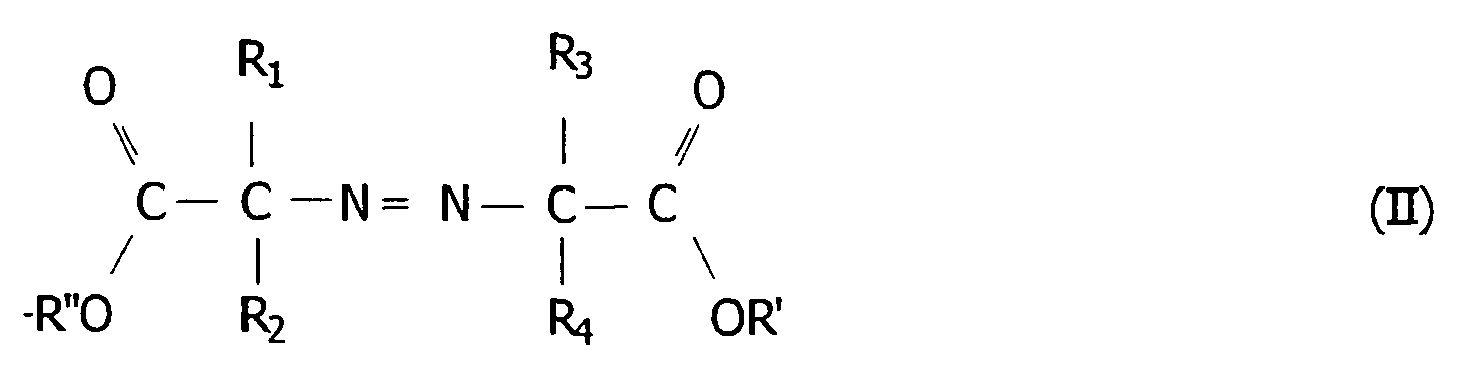
- R1, R2, R3 et R4, identiques ou différents sont sélectionnés indépendamment dans le groupe consistant en -alkyles linéaires ou ramifiés ayant de 1 à 9 atomes de carbone, de préférence de 1 à 4 atomes de carbone, éventuellement substitués par un ou plusieurs substituants sélectionnés parmi les substituants hydroxyl, alkoxy en C1 à C6, halogène ; - cycloalkyles en C3 à C12, éventuellement substitués par un ou plusieurs substituants sélectionnés parmi les groupes alkyle en C1 à C6, alkoxy en C1 à C6, hydroxy et halogéné ;
- aralkyles éventuellement substitués par un ou plusieurs groupes alkyle en C1 à C6, alkoxy en C1 à C6, hydroxy et halogéné ;
- aryles éventuellement substitués par un ou plusieurs substituants sélectionnés parmi les groupes alkyle en C1 à C6, alkoxy en C1 à C6, hydroxy et halogéné ;
- L'avantage de ces esters d'acides azocarboxyliques est leur basse température de fusion, généralement inférieure à 27°C. Les esters d'acides azocarboxyliques préférés sont ceux dans lesquels R" et R' représentent le méthyle ou l'éthyle et dans lesquels R1, R2, R3 et R4 représentent avantageusement des groupes alkyles de C1 à C4.
- L'ester d'acide azocarboxylique particulièrement préféré est le diéthyl 2, 2'-azobisisobutyrate, c'est-à-dire avec R1, R2, R3, R4 représentant le méthyle et R' et R" représentant l'éthyle. Un mélange de diéthyl 2, 2'-azobisisobutyrate (DEAB) et de diméthyl 2,2'-azobisisobutyrate (DMAB) avec un taux massique en DEAB, de préférence supérieur à 50 % a donné des résultats très intéressants. Des mélanges de DEAB, DMAB et de méthyl2, éthyl 2'-azobisisobutyrate avec de préférence un rapport molaire COOMe/COOEt ≤ 10 peuvent convenir.
- Les esters d'acides azocarboxyliques de formule (II) peuvent être préparés par un procédé classique en deux étapes comprenant une première étape de conversion de l'azonitrile, par réaction avec un alcool, en présence de HCl, selon la réaction de Pinner, conduisant au chlorhydrate d'azoiminoéther correspondant et une seconde étape d'hydrolyse en présence du chlorhydrate ainsi obtenu. Ils peuvent être également préparés par les procédés améliorés tels que décrits dans les documents
DE 2 254 572 ,EP 80 275 EP 230 586 - En outre, ces esters peuvent être préparés par réaction d'un azonitrile avec un alcool et de l'acide chlorhydrique dans un solvant aromatique, avec un rapport molaire HCl/azonitrile > 2 lorsque l'alcool est le méthanol et > 3 lorsque l'alcool est l'éthanol ou un alcool supérieur.
- La quantité d'esters d'acides azocarboxyliques mise en jeu dans le procédé suivant la présente invention représente environ 0,1 à 6 % en poids du ou des monomère(s) éthylénique(s) insaturé(s) utilisé(s) et de préférence 0,5 à 4 % en poids.
- Les monomère éthyléniques insaturés pouvant être utilisés dans le procédé de l'invention sont, par exemple, le butadiène, l'isoprène, le 1,4-pentadiène, le 1,6-hexadiène, le 1,7-octadiène, le styrène, l'α-méthylstyrène, le 2,4-diméthylstyrène, l'éthylstyrène, l'isopropylstyrène, le butylstyrène, le phénylstyrène, le méthylstyrène, le cyclohexylstyrène, le benzylstyrène, etc. ; d'autres styrènes substitués comme le chlorostyrène, le 2,5-dichlorostyrène, le bromostyrène, le fluorostyrène, le trifluorométhylstyrène, l'iodostyrène, le cyanostyrène, le nitrostyrène, le N,N-diméthylaminostyrène, l'acétoxystyrène, le 4-vinylbenzoate de méthyle, le phénoxystyrène, le sulfure de p-vinylphényle et de phényle, l'oxyde de p-vinylphényle et de phényle, etc. ; les monomères acryliques et acryliques substitués, comme l'acrylonitrile, l'acide acrylique, l'acide méthacrylique, l'acrylate de méthyle, l'acrylate de 2-hydroxyéthyle, le méthacrylate de 2-hydroxyéthyle, le méthacrylate de méthyle, le méthacrylate de cyclohéxyle, le méthacrylate de benzoyle, le méthacrylate d'isopropyle, le méthacrylate d'octyle, le méthacrylonitrile, l'α-chloroacrylate de méthyle, l'α-éthoxyacrylate d'éthyle, l'α-acétaminocrylate de méthyle, l'acrylate de butyle, l'acrylate d'éthyle, l'acrylate de 2-éthylhéxyle, l'acrylate de phényle, le méthacrylate de phényle, l'α-chloroacrylonitrile, le N,N-diméthylacrylamide, le N,N-dibenzylacrylamide, le N-butylacrylamide, le méthacrylylformamide, etc. ; les esters vinyliques, les éthers vinyliques, les vinylcétones, etc., comme l'acétate de vinyle, le chloroacétate de vinyle, l'alcool vinylique, le butyrate de vinyle, l'acétate d'isopropényle, le formiate de vinyle, le chlorure de vinylidène, le méthoxyacétate de vinyle, le benzoate de vinyle, le chlorure de vinyle, l'iodure de vinyle, le vinyltoluène, le vinylnaphtalène, le bromure de vinyle, le fluorure de vinyle, le bromure de vinylidène, le 1-chloro-1-fluoroéthylène, le fluorure de vinylidène, l'éther méthylique de vinyle, l'éther éthylique de vinyle, les éthers propyliques de vinyle, les éthers butyliques de vinyle, l'éther 2-éthylhexylique de vinyle, l'éther phénylique de vinyle, l'éther 2-méthoxyéthylique de vinyle, le méthoxybutadiène, l'éther 2-butoxyéthylique de vinyle, le 3,4-dihydro-1,2-pyranne, l'éther 2-butoxy-2'-vinyloxyéthylique d'éthyle, l'éther 2-éthylmercaptoéthylique de vinyle, la vinylméthylcétone, la vinyléthylcétone, les vinylphosphonates tels que le vinylphosphonate de bis(β-chloroéthyle), la vinylphénylcétone, le sulfure de vinyle et d'éthyle, la sulfone de vinyle et d'éthyle, le N-méthyl-N-vinylacétamide, la N-vinylpyrrolidone, le vinylimidazole, le sulfure de divinyle, le sulfoxyde de divinyle, la sulfone de divinyle, le vinylsulfonate de sodium, le vinylsulfonate de méthyle, le N-vinylpyrrole, etc. ; le fumarate de diméthyle, le maléate de diméthyle, l'acide maléique, l'acide crotonique, l'acide fumarique, l'acide itaconique, l'itaconate de monométhyle, le méthacrylate de t-butylaminoéthyle, le méthacrylate de diméthylaminoéthyle, l'acrylate de glycidyle, l'alcool allylique, les monoesters de glycols et de l'acide itaconique, le dichlorobutadiène, la vinylpyridine, etc. La quantité de monomère(s) éthylénique(s) insaturé(s) pour la polymérisation est généralement de 5 à 80 % et de préférence de 10 à 50 % du poids du polyol.
- Les monomères éthyléniques insaturés préférés sont les monomères ou mélange de monomères miscibles dans le polyol. On peut citer notamment le styrène, les acryliques substitués ou non.
- Suivant l'invention, la température de polymérisation peut être comprise entre 60 et 140°C et de préférence comprise entre 70 et 120°C.
- Les polyols pouvant être utilisés dans la présente invention sont connus. Ils peuvent aussi bien être exempts d'insaturation éthylénique comme ceux décrits dans le brevet US réexaminé N° 28.715 qu'insaturés comme ceux décrits dans le brevet
US 3 652 659 et le brevet US réexaminé N° 29.014. - Les polyols exempts d'insaturation éthylénique sont souvent obtenus par condensation catalytique d'un oxyde d'alkylène ou d'un mélange d'oxydes d'alkylène simultanément ou successivement avec un composé organique comprenant au moins 2 atomes d'hydrogène actifs comme mentionné dans les brevets
US 1 922 451 ,US 3 190 927 etUS 3 346 557 . - Des polyols représentatifs sont notamment les polyesters polyhydroxylés, les polyalkylènepolyétherpolyols, les polyuréthannes à plusieurs radicaux hydroxyle terminaux, les polycaprolactonepolyesters à plusieurs radicaux hydroxyle terminaux, les composés phosphorés polyhydroxylés et les produits d'addition d'oxydes d'alkylène sur les polythioéthers polyhydroxylés, les polyacétals, les polyols et thiols aliphatiques, l'ammoniac et les amines, notamment les amines aromatiques, aliphatiques ou hétérocycliques, éventuellement en mélange. Les produits d'addition d'oxydes d'alkylène sur des composés comptant au nombre de deux ou davantage des radicaux différents des classes ci-dessus conviennent aussi, ainsi qu'il en est des amino-alcools comprenant un radical amino et un radical hydroxyle. Il est possible d'utiliser également les produits d'addition d'oxydes d'alkylène sur des composés contenant un radical thiol et un radical hydroxyle, de même que sur des composés contenant un radical amino et un radical thiol. En règle générale, le poids équivalents des polyols est de 100 à 20 000, et de préférence de 500 à 10 000 et encore mieux de 1 000 à 3 000.
- Tout polyester hydroxylé approprié convient, comme par exemple ceux issus d'acides polycarboxyliques et d'alcools polyhydroxylés. Il est possible d'utiliser tout acide polycarboxylique convenable, comme l'acide oxalique, l'acide malonique, l'acide succinique, l'acide glutarique, l'acide adipique, l'acide pimélique, l'acide subérique, l'acide azélaïque, l'acide sébacique, l'acide brassylique, l'acide thapsique, l'acide maléique, l'acide fumarique, l'acide glutaconique, l'acide α-hydromuconique, l'acide β-hydromuconique, l'acide α-butyl-α-éthylglutarique, l'acide α-β-diéthylsuccinique, l'acide isophtalique, l'acide téréphtalique, l'acide hémimellitique et l'acide 1,4-cyclohexanedicarboxylique. Il est possible d'utiliser tout alcool polyhydroxylé convenable tant de caractère aliphatique que de caractère aromatique, comme l'éthylèneglycol, le 1,3-propylèneglycol, 1,2-propylèneglycol, le 1,4-butylèneglycol, le 1,3-butylèneglycol, le 1,2-butylèneglycol, le 1,5-pentanediol, le 1,4-pentanediol, le 1,3-pentanediol, le 1,6-hexanediol, le 1,7 heptanediol, le glycérol, le 1,1,1-triméthylolpropane, le 1,1,1-triméthyloléthane, l'héxane-1,2,6-triol, l'α-méthylglucoside, le pentaérythritol et le sorbitol. Par "alcool polyhydroxylé", on entend également les composés dérivant du phénol, comme le 2,2-bis(4-hydroxyphényl)propane, appelé couramment Bisphénol A.
- Il est possible d'utiliser tout polyalkylène-polyéther-polyol approprié comme le produit de la polymérisation d'un oxyde d'alkylène ou d'un oxyde d'alkylène avec un alcool polyhydroxylé comptant 2 à 6 radicaux hydroxyle. Il est possible d'utiliser tout alcool polyhydroxylé tels que ceux mentionnés ci-dessus pour la préparation des polyesters hydroxylés. Tout oxyde d'alkylène convenable peut être utilisé, comme il en est de l'oxyde d'éthylène, de l'oxyde de propylène, de l'oxyde de butylène, de l'oxyde d'amylène, outre des copolymères hétérogènes ou à blocs de ces oxydes. Les polyalkylènepolyétherpolyols peuvent être préparés à partir d'autres composés de départ tels que le tétrahydrofuranne et les copolymères d'oxydes d'alkylène sur le tétrahydrofuranne, les épihalohydrines, comme l'épichlorhydrine, et les oxydes d'aralkylène, comme l'oxyde de styrène. Les polyalkylènepolyétherpolyols peuvent comprendre des radicaux hydroxyle primaires ou secondaires et, de préférence, sont des polyéthers issus d'oxydes d'alkylène de 2 à 6 atomes de carbone tels que les polyoxyéthylèneglycols, les polyoxypropylèneglycols et les polyoxybutylèneglycols. Les polyalkylènes-polyétherpolyols peuvent être préparés par tout procédé connu, par exemple celui mentionné par Wurtz en 1859 et dans Encyclopedia of Chemical Technology, volume 7, pages 257 à 262, publiée chez Interscience Publishers inc. (1951) ou dans le brevet
US 1 922 459 . Les polyéthers préférés sont notamment les produits d'addition d'oxydes d'alkylène sur le triméthylolpropane, le glycérol, le pentaérythritol, le saccharose, le sorbitol, le propylèneglycol et le 2,2-(4,4'-hydroxyphényl)propane, outre leurs mélanges, ayant un poids équivalent de 100 à 5 000. - Des polythioéthers polyhydroxylés appropriés qui peuvent être condensés avec les oxydes d'alkylène sont notamment le produit de condensation du thiodiglycol ou le produit de réaction d'un alcool dihydroxylé, tel que l'un de ceux mentionnés ci-dessus pour la synthèse des polyesters hydroxylés, avec tout autre thioétherglycol approprié.
- Le polyester hydroxylé peut aussi être un polyesteramide tel qu'obtenu par addition d'une certaine quantité d'amine ou d'amino-alcool aux réactifs servant à la préparation de ce polyester. Ainsi, des polyesteramides peuvent êtres obtenus par condensation d'un amino-alcool tel que l'éthanolamine avec les acides polycarboxyliques mentionnés ci-dessus, ou bien ils peuvent être préparés à l'aide des mêmes réactifs que ceux formant le polyester hydroxylé, une partie seulement des réactifs étant formée par un diamine telle que l'éthylènediamine.
- Les composés phosphorés polyhydroxylés qui peuvent être utilisés sont notamment les composés mentionnés dans le brevet
US 3 639 542 . Les composés phosphorés polyhydroxylés préférés sont obtenus à partir d'oxydes d'alkylène et d'acides du phosphore ayant une équivalence en P2O5 d'environ 72 à 95 %. - Des polyacétals convenables qui peuvent être condensés avec des oxydes d'alkylène sont notamment les produits de la réaction du formaldéhyde ou d'un autre aldéhyde convenable avec un alcool dihydroxylé ou un oxyde d'alkylène tels que ceux mentionnés ci-dessus.
- Des thiols aliphatiques appropriés qui peuvent être condensés avec des oxydes d'alkylène sont notamment les alcanethiols comprenant au moins deux radicaux thiol tels que le 1,2-éthanedithiol, le 1,2-propanedithiol, le 1,3-propanedithiol et le 1,6-hexanedithiol, outre les alkènethiols, comme le 2-butène-1,4-dithiol et les alkynethiols, comme le 3-hexyne-1,6-dithiol.
- Des amines appropriées qui peuvent être condensées avec des oxydes d'alkylène sont notamment les amines aromatiques, comme l'aniline, l'o-chloroaniline, la p-aminoailine, le 1,5-diaminonaphtalène, la méthylènedianiline, les produits de condensation de l'aniline et du formaldéhyde et le 2,4-diaminotoluène, outre les amines aliphatiques, comme la méthylamine, la triisopropanolamine, l'éthylènediamine, la 1,3-propylènediamine, la 1,4-butylènediamine et la 1,3-butylènediamine.
- Les polyols contenant des groupements esters peuvent également convenir. Ces polyols sont préparés par réaction d'un oxyde d'alkylène avec un anhydride d'acide dicarboxylique et un composé contenant des atomes d'hydrogène actifs. On peut se reporter aux brevets
US 3 585 185 ,US 3 639 541 etUS 3 639 542 pour une description détaillée de la méthode de préparation. - Les polyols insaturés pouvant être utilisés dans la présente invention peuvent être préparés par réaction de tout polyol classique, tel que ceux définis précédemment, avec un composé organique comprenant à la fois au moins une insaturation éthylénique et un radical hydroxyle, carboxyle, époxyde ou anhydride. En variante, les polyols peuvent être préparés à partir d'un composé comprenant à la fois au moins une insaturation éthylénique et un radical hydroxyle, carboxyle, anhydride ou époxyde comme réactif intervenant dans la synthèse du polyol. Des exemples de tels composés organiques sont les acides et anhydrides polycarboxyliques insaturés, comme l'acide ou l'anhydride maléique, l'acide ou l'anhydride fumarique, l'acide ou l'anhydride crotonique, l'anhydride propénylsuccinique et les acides ou anhydrides maléiques halogénés, les alcools polyhydroxylés insaturés, comme le 2-butène-1,4-diol, l'éther allylique du glycérol, l'éther allylique du triméthylolpropane, l'éther allylique du pentaérythritol, l'éther vinylique du pentaérythritol, l'éther diallylique du pentaérythritol et le 1-butène-3,4-diol, outre les époxydes insaturés, comme le 3,4-époxyde du 1-vinylcyclohexane, le monoxyde de butadiène, l'éther glycidylique de vinyle ou 1-vinyloxy-2,3-époxypropane, le méthacrylate de glycidyle et l'oxyde de 3-allyloxypropylène ou éther glycidylique d'allyle. Lorsqu'un acide ou anhydride polycarboxylique sert à incorporer une insaturation dans les polyols, il est nécessaire de faire réagir le polyol insaturé avec un oxyde d'alkylène, qui est de préférence l'oxyde d'éthylène ou de propylène, pour remplacer les radicaux carboxyle par des radicaux hydroxyle avant l'utilisation conformément à l'invention. La quantité d'oxyde d'alkylène utilisée est de nature à abaisser l'indice d'acide du polyol insaturé à environ 1 au maximum.
- Pour la préparation de polyols insaturés utilisables dans le procédé suivant l'invention, la quantité de composé organique, rapportée à 1 mole de polyol, est d'environ 0,1 à 3,0 moles et de préférence de 0,30 à 1,5 moles.
- La préparation de polyols insaturés utilisés suivant l'invention est effectuée suivant les procédés classiques, tels que ceux décrits dans les brevets
US 3 275 606 etUS 3 280 077 . En règle générale, il est nécessaire que la température de réaction soit de 0 à 130°C. Les catalyseurs tant acides, comme les acides de Lewis, que basiques, comme les hydroxydes de métaux alcalins, peuvent convenir. De plus, une réaction sans catalyse peut être effectuée à une température de 50 à 200°C. - En outre, les polyols insaturés obtenus par la polymérisation radicalaire des diènes peuvent convenir. On peut citer notamment les polyols préparés en polymérisant le polybutadiène ou l'isoprène avec éventuellement un ou plusieurs monomère(s) éthyléniques insaturé(s) avec un amorceur radicalaire tel que par exemple le peroxyde d'hydrogène.
- Le procédé de l'invention peut être effectué en présence d'un agent de transfert de chaîne, notamment les alkylmercaptans avec le radical alkyle ayant de 1 à 20 atomes de carbone. La quantité d'agent de transfert de chaîne mise en jeu est généralement comprise entre 0 et 2 % en poids du ou des monomère(s) éthylénique(s) insaturé(s) à polymériser.
- Le procédé conforme à l'invention peut être mis en oeuvre en introduisant tous les réactifs dans un réacteur, lequel est ensuite porté à la température de polymérisation. Le procédé peut également être mis en oeuvre par apport simultané du ou des monomère(s) éthylénique(s) insaturé(s) et de l'ester d'acide azocarboxylique liquide au polyol à vitesse constante. Suivant un mode préféré du procédé, le réacteur contenant le polyol est d'abord mis sous azote, puis porté à la température de polymérisation et ensuite le ou les monomère(s) éthylénique(s) insaturé(s), éventuellement en mélange avec l'agent de transfert de chaîne, et l'ester d'acide azocarboxylique éventuellement en solution dans une fraction du polyol, sont introduits simultanément et à vitesse constante. Après la fin de l'introduction du ou des monomère(s), on porte le réacteur à la température de cuisson avec injection d'une fraction d'ester d'acide azocarboxylique afin de consommer les monomères résiduels. Pendant toute la durée des opérations le réacteur est sous balayage d'azote.
- Suivant une variante du procédé, l'ester d'acide azocarboxylique peut être introduit en semi-continu tout au long de la polymérisation.
- Outre l'avantage d'être liquide à une température comprise entre -20 et 27°C, les esters d'acides carboxyliques utilisés sont extrêmement solubles dans les polyols et autres milieux organiques. De plus, ils ne génèrent ni des sous produits toxiques, ni même des composés cyanés.
- Les dispersions de copolymères ainsi obtenues sont stables, transparentes et aptes à être utilisées dans la fabrication des polyuréthanes.
-
DEAB : Diéthyl 2,2'-azobisisobutyrate Arcol 1 000 P : Polyol de polyoxypropylène de Lyondell contenant 0,02 meq/g d'insaturation, d'indice d'OH 110 mg KOH/g Arcol polyol 1025 : polyol de polyoxypropylène de Lyondell contenant 50 meq/Kg d'insaturation, d'indice d'OH 28,5 mg KOH/g. PolyBd R20LM: Polybutadiène hydroxylé d'Elf Atochem d'indice d'OH 95mg KOH/g Poly Bd R45HT : polybutadiène hydroxylé d'Elf Atochem d'indice d'OH 47 mg KOH/g - Dans ce qui suit, sauf indication contraire, les quantités sont exprimées en parties en poids.
- Dans un réacteur équipé d'un thermomètre, d'une agitation, d'une source d'azote, on introduit 60 parties de Arcol 1 000 P. Le polyol est dégazé à l'azote pendant 30 minutes par bullage et est ensuite maintenu sous atmosphère d'azote tout au long de la réaction. Le contenu du réacteur est alors porté à 80°C. Un mélange constitué de 10 parties de styrène, 10 parties d'acrylonitrile et 0,04 partie de n-dodécylmercaptan est introduit dans le réacteur sur une durée de 3 heures parallèlement à une solution de 20 parties Arcol 1 000 P à laquelle est additionné 0,3 partie de DEAB. A la fin de la coulée des monomères, du polyol et de l'amorceur, on coule 0,04 partie de DEAB dans le réacteur, la température du milieu réactionnel est ensuite portée à 100°C et le milieu est maintenu à cette température pendant une heure. Le contenu du réacteur est alors refroidi et enfin vidangé.
- La composition ainsi obtenue est une dispersion de viscosité Brookfield à 25°C de 1 080 mPa.s et d'indice d'OH : 85 mg KOH/g.
- On opère comme décrit à l'exemple 1 sauf que l'Arcol 1 000 P est remplacé par la polyBd R20LM.
- La composition ainsi obtenue est une dispersion homogène transparente de viscosité Brookfield à 25°C de 3 050 mPa.s et d'indice d'OH: 75 mg KOH/g.
- Dans un réacteur équipé d'un thermomètre, d'une agitation, d'une source d'azote, on introduit 60 parties de polyBd R45HT. Le polyol est dégazé à l'azote pendant 30 minutes par bullage et est ensuite maintenu sous atmosphère d'azote tout au long de la réaction. Le contenu du réacteur est alors porté à 80°C. Un mélange constitué de 10 parties de styrène, 10 parties d'acrylonitrile et 0,04 partie de n-dodécylmercaptan est introduit dans le réacteur sur une durée de 3 heures parallèlement à une solution de 20 parties PolyBd R20LM à laquelle est additionné 0,4 partie de DEAB. A la fin de la coulée des monomères, du polyol et de l'amorceur, on coule 0,08 partie de DEAB dans le réacteur, la température du milieu réactionnel est augmentée à 100°C et le milieu est maintenu à cette température pendant une heure. Le contenu du réacteur est alors refroidi et vidangé.
- La composition ainsi obtenue est une dispersion homogène transparente de viscosité Brookfield à 25°C de 8 000 mPa.s et d'indice d'OH: 46 mg KOH/g.
- On opère comme décrit à l'exemple 2 sauf qu'un mélange constitué de 20 parties de méthacrylate de butyle et 0,04 partie de n-dodécyl mercaptan est introduit dans le réacteur sur une durée de 3 heures parallèlement à une solution de 20 parties de PolyBd R20LM auquel est additionné 0,4 partie de DEAB.
- La composition ainsi obtenue est une dispersion homogène transparente de viscosité Bookfield à 25°C de 7 300 mPa.s et d'indice d'OH = 75 mg KOH/g.
- On opère comme décrit à l'exemple 1 sauf que l'Arcol 1 000 P est remplacé par l'Arcol polyol 1 025 et que le mélange constitué de 6 parties de styrène et 14 parties d'acrylonitrile est introduit dans le réacteur sur une durée de trois heures parallèlement à une solution de 20 parties Arcol polyol 1 025 auquel est additionné 0,4 partie de DEAB.
- La composition ainsi obtenue est une dispersion stable de viscosité Brookfield à 25°C de 3 850 mPa.s et d'indice d'OH = 23 mg KOH/g
Claims (7)
- Procédé de préparation de dispersions stables de (co)polymères dans un polyol par polymérisation in situ d'un monomère ou d'un mélange de monomères éthylénique(s) insaturé(s) en présence d'un amorceur caractérisé en ce que l'amorceur est un ester d'acide azocarboxylique de formule (II) ou un mélange d'ester d'acides azocarboxyliques de formule (II).
 - aralkyles éventuellement substitués par un ou plusieurs groupes allyle an C1 à C6, alkoxy en C1 à C6, hydroxy et halogéné ;- aryles éventuellement substitués par un ou plusieurs substituants sélectionnés parmi ies groupes alkyle en C1 à C6, alkoxy en C1 à C6, hydroxy et halogéné ;avec au moins une des combinaisons R1-R2 et R3-R4 pouvant éventuellement former un cycle aliphatique ; R" et R' sont identiques ou différents l'un de l'autre et sont sélectionnés indépendamment dans le groupe consistant en radicaux aliphatiques linéaires ou ramifiés en C1 à C10, de préférence en C1 à C4.
 - Procédé selon la revendication 1 caractérisé en ce que les esters d'acides azocarboxyliques sont ceux dans lesquels R" et R' représentent le méthyle ou l'éthyle et dans lesquels R1, R2, R3 et R4 représentent un radical alkyle C1 à C4.
- Procédé selon la revendication 2 caractérisé en ce que R" et R' représentent le radical éthyle et R1, R2, R3 et R4 représentent un radical méthyle.
- Procédé selon la revendication 1 caractérisé en ce que l'amorceur est un mélange de diéthyl 2,2'-azobisisobutyrate (DEAB) et de méthyl 2, 2'-azobisisobutyrate (DMAB).
- Procédé selon l'une quelconque des revendications 1 à 4 caractérisé en ce que les monomères éthyléniques insaturés sont des monomères ou des mélanges de monomères miscibles dans le polyol.
- Procédé selon la revendication 1 caractérisé en ce que l'amorceur est un mélange de DEAB, DMAB et de méthyl 2, éthyl 2' azobisisobutyrate.
- Procédé selon l'une quelconque des revendications 1 à 6 caractérisé en ce que l'amorceur est introduit en semi-continu.
Applications Claiming Priority (3)
| Application Number | Priority Date | Filing Date | Title |
|---|---|---|---|
| FR9911834 | 1999-09-22 | ||
| FR9911834A FR2798660B1 (fr) | 1999-09-22 | 1999-09-22 | Procede de preparation des dispersions stables de (co) polymeres dans un polyol |
| PCT/FR2000/002401 WO2001021665A1 (fr) | 1999-09-22 | 2000-08-30 | Procede de preparation des dispersions stables de (co)polymeres dans un polyol |
Publications (2)
| Publication Number | Publication Date |
|---|---|
| EP1226181A1 EP1226181A1 (fr) | 2002-07-31 |
| EP1226181B1 true EP1226181B1 (fr) | 2007-12-12 |
Family
ID=9550117
Family Applications (1)
| Application Number | Title | Priority Date | Filing Date |
|---|---|---|---|
| EP00960760A Revoked EP1226181B1 (fr) | 1999-09-22 | 2000-08-30 | Procede de preparation des dispersions stables de (co)polymeres dans un polyol |
Country Status (9)
| Country | Link |
|---|---|
| US (1) | US6642306B1 (fr) |
| EP (1) | EP1226181B1 (fr) |
| JP (1) | JP3954384B2 (fr) |
| AT (1) | ATE380830T1 (fr) |
| AU (1) | AU7295600A (fr) |
| CA (1) | CA2385336C (fr) |
| DE (1) | DE60037446D1 (fr) |
| FR (1) | FR2798660B1 (fr) |
| WO (1) | WO2001021665A1 (fr) |
Families Citing this family (1)
| Publication number | Priority date | Publication date | Assignee | Title |
|---|---|---|---|---|
| US20110306728A1 (en) * | 2010-06-11 | 2011-12-15 | Bayer Materialscience Ag | Polymer polyols prepared from nitrile-free azo-initiators |
Family Cites Families (19)
| Publication number | Priority date | Publication date | Assignee | Title |
|---|---|---|---|---|
| US1922451A (en) | 1931-09-25 | 1933-08-15 | Laurence Selling | Thermostat |
| US2471959A (en) * | 1948-01-15 | 1949-05-31 | Du Pont | Polymerizations employing azo compounds as catalysts |
| US3190927A (en) | 1960-04-13 | 1965-06-22 | Wyandotte Chemicals Corp | Process for oxyalkylating solid polyols |
| US3275606A (en) | 1961-06-01 | 1966-09-27 | Hooker Chemical Corp | Compositions containing adducts of hexahalocyclopentadiene |
| US3280077A (en) | 1962-12-10 | 1966-10-18 | Leslie C Case | Resinous compositions comprising epoxy resins and polyester-ether copolymers having acidic end groups |
| USRE28715E (en) | 1964-08-12 | 1976-02-17 | Polyurethanes, reactive solutions and methods and their production | |
| US3346557A (en) | 1965-06-04 | 1967-10-10 | Wyandotte Chemicals Corp | Process for oxyalkylating solid polyols |
| US3639541A (en) | 1968-05-13 | 1972-02-01 | Basf Wyandotte Corp | Ester-containing polyols having halogen and phosphorus atoms |
| US3639542A (en) | 1968-05-13 | 1972-02-01 | Basf Wyandotte Corp | Ester-containing polyols having halogen and phosphorus atoms therein |
| US3585185A (en) | 1968-05-13 | 1971-06-15 | Wyandotte Chemicals Corp | Ester-containing polyols |
| US3652659A (en) | 1969-08-20 | 1972-03-28 | Borden Inc | Method for the manufacture of vinyl esters |
| GB1410359A (en) | 1972-11-17 | 1975-10-15 | Kralovopolska Strojirna | Process for regenerating waste rubber and apparatus for carrying out the process |
| USRE29014E (en) | 1972-12-04 | 1976-10-26 | Basf Wyandotte Corporation | Highly-stable graft copolymer dispersions in polyols containing unsaturation and polyurethanes prepared therefrom |
| US3875258A (en) | 1973-10-15 | 1975-04-01 | Basf Wyandotte Corp | Graft copolymers |
| US3950317A (en) * | 1973-10-29 | 1976-04-13 | Basf Wyandotte Corporation | Process for the preparation of graft copolymer dispersions |
| US4258148A (en) | 1977-03-22 | 1981-03-24 | Olin Corporation | Graft copolymers from unsaturated monomers and azo di-ester polyols and polyurethanes prepared therefrom |
| US4161468A (en) * | 1977-10-27 | 1979-07-17 | Basf Wyandotte Corporation | Process for the preparation of graft polymer dispersions employing liquid free radical catalysts |
| EP0080275A1 (fr) | 1981-11-19 | 1983-06-01 | Imperial Chemical Industries Plc | Préparation d'azoiminoéther hydrochlorides à partir d'azonitriles et leur hydrolyse en esters azocarboxyliques |
| JPH0625100B2 (ja) | 1986-01-14 | 1994-04-06 | 和光純薬工業株式会社 | アゾイミノエ−テルの製造法 |
-
1999
- 1999-09-22 FR FR9911834A patent/FR2798660B1/fr not_active Expired - Fee Related
-
2000
- 2000-08-30 US US10/088,861 patent/US6642306B1/en not_active Expired - Fee Related
- 2000-08-30 EP EP00960760A patent/EP1226181B1/fr not_active Revoked
- 2000-08-30 AT AT00960760T patent/ATE380830T1/de not_active IP Right Cessation
- 2000-08-30 AU AU72956/00A patent/AU7295600A/en not_active Abandoned
- 2000-08-30 DE DE60037446T patent/DE60037446D1/de not_active Expired - Lifetime
- 2000-08-30 CA CA002385336A patent/CA2385336C/fr not_active Expired - Fee Related
- 2000-08-30 JP JP2001525238A patent/JP3954384B2/ja not_active Expired - Fee Related
- 2000-08-30 WO PCT/FR2000/002401 patent/WO2001021665A1/fr not_active Ceased
Also Published As
| Publication number | Publication date |
|---|---|
| FR2798660B1 (fr) | 2001-11-16 |
| FR2798660A1 (fr) | 2001-03-23 |
| EP1226181A1 (fr) | 2002-07-31 |
| CA2385336A1 (fr) | 2001-03-29 |
| WO2001021665A1 (fr) | 2001-03-29 |
| JP2003510379A (ja) | 2003-03-18 |
| DE60037446D1 (de) | 2008-01-24 |
| US6642306B1 (en) | 2003-11-04 |
| JP3954384B2 (ja) | 2007-08-08 |
| CA2385336C (fr) | 2009-07-07 |
| AU7295600A (en) | 2001-04-24 |
| ATE380830T1 (de) | 2007-12-15 |
Similar Documents
| Publication | Publication Date | Title |
|---|---|---|
| CN1142956C (zh) | 利用叔戊基过氧化自由基引发剂制备接枝多元醇的方法 | |
| EP0221412B1 (fr) | Préparation de dispersions de polymères greffés et mousse de polyuréthane retardateur de flamme | |
| JP3660687B2 (ja) | 末端不飽和オリゴマーの合成 | |
| JPS61246231A (ja) | 流体ポリマー/ポリオール分散体 | |
| JPS6365683B2 (fr) | ||
| JP2007077396A5 (fr) | ||
| EP0001789B1 (fr) | Procédé de préparation de dispersions de polymérisats greffés en utilisant des catalyseurs liquides à radicaux libres | |
| JP2801929B2 (ja) | ポリオールポリアクリレート分散剤 | |
| EP0370547B1 (fr) | Copolymères préstabilisants et stabilisants greffés, leur préparation, procédé d'obtention de dispersions de polymères-polyols et procédé d'obtention de mousses de polyuréthanne | |
| EP0664306A2 (fr) | Dispersions à base de polymères greffés contenant un troisième monomère et mousses de polyuréthane ayant une tendance réduite à la rétractilité ainsi préparées | |
| CA2385336C (fr) | Procede de preparation des dispersions stables de (co)polymeres dans un polyol | |
| CN110437398B (zh) | 一种连续分散聚合工艺制备聚合物聚醚多元醇的方法 | |
| US4321342A (en) | Curable fixtures of polyepoxides and amine-terminated graft polymer dispersions | |
| US4837247A (en) | Stable polymer polyols in base polyols with molecular weight greater than 4000 using high molecular weight dispersants | |
| JP2011195823A (ja) | アクリル変性(水素添加)ポリブタジエンの製造方法 | |
| US5225481A (en) | Polyol polyacrylate dispersants | |
| US7884229B2 (en) | Method for making a polyether monomer | |
| EP0591025B1 (fr) | Procédé de préparation de copolymères glutarimides et composés intermédiaires utiles | |
| US20050239968A1 (en) | Process for preparing graft polyols using enol ethers as reaction moderators | |
| US7169867B2 (en) | Catalyst for bulk polymerization | |
| JPH06107595A (ja) | ラクトンから誘導した反応性単量体を含む組成物の製造方法 | |
| EP0507036A1 (fr) | Polymères à fonctions disulfure de thiurame pendantes, leur fabrication, et leur application à la fabrication de copolymères greffés | |
| FR3121684A1 (fr) | Composition comprenant au moins un peroxyde aromatique et au moins du peroxyde d'hydrogène | |
| JP2002069431A (ja) | 各末端に水酸基を有するシーリング材用ポリオール組成物 | |
| JPH0371421B2 (fr) |
Legal Events
| Date | Code | Title | Description |
|---|---|---|---|
| PUAI | Public reference made under article 153(3) epc to a published international application that has entered the european phase |
Free format text: ORIGINAL CODE: 0009012 |
|
| 17P | Request for examination filed |
Effective date: 20020305 |
|
| AK | Designated contracting states |
Kind code of ref document: A1 Designated state(s): AT BE CH CY DE DK ES FI FR GB GR IE IT LI LU MC NL PT SE |
|
| AX | Request for extension of the european patent |
Free format text: AL;LT;LV;MK;RO;SI |
|
| RAP1 | Party data changed (applicant data changed or rights of an application transferred) |
Owner name: ARKEMA |
|
| 17Q | First examination report despatched |
Effective date: 20050121 |
|
| RAP1 | Party data changed (applicant data changed or rights of an application transferred) |
Owner name: ARKEMA FRANCE |
|
| GRAP | Despatch of communication of intention to grant a patent |
Free format text: ORIGINAL CODE: EPIDOSNIGR1 |
|
| RAP1 | Party data changed (applicant data changed or rights of an application transferred) |
Owner name: ARKEMA FRANCE |
|
| GRAS | Grant fee paid |
Free format text: ORIGINAL CODE: EPIDOSNIGR3 |
|
| GRAA | (expected) grant |
Free format text: ORIGINAL CODE: 0009210 |
|
| AK | Designated contracting states |
Kind code of ref document: B1 Designated state(s): AT BE CH CY DE DK ES FI FR GB GR IE IT LI LU MC NL PT SE |
|
| REG | Reference to a national code |
Ref country code: GB Ref legal event code: FG4D Free format text: NOT ENGLISH |
|
| REG | Reference to a national code |
Ref country code: CH Ref legal event code: EP |
|
| REG | Reference to a national code |
Ref country code: IE Ref legal event code: FG4D Free format text: LANGUAGE OF EP DOCUMENT: FRENCH |
|
| REF | Corresponds to: |
Ref document number: 60037446 Country of ref document: DE Date of ref document: 20080124 Kind code of ref document: P |
|
| PG25 | Lapsed in a contracting state [announced via postgrant information from national office to epo] |
Ref country code: SE Free format text: LAPSE BECAUSE OF FAILURE TO SUBMIT A TRANSLATION OF THE DESCRIPTION OR TO PAY THE FEE WITHIN THE PRESCRIBED TIME-LIMIT Effective date: 20080312 |
|
| PG25 | Lapsed in a contracting state [announced via postgrant information from national office to epo] |
Ref country code: NL Free format text: LAPSE BECAUSE OF FAILURE TO SUBMIT A TRANSLATION OF THE DESCRIPTION OR TO PAY THE FEE WITHIN THE PRESCRIBED TIME-LIMIT Effective date: 20071212 Ref country code: FI Free format text: LAPSE BECAUSE OF FAILURE TO SUBMIT A TRANSLATION OF THE DESCRIPTION OR TO PAY THE FEE WITHIN THE PRESCRIBED TIME-LIMIT Effective date: 20071212 |
|
| NLV1 | Nl: lapsed or annulled due to failure to fulfill the requirements of art. 29p and 29m of the patents act | ||
| PG25 | Lapsed in a contracting state [announced via postgrant information from national office to epo] |
Ref country code: AT Free format text: LAPSE BECAUSE OF FAILURE TO SUBMIT A TRANSLATION OF THE DESCRIPTION OR TO PAY THE FEE WITHIN THE PRESCRIBED TIME-LIMIT Effective date: 20071212 |
|
| GBV | Gb: ep patent (uk) treated as always having been void in accordance with gb section 77(7)/1977 [no translation filed] | ||
| PG25 | Lapsed in a contracting state [announced via postgrant information from national office to epo] |
Ref country code: ES Free format text: LAPSE BECAUSE OF FAILURE TO SUBMIT A TRANSLATION OF THE DESCRIPTION OR TO PAY THE FEE WITHIN THE PRESCRIBED TIME-LIMIT Effective date: 20080323 |
|
| PLBI | Opposition filed |
Free format text: ORIGINAL CODE: 0009260 |
|
| PG25 | Lapsed in a contracting state [announced via postgrant information from national office to epo] |
Ref country code: PT Free format text: LAPSE BECAUSE OF FAILURE TO SUBMIT A TRANSLATION OF THE DESCRIPTION OR TO PAY THE FEE WITHIN THE PRESCRIBED TIME-LIMIT Effective date: 20080512 |
|
| REG | Reference to a national code |
Ref country code: IE Ref legal event code: FD4D |
|
| 26 | Opposition filed |
Opponent name: BASF SE Effective date: 20080910 |
|
| PLAX | Notice of opposition and request to file observation + time limit sent |
Free format text: ORIGINAL CODE: EPIDOSNOBS2 |
|
| PG25 | Lapsed in a contracting state [announced via postgrant information from national office to epo] |
Ref country code: IE Free format text: LAPSE BECAUSE OF FAILURE TO SUBMIT A TRANSLATION OF THE DESCRIPTION OR TO PAY THE FEE WITHIN THE PRESCRIBED TIME-LIMIT Effective date: 20071212 Ref country code: DE Free format text: LAPSE BECAUSE OF FAILURE TO SUBMIT A TRANSLATION OF THE DESCRIPTION OR TO PAY THE FEE WITHIN THE PRESCRIBED TIME-LIMIT Effective date: 20080313 Ref country code: DK Free format text: LAPSE BECAUSE OF FAILURE TO SUBMIT A TRANSLATION OF THE DESCRIPTION OR TO PAY THE FEE WITHIN THE PRESCRIBED TIME-LIMIT Effective date: 20071212 |
|
| PG25 | Lapsed in a contracting state [announced via postgrant information from national office to epo] |
Ref country code: GB Free format text: LAPSE BECAUSE OF FAILURE TO SUBMIT A TRANSLATION OF THE DESCRIPTION OR TO PAY THE FEE WITHIN THE PRESCRIBED TIME-LIMIT Effective date: 20071212 |
|
| PG25 | Lapsed in a contracting state [announced via postgrant information from national office to epo] |
Ref country code: GR Free format text: LAPSE BECAUSE OF FAILURE TO SUBMIT A TRANSLATION OF THE DESCRIPTION OR TO PAY THE FEE WITHIN THE PRESCRIBED TIME-LIMIT Effective date: 20080313 |
|
| PG25 | Lapsed in a contracting state [announced via postgrant information from national office to epo] |
Ref country code: MC Free format text: LAPSE BECAUSE OF NON-PAYMENT OF DUE FEES Effective date: 20080831 |
|
| REG | Reference to a national code |
Ref country code: CH Ref legal event code: PL |
|
| REG | Reference to a national code |
Ref country code: FR Ref legal event code: ST Effective date: 20090430 |
|
| PG25 | Lapsed in a contracting state [announced via postgrant information from national office to epo] |
Ref country code: CH Free format text: LAPSE BECAUSE OF NON-PAYMENT OF DUE FEES Effective date: 20080831 Ref country code: LI Free format text: LAPSE BECAUSE OF NON-PAYMENT OF DUE FEES Effective date: 20080831 |
|
| PG25 | Lapsed in a contracting state [announced via postgrant information from national office to epo] |
Ref country code: CY Free format text: LAPSE BECAUSE OF FAILURE TO SUBMIT A TRANSLATION OF THE DESCRIPTION OR TO PAY THE FEE WITHIN THE PRESCRIBED TIME-LIMIT Effective date: 20071212 Ref country code: BE Free format text: LAPSE BECAUSE OF NON-PAYMENT OF DUE FEES Effective date: 20080831 |
|
| PG25 | Lapsed in a contracting state [announced via postgrant information from national office to epo] |
Ref country code: FR Free format text: LAPSE BECAUSE OF NON-PAYMENT OF DUE FEES Effective date: 20080901 |
|
| RDAF | Communication despatched that patent is revoked |
Free format text: ORIGINAL CODE: EPIDOSNREV1 |
|
| RDAG | Patent revoked |
Free format text: ORIGINAL CODE: 0009271 |
|
| STAA | Information on the status of an ep patent application or granted ep patent |
Free format text: STATUS: PATENT REVOKED |
|
| 27W | Patent revoked |
Effective date: 20091016 |
|
| PG25 | Lapsed in a contracting state [announced via postgrant information from national office to epo] |
Ref country code: LU Free format text: LAPSE BECAUSE OF NON-PAYMENT OF DUE FEES Effective date: 20080830 |
|
| PG25 | Lapsed in a contracting state [announced via postgrant information from national office to epo] |
Ref country code: IT Free format text: LAPSE BECAUSE OF NON-PAYMENT OF DUE FEES Effective date: 20080831 |