EP1225274A2 - Verfahren zum Behandeln einer Materialbahn und Kalander - Google Patents
Verfahren zum Behandeln einer Materialbahn und Kalander Download PDFInfo
- Publication number
- EP1225274A2 EP1225274A2 EP01129894A EP01129894A EP1225274A2 EP 1225274 A2 EP1225274 A2 EP 1225274A2 EP 01129894 A EP01129894 A EP 01129894A EP 01129894 A EP01129894 A EP 01129894A EP 1225274 A2 EP1225274 A2 EP 1225274A2
- Authority
- EP
- European Patent Office
- Prior art keywords
- material web
- rollers
- nip
- soft
- calender
- Prior art date
- Legal status (The legal status is an assumption and is not a legal conclusion. Google has not performed a legal analysis and makes no representation as to the accuracy of the status listed.)
- Granted
Links
Images
Classifications
-
- D—TEXTILES; PAPER
- D21—PAPER-MAKING; PRODUCTION OF CELLULOSE
- D21G—CALENDERS; ACCESSORIES FOR PAPER-MAKING MACHINES
- D21G1/00—Calenders; Smoothing apparatus
Definitions
- the invention relates to a method for treating a Material web in which the material web is divided by several soft nips guided in a roll stack and there is pressurized.
- the invention further relates to a calender with a roll stack of several Rollers that form several soft nips, one in which Material web can be pressurized.
- the invention is based on a paper web described as an example of a material web. she is however also applicable to other material webs.
- Paper webs are made through in the course of their manufacture Calender guided and there with pressure and if necessary also elevated temperature. With this satin finish on the one hand, the paper web is compressed, on the other hand you can have certain surface properties achieve, especially smoothness and shine.
- center roll are used, which with are covered with a plastic covering.
- this calender comes to an undesirable Vibration problems, a so-called barring phenomenon.
- This barring phenomenon is noticeable through strip-shaped markings on the elastic rollers, more specifically, their plastic coverings. This Markings shape when treating the paper web into the paper web. Once those markings are there visible, the paper web is considered a committee.
- the invention has for its object the barring appearance to diminish.
- This task is carried out in a method of the aforementioned Art solved in that the material web in front by smoothing the passage of the nips by slip-free through an additional nip, which is formed between two soft rollers.
- a Has roll stack which is formed from several rollers a variety of natural frequencies.
- the natural frequencies of the rollers are meant for themselves, like such as natural bending frequencies, but the natural vibrations, resulting from the vibrating roller masses on the spring and damper systems of the intermediate Plastic coverings result.
- a running calender generates excitation forces Frequencies arise from the multiples of the roller speeds put together. These excitation forces can arise from inhomogeneities, Anisotropies or geometry errors (out-of-roundness) be justified. Fluctuations in paper thickness can also occur the paper web running through the calender excite the roll stack. Strikes one of these excitation frequencies to a natural frequency, that is the answer Vibration system with increased vibrations. Because of the large number of possible pathogens and the variety of possible natural vibrations these resonance points are constructively practical cant handle. As a rule, the vibration system also so strongly damped and the excitation forces are so small that the resulting swinging movements are immediate are not distracting.
- the invention now assumes that one in the calender never incoming paper web before treatment completely free of fluctuations in basis weight or thickness is. In addition, a paper web is still very much rough. If you analyze the fluctuations on their frequencies there is usually a broadband Noise fixed, in which all frequencies are contained are. This is an excitation of one or more natural frequencies of the roller system through the paper web unavoidable. The calender reacts at these natural frequencies with an increased amplitude that initially, as already described above, is not disturbing. With over time, however, the increased amplitudes become apparent the plastic coverings, and so there is a Feedback in the vibration system.
- the two preferably drive the additional nip forming rollers. This makes it possible to wear out of these two rollers to decrease. The smaller the wear is, the longer the two can last additional nip-forming rollers can be used. In addition, the risk is kept low, that an additional one with these two rollers Imprint into the material web that causes barring performs.
- the material web is preferably treated on both Sides the same. So you use the on both sides of the Material web of the same rolls, i.e. Rolling with the same Diameter and same surface properties.
- the additional nip outside a plane in which the nips of the roll stack are arranged are. This increases the risk of vibrations from the calender itself to the rollers of the additional Transfer nips, kept small.
- the task is also through a calender of the beginning mentioned type solved, namely that outside an additional nip is provided for the roll stack, which is driven by two soft driven rollers with the same Surface properties is formed, which is a peripheral speed have that of speed corresponds to the continuous material web.
- the additional nip serves the material web vorzuglätten. By pre-smoothing it is achieved that less excitation frequencies and decreased Exciter amplitudes entered in the actual roll stack become. The material web is therefore slip-free passed through the nip so that the rollers holding this Form additional nip, not wear out.
- a path of the additional Nip is provided in a nip by one end roller is limited.
- This nip is the first Nip of the roll stack through which the material web passes. So you pre-smooth the material web before it is treated in one of the nips of the roll stack.
- the two are preferably the additional nip forming rollers laterally offset in the direction of web travel arranged to the roll stack. This has the advantage that there are no vibrations in the calender in the roll plane can reproduce on the reels that additional to those Form nip. A complete vibrational Decoupling between the roll stack and the two additional rollers will not be accessible. However, if the direction of vibration is not more the location of the additional nip can be sufficient damping is ensured.
- the two preferably have the additional nip forming rollers of the same diameter and the same Surface properties. This ensures that the web of material from both sides is treated equally or symmetrically. By the pre-smoothing in the additional nip will not be additional one-sided interference in the material web entered.
- both rollers with are driven by the same drive power. This again results in symmetrical relationships in the nip.
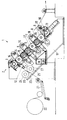
- the invention is based on a preferred Embodiment in connection with the drawing described in more detail. Herein shows the only Fig. a calender.
- a calender 1 has a roll stack of several, In the present case eight, rollers 3-10 on one Chair 11 are arranged.
- rollers 3-10 on one Chair 11 are arranged.
- the rollers 3, 5, 6, 8, 10 designed as “soft rollers", i.e. they have an elastic surface covering, preferably made of a plastic.
- the remaining Rollers 4, 7, 9 are designed as so-called “hard” rollers, i.e. the surface of these rollers 4, 7, 9 is made of a largely unyielding metal.
- the intermediate or middle rolls are known 4-9 mounted on levers 12. If the lower end roller 10, which is supported by a piston-cylinder drive 13 is lowered, then the rollers can separate from each other.
- the rollers 3-10 form nips 14-20 between them where the nips 14, 15 and 17-20 are designed as soft nips are, while the nip 16 is designed as an interchangeable nip is.
- the soft nips are of a soft Roller and a hard roller limited during the Alternating nip is limited by two soft rollers.
- a material web 21 in the present If a paper web, led by a Roll 22 is processed. But it is also possible that the material web 21 directly from a manufacturing machine, for example a paper machine.
- the roll stack 2 is at an angle of approximately 45 ° arranged to the vertical.
- the roll stack 2 can also be less or more than that have eight rollers shown. However, it should have at least four rollers, so that at least three nips can be formed.
- an additional nip 23rd provided, which is formed by two soft rollers 24, 25 is.
- the two soft rollers 24, 25 are the same built up, i.e. they have the same diameter and the same surface and are also otherwise constructive designed the same.
- the two rollers 24, 25 each have a drive 26, 27 are thus driven.
- the drive power is distributed symmetrically.
- the drive is such that the rollers 24, 25 have a peripheral speed have the speed of Material web 21 corresponds.
- the contact is between the material web 21 and the two rollers 24, 25 in the nip 23 completely slip-free, i.e. the contact zone has no gliding area.
- the entire contact zone forms a detention area. Because wear is only related arising with friction or relative movement can, such as in a calender where a running hard against a soft roller is the periodic one Wear due to a superimposed oscillating movement locked out.
- the material web 21 is passed through in the additional nip 23 the two soft rollers 24, 25 are leveled, i.e. a rough material web is pre-smoothed without the two Wear rollers 24, 25 themselves.
- a pre-smoothed Material web 21 are less as a result Excitation frequencies and lower excitation amplitudes in introduced the calender.
- the two are Rolls 24, 25 outside a press plane of the roll stack 2 arranged, i.e. the axes of the soft rollers 24, 25, which form the additional nip 23, lie not in the same plane as the axes of the rollers of the roll stack.
- the vibrations are particularly critical towards the press plane, i.e. the plane in arranged the axes of the rollers 3-10 of the roll stack 2 are spread out. If you look at the two rollers 24, 25 of the additional nip 23 from this direction of propagation takes out, you already have a basic one Decoupling from the vibrations in the roll stack 2 reached.
Landscapes
- Paper (AREA)
- Treatment Of Fiber Materials (AREA)
Abstract
Description
Claims (9)
- Verfahren zum Behandeln einer Materialbahn, bei dem die Materialbahn durch mehrere weiche Nips in einem Walzenstapel geführt und dort mit Druck beaufschlagt wird, dadurch gekennzeichnet, daß die Materialbahn vor dem Durchlaufen der Nips vorgeglättet wird, indem sie schlupffrei durch einen zusätzlichen Nip geführt wird, der zwischen zwei weichen Walzen ausgebildet ist.
- Verfahren nach Anspruch 1, dadurch gekennzeichnet, daß man die beiden den zusätzlichen Nip bildenden Walzen antreibt.
- Verfahren nach Anspruch 1 oder 2, dadurch gekennzeichnet, daß man die Materialbahn auf beiden Seiten gleich behandelt.
- Verfahren nach einem der Ansprüche 1 bis 3, dadurch gekennzeichnet, daß man den zusätzlichen Nip außerhalb einer Ebene anordnet, in der die Nips des Walzenstapels angeordnet sind.
- Kalander mit einem Walzenstapel aus mehreren Walzen, die mehrere weiche Nips bilden, in denen eine Materialbahn mit Druck beaufschlagbar ist, dadurch gekennzeichnet, daß außerhalb des Walzenstapels (2) ein zusätzlicher Nip vorgesehen ist, der durch zwei weiche angetriebene Walzen (24, 25) mit gleichen Oberflächeneigenschaften gebildet ist, die eine Umfangsgeschwindigkeit aufweisen, die der Geschwindigkeit der durchlaufenden Materialbahn (21) entspricht.
- Kalander nach Anspruch 5, dadurch gekennzeichnet, daß ein Bahnverlauf von dem zusätzlichen Nip (23) in einen Nip (14) vorgesehen ist, der durch eine Endwalze (3) begrenzt ist.
- Kalander nach Anspruch 5 oder 6, dadurch gekennzeichnet, daß die beiden den zusätzlichen Nip (23) bildenden Walzen (24, 25) in Bahnlaufrichtung seitlich versetzt zum Walzenstapel (2) angeordnet sind.
- Kalander einem der Ansprüche 5 bis 7, dadurch gekennzeichnet, daß die beiden den zusätzlichen Nip (23) bildenden Walzen (24, 25) den gleichen Durchmesser aufweisen.
- Kalander nach Anspruch 8, dadurch gekennzeichnet, daß beide Walzen (24, 25) mit der gleichen Antriebsleistung angetrieben sind.
Applications Claiming Priority (2)
| Application Number | Priority Date | Filing Date | Title |
|---|---|---|---|
| DE2001101182 DE10101182C1 (de) | 2001-01-12 | 2001-01-12 | Verfahren zum Behandeln einer Materialbahn und Kalander |
| DE10101182 | 2001-01-12 |
Publications (3)
| Publication Number | Publication Date |
|---|---|
| EP1225274A2 true EP1225274A2 (de) | 2002-07-24 |
| EP1225274A3 EP1225274A3 (de) | 2003-02-12 |
| EP1225274B1 EP1225274B1 (de) | 2006-04-05 |
Family
ID=7670354
Family Applications (1)
| Application Number | Title | Priority Date | Filing Date |
|---|---|---|---|
| EP01129894A Revoked EP1225274B1 (de) | 2001-01-12 | 2001-12-15 | Verfahren zum Behandeln einer Materialbahn und Kalander |
Country Status (2)
| Country | Link |
|---|---|
| EP (1) | EP1225274B1 (de) |
| DE (2) | DE10101182C1 (de) |
Family Cites Families (6)
| Publication number | Priority date | Publication date | Assignee | Title |
|---|---|---|---|---|
| DE403823C (de) * | 1922-09-19 | 1924-10-06 | C G Haubold A G | Verfahren zum Glaetten von Papier |
| EP0374292B1 (de) * | 1988-12-22 | 1993-09-01 | Felix Schoeller jr. Papierfabrik GmbH & Co. KG | Vorrichtung und Verfahren zum Glätten und Kalibrieren von Papier, insbesondere von fotografischen Basispapieren |
| DE4011394C1 (de) * | 1990-04-09 | 1991-11-28 | Sulzer-Escher Wyss Gmbh, 7980 Ravensburg, De | |
| DE19508349C2 (de) * | 1995-03-09 | 2003-04-03 | Voith Paper Patent Gmbh | Kalander für die Behandlung einer Papierbahn und Verfahren zu dessen Betrieb |
| FI112965B (fi) * | 1999-11-05 | 2004-02-13 | Metso Paper Inc | Kalanterointisovitelma paperikonetta varten |
| FI4460U1 (fi) * | 2000-02-21 | 2000-06-02 | Valmet Corp | Kalanteri |
-
2001
- 2001-01-12 DE DE2001101182 patent/DE10101182C1/de not_active Revoked
- 2001-12-15 EP EP01129894A patent/EP1225274B1/de not_active Revoked
- 2001-12-15 DE DE50109429T patent/DE50109429D1/de not_active Revoked
Also Published As
| Publication number | Publication date |
|---|---|
| EP1225274A3 (de) | 2003-02-12 |
| DE10101182C1 (de) | 2002-01-24 |
| DE50109429D1 (de) | 2006-05-18 |
| EP1225274B1 (de) | 2006-04-05 |
Similar Documents
| Publication | Publication Date | Title |
|---|---|---|
| DE69413202T2 (de) | Verfahren zum kalandrieren einer papier- oder ähnlichen materialbahn und kalander zur durchführung des verfahrens | |
| DE102008024013B3 (de) | Verfahren und Vorrichtung zum Richten eines Metallbandes | |
| AT519598B1 (de) | Verfahren und Vorrichtung zum Auftragen von Stärke | |
| DE3815445C2 (de) | ||
| EP0451449A1 (de) | Verfahren zum Glätten einer beidseitig gestrichenen Papier- oder Kartonbahn | |
| EP0779393B1 (de) | Kalander für die Behandlung einer Papierbahn und Anwendung dieses Kalanders | |
| EP0949378A1 (de) | Walzenmaschine und Verfahren zu ihrem Betrieb | |
| DE10202137B4 (de) | Zweisiebformer | |
| EP1275774B1 (de) | Verfahren zum Betreiben eines Kalanders und Kalander | |
| EP1205599A2 (de) | Maschine zur Herstellung einer Faserstoffbahn | |
| DE10133891C1 (de) | Kalander und Verfahren zum Anordnen von Walzen in einem Walzenstapel eines Kalanders | |
| EP1225274B1 (de) | Verfahren zum Behandeln einer Materialbahn und Kalander | |
| EP1275777B1 (de) | Verfahren zum Betreiben eines Kalanders | |
| DE102005060379A1 (de) | Vorrichutng und Verfahren zur Behandlung einer Faserstoffbahn, insbesondere zur Herstellung einer Tissuepapierbahn | |
| EP1275775B1 (de) | Verfahren zum Betreiben eines Kalanders | |
| DE10317676B3 (de) | Verfahren zum Satinieren einer Papier- oder Kartonbahn | |
| WO2025067861A1 (de) | Walzenanordnung für eine stauchung einer faserstoffbahn | |
| DE19940897C1 (de) | Kalander | |
| EP1318237B1 (de) | Verfahren und Kalander zum Satinieren einer Papier- oder Kartonbahn | |
| DE19840023A1 (de) | Pressenanordnung | |
| DE19645408B4 (de) | Verfahren zur Herstellung einer Faserstoffbahn | |
| DE10393245T5 (de) | Verfahren zur Bildung von Zellstoff mit hoher Konsistenz in einer Papier- oder Kartonmaschine und entsprechender Former für Zellstoff mit hoher Konsistenz einer Papier- oder Kartonmaschine | |
| DE102007047904A1 (de) | Walzenanordnung einer Faserstoffbahn-Behandlungsmaschine | |
| DE10157692A1 (de) | Verfahren und Kalander zum Glätten einer Faserstoffbahn | |
| DE112004000370T5 (de) | Verfahren zur Behandlung einer Faserbahn |
Legal Events
| Date | Code | Title | Description |
|---|---|---|---|
| PUAI | Public reference made under article 153(3) epc to a published international application that has entered the european phase |
Free format text: ORIGINAL CODE: 0009012 |
|
| AK | Designated contracting states |
Kind code of ref document: A2 Designated state(s): AT BE CH CY DE DK ES FI FR GB GR IE IT LI LU MC NL PT SE TR |
|
| AX | Request for extension of the european patent |
Free format text: AL;LT;LV;MK;RO;SI |
|
| PUAL | Search report despatched |
Free format text: ORIGINAL CODE: 0009013 |
|
| AK | Designated contracting states |
Designated state(s): AT BE CH CY DE DK ES FI FR GB GR IE IT LI LU MC NL PT SE TR |
|
| AX | Request for extension of the european patent |
Extension state: AL LT LV MK RO SI |
|
| 17P | Request for examination filed |
Effective date: 20030111 |
|
| AKX | Designation fees paid |
Designated state(s): DE FI SE |
|
| GRAP | Despatch of communication of intention to grant a patent |
Free format text: ORIGINAL CODE: EPIDOSNIGR1 |
|
| GRAS | Grant fee paid |
Free format text: ORIGINAL CODE: EPIDOSNIGR3 |
|
| GRAA | (expected) grant |
Free format text: ORIGINAL CODE: 0009210 |
|
| AK | Designated contracting states |
Kind code of ref document: B1 Designated state(s): DE FI SE |
|
| REF | Corresponds to: |
Ref document number: 50109429 Country of ref document: DE Date of ref document: 20060518 Kind code of ref document: P |
|
| REG | Reference to a national code |
Ref country code: SE Ref legal event code: TRGR |
|
| RAP2 | Party data changed (patent owner data changed or rights of a patent transferred) |
Owner name: VOITH PATENT GMBH |
|
| PLBI | Opposition filed |
Free format text: ORIGINAL CODE: 0009260 |
|
| PLAX | Notice of opposition and request to file observation + time limit sent |
Free format text: ORIGINAL CODE: EPIDOSNOBS2 |
|
| 26 | Opposition filed |
Opponent name: ANDRITZ KUESTERS GMBH & CO. KG Effective date: 20070104 |
|
| PLAF | Information modified related to communication of a notice of opposition and request to file observations + time limit |
Free format text: ORIGINAL CODE: EPIDOSCOBS2 |
|
| PLBB | Reply of patent proprietor to notice(s) of opposition received |
Free format text: ORIGINAL CODE: EPIDOSNOBS3 |
|
| PLAB | Opposition data, opponent's data or that of the opponent's representative modified |
Free format text: ORIGINAL CODE: 0009299OPPO |
|
| R26 | Opposition filed (corrected) |
Opponent name: ANDRITZ KUESTERS GMBH Effective date: 20070104 |
|
| PGFP | Annual fee paid to national office [announced via postgrant information from national office to epo] |
Ref country code: DE Payment date: 20071221 Year of fee payment: 7 |
|
| RDAF | Communication despatched that patent is revoked |
Free format text: ORIGINAL CODE: EPIDOSNREV1 |
|
| PGFP | Annual fee paid to national office [announced via postgrant information from national office to epo] |
Ref country code: FI Payment date: 20081215 Year of fee payment: 8 |
|
| PGFP | Annual fee paid to national office [announced via postgrant information from national office to epo] |
Ref country code: SE Payment date: 20081212 Year of fee payment: 8 |
|
| RDAG | Patent revoked |
Free format text: ORIGINAL CODE: 0009271 |
|
| STAA | Information on the status of an ep patent application or granted ep patent |
Free format text: STATUS: PATENT REVOKED |
|
| 27W | Patent revoked |
Effective date: 20081212 |
|
| REG | Reference to a national code |
Ref country code: SE Ref legal event code: ECNC |