EP1209217A2 - Brennstofföle mit verbesserter Schmierwirkung, enthaltend Umsetzungsprodukte aus Fettsäuren mit kurzkettigen öllöslichen Aminen - Google Patents
Brennstofföle mit verbesserter Schmierwirkung, enthaltend Umsetzungsprodukte aus Fettsäuren mit kurzkettigen öllöslichen Aminen Download PDFInfo
- Publication number
- EP1209217A2 EP1209217A2 EP01126253A EP01126253A EP1209217A2 EP 1209217 A2 EP1209217 A2 EP 1209217A2 EP 01126253 A EP01126253 A EP 01126253A EP 01126253 A EP01126253 A EP 01126253A EP 1209217 A2 EP1209217 A2 EP 1209217A2
- Authority
- EP
- European Patent Office
- Prior art keywords
- fuel oils
- carbon atoms
- reaction products
- alkyl
- amylamine
- Prior art date
- Legal status (The legal status is an assumption and is not a legal conclusion. Google has not performed a legal analysis and makes no representation as to the accuracy of the status listed.)
- Granted
Links
Classifications
-
- C—CHEMISTRY; METALLURGY
- C10—PETROLEUM, GAS OR COKE INDUSTRIES; TECHNICAL GASES CONTAINING CARBON MONOXIDE; FUELS; LUBRICANTS; PEAT
- C10L—FUELS NOT OTHERWISE PROVIDED FOR; NATURAL GAS; SYNTHETIC NATURAL GAS OBTAINED BY PROCESSES NOT COVERED BY SUBCLASSES C10G OR C10K; LIQUIFIED PETROLEUM GAS; USE OF ADDITIVES TO FUELS OR FIRES; FIRE-LIGHTERS
- C10L10/00—Use of additives to fuels or fires for particular purposes
- C10L10/08—Use of additives to fuels or fires for particular purposes for improving lubricity; for reducing wear
-
- C—CHEMISTRY; METALLURGY
- C10—PETROLEUM, GAS OR COKE INDUSTRIES; TECHNICAL GASES CONTAINING CARBON MONOXIDE; FUELS; LUBRICANTS; PEAT
- C10L—FUELS NOT OTHERWISE PROVIDED FOR; NATURAL GAS; SYNTHETIC NATURAL GAS OBTAINED BY PROCESSES NOT COVERED BY SUBCLASSES C10G OR C10K; LIQUIFIED PETROLEUM GAS; USE OF ADDITIVES TO FUELS OR FIRES; FIRE-LIGHTERS
- C10L1/00—Liquid carbonaceous fuels
- C10L1/10—Liquid carbonaceous fuels containing additives
- C10L1/14—Organic compounds
- C10L1/22—Organic compounds containing nitrogen
- C10L1/221—Organic compounds containing nitrogen compounds of uncertain formula; reaction products where mixtures of compounds are obtained
-
- C—CHEMISTRY; METALLURGY
- C10—PETROLEUM, GAS OR COKE INDUSTRIES; TECHNICAL GASES CONTAINING CARBON MONOXIDE; FUELS; LUBRICANTS; PEAT
- C10L—FUELS NOT OTHERWISE PROVIDED FOR; NATURAL GAS; SYNTHETIC NATURAL GAS OBTAINED BY PROCESSES NOT COVERED BY SUBCLASSES C10G OR C10K; LIQUIFIED PETROLEUM GAS; USE OF ADDITIVES TO FUELS OR FIRES; FIRE-LIGHTERS
- C10L1/00—Liquid carbonaceous fuels
- C10L1/10—Liquid carbonaceous fuels containing additives
- C10L1/14—Organic compounds
- C10L1/22—Organic compounds containing nitrogen
- C10L1/222—Organic compounds containing nitrogen containing at least one carbon-to-nitrogen single bond
- C10L1/2222—(cyclo)aliphatic amines; polyamines (no macromolecular substituent 30C); quaternair ammonium compounds; carbamates
Definitions
- the present invention relates to reaction products of fatty acids short-chain oil-soluble amines with good low-temperature stability and their use to improve the lubricating effect of middle distillate fuel oils.
- Mineral oils and mineral oil distillates used as fuel oils generally contain 0.5 wt .-% and more sulfur, when burning causes the formation of sulfur dioxide. To the resulting To reduce environmental pollution, the sulfur content of fuel oils lowered further and further.
- the diesel fuel standard EN 590 writes in Germany currently has a maximum sulfur content of 350 ppm. In Scandinavia already comes in with fuel oils with less than 50 ppm Exceptional cases with less than 10 ppm sulfur for use.
- This Fuel oils are usually made by taking those from petroleum Fractions obtained by distillation hydrogenated refined. In the Desulphurization also removes other substances that Give fuel oils a natural lubricating effect. About these substances include polyaromatic and polar compounds.
- WO-A-99/36489 discloses the use of mixtures of monomeric and polymeric fatty acids to improve the lubricating effect of low sulfur Middle distillates.
- EP-A-0 798 364 discloses salts and amides from mono- to tetracarboxylic acids with 2 up to 50 carbon atoms and aliphatic mono- / polyamines with 2 to 50 carbon atoms and 1 up to 10 N atoms as lubricity additives for low-sulfur diesel fuel.
- Preferred amines have 8-20 C atoms, e.g. Coconut fatty amine, tallow fatty amine and Oleylamine.
- WO-A-95/33805 discloses the use of cold flow improvers to improve the lubricating effect of low-sulfur middle distillates.
- Polar nitrogen-containing compounds which contain a group NR 13 , where R 13 is a hydrocarbon radical having 8 to 40 carbon atoms and which can be in the form of a cation, are also mentioned as suitable substances.
- WO-A-96/18706 in analogy to WO-A-95/33805, discloses the use of those therein mentioned nitrogenous compounds in combination with lubricity additives.
- WO-A-96/23855 in analogy to WO-A-95/33805, discloses the use of those therein mentioned nitrogenous compounds in combination with detergent additives.
- EP-A-0 926 221 discloses salts of C 6 -C 20 alkylphenols with primary or secondary aliphatic C 6 -C 50 monoamines to improve the lubricating effect of low-sulfur diesel fuel.
- WO-A-00/15739 discloses low sulfur diesel fuel with improved Lubricating action containing at least one dicarboxylic acid, at least one amine with straight-chain hydrocarbon residue, and optionally one Monocarboxylic acid. These can be physical mixtures as well Salts, amides and / or imides.
- the additive oils show improved Lubricity, storage stability and corrosion protection.
- the fatty acids used in the prior art, Fatty acid ammonium salts and fatty acid amides have the disadvantage that they are used in the Storage at low temperatures, i.e. often at room temperature, mostly solidify at temperatures of 0 ° C at the latest at -5 ° C, or that crystalline Separate shares and cause handling problems. This problem is too can only be partially dissolved by dilution with organic solvents, as it also consists of Crystals of these solutions crystallize or the solution gels and solidifies. she must therefore be greatly diluted or in for use as lubricity additives heated storage containers and metered via heated lines.
- the object underlying the present invention was to provide lubricity additives to find that improve the lubricating effect of middle distillates, however remain homogeneous, clear and in particular flowable even in the cold, and that Do not adversely affect the cold flow properties of the middle distillates.
- Another object of the invention is the use of the above Implementation products to improve the lubricating properties of low sulfur Middle distillates.
- Preferred fatty acids are those with 8 to 40 carbon atoms, in particular 12 to 22 carbon atoms. You can have one or more double bonds contained and be of natural or synthetic origin. Preferably includes Component A fatty acids that contain at least one double bond or Fatty acid mixtures in which at least 50% by weight, in particular at least 75%, especially at least 90% of the ingredients one or more Double bonds included. With polyunsaturated carboxylic acids whose double bonds can be isolated or conjugated. The proportion of saturated Fatty acids are preferably below 20%, in particular below 10%, especially below 5%.
- the alkyl residues of the fatty acids consist essentially of carbon and Hydrogen.
- Suitable fatty acids are for example laurin, tridecane, myristic, pentadecane, palmitin, margarine, Stearic, isostearic, arachic and behenic acid, oleic and erucic acid, palmitoleic, Myristoleic, linoleic, linolenic, elaeosteric and arachidonic acid, ricinoleic acid as well as fatty acid mixtures obtained from natural fats and oils, e.g.
- Preferred fatty acid (mixtures) have iodine numbers of at least 40 gJ / 100 g, preferably at least 80 gJ / 100 g, in particular at least 125 gJ / 100 g.
- dicarboxylic acids such as dimer fatty acids and alkyl and alkenylsuccinic acids with C 8 -C 50 alk (en) yl radicals, preferably with C 8 -C 40 , in particular with C 12 -C 22 alkyl radicals.
- the alkyl radicals can be linear or branched (oligomerized alkenes such as oligopropylene, polyisobutylene).
- the fatty acids can also contain 1-40%, especially 1-25%, resin acids.
- Suitable amines are primary, secondary and tertiary amines which carry at least one branched C 3 -C 18 alkyl radical, preferably C 4 -C 12 alkyl radical, in particular C 4 -C 8 alkyl radical.
- Branching here is understood to mean both a C chain branch (for example isoalkyl radicals and tert-alkyl radicals) and the binding of the amino group to a secondary or tertiary carbon atom.
- these are secondary and tertiary amines which carry at least two branched C 3 -C 18 alkyl radicals, preferably C 4 -C 12 alkyl radicals, in particular C 4 -C 8 alkyl radicals.
- the amines preferably contain at least 4, in particular at least 8, especially at least 10 carbon atoms.
- the branching of the alkyl radical is preferably a tertiary carbon atom. In a preferred embodiment, the branch contains the bond to nitrogen.
- Preferred branched alkyl radicals are the isopropyl, iso-butyl, tert-butyl, 3-methyl-butyl, amyl, 2-ethylhexyl radical and the various isomers of the iso-nonyl radical. Likewise suitable are not terminally substituted alkyl radicals such as. B.
- R 2 and R 3 are preferably hydrogen or lower alkyl having 1-4 C atoms, such as methyl, ethyl, propyl and butyl.
- Suitable amines are e.g. Isopropylamine, isobutylamine, 2-aminobutane, 3-methylbutylamine, 2-amylamine, 3-amylamine, tert-amylamine, 2-ethylhexylamine, Isononylamine, di-sec-butylamine, di-2-amylamine, di-3-amylamine, di-tert-amylamine, Di (2-ethylhexyl) amine, di-isononylamine and mixtures of several amines.
- the reaction of carboxylic acid and amine is preferably carried out by mixing both components at low temperatures to the ammonium salt.
- the reaction products can heat, provided that the amines used at most carry two alkyl radicals, with the elimination of water in amides or, if the Amines carry only one alkyl radical, are converted into imides.
- reaction products according to the invention are preferred between 0.1 and 1.2, preferably between 0.2 and 1.0 mol, in particular between 0.9 and 1.0 mol of amine used per mol of acid group.
- fatty acid salts are particularly preferred.
- it is partially neutralized or partially amidated fatty acids, i.e. Mixtures of fatty acids and their salts and / or amides. Amines greater than equimolar can are used, but have no advantages.
- the reaction products according to the invention are oils in amounts of 0.001 to 0.5 wt .-%, preferably 0.001 to 0.1 wt .-% added. You can do it as such or dissolved in solvents such as e.g. aliphatic and / or aromatic hydrocarbons or hydrocarbon mixtures such as e.g. Toluene, xylene, ethylbenzene, decane, pentadecane, gasoline fractions, kerosene or commercial solvent mixtures such as Solvent Naphtha, ® Shellsol AB, ® Solvesso 150, ® Solvesso 200, ® Exxsol, ® Isopar and ® Shellsol D types.
- solvents such as e.g. aliphatic and / or aromatic hydrocarbons or hydrocarbon mixtures such as e.g. Toluene, xylene, ethylbenzene, decane, pentadecane, gasoline fractions,
- the additives according to the invention preferably contain 1-80%, especially 10-70%, especially 25 - 60% solvent.
- the additives, even at low Temperatures of -40 ° C and below are easily used can improve the lubricity of the additive oils and their Corrosion protection properties.
- reaction products according to the invention also together with one or several oil-soluble co-additives can be used, which alone Cold flow properties and / or lubricating effect of crude oils, lubricating oils or Improve fuel oils.
- oil-soluble co-additives are those containing vinyl acetate Copolymers or terpolymers of ethylene, polar compounds, the one Effect paraffin dispersion (paraffin dispersants), comb polymers, Alkylphenol aldehyde resins and oil-soluble amphiphiles.
- the 10 to 40 wt .-% vinyl acetate and 60 contain up to 90 wt .-% ethylene.
- the reaction products according to the invention are mixed with Ethylene / vinyl acetate / neononanoic acid vinyl ester terpolymers or ethylene-vinyl acetate / Neodecanoic acid vinyl ester terpolymers to improve the Flowability of mineral oils or mineral oil distillates.
- the terpolymers of Besides contain neononanoic acid vinyl ester or the neodecanoic acid vinyl ester Ethylene 10 to 35 wt .-% vinyl acetate and 1 to 25 wt .-% of the respective Neo compound.
- other preferred copolymers contain up to 35 wt .-% vinyl esters still 0.5 to 20 wt .-% olefin such as diisobutylene, 4-methylpentene or norbornene.
- the mixing ratio of the invention Reaction products with the ethylene-vinyl acetate copolymers described above or the terpolymers of ethylene, vinyl acetate and Vinyl esters of neononanoic or neodecanoic acid are (in parts by weight) 20: 1 to 1:20, preferably 10: 1 to 1:10.
- Paraffin dispersants For use as a flow improver and / or lubricity additive, the reaction products according to the invention also together with Paraffin dispersants are used. Paraffin dispersants reduce that Size of the paraffin crystals and cause the paraffin particles to fail settle, but colloidally with significantly reduced sedimentation efforts, stay dispersed. Furthermore, they increase the lubricating effect of the additives according to the invention. Oil-soluble polar dispersants have been found as paraffin dispersants Compounds with ionic or polar groups, e.g.
- Amine salts and / or amides proven by the reaction of aliphatic or aromatic amines, preferably long-chain aliphatic amines, with aliphatic or aromatic mono-, di-, Tri- or tetracarboxylic acids or their anhydrides are obtained (cf. US 4,211,534).
- Other paraffin dispersants are copolymers of Maleic anhydride and ⁇ , ⁇ -unsaturated compounds, optionally with primary monoalkylamines and / or aliphatic alcohols are implemented can (cf. EP 0 154 177), the reaction products of alkenylspirobislactones with amines (cf.
- EP 0 413 279 B1 and reaction products according to EP 0 606 055 A2 terpolymers based on ⁇ , ⁇ -unsaturated dicarboxylic anhydrides, ⁇ , ⁇ -unsaturated compounds and polyoxyalkylene ethers of lower unsaturated ones Alcohols.
- Alkylphenol aldehyde resins are also suitable as paraffin dispersants.
- reaction products according to the invention can be used together with alkylphenol-formaldehyde resins.
- these alkylphenol-formaldehyde resins are those of the formula wherein R 6 is C 4 -C 50 alkyl or alkenyl, R 7 is ethoxy and / or propoxy, n is a number from 5 to 100 and p is a number from 0 to 50.
- reaction products according to the invention are used together with comb polymers.
- comb polymers This is understood to mean polymers in which hydrocarbon radicals having at least 8, in particular at least 10, carbon atoms are bonded to a polymer backbone. They are preferably homopolymers whose alkyl side chains contain at least 8 and in particular at least 10 carbon atoms. In copolymers, at least 20%, preferably at least 30%, of the monomers have side chains (cf. Comb-like Polymers-Structure and Properties; NA Platé and VP Shibaev, J. Polym. Sci. Macromolecular Revs. 1974, 8, 117 ff).
- Suitable comb polymers are, for example, fumarate / vinyl acetate copolymers (cf. EP 0 153 176 A1), copolymers of a C 6 -C 24 - ⁇ -olefin and an NC 6 -C 22 -alkylmaleimide (cf. EP 0 320 766) , also esterified olefin / maleic anhydride copolymers, polymers and copolymers of ⁇ -olefins and esterified copolymers of styrene and maleic anhydride.
- fumarate / vinyl acetate copolymers cf. EP 0 153 176 A1
- copolymers of a C 6 -C 24 - ⁇ -olefin and an NC 6 -C 22 -alkylmaleimide cf. EP 0 320 766
- esterified olefin / maleic anhydride copolymers polymers and copoly
- the mixing ratio (in parts by weight) of the invention Reaction products with paraffin dispersants, resins or comb polymers is in each case 1:10 to 20: 1, preferably 1: 1 to 10: 1.
- the reaction products according to the invention are suitable for the Lubricating properties of animal, vegetable, mineral or to improve synthetic fuel oils with only low dosing rates. About that they also improve the corrosion protection properties of the additive oils.
- the emulsifying properties of the additive oils less impaired than with the lubricating additives of the prior art Case is.
- the reaction products according to the invention are for use in Middle distillates are particularly suitable. Middle distillates are called especially those mineral oils that are obtained by distilling crude oil and boil in the range from 120 to 450 ° C, for example kerosene, jet fuel, diesel and heating oil.
- the oils can also contain alcohols such as methanol and / or ethanol or consist of these.
- the invention Reaction products used in such middle distillates that 0.05 wt .-% Sulfur and less, more preferably less than 350 ppm sulfur, in particular less than 200 ppm sulfur and in special cases less than Contain 50 ppm sulfur.
- These are generally such Middle distillates which have been subjected to hydrogenation refining and therefore only small amounts of polyaromatic and polar compounds contain, which give them a natural lubricating effect.
- the Reaction products according to the invention are further preferably in such middle distillates used, the 95% distillation points below 370 ° C, in particular 350 ° C and in special cases below 330 ° C. You can also can be used as components in lubricating oils.
- reaction products can be used alone or together with other additives be used, e.g. with other pour point depressors or Dewaxing aids, with corrosion inhibitors, antioxidants, Mud inhibitors, dehazers and additives to lower the cloud point.
- additives e.g. with other pour point depressors or Dewaxing aids, with corrosion inhibitors, antioxidants, Mud inhibitors, dehazers and additives to lower the cloud point.
- Additives (V comparison) additive A Oleic acid neutralized with di (2-ethylhexyl) amine B Tall oil fatty acid neutralized with di (2-ethylhexyl) amine C Tall oil fatty acid partially neutralized with 0.33 mol di (2-ethylhexyl) amine D Tall oil fatty acid partially neutralized with 0.1 mol di (2-ethylhexyl) amine e Tall oil fatty acid neutralized with 2-aminobutane F Tall oil fatty acid neutralized with 2-ethylhexylamine G Tall oil fatty acid neutralized with diamylamine H Tall oil fatty acid neutralized with di (sec-butylamine) I Tall oil fatty acid neutralized with N, N-dimethylbutylamine K (V) Oleic acid neutralized with tri-n-butylamine L (V) Oleic acid neutralized with oleylamine Eigenstock points of the additives example additive Pour point 1 A ⁇
- the determination of the own stock point (pour point) is carried out in accordance with ISO 3016 storage stability of the additives.
- the additives were stored at -25 ° C for three days and then assessed visually.
- the absence of cloudiness and precipitations shows the improved low-temperature properties of the additives according to the invention.
- the lubricating effect of the additives was determined using an HFRR device from PCS Instruments performed on additive oils at 60 ° C.
- the high frequency Reciprocating Rig Test (HFRR) is described in D. Wei, H. Spikes, Wear, Vol. 111, No. 2, p. 217, 1986.
- the results are as a coefficient of friction and wear Scar (WS 1.4) specified.
- a low coefficient of friction and a low wear Scar show a good lubricating effect.
- Test oil 1 Test oil 2 boiling range: 198-355 ° C 182 - 312 ° C Density: 0.832 g / cm 3 0.819 Cloud Point: -4 ° C -29 ° C sulfur content: 26 ppm 2.7 ppm
- the boiling data are determined in accordance with ASTM D-86 and the cloud point in accordance with ISO 3015.
- Wear Scar in Test Oil 1 100 ppm in test oil 1 example additive WS1.4 Friction 27 without 679 ⁇ m 0.40 28 100 ppm A 396 ⁇ m 0.20 29 100 ppm B 284 ⁇ m 0.16 30 100 ppm C. 302 ⁇ m 0.16 31 100 ppm D 332 ⁇ m 0.18 32 100 ppm E 381 ⁇ m 0.18 33 100 ppm F 395 ⁇ m 0.20 34 100 ppm G 374 ⁇ m 0.17 35 100 ppm H 367 ⁇ m 0.19 36 100 ppm I. 367 ⁇ m 0.19 37 (see) 100 ppm K.
Landscapes
- Chemical & Material Sciences (AREA)
- Oil, Petroleum & Natural Gas (AREA)
- Engineering & Computer Science (AREA)
- Organic Chemistry (AREA)
- Chemical Kinetics & Catalysis (AREA)
- General Chemical & Material Sciences (AREA)
- Combustion & Propulsion (AREA)
- Liquid Carbonaceous Fuels (AREA)
- Lubricants (AREA)
Abstract
Description

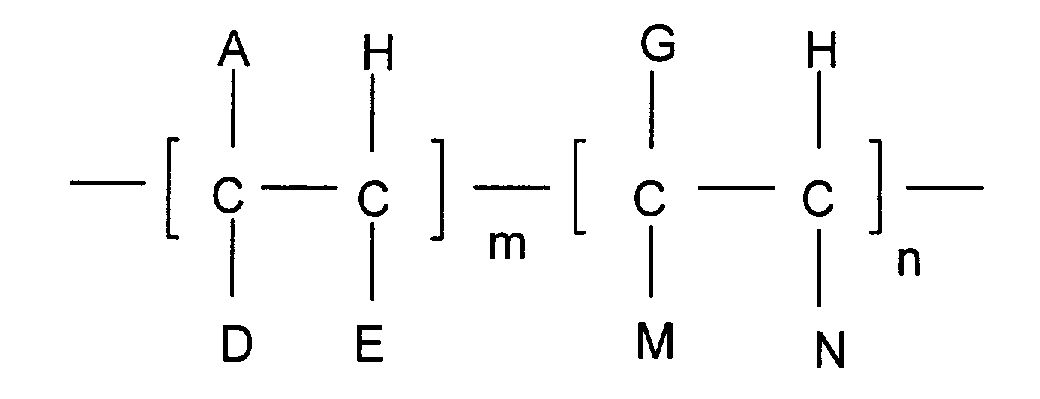
- A
- R', COOR', OCOR', R"-COOR' oder OR';
- D
- H, CH3, A oder R;
- E
- H oder A;
- G
- H, R", R"-COOR', einen Arylrest oder einen heterocyclischen Rest;
- M
- H, COOR", OCOR", OR" oder COOH;
- N
- H, R", COOR", OCOR, COOH oder einen Arylrest;
- R'
- eine Kohlenwasserstoffkette mit 8-150 Kohlenstoffatomen;
- R"
- eine Kohlenwasserstoffkette mit 1 bis 10 Kohlenstoffatomen;
- m
- eine Zahl zwischen 0,4 und 1,0; und
- n
- eine Zahl zwischen 0 und 0,6.
| Additive (V=Vergleich) | |
| Additiv | |
| A | Ölsäure neutralisiert mit Di(2-ethylhexyl)amin |
| B | Tallölfettsäure neutralisiert mit Di(2-ethylhexyl)amin |
| C | Tallölfettsäure teilneutralisiert mit 0,33 mol Di(2-ethylhexyl)amin |
| D | Tallölfettsäure teilneutralisiert mit 0,1 mol Di(2-ethylhexyl)amin |
| E | Tallölfettsäure neutralisiert mit 2-Aminobutan |
| F | Tallölfettsäure neutralisiert mit 2-Ethylhexylamin |
| G | Tallölfettsäure neutralisiert mit Diamylamin |
| H | Tallölfettsäure neutralisiert mit Di (sek.-Butylamin) |
| I | Tallölfettsäure neutralisiert mit N,N-Dimethylbutylamin |
| K (V) | Ölsäure neutralisiert mit Tri-n-butylamin |
| L (V) | Ölsäure neutralisiert mit Oleylamin |
| Eigenstockpunkte der Additive | ||
| Beispiel | Additiv | Pour Point |
| 1 | A | <-40°C |
| 2 | B | <-40°C |
| 3 | C | <-40°C |
| 4 | D | -21°C |
| 5 | E | <-40°C |
| 6 | F | <-40°C |
| 7 | G | <-40°C |
| 8 | H | <-40°C |
| 9 | I | <-40°C |
| 10 (Vergleich) | K | - 21°C |
| 11 (Vergleich) | L | + 21°C |
| 12 (Vergleich) | Tallölfettsäure | - 12°C |
| 13 (Vergleich) | Ölsäure | +6 °C |
Die Additive wurden über drei Tage bei -25°C gelagert und anschließend visuell beurteilt. Das Ausbleiben von Trübungen und Ausscheidungen zeigt die verbesserten Kälteeigenschaften der erfindungsgemäßen Additive.
| Lagerstabilität | ||
| Beispiel | Additiv | Beurteilung nach Lagerung |
| 14 | A | Klare viskose Flüssigkeit |
| 15 | B | Klare viskose Flüssigkeit |
| 16 | C | Klare viskose Flüssigkeit |
| 17 | D | Klare viskose Flüssigkeit |
| 18 | E | Klare viskose Flüssigkeit |
| 19 | F | Klare viskose Flüssigkeit |
| 20 | G | Klare viskose Flüssigkeit |
| 21 | H | Klare viskose Flüssigkeit |
| 22 | I | Klare viskose Flüssigkeit |
| 23 (Vergleich) | K | Kristallin, fest |
| 24 (Vergleich) | L | wachsartig, fest |
| 25 (Vergleich) | Tallölfettsäure | Kristallin, fest |
| 26 (Vergleich) | Ölsäure | Kristallin, fest |
| Eigenschaften der Testöle | ||
| Testöl 1 | Testöl 2 | |
| Siedebereich: | 198 - 355°C | 182 - 312°C |
| Dichte: | 0,832 g/cm3 | 0,819 |
| Cloud Point: | -4°C | -29°C |
| Schwefelgehalt: | 26 ppm | 2,7 ppm |
| Wear Scar in Testöl 1 | |||
| 100 ppm in Testöl 1 | |||
| Beispiel | Additiv | WS1.4 | Friction |
| 27 | ohne | 679 µm | 0,40 |
| 28 | 100 ppm A | 396 µm | 0,20 |
| 29 | 100 ppm B | 284 µm | 0,16 |
| 30 | 100 ppm C | 302 µm | 0,16 |
| 31 | 100 ppm D | 332 µm | 0,18 |
| 32 | 100 ppm E | 381 µm | 0,18 |
| 33 | 100 ppm F | 395 µm | 0,20 |
| 34 | 100 ppm G | 374 µm | 0,17 |
| 35 | 100 ppm H | 367 µm | 0,19 |
| 36 | 100 ppm I | 367 µm | 0,19 |
| 37 (Vgl.) | 100 ppm K | 346 µm | 0,18 |
| 38 (Vgl.) | 100 ppm L | 420 µm | 0,20 |
| 39 (Vgl.) | 100 ppm Tallölfettsäure | 433 µm | 0,21 |
| 40 (Vgl.) | 100 ppm Ölsäure | 443 µm | 0,21 |
| Wear Scar in Testöl 2 | |||
| 150 ppm in Testöl 2 | |||
| Beispiel | Additiv | WS 1.4 | Friction |
| 41 | ohne | 564 µm | 0,34 |
| 42 | B | 358 µm | 0,17 |
| 43 | D | 342 µm | 0,16 |
| 44 (Vgl.) | 100 ppm Tallölfettsäure | 394 µm | 0,19 |
| 45 (Vgl.) | 100 ppm Ölsäure | 405 µm | 0,21 |
Claims (11)
- Brennstofföle, enthaltend neben einem Mitteldestillat mit bis zu 0,05 Gew.-% Schwefelgehalt Umsetzungsprodukte ausA) Mono- oder Dicarbonsäuren mit 6 bis 50 Kohlenstoffatomen, undB) primären, sekundären oder tertiären Aminen der Formel
- Brennstofföle nach Anspruch 1, worin Bestandteil A eine Mono- oder Dicarbonsäure mit 12 bis 22 C-Atomen ist.
- Brennstofföle nach Anspruch 1 und/oder 2, worin Bestandteil A solche Carbonsäuren umfasst, die eine oder mehrere Doppelbindungen aufweisen.
- Brennstofföle nach einem oder mehreren der Ansprüche 1 bis 3, worin R1 für einen verzweigten C4-C12-Alkylrest steht.
- Brennstofföle nach einem oder mehreren der Ansprüche 1 bis 4, worin R2 und/oder R3 für verzweigte C4-C12-Alkylreste stehen.
- Brennstofföle nach einem oder mehreren der Ansprüche 1 bis 4, worin R2 und/oder R3 für Wasserstoff, Methyl, Ethyl, Propyl oder Butyl stehen.
- Brennstofföle nach einem oder mehreren der Ansprüche 1 bis 6, worin die Verzweigung des Alkylrests ein tertiäres C-Atom ist.
- Brennstofföle nach einem oder mehreren der Ansprüche 1 bis 7, worin die Verzweigung des Alkylrests die Bindung zum Stickstoff enthält.
- Brennstofföle nach einem oder mehreren der Ansprüche 1 bis 7, worin als Aminelsopropylamin, Isobutylamin, 2-Aminobutan, 3-Methyl-butylamin, 2-Amylamin, 3-Amylamin, tert.-Amylamin,, 2-Ethylhexylamin, Isononylamin, Di-sec.-butylamin, Di-2-Amylamin, Di-3-Amylamin, Di-tert-Amylamin,, Di(2-ethylhexyl)amin, Di-isononylamin sowie Mischungen daraus verwendet werden.
- Verwendung eines Umsetzungsprodukts ausA) Mono- oder Dicarbonsäuren mit 6 bis 50 Kohlenstoffatomen, undB) primären, sekundären oder tertiären Aminen der Formel
- Additive zur Verbesserung der Schmierfähigkeit von Mitteldestillaten mit bis zu 0,05 Gew.-% Schwefelgehalt, enthaltend Umsetzungsprodukte ausA) Mono- oder Dicarbonsäuren mit 6 bis 50 Kohlenstoffatomen, undB) primären, sekundären oder tertiären Aminen der Formel
Applications Claiming Priority (2)
| Application Number | Priority Date | Filing Date | Title |
|---|---|---|---|
| DE10058356A DE10058356B4 (de) | 2000-11-24 | 2000-11-24 | Brennstofföle mit verbesserter Schmierwirkung, enthaltend Umsetzungsprodukte aus Fettsäuren mit kurzkettigen öllöslichen Aminen |
| DE10058356 | 2000-11-24 |
Publications (3)
| Publication Number | Publication Date |
|---|---|
| EP1209217A2 true EP1209217A2 (de) | 2002-05-29 |
| EP1209217A3 EP1209217A3 (de) | 2003-07-09 |
| EP1209217B1 EP1209217B1 (de) | 2009-02-25 |
Family
ID=7664506
Family Applications (1)
| Application Number | Title | Priority Date | Filing Date |
|---|---|---|---|
| EP01126253A Expired - Lifetime EP1209217B1 (de) | 2000-11-24 | 2001-11-06 | Brennstofföle mit verbesserter Schmierwirkung, enthaltend Umsetzungsprodukte aus Fettsäuren mit kurzkettigen öllöslichen Aminen |
Country Status (5)
| Country | Link |
|---|---|
| US (1) | US6793696B2 (de) |
| EP (1) | EP1209217B1 (de) |
| JP (1) | JP2002167587A (de) |
| CA (1) | CA2352705A1 (de) |
| DE (2) | DE10058356B4 (de) |
Cited By (6)
| Publication number | Priority date | Publication date | Assignee | Title |
|---|---|---|---|---|
| EP1739154A2 (de) | 2005-06-27 | 2007-01-03 | Afton Chemical Corporation | Schmierfähigkeitsadditiv für Kraftstoffe |
| CN102277212A (zh) * | 2011-07-22 | 2011-12-14 | 中国石油化工股份有限公司 | 一种柴油添加剂 |
| CN103060028A (zh) * | 2011-10-21 | 2013-04-24 | 中国石油化工股份有限公司 | 一种含烷基乙二醇乙酸的柴油添加剂组合物及应用 |
| CN103060029A (zh) * | 2011-10-21 | 2013-04-24 | 中国石油化工股份有限公司 | 一种含烷基乙二醇乙酸多元醇酯的柴油添加剂组合物及应用 |
| CN103060030A (zh) * | 2011-10-21 | 2013-04-24 | 中国石油化工股份有限公司 | 一种含烷基乙二醇乙酰胺的柴油添加剂组合物及应用 |
| WO2023274335A1 (zh) | 2021-06-30 | 2023-01-05 | 中国石油化工股份有限公司 | 燃油润滑性改进剂组合物及其应用 |
Families Citing this family (17)
| Publication number | Priority date | Publication date | Assignee | Title |
|---|---|---|---|---|
| US7435272B2 (en) | 2002-04-24 | 2008-10-14 | Afton Chemical Intangibles | Friction modifier alkoxyamine salts of carboxylic acids as additives for fuel compositions and methods of use thereof |
| US7402185B2 (en) | 2002-04-24 | 2008-07-22 | Afton Chemical Intangibles, Llc | Additives for fuel compositions to reduce formation of combustion chamber deposits |
| US7846224B2 (en) | 2002-04-24 | 2010-12-07 | Afton Chemical Intangibles, Llc | Methods to improve the low temperature compatibility of amide friction modifiers in fuels and amide friction modifiers |
| US6866690B2 (en) * | 2002-04-24 | 2005-03-15 | Ethyl Corporation | Friction modifier additives for fuel compositions and methods of use thereof |
| US20050132641A1 (en) * | 2003-12-23 | 2005-06-23 | Mccallum Andrew J. | Fuel lubricity from blends of lubricity improvers and corrosion inhibitors or stability additives |
| US20060130394A1 (en) * | 2004-12-22 | 2006-06-22 | Flint Hills Resources, L.P. | Performance diesel fuels and additives |
| EP1770151A1 (de) * | 2005-09-30 | 2007-04-04 | Infineum International Limited | Zusatzkonzentrat |
| US8148306B2 (en) * | 2005-10-11 | 2012-04-03 | The Lubrizol Corporation | Product of amines with hydroxy acid as friction modifiers suitable for automatic transmission fluids |
| US20080060608A1 (en) * | 2006-09-07 | 2008-03-13 | Angela Priscilla Breakspear | Method and use for the prevention of fuel injector deposits |
| EP1942175B1 (de) * | 2006-12-13 | 2012-09-26 | Infineum International Limited | Additivzusammensetzung |
| US20080141582A1 (en) * | 2006-12-13 | 2008-06-19 | Angela Priscilla Breakspear | Additive Composition |
| EP2196520B1 (de) * | 2008-12-09 | 2011-01-19 | Infineum International Limited | Verfahren zur Verbesserung von Ölzusammensetzungen |
| CN102453558B (zh) * | 2010-10-27 | 2014-03-12 | 中国石油化工股份有限公司 | 一种低硫柴油润滑性添加剂组合物及其应用 |
| CN102453561B (zh) * | 2010-10-27 | 2014-05-28 | 中国石油化工股份有限公司 | 一种柴油添加剂及其在低硫柴油中的应用 |
| CN102229837A (zh) * | 2011-05-19 | 2011-11-02 | 赵志明 | 石化柴油用抗磨剂及其使用方法 |
| KR20150042831A (ko) | 2012-08-14 | 2015-04-21 | 바스프 에스이 | 비-시클릭 장애 아민을 포함하는 윤활제 조성물 |
| KR102759004B1 (ko) | 2018-11-07 | 2025-01-24 | 셰브런 유.에스.에이.인크. | 연료 효율 향상을 위한 첨가제로서의 아미노 알칸디올 및 카르복실산염 |
Family Cites Families (21)
| Publication number | Priority date | Publication date | Assignee | Title |
|---|---|---|---|---|
| DE1645886A1 (de) * | 1967-03-31 | 1971-06-16 | Aral Ag | Kraftstoffe fuer Ottomotoren |
| NL7713482A (nl) * | 1977-12-06 | 1979-06-08 | Beverolfabrieken | Werkwijze ter bereiding van een koolwaterstof- brandstof met smerende werking. |
| US4211534A (en) | 1978-05-25 | 1980-07-08 | Exxon Research & Engineering Co. | Combination of ethylene polymer, polymer having alkyl side chains, and nitrogen containing compound to improve cold flow properties of distillate fuel oils |
| DE3405843A1 (de) | 1984-02-17 | 1985-08-29 | Bayer Ag, 5090 Leverkusen | Copolymere auf basis von maleinsaeureanhydrid und (alpha), (beta)-ungesaettigten verbindungen, ein verfahren zu ihrer herstellung und ihre verwendung als paraffininhibitoren |
| DE3525124A1 (de) * | 1985-07-13 | 1987-01-15 | Huels Chemische Werke Ag | Kraftstoffe und heizoele und verwendung eines emulgatorsystems zur herstellung dieser kraftstoffe und heizoele |
| GB8706369D0 (en) * | 1987-03-18 | 1987-04-23 | Exxon Chemical Patents Inc | Crude oil |
| DE3742630A1 (de) | 1987-12-16 | 1989-06-29 | Hoechst Ag | Polymermischungen fuer die verbesserung der fliessfaehigkeit von mineraloeldestillaten in der kaelte |
| DE3926992A1 (de) | 1989-08-16 | 1991-02-21 | Hoechst Ag | Verwendung von umsetzungsprodukten von alkenylspirobislactonen und aminen als paraffindispergatoren |
| ATE158314T1 (de) | 1993-01-06 | 1997-10-15 | Hoechst Ag | Terpolymere auf basis von alpha,beta- ungesättigten dicarbonsäureanhydriden, alpha,beta-ungesättigten verbindungen und polyoxyalkylenethern von niederen, ungesättigten alkoholen |
| GB9411614D0 (en) * | 1994-06-09 | 1994-08-03 | Exxon Chemical Patents Inc | Fuel oil compositions |
| DE69517514T2 (de) | 1994-12-13 | 2000-11-02 | Infineum Usa L.P., Linden | Kraft öl zusammensetzungen |
| GB9502041D0 (en) | 1995-02-02 | 1995-03-22 | Exxon Chemical Patents Inc | Additives and fuel oil compositions |
| US5755834A (en) * | 1996-03-06 | 1998-05-26 | Exxon Chemical Patents Inc. | Low temperature enhanced distillate fuels |
| JPH09255973A (ja) * | 1996-03-25 | 1997-09-30 | Oronaito Japan Kk | 軽油添加剤及び軽油組成物 |
| DE19622052A1 (de) * | 1996-05-31 | 1997-12-04 | Basf Ag | Paraffindispergatoren für Erdölmitteldestillate |
| FR2751982B1 (fr) | 1996-07-31 | 2000-03-03 | Elf Antar France | Additif d'onctuosite pour carburant moteurs et composition de carburants |
| US5853436A (en) | 1997-12-22 | 1998-12-29 | Chevron Chemical Company Llc | Diesel fuel composition containing the salt of an alkyl hydroxyaromatic compound and an aliphatic amine |
| FR2772784B1 (fr) | 1997-12-24 | 2004-09-10 | Elf Antar France | Additif d'onctuosite pour carburant |
| CA2316219C (en) | 1998-01-13 | 2005-04-12 | Baker Hughes Incorporated | Composition and method to improve lubricity in fuels |
| US6051039A (en) | 1998-09-14 | 2000-04-18 | The Lubrizol Corporation | Diesel fuel compositions |
| NO308375B1 (no) | 1999-01-28 | 2000-09-04 | Cleanpipe As | Anordning for støtvis utspyling i et væskesystem |
-
2000
- 2000-11-24 DE DE10058356A patent/DE10058356B4/de not_active Expired - Fee Related
-
2001
- 2001-07-09 CA CA002352705A patent/CA2352705A1/en not_active Abandoned
- 2001-09-28 JP JP2001301433A patent/JP2002167587A/ja not_active Withdrawn
- 2001-11-06 EP EP01126253A patent/EP1209217B1/de not_active Expired - Lifetime
- 2001-11-06 DE DE50114727T patent/DE50114727D1/de not_active Expired - Lifetime
- 2001-11-09 US US10/035,522 patent/US6793696B2/en not_active Expired - Fee Related
Cited By (11)
| Publication number | Priority date | Publication date | Assignee | Title |
|---|---|---|---|---|
| EP1739154A2 (de) | 2005-06-27 | 2007-01-03 | Afton Chemical Corporation | Schmierfähigkeitsadditiv für Kraftstoffe |
| EP1739154A3 (de) * | 2005-06-27 | 2008-07-16 | Afton Chemical Corporation | Schmierfähigkeitsadditiv für Kraftstoffe |
| US8287608B2 (en) | 2005-06-27 | 2012-10-16 | Afton Chemical Corporation | Lubricity additive for fuels |
| CN102277212A (zh) * | 2011-07-22 | 2011-12-14 | 中国石油化工股份有限公司 | 一种柴油添加剂 |
| CN102277212B (zh) * | 2011-07-22 | 2013-08-14 | 中国石油化工股份有限公司 | 一种柴油添加剂 |
| CN103060028A (zh) * | 2011-10-21 | 2013-04-24 | 中国石油化工股份有限公司 | 一种含烷基乙二醇乙酸的柴油添加剂组合物及应用 |
| CN103060029A (zh) * | 2011-10-21 | 2013-04-24 | 中国石油化工股份有限公司 | 一种含烷基乙二醇乙酸多元醇酯的柴油添加剂组合物及应用 |
| CN103060030A (zh) * | 2011-10-21 | 2013-04-24 | 中国石油化工股份有限公司 | 一种含烷基乙二醇乙酰胺的柴油添加剂组合物及应用 |
| CN103060028B (zh) * | 2011-10-21 | 2015-03-18 | 中国石油化工股份有限公司 | 一种含烷基乙二醇乙酸的柴油添加剂组合物及应用 |
| WO2023274335A1 (zh) | 2021-06-30 | 2023-01-05 | 中国石油化工股份有限公司 | 燃油润滑性改进剂组合物及其应用 |
| US12365847B2 (en) | 2021-06-30 | 2025-07-22 | China Petroleum & Chemical Corporation | Lubricity improver composition for fuel oil and use thereof |
Also Published As
| Publication number | Publication date |
|---|---|
| EP1209217A3 (de) | 2003-07-09 |
| CA2352705A1 (en) | 2002-05-24 |
| JP2002167587A (ja) | 2002-06-11 |
| US20020095858A1 (en) | 2002-07-25 |
| US6793696B2 (en) | 2004-09-21 |
| DE10058356B4 (de) | 2005-12-15 |
| DE50114727D1 (de) | 2009-04-09 |
| DE10058356A1 (de) | 2002-06-06 |
| EP1209217B1 (de) | 2009-02-25 |
Similar Documents
| Publication | Publication Date | Title |
|---|---|---|
| EP1209217B1 (de) | Brennstofföle mit verbesserter Schmierwirkung, enthaltend Umsetzungsprodukte aus Fettsäuren mit kurzkettigen öllöslichen Aminen | |
| EP2038380B1 (de) | Mischung aus polaren öllöslichen stickstoffverbindungen und säureamiden als paraffindispergator für kraftstoffe | |
| EP1116781A1 (de) | Mehrfunktionelles Additiv für Brennstofföle | |
| EP1116780B1 (de) | Mehrfunktionelles Additiv für Brennstofföle | |
| EP2129752A1 (de) | Mischung aus kaltfliessverbesserern und aminen | |
| EP1209215B1 (de) | Brennstofföle mit verbesserter Schmierwirkung, enthaltend Mischungen aus Festtsäuren mit Paraffindispergatoren, sowie ein schmierverbesserndes Additiv | |
| DE10058357B4 (de) | Fettsäuremischungen verbesserter Kältestabilität, welche Kammpolymere enthalten, sowie deren Verwendung in Brennstoffölen | |
| DE10012946B4 (de) | Verwendung von öllöslichen Amphiphilen als Lösemittel für hydroxyfunktionelle Copolymere | |
| EP1380634A1 (de) | Oxidationsstabilisierte Schmieradditive für hochentschwefelte Brennstofföle | |
| EP4127107A1 (de) | Zusammensetzungen und verfahren zur dispergierung von paraffinen in schwefelarmen brennstoffölen | |
| EP1134274A2 (de) | Mischungen aus Carbonsäuren, deren Derivaten und hydroxylgruppenhaltigen polymeren, sowie deren Verwendung zur Verbesserung der Schmierwirkung von Ölen | |
| EP1380633B1 (de) | Verwendung von öligen Flüssigkeiten zur Verbesserung der Oxidationsstabilität der Brennstofföle | |
| DE10136828B4 (de) | Schmierverbessernde Additive mit verminderter Emulgierneigung für hochentschwefelte Brennstofföle | |
| DE19927560C2 (de) | Brennstoffölzusammensetzung | |
| DE19816797C2 (de) | Verwendung von stickstoffhaltigen Ethylencopolymeren zur Herstellung von Brennstoffölen mit verbesserter Schmierwirkung | |
| DE10252973A1 (de) | Oxidationsstabilisierte Schmieradditive für hochentschwefelte Brennstofföle | |
| DE10000650C2 (de) | Mehrfunktionelles Additiv für Brennstofföle | |
| DE10252972A1 (de) | Oxidationsstabilisierte ölige Flüssigkeiten auf Basis pflanzlicher oder tierischer Öle | |
| DE10048682A1 (de) | Mehrfunktionelles Additiv für Brennstofföle |
Legal Events
| Date | Code | Title | Description |
|---|---|---|---|
| PUAI | Public reference made under article 153(3) epc to a published international application that has entered the european phase |
Free format text: ORIGINAL CODE: 0009012 |
|
| AK | Designated contracting states |
Kind code of ref document: A2 Designated state(s): AT BE CH CY DE DK ES FI FR GB GR IE IT LI LU MC NL PT SE TR |
|
| AX | Request for extension of the european patent |
Free format text: AL;LT;LV;MK;RO;SI |
|
| PUAL | Search report despatched |
Free format text: ORIGINAL CODE: 0009013 |
|
| AK | Designated contracting states |
Designated state(s): AT BE CH CY DE DK ES FI FR GB GR IE IT LI LU MC NL PT SE TR |
|
| AX | Request for extension of the european patent |
Extension state: AL LT LV MK RO SI |
|
| 17P | Request for examination filed |
Effective date: 20040109 |
|
| AKX | Designation fees paid |
Designated state(s): AT BE CH CY DE DK ES FI FR GB GR IE IT LI LU MC NL PT SE TR |
|
| RAP1 | Party data changed (applicant data changed or rights of an application transferred) |
Owner name: CLARIANT PRODUKTE (DEUTSCHLAND) GMBH |
|
| 17Q | First examination report despatched |
Effective date: 20050809 |
|
| 17Q | First examination report despatched |
Effective date: 20050809 |
|
| RIC1 | Information provided on ipc code assigned before grant |
Ipc: C10L 10/04 20060101AFI20080731BHEP Ipc: C10L 1/222 20060101ALI20080731BHEP Ipc: C10L 1/224 20060101ALI20080731BHEP Ipc: C10L 10/08 20060101ALI20080731BHEP |
|
| GRAP | Despatch of communication of intention to grant a patent |
Free format text: ORIGINAL CODE: EPIDOSNIGR1 |
|
| GRAP | Despatch of communication of intention to grant a patent |
Free format text: ORIGINAL CODE: EPIDOSNIGR1 |
|
| GRAS | Grant fee paid |
Free format text: ORIGINAL CODE: EPIDOSNIGR3 |
|
| GRAA | (expected) grant |
Free format text: ORIGINAL CODE: 0009210 |
|
| RBV | Designated contracting states (corrected) |
Designated state(s): DE FR GB NL |
|
| AK | Designated contracting states |
Kind code of ref document: B1 Designated state(s): DE FR GB NL |
|
| REG | Reference to a national code |
Ref country code: GB Ref legal event code: FG4D Free format text: NOT ENGLISH |
|
| REF | Corresponds to: |
Ref document number: 50114727 Country of ref document: DE Date of ref document: 20090409 Kind code of ref document: P |
|
| PLBE | No opposition filed within time limit |
Free format text: ORIGINAL CODE: 0009261 |
|
| STAA | Information on the status of an ep patent application or granted ep patent |
Free format text: STATUS: NO OPPOSITION FILED WITHIN TIME LIMIT |
|
| 26N | No opposition filed |
Effective date: 20091126 |
|
| PGFP | Annual fee paid to national office [announced via postgrant information from national office to epo] |
Ref country code: DE Payment date: 20121010 Year of fee payment: 12 Ref country code: FR Payment date: 20121127 Year of fee payment: 12 |
|
| PGFP | Annual fee paid to national office [announced via postgrant information from national office to epo] |
Ref country code: GB Payment date: 20121017 Year of fee payment: 12 |
|
| PGFP | Annual fee paid to national office [announced via postgrant information from national office to epo] |
Ref country code: NL Payment date: 20121017 Year of fee payment: 12 |
|
| REG | Reference to a national code |
Ref country code: NL Ref legal event code: V1 Effective date: 20140601 |
|
| GBPC | Gb: european patent ceased through non-payment of renewal fee |
Effective date: 20131106 |
|
| REG | Reference to a national code |
Ref country code: FR Ref legal event code: ST Effective date: 20140731 |
|
| REG | Reference to a national code |
Ref country code: DE Ref legal event code: R119 Ref document number: 50114727 Country of ref document: DE Effective date: 20140603 |
|
| PG25 | Lapsed in a contracting state [announced via postgrant information from national office to epo] |
Ref country code: DE Free format text: LAPSE BECAUSE OF NON-PAYMENT OF DUE FEES Effective date: 20140603 Ref country code: NL Free format text: LAPSE BECAUSE OF NON-PAYMENT OF DUE FEES Effective date: 20140601 |
|
| PG25 | Lapsed in a contracting state [announced via postgrant information from national office to epo] |
Ref country code: GB Free format text: LAPSE BECAUSE OF NON-PAYMENT OF DUE FEES Effective date: 20131106 Ref country code: FR Free format text: LAPSE BECAUSE OF NON-PAYMENT OF DUE FEES Effective date: 20131202 |