EP1200557B1 - Method of making plant artificial chromosomes - Google Patents
Method of making plant artificial chromosomes Download PDFInfo
- Publication number
- EP1200557B1 EP1200557B1 EP00952574A EP00952574A EP1200557B1 EP 1200557 B1 EP1200557 B1 EP 1200557B1 EP 00952574 A EP00952574 A EP 00952574A EP 00952574 A EP00952574 A EP 00952574A EP 1200557 B1 EP1200557 B1 EP 1200557B1
- Authority
- EP
- European Patent Office
- Prior art keywords
- plant
- protoplasts
- chromosome
- plant species
- nucleic acid
- Prior art date
- Legal status (The legal status is an assumption and is not a legal conclusion. Google has not performed a legal analysis and makes no representation as to the accuracy of the status listed.)
- Expired - Lifetime
Links
- 210000004507 artificial chromosome Anatomy 0.000 title claims abstract description 35
- 238000004519 manufacturing process Methods 0.000 title claims description 16
- 241000196324 Embryophyta Species 0.000 claims abstract description 209
- 210000001938 protoplast Anatomy 0.000 claims abstract description 115
- 210000000349 chromosome Anatomy 0.000 claims abstract description 103
- 238000000034 method Methods 0.000 claims abstract description 90
- 210000004027 cell Anatomy 0.000 claims abstract description 76
- 239000012634 fragment Substances 0.000 claims abstract description 49
- 230000002759 chromosomal effect Effects 0.000 claims abstract description 34
- 102000039446 nucleic acids Human genes 0.000 claims abstract description 22
- 108020004707 nucleic acids Proteins 0.000 claims abstract description 22
- 150000007523 nucleic acids Chemical class 0.000 claims abstract description 22
- 238000004113 cell culture Methods 0.000 claims abstract description 3
- 108090000623 proteins and genes Proteins 0.000 claims description 53
- 240000004808 Saccharomyces cerevisiae Species 0.000 claims description 22
- 210000001106 artificial yeast chromosome Anatomy 0.000 claims description 14
- 210000005253 yeast cell Anatomy 0.000 claims description 11
- 230000006798 recombination Effects 0.000 claims description 9
- 238000005215 recombination Methods 0.000 claims description 9
- 230000009261 transgenic effect Effects 0.000 claims description 9
- 239000003550 marker Substances 0.000 claims description 7
- 241000209510 Liliopsida Species 0.000 claims description 6
- 241001233957 eudicotyledons Species 0.000 claims description 6
- 230000001747 exhibiting effect Effects 0.000 claims description 6
- 239000013043 chemical agent Substances 0.000 claims description 5
- 230000006870 function Effects 0.000 claims description 5
- 230000001172 regenerating effect Effects 0.000 claims description 5
- 108091026890 Coding region Proteins 0.000 claims description 4
- 238000003906 pulsed field gel electrophoresis Methods 0.000 claims description 4
- 230000001678 irradiating effect Effects 0.000 claims description 3
- 210000000745 plant chromosome Anatomy 0.000 claims description 3
- 229930193152 Dynemicin Natural products 0.000 claims description 2
- 229930189413 Esperamicin Natural products 0.000 claims description 2
- 101710204212 Neocarzinostatin Proteins 0.000 claims description 2
- HXCHCVDVKSCDHU-LULTVBGHSA-N calicheamicin Chemical group C1[C@H](OC)[C@@H](NCC)CO[C@H]1O[C@H]1[C@H](O[C@@H]2C\3=C(NC(=O)OC)C(=O)C[C@](C/3=C/CSSSC)(O)C#C\C=C/C#C2)O[C@H](C)[C@@H](NO[C@@H]2O[C@H](C)[C@@H](SC(=O)C=3C(=C(OC)C(O[C@H]4[C@@H]([C@H](OC)[C@@H](O)[C@H](C)O4)O)=C(I)C=3C)OC)[C@@H](O)C2)[C@@H]1O HXCHCVDVKSCDHU-LULTVBGHSA-N 0.000 claims description 2
- 229930195731 calicheamicin Natural products 0.000 claims description 2
- LJQQFQHBKUKHIS-WJHRIEJJSA-N esperamicin Chemical compound O1CC(NC(C)C)C(OC)CC1OC1C(O)C(NOC2OC(C)C(SC)C(O)C2)C(C)OC1OC1C(\C2=C/CSSSC)=C(NC(=O)OC)C(=O)C(OC3OC(C)C(O)C(OC(=O)C=4C(=CC(OC)=C(OC)C=4)NC(=O)C(=C)OC)C3)C2(O)C#C\C=C/C#C1 LJQQFQHBKUKHIS-WJHRIEJJSA-N 0.000 claims description 2
- QZGIWPZCWHMVQL-UIYAJPBUSA-N neocarzinostatin chromophore Chemical compound O1[C@H](C)[C@H](O)[C@H](O)[C@@H](NC)[C@H]1O[C@@H]1C/2=C/C#C[C@H]3O[C@@]3([C@@H]3OC(=O)OC3)C#CC\2=C[C@H]1OC(=O)C1=C(O)C=CC2=C(C)C=C(OC)C=C12 QZGIWPZCWHMVQL-UIYAJPBUSA-N 0.000 claims description 2
- 229950009268 zinostatin Drugs 0.000 claims description 2
- 239000000543 intermediate Substances 0.000 abstract description 2
- 108020004414 DNA Proteins 0.000 description 42
- 230000004927 fusion Effects 0.000 description 19
- 230000009466 transformation Effects 0.000 description 19
- 235000014680 Saccharomyces cerevisiae Nutrition 0.000 description 18
- 241000208133 Nicotiana plumbaginifolia Species 0.000 description 16
- LFQSCWFLJHTTHZ-UHFFFAOYSA-N Ethanol Chemical compound CCO LFQSCWFLJHTTHZ-UHFFFAOYSA-N 0.000 description 13
- SBUJHOSQTJFQJX-NOAMYHISSA-N kanamycin Chemical compound O[C@@H]1[C@@H](O)[C@H](O)[C@@H](CN)O[C@@H]1O[C@H]1[C@H](O)[C@@H](O[C@@H]2[C@@H]([C@@H](N)[C@H](O)[C@@H](CO)O2)O)[C@H](N)C[C@@H]1N SBUJHOSQTJFQJX-NOAMYHISSA-N 0.000 description 13
- 108091035539 telomere Proteins 0.000 description 13
- 210000003411 telomere Anatomy 0.000 description 13
- 102000055501 telomere Human genes 0.000 description 13
- 210000002230 centromere Anatomy 0.000 description 12
- 229930027917 kanamycin Natural products 0.000 description 12
- 229960000318 kanamycin Drugs 0.000 description 12
- 229930182823 kanamycin A Natural products 0.000 description 12
- 241000894007 species Species 0.000 description 12
- 239000013598 vector Substances 0.000 description 12
- 241000208136 Nicotiana sylvestris Species 0.000 description 11
- 238000004458 analytical method Methods 0.000 description 11
- 239000002609 medium Substances 0.000 description 10
- QTBSBXVTEAMEQO-UHFFFAOYSA-N Acetic acid Chemical compound CC(O)=O QTBSBXVTEAMEQO-UHFFFAOYSA-N 0.000 description 9
- 240000008042 Zea mays Species 0.000 description 9
- 239000000243 solution Substances 0.000 description 9
- 108091029865 Exogenous DNA Proteins 0.000 description 8
- 235000016383 Zea mays subsp huehuetenangensis Nutrition 0.000 description 8
- 235000002017 Zea mays subsp mays Nutrition 0.000 description 8
- 238000002474 experimental method Methods 0.000 description 8
- 238000007903 genomic in situ hybridization Methods 0.000 description 8
- 235000009973 maize Nutrition 0.000 description 8
- 230000031864 metaphase Effects 0.000 description 8
- 239000013612 plasmid Substances 0.000 description 8
- 210000004102 animal cell Anatomy 0.000 description 7
- 238000002955 isolation Methods 0.000 description 7
- 230000008569 process Effects 0.000 description 7
- 102000004169 proteins and genes Human genes 0.000 description 7
- 239000000523 sample Substances 0.000 description 7
- 230000000392 somatic effect Effects 0.000 description 7
- 241001465754 Metazoa Species 0.000 description 6
- 244000061176 Nicotiana tabacum Species 0.000 description 6
- 241000209140 Triticum Species 0.000 description 6
- 235000021307 Triticum Nutrition 0.000 description 6
- 238000011534 incubation Methods 0.000 description 6
- 239000000463 material Substances 0.000 description 6
- 229920001223 polyethylene glycol Polymers 0.000 description 6
- 230000010076 replication Effects 0.000 description 6
- 241000589158 Agrobacterium Species 0.000 description 5
- 241000219194 Arabidopsis Species 0.000 description 5
- 241001106067 Atropa Species 0.000 description 5
- UXVMQQNJUSDDNG-UHFFFAOYSA-L Calcium chloride Chemical compound [Cl-].[Cl-].[Ca+2] UXVMQQNJUSDDNG-UHFFFAOYSA-L 0.000 description 5
- FBPFZTCFMRRESA-KVTDHHQDSA-N D-Mannitol Chemical compound OC[C@@H](O)[C@@H](O)[C@H](O)[C@H](O)CO FBPFZTCFMRRESA-KVTDHHQDSA-N 0.000 description 5
- 241000209219 Hordeum Species 0.000 description 5
- 235000007340 Hordeum vulgare Nutrition 0.000 description 5
- 229930195725 Mannitol Natural products 0.000 description 5
- 241000208125 Nicotiana Species 0.000 description 5
- 235000002637 Nicotiana tabacum Nutrition 0.000 description 5
- 239000001110 calcium chloride Substances 0.000 description 5
- 229910001628 calcium chloride Inorganic materials 0.000 description 5
- 230000002950 deficient Effects 0.000 description 5
- 239000001963 growth medium Substances 0.000 description 5
- 238000009396 hybridization Methods 0.000 description 5
- 238000007901 in situ hybridization Methods 0.000 description 5
- 239000000594 mannitol Substances 0.000 description 5
- 235000010355 mannitol Nutrition 0.000 description 5
- 230000001404 mediated effect Effects 0.000 description 5
- 238000010561 standard procedure Methods 0.000 description 5
- ZHNUHDYFZUAESO-UHFFFAOYSA-N Formamide Chemical compound NC=O ZHNUHDYFZUAESO-UHFFFAOYSA-N 0.000 description 4
- 238000004520 electroporation Methods 0.000 description 4
- 238000002509 fluorescent in situ hybridization Methods 0.000 description 4
- 238000010353 genetic engineering Methods 0.000 description 4
- 238000000338 in vitro Methods 0.000 description 4
- 230000010354 integration Effects 0.000 description 4
- 239000000203 mixture Substances 0.000 description 4
- 238000012986 modification Methods 0.000 description 4
- 230000004048 modification Effects 0.000 description 4
- 230000005855 radiation Effects 0.000 description 4
- 230000003362 replicative effect Effects 0.000 description 4
- 239000013605 shuttle vector Substances 0.000 description 4
- 241001465356 Atropa belladonna Species 0.000 description 3
- 244000075850 Avena orientalis Species 0.000 description 3
- 235000007319 Avena orientalis Nutrition 0.000 description 3
- 235000007558 Avena sp Nutrition 0.000 description 3
- 235000004977 Brassica sinapistrum Nutrition 0.000 description 3
- 102000004190 Enzymes Human genes 0.000 description 3
- 108090000790 Enzymes Proteins 0.000 description 3
- 240000007377 Petunia x hybrida Species 0.000 description 3
- 102000018120 Recombinases Human genes 0.000 description 3
- 108010091086 Recombinases Proteins 0.000 description 3
- 108091081062 Repeated sequence (DNA) Proteins 0.000 description 3
- 108010052160 Site-specific recombinase Proteins 0.000 description 3
- HEMHJVSKTPXQMS-UHFFFAOYSA-M Sodium hydroxide Chemical compound [OH-].[Na+] HEMHJVSKTPXQMS-UHFFFAOYSA-M 0.000 description 3
- 108700019146 Transgenes Proteins 0.000 description 3
- 230000008901 benefit Effects 0.000 description 3
- 230000015572 biosynthetic process Effects 0.000 description 3
- 230000001488 breeding effect Effects 0.000 description 3
- 230000007910 cell fusion Effects 0.000 description 3
- 238000005119 centrifugation Methods 0.000 description 3
- 239000003795 chemical substances by application Substances 0.000 description 3
- 238000010367 cloning Methods 0.000 description 3
- 238000001514 detection method Methods 0.000 description 3
- 230000008030 elimination Effects 0.000 description 3
- 238000003379 elimination reaction Methods 0.000 description 3
- 238000005516 engineering process Methods 0.000 description 3
- 230000002068 genetic effect Effects 0.000 description 3
- 230000002363 herbicidal effect Effects 0.000 description 3
- 239000004009 herbicide Substances 0.000 description 3
- 230000006801 homologous recombination Effects 0.000 description 3
- 238000002744 homologous recombination Methods 0.000 description 3
- OOYGSFOGFJDDHP-KMCOLRRFSA-N kanamycin A sulfate Chemical compound OS(O)(=O)=O.O[C@@H]1[C@@H](O)[C@H](O)[C@@H](CN)O[C@@H]1O[C@H]1[C@H](O)[C@@H](O[C@@H]2[C@@H]([C@@H](N)[C@H](O)[C@@H](CO)O2)O)[C@H](N)C[C@@H]1N OOYGSFOGFJDDHP-KMCOLRRFSA-N 0.000 description 3
- 239000003921 oil Substances 0.000 description 3
- 238000005204 segregation Methods 0.000 description 3
- 239000007787 solid Substances 0.000 description 3
- 239000000725 suspension Substances 0.000 description 3
- 238000012546 transfer Methods 0.000 description 3
- XLYOFNOQVPJJNP-UHFFFAOYSA-N water Chemical compound O XLYOFNOQVPJJNP-UHFFFAOYSA-N 0.000 description 3
- YBJHBAHKTGYVGT-ZKWXMUAHSA-N (+)-Biotin Chemical compound N1C(=O)N[C@@H]2[C@H](CCCCC(=O)O)SC[C@@H]21 YBJHBAHKTGYVGT-ZKWXMUAHSA-N 0.000 description 2
- IAKHMKGGTNLKSZ-INIZCTEOSA-N (S)-colchicine Chemical compound C1([C@@H](NC(C)=O)CC2)=CC(=O)C(OC)=CC=C1C1=C2C=C(OC)C(OC)=C1OC IAKHMKGGTNLKSZ-INIZCTEOSA-N 0.000 description 2
- 244000247529 Amaryllis bella-donna Species 0.000 description 2
- 241000972773 Aulopiformes Species 0.000 description 2
- 108090001008 Avidin Proteins 0.000 description 2
- 235000014698 Brassica juncea var multisecta Nutrition 0.000 description 2
- 235000006008 Brassica napus var napus Nutrition 0.000 description 2
- 235000006618 Brassica rapa subsp oleifera Nutrition 0.000 description 2
- 244000188595 Brassica sinapistrum Species 0.000 description 2
- GUTLYIVDDKVIGB-OUBTZVSYSA-N Cobalt-60 Chemical compound [60Co] GUTLYIVDDKVIGB-OUBTZVSYSA-N 0.000 description 2
- 102000053602 DNA Human genes 0.000 description 2
- 239000003298 DNA probe Substances 0.000 description 2
- KCXVZYZYPLLWCC-UHFFFAOYSA-N EDTA Chemical compound OC(=O)CN(CC(O)=O)CCN(CC(O)=O)CC(O)=O KCXVZYZYPLLWCC-UHFFFAOYSA-N 0.000 description 2
- 241000206602 Eukaryota Species 0.000 description 2
- DHMQDGOQFOQNFH-UHFFFAOYSA-N Glycine Chemical compound NCC(O)=O DHMQDGOQFOQNFH-UHFFFAOYSA-N 0.000 description 2
- 235000010469 Glycine max Nutrition 0.000 description 2
- 244000068988 Glycine max Species 0.000 description 2
- 235000007338 Hordeum bulbosum Nutrition 0.000 description 2
- 244000075920 Hordeum bulbosum Species 0.000 description 2
- 108090000913 Nitrate Reductases Proteins 0.000 description 2
- 101710163270 Nuclease Proteins 0.000 description 2
- 241000209094 Oryza Species 0.000 description 2
- 235000007164 Oryza sativa Nutrition 0.000 description 2
- 241000209046 Pennisetum Species 0.000 description 2
- 229920001030 Polyethylene Glycol 4000 Polymers 0.000 description 2
- 235000002595 Solanum tuberosum Nutrition 0.000 description 2
- 244000061456 Solanum tuberosum Species 0.000 description 2
- 229920002472 Starch Polymers 0.000 description 2
- 229930006000 Sucrose Natural products 0.000 description 2
- CZMRCDWAGMRECN-UGDNZRGBSA-N Sucrose Chemical compound O[C@H]1[C@H](O)[C@@H](CO)O[C@@]1(CO)O[C@@H]1[C@H](O)[C@@H](O)[C@H](O)[C@@H](CO)O1 CZMRCDWAGMRECN-UGDNZRGBSA-N 0.000 description 2
- 208000035199 Tetraploidy Diseases 0.000 description 2
- 241000607479 Yersinia pestis Species 0.000 description 2
- 239000002253 acid Substances 0.000 description 2
- 150000007513 acids Chemical class 0.000 description 2
- 230000003115 biocidal effect Effects 0.000 description 2
- 238000009395 breeding Methods 0.000 description 2
- ZCCIPPOKBCJFDN-UHFFFAOYSA-N calcium nitrate Chemical compound [Ca+2].[O-][N+]([O-])=O.[O-][N+]([O-])=O ZCCIPPOKBCJFDN-UHFFFAOYSA-N 0.000 description 2
- 239000001913 cellulose Substances 0.000 description 2
- 229920002678 cellulose Polymers 0.000 description 2
- 229930002875 chlorophyll Natural products 0.000 description 2
- 235000019804 chlorophyll Nutrition 0.000 description 2
- ATNHDLDRLWWWCB-AENOIHSZSA-M chlorophyll a Chemical compound C1([C@@H](C(=O)OC)C(=O)C2=C3C)=C2N2C3=CC(C(CC)=C3C)=[N+]4C3=CC3=C(C=C)C(C)=C5N3[Mg-2]42[N+]2=C1[C@@H](CCC(=O)OC\C=C(/C)CCC[C@H](C)CCC[C@H](C)CCCC(C)C)[C@H](C)C2=C5 ATNHDLDRLWWWCB-AENOIHSZSA-M 0.000 description 2
- 238000005520 cutting process Methods 0.000 description 2
- 230000002380 cytological effect Effects 0.000 description 2
- 230000000694 effects Effects 0.000 description 2
- 230000005284 excitation Effects 0.000 description 2
- 238000013467 fragmentation Methods 0.000 description 2
- 238000006062 fragmentation reaction Methods 0.000 description 2
- 230000006872 improvement Effects 0.000 description 2
- 238000001727 in vivo Methods 0.000 description 2
- 238000002372 labelling Methods 0.000 description 2
- 230000033001 locomotion Effects 0.000 description 2
- 238000013507 mapping Methods 0.000 description 2
- 230000021121 meiosis Effects 0.000 description 2
- 238000000520 microinjection Methods 0.000 description 2
- 230000011278 mitosis Effects 0.000 description 2
- 239000002245 particle Substances 0.000 description 2
- 238000003752 polymerase chain reaction Methods 0.000 description 2
- 238000002360 preparation method Methods 0.000 description 2
- XJMOSONTPMZWPB-UHFFFAOYSA-M propidium iodide Chemical compound [I-].[I-].C12=CC(N)=CC=C2C2=CC=C(N)C=C2[N+](CCC[N+](C)(CC)CC)=C1C1=CC=CC=C1 XJMOSONTPMZWPB-UHFFFAOYSA-M 0.000 description 2
- 239000012492 regenerant Substances 0.000 description 2
- 230000008929 regeneration Effects 0.000 description 2
- 238000011069 regeneration method Methods 0.000 description 2
- 108091008146 restriction endonucleases Proteins 0.000 description 2
- 235000009566 rice Nutrition 0.000 description 2
- 235000019515 salmon Nutrition 0.000 description 2
- 238000012163 sequencing technique Methods 0.000 description 2
- 239000008107 starch Substances 0.000 description 2
- 235000019698 starch Nutrition 0.000 description 2
- 239000000126 substance Substances 0.000 description 2
- 239000005720 sucrose Substances 0.000 description 2
- 210000001519 tissue Anatomy 0.000 description 2
- 230000005945 translocation Effects 0.000 description 2
- SIGQQUBJQXSAMW-ZCFIWIBFSA-N (R)-5-diphosphomevalonic acid Chemical compound OC(=O)C[C@@](O)(C)CCOP(O)(=O)OP(O)(O)=O SIGQQUBJQXSAMW-ZCFIWIBFSA-N 0.000 description 1
- KJTLQQUUPVSXIM-ZCFIWIBFSA-M (R)-mevalonate Chemical compound OCC[C@](O)(C)CC([O-])=O KJTLQQUUPVSXIM-ZCFIWIBFSA-M 0.000 description 1
- 241000589155 Agrobacterium tumefaciens Species 0.000 description 1
- 244000291564 Allium cepa Species 0.000 description 1
- 235000002732 Allium cepa var. cepa Nutrition 0.000 description 1
- USFZMSVCRYTOJT-UHFFFAOYSA-N Ammonium acetate Chemical compound N.CC(O)=O USFZMSVCRYTOJT-UHFFFAOYSA-N 0.000 description 1
- 239000005695 Ammonium acetate Substances 0.000 description 1
- 244000144730 Amygdalus persica Species 0.000 description 1
- 244000099147 Ananas comosus Species 0.000 description 1
- 235000007119 Ananas comosus Nutrition 0.000 description 1
- 235000017060 Arachis glabrata Nutrition 0.000 description 1
- 244000105624 Arachis hypogaea Species 0.000 description 1
- 235000010777 Arachis hypogaea Nutrition 0.000 description 1
- 235000018262 Arachis monticola Nutrition 0.000 description 1
- 244000003416 Asparagus officinalis Species 0.000 description 1
- 235000005340 Asparagus officinalis Nutrition 0.000 description 1
- 241000894006 Bacteria Species 0.000 description 1
- 235000016068 Berberis vulgaris Nutrition 0.000 description 1
- 241000335053 Beta vulgaris Species 0.000 description 1
- 241000219310 Beta vulgaris subsp. vulgaris Species 0.000 description 1
- 241000219198 Brassica Species 0.000 description 1
- 235000011331 Brassica Nutrition 0.000 description 1
- 240000002791 Brassica napus Species 0.000 description 1
- 235000011299 Brassica oleracea var botrytis Nutrition 0.000 description 1
- 235000017647 Brassica oleracea var italica Nutrition 0.000 description 1
- 240000003259 Brassica oleracea var. botrytis Species 0.000 description 1
- 101100328086 Caenorhabditis elegans cla-1 gene Proteins 0.000 description 1
- 235000009467 Carica papaya Nutrition 0.000 description 1
- 240000006432 Carica papaya Species 0.000 description 1
- 241000218645 Cedrus Species 0.000 description 1
- 108091060290 Chromatid Proteins 0.000 description 1
- 108010077544 Chromatin Proteins 0.000 description 1
- 108020004638 Circular DNA Proteins 0.000 description 1
- 240000000560 Citrus x paradisi Species 0.000 description 1
- 240000007154 Coffea arabica Species 0.000 description 1
- 108091035707 Consensus sequence Proteins 0.000 description 1
- 229920000742 Cotton Polymers 0.000 description 1
- 235000009854 Cucurbita moschata Nutrition 0.000 description 1
- 240000001980 Cucurbita pepo Species 0.000 description 1
- 235000009852 Cucurbita pepo Nutrition 0.000 description 1
- 101150074155 DHFR gene Proteins 0.000 description 1
- KJTLQQUUPVSXIM-UHFFFAOYSA-N DL-mevalonic acid Natural products OCCC(O)(C)CC(O)=O KJTLQQUUPVSXIM-UHFFFAOYSA-N 0.000 description 1
- -1 DNA Chemical class 0.000 description 1
- 108020003215 DNA Probes Proteins 0.000 description 1
- 238000007399 DNA isolation Methods 0.000 description 1
- 235000018783 Dacrycarpus dacrydioides Nutrition 0.000 description 1
- 229920002307 Dextran Polymers 0.000 description 1
- 235000009355 Dianthus caryophyllus Nutrition 0.000 description 1
- 240000006497 Dianthus caryophyllus Species 0.000 description 1
- 235000014466 Douglas bleu Nutrition 0.000 description 1
- 102100031780 Endonuclease Human genes 0.000 description 1
- 108010042407 Endonucleases Proteins 0.000 description 1
- YQYJSBFKSSDGFO-UHFFFAOYSA-N Epihygromycin Natural products OC1C(O)C(C(=O)C)OC1OC(C(=C1)O)=CC=C1C=C(C)C(=O)NC1C(O)C(O)C2OCOC2C1O YQYJSBFKSSDGFO-UHFFFAOYSA-N 0.000 description 1
- 241000702191 Escherichia virus P1 Species 0.000 description 1
- 239000004471 Glycine Substances 0.000 description 1
- 244000299507 Gossypium hirsutum Species 0.000 description 1
- 244000020551 Helianthus annuus Species 0.000 description 1
- 235000003222 Helianthus annuus Nutrition 0.000 description 1
- 101001128156 Homo sapiens Nanos homolog 3 Proteins 0.000 description 1
- 101001124309 Homo sapiens Nitric oxide synthase, endothelial Proteins 0.000 description 1
- 101000740205 Homo sapiens Sal-like protein 1 Proteins 0.000 description 1
- 102000004286 Hydroxymethylglutaryl CoA Reductases Human genes 0.000 description 1
- 108090000895 Hydroxymethylglutaryl CoA Reductases Proteins 0.000 description 1
- 108010000775 Hydroxymethylglutaryl-CoA synthase Proteins 0.000 description 1
- 102100028889 Hydroxymethylglutaryl-CoA synthase, mitochondrial Human genes 0.000 description 1
- 206010020649 Hyperkeratosis Diseases 0.000 description 1
- 102100034343 Integrase Human genes 0.000 description 1
- 108010061833 Integrases Proteins 0.000 description 1
- 108091023242 Internal transcribed spacer Proteins 0.000 description 1
- 108010065958 Isopentenyl-diphosphate Delta-isomerase Proteins 0.000 description 1
- 101100288095 Klebsiella pneumoniae neo gene Proteins 0.000 description 1
- FBOZXECLQNJBKD-ZDUSSCGKSA-N L-methotrexate Chemical compound C=1N=C2N=C(N)N=C(N)C2=NC=1CN(C)C1=CC=C(C(=O)N[C@@H](CCC(O)=O)C(O)=O)C=C1 FBOZXECLQNJBKD-ZDUSSCGKSA-N 0.000 description 1
- 235000004431 Linum usitatissimum Nutrition 0.000 description 1
- 240000006240 Linum usitatissimum Species 0.000 description 1
- 235000007688 Lycopersicon esculentum Nutrition 0.000 description 1
- 241000218922 Magnoliophyta Species 0.000 description 1
- 244000070406 Malus silvestris Species 0.000 description 1
- 240000004658 Medicago sativa Species 0.000 description 1
- 235000017587 Medicago sativa ssp. sativa Nutrition 0.000 description 1
- 108700040132 Mevalonate kinases Proteins 0.000 description 1
- 229920000881 Modified starch Polymers 0.000 description 1
- 239000004368 Modified starch Substances 0.000 description 1
- 206010028400 Mutagenic effect Diseases 0.000 description 1
- GXCLVBGFBYZDAG-UHFFFAOYSA-N N-[2-(1H-indol-3-yl)ethyl]-N-methylprop-2-en-1-amine Chemical compound CN(CCC1=CNC2=C1C=CC=C2)CC=C GXCLVBGFBYZDAG-UHFFFAOYSA-N 0.000 description 1
- 229910002651 NO3 Inorganic materials 0.000 description 1
- 241001144477 Nicotiana digluta Species 0.000 description 1
- NHNBFGGVMKEFGY-UHFFFAOYSA-N Nitrate Chemical compound [O-][N+]([O-])=O NHNBFGGVMKEFGY-UHFFFAOYSA-N 0.000 description 1
- 102100028452 Nitric oxide synthase, endothelial Human genes 0.000 description 1
- 239000000020 Nitrocellulose Substances 0.000 description 1
- 108091093105 Nuclear DNA Proteins 0.000 description 1
- 108091028043 Nucleic acid sequence Proteins 0.000 description 1
- 241001233986 Orychophragmus Species 0.000 description 1
- 240000000125 Oryza minuta Species 0.000 description 1
- 235000010627 Phaseolus vulgaris Nutrition 0.000 description 1
- 244000046052 Phaseolus vulgaris Species 0.000 description 1
- IAJOBQBIJHVGMQ-UHFFFAOYSA-N Phosphinothricin Natural products CP(O)(=O)CCC(N)C(O)=O IAJOBQBIJHVGMQ-UHFFFAOYSA-N 0.000 description 1
- 102100024279 Phosphomevalonate kinase Human genes 0.000 description 1
- 241000218657 Picea Species 0.000 description 1
- 235000008124 Picea excelsa Nutrition 0.000 description 1
- 244000193463 Picea excelsa Species 0.000 description 1
- 240000007320 Pinus strobus Species 0.000 description 1
- 235000008578 Pinus strobus Nutrition 0.000 description 1
- 235000008582 Pinus sylvestris Nutrition 0.000 description 1
- 240000004713 Pisum sativum Species 0.000 description 1
- 235000010582 Pisum sativum Nutrition 0.000 description 1
- 108020005120 Plant DNA Proteins 0.000 description 1
- 235000006040 Prunus persica var persica Nutrition 0.000 description 1
- 240000001416 Pseudotsuga menziesii Species 0.000 description 1
- 235000005386 Pseudotsuga menziesii var menziesii Nutrition 0.000 description 1
- 235000014443 Pyrus communis Nutrition 0.000 description 1
- 108020004511 Recombinant DNA Proteins 0.000 description 1
- 102000006382 Ribonucleases Human genes 0.000 description 1
- 108010083644 Ribonucleases Proteins 0.000 description 1
- 108020001027 Ribosomal DNA Proteins 0.000 description 1
- 241000220317 Rosa Species 0.000 description 1
- 240000000111 Saccharum officinarum Species 0.000 description 1
- 235000007201 Saccharum officinarum Nutrition 0.000 description 1
- 102100037204 Sal-like protein 1 Human genes 0.000 description 1
- 235000007238 Secale cereale Nutrition 0.000 description 1
- 244000082988 Secale cereale Species 0.000 description 1
- 229920002684 Sepharose Polymers 0.000 description 1
- 241000207763 Solanum Species 0.000 description 1
- 235000002634 Solanum Nutrition 0.000 description 1
- 240000003768 Solanum lycopersicum Species 0.000 description 1
- 235000002597 Solanum melongena Nutrition 0.000 description 1
- 244000061458 Solanum melongena Species 0.000 description 1
- 238000002105 Southern blotting Methods 0.000 description 1
- 241000187747 Streptomyces Species 0.000 description 1
- 241000701955 Streptomyces virus phiC31 Species 0.000 description 1
- 235000021536 Sugar beet Nutrition 0.000 description 1
- QAOWNCQODCNURD-UHFFFAOYSA-L Sulfate Chemical compound [O-]S([O-])(=O)=O QAOWNCQODCNURD-UHFFFAOYSA-L 0.000 description 1
- 241000209138 Tripsacum Species 0.000 description 1
- 241000722921 Tulipa gesneriana Species 0.000 description 1
- 235000009754 Vitis X bourquina Nutrition 0.000 description 1
- 235000012333 Vitis X labruscana Nutrition 0.000 description 1
- 240000006365 Vitis vinifera Species 0.000 description 1
- 235000014787 Vitis vinifera Nutrition 0.000 description 1
- 230000009471 action Effects 0.000 description 1
- 230000009418 agronomic effect Effects 0.000 description 1
- 150000001298 alcohols Chemical class 0.000 description 1
- 150000001413 amino acids Chemical class 0.000 description 1
- 229940043376 ammonium acetate Drugs 0.000 description 1
- 235000019257 ammonium acetate Nutrition 0.000 description 1
- 230000003321 amplification Effects 0.000 description 1
- 239000000427 antigen Substances 0.000 description 1
- 108091007433 antigens Proteins 0.000 description 1
- 102000036639 antigens Human genes 0.000 description 1
- 235000021016 apples Nutrition 0.000 description 1
- 238000013459 approach Methods 0.000 description 1
- 238000003491 array Methods 0.000 description 1
- 101150103518 bar gene Proteins 0.000 description 1
- 230000004888 barrier function Effects 0.000 description 1
- 230000005540 biological transmission Effects 0.000 description 1
- 229920001222 biopolymer Polymers 0.000 description 1
- 230000006696 biosynthetic metabolic pathway Effects 0.000 description 1
- 229960002685 biotin Drugs 0.000 description 1
- 235000020958 biotin Nutrition 0.000 description 1
- 239000011616 biotin Substances 0.000 description 1
- GPRBEKHLDVQUJE-VINNURBNSA-N cefotaxime Chemical compound N([C@@H]1C(N2C(=C(COC(C)=O)CS[C@@H]21)C(O)=O)=O)C(=O)/C(=N/OC)C1=CSC(N)=N1 GPRBEKHLDVQUJE-VINNURBNSA-N 0.000 description 1
- 229960004261 cefotaxime Drugs 0.000 description 1
- 230000021164 cell adhesion Effects 0.000 description 1
- 230000032823 cell division Effects 0.000 description 1
- 230000001413 cellular effect Effects 0.000 description 1
- 210000004756 chromatid Anatomy 0.000 description 1
- 210000003483 chromatin Anatomy 0.000 description 1
- 239000013611 chromosomal DNA Substances 0.000 description 1
- 238000003776 cleavage reaction Methods 0.000 description 1
- 229960001338 colchicine Drugs 0.000 description 1
- 150000001875 compounds Chemical class 0.000 description 1
- 238000010276 construction Methods 0.000 description 1
- 230000002559 cytogenic effect Effects 0.000 description 1
- 238000012217 deletion Methods 0.000 description 1
- 230000037430 deletion Effects 0.000 description 1
- 230000001419 dependent effect Effects 0.000 description 1
- 238000011161 development Methods 0.000 description 1
- 230000018109 developmental process Effects 0.000 description 1
- 238000010790 dilution Methods 0.000 description 1
- 239000012895 dilution Substances 0.000 description 1
- 235000013305 food Nutrition 0.000 description 1
- 230000007614 genetic variation Effects 0.000 description 1
- IAJOBQBIJHVGMQ-BYPYZUCNSA-N glufosinate-P Chemical compound CP(O)(=O)CC[C@H](N)C(O)=O IAJOBQBIJHVGMQ-BYPYZUCNSA-N 0.000 description 1
- 101150029559 hph gene Proteins 0.000 description 1
- 230000008676 import Effects 0.000 description 1
- 238000010348 incorporation Methods 0.000 description 1
- 238000003780 insertion Methods 0.000 description 1
- 230000037431 insertion Effects 0.000 description 1
- 229960002064 kanamycin sulfate Drugs 0.000 description 1
- 210000002415 kinetochore Anatomy 0.000 description 1
- 231100000636 lethal dose Toxicity 0.000 description 1
- 238000001638 lipofection Methods 0.000 description 1
- 238000012423 maintenance Methods 0.000 description 1
- 210000004962 mammalian cell Anatomy 0.000 description 1
- 230000007102 metabolic function Effects 0.000 description 1
- MYWUZJCMWCOHBA-VIFPVBQESA-N methamphetamine Chemical compound CN[C@@H](C)CC1=CC=CC=C1 MYWUZJCMWCOHBA-VIFPVBQESA-N 0.000 description 1
- 229960000485 methotrexate Drugs 0.000 description 1
- 102000002678 mevalonate kinase Human genes 0.000 description 1
- 235000019426 modified starch Nutrition 0.000 description 1
- 238000010369 molecular cloning Methods 0.000 description 1
- 230000000877 morphologic effect Effects 0.000 description 1
- 230000003505 mutagenic effect Effects 0.000 description 1
- 231100000243 mutagenic effect Toxicity 0.000 description 1
- 229920001220 nitrocellulos Polymers 0.000 description 1
- 238000003199 nucleic acid amplification method Methods 0.000 description 1
- 239000002773 nucleotide Substances 0.000 description 1
- 125000003729 nucleotide group Chemical group 0.000 description 1
- 239000002417 nutraceutical Substances 0.000 description 1
- 235000021436 nutraceutical agent Nutrition 0.000 description 1
- 230000000888 organogenic effect Effects 0.000 description 1
- 230000037361 pathway Effects 0.000 description 1
- 235000020232 peanut Nutrition 0.000 description 1
- 108091000116 phosphomevalonate kinase Proteins 0.000 description 1
- 238000004161 plant tissue culture Methods 0.000 description 1
- 238000012545 processing Methods 0.000 description 1
- 230000001737 promoting effect Effects 0.000 description 1
- 230000001105 regulatory effect Effects 0.000 description 1
- 230000008439 repair process Effects 0.000 description 1
- 230000004044 response Effects 0.000 description 1
- 230000007017 scission Effects 0.000 description 1
- 239000006152 selective media Substances 0.000 description 1
- 238000000926 separation method Methods 0.000 description 1
- 230000001568 sexual effect Effects 0.000 description 1
- 150000003384 small molecules Chemical class 0.000 description 1
- 235000020354 squash Nutrition 0.000 description 1
- 238000010186 staining Methods 0.000 description 1
- 239000008223 sterile water Substances 0.000 description 1
- 230000001954 sterilising effect Effects 0.000 description 1
- 238000004659 sterilization and disinfection Methods 0.000 description 1
- 229910021653 sulphate ion Inorganic materials 0.000 description 1
- 238000004114 suspension culture Methods 0.000 description 1
- 238000003786 synthesis reaction Methods 0.000 description 1
- 150000003505 terpenes Chemical class 0.000 description 1
- 210000001550 testis Anatomy 0.000 description 1
- UZKQTCBAMSWPJD-UQCOIBPSSA-N trans-Zeatin Natural products OCC(/C)=C\CNC1=NC=NC2=C1N=CN2 UZKQTCBAMSWPJD-UQCOIBPSSA-N 0.000 description 1
- UZKQTCBAMSWPJD-FARCUNLSSA-N trans-zeatin Chemical compound OCC(/C)=C/CNC1=NC=NC2=C1N=CN2 UZKQTCBAMSWPJD-FARCUNLSSA-N 0.000 description 1
- 238000000844 transformation Methods 0.000 description 1
- 238000011426 transformation method Methods 0.000 description 1
- 230000001131 transforming effect Effects 0.000 description 1
- 230000001052 transient effect Effects 0.000 description 1
- 238000013519 translation Methods 0.000 description 1
- 241001515965 unidentified phage Species 0.000 description 1
- 238000012800 visualization Methods 0.000 description 1
- 239000011782 vitamin Substances 0.000 description 1
- 229940088594 vitamin Drugs 0.000 description 1
- 229930003231 vitamin Natural products 0.000 description 1
- 235000013343 vitamin Nutrition 0.000 description 1
- 150000003722 vitamin derivatives Chemical class 0.000 description 1
- 238000003260 vortexing Methods 0.000 description 1
- 238000005406 washing Methods 0.000 description 1
- 239000002676 xenobiotic agent Substances 0.000 description 1
Images


Classifications
-
- C—CHEMISTRY; METALLURGY
- C12—BIOCHEMISTRY; BEER; SPIRITS; WINE; VINEGAR; MICROBIOLOGY; ENZYMOLOGY; MUTATION OR GENETIC ENGINEERING
- C12N—MICROORGANISMS OR ENZYMES; COMPOSITIONS THEREOF; PROPAGATING, PRESERVING, OR MAINTAINING MICROORGANISMS; MUTATION OR GENETIC ENGINEERING; CULTURE MEDIA
- C12N5/00—Undifferentiated human, animal or plant cells, e.g. cell lines; Tissues; Cultivation or maintenance thereof; Culture media therefor
- C12N5/10—Cells modified by introduction of foreign genetic material
- C12N5/12—Fused cells, e.g. hybridomas
- C12N5/14—Plant cells
-
- C—CHEMISTRY; METALLURGY
- C12—BIOCHEMISTRY; BEER; SPIRITS; WINE; VINEGAR; MICROBIOLOGY; ENZYMOLOGY; MUTATION OR GENETIC ENGINEERING
- C12N—MICROORGANISMS OR ENZYMES; COMPOSITIONS THEREOF; PROPAGATING, PRESERVING, OR MAINTAINING MICROORGANISMS; MUTATION OR GENETIC ENGINEERING; CULTURE MEDIA
- C12N15/00—Mutation or genetic engineering; DNA or RNA concerning genetic engineering, vectors, e.g. plasmids, or their isolation, preparation or purification; Use of hosts therefor
- C12N15/09—Recombinant DNA-technology
- C12N15/63—Introduction of foreign genetic material using vectors; Vectors; Use of hosts therefor; Regulation of expression
- C12N15/79—Vectors or expression systems specially adapted for eukaryotic hosts
- C12N15/82—Vectors or expression systems specially adapted for eukaryotic hosts for plant cells, e.g. plant artificial chromosomes (PACs)
- C12N15/8201—Methods for introducing genetic material into plant cells, e.g. DNA, RNA, stable or transient incorporation, tissue culture methods adapted for transformation
- C12N15/8202—Methods for introducing genetic material into plant cells, e.g. DNA, RNA, stable or transient incorporation, tissue culture methods adapted for transformation by biological means, e.g. cell mediated or natural vector
-
- C—CHEMISTRY; METALLURGY
- C12—BIOCHEMISTRY; BEER; SPIRITS; WINE; VINEGAR; MICROBIOLOGY; ENZYMOLOGY; MUTATION OR GENETIC ENGINEERING
- C12N—MICROORGANISMS OR ENZYMES; COMPOSITIONS THEREOF; PROPAGATING, PRESERVING, OR MAINTAINING MICROORGANISMS; MUTATION OR GENETIC ENGINEERING; CULTURE MEDIA
- C12N15/00—Mutation or genetic engineering; DNA or RNA concerning genetic engineering, vectors, e.g. plasmids, or their isolation, preparation or purification; Use of hosts therefor
- C12N15/09—Recombinant DNA-technology
- C12N15/63—Introduction of foreign genetic material using vectors; Vectors; Use of hosts therefor; Regulation of expression
- C12N15/79—Vectors or expression systems specially adapted for eukaryotic hosts
- C12N15/82—Vectors or expression systems specially adapted for eukaryotic hosts for plant cells, e.g. plant artificial chromosomes (PACs)
- C12N15/8201—Methods for introducing genetic material into plant cells, e.g. DNA, RNA, stable or transient incorporation, tissue culture methods adapted for transformation
- C12N15/8206—Methods for introducing genetic material into plant cells, e.g. DNA, RNA, stable or transient incorporation, tissue culture methods adapted for transformation by physical or chemical, i.e. non-biological, means, e.g. electroporation, PEG mediated
Definitions
- the present invention relates to the field of molecular genetics and particularly to the production of artificial chromosomes such as plant artificial chromosomes.
- the artificial chromosome is a linear piece of DNA that contains all the necessary elements for stable replication and segregation. Artificial chromosomes have been described for yeast (Burke et al., Science 236:806-812, (1987)), bacteria (O'Connor et al., Science 244(4910): 1307-1312 (1989), Shizuya et al., Proc. Natl. Acad. Sci. USA 89 (18):8794-8797 (1992), Hosoda et al., Nucleic Acids Res.
- chromosomes were produced by identifying the required elements and then manipulating them to build a chromosome, or via in vivo and in vitro manipulations involving isolation of one or more chromosomal elements.
- U.S. Patent 5,270,201 describes telomeric sequences from Arabidopsis and use of those sequences to construct a plant artificial chromosome.
- the patent disclosure relates to a recombinant DNA molecule that contains the telomere and optionally the centromere of a higher eukaryote.
- the functional elements of a chromosome must be assembled and transformed into a plant cell.
- the element exemplified in the patent, the telomere is the simplest one of the necessary pieces.
- a plant centromere is known to be a highly complex structure of at least 360,000 base pairs. More recently, PCT application (WO 98/55637) describes the identification and cloning of functional plant centromeres based on Arabidopsis.
- Applicants have invented methods of producing plant artificial chromosomes.
- the method is generally applicable to any plant species of interest including dicots and monocots.
- the methods take advantage of the natural ability of a plant cell to repair damage done to its chromosomes.
- the present invention utilizes the normal metabolic functions of a plant cell to perform all necessary processes to create functional minichromosomes.
- a first aspect of the present invention is directed to a method of making a plant artificial chromosome. It entails the following: a) preparing recombinant protoplasts of a first plant species containing an exogenous or non-native nucleic acid (e.g., DNA) of interest; b) producing chromosome fragments of chromosomes contained in the recombinant protoplasts; c) fusing the recombinant protoplasts of (b) with protoplasts of a second plant species to produce fused protoplasts, wherein the first and second plant species may be the same or different; and d) identifying fused protoplasts of c) or cells derived from the fused protoplasts of (c) that contain chromosome fragments that exhibit normal plant chromosomal properties.
- the plant artificial chromosome is made by the following procedure: a) producing transformed plants of a first plant species containing an exogenous nucleic acid; b) producing chromosome fragments of chromosomes of the first plant species; c) crossing the first plant species containing the chromosome fragments with a second plant species to produce hybrid plant species wherein the first and second plant species may be the same or different; and d) identifying hybrid plant species of c) or cells or protoplasts thereof containing at least one chromosome fragment that exhibits normal plant chromosomal functions.
- chromosome fragments are produced by irradiating the protoplasts or treating with a chemical agent.
- Fused protoplasts or cells derived from the fused protoplasts that contain chromosome fragments exhibiting normal plant chromosomal properties are identified by pulsed field gel electrophoresis.
- the first and second plants may be members of the same species or family, or they may be unrelated. The methods are applicable to all plants - - monocots and dicots alike.
- the exogenous DNA contains at least one functional site such as a recombination site, a restriction site and/or a coding region.
- Selectable marker genes are generally included as a part of the coding region.
- Yeast chromosomal elements e.g., yeast artificial chromosomes
- the method of the present invention produces a chromosomal fragment containing another centromeric sequence functional in a plant cell, as well as the centromeric sequence functional in a yeast cell.
- PACs plant artificial chromosomes
- Another aspect of the present invention is directed to whole plants produced by the methods, such as by regenerating the plants from the fused protoplasts. Isolated plant cells and plant cell and protoplast cultures are also disclosed.
- a further aspect of the present invention is directed to a method of making a transgenic plant.
- This method entails a) preparing recombinant protoplasts of a first plant species containing an exogenous nucleic acid; b) producing chromosome fragments of chromosomes contained in the recombinant protoplasts; c) fusing the recombinant protoplasts of (b) with protoplasts of a second plant species to produce fused protoplasts, wherein the first and second plant species may be the same or different; d) identifying fused protoplasts of c) or cells derived from the fused protoplasts of (c) that contain chromosome fragments that exhibit normal plant chromosomal properties; and e) regenerating a whole plant from the protoplasts or cells identified in d) that contain the chromosome fragments exhibiting normal plant chromosomal properties. Seed derived from the transgenic plants is also provided.
- the invention relates to the production of artificial chromosomes and the preparation of cell lines containing functional artificial chromosomes. Also provided are methods for introducing DNA into the artificial chromosome by targeted integration and delivery of the artificial chromosome into recipient cells.
- Cells that can harbor and that can be used in the manipulation of the artificial chromosome include yeast and cells from monocotyledonous and dicotyledonous plants, and the cell cultures and regenerated plants from those cells.
- the telomere is a stretch of DNA at the ends of chromosomes that are required for the complete replication of the chromosomal ends.
- a eukaryotic chromosome would shorten after each round of replication except for the presence of the telomere at each end.
- the telomere has a characteristic DNA sequence that is replicated differently from the bulk of the chromosome.
- the telomere serves as primer for the completion of the lagging strand as the chromosome replicates.
- telomere structure appears to be well conserved throughout the angiosperms.
- the telomeres of the monocot maize are varied in size and cross-hybridize with the telomeric sequence of Arabidopsis. The conservation of telomere structure and sequence is also seen into the animal kingdom.
- centromere is required for the accurate segregation of the sister chromatids after replication.
- the centromere consists of a sequence that is distinct from the rest of the chromosome. Kinetochores, which form at the centromere, attach to the spindle during mitosis and meiosis and are responsible for separation of the chromosomes. Centromeres are typically composed of large arrays of tandemly repeated DNA families. See, Clarke, Curr. Opin. Gen. Dev. 8 :212-218 (1998) and Pidoux, et al., Curr. Opin. Cell Biol. 12 :308-319 (2000).
- ARS autonomously replicating sequences
- the plant ARS elements are capable of conferring autonomous replicating ability to plasmids in Saccharomyces cerevisiae. Study of maize nuclear DNA sequences capable of promoting the autonomous replication of plasmids in yeast showed that they represent two families of highly repeated sequences within the maize genome. Those sequences have characteristic genomic hybridization patterns. There was typically only one copy of an ARS-homologous sequence on each 12-15 kb of genomic fragment (Berlani et al., Plant Mol. Biol., 11 :161-162 (1988)).
- a plant artificial chromosome is produced first by introducing the exogenous DNA e.g ., one or more gene(s) of interest including or associated with a selectable marker gene, into the desired plant species (e.g ., maize).
- the selection of vector for use will depend upon the preferred transformation technique and the target species for transformation. For certain target species, different antibiotic or herbicide selection markers may be preferred.
- Selection markers used routinely in transformations include the nptII gene which confers resistance to kanamycin (Messing, et al., Gene 19 :259-268 (1982); Bevan, et al., Nature 304 :184-187 (1983)), the bar gene which confers resistance to the herbicide phosphinothricin (White, et al., Nucl. Acids Res. 18: 1062 (1990); Spencer, et al., Theor. Appl. Genet. 79 :625-631 (1990)), the hph gene which confers resistance to the antibiotic hygromycin (Blochinger, et al., Mol. Cell Biol.
- Vectors suitable for Agrobacterium transformation typically carry at least one T-DNA border sequence. These include vectors such as pBIN19 and pCIB200 (EP 0 332 104).
- Stable transformed cell lines are then selected which express the exogenous or non-native nucleic acid.
- the cells may be either from a whole regenerated plant following transformation and selection, or the cells may be obtained from suspension culture following transformation and selection. Methods of transforming plant cells or protoplasts to integrate exogenous DNA in the plant chromosome may be performed in accordance with standard procedures. Choosing a specific technique will depend primarily on whether the plant is a monocot or dicot.
- Transformation techniques for dicotyledons are well known in the art and include Agrobacterium- based techniques and techniques that do not require Agrobacterium
- Non -Agrobacterium techniques involve the uptake of exogenous genetic material directly by protoplasts or cells. These techniques include PEG or electroporation mediated uptake, particle bombardment-mediated delivery and microinjection. Examples of these techniques are described in Paszkowski et al., EMBO J., 3 :2717-2722 (1984), Potrykus et al., Mol. Gen. Genet. 199 :169-177 (1985), Reich et al., Biotechnology 4 :1001-1004 (1986), and Klein et al., Nature, 327:70-73 (1987). In each case, the transformed cells are regenerated to whole plants using standard techniques.
- Preferred transformation techniques for monocots include direct gene transfer into protoplasts using PEG or electroporation techniques and particle bombardment into callus tissue. Transformation can be undertaken with a single DNA species or multiple DNA species (i.e ., co-transformation) and both these techniques are suitable for use with this invention. Co-transformation may have the advantage of avoiding complex vector construction and of generating transgenic plants with unlinked loci for the gene of interest and the selectable marker, enabling the removal of the selectable marker in subsequent generations, should this be regarded desirable.
- a disadvantage of the use of co-transformation is the less than 100% frequency with which separate DNA species are integrated into the genome (Schocher et al., Biotechnology 4 :1093-1096 (1986)). Generation and rescue of minichromosomes
- Protoplasts are derived from the transformed cells in accordance with standard techniques.
- fragments of the plant chromosomes (also referred to as "minichromosomes") are produced by irradiating the protoplasts. The irradiation renders the protoplasts non-viable.
- High doses of gamma radiation e.g ., 1000 Gy from a Cobalt-60 source
- fragmenting chromosomal DNA e.g ., the protoplasts or cells may be treated or otherwise contacted with a chemical agent. Examples of such agents include calicheamicin, esperamicin, dynemicin and neocarzinostatin.
- the treated protoplasts are fused with non-transformed or normal (e.g. , undamaged) protoplasts derived from cells of the same plant species or a different but related (i.e., the same family of) plant species, in accordance with standard techniques.
- the purpose of fusing the treated protoplasts with non-transformed protoplasts is to revive the transformed protoplasts from the effects of the chromosomal disruption e.g., caused by irradiation or chemical treatment.
- the fused protoplasts are cultured on selective media to allow whole plant cells to form and to identify plant cells that contain and express the gene(s) of interest. These cells are screened by any suitable method (FISH, GISH, PFGE, Southern blot, etc.) to identify lines that have the gene of interest on a minichromosome that otherwise exhibits normal chromosomal activities.
- FISH FISH, GISH, PFGE, Southern blot, etc.
- normal chromosomal activities it is meant that the microchromosomes, artificial chromosome or chromosome fragments contain a centromere, telomeric and ARS sequences and are stable through normal cellular events such as meiosis and mitosis. That is, they are capable of independent replication and transmission through subsequent cell divisions.
- the desired microchromosome After analyzing the stability of the desired microchromosome, it can be used as an artificial chromosome.
- This cell line or plant can be treated again as described above to select even smaller microchromosomes or PACs.
- the plant artificial chromosomes can be easily moved from one plant species to another by different means including methods based on unstable hybrid formation.
- the initial transformants are screened by appropriate means (e.g. , FISH, RAPD, PFGE and linkage analysis) to identify cell lines that have the gene(s) of interest located near the centromeric region of a chromosome.
- appropriate means e.g. , FISH, RAPD, PFGE and linkage analysis
- This preferred embodiment not only provides a higher probability of recovering microchromosomes that contain the desired gene(s) but results in the selection of the shortest fragments that contain the exogenous DNA and exhibit normal chromosomal activities.
- the size of the minichromosomes lies in the range of from about 3 to about 4 Mb.p.
- Chromosome fragments that exhibit normal chromosomal activity and contain the exogenous DNA can be isolated from the protoplasts and then further manipulated on a genetic level to incorporate additional exogenous DNA material of interest, and then transformed into a plant of interest.
- the isolated PACs can be introduced into the selected plant species in accordance with standard techniques such as electroporation or protoplasts or PEG-mediated transformation. In other embodiments, however, the fragments are not isolated; rather, are moved from plant cell to plant cell by successive fusion with protoplasts of the selected plant species.
- the plant species containing the chromosome fragments are chosen such that upon crossing, produce unstable progeny or demonstrate segregation preferential or sorting out.
- Suitable pairs of plants include the donor, Tripsacum, and as the recipient, maize, wheat, barley or oat.
- the donor is Orychophragmus and the recipient is a crucifer such as canola.
- Donor/recipient pairs in other preferred embodiments are as follows: Glycine tomentellal soybean; Solanum phreja /potato; maize/wheat; maize/barley; maize/oat; Pennisetum /wheat; Pennisetum /barley ; Hordeum bulbosum /barley; Hordeum bulbosum /wheat; Nicotiana digluta / Nicotiana tabacum and Oryza minuta /rice.
- Crossing the donor with the recipient plant is a viable technique provided that a fertile plant can be regenerated from a tissue culture carrying the PACs. Movement of the PACs from plant cell to yeast cell is accomplished by fusing the plant protoplast with a yeast spheroplast.
- a sexual cross between two plants is used not only to rescue chromosome fragments, but for their subsequent movement between different organisms as well.
- transformed plants are produced as described.
- whole transgenic plants or pollen from a whole transgenic plant is treated with an agent, such as irradiation, to induce chromosome fragmentation.
- Such treated pollen is then used to pollinate a second plant. It has been shown (Pandey, Nature 256:310-313 (1975)) that crosses between irradiated and normal plants can be done and result in transfer of marker traits from the irradiated organism; the nature of such transgenosis has never been elucidated.
- the progeny from such crosses is analyzed and chromosome fragments that function as chromosomes are identified in the same way as chromosomes reconstructed through a protoplast fusion.
- the exogenous nucleic acid varies widely. For example, it embraces any DNA not present in the native plant genome or in the desired copy number, and that encodes a protein whose expression in plants would be valuable from some standpoint.
- the DNAs and proteins fall into the broad categories of crop protection, crop improvement, production of specialty compounds including specific chemicals, nutraceuticals and other products associated with food quality such as modified starch, oils and protein compositions, that, in total, require the expression of a coordinate set of genes and thus a specialized transformation system in order to have the plant exhibit the trait of interest.
- An example is the isoprenoid biosynthetic pathway that is not regulated by plants.
- genes involved in mevalonate biosynthesis - - HMG-CoA synthase, HMG-CoA reductase, mevalonate kinase, phosphomevalonate kinase, mevalonate pyrophosphate carboxylase and isopentenyl pyrophosphate isomerase - - are well known.
- Other examples are the genes involved in amino acid synthesis.
- the exogenous genes can be useful for modifying the input requirements of a plant such as their response to the environment, their ability to protect themselves from pests, protection from xenobiotic agents, which alter other traits such as overall yield, production of nutritionally balanced protein, better quality starch, high quality or quantity of oil or vitamin levels.
- the genes may also allow the plants to perform functions they normally do not such as to produce pharmaceutical proteins, antigens and small molecules.
- the exogenous nucleic acid is organized in such a fashion to include more characteristics e.g. , recombination sites for introducing new genes, components of a yeast artificial chromosome (YAC) such as telomeric sequences and an autonomous replicating sequence and preferably these elements in combination with a centromere, which import yeast-plant shuttle characteristics to the PAC, low frequency restriction enzyme sites for subsequent cloning, and other properties that facilitate subsequent manipulation in vitro.
- YAC yeast artificial chromosome
- the presence of the YAC sequences allows further selection for the presence of artificial chromosomes and for performing genetic manipulations with them.
- the artificial chromosomes can be transferred to yeast for re-designing, e.g. equipping with the sequences of interest, including those for site-specific homologous recombination, and put back into the plant cells. See, U.S. Patents 5,270,201; 5,288,625; 5,721,118; and 5,712,134.
- Yeast possess an efficient homologous recombination system that facilitates the DNA manipulation within yeast cells (Spencer et al., In Methods: a companion to Methods Enzymol. 5 :161-175, (1993); Hieter et al., in Genome analysis: genetic and physical mapping. Ed. Davies, Tilghman.
- yeast artificial chromosome makes manipulation with foreign DNA even more convenient. YACs can tolerate more than 2 Mb of DNA inserts (Burke et al., Science, 236 :806-812 (1987)). Plant minichromosomes carrying plant selectable markers and YAC sequences might serve as a shuttle vector that can be transferred from the plant cells into yeast for genetic manipulation and then be returned into the plant cell.
- this shuttle vector can be equipped with any genes of interest, sequences recognized by site-specific recombinases (FLP, R, Cre), or additional selectable markers.
- FLP, R, Cre site-specific recombinases
- large fragments of plant minichromosomes can be deleted or replaced with other sequences (Spencer et al., in Methods: a companion to Meth. Enzymol. 5 :161-175 (1993)). It also allows preparative isolation of plant minichromosomes for further manipulations such as subcloning and sequencing or re-introduction into the plant cells with the help of microinjection, lipofection or electroporation.
- these transformation methods might have a technical barrier for obtaining sufficient amounts of intact DNA.
- Site-specific recombinases from bacteriophage and yeasts are being widely used as tools for manipulating DNA both in the test-tube and in living organisms.
- Preferred recombinases/recombination site combinations for use in the present invention are Cre-Lox, FLP- FRT , and R- RS , where Cre, FLP and R are recombinases from bacteriophage P1, yeast and Zygosacharomyces rouxii respectively, and Lox, FRT, and RS are the recombination sites.
- Other suitable systems include the attP and attB sites recognized by integrase of Streptomyces bacteriophage phiC31 site-specific recombination system.
- these sites require 7-8 base pairs (bp) of core sequence between 12-13 bp inverted repeats; the asymmetric core site determines the site orientation, and thus the types of recombination product.
- the corresponding recombinase can catalyze the reciprocal exchange to produce a deletion, inversion, translocation or co-integration event. See, Bollag et al., Ann. Rev. Genet. 23 :199-225 (1989); Kilby et al., Trends Genet. 9 :413-421 (1993); and Ow, Curr. Opinion Biotech.
- low frequency restriction sites e.g., for rare-cutting restriction enzymes and nucleases, include intron encoded yeast endonuclease I- Sce I (Choulika et al., Mol. Cell Biol. 15 :1968-1973 (1995)), Ho nuclease of S . cerevisiae, Not 1 (an 8 bp cutter) and 6 b.p. cutters with low number of recognition sites in plant genomes e.g., Sal 1 and Cla 1 .
- Another embodiment of the present invention is directed to cultures of plant cells containing chromosome fragments containing the exogenous DNA and that exhibit normal chromosomal activities. Another aspect of this embodiment is directed to transgenic plants regenerated or derived from the aforementioned cultures. Plants produced in accordance with the disclosed methods are genetically different from transgenics produced via known methods. The transgenic plants of the present invention contain the transgenes in a single locus and allow for the transgenes to move together as a single locus in a breeding program. Known methods, on the other hand, result in the random integration of the transgene in the plant genome.
- the methods of the present invention may be practiced on a wide variety of plants. These include: maize, tomato, turfgrass, asparagus, papaya, sunflower, rye, beans, potato, rice, peanut, barley, malt, wheat, alfalfa, soybean, oat, eggplant, squash, onion, broccoli, sugarcane, sugar beet, beets, apples, oranges, grapefruit, pear, plum, peach, pineapple, grape, rose, carnation, tulip, Douglas fir, cedar, white pine, scotch pine, spruce, peas, cotton, flax, coffee and members of the Brassica family such as canola and rape seed.
- the method of the present invention also is applicable to animal cells and animal artificial chromosomes.
- This embodiment entails introducing an exogenous nucleic acid e.g., DNA, into animal cells to produce a transformed animal cell, treating the transformed animal cells e.g., by irradiation or with chemical agents, to produce chromosome fragments; fusing the treated animal cells with non-transformed or undamaged animal cells that are the same or different from the transformed cells (preferably the same or a closely related animal such as from the same family); and identifying cells derived from the fused cells that contain chromosome fragments that exhibit normal animal chromosomal activities and wherein the exogenous nucleic is expressed.
- an exogenous nucleic acid e.g., DNA
- Example 1 describes experiments conducted to demonstrate the production of stable microchromosomes following irradiation, fusion and plant regeneration.
- Example 2 demonstrates the production of stable artificial chromosomes that are able to confer selective advantage to the cells in which they are maintained and which contain yeast artificial chromosomes for conferring shuttle properties to the plant artificial chromosome.
- Example 3 is a method for visualizing the location of the introduced exogenous DNA in a plant cell and for the visualization of microchromosomes.
- asymmetric hybrids are produced by fusion with a radiation-inactivated donor.
- the manipulation of the introduced genetic variation could result in a quicker introgression of a desired trait. Therefore, this technique could be applied in breeding programs.
- the resulting plants were male sterile, even though they appeared to contain only a few chromosomes from the donor partner as shown in Famelaer, et al., Theor. Appl. Genet. 79:513-520 (1990).
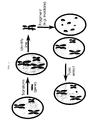
- the scheme presented in Fig. 1 shows the basic strategy applied for the minichromosomes' production in plant cells.
- Donor protoplasts were irradiated in a Gamma cell 200 (Co60 source, dose rate 0.048 J kg-ls-1) with different doses, and fused with recipient cells according to Kao, in: Wetter, LR, Constabel F (eds.) Plant Tissue Culture Methods, NRCC 19876 :49-57, (1982). Culture and selection conditions of protoplasts and fusion products were carried out according to Dirks et al., Mol. Gen. Genet. 179 :283-288 (1986). Cell colonies were regenerated on RPO.25 or RP1 medium (Installe et al., J. Plant Physiol. 119 :443-454 (1985)) with 0.25 mg or 1 mg/l zeatine. Regenerated plants were further cultivated on R'SA medium. Chromosome analysis of regenerated hybrids.
- Chromosome analysis was facilitated by morphological differences of recipient and donor metaphase chromosomes:
- N. plumbaginifolia is characterized by telocentric and N. sylvestris by meta- or submetacentric chromosomes.
- Regenerants can be classified into two groups: a first group of 19 plants from 13 different cell colonies, with 43 ⁇ 56 chromosomes (37 - 42 recipient chromosomes), and a second group (2 plants from 2 independent cell colonies) with 61 - 67 chromosomes and a hexaploid set of recipient chromosomes.
- the average number of identifiable donor chromosomes in 15 independent regenerants is about 8.7. Donor chromosome fragments resulting from radiation-induced damage were observed in all plants.
- chromosomes The total number and exact type of chromosomes are difficult to establish for several reasons. First, small variations in chromosome numbers may exist within one regenerant. Also radiation damage of donor chromosomes may result in recipient-like chromosomes; and interspecific chromosome exchanges may result in reconstructed and deleted recipient chromosomes as well as in the loss of chromosomes. Finally, chromosome translocations could not be observed.
- Fusion products between remote species generally spontaneously eliminate one of the parental genomes, thereby creating asymmetric hybrids that contain, in addition to a complete recipient genome, a few chromosomes derived from the donor.
- Methods for transferring part of the plant genome have been developed since one often wants to introduce only a small number of traits from the donor into the recipient.
- the donor-recipient method also called "gamma" fusion, is the most frequently used technique for creating asymmetric somatic hybrids. Although irradiation directs the process of chromosome elimination, it is not the sole control of the process. Highly asymmetric hybrids in which only one or few donor chromosomes are contained, have only rarely been described. This observation is irrespective of the radiation dose use.
- Nitrate reductase deficient mutant of Nicotiana plumbaginifolia (cnx20) and Atropa belladonna plants were used for the experiments.
- Protoplasts were isolated as described by Negrutiu et al., Theor. Appl. Genet. 72:279-286 (1986).
- Treatment of Atropa belladonna protoplasts with different doses of gamma rays was performed as described by Gleba et al., Theor. Appl. Genet. 76:760-766 (1988).
- the fusions of protoplasts were carried out as described by Menczel et al., Genetics, 100 :487-495 (1982).
- Protoplasts were cultured in K3 medium for 2 weeks, diluted in MDn medium (Negrutiu et al., Theor. Appl. Genet. 66:341-347 (1983); Negrutiu et al., Theor. Appl. Genet. 72 :279-286 (1986)). After 1 month visible calli were transferred to solid medium and regenerated as described elsewhere (Installe et al., J. Plant Physiol. 119 :443-454 (1985)). Metaphase plates from root tips for chromosome analysis were prepared as described by Gleba et al., Theor. Appl. Genet. 76 :760-766 (1988).
- the chromosomes analysis was greatly facilitated as the Atropa metaphase chromosomes are approximately twice shorter and significantly thinner that Nicotiana plumbaginifolia chromosomes (Gleba et al., Theor. Appl. Genet. 76 :760-766 (1988)).
- Minichromosomes which are significantly smaller than Atropa intact chromosomes, were detected in all samples analyzed.
- the size of detectable minichromosomes was variable starting from almost half the size of parental chromosome to hardly visible minichromosomes (Fig. 2). It is very possible that such "gamma" hybrids contain so small minichromosomes that they are simply invisible on the metaphase plate.
- Example 1 The constructs described in Example 1 suit many different purposes including plant minichromosome rescue in yeast cells and cloning any genes of interest.
- the genes of interest which could be cloned into the YAC would include, but not be limited to, genes for herbicide resistance, quality trait improvement such as starch modification, oil quality, protein quality, drought resistance, cold tolerance, pest resistance, and other input and output agricultural traits.
- Any number of methods can be used to identify the integration sites of the YAC. These methods include RAPD to mapping, fluorescent in situ hybridization (FISH) and Southern analysis. By identifying constructs that have inserted near the centromere, there is a greater chance of recovering fragmented chromosomes containing the centromere region and the construct of interest. There is evidence that this minimal "chromosome” can be repaired in the cell to include telomeres. This biologically assembled artificial chromosome could be rescued by transformation into yeast and from them being used to re-transform other plants of the same species.
- FISH fluorescent in situ hybridization
- the protoplasts were further cultured in K3 medium and subsequently diluted in selection medium (MDn) supplemented with 25 mg/1 kanamycin monosulphate. After one to two months, visible calli were transferred to solid selection medium and subsequently regenerated as described by Installe et al., J. Plant Physiol. 119 :443-454 (1985). Control experiments were carried out under the same conditions. Cytological analysis
- metaphase plates were prepared using the protoplast method as described by Mouras et al., Caryolgia 31 :117-127 (1978). Alternatively, metaphase spreads were also obtained from the root tips of regenerated plants as described by Pijnacker et al., Can. J. Genet. Cytol. 26 :415-419 (1984).
- the first vector pYAC-GN is shown in Fig. 3. It was created from pYAC-4 by insertion of two genes: p35S-APH(3')III- NOS3' and p35S-GUS-NOS3' into Sall and Clal sites respectively. Transformed plants can be selected for kanamycin resistance as well as for GUS activity.
- a Polylinker containing rare-cutting for plant DNA sites was inserted into EcoR1 site of SUP4 gene. This polylinker can be used for further modification of pYAC-GN by inserting for example recombination sites recognized by site-specific recombinases, thus allowing integration of any gene(s) of interest into plant minichromosomes containing YAC-GN.
- the rest of the sequences in the construct are of pYAC 4 origin and can be used to resque plant minichromosomes in yeast cells.
- pIC461 and pIC462 Two other vectors, pIC461 and pIC462 (Fig. 4) were made as described below.
- Expression cassette p35S:GUS:OCS3' was cloned into ClaI site of pYAC-4. Resulting plasmid was inserted into pBIN19 as Bam HI fragment, producing pIC461 or pIC462 depending on orientation of insert.
- This vector allows Agrobacterium- mediated transformation of plant cells due to the presence of pNOS-NPTII-NOS3' gene within T-DNA borders.
- the vector pYAC-GN was used for direct transformation of Nicotiana tabacum protoplasts using a solution of PEG with Ca 2+ and pH 9.8. Seeds of Nicotiana tabacum cv Wisconsin were germinated on media MS after sterilization with solution "diacid” for 5 minutes and washing 5 times with sterile water. Three- to four-week old leaves were used for protoplast isolation. The protoplasts were transformed as described by Koop et al., Planta, 199 :193-201 (1996).
- Leaves were cut on pieces and put abaxial side down on the surface of filter-sterilized enzyme solution containing Cellulose Onozuka 0.5%, Macerozime 0.5%, Dricelase 0.25%, Cellulysine 0.25%, 0.5 M mannitol and CaCl 2 * 2 H 2 O 110 mg/l.
- the pH was adjusted to 5.7.
- leaf pieces were teased to release any protoplasts that had not been liberated by enzyme action alone.
- the protoplasts were sedimented by centrifugation (100xg, for 5 min) and washed in 0.5M sucrose, 15mM CaCl 2 . W5 solution was loaded onto the top to prevent damage of protoplasts from direct contact with the air.
- protoplasts were transferred to a new centrifuge tube and resuspended in 10 ml of TB buffer containing 0.4 M mannitol, 15 mM CaCl 2 pH 5.7. The density of protoplasts was adjusted to 5x10 6 protoplasts/ml. One hundred microliters of this suspension was transferred to 6-cm Petri dish and the protoplasts were left for a few minutes to settle.
- the DNA solution (25 ⁇ l of 50 ⁇ g pYAC-GN dissolved in 18 ⁇ l TE pH5.6 plus 7 ⁇ l of culture media) was carefully added to the suspension, resuspended by gentle shaking of Petri dish and finally mixed with 125 ⁇ l of PEG solution (40% (w/v) of PEG 4000, 70mM Ca(NO 3 ) 2, 1,2754g mannitol per 26 ml). After 7-8 min of incubation the culture media was added to a volume of 125 ⁇ l, and after two minutes 2.6 ml of culture media was gradually added. After two weeks of incubation kanamycin was added to select transformed colonies. The Agrobacterium -mediated plant transformation was used with two other vectors -- pIC461 and pIC462.
- Leaf-discs transformation of Nicotiana sylvestris and Nicotiana tabacum species was performed using standard protocol.
- Leaf disks were co-cultivated with Agrobacterium tumefaciens EHA105 harboring pIC461 or pIC462 in MS media complemented with 1mg/l BAP and 0.5 mg/1 NAA.
- leaf-discs were transferred onto solid MS media with 1mg/l BAP, 0.1 mg/L NAA, 200mg/L carbeniciline and 200mg/L cefotaxime.
- After 7 days explants were transferred onto the same media but complemented with 25mg/L kanamycin. After 2-3 weeks concentration of kanamycin was increased to 50mg/l.
- Protoplasts of primary transformants carrying pYAC-GN or T-DNA of either pIC461 or pIC462 were used for gamma-irradiation. Then gamma-irradiated protoplasts of Nicotiana tabacum were fused with protoplasts from the other. It was reported in Parokonny et al., Plant J., 2 :863-874 (1992), that a number of stable minichromosomes originated from the irradiated parent was present in several regenerants. The purpose of this experiment, therefore, was to get the asymmetric somatic hybrid having a minichromosome with loxP site. Two irradiation doses were used - - 250Gy and 500Gy.
- the protoplast fusion technique performed was based on that of Negrutiu et al., Theor. Appl. Genet. 66 :341-347 (1983). Leaves were cut on pieces and put abaxial side down on the surface of filter-sterilized enzyme solution containing Cellulose Onozuka 0.5%, Macerozime 0.5%, Dricelase 0.25%, Cellulysine 0.25%, 0.5 M mannitol, CaCl 2 * 2 H 2 O 110 mg/l, 6mg/l BAP and 2mg/l NAA. The pH was adjusted to 5.7.
- Equal volume of PEG solution [40% PEG 4000, 70mM Ca (NO 3 ) 2 , 1,2754g mannitol per 26 ml (0.27M)] was carefully added Then 200 ⁇ l of W5 were added, incubated for 15-30 min. and mixed with another 2 ml of W5. After 20 minutes of incubation W5 was changed once and finally replaced with 3 ml of culture media. After two to three weeks of incubation, kanamycin sulfate was added to select hybrid colonies. The selected hybrids carried complete Nicotiana plumbaginifolia genome and minichromosomes with YAC sequences and kanamycine resistant gene.
- Example 3 Genomic in situ hybridization (GISH).
- genomic in situ hybridization in which total genomic DNA used as a probe can be used to determine the parental origin of chromosomal material in asymmetric hybrids as described in Parokonny et al., Plant Journal 2 :863-874 (1992).
- Asymmetric somatic hybrids were obtained by cell fusion of leaf mesophyll protoplasts from the non-irradiated parent (recipient) with gamma-irradiated mesophyll protoplasts from the other (donor). Irradiation doses administered prior to fusion ranged between 10 and 1000 Gy. Regenerants originated from individual nuclear hybrid colonies of the different fusion combinations. Regenerant Oct-3 was a product of symmetric cell fusion between mesophyll protoplasts of N. plumbaginifolia cnx 20 and a lysine-overproducing mutant of N. sylvestris (ALC; Negrutiu et al., Theor. Appl. Genet.
- genomic DNA was extracted from three to four young leaves of N. plumbaginifolia cnx 20 and N. sylvestris V-42, using the minipreparation technique of Dvorak, et al., Theor. Appl. Genet 63 :349-360 (1982).
- TTAGGG TTAGGGn.
- PCR polymerase chain reaction
- pTa71 A probe containing the 5.8S, 18S and 25S ribosomal genes, and part of the intergenic spacer from wheat (pTa71; Gerlach, et al., Nucl. Acids Res. 7 :1869-1885 (1979)), recloned into pUC18, was kindly supplied by Dr Kevin Jones, Department of Botany, University of Reading.
- Probe DNA was labeled with biotin-14-dATP (Life Technologies, Paisley, UK) by nick translation, as recommended by the manufacturer. Unincorporated nucleotides were removed by spin dialyzing through a 200 1 Sepharose CL-6B (Pharmacia) column (Maniatis et al., Molecular Cloning: A Laboratory Manual. Cold Spring Harbor. Cold Spring Harbor Laboratory Press, 1982). If the probe was to be used for in situ hybridization, a 30x excess of sheared denatured salmon testis DNA was added at this stage. The mixture was then precipitated once in ethanol and reconstituted in 20 1 of TE (10 mM Tris-HCI, pH 8.0,1 mM EDTA). Spotting an aliquot of labeled DNA onto nitrocellulose and detecting labeled DNA using the BRL DNA detection kit (Life Technologies) tested biotin incorporation.
- Root tips were pretreated in 0.035% colchicine (Sigma, Poole, UK) for 1.5 hours at room temperature, fixed in 3:1 ethanol:acetic acid for up to 2 weeks at 4°C, and stored in 70% ethanol at -20C. Root tips were squashed in 45% acetic acid on slides treated with Vectabond (Vector Laboratories, Peterborough, UK) to aid cell adhesion. Slides were stored desiccated at -20C for one to two weeks before processing. They were then immersed in 3:1 ethanol:acetic acid for 30 min. and absolute ethanol for 2 x 10 min., air-dried and treated with 50 g ml-1 of DNase-free RNase in 2 x SSC for 2 hr. at 37°C. After dehydrating through an alcohol series, they were dried in a vacuum desiccator overnight at 4°C.
- the method used for in situ hybridization was as described by Parokonny et al., Plant J. 2:695-704 (1992).
- the hybridization mixture consisted of 10% dextran sulphate, 50% formamide, 450 g ml-1 sonicated, sheared salmon sperm DNA and biotinylated probe to final concentrations of 15 g ml-1, 5 g m-1 and 200 ng ml-1, respectively, for GISH, (TTTAGGG)n and pTa71.
- Post-hybridization washes were in 2 x SSC at 42C, 50% formamide, 50% 2 x SSC at 42°C and 2 x SS°C at room temperature.
- Biotinylated DNA was detected with fluoresceinated avidin using one amplification with biotinylated anti-avidin D as described by Schwarzacher et al., Ann. Bot. 64 :315-324 (1989). Unhybridized DNA was visualized by staining with 0.5 g ml-1 propidium iodide. Chromatin from both parents was detected by counterstaining with 2 g ml-1 diaminidophenylindole (DAPI).
- DAPI diaminidophenylindole
- GISH was used to localize, and from each parental species in metaphase spreads of asymmetric somatic hybrids. Each of 31 plants originating from a different nuclear hybrid was treated by GISH. The irradiated donor for 17 of these was N. sylvestris and the remaining 14 were N. plumbaginifolia. The chromosomes from N. sylvestris fluoresced yellow, and those from N. plumbaginifolia fluoresced red. By the color of their fluorescence the species origin in rearranged chromosomes could be determined unequivocally. By counterstaining with DAPI, minichromosomes were identified and the donor chromosome could be identified by the color of the fluorescence. In situ hybridization localized the telomeric repeat at the termini of all chromosomes. Signals for the telomeric region could also be seen on chromosomes in which large segments had been deleted following irradiation.
- the present invention is applicable to agricultural biotechnology and in particular, to the manipulation of the plant genome to produce plant artificial chromosomes and the introduction of non-native nucleic acid into plants using the artificial chromosomes.
Landscapes
- Health & Medical Sciences (AREA)
- Life Sciences & Earth Sciences (AREA)
- Genetics & Genomics (AREA)
- Engineering & Computer Science (AREA)
- Biomedical Technology (AREA)
- Biotechnology (AREA)
- Wood Science & Technology (AREA)
- Organic Chemistry (AREA)
- Chemical & Material Sciences (AREA)
- Zoology (AREA)
- Bioinformatics & Cheminformatics (AREA)
- General Engineering & Computer Science (AREA)
- Molecular Biology (AREA)
- Cell Biology (AREA)
- Microbiology (AREA)
- Biochemistry (AREA)
- General Health & Medical Sciences (AREA)
- Plant Pathology (AREA)
- Biophysics (AREA)
- Physics & Mathematics (AREA)
- Botany (AREA)
- Breeding Of Plants And Reproduction By Means Of Culturing (AREA)
- Micro-Organisms Or Cultivation Processes Thereof (AREA)
- Control Of Positive-Displacement Air Blowers (AREA)
Applications Claiming Priority (3)
| Application Number | Priority Date | Filing Date | Title |
|---|---|---|---|
| US14744599P | 1999-08-05 | 1999-08-05 | |
| US147445P | 1999-08-05 | ||
| PCT/US2000/021461 WO2001011020A1 (en) | 1999-08-05 | 2000-08-07 | Method of making plant artificial chromosomes |
Publications (3)
| Publication Number | Publication Date |
|---|---|
| EP1200557A1 EP1200557A1 (en) | 2002-05-02 |
| EP1200557A4 EP1200557A4 (en) | 2003-05-14 |
| EP1200557B1 true EP1200557B1 (en) | 2006-04-26 |
Family
ID=22521594
Family Applications (1)
| Application Number | Title | Priority Date | Filing Date |
|---|---|---|---|
| EP00952574A Expired - Lifetime EP1200557B1 (en) | 1999-08-05 | 2000-08-07 | Method of making plant artificial chromosomes |
Country Status (7)
| Country | Link |
|---|---|
| EP (1) | EP1200557B1 (enExample) |
| JP (1) | JP2003512025A (enExample) |
| AT (1) | ATE324434T1 (enExample) |
| AU (1) | AU772110B2 (enExample) |
| CA (1) | CA2378787A1 (enExample) |
| DE (1) | DE60027570T2 (enExample) |
| WO (1) | WO2001011020A1 (enExample) |
Families Citing this family (23)
| Publication number | Priority date | Publication date | Assignee | Title |
|---|---|---|---|---|
| US7235716B2 (en) | 1997-06-03 | 2007-06-26 | Chromatin, Inc. | Plant centromere compositions |
| US7119250B2 (en) | 1997-06-03 | 2006-10-10 | The University Of Chicago | Plant centromere compositions |
| US7227057B2 (en) | 1997-06-03 | 2007-06-05 | Chromatin, Inc. | Plant centromere compositions |
| US7193128B2 (en) | 1997-06-03 | 2007-03-20 | Chromatin, Inc. | Methods for generating or increasing revenues from crops |
| DE10049587A1 (de) | 2000-10-06 | 2002-05-02 | Icon Genetics Ag | Vektorsystem für Pflanzen |
| DE10061150A1 (de) | 2000-12-08 | 2002-06-13 | Icon Genetics Ag | Verfahren und Vektoren zur Erzeugung von transgenen Pflanzen |
| DE10102389A1 (de) | 2001-01-19 | 2002-08-01 | Icon Genetics Ag | Verfahren und Vektoren zur Plastidentransformation höherer Pflanzen |
| DE10114209A1 (de) | 2001-03-23 | 2002-12-05 | Icon Genetics Ag | Ortsgerichtete Transformation durch Verwendung von Amplifikationsvektoren |
| DE10115507A1 (de) | 2001-03-29 | 2002-10-10 | Icon Genetics Ag | Verfahren zur Kodierung von Information in Nukleinsäuren eines genetisch veränderten Organismus |
| DE10121283B4 (de) | 2001-04-30 | 2011-08-11 | Icon Genetics GmbH, 80333 | Verfahren und Vektoren zur Amplifikation oder Expression von gewünschten Nucleinsäuresequenzen in Pflanzen |
| IL158885A0 (en) * | 2001-05-30 | 2004-05-12 | Chromos Molecular Systems Inc | Plant artificial chromosomes, uses thereof and methods of preparing plant artificial chromosomes |
| JP4489424B2 (ja) | 2001-05-30 | 2010-06-23 | グラクソ グループ リミテッド | 染色体に基くプラットホーム |
| DE10131690A1 (de) * | 2001-06-29 | 2003-01-16 | Icon Genetics Ag | Verfahren zum kontrollierten Umordnen von Chromosomenfragmenten für die Pflanzenzucht |
| DE10132780A1 (de) | 2001-07-06 | 2003-01-16 | Icon Genetics Ag | Plastidäre Genexpression über autonom replizierende Vektoren |
| DE10143237A1 (de) | 2001-09-04 | 2003-03-20 | Icon Genetics Ag | Herstellung künstlicher interner ribosomaler Eingangsstellenelemente (Ires-Elemente) |
| DE10143238A1 (de) | 2001-09-04 | 2003-03-20 | Icon Genetics Ag | Identifizierung eukaryotischer interner Ribosomen-Eingangsstellen (IRES)-Elemente |
| DE10203627A1 (de) * | 2002-01-30 | 2003-07-31 | Ulrich Zimmermann | Identifizierung von merkmalspezifischen Genen pflanzlicher Organismen |
| US7164056B2 (en) | 2002-05-03 | 2007-01-16 | Pioneer Hi-Bred International, Inc. | Gene targeting using replicating DNA molecules |
| CA2557644C (en) * | 2004-02-23 | 2016-05-24 | Chromatin, Inc. | Plants modified with mini-chromosomes |
| US7993913B2 (en) | 2006-05-09 | 2011-08-09 | The Curators Of The University Of Missouri | Plant artificial chromosome platforms via telomere truncation |
| AU2009333863B2 (en) * | 2008-12-17 | 2015-02-05 | Corteva Agriscience Llc | Targeted integration into the Zp15 locus |
| US9096909B2 (en) | 2009-07-23 | 2015-08-04 | Chromatin, Inc. | Sorghum centromere sequences and minichromosomes |
| WO2018052919A1 (en) * | 2016-09-14 | 2018-03-22 | Monsanto Technology Llc | Methods and compositions for genome editing via haploid induction |
Family Cites Families (2)
| Publication number | Priority date | Publication date | Assignee | Title |
|---|---|---|---|---|
| US5270201A (en) * | 1988-03-24 | 1993-12-14 | The General Hospital Corporation | Artificial chromosome vector |
| AU746775B2 (en) * | 1997-06-03 | 2002-05-02 | University Of Chicago, The | Plant artificial chromosome (PLAC) compositions and methods |
-
2000
- 2000-08-07 CA CA002378787A patent/CA2378787A1/en not_active Abandoned
- 2000-08-07 JP JP2001515807A patent/JP2003512025A/ja active Pending
- 2000-08-07 EP EP00952574A patent/EP1200557B1/en not_active Expired - Lifetime
- 2000-08-07 AU AU65247/00A patent/AU772110B2/en not_active Ceased
- 2000-08-07 WO PCT/US2000/021461 patent/WO2001011020A1/en not_active Ceased
- 2000-08-07 AT AT00952574T patent/ATE324434T1/de active
- 2000-08-07 DE DE60027570T patent/DE60027570T2/de not_active Expired - Lifetime
Also Published As
| Publication number | Publication date |
|---|---|
| CA2378787A1 (en) | 2001-02-15 |
| JP2003512025A (ja) | 2003-04-02 |
| AU6524700A (en) | 2001-03-05 |
| EP1200557A4 (en) | 2003-05-14 |
| EP1200557A1 (en) | 2002-05-02 |
| DE60027570D1 (de) | 2006-06-01 |
| DE60027570T2 (de) | 2007-02-15 |
| WO2001011020A1 (en) | 2001-02-15 |
| AU772110B2 (en) | 2004-04-08 |
| ATE324434T1 (de) | 2006-05-15 |
Similar Documents
| Publication | Publication Date | Title |
|---|---|---|
| AU772110B2 (en) | Method of making plant artificial chromosomes | |
| US7244876B1 (en) | Process of rapid variety-independent plant transformation | |
| EP3694992A1 (en) | Type i-e crispr-cas systems for eukaryotic genome editing | |
| Komatsu et al. | Genome editing in PDS genes of tomatoes by non-selection method and of Nicotiana benthamiana by one single guide RNA to edit two orthologs | |
| US20260043038A1 (en) | Genome editing in plants | |
| US20210123067A1 (en) | Compositions and methods for transferring cytoplasmic or nuclear traits or components | |
| US20230203517A1 (en) | Large scale genome manipulation | |
| US7247768B1 (en) | Method of making plant artificial chromosomes | |
| US20250027097A1 (en) | High efficiency large scale chromosomal genome manipulation | |
| CN105968178A (zh) | 水稻OsRAD1蛋白及其编码基因在调控花粉育性中的应用 | |
| ES2371645T3 (es) | Promotores específicos del polen de rigrás y las construcciones de expresión. | |
| US20260071228A1 (en) | Guide polynucleotide multiplexing | |
| US20250163393A1 (en) | Methods and compositions for advanced breeding through targeted chromosome engineering | |
| Liu | The development and evaluation of transgenic sorghum lines for conferred phenotypes | |
| WO2025059184A1 (en) | Methods and compositions for generating genome-edited paternal doubled haploids | |
| WO2026072580A1 (en) | Eif4e compositions and methods for viral resistance in maize | |
| Yu | Towards gene targeting in Arabidopsis thaliana | |
| Wasley | Tools and Methodologies for Manipulation of the Nuclear and Plastid Genome of Lolium perenne L. | |
| Bellini | Transformation in Lycopersicon esculentum L.(Tomato) |
Legal Events
| Date | Code | Title | Description |
|---|---|---|---|
| PUAI | Public reference made under article 153(3) epc to a published international application that has entered the european phase |
Free format text: ORIGINAL CODE: 0009012 |
|
| 17P | Request for examination filed |
Effective date: 20020110 |
|
| AK | Designated contracting states |
Kind code of ref document: A1 Designated state(s): AT BE CH CY DE DK ES FI FR GB GR IE IT LI LU MC NL PT SE |
|
| AX | Request for extension of the european patent |
Free format text: AL;LT;LV;MK;RO;SI |
|
| A4 | Supplementary search report drawn up and despatched |
Effective date: 20030401 |
|
| 17Q | First examination report despatched |
Effective date: 20050224 |
|
| GRAP | Despatch of communication of intention to grant a patent |
Free format text: ORIGINAL CODE: EPIDOSNIGR1 |
|
| GRAS | Grant fee paid |
Free format text: ORIGINAL CODE: EPIDOSNIGR3 |
|
| GRAA | (expected) grant |
Free format text: ORIGINAL CODE: 0009210 |
|
| AK | Designated contracting states |
Kind code of ref document: B1 Designated state(s): AT BE CH CY DE DK ES FI FR GB GR IE IT LI LU MC NL PT SE |
|
| PG25 | Lapsed in a contracting state [announced via postgrant information from national office to epo] |
Ref country code: IT Free format text: LAPSE BECAUSE OF FAILURE TO SUBMIT A TRANSLATION OF THE DESCRIPTION OR TO PAY THE FEE WITHIN THE PRESCRIBED TIME-LIMIT;WARNING: LAPSES OF ITALIAN PATENTS WITH EFFECTIVE DATE BEFORE 2007 MAY HAVE OCCURRED AT ANY TIME BEFORE 2007. THE CORRECT EFFECTIVE DATE MAY BE DIFFERENT FROM THE ONE RECORDED. Effective date: 20060426 Ref country code: FI Free format text: LAPSE BECAUSE OF FAILURE TO SUBMIT A TRANSLATION OF THE DESCRIPTION OR TO PAY THE FEE WITHIN THE PRESCRIBED TIME-LIMIT Effective date: 20060426 Ref country code: BE Free format text: LAPSE BECAUSE OF FAILURE TO SUBMIT A TRANSLATION OF THE DESCRIPTION OR TO PAY THE FEE WITHIN THE PRESCRIBED TIME-LIMIT Effective date: 20060426 Ref country code: NL Free format text: LAPSE BECAUSE OF FAILURE TO SUBMIT A TRANSLATION OF THE DESCRIPTION OR TO PAY THE FEE WITHIN THE PRESCRIBED TIME-LIMIT Effective date: 20060426 |
|
| REG | Reference to a national code |
Ref country code: GB Ref legal event code: FG4D |
|
| REG | Reference to a national code |
Ref country code: IE Ref legal event code: FG4D |
|
| REF | Corresponds to: |
Ref document number: 60027570 Country of ref document: DE Date of ref document: 20060601 Kind code of ref document: P |
|
| PG25 | Lapsed in a contracting state [announced via postgrant information from national office to epo] |
Ref country code: SE Free format text: LAPSE BECAUSE OF FAILURE TO SUBMIT A TRANSLATION OF THE DESCRIPTION OR TO PAY THE FEE WITHIN THE PRESCRIBED TIME-LIMIT Effective date: 20060726 Ref country code: DK Free format text: LAPSE BECAUSE OF FAILURE TO SUBMIT A TRANSLATION OF THE DESCRIPTION OR TO PAY THE FEE WITHIN THE PRESCRIBED TIME-LIMIT Effective date: 20060726 |
|
| PG25 | Lapsed in a contracting state [announced via postgrant information from national office to epo] |
Ref country code: ES Free format text: LAPSE BECAUSE OF FAILURE TO SUBMIT A TRANSLATION OF THE DESCRIPTION OR TO PAY THE FEE WITHIN THE PRESCRIBED TIME-LIMIT Effective date: 20060806 |
|
| PG25 | Lapsed in a contracting state [announced via postgrant information from national office to epo] |
Ref country code: IE Free format text: LAPSE BECAUSE OF NON-PAYMENT OF DUE FEES Effective date: 20060808 |
|
| REG | Reference to a national code |
Ref country code: CH Ref legal event code: NV Representative=s name: ARNOLD & SIEDSMA AG |
|
| PG25 | Lapsed in a contracting state [announced via postgrant information from national office to epo] |
Ref country code: MC Free format text: LAPSE BECAUSE OF NON-PAYMENT OF DUE FEES Effective date: 20060831 |
|
| PG25 | Lapsed in a contracting state [announced via postgrant information from national office to epo] |
Ref country code: PT Free format text: LAPSE BECAUSE OF FAILURE TO SUBMIT A TRANSLATION OF THE DESCRIPTION OR TO PAY THE FEE WITHIN THE PRESCRIBED TIME-LIMIT Effective date: 20060926 |
|
| NLV1 | Nl: lapsed or annulled due to failure to fulfill the requirements of art. 29p and 29m of the patents act | ||
| ET | Fr: translation filed | ||
| PLBE | No opposition filed within time limit |
Free format text: ORIGINAL CODE: 0009261 |
|
| STAA | Information on the status of an ep patent application or granted ep patent |
Free format text: STATUS: NO OPPOSITION FILED WITHIN TIME LIMIT |
|
| 26N | No opposition filed |
Effective date: 20070129 |
|
| PG25 | Lapsed in a contracting state [announced via postgrant information from national office to epo] |
Ref country code: GR Free format text: LAPSE BECAUSE OF FAILURE TO SUBMIT A TRANSLATION OF THE DESCRIPTION OR TO PAY THE FEE WITHIN THE PRESCRIBED TIME-LIMIT Effective date: 20060727 |
|
| PG25 | Lapsed in a contracting state [announced via postgrant information from national office to epo] |
Ref country code: LU Free format text: LAPSE BECAUSE OF NON-PAYMENT OF DUE FEES Effective date: 20060807 |
|
| PG25 | Lapsed in a contracting state [announced via postgrant information from national office to epo] |
Ref country code: CY Free format text: LAPSE BECAUSE OF FAILURE TO SUBMIT A TRANSLATION OF THE DESCRIPTION OR TO PAY THE FEE WITHIN THE PRESCRIBED TIME-LIMIT Effective date: 20060426 |
|
| PGFP | Annual fee paid to national office [announced via postgrant information from national office to epo] |
Ref country code: CH Payment date: 20110812 Year of fee payment: 12 |
|
| PGFP | Annual fee paid to national office [announced via postgrant information from national office to epo] |
Ref country code: FR Payment date: 20110818 Year of fee payment: 12 Ref country code: AT Payment date: 20110726 Year of fee payment: 12 |
|
| PGFP | Annual fee paid to national office [announced via postgrant information from national office to epo] |
Ref country code: GB Payment date: 20120726 Year of fee payment: 13 |
|
| PGFP | Annual fee paid to national office [announced via postgrant information from national office to epo] |
Ref country code: DE Payment date: 20120831 Year of fee payment: 13 |
|
| REG | Reference to a national code |
Ref country code: CH Ref legal event code: PL |
|
| REG | Reference to a national code |
Ref country code: AT Ref legal event code: MM01 Ref document number: 324434 Country of ref document: AT Kind code of ref document: T Effective date: 20120807 |
|
| PG25 | Lapsed in a contracting state [announced via postgrant information from national office to epo] |
Ref country code: CH Free format text: LAPSE BECAUSE OF NON-PAYMENT OF DUE FEES Effective date: 20120831 Ref country code: LI Free format text: LAPSE BECAUSE OF NON-PAYMENT OF DUE FEES Effective date: 20120831 |
|
| REG | Reference to a national code |
Ref country code: FR Ref legal event code: ST Effective date: 20130430 |
|
| PG25 | Lapsed in a contracting state [announced via postgrant information from national office to epo] |
Ref country code: AT Free format text: LAPSE BECAUSE OF NON-PAYMENT OF DUE FEES Effective date: 20120807 |
|
| PG25 | Lapsed in a contracting state [announced via postgrant information from national office to epo] |
Ref country code: FR Free format text: LAPSE BECAUSE OF NON-PAYMENT OF DUE FEES Effective date: 20120831 |
|
| GBPC | Gb: european patent ceased through non-payment of renewal fee |
Effective date: 20130807 |
|
| PG25 | Lapsed in a contracting state [announced via postgrant information from national office to epo] |
Ref country code: DE Free format text: LAPSE BECAUSE OF NON-PAYMENT OF DUE FEES Effective date: 20140301 |
|
| REG | Reference to a national code |
Ref country code: DE Ref legal event code: R119 Ref document number: 60027570 Country of ref document: DE Effective date: 20140301 |
|
| PG25 | Lapsed in a contracting state [announced via postgrant information from national office to epo] |
Ref country code: GB Free format text: LAPSE BECAUSE OF NON-PAYMENT OF DUE FEES Effective date: 20130807 |