EP1197480A1 - Composition cimentaire, son utilisation pour la réalisation de chape liquide autonivelante et chape ainsi obtenue - Google Patents
Composition cimentaire, son utilisation pour la réalisation de chape liquide autonivelante et chape ainsi obtenue Download PDFInfo
- Publication number
- EP1197480A1 EP1197480A1 EP01402536A EP01402536A EP1197480A1 EP 1197480 A1 EP1197480 A1 EP 1197480A1 EP 01402536 A EP01402536 A EP 01402536A EP 01402536 A EP01402536 A EP 01402536A EP 1197480 A1 EP1197480 A1 EP 1197480A1
- Authority
- EP
- European Patent Office
- Prior art keywords
- composition according
- cement
- parts
- self
- screed
- Prior art date
- Legal status (The legal status is an assumption and is not a legal conclusion. Google has not performed a legal analysis and makes no representation as to the accuracy of the status listed.)
- Granted
Links
- 239000000203 mixture Substances 0.000 title claims abstract description 89
- 239000004568 cement Substances 0.000 title claims abstract description 31
- 239000002562 thickening agent Substances 0.000 claims abstract description 35
- 239000011398 Portland cement Substances 0.000 claims abstract description 25
- 230000007717 exclusion Effects 0.000 claims abstract description 16
- 239000011230 binding agent Substances 0.000 claims abstract description 14
- 239000007788 liquid Substances 0.000 claims abstract description 11
- 238000000034 method Methods 0.000 claims abstract 2
- OSGAYBCDTDRGGQ-UHFFFAOYSA-L calcium sulfate Chemical compound [Ca+2].[O-]S([O-])(=O)=O OSGAYBCDTDRGGQ-UHFFFAOYSA-L 0.000 claims description 30
- XLYOFNOQVPJJNP-UHFFFAOYSA-N water Substances O XLYOFNOQVPJJNP-UHFFFAOYSA-N 0.000 claims description 27
- NIXOWILDQLNWCW-UHFFFAOYSA-M Acrylate Chemical compound [O-]C(=O)C=C NIXOWILDQLNWCW-UHFFFAOYSA-M 0.000 claims description 17
- 239000004576 sand Substances 0.000 claims description 17
- JOYRKODLDBILNP-UHFFFAOYSA-N Ethyl urethane Chemical compound CCOC(N)=O JOYRKODLDBILNP-UHFFFAOYSA-N 0.000 claims description 13
- 229920003171 Poly (ethylene oxide) Polymers 0.000 claims description 13
- 230000002209 hydrophobic effect Effects 0.000 claims description 12
- BDHFUVZGWQCTTF-UHFFFAOYSA-M sulfonate Chemical compound [O-]S(=O)=O BDHFUVZGWQCTTF-UHFFFAOYSA-M 0.000 claims description 12
- 239000004094 surface-active agent Substances 0.000 claims description 12
- 239000004014 plasticizer Substances 0.000 claims description 11
- 239000002671 adjuvant Substances 0.000 claims description 9
- 229920001400 block copolymer Polymers 0.000 claims description 9
- 238000004519 manufacturing process Methods 0.000 claims description 7
- NIXOWILDQLNWCW-UHFFFAOYSA-N acrylic acid group Chemical group C(C=C)(=O)O NIXOWILDQLNWCW-UHFFFAOYSA-N 0.000 claims description 6
- 239000000463 material Substances 0.000 claims description 6
- 150000004676 glycans Chemical class 0.000 claims description 5
- 229920000417 polynaphthalene Polymers 0.000 claims description 5
- 229920001282 polysaccharide Polymers 0.000 claims description 5
- 239000005017 polysaccharide Substances 0.000 claims description 5
- 229920003169 water-soluble polymer Chemical class 0.000 claims description 4
- 240000008886 Ceratonia siliqua Species 0.000 claims description 3
- 235000013912 Ceratonia siliqua Nutrition 0.000 claims description 3
- 244000007835 Cyamopsis tetragonoloba Species 0.000 claims description 3
- 229920000877 Melamine resin Polymers 0.000 claims description 3
- 235000011132 calcium sulphate Nutrition 0.000 claims description 3
- 239000001175 calcium sulphate Substances 0.000 claims description 3
- 239000000416 hydrocolloid Substances 0.000 claims description 3
- JDSHMPZPIAZGSV-UHFFFAOYSA-N melamine Chemical compound NC1=NC(N)=NC(N)=N1 JDSHMPZPIAZGSV-UHFFFAOYSA-N 0.000 claims description 3
- 239000002245 particle Substances 0.000 claims description 3
- 230000008719 thickening Effects 0.000 claims description 3
- 229920001285 xanthan gum Polymers 0.000 claims description 3
- GJCOSYZMQJWQCA-UHFFFAOYSA-N 9H-xanthene Chemical compound C1=CC=C2CC3=CC=CC=C3OC2=C1 GJCOSYZMQJWQCA-UHFFFAOYSA-N 0.000 claims description 2
- 229920003170 water-soluble synthetic polymer Polymers 0.000 claims description 2
- 239000003349 gelling agent Substances 0.000 claims 2
- 229920003086 cellulose ether Polymers 0.000 claims 1
- 239000003795 chemical substances by application Substances 0.000 abstract description 10
- 239000000654 additive Substances 0.000 abstract description 6
- 238000000576 coating method Methods 0.000 abstract 4
- 239000011248 coating agent Substances 0.000 abstract 3
- 239000004570 mortar (masonry) Substances 0.000 description 45
- VYPSYNLAJGMNEJ-UHFFFAOYSA-N Silicium dioxide Chemical compound O=[Si]=O VYPSYNLAJGMNEJ-UHFFFAOYSA-N 0.000 description 29
- 239000012530 fluid Substances 0.000 description 27
- 229910052925 anhydrite Inorganic materials 0.000 description 21
- 238000001035 drying Methods 0.000 description 17
- 229940048053 acrylate Drugs 0.000 description 16
- 238000002156 mixing Methods 0.000 description 15
- DGAQECJNVWCQMB-PUAWFVPOSA-M Ilexoside XXIX Chemical compound C[C@@H]1CC[C@@]2(CC[C@@]3(C(=CC[C@H]4[C@]3(CC[C@@H]5[C@@]4(CC[C@@H](C5(C)C)OS(=O)(=O)[O-])C)C)[C@@H]2[C@]1(C)O)C)C(=O)O[C@H]6[C@@H]([C@H]([C@@H]([C@H](O6)CO)O)O)O.[Na+] DGAQECJNVWCQMB-PUAWFVPOSA-M 0.000 description 12
- 239000002585 base Substances 0.000 description 12
- 239000011734 sodium Substances 0.000 description 12
- 229910052708 sodium Inorganic materials 0.000 description 12
- 238000005259 measurement Methods 0.000 description 11
- VGGSQFUCUMXWEO-UHFFFAOYSA-N Ethene Chemical compound C=C VGGSQFUCUMXWEO-UHFFFAOYSA-N 0.000 description 10
- 229920001577 copolymer Polymers 0.000 description 10
- LYCAIKOWRPUZTN-UHFFFAOYSA-N Ethylene glycol Chemical compound OCCO LYCAIKOWRPUZTN-UHFFFAOYSA-N 0.000 description 9
- 239000000178 monomer Substances 0.000 description 9
- 238000004062 sedimentation Methods 0.000 description 9
- 239000008030 superplasticizer Substances 0.000 description 9
- 230000000740 bleeding effect Effects 0.000 description 8
- 241001508691 Martes zibellina Species 0.000 description 7
- 239000000243 solution Substances 0.000 description 7
- 241000196324 Embryophyta Species 0.000 description 6
- CERQOIWHTDAKMF-UHFFFAOYSA-M Methacrylate Chemical compound CC(=C)C([O-])=O CERQOIWHTDAKMF-UHFFFAOYSA-M 0.000 description 6
- 239000003513 alkali Substances 0.000 description 6
- 230000006399 behavior Effects 0.000 description 6
- 230000008901 benefit Effects 0.000 description 6
- 239000000839 emulsion Substances 0.000 description 6
- 229920000642 polymer Polymers 0.000 description 6
- 238000000518 rheometry Methods 0.000 description 6
- RTZKZFJDLAIYFH-UHFFFAOYSA-N Diethyl ether Chemical compound CCOCC RTZKZFJDLAIYFH-UHFFFAOYSA-N 0.000 description 5
- CERQOIWHTDAKMF-UHFFFAOYSA-N Methacrylic acid Chemical compound CC(=C)C(O)=O CERQOIWHTDAKMF-UHFFFAOYSA-N 0.000 description 5
- 239000001913 cellulose Substances 0.000 description 5
- 229920002678 cellulose Polymers 0.000 description 5
- WGCNASOHLSPBMP-UHFFFAOYSA-N hydroxyacetaldehyde Natural products OCC=O WGCNASOHLSPBMP-UHFFFAOYSA-N 0.000 description 5
- 229920000058 polyacrylate Polymers 0.000 description 5
- 238000012360 testing method Methods 0.000 description 5
- 239000004354 Hydroxyethyl cellulose Substances 0.000 description 4
- 229920000663 Hydroxyethyl cellulose Polymers 0.000 description 4
- 241001125843 Trichiuridae Species 0.000 description 4
- 150000008064 anhydrides Chemical class 0.000 description 4
- 230000015572 biosynthetic process Effects 0.000 description 4
- 238000005266 casting Methods 0.000 description 4
- 238000006243 chemical reaction Methods 0.000 description 4
- 230000000052 comparative effect Effects 0.000 description 4
- 239000002270 dispersing agent Substances 0.000 description 4
- 230000000694 effects Effects 0.000 description 4
- 229910052602 gypsum Inorganic materials 0.000 description 4
- 239000010440 gypsum Substances 0.000 description 4
- 235000019447 hydroxyethyl cellulose Nutrition 0.000 description 4
- 150000003839 salts Chemical class 0.000 description 4
- 238000005204 segregation Methods 0.000 description 4
- -1 alkenyl ether Chemical compound 0.000 description 3
- 239000007864 aqueous solution Substances 0.000 description 3
- 230000006378 damage Effects 0.000 description 3
- 238000009826 distribution Methods 0.000 description 3
- 229910001653 ettringite Inorganic materials 0.000 description 3
- 238000010438 heat treatment Methods 0.000 description 3
- 238000004806 packaging method and process Methods 0.000 description 3
- 230000007170 pathology Effects 0.000 description 3
- 229920002635 polyurethane Polymers 0.000 description 3
- 239000004814 polyurethane Substances 0.000 description 3
- 238000002360 preparation method Methods 0.000 description 3
- SMZOUWXMTYCWNB-UHFFFAOYSA-N 2-(2-methoxy-5-methylphenyl)ethanamine Chemical compound COC1=CC=C(C)C=C1CCN SMZOUWXMTYCWNB-UHFFFAOYSA-N 0.000 description 2
- 239000002253 acid Substances 0.000 description 2
- 239000011149 active material Substances 0.000 description 2
- 230000000996 additive effect Effects 0.000 description 2
- 125000005907 alkyl ester group Chemical group 0.000 description 2
- 150000001875 compounds Chemical class 0.000 description 2
- 230000003750 conditioning effect Effects 0.000 description 2
- 238000007334 copolymerization reaction Methods 0.000 description 2
- 238000006073 displacement reaction Methods 0.000 description 2
- 230000009931 harmful effect Effects 0.000 description 2
- 230000007062 hydrolysis Effects 0.000 description 2
- 238000006460 hydrolysis reaction Methods 0.000 description 2
- 238000010348 incorporation Methods 0.000 description 2
- 238000009434 installation Methods 0.000 description 2
- FPYJFEHAWHCUMM-UHFFFAOYSA-N maleic anhydride Chemical compound O=C1OC(=O)C=C1 FPYJFEHAWHCUMM-UHFFFAOYSA-N 0.000 description 2
- 229920001495 poly(sodium acrylate) polymer Polymers 0.000 description 2
- 229920005862 polyol Polymers 0.000 description 2
- 229920002451 polyvinyl alcohol Polymers 0.000 description 2
- 235000019422 polyvinyl alcohol Nutrition 0.000 description 2
- 150000003254 radicals Chemical class 0.000 description 2
- 230000009467 reduction Effects 0.000 description 2
- 230000035939 shock Effects 0.000 description 2
- 239000000377 silicon dioxide Substances 0.000 description 2
- SONHXMAHPHADTF-UHFFFAOYSA-M sodium;2-methylprop-2-enoate Chemical compound [Na+].CC(=C)C([O-])=O SONHXMAHPHADTF-UHFFFAOYSA-M 0.000 description 2
- 238000003892 spreading Methods 0.000 description 2
- 230000007480 spreading Effects 0.000 description 2
- 238000003786 synthesis reaction Methods 0.000 description 2
- 229920006163 vinyl copolymer Polymers 0.000 description 2
- PQUXFUBNSYCQAL-UHFFFAOYSA-N 1-(2,3-difluorophenyl)ethanone Chemical compound CC(=O)C1=CC=CC(F)=C1F PQUXFUBNSYCQAL-UHFFFAOYSA-N 0.000 description 1
- 125000003903 2-propenyl group Chemical group [H]C([*])([H])C([H])=C([H])[H] 0.000 description 1
- ATVJXMYDOSMEPO-UHFFFAOYSA-N 3-prop-2-enoxyprop-1-ene Chemical compound C=CCOCC=C ATVJXMYDOSMEPO-UHFFFAOYSA-N 0.000 description 1
- 238000012935 Averaging Methods 0.000 description 1
- 208000031968 Cadaver Diseases 0.000 description 1
- PXGOKWXKJXAPGV-UHFFFAOYSA-N Fluorine Chemical compound FF PXGOKWXKJXAPGV-UHFFFAOYSA-N 0.000 description 1
- 229920002907 Guar gum Polymers 0.000 description 1
- 229920001732 Lignosulfonate Polymers 0.000 description 1
- 229920000881 Modified starch Polymers 0.000 description 1
- 239000004368 Modified starch Substances 0.000 description 1
- JCXJVPUVTGWSNB-UHFFFAOYSA-N Nitrogen dioxide Chemical compound O=[N]=O JCXJVPUVTGWSNB-UHFFFAOYSA-N 0.000 description 1
- 239000002202 Polyethylene glycol Substances 0.000 description 1
- 239000004721 Polyphenylene oxide Substances 0.000 description 1
- OFOBLEOULBTSOW-UHFFFAOYSA-N Propanedioic acid Natural products OC(=O)CC(O)=O OFOBLEOULBTSOW-UHFFFAOYSA-N 0.000 description 1
- 229920002472 Starch Polymers 0.000 description 1
- XTXRWKRVRITETP-UHFFFAOYSA-N Vinyl acetate Chemical compound CC(=O)OC=C XTXRWKRVRITETP-UHFFFAOYSA-N 0.000 description 1
- 239000004480 active ingredient Substances 0.000 description 1
- 125000002009 alkene group Chemical group 0.000 description 1
- 125000000217 alkyl group Chemical group 0.000 description 1
- 150000001412 amines Chemical class 0.000 description 1
- UIERETOOQGIECD-ARJAWSKDSA-N angelic acid group Chemical group C(\C(\C)=C/C)(=O)O UIERETOOQGIECD-ARJAWSKDSA-N 0.000 description 1
- 229940095564 anhydrous calcium sulfate Drugs 0.000 description 1
- 239000002956 ash Substances 0.000 description 1
- 230000001680 brushing effect Effects 0.000 description 1
- PVEOYINWKBTPIZ-UHFFFAOYSA-N but-3-enoic acid Chemical compound OC(=O)CC=C PVEOYINWKBTPIZ-UHFFFAOYSA-N 0.000 description 1
- 150000001732 carboxylic acid derivatives Chemical class 0.000 description 1
- 230000008859 change Effects 0.000 description 1
- 239000003638 chemical reducing agent Substances 0.000 description 1
- 230000000295 complement effect Effects 0.000 description 1
- 230000006835 compression Effects 0.000 description 1
- 238000007906 compression Methods 0.000 description 1
- 230000001143 conditioned effect Effects 0.000 description 1
- 238000010276 construction Methods 0.000 description 1
- 239000006184 cosolvent Substances 0.000 description 1
- 238000005336 cracking Methods 0.000 description 1
- 239000013530 defoamer Substances 0.000 description 1
- 230000003111 delayed effect Effects 0.000 description 1
- 230000006866 deterioration Effects 0.000 description 1
- MTHSVFCYNBDYFN-UHFFFAOYSA-N diethylene glycol Chemical compound OCCOCCO MTHSVFCYNBDYFN-UHFFFAOYSA-N 0.000 description 1
- 125000005442 diisocyanate group Chemical group 0.000 description 1
- 208000037265 diseases, disorders, signs and symptoms Diseases 0.000 description 1
- 208000035475 disorder Diseases 0.000 description 1
- 238000006253 efflorescence Methods 0.000 description 1
- 229940082150 encore Drugs 0.000 description 1
- 150000002148 esters Chemical class 0.000 description 1
- 150000002170 ethers Chemical class 0.000 description 1
- 150000002191 fatty alcohols Chemical class 0.000 description 1
- 239000010419 fine particle Substances 0.000 description 1
- 239000011737 fluorine Substances 0.000 description 1
- 229910052731 fluorine Inorganic materials 0.000 description 1
- 239000010881 fly ash Substances 0.000 description 1
- 238000005187 foaming Methods 0.000 description 1
- 239000003517 fume Substances 0.000 description 1
- 238000001879 gelation Methods 0.000 description 1
- 230000005484 gravity Effects 0.000 description 1
- 238000000227 grinding Methods 0.000 description 1
- 239000000665 guar gum Substances 0.000 description 1
- 235000010417 guar gum Nutrition 0.000 description 1
- 229960002154 guar gum Drugs 0.000 description 1
- 230000000887 hydrating effect Effects 0.000 description 1
- 230000036571 hydration Effects 0.000 description 1
- 238000006703 hydration reaction Methods 0.000 description 1
- 125000001165 hydrophobic group Chemical group 0.000 description 1
- 230000002706 hydrostatic effect Effects 0.000 description 1
- 239000012535 impurity Substances 0.000 description 1
- 229910052500 inorganic mineral Inorganic materials 0.000 description 1
- 238000004898 kneading Methods 0.000 description 1
- 229920005684 linear copolymer Polymers 0.000 description 1
- 208000028755 loss of height Diseases 0.000 description 1
- 229920002521 macromolecule Polymers 0.000 description 1
- VZCYOOQTPOCHFL-UPHRSURJSA-N maleic acid Chemical compound OC(=O)\C=C/C(O)=O VZCYOOQTPOCHFL-UPHRSURJSA-N 0.000 description 1
- 239000011976 maleic acid Substances 0.000 description 1
- 229910052751 metal Inorganic materials 0.000 description 1
- 239000002184 metal Substances 0.000 description 1
- 125000005395 methacrylic acid group Chemical group 0.000 description 1
- 229920000609 methyl cellulose Polymers 0.000 description 1
- 239000001923 methylcellulose Substances 0.000 description 1
- 239000000693 micelle Substances 0.000 description 1
- 239000011707 mineral Substances 0.000 description 1
- 235000019426 modified starch Nutrition 0.000 description 1
- 239000003607 modifier Substances 0.000 description 1
- 229910052757 nitrogen Inorganic materials 0.000 description 1
- 125000004433 nitrogen atom Chemical group N* 0.000 description 1
- 239000005416 organic matter Substances 0.000 description 1
- 239000002985 plastic film Substances 0.000 description 1
- 229920006255 plastic film Polymers 0.000 description 1
- 229920000580 poly(melamine) Polymers 0.000 description 1
- 229920000570 polyether Polymers 0.000 description 1
- 229920001223 polyethylene glycol Polymers 0.000 description 1
- 150000003077 polyols Chemical class 0.000 description 1
- 150000003138 primary alcohols Chemical class 0.000 description 1
- 150000003141 primary amines Chemical class 0.000 description 1
- 230000002035 prolonged effect Effects 0.000 description 1
- 238000005086 pumping Methods 0.000 description 1
- 229920005604 random copolymer Polymers 0.000 description 1
- 206010037844 rash Diseases 0.000 description 1
- 239000006254 rheological additive Substances 0.000 description 1
- 230000035945 sensitivity Effects 0.000 description 1
- 239000002893 slag Substances 0.000 description 1
- 229940047670 sodium acrylate Drugs 0.000 description 1
- 239000007787 solid Substances 0.000 description 1
- 239000008107 starch Substances 0.000 description 1
- 235000019698 starch Nutrition 0.000 description 1
- 238000003860 storage Methods 0.000 description 1
- 230000035900 sweating Effects 0.000 description 1
- 230000002195 synergetic effect Effects 0.000 description 1
- 229920001059 synthetic polymer Polymers 0.000 description 1
- 229920001897 terpolymer Polymers 0.000 description 1
- 239000012749 thinning agent Substances 0.000 description 1
- VZCYOOQTPOCHFL-UHFFFAOYSA-N trans-butenedioic acid Natural products OC(=O)C=CC(O)=O VZCYOOQTPOCHFL-UHFFFAOYSA-N 0.000 description 1
- 238000012546 transfer Methods 0.000 description 1
- 230000000007 visual effect Effects 0.000 description 1
- 238000005303 weighing Methods 0.000 description 1
- 239000000230 xanthan gum Substances 0.000 description 1
- 235000010493 xanthan gum Nutrition 0.000 description 1
- 229940082509 xanthan gum Drugs 0.000 description 1
Images


Classifications
-
- C—CHEMISTRY; METALLURGY
- C04—CEMENTS; CONCRETE; ARTIFICIAL STONE; CERAMICS; REFRACTORIES
- C04B—LIME, MAGNESIA; SLAG; CEMENTS; COMPOSITIONS THEREOF, e.g. MORTARS, CONCRETE OR LIKE BUILDING MATERIALS; ARTIFICIAL STONE; CERAMICS; REFRACTORIES; TREATMENT OF NATURAL STONE
- C04B24/00—Use of organic materials as active ingredients for mortars, concrete or artificial stone, e.g. plasticisers
- C04B24/24—Macromolecular compounds
- C04B24/28—Macromolecular compounds obtained otherwise than by reactions only involving carbon-to-carbon unsaturated bonds
- C04B24/282—Polyurethanes; Polyisocyanates
-
- C—CHEMISTRY; METALLURGY
- C04—CEMENTS; CONCRETE; ARTIFICIAL STONE; CERAMICS; REFRACTORIES
- C04B—LIME, MAGNESIA; SLAG; CEMENTS; COMPOSITIONS THEREOF, e.g. MORTARS, CONCRETE OR LIKE BUILDING MATERIALS; ARTIFICIAL STONE; CERAMICS; REFRACTORIES; TREATMENT OF NATURAL STONE
- C04B24/00—Use of organic materials as active ingredients for mortars, concrete or artificial stone, e.g. plasticisers
- C04B24/24—Macromolecular compounds
- C04B24/26—Macromolecular compounds obtained by reactions only involving carbon-to-carbon unsaturated bonds
- C04B24/2641—Polyacrylates; Polymethacrylates
-
- C—CHEMISTRY; METALLURGY
- C04—CEMENTS; CONCRETE; ARTIFICIAL STONE; CERAMICS; REFRACTORIES
- C04B—LIME, MAGNESIA; SLAG; CEMENTS; COMPOSITIONS THEREOF, e.g. MORTARS, CONCRETE OR LIKE BUILDING MATERIALS; ARTIFICIAL STONE; CERAMICS; REFRACTORIES; TREATMENT OF NATURAL STONE
- C04B24/00—Use of organic materials as active ingredients for mortars, concrete or artificial stone, e.g. plasticisers
- C04B24/24—Macromolecular compounds
- C04B24/28—Macromolecular compounds obtained otherwise than by reactions only involving carbon-to-carbon unsaturated bonds
- C04B24/32—Polyethers, e.g. alkylphenol polyglycolether
-
- C—CHEMISTRY; METALLURGY
- C04—CEMENTS; CONCRETE; ARTIFICIAL STONE; CERAMICS; REFRACTORIES
- C04B—LIME, MAGNESIA; SLAG; CEMENTS; COMPOSITIONS THEREOF, e.g. MORTARS, CONCRETE OR LIKE BUILDING MATERIALS; ARTIFICIAL STONE; CERAMICS; REFRACTORIES; TREATMENT OF NATURAL STONE
- C04B24/00—Use of organic materials as active ingredients for mortars, concrete or artificial stone, e.g. plasticisers
- C04B24/24—Macromolecular compounds
- C04B24/38—Polysaccharides or derivatives thereof
-
- C—CHEMISTRY; METALLURGY
- C04—CEMENTS; CONCRETE; ARTIFICIAL STONE; CERAMICS; REFRACTORIES
- C04B—LIME, MAGNESIA; SLAG; CEMENTS; COMPOSITIONS THEREOF, e.g. MORTARS, CONCRETE OR LIKE BUILDING MATERIALS; ARTIFICIAL STONE; CERAMICS; REFRACTORIES; TREATMENT OF NATURAL STONE
- C04B28/00—Compositions of mortars, concrete or artificial stone, containing inorganic binders or the reaction product of an inorganic and an organic binder, e.g. polycarboxylate cements
- C04B28/02—Compositions of mortars, concrete or artificial stone, containing inorganic binders or the reaction product of an inorganic and an organic binder, e.g. polycarboxylate cements containing hydraulic cements other than calcium sulfates
- C04B28/04—Portland cements
-
- C—CHEMISTRY; METALLURGY
- C04—CEMENTS; CONCRETE; ARTIFICIAL STONE; CERAMICS; REFRACTORIES
- C04B—LIME, MAGNESIA; SLAG; CEMENTS; COMPOSITIONS THEREOF, e.g. MORTARS, CONCRETE OR LIKE BUILDING MATERIALS; ARTIFICIAL STONE; CERAMICS; REFRACTORIES; TREATMENT OF NATURAL STONE
- C04B2111/00—Mortars, concrete or artificial stone or mixtures to prepare them, characterised by specific function, property or use
- C04B2111/00034—Physico-chemical characteristics of the mixtures
- C04B2111/00146—Sprayable or pumpable mixtures
-
- C—CHEMISTRY; METALLURGY
- C04—CEMENTS; CONCRETE; ARTIFICIAL STONE; CERAMICS; REFRACTORIES
- C04B—LIME, MAGNESIA; SLAG; CEMENTS; COMPOSITIONS THEREOF, e.g. MORTARS, CONCRETE OR LIKE BUILDING MATERIALS; ARTIFICIAL STONE; CERAMICS; REFRACTORIES; TREATMENT OF NATURAL STONE
- C04B2111/00—Mortars, concrete or artificial stone or mixtures to prepare them, characterised by specific function, property or use
- C04B2111/10—Compositions or ingredients thereof characterised by the absence or the very low content of a specific material
- C04B2111/1018—Gypsum free or very low gypsum content cement compositions
-
- C—CHEMISTRY; METALLURGY
- C04—CEMENTS; CONCRETE; ARTIFICIAL STONE; CERAMICS; REFRACTORIES
- C04B—LIME, MAGNESIA; SLAG; CEMENTS; COMPOSITIONS THEREOF, e.g. MORTARS, CONCRETE OR LIKE BUILDING MATERIALS; ARTIFICIAL STONE; CERAMICS; REFRACTORIES; TREATMENT OF NATURAL STONE
- C04B2111/00—Mortars, concrete or artificial stone or mixtures to prepare them, characterised by specific function, property or use
- C04B2111/60—Flooring materials
- C04B2111/62—Self-levelling compositions
Definitions
- the present invention relates to the field of cementitious compositions, used for the realization of liquid screeds, in particular self-leveling, their manufacturing process and the screeds thus produced.
- a fluid (or liquid) screed is formed from a cementitious composition to base of binder, very often an aggregate, which is generally sand, and at least one adjuvant, which is a fluidizer (also called superplasticizer or dispersant), which transforms the mixture into a dough whose consistency is close after mixing that some water.
- a fluidizer also called superplasticizer or dispersant
- the different types of screeds are distinguished by their grain size, the nature of their binder and their packaging system.
- the particle size has an influence on the surface appearance.
- sand less than about 1 mm a perfectly smooth surface is obtained. Beyond, the sand outcrops on the surface, giving it a certain relief because of the appearance of protrusions which begin to be clearly visible to the naked eye when the upper limit of its granular extent exceeds about a few mm.
- binders are either aluminous cement, supplemented with calcium sulphate hydrated or not so that ettringite is formed as a product of hydration and to reduce shrinkage after drying, either natural anhydrite or synthetic (anhydrous calcium sulfate) which turns into gypsum at the end of the reaction.
- Anhydrite screeds have the major disadvantage of being after drying very sensitive to water. Any rehumidification of the anhydrite screed by raising support slab or from covering installation products is therefore prohibited, which complicates the conditions of realization (closed room, coverage for example) which must be scrupulously respected under pain of rapidly causing serious disorders in the behavior of the floor covering (rewetting can decrease by 40% resistance of the screed).
- anhydrite screeds dry up with gypsum which crystallizes, accompanied by reflections of milt. Efflorescence, soft milt or resulting vitrified crust must then be removed by sanding, brushing or planing.
- these products exist in dry form, that is to say, ready to mix or in the form of a fluid mortar.
- the case of the fluid mortar is particularly advantageous for delivery to the site by router truck followed transfer by pumping; the mortar is then prepared and mixed in a central concrete, then delivered ready to use. It only remains for the user to carry out the casting of the screed. In addition to the limited number of operations to be carried out by the user and the gain in time or labor which results, such conditioning guarantees regularity product quality.
- cement binder Portland which has a considerably longer setting time (four hours or more).
- patent application EP-A-0 725 044 reports a fluid mortar composition
- a fluid mortar composition comprising ordinary Portland cement with as fluidizing agent an acrylic dispersant obtained by copolymerization of well identified monomers, to which a viscosity agent is added, which ensures the cohesion or stability (absence of bleeding and sedimentation) of the mortar, an agent defoamer, setting accelerator and shrinkage reducing agent.
- the composition also contains aggregates (sand), and natural anhydrite (in proportions higher than approximately 5% compared to cement).
- the properties of such screed concerns the fluidification time (more than 3 hours) without segregation between the different mineral components and water, segregation generally observed for very thin mortars.
- this fluid mortar is cohesive or stable, that is to say that it has neither sweating nor sedimentation.
- Such properties are compatible with the conditioning of the screed in the form of ready-mixed mortar ready-to-use, centrally produced and available by truck.
- composition of EP-A-0 725 044 has another property. important, which is not described in the text of the corresponding application, but which is well known to those skilled in the art.
- This property results from the presence of anhydrite. It consists of an ability to significantly limit the harmful effect of a possible drying of the screed once laid and hardened, for example on the occasion of a rapid and significant increase in ambient temperature.
- the harmful effect in question is that of raising the edges of the yoke, or warping, and the consecutive formation of macrocracks under the effect of its own weight.
- This pathology, also called “curling” is linked to the differential of withdrawal between the bottom and the screed surface, differential caused by a moisture gradient settling in drying, especially during a sudden increase in ambient temperature.
- the shrinkage differential causes the appearance of mechanical stresses. The instability that resulting is released when raising the edges.
- the presence of anhydrite provides a remedy this pathology because by hydrating by chemical reaction with the water of mixing and cement, it turns into gypsum and ettringite, reputable molecules as likely to perform the function of water tank.
- the reservoir thus formed opposes the establishment of a humidity gradient between the bottom and the surface of the screed during rapid drying, thus establishing a shrinkage differential.
- composition of patent application EP-A-0 725 044 although only suitable for transport, deferred pouring on site and the reduction of phenomenon of "curling", has the disadvantage of having to be prepared and kneaded on a specialized production site because it contains anhydrite.
- the conventional concrete batching plants however intended for mixing aggregates (sand by example), binders and additives and for mixing with water, do not allow the use of anhydrite, whether natural or synthetic, even partially, because that this would necessarily pollute the storage, transport, mixing and mixing, also used for the production of conventional ready-mixed concrete.
- any impurity of anhydrite is absolutely prohibited for conventional concrete because risks of deterioration of the latter once hardened linked to delayed formation ettringite, risks well known to those skilled in the art.
- the inventors have developed a cementitious composition for liquid (fluid) screed based on binder and additives, the binder of which comprises cement Portland, and the adjuvants include at least one plasticizer and a combination of thickening agent (called classic) acting by steric exclusion (or bulk) and of a thickening agent of gelling type (or associative).
- the binder comprises Portland cement, without additional addition of sulfate calcium other than the setting regulator (gypsum introduced during the grinding of the clinker).
- Adjuvants may also contain, in addition to rheology mentioned above (thinning and thickening), a surfactant to regulate the amount of air entrained.
- composition makes it possible to obtain the properties required for a screed fluid conditioned for example in the form of mortar or concrete. Indeed she reconciles high maneuverability (conferring the self-leveling character), controlled rheology (avoiding sedimentation and bleeding) and reduced "curling". Not comprising anhydrite, the composition according to the preferred variant of the invention can be produced in a conventional concrete plant. In addition, it makes it possible to produce, in a single pouring, self-leveling screeds whose thickness exceeds approximately 5 to 6 cm.
- the composition according to the present invention unlike known self-leveling or self-placing concrete and mortars which require always a very compact granular mixture (i.e. ensuring distribution granular as wide as possible, this in particular to limit the phenomena of segregation) has the enormous advantage of overcoming this constraint thanks to a rheological profile such that the cement composition is fluid under stress (allowing it to be pumped and spread) and thickens quickly when it is at rest (avoiding sedimentation of aggregate, bleeding and the rise of air bubbles).
- Such a profile is obtained with a balanced combination of modifiers of rheology, without having to control the compactness of the granular mixture which classic way, would be obtained by completing the granular distribution of the cement by that of fine particles, such as ash, silica fumes or ground slag.
- the composition according to the present invention comprises, per 100 parts by weight of Portland cement, from 1 to 5 parts of a plasticizer based (meth) acrylate or of polynaphthalene sulfonate type, or melamine sulfonate, and preferably comprises, for 100 parts of Portland cement, from 0.03 to 1 part of thinning agent, from 0.02 to 1 part of thickening agent acting by steric exclusion and 0.01 to 0.5 part of thickening agent of gelling type.
- the parts of adjuvants are parts by weight of active material.
- the composition comprises, for 100 parts of Portland cement, 0.13 to 0.5 part of plasticizer, 0.1 to 0.3 part thickening agent acting by steric exclusion and from 0.05 to 0.15 part of agent thickener of gelling type.
- cementitious material fluid and hardened
- the cementitious material has the property of presenting low compactness, that is to say a high porosity, demonstrated by a low density.
- surfactant in the composition according to the invention makes it possible to regulate the amount of air present in the final material, therefore its porosity.
- a concentration of 0.01 to 0.15 part of surfactant per 100 parts by weight of Portland cement allows to regulate the quantity of air entrained between approximately 15 and 20% by volume in the final material, corresponding to a density around 1.6 to 1.9 approximately.
- composition according to the invention makes it possible to obtain screeds whose resistance mechanical is sufficient after 24 hours, i.e. with resistance mechanical of at least 0.9 MPa, which avoids limiting access for too long the site.
- the composition according to the preferred variant of the invention also has the advantage considerably reduced sensitivity to curling, guaranteeing evenness of the poured screed, after its complete drying.
- the cement composition according to the invention is usually and advantageous, mixed with an aggregate.
- the aggregate is sand with a particle size less than or equal to 5 mm approximately.
- This aggregate can be present in very variable proportions, ranging from example from 250 to 500 parts per 100 parts by weight of cement.
- the composition according to the invention also has the advantage of obtaining screeds with a very smooth at the level of which the larger aggregates are not flush.
- Consistency and workability are thus obtained by a balanced mixture rheology modifiers, namely plasticizers (polyacrylate, polynaphthalene sulfonate, polymelamine sulfonate, lignosulfonates), thickeners acting by steric exclusion (or bulk) (increase in viscosity) and so-called associative thickeners acting by gelation (creation of a network three-dimensional).
- plasticizers polyacrylate, polynaphthalene sulfonate, polymelamine sulfonate, lignosulfonates
- thickeners acting by steric exclusion (or bulk) increase in viscosity
- so-called associative thickeners acting by gelation creation of a network three-dimensional
- the first class of thickeners has the role of increasing the viscosity of the medium: these are macromolecules, which, depending on their affinity with the solution interstitial and therefore, by their radius of gyration, increase artificially (by steric exclusion) the effective solid volume fraction and therefore, the viscosity of the solution.
- additives soluble in alkaline medium such as ASE (alkali soluble emulsions), cellulose derivatives, more particularly ethers of cellulose such as hydroxyethylcellulose, methylcellulose and hydrocolloids of plant origin such as xanthan, guar, carob gums, which alone do not create intermacromolecular junction areas.
- polymers of high molecular weight water-soluble synthesis such as poly (ethylene oxide) and crosslinked sodium polyacrylates, polyvinyl alcohols.
- the second class of so-called associative thickeners acting by gelling is made up of water-soluble polymers carrying some hydrophobic groups able to meet in micelles and allowing to create a three-dimensional network, not only by itself, but also with the thickener acting by steric exclusion.
- the advantage of such a network is that when it is created, it causes a strong increased viscosity.
- When it is subjected to a constraint of shear it is destroyed due to the weakness of the micellar type bonds.
- Such rheological behavior is quite advantageous as part of the composition cement of the invention because this high viscosity at rest makes it possible to overcome problems of sedimentation, segregation, bleeding and instability of the occluded air.
- the collapse of the viscosity gives the produces excellent pumpability and sufficient workability to qualify the self-leveling and self-leveling cementitious composition.
- polymers of hydrophobic modified water-soluble synthesis for example based on acrylic or urethane such as polyacrylates (HMPA-Hydrophobically Modified Polyacrylates or HASE-Hydrophobically Alkali Soluble Emulsion) or polyurethanes (HEUR-Hydrophocally Modified Urethan Block Copolymer), or hydrocolloids, polysaccharides and natural or semi-synthetic polymers water-soluble, all being hydrophobic modified.
- acrylic or urethane such as polyacrylates (HMPA-Hydrophobically Modified Polyacrylates or HASE-Hydrophobically Alkali Soluble Emulsion) or polyurethanes (HEUR-Hydrophocally Modified Urethan Block Copolymer), or hydrocolloids, polysaccharides and natural or semi-synthetic polymers water-soluble, all being hydrophobic modified.
- the preferred associative thickener is a hydrophobic modified poly (ethylene oxide) urethane block copolymer (HEUR) usually synthesized by reacting an excess of diisocyanate with a polyethylene glycol. To the product of this first reaction is then added a primary alcohol or a primary amine (for example a fatty alcohol or a fatty amine of radical C 8 to C 30 simple or having fluorine, alkyl, alkene groups, etc.).
- HEUR hydrophobic modified poly (ethylene oxide) urethane block copolymer
- the combination according to the invention of the two types of thickeners has the additional advantage of modifying the rheology of the mortar so important without using excessive amounts of organic matter, which helps contain the setting delay caused systematically by thickeners known so far. Without this combination, hardening would take place after 24 hours only.
- composition according to the invention is added with water in proportions ranging from 40 to 90 parts by weight, preferably between 70 and 80, per 100 parts by weight of Portland cement.
- the cement composition according to the present invention can be used for the realization of self-leveling liquid screeds.
- Screeds whose thickness can exceed approximately 6 cm, or even 8 cm or 10 cm can be easily poured in a single pass. They thus allow to quickly coat underfloor heating pipes, or even to "catch up" uneven floors with differences of more than 5 cm, for example.
- Fluid mortars are obtained by intimate mixing in a type mixer Perrier, the total mixing time being 5 to 7 minutes.
- the cone is filled with mortar, then lifted as vertically as possible.
- the spread is measured according to three diameters, using a caliper.
- the spreading value, corresponding to the average of the three diameters, must be greater than 200 mm for the mortar to be considered fluid and self-leveling.
- the mortar is poured, just after mixing, into a transparent tube of inside diameter equal to 4.3 cm and height equal to 50 cm closed at the bottom.
- the hole upper is closed with a plastic film without it being in contact with the free surface of the mortar.
- a visual observation is practiced. There is a possible bleeding of water, a possible loss of height by relative to the initial position of the mortar surface, its appearance, the size and the distribution of air bubbles along the wall of the tube.
- two 5 cm cylinders height are cut respectively at the top and bottom of the 50 cm tube. After demoulding, the density of the two sections is then determined by hydrostatic weighing.
- Standard examples 4 x 4 x 16 cm 3 are produced from the examples of the invention in sets of three. The release is carried out at 24 hours, their conservation in the mold having taken place at 20 ° C. The resistance in simple compression is measured immediately after demolding, which corresponds to the pressure necessary to burst the test pieces which are compressed between two jaws (breaking stress). The average of the results obtained for the three test pieces of each series is presented in Table 2.
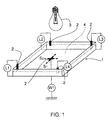
- the raising of the edges or “curling” is measured with a laboratory device in accordance with FIG. 1.
- the mortar is poured into a mold (1) of 33 x 33 x 3 cm 3 .
- Metal inserts (2) are held by a template for the first 24 hours.
- two displacement sensors measuring the shrinkage in the center of the plate (S 1 and S 2 ) and four displacement sensors (L 1 , L 2 , L 3 and L 4 ) measuring the edge reading are fixed on these inserts.
- a scale (W 1 ) also tracks the evolution of the mass. All these data are recorded over time.
- the device is placed in a climatic chamber (not shown) making it possible to maintain 20 ° C and 50% relative humidity.
- a thermal shock is applied between the seventh and the ninth day (40 ° C at the surface of the sample) (4), by means of an illuminating bulb (3) located above the sample (4).
- This device makes it possible to reproduce in the laboratory the behavior of a slab and to measure the curling (figure 2), the withdrawal (figure 3) and the evolution of the mass consecutive to the water departure (figure 4).
- Table 1 groups together the cement compositions presented in the examples 1 to 6 below, and Table 2 the results of the measurements carried out on them.
- the mortar is very stable, it keeps the fluidity which gives it character self-leveling required for casting beyond 3 hours.
- the mechanical resistance is satisfactory at 24 hours (table 2) and authorizes pedestrian passage on the screed as soon as this deadline.
- This composition of the mortar differs from that of the previous examples in the nature of the conventional thickener used. Behaviors of fresh mortars (table above) and hardened (table 2) are very close to those corresponding to the composition from example 1. The main difference lies in the time after which occurs stress relaxation, longer for example 4 (between seven and eight days) than for example 1 (five days). Due to the delay in establishing relaxation constraints, the amplitude of the reading is greater for the composition of the example 4, as shown in FIG. 2, but, for example 4, only a very small statement of the edges remain in long time.
- Example 5 comprises anhydrite. Characteristics rheological of fresh mortar (table 2) are lower than those of the examples above while the quantity of water related to the mass of cement is greater. The decrease in sprawl is due to the presence of anhydrite which increases the demand for water in the mortar, an effect well known to those skilled in the art.
- This example 5 shows that its composition, based on cement and anhydrite, makes it possible to eliminate, in a to some extent, the pathology of "curling" since beyond seven to eight days of drying manifests the relaxation of stresses which allows the sample to return to its original flatness ( Figure 2).
- the amplitude of the edge reading is much higher than that observed for the examples according to the invention (examples 1 and 4).
- Example 6 (comparative) (mortar for conventional self-leveling screed with high compactness)
- This example illustrates the behavior of cement screeds which show serious damage during drying, damage linked to the phenomenon of “curling”.
- the mortar has all the characteristics required to obtain a self-leveling screed, in particular the fluidity (table 2). Contrary to what is observed for the compositions of Examples 1 and 4 (present invention) and 5 (addition of anhydrite), no stress relaxation phenomenon is observed (FIG. 2) for the time necessary for the complete drying of the mortar. (figure 4). Admittedly, the reading of the edges is less marked during the first days (the drying is slower, the structure being more compact), but it continues when the drying is prolonged until reaching a value much higher than that corresponding to each of the compositions of Examples 1, 4 and 5, as soon as relaxation begins within them. Above all, the edges remain in the raised position. The sample is definitely distorted. Any overload is then likely to cause the material to break (cracking) including its own weight.
Landscapes
- Chemical & Material Sciences (AREA)
- Engineering & Computer Science (AREA)
- Ceramic Engineering (AREA)
- Materials Engineering (AREA)
- Structural Engineering (AREA)
- Organic Chemistry (AREA)
- Chemical Kinetics & Catalysis (AREA)
- Inorganic Chemistry (AREA)
- Curing Cements, Concrete, And Artificial Stone (AREA)
Abstract
Description
L'objet de la présente invention est donc de proposer une composition cimentaire pour chape fluide qui pallie les inconvénients précités, tout en présentant des propriétés habituellement requises pour tout mortier fluide, décrites ci-après :
- outre l'aspect parfaitement lisse évoqué ci-dessus, le mortier fluide doit conserver sa fluidité et sa cohésion ou stabilité (absence de ressuage) pendant au moins trois heures,
- l'absence de sédimentation, qui se mesure (plus précisément que le ressuage lorsque celui-ci est négligeable) après durcissement, est aussi requise,
- une fois coulé sous forme de plaque de faible épaisseur par rapport aux autres dimensions, puis durci, il doit présenter un gauchissement ou "curling" le plus faible possible, c'est-à-dire conserver sa planéité initiale même après séchage complet,
- enfin, le durcissement du mortier doit se produire avant 24 heures (après le malaxage en centrale à béton) de façon à ne pas pénaliser l'enchaínement des opérations ultérieures conduites par les autres corps de métier qui interviennent sur le chantier.
- ciment Portland CEM I ou ciment Portland composé CEM II (tel que défini par la norme NF P 15-301 : 1994)
- Superplastifiant (fluidifiant) à base acrylate ou méthacrylate (sous forme de
solution aqueuse à 33 % d'extrait sec ou sous forme sèche) :
- SSP 104 décrit dans la demande de brevet EP-A-0 725 044 (à 31 % de
matière active) qui est un terpolymère composé d'acrylate de sodium, de
méthacrylate de sodium et de poly(oxyde d'éthylène)
ou - Cimfluid 2000AC (à 28 % de matière active) qui comprend un poly(oxyde d'éthylène) de faible masse et un copolymère de méthacrylate de sodium et de méthacrylate de poly(oxyde d'éthylène).
- copolymères de a) acide acrylique ou méthacrylique et de b) hydroxy- (C2-C3 )alkylester de l'acide acrylique ou méthacrylique, comme ceux décrits dans la demande de brevet EP-A-0 303 747,
- mélange comprenant au moins un copolymère d'alkényléther de formule (I), au moins un polyalkènyléther de formule (II), et d'anhydride maléique, comme anhydride, ses produits d'hydrolyse ou sels desdits produits d'hydrolyse, comme décrits dans EP-A-0 619 277,
- copolymère de formule (I) décrite dans JP 6 048 797,
- additif superplastifiant obtenu par terpolymérisation de monomères de formules (IV), (V) ou (VI) comme décrit dans EP-A 0 612 702,
- sel du polymère formé par réaction d'un acide polycarboxylique avec un polymère acrylique contenant un atome d'azote, typiquement en solution aqueuse, comme décrit dans FR 2 656 297,
- composition polymère ou un des ses sels qui est un copolymère d'un mono-ester de l'acide maléique avec un composé de formule (I), et d'un monomère de formule (II), comme définies dans FR 2 668 773,
- copolymère statistique sous forme d'acide libre ou de sel, comportant trois types de monomères, comme décrit dans FR 2 671 090,
- copolymère vinylique soluble dans l'eau, "représentatif' de copolymères linéaires à partir de vinylacétate et acide maléamique N-substitué, selon la formule (A) décrite dans EP-A-0 604 676,
- agent dispersant comprenant un copolymère vinylique hydrosoluble obtenu par copolymérisation radicalaire en solution aqueuse à partir des monomères de formule (1), (2), (3) ,(4) et (5) comme décrit dans la demande de brevet EP-A-0 590 983,
- copolymère obtenu à partir de (A), (B), (C) et (D), comme décrit dans EP-A-0 610 699,
- polymère ou copolymère hydrosolubles d'acide carboxylique éthylénique choisi parmi les acides acrylique, méthacrylique, fumarique, maléique, itaconique, crotonique, aconitique, sinapique, mésaconique, undécylénique, angélique, hydoxy-acrylique, et l'anhydride maléique, comme décrit dans FR-A-2 699 915,
- additif pour le contrôle de la fluidité des compositions de ciment, comprenant au moins un copolymère obtenu à partir d'un monomère (a) d'ester d'acide mono(méth)acrylique d'alkylène glycol de formule (I) et d'un monomère (b) à base d'acide (méth)acrylique de formule (II), ou bien un copolymère obtenu à partir d'un monomère (d) à base de mono(méth)allyl éther d'alcoxypolyalkylène glycol de formule (III) et d'un monomère (b) à base d'acide (méth)acrylique de formule (IV) comme défini dans FR-A-2 706 447,
- ou tout autre superplastifiant, par exemple de type polynaphtalène sulfonate ou mélamine sulfonate.
- SSP 104 décrit dans la demande de brevet EP-A-0 725 044 (à 31 % de
matière active) qui est un terpolymère composé d'acrylate de sodium, de
méthacrylate de sodium et de poly(oxyde d'éthylène)
- Epaississants classiques (agissant par exclusion) utilisés sous forme de
matière sèche :
Ils sont choisis parmi les polymères d'origine naturelle tels que les
polysaccharides :
- gomme guar,
- gomme xanthane,
- caroube,
- cellulose modifiée,
- amidon modifié ou non,
- poly(oxyde d'éthylène) à très longue chaíne,
- polyacrylates de sodium réticulés
- alcools polyvinyliques,
- Epaississants de type gélifiants (utilisés sous forme de solution eau-cosolvant
type ether de glycol à 50 % d'extrait sec ou sous forme sèche) :
Ces polymères hydrosolubles sont choisis parmi :
- les ASE (Alkali Soluble Emulsion)
- les HASE (Hydrophobically Alkali Soluble Emulsion)
- les HEUR (Hydrophobically Modified URethan block copolymer): copolymères bloc poly(oxyde d'éthylène) urethane modifiés hydrophobes
- les polyethers-polyols
- les HMHEC (hydrophobically modified hydroxyethyl cellulose) : hydroxyéthyle cellulose modifiée hydrophobe.
- Tensio-actifs : Ces molécules présentent une certaine miscibilité avec l'eau et ont tendance à s'accumuler à l'interface entre l'eau et l'air.Les tensio-actifs préférés de l'invention sont de type zwiterionique ou non ionique car ils ont un effet moussant très important et sont insensibles à toute variation de pH.
- Sables : de granulométrie de préférence ≤ 5 mm environ.
- 386 parties de sable ≤ 4 mm
- 74 parties d'eau
- 0,63 partie de superplastifiant à base acrylate (Cimfluid 2000AC)
- 0,11 partie de poly(oxyde d'éthylène) Mw∼4 000 000
- 0,17 partie de copolymère bloc poly(oxyde d'éthylène) d'uréthane modifié hydrophobe
- 0,11 partie de N-lauryl beta iminopropionate de sodium
- 386 parties de sable ≤ 4 mm
- 74 parties d'eau
- 0,63 partie de superplastifiant à base acrylate (Cimfluid 2000AC)
- 0,11 partie de N-lauryl beta iminopropionate de sodium
- 0,28 partie de poly(oxyde d'éthylène) Mw∼4 000 000
- 386 parties de sable ≤ 4 mm
- 74 parties d'eau
- 0,63 parties de superplastifiant à base acrylate (Cimfluid 2000AC)
- 0,11 partie de N-lauryl beta iminopropionate de sodium
et uniquement un épaississant de type gélifiant : - 0,28 partie de copolymère bloc poly(oxyde d'éthylène) uréthane modifié hydrophobe
- 386 parties de sable ≤ 4 mm
- 74 parties d'eau
- 0,63 partie de superplastifiant à base acrylate (Cimfluid 2000AC)
- 0,11 partie de d'hydroxypropylguar, Mw∼220000-500000
- 0,17 partie de copolymère bloc polyurethane poly(oxyde d'éthylène) modifié hydrophobe
- 0,11 partie de N-lauryl beta iminopropionate de sodium
- 20 parties d'anhydrite
- 390 parties de sable ≤ 4 mm
- 85 parties d'eau
- 0,7 partie de polynaphtalène sulfonate
- 0,2 partie d'amidon modifié
- 187 parties de cendres volantes
- 357 parties de sable ≤ 4 mm
- 100 parties d'eau
- 1,75 parties de superplastifiant à base acrylate (Cimfluid 2000AC)
- 2,9 parties de silice précipitée jouant le rôle de complément granulaire


Claims (19)
- Composition cimentaire pour chape liquide à base de liant et d'adjuvants, le liant comprenant du ciment Portland et les adjuvants comprenant au moins un fluidifiant, caractérisée en ce que les adjuvants renferment une combinaison d'un agent épaississant agissant par exclusion stérique et d'un agent épaississant de type gélifiant.
- Composition cimentaire selon la revendication 1 caractérisée en ce que le liant comprend du ciment Portland sans ajout de sulfate de calcium autre que le régulateur de prise.
- Composition selon l'une des revendications précédentes, caractérisée en ce qu'elle comprend, pour 100 parties en poids de ciment Portland, de 1 à 5 parties d'un fluidifiant à base (méth)acrylate ou de type polynaphtalène sulfonate, ou mélamine sulfonate.
- Composition selon la revendication 3, caractérisée en ce qu'elle comprend, pour 100 parties de ciment Portland, de 0,03 à 1 partie de fluidifiant, de 0,02 à 1 partie d'agent épaississant agissant par exclusion stérique, et de 0,01 à 0,5 partie d'agent épaississant gélifiant.
- Composition selon la revendication 4, caractérisée en ce qu'elle comprend, pour 100 parties de ciment Portland, de 0,13 à 0,5 partie de fluidifiant, de 0,1 à 0,3 partie d'agent épaississant agissant par exclusion stérique, et de 0,05 à 0,15 partie d'agent épaississant gélifiant.
- Composition selon l'une quelconque des revendications précédentes, caractérisée en ce qu'elle comprend également un tensio-actif.
- Composition selon la revendication 6 caractérisée en ce qu'elle comprend de 0,01 à 0,15 partie de tensio-actif, pour 100 parties en poids de ciment Portland, permettant de réguler la quantité d'air entraíné entre approximativement 15 et 20 % en volume dans le matériau final.
- Composition selon l'une quelconque des revendications précédentes, caractérisée en ce qu'elle est mélangée à un agrégat.
- Composition selon la revendication 8, caractérisée en ce que l'agrégat est du sable de granulométrie inférieure ou égale à 5 mm environ.
- Composition selon l'une quelconque des revendications précédentes, caractérisée en ce qu'elle est additionnée d'eau dans des proportions de 40 à 90 parties en poids.
- Composition selon l'une quelconque des revendications précédentes, caractérisée en ce que l'épaississant agissant par exclusion stérique est choisi parmi les polysaccharides et les polymères de synthèse hydrosolubles à forte masse moléculaire.
- Composition selon l'une quelconque des revendications précédentes caractérisée en ce que l'épaississant agissant par exclusion stérique est choisi parmi les éthers de cellulose, les gommes xanthane, guar ou caroube.
- Composition selon l'une quelconque des revendications précédentes, caractérisée en ce que l'agent épaississant gélifiant est choisi parmi les hydrocolloïdes modifiés hydrophobes, les polysaccharides modifiés hydrophobes et les polymères hydrosolubles à base acrylique ou uréthane modifiés hydrophobes.
- Composition selon la revendication 13 caractérisée en ce que l'agent épaississant gélifiant est un copolymère bloc poly(oxyde d'éthylène) uréthane modifié hydrophobe.
- Utilisation de la composition cimentaire selon l'une des revendications précédentes pour la réalisation de chapes liquides autonivelantes.
- Procédé de fabrication d'une chape autonivelante à partir de la composition cimentaire selon les revendications 1 à 14 caractérisé en ce qu'il ne nécessite qu'un seul coulage, quelle que soit l'épaisseur requise de la chape.
- Chape autonivelante réalisée à partir de la composition cimentaire selon les revendications 1 à 14.
- Chape autonivelante selon la revendication 17 caractérisée en ce qu'elle présente une densité comprise entre 1,6 et 1,9 environ.
- Chape autonivelante selon l'une des revendications 17 ou 18 caractérisée en ce qu'elle présente une épaisseur supérieure à 6 cm environ.
Applications Claiming Priority (2)
| Application Number | Priority Date | Filing Date | Title |
|---|---|---|---|
| FR0013117 | 2000-10-13 | ||
| FR0013117A FR2815342B1 (fr) | 2000-10-13 | 2000-10-13 | Composition cimentaire, son utilisation pour la realisation de chape liquide autonivelante et chape ainsi obtenue |
Publications (2)
| Publication Number | Publication Date |
|---|---|
| EP1197480A1 true EP1197480A1 (fr) | 2002-04-17 |
| EP1197480B1 EP1197480B1 (fr) | 2005-04-27 |
Family
ID=8855309
Family Applications (1)
| Application Number | Title | Priority Date | Filing Date |
|---|---|---|---|
| EP01402536A Expired - Lifetime EP1197480B1 (fr) | 2000-10-13 | 2001-10-02 | Composition cimentaire, son utilisation pour la réalisation de chape liquide autonivelante et chape ainsi obtenue |
Country Status (5)
| Country | Link |
|---|---|
| US (2) | US6849117B2 (fr) |
| EP (1) | EP1197480B1 (fr) |
| CA (1) | CA2358679C (fr) |
| ES (1) | ES2240374T3 (fr) |
| FR (1) | FR2815342B1 (fr) |
Cited By (4)
| Publication number | Priority date | Publication date | Assignee | Title |
|---|---|---|---|---|
| WO2003106369A1 (fr) * | 2002-06-12 | 2003-12-24 | Elotex Ag | Additif pour systemes a prise hydraulique, melanges a prise hydraulique, et leur utilisation |
| FR2919602A1 (fr) * | 2007-07-30 | 2009-02-06 | Francais Ciments | "melange d'adjuvants modificateurs de rheologie pour beton autoplacant et beton autoplacant renfermant un tel melange" |
| FR2943339A1 (fr) * | 2009-03-23 | 2010-09-24 | Francais Ciments | Liant cimentaire et composition cimentaire pour chape fluide autonivelante, et chape fluide autonivelante ainsi realisee |
| WO2014009649A1 (fr) * | 2012-07-10 | 2014-01-16 | Saint-Gobain Weber | Compositions autonivelantes a base de liants hydrauliques pour chapes ou revetements de sol |
Families Citing this family (27)
| Publication number | Priority date | Publication date | Assignee | Title |
|---|---|---|---|---|
| AUPQ468299A0 (en) * | 1999-12-15 | 2000-01-20 | James Hardie Research Pty Limited | Method and apparatus for extruding cementitious articles |
| MXPA02008921A (es) * | 2000-03-14 | 2004-10-15 | James Hardie Res Pty Ltd | Materiales de construccion de fibras-cemento, con aditivos de baja densidad. |
| HUP0303345A3 (en) * | 2001-03-02 | 2004-05-28 | James Hardie Int Finance Bv | A method and apparatus for forming a laminated sheet material by spattering |
| US20030164119A1 (en) * | 2002-03-04 | 2003-09-04 | Basil Naji | Additive for dewaterable slurry and slurry incorporating same |
| US6936574B2 (en) * | 2002-08-30 | 2005-08-30 | Halliburton Energy Services, Inc. | Process for controlling gas migration during well cementing |
| US7993570B2 (en) * | 2002-10-07 | 2011-08-09 | James Hardie Technology Limited | Durable medium-density fibre cement composite |
| US20050011159A1 (en) * | 2003-07-14 | 2005-01-20 | Standal Douglas J. | Cove elements and floor coatings and methods for installing |
| US7315577B2 (en) * | 2003-09-15 | 2008-01-01 | Intel Corporation | Multiple antenna systems and method using high-throughput space-frequency block codes |
| US7998571B2 (en) | 2004-07-09 | 2011-08-16 | James Hardie Technology Limited | Composite cement article incorporating a powder coating and methods of making same |
| FR2880015B1 (fr) * | 2004-12-27 | 2007-02-23 | Francais Ciments | Composition cimentaire renfermant un agent de blocage du retrait et son utilisation notamment pour la fabrication de chapes liquides |
| NZ561265A (en) * | 2005-02-15 | 2011-11-25 | Hardie James Technology Ltd | Nailable flooring sheet which includes low density additives in cement |
| US8993462B2 (en) | 2006-04-12 | 2015-03-31 | James Hardie Technology Limited | Surface sealed reinforced building element |
| US20070272127A1 (en) * | 2006-05-27 | 2007-11-29 | Antonio Puccio | Marble mix kit and method of producing same |
| US8209927B2 (en) * | 2007-12-20 | 2012-07-03 | James Hardie Technology Limited | Structural fiber cement building materials |
| CL2009000371A1 (es) * | 2008-03-03 | 2009-10-30 | United States Gypsum Co | Composicion cementicia, que contiene una fase continua que resulta del curado de una mezcla cementicia, en ausencia de harina de silice, y que comprende cemento inorganico, mineral inorganico, relleno puzolanico, policarboxilato y agua; y uso de la composicion en una panel y barrera cementicia. |
| US8061257B2 (en) * | 2008-03-03 | 2011-11-22 | United States Gypsum Company | Cement based armor panel system |
| CL2009000372A1 (es) | 2008-03-03 | 2009-11-13 | United States Gypsum Co | Panel cementicio blindado reforzado con fibra, que comprende un nucleo cementicio de una fase curada constituida de cemento inorganico, mineral inorganico, relleno puzolanico, policarboxilato y agua, y una capa de recubrimiento unida a una superficie de la fase curada. |
| CL2009000373A1 (es) | 2008-03-03 | 2009-10-30 | United States Gypsum Co | Metodo para hacer un panel resistente a explosivos, con las etapas de preparar una mezcla cementicia acuosa de cemento, rellenos inorganicos y puzolanico, agente autonivelante de policarboxilato, y formar la mezcla en un panel con refuerzo de fibra, luego curar, pulir, cortar y curar el panel. |
| FR2950467B1 (fr) | 2009-09-23 | 2011-10-28 | Baltymore | Procede de traitement de materiaux solides radioactifs |
| ITMI20111642A1 (it) * | 2011-09-12 | 2013-03-13 | Italcementi Spa | Manufatto cementizio a basso spessore ed elevate qualita' superficiali per applicazioni non strutturali, e metodo per la sua produzione |
| WO2015148946A1 (fr) * | 2014-03-28 | 2015-10-01 | Dow Global Technologies Llc | Compositions stables de pce et de vma polysaccharidiques pour des gâchées de béton, et leurs utilisations |
| FR3053040B1 (fr) | 2016-06-23 | 2021-06-18 | Saint Gobain Placo | Materiau de construction sous forme de plaques |
| JP7095642B2 (ja) * | 2019-03-29 | 2022-07-05 | 住友大阪セメント株式会社 | セメント組成物 |
| CN111019662B (zh) * | 2019-12-20 | 2022-05-24 | 华南理工大学 | 一种利用铝灰生产的土壤保水剂及其制备方法 |
| CN112794693B (zh) * | 2021-02-22 | 2022-06-14 | 湖北联诺建设有限公司 | 一种内养护自流平砂浆 |
| US12338621B2 (en) | 2021-09-17 | 2025-06-24 | United States Gypsum Company | Structural load-bearing wall |
| CN114656229B (zh) * | 2022-04-29 | 2023-04-28 | 中国电建集团成都勘测设计研究院有限公司 | 用于批量获取原状土样的砂浆材料及取样施工方法 |
Citations (3)
| Publication number | Priority date | Publication date | Assignee | Title |
|---|---|---|---|---|
| DE3909070A1 (de) * | 1989-03-20 | 1990-09-27 | Aqualon Gmbh | Additiv fuer gips- und zementhaltige massen |
| JPH11157898A (ja) * | 1997-12-02 | 1999-06-15 | Kao Corp | 水硬性組成物用添加剤 |
| FR2780396A1 (fr) * | 1998-06-30 | 1999-12-31 | Coatex Sa | Nouveaux agents de type polycondensat pour ameliorer la maniabilite des liants hydrauliques, leur procede de preparation, les liants les contenant et leurs applications |
Family Cites Families (21)
| Publication number | Priority date | Publication date | Assignee | Title |
|---|---|---|---|---|
| US4394175A (en) * | 1981-05-07 | 1983-07-19 | Cheriton Leslie W | Self-levelling cementitious mixes |
| JPS5836956A (ja) * | 1981-08-26 | 1983-03-04 | 日本鋼管株式会社 | 転炉風砕スラグを用いた床用流動性組成物 |
| JPS5945626B2 (ja) * | 1981-12-29 | 1984-11-07 | 太平洋セメント株式会社 | セメント系セルフレベリング床材 |
| US4968734A (en) | 1986-07-01 | 1990-11-06 | W. R. Grace & Co.-Conn. | Cement admixture |
| JP2811336B2 (ja) | 1989-11-06 | 1998-10-15 | 株式会社エヌエムビー | 新規なセメント分散剤 |
| DE4135956C2 (de) | 1990-11-06 | 2001-10-18 | Mbt Holding Ag Zuerich | Zusatzmittel für Zementmischungen und deren Verwendung |
| CH682237A5 (en) | 1990-12-29 | 1993-08-13 | Sandoz Ag | Styrene]-maleic acid half-ester copolymer, used as cement additive |
| JP2628486B2 (ja) | 1992-09-30 | 1997-07-09 | 竹本油脂株式会社 | セメント用分散剤 |
| DK0604676T3 (da) | 1992-12-28 | 1997-07-28 | Sika Ag | Vandopløselige copolymerer af vinylacetat og maleaminsyrer, anvendelse heraf som fluidiseringsmidler eller "high range" vandreduktionsmidler til vandige suspensioner |
| FR2699915B1 (fr) | 1992-12-29 | 1995-03-10 | Prod Ind Cfpi Franc | Composition de matières améliorant les propriétés rhéologiques des produits à base de ciments. |
| AT399340B (de) | 1993-02-01 | 1995-04-25 | Chemie Linz Gmbh | Copolymere auf basis von maleinsäurederivaten und vinylmonomeren, deren herstellung und verwendung |
| IT1263969B (it) | 1993-02-25 | 1996-09-05 | Mario Collepardi | Addittivi superfluidificanti ad elevata conservazione della lavorabilita' |
| JP3420274B2 (ja) | 1993-04-05 | 2003-06-23 | ダブリュー・アール・グレース・アンド・カンパニー−コーン | 流動性低下防止に優れた新規なセメント分散剤組成物 |
| WO1995011204A1 (fr) | 1993-10-21 | 1995-04-27 | Chichibu Onoda Cement Corporation | Composition a base aqueuse et auto-nivelante |
| DE4430362A1 (de) * | 1994-08-26 | 1996-02-29 | Sueddeutsche Kalkstickstoff | Fließmittel für zementhaltige Bindemittelsuspensionen |
| FR2728890B1 (fr) * | 1994-12-30 | 1997-01-24 | Rhone Poulenc Chimie | Mortier fluide autonivelant comprenant du sulfate de calcium et de la chaux |
| FR2763065B1 (fr) * | 1997-05-12 | 1999-07-30 | Lafarge Sa | Composition autonivelante a base de ciment |
| FR2771088B1 (fr) * | 1997-11-17 | 2000-01-21 | Jean Dominique Ceccaldi | Beton ou mortier sans retrait |
| US5873936A (en) * | 1997-11-17 | 1999-02-23 | Maxxon Corp. | Cement composition self-leveling floor coating formulations and their method of use |
| JP4155616B2 (ja) * | 1998-01-20 | 2008-09-24 | 株式会社日本触媒 | セメント混和剤およびそれを用いたセメント組成物並びにその調製方法 |
| US6173778B1 (en) * | 1998-05-27 | 2001-01-16 | Bj Services Company | Storable liquid systems for use in cementing oil and gas wells |
-
2000
- 2000-10-13 FR FR0013117A patent/FR2815342B1/fr not_active Expired - Fee Related
-
2001
- 2001-10-02 EP EP01402536A patent/EP1197480B1/fr not_active Expired - Lifetime
- 2001-10-02 ES ES01402536T patent/ES2240374T3/es not_active Expired - Lifetime
- 2001-10-09 CA CA2358679A patent/CA2358679C/fr not_active Expired - Fee Related
- 2001-10-15 US US09/975,954 patent/US6849117B2/en not_active Expired - Lifetime
-
2004
- 2004-08-10 US US10/914,229 patent/US7166159B2/en not_active Expired - Fee Related
Patent Citations (3)
| Publication number | Priority date | Publication date | Assignee | Title |
|---|---|---|---|---|
| DE3909070A1 (de) * | 1989-03-20 | 1990-09-27 | Aqualon Gmbh | Additiv fuer gips- und zementhaltige massen |
| JPH11157898A (ja) * | 1997-12-02 | 1999-06-15 | Kao Corp | 水硬性組成物用添加剤 |
| FR2780396A1 (fr) * | 1998-06-30 | 1999-12-31 | Coatex Sa | Nouveaux agents de type polycondensat pour ameliorer la maniabilite des liants hydrauliques, leur procede de preparation, les liants les contenant et leurs applications |
Non-Patent Citations (1)
| Title |
|---|
| PATENT ABSTRACTS OF JAPAN vol. 1999, no. 11 30 September 1999 (1999-09-30) * |
Cited By (13)
| Publication number | Priority date | Publication date | Assignee | Title |
|---|---|---|---|---|
| WO2003106369A1 (fr) * | 2002-06-12 | 2003-12-24 | Elotex Ag | Additif pour systemes a prise hydraulique, melanges a prise hydraulique, et leur utilisation |
| CN1301931C (zh) * | 2002-06-12 | 2007-02-28 | 艾洛特斯股份公司 | 用于水凝体系的添加剂、水凝混合物及其用途 |
| US7988783B2 (en) | 2002-06-12 | 2011-08-02 | Akzo Nobel N.V. | Additive for hydraulically setting systems, the hydraulically setting mixtures and the use there of |
| WO2009053541A3 (fr) * | 2007-07-30 | 2009-07-02 | Francais Ciments | Composition cimentaire pour béton autoplaçant et béton autoplaçant renfermant une telle composition |
| FR2919602A1 (fr) * | 2007-07-30 | 2009-02-06 | Francais Ciments | "melange d'adjuvants modificateurs de rheologie pour beton autoplacant et beton autoplacant renfermant un tel melange" |
| EA020916B1 (ru) * | 2007-07-30 | 2015-02-27 | Симан Франсе | Композиция самоукладывающегося бетона и самоукладывающийся бетон, содержащий такую композицию |
| FR2943339A1 (fr) * | 2009-03-23 | 2010-09-24 | Francais Ciments | Liant cimentaire et composition cimentaire pour chape fluide autonivelante, et chape fluide autonivelante ainsi realisee |
| WO2010109116A3 (fr) * | 2009-03-23 | 2010-12-02 | Ciments Français | Composition cimentaire pour chape fluide autonivelante, et chape fluide autonivelante ainsi réalisée |
| US8226762B2 (en) | 2009-03-23 | 2012-07-24 | Ciments Francais | Cement composition for a self-leveling fluid screed, and self-leveling fluid screed thus produced |
| WO2014009649A1 (fr) * | 2012-07-10 | 2014-01-16 | Saint-Gobain Weber | Compositions autonivelantes a base de liants hydrauliques pour chapes ou revetements de sol |
| FR2993268A1 (fr) * | 2012-07-10 | 2014-01-17 | Saint Gobain Weber | Compositions autonivelantes a base de liants hydrauliques pour chapes ou revetements de sol |
| CN104661982A (zh) * | 2012-07-10 | 2015-05-27 | 圣戈班韦伯公司 | 用于地面面层或者覆盖层的基于水硬性粘结剂的自调平组合物 |
| CN104661982B (zh) * | 2012-07-10 | 2017-05-24 | 圣戈班韦伯公司 | 用于地面面层或者覆盖层的基于水硬性粘结剂的自调平组合物 |
Also Published As
| Publication number | Publication date |
|---|---|
| FR2815342A1 (fr) | 2002-04-19 |
| US7166159B2 (en) | 2007-01-23 |
| ES2240374T3 (es) | 2005-10-16 |
| US20050005821A1 (en) | 2005-01-13 |
| CA2358679A1 (fr) | 2002-04-13 |
| US20020121230A1 (en) | 2002-09-05 |
| EP1197480B1 (fr) | 2005-04-27 |
| US6849117B2 (en) | 2005-02-01 |
| FR2815342B1 (fr) | 2003-08-01 |
| CA2358679C (fr) | 2010-06-01 |
Similar Documents
| Publication | Publication Date | Title |
|---|---|---|
| EP1197480B1 (fr) | Composition cimentaire, son utilisation pour la réalisation de chape liquide autonivelante et chape ainsi obtenue | |
| EP2411345B1 (fr) | Composition cimentaire pour chape fluide autonivelante, et chape fluide autonivelante ainsi réalisée | |
| EP2108007B1 (fr) | Utilisation d'un additif rhéologique dans la fabrication par vibrocompaction d'une formulation a base d'eau et de liant hydraulique, formulation obtenue | |
| EP2601152B1 (fr) | Composition pulverulente de mortier a adherence amelioree | |
| WO2011086133A1 (fr) | Adjuvant moussant pour la preparation de mousses minerales d'enduits, de mortiers et betons, mousses ainsi obtenues et produits durcis issus de ces mousses | |
| FR2961806A1 (fr) | Beton permeable | |
| EP2176187B1 (fr) | Composition cimentaire de béton autoplaçant et béton autoplaçant renfermant une telle composition | |
| EP0886628B1 (fr) | Suspensions aqueuses de silice et leurs applications dans les compositions a base de liant mineral | |
| WO2014096701A1 (fr) | Composition de béton ou mortier allégé comprenant une mousse aqueuse | |
| CA2743556C (fr) | Utilisation d'au moins un ether de cellulose pour reduire le retrait et/ou la fissuration plastique dans le beton | |
| FR3097859A1 (fr) | Composition de liant pour matériau de construction | |
| EP1893548A2 (fr) | Compositions de liant rapide pour pieces et ouvrages en beton contenant un sel de calcium | |
| FR2961807A1 (fr) | Procede de transport d'une composition hydraulique | |
| FR2961804A1 (fr) | Composition hydraulique | |
| WO2000066512A1 (fr) | Beton pour la construction de chapes auto-nivelantes et son procede d'utilisation | |
| FR2961805A1 (fr) | Composition hydraulique retardee a prise declenchee par un accelerateur | |
| FR2948930A1 (fr) | Agent anti-pellicule de surface | |
| CA2749418C (fr) | Composition utile pour la preparation d'un beton sans ajout d'eau | |
| EP2817272B1 (fr) | Agent anti-pellicule de surface | |
| FR2921654A1 (fr) | Adjuvants pour des compositions hydrauliques de faible viscosite. | |
| CA2188627A1 (fr) | Additif pour controler la sedimentation des conglomerats | |
| WO2017202801A1 (fr) | Utilisation de platre pour la fabrication d'une chape fluide destinee aux pays chauds | |
| FR3038601A1 (fr) | Coulis d'injection et son utilisation pour remplir des canalisations |
Legal Events
| Date | Code | Title | Description |
|---|---|---|---|
| PUAI | Public reference made under article 153(3) epc to a published international application that has entered the european phase |
Free format text: ORIGINAL CODE: 0009012 |
|
| AK | Designated contracting states |
Kind code of ref document: A1 Designated state(s): AT BE CH CY DE DK ES FI FR GB GR IE IT LI LU MC NL PT SE TR Kind code of ref document: A1 Designated state(s): BE ES FR GR IT |
|
| AX | Request for extension of the european patent |
Free format text: AL;LT;LV;MK;RO;SI |
|
| RIN1 | Information on inventor provided before grant (corrected) |
Inventor name: GRELAUD, JEAN-PIERRE Inventor name: PASQUIER, MICHEL 1, RUE ANDRE LEBOURBLANC Inventor name: COLOMBET, PIERRE Inventor name: AMBROISE, JEAN |
|
| 17P | Request for examination filed |
Effective date: 20021004 |
|
| AKX | Designation fees paid |
Free format text: AT BE CH CY DE LI |
|
| RBV | Designated contracting states (corrected) |
Designated state(s): BE ES FR GR IT |
|
| REG | Reference to a national code |
Ref country code: DE Ref legal event code: 8566 |
|
| GRAP | Despatch of communication of intention to grant a patent |
Free format text: ORIGINAL CODE: EPIDOSNIGR1 |
|
| GRAS | Grant fee paid |
Free format text: ORIGINAL CODE: EPIDOSNIGR3 |
|
| GRAA | (expected) grant |
Free format text: ORIGINAL CODE: 0009210 |
|
| AK | Designated contracting states |
Kind code of ref document: B1 Designated state(s): BE ES FR GR IT |
|
| REG | Reference to a national code |
Ref country code: IE Ref legal event code: FG4D Free format text: LANGUAGE OF EP DOCUMENT: FRENCH |
|
| REG | Reference to a national code |
Ref country code: GR Ref legal event code: EP Ref document number: 20050401919 Country of ref document: GR |
|
| REG | Reference to a national code |
Ref country code: ES Ref legal event code: FG2A Ref document number: 2240374 Country of ref document: ES Kind code of ref document: T3 |
|
| PLBE | No opposition filed within time limit |
Free format text: ORIGINAL CODE: 0009261 |
|
| STAA | Information on the status of an ep patent application or granted ep patent |
Free format text: STATUS: NO OPPOSITION FILED WITHIN TIME LIMIT |
|
| 26N | No opposition filed |
Effective date: 20060130 |
|
| REG | Reference to a national code |
Ref country code: FR Ref legal event code: PLFP Year of fee payment: 15 |
|
| REG | Reference to a national code |
Ref country code: FR Ref legal event code: PLFP Year of fee payment: 16 |
|
| PGFP | Annual fee paid to national office [announced via postgrant information from national office to epo] |
Ref country code: FR Payment date: 20161020 Year of fee payment: 16 |
|
| PGFP | Annual fee paid to national office [announced via postgrant information from national office to epo] |
Ref country code: BE Payment date: 20161019 Year of fee payment: 16 Ref country code: ES Payment date: 20161011 Year of fee payment: 16 Ref country code: GR Payment date: 20161019 Year of fee payment: 16 Ref country code: IT Payment date: 20161024 Year of fee payment: 16 |
|
| REG | Reference to a national code |
Ref country code: FR Ref legal event code: ST Effective date: 20180629 |
|
| REG | Reference to a national code |
Ref country code: BE Ref legal event code: MM Effective date: 20171031 |
|
| PG25 | Lapsed in a contracting state [announced via postgrant information from national office to epo] |
Ref country code: FR Free format text: LAPSE BECAUSE OF NON-PAYMENT OF DUE FEES Effective date: 20171031 Ref country code: BE Free format text: LAPSE BECAUSE OF NON-PAYMENT OF DUE FEES Effective date: 20171031 Ref country code: GR Free format text: LAPSE BECAUSE OF NON-PAYMENT OF DUE FEES Effective date: 20180504 |
|
| PG25 | Lapsed in a contracting state [announced via postgrant information from national office to epo] |
Ref country code: IT Free format text: LAPSE BECAUSE OF NON-PAYMENT OF DUE FEES Effective date: 20171002 |
|
| REG | Reference to a national code |
Ref country code: ES Ref legal event code: FD2A Effective date: 20181220 |
|
| PG25 | Lapsed in a contracting state [announced via postgrant information from national office to epo] |
Ref country code: ES Free format text: LAPSE BECAUSE OF NON-PAYMENT OF DUE FEES Effective date: 20171003 |