EP1197233B1 - Poröser Keramikkörper für in vivo oder in vitro Gebrauch - Google Patents
Poröser Keramikkörper für in vivo oder in vitro Gebrauch Download PDFInfo
- Publication number
- EP1197233B1 EP1197233B1 EP01123383A EP01123383A EP1197233B1 EP 1197233 B1 EP1197233 B1 EP 1197233B1 EP 01123383 A EP01123383 A EP 01123383A EP 01123383 A EP01123383 A EP 01123383A EP 1197233 B1 EP1197233 B1 EP 1197233B1
- Authority
- EP
- European Patent Office
- Prior art keywords
- pores
- calcium phosphate
- porous ceramics
- sintered
- vivo
- Prior art date
- Legal status (The legal status is an assumption and is not a legal conclusion. Google has not performed a legal analysis and makes no representation as to the accuracy of the status listed.)
- Expired - Lifetime
Links
- 239000000919 ceramic Substances 0.000 title claims description 89
- 238000001727 in vivo Methods 0.000 title claims description 49
- 238000000338 in vitro Methods 0.000 title claims description 19
- 239000011148 porous material Substances 0.000 claims description 118
- 239000001506 calcium phosphate Substances 0.000 claims description 68
- QORWJWZARLRLPR-UHFFFAOYSA-H tricalcium bis(phosphate) Chemical compound [Ca+2].[Ca+2].[Ca+2].[O-]P([O-])([O-])=O.[O-]P([O-])([O-])=O QORWJWZARLRLPR-UHFFFAOYSA-H 0.000 claims description 68
- 235000011010 calcium phosphates Nutrition 0.000 claims description 60
- 229910000389 calcium phosphate Inorganic materials 0.000 claims description 56
- 239000002245 particle Substances 0.000 claims description 42
- 239000000463 material Substances 0.000 claims description 30
- QSHDDOUJBYECFT-UHFFFAOYSA-N mercury Chemical compound [Hg] QSHDDOUJBYECFT-UHFFFAOYSA-N 0.000 claims description 27
- 229910052753 mercury Inorganic materials 0.000 claims description 27
- 229910052588 hydroxylapatite Inorganic materials 0.000 claims description 19
- XYJRXVWERLGGKC-UHFFFAOYSA-D pentacalcium;hydroxide;triphosphate Chemical compound [OH-].[Ca+2].[Ca+2].[Ca+2].[Ca+2].[Ca+2].[O-]P([O-])([O-])=O.[O-]P([O-])([O-])=O.[O-]P([O-])([O-])=O XYJRXVWERLGGKC-UHFFFAOYSA-D 0.000 claims description 19
- 238000004891 communication Methods 0.000 claims description 16
- 238000000034 method Methods 0.000 claims description 14
- 238000005259 measurement Methods 0.000 claims description 10
- 239000002002 slurry Substances 0.000 claims description 10
- 239000000203 mixture Substances 0.000 claims description 9
- 229910000391 tricalcium phosphate Inorganic materials 0.000 claims description 8
- 235000019731 tricalcium phosphate Nutrition 0.000 claims description 8
- 229940078499 tricalcium phosphate Drugs 0.000 claims description 8
- 239000000843 powder Substances 0.000 claims description 6
- 239000003431 cross linking reagent Substances 0.000 claims description 4
- 239000004088 foaming agent Substances 0.000 claims description 4
- 239000002952 polymeric resin Substances 0.000 claims description 4
- 229920003002 synthetic resin Polymers 0.000 claims description 4
- 239000002131 composite material Substances 0.000 claims description 3
- 239000002612 dispersion medium Substances 0.000 claims description 3
- 238000003756 stirring Methods 0.000 claims description 3
- XLYOFNOQVPJJNP-UHFFFAOYSA-N water Substances O XLYOFNOQVPJJNP-UHFFFAOYSA-N 0.000 claims description 2
- 210000000988 bone and bone Anatomy 0.000 description 30
- 210000004027 cell Anatomy 0.000 description 23
- 238000009826 distribution Methods 0.000 description 15
- 230000015572 biosynthetic process Effects 0.000 description 13
- 210000000963 osteoblast Anatomy 0.000 description 11
- 238000011049 filling Methods 0.000 description 9
- 239000006185 dispersion Substances 0.000 description 7
- 238000005192 partition Methods 0.000 description 6
- 238000005245 sintering Methods 0.000 description 6
- 238000005452 bending Methods 0.000 description 5
- -1 calcium phosphate compound Chemical class 0.000 description 5
- 230000002950 deficient Effects 0.000 description 5
- 210000001519 tissue Anatomy 0.000 description 4
- 210000004204 blood vessel Anatomy 0.000 description 3
- 238000013270 controlled release Methods 0.000 description 3
- 238000010438 heat treatment Methods 0.000 description 3
- 239000007787 solid Substances 0.000 description 3
- 239000000126 substance Substances 0.000 description 3
- 241000842962 Apoda limacodes Species 0.000 description 2
- 229910014497 Ca10(PO4)6(OH)2 Inorganic materials 0.000 description 2
- FBPFZTCFMRRESA-FSIIMWSLSA-N D-Glucitol Natural products OC[C@H](O)[C@H](O)[C@@H](O)[C@H](O)CO FBPFZTCFMRRESA-FSIIMWSLSA-N 0.000 description 2
- 229920002873 Polyethylenimine Polymers 0.000 description 2
- 210000001124 body fluid Anatomy 0.000 description 2
- 239000010839 body fluid Substances 0.000 description 2
- 238000005520 cutting process Methods 0.000 description 2
- 239000000428 dust Substances 0.000 description 2
- 239000000835 fiber Substances 0.000 description 2
- 238000007667 floating Methods 0.000 description 2
- 239000012530 fluid Substances 0.000 description 2
- 239000006260 foam Substances 0.000 description 2
- 230000005484 gravity Effects 0.000 description 2
- 238000004519 manufacturing process Methods 0.000 description 2
- 229920000232 polyglycine polymer Polymers 0.000 description 2
- 229920000259 polyoxyethylene lauryl ether Polymers 0.000 description 2
- 238000011084 recovery Methods 0.000 description 2
- 239000000600 sorbitol Substances 0.000 description 2
- 229910021642 ultra pure water Inorganic materials 0.000 description 2
- 239000012498 ultrapure water Substances 0.000 description 2
- 238000005406 washing Methods 0.000 description 2
- OYPRJOBELJOOCE-UHFFFAOYSA-N Calcium Chemical compound [Ca] OYPRJOBELJOOCE-UHFFFAOYSA-N 0.000 description 1
- 229910001200 Ferrotitanium Inorganic materials 0.000 description 1
- 229910019142 PO4 Inorganic materials 0.000 description 1
- 208000002193 Pain Diseases 0.000 description 1
- RTAQQCXQSZGOHL-UHFFFAOYSA-N Titanium Chemical compound [Ti] RTAQQCXQSZGOHL-UHFFFAOYSA-N 0.000 description 1
- 229910052586 apatite Inorganic materials 0.000 description 1
- QVGXLLKOCUKJST-UHFFFAOYSA-N atomic oxygen Chemical compound [O] QVGXLLKOCUKJST-UHFFFAOYSA-N 0.000 description 1
- 230000005587 bubbling Effects 0.000 description 1
- 239000011575 calcium Substances 0.000 description 1
- 229910052791 calcium Inorganic materials 0.000 description 1
- 238000003763 carbonization Methods 0.000 description 1
- 229910010293 ceramic material Inorganic materials 0.000 description 1
- 239000003795 chemical substances by application Substances 0.000 description 1
- 230000000052 comparative effect Effects 0.000 description 1
- 201000010099 disease Diseases 0.000 description 1
- 208000037265 diseases, disorders, signs and symptoms Diseases 0.000 description 1
- 238000001035 drying Methods 0.000 description 1
- 230000000694 effects Effects 0.000 description 1
- 239000000945 filler Substances 0.000 description 1
- 239000008187 granular material Substances 0.000 description 1
- 210000005260 human cell Anatomy 0.000 description 1
- 230000010354 integration Effects 0.000 description 1
- 229940094506 lauryl betaine Drugs 0.000 description 1
- 238000002156 mixing Methods 0.000 description 1
- 238000000465 moulding Methods 0.000 description 1
- DVEKCXOJTLDBFE-UHFFFAOYSA-N n-dodecyl-n,n-dimethylglycinate Chemical compound CCCCCCCCCCCC[N+](C)(C)CC([O-])=O DVEKCXOJTLDBFE-UHFFFAOYSA-N 0.000 description 1
- 231100000252 nontoxic Toxicity 0.000 description 1
- 230000003000 nontoxic effect Effects 0.000 description 1
- 238000012829 orthopaedic surgery Methods 0.000 description 1
- 229910052760 oxygen Inorganic materials 0.000 description 1
- 239000001301 oxygen Substances 0.000 description 1
- 230000036407 pain Effects 0.000 description 1
- NBIIXXVUZAFLBC-UHFFFAOYSA-K phosphate Chemical compound [O-]P([O-])([O-])=O NBIIXXVUZAFLBC-UHFFFAOYSA-K 0.000 description 1
- 239000010452 phosphate Substances 0.000 description 1
- 235000021317 phosphate Nutrition 0.000 description 1
- 238000002360 preparation method Methods 0.000 description 1
- 238000010298 pulverizing process Methods 0.000 description 1
- 238000007493 shaping process Methods 0.000 description 1
- 238000003892 spreading Methods 0.000 description 1
- 229910001220 stainless steel Inorganic materials 0.000 description 1
- 239000010935 stainless steel Substances 0.000 description 1
- 230000001954 sterilising effect Effects 0.000 description 1
- 238000004659 sterilization and disinfection Methods 0.000 description 1
- 239000004575 stone Substances 0.000 description 1
- 238000001356 surgical procedure Methods 0.000 description 1
- 239000010936 titanium Substances 0.000 description 1
Images






Classifications
-
- C—CHEMISTRY; METALLURGY
- C04—CEMENTS; CONCRETE; ARTIFICIAL STONE; CERAMICS; REFRACTORIES
- C04B—LIME, MAGNESIA; SLAG; CEMENTS; COMPOSITIONS THEREOF, e.g. MORTARS, CONCRETE OR LIKE BUILDING MATERIALS; ARTIFICIAL STONE; CERAMICS; REFRACTORIES; TREATMENT OF NATURAL STONE
- C04B35/00—Shaped ceramic products characterised by their composition; Ceramics compositions; Processing powders of inorganic compounds preparatory to the manufacturing of ceramic products
- C04B35/01—Shaped ceramic products characterised by their composition; Ceramics compositions; Processing powders of inorganic compounds preparatory to the manufacturing of ceramic products based on oxide ceramics
- C04B35/447—Shaped ceramic products characterised by their composition; Ceramics compositions; Processing powders of inorganic compounds preparatory to the manufacturing of ceramic products based on oxide ceramics based on phosphates, e.g. hydroxyapatite
-
- A—HUMAN NECESSITIES
- A61—MEDICAL OR VETERINARY SCIENCE; HYGIENE
- A61F—FILTERS IMPLANTABLE INTO BLOOD VESSELS; PROSTHESES; DEVICES PROVIDING PATENCY TO, OR PREVENTING COLLAPSING OF, TUBULAR STRUCTURES OF THE BODY, e.g. STENTS; ORTHOPAEDIC, NURSING OR CONTRACEPTIVE DEVICES; FOMENTATION; TREATMENT OR PROTECTION OF EYES OR EARS; BANDAGES, DRESSINGS OR ABSORBENT PADS; FIRST-AID KITS
- A61F2/00—Filters implantable into blood vessels; Prostheses, i.e. artificial substitutes or replacements for parts of the body; Appliances for connecting them with the body; Devices providing patency to, or preventing collapsing of, tubular structures of the body, e.g. stents
- A61F2/02—Prostheses implantable into the body
- A61F2/28—Bones
-
- A—HUMAN NECESSITIES
- A61—MEDICAL OR VETERINARY SCIENCE; HYGIENE
- A61L—METHODS OR APPARATUS FOR STERILISING MATERIALS OR OBJECTS IN GENERAL; DISINFECTION, STERILISATION OR DEODORISATION OF AIR; CHEMICAL ASPECTS OF BANDAGES, DRESSINGS, ABSORBENT PADS OR SURGICAL ARTICLES; MATERIALS FOR BANDAGES, DRESSINGS, ABSORBENT PADS OR SURGICAL ARTICLES
- A61L24/00—Surgical adhesives or cements; Adhesives for colostomy devices
- A61L24/001—Use of materials characterised by their function or physical properties
- A61L24/0036—Porous materials, e.g. foams or sponges
-
- A—HUMAN NECESSITIES
- A61—MEDICAL OR VETERINARY SCIENCE; HYGIENE
- A61L—METHODS OR APPARATUS FOR STERILISING MATERIALS OR OBJECTS IN GENERAL; DISINFECTION, STERILISATION OR DEODORISATION OF AIR; CHEMICAL ASPECTS OF BANDAGES, DRESSINGS, ABSORBENT PADS OR SURGICAL ARTICLES; MATERIALS FOR BANDAGES, DRESSINGS, ABSORBENT PADS OR SURGICAL ARTICLES
- A61L24/00—Surgical adhesives or cements; Adhesives for colostomy devices
- A61L24/001—Use of materials characterised by their function or physical properties
- A61L24/0042—Materials resorbable by the body
-
- A—HUMAN NECESSITIES
- A61—MEDICAL OR VETERINARY SCIENCE; HYGIENE
- A61L—METHODS OR APPARATUS FOR STERILISING MATERIALS OR OBJECTS IN GENERAL; DISINFECTION, STERILISATION OR DEODORISATION OF AIR; CHEMICAL ASPECTS OF BANDAGES, DRESSINGS, ABSORBENT PADS OR SURGICAL ARTICLES; MATERIALS FOR BANDAGES, DRESSINGS, ABSORBENT PADS OR SURGICAL ARTICLES
- A61L24/00—Surgical adhesives or cements; Adhesives for colostomy devices
- A61L24/0047—Composite materials, i.e. containing one material dispersed in a matrix of the same or different material
- A61L24/0052—Composite materials, i.e. containing one material dispersed in a matrix of the same or different material with an inorganic matrix
- A61L24/0063—Phosphorus containing materials, e.g. apatite
-
- C—CHEMISTRY; METALLURGY
- C04—CEMENTS; CONCRETE; ARTIFICIAL STONE; CERAMICS; REFRACTORIES
- C04B—LIME, MAGNESIA; SLAG; CEMENTS; COMPOSITIONS THEREOF, e.g. MORTARS, CONCRETE OR LIKE BUILDING MATERIALS; ARTIFICIAL STONE; CERAMICS; REFRACTORIES; TREATMENT OF NATURAL STONE
- C04B38/00—Porous mortars, concrete, artificial stone or ceramic ware; Preparation thereof
- C04B38/0051—Porous mortars, concrete, artificial stone or ceramic ware; Preparation thereof characterised by the pore size, pore shape or kind of porosity
- C04B38/0064—Multimodal pore size distribution
-
- C—CHEMISTRY; METALLURGY
- C04—CEMENTS; CONCRETE; ARTIFICIAL STONE; CERAMICS; REFRACTORIES
- C04B—LIME, MAGNESIA; SLAG; CEMENTS; COMPOSITIONS THEREOF, e.g. MORTARS, CONCRETE OR LIKE BUILDING MATERIALS; ARTIFICIAL STONE; CERAMICS; REFRACTORIES; TREATMENT OF NATURAL STONE
- C04B38/00—Porous mortars, concrete, artificial stone or ceramic ware; Preparation thereof
- C04B38/06—Porous mortars, concrete, artificial stone or ceramic ware; Preparation thereof by burning-out added substances by burning natural expanding materials or by sublimating or melting out added substances
- C04B38/0615—Porous mortars, concrete, artificial stone or ceramic ware; Preparation thereof by burning-out added substances by burning natural expanding materials or by sublimating or melting out added substances the burned-out substance being a monolitic element having approximately the same dimensions as the final article, e.g. a porous polyurethane sheet or a prepreg obtained by bonding together resin particles
- C04B38/062—Porous mortars, concrete, artificial stone or ceramic ware; Preparation thereof by burning-out added substances by burning natural expanding materials or by sublimating or melting out added substances the burned-out substance being a monolitic element having approximately the same dimensions as the final article, e.g. a porous polyurethane sheet or a prepreg obtained by bonding together resin particles the burned-out substance being formed in situ, e.g. by polymerisation of a prepolymer composition containing ceramic powder
-
- A—HUMAN NECESSITIES
- A61—MEDICAL OR VETERINARY SCIENCE; HYGIENE
- A61F—FILTERS IMPLANTABLE INTO BLOOD VESSELS; PROSTHESES; DEVICES PROVIDING PATENCY TO, OR PREVENTING COLLAPSING OF, TUBULAR STRUCTURES OF THE BODY, e.g. STENTS; ORTHOPAEDIC, NURSING OR CONTRACEPTIVE DEVICES; FOMENTATION; TREATMENT OR PROTECTION OF EYES OR EARS; BANDAGES, DRESSINGS OR ABSORBENT PADS; FIRST-AID KITS
- A61F2/00—Filters implantable into blood vessels; Prostheses, i.e. artificial substitutes or replacements for parts of the body; Appliances for connecting them with the body; Devices providing patency to, or preventing collapsing of, tubular structures of the body, e.g. stents
- A61F2/02—Prostheses implantable into the body
- A61F2/30—Joints
- A61F2002/30001—Additional features of subject-matter classified in A61F2/28, A61F2/30 and subgroups thereof
- A61F2002/30003—Material related properties of the prosthesis or of a coating on the prosthesis
- A61F2002/30004—Material related properties of the prosthesis or of a coating on the prosthesis the prosthesis being made from materials having different values of a given property at different locations within the same prosthesis
- A61F2002/30011—Material related properties of the prosthesis or of a coating on the prosthesis the prosthesis being made from materials having different values of a given property at different locations within the same prosthesis differing in porosity
-
- A—HUMAN NECESSITIES
- A61—MEDICAL OR VETERINARY SCIENCE; HYGIENE
- A61F—FILTERS IMPLANTABLE INTO BLOOD VESSELS; PROSTHESES; DEVICES PROVIDING PATENCY TO, OR PREVENTING COLLAPSING OF, TUBULAR STRUCTURES OF THE BODY, e.g. STENTS; ORTHOPAEDIC, NURSING OR CONTRACEPTIVE DEVICES; FOMENTATION; TREATMENT OR PROTECTION OF EYES OR EARS; BANDAGES, DRESSINGS OR ABSORBENT PADS; FIRST-AID KITS
- A61F2/00—Filters implantable into blood vessels; Prostheses, i.e. artificial substitutes or replacements for parts of the body; Appliances for connecting them with the body; Devices providing patency to, or preventing collapsing of, tubular structures of the body, e.g. stents
- A61F2/02—Prostheses implantable into the body
- A61F2/30—Joints
- A61F2/3094—Designing or manufacturing processes
- A61F2002/30968—Sintering
-
- A—HUMAN NECESSITIES
- A61—MEDICAL OR VETERINARY SCIENCE; HYGIENE
- A61F—FILTERS IMPLANTABLE INTO BLOOD VESSELS; PROSTHESES; DEVICES PROVIDING PATENCY TO, OR PREVENTING COLLAPSING OF, TUBULAR STRUCTURES OF THE BODY, e.g. STENTS; ORTHOPAEDIC, NURSING OR CONTRACEPTIVE DEVICES; FOMENTATION; TREATMENT OR PROTECTION OF EYES OR EARS; BANDAGES, DRESSINGS OR ABSORBENT PADS; FIRST-AID KITS
- A61F2250/00—Special features of prostheses classified in groups A61F2/00 - A61F2/26 or A61F2/82 or A61F9/00 or A61F11/00 or subgroups thereof
- A61F2250/0014—Special features of prostheses classified in groups A61F2/00 - A61F2/26 or A61F2/82 or A61F9/00 or A61F11/00 or subgroups thereof having different values of a given property or geometrical feature, e.g. mechanical property or material property, at different locations within the same prosthesis
- A61F2250/0023—Special features of prostheses classified in groups A61F2/00 - A61F2/26 or A61F2/82 or A61F9/00 or A61F11/00 or subgroups thereof having different values of a given property or geometrical feature, e.g. mechanical property or material property, at different locations within the same prosthesis differing in porosity
-
- A—HUMAN NECESSITIES
- A61—MEDICAL OR VETERINARY SCIENCE; HYGIENE
- A61F—FILTERS IMPLANTABLE INTO BLOOD VESSELS; PROSTHESES; DEVICES PROVIDING PATENCY TO, OR PREVENTING COLLAPSING OF, TUBULAR STRUCTURES OF THE BODY, e.g. STENTS; ORTHOPAEDIC, NURSING OR CONTRACEPTIVE DEVICES; FOMENTATION; TREATMENT OR PROTECTION OF EYES OR EARS; BANDAGES, DRESSINGS OR ABSORBENT PADS; FIRST-AID KITS
- A61F2310/00—Prostheses classified in A61F2/28 or A61F2/30 - A61F2/44 being constructed from or coated with a particular material
- A61F2310/00005—The prosthesis being constructed from a particular material
- A61F2310/00179—Ceramics or ceramic-like structures
- A61F2310/00293—Ceramics or ceramic-like structures containing a phosphorus-containing compound, e.g. apatite
-
- C—CHEMISTRY; METALLURGY
- C04—CEMENTS; CONCRETE; ARTIFICIAL STONE; CERAMICS; REFRACTORIES
- C04B—LIME, MAGNESIA; SLAG; CEMENTS; COMPOSITIONS THEREOF, e.g. MORTARS, CONCRETE OR LIKE BUILDING MATERIALS; ARTIFICIAL STONE; CERAMICS; REFRACTORIES; TREATMENT OF NATURAL STONE
- C04B2111/00—Mortars, concrete or artificial stone or mixtures to prepare them, characterised by specific function, property or use
- C04B2111/00474—Uses not provided for elsewhere in C04B2111/00
- C04B2111/00836—Uses not provided for elsewhere in C04B2111/00 for medical or dental applications
Definitions
- the present invention relates to a porous ceramics body for in vivo and in vitro use and more particularly to a porous ceramics body for in vivo use made of a calcium phosphate sintered material which is preferably used for artificial bones and as a filling material for such artificial bones and has an excellent property in forming osseous tissues of a living body as well as a high degree of strength and also to a culture vessel for cells.
- the thus proposed conventional sintered porous body of calcium phosphate is formed of immature sintered porous material having an innumerable number of fine open pores in the walls portions.
- the reference to the immature sintered porous body was made to clarify that the crystalline particles to form a sintered body are not sufficiently connected, thus leaving gaps therebetween with the result that a number of fine pores having diameters substantially smaller than those of the crystalline particles are dispersed all over the sintered body.
- US 4,654,314 discloses a process for the preparation of a porous ceramic material, which comprises the steps of: bubbling 100 parts by weight of albument to form a multiplicity of bubbles having a size of 1 to 600 ⁇ m; incorporating the bubbled albumen with 30 to 120 parts by weight of calcium phosphate compound powder and 1 to 5 parts by weight of an organic fiber having a length of 5 ⁇ m to 5 mm and a diameter of 1 to 30 ⁇ m; shaping the thus-obtained mixture into a desired shape and size; heating the shaped mixture at a temperature of 120° to 150°C to harden the albumen; heating the hardened shaped mixture at a temperature of 500° to 700°C to carbonize the hardened albumen and organic fiber; and then, heating the carbonized shaped mixture at a temperature of 800° to 2,350°C in an oxygen-containing atmosphere to remove the carbonization product by burning and to sinter the calcium phosphate compound powder.
- the inventors made an intensive research work in order to overcome the above shortcomings of the conventional porous ceramics body for in vivo use (a sintered body of calcium phosphate). As a result, the reduction of strength in the sintered body of calcium phosphate was found less if said ceramics body of calcium phosphate has a particular pore structure, thus retaining the strength required for artificial bones and artificial osseous filling material. Further, it was found that said particular pore structure of the sintered calcium phosphate body assures quick formation of osseous tissues as a result of osseous tissue cells (osteoblast cells) and blood vessels entering the pores such that formation of the osseous tissues is prompted. Based on this knowledge, the inventors have completed the porous ceramics body for in vivo or in vitro use according to the present invention.
- the present invention has been made to solve the problems discussed hereinbefore and its object is to provide a porous ceramics body for in vivo or in vitro use which is excellent in maintaining a sufficient mechanical strength while prompting the formation of osseous system tissues such that suitable artificial bones, an artificial filling material for osseous systems.
- the porous ceramics body according to the present invention is characterized in that a number of pores are closely distributed in three dimensional directions, adjoining pores thereof being partitioned by wall portions formed with respective communication ports to bring said adjoining pores into communication with each other such that a vacancy of a series of spherical pores are formed therewithin, said porous ceramics body being made of a sintered calcium phosphate body, characterized in that, within said sintered calcium phosphate body, pores each having a diameter of 5 microns ( ⁇ m) or more account for 80 % or more of all the pores in terms of volume whereas pores having a diameter of less than 5 microns ( ⁇ m) account for less than 20 % of all the pores in terms of volume as subjected to a mercury porosimeter measurement, wherein said porous ceramics body being obtainable by a process comprising the steps of adding cross-linkable polymeric resin to a calcium phosphate in powder form together with water as a dispersion medium, forming a slurry, adding foaming agent
- the porous ceramics body according to the present invention is characterized in that a series of spherical pores are closely distributed in three dimensional directions such that said series of spherical pores allow the entry of osseous system cells (osteoblast cells) thereinto through the communication ports whereas adjoining pores are partitioned by wall portions in which there are substantially no open pores having a diameter of less than 5 microns ( ⁇ m), said porous ceramics body being made of a sintered calcium phosphate body.
- the porous ceramics body for in vivo use according to the present invention is made of the sintered calcium phosphate body of the aforementioned structure having therein a number of open pores to allow the entry of osseous system cells (osteoblast cells or the like) and blood vessels thereinto whereas there are substantially no pores except the communication ports in the wall portions.
- the volume of the pores having a diameter of 5 microns ( ⁇ m) or more accounts for 90 % of all the pores or more and the ratio of 93% or more is further preferable.
- complete sintering to minimize fine pores in the wall portions which partition adjoining pores like in the porous ceramics body according to the present invention.
- the complete sintering means in this context that crystalline particles constituting the sintered body are completely connected to each other leaving no gaps therebetween to such an extent that there are substantially no pores smaller than the crystalline particles all through the sintered body.
- porous ceramics body according to the present invention is suitable for artificial bones and a filling material for artificial osseous systems.
- pores accounting for an accumulated ratio of 50 % in terms of volume have a diameter of 10 to 600 microns ( ⁇ m) as subjected to a mercury porosimeter measurement.
- osseous system cells osteoblast cells or the like are quickly admitted into the porous ceramics body for in vivo or in vitro use to prompt the formation of osseous systems.
- pores accounting for an accumulated ratio of 50 % in terms of volume have a diameter less than 10 microns ( ⁇ m). If, on the other hand, pores accounting for an accumulated ratio of 50 % in terms of volume have a diameter more than 600 microns ( ⁇ m), osseous system cells (osteoblast cells or the like) which have been admitted thereinto will flow out without making the formation of osseous systems. Therefore, it is preferable that pores accounting for an accumulated ratio of 50 % in terms of volume have a diameter of 10 to 600 microns ( ⁇ m) as subjected to a mercury porosimeter measurement.
- pores accounting for an accumulated ration of 50 % in terms of volume have a diameter of 20 to 200 microns ( ⁇ m) if the mechanical strength thereof and the cell entry and subsequent stability thereat is to be considered and, in this respect, the diameter of 30 to 100 microns ( ⁇ m) is still further preferable.
- said sintered calcium phosphate body has a porosity of 45 to 90 %.
- a porous ceramics body which does not have a series of spherical pores in mutual communication has a problem that osseous system cells (osteoblast cells or the like) will not be admitted thereinto.
- the porosity of the sintered calcium phosphate body is more than 90 %, the mechanical strength of the porous ceramics body falls to such an extent the same is not suitable for artificial bones.
- said sintered calcium phosphate body has a porosity of 45 to 90 %.
- said sintered calcium phosphate body is a sintered body made of a material selected from hydroxy apatite, tricalcium phosphate and a composite material thereof. Hydroxy apatite is particularly preferable.
- Such sintered calcium phosphate body adopted for the porous ceramics body for in vivo use has an affinity with the human body and converted into complete osseous systems. Therefore, the need for a re-operation to remove surgical titanium or stainless steel members is eliminated.
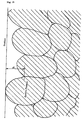
- each wall portion has a surface spread with calcium phosphate particles closely as if stone pavement, given calcium phosphate particles cooperating to define a recess therebetween, said recess having a diameter equal to or less than a mean particle diameter.
- the disclosure to the effect that given calcium phosphate particles cooperate to define a recess therebetween and that said recess has diameter equal to or less than a mean particle diameter means that the height h shown in Fig. 15 is equal to or less than a mean particle diameter.
- Such calcium phosphate particles and those therearound make a flat surface, thus providing an extensive contact area between the particles which prevents a possibility to drop therefrom and contributes to improvement of strength. If there is cutting dust on the surface, it can be difficult for fluid to enter the sintered calcium phosphate body.
- the sintered calcium phosphate body according to the present invention controls generation of floating particles like the cutting dust as mentioned above. Therefore, the risk of floating particles preventing the entry of the fluid thereinto is eliminated.
- a diameter of the pores as subjected to a mercury porosimeter measurement is being defined as the narrowest part within the series of open pores and corresponds with communication ports 3 in Fig. 1
- Fig. 1 is an explanatory cross-sectional view of the porous structure in the sintered body of calcium phosphate forming a porous ceramics body for in vivo or in vitro use according to the present invention
- Fig. 2 is an explanatory cross-sectional view of the typical porous structure in the sintered body of calcium phosphate in the prior art.
- a porous ceramics body for in vivo use made of a sintered calcium phosphate material in which a number of pores 2 are closely or densely distributed in three dimensional directions, adjoining pores thereof being partitioned by wall portions 1 formed with respective communication ports 3 such that said a number of pores 2 are provided in the form of a cluster or festoon within the porous ceramics body.
- said closely or densely distributed a number of pores 2 are in general partitioned by wall portions 1.
- Said wall portions which are otherwise supposed to partition the adjoining pores 2 have communication ports 2 to bring said adjoining pores 2 into communication with each other.
- a series of spherical pores are provided in the form of a cluster or festoon (as shown by the not-inked-in portions of the porous ceramics body in Fig. 1) within the porous ceramics body.
- Said wall portions per se which partition said series of spherical pores have substantially no pores formed therein. Further, the surfaces of the wall portions 1 are formed with irregularities in the form of fine recesses.
- the prior art porous ceramics body for in vivo use as shown in Fig. 2 has a porous structure within in which there are formed a number of pores 5 extending in three dimensional directions. Further, there are wall portions 1 to partition the pores 5, said wall portions per se being formed with fine pores 6 therewithin.
- the porous ceramics body for in vivo use according to the present invention is formed with the spherical pores 2 in communication with each other to be closely or densely distributed therewithin in three dimensional directions so as to allow easy entry of osseous tissue cells (osteoblast cells) or capillary vessel cells thereinto, thus prompting formation of osseous systems.
- the wall portions 1 to partition adjoining spherical pores 2 in the present invention have no fine pores 6 as found in the prior art, there is no remarkable reduction in mechanical strength thereof.
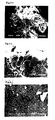
- Figs. 3a, 3b and 3c are electron microscopic pictures of porous ceramics body according to the present invention in which said body is made of hydroxy apatite; Fig. 3a picture was taken by an electron microscope with a magnification power of 35, Fig. 3b picture was taken by an electron microscope with a magnification power of 150, and Fig. 3c picture was taken by an electron microscope with a magnification power of 10,000.
- Figs. 4a, 4b and 4c are electron microscopic pictures of a prior art porous ceramics body for in vivo use (manufactured by company A; Fig. 4a picture was taken by an electron microscope with a magnification power of 35, Fig. 4b picture was taken by an electron microscope with a magnification power of 150, and Fig. 4c picture was taken by an electron microscope with a magnification power of 10,000.
- Fig. 5a, Fig. 5b and Fig. 5c are electron microscopic pictures of another prior art porous ceramics body for in vivo use (manufactured by company B; Fig. 5a picture was taken by an electron microscope with a magnification power of 35, Fig. 5b picture was taken by an electron microscope with a magnification power of 150, and Fig. 5c picture was taken by an electron microscope with a magnification power of 10,000.
- Fig. 6a, Fig. 6b and Fig. 6c are electron microscopic pictures of a further prior art porous ceramics body for in vivo use (manufactured by company C; Fig. 6a was taken by an electron microscope by a magnification power of 35, Fig. 6b picture was taken by an electron microscope with a magnification power of 150, and Fig. 6c picture was taken by an electron microscope with a magnification power of 10,000.
- Fig. 7a, Fig. 7b and Fig. 7c are electron microscopic pictures of a still further prior art porous ceramics body for in vivo use (manufactured by company D; Fig. 7a picture was taken by an electron microscope with a magnification power of 35, Fig. 7b picture was taken by an electron microscope with a magnification power of 150, and Fig. 7c picture was taken by an electron microscope, with a magnification power of 10,000.
- Fig. 8a, Fig. 8b and Fig. 8c are electron microscopic pictures of a still further prior art porous ceramics body for in vivo use (manufactured by company E; Fig. 8a picture was taken by an electron microscope with a magnification power of 35, Fig. 8b picture was taken by an electron microscope with a magnification power of 150, and Fig. 8c picture was taken by an electron microscope with a magnification power of 10,000.
- the majority of the wall portions 1 of the porous ceramics body has no fine pores but is formed with fine irregularities in the form of recesses in the surface thereof.
- the wall portions 1 of the prior art porous ceramics body are formed with fine pores 6 therewithin and the communication ports are not formed.
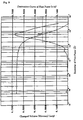
- Fig. 9 is a distribution map of fine pores plotted on the basis of the mercury porosimeter examination for the porous ceramics body for in vivo use according to the present invention (a specimen shown in Fig. 3);
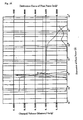
- Fig. 10 is a distribution map of fine pores plotted on the basis of mercury prosimeter examination for the prior art counterpart (the specimen shown in Fig. 4);
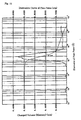
- Fig. 11 is a distribution map of fine pores plotted on the basis of mercury prosimeter examination for the prior art counterpart (the specimen shown in Fig. 5);
- Fig. 12 is a distribution map of fine pores plotted on the basis of mercury prosimeter examination for the prior art counterpart (the specimen shown in Fig. 6);
- Fig. 9 is a distribution map of fine pores plotted on the basis of the mercury porosimeter examination for the porous ceramics body for in vivo use according to the present invention (a specimen shown in Fig. 3);
- Fig. 10 is a distribution map of fine pores plotted on the basis of mercury prosimeter examination for
- Fig. 13 is a distribution map of fine pores plotted on the basis of mercury porosimeter examination for the prior art counterpart (the specimen shown in Fig. 7); and Fig. 14 is a distribution map of fine pores plotted on the basis of mercury porosimeter examination for the prior art counterpart (the specimen shown in Fig. 8).
- the porous ceramics body according to the present invention has a distribution of fine pores (measured by the mercury porosimeter examination) showing that the pores account for 80 % or more of all the pores in terms of volumes have a diameter of 5 micron (5 ⁇ m) or more and it is preferable that so do the pores accounting for 90 % or more.
- the volume of the pores each having a diameter of 5 micron (5 ⁇ m) or less accounts for less than 20 % of the total volume of all the pores therewithin and it is preferable that so do the pores accounting for less than 10 %.
- Figs. 10 through 14 show that the volume of the pores each having a diameter of 5 ⁇ m or more accounts for 50 % or less while pores accounting for at least 50 % or more thereof have fine pores (each having a diameter of less than 5 ⁇ m).
- the fine pore distribution (distribution plotted on the basis of the result of measurement by the mercury porosimeter examination) shown in Fig. 9 indicates that the diameters of the pores accounting for an accumulated percentage of 50 % are about 60 ⁇ m. Further, the fine pore distribution (plotted on the basis of the result of measurement by the mercury porosimeter examination) as shown in Figs. 10 through 14 indicates that the diameters of the pores accounting for an accumulated percentage of 50 are about 0.1 ⁇ m (Fig. 10), about 2.5 ⁇ m (Fig. 11), about 1.5 ⁇ m (Fig. 12), about 3 ⁇ m (Fig. 13), and about 0.3 ⁇ m (Fig. 14).
- the porous ceramics body according to the present invention has a very small number of or substantially no fine pores in the wall portions.
- the porous ceramics body according to the present invention is made of a sintered porous ceramics material having a very small number of pores in the wall portion of the porous body, said porous body is excellent in strength property such as bending strength. If the bending strength is lower to the level of the prior art, it is possible to have a higher percentage of pores.
- the porous ceramics body for in vivo use (that is, the porous ceramics body made of a sintered hydroxy apatite having the pore percentage of 75 %, the pore diameter (central value) of spherical pores of 150 ⁇ m) has a bending strength of 5 to 8 MPa which is two to three times a similar prior art sintered body (the pore percentage of 70 % or thereabout and the average pore diameter of 200 ⁇ m).
- calcium phosphate particles formed through granular growth by sintering constitute the body.
- a plurality of material particles fuse each other until particles rounded overall are observed on the surface by microscope.
- the surface of the porous ceramics body are relatively smoothly constructed by closely spreading said calcium phosphate particles overall such that the irregularities formed in the form of recesses between a given calcium phosphate particle on the surface and another given adjoining calcium phosphate particle on the surface are equal to or less than the mean particle diameter, thus ensuring that the body fluid is kept from stagnating to make it easy for the human cells to stick thereto uniformly and overall.
- the particles hardly fall off from the surface of the wall portions of the porous ceramics body such that there is no cause for cracks to be formed, thus improving the strength thereof.
- the surface of the wall portions spread with the calcium phosphate particles are in the shape of a reversed figure of the letter ⁇ in cross section, it is assumed that cells are effectively nested in tiny recesses defined therebetween. Further, calcium phosphate particles are securely joined to each other to prevent them from falling off therefrom such that washing thereof is easily done.
- the handling thereof at the time of a surgical operation is so easy that powder is hardly produced by any partial breakage. It is also possible to provide a shape to fit that of broken part of the patient's bone. Further, if the broken part of the patient's bone is to be refilled with the porous ceramics body in the form of granules which will not be squashed under refilling work, the porous structure of the refilling material is maintained to assure effective formation of osseous issues.
- the diameter of the communication ports 3 in the form of a series of spherical pores is in the range of 10 to 600 ⁇ m (central value) for the accumulated volume percentage of 50% by press charged mercury method.
- the structure of the porous ceramics body is aimed at easy entry of osseous tissues (osteoblast cells) or capillary vessels thereinto for stable and effective osseous formation.
- osseous tissues osteoblast cells
- capillary vessels thereinto for stable and effective osseous formation.
- the entry of osseous cells is not easy with a pore diameter of less than 10 ⁇ m (central value) while the circulation of the body fluid increases to such an extent that the cells will not take root due to flowout thereof at more than 600 ⁇ m.
- the pore percentage of the porous ceramics body for in vivo use in accordance with the present invention is in the range of 45 % to 90 %.
- the porosity ratio is less than 45 %, the osseous tissue cells (osteblast cells) or blood vessels will not enter the porous ceramics body easily. On the other hand, it is impossible to maintain a sufficient strength with the porosity ratio of more than 90 %. It is preferable in the present invention that the porosity ratio is in the neighborhood of 75 %.
- porous ceramics body according to the present invention is preferably provided with fine irregularities in the wall portions 1 within the pores of said porous ceramics body and said irregularities are defined by sintered material particles such that the osseous system cells (osteblast cells) take root to facilitate the osseous formation.
- osseous system cells osteblast cells
- sintered calcium phosphates which constitute the porous ceramics include tricalcium phosphate, hydroxy apatite, oxy apatite, quatrocalcium phosphate and combinations thereof. Of said materials, hydroxy apatite, tricalcium phosphate and the combinations thereof are particularly preferable.
- a cross-linkable polymeric resin such as polyethylene imine [Mn: about 8000 ⁇ 10500] is added to hydroxy apatite [Ca 10 (PO 4 ) 6 (OH) 2 ] in powder form having a mean diameter of 0.1 to 5 ⁇ m together with ultra pure water as a dispersion medium therefor to mix and pulverize into a slurry.
- a cross-linkable polymeric resin such as polyethylene imine [Mn: about 8000 ⁇ 10500] is added to hydroxy apatite [Ca 10 (PO 4 ) 6 (OH) 2 ] in powder form having a mean diameter of 0.1 to 5 ⁇ m together with ultra pure water as a dispersion medium therefor to mix and pulverize into a slurry.
- a foaming agent (a member selected from polyoxy ethylene laurylether, lauryl betaine, and lauryl triethanol sulfate amine) is added to stir and foam the mixture.
- a cross linking agent (sorbitol polyglycin diether or the like) is added thereto before the foamed slurry is poured into mold where the foamed slurry is fixed and dried to be further subjected to sinter the same at a temperature of 1100 °C to 1300 °C to obtain a sintered porous hydroxy apatite body.
- This sintering step is done for 0.5 to 3 hours and the resultant body is known as a completely sintered porous body.
- the complete sintering indicates a state in which crystalline particles forming a sintered body are sufficiently connected each other leaving no gaps therebetween such that there are no pores substantially smaller than the crystalline particles all over the sintered body.
- the fine pores in the wall portions 1 of the body of the porous ceramics body disappear while the wall portions 1 of the body are formed with fine irregularities on the surfaces thereof.
- the wall portions of the porous ceramics body which partition the respective adjoining pores are so thin as to collapse on drying or sintering to define communication ports. Further, since no press molding is involved in the manufacture of the porous ceramics body, a sintered body having a high porosity is easily obtained.
- porous body is completely sintered, fine pores are prevented from being formed in the wall portions.
- porous ceramics body for in vivo and in vitro use according to the present invention is excellent in prompting the in vivo osseous formation while maintaining the mechanical strength, it makes a suitable artificial bone or an artificial osseous filling material.
- a sintered hydroxy apatite body is most suitable for artificial bones or artificial filling materials.
- a slurry was prepared by adding, as a cross linked polymeric resin, 10.5 parts by weight of polyethylene imine (Mn8000 to 10500) to 100 parts by weight of powdered hydroxy apatite [Ca 10 (PO 4 ) 6 (OH) 2 ] having a mean diameter of 0.3 ⁇ m together with 70 parts by weight of ultra pure water as a dispersion agent for mixing and pulverizing.
- a foaming agent polyoxyethylene laurylether
- pores having diameters of 5 ⁇ m or more accounts for 97 % or more of the entire pores in the thus obtained porous ceramics body for in vivo use whereas fine pores having a diameter of less than 5 ⁇ m scarcely exist.
- the porosity calculated from the bulk specific gravity and the true specific gravity is 75 %.
- the bending strength measurement of the porous ceramics body specimen is 8MPa.
- Three types of commercially available calcium phosphates [including (A) the specimen shown in Figs. 4 (manufactured by company A: HAp (hydroxy apatite) having a porosity of 70%; (B) the specimen shown in Figs. 5 (manufactured by company B: HAp of 70%, ⁇ -TCP (tricalcium phosphate) of 30%, a porosity of 55 %; (C) the specimen shown in Figs. 6 (manufactured by company C : ⁇ -TCP a porosity of 75 % ) were prepared and subjected to the examination in accordance with the press charged mercury method to show obtained results in Figs. 10 through 12.
- the prior art sintered porous body had a considerably larger number of fine pores having a diameter of less than 5 ⁇ m than the embodiments.
- a tiny piece having a diameter of 10mm and a length of 4mm was prepared from the specimen used in Embodiment 1. Said piece was subjected to a normal sterilization process and, thereafter, was implanted in the back of a rat
- the porous body suits an artificial bone or an artificial osseous filling material in the above embodiment
- the porous ceramics body for in vivo or in vitro use according to the present invention can be suitably used for a material used for controlled release of chemicals within a living body.
- tricalcium phosphate is suitable as the material for controlled release of chemicals as porous ceramics body for in vivo use.
- porous ceramics body for in vivo or in vitro use according to the present invention is made of a sintered calcium body having a particular structure, in vivo osseous formation is promptly done and excellent in the strength, thus providing a suitable material as artificial bones, artificial osseous filler, a material for controlled release of chemicals or a culture vessel for cells.
Landscapes
- Chemical & Material Sciences (AREA)
- Health & Medical Sciences (AREA)
- Engineering & Computer Science (AREA)
- Ceramic Engineering (AREA)
- Materials Engineering (AREA)
- General Health & Medical Sciences (AREA)
- Veterinary Medicine (AREA)
- Public Health (AREA)
- Life Sciences & Earth Sciences (AREA)
- Animal Behavior & Ethology (AREA)
- Surgery (AREA)
- Structural Engineering (AREA)
- Epidemiology (AREA)
- Organic Chemistry (AREA)
- Cardiology (AREA)
- Inorganic Chemistry (AREA)
- Dispersion Chemistry (AREA)
- Manufacturing & Machinery (AREA)
- Orthopedic Medicine & Surgery (AREA)
- Composite Materials (AREA)
- Oral & Maxillofacial Surgery (AREA)
- Transplantation (AREA)
- Biomedical Technology (AREA)
- Heart & Thoracic Surgery (AREA)
- Vascular Medicine (AREA)
- Compositions Of Oxide Ceramics (AREA)
- Materials For Medical Uses (AREA)
Claims (9)
- Poröser Keramikkörper für die in-vivo- oder in-vitro-Verwendung, worin eine Anzahl von Poren eng in dreidimensionaler Richtung verteilt sind, und benachbarte Poren davon durch Wandbereiche voneinander getrennt sind, die mit jeweiligen Verbindungsöffnungen ausgestattet sind, so dass die benachbarten Poren miteinander in einer solchen Weise verbunden sind, dass eine Reihe von sphärischen Poren dadurch geformt werden, wobei der poröse Keramikkörper hergestellt ist aus einem gesinterten Calciumphosphatkörper, dadurch gekennzeichnet, dass innerhalb des gesinterten Calciumphosphatkörpers offene Poren, die jeweils einen Durchmesser von 5 µm oder mehr aufweisen, 80% oder mehr, bezogen auf das Volumen, aller Poren ausmachen, wohingegen offene Poren mit einem Durchmesser von weniger als 5 µm, bezogen auf das Volumen, weniger als 20% aller Poren ausmachen, bestimmt mittels Quecksilberporosimetermessung, wobei der poröse Keramikkörper erhältlich ist nach einem Verfahren, das die Schritte der Zugabe eines vernetzbaren Polymerharzes zu Calciumphosphat in Pulverform zusammen mit Wasser als Dispersionsmedium, Herstellen einer Aufschlämmung, Zugabe eines Aufschäummittels, Rühren dieser Mischung, Zugabe eines Vernetzungsmittels und Eingießen der Mischung in eine Form, in der die aufgeschäumte Aufschlämmung fixiert, getrocknet und gesintert wird, umfasst.
- Poröser Keramikkörper für die in-vivo- oder in-vitro-Verwendung gemäß Anspruch 1, worin Poren, die zu einem akkumulierten Anteil von 50%, bezogen auf das Volumen, beitragen, einen Durchmesser von 10-600 µm aufweisen, gemessen mittels Quecksilberporosimetrie.
- Poröser Keramikkörper für die in-vivo oder in-vitro-Verwendung gemäß Anspruch 1 oder 2, worin der gesinterte Calciumphosphatkörper eine Porosität von 45-90% aufweist.
- Poröser Keramikkörper für die in-vivo oder in-vitro-Verwendung gemäß Anspruch 1 oder 2, worin der gesinterte Calciumphosphatkörper ein Sinterkörper ist, der hergestellt ist aus einem Material, das ausgewählt ist aus Hydroxyapatit, Tricalciumphosphat und einem Kompositmaterial daraus.
- Poröser Keramikkörper für die in-vivo oder in-vitro-Verwendung gemäß Anspruch 3, worin der gesinterte Calciumphosphatkörper ein Sinterkörper ist, der hergestellt ist aus einem Material, das ausgewählt ist aus Hydroxyapatit, Tricalciumphosphat und einem Kompositmaterial daraus.
- Poröser Keramikkörper für die in-vivo oder in-vitro-Verwendung gemäß Anspruch 1 oder 2, worin jeder Wandbereich eine mit Calciumphosphatteilchen bedeckte Oberfläche aufweist, benachbarte Calciumphosphatteilchen unter Festlegung einer Vertiefung zwischen ihnen zusammenwirken, und die Vertiefung eine Tiefe aufweist, die kleiner oder gleich einem mittleren Teilchendurchmesser ist.
- Poröser Keramikkörper für die in-vivo oder in-vitro-Verwendung gemäß Anspruch 3, worin jeder Wandbereich eine mit Calciumphosphatteilchen bedeckte Oberfläche aufweist, benachbarte Calciumphosphatteilchen unter Festlegung einer Vertiefung zwischen ihnen zusammenwirken, und die Vertiefung eine Tiefe aufweist, die kleiner oder gleich einem mittleren Teilchendurchmesser ist.
- Poröser Keramikkörper für die in-vivo oder in-vitro-Verwendung gemäß Anspruch 4, worin jeder Wandbereich eine mit Calciumphosphatteilchen bedeckte Oberfläche aufweist, benachbarte Calciumphosphatteilchen unter Festlegung einer Vertiefung zwischen ihnen zusammenwirken, und die Vertiefung eine Tiefe aufweist, die kleiner oder gleich einem mittleren Teilchendurchmesser ist.
- Poröser Keramikkörper für die in-vivo oder in-vitro-Verwendung gemäß Anspruch 5, worin jeder Wandbereich eine mit Calciumphosphatteilchen bedeckte Oberfläche aufweist, benachbarte Calciumphosphatteilchen unter Festlegung einer Vertiefung zwischen ihnen zusammenwirken, und die Vertiefung eine Tiefe aufweist, die kleiner oder gleich einem mittleren Teilchendurchmesser ist.
Applications Claiming Priority (6)
| Application Number | Priority Date | Filing Date | Title |
|---|---|---|---|
| JP2000312934 | 2000-10-13 | ||
| JP2000312934 | 2000-10-13 | ||
| JP2001033147 | 2001-02-09 | ||
| JP2001033147 | 2001-02-09 | ||
| JP2001151934 | 2001-05-22 | ||
| JP2001151934 | 2001-05-22 |
Publications (2)
| Publication Number | Publication Date |
|---|---|
| EP1197233A1 EP1197233A1 (de) | 2002-04-17 |
| EP1197233B1 true EP1197233B1 (de) | 2006-04-12 |
Family
ID=27344927
Family Applications (1)
| Application Number | Title | Priority Date | Filing Date |
|---|---|---|---|
| EP01123383A Expired - Lifetime EP1197233B1 (de) | 2000-10-13 | 2001-10-11 | Poröser Keramikkörper für in vivo oder in vitro Gebrauch |
Country Status (3)
| Country | Link |
|---|---|
| US (1) | US6713420B2 (de) |
| EP (1) | EP1197233B1 (de) |
| DE (1) | DE60118683T2 (de) |
Families Citing this family (14)
| Publication number | Priority date | Publication date | Assignee | Title |
|---|---|---|---|---|
| JP3739715B2 (ja) * | 2002-03-19 | 2006-01-25 | オリンパス株式会社 | 人工骨および組織工学用担体 |
| DE10328892A1 (de) * | 2003-06-26 | 2005-05-12 | Curasan Ag | Knochenaufbaumittel und Herstellungsverfahren |
| WO2005020846A2 (en) * | 2003-08-25 | 2005-03-10 | Mcgowan Kenneth A | Artificial bone and joint compositions and methods of use and manufacture |
| CN100389733C (zh) * | 2004-11-29 | 2008-05-28 | 西安理工大学 | 孔结构呈梯度变化的球形内孔人工骨的制备方法 |
| US7901650B2 (en) * | 2005-06-22 | 2011-03-08 | Skeletal Kinectics, LLC | Porous beta-tricalcium phosphate and methods for producing the same |
| US10300167B2 (en) | 2006-03-24 | 2019-05-28 | Cabertech, Inc. | Functionalized calcium phosphate artificial bone and joint compositions and methods of use and manufacture |
| EP2001409B1 (de) * | 2006-03-24 | 2019-07-10 | CAberTech, Inc. | Funktionalisierte künstliche knochen- und gelenkszusammensetzungen sowie verfahren zu ihrer herstellung und verwendung |
| JP5237291B2 (ja) * | 2007-09-12 | 2013-07-17 | 株式会社クラレ | 人工骨 |
| AU2009204183A1 (en) * | 2008-01-09 | 2009-07-16 | Innovative Health Technologies, Llc | Implant pellets and methods for performing bone augmentation and preservation |
| JP5095034B2 (ja) * | 2009-12-18 | 2012-12-12 | ハウメディカ・オステオニクス・コーポレイション | 照射後貯蔵安定性の直接注入可能なデュアルペースト型骨セメントを製造するシステムおよびリン酸カルシウム組成物 |
| WO2012062360A1 (en) | 2010-11-10 | 2012-05-18 | Stryker Trauma Gmbh | Polymeric bone foam composition and method |
| US10981832B2 (en) * | 2015-09-16 | 2021-04-20 | Sofsera Corporation | Sintered calcium phosphate molded body and process for manufacturing the same |
| US12186456B2 (en) | 2018-08-09 | 2025-01-07 | Osaka University | Artificial bone and manufacturing method of artificial bone |
| TWI791260B (zh) * | 2021-08-12 | 2023-02-01 | 行政院農業委員會 | 一種從含鈣生物廢棄物製備雙相磷酸鈣多孔陶瓷的兩階段燒結方法 |
Family Cites Families (21)
| Publication number | Priority date | Publication date | Assignee | Title |
|---|---|---|---|---|
| JPS56166843A (en) | 1980-05-28 | 1981-12-22 | Mitsubishi Mining & Cement Co | Filler for bone broken section and void section |
| GB8312384D0 (en) | 1983-05-05 | 1983-06-08 | Drg Uk Ltd | Printing roll with detachable sleeve |
| JPS6016879A (ja) | 1983-07-09 | 1985-01-28 | 住友セメント株式会社 | 多孔質セラミツク材料 |
| US4654314A (en) * | 1983-07-09 | 1987-03-31 | Sumitomo Cement Co., Ltd. | Porous ceramic material and processes for preparing same |
| JPS62295666A (ja) | 1986-06-16 | 1987-12-23 | 呉羽化学工業株式会社 | 連続二次元多孔型インプラント材及びその製造法 |
| JP2572606B2 (ja) * | 1987-09-14 | 1997-01-16 | 旭光学工業株式会社 | 表面多孔質なリン酸カルシウム系セラミックスの製造法 |
| JP2706467B2 (ja) | 1988-05-27 | 1998-01-28 | 住友大阪セメント株式会社 | 骨移植用人工骨構造体 |
| JPH0233388A (ja) | 1988-07-19 | 1990-02-02 | Nkk Corp | スクリーンユニットの製造方法 |
| JPH0533062A (ja) | 1991-07-26 | 1993-02-09 | Kawasaki Steel Corp | 無方向性電磁鋼板の製造方法 |
| DE69207198C5 (de) | 1991-08-12 | 2007-12-06 | Dytech Corp. Ltd., Stannington | Poröse gegenstände |
| JPH0575427A (ja) | 1991-09-13 | 1993-03-26 | Nec Corp | 半導体集積回路装置 |
| JPH05305134A (ja) | 1992-04-30 | 1993-11-19 | Japan Steel Works Ltd:The | 骨形成用多孔質燐酸カルシウム材 |
| JP3231135B2 (ja) | 1993-04-16 | 2001-11-19 | 日本特殊陶業株式会社 | 生体インプラント材料及びその製造方法 |
| JP2576404B2 (ja) | 1994-04-22 | 1997-01-29 | 三菱マテリアル株式会社 | 骨欠損部、骨空隙部及び骨吸収部充填材の製造法 |
| JPH07291759A (ja) | 1994-04-27 | 1995-11-07 | Ngk Spark Plug Co Ltd | 多孔質セラミックスの製造方法 |
| DE4435680A1 (de) | 1994-10-06 | 1996-04-11 | Merck Patent Gmbh | Poröse Knochenersatzmaterialien |
| JPH08133857A (ja) | 1994-11-08 | 1996-05-28 | Sumitomo Electric Ind Ltd | セラミックス多孔体及びその製造方法 |
| GB2354519B (en) | 1996-10-04 | 2001-06-13 | Dytech Corp Ltd | Production of porous ceramic articles |
| JPH10167853A (ja) | 1996-12-11 | 1998-06-23 | Shigeharu Takagi | 人工骨材料用の多孔質体セラミックス成形体 |
| WO1998038948A1 (en) | 1997-03-04 | 1998-09-11 | Implico B.V. | An artefact suitable for use as a bone implant |
| JP3400740B2 (ja) | 1999-04-13 | 2003-04-28 | 東芝セラミックス株式会社 | リン酸カルシウム系多孔質焼結体およびその製造方法 |
-
2001
- 2001-10-10 US US09/973,079 patent/US6713420B2/en not_active Expired - Fee Related
- 2001-10-11 EP EP01123383A patent/EP1197233B1/de not_active Expired - Lifetime
- 2001-10-11 DE DE60118683T patent/DE60118683T2/de not_active Expired - Lifetime
Also Published As
| Publication number | Publication date |
|---|---|
| DE60118683T2 (de) | 2007-03-15 |
| US6713420B2 (en) | 2004-03-30 |
| US20020052662A1 (en) | 2002-05-02 |
| DE60118683D1 (de) | 2006-05-24 |
| EP1197233A1 (de) | 2002-04-17 |
Similar Documents
| Publication | Publication Date | Title |
|---|---|---|
| EP1197233B1 (de) | Poröser Keramikkörper für in vivo oder in vitro Gebrauch | |
| Sopyan et al. | Porous hydroxyapatite for artificial bone applications | |
| US7709081B2 (en) | Porous bioactive glass and preparation method thereof | |
| EP1545466B1 (de) | Anorganische geformte körper und verfahren für ihre herstellung und verwendung | |
| US6221477B1 (en) | Material and process for producing the same | |
| EP1210036B1 (de) | Verbundformkörper sowie verfahren zur herstellung und zum gebrauch | |
| US7012034B2 (en) | Resorbable bone replacement and bone formation material | |
| US7279219B2 (en) | Porous calcium phosphate ceramic and method for producing same | |
| JP2004505677A (ja) | 多孔質人工骨移植片およびその製造方法 | |
| JPH0359703B2 (de) | ||
| US6776860B2 (en) | Ceramic composite and manufacturing method thereof | |
| JP4699902B2 (ja) | リン酸カルシウムセラミックス多孔体及びその製造方法 | |
| EP1293220B1 (de) | Poröse Calciumphosphat-Keramik für in vivo-Anwendungen | |
| JP3470759B2 (ja) | 生体用セラミックス多孔質部材 | |
| JPH0566909B2 (de) | ||
| JP2011125653A (ja) | 複合生体材料 | |
| KR101767458B1 (ko) | 다중치수기공형 세라믹 과립 및 분무열분해법과 발포법을 이용한 그 제조 방법 | |
| JP2011110388A (ja) | 複合生体材料 | |
| Hench | a Julian R. Jones | |
| HK40061207A (en) | Collagen matrix or granulate blend of bone substitute material | |
| HK40061207B (en) | Collagen matrix or granulate blend of bone substitute material | |
| ZA200106061B (en) | Inorganic shaped bodies and methods for their production and use. |
Legal Events
| Date | Code | Title | Description |
|---|---|---|---|
| PUAI | Public reference made under article 153(3) epc to a published international application that has entered the european phase |
Free format text: ORIGINAL CODE: 0009012 |
|
| AK | Designated contracting states |
Kind code of ref document: A1 Designated state(s): DE GB Kind code of ref document: A1 Designated state(s): AT BE CH CY DE DK ES FI FR GB GR IE IT LI LU MC NL PT SE TR |
|
| AX | Request for extension of the european patent |
Free format text: AL;LT;LV;MK;RO;SI |
|
| 17P | Request for examination filed |
Effective date: 20020531 |
|
| 17Q | First examination report despatched |
Effective date: 20021017 |
|
| AKX | Designation fees paid |
Free format text: DE GB |
|
| RAP1 | Party data changed (applicant data changed or rights of an application transferred) |
Owner name: TOSHIBA DENKO CO., LTD Owner name: INDEPENDENT ADMINISTRATIVE INSTITUTION NATIONAL IN Owner name: TOSHIBA CERAMICS CO., LTD. |
|
| GRAP | Despatch of communication of intention to grant a patent |
Free format text: ORIGINAL CODE: EPIDOSNIGR1 |
|
| RAP1 | Party data changed (applicant data changed or rights of an application transferred) |
Owner name: TOSHIBA DENKO CO., LTD Owner name: INDEPENDENT ADMINISTRATIVE INSTITUTION NATIONAL I Owner name: TOSHIBA CERAMICS CO., LTD. |
|
| GRAS | Grant fee paid |
Free format text: ORIGINAL CODE: EPIDOSNIGR3 |
|
| GRAA | (expected) grant |
Free format text: ORIGINAL CODE: 0009210 |
|
| AK | Designated contracting states |
Kind code of ref document: B1 Designated state(s): DE GB |
|
| REG | Reference to a national code |
Ref country code: GB Ref legal event code: FG4D |
|
| REF | Corresponds to: |
Ref document number: 60118683 Country of ref document: DE Date of ref document: 20060524 Kind code of ref document: P |
|
| PLBE | No opposition filed within time limit |
Free format text: ORIGINAL CODE: 0009261 |
|
| STAA | Information on the status of an ep patent application or granted ep patent |
Free format text: STATUS: NO OPPOSITION FILED WITHIN TIME LIMIT |
|
| 26N | No opposition filed |
Effective date: 20070115 |
|
| PGFP | Annual fee paid to national office [announced via postgrant information from national office to epo] |
Ref country code: DE Payment date: 20121018 Year of fee payment: 12 |
|
| PGFP | Annual fee paid to national office [announced via postgrant information from national office to epo] |
Ref country code: GB Payment date: 20121030 Year of fee payment: 12 |
|
| REG | Reference to a national code |
Ref country code: GB Ref legal event code: 732E Free format text: REGISTERED BETWEEN 20130919 AND 20130925 |
|
| GBPC | Gb: european patent ceased through non-payment of renewal fee |
Effective date: 20131011 |
|
| PG25 | Lapsed in a contracting state [announced via postgrant information from national office to epo] |
Ref country code: GB Free format text: LAPSE BECAUSE OF NON-PAYMENT OF DUE FEES Effective date: 20131011 |
|
| REG | Reference to a national code |
Ref country code: DE Ref legal event code: R119 Ref document number: 60118683 Country of ref document: DE Effective date: 20140501 |
|
| PG25 | Lapsed in a contracting state [announced via postgrant information from national office to epo] |
Ref country code: DE Free format text: LAPSE BECAUSE OF NON-PAYMENT OF DUE FEES Effective date: 20140501 |