EP1176205B1 - Expression von Alkalischer Phosphatase in Hefe - Google Patents
Expression von Alkalischer Phosphatase in Hefe Download PDFInfo
- Publication number
- EP1176205B1 EP1176205B1 EP01117822A EP01117822A EP1176205B1 EP 1176205 B1 EP1176205 B1 EP 1176205B1 EP 01117822 A EP01117822 A EP 01117822A EP 01117822 A EP01117822 A EP 01117822A EP 1176205 B1 EP1176205 B1 EP 1176205B1
- Authority
- EP
- European Patent Office
- Prior art keywords
- gene
- expression
- alkaline phosphatase
- vector
- artificial sequence
- Prior art date
- Legal status (The legal status is an assumption and is not a legal conclusion. Google has not performed a legal analysis and makes no representation as to the accuracy of the status listed.)
- Expired - Lifetime
Links
Images


Classifications
-
- C—CHEMISTRY; METALLURGY
- C12—BIOCHEMISTRY; BEER; SPIRITS; WINE; VINEGAR; MICROBIOLOGY; ENZYMOLOGY; MUTATION OR GENETIC ENGINEERING
- C12N—MICROORGANISMS OR ENZYMES; COMPOSITIONS THEREOF; PROPAGATING, PRESERVING, OR MAINTAINING MICROORGANISMS; MUTATION OR GENETIC ENGINEERING; CULTURE MEDIA
- C12N9/00—Enzymes; Proenzymes; Compositions thereof; Processes for preparing, activating, inhibiting, separating or purifying enzymes
- C12N9/14—Hydrolases (3)
- C12N9/16—Hydrolases (3) acting on ester bonds (3.1)
-
- C—CHEMISTRY; METALLURGY
- C12—BIOCHEMISTRY; BEER; SPIRITS; WINE; VINEGAR; MICROBIOLOGY; ENZYMOLOGY; MUTATION OR GENETIC ENGINEERING
- C12N—MICROORGANISMS OR ENZYMES; COMPOSITIONS THEREOF; PROPAGATING, PRESERVING, OR MAINTAINING MICROORGANISMS; MUTATION OR GENETIC ENGINEERING; CULTURE MEDIA
- C12N15/00—Mutation or genetic engineering; DNA or RNA concerning genetic engineering, vectors, e.g. plasmids, or their isolation, preparation or purification; Use of hosts therefor
- C12N15/09—Recombinant DNA-technology
- C12N15/63—Introduction of foreign genetic material using vectors; Vectors; Use of hosts therefor; Regulation of expression
- C12N15/79—Vectors or expression systems specially adapted for eukaryotic hosts
- C12N15/80—Vectors or expression systems specially adapted for eukaryotic hosts for fungi
- C12N15/81—Vectors or expression systems specially adapted for eukaryotic hosts for fungi for yeasts
- C12N15/815—Vectors or expression systems specially adapted for eukaryotic hosts for fungi for yeasts for yeasts other than Saccharomyces
-
- C—CHEMISTRY; METALLURGY
- C12—BIOCHEMISTRY; BEER; SPIRITS; WINE; VINEGAR; MICROBIOLOGY; ENZYMOLOGY; MUTATION OR GENETIC ENGINEERING
- C12Y—ENZYMES
- C12Y301/00—Hydrolases acting on ester bonds (3.1)
- C12Y301/03—Phosphoric monoester hydrolases (3.1.3)
- C12Y301/03001—Alkaline phosphatase (3.1.3.1)
Definitions
- the invention relates to a method for recombinant production or expression of eukaryotic alkaline phosphatase.
- a codon-optimized DNA coding for a eukaryotic highly active alkaline phosphatase having a specific activity of more than 3000 U / mg is disclosed. Also disclosed is a method of inserting the DNA into a vector for expression in yeast cells.
- Alkaline phosphatases are dimeric, zinc-containing, nonspecific phosphomonoesterases found in both prokaryotic and eukaryotic organisms, eg, E. coli and mammals (McComb et al., 1979 Alkaline Phosphatases Plenum Press, New York ). Comparison of the primary structure of various alkaline phosphatases revealed a high degree of homology (25-30% homology between E. coli and mammalian AP; Millan, 1988 Anticancer Res. 8 , 995-1004; Harris, 1989 Clin. Chim. Acta 186 , 133 -150).
- the AP family consists of four members encoded in different gene loci (Millan, 1988 Anticancer Res . 8 , 995-1004; Harris 1989 Clin. Chim. Acta 186 , 133-150).
- the family of alkaline phosphatases includes tissue-specific APs (placenta AP (PLAP), germ cell AP (GCAP) and intestinal AP (IAP)) and non-tissue-specific APs (TnAP), which are predominantly localized in liver, kidney and bone are.
- a key feature of the hitherto known APs is the large variability in the catalytic activity of the mammalian APs, which have a 10 to 100-fold higher k cat s value than E. coli AP.
- the mammalian APs the bovine intestinal APs (bIAP) show the highest specific activities. This feature makes the bIAPs attractive for biochemical applications such as the use of appropriate enzyme conjugates as a diagnostic reagent or for the dephosphorylation of DNA.
- the existence of various alkaline phosphatases from the bovine intestine with different high specific activities is described in EP 0 955 369 and Manes et al. (1998) J. Biol. Chem. 273 No. 36, 23353-23360.
- eukaryotic low-level (up to 3000 U / mg) alkaline phosphatases in various eukaryotic cell lines such as CHO cells (BIAP I / WO 93/18139, Weissig et al. 1993, Biochem J. 260 , 503-508), COS cells (human placenta-AP / Berger et al., 1987 Biochemistry 84 , 4885-4889) or baculovirus expression system (human placenta-AP / Davis et al., 1992, Biotechnology 10 , 1148-1150).
- CHO cells BIAP I / WO 93/18139, Weissig et al. 1993, Biochem J. 260 , 503-508
- COS cells human placenta-AP / Berger et al., 1987 Biochemistry 84 , 4885-4889
- baculovirus expression system human placenta-AP / Davis et al., 1992, Biotechnology 10 , 1148-1150
- prokaryotic alkaline phosphatases in prokaryotic expression hosts such as E. coli is in principle possible (human placenta-AP / Beck and Burtscher, 1994 Protein Expression and Purification 5 , 192-197), but the expressed in prokaryotes alkaline phosphatases have no glycosylation which is particularly essential in the preparation of enzyme conjugates.
- the present invention has the object to develop a robust and stable expression process for the production of glycosylated eukaryotic alkaline phosphatase with high specific activity, which also allows high expression performance economic production of a corresponding alkaline phosphatase and also provides an enzyme with respect its properties such as specific activity and thermostability with the native highly active or low alkaline phosphatase (commercially available, for example, from Roche Diagnostics GmbH, Biozyme, Oriental Yeast).
- a gene sequence is a DNA sequence which codes for a eukaryotic alkaline phosphatase which has a specific activity of more than 3000 U / mg, in special cases of more than 7000 U / mg to about 10,000 U / mg.
- a DNA sequence according to SEQ ID NO: 1 has proved to be suitable according to the invention.
- Particularly preferred is a codon-optimized DNA sequence which corresponds at the amino acid level of the gene sequence SEQ ID NO: 1. Codon optimization means that by silent mutation, i.
- each codon of, for example, SEQ ID NO: 1 is optimized to enhance translation according to the needs of the selected expression host, thus obtaining, for example, the gene sequence of SEQ ID NO: 5 .
- gene sequences other than SEQ ID NO: 1 which encode alkaline phosphatases and optionally codon-optimized may also be incorporated into the vector, e.g. BIAPI, III, IV (DE 198 19 962 or EP 0 955 369).
- Particularly preferred for the method according to the invention is the use of a codon-optimized gene sequence according to SEQ ID NO: 5.
- the corresponding gene sequence is then cloned into one or more vector (s) which (s) is selected according to the host to be transformed ,
- yeast host are particularly methylotrophic yeasts, eg yeast Pichia pastoris, Hansenula polymorpha, but also other yeasts, such as Saccharomyces cerevisiae, Yarrowia lipolytica or Schizosaccharomyces pombe suitable.
- Suitable vectors are known in the art, such as pPICZ ⁇ A, pPIC9K, Yes vectors, pTEF1 / Zeo, pYDI (eg Invitrogen).
- the resulting expression vector is preferably transformed into various strains of Pichia pastoris and stably integrated into the genome.
- the stable integration into the yeast genome has the advantage that no selection pressure is required in the later production of, for example, eukaryotic, highly active alkaline phosphatase in large-volume fermentations.
- Stable integration into the genome means that the expression vector is incorporated into the genome of eg Pichia pastoris via homologous recombination and thus inherited from generation to generation as an integral part of the yeast genome (Cregg, JM et al., Mol. Cell. Biol (1985), 3376-3385).
- the increase in gene copy number in the methylotrophic yeast was achieved by multiple transformation while increasing the selection pressure with a suitable selection marker, such as an antibiotic such as Zeocin ® or geneticin (G418) or an auxotrophic marker, after which only clones are viable, the multiple copies of the expression vector have integrated stably into the genome.
- a suitable selection marker such as an antibiotic such as Zeocin ® or geneticin (G418) or an auxotrophic marker
- the clones produce more resistance protein. This can be done, for example, by a multiple integration of the expression vector, which also contains the resistance gene for the antibiotic used as a selection marker in addition to the expression cassette for example highly active alkaline phosphatase.
- One of the measures required to provide the method of the invention is the synthesis of a codon-optimized gene sequence.
- To optimize each codon for expression in yeast was a complete de novo synthesis of the approximately 1.5 kbp gene encoding the eukaryotic highly active alkaline phosphatase coded, required.
- By back translation of the amino acid sequence of the eukaryotic highly active alkaline phosphatase according to SEQ ID NO. 4 (BIAP-II) could, by using the degenerate code of each codon, if necessary, be optimized.
- the gene was divided into 28 oligonucleotides with a length of 54 to 82 nucleotides.
- the oligonucleotides were designed as an alternating sequence of sense strand and counterstrand fragment, each of which overlapped complementarily with their 5 'and 3' ends with the adjacent oligonucleotides.
- the overlap area was chosen in each case such that a non-specific binding is largely prevented during the annealing reaction in the later PCR reaction.
- the oligonucleotides at the 5 'or 3' end of the gene were provided upstream or downstream of the coding region with recognition sites for restriction endonucleases which are suitable for a later insertion of the synthetic gene according to SEQ ID NO. 5 could be used in expression vectors.
- a recognition site for the restriction endonuclease EcoRI and downstream a recognition site for the restriction endonuclease Asp718 was installed upstream.
- the sequences of the oligonucleotides are shown in SEQ ID no. 6 to 33 shown.
- Gene synthesis was performed by PCR reaction.
- the coding region was first divided into three sections (oligonucleotides 6 to 15, 16 to 23, 24 to 33) and these sections produced in separate PCR reactions.
- oligonucleotides 6 to 15, 16 to 23, 24 to 33 oligonucleotides 6 to 15, 16 to 23, 24 to 33
- a stepwise extension of the gene fragment to the full length product, which is then amplified in subsequent cycles.
- the annealing temperature depends on the overlap area with the lowest melting temperature.
- the three sections were then analyzed by agarose gel electrophoresis, the products of the expected length isolated from the gel using QIAquick Gel Extraction Kit (Qiagen) and synthesized in another PCR reaction to the complete gene product.
- the PCR reaction was carried out in the first 5 cycles without the addition of the primers at the 5 'end and at the 3' end of the entire gene, so that first of the three fragments few fragments of the gene product of the expected length arise.
- the annealing temperature depends on the overlap area with the lowest melting temperature. Thereafter, the terminal primers were added and the annealing temperature increased according to the annealing temperature of the primer having the lowest melting temperature. In another 25 cycles, the gene fragment of the expected length was then highly amplified.
- the PCR mixture was analyzed by agarose gel electrophoresis, the gene fragment with the expected size isolated (QIAquick Gel Extraction Kit / Qiagen).
- the expression performance could be increased by a factor of 3 compared to the first experiments with the wild-type gene.
- a measure to increase the expression performance of heterologous and homologous proteins in Pichia pastoris is the increase in gene copy number in the cell by multiple transformation. This measure can serve to increase the transcription product, the mRNA of the target gene.
- the increase in gene copy number is achieved by multiple transformation of a clone with the expression vector while increasing the selection pressure during subsequent growth of the transformants on nutrient plates with increased concentration of the antibiotic used as a selection marker.
- an expression clone which has already taken up at least one copy of the expression vector from the first transformation pass is again made competent (see Example 1) and transformed again with the expression vector.
- Another measure to increase the expression performance of heterologous and homologous proteins in yeast, such as Pichia pastoris is the increase in gene copy number by multiple selection. This is achieved by transformation of an expression clone which has already undergone multiple transformation with an expression vector containing the expression cassette with the target gene (eg the gene coding for the highly active alkaline phosphatase according to SEQ ID NO: 5) and a resistance gene for the selection marker used as the first antibiotic (eg Zeocin ®) which has been optimized with a second expression vector containing the target gene (for example, the gene for the highly active alkaline phosphatase encoded by SEQ ID NO: 5) and a resistance gene for the used as a selection marker second antibiotic (eg Geneticin (G418)).
- the target gene eg the gene coding for the highly active alkaline phosphatase according to SEQ ID NO: 5
- a resistance gene for the selection marker used as the first antibiotic eg Zeocin ®
- the expression performance was increased by a factor of 4 compared to the expression performance of the clones from the first transformant passage with the codon-optimized gene.
- the recombinant alkaline phosphatase can be extracted from the biomass by extraction methods which are known to those skilled in the art, e.g. "Protein Purification", Springer-Verlag, ed. Robert Scopes (1982).
- extraction methods which are known to those skilled in the art, e.g. "Protein Purification", Springer-Verlag, ed. Robert Scopes (1982).
- chromatographic separation methods in particular using hydrophobic column materials and a cation exchanger, a band-pure product with a specific activity of more than 7000 U / mg is achieved.
- the purified product was subjected to N-terminal sequencing.
- EAEAEFLIPA SEQ ID NO: 36
- the sequence clearly correlates with the N-terminal sequence of the AP "LIPA” (SEQ ID NO: 37) and the linker peptide of the construct EAEAEF (SEQ ID NO: 38), which is characterized by the cloning strategy of the Gene sequence in the vector and by the cleavage of the ⁇ -factor signal peptide by a Kex2 signal peptidase (eg Invitrogen) ensteht.
- the stability of the recombinant alkaline phosphatase product was examined in comparison to the naturally occurring alkaline phosphatase.
- the samples give comparable results at a thermal load (55 ° C) of the solution.
- the present invention describes a process which involves the economical production of a recombinant alkaline phosphatase from mammalian cells, e.g. Bovine intestine, which possesses comparable properties to native highly active alkaline phosphatase from the bovine intestine and is glycosylated.
- a DNA sequence according to SEQ ID NO: 5 is disclosed as a codon-optimized gene sequence for the expression of the gene of the highly active alkaline phosphatase Pichia pastoris.
- pHAP10-3 is the vector pPICZ ⁇ A which is commercially available (Invitrogen) and which contains the gene according to SEQ ID NO: 5 which is under the control of the AOX 1 promoter.
- a host strain transformed with the above vectors Especially named is the Pichia pastoris X-33 strain transformed with vector pHAP10-3.
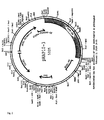
- a vector containing the entire expression cassette of pHAP 10-3 consisting essentially of the AOX 1 promoter, the signal peptide of the ⁇ -factor from Saccharomyces cerevisiae, which clones in the correct reading frame behind the signal peptide codon-optimized target gene according to SEQ ID NO: 5, which codes for the highly active alkaline phosphatase and the AOX 1 transcription termination region consists (see Fig. 3).
- the vector pHAP 10-3 / 9K which consists of the commercially available vector pPIC9K (Invitrogen) and the expression cassette of pHAP 10-3, including the synthetic gene according to SEQ ID NO: 5.
- the vectors pHAP 10-3 and pHAP 10-3 / 9K are equally relevant since the final production clone contains copies of both vectors.
- a host strain transformed with the pHAP10-3 / 9K vector is also suitable within the meaning of the present invention, such as YES vectors, pYD1, pTEF 1 / ZEO (Invitrogen) and Saccharomyces cerevisiae, Schizosaccharmyces pombe, Hansenula polymorpha, Yarrowia lipolytica and in particular Pichia pastoris X 33rd Particularly suitable is the Pichia pastoris X-33 strain transformed with the vector pHAP10-3 / 9K.
- Pichia pastoris strains transformed with disclosed vectors are particularly preferred for the method of the invention.
- the strain Pichia pastoris X-33 which is transformed with a pHAP 10-3 and a pHAP 10-3 / 9K vector.
- YPD Yeast Peptone Dextrose
- YPDS Yeast Peptone Dextrose Sorbitol
- BMGY Buffered glycerol-complex medium
- BMMY Buffered methanol-complex medium
- the bIAPII gene according to SEQ ID no. 1 (EP 0 955 369; Manes et al., 1998, J. Biol. Chem. 273 No. 36 , 23353-23360) was initially determined by PCR and selection of suitable primers according to SEQ ID NO: 2 and 3 upstream and downstream with provided the cloning in expression vectors for Pichia pastoris suitable restriction endonuclease cleavage sites.
- the restriction endonuclease cleavage site for EcoRI was added upstream and the restriction endonuclease cleavage site Asp718 I was added upstream.
- the PCR fragment was recut with EcoRI and Asp718 I (Roche Diagnostics GmbH), re-isolated (QIAquick Gel Extraction Kit / Qiagen) and then into a QIAquick Gel Extraction Kit / linearized and isolated with EcoRI and Asp718 I (Roche Diagnostics GmbH) Qiagen) vector fragment of the expression vector pPICZ ⁇ A (Invitrogen).
- the bIAPII gene is under the control of the AOX 1 promoter (promoter for the alcohol oxidase 1 from Pichia pastoris, inducible with methanol and is cloned in the correct reading frame behind the signal peptide of the ⁇ -factor from Saccharomyces cerevisiae gene gene thus inserted
- the resulting expression vector containing the bIAPII gene coding for the eukaryotic highly active alkaline phosphatase was called pHAP-1 (see Figure 1).
- a colony of Pichia pastoris wild-type strain was inoculated in 5 ml of YPD medium (Invitrogen) and incubated at 30 ° C overnight with shaking. The overnight culture was then inoculated 1: 2000 in 200 ml of fresh YPD medium (Invitrogen) and incubated overnight at 30 ° C with shaking until an OD 600 of 1.3 to 1.5 was reached. The cells were spun down (1500 xg / 5 minutes) and the pellet resuspended in 200 ml of ice-cold, sterile water (0 ° C).
- the cells were again centrifuged (1500 xg / 5 minutes) and resuspended in 100 ml of ice-cold, sterile water (0 ° C). The cells were again centrifuged down, resuspended in 10 ml of ice-cold (0 ° C) 1 M sorbitol (ICN). The cells were again centrifuged off, resuspended in 0.5 ml of ice-cold (0 ° C) 1 M sorbitol (ICN). The cells thus obtained were kept on ice and immediately used for transformation.
- the mixture was mixed with 1 ml of 1M sorbitol (ICN) and then plated 100 to 150 .mu.l on a YPDS agar plate (Invitrogen) with 100 .mu.g / ml Zeocin® (Invitrogen). The plates were then incubated for 2-4 days at 30 ° C.
- ICN 1M sorbitol
- BMMY medium contains methanol (Mallinckrodt Baker BV), which induces the expression of the highly active alkaline phosphatase via the AOX 1 promoter.
- the shake flasks were incubated with shaking at 30 ° C., samples were taken every 24 hours, the OD 600 was determined, an activity test for the expression of the highly active alkaline phosphatase was carried out and in each case fed with 0.5% methanol (Mallinckrodt Baker BV) for further induction. The expression experiments ran for 96 hours.
- the activity test works according to the following principle: The absorption increase is measured at 405 nm.
- the activity was determined from the medium supernatant of the expression cultures.
- the reaction was started with 5 ul of the supernatant also, but with additional 0.5 mM ZnCl 2 were added. The calculation was done without factor x.
- the PCR fragment was recut with EcoRI and Asp718 (Roche Diagnostics GmbH), re-isolated (QIAquick Gel Extraction Kit / Qiagen) and then into a linearized and isolated with EcoRI and Asp718 (Roche Diagnostics GmbH) (QIAquick Gel Extraction Kit / Qiagen) Vector fragment of the expression vector pPICZ ⁇ A (Invitrogen) ligated.
- the synthetic gene is under the control of the AOX 1 promoter (promoter for the alcohol oxidase 1 from Pichia pastoris, with methanol (Mallinckrodt Baker B.V.) Inducible) and is cloned in the correct reading frame behind the signal peptide of the ⁇ -factor from Saccharomyces cerevisiae.
- the gene fragment thus inserted was then examined for error-free base sequence by restriction analysis and sequencing.
- the resulting expression vector which contains a synthetic gene coding for the eukaryotic highly active alkaline phosphatase, was called pHAP10-3 (see Fig. 2).
- the vector was first linearized with SacI (Roche Diagnostics GmbH). The transformation was performed by electroporation with Gene Pulser II (Biorad). For this purpose, a colony of Pichia pastoris 5 ml YPD medium (Invitrogen) was inoculated and incubated at 30 ° C overnight with shaking. The overnight culture was then inoculated 1: 2000 in 200 ml of fresh YPD medium (Invitrogen) and incubated overnight at 30 ° C with shaking until an OD 600 of 1.3 to 1.5 was reached.
- SacI Roche Diagnostics GmbH
- Gene Pulser II Biorad
- a colony of Pichia pastoris 5 ml YPD medium Invitrogen
- the overnight culture was then inoculated 1: 2000 in 200 ml of fresh YPD medium (Invitrogen) and incubated overnight at 30 ° C with shaking until an OD 600 of 1.3 to 1.5 was reached.
- the cells were spun down (1500 xg / 5 minutes) and the pellet resuspended in 200 ml of ice-cold, sterile water (0 ° C). The cells were again centrifuged (1500 xg / 5 minutes) and resuspended in 100 ml of ice-cold, sterile water (0 ° C). The cells were again centrifuged down, resuspended in 10 ml of ice-cold (0 ° C) 1 M sorbitol (ICN). The cells were again centrifuged down, resuspended in 0.5 ml of ice-cold (0 ° C) 1 M sorbitol (ICN). The cells thus obtained were kept on ice and immediately used for transformation.
- the mixture was mixed with 1 ml of 1M sorbitol (ICN) and then plated 100 to 150 .mu.l on a YPDS agar plate (Invitrogen) with 100 .mu.g / ml Zeocin® (Invitrogen). The plates were then incubated for 2 to 4 days at 30 ° C.
- ICN 1M sorbitol
- BMMY medium contains methanol (Mallinckrodt Baker BV), which induces the expression of the highly active alkaline phosphatase via the AOX 1 promoter.
- the shake flasks were incubated with shaking at 30 ° C., samples were taken every 24 hours, the OD 600 was determined, an activity test for the expression of the highly active alkaline phosphatase was carried out and in each case fed with 0.5% methanol (Mallinckrodt Baker BV) for further induction. The expression experiments ran for 96 hours.
- the activity test was carried out as described above.
- the best clones from the expression experiments were prepared for electroporation as described above and transformed again with 1 ⁇ g of linearized pHAP10-3 vector DNA and the transformation mixture on YPDS agar plates (Invitrogen) with 1000 to 2000 ⁇ g / ml Zeocin® (Invitrogen ) plated.
- the selection pressure is increased so that only clones can grow which have integrated several copies of the expression vector pHAP10-3 and thus also several copies of respective resistance gene (here Zeocin ® ) into the genome.
- the Zeocin ® -Resistenzprotein is the product of the Streptoalloteichus Bleomycingens hindusstanus (Chalmels, T.
- the Zeocin ® binds in a stoichiometric concentration ratio and thus the cell confers resistance to Zeocin ®.
- the entire expression cassette from pHAP10-3 consisting of AOX 1 promoter, signal peptide of the ⁇ -factor from Saccharomyces cerevisiae, codon-optimized gene for the highly active alkaline phosphatase according to SEQ ID NO: 5 and AOX 1 transcription termination region, isolated by PCR by appropriately selected primers as described below in the vector pPIC9K, its integration into the Genome of Pichia pastoris via G418 (Roche Diagnostics GmbH) is selected.
- the primers are shown in SEQ ID NOS: 34 and 35.
- the PCR batch was analyzed by agarose gel electrophoresis, isolated the gene fragment of the expected size (QIAquick Gel Extraction Kit / Qiagen), with SacI and NotI (Roche Diagnostics GmbH), then isolated from the agarose gel (QIAquick Gel Extraction Kit / Qiagen) and ligated into a vector fragment of pPIC9K also linearized with SacI / NotI (Roche Diagnostics GmbH) and isolated. Thus, it was ensured that the entire expression cassette of pHAP10-3 was identical to pPIC9K. The inserted fragment was checked by restriction analysis and sequencing with the flanking regions. The resulting expression vector was called pHAP10-3 / 9K (see Fig. 3).
- the clones with the maximum haAP expression output from the multiple transformation with pHAP10-3 were prepared for electroporation as described above and transformed with 1 ⁇ g of SacI (Roche Diagnostics GmbH) linearized vector fragment of pHAP10-3 / 9K as described above.
- the transformation mixture was then stored for 1 to 3 days at 4 ° C. in 1 M sorbitol (ICN) (for the formation of G418 resistance) and then 100 to 200 ⁇ l on YPD plates (Invitrogen) with 1, 2 or 4 mg / g418 (Roche Diagnostics GmbH) and incubated for 3 to 5 days at 30 ° C.
- Resulting clones were again examined as described via the activity test for increased expression of the eukaryotic highly active alkaline phosphatase
Landscapes
- Life Sciences & Earth Sciences (AREA)
- Health & Medical Sciences (AREA)
- Genetics & Genomics (AREA)
- Chemical & Material Sciences (AREA)
- Organic Chemistry (AREA)
- Engineering & Computer Science (AREA)
- Bioinformatics & Cheminformatics (AREA)
- Wood Science & Technology (AREA)
- Zoology (AREA)
- General Engineering & Computer Science (AREA)
- General Health & Medical Sciences (AREA)
- Biochemistry (AREA)
- Biomedical Technology (AREA)
- Biotechnology (AREA)
- Mycology (AREA)
- Molecular Biology (AREA)
- Microbiology (AREA)
- Medicinal Chemistry (AREA)
- Physics & Mathematics (AREA)
- Biophysics (AREA)
- Plant Pathology (AREA)
- Micro-Organisms Or Cultivation Processes Thereof (AREA)
- Enzymes And Modification Thereof (AREA)
- Coloring Foods And Improving Nutritive Qualities (AREA)
- Medicines Containing Material From Animals Or Micro-Organisms (AREA)
Description
- Die Erfindung betrifft ein Verfahren zu rekombinanten Herstellung bzw. Expression von eukaryontischer Alkalischer Phosphatase. Offenbart wird darüber hinaus eine codon-optimierte DNA, kodierend für eine eukaryontische hochaktive Alkalische Phosphatase mit einer spezifischen Aktivität über 3000 U/mg. Offenbart wird ferner ein Verfahren zur Insertion der DNA in einen Vektor zur Expression in Hefe-Zellen.
- Alkalische Phosphatasen (AP) sind dimere, zinkhaltige, nichtspezifische Phosphomonoesterasen, die sowohl in prokaryontischen wie auch eukaryontischen Organismen, z.B. in E. coli und Säugern vorkommen (McComb et al., 1979 Alkaline Phosphatases Plenum Press, New York). Der Vergleich der Primärstruktur verschiedener Alkalischer Phosphatasen ergab einen hohen Homologiegrad (25-30% Homologie zwischen E. coli- und Säuger-AP; Millàn, 1988 Anticancer Res. 8, 995-1004; Harris, 1989 Clin. Chim. Acta 186, 133-150).
- Im Menschen und höheren Tieren besteht die AP-Familie aus vier Mitgliedern, die in verschiedenen Genloci codiert sind (Millan, 1988 Anticancer Res . 8, 995-1004; Harris 1989 Clin. Chim. Acta 186, 133-150). Zur Familie der Alkalischen Phosphatasen zählen die gewebespezifischen APs (Placenta-AP (PLAP), Germzellen-AP (GCAP) und Darm-AP (IAP)) und die nicht-gewebespezifischen APs (TnAP), die vorwiegend in Leber, Niere und Knochen lokalisiert sind.
- Eine entscheidende Eigenschaft der bislang bekannten APs ist die große Variabilität in der katalytischen Aktivität der Säuger-APs, die einen 10-100fach höheren kcats-Wert besitzen als E. coli-AP. Unter den Säuger-APs zeigen die APs aus dem Rinderdarm (bIAP) die höchsten spezifischen Aktivitäten. Diese Eigenschaft machen die bIAPs attraktiv für biochemische Anwendungen wie z.B. der Einsatz entsprechender Enzymkonjugate als diagnostisches Reagenz oder zur Dephosphorylierung von DNA. Die Existenz verschiedener Alkalischer Phosphatasen aus dem Rinderdarm mit unterschiedlichen hohen spezifischen Aktivitäten ist in EP 0 955 369 bzw. Manes et al. (1998), J. Biol. Chem. 273 No. 36, 23353-23360, beschrieben. Bislang ist eine rekombinante Expression von eukaryontischen niederaktiven (bis 3000 U/mg) Alkalischen Phosphatasen in verschiedenen eukaryontischen Zelllinien wie z.B. CHO-Zellen (bIAP I/WO 93/18139; Weissig et al. 1993, Biochem J. 260, 503-508), COS-Zellen (humane Placenta-AP/Berger et al., 1987 Biochemistry 84, 4885-4889) oder Baculovirus-Expressionssystem (humane Placenta-AP/Davis et al. 1992, Biotechnology 10, 1148-1150) beschrieben. Auch ist die Expression von höher aktiven AP's (spez. Aktivität >3000 U/mg) aus dem Rinderdarm in CHO-Zellen beschrieben (bIAP II, III und IV/Manes et al. 1998, J. Biol. Chem. 273 No. 36, 23353-23360). Nachteil der Expression von Alkalischen Phosphatasen in diesen Expressionssystemen ist jedoch die geringe Expressionsleistung, die die rekombinante Herstellung, insbesondere einer hochaktiven AP nicht wirtschaftlich macht.
- Eine Expression von eukaryontischen Alkalischen Phosphatasen in prokaryontischen Expressionswirten wie z.B. E. coli ist zwar prinzipiell möglich (humane Placenta-AP/Beck and Burtscher, 1994 Protein Expression and Purification 5, 192-197), jedoch weisen die in Prokaryonten exprimierten Alkalischen Phosphatasen keine Glykosylierung auf, die insbesondere bei der Herstellung von Enzymkonjugaten essentiell ist.
- Demzufolge liegt der vorliegenden Erfindung die Aufgabe zugrunde, ein widerstandsfähiges und stabiles Expressionsverfahren zur Herstellung glykosylierter eukaryontischer Alkalischer Phosphatase mit hoher spezifischer Aktivität zu entwickeln, das zudem auf Grund hoher Expressionsleistung eine wirtschaftliche Herstellung einer entsprechenden Alkalischen Phosphatase ermöglicht und darüber hinaus ein Enzym liefert, das bezüglich seiner Eigenschaften wie z.B. spezifischer Aktivität und Thermostabilität mit der nativen hochaktiven oder niederaktiven Alkalischen Phosphatase (kommerziell erhältlich z.B. bei Roche Diagnostics GmbH, Biozyme, Oriental Yeast) vergleichbar ist.
- Die Aufgabe wird erfindungsgemäß gelöst durch ein Verfahren zur Herstellung einer eukaryontischen Alkalischen Phosphatase mit hoher spezifischer Aktivität in Hefe, insbesondere in einer methylotrophen Hefe umfassend die Schritte:
- a) Klonierung einer Gensequenz in unterschiedlichen Vektoren
- b) Transformation der Hefe,
- c) Expression und
- d) Reinigung der Alkalischen Phosphatase,
dadurch gekennzeichnet, daß- (i) ein erster Vektor ein Resistenzgen gegen einen ersten Selektionsmarker aufweist,
- (ii) Transformanten, die das Resistenzgen und die Gensequenz in das Genom integriert haben, durch Wachstum auf Nährmedium mit einer geringen Konzentration an erstem Selektionsmarker selektioniert werden,
- (iii) die Genkopienzahl durch Mehrfachtransformation erhöht wird, wobei Mehrfachtransformanten durch Wachstum auf Nährmedium mit erhöhtem Selektionsdruck selektioniert werden,
- (iv) ein zweiter Vektor, welcher neben der Gensequenz ein Resistenzgen gegen einen zweiten Selektionsmarker aufweist, zugegeben wird,
- (v) die Genkopienzahl durch Mehrfachtransformation mit dem zweiten Vektor erhöht wird, wobei Mehrfachtransformanten durch Wachstum auf Nährmedium mit erhöhtem Selektionsdruck selektioniert werden, und
- (vi) die Klone selektioniert werden, die mehrere Kopien der Gensequenz und der Selektionsmarker-Resistenzgene stabil in das Genom integriert haben.
- Bevorzugt ist als Gensequenz eine DNA-Sequenz, die für eine eukaryontische alkalische Phosphatase codiert, welche eine spezifische Aktivität von mehr als 3000 U/mg, in besonderen Fällen von über 7000 U/mg bis etwa 10.000 U/mg aufweist. Beispielsweise hat sich erfindungsgemäß eine DNA-Sequenz gemäß SEQ ID NO: 1 als geeignet erwiesen. Besonders bevorzugt wird eine codon-optimierte DNA-Sequenz, die auf Aminosäure-Ebene der Gensequenz SEQ ID NO: 1 entspricht. Codon-Optimierung bedeutet, daß durch stumme Mutation, d.h. Änderungen auf DNA-Ebene, die sich jedoch nicht auf Aminosäure-Ebene auswirken, jedes Codon beispielsweise von SEQ ID NO: 1 zur Steigerung der Translation nach den Bedürfnissen des ausgewählten Expressionswirtes optimiert wird, wodurch beispielsweise die Gensequenz gemäß SEQ ID NO: 5 erhalten wird. Es können jedoch auch andere Gensequenzen als SEQ ID NO: 1, die für Alkalische Phosphatasen codieren und gegebenenfalls codon-optimiert sind, in den Vektor eingebaut werden, wie z.B. bIAPI, III, IV (DE 198 19 962 bzw. EP 0 955 369). Besonders bevorzugt für das erfindungsgemäße Verfahren ist die Verwendung einer codon-optimierten Gensequenz gemäß SEQ ID NO: 5. Die entsprechende Gensequenz wird dann in einen oder mehrere Vektor(en) kloniert, welche(r) entsprechend dem zu transformierenden Wirt ausgewählt wird bzw. werden.
- Als Hefe-Wirt sind besonders methylotrophe Hefen, z.B. Hefe Pichia pastoris, Hansenula polymorpha, aber auch andere Hefen, wie z.B. Saccharomyces cerevisiae, Yarrowia lipolytica oder Schizosaccharomyces pombe geeignet. Geeignete Vektoren sind dem Fachmann bekannt, wie beispielsweise pPICZαA, pPIC9K, Yes-Vektoren, pTEF1/Zeo, pYDI (z.B. Invitrogen). Der so entstandene Expressionsvektor wird bevorzugt in verschiedene Stämme von Pichia pastoris transformiert und stabil in das Genom integriert werden. Die stabile Integration in das Hefegenom hat den Vorteil, daß bei der späteren Produktion der beispielsweise eukaryontischen, hochaktiven Alkalischen Phosphatase in großvolumigen Fermenten kein Selektionsdruck benötigt wird. Stabile Integration in das Genom bedeutet, daß der Expressionsvektor über homologe Rekombination in das Genom von z.B. Pichia pastoris eingebaut wird und somit als fester Bestandteil des Hefegenoms von Generation zu Generation weitervererbt wird (Cregg, J.M. et al., Mol. Cell. Biol. 5 (1985), 3376-3385).
- Die Erhöhung der Genkopienzahl in der methylotrophen Hefe wurde durch Mehrfachtransformation bei gleichzeitiger Erhöhung des Selektionsdruckes mit einem geeigneten Selektionsmarker, z.B. einem Antibiotikum wie beispielsweise Zeocin® bzw. Geneticin (G418) oder einem Auxotrophiemarker erreicht, wonach nur Klone lebensfähig sind, die mehrere Kopien des Expressionsvektors stabil in das Genom integriert haben. Um gegen höhere Konzentrationen des als Selektionsmarker verwendeten Antibiotikums resistent zu sein, ist es erforderlich, daß die Klone vermehrt Resistenzprotein produzieren. Dies kann beispielsweise durch eine multiple Integration des Expressionsvektors erfolgen, der neben der Expressionskassette für die beispielsweise hochaktive Alkalische Phosphatase auch das Resistenzgen für das als Selektionsmarker verwendete Antibiotikum enthält.
- Die Aufgabe eukaryontische Alkalische Phosphatase in einem widerstandsfähigen und stabilen Expressionsverfahren mit hoher Expressionsleistung wirtschaftlich herzustellen, konnte erst durch die Kombination der Maßnahmen (i) bis (vi) erreicht werden. So führte beispielsweise die Transformation eines Pichia pastoris Stammes X-33 mit einen Expressionsvektor, der das bIAPII-Gen gemäß SEQ ID NO: 1 enthält, ohne diese Maßnahmen nicht zum gewünschten Erfolg (siehe Beispiel 1 und 2). Mit dem Verfahren konnte zwar die Expressionsleistung im Vergleich zu der Expression von bIAPII in CHO-Zellen (Manes et al., 1998 J. Biol. Chem. 273 No. 36, 23353-23360) erheblich gesteigert werden, jedoch erlaubt das Verfahren nicht die Herstellung einer rekombinanten Alkalischen Phosphatase unter wirtschaftlichen Gesichtspunkten.
- Eine der erforderlichen Maßnahmen zur Bereitstellung des erfindungsgemäßen Verfahrens ist die Synthese einer codon-optimierten Gensequenz.Um jedes Codon zur Expression in Hefe zu optimieren war eine komplette de novo Synthese des ca. 1,5 kBp langen Gens, das für die eukaryontische hochaktive Alkalische Phosphatase kodiert, erforderlich. Durch Rückübersetzung der Aminosäuresequenz der eukaryontischen hochaktiven Alkalischen Phosphatase gemäß SEQ ID No. 4 (bIAP-II) konnte durch Ausnutzung des degenerierten Codes jedes Codon, wenn erforderlich, optimiert werden. Dazu wurde das Gen in 28 Oligonukleotide mit einer Länge von 54 bis 82 Nukleotide unterteilt. Die Oligonukleotide wurden als alternierende Folge von Sinnstrang- und Gegenstrangfragment entworfen, die jeweils mit ihren 5'- bzw. 3'-Enden mit den benachbarten Oligonukleotiden komplementär überlappten. Der Überlappungsbereich wurde jeweils so gewählt, daß bei der Annealingreaktion in der späteren PCR-Reaktion eine unspezifische Bindung weitgehend verhindert wird. Die Oligonukleotide am 5'- bzw. 3'-Ende des Gens wurden stromaufwärts bzw. stromabwärts des kodierenden Bereichs mit Erkennungsstellen für Restriktionsendonukleasen versehen, die für eine spätere Insertion des synthetischen Gens gemäß SEQ ID No. 5 in Expressionsvektoren genutzt werden konnten. So wurde stromaufwärts eine Erkennungsstelle für die Restriktionsendonuklease EcoRI und stromabwärts eine Erkennungsstelle für die Restriktionsendonuklease Asp718 eingebaut. Die Sequenzen der Oligonukleotide sind in SEQ ID No. 6 bis 33 dargestellt.
- Die Gensynthese wurde mittels PCR-Reaktion durchgeführt. Dazu wurde der kodierende Bereich zunächst in drei Teilstücke unterteilt (Oligonukleotide 6 bis 15, 16 bis 23, 24 bis 33) und diese Teilstücke in getrennten PCR-Reaktionen erzeugt. Bei der Gensynthese mit überlappenden komplementären Oligonukleotiden mittels PCR-Reaktion erfolgt dabei ein schrittweises Verlängern des Genfragmentes bis zum volle Länge-Produkt, das dann in den weiteren Zyklen amplifiziert wird. Die Annealingtemperatur richtet sich dabei nach dem Überlappungsbereich mit der geringsten Schmelztemperatur.
- Die drei Teilstücke wurden anschließend mittels Agarosegelelektrophorese analysiert, die Produkte mit der erwarteten Länge aus dem Gel mittels QIAquick Gel Extraction Kit (Qiagen) isoliert und in einer weiteren PCR-Reaktion zu dem kompletten Genprodukt synthetisiert. Die PCR-Reaktion wurde dabei in den ersten 5 Zyklen ohne Zugabe der Primern am 5'-Ende und am 3'-Ende des gesamten Gens durchgeführt, so daß zunächst aus den drei Teilstücken wenige Fragmente des Genproduktes der erwarteten Länge entstehen. Die Annealingtemperatur richtet sich dabei nach dem Überlappungsbereich mit der geringsten Schmelztemperatur. Danach wurden die endständigen Primer zugegeben und die Annealingtemperatur entsprechend der Annealingtemperatur des Primers mit der geringsten Schmelztemperatur erhöht. In weiteren 25 Zyklen wurde danach das Genfragment der erwarteten Länge hochamplifiziert.
- Der PCR-Ansatz wurde mittels Agarosegelelektrophorese analysiert, das Genfragment mit der erwarteten Größe isoliert (QIAquick Gel Extraction Kit/Qiagen).
- Die Klonierung eines entsprechenden PCR Fragmentes, die Transformation in Pichia pastoris sowie die Expression ist in Beispiel 3 beschrieben.
- Mit dem Codon-optimierten Gen für die hochaktive Alkalische Phosphatase konnte die Expressionsleistung um den Faktor 3 gegenüber den ersten Versuchen mit dem Wildtypgen gesteigert werden.
- Jedoch war mit diesen Klonen noch kein wirtschaftliches Verfahren zur Herstellung der hochaktiven Alkalischen Phosphatase erreicht.
- Eine Maßnahme zur Steigerung der Expressionsleistung heterologer und homologer Proteine in Pichia pastoris ist die Erhöhung der Genkopienzahl in der Zelle durch Mehrfachtransformation. Diese Maßnahme kann die Erhöhung des Transkriptionsproduktes, der mRNA des Zielgens, dienen. Man erreicht die Erhöhung der Genkopienzahl durch Mehrfachtransformation eines Klones mit dem Expressionsvektor bei gleichzeitiger Erhöhung des Selektionsdruckes beim anschließenden Wachstum der Transformanten auf Nährplatten mit erhöhter Konzentration des als Selektionsmarker verwendeten Antibiotikums. Dabei wird ein Expressionsklon, der aus dem ersten Transformationsdurchgang bereits mindestens eine Kopie des Expressionsvektors aufgenommen haben, wieder kompetent gemacht (s. Beispiel 1) und wieder mit Expressionsvektor transformiert. Selektioniert werden Transformanten, die mehrere Kopien des Expressionsvektors in das Genom integriert haben, durch Ausplattieren auf Nährplatten mit höherem Selektionsdruck, d.h. Platten mit einer höheren Konzentration des als Selektionsmarker verwendeten Antibiotikums (z.B. Zeocin®), als beim ersten Transformationsdurchgang. Dabei wird zunächst die höchste Konzentration des als Selektionsmarker verwendeten Antibiotikums, bei der die Klone aus dem ersten Transformationsdurchgang noch wachsen können, ermittelt und demzufolge die Konzentration des als Selektionsmarker verwendeten Antibiotikums in den YPDS-Agarplatten nach der zusätzlichen Transformation über den ermittelten Schwellenwert erhöht. Durch die Erhöhung der Kopienzahl des Expressionsvektors wird auch die Kopienzahl des Resistenzgens, das Bestandteil des Expressionsvektors ist, erhöht und damit auch die Resistenz gegen höhere Konzentrationen des als Selektionsmarker verwendeten Antibiotikums erreicht. Durch Variation der Konzentration des als Selektionsmarker verwendeten Antibiotikums in den Nährplatten (ca. 100 bis 2000 µg/ml) können auch Klone mit unterschiedlich hohen Kopienzahlen des Expressionsvektors im Genom selektioniert werden (s. Beispiel 4).
- Eine weitere Maßnahme zur Steigerung der Expressionsleistung heterologer und homologer Proteine in Hefe, wie beispielsweise Pichia pastoris ist die Erhöhung der Genkopienzahl durch Mehrfachselektion. Man erreicht dies durch Transformation eines Expressionsklons, der bereits durch Mehrfachtransformation mit einem Expressionsvektor, der die Expressionskassette mit dem Zielgen (z.B. das Gen, das für die hochaktive Alkalische Phosphatase kodiert gemäß SEQ ID NO: 5) und ein Resistenzgen für das als Selektionsmarker verwendete erste Antibiotikum (z.B. Zeocin®) enthält, optimiert wurde, mit einem zweiten Expressionsvektor, der das Zielgen (z.B. das Gen, das für die hochaktive Alkalische Phosphatase kodiert gemäß SEQ ID NO: 5) und ein Resistenzgen für das als Selektionsmarker verwendete zweite Antibiotikum (z.B. Geneticin (G418)) enthält. Beim anschließenden Ausplattieren der Transformanten auf Nährplatten, die das zweite Antibiotikum als Selektionsmarker enthalten, werden nur Klone selektioniert, die neben den Kopien des Expressionsvektors mit Resistenzgen für das als Selektionsmarker verwendete erste Antibiotikum auch mindestens eine Kopie des Expressionsvektors mit Resistenzgen für das als Selektionsmarker verwendete zweite Antibiotikum aufgenommen haben. Diese Expressionsklone können nun wiederum einer weiteren Mehrfachtransformation mit dem Expressionsvektor mit Resistenzgen für das als Selektionsmarker verwendete zweite Antibiotikum unterzogen werden (s. Beispiel 5).
- Durch die Kombination der Maßnahmen der Mehrfachtransformation und der Doppelselektion konnte die Expressionsleistung um den Faktor 4 gegenüber der Expressionsleistung der Klonen aus dem ersten Transformantendurchgang mit den codon-optimierten Gen gesteigert werden.
- Die rekombinante Alkalische Phosphatase kann durch Extraktionsmethoden, die dem Fachmann prinzipiell bekannt sind, aus der Biomasse extrahiert werden z.B. "Protein Purification", Springer-Verlag, Herausg. Robert Scopes (1982). Durch chromatographische Trennungsmethoden, wie insbesondere unter Verwendung von hydrophoben Säulenmaterialien und eines Kationenaustauschers, wird ein bandenreines Produkt mit einer spezifischen Aktivität von mehr als 7000 U/mg erzielt.
- Um die rekombinante hochaktive Alkalische Phosphatase zu charakterisieren wurde das gereinigte Produkt einer N-terminalen Sequenzierung unterworfen.
- Es wurde dominant die Sequenz EAEAEFLIPA (SEQ ID NO: 36) bestimmt. Die Sequenz korreliert eindeutig mit der N-terminalen Sequenz der AP "LIPA" (SEQ ID NO: 37) und dem Linkerpeptid des Konstruktes EAEAEF (SEQ ID NO: 38), das durch die Klonierungsstrategie der Gensequenz in den Vektor und durch die Abspaltung des α-Faktor-Signalpeptides durch eine Kex2-Signalpeptidase (z.B. Invitrogen) ensteht.
- Die Stabilität der rekombinanten Alkalischen Phosphatase Produktes wurde im Vergleich zu der natürlich vorkommenden Alkalischen Phosphatase untersucht. Die Proben ergeben bei einer thermischen Belastung (55°C) der Lösung vergleichbare Ergebnisse.
- Mit der vorliegenden Erfindung wird somit erstmals ein Verfahren beschrieben, daß eine wirtschaftliche Herstellung einer rekombinanten Alkalischen Phosphatase aus Säugerzellen, wie z.B. Rinderdarm ermöglicht, die vergleichbare Eigenschaften zur nativen hochaktiven Alkalischen Phosphatase aus dem Rinderdarm besitzt und glykosyliert ist.
- Des weiteren wird eine DNA Sequenz gemäß SEQ ID NO: 5 als codon-optimierte Gensequenz für die Expression des Gens der hochaktiven Alkalischen Phosphatase Pichia pastoris offenbart.
- Offenbart wird des weiteren ein Vektor enthaltend SEQ ID NO: 5, besonders ein Vektor pHAP10-3 gemäß Fig. 2. pHAP10-3 ist der Vektor pPICZαA, der kommerziell erhältlich ist (Invitrogen), und der das Gen gemäß SEQ ID NO: 5 enthält, das unter Kontrolle des AOX 1-Promotors steht.
- Des weiteren ist offenbart ein Wirtsstamm, der mit den obigen Vektoren transformiert wurde. Besonders genannt ist der Pichia pastoris X-33 Stamm transformiert mit Vektor pHAP10-3.
- Des weiteren ist ein Vektor offenbart, der die gesamte Expressionskassette aus pHAP 10-3 enthält, die im wesentlichen aus dem AOX 1-Promotor, dem Signalpeptid des α-Faktors aus Saccharomyces cerevisiae, das im korrekten Leserahmen hinter das Signalpeptid kloniert codon-optimierte Zielgen gemäß SEQ ID NO: 5, das für die hochaktive Alkalische Phosphatase kodiert und der AOX 1-Transkriptionsterminationsregion besteht (siehe Fig. 3). Besonders genannt ist der Vektor pHAP 10-3/9K, der aus dem kommerziell erhältlichen Vektor pPIC9K (Invitrogen) und der Expressionskassette aus pHAP 10-3, einschließlich des synthetischen Gens gemäß SEQ ID NO: 5 besteht.
Die Vektoren pHAP 10-3 und pHAP 10-3/9K sind gleichermaßen relevant, da der letztendliche Produktionsklon Kopien von beiden Vektoren enthält. - Offenbart ist des weiteren ein Wirtsstamm, der mit dem pHAP10-3/9K-Vektor transformiert wurde. Geeignet im Sinne der vorliegenden Erfindung sind jedoch auch andere dem Fachmann bekannte Vektoren und Stämme, wie beispielsweise YES-Vektoren, pYD1, pTEF 1/ZEO (Invitrogen) und Saccharomyces cerevisiae, Schizosaccharmyces pombe, Hansenula polymorpha, Yarrowia lipolytica und insbesondere Pichia pastoris X-33. Insbesondere geeignet ist der Pichia pastoris X-33 Stamm transformiert mit dem Vektor pHAP10-3/9K.
- Demzufolge ist darüber hinaus offenbart ein Verfahren zur Herstellung einer eurkaryontischen hochaktiven Alkalischen Phosphatase durch Expression des Proteins in einem Wirtsstam, der mit einem oder mehrerem erfindungsgemäßen Vektor(en), insbesondere mit dem pHAP10-3 Vektor bzw. pHAP10-3/9K Vektor transformiert wurde. Pichia pastoris-Stämme, die mit offenbarten Vektoren transformiert wurden, sind für das erfindungsgemäße Verfahren besonders bevorzugt. Insbesondere bevorzugt ist dabei der Stamm Pichia pastoris X-33, der mit einem pHAP 10-3- und einem pHAP 10-3/9K-Vektor transformiert ist.
-
- Abbildung 1
Plasmidkarte von Expressionsvektor pHAP-1 mit dem bIAPII-Gen in pICZαA (Invitrogen). - Abbildung 2
Plasmidkarte von Expressionsvektor pHAP10-3 mit dem synthetischen Gen in pPIC9K (Invitrogen). - Abbildung 3
Plasmidkarte von Expressionsvektor pHAP10-3/9K mit dem synthetischen Gen in pPIC9K (Invitrogen). -
YPD: Yeast Peptone Dextrose YPDS: Yeast Peptone Dextrose Sorbitol BMGY: Buffered Glyerol-complex medium BMMY: Buffered Methanol-complex medium - Das bIAPII-Gen gemäß SEQ ID No. 1 (EP 0 955 369;Manes et al., 1998, J. Biol. Chem. 273 No. 36, 23353-23360) wurde zunächst mittels PCR und Wahl geeigneter Primer gemäß SEQ ID NO: 2 und 3 stromaufwärts und stromabwärts mit für die Klonierung in Expressionsvektoren für Pichia pastoris geeigneten Restriktionsendonukleaseschnittstellen versehen. So wurde stromaufwärts die Restriktionsendonukleaseschnittstelle für EcoRI und stromabwärts die Restriktionsendonukleaseschnittstelle Asp718 I angehängt.
- Das PCR-Fragment wurde mit EcoRI und Asp718 I (Roche Diagnostics GmbH) nachgeschnitten, nochmals isoliert (QIAquick Gel Extraction Kit/Qiagen) und anschließend in ein mit EcoRI und Asp718 I (Roche Diagnostics GmbH) linearisiertes und isoliertes (QIAquick Gel Extraction Kit/Qiagen) Vektorfragment des Expressionsvektors pPICZαA (Invitrogen) ligiert. In diesem Vektor steht das bIAPII-Gen unter Kontrolle des AOX 1-Promotors (Promotor für die Alkoholoxidase 1 aus Pichia pastoris, mit Methanol induzierbar und wird im korrekten Leserahmen hinter das Signalpeptid des α-Faktors aus Saccharomyces cerevisiae kloniert. Das so insertierte Genfragment wurde dann mittels Restriktionsanalyse und Sequenzierung auf fehlerfreie Basensequenz untersucht. Der so entstandene Expressionsvektor, der das bIAPII-Gen enthält, das für die eukaryontische hochaktive Alkalische Phosphatase kodiert, wurde pHAP-1 (s. Fig. 1) genannt.
- Zur Transformation von pHAP-1 in Pichia pastoris X-33 mit anschließender Integration in das Genom wurde der Vektor zunächst mit SacI (Roche Diagnostics GmbH) linearisiert. Die Transformation wurde mittels Elektroporation mit dem Gene Pulser II (Biorad) durchgeführt.
- Dazu wurde eine Kolonie von Pichia pastoris Wildtypstamm in 5 ml YPD-Medium (Invitrogen) angeimpft und bei 30°C über Nacht unter Schütteln inkubiert. Die Übernachtkultur wurde anschließend 1:2000 in 200 ml frisches YPD-Medium (Invitrogen) überimpft und über Nacht bei 30°C unter Schütteln inkubiert, bis eine OD600 von 1,3 - 1,5 erreicht war. Die Zellen wurden abzentrifugiert (1500 x g / 5 Minuten) und das Pellet in 200 ml eiskaltem, sterilen Wasser (0°C) resuspendiert. Die Zellen wurden wiederum abzentrifugiert (1500 x g/5 Minuten) und in 100 ml eiskaltem, sterilen Wasser (0°C) resuspendiert. Die Zellen wurden wiederum abzentrifugiert, in 10 ml eiskaltem (0°C) 1 M Sorbitol (ICN) resuspendiert. Die Zellen wurden wiederum abzentrifugiert, in 0,5 ml eiskaltem (0°C) 1 M Sorbitol (ICN) resuspendiert. Die so gewonnenen Zellen wurden auf Eis gehalten und sofort zur Transformation eingesetzt.
- 80 µl der Zellen wurden mit ca. 1 µg linearisierter pHAP-1-Vektor-DNA versetzt und der gesamte Ansatz in eine eiskalte (0°C) Elektroporationsküvette transferiert und weitere 5 Minuten auf Eis inkubiert. Anschließend wurde die Küvette in den Gene Pulser II (Biorad) überführt und die Transformation bei 1 kV, 1 kΩ und 25µF durchgeführt. Nach der Elektroporation wurde der Ansatz mit 1 ml 1M Sorbitol (ICN) versetzt und anschließend 100 bis 150 µl auf eine YPDS-Agarplatte (Invitrogen) mit 100µg/ml Zeocin® (Invitrogen) ausplattiert. Die Platten wurden anschließend 2-4 Tage bei 30 °C inkubiert.
- Die Klone wurden auf Raster-MD (= minimal Dextrose)-Platten überimpft und weiter analysiert. Gewachsene Klone wurden gepickt, in 20 µl steriles Wasser resuspendiert, mit 17,5 U Lyticase (Roche Diagnostics GmbH) aufgeschlossen (1 Stunde, 37°C) und direkt mittels PCR auf die korrekte Integration der bIAPII-Expressionskassette untersucht.
- Klone, die die komplette Expressionskassette bei der Transformation in das Genom integriert haben, wurden dann in Expressionsversuchen eingesetzt.
- Positive Klone wurden in 3 ml BMGY-Medium (Invitrogen) angeimpft und über Nacht bei 30°C unter Schütteln inkubiert. Anschließend wurden die OD bei 600 nm bestimmt und so in 10ml BMMY-Medium (Invitrogen) überimpft, daß eine OD600 von 1 resultierte. Das BMMY-Medium (Invitrogen) enthält Methanol (Mallinckrodt Baker B.V.), das die Expression der hochaktiven Alkalischen Phosphatase über den AOX 1-Promotor induziert.
- Die Schüttelkolben wurden bei 30°C unter Schütteln inkubiert, alle 24 Stunden Proben gezogen, die OD600 bestimmt, ein Aktivitätstest auf Expression der hochaktiven Alkalischen Phosphatase durchgeführt und jeweils mit 0,5% Methanol (Mallinckrodt Baker B.V.) zur weiteren Induktion nachgefüttert. Die Expressionsversuche liefen über 96 Stunden.
- Je 500 µl wurden der Expressionskultur gemäß Beispiel 1 entnommen, die OD600 bestimmt und die Zellen abzentrifugiert. Der Überstand wurde aufbewahrt und das Zellpellet wurde in einer der OD600 entsprechenden Menge Y-PER™ (50 bis 300 µl/Pierce) zur Lyse resuspendiert und 1 Stunde bei Raumtemperatur geschüttelt. Anschließend wurde das Lysat zur Abtrennung von Zelltrümmern abzentrifugiert (15000 x g/5 Minuten) und der Überstand in frische Reaktionsgefäße überführt. 5 µl des Lysates wurden dann im Aktivitätstest eingesetzt.
- Der Aktivitätstest funktioniert nach folgendem Prinzip:

- 3 ml Diethanolamin-Puffer (1 mol/L Diethanolamin (Merck) pH 9,8, 0,5 mmol/L MgCl2 (Riedel de Haen)) wurden mit 50 µl 4- Nitrophenylphosphatlösung (0,67 Mol/L 4- Nitrophenylphosphat, Na-Salz (Roche Diagnostics GmbH)) versetzt und der Ansatz auf 37°C temperiert. Anschließend wurde die Reaktion durch Zugabe von 5 µl Lysat gestartet und die Absorptionsänderung bei 37°C über 3 Minuten bestimmt und daraus das ΔE/min berechnet.
- Die Aktivität wurde dann nach folgender Formel berechnet:

Faktor x = Konzentrierungsfaktor nach Zellaufschluss - Analog wurde die Aktivität aus dem Mediumüberstand der Expressionskulturen bestimmt. Hier wurden ebenfalls die Reaktion mit 5 µl des Überstandes gestartet, jedoch wurden zusätzlich noch jeweils 0,5 mM ZnCl2 zugegeben. Die Berechnung erfolgte dabei ohne Faktor x.
- Das PCR-Fragment wurde mit EcoRI und Asp718 (Roche Diagnostics GmbH) nachgeschnitten, nochmals isoliert (QIAquick Gel Extraction Kit/Qiagen) und anschließend in ein mit EcoRI und Asp718 (Roche Diagnostics GmbH) linearisiertes und isoliertes (QIAquick Gel Extraction Kit/Qiagen) Vektorfragment des Expressionsvektors pPICZαA (Invitrogen) ligiert. In diesem Vektor steht das synthetische Gen unter Kontrolle des AOX 1-Promotors (Promotor für die Alkoholoxidase 1 aus Pichia pastoris, mit Methanol (Mallinckrodt Baker B.V.) induzierbar) und wird im korrekten Leserahmen hinter das Signalpeptid des α-Faktors aus Saccharomyces cerevisiae kloniert. Das so insertierte Genfragment wurde dann mittels Restriktionsanalyse und Sequenzierung auf fehlerfreie Basensequenz untersucht. Der so entstandene Expressionsvektor, der ein synthetisches Gen, das für die eukaryontische hochaktive Alkalische Phosphatase kodiert, enthält wurde pHAP10-3 (s. Fig. 2) genannt.
- Zur Transformation von pHAP10-3 in Pichia pastoris X-33 mit anschließender Integration in das Genom wurde der Vektor zunächst mit SacI (Roche Diagnostics GmbH) linearisiert. Die Transformation wurde mittels Elektroporation mit dem Gene Pulser II (Biorad) durchgeführt. Dazu wurde eine Kolonie von Pichia pastoris 5 ml YPD-Medium (Invitrogen) angeimpft und bei 30°C über Nacht unter Schütteln inkubiert. Die Übernachtkultur wurde anschließend 1:2000 in 200 ml frisches YPD-Medium (Invitrogen) überimpft und über Nacht bei 30°C unter Schütteln inkubiert, bis eine OD600 von 1,3 bis 1,5 erreicht war. Die Zellen wurden abzentrifugiert (1500 x g / 5 Minuten) und das Pellet in 200 ml eiskaltem, sterilen Wasser (0°C) resuspendiert. Die Zellen wurden wiederum abzentrifugiert (1500 x g/5 Minuten) und in 100 ml eiskaltem, sterilen Wasser (0°C) resuspendiert. Die Zellen wurden wiederum abzentrifugiert, in 10 ml eiskaltem (0°C) 1 M Sorbitol (ICN) resuspendiert. Die Zellen wurden wiederum abzentrifugiert, in 0,5 ml eiskaltem (0°C) 1 M Sorbitol (ICN) resuspendiert. Die so gewonnenen Zellen wurden auf Eis gehalten und sofort zur Transformation eingesetzt.
- 80 µl der Zellen wurden mit ca. 1 µg linearisierter pHAP10-3-Vektor-DNA versetzt und der gesamte Ansatz in eine eiskalte (0°C) Elektroporationsküvette transferiert und weitere 5 Minuten auf Eis inkubiert. Anschließend wurde die Küvette in den Gene Pulser II (Biorad) überführt und die Transformation bei 1 kV, 1 kΩ und 25µF durchgeführt. Nach der Elektroporation wurde der Ansatz mit 1 ml 1M Sorbitol (ICN) versetzt und anschließend 100 bis 150 µl auf eine YPDS-Agarplatte (Invitrogen) mit 100µg/ml Zeocin® (Invitrogen) ausplattiert. Die Platten wurden anschließend 2 - 4 Tage bei 30 °C inkubiert.
- Die Klone wurden auf Raster-MD (= minimal Dextrose)-Platten überimpft und weiter analysiert. Gewachsene Klone wurden gepickt, in 20 µl steriles Wasser resuspendiert, mit 17,5 U Lyticase (Roche Diagnostics GmbH) aufgeschlossen (1 Stunde, 37°C) und direkt mittels PCR auf die korrekte Integration der synthetischen AP-Expressionskassette untersucht.
- Klone, die die komplette Expressionskassette bei der Transformation in das Genom integriert haben, wurden dann in Expressionsversuchen eingesetzt.
- Positive Klone wurden in 3 ml BMGY-Medium (Invitrogen) angeimpft und über Nacht bei 30°C unter Schütteln inkubiert. Anschließend wurden die OD bei 600 nm bestimmt und so in 10ml BMMY-Medium (Invitrogen) überimpft, daß eine OD600 von 1 resultierte. Das BMMY-Medium (Invitrogen) enthält Methanol (Mallinckrodt Baker B.V.), das die Expression der hochaktiven Alkalischen Phosphatase über den AOX 1-Promotor induziert.
- Die Schüttelkolben wurden bei 30°C unter Schütteln inkubiert, alle 24 Stunden Proben gezogen, die OD600 bestimmt, ein Aktivitätstest auf Expression der hochaktiven Alkalischen Phosphatase durchgeführt und jeweils mit 0,5% Methanol (Mallinckrodt Baker B.V.) zur weiteren Induktion nachgefüttert. Die Expressionsversuche liefen über 96 Stunden.
- Je 500 µl wurden der Expressionskultur entnommen, die OD600 bestimmt und die Zellen abzentrifugiert. Der Überstand wurde aufbewahrt und das Zellpellet wurde in einer der OD600 entsprechenden Menge Y-PER™ (50 bis 300 µl/Pierce) zur Lyse resuspendiert und 1 Stunde bei Raumtemperatur geschüttelt. Anschließend wurde das Lysat zur Abtrennung von Zelltrümmern abzentrifugiert (15000 x g/5 Minuten) und der Überstand in frische Reaktionsgefäße überführt. 5 µl des Lysates wurden dann im Aktivitätstest eingesetzt.
- Der Aktivitätstest wurde wie oben beschrieben durchgeführt.
- Die besten Klone aus den Expressionsversuchen wurden wiederum für die Elektroporation wie oben beschrieben vorbereitet und wiederum mit 1 µg linearisierter pHAP10-3-Vektor-DNA transformiert und der Transformationsansatz auf YPDS-Agarplatten (Invitrogen) mit 1000 bis 2000 µg/ml Zeocin® (Invitrogen) ausplattiert. Dadurch wird der Selektionsdruck derart erhöht, daß nur Klone wachsen können, die mehrere Kopien des Expressionsvektors pHAP10-3 und somit auch mehrere Kopien jeweiligen Resistenzgens (hier Zeocin®) in das Genom integriert haben. Das Zeocin® -Resistenzprotein ist das Produkt des Bleomycingens von Streptoalloteichus hindusstanus (Chalmels, T. et al., Curr. Genet. 20 (1991), 309-314; Drocourt, D. et al., Nucleic Acid Research 18 (1990), 4009), das Zeocin® in einem stöchiometrischen Konzentrationsverhältnis bindet und somit der Zelle Resistenz gegenüber Zeocin® verleiht. Je höher die Konzentration an Zeocin® in den YPDS-Agarplatten, um so mehr Resistenzprotein muß die Zelle erzeugen, um das Zeocin® quantitativ zu binden und damit ein Wachstum zu ermöglichen. Dies ist u.a. möglich, wenn multiple Kopien des Resistenzgens in das Genom integriert werden. Klone wurden wie oben beschrieben auf Raster-MD-Platten überimpft und wiederum wie oben beschrieben mittels PCR-Analyse auf korrekte Integration der haAP-Expressionskassette überprüft. Anschließend wurden diese Klone wiederum wie oben beschrieben auf haAP-Aktivität getestet.
- Eine Steigerung der Zeocin®-Konzentration über 2000 µg/ml führte nicht zu einer verbesserten Expressionsleistung der hochaktiven Alkalischen Phosphatase. Um die Genkopienzahl des Gens gemäß SEQ ID NO: 5, das für die hochaktive Alkalische Phosphatase kodiert und für die Expression in Hefe codon-optimiert ist, in den Expressionsklonen weiter zu erhöhen, wurde die Integration zusätzlicher Expressionsvektoren in das Genom der aus Beispiel 3 und 4 hervorgegangenen Expressionsklone mit der höchsten Expressionsleistung über einen zweiten Selektionsdruck, bevorzugt G418 (Roche Diagnostics GmbH) selektioniert. Zu diesem Zweck wurde die gesamte Expressionskassette aus pHAP10-3, bestehend aus AOX 1-Promotor, Signalpeptid des α-Faktors aus Saccharomyces cerevisiae, codon-optimiertes Gen für die hochaktive Alkalische Phosphatase gemäß SEQ ID NO: 5 und AOX 1-Transkriptionsterminations-Region, mittels PCR durch entsprechend gewählte Primer isoliert wie unten beschrieben in den Vektor pPIC9K kloniert, dessen Integration in das Genom von Pichia pastoris über G418 (Roche Diagnostics GmbH) selektioniert wird. Die Primer sind in SEQ ID NO: 34 und 35 dargestellt.
- Der PCR-Ansatz wurde mittels Agarosegelelektrophorese analysiert, das Genfragment mit der erwarteten Größe isoliert (QIAquick Gel Extraction Kit/Qiagen), mit SacI und NotI (Roche Diagnostics GmbH) nachgeschnitten, anschließend wieder aus dem Agarosegel isoliert (QIAquick Gel Extraction Kit/Qiagen) und in ein ebenfalls mit SacI/NotI (Roche Diagnostics GmbH) linearisiertes und isoliertes Vektorfragment von pPIC9K ligiert. Somit war gewährleistet, daß die gesamte Expressionskassette aus pHAP10-3 identisch in pPIC9K vorlag. Das insertierte Fragment wurde mittels Restriktionsanalyse und Sequenzierung mit den flankierenden Regionen überprüft. Der so entstandene Expressionsvektor wurde pHAP10-3/9K (s. Fig. 3) genannt.
- Die Klone mit der höchstens haAP-Expressionsleistung aus der Mehrfachtransformation mit pHAP10-3 (Zeocinresistenz) wurden wie oben beschrieben für die Elektroporation vorbereitet und mit 1 µg mit SacI (Roche Diagnostics GmbH) linearisierten Vektorfragment von pHAP10-3/9K wie oben beschrieben transformiert. Der Transformationsansatz wurde anschließend 1 bis 3 Tage bei 4°C in 1 M Sorbitol (ICN) aufbewahrt (zur Ausbildung der G418-Resistenz) und dann 100 bis 200 µl auf YPD-Platten (Invitrogen) mit 1, 2 bzw. 4 mg/ml G418 (Roche Diagnostics GmbH) ausplattiert und 3 bis 5 Tage bei 30°C inkubiert. Daraus resultierende Klone wurden wiederum wie beschrieben über den Aktivitätstest auf eine erhöhte Expression der eukaryontischen hochaktiven Alkalischen Phosphatase untersucht
-
- <110> Roche Diagnostics GmbH
- <120> Expression of alkaline phosphatase in yeast
- <130> 5387/00/
- <140>
<141> - <160> 38
- <170> PatentIn Ver. 2.1
- <210> 1
<211> 1476
<212> DNA
<213> Bovine - <400> 1

- <210> 2
<211> 40
<212> DNA
<213> Artificial Sequence - <220>
<223> Description of Artificial Sequence: Artificial - <400> 2
gcgcgaattc ctcatcccag ctgaggagga aaaccccgcc 40 - <210> 3
<211> 36
<212> DNA
<213> Artificial Sequence - <220>
<223> Description of Artificial Sequence: Artificial - <400> 3
cgcgggtacc ctagtcgggg atgctggtgg cggtgg 36 - <210> 4
<211> 487
<212> PRT
<213> Bovine - <400> 4


- <210> 5
<211> 1476
<212> DNA
<213> Artificial Sequence - <220>
<223> Description of Artificial Sequence: Artificial - <400> 5

- <210> 6
<211> 78
<212> DNA
<213> Artificial Sequence - <220>
<223> Description of Artificial Sequence: Artificial - <400> 6

- <210> 7
<211> 70
<212> DNA
<213> Artificial Sequence - <220>
<223> Description of Artificial Sequence: Artificial - <400> 7

- <210> 8
<211> 69
<212> DNA
<213> Artificial Sequence - <220>
<223> Description of Artificial Sequence: Artificial - <400> 8


- <210> 9
<211> 70
<212> DNA
<213> Artificial Sequence - <220>
<223> Description of Artificial Sequence: Artificial - <400> 9

- <210> 10
<211> 71
<212> DNA
<213> Artificial Sequence - <220>
<223> Description of Artificial Sequence: Artificial - <400> 10

- <210> 11
<211> 71
<212> DNA
<213> Artificial Sequence - <220>
<223> Description of Artificial Sequence: Artificial - <400> 11

- <210> 12
<211> 72
<212> DNA
<213> Artificial Sequence - <220>
<223> Description of Artificial Sequence: Artificial - <400> 12

- <210> 13
<211> 74
<212> DNA
<213> Artificial Sequence - <220>
<223> Description of Artificial Sequence: Artificial - <400> 13

- <210> 14
<211> 74
<212> DNA
<213> Artificial Sequence - <220>
<223> Description of Artificial Sequence: Artificial - <400> 14

- <210> 15
<211> 68
<212> DNA
<213> Artificial Sequence - <220>
<223> Description of Artificial Sequence: Artificial - <400> 15

- <210> 16
<211> 55
<212> DNA
<213> Artificial Sequence - <220>
<223> Description of Artificial Sequence: Artificial - <400> 16
gatgctcaaa agaatggttg tcaagatatt gctgctcaat tggtttacaa tatgg 55 - <210> 17
<211> 72
<212> DNA
<213> Artificial Sequence - <220>
<223> Description of Artificial Sequence: Artificial - <400> 17

- <210> 18
<211> 71
<212> DNA
<213> Artificial Sequence - <220>
<223> Description of Artificial Sequence: Artificial - <400> 18


- <210> 19
<211> 73
<212> DNA
<213> Artificial Sequence - <220>
<223> Description of Artificial Sequence: Artificial - <400> 19

- <210> 20
<211> 71
<212> DNA
<213> Artificial Sequence - <220>
<223> Description of Artificial Sequence: Artificial - <400> 20

- <210> 21
<211> 54
<212> DNA
<213> Artificial Sequence - <220>
<223> Description of Artificial Sequence: Artificial - <400> 21
cttcatatca gctggttcaa acaaacccat caaatgagta acactagaat catc 54 - <210> 22
<211> 59
<212> DNA
<213> Artificial Sequence - <220>
<223> Description of Artificial Sequence: Artificial - <400> 22
gaaccagctg atatgaagta taatgttcaa caagatcata ctaaggatcc aactttggc 59 - <210> 23
<211> 67
<212> DNA
<213> Artificial Sequence - <220>
<223> Description of Artificial Sequence: Artificial - <400> 23

- <210> 24
<211> 69
<212> DNA
<213> Artificial Sequence - <220>
<223> Description of Artificial Sequence: Artificial - <400> 24

- <210> 25
<211> 73
<212> DNA
<213> Artificial Sequence - <220>
<223> Description of Artificial Sequence: Artificial - <400> 25

- <210> 26
<211> 74
<212> DNA
<213> Artificial Sequence - <220>
<223> Description of Artificial Sequence: Artificial - <400> 26

- <210> 27
<211> 73
<212> DNA
<213> Artificial Sequence - <220>
<223> Description of Artificial Sequence: Artificial - <400> 27

- <210> 28
<211> 73
<212> DNA
<213> Artificial Sequence - <220>
<223> Description of Artificial Sequence: Artificial - <400> 28

- <210> 29
<211> 76
<212> DNA
<213> Artificial Sequence - <220>
<223> Description of Artificial Sequence: Artificial - <400> 29

- <210> 30
<211> 77
<212> DNA
<213> Artificial Sequence - <220>
<223> Description of Artificial Sequence: Artificial - <400> 30

- <210> 31
<211> 73
<212> DNA
<213> Artificial Sequence - <220>
<223> Description of Artificial Sequence: Artificial - <400> 31

- <210> 32
<211> 74
<212> DNA
<213> Artificial Sequence - <220>
<223> Description of Artificial Sequence: Artificial - <400> 32

- <210> 33
<211> 82
<212> DNA
<213> Artificial Sequence - <220>
<223> Description of Artificial Sequence: Artificial - <400> 33

- <210> 34
<211> 31
<212> DNA
<213> Artificial Sequence - <220>
<223> Description of Artificial Sequence: Artificial - <400> 34
gcgcgcctag gagatctaac atccaaagac g 31 - <210> 35
<211> 29
<212> DNA
<213> Artificial Sequence - <220>
<223> Description of Artificial Sequence: Artificial - <400> 35
cgcgcgctag cggatccgca caaacgaag 29 - <210> 36
<211> 10
<212> PRT
<213> Saccharomyces cerevisiae - <400> 36

- <210> 37
<211> 4
<212> PRT
<213> Saccharomyces cerevisiae - <400> 37

- <210> 38
<211> 6
<212> PRT
<213> Saccharomyces cerevisiae - <400> 38

Claims (5)
- Verfahren zur Herstellung einer eukaryontischen Alkalischen Phosphatase in Hefezellen umfassend die Schritte: a) Klonierung einer Gensequenz in unterschiedlichen Vektoren, b) Transformation der Hefe, c) Expression und d) Reinigung der Alkalischen Phosphatase, dadurch gekennzeichnet, daß- ein erster Vektor ein Resistenzgen gegen einen ersten Selektionsmarker aufweist,- Transformanten, die das Resistenzgen und die Gensequenz in das Genom integriert haben, durch Wachstum auf Nährmedium mit einer geringen Konzentration an erstem Selektionsmarker selektioniert werden,- die Genkopienzahl durch Mehrfachtransformation erhöht wird, wobei Mehrfachtransformanten durch Wachstum auf Nährmedium mit erhöhtem Selektionsdruck selektioniert werden,- ein zweiter Vektor, welcher ein Resistenzgen gegen einen zweiten Selektionsmarker aufweist, zugegeben wird,- die Genkopienzahl durch Mehrfachtransformation mit dem zweiten Vektor erhöht wird, wobei Mehrfachtransformanten durch Wachstum auf Nährmedium mit erhöhtem Selektionsdruck selektioniert werden, und- solche Klone selektioniert werden, die mehrere Kopien der Gensequenz und der Selektionsmarker-Resistenzgene stabil in das Genom integriert haben.
- Verfahren gemäß Anspruch 1, wobei die Gensequenz SEQ ID NO: 1 entspricht.
- Verfahren gemäß Anspruch 1, wobei die Gensequenz SEQ ID NO: 5 entspricht.
- Verfahren gemäß einem der Ansprüche 1 bis 3, wobei methylotrophe Hefezellen verwendet werden.
- Verfahren gemäß einem der Ansprüche 1 bis 4, wobei als Hefestamm Pichia pastoris oder Hansenula polymorpha verwendet wird.
Priority Applications (2)
| Application Number | Priority Date | Filing Date | Title |
|---|---|---|---|
| EP06021699A EP1792982B1 (de) | 2000-07-25 | 2001-07-21 | Codon-optimierte alkalisch Phosphatase und ihre Expression in Hefe |
| DK06021699.1T DK1792982T3 (da) | 2000-07-25 | 2001-07-21 | Codon-optimeret phosphatase og ekspression heraf i gær |
Applications Claiming Priority (2)
| Application Number | Priority Date | Filing Date | Title |
|---|---|---|---|
| DE10036491 | 2000-07-25 | ||
| DE10036491A DE10036491A1 (de) | 2000-07-25 | 2000-07-25 | Expression von Alkalischer Phosphatase in Hefe |
Related Child Applications (1)
| Application Number | Title | Priority Date | Filing Date |
|---|---|---|---|
| EP06021699A Division EP1792982B1 (de) | 2000-07-25 | 2001-07-21 | Codon-optimierte alkalisch Phosphatase und ihre Expression in Hefe |
Publications (3)
| Publication Number | Publication Date |
|---|---|
| EP1176205A2 EP1176205A2 (de) | 2002-01-30 |
| EP1176205A3 EP1176205A3 (de) | 2002-05-22 |
| EP1176205B1 true EP1176205B1 (de) | 2007-03-14 |
Family
ID=7650333
Family Applications (2)
| Application Number | Title | Priority Date | Filing Date |
|---|---|---|---|
| EP01117822A Expired - Lifetime EP1176205B1 (de) | 2000-07-25 | 2001-07-21 | Expression von Alkalischer Phosphatase in Hefe |
| EP06021699A Expired - Lifetime EP1792982B1 (de) | 2000-07-25 | 2001-07-21 | Codon-optimierte alkalisch Phosphatase und ihre Expression in Hefe |
Family Applications After (1)
| Application Number | Title | Priority Date | Filing Date |
|---|---|---|---|
| EP06021699A Expired - Lifetime EP1792982B1 (de) | 2000-07-25 | 2001-07-21 | Codon-optimierte alkalisch Phosphatase und ihre Expression in Hefe |
Country Status (11)
| Country | Link |
|---|---|
| US (1) | US6884602B2 (de) |
| EP (2) | EP1176205B1 (de) |
| JP (1) | JP3657895B2 (de) |
| CN (1) | CN1161461C (de) |
| AT (2) | ATE356881T1 (de) |
| CA (1) | CA2352609C (de) |
| CZ (1) | CZ302558B6 (de) |
| DE (2) | DE10036491A1 (de) |
| DK (2) | DK1792982T3 (de) |
| ES (2) | ES2283360T3 (de) |
| IL (1) | IL144467A (de) |
Families Citing this family (21)
| Publication number | Priority date | Publication date | Assignee | Title |
|---|---|---|---|---|
| DE10036491A1 (de) * | 2000-07-25 | 2002-02-07 | Roche Diagnostics Gmbh | Expression von Alkalischer Phosphatase in Hefe |
| DE10213201A1 (de) * | 2002-03-25 | 2003-10-16 | Roche Diagnostics Gmbh | Erzeugung von schwach aktiven oder inaktiven Mutanten von Alkalischer Phosphatase und deren Expression in Hefe |
| EP1460425A1 (de) * | 2003-03-17 | 2004-09-22 | Boehringer Mannheim Gmbh | Entglykosilierte Enzymen für Konjugaten |
| JP2008005734A (ja) * | 2006-06-28 | 2008-01-17 | Kikkoman Corp | アルカリホスファターゼ |
| ES2695999T3 (es) * | 2007-10-12 | 2019-01-11 | Hoffmann La Roche | Expresión de proteínas a partir de múltiples ácidos nucleicos |
| EP2401378B1 (de) | 2009-02-25 | 2013-08-14 | Merck Sharp & Dohme Corp. | Stoffwechselmanipulation eines galaktoseassimilationswegs bei der glycoengineerten hefe pichia pastoris |
| CA2753814C (en) * | 2009-02-27 | 2018-07-31 | Novartis Ag | Novel selection vectors and methods of selecting eukaryotic host cells |
| EP2764017B1 (de) * | 2011-10-05 | 2018-01-10 | Ben Gurion University of The Negev Research and Development Authority | Zusammensetzungen und verfahren zur vermittlung von herbizidresistenz |
| CA2864887C (en) | 2012-02-16 | 2017-04-25 | Eli Lilly And Company | Methods and compositions for reducing the environmental impact of animal waste |
| JP6732368B2 (ja) * | 2016-01-12 | 2020-07-29 | 東ソー株式会社 | アルカリホスファターゼ及びその製造方法 |
| CN105802979B (zh) * | 2016-04-01 | 2019-09-06 | 郑州科蒂亚生物技术有限公司 | 一种小牛肠碱性磷酸酶的表达载体及表达方法 |
| RU2750721C2 (ru) | 2017-03-10 | 2021-07-01 | Ф. Хоффманн-Ля Рош Аг | Способ получения мультиспецифических антител |
| CA3057089A1 (en) | 2017-03-21 | 2018-09-27 | Synthetic Biologics, Inc. | Alkaline phosphatase formulations |
| US11932860B2 (en) | 2017-10-03 | 2024-03-19 | Kikkoman Corporation | Method for producing alkaline phosphatase, alkaline phosphatase obtained using said method, and vector and transformant for production thereof |
| EP3737750B1 (de) | 2018-01-09 | 2024-06-05 | Theriva Biologics, Inc. | Alkalische phosphatasemittel zur behandlung von entwicklungsstörungen des nervensystems |
| WO2019183209A1 (en) | 2018-03-20 | 2019-09-26 | Synthetic Biologics, Inc. | Alkaline phosphatase agents for treatment of radiation disorders |
| ES3032290T3 (en) | 2018-03-20 | 2025-07-16 | Theriva Biologics Inc | Intestinal alkaline phosphatase formulations |
| KR20220005560A (ko) * | 2019-05-06 | 2022-01-13 | 신세틱 바이오로직스, 인코퍼레이티드 | 알칼리성 포스페이트-기반 종양학 치료제 |
| CA3146738A1 (en) * | 2019-07-18 | 2021-01-21 | Synthetic Biologics, Inc. | Intestinal alkaline phosphatase-based treatments of metabolic disorders |
| JP7510787B2 (ja) | 2020-05-28 | 2024-07-04 | シスメックス株式会社 | アルカリフォスファターゼ融合抗体及びその製造方法、並びに免疫測定用試薬及び免疫測定方法 |
| CN113564185B (zh) * | 2021-09-07 | 2023-06-06 | 金标优尼科(无锡)生物科技有限公司 | 一种碱性磷酸酶基因及其cho稳定细胞株和alp制备方法 |
Family Cites Families (9)
| Publication number | Priority date | Publication date | Assignee | Title |
|---|---|---|---|---|
| GB2200118A (en) * | 1987-01-23 | 1988-07-27 | Allelix Inc | Synthetic chymosin-and prochymosin-encoding DNA segments |
| NZ233642A (en) * | 1989-05-10 | 1992-12-23 | Somatogenetics Int | Linked hemoglobin subunits, preparation by genetic engineering and linker assay |
| CA2017176A1 (en) * | 1989-05-22 | 1990-11-22 | Yoshitomi Pharmaceutical Industries Ltd. | Albumin gene-containing plasmid, transformant carrying same, production of such transformant and production of albumin |
| CA2101610A1 (en) * | 1992-08-07 | 1994-02-08 | William D. Prevatt | Production of bacillus entomotoxins in methylotrophic yeast |
| IL133931A0 (en) * | 1997-07-21 | 2001-04-30 | Du Pont | Transformed yeast strains and their use for the production of monoterminal and diterminal aliphatic carboxylates |
| DE19819962A1 (de) * | 1998-05-05 | 1999-11-11 | Roche Diagnostics Gmbh | Hochaktive alkalische Phosphatase |
| CN1940067A (zh) * | 1999-03-22 | 2007-04-04 | 诺沃奇梅兹有限公司 | 用于在真菌细胞中表达基因的启动子 |
| WO2001066693A1 (en) * | 2000-03-10 | 2001-09-13 | Novozymes A/S | Compositions and methods for producing high yields of heterologous polypeptides in a pichia cell |
| DE10036491A1 (de) * | 2000-07-25 | 2002-02-07 | Roche Diagnostics Gmbh | Expression von Alkalischer Phosphatase in Hefe |
-
2000
- 2000-07-25 DE DE10036491A patent/DE10036491A1/de not_active Withdrawn
-
2001
- 2001-07-19 IL IL144467A patent/IL144467A/en not_active IP Right Cessation
- 2001-07-19 CZ CZ20012639A patent/CZ302558B6/cs not_active IP Right Cessation
- 2001-07-20 CN CNB011232463A patent/CN1161461C/zh not_active Expired - Fee Related
- 2001-07-21 AT AT01117822T patent/ATE356881T1/de not_active IP Right Cessation
- 2001-07-21 EP EP01117822A patent/EP1176205B1/de not_active Expired - Lifetime
- 2001-07-21 ES ES01117822T patent/ES2283360T3/es not_active Expired - Lifetime
- 2001-07-21 DE DE50112186T patent/DE50112186D1/de not_active Expired - Lifetime
- 2001-07-21 AT AT06021699T patent/ATE553191T1/de active
- 2001-07-21 DK DK06021699.1T patent/DK1792982T3/da active
- 2001-07-21 DK DK01117822T patent/DK1176205T3/da active
- 2001-07-21 ES ES06021699T patent/ES2384108T3/es not_active Expired - Lifetime
- 2001-07-21 EP EP06021699A patent/EP1792982B1/de not_active Expired - Lifetime
- 2001-07-23 JP JP2001222153A patent/JP3657895B2/ja not_active Expired - Lifetime
- 2001-07-23 US US09/911,132 patent/US6884602B2/en not_active Expired - Lifetime
- 2001-07-23 CA CA002352609A patent/CA2352609C/en not_active Expired - Fee Related
Also Published As
| Publication number | Publication date |
|---|---|
| DK1792982T3 (da) | 2012-07-23 |
| CN1334341A (zh) | 2002-02-06 |
| CA2352609A1 (en) | 2002-01-25 |
| US20030096341A1 (en) | 2003-05-22 |
| DK1176205T3 (da) | 2007-07-16 |
| EP1792982A3 (de) | 2007-06-13 |
| CN1161461C (zh) | 2004-08-11 |
| IL144467A (en) | 2010-05-31 |
| DE50112186D1 (de) | 2007-04-26 |
| CZ20012639A3 (cs) | 2002-03-13 |
| EP1176205A3 (de) | 2002-05-22 |
| CA2352609C (en) | 2008-02-12 |
| JP3657895B2 (ja) | 2005-06-08 |
| EP1792982B1 (de) | 2012-04-11 |
| ATE553191T1 (de) | 2012-04-15 |
| ES2283360T3 (es) | 2007-11-01 |
| IL144467A0 (en) | 2002-05-23 |
| ES2384108T3 (es) | 2012-06-29 |
| ATE356881T1 (de) | 2007-04-15 |
| US6884602B2 (en) | 2005-04-26 |
| EP1176205A2 (de) | 2002-01-30 |
| JP2002253269A (ja) | 2002-09-10 |
| DE10036491A1 (de) | 2002-02-07 |
| EP1792982A2 (de) | 2007-06-06 |
| CZ302558B6 (cs) | 2011-07-13 |
Similar Documents
| Publication | Publication Date | Title |
|---|---|---|
| EP1792982B1 (de) | Codon-optimierte alkalisch Phosphatase und ihre Expression in Hefe | |
| DE3650749T2 (de) | DNA Fragment kodierend für eine AOX | |
| DE68929013T2 (de) | Genaustausch als Mittel zur Konstruktion von Aspergillus-Stämmen | |
| DE60222857T2 (de) | Concatemere unterschiedlich exprimierter multipler gene | |
| DE69633343T2 (de) | Verbesserte verfahren zur transformation von phaffiastämmen,transformierte phaffiastämme auf diese weise erhaltend, und rekominante dns in besagtem verfahren verwendbar | |
| EP0751995B1 (de) | Riboflavin-biosynthesis in fungi | |
| DE69133066T2 (de) | Verfahren zur Expression heterologischer Gene in der Hefe Pichia Pastoris, Expressionsverfahren und transformierte Mikroorganismen | |
| DE69326559T2 (de) | Rekombinante methode und wirt zur herstellung von xylitol | |
| EP1360283B1 (de) | Expression der rekombinanten proteinase k aus tritirachium album in hefe | |
| EP1040193B1 (de) | Promotor aus ashbya gossypii | |
| EP2084272B1 (de) | Klonierung, expression und verwendung saurer lysophospholipasen | |
| EP1348760B1 (de) | Erzeugung von schwach aktiven oder inaktiven Mutanten von Alkalischer Phosphatase und deren Expression in Hefe | |
| DE69027970T2 (de) | Hefe-Promoter | |
| EP1504103B1 (de) | Promotoren mit veränderter transkriptionseffizienz aus der methylotrophen hefe hansenula polymorpha | |
| EP0187138B1 (de) | Mikroorganismus und Plasmid für konstitutive Creatinamidino-hydrolase-Bildung sowie Verfahren zur Herstellung derselben | |
| DE60120379T2 (de) | Hydroperoxidlyase der Warzenmelone (Cucumis Melo) sowie deren Verwendungen | |
| DE69122940T2 (de) | Von E-coli abgeleitete stromaufwärts gelegene, in Hefe wirksame, regulatorische Sequenzen | |
| EP0307730B1 (de) | Expression von Mutarotase | |
| EP1918379B1 (de) | Expressionsvektoren zur multiplen Gen-Integration und Überexpression von homologen und heterologen Proteinen in Hefen der Gattung Arxula | |
| DE3803175A1 (de) | Stabile creatinamidinohydrolase-mutanten | |
| DE19525282A1 (de) | Expressionskassetten zur heterologen Expression von Proteinen in der Hefe Yarrowia lipolytica unter Kontrolle des regulierbaren Promotors der Isocitratlyase | |
| DD298821A5 (de) | Wirts-vektor-system und verfahren zu seiner herstellung | |
| WO2006136311A1 (de) | Metabolic engineering der q10-produktion in hefen der gattung sporidiobolus | |
| DE69813185T2 (de) | Klonierung und Expression eines neuen Glukoamylasegens aus endomyces fibuliger | |
| WO2003006663A2 (de) | Verfahren zur herstellung von deletionsmutanten |
Legal Events
| Date | Code | Title | Description |
|---|---|---|---|
| PUAI | Public reference made under article 153(3) epc to a published international application that has entered the european phase |
Free format text: ORIGINAL CODE: 0009012 |
|
| AK | Designated contracting states |
Kind code of ref document: A2 Designated state(s): AT BE CH CY DE DK ES FI FR GB GR IE IT LI LU MC NL PT SE TR |
|
| AX | Request for extension of the european patent |
Free format text: AL;LT;LV;MK;RO;SI |
|
| PUAL | Search report despatched |
Free format text: ORIGINAL CODE: 0009013 |
|
| AX | Request for extension of the european patent |
Free format text: AL;LT;LV;MK;RO;SI |
|
| 17P | Request for examination filed |
Effective date: 20021122 |
|
| AKX | Designation fees paid |
Designated state(s): AT BE CH CY DE DK ES FI FR GB GR IE IT LI LU MC NL PT SE TR |
|
| 17Q | First examination report despatched |
Effective date: 20050418 |
|
| GRAP | Despatch of communication of intention to grant a patent |
Free format text: ORIGINAL CODE: EPIDOSNIGR1 |
|
| GRAS | Grant fee paid |
Free format text: ORIGINAL CODE: EPIDOSNIGR3 |
|
| GRAA | (expected) grant |
Free format text: ORIGINAL CODE: 0009210 |
|
| AK | Designated contracting states |
Kind code of ref document: B1 Designated state(s): AT BE CH CY DE DK ES FI FR GB GR IE IT LI LU MC NL PT SE TR |
|
| PG25 | Lapsed in a contracting state [announced via postgrant information from national office to epo] |
Ref country code: FI Free format text: LAPSE BECAUSE OF FAILURE TO SUBMIT A TRANSLATION OF THE DESCRIPTION OR TO PAY THE FEE WITHIN THE PRESCRIBED TIME-LIMIT Effective date: 20070314 Ref country code: IE Free format text: LAPSE BECAUSE OF FAILURE TO SUBMIT A TRANSLATION OF THE DESCRIPTION OR TO PAY THE FEE WITHIN THE PRESCRIBED TIME-LIMIT Effective date: 20070314 |
|
| REG | Reference to a national code |
Ref country code: GB Ref legal event code: FG4D Free format text: NOT ENGLISH |
|
| REG | Reference to a national code |
Ref country code: CH Ref legal event code: EP |
|
| REF | Corresponds to: |
Ref document number: 50112186 Country of ref document: DE Date of ref document: 20070426 Kind code of ref document: P |
|
| REG | Reference to a national code |
Ref country code: IE Ref legal event code: FG4D Free format text: LANGUAGE OF EP DOCUMENT: GERMAN |
|
| REG | Reference to a national code |
Ref country code: SE Ref legal event code: TRGR |
|
| GBT | Gb: translation of ep patent filed (gb section 77(6)(a)/1977) |
Effective date: 20070612 |
|
| REG | Reference to a national code |
Ref country code: DK Ref legal event code: T3 |
|
| PG25 | Lapsed in a contracting state [announced via postgrant information from national office to epo] |
Ref country code: PT Free format text: LAPSE BECAUSE OF FAILURE TO SUBMIT A TRANSLATION OF THE DESCRIPTION OR TO PAY THE FEE WITHIN THE PRESCRIBED TIME-LIMIT Effective date: 20070814 |
|
| REG | Reference to a national code |
Ref country code: IE Ref legal event code: FD4D |
|
| REG | Reference to a national code |
Ref country code: ES Ref legal event code: FG2A Ref document number: 2283360 Country of ref document: ES Kind code of ref document: T3 |
|
| PLBE | No opposition filed within time limit |
Free format text: ORIGINAL CODE: 0009261 |
|
| STAA | Information on the status of an ep patent application or granted ep patent |
Free format text: STATUS: NO OPPOSITION FILED WITHIN TIME LIMIT |
|
| BERE | Be: lapsed |
Owner name: ROCHE DIAGNOSTICS G.M.B.H. Effective date: 20070731 Owner name: F. HOFFMANN-LA ROCHE A.G. Effective date: 20070731 |
|
| 26N | No opposition filed |
Effective date: 20071217 |
|
| PG25 | Lapsed in a contracting state [announced via postgrant information from national office to epo] |
Ref country code: MC Free format text: LAPSE BECAUSE OF NON-PAYMENT OF DUE FEES Effective date: 20070731 Ref country code: GR Free format text: LAPSE BECAUSE OF FAILURE TO SUBMIT A TRANSLATION OF THE DESCRIPTION OR TO PAY THE FEE WITHIN THE PRESCRIBED TIME-LIMIT Effective date: 20070615 |
|
| PG25 | Lapsed in a contracting state [announced via postgrant information from national office to epo] |
Ref country code: BE Free format text: LAPSE BECAUSE OF NON-PAYMENT OF DUE FEES Effective date: 20070731 |
|
| PG25 | Lapsed in a contracting state [announced via postgrant information from national office to epo] |
Ref country code: AT Free format text: LAPSE BECAUSE OF NON-PAYMENT OF DUE FEES Effective date: 20070721 |
|
| PG25 | Lapsed in a contracting state [announced via postgrant information from national office to epo] |
Ref country code: CY Free format text: LAPSE BECAUSE OF FAILURE TO SUBMIT A TRANSLATION OF THE DESCRIPTION OR TO PAY THE FEE WITHIN THE PRESCRIBED TIME-LIMIT Effective date: 20070314 |
|
| PG25 | Lapsed in a contracting state [announced via postgrant information from national office to epo] |
Ref country code: LU Free format text: LAPSE BECAUSE OF NON-PAYMENT OF DUE FEES Effective date: 20070721 |
|
| PG25 | Lapsed in a contracting state [announced via postgrant information from national office to epo] |
Ref country code: TR Free format text: LAPSE BECAUSE OF FAILURE TO SUBMIT A TRANSLATION OF THE DESCRIPTION OR TO PAY THE FEE WITHIN THE PRESCRIBED TIME-LIMIT Effective date: 20070314 |
|
| REG | Reference to a national code |
Ref country code: FR Ref legal event code: PLFP Year of fee payment: 16 |
|
| REG | Reference to a national code |
Ref country code: FR Ref legal event code: PLFP Year of fee payment: 17 |
|
| PGFP | Annual fee paid to national office [announced via postgrant information from national office to epo] |
Ref country code: FR Payment date: 20170621 Year of fee payment: 17 Ref country code: GB Payment date: 20170626 Year of fee payment: 17 |
|
| PGFP | Annual fee paid to national office [announced via postgrant information from national office to epo] |
Ref country code: NL Payment date: 20170714 Year of fee payment: 17 |
|
| PGFP | Annual fee paid to national office [announced via postgrant information from national office to epo] |
Ref country code: ES Payment date: 20170808 Year of fee payment: 17 Ref country code: CH Payment date: 20170725 Year of fee payment: 17 Ref country code: IT Payment date: 20170717 Year of fee payment: 17 |
|
| REG | Reference to a national code |
Ref country code: CH Ref legal event code: PL |
|
| REG | Reference to a national code |
Ref country code: NL Ref legal event code: MM Effective date: 20180801 |
|
| GBPC | Gb: european patent ceased through non-payment of renewal fee |
Effective date: 20180721 |
|
| PG25 | Lapsed in a contracting state [announced via postgrant information from national office to epo] |
Ref country code: LI Free format text: LAPSE BECAUSE OF NON-PAYMENT OF DUE FEES Effective date: 20180731 Ref country code: FR Free format text: LAPSE BECAUSE OF NON-PAYMENT OF DUE FEES Effective date: 20180731 Ref country code: GB Free format text: LAPSE BECAUSE OF NON-PAYMENT OF DUE FEES Effective date: 20180721 Ref country code: CH Free format text: LAPSE BECAUSE OF NON-PAYMENT OF DUE FEES Effective date: 20180731 |
|
| PG25 | Lapsed in a contracting state [announced via postgrant information from national office to epo] |
Ref country code: NL Free format text: LAPSE BECAUSE OF NON-PAYMENT OF DUE FEES Effective date: 20180801 |
|
| PG25 | Lapsed in a contracting state [announced via postgrant information from national office to epo] |
Ref country code: IT Free format text: LAPSE BECAUSE OF NON-PAYMENT OF DUE FEES Effective date: 20180721 |
|
| REG | Reference to a national code |
Ref country code: ES Ref legal event code: FD2A Effective date: 20190917 |
|
| PG25 | Lapsed in a contracting state [announced via postgrant information from national office to epo] |
Ref country code: ES Free format text: LAPSE BECAUSE OF NON-PAYMENT OF DUE FEES Effective date: 20180722 |
|
| PGFP | Annual fee paid to national office [announced via postgrant information from national office to epo] |
Ref country code: DK Payment date: 20200625 Year of fee payment: 20 |
|
| PGFP | Annual fee paid to national office [announced via postgrant information from national office to epo] |
Ref country code: DE Payment date: 20200615 Year of fee payment: 20 |
|
| PGFP | Annual fee paid to national office [announced via postgrant information from national office to epo] |
Ref country code: SE Payment date: 20200709 Year of fee payment: 20 |
|
| REG | Reference to a national code |
Ref country code: DE Ref legal event code: R071 Ref document number: 50112186 Country of ref document: DE |
|
| REG | Reference to a national code |
Ref country code: DK Ref legal event code: EUP Expiry date: 20210721 |
|
| REG | Reference to a national code |
Ref country code: SE Ref legal event code: EUG |