EP1173179B1 - Utilisation du saredutant et de ses sels pharmaceutiquement acceptables dans le traitement ou la prevention des troubles depressifs majeurs - Google Patents
Utilisation du saredutant et de ses sels pharmaceutiquement acceptables dans le traitement ou la prevention des troubles depressifs majeurs Download PDFInfo
- Publication number
- EP1173179B1 EP1173179B1 EP00922735A EP00922735A EP1173179B1 EP 1173179 B1 EP1173179 B1 EP 1173179B1 EP 00922735 A EP00922735 A EP 00922735A EP 00922735 A EP00922735 A EP 00922735A EP 1173179 B1 EP1173179 B1 EP 1173179B1
- Authority
- EP
- European Patent Office
- Prior art keywords
- saredutant
- pharmaceutically acceptable
- acceptable salts
- major depressive
- depressive disorders
- Prior art date
- Legal status (The legal status is an assumption and is not a legal conclusion. Google has not performed a legal analysis and makes no representation as to the accuracy of the status listed.)
- Expired - Lifetime
Links
Classifications
-
- A—HUMAN NECESSITIES
- A61—MEDICAL OR VETERINARY SCIENCE; HYGIENE
- A61K—PREPARATIONS FOR MEDICAL, DENTAL OR TOILETRY PURPOSES
- A61K31/00—Medicinal preparations containing organic active ingredients
- A61K31/33—Heterocyclic compounds
- A61K31/395—Heterocyclic compounds having nitrogen as a ring hetero atom, e.g. guanethidine or rifamycins
- A61K31/435—Heterocyclic compounds having nitrogen as a ring hetero atom, e.g. guanethidine or rifamycins having six-membered rings with one nitrogen as the only ring hetero atom
- A61K31/44—Non condensed pyridines; Hydrogenated derivatives thereof
- A61K31/445—Non condensed piperidines, e.g. piperocaine
- A61K31/451—Non condensed piperidines, e.g. piperocaine having a carbocyclic group directly attached to the heterocyclic ring, e.g. glutethimide, meperidine, loperamide, phencyclidine, piminodine
-
- A—HUMAN NECESSITIES
- A61—MEDICAL OR VETERINARY SCIENCE; HYGIENE
- A61P—SPECIFIC THERAPEUTIC ACTIVITY OF CHEMICAL COMPOUNDS OR MEDICINAL PREPARATIONS
- A61P25/00—Drugs for disorders of the nervous system
-
- A—HUMAN NECESSITIES
- A61—MEDICAL OR VETERINARY SCIENCE; HYGIENE
- A61P—SPECIFIC THERAPEUTIC ACTIVITY OF CHEMICAL COMPOUNDS OR MEDICINAL PREPARATIONS
- A61P25/00—Drugs for disorders of the nervous system
- A61P25/18—Antipsychotics, i.e. neuroleptics; Drugs for mania or schizophrenia
-
- A—HUMAN NECESSITIES
- A61—MEDICAL OR VETERINARY SCIENCE; HYGIENE
- A61P—SPECIFIC THERAPEUTIC ACTIVITY OF CHEMICAL COMPOUNDS OR MEDICINAL PREPARATIONS
- A61P25/00—Drugs for disorders of the nervous system
- A61P25/22—Anxiolytics
-
- A—HUMAN NECESSITIES
- A61—MEDICAL OR VETERINARY SCIENCE; HYGIENE
- A61P—SPECIFIC THERAPEUTIC ACTIVITY OF CHEMICAL COMPOUNDS OR MEDICINAL PREPARATIONS
- A61P25/00—Drugs for disorders of the nervous system
- A61P25/24—Antidepressants
Definitions
- the present invention relates to a new use of the sarédutant.
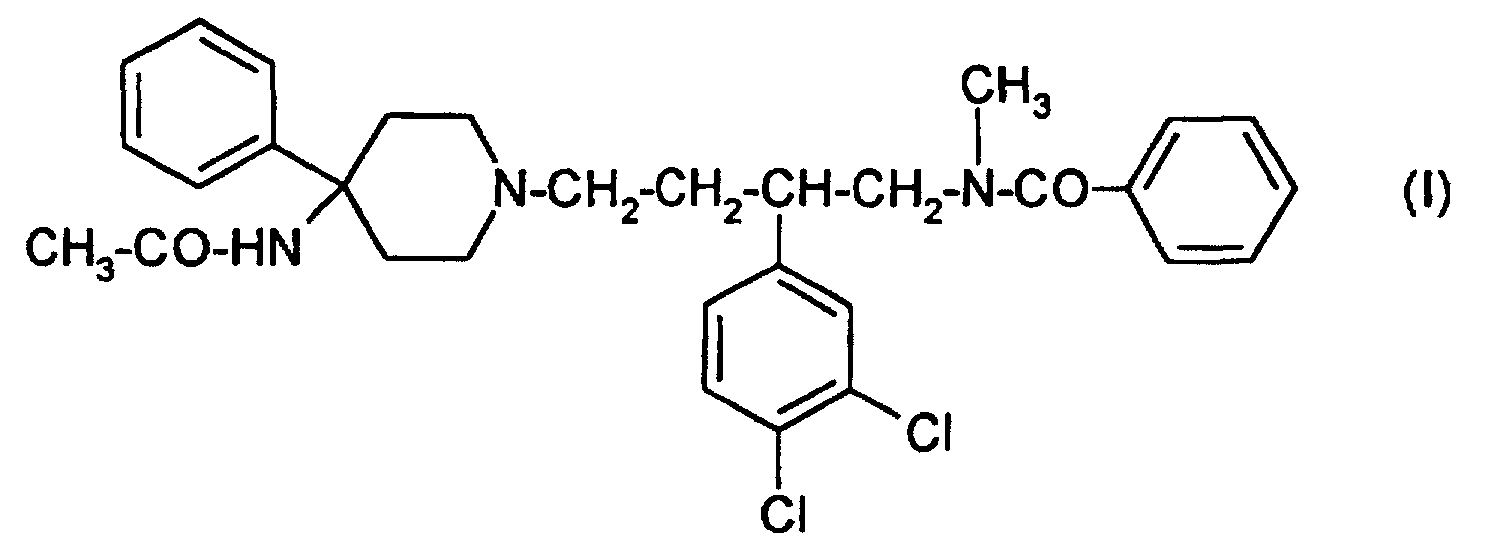
- Sarédutant is the International Non-proprietary Name (INN) of (S) - (-) - N-methyl-N- [4- (4-acetylamino-4-phenylpiperidin-1-yl) -2- (3,4-dichlorophenyl) butyl] benzamide of formula:
- neurokinin A antagonists of neurokinin A and can be useful in any neurokinin A dependent pathology and more particularly in neurogenic inflammations of the respiratory tract.
- These compounds have also been described as non-peptide, potent and selective antagonists of the neurokinin A NK 2 receptors (Life Sciences, 1992, 50 (15), PL101-PL106).
- saredutant and its salts pharmaceutically acceptable are useful in the treatment or prevention of major depressive disorders.
- the present invention relates to the use of sarédutant and its salts pharmaceutically acceptable for the preparation of useful medicaments in the treatment or prevention of major depressive disorders.
- Saredutant and its pharmaceutically acceptable salts are prepared according to the process described in patent EP 0 474 561 B1 or that described in EP patent 0 698 601 B1.
- the salts of the compound of formula (I) are the salts with acids conventional pharmaceutically acceptable minerals or organic such as that hydrochloride, hydrobromide, sulfate, hydrogen sulfate, dihydrogenphosphate, methanesulfonate, methylsulfate, acetate, oxalate, maleate, fumarate, succinate, naphthalene-2-sulfonate, glyconate, gluconate, citrate, isethionate, benzenesulfonate, toluenesulfonate.
- acids conventional pharmaceutically acceptable minerals or organic such as that hydrochloride, hydrobromide, sulfate, hydrogen sulfate, dihydrogenphosphate, methanesulfonate, methylsulfate, acetate, oxalate, maleate, fumarate, succinate, naphthalene-2-sulfonate, glyconate, gluconate, citrate, isethionate
- the compound of formula (I) and its pharmaceutically acceptable salts are generally administered in dosage units.
- Said dosage units are preferably formulated in pharmaceutical compositions in which the active ingredient is mixed with a pharmaceutical excipient.
- compositions of the present invention for oral, sublingual, inhaled, subcutaneous, intramuscular administration, intravenous, transdermal, local or rectal, the active ingredient alone or in combination with another active ingredient can be administered as administration unit, mixed with pharmaceutical carriers classics, animals and humans.
- Unit forms suitable administration forms include oral forms such than tablets, capsules, powders, granules and solutions or oral suspensions, the forms of sublingual and oral administration, aerosols, topical forms of administration, implants, forms subcutaneous, transdermal, intramuscular administration, intravenous, intranasal and rectal forms of administration.
- the daily dosage of the compound of formula (I) is from 0.05 to 5 mg / kg, advantageously from 1 to 2.5 mg / kg, preferably from 2 to 2.5 mg / kg, to be administered once or more than once.
- the compound of formula (I) and its salts are generally formulated in dosage units containing 2.5 to 500 mg, advantageously from 50 to 250 mg, preferably from 100 to 250 mg of active ingredient per dosage unit to be administered times, twice or more times at the same time, as needed.
- these dosages are examples of average situations, there may have special cases where higher or lower dosages are suitable, such dosages also belong to the invention.
- the appropriate dosage for each patient is determined by the doctor according to the method of administration, age, weight and response from said patient.
- a vehicle is added to the active ingredient, micronized or not pharmaceutical which can be composed of diluents such as for example lactose, microcrystalline cellulose, starch and adjuvants formulation as binders (polyvinylpyrrolidone, hydroxypropylmethylcellulose, etc.), flow agents such as silica, lubricants like magnesium stearate, stearic acid, glycerol tribehenate, sodium stearyl fumarate.
- diluents such as for example lactose, microcrystalline cellulose, starch and adjuvants formulation as binders (polyvinylpyrrolidone, hydroxypropylmethylcellulose, etc.)
- flow agents such as silica, lubricants like magnesium stearate, stearic acid, glycerol tribehenate, sodium stearyl fumarate.
- wetting agents or surfactants such as lauryl sulfate sodium can be added to the formulation.
- the tablets can be produced by different techniques, direct compression, dry granulation, wet granulation, fusion hot.
- the tablets can be naked or coated (by sucrose by example) or coated with various polymers or other materials appropriate.
- Tablets may have flash, delayed or prolonged by producing polymer matrices or using specific polymers in the film coating.
- a capsule preparation is obtained by simple mixing of the principle active with dry pharmaceutical vehicles (simple mixing or dry, wet granulation, hot melting), liquids or semi-solids.
- the capsules can be soft or hard, film-coated or not so as to have a flash activity, prolonged or delayed (for example by an enteric form).
- a preparation in the form of syrup or elixir may contain the active ingredient together with a sweetener, preferably calorie-free, methylparaben and propylparaben as an antiseptic, as well as a agent giving flavor and a suitable color.
- a sweetener preferably calorie-free, methylparaben and propylparaben as an antiseptic, as well as a agent giving flavor and a suitable color.
- Water dispersible powders or granules may contain the active principle in mixture with dispersing agents, agents wetting agents or suspending agents, such as polyvinylpyrrolidone, as well as with sweeteners or taste correctors.
- suppositories are used which are prepared with binders melting at rectal temperature, by example of cocoa butter or polyethylene glycols.
- aqueous suspensions, isotonic saline solutions or solutions sterile and injectable which contain dispersing agents and / or pharmacologically compatible solubilizers, e.g. propylene glycol or butylene glycol.
- a cosolvent like for example an alcohol such as ethanol or a glycol such as polyethylene glycol or propylene glycol, and a hydrophilic surfactant such as Tween® 80.
- a cosolvent like for example an alcohol such as ethanol or a glycol such as polyethylene glycol or propylene glycol, and a hydrophilic surfactant such as Tween® 80.
- creams for local administration, creams, ointments, gels, eye drops.
- patches can be used under multilaminate or reservoir form in which the active ingredient can be in alcoholic solution.
- an aerosol containing for example sorbitan trioleate or oleic acid as well as trichlorofluoromethane, dichlorofluoromethane, dichlorotetrafluoroethane or any other biologically propellant compatible; we can also use a system containing the principle active alone or combined with an excipient, in powder form.
- the active ingredient can also be presented in the form of complex with a cyclodextrin, for example, ⁇ , ⁇ , ⁇ -cyclodextrin, 2-hydroxypropyl- ⁇ -cyclodextrin, methyl- ⁇ -cyclodextrin.
- a cyclodextrin for example, ⁇ , ⁇ , ⁇ -cyclodextrin, 2-hydroxypropyl- ⁇ -cyclodextrin, methyl- ⁇ -cyclodextrin.
- the active ingredient can also be formulated in the form of microcapsules or microspheres, possibly with one or more supports or additives.
- implants can be used. These can be prepared in the form of an oily suspension or in the form of suspension of microspheres in an isotonic medium.
- the oral forms of administration are preferred.
- saredutant The effect of saredutant on major depressive disorders is studied on patients aged 18 to 65 years. Patients receive saredutant orally (300 mg / day) for six weeks about.
- the improvement in depressive syndromes is measured by a significant decrease in scores on the Hamilton Depression Assessment Scale (HAM-D) as well as by the collection of impressions from the clinician and overall impressions from the patient.
- the Hamilton Depression Rating Scale is defined by Hamilton M. in J. Neurol. Neurosurg. Psychiat., 1960, 23 , 56-62.
- the saredutant is used in the form of monosuccinate.
- EXAMPLE 1 25 mg capsule of saredutant.
Landscapes
- Health & Medical Sciences (AREA)
- Life Sciences & Earth Sciences (AREA)
- Pharmacology & Pharmacy (AREA)
- Public Health (AREA)
- General Health & Medical Sciences (AREA)
- Veterinary Medicine (AREA)
- Animal Behavior & Ethology (AREA)
- Chemical & Material Sciences (AREA)
- Medicinal Chemistry (AREA)
- Bioinformatics & Cheminformatics (AREA)
- Engineering & Computer Science (AREA)
- General Chemical & Material Sciences (AREA)
- Chemical Kinetics & Catalysis (AREA)
- Nuclear Medicine, Radiotherapy & Molecular Imaging (AREA)
- Neurosurgery (AREA)
- Neurology (AREA)
- Organic Chemistry (AREA)
- Biomedical Technology (AREA)
- Epidemiology (AREA)
- Psychiatry (AREA)
- Pain & Pain Management (AREA)
- Pharmaceuticals Containing Other Organic And Inorganic Compounds (AREA)
- Acyclic And Carbocyclic Compounds In Medicinal Compositions (AREA)
- Medicines That Contain Protein Lipid Enzymes And Other Medicines (AREA)
- Hydrogenated Pyridines (AREA)
- Peptides Or Proteins (AREA)
- Organic Low-Molecular-Weight Compounds And Preparation Thereof (AREA)
- Medicinal Preparation (AREA)
Description
| Sarédutant (exprimé en base) | 25,0 mg | |
| lactose monohydrate (200 mesh) | QSP | 170 mg |
| croscarmellose sodium | 3,4 mg | |
| stéarate de magnésium | 1,7 mg | |
| eau purifié | QS | |
| pour une gélule blanc opaque de taille 3, remplie à | 170 mg |
| Sarédutant (exprimé en base) | 100,0 mg | |
| lactose monohydrate (200 mesh) | QSP | 170 mg |
| croscarmellose sodium | 3,4 mg | |
| stéarate de magnésium | 1,7 mg | |
| eau purifié | QS | |
| pour une gélule blanc opaque de taille 3, remplie à | 170 mg |
Claims (1)
- Utilisation du saredutant et de ses sels pharmaceutiquement acceptables pour la préparation de médicaments utiles dans le traitement ou la prévention des troubles dépressifs majeurs.
Applications Claiming Priority (3)
| Application Number | Priority Date | Filing Date | Title |
|---|---|---|---|
| FR9905338A FR2792835B3 (fr) | 1999-04-27 | 1999-04-27 | Utilisation du saredutant pour la preparation de medicaments utiles dans le traitement ou la prevention de l'ensemble des troubles de l'humeur, des troubles de l'adaptation ou des troubles mixtes anxiete-depression |
| FR9905338 | 1999-04-27 | ||
| PCT/FR2000/001084 WO2000064423A2 (fr) | 1999-04-27 | 2000-04-25 | Utilisation du saredutant et de ses sels pharmaceutiquement acceptables dans le traitement ou la prevention des troubles de l'humeur d'adaptation et de l'anxiete-depression |
Publications (2)
| Publication Number | Publication Date |
|---|---|
| EP1173179A2 EP1173179A2 (fr) | 2002-01-23 |
| EP1173179B1 true EP1173179B1 (fr) | 2003-03-19 |
Family
ID=9544931
Family Applications (1)
| Application Number | Title | Priority Date | Filing Date |
|---|---|---|---|
| EP00922735A Expired - Lifetime EP1173179B1 (fr) | 1999-04-27 | 2000-04-25 | Utilisation du saredutant et de ses sels pharmaceutiquement acceptables dans le traitement ou la prevention des troubles depressifs majeurs |
Country Status (32)
| Country | Link |
|---|---|
| US (3) | US6573281B1 (fr) |
| EP (1) | EP1173179B1 (fr) |
| JP (1) | JP2002542281A (fr) |
| KR (1) | KR20020001850A (fr) |
| CN (1) | CN1172669C (fr) |
| AR (1) | AR023597A1 (fr) |
| AT (1) | ATE234617T1 (fr) |
| AU (1) | AU764304B2 (fr) |
| BG (1) | BG65472B1 (fr) |
| BR (1) | BR0010006A (fr) |
| CA (1) | CA2370834C (fr) |
| CZ (1) | CZ294904B6 (fr) |
| DE (1) | DE60001725T2 (fr) |
| DK (1) | DK1173179T3 (fr) |
| EE (1) | EE05211B1 (fr) |
| ES (1) | ES2193065T3 (fr) |
| FR (1) | FR2792835B3 (fr) |
| HU (1) | HUP0200969A3 (fr) |
| IL (1) | IL145269A0 (fr) |
| MX (1) | MXPA01010904A (fr) |
| NO (1) | NO20015228L (fr) |
| NZ (1) | NZ513851A (fr) |
| PL (1) | PL196479B1 (fr) |
| PT (1) | PT1173179E (fr) |
| RU (1) | RU2238726C2 (fr) |
| SI (1) | SI1173179T1 (fr) |
| SK (1) | SK285459B6 (fr) |
| TR (1) | TR200102512T2 (fr) |
| TW (1) | TWI225399B (fr) |
| UA (1) | UA69441C2 (fr) |
| WO (1) | WO2000064423A2 (fr) |
| ZA (1) | ZA200107143B (fr) |
Families Citing this family (13)
| Publication number | Priority date | Publication date | Assignee | Title |
|---|---|---|---|---|
| FR2792835B3 (fr) * | 1999-04-27 | 2001-05-25 | Sanofi Sa | Utilisation du saredutant pour la preparation de medicaments utiles dans le traitement ou la prevention de l'ensemble des troubles de l'humeur, des troubles de l'adaptation ou des troubles mixtes anxiete-depression |
| US6903092B2 (en) | 2000-04-06 | 2005-06-07 | Peter Bernstein | Naphthamide neurokinin antagonists for use as medicaments |
| US6846814B2 (en) | 2000-04-06 | 2005-01-25 | Astra Zeneca Ab | Neurokinin antagonists for use as medicaments |
| JP2003530381A (ja) * | 2000-04-06 | 2003-10-14 | アストラゼネカ・アクチエボラーグ | 化合物 |
| ATE400563T1 (de) * | 2000-04-06 | 2008-07-15 | Astrazeneca Ab | Neue neurokinin-antagonisten zum gebrauch als arzneimittel |
| GB0019008D0 (en) * | 2000-08-04 | 2000-09-27 | Astrazeneca Ab | Therapeutic compounds |
| SE0003476D0 (sv) * | 2000-09-28 | 2000-09-28 | Astrazeneca Ab | Compounds |
| FR2912057B1 (fr) * | 2007-02-07 | 2009-04-17 | Sanofi Aventis Sa | Composition pharmaceutique contenant en association le saredutant et un inhibiteur selectif de la recapture de la serotonine ou un inhibiteur de la recapture de la serotonine/norepinephrine |
| FR2904221B1 (fr) * | 2006-07-31 | 2008-09-12 | Sanofi Aventis Sa | Composition pharmaceutique contenant en association le saredutant et la fluoxetine. |
| TW200817003A (en) * | 2006-07-31 | 2008-04-16 | Sanofi Aventis | Pharmaceutical composition comprising, in combination, saredutant and a selective serotonin peuptake inhibitor or a serotonin/norepinephrine reuptake inhibitor |
| FR2912058A1 (fr) * | 2007-02-07 | 2008-08-08 | Sanofi Aventis Sa | Utilisation d'un compose antagoniste des recepteurs nk2 de la neurokinine a pour la preparation de medicaments utiles pour la prevention et le traitement des dysfonctions sexuelles |
| KR101174980B1 (ko) * | 2007-09-14 | 2012-08-17 | 에프. 호프만-라 로슈 아게 | Nk3 수용체 길항제로서의 피페리딘 유도체 |
| US20090076083A1 (en) * | 2007-09-19 | 2009-03-19 | Protia, Llc | Deuterium-enriched saredutant |
Family Cites Families (8)
| Publication number | Priority date | Publication date | Assignee | Title |
|---|---|---|---|---|
| IL99320A (en) * | 1990-09-05 | 1995-07-31 | Sanofi Sa | Arylalkylamines, their preparation and pharmaceutical compositions containing them |
| FR2695626B1 (fr) * | 1992-09-17 | 1994-12-02 | Lebroch Yannick | Dispositif de gobelet adaptable sur un conteneur de boisson. |
| FR2696178B1 (fr) * | 1992-09-30 | 1994-12-30 | Sanofi Elf | Amides basiques quaternaires, procédé pour leur préparation et compositions pharmaceutiques en contenant. |
| FR2700472B1 (fr) | 1993-01-19 | 1995-02-17 | Rhone Poulenc Rorer Sa | Association synergisante ayant un effet antagoniste des récepteurs NK1 et NK2. |
| US5512680A (en) * | 1993-02-26 | 1996-04-30 | Sanofi | Process for the preparation of an optically pure aminoalcohol |
| IL112778A0 (en) * | 1994-03-04 | 1995-05-26 | Merck & Co Inc | Substituted heterocycles, their preparation and pharmaceutical compositions containing them |
| US5554644A (en) * | 1994-06-08 | 1996-09-10 | Warner-Lambert Company | Tachykinin (NK2) antagonists |
| FR2792835B3 (fr) * | 1999-04-27 | 2001-05-25 | Sanofi Sa | Utilisation du saredutant pour la preparation de medicaments utiles dans le traitement ou la prevention de l'ensemble des troubles de l'humeur, des troubles de l'adaptation ou des troubles mixtes anxiete-depression |
-
1999
- 1999-04-27 FR FR9905338A patent/FR2792835B3/fr not_active Expired - Fee Related
-
2000
- 2000-04-25 IL IL14526900A patent/IL145269A0/xx not_active IP Right Cessation
- 2000-04-25 MX MXPA01010904A patent/MXPA01010904A/es active IP Right Grant
- 2000-04-25 BR BR0010006-4A patent/BR0010006A/pt not_active Application Discontinuation
- 2000-04-25 HU HU0200969A patent/HUP0200969A3/hu unknown
- 2000-04-25 RU RU2001124802/14A patent/RU2238726C2/ru not_active IP Right Cessation
- 2000-04-25 DK DK00922735T patent/DK1173179T3/da active
- 2000-04-25 NZ NZ513851A patent/NZ513851A/xx not_active IP Right Cessation
- 2000-04-25 CZ CZ20013812A patent/CZ294904B6/cs not_active IP Right Cessation
- 2000-04-25 ES ES00922735T patent/ES2193065T3/es not_active Expired - Lifetime
- 2000-04-25 JP JP2000613414A patent/JP2002542281A/ja active Pending
- 2000-04-25 AU AU43034/00A patent/AU764304B2/en not_active Ceased
- 2000-04-25 AT AT00922735T patent/ATE234617T1/de active
- 2000-04-25 WO PCT/FR2000/001084 patent/WO2000064423A2/fr not_active Ceased
- 2000-04-25 EE EEP200100553A patent/EE05211B1/xx not_active IP Right Cessation
- 2000-04-25 KR KR1020017013704A patent/KR20020001850A/ko not_active Ceased
- 2000-04-25 EP EP00922735A patent/EP1173179B1/fr not_active Expired - Lifetime
- 2000-04-25 UA UA2001096123A patent/UA69441C2/uk unknown
- 2000-04-25 SI SI200030071T patent/SI1173179T1/xx unknown
- 2000-04-25 US US09/958,439 patent/US6573281B1/en not_active Expired - Fee Related
- 2000-04-25 CA CA002370834A patent/CA2370834C/fr not_active Expired - Fee Related
- 2000-04-25 SK SK1547-2001A patent/SK285459B6/sk not_active IP Right Cessation
- 2000-04-25 PL PL351922A patent/PL196479B1/pl not_active IP Right Cessation
- 2000-04-25 PT PT00922735T patent/PT1173179E/pt unknown
- 2000-04-25 TR TR2001/02512T patent/TR200102512T2/xx unknown
- 2000-04-25 DE DE60001725T patent/DE60001725T2/de not_active Expired - Lifetime
- 2000-04-25 CN CNB008066817A patent/CN1172669C/zh not_active Expired - Fee Related
- 2000-04-26 AR ARP000101955A patent/AR023597A1/es unknown
- 2000-05-10 TW TW089107876A patent/TWI225399B/zh not_active IP Right Cessation
-
2001
- 2001-08-29 ZA ZA200107143A patent/ZA200107143B/xx unknown
- 2001-09-28 BG BG105962A patent/BG65472B1/bg unknown
- 2001-10-25 NO NO20015228A patent/NO20015228L/no not_active Application Discontinuation
-
2003
- 2003-04-08 US US10/409,504 patent/US7390823B2/en not_active Expired - Fee Related
-
2008
- 2008-05-21 US US12/124,262 patent/US20080227818A1/en not_active Abandoned
Also Published As
Similar Documents
| Publication | Publication Date | Title |
|---|---|---|
| BE1005086A5 (fr) | Compositions pour l'administration buccale. | |
| EP1257275B1 (fr) | Utilisation d'un antagoniste des recepteurs aux cannabinoides centraux pour la preparation de medicaments utiles pour faciliter l'arret de la consommation de tabac | |
| EP1221952B1 (fr) | UTILISATION D'UN ANTAGONISTE DES RECEPTEURS AUX CANNABINOiDES CENTRAUX POUR LA PREPARATION DE MEDICAMENTS | |
| TW589174B (en) | Agent for treating high-risk impaired glucose tolerance | |
| US20080227818A1 (en) | Use of saredutant or its pharmaceutically acceptable salts in the treatment of mixed anxiety-depression disorders | |
| FR2613934A1 (fr) | Composition pharmaceutique a base de 1,2,3,9-tetrahydro-9-methyl-3-((2-methyl-1h-imidazol-1-yl) methyl)-4h-carbazol-4-one et de la ranitidine, son procede de fabrication, l'utilisation de ses deux principes actifs pour la fabrication d'un medicament | |
| EP1795194A2 (fr) | Utilisation d'un antagoniste des récepteurs CB1 associé à un bêta3-agoniste pour la préparation de médicaments utiles pour traiter l'appétence | |
| JPH0812575A (ja) | 口腔乾燥症治療剤 | |
| FR2762514A1 (fr) | Utilisation de derives de la tetrahydropyridine pour la preparation de medicaments pour le traitement des maladies entrainant une demyelinisation | |
| FR2837706A1 (fr) | Utilisation d'un antagoniste des recepteurs aux cannabinoides cb1 pour la preparation de medicaments utiles pour traiter les dysfonctionnements sexuels et/ou ameliorer les performances sexuelles | |
| EP1441723B1 (fr) | Utilisation de l'irbesartan pour la prevention ou le traitement de l'hypertension pulmonaire | |
| EP0412901A2 (fr) | Utilisation de trifluorométhyl-phényltétrahydropyridines pour la préparation de médicaments destinés à combattre les troubles de la motricité intestinale | |
| US20060135507A1 (en) | Therapeutic agent for overactive bladder involved in aging | |
| WO2000061125A2 (fr) | L'osanetant dans le traitement des troubles de l'humeur | |
| SK50082006A3 (sk) | Použitie bicyklo[2.2.1]heptánových derivátov na prípravu neuroprotektívnych farmaceutických kompozícií | |
| EP1115399B1 (fr) | Utilisation d'une composition pharmaceutique contenant, en association, un antagoniste des recepteurs at1 de l'angiotensine ii et l'indomethacine pour la fabrication d'un medicament pour traiter les glomerulonephrites chroniques | |
| EP0489640B1 (fr) | Utilisation de phényléthanolaminotétralines pour la préparation de médicaments antidépressifs et anti-stress | |
| FR2758460A1 (fr) | Utilisation des agonistes des recepteurs beta-3 adrenergiques pour la preparation de medicaments cicatrisants | |
| EP0950053B1 (fr) | Nouveaux derives de benzoylalkyl-1,2,3,6-tetrahydropyridines | |
| WO2008110697A2 (fr) | Utilisation d'un compose antagoniste des recepteurs nk2 de la neurokinine a pour la preparation de medicaments utiles pour la prevention et le traitement des dysfonctions sexuelles | |
| HK1041821B (en) | Use of saredutant and the pharmaceutically acceptable salts thereof to produce medicaments used to treat or prevent major depressive disorders | |
| FR2573071A1 (fr) | N-(hydroxy-2-dimethyl-1,1-ethyl)-amino-2-phenyl-1-ethanol utile notamment comme anti-inflammatoire, et son procede de preparation | |
| FR2792834A1 (fr) | Utilisation du sr 49059, de ses solvats et/ou hydrates pharmaceutiquement acceptables, pour la preparation de medicaments utiles dans le traitement ou la prevention du phenomene de raynaud |
Legal Events
| Date | Code | Title | Description |
|---|---|---|---|
| PUAI | Public reference made under article 153(3) epc to a published international application that has entered the european phase |
Free format text: ORIGINAL CODE: 0009012 |
|
| 17P | Request for examination filed |
Effective date: 20011127 |
|
| AK | Designated contracting states |
Kind code of ref document: A2 Designated state(s): AT BE CH CY DE DK ES FI FR GB GR IE IT LI LU MC NL PT SE |
|
| AX | Request for extension of the european patent |
Free format text: AL PAYMENT 20011127;LT PAYMENT 20011127;LV PAYMENT 20011127;MK PAYMENT 20011127;RO PAYMENT 20011127;SI PAYMENT 20011127 |
|
| 17Q | First examination report despatched |
Effective date: 20020214 |
|
| GRAH | Despatch of communication of intention to grant a patent |
Free format text: ORIGINAL CODE: EPIDOS IGRA |
|
| RTI1 | Title (correction) |
Free format text: USE OF SAREDUTANT AND THE PHARMACEUTICALLY ACCEPTABLE SALTS THEREOF TO PRODUCE MEDICAMENTS USED TO TREAT OR PREVENT MAJOR DEPRESSIVE DISORDERS |
|
| GRAH | Despatch of communication of intention to grant a patent |
Free format text: ORIGINAL CODE: EPIDOS IGRA |
|
| GRAA | (expected) grant |
Free format text: ORIGINAL CODE: 0009210 |
|
| AK | Designated contracting states |
Designated state(s): AT BE CH CY DE DK ES FI FR GB GR IE IT LI LU MC NL PT SE |
|
| AX | Request for extension of the european patent |
Extension state: AL LT LV MK RO SI |
|
| REG | Reference to a national code |
Ref country code: GB Ref legal event code: FG4D Free format text: NOT ENGLISH |
|
| REG | Reference to a national code |
Ref country code: CH Ref legal event code: EP |
|
| REG | Reference to a national code |
Ref country code: IE Ref legal event code: FG4D Free format text: FRENCH |
|
| REF | Corresponds to: |
Ref document number: 60001725 Country of ref document: DE Date of ref document: 20030424 Kind code of ref document: P |
|
| PG25 | Lapsed in a contracting state [announced via postgrant information from national office to epo] |
Ref country code: MC Free format text: LAPSE BECAUSE OF NON-PAYMENT OF DUE FEES Effective date: 20030430 |
|
| REG | Reference to a national code |
Ref country code: GR Ref legal event code: EP Ref document number: 20030401553 Country of ref document: GR |
|
| REG | Reference to a national code |
Ref country code: PT Ref legal event code: SC4A Free format text: AVAILABILITY OF NATIONAL TRANSLATION Effective date: 20030430 |
|
| REG | Reference to a national code |
Ref country code: SE Ref legal event code: TRGR |
|
| GBT | Gb: translation of ep patent filed (gb section 77(6)(a)/1977) | ||
| REG | Reference to a national code |
Ref country code: DK Ref legal event code: T3 |
|
| REG | Reference to a national code |
Ref country code: ES Ref legal event code: FG2A Ref document number: 2193065 Country of ref document: ES Kind code of ref document: T3 |
|
| PLBE | No opposition filed within time limit |
Free format text: ORIGINAL CODE: 0009261 |
|
| STAA | Information on the status of an ep patent application or granted ep patent |
Free format text: STATUS: NO OPPOSITION FILED WITHIN TIME LIMIT |
|
| 26N | No opposition filed |
Effective date: 20031222 |
|
| REG | Reference to a national code |
Ref country code: CH Ref legal event code: NV Representative=s name: KIRKER & CIE SA |
|
| REG | Reference to a national code |
Ref country code: SI Ref legal event code: IF |
|
| REG | Reference to a national code |
Ref country code: CH Ref legal event code: PFA Owner name: SANOFI-AVENTIS Free format text: SANOFI-SYNTHELABO#174, AVENUE DE FRANCE#75013 PARIS (FR) -TRANSFER TO- SANOFI-AVENTIS#174, AVENUE DE FRANCE#75013 PARIS (FR) |
|
| REG | Reference to a national code |
Ref country code: PT Ref legal event code: PD4A Free format text: SANOFI-AVENTIS FR Effective date: 20050113 |
|
| NLT1 | Nl: modifications of names registered in virtue of documents presented to the patent office pursuant to art. 16 a, paragraph 1 |
Owner name: SANOFI -AVENTIS |
|
| REG | Reference to a national code |
Ref country code: SI Ref legal event code: SP73 Owner name: SANOFI-AVENTIS; FR Effective date: 20050126 |
|
| REG | Reference to a national code |
Ref country code: FR Ref legal event code: CD |
|
| PGFP | Annual fee paid to national office [announced via postgrant information from national office to epo] |
Ref country code: LU Payment date: 20110415 Year of fee payment: 12 |
|
| PGFP | Annual fee paid to national office [announced via postgrant information from national office to epo] |
Ref country code: GR Payment date: 20110310 Year of fee payment: 12 |
|
| PGFP | Annual fee paid to national office [announced via postgrant information from national office to epo] |
Ref country code: DE Payment date: 20110420 Year of fee payment: 12 Ref country code: PT Payment date: 20110420 Year of fee payment: 12 Ref country code: ES Payment date: 20110518 Year of fee payment: 12 Ref country code: IE Payment date: 20110412 Year of fee payment: 12 Ref country code: SE Payment date: 20110412 Year of fee payment: 12 Ref country code: FR Payment date: 20110426 Year of fee payment: 12 Ref country code: CH Payment date: 20110412 Year of fee payment: 12 |
|
| PGFP | Annual fee paid to national office [announced via postgrant information from national office to epo] |
Ref country code: DK Payment date: 20110412 Year of fee payment: 12 Ref country code: GB Payment date: 20110420 Year of fee payment: 12 Ref country code: AT Payment date: 20110328 Year of fee payment: 12 Ref country code: FI Payment date: 20110412 Year of fee payment: 12 Ref country code: BE Payment date: 20110411 Year of fee payment: 12 Ref country code: NL Payment date: 20110420 Year of fee payment: 12 |
|
| PGFP | Annual fee paid to national office [announced via postgrant information from national office to epo] |
Ref country code: IT Payment date: 20110422 Year of fee payment: 12 |
|
| PGFP | Annual fee paid to national office [announced via postgrant information from national office to epo] |
Ref country code: CY Payment date: 20110415 Year of fee payment: 12 |
|
| BERE | Be: lapsed |
Owner name: S.A. *SANOFI-AVENTIS Effective date: 20120430 |
|
| REG | Reference to a national code |
Ref country code: PT Ref legal event code: MM4A Free format text: LAPSE DUE TO NON-PAYMENT OF FEES Effective date: 20121025 |
|
| REG | Reference to a national code |
Ref country code: NL Ref legal event code: V1 Effective date: 20121101 |
|
| REG | Reference to a national code |
Ref country code: DK Ref legal event code: EBP |
|
| REG | Reference to a national code |
Ref country code: CH Ref legal event code: PL |
|
| REG | Reference to a national code |
Ref country code: SE Ref legal event code: EUG |
|
| REG | Reference to a national code |
Ref country code: AT Ref legal event code: MM01 Ref document number: 234617 Country of ref document: AT Kind code of ref document: T Effective date: 20120425 |
|
| GBPC | Gb: european patent ceased through non-payment of renewal fee |
Effective date: 20120425 |
|
| REG | Reference to a national code |
Ref country code: LT Ref legal event code: MM9D Effective date: 20120425 |
|
| REG | Reference to a national code |
Ref country code: IE Ref legal event code: MM4A |
|
| REG | Reference to a national code |
Ref country code: FR Ref legal event code: ST Effective date: 20121228 |
|
| REG | Reference to a national code |
Ref country code: GR Ref legal event code: ML Ref document number: 20030401553 Country of ref document: GR Effective date: 20121102 |
|
| PG25 | Lapsed in a contracting state [announced via postgrant information from national office to epo] |
Ref country code: CH Free format text: LAPSE BECAUSE OF NON-PAYMENT OF DUE FEES Effective date: 20120430 Ref country code: FI Free format text: LAPSE BECAUSE OF NON-PAYMENT OF DUE FEES Effective date: 20120425 Ref country code: LI Free format text: LAPSE BECAUSE OF NON-PAYMENT OF DUE FEES Effective date: 20120430 Ref country code: GB Free format text: LAPSE BECAUSE OF NON-PAYMENT OF DUE FEES Effective date: 20120425 Ref country code: CY Free format text: LAPSE BECAUSE OF NON-PAYMENT OF DUE FEES Effective date: 20120425 Ref country code: IE Free format text: LAPSE BECAUSE OF NON-PAYMENT OF DUE FEES Effective date: 20120425 Ref country code: AT Free format text: LAPSE BECAUSE OF NON-PAYMENT OF DUE FEES Effective date: 20120425 Ref country code: BE Free format text: LAPSE BECAUSE OF NON-PAYMENT OF DUE FEES Effective date: 20120430 |
|
| PG25 | Lapsed in a contracting state [announced via postgrant information from national office to epo] |
Ref country code: IT Free format text: LAPSE BECAUSE OF NON-PAYMENT OF DUE FEES Effective date: 20120425 Ref country code: PT Free format text: LAPSE BECAUSE OF NON-PAYMENT OF DUE FEES Effective date: 20121025 Ref country code: FR Free format text: LAPSE BECAUSE OF NON-PAYMENT OF DUE FEES Effective date: 20120430 Ref country code: GR Free format text: LAPSE BECAUSE OF NON-PAYMENT OF DUE FEES Effective date: 20121102 Ref country code: SE Free format text: LAPSE BECAUSE OF NON-PAYMENT OF DUE FEES Effective date: 20120426 |
|
| REG | Reference to a national code |
Ref country code: SI Ref legal event code: KO00 Effective date: 20130118 Ref country code: DE Ref legal event code: R119 Ref document number: 60001725 Country of ref document: DE Effective date: 20121101 |
|
| PG25 | Lapsed in a contracting state [announced via postgrant information from national office to epo] |
Ref country code: NL Free format text: LAPSE BECAUSE OF NON-PAYMENT OF DUE FEES Effective date: 20121101 |
|
| REG | Reference to a national code |
Ref country code: ES Ref legal event code: FD2A Effective date: 20130715 |
|
| PG25 | Lapsed in a contracting state [announced via postgrant information from national office to epo] |
Ref country code: ES Free format text: LAPSE BECAUSE OF NON-PAYMENT OF DUE FEES Effective date: 20120426 |
|
| PG25 | Lapsed in a contracting state [announced via postgrant information from national office to epo] |
Ref country code: DK Free format text: LAPSE BECAUSE OF NON-PAYMENT OF DUE FEES Effective date: 20120430 |
|
| PG25 | Lapsed in a contracting state [announced via postgrant information from national office to epo] |
Ref country code: LU Free format text: LAPSE BECAUSE OF NON-PAYMENT OF DUE FEES Effective date: 20120425 |
|
| PG25 | Lapsed in a contracting state [announced via postgrant information from national office to epo] |
Ref country code: DE Free format text: LAPSE BECAUSE OF NON-PAYMENT OF DUE FEES Effective date: 20121101 |