EP1153494B1 - Method and system for control signalling enabling flexible link adaptation in a radiocommunication system - Google Patents
Method and system for control signalling enabling flexible link adaptation in a radiocommunication system Download PDFInfo
- Publication number
- EP1153494B1 EP1153494B1 EP00909845A EP00909845A EP1153494B1 EP 1153494 B1 EP1153494 B1 EP 1153494B1 EP 00909845 A EP00909845 A EP 00909845A EP 00909845 A EP00909845 A EP 00909845A EP 1153494 B1 EP1153494 B1 EP 1153494B1
- Authority
- EP
- European Patent Office
- Prior art keywords
- mcs
- entity
- transmitting
- modulation
- link
- Prior art date
- Legal status (The legal status is an assumption and is not a legal conclusion. Google has not performed a legal analysis and makes no representation as to the accuracy of the status listed.)
- Expired - Lifetime
Links
- 238000000034 method Methods 0.000 title claims description 49
- 230000006978 adaptation Effects 0.000 title description 18
- 230000011664 signaling Effects 0.000 title description 11
- 238000005259 measurement Methods 0.000 claims description 13
- 230000005540 biological transmission Effects 0.000 description 33
- 238000004891 communication Methods 0.000 description 16
- 238000005457 optimization Methods 0.000 description 5
- 230000008859 change Effects 0.000 description 4
- 230000008569 process Effects 0.000 description 4
- 230000008901 benefit Effects 0.000 description 3
- 238000010586 diagram Methods 0.000 description 3
- 230000015556 catabolic process Effects 0.000 description 2
- 230000001413 cellular effect Effects 0.000 description 2
- 238000011217 control strategy Methods 0.000 description 2
- 238000007796 conventional method Methods 0.000 description 2
- 238000006731 degradation reaction Methods 0.000 description 2
- 238000013507 mapping Methods 0.000 description 2
- 101710116852 Molybdenum cofactor sulfurase 1 Proteins 0.000 description 1
- 230000003044 adaptive effect Effects 0.000 description 1
- 230000009286 beneficial effect Effects 0.000 description 1
- 238000012937 correction Methods 0.000 description 1
- 125000004122 cyclic group Chemical group 0.000 description 1
- 239000002360 explosive Substances 0.000 description 1
- 230000003993 interaction Effects 0.000 description 1
- 230000007246 mechanism Effects 0.000 description 1
- 238000012986 modification Methods 0.000 description 1
- 230000004048 modification Effects 0.000 description 1
- 230000010363 phase shift Effects 0.000 description 1
- 238000012545 processing Methods 0.000 description 1
- 238000013468 resource allocation Methods 0.000 description 1
- 230000011218 segmentation Effects 0.000 description 1
- 230000007704 transition Effects 0.000 description 1
Images




Classifications
-
- H—ELECTRICITY
- H04—ELECTRIC COMMUNICATION TECHNIQUE
- H04L—TRANSMISSION OF DIGITAL INFORMATION, e.g. TELEGRAPHIC COMMUNICATION
- H04L1/00—Arrangements for detecting or preventing errors in the information received
- H04L1/0001—Systems modifying transmission characteristics according to link quality, e.g. power backoff
- H04L1/0015—Systems modifying transmission characteristics according to link quality, e.g. power backoff characterised by the adaptation strategy
- H04L1/0016—Systems modifying transmission characteristics according to link quality, e.g. power backoff characterised by the adaptation strategy involving special memory structures, e.g. look-up tables
-
- H—ELECTRICITY
- H04—ELECTRIC COMMUNICATION TECHNIQUE
- H04L—TRANSMISSION OF DIGITAL INFORMATION, e.g. TELEGRAPHIC COMMUNICATION
- H04L1/00—Arrangements for detecting or preventing errors in the information received
- H04L1/0001—Systems modifying transmission characteristics according to link quality, e.g. power backoff
- H04L1/0002—Systems modifying transmission characteristics according to link quality, e.g. power backoff by adapting the transmission rate
- H04L1/0003—Systems modifying transmission characteristics according to link quality, e.g. power backoff by adapting the transmission rate by switching between different modulation schemes
-
- H—ELECTRICITY
- H04—ELECTRIC COMMUNICATION TECHNIQUE
- H04L—TRANSMISSION OF DIGITAL INFORMATION, e.g. TELEGRAPHIC COMMUNICATION
- H04L1/00—Arrangements for detecting or preventing errors in the information received
- H04L1/0001—Systems modifying transmission characteristics according to link quality, e.g. power backoff
- H04L1/0009—Systems modifying transmission characteristics according to link quality, e.g. power backoff by adapting the channel coding
-
- H—ELECTRICITY
- H04—ELECTRIC COMMUNICATION TECHNIQUE
- H04L—TRANSMISSION OF DIGITAL INFORMATION, e.g. TELEGRAPHIC COMMUNICATION
- H04L1/00—Arrangements for detecting or preventing errors in the information received
- H04L1/0001—Systems modifying transmission characteristics according to link quality, e.g. power backoff
- H04L1/0023—Systems modifying transmission characteristics according to link quality, e.g. power backoff characterised by the signalling
- H04L1/0025—Transmission of mode-switching indication
-
- H—ELECTRICITY
- H04—ELECTRIC COMMUNICATION TECHNIQUE
- H04L—TRANSMISSION OF DIGITAL INFORMATION, e.g. TELEGRAPHIC COMMUNICATION
- H04L1/00—Arrangements for detecting or preventing errors in the information received
- H04L1/0001—Systems modifying transmission characteristics according to link quality, e.g. power backoff
- H04L1/0023—Systems modifying transmission characteristics according to link quality, e.g. power backoff characterised by the signalling
- H04L1/0026—Transmission of channel quality indication
-
- H—ELECTRICITY
- H04—ELECTRIC COMMUNICATION TECHNIQUE
- H04L—TRANSMISSION OF DIGITAL INFORMATION, e.g. TELEGRAPHIC COMMUNICATION
- H04L1/00—Arrangements for detecting or preventing errors in the information received
- H04L1/12—Arrangements for detecting or preventing errors in the information received by using return channel
-
- H—ELECTRICITY
- H04—ELECTRIC COMMUNICATION TECHNIQUE
- H04L—TRANSMISSION OF DIGITAL INFORMATION, e.g. TELEGRAPHIC COMMUNICATION
- H04L1/00—Arrangements for detecting or preventing errors in the information received
- H04L1/12—Arrangements for detecting or preventing errors in the information received by using return channel
- H04L1/16—Arrangements for detecting or preventing errors in the information received by using return channel in which the return channel carries supervisory signals, e.g. repetition request signals
- H04L1/18—Automatic repetition systems, e.g. Van Duuren systems
- H04L1/1812—Hybrid protocols; Hybrid automatic repeat request [HARQ]
- H04L1/1819—Hybrid protocols; Hybrid automatic repeat request [HARQ] with retransmission of additional or different redundancy
-
- H—ELECTRICITY
- H04—ELECTRIC COMMUNICATION TECHNIQUE
- H04L—TRANSMISSION OF DIGITAL INFORMATION, e.g. TELEGRAPHIC COMMUNICATION
- H04L1/00—Arrangements for detecting or preventing errors in the information received
- H04L1/12—Arrangements for detecting or preventing errors in the information received by using return channel
- H04L1/16—Arrangements for detecting or preventing errors in the information received by using return channel in which the return channel carries supervisory signals, e.g. repetition request signals
- H04L1/18—Automatic repetition systems, e.g. Van Duuren systems
- H04L1/1829—Arrangements specially adapted for the receiver end
- H04L1/1835—Buffer management
- H04L1/1845—Combining techniques, e.g. code combining
Definitions
- the present invention generally relates to mode signalling in the field of communication systems and, more particularly, to mode signalling involving multiple modulation and coding schemes, link adaptation and incremental redundancy in digital communication systems.
- a corresponding minimum user bit rate is required.
- user bit rate corresponds to voice quality and/or data throughput, with a higher user bit rate producing better voice quality and/or higher data throughput.
- the total user bit rate is determined by a selected combination of techniques for speech coding, channel coding, modulation and resource allocation (e.g., for a TDMA system, the number of assignable time slots per call and for a CDMA system, the number of codes assigned to a call).
- GMSK Gaussian Minimum Shift Keying
- QPSK Quadrature Phase Shift Keying
- QAM Quadrature Amplitude Modulation
- each communication system operates using a single modulation scheme for transmission of information under all conditions.
- ETSI originally specified the GSM standard to communicate control, voice and data information over links using a GMSK modulation scheme to provide transmission and retransmission of information.
- modulation schemes may use a different number of values or levels to represent information symbols.
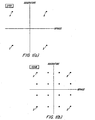
- the signal set i.e., amplitude coefficients, associated with QPSK, an exemplary lower level modulation (LLM) scheme, are illustrated in Figure 1(a) .
- LLM lower level modulation
- 16QAM is a higher level modulation (HLM) scheme having the signal set depicted in Figure 1(b)
- the minimum Euclidean distance between the coefficients in the LLM scheme is greater than the minimum Euclidean distance between coefficients in the HLM scheme for the same average signal power, which makes it easier for receive signal processing to distinguish between modulation changes in the LLM scheme.
- LLM schemes are more robust with respect to noise and interference, i.e., require a lower carrier-to-interference (C/I) level to achieve acceptable received signal quality.
- HLM schemes provide greater user bit rates, e.g., 16QAM provides twice the user bit rate of QPSK, but require higher C/I levels.
- FEC forward error correction
- ARQ automatic retransmission request
- FEC techniques include, for example, convolutional or block coding of the data prior to modulation.
- FEC coding involves representing a certain number of data bits using a certain number of code bits.
- convolutional codes by their code rates, e.g., J/2 and 1/3, wherein the lower code rates provide greater error protection but lower user bit rates for a given channel bit rate.
- ARQ techniques involve, analyzing received blocks of data for errors and requesting retransmission of blocks which contain errors.
- a logical link control (LLC) frame containing a frame header (FH), a frame header (PH), a payload of information and a frame check sequence (PCS) is mapped into a plurality of radio link control (RLC) blocks, each of which include a block header (BH), information field, and block check sequence (BCS), which can be used by a receiver to check for errors in the information field.
- RLC blocks are further mapped into physical layer bursts, i.e., the radio signals which have been GMSK modulated onto the carrier wave for transmission.
- the information contained in each RLC block can be over four bursts for transmission,
- each RLC block When processed by a receiver, e.g., a receiver in a mobile radio telephone, each RLC block can, after demodulation, be evaluated for errors using the block check sequence and well known cyclic redundancy check techniques. If there are errors, then a request is sent back to the transmitting entity, e.g., a base station in a radiocommunication system, denoting the block to be resent using predefined ARQ protocols.
- MCS modulation/coding schemes
- GPRS GPRS Optimization
- FEC coding schemes three convolutional codes of different: rate and one uncoded mode. After one of the four coding schemes is selected for a current LLC frame, segmentation of this frame to RLC blocks is performed. If an RLC block is found to be erroneous at the receiver (i.e., it has errors which cannot be corrected) and needs to be retransmitted, the originally selected.
- FEC coding scheme is used for retransmission, i.e., this system employs fixed redundancy for retransmission purposes.
- the retransmitted block may be combined with die earlier transmitted version in a process commonly referred to as soft combining in an attempt to successfully decode the transmitted data.
- Another proposed hybrid ARQ scheme provides for additional redundant bits to be transmitted if the originally transmitted block cannot be decoded.
- This scheme is conceptually illustrated in Figure 3 .
- three decoding attempts are made by the receiver, First, the receiver attempts to decode the originally received data block (with or without redundancy). Upon failure, the receiver then receives additional redundant bits R1, which it uses in conjunction with the originally transmitted data block to attempt decoding. As a third step, the receiver obtains another block of redundant information R2, which it uses in conjunction with the originally received data block and the block of redundant bits R1 to attempt decoding for a third time. This process can be repeated until successful decoding is achieved.
- MCS changes may or may not be based solely on reported link quality estimates. For example, when incremental redundancy is used and the receiver has limited memory it may be beneficial to increase the robustness of the MCS even though (in a system with unlimited memory) it would decrease throughput.
- the number of required retransmissions for successful incremental redundancy combination will be higher. This, in turn, requires a lot of memory. If the receiver runs out of memory, it will begin to discard received blocks that have previously been stored for later incremental redundancy combination. Since the information transmitted using the relatively unrobust MCS probably relies in part upon incremental redundancy combining to achieve acceptable decoding performance, the result may be significantly degradation in received signal quality. Hence it may be better under such circumstances to dynamically increase the robustness of the transmission's MCS, e.g., when the receiver starts to run out of memory.
- control of MCS changes may reside with the receiving entity 42 as shown in Figure 4(b) . Then, the receiving entity 42 makes quality measurements on the forward link as in Figure 4(a) . However, instead of transmitting the quality measurements to the transmitting entity 40, the receiving entity determines if any MCS changes are desirable and forwards such information to the transmitting entity on the reverse link 46.
- the invention includes a method in a receiving entity according to claim 1, a method in a transmitting entity according to claim 4 and a receiver according to claim 12.
- a message can be transmitted between two entities which informs a transmitting entity whether a receiving entity currently prefers incremental redundancy. For example, if the receiving entity is running out of memory in which to store blocks for incremental redundancy combining, then the receiving entity can signal the transmitting entity using this message. The transmitting entity can, in turn, factor this information into its choice of MCS for subsequent transmissions.
- another message can be transmitted which informs the transmitting entity whether the receiving entity currently prefers resegementation of retransmitted blocks. If so, then the transmitter may adjust the MCS of retransmitted blocks relative to the MCS used to originally transmit the block which is being retransmitted. Otherwise, if the receiving entity informs the transmitting entity that resegmentation is not preferred, then the transmitting entity can retransmit blocks using the original MCS.
- the resegmentation message is transmitted in control blocks on the dowlink, while the incremental redundancy message is transmitted in control blocks on the uplink.
- entity informs the transmitting entity that resegmentation is not preferred, then the transmitting entity can retransmit blocks using the original MCS.
- the resegmentation message is transmitted in control blocks on the dowlink, while the incremental redundancy message is transmitted in control blocks on the uplink.
- TDMA time division multiple access
- CDMA code division multiple access
- ETSI European Telecommunication Standard Institute
- a communication system 10 according to an exemplary GSM embodiment of the present invention is depicted.
- the system 10 is designed as a hierarchical network with multiple levels for managing calls. Using a set of uplink and downlink frequencies, mobile stations 12 operating within the system 10 participate in calls using time slots allocated to them on these frequencies.
- a group of Mobile Switching Centers (MSCs) 14 are responsible for the routing of calls from an originator to a destination. In particular, these entities are responsible for setup, control and termination of calls.
- MSCs Mobile Switching Centers
- One of the MSCs 14, known as the gateway MSC handles communication with a Public Switched Telephone Network (PSTN) 18, or other public and private networks.
- PSTN Public Switched Telephone Network
- each of the MSCs 14 are connected to a group of base station controllers (BSCs) 16.
- BSCs base station controllers
- the BSC 16 communicates with a MSC 14 under a standard interface known as the A-interface, which is based on the Mobile Application Part of CCITT Signaling System No. 7.
- each of the BSCs 16 controls a group of base transceiver stations (BTSs) 20.
- Each BTS 20 includes a number of TRXs (not shown) that use the uplink and downlink RF channels to serve a particular common geographical area, such as one or more communication cells 21.
- the BTSs 20 primarily provide the RF links for the transmission and reception of data bursts to and from the mobile stations 12 within their designated cell. When used to convey packet data, these channels are frequently referred to as packet data channels (PDCHs).
- PDCHs packet data channels
- a number of BTSs 20 are incorporated into a radio base station (RBS) 22.
- RBS radio base station
- the RBS 22 may be, for example, configured according to a family of RBS-2000 products, which products are offered by Ardaktiebolaget L M Ericsson, the assignee of the present invention.
- RBS-2000 products which products are offered by Telefonaktiebolaget L M Ericsson, the assignee of the present invention.
- the interested reader is referred to U.S. Patent Application Serial No. 08/921,319 , entitled "A Link Adaptation Method For Links using Modulation Schemes That Have Different Symbol Rates", to Magnus Frodigh et al., the disclosure of which is expressly incorporated here by reference.
- An advantage of introducing a packet data protocol in cellular systems is the ability to support high data rate transmissions and at the same time achieve a flexibility and efficient utilization of the radio frequency bandwidth over the radio interface.
- the concept of GPRS is designed for so-called "multislot operations" where a single user is allowed to occupy more than one transmission resource simultaneously.
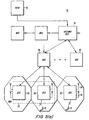
- FIG. 5(b) An overview of the GPRS network architecture is illustrated in Figure 5(b) . Since GPRS is an optimization of GSM, many of the network nodes/entities are similar to those described above with respect to Figure 5(a) .
- Information packets from external networks will enter the GPRS network at a GGSN (Gateway GPRS Service Node) 100.
- the packet is then routed from the GGSN via a backbone network, 120, to a SGSN (Serving GPRS Support Node) 140, that is serving the area in which the addressed GPRS mobile resides. From the SGSN 140 the packets are routed to the correct BSS (Base Station System) 160, in a dedicated GPRS transmission.
- BSS Base Station System
- the BSS includes a plurality of base transceiver stations (BTS), only one of which, BTS 180, is shown and a base station controller (BSC) 200.
- BTS base transceiver stations
- BSC base station controller
- the interface between the BTSs and the BSCs are referred to as the A-bis interface.
- the BSC is a GSM specific denotation and for other exemplary systems the term Radio Network Control (RNC) is used for a node having similar functionality as that of a BSC.
- RNC Radio Network Control
- a GPRS register will hold all GPRS subscription data.
- the GPRS register may, or may not, be integrated with the HLR (Home Location Register) 220 of the GSM system. Subscriber data may be interchanged between the SGSN and the MSC/VLR 240 to ensure service interaction, such as restricted roaming.
- the access network interface between the BSC 200 and MSC/VLR 240 is a standard interface known as the A-interface, which is based on the Mobile Application Part of CCITT Signaling System No. 7.
- the MSC/VLR 240 also provides access to the land-line system via PSTN 260.
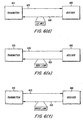
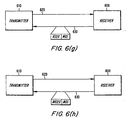
- one or more additional overhead messages can be provided in the signalling between the receiving entity 600 (e.g., RBS 180 or MS 210) and the transmitting entity 610 (e.g., MS 210 or RBS 180).
- These messages referred to as LA/IR and RSEG/NRSEG in Figures 6(a)-6(h) are shown as portions of control blocks which are transmitted periodically from each entity (or upon request) and which also include other messages, e.g., acknowledgement reports.
- the LA/IR message provides an explicit request of the preferred operating mode, i.e., either link adaptation or incremental redundancy.
- This message can be included in a control block in addition to the link quality measurements or MCS command described above with respect to Figures 4(a) or 4(b) . This information can then be used by the other entity when selecting from two predetermined rules or rule sets for changing the MCS.
- the receiving entity 600 transmits the LA/IR message field on link 620 (along with link quality measurements(LQM)) with a value which indicates that incremental redundancy is preferred, this implies that it currently has adequate memory capacity to continue to store blocks to support incremental redundancy combining.
- This informs the transmitting entity 610 that it can employ an MCS rule or rule set that makes, for example, aggressive (i.e., less robust) MCS choices, taking the link quality estimate report which is also transmitted to the transmitting entity 610 into account.
- the LA/IR message may instead have a value which indicates that link adaptation is preferred by receiving entity 600. This may imply, for example, that the receiving entity 600 lacks available memory and, therefore, cannot rely on incremental redundancy combining.
- transmitting entity 600 may then switch to a second MCS rule or rule set that makes more conservative (i.e., more robust) MCS choices, based on the link quality estimates, to ensure that the receiver achieves sufficient performance without the incremental redundancy combining.
- the receiving entity 600 can transmit the LA/IR message with a value indicating that incremental redundancy is preferred.
- the controlling entity i.e., the receiver 600 in this example
- the MCS as signaled in the MCS command which is transmitted along with the LA/IR message
- the non-controlling party will note that IR combining is being performed and, therefore, shall provide retransmissions using the same MCS as the initial transmissions.
- the MCS identified in the MCS command should be used.
- the receiving entity 600 can transmit the LA/IR message with a value indicating that incremental redundancy is not available at the receiving entity as seen in Figure 6(d) .
- the non-controlling party will note that incremental redundancy combining is not being performed and, therefore, shall preferably provide retransmissions using the same, or close to the same, MCS as is currently employed for new block transmissions. Again, for the new transmissions, the MCS identified in the MCS command should be used.
- receiving entity 600 can also inform transmitting entity 610 whether or not retransmissions should be made with resegmented blocks, i.e., whether the MCS for retransmissions should be the same or different than the MCS for new block transmissions, using the RSEG/NRSEG message.
- the RSEG/NRSEG message can be transmitted with either link quality measurements or MCS commands.
- the transmitting entity 600 will know that a more (or less) robust MCS can be selected for retransmitting not acknowledged blocks than was used to originally transmit those blocks to receiving entity 600.
- the original MCS can be varied based on the link quality measurements reported on link 630, taking into account that a more robust MCS has been requested for the retransmissions (which fact may be used by transmitting entity 610 to increase the MCS for original transmissions as well).
- the transmitting entity 610 will perform retransmissions with the same MCS as the initial transmissions. This may also be taken as an indication by transmitting entity 600 that the prevailing MCS can continue to be used for new block transmissions, based also on the link quality measurements.
- the RSEG/NRSEG message can also be transmitted with MCS commands instead of link quality measurements.
- MCS commands instead of link quality measurements.
- the transmitting entity 610 if the RSEG value is transmitted, then the transmitting entity 610 will use a more robust MCS to retransmit a resegmented version of unacknowledged blocks. The MCS for originally transmitted blocks is then dictated by the MCS command.
- the transmitting entity will use the same MCS value for retransmitted blocks and will use the MCS indicated in the MCS command for new transmissions.
- LA/IR and RSEG/NRSEG messages may be provided together on both links, separately on either link or in any other combination desirable.
- EGPRS Enhanced GPRS
- MCS-1 most robust
- MCS-8 most robust
- the network will control he MCS choices, i.e., the mobile station reports downlink quality estimates in the uplink, and the network gives uplink MCS commands to the mobile station in the downlink.
- Block acknowledgments are signaled in both links in so-called Control Blocks.
- the above mentioned quality reports and MCS commands are included in these Control Blocks.
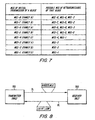
- EGPRS allow changes of the MCSs for retransmissions with certain constraints as seen in Figure 7 .
- any MCS can be used. Under these conditions, the messages described above according to the present invention can be used as follows.
- the downlink quality estimate is signaled.
- the inventive LA/IR message is introduced, for example by using an additional bit flag in the control word.
- the network's interpretation is that if the IR value is signaled, incremental redundancy operation is possible for the mobile station 800 and the network (as represented by RBS 810)can be very aggressive when choosing an MCS, since it can rely on the fact that the mobile station 800 uses IR combining. If, on the other hand, the LA value is signaled in this field of the uplink control block, then IR operation is not possible for mobile station 800, and hence the network should take this into account when choosing an MCS, i.e., by choosing a more robust MCS.
- the control blocks include an MCS command is signaled, which tells the mobile station 800 which MCS (e.g., of those shown in Figure 7 ) should be used for transmitting uplink RLC blocks.
- the RSEG/NRSEG message can also be added to the downlink control blocks, e.g., using a bit flag.
- an NRSEG value can be interpreted by the mobile station 800 as meaning retransmissions by the mobile station use the same MCSs as the initial transmissions of those blocks.
- a RSEG value should be interpreted by mobile station 800 as meaning that blocks to be retransmitted should be resegmented and transmitted using different (e.g., more robust) MCSs than the initial MCSs of those blocks.
- the specific MCS to use for retransmissions can be determined by a predetermined rule stored in the mobile station.
- This rule could be, purely for example, that:
- the MCS for retransmissions without losing old IR information.
- those transitions could be allowed, even if resegmentation is not allowed for other retransmissions.
- NRSEG can be indicated in the downlink control block
- retransmissions for blocks originally transmitted using MCS-8 or MCS-7 can be performed using MCS-6 or MCS-5, respectively, if the ordered MCS is lower or equal to MCS-8 or MCS-7, respectively.
- the NRSEG value can be controlling.
- the RSEG/NRSEG flag can be extended to two bits, one indicating the RSEG/NRSEG value and one indicating whether NRSEG is valid for all MCSs.
- the present invention provides for increase of the modulation and coding scheme choices is systems using link adaptation and Incremental Redundancy. Moreover, the strategy for the link adaptation algorithm will be more sensitive to whether incremental redundancy can/should be used at each moment, and does not have to sacrifice performance in either case.
- the link adaptation protocol will be more robust to memory problems in the receivers, i.e., when there is no or little memory available for incremental redundancy operation, this is taken into amount in the algorithms.
- the present invention also makes it more likely that protocol stalling and unnecessarily large performance degradations can be avoided.
Landscapes
- Engineering & Computer Science (AREA)
- Quality & Reliability (AREA)
- Computer Networks & Wireless Communication (AREA)
- Signal Processing (AREA)
- Detection And Prevention Of Errors In Transmission (AREA)
- Mobile Radio Communication Systems (AREA)
- Digital Transmission Methods That Use Modulated Carrier Waves (AREA)
- Communication Control (AREA)
Applications Claiming Priority (3)
| Application Number | Priority Date | Filing Date | Title |
|---|---|---|---|
| US252989 | 1981-04-10 | ||
| US09/252,989 US6865233B1 (en) | 1999-02-19 | 1999-02-19 | Method and system for control signalling enabling flexible link adaptation in a radiocommunication system |
| PCT/SE2000/000269 WO2000049760A1 (en) | 1999-02-19 | 2000-02-11 | Method and system for control signalling enabling flexible link adaption in a radiocommunication system |
Publications (2)
| Publication Number | Publication Date |
|---|---|
| EP1153494A1 EP1153494A1 (en) | 2001-11-14 |
| EP1153494B1 true EP1153494B1 (en) | 2008-07-30 |
Family
ID=22958387
Family Applications (1)
| Application Number | Title | Priority Date | Filing Date |
|---|---|---|---|
| EP00909845A Expired - Lifetime EP1153494B1 (en) | 1999-02-19 | 2000-02-11 | Method and system for control signalling enabling flexible link adaptation in a radiocommunication system |
Country Status (9)
| Country | Link |
|---|---|
| US (1) | US6865233B1 (enExample) |
| EP (1) | EP1153494B1 (enExample) |
| JP (2) | JP4555482B2 (enExample) |
| CN (1) | CN1146181C (enExample) |
| AU (1) | AU766839B2 (enExample) |
| BR (1) | BR0008299B1 (enExample) |
| CA (1) | CA2363652C (enExample) |
| DE (1) | DE60039681D1 (enExample) |
| WO (1) | WO2000049760A1 (enExample) |
Cited By (1)
| Publication number | Priority date | Publication date | Assignee | Title |
|---|---|---|---|---|
| CN109076386A (zh) * | 2016-05-09 | 2018-12-21 | 华为技术有限公司 | 信息传输的方法、接收设备、发送设备和系统 |
Families Citing this family (80)
| Publication number | Priority date | Publication date | Assignee | Title |
|---|---|---|---|---|
| US6782490B2 (en) * | 1999-03-17 | 2004-08-24 | At&T Corp. | Network-based service for the repair of IP multicast sessions |
| FI109438B (fi) * | 1999-10-15 | 2002-07-31 | Nokia Corp | Menetelmä tiedon siirtämiseksi pakettidatakanavalla |
| US7388918B2 (en) * | 2000-03-13 | 2008-06-17 | Texas Instruments Incorporated | Apparatus and method for the transparent upgrading of technology and applications in digital radio systems using programmable transmitters and receivers |
| DE10022270B4 (de) * | 2000-05-08 | 2006-07-27 | Siemens Ag | Verfahren und Kommunikationssystem zum Übertragen von kodierten Datenpaketen |
| US7124193B1 (en) | 2000-08-24 | 2006-10-17 | At&T Corp. | Method of using link adaptation and power control for streaming services in wireless networks |
| EP1332572A2 (en) * | 2000-11-09 | 2003-08-06 | Telefonaktiebolaget Lm Ericsson | Device and method for transfer of data packets |
| CA2825592C (en) * | 2000-11-15 | 2016-04-19 | An Chen | Improved frame structure for communication system using adaptive modulation |
| US7437654B2 (en) * | 2000-11-29 | 2008-10-14 | Lucent Technologies Inc. | Sub-packet adaptation in a wireless communication system |
| US6950401B2 (en) * | 2000-12-20 | 2005-09-27 | Nokia Corporation | Apparatus, and associated method, for facilitating resource allocation in a communication system |
| GB0104830D0 (en) | 2001-02-27 | 2001-04-18 | Koninkl Philips Electronics Nv | Radio communication system |
| KR100882145B1 (ko) | 2001-02-27 | 2009-02-06 | 코닌클리케 필립스 일렉트로닉스 엔.브이. | 무선 통신 시스템 |
| US6909758B2 (en) | 2001-04-27 | 2005-06-21 | Telefonaktiebolaget Lm Ericsson (Publ) | Systems and methods for decoding data blocks |
| US7289567B2 (en) * | 2001-04-30 | 2007-10-30 | Motorola, Inc. | Apparatus and method for transmitting and receiving data using partial chase combining |
| EP1255368A1 (en) * | 2001-04-30 | 2002-11-06 | Siemens Information and Communication Networks S.p.A. | Method to perform link adaptation in enhanced cellular communication systems with several modulation and coding schemes |
| KR101358583B1 (ko) * | 2001-05-14 | 2014-02-04 | 인터디지탈 테크날러지 코포레이션 | 다운링크 자원 할당을 위한 채널 품질 측정값 제공 방법, 무선 디지털 통신 시스템 및 사용자 장치 |
| EP1276264A1 (de) * | 2001-07-09 | 2003-01-15 | Siemens Aktiengesellschaft | Verfahren zur paketvermittelten Datenübertragung in einem Funkkommunikationssystem mit mehreren Funkzellen |
| DE50201324D1 (de) * | 2001-07-09 | 2004-11-18 | Siemens Ag | Verfahren zur paketvermittelten datenübertragung in einem funkkommunikationssystem mit mehreren funkzellen |
| EP1419604A1 (en) * | 2001-08-14 | 2004-05-19 | Redline Communications Inc. | Retransmission method and apparatus for wireless communications systems |
| US6549759B2 (en) * | 2001-08-24 | 2003-04-15 | Ensemble Communications, Inc. | Asymmetric adaptive modulation in a wireless communication system |
| US8494063B1 (en) | 2001-09-25 | 2013-07-23 | Netgear, Inc. | System and method for stacking receiver channels for increased system through-put in an RF data transmission system |
| US7564827B2 (en) * | 2001-10-19 | 2009-07-21 | Alcatel-Lucent Usa Inc. | Adaptive hybrid retransmission method for wireless communications |
| US7020455B2 (en) | 2001-11-28 | 2006-03-28 | Telefonaktiebolaget L M Ericsson (Publ) | Security reconfiguration in a universal mobile telecommunications system |
| SG107575A1 (en) * | 2002-01-17 | 2004-12-29 | Oki Techno Ct Singapore Pte | Communication systems with hybrid automatic repeat requests (harq) and rate matching |
| US8233501B2 (en) | 2002-02-13 | 2012-07-31 | Interdigital Technology Corporation | Transport block set segmentation |
| US7287206B2 (en) | 2002-02-13 | 2007-10-23 | Interdigital Technology Corporation | Transport block set transmission using hybrid automatic repeat request |
| US6975650B2 (en) * | 2002-02-13 | 2005-12-13 | Interdigital Technology Corporation | Transport block set segmentation |
| US7577227B2 (en) * | 2002-04-18 | 2009-08-18 | Alcatel-Lucent Usa Inc. | Link adaption in general packet radio service networks |
| US7149245B2 (en) * | 2002-04-29 | 2006-12-12 | Lucent Technologies Inc. | Link adaption in enhanced general packet radio service networks |
| GB2391431A (en) | 2002-07-30 | 2004-02-04 | Fujitsu Ltd | Adaptive modulation and coding method |
| AU2003270856B2 (en) * | 2002-09-30 | 2010-08-26 | Intel Corporation | Messaging for transmission link adaptation |
| US7957486B2 (en) * | 2002-09-30 | 2011-06-07 | Intel Corporation | Transmission link adaptation |
| WO2004040832A1 (ja) * | 2002-10-31 | 2004-05-13 | Matsushita Electric Industrial Co., Ltd. | 送信装置及び送信方法 |
| US7272768B2 (en) | 2002-12-09 | 2007-09-18 | Broadcom Corporation | Edge incremental redundancy memory structure and memory management |
| DE10257463B4 (de) * | 2002-12-09 | 2006-04-20 | Infineon Technologies Ag | IR-Speicher |
| KR20040083617A (ko) * | 2003-03-24 | 2004-10-06 | 삼성전자주식회사 | 향상된 역방향 전용전송채널을 서비스하는 비동기 방식의부호분할다중접속 이동통신시스템에서 소프트 핸드오버영역에 위치하는 이동단말이 역방향 데이터를 재전송하는방법 및 시스템 |
| DE10315767B4 (de) * | 2003-04-07 | 2005-07-07 | Siemens Ag | Verfahren zur Datenübertragung in einem Funkkommunikationssystem |
| US7433460B2 (en) * | 2003-04-30 | 2008-10-07 | Lucent Technologies Inc. | Methods of controlling link quality and transmit power in communication networks |
| EP1499059B1 (en) * | 2003-07-18 | 2011-07-06 | Motorola Mobility, Inc. | Method and device for determining the link quality in an OFDM network |
| CN1846387A (zh) * | 2003-09-08 | 2006-10-11 | 艾利森电话股份有限公司 | 移动单元辅助的调制管理 |
| US7471928B2 (en) * | 2003-09-08 | 2008-12-30 | Telefonaktiebolaget Lm Ericsson (Publ) | Modulation scheme management |
| WO2005076655A1 (ja) * | 2004-02-10 | 2005-08-18 | Mitsubishi Denki Kabushiki Kaisha | 移動局、基地局、通信システム、および通信方法 |
| HUE048550T2 (hu) | 2004-04-01 | 2020-08-28 | Optis Wireless Technology Llc | Interferenciakorlátozás újraátvitel számára |
| US7584397B2 (en) | 2004-06-10 | 2009-09-01 | Interdigital Technology Corporation | Method and apparatus for dynamically adjusting data transmission parameters and controlling H-ARQ processes |
| US7525946B2 (en) * | 2004-08-20 | 2009-04-28 | Nokia Corporation | System and method for decoding signalling messages on FLO HR channels |
| CN101057438A (zh) | 2004-10-12 | 2007-10-17 | 阿瓦雷公司 | 电信环境中的资源共享 |
| JP4457868B2 (ja) * | 2004-11-25 | 2010-04-28 | 富士通株式会社 | 無線通信装置、移動局 |
| BRPI0516632A (pt) * | 2004-12-02 | 2008-09-16 | Thomson Licensing | correção de erros antecipada e adaptativa |
| EP1851889B1 (en) * | 2005-02-10 | 2016-11-23 | Telefonaktiebolaget LM Ericsson (publ) | Quality-based data scheduling |
| US7508884B2 (en) * | 2005-03-24 | 2009-03-24 | Harris Corporation | System and method for communicating data using constant amplitude equalized waveform |
| WO2007024648A2 (en) * | 2005-08-25 | 2007-03-01 | Nms Communications Corporation | Methods and apparatus for differential encoding |
| CN1925382B (zh) * | 2005-08-29 | 2010-06-16 | 中兴通讯股份有限公司 | 一种混合自动请求重传的方法 |
| WO2007052110A2 (en) * | 2005-11-07 | 2007-05-10 | Nokia Corporation | Signaling cell combining capabilities |
| EP1966924A4 (en) * | 2005-12-30 | 2012-10-24 | Ericsson Telefon Ab L M | METHOD AND ARRANGEMENT FOR HARQ PROCESS IN MULTI-CARRIER WIRELESS SYSTEMS |
| JP4410282B2 (ja) * | 2006-01-18 | 2010-02-03 | パナソニック株式会社 | 無線送信装置および無線送信方法 |
| JP2009533973A (ja) | 2006-04-12 | 2009-09-17 | アウェア, インコーポレイテッド | パケット再送信ならびにメモリの共有 |
| CN101296165B (zh) | 2007-04-27 | 2011-09-21 | 华为技术有限公司 | 发送控制信令的方法和装置 |
| KR101468490B1 (ko) * | 2007-05-02 | 2014-12-10 | 삼성전자주식회사 | 무선 통신 시스템에서 제어 채널들의 집합을 한정하여 송수신하는 방법 및 장치 |
| EP2153564A4 (en) * | 2007-05-07 | 2013-10-30 | Nokia Corp | FEEDBACK AND LINK ADAPTATION PROCESSES FOR WIRELESS NETWORKS |
| EP2506484B1 (en) * | 2007-06-20 | 2015-01-07 | Motorola Mobility LLC | Method and base unit for candidate control channels |
| JP2007336583A (ja) * | 2007-08-06 | 2007-12-27 | Fujitsu Ltd | 送信装置、受信装置、再送制御方法 |
| CN101383657B (zh) * | 2007-09-05 | 2012-11-28 | 中兴通讯股份有限公司 | 一种下行信道控制信令的发送和接收方法及其装置 |
| CN101123588B (zh) * | 2007-09-14 | 2013-01-23 | 华为技术有限公司 | 控制冗余数据包传输的方法、媒体网关及系统 |
| JP2009081567A (ja) * | 2007-09-25 | 2009-04-16 | Oki Electric Ind Co Ltd | 再送制御システム、再送制御方法、送信機及び受信機 |
| ES2519766T3 (es) | 2007-12-20 | 2014-11-07 | Optis Wireless Technology, Llc | Señalización de canal de control usando un campo de señalización común para el formato de trnasporte y la versión de redundancia |
| JP5063387B2 (ja) * | 2008-01-28 | 2012-10-31 | 京セラ株式会社 | 無線通信システム、送信装置、受信装置、無線通信方法 |
| US8086229B2 (en) | 2008-02-25 | 2011-12-27 | Telefonaktiebolaget L M Ericsson (Publ) | Alleviating mobile device overload conditions in a mobile communication system |
| EP2114030B1 (en) * | 2008-04-30 | 2020-09-16 | Google Technology Holdings LLC | Methods and devices for preemptively transmitting a signal in accordance with an MCS other than a network commanded MCS |
| JP5195925B2 (ja) * | 2009-01-15 | 2013-05-15 | 富士通株式会社 | 送信装置、通信システム、通信方法 |
| CN101867937B (zh) * | 2009-04-14 | 2014-08-13 | 中兴通讯股份有限公司 | 基于恒定调度的混合自动重传实现方法 |
| US8189525B2 (en) * | 2009-06-19 | 2012-05-29 | Clearwire Ip Holdings Llc | Solution for INE/HO LB bottle neck |
| US8175051B2 (en) | 2009-05-29 | 2012-05-08 | Clearwire Ip Holdings Llc | Hybrid scheme for DL link adaptation |
| CN102742202B (zh) * | 2010-02-05 | 2015-12-02 | 瑞典爱立信有限公司 | 无线通信系统中的方法和装置 |
| JP2010263633A (ja) * | 2010-06-09 | 2010-11-18 | Fujitsu Ltd | 再送方法 |
| JP2010263634A (ja) * | 2010-06-09 | 2010-11-18 | Fujitsu Ltd | 送信装置、受信装置 |
| JP5930057B2 (ja) * | 2011-10-27 | 2016-06-08 | エンパイア テクノロジー ディベロップメント エルエルシー | 低複雑性および高電力効率の誤り訂正符号化スキーム |
| US10367621B2 (en) * | 2014-10-27 | 2019-07-30 | Qualcomm Incorporated | Fountain HARQ for reliable low latency communication |
| CN118694482A (zh) | 2015-09-24 | 2024-09-24 | 交互数字专利控股公司 | 用于无线系统中的增强复用的系统 |
| US10958379B2 (en) * | 2017-05-12 | 2021-03-23 | Qualcomm Incorporated | Mapping of channel encoded bits to symbol for retransmission |
| JP7458839B2 (ja) * | 2020-03-18 | 2024-04-01 | キヤノン株式会社 | 通信装置、通信装置の制御方法、およびプログラム |
| CN118158090B (zh) * | 2024-05-11 | 2024-09-17 | 浙商银行股份有限公司 | 云平台宿主机网络链路冗余状态判别方法及装置 |
Family Cites Families (19)
| Publication number | Priority date | Publication date | Assignee | Title |
|---|---|---|---|---|
| US434417A (en) * | 1890-08-12 | Clothes-hook | ||
| US4344171A (en) | 1980-12-11 | 1982-08-10 | International Business Machines Corporation | Effective error control scheme for satellite communications |
| US4422171A (en) * | 1980-12-29 | 1983-12-20 | Allied Corporation, Law Department | Method and system for data communication |
| CA1235189A (en) | 1985-01-14 | 1988-04-12 | Haruhiko Akiyama | Error correction encoding system |
| JP2776094B2 (ja) | 1991-10-31 | 1998-07-16 | 日本電気株式会社 | 可変変調通信方法 |
| JPH05327776A (ja) * | 1992-05-19 | 1993-12-10 | Fujitsu Ltd | データ転送方式 |
| JP3316059B2 (ja) * | 1993-09-01 | 2002-08-19 | 株式会社東芝 | データ伝送装置 |
| FR2718306B1 (fr) * | 1994-03-31 | 1996-04-26 | Alcatel Mobile Comm France | Procédé d'adaptation de l'interface air, dans un système de radiocommunication vers des mobiles. |
| JPH07336336A (ja) | 1994-06-14 | 1995-12-22 | Toshiba Corp | データ伝送装置 |
| FI97927C (fi) * | 1995-05-09 | 1997-03-10 | Nokia Telecommunications Oy | Ei-transparentti datansiirto digitaalisessa tietoliikennejärjestelmässä |
| US5983260A (en) * | 1995-07-19 | 1999-11-09 | Fujitsu Network Communications, Inc. | Serial control and data interconnects for coupling an I/O module with a switch fabric in a switch |
| US5754754A (en) | 1995-07-26 | 1998-05-19 | International Business Machines Corporation | Transmission order based selective repeat data transmission error recovery system and method |
| US5907563A (en) | 1996-03-07 | 1999-05-25 | Kokusai Denshin Denwa Co. Ltd. | Error control method and apparatus for wireless data communication |
| US5963551A (en) * | 1996-09-30 | 1999-10-05 | Innomedia Pte Ltd. | System and method for dynamically reconfigurable packet transmission |
| US5914959A (en) * | 1996-10-31 | 1999-06-22 | Glenayre Electronics, Inc. | Digital communications system having an automatically selectable transmission rate |
| US6278744B1 (en) * | 1996-11-15 | 2001-08-21 | Conexant Systems, Inc. | System for controlling and shaping the spectrum and redundancy of signal-point limited transmission |
| US6208663B1 (en) * | 1997-08-29 | 2001-03-27 | Telefonaktiebolaget Lm Ericsson (Publ) | Method and system for block ARQ with reselection of FEC coding and/or modulation |
| US6009553A (en) * | 1997-12-15 | 1999-12-28 | The Whitaker Corporation | Adaptive error correction for a communications link |
| US20010056560A1 (en) * | 1998-10-08 | 2001-12-27 | Farooq Khan | Method and system for measurement based automatic retransmission request in a radiocommunication system |
-
1999
- 1999-02-19 US US09/252,989 patent/US6865233B1/en not_active Expired - Lifetime
-
2000
- 2000-02-11 EP EP00909845A patent/EP1153494B1/en not_active Expired - Lifetime
- 2000-02-11 AU AU32025/00A patent/AU766839B2/en not_active Expired
- 2000-02-11 JP JP2000600388A patent/JP4555482B2/ja not_active Expired - Lifetime
- 2000-02-11 WO PCT/SE2000/000269 patent/WO2000049760A1/en not_active Ceased
- 2000-02-11 CN CNB008064822A patent/CN1146181C/zh not_active Expired - Lifetime
- 2000-02-11 DE DE60039681T patent/DE60039681D1/de not_active Expired - Lifetime
- 2000-02-11 BR BRPI0008299-6A patent/BR0008299B1/pt active IP Right Grant
- 2000-02-11 CA CA2363652A patent/CA2363652C/en not_active Expired - Lifetime
-
2010
- 2010-04-21 JP JP2010097567A patent/JP4621805B2/ja not_active Expired - Lifetime
Cited By (2)
| Publication number | Priority date | Publication date | Assignee | Title |
|---|---|---|---|---|
| CN109076386A (zh) * | 2016-05-09 | 2018-12-21 | 华为技术有限公司 | 信息传输的方法、接收设备、发送设备和系统 |
| CN109076386B (zh) * | 2016-05-09 | 2020-11-03 | 华为技术有限公司 | 信息传输的方法、接收设备、发送设备和系统 |
Also Published As
| Publication number | Publication date |
|---|---|
| CN1347606A (zh) | 2002-05-01 |
| BR0008299B1 (pt) | 2015-01-13 |
| DE60039681D1 (de) | 2008-09-11 |
| JP4555482B2 (ja) | 2010-09-29 |
| EP1153494A1 (en) | 2001-11-14 |
| CA2363652C (en) | 2012-01-10 |
| JP2002537722A (ja) | 2002-11-05 |
| AU766839B2 (en) | 2003-10-23 |
| JP4621805B2 (ja) | 2011-01-26 |
| JP2010213318A (ja) | 2010-09-24 |
| WO2000049760A1 (en) | 2000-08-24 |
| BR0008299A (pt) | 2002-01-22 |
| AU3202500A (en) | 2000-09-04 |
| US6865233B1 (en) | 2005-03-08 |
| CN1146181C (zh) | 2004-04-14 |
| CA2363652A1 (en) | 2000-08-24 |
Similar Documents
| Publication | Publication Date | Title |
|---|---|---|
| CA2363652C (en) | Method and system for control signalling enabling flexible link adaption in a radiocommunication system | |
| US6208663B1 (en) | Method and system for block ARQ with reselection of FEC coding and/or modulation | |
| US20010056560A1 (en) | Method and system for measurement based automatic retransmission request in a radiocommunication system | |
| US9025430B2 (en) | System and method of modulation and coding scheme adjustment for a LTE shared data channel | |
| US6654384B1 (en) | Integrated self-optimizing multi-parameter and multi-variable point to multipoint communication system | |
| US20050159166A1 (en) | Quality of service controlled link adaptation | |
| US20030202574A1 (en) | Link adaption in enhanced general packet radio service networks | |
| AU5663199A (en) | Group addressing in a packet communication system | |
| CN101032156B (zh) | 基于学习无线链路自适应(rla)为数字传输段选择前向纠错(fec)/星座图配对的方法 | |
| US20030088822A1 (en) | Transmission/reception apparatus and method for packet retransmission in a CDMA mobile communication system | |
| US20040014444A1 (en) | Radio link adaptation method and control unit implementing the method | |
| US20040228318A1 (en) | Method of optimizing the performance of a mobile radio system | |
| MXPA00002093A (en) | Method and system for block arq with reselection of fec coding and/or modulation | |
| HK1033515B (en) | Method and system for block arq with reselection of fec coding and/or modulation |
Legal Events
| Date | Code | Title | Description |
|---|---|---|---|
| PUAI | Public reference made under article 153(3) epc to a published international application that has entered the european phase |
Free format text: ORIGINAL CODE: 0009012 |
|
| 17P | Request for examination filed |
Effective date: 20010913 |
|
| AK | Designated contracting states |
Kind code of ref document: A1 Designated state(s): AT BE CH CY DE DK ES FI FR GB GR IE IT LI LU MC NL PT SE |
|
| AX | Request for extension of the european patent |
Free format text: AL;LT;LV;MK;RO;SI |
|
| RAP1 | Party data changed (applicant data changed or rights of an application transferred) |
Owner name: TELEFONAKTIEBOLAGET LM ERICSSON (PUBL) |
|
| RBV | Designated contracting states (corrected) |
Designated state(s): DE FR GB IT |
|
| 17Q | First examination report despatched |
Effective date: 20041022 |
|
| 17Q | First examination report despatched |
Effective date: 20041022 |
|
| GRAP | Despatch of communication of intention to grant a patent |
Free format text: ORIGINAL CODE: EPIDOSNIGR1 |
|
| GRAS | Grant fee paid |
Free format text: ORIGINAL CODE: EPIDOSNIGR3 |
|
| GRAA | (expected) grant |
Free format text: ORIGINAL CODE: 0009210 |
|
| AK | Designated contracting states |
Kind code of ref document: B1 Designated state(s): DE FR GB IT |
|
| REG | Reference to a national code |
Ref country code: GB Ref legal event code: FG4D |
|
| REF | Corresponds to: |
Ref document number: 60039681 Country of ref document: DE Date of ref document: 20080911 Kind code of ref document: P |
|
| PLBE | No opposition filed within time limit |
Free format text: ORIGINAL CODE: 0009261 |
|
| STAA | Information on the status of an ep patent application or granted ep patent |
Free format text: STATUS: NO OPPOSITION FILED WITHIN TIME LIMIT |
|
| 26N | No opposition filed |
Effective date: 20090506 |
|
| REG | Reference to a national code |
Ref country code: DE Ref legal event code: R008 Ref document number: 60039681 Country of ref document: DE |
|
| REG | Reference to a national code |
Ref country code: DE Ref legal event code: R039 Ref document number: 60039681 Country of ref document: DE Effective date: 20110830 |
|
| REG | Reference to a national code |
Ref country code: DE Ref legal event code: R097 Ref document number: 60039681 Country of ref document: DE |
|
| REG | Reference to a national code |
Ref country code: DE Ref legal event code: R040 Ref document number: 60039681 Country of ref document: DE Effective date: 20120116 |
|
| REG | Reference to a national code |
Ref country code: FR Ref legal event code: PLFP Year of fee payment: 17 |
|
| REG | Reference to a national code |
Ref country code: FR Ref legal event code: PLFP Year of fee payment: 18 |
|
| REG | Reference to a national code |
Ref country code: FR Ref legal event code: PLFP Year of fee payment: 19 |
|
| PGFP | Annual fee paid to national office [announced via postgrant information from national office to epo] |
Ref country code: DE Payment date: 20190227 Year of fee payment: 20 Ref country code: IT Payment date: 20190222 Year of fee payment: 20 Ref country code: GB Payment date: 20190227 Year of fee payment: 20 |
|
| PGFP | Annual fee paid to national office [announced via postgrant information from national office to epo] |
Ref country code: FR Payment date: 20190225 Year of fee payment: 20 |
|
| REG | Reference to a national code |
Ref country code: DE Ref legal event code: R071 Ref document number: 60039681 Country of ref document: DE |
|
| REG | Reference to a national code |
Ref country code: GB Ref legal event code: PE20 Expiry date: 20200210 |
|
| PG25 | Lapsed in a contracting state [announced via postgrant information from national office to epo] |
Ref country code: GB Free format text: LAPSE BECAUSE OF EXPIRATION OF PROTECTION Effective date: 20200210 |