EP1142185B1 - Verfahren und anordnung zur kanalcodierung bzw. decodierung von in rahmen strukturierten informationen - Google Patents
Verfahren und anordnung zur kanalcodierung bzw. decodierung von in rahmen strukturierten informationen Download PDFInfo
- Publication number
- EP1142185B1 EP1142185B1 EP99966823A EP99966823A EP1142185B1 EP 1142185 B1 EP1142185 B1 EP 1142185B1 EP 99966823 A EP99966823 A EP 99966823A EP 99966823 A EP99966823 A EP 99966823A EP 1142185 B1 EP1142185 B1 EP 1142185B1
- Authority
- EP
- European Patent Office
- Prior art keywords
- channel
- mode
- coding
- information
- bits
- Prior art date
- Legal status (The legal status is an assumption and is not a legal conclusion. Google has not performed a legal analysis and makes no representation as to the accuracy of the status listed.)
- Expired - Lifetime
Links
- 238000000034 method Methods 0.000 title claims description 32
- 230000005540 biological transmission Effects 0.000 claims description 29
- 230000011664 signaling Effects 0.000 claims description 9
- 230000003044 adaptive effect Effects 0.000 description 7
- 230000006978 adaptation Effects 0.000 description 4
- 238000012937 correction Methods 0.000 description 4
- 238000004891 communication Methods 0.000 description 3
- 230000001419 dependent effect Effects 0.000 description 3
- 230000009897 systematic effect Effects 0.000 description 3
- 238000011161 development Methods 0.000 description 2
- 230000018109 developmental process Effects 0.000 description 2
- 238000010586 diagram Methods 0.000 description 2
- 238000005562 fading Methods 0.000 description 2
- 238000010295 mobile communication Methods 0.000 description 2
- 238000012545 processing Methods 0.000 description 2
- 238000012546 transfer Methods 0.000 description 2
- 206010009944 Colon cancer Diseases 0.000 description 1
- 230000002411 adverse Effects 0.000 description 1
- 125000004122 cyclic group Chemical group 0.000 description 1
- 230000000694 effects Effects 0.000 description 1
- 230000006870 function Effects 0.000 description 1
- 230000007257 malfunction Effects 0.000 description 1
- 238000013507 mapping Methods 0.000 description 1
- 238000012544 monitoring process Methods 0.000 description 1
- 238000013139 quantization Methods 0.000 description 1
- 230000004044 response Effects 0.000 description 1
- 230000008054 signal transmission Effects 0.000 description 1
- 238000001228 spectrum Methods 0.000 description 1
Images



Classifications
-
- H—ELECTRICITY
- H04—ELECTRIC COMMUNICATION TECHNIQUE
- H04L—TRANSMISSION OF DIGITAL INFORMATION, e.g. TELEGRAPHIC COMMUNICATION
- H04L1/00—Arrangements for detecting or preventing errors in the information received
-
- H—ELECTRICITY
- H04—ELECTRIC COMMUNICATION TECHNIQUE
- H04L—TRANSMISSION OF DIGITAL INFORMATION, e.g. TELEGRAPHIC COMMUNICATION
- H04L1/00—Arrangements for detecting or preventing errors in the information received
- H04L1/0001—Systems modifying transmission characteristics according to link quality, e.g. power backoff
- H04L1/0023—Systems modifying transmission characteristics according to link quality, e.g. power backoff characterised by the signalling
- H04L1/0025—Transmission of mode-switching indication
-
- H—ELECTRICITY
- H03—ELECTRONIC CIRCUITRY
- H03M—CODING; DECODING; CODE CONVERSION IN GENERAL
- H03M13/00—Coding, decoding or code conversion, for error detection or error correction; Coding theory basic assumptions; Coding bounds; Error probability evaluation methods; Channel models; Simulation or testing of codes
- H03M13/03—Error detection or forward error correction by redundancy in data representation, i.e. code words containing more digits than the source words
- H03M13/23—Error detection or forward error correction by redundancy in data representation, i.e. code words containing more digits than the source words using convolutional codes, e.g. unit memory codes
-
- H—ELECTRICITY
- H03—ELECTRONIC CIRCUITRY
- H03M—CODING; DECODING; CODE CONVERSION IN GENERAL
- H03M13/00—Coding, decoding or code conversion, for error detection or error correction; Coding theory basic assumptions; Coding bounds; Error probability evaluation methods; Channel models; Simulation or testing of codes
- H03M13/35—Unequal or adaptive error protection, e.g. by providing a different level of protection according to significance of source information or by adapting the coding according to the change of transmission channel characteristics
- H03M13/356—Unequal error protection [UEP]
-
- H—ELECTRICITY
- H03—ELECTRONIC CIRCUITRY
- H03M—CODING; DECODING; CODE CONVERSION IN GENERAL
- H03M13/00—Coding, decoding or code conversion, for error detection or error correction; Coding theory basic assumptions; Coding bounds; Error probability evaluation methods; Channel models; Simulation or testing of codes
- H03M13/65—Purpose and implementation aspects
- H03M13/6508—Flexibility, adaptability, parametrability and configurability of the implementation
-
- H—ELECTRICITY
- H03—ELECTRONIC CIRCUITRY
- H03M—CODING; DECODING; CODE CONVERSION IN GENERAL
- H03M13/00—Coding, decoding or code conversion, for error detection or error correction; Coding theory basic assumptions; Coding bounds; Error probability evaluation methods; Channel models; Simulation or testing of codes
- H03M13/65—Purpose and implementation aspects
- H03M13/6508—Flexibility, adaptability, parametrability and configurability of the implementation
- H03M13/6516—Support of multiple code parameters, e.g. generalized Reed-Solomon decoder for a variety of generator polynomials or Galois fields
-
- H—ELECTRICITY
- H04—ELECTRIC COMMUNICATION TECHNIQUE
- H04L—TRANSMISSION OF DIGITAL INFORMATION, e.g. TELEGRAPHIC COMMUNICATION
- H04L1/00—Arrangements for detecting or preventing errors in the information received
- H04L1/0001—Systems modifying transmission characteristics according to link quality, e.g. power backoff
- H04L1/0009—Systems modifying transmission characteristics according to link quality, e.g. power backoff by adapting the channel coding
-
- H—ELECTRICITY
- H04—ELECTRIC COMMUNICATION TECHNIQUE
- H04L—TRANSMISSION OF DIGITAL INFORMATION, e.g. TELEGRAPHIC COMMUNICATION
- H04L1/00—Arrangements for detecting or preventing errors in the information received
- H04L1/004—Arrangements for detecting or preventing errors in the information received by using forward error control
- H04L1/0041—Arrangements at the transmitter end
-
- H—ELECTRICITY
- H04—ELECTRIC COMMUNICATION TECHNIQUE
- H04L—TRANSMISSION OF DIGITAL INFORMATION, e.g. TELEGRAPHIC COMMUNICATION
- H04L1/00—Arrangements for detecting or preventing errors in the information received
- H04L1/004—Arrangements for detecting or preventing errors in the information received by using forward error control
- H04L1/0045—Arrangements at the receiver end
- H04L1/0054—Maximum-likelihood or sequential decoding, e.g. Viterbi, Fano, ZJ algorithms
-
- H—ELECTRICITY
- H04—ELECTRIC COMMUNICATION TECHNIQUE
- H04L—TRANSMISSION OF DIGITAL INFORMATION, e.g. TELEGRAPHIC COMMUNICATION
- H04L1/00—Arrangements for detecting or preventing errors in the information received
- H04L1/004—Arrangements for detecting or preventing errors in the information received by using forward error control
- H04L1/0056—Systems characterized by the type of code used
- H04L1/0059—Convolutional codes
-
- H—ELECTRICITY
- H04—ELECTRIC COMMUNICATION TECHNIQUE
- H04L—TRANSMISSION OF DIGITAL INFORMATION, e.g. TELEGRAPHIC COMMUNICATION
- H04L1/00—Arrangements for detecting or preventing errors in the information received
- H04L1/004—Arrangements for detecting or preventing errors in the information received by using forward error control
- H04L1/0056—Systems characterized by the type of code used
- H04L1/007—Unequal error protection
-
- H—ELECTRICITY
- H04—ELECTRIC COMMUNICATION TECHNIQUE
- H04L—TRANSMISSION OF DIGITAL INFORMATION, e.g. TELEGRAPHIC COMMUNICATION
- H04L1/00—Arrangements for detecting or preventing errors in the information received
- H04L1/004—Arrangements for detecting or preventing errors in the information received by using forward error control
- H04L1/0072—Error control for data other than payload data, e.g. control data
-
- H—ELECTRICITY
- H04—ELECTRIC COMMUNICATION TECHNIQUE
- H04L—TRANSMISSION OF DIGITAL INFORMATION, e.g. TELEGRAPHIC COMMUNICATION
- H04L1/00—Arrangements for detecting or preventing errors in the information received
- H04L1/004—Arrangements for detecting or preventing errors in the information received by using forward error control
- H04L1/0075—Transmission of coding parameters to receiver
-
- H—ELECTRICITY
- H04—ELECTRIC COMMUNICATION TECHNIQUE
- H04L—TRANSMISSION OF DIGITAL INFORMATION, e.g. TELEGRAPHIC COMMUNICATION
- H04L1/00—Arrangements for detecting or preventing errors in the information received
- H04L1/0001—Systems modifying transmission characteristics according to link quality, e.g. power backoff
- H04L1/0014—Systems modifying transmission characteristics according to link quality, e.g. power backoff by adapting the source coding
Definitions
- the invention relates to a method and an arrangement for Channel coding or decoding of structures structured in frames Information, especially in the context of adaptive multi-rate coding.
- Source signals or source information such as voice, sound, Image and video signals almost always include statistical redundancy, so redundant information.
- This redundancy can be greatly reduced so that efficient transmission or storage of the source signal is made possible.
- This redundancy reduction eliminates the transmission of redundant signal content based on prior knowledge from e.g. statistical parameters of the signal curve based.
- the bit rate of the source encoded information (Source bits or data bits) is also called source bit rate. After the transfer, these are used for the source decoding Shares added to the signal again, so that practically none Loss of quality is detectable.
- a transmission medium in particular a radio interface to be able to be transmitted as efficiently as possible So this information to be transmitted before the transmission compressed by a source code and by a Channel coding protected against channel errors.
- GSM Global System for Mobile Communication
- a full rate speech codec of a half rate speech codec or an Enhanced Full Rate speech codec become.
- a speech codec or coding is included in this application also a method for encoding and / or for the corresponding Decoding, which is also a source and / or channel coding and can also include other data can be applied as voice data.
- GSM Global System for Mobile communications
- GSM Global System for Mobile communications
- AMR Adaptive Multirate
- the source bit rate depending Differentiate from frame to frame according to the code mode used can.
- Half rate or full rate For example can such an AMR speech codec under good channel conditions and / or in high-capacity radio cells in the half Rate (HR) channel work. It is said to be under bad channel conditions be dynamically switched to the full rate (FR) channel and vice versa.
- Hyf Rate or Full Rate there are different code modes for different speech and channel coding rates Available, which also according to the channel quality can be selected (rate adaptation).
- the gross bit rate remains constant after channel coding within a channel mode (22.8 Kbit / sec. In full rate FR and 11.4 Kbit / sec. In Half rate channel HR).
- the channel conditions of a transmission link depending on the requirements of certain network parameters or from speech to speech coding according to different code modes carried out, for example, different rates have (variable source bit rate). Because the gross bit rate after the channel coding should remain constant, the Channel coding an appropriately adapted variable number of error protection bits added.
- the invention is therefore based on the problem of a method and an arrangement for channel coding or for decoding to provide information about the nature of the Transmit coding easily and reliably.
- a method is specified in which a first part of first information, for example useful information, with different types of coding independently channel-coded uniformly on the type of coding becomes.
- Information to describe the coding of first information can provide information to describe the source coding and / or the channel coding and / or others for Decoding first information, such as Art the coding (source and / or channel coding of the first Information) or the rate of coding (source and / or Channel coding of the first information) included.
- the invention can be advantageous Find use.
- the rate of the channel coding at least a second part of the first information, for example the useful information on quality adapted to the transmission channel and / or the network load. So is it is possible to change the channel coding to changing framework conditions adapt a communication system, and this transmission side Adaptation in a simple and reliable way to transmit a recipient.
- the second information contains Signaling information and / or information on Description of the reception quality, depending on the current Reception result to influence a transmitter. So it is possible the transmission of information according to the principle of a Control loop.
- the problem is also solved by a method for decoding of information structured in the context of a first part for decoding second information the first information is used. This enables the encoded transmission of second information with a sufficient large block length and avoids complex multiple decoding according to the try and error principle described above.
- the problem is also solved by arrangements for channel coding or decoding of information structured in frames each with a digital signal processor is set up such that a first part of the first information with different types of coding independently of the type of coding can be channel-coded uniformly, or that for decoding second information also a first one Part of the first information is usable. These orders are particularly suitable for carrying out the inventive Method or one of the above Further education.
- the mobile radio system shown in Figure 1 corresponds to in its structure is a well-known GSM mobile radio system that a variety of mobile switching centers MSC, which are interconnected or have access to a landline Establish PSTN. Furthermore, these are mobile switching centers MSC with at least one base station controller BSC connected, which is also formed by a data processing system can be. Each base station controller is in turn connected to at least one base station BS.
- Base station BS is a radio that uses a radio interface a radio connection to radio devices, so-called mobile stations MS can build up.
- the range of the signals of a base station is defined in essentially a radio cell FZ. Allocation of resources like frequency bands to radio cells and thus to those to be transmitted Data packets can be sent through control devices such as the base station controller BSC are controlled. Base stations BS and a base station controller BSC can to be combined into a base station system BSS.
- the BSS base station system is also used for radio channel management, data rate adaptation, monitoring of the radio transmission link, Hand-over procedures, connection control and if necessary for the allocation or signaling responsible for the speech codecs to be used and transmitted if necessary, corresponding signaling information to the mobile stations MS.
- the transmission of such Signaling information can also be via signaling channels respectively.
- the invention can also to signal other information, such as Type of information (data, languages, images, etc.) and / or their coding, switching information in any transmission method, such as DECT, WB-CDMA or multimode transmission methods (GSM / WB-CDMA / TD-CDMA) within one UMTS (Universal Mobile Telephony System) can be used.
- Type of information data, languages, images, etc.
- WB-CDMA multimode transmission methods
- GSM / WB-CDMA / TD-CDMA Universal Mobile Telephony System
- FIG. 2 shows a source Q which generates source signals qs, that of a source encoder QE, such as the GSM full rate Speech encoder, for symbol sequences consisting of symbols be compressed.
- a source encoder QE such as the GSM full rate Speech encoder
- the source encoder QE generates quantized parameters (e.g. language coefficients) that are hereinafter also referred to as symbols of a symbol sequence, and the properties of the source in the current block reflect in a certain way (e.g. spectrum of language, Filter parameters). These symbols point after quantization a certain symbol value.
- the symbols of the symbol sequence or the corresponding symbol values are represented by a binary mapping (assignment rule), which are often described as part of the source coding QE is mapped to a sequence of binary code words, which each have several bit positions. Will these be binary For example, code words in sequence as a sequence of binary If code words are processed further, a sequence of source-coded bit positions embedded in a frame structure could be.
- a binary mapping assignment rule
- convolutional codes In mobile radio systems, convolutional codes have proven to be efficient codes for the subsequent channel coding. With a large block length, these have a large error correction capability and an adequate decoding complexity. Only convolutional codes of rate 1 / n are dealt with below.
- a convolutional encoder with memory m generates n code bits from the last m +1 data bits via a register.
- bits are used in speech coding divided into classes and different against mistakes protected. This is done in the convolutional coding by different Guess. Rates are greater than 1 ⁇ 2 by puncturing achieved.
- ETSI mobile radio systems in Europe
- CE channel encoder
- a coding of the source-coded bit sequences against channel interference occurs in such a way that the gross bit rate still 22.8 kbit / s (full rate mode) or 11.4 kbit / s (Half rate mode).
- the current source bit rate is used depending on the language (pause, hissing sounds, self sounds, voiced, unvoiced etc.), depending on the channel conditions (good, bad channel) or depending on network conditions (Overload, compatibility, etc.) changed.
- the channel coding will be adjusted accordingly.
- the rate currently used (for example through the current code mode) and / or others Information is stored within the same frame as mode bits mb transmitted.
- the first part of the data bits db1 are coded identically for all source bit rates or speech coding rates or code modes used.
- This first part db1 can be the approx. 5 m first source bits.
- the trellis for this first part is then built up in the channel decoder QD, and the mode bits are first decided or decoded.
- the current speech rate or the current code mode is determined from these mode bits mb and the second part of the data bits db2 is also decoded in accordance with the decoding method used for this rate or this code mode.
- the first part or another part of the data bits db1 can also together with the Modusbits mb regardless of the type of Source coding are channel coded uniformly, i.e. independently a first part of the current code mode Data bits db1 are channel-coded together with the mode bits mb, and although also for all code modes according to a uniform Method.
- a source coding method generates frames or blocks with a length of 140 data bits db (case 1) or 100 data bits db (case 2) according to two different code modes.
- a mode bit mb which is also to be transmitted in the same frame is intended to indicate which of the two block lengths has just been generated by the source encoder QE.
- a frame with a length of 303 bits is to be generated in both cases, which inevitably leads to different channel coding methods for the two cases, at least with regard to the rate.
- the mode bit or the mode bits mb together with the first Part of the data bits db1 uniform in both cases, for example regarding the rate (rate 1/3) of the applied Convolutional codes, the generator polynomials used or the applied memory, channel-coded, in particular convolutionally coded.
- the trellis of a convolutional decoder for the first 21 bits (one mode bit mb + 20 first data bits db1) of a convolution decoder can be built up without being known is the data block length used for coding has been. If the trellis is built over this length, it can first bit (the mode bit mb) can be determined. Here is the Length of influence of the code is taken into account and thus the error rate significantly less than when building the trellis only for this first mode bit. After this mode bit is determined the block length used or the used code mode known and depending on the second part of the data bits db2 decoded at rate 1/2 or rate 1/3.
- the complexity of the decoding is thus only slightly higher than the decoding according to only one code mode.
- a systematic convolutional code can be used to keep the error rate below the channel error rate for bad channels.
- a recursive code can be used.
- the error rate is then higher for good channels than for non-systematic, non-recursive convolutional codes (previous GSM).
- GSM non-systematic, non-recursive convolutional codes
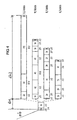
- Figure 4 shows the scheme for the full rate channel (FR):
- the speech coding is at 13.3 kbit / s (code mode 1), 9.5 kbit / s (code mode 2), 8.1 kbit / s (code mode 3) and 6.3 kbit / s (Code mode 4) generated four different rates.
- the coding takes place in frames or blocks with a duration of 20 ms. additionally will be in code mode 2 before convolutional coding CRC with 4 bits added and 2 each for code modes 3 and 4 CRCs with 3 bits each. This leads to block lengths of 266 bits db (Code mode 1), 199 bits db (code mode 2), 168 bits db (code mode 3) and 132 bits db (code mode 4).
- mode bits are to be transferred to the beginning of each Blocks or frames placed.
- a becomes recursive systematic convolutional code of rates 1/2 and 1/3 used. Rates are 1/4 and 1/5 by repeating bits generated higher rates by puncturing.
- Rates are 1/4 and 1/5 by repeating bits generated higher rates by puncturing.
- the mode bits mb and a first part of the Data bits db1 are also channel coded, with the mode bits mb are always channel-coded at a rate of 1/5 and the first Part of the data bits db1 are always channel-coded at a rate of 1/3 or 1/4 become.
- Figure 5 shows the scheme for the half rate channel (HR): That already explained principle of the same coding of the mode bits and the first data bits are also implemented for the half rate channel. There only the code modes 3 (8.1 kbit / s) and 4 (6.3 kbit / s) and channel coding to 11.4 kbit / s added. Since fewer code modes are used, the half rate channel is sufficient two mode bits. It will be the same convolutional encoder as used in the full rate codec, but it is not terminated.
- the source coding adapted channel-coded bit sequences x or code bits in one processed modulator, not shown, and then transmitted over a transmission link CH.
- transferring malfunctions occur, such as fading, or noise.
- the transmission path CH is between a transmitter and a recipient.
- the recipient may contain one Antenna, not shown, for receiving the transmission link CH transmitted signals, a scanner, a demodulator for demodulating the signals and an equalizer to eliminate intersymbol interference. These facilities have also been shown in FIG 1 not shown. Also possible interleaving and Deinterleaving is not shown.
- the equalizer outputs reception values of a reception sequence y.
- the received values have due to interference in the transmission over the CH link values that range from "+1" and "-1" differ.
- the channel coding is reversed in a channel decoder CD.
- the Viterbi algorithm is advantageously used for decoding convolutional codes.
- the length of influence during decoding is approx. 5 ⁇ m . This is to express that errors in the code can generally still be corrected up to this length of influence. Because the code bits in the block to be decoded are further removed, the current information bit is not corrected.
- the trellis of the decoder is built up to the data bit approx. 5 m away. A decision is then made about the first bit.
- the source coding of the first 5 ⁇ m bits is also generally different. This means that the source decoding for these bits is also different and must therefore be decoded differently depending on the source coding rate used or on the code mode used.
- the received mode bits m b and data bits db are present, and source decoding QD into received source signals qs, which are output at the information sink S, takes place.
- the Mode bits also other information, especially control or Signaling information is transmitted, such as Channel status information or responses to the Signaling information (return channel), information on Description of the coding used or the one to be used Decoding or other information required for decoding the first information can be used.
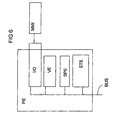
- FIG. 6 shows a processor unit PE, which in particular in a communication device, such as a base station BS or mobile station MS can be included. It contains one Control device STE, which essentially consists of a program-controlled Microcontroller exists, and a processing device VE made up of a processor, in particular a digital signal processor, both of which are writing and have read access to SPE memory modules.
- a communication device such as a base station BS or mobile station MS can be included.
- Control device STE which essentially consists of a program-controlled Microcontroller exists
- a processing device VE made up of a processor, in particular a digital signal processor, both of which are writing and have read access to SPE memory modules.
- the microcontroller controls and controls all essential Elements and functions of a functional unit that the Processor unit PE contains.
- the digital signal processor, a part of the digital signal processor or a special one Processor is used to carry out the coding or decoding responsible.
- the choice of language codecs can also by the microcontroller or the digital signal processor yourself.
- An input / output interface I / O is used for input / output of user or control data, for example to an operating unit MMI, which contain a keyboard and / or a display can.
Landscapes
- Engineering & Computer Science (AREA)
- Computer Networks & Wireless Communication (AREA)
- Signal Processing (AREA)
- Physics & Mathematics (AREA)
- Probability & Statistics with Applications (AREA)
- Theoretical Computer Science (AREA)
- Quality & Reliability (AREA)
- Artificial Intelligence (AREA)
- Mathematical Physics (AREA)
- Detection And Prevention Of Errors In Transmission (AREA)
- Error Detection And Correction (AREA)
- Compression, Expansion, Code Conversion, And Decoders (AREA)
Applications Claiming Priority (3)
| Application Number | Priority Date | Filing Date | Title |
|---|---|---|---|
| DE19858393 | 1998-12-17 | ||
| DE19858393 | 1998-12-17 | ||
| PCT/DE1999/003838 WO2000036781A1 (de) | 1998-12-17 | 1999-12-01 | Verfahren und anordnung zur kanalcodierung bzw. decodierung von in rahmen strukturierten informationen |
Publications (2)
| Publication Number | Publication Date |
|---|---|
| EP1142185A1 EP1142185A1 (de) | 2001-10-10 |
| EP1142185B1 true EP1142185B1 (de) | 2004-03-10 |
Family
ID=7891511
Family Applications (1)
| Application Number | Title | Priority Date | Filing Date |
|---|---|---|---|
| EP99966823A Expired - Lifetime EP1142185B1 (de) | 1998-12-17 | 1999-12-01 | Verfahren und anordnung zur kanalcodierung bzw. decodierung von in rahmen strukturierten informationen |
Country Status (7)
| Country | Link |
|---|---|
| EP (1) | EP1142185B1 (enExample) |
| JP (1) | JP2002533013A (enExample) |
| KR (1) | KR100673659B1 (enExample) |
| CN (1) | CN1319301C (enExample) |
| DE (1) | DE59908833D1 (enExample) |
| HU (1) | HUP0104936A3 (enExample) |
| WO (1) | WO2000036781A1 (enExample) |
Families Citing this family (5)
| Publication number | Priority date | Publication date | Assignee | Title |
|---|---|---|---|---|
| EP1187385A1 (en) * | 2000-09-12 | 2002-03-13 | Lucent Technologies Inc. | Signalling of data rate and diversity configuration |
| US8179864B2 (en) | 2002-08-06 | 2012-05-15 | Rockstar Bidco Lp | Method of controlling a communications link |
| US20040141572A1 (en) * | 2003-01-21 | 2004-07-22 | Johnson Phillip Marc | Multi-pass inband bit and channel decoding for a multi-rate receiver |
| CN101868034B (zh) * | 2009-04-15 | 2015-07-22 | 中兴通讯股份有限公司 | 一种本地交换的建立方法 |
| RU2409897C1 (ru) | 2009-05-18 | 2011-01-20 | Самсунг Электроникс Ко., Лтд | Кодер, передающее устройство, система передачи и способ кодирования информационных объектов |
Family Cites Families (13)
| Publication number | Priority date | Publication date | Assignee | Title |
|---|---|---|---|---|
| JPH073964B2 (ja) * | 1987-01-27 | 1995-01-18 | 松下電器産業株式会社 | Pcm音声復号装置 |
| US5105442A (en) * | 1990-11-07 | 1992-04-14 | At&T Bell Laboratories | Coded modulation with unequal error protection |
| JPH0661903A (ja) * | 1992-08-12 | 1994-03-04 | Matsushita Electric Ind Co Ltd | 通話装置 |
| JPH06311143A (ja) * | 1993-04-21 | 1994-11-04 | Nec Corp | 誤り制御通信システム |
| JPH0818543A (ja) * | 1994-07-01 | 1996-01-19 | Nippon Telegr & Teleph Corp <Ntt> | 可変ビットレート符号化復号化方法、その符号化器及び復号化器 |
| US5537410A (en) * | 1994-09-15 | 1996-07-16 | Oki Telecom | Subsequent frame variable data rate indication method |
| FI100211B (fi) * | 1995-03-06 | 1997-10-15 | Nokia Telecommunications Oy | Suurinopeuksinen datasiirto matkaviestinverkoissa |
| JPH0923214A (ja) * | 1995-07-05 | 1997-01-21 | Hitachi Ltd | ディジタル信号送受信装置 |
| US5754734A (en) * | 1995-10-31 | 1998-05-19 | Motorola, Inc. | Method of transmitting voice coding information using cyclic redundancy check bits |
| JPH09275391A (ja) * | 1996-04-04 | 1997-10-21 | Oki Electric Ind Co Ltd | 情報符号化装置及び情報復号装置 |
| JPH09297599A (ja) * | 1996-05-08 | 1997-11-18 | Matsushita Electric Ind Co Ltd | 音声符号化装置 |
| US6256487B1 (en) * | 1998-09-01 | 2001-07-03 | Telefonaktiebolaget Lm Ericsson (Publ) | Multiple mode transmitter using multiple speech/channel coding modes wherein the coding mode is conveyed to the receiver with the transmitted signal |
| US6452941B1 (en) * | 1998-09-16 | 2002-09-17 | Telefonaktiebolaget Lm Ericsson (Publ) | Method and system for alternating transmission of codec mode information |
-
1999
- 1999-12-01 HU HU0104936A patent/HUP0104936A3/hu unknown
- 1999-12-01 JP JP2000588921A patent/JP2002533013A/ja active Pending
- 1999-12-01 KR KR1020017007529A patent/KR100673659B1/ko not_active Expired - Fee Related
- 1999-12-01 CN CNB99814651XA patent/CN1319301C/zh not_active Expired - Fee Related
- 1999-12-01 WO PCT/DE1999/003838 patent/WO2000036781A1/de not_active Ceased
- 1999-12-01 EP EP99966823A patent/EP1142185B1/de not_active Expired - Lifetime
- 1999-12-01 DE DE59908833T patent/DE59908833D1/de not_active Expired - Lifetime
Also Published As
| Publication number | Publication date |
|---|---|
| JP2002533013A (ja) | 2002-10-02 |
| EP1142185A1 (de) | 2001-10-10 |
| CN1330818A (zh) | 2002-01-09 |
| KR100673659B1 (ko) | 2007-01-23 |
| HUP0104936A3 (en) | 2003-07-28 |
| WO2000036781A1 (de) | 2000-06-22 |
| HUP0104936A2 (hu) | 2002-04-29 |
| CN1319301C (zh) | 2007-05-30 |
| KR20010080764A (ko) | 2001-08-22 |
| DE59908833D1 (de) | 2004-04-15 |
Similar Documents
| Publication | Publication Date | Title |
|---|---|---|
| DE69912075T2 (de) | TURBOENKODER/DEKODER UND VON DER SERVICEQUALITÄT (QoS) ABHÄNGIGES RAHMENVERARBEITUNGSVERFAHREN | |
| EP1198913B1 (de) | Verfahren zum fehlerschutz eines datenbitstromes | |
| DE69803994T2 (de) | Verfahren zur übertragung von sprachinaktivität signalen mit reduzierter leistung in einer tdma anordnung | |
| DE4192982C2 (de) | Fehlererkennungssystem | |
| DE19815597B4 (de) | Datenübertragungssystem, mobile Station und Verfahren zum Verringern der Rahmenfehlerrate bei einer in Form von Datenrahmen erfolgenden Datenübertragung | |
| EP1121762A1 (de) | Verfahren zur kodierung oder dekodierung und vorrichtung zum kodieren oder dekodieren | |
| DE60219572T2 (de) | Verfahren zür Kodierung und Dekodierung von Steuerinformationen in einem drahtlosen Kommunikationssystem | |
| DE19941331B4 (de) | Verfahren zum Übertragen von Information zu Hintergrundrauschen bei Datenübertragung mittels Datenrahmen sowie Kommunikationssystem, Mobilstation und Netzwerkelement | |
| DE60032714T2 (de) | Verfahren und Apparat für den Kanalfehlerschutz eines quellencodierten Bitstromes | |
| DE60308509T2 (de) | Blinde transportformatdetektion für übertragungsverbindung | |
| EP1046254B1 (de) | Verfahren und vorrichtung zur codierung und übertragung von informationen, unter verwendung von quellengesteuerter kanaldecodierung | |
| DE19520764B4 (de) | Kommunikationssystem | |
| WO2000036781A1 (de) | Verfahren und anordnung zur kanalcodierung bzw. decodierung von in rahmen strukturierten informationen | |
| EP1497943A2 (de) | Verfahren und kommunikationsvorrichtung zur anpassung der datenrate in einer kommunikationsvorrichtung | |
| DE10226394B4 (de) | Verfahren zur Datenübertragung | |
| DE69832877T2 (de) | Datenkommunikationsverfahren und Vorrichtung | |
| EP1196912B1 (de) | Verfahren und vorrichtung zur decodierung von quellensignalen | |
| EP1116334B1 (de) | Verfahren zur gemeinsamen quellen- und kanalcodierung | |
| DE19940666C2 (de) | Verfahren und Vorrichtung zur Dekodierung von über einen Übertragungskanal übertragenen kanalkodierten Daten | |
| DE69821762T2 (de) | Anordnung und Verfahren zur Umsetzung einer Datenrate | |
| WO2004006489A1 (de) | Verfahren zur ratenanpassung | |
| WO2000031880A1 (de) | Verfahren, basisstation und teilnehmerstation zur kanalkodierung in einem gsm-mobilfunksystem | |
| DE10023826B4 (de) | Verfahren zum Übertragen einer Rahmennummer in einem Kommunikationssystem | |
| WO2003096538A2 (de) | Verfahren und vorrichtung zum wiedergewinnen eines codeworts aus einem empfangenen, fehlerhaften codewort, verfahren und vorrichtung zum erzeugen eines codeworts, und übertragunssystem | |
| WO2002056479A1 (de) | Verfahren und anordnung zur codierung bzw. decodierung |
Legal Events
| Date | Code | Title | Description |
|---|---|---|---|
| PUAI | Public reference made under article 153(3) epc to a published international application that has entered the european phase |
Free format text: ORIGINAL CODE: 0009012 |
|
| 17P | Request for examination filed |
Effective date: 20010516 |
|
| AK | Designated contracting states |
Kind code of ref document: A1 Designated state(s): AT BE CH CY DE DK ES FI FR GB GR IE IT LI LU MC NL PT SE |
|
| REG | Reference to a national code |
Ref country code: GB Ref legal event code: FG4D Free format text: NOT ENGLISH |
|
| 17Q | First examination report despatched |
Effective date: 20030310 |
|
| GRAP | Despatch of communication of intention to grant a patent |
Free format text: ORIGINAL CODE: EPIDOSNIGR1 |
|
| GRAP | Despatch of communication of intention to grant a patent |
Free format text: ORIGINAL CODE: EPIDOSNIGR1 |
|
| GRAS | Grant fee paid |
Free format text: ORIGINAL CODE: EPIDOSNIGR3 |
|
| GRAA | (expected) grant |
Free format text: ORIGINAL CODE: 0009210 |
|
| AK | Designated contracting states |
Kind code of ref document: B1 Designated state(s): DE FR GB IT |
|
| REG | Reference to a national code |
Ref country code: IE Ref legal event code: FG4D Free format text: GERMAN |
|
| REF | Corresponds to: |
Ref document number: 59908833 Country of ref document: DE Date of ref document: 20040415 Kind code of ref document: P |
|
| GBT | Gb: translation of ep patent filed (gb section 77(6)(a)/1977) |
Effective date: 20040401 |
|
| REG | Reference to a national code |
Ref country code: IE Ref legal event code: FD4D |
|
| ET | Fr: translation filed | ||
| PLBE | No opposition filed within time limit |
Free format text: ORIGINAL CODE: 0009261 |
|
| STAA | Information on the status of an ep patent application or granted ep patent |
Free format text: STATUS: NO OPPOSITION FILED WITHIN TIME LIMIT |
|
| 26N | No opposition filed |
Effective date: 20041213 |
|
| PGFP | Annual fee paid to national office [announced via postgrant information from national office to epo] |
Ref country code: GB Payment date: 20121212 Year of fee payment: 14 Ref country code: IT Payment date: 20121221 Year of fee payment: 14 |
|
| PGFP | Annual fee paid to national office [announced via postgrant information from national office to epo] |
Ref country code: FR Payment date: 20130131 Year of fee payment: 14 Ref country code: DE Payment date: 20130218 Year of fee payment: 14 |
|
| REG | Reference to a national code |
Ref country code: DE Ref legal event code: R119 Ref document number: 59908833 Country of ref document: DE |
|
| GBPC | Gb: european patent ceased through non-payment of renewal fee |
Effective date: 20131201 |
|
| REG | Reference to a national code |
Ref country code: FR Ref legal event code: ST Effective date: 20140829 |
|
| REG | Reference to a national code |
Ref country code: DE Ref legal event code: R119 Ref document number: 59908833 Country of ref document: DE Effective date: 20140701 |
|
| PG25 | Lapsed in a contracting state [announced via postgrant information from national office to epo] |
Ref country code: DE Free format text: LAPSE BECAUSE OF NON-PAYMENT OF DUE FEES Effective date: 20140701 |
|
| PG25 | Lapsed in a contracting state [announced via postgrant information from national office to epo] |
Ref country code: GB Free format text: LAPSE BECAUSE OF NON-PAYMENT OF DUE FEES Effective date: 20131201 Ref country code: FR Free format text: LAPSE BECAUSE OF NON-PAYMENT OF DUE FEES Effective date: 20131231 |
|
| PG25 | Lapsed in a contracting state [announced via postgrant information from national office to epo] |
Ref country code: IT Free format text: LAPSE BECAUSE OF NON-PAYMENT OF DUE FEES Effective date: 20131231 |
|
| PG25 | Lapsed in a contracting state [announced via postgrant information from national office to epo] |
Ref country code: IT Free format text: LAPSE BECAUSE OF NON-PAYMENT OF DUE FEES Effective date: 20131201 |