EP1137071B1 - Fast-dump structure for full-frame image sensors with lateral overflow drain antiblooming structures - Google Patents
Fast-dump structure for full-frame image sensors with lateral overflow drain antiblooming structures Download PDFInfo
- Publication number
- EP1137071B1 EP1137071B1 EP01200931A EP01200931A EP1137071B1 EP 1137071 B1 EP1137071 B1 EP 1137071B1 EP 01200931 A EP01200931 A EP 01200931A EP 01200931 A EP01200931 A EP 01200931A EP 1137071 B1 EP1137071 B1 EP 1137071B1
- Authority
- EP
- European Patent Office
- Prior art keywords
- fast
- dump
- charge coupled
- coupled device
- phase
- Prior art date
- Legal status (The legal status is an assumption and is not a legal conclusion. Google has not performed a legal analysis and makes no representation as to the accuracy of the status listed.)
- Expired - Lifetime
Links
- 230000004888 barrier function Effects 0.000 claims description 10
- 239000007772 electrode material Substances 0.000 claims description 6
- 239000000758 substrate Substances 0.000 claims description 2
- 238000001444 catalytic combustion detection Methods 0.000 description 28
- 108091006146 Channels Proteins 0.000 description 11
- 239000007943 implant Substances 0.000 description 9
- 238000010586 diagram Methods 0.000 description 6
- 230000008901 benefit Effects 0.000 description 5
- 238000000034 method Methods 0.000 description 4
- 230000008569 process Effects 0.000 description 4
- 239000000463 material Substances 0.000 description 3
- 230000007704 transition Effects 0.000 description 3
- 230000015572 biosynthetic process Effects 0.000 description 2
- 238000005530 etching Methods 0.000 description 2
- 238000003384 imaging method Methods 0.000 description 2
- 230000000873 masking effect Effects 0.000 description 2
- 229910021420 polycrystalline silicon Inorganic materials 0.000 description 2
- 229920005591 polysilicon Polymers 0.000 description 2
- 102000004129 N-Type Calcium Channels Human genes 0.000 description 1
- 108090000699 N-Type Calcium Channels Proteins 0.000 description 1
- 230000000694 effects Effects 0.000 description 1
- 230000006872 improvement Effects 0.000 description 1
- AMGQUBHHOARCQH-UHFFFAOYSA-N indium;oxotin Chemical compound [In].[Sn]=O AMGQUBHHOARCQH-UHFFFAOYSA-N 0.000 description 1
- 230000008520 organization Effects 0.000 description 1
Images




Classifications
-
- H—ELECTRICITY
- H10—SEMICONDUCTOR DEVICES; ELECTRIC SOLID-STATE DEVICES NOT OTHERWISE PROVIDED FOR
- H10D—INORGANIC ELECTRIC SEMICONDUCTOR DEVICES
- H10D44/00—Charge transfer devices
- H10D44/40—Charge-coupled devices [CCD]
- H10D44/45—Charge-coupled devices [CCD] having field effect produced by insulated gate electrodes
- H10D44/454—Output structures
-
- H—ELECTRICITY
- H10—SEMICONDUCTOR DEVICES; ELECTRIC SOLID-STATE DEVICES NOT OTHERWISE PROVIDED FOR
- H10F—INORGANIC SEMICONDUCTOR DEVICES SENSITIVE TO INFRARED RADIATION, LIGHT, ELECTROMAGNETIC RADIATION OF SHORTER WAVELENGTH OR CORPUSCULAR RADIATION
- H10F39/00—Integrated devices, or assemblies of multiple devices, comprising at least one element covered by group H10F30/00, e.g. radiation detectors comprising photodiode arrays
- H10F39/10—Integrated devices
- H10F39/12—Image sensors
- H10F39/15—Charge-coupled device [CCD] image sensors
- H10F39/151—Geometry or disposition of pixel elements, address lines or gate electrodes
-
- H—ELECTRICITY
- H10—SEMICONDUCTOR DEVICES; ELECTRIC SOLID-STATE DEVICES NOT OTHERWISE PROVIDED FOR
- H10F—INORGANIC SEMICONDUCTOR DEVICES SENSITIVE TO INFRARED RADIATION, LIGHT, ELECTROMAGNETIC RADIATION OF SHORTER WAVELENGTH OR CORPUSCULAR RADIATION
- H10F39/00—Integrated devices, or assemblies of multiple devices, comprising at least one element covered by group H10F30/00, e.g. radiation detectors comprising photodiode arrays
- H10F39/10—Integrated devices
- H10F39/12—Image sensors
- H10F39/15—Charge-coupled device [CCD] image sensors
- H10F39/153—Two-dimensional or three-dimensional array CCD image sensors
- H10F39/1536—Frame transfer
-
- H—ELECTRICITY
- H10—SEMICONDUCTOR DEVICES; ELECTRIC SOLID-STATE DEVICES NOT OTHERWISE PROVIDED FOR
- H10F—INORGANIC SEMICONDUCTOR DEVICES SENSITIVE TO INFRARED RADIATION, LIGHT, ELECTROMAGNETIC RADIATION OF SHORTER WAVELENGTH OR CORPUSCULAR RADIATION
- H10F39/00—Integrated devices, or assemblies of multiple devices, comprising at least one element covered by group H10F30/00, e.g. radiation detectors comprising photodiode arrays
- H10F39/10—Integrated devices
- H10F39/12—Image sensors
- H10F39/15—Charge-coupled device [CCD] image sensors
- H10F39/158—Charge-coupled device [CCD] image sensors having arrangements for blooming suppression
Definitions
- the field of the invention relates in general to a fast-dump structure for a solid-state image sensor according to claim 1 that can be used to selectively dump charge from the main array of the device.
- this invention relates to image sensors of the frame transfer or full-frame type, which incorporate lateral-overflow drains (LODs) for blooming protection.
- LODs lateral-overflow drains
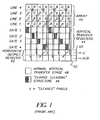
- the fast-dump structure is typically used within prior art devices in the transition area between the vertical and horizontal CCD.
- the fast-dump can be used to selectively dump charge from the main array of the device before transfer is made into the horizontal register for effective and fast subsampling of the image.
- These structures can be located at every column of the vertical section, or only at specific locations, (i.e., specific rows and/or columns), as predetermined at the time of design as described in U.S. Patent No. 5,440,343 .
- Such prior art devices typically require a contact be made directly to the drain regions of each such structure, thereby putting obvious limitations on the cell sizes that can be realized for a given set of design rules.
- the fast-dump structure is typically used within prior art devices in the transition area between the vertical and horizontal CCD as shown in Fig. 1 .
- the fast dump can be used to selectively dump charge from the main array of the device before transfer is made into the horizontal register for effective and fast subsampling of the image.
- These structures can be located at every column of the vertical imaging section, or only at specific locations, (i.e., specific rows and/or columns), as predetermined at the time of design as described in U.S. Patent No. 5,440,343 .
- Such prior art devices typically require a contact be made directly to the drain regions of each such structure, thereby putting obvious limitations on the cell sizes that can be realized for a given set of design rules.
- FIG. 2 Although other types of fast-dump structures exist that eliminate the need for a separate contact at each column, such as shown in Fig. 2 , these structures have the disadvantage that charge must be transferred through the horizontal shift register which slows down the process.
- the primary advantage of this new structure is that it does not require a separate contact to its drain region by using the existing drain of a lateral-overflow drain (LOD) antiblooming structure that is also typically used on full-frame CCD image sensors.
- LOD lateral-overflow drain
- a separate opening in the gate electrode for the drain contact is avoided, thereby making the structure more compact.
- Gate control is provided by etching a hole in the CCD gate electrode over particular overflow channel regions of the LOD structure, and overlaying this with one of the subsequent gate electrode layers. This subsequent gate electrode is then used to control the fast-dump operation.
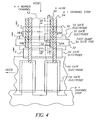
- FIG. 4 and 5a-5d The top view, cross-sectional views, and timing diagram for such a structure are shown in Figs. 4 and 5a-5d .
- timing is shown for a two-phase CCD being operated with accumulation-mode clocking, it is to be understood that other types of CCDs and clocking schemes may be used.
- Another advantage of this structure is that it does not require any additional masking or processing steps when built using a double (or more) electrode CCD process that employs a typical LOD structure.
- the fast-dump structure is typically used within prior art devices in the transition area between the vertical and horizontal CCD as shown in Fig. 1 .
- the fast dump can be used to selectively dump charge from the main array of the device before transfer is made into the horizontal register for effective and fast subsampling of the image.
- These structures can be located at every column of the vertical imaging section, or only at specific locations, (i.e., specific rows and/or columns), as predetermined at the time of design as described in U.S. Patent No. 5,440,343 .
- Such prior art devices typically require a contact be made directly to the drain regions of each such structure, thereby putting obvious limitations on the cell sizes that can be realized for a given set of design rules.
- FDG fast-dump gate
- Fig. 2b Illustrative examples of such devices are shown in Fig. 2b , and the prior art device as seen in Fig. 2a . These structures have the disadvantage that charge must be transferred through the horizontal shift register (H1, H2) which slows down the process.
- H1, H2 horizontal shift register
- multiple phase includes both two-phase and virtual-phase devices as well as devices having more than two phases.
- a virtual-phase device has one clocked phase and one virtual (non-clocked) phase BR1A and BR2A which refer to barrier implants.
- image sensing device 10 has a plurality of pixels 12 arranged in an array of rows 14 and columns 16.
- the image sensing device 10 is a two-phase, full-frame device with columns 16 formed as vertical charge-coupled device shift registers 18.
- Each of the vertical shift registers 18 has multiple pixels 12 with multiple phases 23 for each of the pixels 12.
- the preferred embodiment employs full-frame devices as image sensing device 10, because of the inherent advantages for the best mode being a full-frame device.
- the present invention could also be employed on interline-type devices.
- Fig. 3 illustrates a two-phase device employed by the preferred embodiment of the present invention having separate phase electrodes ⁇ 1 , ⁇ 2 within each of the CCD pixels 12.
- the phase electrodes ⁇ 1 , ⁇ 2 are electrically connected to voltage sources V1, V2, respectively, to provide alternate pulses to the two phases within the pixels 12 to effect charge transfer within each of the vertical shift register 18 two-phase CCD devices.
- Each of the phase electrodes ⁇ 1 , ⁇ 2 for the multiple phases 23 is formed from a separate electrode material resulting in two levels of electrode material.
- the phase electrodes ⁇ 1 , ⁇ 2 are shown such that adjacent electrodes overlap.
- phase electrodes ⁇ 1 , ⁇ 2 are formed from polysilicon, however, there are numerous teachings within the art wherein at least one of the phase electrodes ⁇ 1 , ⁇ 2 is formed from a different material, such as Indium Tin Oxide (ITO).
- ITO Indium Tin Oxide
- the fast-dump gate 30 of the present invention is formed at strategic locations within selected CCD pixels 12 by first forming a hole within one of the phase electrodes ⁇ 1 , ⁇ 2 within the selected CCD pixels 12. A drain is formed adjacent to the hole to provide for the removal of pixel charges from the selected cells 22 of the vertical CCD shift register 18 which allows for altering the resolution size.
- the capability for altering resolution sizes is desired in numerous applications such as higher speed applications or for windowing applications where only a subset of the entire pixel array of the image sensing device 10 is desired. In a reduced resolution mode, it is not necessary to output all of the pixel charges through horizontal shift register 40.
- a fast-dump gate electrode 30 is formed to remove undesired pixel data as expeditiously as possible by forming an electrode within the hole adjacent to a drain.
- the electrode is formed from a different electrode level from that in which the hole is formed allowing control over the draining of pixel charges without effecting the charge transfer within the vertical CCD shift register 18.
- the CCD is a two-phase device, having two levels of electrode material (polysilicon, ITO or other electrode material).
- the hole within the preferred embodiment is formed in the first electrode level and the fast-dump gate electrode 30 is then formed over the hole from the second level of electrode material. This allows the fast-dump gate electrode 30 to be isolated from the first electrode level in which it is formed enabling independent operation of the fast-dump gate electrode 30 without effecting the operation of the vertical CCD shift register 18.
- the fast-dump gate electrode 30 within the preferred embodiment is formed in corresponding cells 22 within each of the columns 16 of the CCD such that an entire row of pixels can be drained from the charge coupled devices.
- the drain used to form the fast-dump gate is a lateral overflow drain structure and the CCD is preferably a full-frame device.
- Fig. 4 is a top view of a portion of image sensing device 10 that has been selected to show the features and structure of the new fast-dump gate 30.
- the phase-1 electrode ⁇ 1 is electrically connected to voltage source V1
- the phase-2 electrode ⁇ 2 is electrically connected to voltage source V2 to create the two-phase, image sensing device 10 of the preferred embodiment.
- the fast-dump gate 30 electrode is preferably formed within the phase-1 electrode ⁇ 1 area because this is the last phase in the cell which facilitates an efficient dump of all the charge contained within a cell. While it will be understood to those skilled in the art, that the fast-dump gate 30 can be formed in any of the phases, it is preferably formed within the last phase of the cell.
- phase-1 electrode ⁇ 1 is drained via the fast-dump gate 30 prior to charge from the phase-2 electrode ⁇ 2 being shifted into the phase-1 electrode ⁇ 1 area where this charge is also drained via fast-dump gate 30.
- the organization of having the last phase contain fast-dump gate 30 is consistent before charge is transferred out of the cell, and it is desirable to remove all the charge from the cell via the fast-dump gate 30 structure. Therefore, the last phase within a cell is the preferred phase for placement of the fast-dump gate 30 structure.
- the frame transfer, image sensing device 10 has the fast-dump gate 30 structure formed within cell 32 that consists of two phases as previously discussed.
- Each of the columns 16 within image sensing device 10 has a lateral overflow drain (LOD) 52 on one side of the column 16 that, within the preferred embodiment, is formed from an n+ material.
- LOD lateral overflow drain
- a channel stop 54 is formed from a p+ material.
- the columns 16 have the LOD 52 and channel stop 54 formed within a p-type epitaxial layer formed on a p-type substrate.
- An n-type buried channel 42 is formed within the portions of the column 16 that is intended to transfer charge through the various phases.
- the n-type buried channel 42 will exist throughout the image sensor device 10 except in the areas that are adjacent LOD 52 and the junction edges of the phase electrodes ⁇ 1 , ⁇ 2 . Therefore, fingers of the n-type channel 42 will reach the n+ type LOD 52 in the center areas of the phase electrodes ⁇ 1 , ⁇ 2 as seen in Fig. 4 . In the cells where the fast-dump gates 30 are formed, a trench is formed in the center of the phase electrode over the finger of n-type buried channel 42 that extends towards LOD 52 as seen in Fig. 4 .
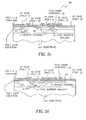
- Fig. 5a is a cross-sectional view taken through line A-A of Fig. 4 wherein the p-type barrier implant 56 is shown beneath notch 58.
- This p-type barrier implant 56 is along the edge of column 16 near LOD 52.
- Fig. 5b is a cross-sectional view taken through line B-B of Fig. 4 illustrating the entire width of a phase not having a fast-dump gate 30.
- notch 58 illustrated in Fig. 5a contained in the phase having a fast-dump gate 30 are both of these figures.
- Both of these figures contain the p-type barrier implant 56 that provides a threshold for charges to the LOD 52.
- the phases that do not have a fast-dump gate 30, such as that illustrated in Fig. 5b still have a p-type barrier implant 56.
- Fig. 5c is a cross-sectional view of line C-C of Fig. 4 illustrating a typical charge transfer path for one of the columns including a phase having a fast-dump gate 30.
- Fig. 5c is a view directly through notch 58 to illustrate the formation of the fast-dump gate 30 structure of the present invention in conjunction with the previously discussed Fig. 5a .
- Various fingers like outcrops of n-type buried channel 42 can be seen within each of the phases beneath the center of each electrode embedded within the a p-type barrier implant layer 56.
- the p-type barrier implant 56 that runs along the entire column is evident within Fig. 5c .
- the fast-dump gate 30 in the preferred embodiment is placed directly on top of the n-type buried channel 42 outcrops for the phase selected to contained the fast-dump gate 30.
- Fig. 5d which is a cross-sectional view through line D-D of Fig. 4 .
- This cross section illustrates the structure of the preferred embodiment along a line parallel to that discussed above for Fig. 5c only farther towards the center of each of the charge transfer cells.
- P-type barrier implants 65 are placed at the edge of each the electrodes to provide a potential threshold between each of the phases.
- Fig. 6a is a sample timing diagram for the fast-dump structure of Fig. 4 .
- Fig. 6b is a channel potential diagram for the fast-dump structure of Fig. 4 illustrating the operation of the fast-dump gate 30 wherein the charges contained in that phase get dumped into the lateral overflow drain 52.
- fast-dump gate 30 provides a structure that does not require a separate contact to a drain region instead using the existing drain of a lateral-overflow drain (LOD) typically used for antiblooming purposes.
- LOD structures are typically used on full-frame CCD image sensors.
- Gate control is provided by etching a hole in the CCD gate electrode over the overflow channel region of the LOD structure, and overlaying this with one of the subsequent gate electrode layers. This subsequent gate electrode is then used to control the fast-dump operation.
- FIG. 4 The top view, cross-sectional views, and timing diagram for such a structure are shown in Figs. 4 through 6b .
- timing is shown for a two-phase CCD being operated with accumulation-mode clocking, it is to be understood that other types of CCDs and clocking schemes may be used.
- Another advantage of this structure is that it does not require any additional masking or processing steps when built using a double (or more) electrode CCD process that employs a typical LOD structure.
Landscapes
- Solid State Image Pick-Up Elements (AREA)
- Transforming Light Signals Into Electric Signals (AREA)
- Facsimile Heads (AREA)
Applications Claiming Priority (2)
| Application Number | Priority Date | Filing Date | Title |
|---|---|---|---|
| US533051 | 1974-12-16 | ||
| US09/533,051 US6693671B1 (en) | 2000-03-22 | 2000-03-22 | Fast-dump structure for full-frame image sensors with lod antiblooming structures |
Publications (3)
| Publication Number | Publication Date |
|---|---|
| EP1137071A2 EP1137071A2 (en) | 2001-09-26 |
| EP1137071A3 EP1137071A3 (en) | 2005-09-14 |
| EP1137071B1 true EP1137071B1 (en) | 2010-09-01 |
Family
ID=24124256
Family Applications (1)
| Application Number | Title | Priority Date | Filing Date |
|---|---|---|---|
| EP01200931A Expired - Lifetime EP1137071B1 (en) | 2000-03-22 | 2001-03-12 | Fast-dump structure for full-frame image sensors with lateral overflow drain antiblooming structures |
Country Status (4)
| Country | Link |
|---|---|
| US (1) | US6693671B1 (enExample) |
| EP (1) | EP1137071B1 (enExample) |
| JP (1) | JP4743983B2 (enExample) |
| DE (1) | DE60142943D1 (enExample) |
Families Citing this family (15)
| Publication number | Priority date | Publication date | Assignee | Title |
|---|---|---|---|---|
| JP2001238134A (ja) * | 2000-02-23 | 2001-08-31 | Sony Corp | 固体撮像素子およびその駆動方法並びにカメラシステム |
| US6995795B1 (en) | 2000-09-12 | 2006-02-07 | Eastman Kodak Company | Method for reducing dark current |
| US20050068441A1 (en) * | 2003-09-26 | 2005-03-31 | Eastman Kodak Company | Multiple output CCD for color imaging |
| US7492404B2 (en) | 2004-08-27 | 2009-02-17 | Eastman Kodak Company | Fast flush structure for solid-state image sensors |
| US20080007622A1 (en) * | 2006-06-08 | 2008-01-10 | Eastman Kodak Company | Method of improving solid-state image sensor sensitivity |
| JP2009177018A (ja) * | 2008-01-25 | 2009-08-06 | Sanyo Electric Co Ltd | 固体撮像素子及びその製造方法 |
| US8134630B2 (en) * | 2008-05-09 | 2012-03-13 | Truesense Imaging, Inc. | System and method for draining residual charge from charge-coupled device (CCD) shift registers in image sensors having reset drains |
| US8329499B2 (en) * | 2008-12-10 | 2012-12-11 | Truesense Imaging, Inc. | Method of forming lateral overflow drain and channel stop regions in image sensors |
| JP5243983B2 (ja) * | 2009-01-30 | 2013-07-24 | 浜松ホトニクス株式会社 | 電子増倍機能内蔵型の固体撮像素子 |
| JP5300577B2 (ja) * | 2009-04-23 | 2013-09-25 | 三菱電機株式会社 | Tdi方式のイメージセンサ、及び該イメージセンサの駆動方法 |
| US8800130B2 (en) * | 2011-05-25 | 2014-08-12 | Truesense Imaging, Inc. | Methods for producing image sensors having multi-purpose architecture |
| US8773563B2 (en) | 2011-05-25 | 2014-07-08 | Truesense Imaging, Inc. | Multi-purpose architecture for CCD image sensors |
| US8736924B2 (en) | 2011-09-28 | 2014-05-27 | Truesense Imaging, Inc. | Time-delay-and-integrate image sensors having variable integration times |
| CN105611197B (zh) * | 2015-12-23 | 2018-08-17 | 中国科学院长春光学精密机械与物理研究所 | 无抗溢出功能帧转移ccd的抗饱和读出方法 |
| JP7765306B2 (ja) * | 2022-02-24 | 2025-11-06 | 浜松ホトニクス株式会社 | 固体撮像素子 |
Citations (1)
| Publication number | Priority date | Publication date | Assignee | Title |
|---|---|---|---|---|
| US4528596A (en) * | 1982-11-30 | 1985-07-09 | Rca Corporation | Suppression of edge effects arising in CCD imager field registers |
Family Cites Families (17)
| Publication number | Priority date | Publication date | Assignee | Title |
|---|---|---|---|---|
| JPS5817788A (ja) * | 1981-07-23 | 1983-02-02 | Toshiba Corp | 固体撮像装置 |
| US4611140A (en) | 1985-08-26 | 1986-09-09 | The United States Of America As Represented By The Secretary Of The Navy | Saw-CTD parallel to serial imager |
| KR900007234B1 (ko) * | 1986-07-07 | 1990-10-05 | 가부시기가이샤 히다찌세이사구쇼 | 전하이송형 고체촬상소자 |
| US4972254A (en) * | 1987-02-24 | 1990-11-20 | Kabushiki Kaisha Toshiba | Solid state image sensors for reproducing high definition images |
| US5121214A (en) | 1990-06-29 | 1992-06-09 | The United States Of America As Represented By The United States Department Of Energy | Method for eliminating artifacts in CCD imagers |
| US5130774A (en) * | 1990-07-12 | 1992-07-14 | Eastman Kodak Company | Antiblooming structure for solid-state image sensor |
| AU1995092A (en) | 1991-05-10 | 1992-12-30 | Q-Dot. Inc. | High-speed peristaltic ccd imager with gaas fet output |
| US5355165A (en) | 1992-08-06 | 1994-10-11 | Princeton Scientific Instruments, Inc. | Very high frame rate CCD imager |
| US5343297A (en) | 1992-09-17 | 1994-08-30 | General Electric Company | Charge amplifier with precise, integer gain |
| US5440343A (en) | 1994-02-28 | 1995-08-08 | Eastman Kodak Company | Motion/still electronic image sensing apparatus |
| US5668597A (en) | 1994-12-30 | 1997-09-16 | Eastman Kodak Company | Electronic camera with rapid automatic focus of an image upon a progressive scan image sensor |
| DE69632172T2 (de) * | 1995-02-21 | 2005-04-21 | Dalsa Corp | Ladungsgekoppelte bildaufnahmeanordnung |
| JP3590944B2 (ja) * | 1996-02-23 | 2004-11-17 | 日本テキサス・インスツルメンツ株式会社 | 電荷結合型半導体装置 |
| JP3750221B2 (ja) * | 1996-10-01 | 2006-03-01 | ソニー株式会社 | 固体撮像装置 |
| JP2894323B2 (ja) * | 1997-06-23 | 1999-05-24 | 日本電気株式会社 | 固体撮像装置およびその製造方法 |
| US6051857A (en) * | 1998-01-07 | 2000-04-18 | Innovision, Inc. | Solid-state imaging device and method of detecting optical signals using the same |
| JP2000134540A (ja) * | 1998-10-29 | 2000-05-12 | Nec Corp | 固体撮像装置及びその駆動方法 |
-
2000
- 2000-03-22 US US09/533,051 patent/US6693671B1/en not_active Expired - Lifetime
-
2001
- 2001-03-12 EP EP01200931A patent/EP1137071B1/en not_active Expired - Lifetime
- 2001-03-12 DE DE60142943T patent/DE60142943D1/de not_active Expired - Lifetime
- 2001-03-21 JP JP2001081327A patent/JP4743983B2/ja not_active Expired - Lifetime
Patent Citations (1)
| Publication number | Priority date | Publication date | Assignee | Title |
|---|---|---|---|---|
| US4528596A (en) * | 1982-11-30 | 1985-07-09 | Rca Corporation | Suppression of edge effects arising in CCD imager field registers |
Also Published As
| Publication number | Publication date |
|---|---|
| DE60142943D1 (de) | 2010-10-14 |
| JP2001326344A (ja) | 2001-11-22 |
| US6693671B1 (en) | 2004-02-17 |
| EP1137071A3 (en) | 2005-09-14 |
| EP1137071A2 (en) | 2001-09-26 |
| JP4743983B2 (ja) | 2011-08-10 |
Similar Documents
| Publication | Publication Date | Title |
|---|---|---|
| US6693671B1 (en) | Fast-dump structure for full-frame image sensors with lod antiblooming structures | |
| US4168444A (en) | Imaging devices | |
| JP6044044B2 (ja) | 非対称ゲート式マトリクス電荷転送イメージ・センサ | |
| JPS62265759A (ja) | 固体撮像素子 | |
| US4668971A (en) | CCD imager with JFET peripherals | |
| EP0491922A1 (en) | Antiblooming structure for solid-state image sensor | |
| EP0455801A1 (en) | Image sensor | |
| US5402459A (en) | Frame transfer image sensor with electronic shutter | |
| US5235196A (en) | Transfer region design for charge-coupled device image sensor | |
| KR101159032B1 (ko) | 고체 촬상 소자 | |
| US20110024606A1 (en) | Solid-state imaging device | |
| US6114717A (en) | Solid-state imaging device having no transfer error of the signal charges from vertical horizontal charge-transfer section | |
| EP1289020B1 (en) | A lateral overflow drain, antiblooming structure for CCD devices having improved breakdown voltage | |
| US4974043A (en) | Solid-state image sensor | |
| US5256891A (en) | CCD electrode structure for image sensors | |
| EP0059547B1 (en) | Clock controlled anti-blooming for virtual phase ccd's | |
| US4654683A (en) | Blooming control in CCD image sensors | |
| EP0614225B1 (en) | Charge coupled device | |
| US7321392B2 (en) | Solid state imaging device with lateral overflow drain and driving method thereof achieving low power consumption | |
| JP2877047B2 (ja) | 固体撮像装置 | |
| JPH08264747A (ja) | コンテナ側方オーバーフロードレインインプラントを有する固体画像化器及びその製造方法 | |
| JP3301176B2 (ja) | 電荷転送装置 | |
| JP3247163B2 (ja) | 固体撮像装置及びその製造方法 | |
| KR100223931B1 (ko) | 고체 촬상 소자 및 그 제조방법 | |
| EP0478946A1 (en) | CCD frame transfer image device |
Legal Events
| Date | Code | Title | Description |
|---|---|---|---|
| PUAI | Public reference made under article 153(3) epc to a published international application that has entered the european phase |
Free format text: ORIGINAL CODE: 0009012 |
|
| AK | Designated contracting states |
Kind code of ref document: A2 Designated state(s): AT BE CH CY DE DK ES FI FR GB GR IE IT LI LU MC NL PT SE TR |
|
| AX | Request for extension of the european patent |
Free format text: AL;LT;LV;MK;RO;SI |
|
| PUAL | Search report despatched |
Free format text: ORIGINAL CODE: 0009013 |
|
| AK | Designated contracting states |
Kind code of ref document: A3 Designated state(s): AT BE CH CY DE DK ES FI FR GB GR IE IT LI LU MC NL PT SE TR |
|
| AX | Request for extension of the european patent |
Extension state: AL LT LV MK RO SI |
|
| 17P | Request for examination filed |
Effective date: 20060307 |
|
| AKX | Designation fees paid |
Designated state(s): DE FR GB NL |
|
| GRAP | Despatch of communication of intention to grant a patent |
Free format text: ORIGINAL CODE: EPIDOSNIGR1 |
|
| GRAS | Grant fee paid |
Free format text: ORIGINAL CODE: EPIDOSNIGR3 |
|
| GRAA | (expected) grant |
Free format text: ORIGINAL CODE: 0009210 |
|
| AK | Designated contracting states |
Kind code of ref document: B1 Designated state(s): DE FR GB NL |
|
| REG | Reference to a national code |
Ref country code: GB Ref legal event code: FG4D |
|
| REF | Corresponds to: |
Ref document number: 60142943 Country of ref document: DE Date of ref document: 20101014 Kind code of ref document: P |
|
| REG | Reference to a national code |
Ref country code: NL Ref legal event code: T3 |
|
| PLBE | No opposition filed within time limit |
Free format text: ORIGINAL CODE: 0009261 |
|
| STAA | Information on the status of an ep patent application or granted ep patent |
Free format text: STATUS: NO OPPOSITION FILED WITHIN TIME LIMIT |
|
| 26N | No opposition filed |
Effective date: 20110606 |
|
| REG | Reference to a national code |
Ref country code: GB Ref legal event code: 732E Free format text: REGISTERED BETWEEN 20120315 AND 20120321 |
|
| REG | Reference to a national code |
Ref country code: DE Ref legal event code: R097 Ref document number: 60142943 Country of ref document: DE Effective date: 20110606 |
|
| PGFP | Annual fee paid to national office [announced via postgrant information from national office to epo] |
Ref country code: NL Payment date: 20140308 Year of fee payment: 14 |
|
| PGFP | Annual fee paid to national office [announced via postgrant information from national office to epo] |
Ref country code: FR Payment date: 20140311 Year of fee payment: 14 |
|
| PGFP | Annual fee paid to national office [announced via postgrant information from national office to epo] |
Ref country code: GB Payment date: 20140312 Year of fee payment: 14 |
|
| REG | Reference to a national code |
Ref country code: DE Ref legal event code: R082 Ref document number: 60142943 Country of ref document: DE Representative=s name: MEYER & PARTNER GBR, DE |
|
| REG | Reference to a national code |
Ref country code: GB Ref legal event code: 732E Free format text: REGISTERED BETWEEN 20140904 AND 20140910 |
|
| REG | Reference to a national code |
Ref country code: DE Ref legal event code: R082 Ref document number: 60142943 Country of ref document: DE Representative=s name: MEYER & PARTNER GBR, DE Effective date: 20140918 Ref country code: DE Ref legal event code: R081 Ref document number: 60142943 Country of ref document: DE Owner name: SEMICONDUCTOR COMPONENTS INDUSTRIES, LLC (N. D, US Free format text: FORMER OWNER: EASTMAN KODAK CO., ROCHESTER, N.Y., US Effective date: 20140918 |
|
| REG | Reference to a national code |
Ref country code: NL Ref legal event code: SD Effective date: 20150209 Ref country code: NL Ref legal event code: TD Effective date: 20150209 |
|
| GBPC | Gb: european patent ceased through non-payment of renewal fee |
Effective date: 20150312 |
|
| REG | Reference to a national code |
Ref country code: NL Ref legal event code: MM Effective date: 20150401 |
|
| REG | Reference to a national code |
Ref country code: FR Ref legal event code: ST Effective date: 20151130 |
|
| PG25 | Lapsed in a contracting state [announced via postgrant information from national office to epo] |
Ref country code: GB Free format text: LAPSE BECAUSE OF NON-PAYMENT OF DUE FEES Effective date: 20150312 |
|
| PG25 | Lapsed in a contracting state [announced via postgrant information from national office to epo] |
Ref country code: FR Free format text: LAPSE BECAUSE OF NON-PAYMENT OF DUE FEES Effective date: 20150331 |
|
| PG25 | Lapsed in a contracting state [announced via postgrant information from national office to epo] |
Ref country code: NL Free format text: LAPSE BECAUSE OF NON-PAYMENT OF DUE FEES Effective date: 20150401 |
|
| PGFP | Annual fee paid to national office [announced via postgrant information from national office to epo] |
Ref country code: DE Payment date: 20200218 Year of fee payment: 20 |
|
| REG | Reference to a national code |
Ref country code: DE Ref legal event code: R071 Ref document number: 60142943 Country of ref document: DE |