EP1136123A2 - Composition catalytique et procédé pour la catalyse de dimérisation, de codimérisation et d'oligomérisation des oléfines - Google Patents
Composition catalytique et procédé pour la catalyse de dimérisation, de codimérisation et d'oligomérisation des oléfines Download PDFInfo
- Publication number
- EP1136123A2 EP1136123A2 EP01400510A EP01400510A EP1136123A2 EP 1136123 A2 EP1136123 A2 EP 1136123A2 EP 01400510 A EP01400510 A EP 01400510A EP 01400510 A EP01400510 A EP 01400510A EP 1136123 A2 EP1136123 A2 EP 1136123A2
- Authority
- EP
- European Patent Office
- Prior art keywords
- catalytic composition
- composition according
- product
- aluminum
- chloride
- Prior art date
- Legal status (The legal status is an assumption and is not a legal conclusion. Google has not performed a legal analysis and makes no representation as to the accuracy of the status listed.)
- Granted
Links
Classifications
-
- C—CHEMISTRY; METALLURGY
- C07—ORGANIC CHEMISTRY
- C07C—ACYCLIC OR CARBOCYCLIC COMPOUNDS
- C07C2/00—Preparation of hydrocarbons from hydrocarbons containing a smaller number of carbon atoms
- C07C2/02—Preparation of hydrocarbons from hydrocarbons containing a smaller number of carbon atoms by addition between unsaturated hydrocarbons
- C07C2/04—Preparation of hydrocarbons from hydrocarbons containing a smaller number of carbon atoms by addition between unsaturated hydrocarbons by oligomerisation of well-defined unsaturated hydrocarbons without ring formation
- C07C2/06—Preparation of hydrocarbons from hydrocarbons containing a smaller number of carbon atoms by addition between unsaturated hydrocarbons by oligomerisation of well-defined unsaturated hydrocarbons without ring formation of alkenes, i.e. acyclic hydrocarbons having only one carbon-to-carbon double bond
- C07C2/08—Catalytic processes
- C07C2/26—Catalytic processes with hydrides or organic compounds
- C07C2/32—Catalytic processes with hydrides or organic compounds as complexes, e.g. acetyl-acetonates
-
- B—PERFORMING OPERATIONS; TRANSPORTING
- B01—PHYSICAL OR CHEMICAL PROCESSES OR APPARATUS IN GENERAL
- B01J—CHEMICAL OR PHYSICAL PROCESSES, e.g. CATALYSIS OR COLLOID CHEMISTRY; THEIR RELEVANT APPARATUS
- B01J31/00—Catalysts comprising hydrides, coordination complexes or organic compounds
- B01J31/02—Catalysts comprising hydrides, coordination complexes or organic compounds containing organic compounds or metal hydrides
- B01J31/0277—Catalysts comprising hydrides, coordination complexes or organic compounds containing organic compounds or metal hydrides comprising ionic liquids, as components in catalyst systems or catalysts per se, the ionic liquid compounds being used in the molten state at the respective reaction temperature
- B01J31/0278—Catalysts comprising hydrides, coordination complexes or organic compounds containing organic compounds or metal hydrides comprising ionic liquids, as components in catalyst systems or catalysts per se, the ionic liquid compounds being used in the molten state at the respective reaction temperature containing nitrogen as cationic centre
- B01J31/0281—Catalysts comprising hydrides, coordination complexes or organic compounds containing organic compounds or metal hydrides comprising ionic liquids, as components in catalyst systems or catalysts per se, the ionic liquid compounds being used in the molten state at the respective reaction temperature containing nitrogen as cationic centre the nitrogen being a ring member
- B01J31/0284—Catalysts comprising hydrides, coordination complexes or organic compounds containing organic compounds or metal hydrides comprising ionic liquids, as components in catalyst systems or catalysts per se, the ionic liquid compounds being used in the molten state at the respective reaction temperature containing nitrogen as cationic centre the nitrogen being a ring member of an aromatic ring, e.g. pyridinium
-
- B—PERFORMING OPERATIONS; TRANSPORTING
- B01—PHYSICAL OR CHEMICAL PROCESSES OR APPARATUS IN GENERAL
- B01J—CHEMICAL OR PHYSICAL PROCESSES, e.g. CATALYSIS OR COLLOID CHEMISTRY; THEIR RELEVANT APPARATUS
- B01J31/00—Catalysts comprising hydrides, coordination complexes or organic compounds
- B01J31/02—Catalysts comprising hydrides, coordination complexes or organic compounds containing organic compounds or metal hydrides
- B01J31/0277—Catalysts comprising hydrides, coordination complexes or organic compounds containing organic compounds or metal hydrides comprising ionic liquids, as components in catalyst systems or catalysts per se, the ionic liquid compounds being used in the molten state at the respective reaction temperature
- B01J31/0287—Catalysts comprising hydrides, coordination complexes or organic compounds containing organic compounds or metal hydrides comprising ionic liquids, as components in catalyst systems or catalysts per se, the ionic liquid compounds being used in the molten state at the respective reaction temperature containing atoms other than nitrogen as cationic centre
- B01J31/0288—Phosphorus
-
- B—PERFORMING OPERATIONS; TRANSPORTING
- B01—PHYSICAL OR CHEMICAL PROCESSES OR APPARATUS IN GENERAL
- B01J—CHEMICAL OR PHYSICAL PROCESSES, e.g. CATALYSIS OR COLLOID CHEMISTRY; THEIR RELEVANT APPARATUS
- B01J31/00—Catalysts comprising hydrides, coordination complexes or organic compounds
- B01J31/02—Catalysts comprising hydrides, coordination complexes or organic compounds containing organic compounds or metal hydrides
- B01J31/12—Catalysts comprising hydrides, coordination complexes or organic compounds containing organic compounds or metal hydrides containing organo-metallic compounds or metal hydrides
- B01J31/14—Catalysts comprising hydrides, coordination complexes or organic compounds containing organic compounds or metal hydrides containing organo-metallic compounds or metal hydrides of aluminium or boron
- B01J31/143—Catalysts comprising hydrides, coordination complexes or organic compounds containing organic compounds or metal hydrides containing organo-metallic compounds or metal hydrides of aluminium or boron of aluminium
-
- B—PERFORMING OPERATIONS; TRANSPORTING
- B01—PHYSICAL OR CHEMICAL PROCESSES OR APPARATUS IN GENERAL
- B01J—CHEMICAL OR PHYSICAL PROCESSES, e.g. CATALYSIS OR COLLOID CHEMISTRY; THEIR RELEVANT APPARATUS
- B01J31/00—Catalysts comprising hydrides, coordination complexes or organic compounds
- B01J31/16—Catalysts comprising hydrides, coordination complexes or organic compounds containing coordination complexes
- B01J31/22—Organic complexes
- B01J31/2265—Carbenes or carbynes, i.e.(image)
- B01J31/2269—Heterocyclic carbenes
- B01J31/2273—Heterocyclic carbenes with only nitrogen as heteroatomic ring members, e.g. 1,3-diarylimidazoline-2-ylidenes
-
- B—PERFORMING OPERATIONS; TRANSPORTING
- B01—PHYSICAL OR CHEMICAL PROCESSES OR APPARATUS IN GENERAL
- B01J—CHEMICAL OR PHYSICAL PROCESSES, e.g. CATALYSIS OR COLLOID CHEMISTRY; THEIR RELEVANT APPARATUS
- B01J2231/00—Catalytic reactions performed with catalysts classified in B01J31/00
- B01J2231/20—Olefin oligomerisation or telomerisation
-
- B—PERFORMING OPERATIONS; TRANSPORTING
- B01—PHYSICAL OR CHEMICAL PROCESSES OR APPARATUS IN GENERAL
- B01J—CHEMICAL OR PHYSICAL PROCESSES, e.g. CATALYSIS OR COLLOID CHEMISTRY; THEIR RELEVANT APPARATUS
- B01J2531/00—Additional information regarding catalytic systems classified in B01J31/00
- B01J2531/80—Complexes comprising metals of Group VIII as the central metal
- B01J2531/84—Metals of the iron group
- B01J2531/847—Nickel
-
- C—CHEMISTRY; METALLURGY
- C07—ORGANIC CHEMISTRY
- C07C—ACYCLIC OR CARBOCYCLIC COMPOUNDS
- C07C2527/00—Catalysts comprising the elements or compounds of halogens, sulfur, selenium, tellurium, phosphorus or nitrogen; Catalysts comprising carbon compounds
- C07C2527/06—Halogens; Compounds thereof
- C07C2527/125—Compounds comprising a halogen and scandium, yttrium, aluminium, gallium, indium or thallium
-
- C—CHEMISTRY; METALLURGY
- C07—ORGANIC CHEMISTRY
- C07C—ACYCLIC OR CARBOCYCLIC COMPOUNDS
- C07C2531/00—Catalysts comprising hydrides, coordination complexes or organic compounds
- C07C2531/16—Catalysts comprising hydrides, coordination complexes or organic compounds containing coordination complexes
- C07C2531/22—Organic complexes
-
- C—CHEMISTRY; METALLURGY
- C07—ORGANIC CHEMISTRY
- C07C—ACYCLIC OR CARBOCYCLIC COMPOUNDS
- C07C2531/00—Catalysts comprising hydrides, coordination complexes or organic compounds
- C07C2531/26—Catalysts comprising hydrides, coordination complexes or organic compounds containing in addition, inorganic metal compounds not provided for in groups C07C2531/02 - C07C2531/24
Definitions
- the present invention relates to dimerization, codimerization and catalytic oligomerization of olefins.
- Its purpose is a new catalytic composition, codimerization or resulting from the dissolution of at least one nickel complex containing at least a heterocyclic carbene ligand, in the liquid mixture, of ionic nature, at least one quaternary ammonium and / or phosphonium halide, at least at least one aluminum trihalide and optionally at least one halide of aluminum alkyl.
- the present invention also relates to the use of this catalytic composition in dimerization, codimerization processes and / or oligomerization of olefins.
- French patent FR-B-2 611 700 describes the use of liquids with character ionic formed of aluminum halides and ammonium halides quaternaries as solvents for organometallic nickel complexes for the olefin dimerization catalysis.
- French patent FR-B-2 659 871 describes a liquid composition with ionic character resulting from the contacting of at least one halide quaternary ammonium and / or quaternary phosphonium with at least one alkylaluminum dihalide and optionally additionally at least one aluminum trihalide.
- This patent also describes the use of these media. as solvents for transition metal complexes, especially nickel complexes that do not contain a nickel-carbon bond, which are transformed into olefin oligomerization catalysts.
- these media will be called "molten salts" because they are liquid at temperature moderate.
- nickel catalysts more active are obtained in "molten salts" consisting of an equivalent molar quaternary ammonium halide and / or halide quaternary phosphonium with one (or more) equivalent of aluminum trihalide and optionally any amount of alkyl aluminum dihalide.
- This formulation has proved particularly interesting because that the nickel complexes dissolved therein exhibit catalytic activity high.
- the neutral ligands described in this work and optionally associated with nickel are tertiary phosphines.
- the disadvantage of alkylphosphine ligands is that they are expensive compounds and that oxidize easily in the presence of air.
- nickel complexes carrying at least one monocarbene or bicarbene ligand corresponding for example to formulas (I) and (II) given below are soluble and stable in “molten salt” media and that they allow to catalyze the dimerization, codimerization or oligomerization of olefins.
- These carbene ligands have been the subject of a review in Angew. Chem. Int. Ed. Engl. 1997, 36, 2162. These are ⁇ -donor and ⁇ -acceptor ligands which form very stable bonds with the transition metals. Their electronic properties can be compared to those of basic trialkylphosphines.
- the subject of the invention is therefore a catalytic composition resulting from the dissolution of a nickel compound containing at least one mono- or bi-carbene ligand heterocyclic in a “molten salt” medium consisting of at least one quaternary ammonium halide and / or at least one halide of quaternary phosphonium (Product A), of at least one aluminum halide (Product B) and optionally at least one organic aluminum compound (Product C).
- H heterocyclic carbenes can be generated from salts imidazolium or bis (azolium) corresponding, by deprotonation.
- the metal of transition can play the role of reducer.
- heterocyclic mono- or bicarbene ligands By way of nonlimiting examples of heterocyclic mono- or bicarbene ligands, mention will be made of the carbene ligands described by formulas (1), (2) and (3) given below.
- tetrabutylphosphonium chloride N-butylpyridinium chloride, ethylpyridinium bromide, butyl-3 chloride 1-methylimidazolium, diethylpyrazolium chloride, hydrochloride pyridinium, trimethylphenylammonium chloride and ethyl-3 chloride 1-methylimidazolium.
- These salts can be used alone or in mixtures.
- Aluminum halides used as Product B in the composition "molten salts" according to the invention are essentially chloride and bromide aluminum.
- the organic aluminum compounds optionally used as Products C in the composition of the “molten salts” according to the invention have the general formula AlR x X 3-x , in which R is a hydrocarbon residue, for example alkyl, linear or branched , comprising from 2 to 8 carbon atoms, X being chlorine or bromine and x having a value equal to 1, 2 or 3.
- R is a hydrocarbon residue, for example alkyl, linear or branched , comprising from 2 to 8 carbon atoms, X being chlorine or bromine and x having a value equal to 1, 2 or 3.
- the constituents of the “molten salts” as defined above are in general used in A: B molar ratios of 1: 0.5 to 1: 3, of preferably 1: 1 to 1: 2; Product C is used in a molar ratio with Product B at most equal to 100: 1 and preferably from 0.005: 1 to 10: 1. It is nevertheless necessary that the components and their proportions are such that the mixture is liquid at the temperature at which the compound is introduced nickel although the catalytic reaction of dimerization, codimerization or oligomerization can be done at a temperature lower or higher than the melting temperature of the catalytic composition.
- the compounds included in the composition according to the invention can be mixed in any order.
- the mixing can be done by a simple contacting followed by stirring until a homogeneous liquid is formed.
- Olefins capable of being dimerized, codimerized or oligomerized by the catalytic compositions according to the invention are ethylene, propylene, n-butenes and n-pentenes, alone or as a mixture, pure or diluted with one or several alkane (s), as found in "cups" from petroleum refining processes, such as catalytic cracking or cracking steam.
- the catalytic reaction of dimerization, codimerization or oligomerization olefins can be conducted in a closed system, in a semi-open system or continuously with one or more reaction stages. Vigorous agitation must ensure good contact between the reagent (s) and the catalytic mixture.
- the reaction temperature can be from -40 to +70 ° C, preferably from -20 to +50 ° C. One can operate above or below the melting temperature of the medium, the dispersed solid state not being a limitation on the proper progress of the reaction.
- the heat generated by the reaction can be removed by all means known to those skilled in the art.
- the pressure can be between the atmospheric pressure and 200 atmospheres (around 20 MPa), preferably between atmospheric pressure and 50 atmospheres (around 5 MPa). Products of the reaction and the unreacted reagent (s) are separated from the system catalytic by simple decantation, then fractionated.
- the nickel complex is prepared by improving synthesis described in Organometallics, 1997, 16, 2209.
- the nickel acetate is strongly agitated previously dried (6 mmol) with dimethyl-1,3-imidazolium iodide (12 mmol) in nitromethane (60 mL). It is heated to 150 ° C. by drawing under the vacuum pump for one hour. Let cool and then extract the red complex formed with hot tetrahydrofuran (500 mL). Tetrahydrofuran is then evaporated in vacuo and the red compound is washed with ether diethyl (140 mL). A second wash with absolute ethanol (15 mL) is necessary to remove unreacted 1,3-dimethylimidazolium iodide.
Landscapes
- Chemical & Material Sciences (AREA)
- Organic Chemistry (AREA)
- Chemical Kinetics & Catalysis (AREA)
- Engineering & Computer Science (AREA)
- Materials Engineering (AREA)
- Inorganic Chemistry (AREA)
- Organic Low-Molecular-Weight Compounds And Preparation Thereof (AREA)
- Catalysts (AREA)
- Low-Molecular Organic Synthesis Reactions Using Catalysts (AREA)
Abstract
- Une composition catalytique pour la dimérisation, la codimérisation ou l'oligomérisation des oléfines résulte de la dissolution d'au moins un complexe du nickel contenant un carbène hétérocyclique dans un mélange liquide comprenant au moins un halogénure d'ammonium ou de phosphonium quaternaire, au moins un halogénure d'aluminium et facultativement au moins un composé organométallique d'aluminium.
- On décrit également le procédé de dimérisation, de codimérisation ou d'oligomérisation des oléfines utilisant cette composition catalytique.
Description

- a, b, c, d et n sont des nombres entiers avec a égal à 1, 2 ou 3 ; b de 0 à 2 fois a ; d de 0 à 2 fois a ; c de 1 à 4 fois b ; n égal à 0, 1 ou 2 ;
- X et Y, identiques ou différents, représentent chacun un ligand mono- ou multi-chélatant, chargé ou non ; à titre d'exemples, on pourra citer les halogénures, les carboxylates (par exemple l'éthyl-2-hexanoate), l'acétylacétonate, le sulfate, les phénates, les mono- et di-oléfines, les π-aromatiques, les radicaux alkyles ou aryles, les phosphines, les phosphites et le monoxyde de carbone ;
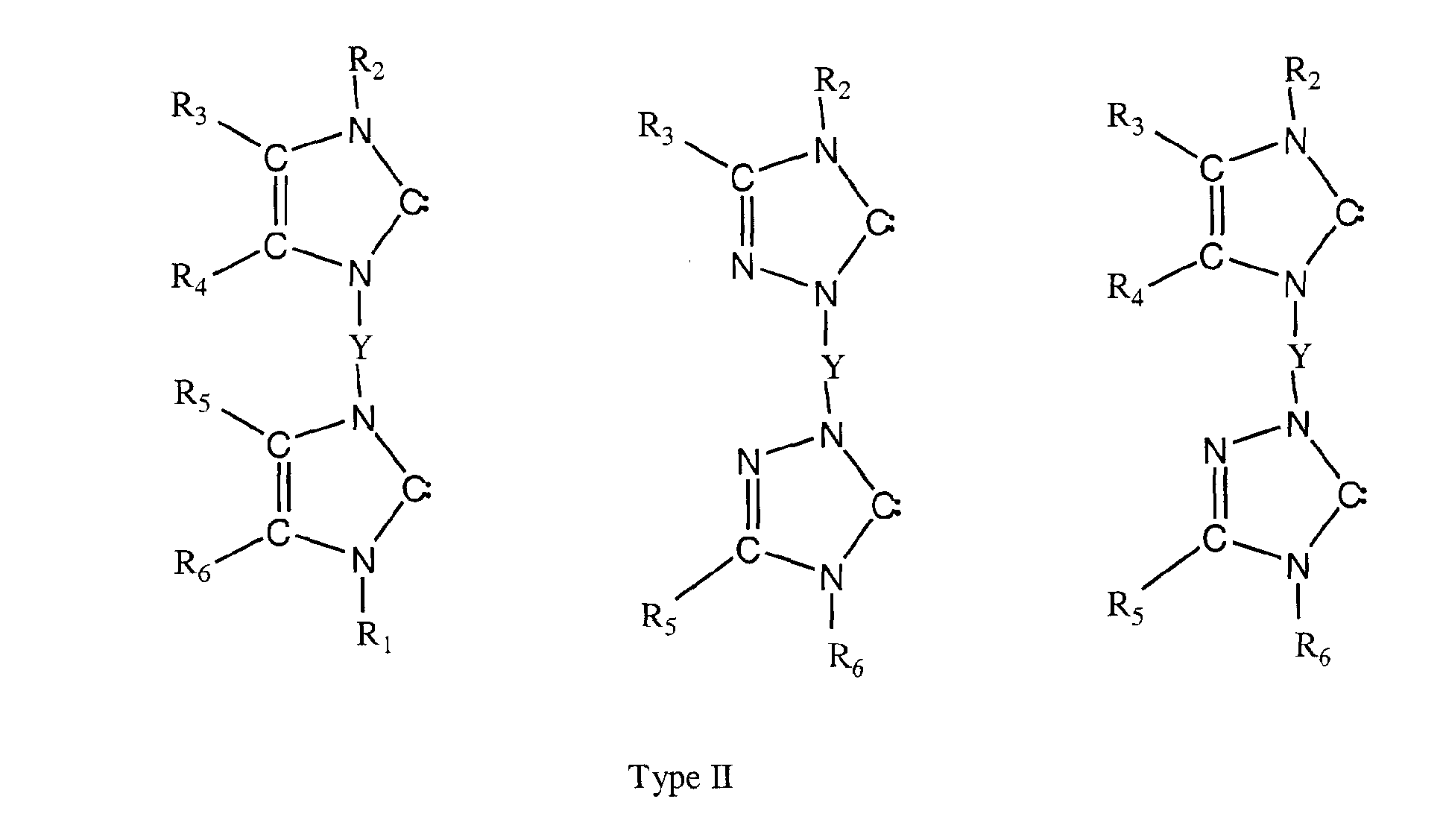
- L est un mono- ou bi-carbène hétérocyclique qui répond par exemple à l'une des formules générales (I) et (II) ci-dessus, dans lesquelles R1, R2, R3, R4, R5 et R6, identiques ou différents, représentent chacun l'hydrogène, un groupe hydrocarboné, aliphatique, saturé ou insaturé, ou aromatique, comprenant de 1 à 12 atomes de carbone, et Y représente un reste bivalent aliphatique de 1 à 4 atomes de carbone ; et
- A est un anion faiblement coordinant ; à titre d'exemples, on pourra citer les anions tétrafluoroborate, hexafluorophosphate, tétraphénylborate et leurs dérivés, les anions tétrachloroaluminate, hexafluoroantimonate, trifluoroacétate, trifluorométhylsulfonate et acétate.


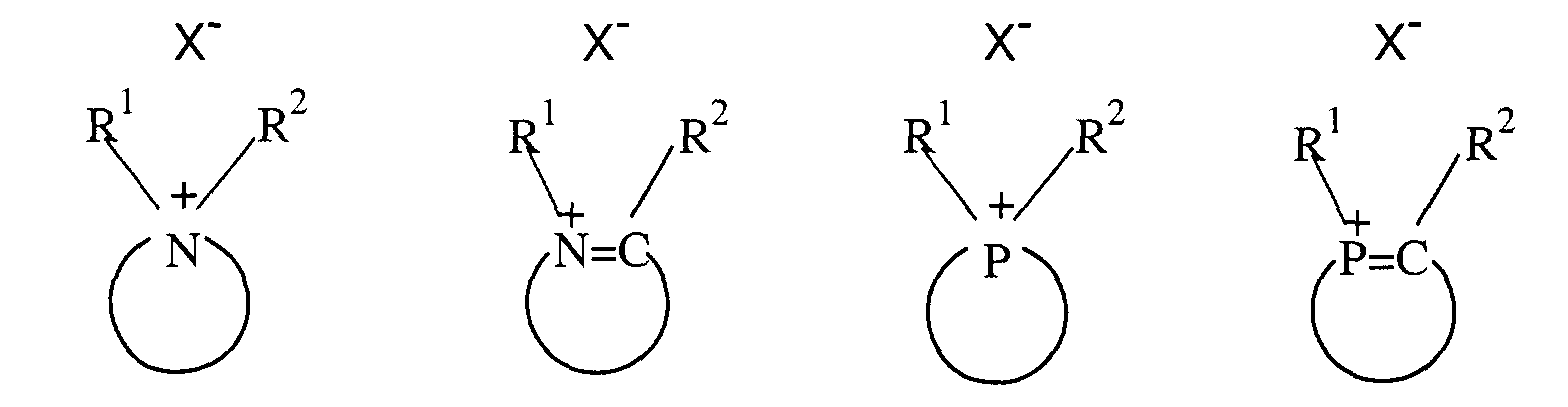
- à l'une des formules générales NR1R2R3R4X (à l'exception de NH4X), PR1R2R3R4X, R1R2N=CR3R4X ou R1R2P=CR3R4X, dans lesquelles X représente Cl ou Br et R1, R2, R3 et R4, identiques ou différents, représentent chacun l'hydrogène ou un reste hydrocarbyle de 1 à 12 atomes de carbone par exemple des groupements alkyles, saturés ou non saturés, cycloalkyles ou aromatiques, aryles ou aralkyles, comprenant de 1 à 12 atomes de carbone, étant entendu que, de préférence, un seul des substituants R1, R2, R3 et R4 représente l'hydrogène ;
- ou encore à l'une des formules générales :
dans lesquelles les hétérocycles azotés ou phosphorés comportant 1, 2 ou 3 atomes d'azote et/ou de phosphore sont constitués de 4 à 10 atomes et X, R1 et R2 sont définis comme précédemment.
Claims (19)
- Composition catalytique résultant de la dissolution d'au moins un composé du nickel contenant au moins un ligand mono- ou bi-carbène hétérocyclique dans un milieu constituéd'au moins un halogénure d'ammonium quaternaire et/ou au moins un halogénure de phosphonium quaternaire, désigné par Produit A ;d'au moins un halogénure d'aluminium, désigné par Produit B ;et facultativement d'au moins un composé organique de l'aluminium, désigné par Produit C.
- Composition catalytique selon la revendication 1 dans laquelle ledit composé du nickel répond à la formule générale (NiaXbYdLc)n (A)n dans laquellea, b, c, d et n sont des nombres entiers avec a égal à 1, 2 ou 3 ; b de 0 à 2 fois a ; d de 0 à 2 fois a ; c de 1 à 4 fois b ; et n égal à 0, 1 ou 2 ;X et Y, identiques ou différents, représentent chacun un ligand mono- ou multi-chélatant, chargé ou non ;L est un ligand mono- ou bi-carbène hétérocyclique ; etA est un anion faiblement coordinant.
- Composition catalytique selon la revendication 2 caractérisée en ce que le ligand L répond à l'une des formules générales (I) et (II) de la description, dans lesquelles R1, R2, R3, R4, R5 et R6, identiques ou différents, représentent chacun l'hydrogène, un groupe hydrocarboné, aliphatique, saturé ou insaturé, ou aromatique, comprenant de 1 à 12 atomes de carbone et Y représente un reste bivalent aliphatique de 1 à 4 atomes de carbone.
- Composition catalytique selon la revendication 2 ou 3 caractérisée en ce que L est choisi parmi les ligands carbènes répondant aux formules (1), (2) et (3) de la description.
- Composition catalytique selon l'une des revendications 2 à 4 caractérisée en ce que X et Y sont choisis parmi les halogénures, les carboxylates, l'acétylacétonate, le sulfate, les phénates, les mono- et di-oléfines, les π-aromatiques, les radicaux alkyles ou aryles, les phosphines, les phosphites et le monoxyde de carbone.
- Composition catalytique selon l'une des revendications 2 à 5 caractérisée en ce que A est choisi parmi les anions tétrafluoroborate, hexafluorophosphate, tétraphénylborate et dérivés, tétrachloroaluminate, hexafluoroantimonate, trifluoroacétate, trifluorométhylsulfonate et acétate.
- Composition catalytique selon les revendications 1 à 6 caractérisée en ce que le composé du nickel est choisi parmiNiCl2,[diméthyl-1,3-imidazolylidène-2]2 ;Nil2,[diméthyl-1,3-imidazolylidène-2]2 ;le chlorure de π- allyl nickel (diméthyl-1,3-imidazolylidène-2) ;Nil2 [diméthyl-1,1'-imidazol-diylidène-2,2'-méthylène-3,3']2 ; etNil2 [diméthyl-1,1'-imidazol-diylidène-2,2'-éthylène-3,3']2I2
- Composition catalytique selon l'une des revendications 1 à 7 caractérisée en ce que l'halogénure d'ammonium quaternaire ou l'halogénure de phosphonium quaternaire utilisable comme Produit A répondà l'une des formules générales :NR1R2R3R4X, à l'exception de NH4X, PR1R2R3R4X, R1R2N=CR3R4X ou R1R2P=CR3R4X,dans lesquelles X représente Cl ou Br et R1, R2, R3 et R4, identiques ou différents, représentent chacun l'hydrogène ou un reste hydrocarbyle de 1 à 12 atomes de carbone ;ou à l'une des formules générales :dans lesquelles les hétérocycles azotés ou phosphorés comportant 1, 2 ou 3 atomes d'azote et/ou de phosphore sont constitués de 4 à 10 atomes et X, R1 et R2 sont définis comme précédemment.

- Composition catalytique selon la revendication 8 caractérisée en ce que l'halogénure d'ammonium quaternaire ou l'halogénure de phosphonium quaternaire est le chlorure de tétrabutylphosphonium, le chlorure de N-butylpyridinium, le bromure d'éthylpyridinium, le chlorure de butyl-3 méthyl-1 imidazolium, le chlorure de diéthylpyrazolium, le chlorhydrate de pyridinium, le chlorure de triméthylphénylammonium ou le chlorure d'éthyl-1 méthyl-3 imidazolium.
- Composition catalytique selon l'une des revendications 1 à 9 caractérisée en ce que l'halogénure d'aluminium utilisé comme Produit B est le trichlorure ou le tribromure d'aluminium.
- Composition catalytique selon l'une des revendications 1 à 10 caractérisée en ce que les Produits A et B sont mis en oeuvre dans un rapport molaire A:B de 1:0.5 à 1:3.
- Composition catalytique selon l'une des revendications 1 à 11 caractérisée en ce que le milieu non aqueux à caractère ionique comprend en outre un Produit C, consistant en au moins un composé organique de l'aluminium.
- Composition catalytique selon la revendication 12 caractérisée en ce que le composé organique de l'aluminium utilisé comme Produit C répond à la formule générale AlRxX3-x, dans laquelle R est un reste alkyle, linéaire ou ramifié, comportant de 2 à 8 atomes de carbone, X étant le chlore ou le brome et x a une valeur égale à 1, 2 ou 3.
- Composition catalytique selon la revendication 12 ou 13 caractérisée en ce que le produit C est le sesquichlorure d'isobutylaluminium, le sesquichlorure d'éthylaluminium, le dichloroisobutylaluminium, le dichloroéthylaluminium ou le chlorodiéthylaluminium.
- Composition catalytique selon l'une des revendications 12 à 14 caractérisée en ce que le Produit C est mis en oeuvre dans un rapport molaire avec le Produit B au plus égal à 100:1
- Procédé de dimérisation, de codimérisation ou d'oligomérisation d'au moins une oléfine, caractérisé en ce que ladite oléfine est mise en contact avec une composition catalytique selon l'une des revendications 1 à 15.
- Procédé selon la revendication 16 caractérisé en ce que la réaction de dimérisation, de codimérisation ou d'oligomérisation des oléfines est conduite en système fermé, en système semi-ouvert ou en continu, avec un ou plusieurs étages de réaction, sous agitation et à une température de -40 à +70 °C.
- Procédé selon l'une des revendications 16 et 17 caractérisé en ce que l'(les) oléfine(s) est (sont) choisie(s) parmi l'éthylène, le propylène, les n-butènes et les n-pentènes et leurs mélanges, purs ou dilués par au moins un alcane.
- Procédé selon l'une des revendications 16 à 18 caractérisé en ce que l'(les) oléfine(s) est (sont) contenue(s) dans une « coupe » issue d'un procédé de raffinage du pétrole.
Applications Claiming Priority (2)
| Application Number | Priority Date | Filing Date | Title |
|---|---|---|---|
| FR0003819A FR2806644B1 (fr) | 2000-03-23 | 2000-03-23 | Composition catalytique et procede pour la catalyse de dimerisation, de codimerisation et d'oligomerisation des olefines |
| FR0003819 | 2000-03-23 |
Publications (3)
| Publication Number | Publication Date |
|---|---|
| EP1136123A2 true EP1136123A2 (fr) | 2001-09-26 |
| EP1136123A3 EP1136123A3 (fr) | 2002-11-27 |
| EP1136123B1 EP1136123B1 (fr) | 2005-05-25 |
Family
ID=8848506
Family Applications (1)
| Application Number | Title | Priority Date | Filing Date |
|---|---|---|---|
| EP01400510A Expired - Lifetime EP1136123B1 (fr) | 2000-03-23 | 2001-02-28 | Composition catalytique et procédé pour la catalyse de dimérisation, de codimérisation et d'oligomérisation des oléfines |
Country Status (6)
| Country | Link |
|---|---|
| US (1) | US6576724B2 (fr) |
| EP (1) | EP1136123B1 (fr) |
| JP (1) | JP4793526B2 (fr) |
| DE (1) | DE60110963T2 (fr) |
| ES (1) | ES2243416T3 (fr) |
| FR (1) | FR2806644B1 (fr) |
Cited By (3)
| Publication number | Priority date | Publication date | Assignee | Title |
|---|---|---|---|---|
| CN105859795A (zh) * | 2016-04-08 | 2016-08-17 | 苏州大学 | 含亚磷酸酯和氮杂环卡宾的混配型镍(ii)配合物、其制备方法与应用 |
| CN106279297A (zh) * | 2016-08-08 | 2017-01-04 | 苏州大学 | 基于亚磷酸酯和不饱和氮杂环卡宾的混配型镍(ii)配合物、其制备方法与应用 |
| FR3086552A1 (fr) * | 2018-09-28 | 2020-04-03 | IFP Energies Nouvelles | Composition catalytique a base de nickel (i) |
Families Citing this family (12)
| Publication number | Priority date | Publication date | Assignee | Title |
|---|---|---|---|---|
| FR2804622B1 (fr) * | 2000-02-04 | 2002-04-05 | Inst Francais Du Petrole | Composition catalytique pour la dimerisation, la codimerisation et l'oligomerisation des olefines |
| FR2806645B1 (fr) * | 2000-03-23 | 2002-05-10 | Inst Francais Du Petrole | Composition catalytique et procede de dimerisation, de codimerisation et d'oligomerisation des olefines |
| AU2001288738A1 (en) * | 2000-09-05 | 2002-03-22 | California Institute Of Technology | Highly active metathesis catalysts generated in situ from inexpensive and air stable precursors |
| EP1395616B1 (fr) | 2001-04-16 | 2019-05-22 | California Institute Of Technology | Complexes de carbene de metaux de transition du groupe 8 utilises comme catalyseurs de metathese d'olefines enantioselective |
| DE10303931B4 (de) * | 2002-02-04 | 2013-04-18 | Institut Français du Pétrole | Katalytische Zusammensetzung zur Dimerisierung, Co-Dimerisierung, Oligomerisierung und Polymerisation der Olefine |
| FR2835521B1 (fr) * | 2002-02-04 | 2004-04-09 | Inst Francais Du Petrole | Composition catalytique contenant un aluminoxane pour la dimerisation, la co-dimerisation et l'oligomerisation des olefines |
| US7078362B2 (en) * | 2004-12-09 | 2006-07-18 | Equistar Chemicals, Lp | Carbene donor-modified Ziegler-Natta catalysts |
| WO2009155170A2 (fr) * | 2008-06-20 | 2009-12-23 | Bridgestone Corporation | Catalyseurs pour la préparation de cis-1,4-polydiènes |
| DE102009029284A1 (de) * | 2009-09-08 | 2011-03-10 | Evonik Oxeno Gmbh | Verfahren zur Oligomerisierung von Olefinen |
| US8383873B2 (en) | 2010-02-16 | 2013-02-26 | The Chinese University Of Hong Kong | Terminal 1,1-disubstituted alkenes, method of making and using thereof |
| US20150080628A1 (en) * | 2013-09-19 | 2015-03-19 | Eastman Chemical Company | Catalyst and process for the co-dimerization of ethylene and propylene |
| KR102432833B1 (ko) | 2020-07-29 | 2022-08-18 | 주식회사 한솔케미칼 | 유기금속 화합물, 이를 포함하는 전구체 조성물, 및 이를 이용한 박막의 제조방법 |
Family Cites Families (12)
| Publication number | Priority date | Publication date | Assignee | Title |
|---|---|---|---|---|
| FR2611700B1 (fr) * | 1987-03-05 | 1989-07-07 | Inst Francais Du Petrole | Procede de dimerisation ou de codimerisation d'olefines |
| US5324799A (en) * | 1990-03-06 | 1994-06-28 | Akihiro Yano | Polyethylene and process of production thereof |
| FR2659871B1 (fr) * | 1990-03-20 | 1992-06-05 | Inst Francais Du Petrole | Composition liquide non aqueuse a caractere ionique et son utilisation comme solvant. invention de mm. yves chauvin, dominique commereuc, isabelle guibard, andre hirschauer, helene olivier, lucien saussine. |
| US5166114A (en) * | 1992-01-14 | 1992-11-24 | Phillips Petroleum Company | Ethylene dimerization and catalyst therefor |
| EP0646413B1 (fr) * | 1993-09-22 | 2000-03-01 | Institut Français du Pétrole | Nouvelle composition contenant du nickel pour la catalyse et procédé de dimérisation et d'oligomérisation des oléfines |
| FR2710280B1 (fr) * | 1993-09-22 | 1995-11-17 | Inst Francais Du Petrole | Composition catalytique et procédé pour la dimérisation des oléfines. |
| FR2728180B1 (fr) * | 1994-12-16 | 1997-01-24 | Inst Francais Du Petrole | Nouvelle composition catalytique a base de complexe de fer nitrosyle et procede pour la dimerisation du butadiene en vinyl-4 cyclohexene |
| DE4447066A1 (de) * | 1994-12-29 | 1996-07-04 | Hoechst Ag | Heterocyclische Carbene enthaltende Metallkomplexverbindungen |
| DE19611629A1 (de) * | 1996-03-25 | 1997-10-02 | Hoechst Ag | Heterocyclische Carbene enthaltende Metallkomplexe als Katalysatoren für C-C-Verknüpfungen |
| AU5530998A (en) * | 1996-12-18 | 1998-07-15 | E.I. Du Pont De Nemours And Company | Relatively stable (1,3-disubstitutedimidazol-2-ylidene)-type carbenes |
| US6060568A (en) * | 1998-12-18 | 2000-05-09 | The Governors Of The University Of Alberta | Carbene transition metal catalysts |
| FR2804678B1 (fr) * | 2000-02-04 | 2002-04-05 | Inst Francais Du Petrole | Procede pour la dimerisation selective du propylene principalement en dimeres ramifies |
-
2000
- 2000-03-23 FR FR0003819A patent/FR2806644B1/fr not_active Expired - Fee Related
-
2001
- 2001-02-28 EP EP01400510A patent/EP1136123B1/fr not_active Expired - Lifetime
- 2001-02-28 DE DE60110963T patent/DE60110963T2/de not_active Expired - Lifetime
- 2001-02-28 ES ES01400510T patent/ES2243416T3/es not_active Expired - Lifetime
- 2001-03-23 US US09/815,347 patent/US6576724B2/en not_active Expired - Lifetime
- 2001-03-23 JP JP2001083998A patent/JP4793526B2/ja not_active Expired - Fee Related
Cited By (4)
| Publication number | Priority date | Publication date | Assignee | Title |
|---|---|---|---|---|
| CN105859795A (zh) * | 2016-04-08 | 2016-08-17 | 苏州大学 | 含亚磷酸酯和氮杂环卡宾的混配型镍(ii)配合物、其制备方法与应用 |
| CN105859795B (zh) * | 2016-04-08 | 2018-06-29 | 苏州大学 | 含亚磷酸酯和氮杂环卡宾的混配型镍(ii)配合物、其制备方法与应用 |
| CN106279297A (zh) * | 2016-08-08 | 2017-01-04 | 苏州大学 | 基于亚磷酸酯和不饱和氮杂环卡宾的混配型镍(ii)配合物、其制备方法与应用 |
| FR3086552A1 (fr) * | 2018-09-28 | 2020-04-03 | IFP Energies Nouvelles | Composition catalytique a base de nickel (i) |
Also Published As
| Publication number | Publication date |
|---|---|
| EP1136123A3 (fr) | 2002-11-27 |
| US6576724B2 (en) | 2003-06-10 |
| US20010049398A1 (en) | 2001-12-06 |
| EP1136123B1 (fr) | 2005-05-25 |
| JP2001259429A (ja) | 2001-09-25 |
| ES2243416T3 (es) | 2005-12-01 |
| FR2806644A1 (fr) | 2001-09-28 |
| FR2806644B1 (fr) | 2002-05-10 |
| DE60110963T2 (de) | 2005-11-17 |
| JP4793526B2 (ja) | 2011-10-12 |
| DE60110963D1 (de) | 2005-06-30 |
Similar Documents
| Publication | Publication Date | Title |
|---|---|---|
| EP1138388B1 (fr) | Composition catalytique pour la dimérisation, la codimérisation et l'oligomérisation des oléfines | |
| EP1136123B1 (fr) | Composition catalytique et procédé pour la catalyse de dimérisation, de codimérisation et d'oligomérisation des oléfines | |
| EP0448445B1 (fr) | Composition liquide non-aqueuse à caractère ionique et son utilisation comme solvant | |
| EP0646413B1 (fr) | Nouvelle composition contenant du nickel pour la catalyse et procédé de dimérisation et d'oligomérisation des oléfines | |
| EP0665057B1 (fr) | Composition catalytique et procédé pour la disproportion des oléfines | |
| JP4273257B2 (ja) | オレフィンの二量化、共二量化、オリゴマー化及び重合用の触媒組成物 | |
| EP0646412B1 (fr) | Composition catalytique et procédé pour la dimérisation des oléfines | |
| FR3020285A1 (fr) | Nouvelle composition catalytique a base de nickel et son utilisation dans un procede d'oligomerisation des olefines | |
| FR2611700A1 (fr) | Procede de dimerisation ou de codimerisation d'olefines | |
| JP4273258B2 (ja) | オレフィンの二量化、共二量化及びオリゴマー化用のアルミノキサンを含む触媒組成物 | |
| FR3020286A1 (fr) | Nouveaux complexes a base de nickel et leur utilisation dans un procede de transformations des olefines | |
| EP2939744A1 (fr) | Nouveaux complexes cycliques à base de nickel et leur utilisation dans un procédé de transformation des olefines | |
| EP1122230A1 (fr) | Procédé pour la dimérisation sélective du propylène principalement en dimères ramifiés | |
| EP1136124B1 (fr) | Composition catalytique et procédé de dimérisation, de codimérisation et d'oligomérisation des oléfines | |
| EP0748785B1 (fr) | Procédé pour le déplacement de la double liaison des oléfines à l'aide d'une composition catalytique à base de complexes de métaux de transition | |
| FR2951727A1 (fr) | Nouveaux complexes et procedes de synthese d'organometalliques du groupe 6 et leur utilisation dans un procede de metathese des olefines | |
| EP1519787B1 (fr) | Procede d hydrogenation selective de composes polyinsatures en composes monoinsatures utilisant un catalyseur homogene | |
| EP4188596B1 (fr) | Procede d'oligomerisation d'ethylene comprenant la preparation in situ de la composition catalytique | |
| FR3116739A1 (fr) | Nouvelle composition catalytique a base de chrome comprenant un additif hydrocarbure aromatique et procede associe pour l’oligomerisation de l’ethylene en octene-1 | |
| FR2835448A1 (fr) | Composition catalytique pour la dimerisation, la co-dimerisation, l'oligomerisation et la polymerisation des olefines | |
| FR3116738A1 (fr) | Nouvelle composition catalytique a base de chrome comprenant un additif ether aromatique et procede associe pour l’oligomerisation de l’ethylene en octene-1 | |
| EP3463653A1 (fr) | Composition catalytique a base de chrome et d'un ligand a base de phosphine et son utilisation dans un procede de procuction d'octenes |
Legal Events
| Date | Code | Title | Description |
|---|---|---|---|
| PUAI | Public reference made under article 153(3) epc to a published international application that has entered the european phase |
Free format text: ORIGINAL CODE: 0009012 |
|
| AK | Designated contracting states |
Kind code of ref document: A2 Designated state(s): AT BE CH CY DE DK ES FI FR GB GR IE IT LI LU MC NL PT SE TR |
|
| AX | Request for extension of the european patent |
Free format text: AL;LT;LV;MK;RO;SI |
|
| PUAL | Search report despatched |
Free format text: ORIGINAL CODE: 0009013 |
|
| AK | Designated contracting states |
Kind code of ref document: A3 Designated state(s): AT BE CH CY DE DK ES FI FR GB GR IE IT LI LU MC NL PT SE TR |
|
| AX | Request for extension of the european patent |
Free format text: AL;LT;LV;MK;RO;SI |
|
| 17P | Request for examination filed |
Effective date: 20030527 |
|
| AKX | Designation fees paid |
Designated state(s): DE ES GB IT NL |
|
| GRAP | Despatch of communication of intention to grant a patent |
Free format text: ORIGINAL CODE: EPIDOSNIGR1 |
|
| GRAS | Grant fee paid |
Free format text: ORIGINAL CODE: EPIDOSNIGR3 |
|
| GRAA | (expected) grant |
Free format text: ORIGINAL CODE: 0009210 |
|
| AK | Designated contracting states |
Kind code of ref document: B1 Designated state(s): DE ES GB IT NL |
|
| REG | Reference to a national code |
Ref country code: GB Ref legal event code: FG4D Free format text: NOT ENGLISH |
|
| REG | Reference to a national code |
Ref country code: IE Ref legal event code: FG4D Free format text: LANGUAGE OF EP DOCUMENT: FRENCH |
|
| REF | Corresponds to: |
Ref document number: 60110963 Country of ref document: DE Date of ref document: 20050630 Kind code of ref document: P |
|
| GBT | Gb: translation of ep patent filed (gb section 77(6)(a)/1977) |
Effective date: 20050711 |
|
| REG | Reference to a national code |
Ref country code: ES Ref legal event code: FG2A Ref document number: 2243416 Country of ref document: ES Kind code of ref document: T3 |
|
| PLBE | No opposition filed within time limit |
Free format text: ORIGINAL CODE: 0009261 |
|
| STAA | Information on the status of an ep patent application or granted ep patent |
Free format text: STATUS: NO OPPOSITION FILED WITHIN TIME LIMIT |
|
| 26N | No opposition filed |
Effective date: 20060228 |
|
| REG | Reference to a national code |
Ref country code: DE Ref legal event code: R081 Ref document number: 60110963 Country of ref document: DE Owner name: IFP ENERGIES NOUVELLES, FR Free format text: FORMER OWNER: INSTITUT FRANCAIS DU PETROLE, RUEIL-MALMAISON, HAUTS-DE-SEINE, FR Effective date: 20110331 Ref country code: DE Ref legal event code: R081 Ref document number: 60110963 Country of ref document: DE Owner name: IFP ENERGIES NOUVELLES, FR Free format text: FORMER OWNER: INSTITUT FRANCAIS DU PETROLE, RUEIL-MALMAISON, FR Effective date: 20110331 |
|
| PGFP | Annual fee paid to national office [announced via postgrant information from national office to epo] |
Ref country code: NL Payment date: 20180227 Year of fee payment: 18 |
|
| PGFP | Annual fee paid to national office [announced via postgrant information from national office to epo] |
Ref country code: DE Payment date: 20180301 Year of fee payment: 18 Ref country code: ES Payment date: 20180314 Year of fee payment: 18 Ref country code: GB Payment date: 20180226 Year of fee payment: 18 |
|
| PGFP | Annual fee paid to national office [announced via postgrant information from national office to epo] |
Ref country code: IT Payment date: 20180228 Year of fee payment: 18 |
|
| REG | Reference to a national code |
Ref country code: DE Ref legal event code: R119 Ref document number: 60110963 Country of ref document: DE |
|
| REG | Reference to a national code |
Ref country code: NL Ref legal event code: MM Effective date: 20190301 |
|
| GBPC | Gb: european patent ceased through non-payment of renewal fee |
Effective date: 20190228 |
|
| PG25 | Lapsed in a contracting state [announced via postgrant information from national office to epo] |
Ref country code: DE Free format text: LAPSE BECAUSE OF NON-PAYMENT OF DUE FEES Effective date: 20190903 Ref country code: NL Free format text: LAPSE BECAUSE OF NON-PAYMENT OF DUE FEES Effective date: 20190301 Ref country code: GB Free format text: LAPSE BECAUSE OF NON-PAYMENT OF DUE FEES Effective date: 20190228 |
|
| PG25 | Lapsed in a contracting state [announced via postgrant information from national office to epo] |
Ref country code: IT Free format text: LAPSE BECAUSE OF NON-PAYMENT OF DUE FEES Effective date: 20190228 |
|
| REG | Reference to a national code |
Ref country code: ES Ref legal event code: FD2A Effective date: 20200331 |
|
| PG25 | Lapsed in a contracting state [announced via postgrant information from national office to epo] |
Ref country code: ES Free format text: LAPSE BECAUSE OF NON-PAYMENT OF DUE FEES Effective date: 20190301 |