EP1123344B1 - Heizkabel - Google Patents
Heizkabel Download PDFInfo
- Publication number
- EP1123344B1 EP1123344B1 EP99935657A EP99935657A EP1123344B1 EP 1123344 B1 EP1123344 B1 EP 1123344B1 EP 99935657 A EP99935657 A EP 99935657A EP 99935657 A EP99935657 A EP 99935657A EP 1123344 B1 EP1123344 B1 EP 1123344B1
- Authority
- EP
- European Patent Office
- Prior art keywords
- cable
- jacket
- nitride
- heat transfer
- heating
- Prior art date
- Legal status (The legal status is an assumption and is not a legal conclusion. Google has not performed a legal analysis and makes no representation as to the accuracy of the status listed.)
- Expired - Lifetime
Links
- 238000010438 heat treatment Methods 0.000 title claims abstract description 51
- 239000000463 material Substances 0.000 claims abstract description 120
- 238000012546 transfer Methods 0.000 claims abstract description 79
- 229920002379 silicone rubber Polymers 0.000 claims abstract description 17
- 239000004945 silicone rubber Substances 0.000 claims abstract description 17
- 150000004767 nitrides Chemical class 0.000 claims abstract description 16
- PZNSFCLAULLKQX-UHFFFAOYSA-N Boron nitride Chemical compound N#B PZNSFCLAULLKQX-UHFFFAOYSA-N 0.000 claims abstract description 15
- 229910052582 BN Inorganic materials 0.000 claims abstract description 14
- PMHQVHHXPFUNSP-UHFFFAOYSA-M copper(1+);methylsulfanylmethane;bromide Chemical compound Br[Cu].CSC PMHQVHHXPFUNSP-UHFFFAOYSA-M 0.000 claims abstract description 10
- 239000004014 plasticizer Substances 0.000 claims abstract description 8
- 229910052581 Si3N4 Inorganic materials 0.000 claims abstract description 6
- TWNQGVIAIRXVLR-UHFFFAOYSA-N oxo(oxoalumanyloxy)alumane Chemical compound O=[Al]O[Al]=O TWNQGVIAIRXVLR-UHFFFAOYSA-N 0.000 claims abstract description 6
- HQVNEWCFYHHQES-UHFFFAOYSA-N silicon nitride Chemical compound N12[Si]34N5[Si]62N3[Si]51N64 HQVNEWCFYHHQES-UHFFFAOYSA-N 0.000 claims abstract description 6
- LTPBRCUWZOMYOC-UHFFFAOYSA-N beryllium oxide Inorganic materials O=[Be] LTPBRCUWZOMYOC-UHFFFAOYSA-N 0.000 claims abstract description 5
- FRWYFWZENXDZMU-UHFFFAOYSA-N 2-iodoquinoline Chemical compound C1=CC=CC2=NC(I)=CC=C21 FRWYFWZENXDZMU-UHFFFAOYSA-N 0.000 claims abstract description 4
- 239000004020 conductor Substances 0.000 claims description 32
- 239000000945 filler Substances 0.000 claims description 23
- 239000000758 substrate Substances 0.000 claims description 9
- 238000000034 method Methods 0.000 claims description 7
- 239000000203 mixture Substances 0.000 claims description 7
- 239000012811 non-conductive material Substances 0.000 claims description 2
- 239000000615 nonconductor Substances 0.000 claims 2
- 230000001419 dependent effect Effects 0.000 claims 1
- 229920001296 polysiloxane Polymers 0.000 description 43
- 239000004568 cement Substances 0.000 description 10
- OKTJSMMVPCPJKN-UHFFFAOYSA-N Carbon Chemical compound [C] OKTJSMMVPCPJKN-UHFFFAOYSA-N 0.000 description 9
- 150000001875 compounds Chemical class 0.000 description 8
- 238000012360 testing method Methods 0.000 description 7
- 229910002804 graphite Inorganic materials 0.000 description 6
- 239000010439 graphite Substances 0.000 description 6
- 230000035939 shock Effects 0.000 description 6
- 239000002131 composite material Substances 0.000 description 4
- 239000012530 fluid Substances 0.000 description 4
- 239000000654 additive Substances 0.000 description 3
- 229910052799 carbon Inorganic materials 0.000 description 3
- 238000009413 insulation Methods 0.000 description 3
- 239000000700 radioactive tracer Substances 0.000 description 3
- 239000004593 Epoxy Substances 0.000 description 2
- 239000004115 Sodium Silicate Substances 0.000 description 2
- 238000013459 approach Methods 0.000 description 2
- 238000010276 construction Methods 0.000 description 2
- 238000005485 electric heating Methods 0.000 description 2
- 230000007613 environmental effect Effects 0.000 description 2
- 238000009472 formulation Methods 0.000 description 2
- 238000005259 measurement Methods 0.000 description 2
- -1 polyethylene Polymers 0.000 description 2
- 230000000717 retained effect Effects 0.000 description 2
- NTHWMYGWWRZVTN-UHFFFAOYSA-N sodium silicate Chemical compound [Na+].[Na+].[O-][Si]([O-])=O NTHWMYGWWRZVTN-UHFFFAOYSA-N 0.000 description 2
- 229910052911 sodium silicate Inorganic materials 0.000 description 2
- 229910000975 Carbon steel Inorganic materials 0.000 description 1
- RYGMFSIKBFXOCR-UHFFFAOYSA-N Copper Chemical compound [Cu] RYGMFSIKBFXOCR-UHFFFAOYSA-N 0.000 description 1
- 239000004698 Polyethylene Substances 0.000 description 1
- 239000004743 Polypropylene Substances 0.000 description 1
- 239000000853 adhesive Substances 0.000 description 1
- 230000001070 adhesive effect Effects 0.000 description 1
- 230000003466 anti-cipated effect Effects 0.000 description 1
- 238000009529 body temperature measurement Methods 0.000 description 1
- 239000006229 carbon black Substances 0.000 description 1
- 239000010962 carbon steel Substances 0.000 description 1
- 230000015556 catabolic process Effects 0.000 description 1
- 229910052802 copper Inorganic materials 0.000 description 1
- 239000010949 copper Substances 0.000 description 1
- 230000007797 corrosion Effects 0.000 description 1
- 238000005260 corrosion Methods 0.000 description 1
- 238000005336 cracking Methods 0.000 description 1
- 239000003989 dielectric material Substances 0.000 description 1
- 229920001971 elastomer Polymers 0.000 description 1
- 239000000806 elastomer Substances 0.000 description 1
- 238000010292 electrical insulation Methods 0.000 description 1
- 239000012772 electrical insulation material Substances 0.000 description 1
- 239000012777 electrically insulating material Substances 0.000 description 1
- 239000003623 enhancer Substances 0.000 description 1
- 230000001747 exhibiting effect Effects 0.000 description 1
- 239000003063 flame retardant Substances 0.000 description 1
- 239000000499 gel Substances 0.000 description 1
- 239000003112 inhibitor Substances 0.000 description 1
- 238000009434 installation Methods 0.000 description 1
- 239000011810 insulating material Substances 0.000 description 1
- 239000012212 insulator Substances 0.000 description 1
- 238000012423 maintenance Methods 0.000 description 1
- 238000004519 manufacturing process Methods 0.000 description 1
- 239000003607 modifier Substances 0.000 description 1
- 229920003052 natural elastomer Polymers 0.000 description 1
- 229920001194 natural rubber Polymers 0.000 description 1
- 230000000704 physical effect Effects 0.000 description 1
- 229920000573 polyethylene Polymers 0.000 description 1
- 229920001155 polypropylene Polymers 0.000 description 1
- 230000009467 reduction Effects 0.000 description 1
- 229920000260 silastic Polymers 0.000 description 1
- 239000000126 substance Substances 0.000 description 1
- 229920003051 synthetic elastomer Polymers 0.000 description 1
- 239000005061 synthetic rubber Substances 0.000 description 1
- 238000011179 visual inspection Methods 0.000 description 1
- XLYOFNOQVPJJNP-UHFFFAOYSA-N water Substances O XLYOFNOQVPJJNP-UHFFFAOYSA-N 0.000 description 1
Images



Classifications
-
- C—CHEMISTRY; METALLURGY
- C08—ORGANIC MACROMOLECULAR COMPOUNDS; THEIR PREPARATION OR CHEMICAL WORKING-UP; COMPOSITIONS BASED THEREON
- C08K—Use of inorganic or non-macromolecular organic substances as compounding ingredients
- C08K3/00—Use of inorganic substances as compounding ingredients
- C08K3/18—Oxygen-containing compounds, e.g. metal carbonyls
- C08K3/20—Oxides; Hydroxides
- C08K3/22—Oxides; Hydroxides of metals
-
- C—CHEMISTRY; METALLURGY
- C08—ORGANIC MACROMOLECULAR COMPOUNDS; THEIR PREPARATION OR CHEMICAL WORKING-UP; COMPOSITIONS BASED THEREON
- C08K—Use of inorganic or non-macromolecular organic substances as compounding ingredients
- C08K3/00—Use of inorganic substances as compounding ingredients
- C08K3/28—Nitrogen-containing compounds
Definitions
- the present invention relates to a heating cable comprising a generally to heat transfer material that is thermally conductive, but electrically non-conductive.
- thermally conductive materials in heat tracing applications
- thermally conductive materials were being commercially used in industrial heat tracing applications.
- Early heat transfer materials for heat tracing used carbon based fillers, such as graphite, loaded into a receiving base material such as sodium silicate, epoxy, etc. These materials were applied in paste form to the exterior of a tube through which steam was passed. The passage of steam through the tube caused the water in the sodium silicate to evaporate. This resulted in the heat transfer material hardening and thus permanently and physically bonding the steam tube to the process pipe to which it was mounted. This physical bonding enhanced the heat transfer between the steam tube and the process pipe and thus resulted in much higher maintenance temperatures on the process pipe than would be experienced by traditional steam tracing methods using no heat transfer material for a given steam/fluid temperature.
- the heat transfer material disclosed in the '458 patent was also extensively used with electric heat tracers by extruding the heat transfer material onto the electric cable at the factory and then shipping the electric heat tracer to the field on a reel. In the field, the electric cable with the extruded heat transfer cement was installed on a pipe and again covered with a channel.
- heat transfer material that has been extruded onto a steam/fluid tracer tube and installed under a channel typically cannot be subsequently removed and reinstalled without damaging the heat transfer material.
- Most prior art heat transfer materials for steam/fluid tracing bond or adhere to some extent to the heated surface when in service, which again prevents reuse. Where heat transfer material has been used between two tubes, which have high expansion forces, the expansion forces have caused the material to crack.
- the document US-A-3 331 946 discloses a heating cable attached to a pipe comprising two heating conductors surrounded by a heat transfer material.
- This heating cable comprises a thermally conductive jacket that is not extruded around the electrical conductors.
- a heating cable comprising a first electrical conductor, a second electrical conductor, and a thermally conductive jacket extruded around said electrical conductors:
- a method of heating a substrate comprising the steps of:
- a thermally conductive, but electrically non-conductive, heat transfer material is provided according to the present invention.
- a jacket or insulation layer is provided for heating cables for rail heating applications, electric heating and power cables, jacketed steam/fluid tracer tubes, and removable/reusable thermal bridge strips for heat tracing tubes.
- the thermally conductive, but electrically non-conductive, articles so made are mechanically sturdy, but flexible. Cable, tubes, bridge strips and similar articles can be shipped on a reel to the final destination.
- a thermally conductive material for heat transfer devices is provided that retains flexibility after use, which has dielectric properties. Articles made with the present heat transfer material do not pose an electrical shock; do not become hard and brittle after use; and do not become bonded to the surface. Yet, the material meets thermal conductivity requirements.
- the thermally conductive, electrically non-conductive composition comprises a polymeric material, such as silicone rubber, and a nitride and/or oxide compound as a filler material.
- Suitable nitride and/or oxide compounds include, but are not limited to, aluminum nitride, boron nitride, silicon nitride, aluminum oxide and beryllium oxide. Compounds that are chemically or physically similar to the specified nitride and oxide compounds may be suitable as well.
- additional plasticizer additives are included to increase the flexibility of the jacket material.
- the jacket material of the present invention has a thermal conductivity that approaches the thermal conductivities of prior art heat transfer materials, is not electrically conductive, and remains flexible at temperature exposures up to and exceeding 450° F (232°C) and does not harden or adhere to the substrate.
- a heating cable has a thermally conductive, electrically non-conductive jacket.
- Such a cable can be installed on a third rail that is usually electrically alive with 480 volts to 800 volts DC or AC potential.
- the heating cable with a jacket according to the present invention can be installed on a live third rail without a danger of electrical shock to the installer.
- the thermally conductive, electrically non-conductive jacket will not form a galvanic corrosion (cell) on the carbon steel third rail.
- the jacket can be extruded onto the cable during manufacture.
- a heating cable according to the present invention with a thermally conductive, electrically non-conductive jacket, can be used in electric heat tracing applications, where reduced element and conductor operating temperatures are advantageous.
- thermally conductive, electrically non-conductive jacket for heating cable for rail heating applications. It is further desirable to have a thermally conductive jacket for a heat transfer element that retains flexibility after use.
- Many types of heating and power cable products require dielectric jackets. It would be advantageous for these heating cables to be jacketed with a highly thermally conductive material in order to reduce the inner conductor/element operating temperature. As these jackets are dielectric jackets, they should remain essentially electrically nonconductive. A heat transfer material according to the present invention or jacket, sheath, strip, insulator or covering made of it addresses these desires.
- a thermally conductive, but electrically non-conductive, heat transfer material is useful as a jacket or insulation layer for a heating device.
- a jacket according to the present invention can be extruded onto a heating cable, which is a heating device that is particularly suitable for rail heating applications in addition to numerous other applications.
- the thermally conductive, but electrically non-conductive, cable so made is mechanically sturdy but flexible so that it can be shipped on a reel to the final destination.
- a thermally conductive, electrically non-conductive, heat transfer material of a heating cable according to the present invention is comprised of a polymeric material, such as a silicone rubber, and a filler material that adds thermal conductivity without adding electrical conductivity.
- the polymeric material is typically silicone rubber, but may be, for example, silicone gels, polyethylene, polypropylene, an elastomer, natural or synthetic rubber, or epoxy.
- the filler material include aluminum nitride (A1N), boron nitride (BN), silicon nitride (Si 3 N 4 ), aluminum oxide (Al 2 O 3 ), and beryllium oxide (BeO), but compounds or materials exhibiting similar chemical or physical properties may also be suitable.
- the filler is preferably provided in the range of approximately 30% to 60% by volume and more preferably in the range of 40% to 50% by volume.
- the plasticizer additives are preferably, but not necessarily, silicone based modifiers such as Silastic HA-2 provided by Dow Coming (STI) Kendalhall, Indiana, U.S.A.
- the plasticizer loading is preferably in the range of approximately 0% to about 15% of filler weight and more preferably in the range of about 5% to about 10% of the filler weight.
- One heat transfer material according to this invention is a compounded mixture of silicone rubber and aluminum nitride (A1N) as the filler.
- the percent filler loading of aluminum nitride is preferably in the range of approximately 30% to 60% by volume and more preferably in the range of 40% to 50% by volume.
- the plasticizer loading is preferably in the range of approximately 0% to 15% of filler weight and more preferably in the range of 5% to 10% of the filler weight.
- Other property enhancers such as fire retardants and ultra violet inhibitors, may also be used without substantially changing the material's heat transfer performance.
- Adhesive materials such as silicones and other similar materials can be used to bond, stick or adhere this compound to a substrate if desired.
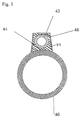
- a heating cable 10 is illustrated in cross section.
- Cable 10 has first and second electrical conductors 12 and 14, respectively, which are surrounded by an electrically insulating material 12a and 14a, respectively.
- a sheath 18 covers electrical conductors 12 and 14, and a jacket 20 covers sheath 18.
- Jacket 20 is illustrative of the heat transfer material of the present invention.
- Jacket 20 is a dielectric material, which is electrically non-conducting.
- conductors 12 and 14 may have a high voltage potential, yet jacket 20 allows heater cable 10 to be safely touched without electrical shock.
- Conductors 12 and 14 generate heat using electrical resistivity, and jacket 20 conducts that heat to a surface that is to be heated.
- jacket 20 serves as both the heat transfer material and the jacket, since jacket 20 is electrically non-conductive, but thermally conductive.
- the thermally conductive, electrically non-conductive jacket of the present invention approaches the conductivities of the prior art heat transfer materials. Additionally, the thermally conductive, electrically non-conductive jacket is flexible at temperature exposures up to and exceeding 450° F (232°C) and does not harden or adhere to the substrate.
- thermally conductive, electrically non-conductive jacket replaces the prior art heat transfer cement material and the silicone rubber jacket of the prior art rail heaters that was required in certain instances due to the electrically conductive prior art heat transfer materials using carbon fillers.
- Jacket material according to the present invention also replaces the prior art heat transfer cement material used without the silicone rubber jacket.
- the material of the present invention is an ideal solution for dissipating heat from a high wattage (10 to 70 W/ft (33 to 230 W/m)) rail heater. This material has a non-electrically conductive surface with a highly thermal conductive capability. Due to the retained flexibility of the jacket material, this material allows rail heaters to be reusable.
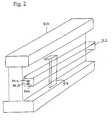
- a typical rail 30 is heated by a heater cable 32, which is made according to the present invention.
- Heater cable 10 of Fig. 1 would be suitable for use as heater cable 32 in Fig. 2.
- Clip 34 secures heater cable 32 to rail 30.
- Heater cable 32 has wires or conductors 32a and 32b and a jacket 32c, according to the present invention.
- heater cable 32 can have an expansion loop that extends away from the rail. Such expansion loops would be electrical-shock hazards, except heater cable 32 is covered with non-electrically conductive, but thermally conductive, heat transfer material 32c. Thus, a human or an animal can brush against the expansion loop without electrical shock.
- Heater cable 32 is covered with a thermally conductive material so that heat generated by its electrical conductors is readily transferred to rail 30.
- An electrical power source (not shown) is connected to heater cable 32 for providing electrical current for generating heat from heater cable 32.
- Heater cable 32 does not become hard or brittle, but instead remains flexible during service, even at temperatures as high as 450°F (232°C). Thus, a rail may be replaced, and heater cable 32 may be reused.
- the jacket material of the present invention is uniquely suitable for a wide range of applications.
- this new material can, in many instances, replace prior art materials (of the '458 patent) because the jacket material of the present invention has a high conductivity level and is removable and reusable.
- the present material does not tend to adhere to the heated surface as did the prior art material.
- a heat transfer material has been discovered that is electrically non-conductive, while also having advantageous properties including retained flexibility and tendency to not adhere to the heated surface during service.
- the present heat transfer material will enable self-regulating and power limiting heaters to reduce core temperatures and thus increase power output for a given resistivity level. Such heaters will allow constant wattage wire elements to be surrounded by the heat transfer material of the present invention, which serves as electrical insulation with a thermal conductance that allows an increase in the maximum current levels at which these heaters can safely operate.
- the heat transfer material of heating cables according to this invention has a substantially reduced electrical conductivity over prior art materials, with an electrical resistivity of 10 11 Ohms-cm or higher service.
- the heat transfer material is removable, reusable and stable to temperature levels in excess of 450° F (232°C). Even after extended operation, the heat transfer material does not cling to or adhere to the underlying heated substrate.
- Heating cables of this invention may be used as self-regulating, power limiting, and constant wattage electric heat tracing cables.
- Self-regulating cables have demonstrated increased power output by 7% or more with reduced operating core temperatures.
- the heat transfer material may be operated over the range of -60° F to 450° F (-51° C to 232° C) to form thermal bridges between heaters and the heated substrate.
- the heat transfer material has greatly improved burn resistance over prior art carbon loaded conductive materials.
- a TEK 3C40 BN cable sample (from Thermon Manufacturing Co. of San Marcos, Texas, U.S.A.) with a conductive silicone jacket according to the present invention was tested on an 85 lb (38.6Kg). composite rail.
- the purpose of this study was to investigate the heat transfer characteristic of the thermally conductive silicone jacketed cable and compare results with a regular (thermally non-conductive) silicone jacketed cable.
- the cable has an electrically conductive braid of copper wires and a jacket covering the wires, such as shown in Fig. 1.
- Fig. 3 shows that the jacket of the present invention is more thermally conductive than a silicone rubber that does not have fillers according to the present invention.
- thermally conductive silicone jacketed cable was tested on an 85 lb. (38.6Kg) composite rail.
- the heat transfer characters of thermally conductive silicone jacketed cable was compared to that of a regular silicone, SureFlow (SFOJ), jacketed cable.
- the temperature difference or delta T between the sheath and the jacket is lower for DT 40-600 BN thermally conductive silicone than for RDT 40-600 BNSFOJ when measured on the rail.
- the thermally conductive jacketed (RDT 40-600) cable runs much cooler (when it is away from the rail) than the cable sample jacketed with the SureFlow (SFOJ). TABLE 1. W/ft Vs.
- Volume resistivity for an insulating material is used to predict the dielectric breakdown of the materials. Volume resistivity was determined for conductive silicone of the present invention, silicone rubber, and graphite loaded heat transfer cement.
- Volume resistivity was measured on test samples per ASTM standard D257. A Model 1864 megOhm meter manufactured by General Radio was used for volume resistivity measurements on test samples. Terminal 1 was tied to the - unknown terminal, terminal 2 to the guard, and terminal 3 to the + unknown terminal. Volume resistance was measured at 500 volts for thermally conductive silicone and silicone rubber samples. Volume resistance for graphite loaded heat transfer cement was measured at 60 volts because volume resistance could not be measured at 500 volts as heat transfer cement was too conductive for this measurement at voltage above 70 volts.
- Volume resistivity was calculated from measured volume resistance in Ohms, the effective area of the measuring electrode in cm 2 , and average thickness of the specimen in cm. Table 3 summarizes the test results.
- the volume resistivity for the thermally conductive silicone is of the order of 10 12 Ohms-cm.
- the volume resistivity for the thermally conductive silicone is nearly equal to that measured for silicone rubber.
- the volume resistivity for thermally conductive silicone is 10 5 times greater than for graphite loaded heat transfer cement.
- the thermally conductive heat transfer material of the present invention exhibits essentially the same volume resistivity as regular, untreated silicone rubber, and it exhibits significantly greater volume resistivity than prior art heat transfer material, which is filled or loaded with graphite.
- the claimed material is electrically non-conductive, having an electrical resistivity of 10 11 Ohms-cm or higher.
- Sample No. Sample Description Sample Thickness (Cm) Electrode Area (Cm 2 ) Volume Resistivity (Ohm - Cm) 1 Thermally Conductive Silicone 0.30 50.26 10 12 4.33 x 10 12 2 Silicone Rubber 0.29 50.26 4.9 x 10 12 3 Graphite Loaded Heat Transfer Cement 0.21 50.26 2.8 x 10 7
- Jacket material on high power output cable may see a very high temperature when energized at high ambient temperature environment. Therefore, jacket material should be chosen such that it will not crack during high temperature exposure applications.
- This test compared RDT 40-600 BN conductive silicone jacket cable samples RDT 406-600 BNSFOJ cable samples, which are made from regular silicone rubber, which are made according to the present invention. Both cables are available from Therman Manufacturing Co. Two one foot (0.3m) long RDT 40-600 BN conductive silicone jacketed cable samples were exposed to 450°F (232°C) in an oven for a period of 14 days. Two control samples of RDT 40-600 BNSFOJ (SureFlow with regular silicone jacket) were tested side-by-side at 450°F (232°C) for 14 days. At the end of 14 days the oven temperature was brought to room temperature. Samples were removed from the oven and examined visually.
- thermally conductive silicone jacketed self-regulating cable samples were examined.
- Two foot (0.61m) long self-regulating (VSX 20-2) bare cable was tested in an environmental chamber at 50°F (10°C) ambient.
- Type J thermocouples were attached on the cable sample to measure sheath temperature.
- the cable was energized at 240 volts and a stable current was recorded after twenty minutes. Voltage and amperage were recorded with a Beckman 4410 meter and with an amp clamp. Thereafter, the same cable sample was jacketed with a thermally conductive silicone of the present invention, and power output and temperature measurements were performed in the environmental chamber at an ambient of temperature of 50°F (10°C).
- thermally conductive silicone was removed from the sample and a thermally non-conductive (regular) silicone was jacketed over the cable. Power output and sheath temperature were again measures at 50°F (10°C) in the chamber. Test results are summarized in Table 4. TABLE 4.
- the cable runs cooler by at least 8 °F (-13.3°C)with a thermally conductive silicone jacket as compared to the bare cable sample.
- Power output increased by 12% between the thermally conductive silicone jacketed cable versus the regular, thermally non-conductive, silicone jacketed cable sample.
- Thermally conductive silicone jacketed cable sample runs 20 °F (11°C) cooler than regular silicone jacketed cable sample.
- a heating cable comprising a thermally conductive, but electrically non-conductive, heat transfer material.
- the heat transfer material comprises a polymeric material, such as silicone rubber, and a nitride or oxide compound.
- the nitride or oxide is preferably selected from a group or compounds including aluminum nitride, boron nitride, silicon nitride, aluminum oxide and beryllium oxide.
- the nitride or oxide ranges preferably, but not absolutely necessarily, between about 30% and about 60% by volume.
- a plasticizer is preferably added in an amount of less than or equal to about 15% of the weight of the nitride or oxide for adding flexibility.
- the heat transfer material can be used in various articles including a jacket, covering or insulation layer for heating cables.
- One application is for rail heating, while others include electric heating and power cables.
- Cables according to the present invention are mechanically sturdy, while remaining flexible after use. Cables made with the present heat transfer material do not pose an electrical shock as the material has dielectric properties. Such articles do not become hard and brittle after use and do not adhere to the heated surface.
- the material and cables made therefrom have these desirable properties, as well as meeting thermal conductivity requirements.
- a heat transfer material having an electrical resistivity of 10 11 Ohms-cm or higher is used.
- Self-regulating, power limiting, constant wattage, and series resistance electric heat tracing cables as well as power conductors/cables are provided.
- the electrical insulation material has increased power output for self-regulating cable by approximately 7% or higher with reduced operating conductor/element temperatures.
Landscapes
- Chemical & Material Sciences (AREA)
- Health & Medical Sciences (AREA)
- Chemical Kinetics & Catalysis (AREA)
- Medicinal Chemistry (AREA)
- Polymers & Plastics (AREA)
- Organic Chemistry (AREA)
- Pipe Accessories (AREA)
- Resistance Heating (AREA)
- Compositions Of Macromolecular Compounds (AREA)
- Lining Or Joining Of Plastics Or The Like (AREA)
- Laminated Bodies (AREA)
- Insulated Conductors (AREA)
Claims (12)
- Heizkabel mit einem ersten elektrischen Leiter (12; 32a), einem zweiten elektrischen Leiter (14; 32b) und einem wärmeleitenden Mantel (20; 32c), der ein wärmeleitendes, elektrisch nichtleitendes Material umfaßt, das folgendes umfaßt: ein Polymermaterial und einen Nitrid- oder Oxidfüllstoff, dadurch gekennzeichnet, daß der Mantel (20; 32c) um die elektrischen Leiter (12, 14, 32a, 32b) herum extrudiert wird.
- Kabel nach Anspruch 1, ferner umfassend: einen ersten elektrischen Isolator (12a), der den ersten elektrischen Leiter (12) umgibt, einen zweiten elektrischen Isolator (14a), der den zweiten elektrischen Leiter (14) umgibt, und eine Hülle (18), die sowohl den ersten als auch den zweiten isolierten elektrischen Leiter (12, 14) umhüllt, wobei der Mantel (20) die Hülle (18) umhüllt.
- Kabel nach Anspruch 1 oder 2, das ferner mindestens eine Schelle (34) zum Befestigen des Heizkabels (32) an einer Eisenbahnschiene (30) umfasst.
- Kabel nach einem beliebigen der vorhergehenden Ansprüche, wobei das Nitrid- oder Oxidfüllstoffmaterial aus der Gruppe gewählt ist, die aus Aluminiumnitrid, Bornitrid, Siliziumnitrid, Aluminiumoxid und Berylliurnoxid besteht.
- Kabel nach Anspruch 4, wobei das Füllstoffmaterial Aluminiumnitrid umfaßt.
- Kabel nach einem beliebigen der vorhergehenden Ansprüche, wobei das Nitrid- oder Oxidfüllstoffmaterial zwischen etwa 30 Vol.-% und etwa 60 Vol.-% der Marttelzusammensetzung liegt.
- Kabel nach Anspruch 6, wobei das Füllstoffinaterial zwischen etwa 40 Vol.-% und 50 Vol-% der Mantelzusammensetzung liegt,
- Kabel nach einem beliebigen der vorhergehenden Ansprüche, wobei der Mantel (20) ferner einen Weichmacher von bis zu einschließlich etwa 15 % des Gewichts des Nitrid- oder Oxidfüllstoffmaterials umfaßt.
- Kabel nach einem beliebigen der vorhergehenden Ansprüche, wobei das Polymermaterial Silikonkautschuk ist.
- Kabel nach einem beliebigen der vorhergehenden Ansprüche, wobei das Polymermaterial und das Füllstoffmaterial in solchen Mengen vorhanden sind, daß der Mantel (20) einen spezifischen elektrischen Widerstand von etwa 1011 Ohm·cm oder mehr hat.
- Kabel nach Anspruch 3 oder einem beliebigen von diesem abhängigen Anspruch, wobei das Heizkabel (32) entfernbar und wiederverwendbar ist.
- Verfahren zum Erwärmen eines Substrats mit den folgenden. Schritten:Extrudieren eines Wärmeübertragungsmaterials umfassend (1) ein Polymermaterial und (2) ein Nitrid- oder Oxidfüllstoffmaterial auf zwei elektrischen Leitern, dadurch ein flexibles Heizkabel bildend;Bereitstellen einer elektrischen Stromquelle für das Heizkabel;Zulassen, daß die elektrische Stromquelle einen elektrischen Strom im Heizkabel erzeugt und dadurch Wärme erzeugt; undZulassen, daß das elektrische Wärmeübertragungsmaterial Wärme von den Leitern auf das Substrat überträgt.
Applications Claiming Priority (3)
| Application Number | Priority Date | Filing Date | Title |
|---|---|---|---|
| US9294398P | 1998-07-15 | 1998-07-15 | |
| US92943P | 1998-07-15 | ||
| PCT/US1999/016196 WO2000004085A1 (en) | 1998-07-15 | 1999-07-15 | Thermally-conductive, electrically non-conductive heat transfer material and articles made thereof |
Publications (3)
| Publication Number | Publication Date |
|---|---|
| EP1123344A1 EP1123344A1 (de) | 2001-08-16 |
| EP1123344A4 EP1123344A4 (de) | 2002-10-23 |
| EP1123344B1 true EP1123344B1 (de) | 2006-06-21 |
Family
ID=22235896
Family Applications (1)
| Application Number | Title | Priority Date | Filing Date |
|---|---|---|---|
| EP99935657A Expired - Lifetime EP1123344B1 (de) | 1998-07-15 | 1999-07-15 | Heizkabel |
Country Status (5)
| Country | Link |
|---|---|
| US (3) | US6410893B1 (de) |
| EP (1) | EP1123344B1 (de) |
| AU (1) | AU5109099A (de) |
| CA (1) | CA2337218C (de) |
| WO (1) | WO2000004085A1 (de) |
Cited By (1)
| Publication number | Priority date | Publication date | Assignee | Title |
|---|---|---|---|---|
| US10375767B2 (en) | 2015-02-09 | 2019-08-06 | Nvent Services Gmbh | Heater cable having a tapered profile |
Families Citing this family (39)
| Publication number | Priority date | Publication date | Assignee | Title |
|---|---|---|---|---|
| EP1123344B1 (de) * | 1998-07-15 | 2006-06-21 | Thermon Manufacturing Company | Heizkabel |
| US6734398B1 (en) * | 2003-01-29 | 2004-05-11 | Michael D. Cecchi | Bladder system for controlling the temperature of laboratory fume hoods and working surfaces |
| US20050072334A1 (en) * | 2003-10-07 | 2005-04-07 | Saint-Gobain Performance Plastics, Inc. | Thermal interface material |
| US7322415B2 (en) * | 2004-07-29 | 2008-01-29 | Tyco Thermal Controls Llc | Subterranean electro-thermal heating system and method |
| US7568526B2 (en) * | 2004-07-29 | 2009-08-04 | Tyco Thermal Controls Llc | Subterranean electro-thermal heating system and method |
| KR100593628B1 (ko) * | 2005-04-26 | 2006-07-03 | (주)에이오앤 | 단열 히터 재킷 |
| US8164031B2 (en) * | 2006-11-01 | 2012-04-24 | Parker-Hannifin Corporation | Electric trace tube bundle with internal branch circuit |
| US20080166552A1 (en) * | 2006-11-06 | 2008-07-10 | Arlon, Inc. | Silicone based compositions for thermal interface materials |
| US20080153959A1 (en) * | 2006-12-20 | 2008-06-26 | General Electric Company | Thermally Conducting and Electrically Insulating Moldable Compositions and Methods of Manufacture Thereof |
| SG10201407723PA (en) | 2007-12-19 | 2014-12-30 | Lam Res Corp | A composite showerhead electrode assembly for a plasma processing apparatus |
| WO2009078923A2 (en) | 2007-12-19 | 2009-06-25 | Lam Research Corporation | Film adhesive for semiconductor vacuum processing apparatus |
| US8910684B2 (en) * | 2008-07-03 | 2014-12-16 | Bridgestone Corporation | Tire innerliner with improved resistance to air permeability |
| US8735487B2 (en) * | 2008-07-03 | 2014-05-27 | Bridgestone Corporation | Tire components with improved heat transfer |
| AU2009322122A1 (en) * | 2008-12-06 | 2010-06-10 | 3Ip, Pllc | Improved heat transfer between tracer and pipe |
| US8925543B2 (en) * | 2009-01-13 | 2015-01-06 | Aerojet Rocketdyne Of De, Inc. | Catalyzed hot gas heating system for pipes |
| US8157186B2 (en) * | 2009-01-23 | 2012-04-17 | Fastrax Industries, Inc. | Strike attachment railroad anchor |
| US8157185B2 (en) * | 2009-01-23 | 2012-04-17 | Fastrax Industries, Inc. | Strike attachment railroad signal line connector |
| KR101092407B1 (ko) * | 2009-04-16 | 2011-12-09 | 박태환 | 무선 헤어 고데기용 방열판 및 무선 헤어 고데기 |
| CN101629402B (zh) * | 2009-08-07 | 2010-12-01 | 孙健 | 铁路道岔快速融雪装置 |
| US9138950B2 (en) * | 2011-08-30 | 2015-09-22 | Bridgestone Americas Tire Operations, Llc | Tire molding apparatus |
| US8813514B2 (en) * | 2012-08-06 | 2014-08-26 | Robert Hon-Sing Wong | Geothermal rail cooling and heating system |
| FR3017416B1 (fr) * | 2014-02-12 | 2018-12-07 | Safran Aircraft Engines | Refroidissement d'une canalisation principale dans un systeme carburant a injection multipoints |
| US10791871B2 (en) | 2014-03-17 | 2020-10-06 | Jong Peter Park | Travel mug for microwave oven |
| WO2016003815A1 (en) | 2014-06-30 | 2016-01-07 | AOI (Advanced Oilfield Innovations, Inc.) | Kerros or layered non-conductive ringed sealing pancake gasket assembly |
| WO2016007202A2 (en) * | 2014-07-08 | 2016-01-14 | Jong Peter Park | Microwaveable vessel |
| WO2016025373A1 (en) * | 2014-08-12 | 2016-02-18 | Perma-Pipe, Inc. | Insulated and heat traced pipe assembly end sealing process |
| CN104462796A (zh) * | 2014-11-24 | 2015-03-25 | 广州供电局有限公司 | 获取三芯电缆填充层热阻的方法及系统 |
| US10123460B2 (en) | 2015-11-13 | 2018-11-06 | Covidien LLP | System and method for thermal management of electronic devices |
| EP3400334A4 (de) * | 2016-01-04 | 2019-06-19 | nVENT SERVICES GMBH | Fahrsteig mit vereisungsschutz mit integrierter steuerung und schaltung |
| CN109313968A (zh) | 2016-04-29 | 2019-02-05 | 恩文特服务有限责任公司 | 电压调平整体式自调节加热器电缆 |
| CN110462754B (zh) | 2017-02-01 | 2022-06-14 | 恩文特服务有限责任公司 | 低烟无卤自动调节发热电缆 |
| US10870749B2 (en) | 2017-07-05 | 2020-12-22 | The University Of Akron | Thermally conductive polymers and methods for making |
| CN111108818B (zh) | 2017-09-21 | 2022-06-28 | 京瓷Avx元器件公司 | 具有低热阻的电绝缘热连接器 |
| KR102029737B1 (ko) * | 2017-10-27 | 2019-10-08 | 삼표레일웨이 주식회사 | 철도의 융설장치 고정클립 |
| US10533288B2 (en) * | 2018-01-30 | 2020-01-14 | Alstom Transport Technologies | Railroad track wire connection and corresponding railroad installation |
| WO2019173591A1 (en) * | 2018-03-07 | 2019-09-12 | The Regents Of The University Of Michigan | Thermoelectric thread for a heating and/or cooling device |
| EP3907423B1 (de) * | 2020-05-06 | 2022-07-20 | WWV Wärmeverwertung GmbH & Co. KG | Verwendung einer flexiblen struktur zur übertragung von wärme |
| US12188729B2 (en) * | 2020-10-08 | 2025-01-07 | Controls Southeast, Inc. | Adjustable heat transfer element |
| CN116715960A (zh) * | 2023-06-07 | 2023-09-08 | 昆山力普电子橡胶有限公司 | 移动存储网络硬盘保护套及其制备方法 |
Citations (2)
| Publication number | Priority date | Publication date | Assignee | Title |
|---|---|---|---|---|
| US3331946A (en) * | 1964-10-08 | 1967-07-18 | Thermon Mfg Co | Electric pipe heater |
| US3834458A (en) * | 1973-06-15 | 1974-09-10 | Thermon Mfg Co | Pipe heat transfer assembly and method of making same |
Family Cites Families (57)
| Publication number | Priority date | Publication date | Assignee | Title |
|---|---|---|---|---|
| US3900654A (en) * | 1971-07-15 | 1975-08-19 | Du Pont | Composite polymeric electric heating element |
| US3798415A (en) * | 1972-08-25 | 1974-03-19 | Graham Corp M | Electrically heated cooking utensil |
| US3800123A (en) * | 1973-01-19 | 1974-03-26 | M & M Enterprises Inc | Cooking and holding oven |
| CH582363A5 (de) * | 1974-07-12 | 1976-11-30 | Eltra Kg Leicht & Trambauer | |
| NL7511173A (nl) * | 1975-09-23 | 1977-03-25 | Philips Nv | Zelfregelend verwarmingselement. |
| US4391425A (en) | 1978-03-20 | 1983-07-05 | Keep Jr Henry | Railroad switch heater |
| USRE31081E (en) * | 1978-03-20 | 1982-11-16 | Railroad switch heater | |
| JPS5541646A (en) * | 1978-09-18 | 1980-03-24 | Shinetsu Polymer Co | Hollow tubular heater |
| US4247756A (en) * | 1979-06-29 | 1981-01-27 | Victor Cucinotta | Heated floor mat |
| US4388523A (en) * | 1981-06-10 | 1983-06-14 | Multistress, Inc. | Electrical heating cable connector |
| US4429845A (en) * | 1982-04-26 | 1984-02-07 | Emerson Electric Co. | Rail track heaters |
| GB8310747D0 (en) * | 1983-04-20 | 1983-05-25 | Cooperheat | Heat tracing tape and controller |
| US4520260A (en) * | 1983-11-02 | 1985-05-28 | Eaton Corporation | Semi-conductive heating cable |
| JPS60112281A (ja) * | 1983-11-18 | 1985-06-18 | 松下電工株式会社 | ヒ−タ |
| US4650972A (en) | 1985-10-04 | 1987-03-17 | Emerson Electric Co. | Heating cable and method of making same |
| US4870251A (en) * | 1985-11-01 | 1989-09-26 | Dennison Manufacturing Company | External heating of transfer pads |
| US5143649A (en) * | 1985-12-06 | 1992-09-01 | Sunbeam Corporation | PTC compositions containing low molecular weight polymer molecules for reduced annealing |
| US6415104B1 (en) * | 1987-05-14 | 2002-07-02 | World Properties, Inc. | Heating elements comprising polybutadiene and polyisoprene based thermosetting compositions |
| US5286952A (en) * | 1987-06-11 | 1994-02-15 | Raychem Corporation | Methods and devices which make use of conductive polymers to join articles |
| US5004190A (en) * | 1987-11-06 | 1991-04-02 | Bylin Heating Systems, Inc. | Rail heating apparatus |
| US4922083A (en) * | 1988-04-22 | 1990-05-01 | Thermon Manufacturing Company | Flexible, elongated positive temperature coefficient heating assembly and method |
| US5057673A (en) * | 1988-05-19 | 1991-10-15 | Fluorocarbon Company | Self-current-limiting devices and method of making same |
| US4957012A (en) * | 1989-06-16 | 1990-09-18 | The United States Of America As Represented By The Administrator Of The National Aeronautics And Space Administration | Predictive aging of polymers |
| US5113058A (en) * | 1990-06-01 | 1992-05-12 | Specialty Cable Corp. | PCT heater cable composition and method for making same |
| US5232970A (en) * | 1990-08-31 | 1993-08-03 | The Dow Chemical Company | Ceramic-filled thermally-conductive-composites containing fusible semi-crystalline polyamide and/or polybenzocyclobutenes for use in microelectronic applications |
| ATE211296T1 (de) * | 1990-09-10 | 2002-01-15 | Tyco Electronics Corp | Flammhemmende leitfähige polymerzusammensetzungvorrichtung |
| JPH04272680A (ja) * | 1990-09-20 | 1992-09-29 | Thermon Mfg Co | スイッチ制御形ゾーン式加熱ケーブル及びその組み立て方法 |
| US5086836A (en) | 1990-11-02 | 1992-02-11 | Thermon Manufacturing Company | Retarding heat tracing system and method of making same |
| US6111234A (en) * | 1991-05-07 | 2000-08-29 | Batliwalla; Neville S. | Electrical device |
| US5194480A (en) * | 1991-05-24 | 1993-03-16 | W. R. Grace & Co.-Conn. | Thermally conductive elastomer |
| US5250228A (en) * | 1991-11-06 | 1993-10-05 | Raychem Corporation | Conductive polymer composition |
| JP3305720B2 (ja) | 1993-07-06 | 2002-07-24 | 株式会社東芝 | 放熱シート |
| JP2698318B2 (ja) * | 1993-08-20 | 1998-01-19 | ティーディーケイ株式会社 | ヒータ |
| DE4338539A1 (de) * | 1993-11-11 | 1995-05-18 | Hoechst Ceram Tec Ag | Verfahren zum Herstellen von keramischen Heizelementen |
| CA2159496C (en) * | 1994-01-31 | 1999-05-04 | Takashi Kaimoto | Ptc planar heater and method for adjusting the resistance of the same |
| JPH07280462A (ja) * | 1994-04-11 | 1995-10-27 | Shin Etsu Chem Co Ltd | 均熱セラミックスヒーター |
| JPH07295409A (ja) * | 1994-04-25 | 1995-11-10 | Canon Inc | 加熱定着装置及びその製造方法 |
| CN1048109C (zh) * | 1994-07-13 | 2000-01-05 | 松下电器产业株式会社 | 高分子感温体和用其制造的感温元件 |
| JPH08104812A (ja) | 1994-09-30 | 1996-04-23 | Toray Dow Corning Silicone Co Ltd | シリコーンゴム組成物 |
| GB9602873D0 (en) * | 1996-02-13 | 1996-04-10 | Dow Corning Sa | Heating elements and process for manufacture thereof |
| US5681883A (en) | 1996-03-05 | 1997-10-28 | Advanced Ceramics Corporation | Enhanced boron nitride composition and polymer based high thermal conductivity molding compound |
| US6005232A (en) * | 1996-06-28 | 1999-12-21 | Raychem Corporation | Heating cable |
| US5824997A (en) * | 1996-08-05 | 1998-10-20 | Fastrax Industries, Inc. | Railroad track switch heater |
| US5807507A (en) | 1996-08-28 | 1998-09-15 | Fuji Polymer Industries Co., Ltd. | Self-fusing conductive silicone rubber composition |
| US5786565A (en) * | 1997-01-27 | 1998-07-28 | Saint-Gobain/Norton Industrial Ceramics Corporation | Match head ceramic igniter and method of using same |
| HUP0004603A2 (hu) * | 1997-10-17 | 2001-04-28 | The Dow Chemical Company | Alfa-olefin monomerek egy vagy több vinil- vagy vinilidén-aromás monomerrel és/vagy egy vagy több gátolt alifás vagy cikloalifás vinil vagy vinilidén monomerrel alkotott interpolimerjét és vezetőképes adalékanyagokat tartalmazó elegyek |
| JP3477062B2 (ja) * | 1997-12-26 | 2003-12-10 | 京セラ株式会社 | ウエハ加熱装置 |
| JP2002506104A (ja) * | 1998-03-11 | 2002-02-26 | ザ ダウ ケミカル カンパニー | エンジニアリング熱可塑性樹脂とブレンドされたアルファ−オレフィンモノマーと1以上のビニルまたはビニリデン芳香族モノマーおよび/又は1以上のヒンダード脂肪族または脂環式ビニルまたはビニリデンモノマーのインターポリマーの熱可塑性組成物 |
| US5941482A (en) * | 1998-03-23 | 1999-08-24 | Thermal-Flex Systems, Inc. | Heating cable assembly and connector for railroad switch heating system |
| US6406817B2 (en) * | 1998-07-01 | 2002-06-18 | Ube Industries, Ltd. | Crosslinked polymer, electrolyte using the polymer, and nonaqueous secondary battery using the electrolyte |
| EP1123344B1 (de) * | 1998-07-15 | 2006-06-21 | Thermon Manufacturing Company | Heizkabel |
| US6194692B1 (en) * | 1998-10-02 | 2001-02-27 | Engelhard Corporation | Electric heating sheet and method of making the same |
| US6415501B1 (en) * | 1999-10-13 | 2002-07-09 | John W. Schlesselman | Heating element containing sewn resistance material |
| US6288372B1 (en) * | 1999-11-03 | 2001-09-11 | Tyco Electronics Corporation | Electric cable having braidless polymeric ground plane providing fault detection |
| US6392206B1 (en) * | 2000-04-07 | 2002-05-21 | Waltow Polymer Technologies | Modular heat exchanger |
| US6433317B1 (en) * | 2000-04-07 | 2002-08-13 | Watlow Polymer Technologies | Molded assembly with heating element captured therein |
| DE60125682T2 (de) * | 2000-10-19 | 2007-11-15 | Heat Trace Ltd. | Heizkabel |
-
1999
- 1999-07-15 EP EP99935657A patent/EP1123344B1/de not_active Expired - Lifetime
- 1999-07-15 US US09/353,675 patent/US6410893B1/en not_active Expired - Fee Related
- 1999-07-15 AU AU51090/99A patent/AU5109099A/en not_active Abandoned
- 1999-07-15 CA CA002337218A patent/CA2337218C/en not_active Expired - Fee Related
- 1999-07-15 WO PCT/US1999/016196 patent/WO2000004085A1/en not_active Ceased
-
2002
- 2002-06-07 US US10/165,441 patent/US6762395B2/en not_active Expired - Fee Related
-
2004
- 2004-07-09 US US10/887,941 patent/US7321107B2/en not_active Expired - Fee Related
Patent Citations (2)
| Publication number | Priority date | Publication date | Assignee | Title |
|---|---|---|---|---|
| US3331946A (en) * | 1964-10-08 | 1967-07-18 | Thermon Mfg Co | Electric pipe heater |
| US3834458A (en) * | 1973-06-15 | 1974-09-10 | Thermon Mfg Co | Pipe heat transfer assembly and method of making same |
Cited By (2)
| Publication number | Priority date | Publication date | Assignee | Title |
|---|---|---|---|---|
| US10375767B2 (en) | 2015-02-09 | 2019-08-06 | Nvent Services Gmbh | Heater cable having a tapered profile |
| US10863588B2 (en) | 2015-02-09 | 2020-12-08 | Nvent Services Gmbh | Heater cable having a tapered profile |
Also Published As
| Publication number | Publication date |
|---|---|
| EP1123344A1 (de) | 2001-08-16 |
| US7321107B2 (en) | 2008-01-22 |
| CA2337218C (en) | 2009-04-28 |
| WO2000004085A1 (en) | 2000-01-27 |
| EP1123344A4 (de) | 2002-10-23 |
| AU5109099A (en) | 2000-02-07 |
| CA2337218A1 (en) | 2000-01-27 |
| US20030034344A1 (en) | 2003-02-20 |
| US6762395B2 (en) | 2004-07-13 |
| US20050067403A1 (en) | 2005-03-31 |
| US6410893B1 (en) | 2002-06-25 |
| WO2000004085A9 (en) | 2000-07-20 |
Similar Documents
| Publication | Publication Date | Title |
|---|---|---|
| EP1123344B1 (de) | Heizkabel | |
| US7476702B2 (en) | Polymer electronic device package having high thermal conductivity and dielectric strength | |
| US4361723A (en) | Insulated high voltage cables | |
| US5710475A (en) | Insulation of high thermal conductivity and apparatus containing same | |
| US10373738B2 (en) | Insulated wire construction with liner | |
| TWI507461B (zh) | 具電壓穩定劑添加劑之聚合性組成物 | |
| CN105940462A (zh) | 电hv输电线缆 | |
| KR20170012003A (ko) | 케이블의 내수성 평가 방법 | |
| US11031766B2 (en) | Cable accessory with improved thermal conductivity | |
| EP0939103B1 (de) | Silicongummizusammensetzung | |
| Koo et al. | Comparison of DC and AC surface breakdown characteristics of GFRP and epoxy nanocomposites in liquid nitrogen | |
| Yaacob et al. | Dielectric properties of polyvinyl chloride with wollastonite filler for the application of high-voltage outdoor insulation material | |
| Katz et al. | Emergency Overioad Characteristics Of Extruded Dielectric Cables Operating At 1300 And Above | |
| JPS587204B2 (ja) | 絶縁コンパウンドの改質法 | |
| JPS59133253A (ja) | トリ−化防止用添加剤組成物 | |
| Santulli et al. | Thermomechanical and electrical characterisation of EVA polymer compounds for cable accessories | |
| Afifi et al. | Electrical Tracking and Erosion of Silicone Rubber Filled with Alumina Tri-Hydrate | |
| Borthakur et al. | Novel Technique to Understand the Interaction of Silicone Oil and Grease With Silicone Rubber for Cable Accessories | |
| JPH11140321A (ja) | 電線被覆用シリコーンゴム組成物 | |
| KR20200078402A (ko) | 용이하게 박리가능한 반도전층을 포함하는 케이블 | |
| Kotte et al. | Influence of the cure parameters on the partial discharge behavior of cast resins | |
| Rajendran et al. | Insulators compounded with Nano Particles | |
| Kultzow | High thermally conductive epoxy system for electrical and electronic thermal management | |
| Chang et al. | Thermally stimulated discharge current and DC resistivity of ethylene propylene rubberwith various Pb concentrations | |
| Davis et al. | Silicone rubbers. Their present place in electrical insulation |
Legal Events
| Date | Code | Title | Description |
|---|---|---|---|
| PUAI | Public reference made under article 153(3) epc to a published international application that has entered the european phase |
Free format text: ORIGINAL CODE: 0009012 |
|
| 17P | Request for examination filed |
Effective date: 20010215 |
|
| AK | Designated contracting states |
Kind code of ref document: A1 Designated state(s): AT BE CH CY DE DK ES FI FR GB GR IE IT LI LU MC NL PT SE |
|
| AX | Request for extension of the european patent |
Free format text: AL;LT;LV;MK;RO;SI |
|
| A4 | Supplementary search report drawn up and despatched |
Effective date: 20020905 |
|
| AK | Designated contracting states |
Kind code of ref document: A4 Designated state(s): AT BE CH CY DE DK ES FI FR GB GR IE IT LI LU MC NL PT SE |
|
| RIC1 | Information provided on ipc code assigned before grant |
Free format text: 7H 05B 3/56 A, 7E 01B 5/00 B |
|
| 17Q | First examination report despatched |
Effective date: 20040115 |
|
| GRAP | Despatch of communication of intention to grant a patent |
Free format text: ORIGINAL CODE: EPIDOSNIGR1 |
|
| RTI1 | Title (correction) |
Free format text: A HEATING CABLE |
|
| DAX | Request for extension of the european patent (deleted) | ||
| RBV | Designated contracting states (corrected) |
Designated state(s): GB SE |
|
| REG | Reference to a national code |
Ref country code: DE Ref legal event code: 8566 |
|
| GRAS | Grant fee paid |
Free format text: ORIGINAL CODE: EPIDOSNIGR3 |
|
| GRAA | (expected) grant |
Free format text: ORIGINAL CODE: 0009210 |
|
| AK | Designated contracting states |
Kind code of ref document: B1 Designated state(s): GB SE |
|
| REG | Reference to a national code |
Ref country code: GB Ref legal event code: FG4D |
|
| PG25 | Lapsed in a contracting state [announced via postgrant information from national office to epo] |
Ref country code: SE Free format text: LAPSE BECAUSE OF FAILURE TO SUBMIT A TRANSLATION OF THE DESCRIPTION OR TO PAY THE FEE WITHIN THE PRESCRIBED TIME-LIMIT Effective date: 20060921 |
|
| PLBE | No opposition filed within time limit |
Free format text: ORIGINAL CODE: 0009261 |
|
| STAA | Information on the status of an ep patent application or granted ep patent |
Free format text: STATUS: NO OPPOSITION FILED WITHIN TIME LIMIT |
|
| GBPC | Gb: european patent ceased through non-payment of renewal fee |
Effective date: 20060921 |
|
| 26N | No opposition filed |
Effective date: 20070322 |
|
| PG25 | Lapsed in a contracting state [announced via postgrant information from national office to epo] |
Ref country code: GB Free format text: LAPSE BECAUSE OF NON-PAYMENT OF DUE FEES Effective date: 20060921 |