EP1106586B1 - Graded index lens - Google Patents
Graded index lens Download PDFInfo
- Publication number
- EP1106586B1 EP1106586B1 EP00125375A EP00125375A EP1106586B1 EP 1106586 B1 EP1106586 B1 EP 1106586B1 EP 00125375 A EP00125375 A EP 00125375A EP 00125375 A EP00125375 A EP 00125375A EP 1106586 B1 EP1106586 B1 EP 1106586B1
- Authority
- EP
- European Patent Office
- Prior art keywords
- mol
- glass
- refractive index
- lens
- mgo
- Prior art date
- Legal status (The legal status is an assumption and is not a legal conclusion. Google has not performed a legal analysis and makes no representation as to the accuracy of the status listed.)
- Expired - Lifetime
Links
Images



Classifications
-
- C—CHEMISTRY; METALLURGY
- C03—GLASS; MINERAL OR SLAG WOOL
- C03C—CHEMICAL COMPOSITION OF GLASSES, GLAZES OR VITREOUS ENAMELS; SURFACE TREATMENT OF GLASS; SURFACE TREATMENT OF FIBRES OR FILAMENTS MADE FROM GLASS, MINERALS OR SLAGS; JOINING GLASS TO GLASS OR OTHER MATERIALS
- C03C21/00—Treatment of glass, not in the form of fibres or filaments, by diffusing ions or metals in the surface
- C03C21/001—Treatment of glass, not in the form of fibres or filaments, by diffusing ions or metals in the surface in liquid phase, e.g. molten salts, solutions
- C03C21/005—Treatment of glass, not in the form of fibres or filaments, by diffusing ions or metals in the surface in liquid phase, e.g. molten salts, solutions to introduce in the glass such metals or metallic ions as Ag, Cu
-
- C—CHEMISTRY; METALLURGY
- C03—GLASS; MINERAL OR SLAG WOOL
- C03C—CHEMICAL COMPOSITION OF GLASSES, GLAZES OR VITREOUS ENAMELS; SURFACE TREATMENT OF GLASS; SURFACE TREATMENT OF FIBRES OR FILAMENTS MADE FROM GLASS, MINERALS OR SLAGS; JOINING GLASS TO GLASS OR OTHER MATERIALS
- C03C3/00—Glass compositions
- C03C3/04—Glass compositions containing silica
- C03C3/062—Glass compositions containing silica with less than 40% silica by weight
- C03C3/064—Glass compositions containing silica with less than 40% silica by weight containing boron
- C03C3/068—Glass compositions containing silica with less than 40% silica by weight containing boron containing rare earths
-
- C—CHEMISTRY; METALLURGY
- C03—GLASS; MINERAL OR SLAG WOOL
- C03C—CHEMICAL COMPOSITION OF GLASSES, GLAZES OR VITREOUS ENAMELS; SURFACE TREATMENT OF GLASS; SURFACE TREATMENT OF FIBRES OR FILAMENTS MADE FROM GLASS, MINERALS OR SLAGS; JOINING GLASS TO GLASS OR OTHER MATERIALS
- C03C3/00—Glass compositions
- C03C3/04—Glass compositions containing silica
- C03C3/076—Glass compositions containing silica with 40% to 90% silica, by weight
- C03C3/089—Glass compositions containing silica with 40% to 90% silica, by weight containing boron
- C03C3/091—Glass compositions containing silica with 40% to 90% silica, by weight containing boron containing aluminium
-
- C—CHEMISTRY; METALLURGY
- C03—GLASS; MINERAL OR SLAG WOOL
- C03C—CHEMICAL COMPOSITION OF GLASSES, GLAZES OR VITREOUS ENAMELS; SURFACE TREATMENT OF GLASS; SURFACE TREATMENT OF FIBRES OR FILAMENTS MADE FROM GLASS, MINERALS OR SLAGS; JOINING GLASS TO GLASS OR OTHER MATERIALS
- C03C3/00—Glass compositions
- C03C3/04—Glass compositions containing silica
- C03C3/076—Glass compositions containing silica with 40% to 90% silica, by weight
- C03C3/097—Glass compositions containing silica with 40% to 90% silica, by weight containing phosphorus, niobium or tantalum
-
- G—PHYSICS
- G02—OPTICS
- G02B—OPTICAL ELEMENTS, SYSTEMS OR APPARATUS
- G02B3/00—Simple or compound lenses
- G02B3/0087—Simple or compound lenses with index gradient
Definitions
- the present invention relates to a refractive index distribution type lens (hereinafter referred to as a graded index lens) in which the refractive index changes along the radial direction for the rod lens. More particularly, the invention relates to a graded index lens obtained by treating a raw glass material by ion exchange using silver to form a refractive index distribution in the radial direction.
- a graded index lens obtained by treating a raw glass material by ion exchange using silver to form a refractive index distribution in the radial direction.
- a refractive index distribution type optical element in which the refractive index parabolically changes in a section thereof from the center along the radii has the same image-forming function as spherical lenses even when both sides thereof are flat. Since this type of optical element has advantages, for example, that a lens having a small diameter and a short focal distance can be easily produced, it is extensively used in optical heads for copiers, printers, facsimile telegraphs, and the like and in other applications.
- Such refractive index distribution type optical elements include graded index lenses and refractive index distribution type fibers.
- the glasses of the related art which are produced through drawing and a subsequent step of ion exchange conducted by immersion in molten salts and are for use as refractive index distribution type optical elements (e.g., lenses) include the following three main kinds: (1) thallium-containing glasses, (2) cesium-containing glasses, and (3) lithium-containing glasses.
- the thallium-containing glasses can give graded index lenses having an extremely large angular aperture because they have high electronic polarizability.
- these lenses have enhanced chromatic aberration and, hence, cannot be used especially in optical systems dealing with color images.
- the cesium-containing glasses have reduced chromatic aberration unlike the thallium-containing glasses.
- the lenses obtained from the cesium-containing glasses are limited to those having a small angular aperture.
- these glasses have a drawback that they have an exceedingly high melting temperature.
- the lithium-containing glasses have reduced chromatic aberration and a moderate melting temperature and are hence used extensively.
- glasses containing a large amount of lithium ions are highly apt to devitrify, a graded index lens having a large angular aperture cannot be produced therefrom.
- Lenses having a large angular aperture are therefore produced from the thallium-containing glasses.
- thallium is toxic, production of the glasses containing a large amount of thallium and use of a molten salt containing a large amount of thallium are undesirable from the standpoint of environmental pollution.
- silver ions are thought to contribute to the attainment of a large difference in refractive index as shown in JP-A-61-261238 and JP-A-62-100451.
- JP-A as used herein means an "unexamined published Japanese patent application”.
- Silver ions are advantageous from the standpoint of producing a lens dealing with color images because use of silver results in reduced chromatic aberration as compared with the case of using thallium. Since silver ions are generally apt to become colloidal, the references cited above propose a glass composition containing a large amount of a phosphorus component in order to inhibit silver ions from forming a colloid.
- Such glasses containing a large amount of a phosphorus component have poor weatherability and insufficient suitability for practical use.
- the glasses containing a large amount of a phosphorus component further have problems that the glasses during ion exchange react with a nitrate to yield a devitrification product on the glass surface and that the glasses themselves partly dissolve in the molten salt.
- a melt of a salt other than nitrates e.g., a melt of a sulfate or halide
- an aluminosilicate glass is known as a glass composition which contains no phosphorus components and in which silver ions do not form a colloid.
- incorporation of an alkali into a silicate glass cleaves the silicate framework to form nonbridging oxygen (hereinafter referred to as "NBO") strongly bonded to alkali ions.
- NBO nonbridging oxygen
- a glass in which NBO is present is subjected to ion exchange to incorporate silver ions thereinto, then the silver ions incorporated are reduced by the NBO to form a silver colloid and thereby color the glass. Consequently, such a glass cannot be used as a lens.
- JP-A-4-219341 are given BeO, CaO, Ga 2 O 3 , La 2 O 3 , MgO, Nb 2 O 3 , Ta 2 O 3 , Yb 2 O 3 , ZnO, and ZrO 2 as ingredients which can be used, besides B 2 O 3 , in place of Al 2 O 3 while inhibiting silver ions from forming a colloid. However, there is no description therein concerning whether the replacement lowers the melting temperature or not.
- US 4,495,299 discloses lenses having a refractive index distribution produced from a thallium-containing glass composition.
- EP 0 918 235 A2 discloses an axial refractive index distributed lens which is obtained by an ion exchange method using silver from a glass material having the following composition:
- An object of the invention which eliminates the problems of the techniques of the related art described above, is to provide a highly durable, excellent lens which has a radial distribution of refractive index required for optical designs and which has satisfactory quality, i.e., which is produced from a glass composition having a low melting temperature and a rate of ion exchange sufficient for practical use and enabling silver ions to be stably present in the glass.
- the invention provides a graded index lens obtainable by subjecting a raw glass material having a rod shape to ion-exchange to thereby replace the alkali ions contained in the glass by silver ions, and then subjecting the glass rod to ion-exchange to form in the glass a distribution of the silver ion concentration and thereby form a parabolic distribution of the refractive index, the raw glass material being constituted of a glass composition comprising the following components:
- the melting temperature of the glass can be lowered while maintaining high durability and silver ions can be stably incorporated in the form of ions into the glass.
- a lens having a necessary radial distribution of refractive index is realized.
- the present inventors have found that the object of the invention can be accomplished by incorporating MgO into an aluminoborosilicate glass as a glass composition for use as a raw glass material from which a lens having a radial distribution of refractive index is to be produced.
- the invention has been thus completed.
- the glass composition is preferably as follows.
- the glass composition in the invention is more preferably as follows.
- the concentration of MgO contained in the glass composition is lower than 2.5 mol%, the effect of lowering the melting temperature and thereby giving a glass of satisfactory quality is insufficient. Concentrations of MgO exceeding 18 mol% are impractical because such a high MgO concentration results in poor stability of silver ions in the glass. Consequently, the concentration of MgO is 2.5 ⁇ MgO ⁇ 18 mol%, preferably 3 ⁇ MgO ⁇ 15 mol%, more preferably 5 ⁇ MgO ⁇ 12.5 mol%.
- the optimal alkali ions to be replaced by silver ions which form a refractive index distribution are sodium ions, which have a high coefficient of mutual diffusion with silver ions and can be replaced by silver ions in a short ion exchange time. If the concentration of sodium ions is 15 mol% or lower, a required difference in refractive index cannot be obtained. If the concentration thereof exceeds 30 mol%, the glass has reduced durability and is unsuitable for practical use. Consequently, the concentration of Na 2 O is 15 ⁇ Na 2 O ⁇ 30 mol%, preferably 18 ⁇ Na 2 O ⁇ 30 mol%, more preferably 20 ⁇ Na 2 O ⁇ 30 mol%.
- Al 2 O 3 is an essential ingredient which is necessary for enabling silver ions to be stably contained in the glass.
- [Na]/[Al] is desirably 1 from the standpoint of eliminating NBO in the glass.
- the incorporation of B 2 O 3 and MgO into the glass enables silver ions to be stably contained in the glass even when [Na]/[Al] is not 1.
- the concentration of Al 2 O 3 is 10 ⁇ Al 2 O 3 ⁇ 25 mol%, preferably 15 ⁇ Al 2 O 3 ⁇ 25 mol%, more preferably 15 ⁇ Al 2 O 3 ⁇ 22.5 mol%.
- B 2 O 3 serves to lower the melting temperature of the glass to facilitate the production of glass products of satisfactory quality.
- B 2 O 3 is effective also in preventing the glass from developing cracks upon ion exchange.
- the concentration of B 2 O 3 is 3 ⁇ B 2 O 3 ⁇ 18 mol%, preferably 5 ⁇ B 2 O 3 ⁇ 18 mol%, more preferably 7 ⁇ B 2 O 3 ⁇ 15 mol%.
- SiO 2 is the main component which forms the network structure of the glass. If the concentration of SiO 2 is lower than 27.5 mol%, the glass has considerably reduced chemical durability. If the concentration thereof exceeds 55 mol%, not only the content of the oxide contributing to the formation of a refractive index distribution and the contents of other oxides are limited but also the glass has too high a melting temperature, making it difficult to obtain glass products of satisfactory quality. Consequently, the concentration of SiO 2 is 27.5 ⁇ SiO 2 ⁇ 55 mol%, preferably 30 ⁇ SiO 2 ⁇ 50 mol%, more preferably 30 ⁇ SiO 2 ⁇ 45 mol%.
- Ta 2 O 5 can be added in the invention for the purpose of modifying the refractive index and refractive index distribution of the mother glass and thereby increasing the degree of freedom of lens design.
- too high concentrations of Ta 2 O 5 in the glass pose problems that the rate of replacement between silver ions and sodium ions becomes low and phase separation occurs in the glass. Consequently, the concentration of Ta 2 O 5 is 5 mol% or lower, preferably 3 mol% or lower.
- La 2 O 3 and BaO also can be added, like Ta 2 O 5 , for the purpose of modifying the refractive index and refractive index distribution of the mother glass.
- La 2 O 3 and BaO have problems that these ingredients are more effective than Ta 2 O 5 in lowering the rate of replacement between silver ions and sodium ions and that too high concentrations of La 2 O 3 and BaO result in phase separation in the glass. Consequently, the concentration of La 2 O 3 and that of BaO each is 3 mol% or lower.
- ZrO 2 can be added in the invention in order to improve the durability of the mother glass.
- too high concentrations of ZrO 2 in the glass pose problems that the glass has too high a melting temperature and the rate of replacement between silver ions and sodium ions is too low. Consequently, the concentration of ZrO 2 is desirably 3 mol% or lower.
- Nb 2 O 5 , Sb 2 O 3 , WO 3 , and Y 2 O 3 can be added as long as the addition thereof does not adversely influence the properties of the lens having a radial distribution of refractive index to be produced.
- the amounts of these ingredients based on the total amount of the main ingredients described above may be as follows: 0 ⁇ Nb 2 O 5 ⁇ 3 mol%, 0 ⁇ Sb 2 O 3 ⁇ 1 mol%, 0 ⁇ WO 3 ⁇ 1 mol%, and 0 ⁇ Y 2 O 3 ⁇ 1 mol%.
- the lens having a radial distribution of refractive index of the invention is produced by the following method.
- a cylindrical raw glass material formed from the glass composition described above is subjected to ion exchange, for example, by immersing it in a molten salt to thereby replace all the alkali ions contained in the glass by silver ions.
- the molten salt for use in this treatment include a melt of a salt mixture comprising from 5 to 30 mol% silver nitrate and from 95 to 70 mol% sodium nitrate and a melt of a salt mixture comprising from 50 to 100 mol% silver chloride, from 0 to 50 mol% zinc chloride, and from 0 to 30 mol% silver sulfide.
- the molten salt mixture containing silver nitrate is preferred.
- Conditions for this treatment are suitably selected in the temperature range of from 300 to 420° for molten salt mixtures containing silver nitrate or from 450 to 550°C for molten salt mixtures containing silver chloride and in the treatment period range of from 3 to 30 days.
- the glass rod in which all the alkali ions have been replaced by silver ions is subjected to ion exchange, for example, by immersing again the rod in a molten salt to form in the glass a distribution of silver ion concentration and thereby form a parabolic distribution of refractive index.
- molten salt for use in this treatment include sodium nitrate and sodium chloride.
- molten sodium nitrate is preferred to use.
- Conditions for this treatment with molten sodium nitrate are suitably selected in the temperature range of from 350 to 500°C and in the treatment period range of from 1 to 20 days.
- the graded index lens produced was evaluated for optical properties, i.e., refractive index distribution and spherical aberration.
- the evaluation methods used are as follows.
- n(r) 2 n 0 2 ⁇ 1-(g ⁇ r) 2 + h 4 ⁇ (g ⁇ r) 4 + h 6 ⁇ (g ⁇ r) 6 + ⁇ ⁇ ⁇ wherein
- the refractive index distribution of the lens produced was roughly determined through calculation from the distribution of silver concentration in the following manner.
- the refractive index n 0 of the center of the lens and the refractive index of a peripheral part of the lens were measured, and the radial distribution of silver concentration in the lens was determined with an X-ray microanalyzer.
- the refractive index distribution in the lens was calculated on the assumption that the refractive index distribution was proportional to the silver concentration distribution.
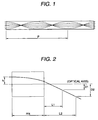
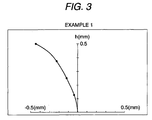
- the longitudinal spherical aberration of the rod obtained was determined by the following method (see Fig. 2).
- a glass material having the composition shown in Table 1 was melted by heating at 1,450°C in a platinum crucible and then cast.
- a glass rod having a diameter of 25 mm was cut out of the glass block obtained. This rod was heated and drawn to thereby produce a glass rod having a diameter of 1 mm. This rod was immersed for 6 days in a 400°C molten salt mixture composed of 20 mol% silver nitrate and 80 mol% sodium nitrate to replace sodium ions contained in the glass by silver ions present in the molten salts. The degree of replacement in this treatment was 98%.
- This glass was treated by immersing it for 16 hours in a 400°C molten salt consisting of sodium nitrate only. Thus, a lens having a radial distribution of refractive index was obtained.
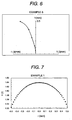
- the refractive index distribution of this lens was determined by the method described above and was found to be nearly parabolic as shown in Fig. 3. This refractive index distribution was ascertained to be suitable for a lens having a radial distribution of refractive index.
- Glass materials having respective compositions differing in MgO concentration from the glass composition of Example 1 as shown in Table 1 (MgO was added in place of B 2 O 3 in Example 2 and in place of Al 2 O 3 in Example 3) were melted by heating at 1,450°C and 1,400°C, respectively, in a platinum crucible and then cast.
- the glasses obtained were evaluated for durability by the powder method. As a result, the water resistance and acid resistance of each glass were both in the second degree. These glasses thus showed higher weatherability.
- a glass rod having a diameter of 25 mm was cut out of each glass block obtained. This rod was heated and drawn to thereby produce a glass rod having a diameter of 1 mm. This rod was immersed in a 360°C molten salt mixture composed of 20 mol% silver nitrate and 80 mol% sodium nitrate for 10 days (Example 2) or 11 days (Example 3) to replace sodium ions contained in the glass by silver ions present in the molten salts. The degrees of replacement in this treatment were 94% (Example 2) and 95% (Example 3).
- This glass was treated by immersion in a molten salt consisting of sodium nitrate only at 400°C for 17.5 hours in Example 2 or at 380°C for 22 hours in Example 3.
- a molten salt consisting of sodium nitrate only at 400°C for 17.5 hours in Example 2 or at 380°C for 22 hours in Example 3.
- the refractive index distributions thus formed were nearly parabolic like that obtained in Example 1, as shown in Figs. 4A (Example 2) and 4B (Example 3). These refractive index distributions were ascertained to be suitable for a lens having a radial distribution of refractive index.
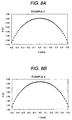
- the values of no and g and the longitudinal spherical aberration were determined in the same manner as in Example 1 and are shown in Table 2 and Figs. 8A (Example 2) and 8B (Example 3), respectively.
- Glass materials having respective compositions differing in Na 2 O concentration from the glass composition of Example 1 as shown in Table 1 were melted by heating at 1,450°C (Example 4) and 1,425°C (Example 5), respectively, in a platinum crucible and then cast.
- the glasses obtained were evaluated for durability by the powder method. As a result, the water resistance and acid resistance of the glass obtained in Example 4 were both in the second degree, and those of the glass obtained in Example 5 were both in the third degree.
- a glass rod having a diameter of 25 mm was cut out of each glass block obtained. This rod was heated and drawn to thereby produce a glass rod having a diameter of 1 mm. This rod was immersed in a 360°C molten salt mixture composed of 20 mol% silver nitrate and 80 mol% sodium nitrate for 13 days (Example 4) or 10 days (Example 5) to replace sodium ions contained in the glass by silver ions present in the molten salts. The degrees of replacement in this treatment were 91% (Example 4) and 96% (Example 5).
- This glass was treated by immersion in a molten salt consisting of sodium nitrate only at 420°C for 14 hours in Example 4 or at 440°C for 8.5 hours in Example 5.
- a molten salt consisting of sodium nitrate only at 420°C for 14 hours in Example 4 or at 440°C for 8.5 hours in Example 5.
- Example 5 The refractive index distributions thus formed were nearly parabolic like that obtained in Example 1, as shown in Figs. 5A (Example 4) and 5B (Example 5).
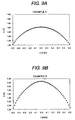
- the values of no and g and the longitudinal spherical aberration are shown in Table 2 and Figs. 9A (Example 4) and 9B (Example 5), respectively.
- the lens obtained in Example 5 had a slightly larger value of g than the others.
- the refractive index of the glass obtained was higher by 0.02 than that in Example 1.
- the glass obtained was evaluated for durability by the powder method. As a result, the water resistance and acid resistance of the glass were in the second degree and the third degree, respectively.
- a glass rod having a diameter of 25 mm was cut out of the glass block obtained. This rod was heated and drawn to thereby produce a glass rod having a diameter of 1 mm. This rod was immersed in a 400°C molten salt mixture composed of 20 mol% silver nitrate and 80 mol% sodium nitrate for 9 days to replace sodium ions contained in the glass by silver ions present in the molten salts. The degree of replacement in this treatment was 93%.
- This glass was treated by immersion in a molten salt consisting of sodium nitrate only at 360°C for 26 hours. Thus, a lens having a radial distribution of refractive index was obtained.
- the refractive index distribution of the lens thus obtained was nearly parabolic like that formed in Example 1, as shown in Fig. 6.
- This refractive index distribution was ascertained to be suitable for a lens having a radial distribution of refractive index.
- the values of no and g and the longitudinal spherical aberration are shown in Table 2 and Fig. 10, respectively.
- Raw glasses respectively having the compositions shown in Table 1 were melted in a platinum crucible and then cast.
- the temperatures required for this melting were 1,550°C (Comparative Example 1) and 1,525°C (Comparative Example 2), which were higher by from 100 to 150°C than the temperatures used for melting in the Examples.
- a high-quality lens having a radial distribution of refractive index by incorporating MgO into an aluminoborosilicate glass in a given proportion.
- This lens has a refractive index distribution required for optical designs and has high properties including satisfactory durability.
- the raw glass material from which the lens is produced has a low melting temperature and a rate of ion exchange sufficient for practical use and enables silver ions to be stably present therein.
Landscapes
- Chemical & Material Sciences (AREA)
- Chemical Kinetics & Catalysis (AREA)
- Life Sciences & Earth Sciences (AREA)
- Engineering & Computer Science (AREA)
- General Chemical & Material Sciences (AREA)
- Geochemistry & Mineralogy (AREA)
- Materials Engineering (AREA)
- Organic Chemistry (AREA)
- Physics & Mathematics (AREA)
- Optics & Photonics (AREA)
- General Physics & Mathematics (AREA)
- Ceramic Engineering (AREA)
- Glass Compositions (AREA)
Applications Claiming Priority (2)
| Application Number | Priority Date | Filing Date | Title |
|---|---|---|---|
| JP34259899A JP2001159702A (ja) | 1999-12-01 | 1999-12-01 | 屈折率分布型レンズ |
| JP34259899 | 1999-12-01 |
Publications (2)
| Publication Number | Publication Date |
|---|---|
| EP1106586A1 EP1106586A1 (en) | 2001-06-13 |
| EP1106586B1 true EP1106586B1 (en) | 2005-08-10 |
Family
ID=18355015
Family Applications (1)
| Application Number | Title | Priority Date | Filing Date |
|---|---|---|---|
| EP00125375A Expired - Lifetime EP1106586B1 (en) | 1999-12-01 | 2000-12-01 | Graded index lens |
Country Status (6)
| Country | Link |
|---|---|
| US (1) | US6511932B2 (enExample) |
| EP (1) | EP1106586B1 (enExample) |
| JP (1) | JP2001159702A (enExample) |
| CN (1) | CN1216821C (enExample) |
| DE (1) | DE60021839T2 (enExample) |
| TW (1) | TWI255260B (enExample) |
Cited By (1)
| Publication number | Priority date | Publication date | Assignee | Title |
|---|---|---|---|---|
| US10364178B2 (en) | 2007-11-29 | 2019-07-30 | Corning Incorporated | Glasses having improved toughness and scratch resistance |
Families Citing this family (28)
| Publication number | Priority date | Publication date | Assignee | Title |
|---|---|---|---|---|
| US20030144907A1 (en) * | 2001-03-05 | 2003-07-31 | American Express Travel Related Services Company, Inc. | System and method for administering incentive offers |
| JP2003021704A (ja) * | 2001-07-10 | 2003-01-24 | Nippon Sheet Glass Co Ltd | 一組の屈折率分布型ロッドレンズ及び該レンズを備えたマイクロ化学システム |
| JP2003123302A (ja) * | 2001-10-10 | 2003-04-25 | Sony Corp | 光学ピックアップ及び光記録再生装置 |
| CN1244096C (zh) * | 2001-10-10 | 2006-03-01 | 索尼公司 | 光学透镜、聚光透镜、光学拾取器和光学记录/再现装置 |
| TW200405139A (en) * | 2002-09-04 | 2004-04-01 | Nippon Sheet Glass Co Ltd | Glass composition for graded-index rod lens cover, graded-index rod lens, and method for manufacturing the same |
| CN100337955C (zh) * | 2002-12-25 | 2007-09-19 | 日本电气硝子株式会社 | 模压成形用光学玻璃 |
| KR20060015533A (ko) * | 2003-04-25 | 2006-02-17 | 코닝 인코포레이티드 | 다중-대역폭 시준기 |
| DE10361555A1 (de) * | 2003-12-19 | 2005-07-28 | Grintech Gmbh | Alumoborosilikatglas und Verfahren zur Herstellung kristallitfreier Gradientenindexlinsen |
| EP1719740A4 (en) | 2004-02-20 | 2010-12-29 | Isuzu Glass Co Ltd | METHOD FOR PRODUCING AN OPTICAL DEVICE |
| US7094117B2 (en) * | 2004-02-27 | 2006-08-22 | Micron Technology, Inc. | Electrical contacts with dielectric cores |
| JP2006071787A (ja) | 2004-08-31 | 2006-03-16 | Sumitomo Electric Ind Ltd | Dlc膜およびその形成方法 |
| CN100340874C (zh) * | 2004-12-14 | 2007-10-03 | 西南师范大学 | 改善自聚焦透镜折射率分布的方法 |
| KR100955619B1 (ko) * | 2005-04-05 | 2010-05-03 | 도요 가라스 가부시키가이샤 | 광섬유 콜리메이터계 및 광섬유 콜리메이터 어레이계의 제조 방법 |
| JP4873399B2 (ja) | 2005-08-08 | 2012-02-08 | 五鈴精工硝子株式会社 | 赤外線吸収能を有する屈折率分布型光学素子の製造方法 |
| FR2939787A1 (fr) * | 2008-12-15 | 2010-06-18 | Saint Gobain | Composition de verre adaptee a la realisation d'elements optiques plans |
| US8889575B2 (en) * | 2011-05-31 | 2014-11-18 | Corning Incorporated | Ion exchangeable alkali aluminosilicate glass articles |
| JP6024747B2 (ja) * | 2012-04-27 | 2016-11-16 | 株式会社ニコン | 光学ガラス、光学素子、光学系および光学装置 |
| JP6293535B2 (ja) | 2014-03-17 | 2018-03-14 | 株式会社東芝 | 光学素子及び光検出装置 |
| US9670088B2 (en) | 2014-05-20 | 2017-06-06 | Corning Incorporated | Scratch resistant glass and method of making |
| DE102014221679B4 (de) * | 2014-10-24 | 2016-12-29 | Fraunhofer-Gesellschaft zur Förderung der angewandten Forschung e.V. | Verfahren zur Herstellung eines Silber enthaltenden Glaspulvers sowie die Verwendung des Glaspulvers |
| CN105911619B (zh) * | 2016-06-07 | 2017-12-19 | 长飞光纤光缆股份有限公司 | 一种梯度折射率石英玻璃透镜 |
| KR20250024866A (ko) | 2018-11-26 | 2025-02-19 | 오웬스 코닝 인텔렉츄얼 캐피탈 엘엘씨 | 비탄성률이 향상된 고성능 섬유 유리 조성물 |
| JP7488260B2 (ja) | 2018-11-26 | 2024-05-21 | オウェンス コーニング インテレクチュアル キャピタル リミテッド ライアビリティ カンパニー | 改善された弾性率を有する高性能ガラス繊維組成物 |
| CN112079565B (zh) * | 2020-09-25 | 2022-04-15 | 成都光明光电股份有限公司 | 玻璃组合物、梯度折射率玻璃及其制造方法 |
| CN112110646B (zh) * | 2020-09-25 | 2022-02-11 | 成都光明光电股份有限公司 | 玻璃材料、梯度折射率玻璃及其制造方法 |
| CN113253557B (zh) * | 2021-04-30 | 2022-08-02 | 电子科技大学 | 一种基于菲涅尔透镜的投影仪系统 |
| CN114105469B (zh) * | 2021-11-24 | 2023-09-05 | 成都光明光电股份有限公司 | 含银玻璃材料及其制造方法 |
| CN116026873B (zh) * | 2023-02-28 | 2026-08-25 | 西北大学 | 一种获得渐变折射率透镜折射率分布的方法 |
Family Cites Families (8)
| Publication number | Priority date | Publication date | Assignee | Title |
|---|---|---|---|---|
| US4092174A (en) | 1976-01-30 | 1978-05-30 | Pilkington Brothers Limited | Photochromic glasses |
| US4405672A (en) | 1982-03-15 | 1983-09-20 | Corning Glass Works | Composite photochromic glass article and method of making |
| JPS5950047A (ja) | 1982-09-14 | 1984-03-22 | Nippon Sheet Glass Co Ltd | 広開口角の屈折率分布型レンズを製造するに適したガラス組成 |
| JPS61261238A (ja) | 1985-05-13 | 1986-11-19 | Hoya Corp | 軸方向に屈折率分布を有するレンズの製造法 |
| JPS62100451A (ja) | 1985-10-28 | 1987-05-09 | Hoya Corp | 屈折率勾配を有するガラス体の製造に適したガラス組成物 |
| US5007948A (en) | 1990-03-19 | 1991-04-16 | Corning Incorporated | Essentially colorless silver-containing glasses through ion exchange |
| JP2738125B2 (ja) | 1990-04-16 | 1998-04-08 | 日本板硝子株式会社 | 銀含有燐酸塩ガラス |
| JPH11153705A (ja) * | 1997-11-20 | 1999-06-08 | Nippon Sheet Glass Co Ltd | 軸方向屈折率分布型レンズ |
-
1999
- 1999-12-01 JP JP34259899A patent/JP2001159702A/ja active Pending
-
2000
- 2000-12-01 EP EP00125375A patent/EP1106586B1/en not_active Expired - Lifetime
- 2000-12-01 US US09/726,517 patent/US6511932B2/en not_active Expired - Fee Related
- 2000-12-01 DE DE60021839T patent/DE60021839T2/de not_active Expired - Fee Related
- 2000-12-01 CN CN00136848.6A patent/CN1216821C/zh not_active Expired - Fee Related
- 2000-12-01 TW TW089125601A patent/TWI255260B/zh not_active IP Right Cessation
Cited By (2)
| Publication number | Priority date | Publication date | Assignee | Title |
|---|---|---|---|---|
| US10364178B2 (en) | 2007-11-29 | 2019-07-30 | Corning Incorporated | Glasses having improved toughness and scratch resistance |
| US10464839B2 (en) | 2007-11-29 | 2019-11-05 | Corning Incorporated | Glasses having improved toughness and scratch resistance |
Also Published As
| Publication number | Publication date |
|---|---|
| EP1106586A1 (en) | 2001-06-13 |
| CN1216821C (zh) | 2005-08-31 |
| TWI255260B (en) | 2006-05-21 |
| US6511932B2 (en) | 2003-01-28 |
| DE60021839D1 (de) | 2005-09-15 |
| US20010003724A1 (en) | 2001-06-14 |
| CN1298842A (zh) | 2001-06-13 |
| DE60021839T2 (de) | 2006-06-01 |
| JP2001159702A (ja) | 2001-06-12 |
Similar Documents
| Publication | Publication Date | Title |
|---|---|---|
| US6511932B2 (en) | Graded index lens | |
| US6066273A (en) | Axial refractive index distributed lens | |
| JP2008230956A (ja) | 屈折率分布型レンズ用母材ガラス組成物、屈折率分布型レンズとその製造方法ならびに光学製品および光学機器 | |
| US7482296B2 (en) | Aluminoborosilicate glass and method for the production of crystallite-free gradient index lenses | |
| US4444893A (en) | Highly refractive, low dispersion, low density optical glass suitable for corrective lenses | |
| US4438211A (en) | Optical and ophthalmic glass with refractive indices nd>1.58, Abbe numbers>45 and densities<2.75 g/cm3 | |
| EP1099670B1 (en) | Mother glass composition for graded index lens | |
| US20020065186A1 (en) | Mother glass composition for graded index lens | |
| CN106746613B (zh) | 光学玻璃 | |
| US20090131239A1 (en) | Base glass composition for graded-refractive-index rod lens and graded-refractive-index rod lens produced from the same | |
| US7576021B2 (en) | Mother glass composition for graded index lens, graded index lens, manufacturing method of graded index lens, optical product and optical instrument using the same | |
| US20220162115A1 (en) | Chemically strengthened optical glass | |
| US6010787A (en) | Glass compositions for core/cladding type distributed index optical element | |
| US4462663A (en) | Converging light transmitting body of high performance and process for production thereof | |
| JPS6364941A (ja) | 光集束性レンズ | |
| JPS5941934B2 (ja) | 光集束性レンズ用ガラス組成物 | |
| JP2738125B2 (ja) | 銀含有燐酸塩ガラス | |
| JP2002211947A (ja) | 屈折率分布型レンズ用母材ガラス組成物 | |
| RU2101238C1 (ru) | Стекло для изготовления градиентных трансляторов изображения методом ионного обмена | |
| CN1018540B (zh) | 适用于眼科用途的中等折射率玻璃 | |
| CN111977974A (zh) | 光学玻璃、光学预制件、光学元件和光学仪器 | |
| JP2002284543A (ja) | 屈折率分布型レンズ用母材ガラス組成物 | |
| JPH0362657B2 (enExample) | ||
| JPH101330A (ja) | 紫外域透過の良いガラス | |
| JP2004250279A (ja) | 屈折率分布型レンズ用母材ガラス組成物、それを用いた屈折率分布型レンズおよびその製造方法 |
Legal Events
| Date | Code | Title | Description |
|---|---|---|---|
| PUAI | Public reference made under article 153(3) epc to a published international application that has entered the european phase |
Free format text: ORIGINAL CODE: 0009012 |
|
| AK | Designated contracting states |
Kind code of ref document: A1 Designated state(s): DE FR GB |
|
| AX | Request for extension of the european patent |
Free format text: AL;LT;LV;MK;RO;SI |
|
| 17P | Request for examination filed |
Effective date: 20010918 |
|
| AKX | Designation fees paid |
Free format text: DE FR GB |
|
| 17Q | First examination report despatched |
Effective date: 20020426 |
|
| GRAP | Despatch of communication of intention to grant a patent |
Free format text: ORIGINAL CODE: EPIDOSNIGR1 |
|
| GRAS | Grant fee paid |
Free format text: ORIGINAL CODE: EPIDOSNIGR3 |
|
| GRAA | (expected) grant |
Free format text: ORIGINAL CODE: 0009210 |
|
| AK | Designated contracting states |
Kind code of ref document: B1 Designated state(s): DE FR GB |
|
| REG | Reference to a national code |
Ref country code: GB Ref legal event code: FG4D |
|
| REF | Corresponds to: |
Ref document number: 60021839 Country of ref document: DE Date of ref document: 20050915 Kind code of ref document: P |
|
| ET | Fr: translation filed | ||
| PLBE | No opposition filed within time limit |
Free format text: ORIGINAL CODE: 0009261 |
|
| STAA | Information on the status of an ep patent application or granted ep patent |
Free format text: STATUS: NO OPPOSITION FILED WITHIN TIME LIMIT |
|
| 26N | No opposition filed |
Effective date: 20060511 |
|
| PGFP | Annual fee paid to national office [announced via postgrant information from national office to epo] |
Ref country code: FR Payment date: 20061208 Year of fee payment: 7 |
|
| PGFP | Annual fee paid to national office [announced via postgrant information from national office to epo] |
Ref country code: GB Payment date: 20071120 Year of fee payment: 8 |
|
| PGFP | Annual fee paid to national office [announced via postgrant information from national office to epo] |
Ref country code: DE Payment date: 20071227 Year of fee payment: 8 |
|
| REG | Reference to a national code |
Ref country code: FR Ref legal event code: ST Effective date: 20081020 |
|
| PG25 | Lapsed in a contracting state [announced via postgrant information from national office to epo] |
Ref country code: FR Free format text: LAPSE BECAUSE OF NON-PAYMENT OF DUE FEES Effective date: 20071231 |
|
| GBPC | Gb: european patent ceased through non-payment of renewal fee |
Effective date: 20081201 |
|
| PG25 | Lapsed in a contracting state [announced via postgrant information from national office to epo] |
Ref country code: DE Free format text: LAPSE BECAUSE OF NON-PAYMENT OF DUE FEES Effective date: 20090701 |
|
| PG25 | Lapsed in a contracting state [announced via postgrant information from national office to epo] |
Ref country code: GB Free format text: LAPSE BECAUSE OF NON-PAYMENT OF DUE FEES Effective date: 20081201 |