EP1097461B1 - Nuclear fuel pellet - Google Patents
Nuclear fuel pellet Download PDFInfo
- Publication number
- EP1097461B1 EP1097461B1 EP99957657A EP99957657A EP1097461B1 EP 1097461 B1 EP1097461 B1 EP 1097461B1 EP 99957657 A EP99957657 A EP 99957657A EP 99957657 A EP99957657 A EP 99957657A EP 1097461 B1 EP1097461 B1 EP 1097461B1
- Authority
- EP
- European Patent Office
- Prior art keywords
- fuel pellet
- grain size
- pellet according
- niobia
- fuel
- Prior art date
- Legal status (The legal status is an assumption and is not a legal conclusion. Google has not performed a legal analysis and makes no representation as to the accuracy of the status listed.)
- Expired - Lifetime
Links
Images
Classifications
-
- G—PHYSICS
- G21—NUCLEAR PHYSICS; NUCLEAR ENGINEERING
- G21C—NUCLEAR REACTORS
- G21C3/00—Reactor fuel elements and their assemblies; Selection of substances for use as reactor fuel elements
- G21C3/02—Fuel elements
-
- G—PHYSICS
- G21—NUCLEAR PHYSICS; NUCLEAR ENGINEERING
- G21C—NUCLEAR REACTORS
- G21C3/00—Reactor fuel elements and their assemblies; Selection of substances for use as reactor fuel elements
- G21C3/42—Selection of substances for use as reactor fuel
- G21C3/58—Solid reactor fuel Pellets made of fissile material
- G21C3/62—Ceramic fuel
- G21C3/623—Oxide fuels
-
- Y—GENERAL TAGGING OF NEW TECHNOLOGICAL DEVELOPMENTS; GENERAL TAGGING OF CROSS-SECTIONAL TECHNOLOGIES SPANNING OVER SEVERAL SECTIONS OF THE IPC; TECHNICAL SUBJECTS COVERED BY FORMER USPC CROSS-REFERENCE ART COLLECTIONS [XRACs] AND DIGESTS
- Y02—TECHNOLOGIES OR APPLICATIONS FOR MITIGATION OR ADAPTATION AGAINST CLIMATE CHANGE
- Y02E—REDUCTION OF GREENHOUSE GAS [GHG] EMISSIONS, RELATED TO ENERGY GENERATION, TRANSMISSION OR DISTRIBUTION
- Y02E30/00—Energy generation of nuclear origin
- Y02E30/30—Nuclear fission reactors
Definitions
- the present invention relates to the production of fuel pellets for nuclear reactors.
- Fuel pellets pressed from powders of uranium oxide and subsequently sintered under controlled conditions of time, temperature and atmosphere are well known. Such fuel pellets are normally generally right cylinders and many such pellets are packed in axial alignment in metal tubes of, for example, Zircaloy (trade name), an alloy of zirconium. The tubes are usually referred to as "cladding" and the filled tube as a "fuel pin". Many fuel pins are grouped together, often in a parallel aligned radial array to form a fuel element or fuel assembly.
- the high temperatures generated result in the oxide fuel pellets expanding and the outer surface of the pellet coming into contact with the inner surface of the cladding producing mechanical stress (PCI).
- PCI mechanical stress
- the mechanical stress is further exacerbated by the production of iodine as a fission product during the nuclear reaction.
- the combination of mechanical stress and iodine which acts as a stress corrosion agent attacking the cladding material grain boundaries can cause rupture of the cladding in extreme cases.
- a small grain size is beneficial in promoting creep of the oxide pellet at the surface to give a stress relieving effect.
- the second effect which occurs during the nuclear reaction is the generation of many different fission gas products including iodine referred to above.
- the fission gas products are created within the oxide structure as atoms which diffuse to grain boundaries and nucleate thereat. Gas bubbles are eventually formed, the bubbles coalescing with each other and being finally given off and known as "fission gas release". It is undesirable for the fission gases to be released and fuel pellets are generally produced with a large grain size to promote retention of the fission gases (FGR). A large grain size promotes retention due to the fact that the fission gas atoms have further to diffuse through the structure before they reach a grain boundary where they can nucleate.
- FGR fission gas
- European Patent Application 82305260.0 (EP 0076680) describes the doping of uranium dioxide or ammonium diuranate as a precursor thereof with one of a selected group of elements, including niobium, to produce a large grain size.
- Japanese Patent Application 04070594 describes the doping of uranium oxide with Nb(IV) oxide
- Japanese Patent Application 03102292 describes the doping of uranium oxide with an intermetallic compound or an oxide which may include niobium oxide.
- UK Patent Application 8517110 (GB2177249) describes the preparation of large grain size materials using seed material composed essentially of single crystals, but makes no reference to niobia doping.
- UK Patent Application 23791/78 (GB1600169) discloses the coating of nuclear fuels pellets with a getter material selected from a group including metallic niobium, but no doping of the pellet material itself is suggested.
- Proposals have been made to produce fuel pellets having two distinct regions: an outer annular region having a small grain size to minimise PCI; and, an inner core region having a large grain size to maximise FGR.
- Such structures are described in 89JP-311936; 87JP-262652; and, 83SU-600645.
- the pellets are generally made by pressing an outer annulus component and a separate inner core component, fitting the two together and then sintering. The pressing conditions are controlled so that during sintering the outer annulus shrinks onto the core and diffusion bonding of the two components occurs.
- GB-B-2020641 of common ownership herewith describes the use of niobium pentoxide (henceforth referred to as "niobia”) as a dopant in uranium oxide fuel pellets.
- niobia niobium pentoxide
- the effect of the niobia is stated to be that of increasing the diffusion rates during sintering so promoting the generation of a large grain size in the pellet. It is also stated that the increased diffusion rate caused by niobia does not also substantially affect the rate of diffusion of the fission gas products within the grains. Thus, a large grain size may be achieved with no apparent adverse effect of also increasing the diffusion rate of the fission gas products.
- the presence of niobia does adversely affect the diffusion rate of fission gas.
- the present invention provides a uranium oxide fuel pellet comprising an inner region and an outer region about the inner region, wherein the uranium oxide of at least a portion of said outer region is rich in niobia relative to the inner region.
- niobia is used.
- the addition is usually made in the form of niobium pentoxide, however, during processing such as sintering, the composition may change due to the effects of a reducing atmosphere or alternate reducing/oxidising atmospheres so that the "niobia" in the final material as produced, or becomes in use in a reactor, may not be niobium pentoxide.
- the term "niobia” used herein is intended to cover all forms of niobium and niobium oxides which may be used or which are formed.
- a uranium oxide fuel material which nevertheless has a large grain size due to the increased diffusion rates promoted by the addition of niobia actually has a greater creep rate than does a material having a smaller grain size thus, reducing PCI.
- the content of niobia in the surface region may be in the range from about 0.1 to 0.5 weight percent with a content of about 0.3 weight percent being preferred.
- the average grain size of a prior art so-called "duplex" pellet having distinct annulus and core regions as described above with reference to the prior art may typically be in the range from about 0.25 to 2.5 ⁇ m.
- the average grain size in the surface region may be greater than about 25 ⁇ m and typically in the range from about 35 to 50 ⁇ m. It should be noted that the method of measuring average grain size in this specification is by the linear intercept method.
- the pellets according to the present invention may be made having the duplex structure as described above with a distinct outer annulus and a distinct core.
- the pellets may be made by two stage pressing and assembling as described or as a unitary construction comprising multiple pressing stages in a complex die arrangement on a press of the type described, for example, in International Patent Application Number WO93/18878.
- the pellet may be made having two distinct regions produced by pressing operations with two powder compositions constituting the outer and inner regions, a homogeneous pellet having the surface regions enhanced in niobia content would fall within the inventive concept of the present invention.
- the annulus and core regions may each comprise about 50vol% of the total pellet volume for example.
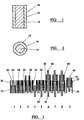
- Figures 1 and 2 show a pellet generally at 10.
- the pellet comprises an outer region 12 having a composition including a niobia addition and a core 14 which is substantially free of niobia.
- the axial end faces of the pellet are often provided in a slightly dished form to accommodate expansion in the axial direction in use and also to provide space for creep relaxation under stress at high temperatures but this has not been shown in the interests of clarity.
- the annular region 12 and core region 14 are pressed separately by known techniques.
- the two components are assembled together and sintered under known conditions of about 1700/1750°C for about 4-5 hours under a hydrogen and moisture containing atmosphere.
- the green properties of the pressed annulus cause it to shrink more than the core with the result that under the sintering conditions the annulus grips the core and the two become diffusion bonded together.
- the die assembly comprises a single outer die 20 with a multiple inner punch assembly, the components of which are enabled to move independently by means of a hydraulically controlled matrix in a mechanical press for example.
- the die 20 has an outer punch 22 and a stepped inner punch 24 creating a cavity 26 for filling with powder 28 as shown in Step 2.
- a third punch member 30 compresses the powder 28 to form a self supporting green compact 32 as shown in Step 3.
- the punch member 30 is withdrawn and the stepped inner punch member 24 is lowered to a position below the lowermost extent 34 of the green compact 32 as shown in Step 4.
- Powder 36 is filled into the core void so formed in Step 4 and as shown in Step 5.
- the outer punch 30 is replaced together with a coaxial top punch 38, punches 38 and 24 being advanced towards each other to compress the core powder filling 36 as shown in Steps 6 and 7 to create a unified green compact 40 comprising the outer compacted annulus 32 and inner compressed core 42 as shown in Step 8.
- the upper punches 30 and 38 are withdrawn and punches 20 and 24 are advanced simultaneously to eject the green compact 40 from the die.
- the green compact 40 is then sintered.
- the core region 14 had an average grain size of 12-15 ⁇ m and was substantially free of niobia whereas the annulus portion 12 comprised a grain size in excess of 25 ⁇ m and had an addition of 0.3 wt% niobia.
- the core region 14 comprised a grain size in excess of 25 ⁇ m being produced by seeding with UO 2 crystals and the annulus portion 12 had a grain size in excess of 25 ⁇ m and contained 0.3wt% of niobia.
Landscapes
- Engineering & Computer Science (AREA)
- Physics & Mathematics (AREA)
- Plasma & Fusion (AREA)
- General Engineering & Computer Science (AREA)
- High Energy & Nuclear Physics (AREA)
- Chemical & Material Sciences (AREA)
- Ceramic Engineering (AREA)
- Inorganic Compounds Of Heavy Metals (AREA)
Applications Claiming Priority (3)
| Application Number | Priority Date | Filing Date | Title |
|---|---|---|---|
| GB9813696 | 1998-06-26 | ||
| GBGB9813696.3A GB9813696D0 (en) | 1998-06-26 | 1998-06-26 | Fuel pellet |
| PCT/GB1999/001863 WO2000000985A1 (en) | 1998-06-26 | 1999-06-11 | Nuclear fuel pellet |
Publications (2)
| Publication Number | Publication Date |
|---|---|
| EP1097461A1 EP1097461A1 (en) | 2001-05-09 |
| EP1097461B1 true EP1097461B1 (en) | 2004-04-07 |
Family
ID=10834345
Family Applications (1)
| Application Number | Title | Priority Date | Filing Date |
|---|---|---|---|
| EP99957657A Expired - Lifetime EP1097461B1 (en) | 1998-06-26 | 1999-06-11 | Nuclear fuel pellet |
Country Status (7)
| Country | Link |
|---|---|
| EP (1) | EP1097461B1 (enExample) |
| JP (1) | JP4700806B2 (enExample) |
| KR (1) | KR20010071578A (enExample) |
| DE (1) | DE69916278T2 (enExample) |
| ES (1) | ES2215409T3 (enExample) |
| GB (1) | GB9813696D0 (enExample) |
| WO (1) | WO2000000985A1 (enExample) |
Cited By (2)
| Publication number | Priority date | Publication date | Assignee | Title |
|---|---|---|---|---|
| RU2467414C1 (ru) * | 2011-12-14 | 2012-11-20 | Скрипник Анастасия Андреевна | Тепловыделяющий элемент ядерного реактора на быстрых нейтронах (варианты) |
| RU2467415C1 (ru) * | 2011-12-14 | 2012-11-20 | Скрипник Анастасия Андреевна | Тепловыделяющий элемент ядерного реактора (варианты) |
Families Citing this family (7)
| Publication number | Priority date | Publication date | Assignee | Title |
|---|---|---|---|---|
| CA2339859A1 (en) * | 2001-02-05 | 2002-08-05 | Glen F. Perry | Natural gas transport system and composition |
| DE10115015C1 (de) * | 2001-03-27 | 2003-05-15 | Framatome Anp Gmbh | Verfahren zur Herstellung eines Kernbrennstoff-Sinterkörpers |
| EP1909294A1 (en) * | 2006-10-03 | 2008-04-09 | The European Atomic Energy Community (EURATOM), represented by the European Commission | High burn-up nuclear fuel pellets |
| ES2686697T3 (es) * | 2014-09-08 | 2018-10-19 | Westinghouse Electric Sweden Ab | Método de fabricación de una pastilla de combustible nuclear para un reactor de energía nuclear |
| ES2686196T3 (es) * | 2014-09-08 | 2018-10-16 | Westinghouse Electric Sweden Ab | Método de fabricación de una pastilla de combustible nuclear para un reactor de energía nuclear |
| EP3588514B1 (en) | 2018-06-21 | 2023-09-27 | Westinghouse Electric Sweden AB | Fuel pellet and method of preparing a fuel pellet |
| CN113012832A (zh) * | 2019-12-20 | 2021-06-22 | 中核北方核燃料元件有限公司 | 一种uo2复合un-uo2燃料芯块的制备方法 |
Family Cites Families (9)
| Publication number | Priority date | Publication date | Assignee | Title |
|---|---|---|---|---|
| US4264540A (en) * | 1978-05-15 | 1981-04-28 | British Nuclear Fuels Limited | Production of nuclear fuel pellets |
| JPS59220677A (ja) * | 1983-05-30 | 1984-12-12 | 株式会社日立製作所 | 原子炉燃料棒 |
| JPS61184484A (ja) * | 1985-02-13 | 1986-08-18 | 原子燃料工業株式会社 | 核燃料要素 |
| JPS62200287A (ja) * | 1986-02-28 | 1987-09-03 | 株式会社東芝 | 核燃料ペレツトの製造方法 |
| JPH03249596A (ja) * | 1990-02-28 | 1991-11-07 | Mitsubishi Materials Corp | 核燃料ペレットの製造方法 |
| JP2737350B2 (ja) * | 1990-02-28 | 1998-04-08 | 三菱マテリアル株式会社 | 核燃料ペレット |
| JPH06194480A (ja) * | 1992-12-24 | 1994-07-15 | Nippon Nuclear Fuel Dev Co Ltd | 核燃料ペレットの製造方法 |
| JPH09127279A (ja) * | 1995-11-06 | 1997-05-16 | Nuclear Fuel Ind Ltd | 核燃料ペレットおよびその製造方法 |
| EP0788117A1 (en) * | 1996-01-30 | 1997-08-06 | Siemens Power Corporation | Nuclear fuel pellet |
-
1998
- 1998-06-26 GB GBGB9813696.3A patent/GB9813696D0/en not_active Ceased
-
1999
- 1999-06-11 DE DE69916278T patent/DE69916278T2/de not_active Expired - Lifetime
- 1999-06-11 EP EP99957657A patent/EP1097461B1/en not_active Expired - Lifetime
- 1999-06-11 JP JP2000557478A patent/JP4700806B2/ja not_active Expired - Fee Related
- 1999-06-11 ES ES99957657T patent/ES2215409T3/es not_active Expired - Lifetime
- 1999-06-11 WO PCT/GB1999/001863 patent/WO2000000985A1/en not_active Ceased
- 1999-06-11 KR KR1020007014651A patent/KR20010071578A/ko not_active Withdrawn
Cited By (2)
| Publication number | Priority date | Publication date | Assignee | Title |
|---|---|---|---|---|
| RU2467414C1 (ru) * | 2011-12-14 | 2012-11-20 | Скрипник Анастасия Андреевна | Тепловыделяющий элемент ядерного реактора на быстрых нейтронах (варианты) |
| RU2467415C1 (ru) * | 2011-12-14 | 2012-11-20 | Скрипник Анастасия Андреевна | Тепловыделяющий элемент ядерного реактора (варианты) |
Also Published As
| Publication number | Publication date |
|---|---|
| EP1097461A1 (en) | 2001-05-09 |
| DE69916278T2 (de) | 2005-04-21 |
| JP4700806B2 (ja) | 2011-06-15 |
| GB9813696D0 (en) | 1998-08-26 |
| WO2000000985A1 (en) | 2000-01-06 |
| DE69916278D1 (de) | 2004-05-13 |
| JP2002519677A (ja) | 2002-07-02 |
| KR20010071578A (ko) | 2001-07-28 |
| ES2215409T3 (es) | 2004-10-01 |
Similar Documents
| Publication | Publication Date | Title |
|---|---|---|
| US11837371B2 (en) | Method of manufacturing a nuclear fuel assembly | |
| US4894203A (en) | Nuclear fuel element having oxidation resistant cladding | |
| US5026516A (en) | Corrosion resistant cladding for nuclear fuel rods | |
| WO2000000985A1 (en) | Nuclear fuel pellet | |
| KR20230006061A (ko) | 열전도도가 향상된 핵연료 소결체 적층 구조 및 이의 제조방법 | |
| US4355002A (en) | Nuclear fuel assembly | |
| US20110049734A1 (en) | Method for Preparing Sintered Annular Nuclear Fuel Pellet | |
| EP0287875B1 (en) | Zirconium cladded pressurized water reactor nuclear fuel element | |
| EP0842518A1 (en) | Nuclear fuel pellets | |
| KR100783986B1 (ko) | 원자로용 연료 펠릿 및 그 제조 방법 | |
| US4689195A (en) | Fuel assembly | |
| US5991354A (en) | Nuclear fuel pellet | |
| DE60215886T3 (de) | Brennstab mit einer Hülle aus einer Zirkoniumlegierung und beinhaltend ein Metalloxid zum Begrenzen der Hydrierung | |
| EP1556869B1 (en) | Method, use and device concerning cladding tubes for nuclear fuel and a fuel assembly for a nuclear pressure water reactor | |
| EP1081716B1 (en) | Method for producing nuclear fuel pellets of the mox type | |
| KR101029616B1 (ko) | 봉삽입 소결에 의한 환형 핵연료 소결체 제조 방법 | |
| KR19990072604A (ko) | 복합부재및이를이용한연료집합체 | |
| EP3745419B1 (en) | Nuclear fuel pellet having excellent compression resistance and reduced surface defect | |
| EP4145469A1 (en) | Method for producing pelletized fuel from uranium-molybdenum powders | |
| JPH0694869A (ja) | 核燃料ペレット及び製造方法 | |
| JPH07209460A (ja) | 沸騰水型原子炉用燃料集合体およびその炉心 | |
| EP0104521B1 (de) | Verfahren zur Herstellung keramischer Brennstofftabletten | |
| JPH03243890A (ja) | 核燃料ペレット | |
| JPS6129678B2 (enExample) | ||
| JPS6031089A (ja) | 核燃料複合被覆管 |
Legal Events
| Date | Code | Title | Description |
|---|---|---|---|
| PUAI | Public reference made under article 153(3) epc to a published international application that has entered the european phase |
Free format text: ORIGINAL CODE: 0009012 |
|
| 17P | Request for examination filed |
Effective date: 20010122 |
|
| AK | Designated contracting states |
Kind code of ref document: A1 Designated state(s): BE DE ES FR GB SE |
|
| GRAP | Despatch of communication of intention to grant a patent |
Free format text: ORIGINAL CODE: EPIDOSNIGR1 |
|
| GRAS | Grant fee paid |
Free format text: ORIGINAL CODE: EPIDOSNIGR3 |
|
| GRAA | (expected) grant |
Free format text: ORIGINAL CODE: 0009210 |
|
| AK | Designated contracting states |
Kind code of ref document: B1 Designated state(s): BE DE ES FR GB SE |
|
| REG | Reference to a national code |
Ref country code: GB Ref legal event code: FG4D |
|
| REF | Corresponds to: |
Ref document number: 69916278 Country of ref document: DE Date of ref document: 20040513 Kind code of ref document: P |
|
| REG | Reference to a national code |
Ref country code: SE Ref legal event code: TRGR |
|
| REG | Reference to a national code |
Ref country code: ES Ref legal event code: FG2A Ref document number: 2215409 Country of ref document: ES Kind code of ref document: T3 |
|
| ET | Fr: translation filed | ||
| PLBE | No opposition filed within time limit |
Free format text: ORIGINAL CODE: 0009261 |
|
| STAA | Information on the status of an ep patent application or granted ep patent |
Free format text: STATUS: NO OPPOSITION FILED WITHIN TIME LIMIT |
|
| 26N | No opposition filed |
Effective date: 20050110 |
|
| REG | Reference to a national code |
Ref country code: FR Ref legal event code: TP |
|
| BECA | Be: change of holder's address |
Owner name: *WESTINGHOUSE ELECTRIC CY LLC4350 NORTHERN PIKE, M Effective date: 20070718 |
|
| BECH | Be: change of holder |
Owner name: *WESTINGHOUSE ELECTRIC CY LLC Effective date: 20070718 |
|
| REG | Reference to a national code |
Ref country code: GB Ref legal event code: 732E |
|
| REG | Reference to a national code |
Ref country code: GB Ref legal event code: 732E |
|
| REG | Reference to a national code |
Ref country code: FR Ref legal event code: PLFP Year of fee payment: 18 |
|
| REG | Reference to a national code |
Ref country code: FR Ref legal event code: PLFP Year of fee payment: 19 |
|
| REG | Reference to a national code |
Ref country code: FR Ref legal event code: PLFP Year of fee payment: 20 |
|
| PGFP | Annual fee paid to national office [announced via postgrant information from national office to epo] |
Ref country code: DE Payment date: 20180608 Year of fee payment: 20 |
|
| PGFP | Annual fee paid to national office [announced via postgrant information from national office to epo] |
Ref country code: FR Payment date: 20180516 Year of fee payment: 20 Ref country code: BE Payment date: 20180619 Year of fee payment: 20 |
|
| PGFP | Annual fee paid to national office [announced via postgrant information from national office to epo] |
Ref country code: SE Payment date: 20180608 Year of fee payment: 20 |
|
| PGFP | Annual fee paid to national office [announced via postgrant information from national office to epo] |
Ref country code: ES Payment date: 20180702 Year of fee payment: 20 Ref country code: GB Payment date: 20180403 Year of fee payment: 20 |
|
| REG | Reference to a national code |
Ref country code: DE Ref legal event code: R071 Ref document number: 69916278 Country of ref document: DE |
|
| REG | Reference to a national code |
Ref country code: GB Ref legal event code: PE20 Expiry date: 20190610 Ref country code: BE Ref legal event code: MK Effective date: 20190611 |
|
| REG | Reference to a national code |
Ref country code: SE Ref legal event code: EUG |
|
| PG25 | Lapsed in a contracting state [announced via postgrant information from national office to epo] |
Ref country code: GB Free format text: LAPSE BECAUSE OF EXPIRATION OF PROTECTION Effective date: 20190610 |
|
| REG | Reference to a national code |
Ref country code: ES Ref legal event code: FD2A Effective date: 20200723 |
|
| PG25 | Lapsed in a contracting state [announced via postgrant information from national office to epo] |
Ref country code: ES Free format text: LAPSE BECAUSE OF EXPIRATION OF PROTECTION Effective date: 20190612 |