EP1090411B1 - Apparatus and method relating to charged particles - Google Patents
Apparatus and method relating to charged particles Download PDFInfo
- Publication number
- EP1090411B1 EP1090411B1 EP99926600A EP99926600A EP1090411B1 EP 1090411 B1 EP1090411 B1 EP 1090411B1 EP 99926600 A EP99926600 A EP 99926600A EP 99926600 A EP99926600 A EP 99926600A EP 1090411 B1 EP1090411 B1 EP 1090411B1
- Authority
- EP
- European Patent Office
- Prior art keywords
- array
- magnetic
- particles
- region
- reference surface
- Prior art date
- Legal status (The legal status is an assumption and is not a legal conclusion. Google has not performed a legal analysis and makes no representation as to the accuracy of the status listed.)
- Expired - Lifetime
Links
- 239000002245 particle Substances 0.000 title claims description 179
- 238000000034 method Methods 0.000 title claims description 46
- 238000000605 extraction Methods 0.000 claims description 76
- 230000001419 dependent effect Effects 0.000 claims description 65
- 238000004458 analytical method Methods 0.000 claims description 59
- 150000002500 ions Chemical class 0.000 claims description 58
- 239000006185 dispersion Substances 0.000 claims description 36
- 230000000694 effects Effects 0.000 claims description 33
- 230000005540 biological transmission Effects 0.000 claims description 32
- 230000009471 action Effects 0.000 claims description 28
- 230000033001 locomotion Effects 0.000 claims description 28
- 239000004020 conductor Substances 0.000 claims description 12
- 238000005468 ion implantation Methods 0.000 claims description 11
- 230000004888 barrier function Effects 0.000 claims description 10
- 238000006073 displacement reaction Methods 0.000 claims description 10
- 238000003491 array Methods 0.000 claims description 7
- 238000011109 contamination Methods 0.000 claims description 7
- 230000004304 visual acuity Effects 0.000 claims description 7
- 238000000926 separation method Methods 0.000 claims description 4
- 238000004544 sputter deposition Methods 0.000 claims description 4
- 230000006866 deterioration Effects 0.000 claims description 2
- 238000007667 floating Methods 0.000 claims description 2
- 238000010884 ion-beam technique Methods 0.000 description 34
- 210000002381 plasma Anatomy 0.000 description 29
- 230000005405 multipole Effects 0.000 description 20
- 230000001133 acceleration Effects 0.000 description 13
- 230000003287 optical effect Effects 0.000 description 13
- 239000007943 implant Substances 0.000 description 9
- 239000000463 material Substances 0.000 description 9
- 235000012431 wafers Nutrition 0.000 description 9
- 230000015572 biosynthetic process Effects 0.000 description 8
- 230000008569 process Effects 0.000 description 8
- 238000005452 bending Methods 0.000 description 6
- 230000008901 benefit Effects 0.000 description 6
- 229910052796 boron Inorganic materials 0.000 description 5
- 239000004065 semiconductor Substances 0.000 description 5
- QVGXLLKOCUKJST-UHFFFAOYSA-N atomic oxygen Chemical compound [O] QVGXLLKOCUKJST-UHFFFAOYSA-N 0.000 description 4
- 238000005516 engineering process Methods 0.000 description 4
- 230000003628 erosive effect Effects 0.000 description 4
- 230000004907 flux Effects 0.000 description 4
- 230000006870 function Effects 0.000 description 4
- 239000007789 gas Substances 0.000 description 4
- 238000002513 implantation Methods 0.000 description 4
- 230000003993 interaction Effects 0.000 description 4
- ZOXJGFHDIHLPTG-UHFFFAOYSA-N Boron Chemical compound [B] ZOXJGFHDIHLPTG-UHFFFAOYSA-N 0.000 description 3
- 239000004411 aluminium Substances 0.000 description 3
- XAGFODPZIPBFFR-UHFFFAOYSA-N aluminium Chemical compound [Al] XAGFODPZIPBFFR-UHFFFAOYSA-N 0.000 description 3
- 229910052782 aluminium Inorganic materials 0.000 description 3
- 238000013459 approach Methods 0.000 description 3
- -1 boron ions Chemical class 0.000 description 3
- 238000009826 distribution Methods 0.000 description 3
- 239000001257 hydrogen Substances 0.000 description 3
- 229910052739 hydrogen Inorganic materials 0.000 description 3
- 239000012535 impurity Substances 0.000 description 3
- 239000006249 magnetic particle Substances 0.000 description 3
- 238000004519 manufacturing process Methods 0.000 description 3
- 230000007246 mechanism Effects 0.000 description 3
- 230000007935 neutral effect Effects 0.000 description 3
- UFHFLCQGNIYNRP-UHFFFAOYSA-N Hydrogen Chemical compound [H][H] UFHFLCQGNIYNRP-UHFFFAOYSA-N 0.000 description 2
- WTEOIRVLGSZEPR-UHFFFAOYSA-N boron trifluoride Chemical compound FB(F)F WTEOIRVLGSZEPR-UHFFFAOYSA-N 0.000 description 2
- 230000008859 change Effects 0.000 description 2
- 230000006835 compression Effects 0.000 description 2
- 238000007906 compression Methods 0.000 description 2
- 230000007423 decrease Effects 0.000 description 2
- 230000003247 decreasing effect Effects 0.000 description 2
- 230000005684 electric field Effects 0.000 description 2
- 230000005686 electrostatic field Effects 0.000 description 2
- 230000006872 improvement Effects 0.000 description 2
- 239000000696 magnetic material Substances 0.000 description 2
- 239000001301 oxygen Substances 0.000 description 2
- 229910052760 oxygen Inorganic materials 0.000 description 2
- 239000000243 solution Substances 0.000 description 2
- 239000002344 surface layer Substances 0.000 description 2
- 229910015900 BF3 Inorganic materials 0.000 description 1
- OKTJSMMVPCPJKN-UHFFFAOYSA-N Carbon Chemical compound [C] OKTJSMMVPCPJKN-UHFFFAOYSA-N 0.000 description 1
- MYMOFIZGZYHOMD-UHFFFAOYSA-N Dioxygen Chemical compound O=O MYMOFIZGZYHOMD-UHFFFAOYSA-N 0.000 description 1
- 230000004075 alteration Effects 0.000 description 1
- 230000000712 assembly Effects 0.000 description 1
- 238000000429 assembly Methods 0.000 description 1
- 238000005513 bias potential Methods 0.000 description 1
- ZDVYABSQRRRIOJ-UHFFFAOYSA-N boron;iron Chemical compound [Fe]#B ZDVYABSQRRRIOJ-UHFFFAOYSA-N 0.000 description 1
- 229910052799 carbon Inorganic materials 0.000 description 1
- 230000015556 catabolic process Effects 0.000 description 1
- 210000004027 cell Anatomy 0.000 description 1
- 230000005591 charge neutralization Effects 0.000 description 1
- 150000001793 charged compounds Chemical class 0.000 description 1
- 238000006243 chemical reaction Methods 0.000 description 1
- 238000010276 construction Methods 0.000 description 1
- 239000002826 coolant Substances 0.000 description 1
- 230000001186 cumulative effect Effects 0.000 description 1
- 238000006731 degradation reaction Methods 0.000 description 1
- 238000013461 design Methods 0.000 description 1
- 229910001882 dioxygen Inorganic materials 0.000 description 1
- 238000010891 electric arc Methods 0.000 description 1
- 238000012615 high-resolution technique Methods 0.000 description 1
- 238000002347 injection Methods 0.000 description 1
- 239000007924 injection Substances 0.000 description 1
- 238000010849 ion bombardment Methods 0.000 description 1
- 238000002955 isolation Methods 0.000 description 1
- 238000012423 maintenance Methods 0.000 description 1
- 238000004949 mass spectrometry Methods 0.000 description 1
- 230000004048 modification Effects 0.000 description 1
- 238000012986 modification Methods 0.000 description 1
- 229910021421 monocrystalline silicon Inorganic materials 0.000 description 1
- 230000003472 neutralizing effect Effects 0.000 description 1
- 230000035699 permeability Effects 0.000 description 1
- 230000002265 prevention Effects 0.000 description 1
- 230000000644 propagated effect Effects 0.000 description 1
- 230000009467 reduction Effects 0.000 description 1
- 238000009738 saturating Methods 0.000 description 1
- 238000012216 screening Methods 0.000 description 1
- 230000009291 secondary effect Effects 0.000 description 1
- 230000035945 sensitivity Effects 0.000 description 1
- 239000000758 substrate Substances 0.000 description 1
Images












Classifications
-
- H—ELECTRICITY
- H01—ELECTRIC ELEMENTS
- H01J—ELECTRIC DISCHARGE TUBES OR DISCHARGE LAMPS
- H01J49/00—Particle spectrometers or separator tubes
- H01J49/02—Details
- H01J49/06—Electron- or ion-optical arrangements
-
- H—ELECTRICITY
- H01—ELECTRIC ELEMENTS
- H01J—ELECTRIC DISCHARGE TUBES OR DISCHARGE LAMPS
- H01J37/00—Discharge tubes with provision for introducing objects or material to be exposed to the discharge, e.g. for the purpose of examination or processing thereof
- H01J37/02—Details
- H01J37/04—Arrangements of electrodes and associated parts for generating or controlling the discharge, e.g. electron-optical arrangement or ion-optical arrangement
- H01J37/05—Electron or ion-optical arrangements for separating electrons or ions according to their energy or mass
-
- H—ELECTRICITY
- H01—ELECTRIC ELEMENTS
- H01J—ELECTRIC DISCHARGE TUBES OR DISCHARGE LAMPS
- H01J37/00—Discharge tubes with provision for introducing objects or material to be exposed to the discharge, e.g. for the purpose of examination or processing thereof
- H01J37/30—Electron-beam or ion-beam tubes for localised treatment of objects
- H01J37/317—Electron-beam or ion-beam tubes for localised treatment of objects for changing properties of the objects or for applying thin layers thereon, e.g. for ion implantation
- H01J37/3171—Electron-beam or ion-beam tubes for localised treatment of objects for changing properties of the objects or for applying thin layers thereon, e.g. for ion implantation for ion implantation
-
- H—ELECTRICITY
- H01—ELECTRIC ELEMENTS
- H01J—ELECTRIC DISCHARGE TUBES OR DISCHARGE LAMPS
- H01J49/00—Particle spectrometers or separator tubes
- H01J49/26—Mass spectrometers or separator tubes
- H01J49/28—Static spectrometers
- H01J49/32—Static spectrometers using double focusing
- H01J49/322—Static spectrometers using double focusing with a magnetic sector of 90 degrees, e.g. Mattauch-Herzog type
-
- H—ELECTRICITY
- H01—ELECTRIC ELEMENTS
- H01J—ELECTRIC DISCHARGE TUBES OR DISCHARGE LAMPS
- H01J2237/00—Discharge tubes exposing object to beam, e.g. for analysis treatment, etching, imaging
- H01J2237/05—Arrangements for energy or mass analysis
- H01J2237/055—Arrangements for energy or mass analysis magnetic
-
- H—ELECTRICITY
- H01—ELECTRIC ELEMENTS
- H01J—ELECTRIC DISCHARGE TUBES OR DISCHARGE LAMPS
- H01J2237/00—Discharge tubes exposing object to beam, e.g. for analysis treatment, etching, imaging
- H01J2237/05—Arrangements for energy or mass analysis
- H01J2237/057—Energy or mass filtering
Definitions
- the present invention relates to apparatus and methods for acting on charged particles.
- the invention relates in particular, but not exclusively, to a charged particle focusing system using magnetic fields to achieve mass (and energy) dependent focusing of a charged particle beam, or series of charged particle beams, so that very high beam currents of mass analysed charged particles, typically positive ions, can be extracted from a multiple slot source.
- very high beam currents of mass analysed charged particles typically positive ions
- Ions are extracted from ion sources [1] and magnetically analysed to achieve mass separation [2] in order to produce a high purity, directed beam of ions (usually positive ions) which can be used to implant into various substrates, of which semiconductor wafers, solar cells and flat panel displays are important commercial examples.
- Existing technology predominantly uses a system of analysis which will be referred to as 'conventional mass separator' optics [3] which restricts the system to the production and analysis of a single ion beam with a significant constraint on the size (and beam current) of that single ion beam.
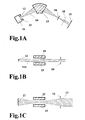
- Figure 1a shows the dispersion plane (the plane in which there is dispersion of the ion beam into many directions according to their (mass)x(energy) product and charge state) of a conventional mass separator.
- the ion beam can be extracted from the ion source [4] as a circular beam, but where a high beam current is required it is usual to extract from a long slot (long in this context being typically a 10:1 aspect ratio or more).
- the ion source 11 produces ions which are extracted from the ion source aperture 12 (circular or long slot) using electrically biased extraction electrodes 13 to form an ion beam 14 (with an energy determined by the extraction voltage) which typically diverges from the ion source extraction region.
- the ion beam is then passed between the poles of an analysing magnet 15 as also shown in a side view in Fig 1b, the beam in this case being a parallel ribbon beam 14A.
- This magnet has two functions, one being to achieve mass dispersion and the other being to focus the beam so that mass analysis can be achieved at the resolving slit 16. It is necessary to focus through a resolving slit so that slightly lower ion masses (deflected through a larger angle) or slightly higher masses (deflected through a smaller angle) are not transmitted.
- This analysis technique does not allow the use of multiple ion beams (as viewed in the dispersion plane of Figure 1a) and the size of the beam in the extraction slot plane is limited by size of the magnet pole gap.
- the divergence in the dispersion plane which is normally small (typically a half-angle of 1-3°), may be acceptable for ion implantation; if it is not then an optical element 18 in the dispersion plane can be used to create a parallel beam before arrival at the target 19.
- the optical components 17 and 18 may be separate or achieved in a single optical element.
- the length of the slot is limited only by the acceptable divergence from the resolving slit 26 (from the point of view of the angular acceptance of the rest of the ion beam system) and the maximum acceptable length from the magnet exit to the resolving slit.
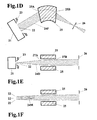
- Figure 1e shows a side view along the axis of the long slot, the beamline being unfolded into a single plane for convenience of illustration.
- a divergent beam 24D is shown leaving the ion source 21, its outlet aperture 22 and the beam forming extraction electrodes 23.
- the beam enters an angled entry analysing magnet field which (for this particular angle of entry) produces a convergent lens 27A (a well known technique for achieving useful converging or diverging focusing [7] ), which significantly reduces the divergence of the beam, and then is focused more at the angled exit region 25B and 27B, ideally producing a near parallel beam.
- Figure 1f shows a source-to-magnet view of a multiple (three) beamlet beam 24M from three outlet apertures 22. The direction of each of the beamlets in the extraction region is chosen for optimum transmission through the analysing magnet.
- Magnetic multipole focusing is commonly used in accelerator beamlines [8], the most commonly used being the quadrupole lens.
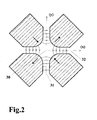
- This lens is shown in Figure 2.
- a beam travelling in the direction of the z-axis 30 (normal to the x and y axes) will experience the action of two focusing planes yz 31 and xz 32.
- One of these planes will be a diverging lens and the other a converging lens, depending on direction of magnetisation, beam direction along the z-axis and particle charge polarity.
- the overall focusing in both planes can be converging [9].
- the important aspect of the prior art use of these lenses is that the general direction of charged particle beam propagation is along the axis 30 of the lens (the z-direction) and is a beam of circular symmetry.
- the ideal solution to the beam current limitation problem is a mass analysis technique that can be used with any number of any length ion source outlet slots.
- a conventional apparatus for acting upon charged particles differently in dependence upon different values of one or more parameters of the particles comprising mass and/or energy and/or charged state of the particles comprises :
- the magnetic poles (331) have a configuration in a plane perpendicular to the said direction (350) of elongation of the array in which the array of magnetic poles is such as to provide between physically opposed poles at least one extended transverse field region of magnetic field with a magnetic field direction transverse to the virtual reference surface, said at least one transverse field region of magnetic field having entry and exit regions associated with individual opposed poles in the array and leading to and exiting from the transverse field region of magnetic field respectively, the entry and exit regions providing curved magnetic fields which are curved in a plane perpendicular to the virtual reference surface, said at least one transverse field region of magnetic field and said entry and exit regions being such that charged particles of the beam, entering into or originating in the field of the magnetic pole array, and moving in said transverse field region with a direction of movement in or substantially parallel to the reference surface have a curved motion imposed thereon by the transverse field region of magnetic field, and pass through the curved field of at least one exit or entry
- the virtual reference surface consists of a virtual surface passing through the array of magnetic poles and defined for the purposes of setting out the features of the present invention.
- the said virtual reference surface is not limited to a surface of a physical object.
- it may be preferred to arrange that the array of elongate magnetic poles has a longitudinal axis defining the said direction of elongation of the array of magnetic poles.
- the said longitudinal axis of the array may be contained in the virtual reference surface or may be spaced from but parallel to the virtual reference surface.
- the charged particles moving in the magnetic pole array may consist of a beam of charged particles passing through the magnetic pole array, or the magnetic particles may originate in an area within the magnetic pole array.
- the most usual use of the parameter dependent selection will be mass analysis for example for producing a selected ion beam for ion implantation, or for use in a mass spectrometer or mass separator.
- the longitudinal axis of the magnetic pole array may be a rectilinear longitudinal axis, or a curved longitudinal axis.
- the elongate magnetic poles may be straight or curved.
- the longitudinal axis may constitute all or part of a circle, or other curve.
- the virtual reference surface may be a plane, that is to say a flat surface, or alternatively may be a curved surface for example a cylindrical surface.
- the configuration of magnetic poles in a plane perpendicular to the longitudinal axis may have a physical geometric symmetry on either side of the reference surface, that is to say the physical components may be symmetrical about the reference surface, even though the magnetic orientation of the poles may or may not be symmetrical.
- the virtual reference surface forms a reference surface of physical geometric symmetry of the array.
- the array of magnetic poles is such as to provide between opposed poles a transverse field region, also referred to as an extended region of magnetic field, in which the charged magnetic particles pass with a curved motion imposed thereon by the field, together with entry and exit regions which provide curved magnetic fields giving focusing of a beam of charged particles.
- parameter dependent dispersion is meant the different changes of direction of movement produced by the magnetic pole array on particles having different values of parameters. It is arranged that the particles of a beam are focused by the effect of the magnetic pole array, and in embodiments of the invention, the parameter dependent dispersion produces focusing of the beam of particles at different focal points along the general direction of propagation of the beam.
- one or more barriers are provided with an analysis aperture or apertures at the focal point of a desired species in the particle beam, preferably the barrier or barriers be aligned along the general direction of propagation of the beam.
- the array of magnetic poles is such as to provide between opposed poles a transverse field region, also referred to as an extended region of magnetic field, in which charged particles moving with a direction of movement in or substantially parallel to the reference surface have a curved motion imposed thereon by the field, together with entry and exit regions which provide curved magnetic fields, curved in a plane perpendicular to the reference surface, giving focusing or divergence of a beam of charged particles passing through the curved field at an angle to the normal to the entry or exit region.
- the extended region also has curved magnetic fields curved in a plane perpendicular to the reference surface.
- the array of magnetic poles also referred to as a multiple magnetic pole array, or multipole, comprises an array of magnetic poles distributed in a plane at right angles to the longitudinal axis (which may be an axis of symmetry), with a geometry appropriate to the focusing requirements and extended along the straight or curved axial direction of the magnets a distance determined by the focusing requirements, the geometry and strength of these poles being consistent along this multipole axis.
- the magnetic poles can be produced electromagnetically or they can be permanent magnets.
- the important aspect in preferred forms of the invention is that it is mass dependent and is used as a method of beam analysis.
- the term 'mass dependent' is a simplification of the true situation.
- the path of the charged particle is dependent not only on mass but also upon the energy and charge state of the particle.
- An ion beam extracted from an ion source will have an energy determined by the acceleration voltage and the charge state of the ion species..
- the elongate cross-section, charged particle beam, with substantial extension across the reference surface may be provided by what is normally termed a 'ribbon' beam.
- the ribbon beam can be curved in a direction at right angles to the general direction of propagation of the beam (a curved ribbon).
- a uniform ribbon beam is propagated through the lens system as a uniform ribbon beam.
- the beam providing means is arranged to provide charged particles entering into, or originating in, the initial transverse field region; the magnetic poles having a configuration in a plane perpendicular to the said direction of elongation such as to give parameter dependent curved motion to charged particles of the beam moving in the initial transverse field region of magnetic field, said charged particles leaving this transverse field region of magnetic field at an angle to the normal to the direction of elongation of the array, passing through any intermediate transverse field regions of the array, and moving into the final transverse field region of magnetic field; successive of said transverse field regions being of alternate polarity.
- transverse field regions are also referred to as extended regions of magnetic field.
- the charged particles may, for example, enter into the initial extended region as a beam of particles, or the particles may be generated in the initial extended region of field. Also, the particles moving in the final extended region may exit the region and then pass to other components, or the particles may be used within the final extended region, for example for ion implantation in a target in the final extended region.
- the significance of the extended field regions between the first set of poles is that it creates the direction of travel through the multiple magnetic pole array that is necessary to create strong focusing (assuming that the beam entering this extended field region did not originally have this direction of travel) and determines, together with magnetic field strength in the multipole region, the strength of the lens action (for a charged particle with a particular mass, energy and charge state).
- the exit extended field determines the angle of the beam when it leaves the magnetic field region.
- a preferred feature for use with the first aspect of the invention is that the initial and final extended regions of magnetic field are substantially symmetrical about a plane perpendicular to the reference surface. This plane is preferably positioned equidistant between the initial and final extended regions.
- This special case is important because a uniform, parallel ribbon beam entering the mass analysing system leaves as a uniform, parallel, analysed beam travelling in the same direction.
- the condition that the entry and exit fields are equal in magnitude can mean either equal flux, or in a desirable special case equal in flux density distribution and geometry (exit field is a mirror image of the entry field).
- exit field is a mirror image of the entry field.
- the latter condition allows the use of complex pole shapes and magnetic fields that are near to saturating the magnetic material of the poles and, because of the intrinsic symmetry of the system, maintains the parallel in/parallel out characteristic.
- This magnetic field arrangement is intrinsically balanced and this has a number of practical advantages.
- the main aspects of the invention not only include the facility of mass analysis but also the facilities of energy analysis and charge state analysis.
- the initial charge state of the particle determines the energy for a given acceleration voltage.
- the charge state can change during transmission (by interaction with neutral gas molecules, for example), the change from singly charged to neutral being particularly important for ions. This can lead to a number of different particle energies in the beam after subsequent electrostatic acceleration. For low energy semiconductor implant, for example, deceleration of the beam may be desirable. Any neutrals in the beam will not be decelerated and the high energy ion impurity in the beam are extremely undesirable.
- the array of magnetic poles comprises a quadrupole having two magnetic poles on each side of the reference plane and preferably the apparatus is arranged in such a manner that parameter dependent collection of charged particles may be achieved by placing collector means on the quadrupole axis.
- This second aspect is a very high resolution technique for collecting a particular mass species for mass separation or mass spectrometry. It would not be suitable for beam formation for ion implantation because of the uncertain optics of the beam as it travels along the quadrupole axis. It can be part (or all) of an ion beam system, the lens being used to analyse and deliver an ion beam to target but with the added facility to analyse the content of the beam passing through this lens.
- the arrangement is such that said charged particles move in parameter dependent curved trajectories in the magnetic field of said at least one transverse field region with relatively high curvature trajectories staying within the transverse field region and being reflected from it, and relatively low curvature trajectories passing through the transverse field region, whereby parameter dependent dispersion of particles is achieved by a focusing action on reflected high curvature beam trajectories and a focusing action on transmitted or collected low curvature beam trajectories, the transverse field region acting as a selective reflection mirror.
- the most useful application of this aspect is for a beam entering the multipole extended entry region at an angle, say 45°, and reflecting out to give a reflection angle of 90°. This reflects masses lower than a certain value and transmits or collects higher masses. If the beam geometry allows, it may be possible to use the mass dependent focusing of reflected beams to achieve analysis.
- the multipole need only be a dipole (or quadrupole).
- the optics described in the aspects above provide the required mass dependent properties necessary to achieve a mass analysed beam which can be delivered to a target with the required characteristics.
- the techniques necessary to utilise the invention include removal of unwanted mass species and beam formation with the required optics.
- the array of magnetic poles is positioned to act on an ion implantation beam entering the array in a non vertical direction, and arranged to deflect the beam so as to exit the said field in a substantially vertical direction, for ion implantation into a subsequent substantially horizontal target.
- This arrangement finds particular use for ion implantation into a horizontal or approximately horizontal target, for example being moved on a horizontal or substantially horizontal conveyor, where it is desired to implant by a vertical or near vertical particle beam.
- this is arranged conventionally, it is normally necessary to provide components for generating the vertical beam, positioned directly above the moving conveyor belt of targets. This gives the disadvantage of particulates falling onto the wafers with consequent contamination.
- the embodiment that the invention allows generation of the implantation beam in a horizontal or near horizontal plane, and the reflection or deflection of the beam through a required angle to emerge substantially vertical.
- the magnetic pole array is such that the beam of charged particles is focussed to at least one cross-over and the position of the cross-over of required particles is chosen to be within the magnetic field of the array so that subsequent further focusing action on the required particles is carried out after the said cross-over point by the effect of the magnetic field of the array.
- This aspect of the invention covers the general case of a beam which has a general direction of propagation parallel to, but not necessarily along, the plane of geometric symmetry, and coming to a crossover (focus) at a position not necessarily in the plane of geometric symmetry.
- the said reference surface is a surface of geometric symmetry with regard to the array of magnetic poles, and the aperture of the resolving structure lies on the plane of geometric symmetry.
- This aspect covers the important practical embodiment where a beam diverging from a source extraction region has an axis of symmetry regarded as the initial general direction of propagation which coincides with the plane of symmetry of the lens structure (the central plane), or a parallel beam (not necessarily symmetrical about the central plane or, in an important practical embodiment, completely to one side of it) which comes from an object position at infinity.
- the crossover (focus) occurs in the lens plane.
- the first of these two geometries has the resolving structure in the middle of the beam and therefore the central part of the beam is lost.
- the structure therefore needs to be as thin as possible, relying on techniques such as tensioning to keep these structures straight.
- the presence of the resolving structure as an electrode can be an advantage for high perveance (high space charge) beams as it creates a central region of zero (ground) potential and allows the injection of secondary electrons (to reduce space charge) into the centre of the beam in the extraction region (see a later aspect of this invention).
- space charge is, in general, not a problem in this invention because the beams are space charge neutralised because there are no electric fields in the lens region and because the invention allows the use of relatively low current density beams. This is due to the lack of restriction on the size and number of beams transmitted from source to target.
- the resolving structure allows transmission of the beam that passes through the aperture, usually a slit, and removes any beams which have crossovers at other positions along the resolving structure.
- Very high mass beams may have crossovers a considerable distance along the lens plane, or no crossover at all (the diverging beam from the extraction region remaining diverging or becoming, in the limiting case, parallel. These high mass beams must be removed without impeding the transmission of the required mass beam.
- a transmission limiting structure positioned in a plane or planes transverse to the general direction of propagation of a focused beam through the resolving structure, for preventing transmission of particles following trajectories beyond the range obstructed by the said resolving structure.
- part of the resolving structure can be extended along the central axis of the beam towards the source into a magnetic field free region away from the lens entry region, where secondary electrons can be transmitted up through the centre of the beam towards the extraction region, reducing the space charge potential at the centre of the beam. This will reduce the divergence of high perveance (high space charge) beams, particularly important for low energy implantation.
- the apparatus includes an extraction assembly for extracting positively charged particles from an elongate charged particle source which is elongate in a direction transverse to the general direction of extraction of the particles, the extraction assembly having an accelerating region followed by a decelerating region to produce a charged particle beam the optics of which are significantly influenced by the space charge of the extracted charged particles; the assembly including an elongate element of conducting material at a floating or a controlled potential, situated at the centre of the beam and parallel to the elongate axis of the source region, and positioned in the electrostatically decelerating field for positive ions or in a field free region; the arrangement being such that the presence of secondary electrons produced by charged particles striking the elongate element, and the presence of the element acting as an electrode, combine to reduce the space charge at the centre of the beam, thus increasing the beam current that can be usefully extracted.
- the wire or strip in this aspect could be tensioned to keep it straight, particularly when, in order to minimise beam loss, the wire or strip are very thin. This raises the problem of erosion due to sputtering.
- surfaces are struck by unwanted charged particles, particularly in the form of atomic and molecular ions, which can result in undesirable erosion, build up of surface layers and flake formation for example. It would be desirable, particularly when, as in this invention, these regions are very close to the required beam, for the material being struck by these particles to be continuously, and preferably automatically, replaced.
- the apparatus may include an elongate element aligned along the elongate axis of the beam which is used to intercept charged particle beams, either to remove those beams or to otherwise influence the behaviour of the charged particle beam, and which is thereby subject to deterioration by contact with the charged particles, including means for moving the elongate element in the direction of its elongate axis to replace the parts thereof which have deteriorated due to contact with the charged particles.
- the apparatus may comprise a moving wire or strip, which is used to intercept charged particle beams, either to remove those beams or to otherwise influence the behaviour of the charged particle beam, the removal process preventing excessive erosion, that might lead to breakage or ineffectiveness, or preventing surface material build up or flake formation which might lead to undesirable effects on the beam or any process carried out elsewhere in the system.
- This aspect can be extended to include tensioning of the wire to keep it straight.
- the tensioning of components such as resolving and transmission slit components can be particularly important when dealing with large ribbon beams.
- the apparatus may include an elongate element aligned along the elongate axis of the beam which is used to intercept or otherwise influence the behaviour of the charged particle beam, the apparatus including means for tensioning the elongate element to keep it straight.
- multipole lenses are multipurpose line lenses for use in an optical system and can be used to focus or make parallel beams for entry into another optical element or for delivery to a target.
- focusing is always mass dependent there is a desirable tendency for successive focusing operations to increase the resolving power of the system.
- the resolving power of the individual lens/resolving slit combinations is a variable depending on geometric factors.
- a strong line lens is regarded as a lens where a crossover is achieved within the lens region and the beam continues to be focused in the same lens after the crossover. This means it is possible to analyse and then focus to parallel using a single line lens. There is therefore an important specific further aspect of the previously mentioned seventh main aspect.
- the position of the crossover is chosen so that subsequent further focusing of the beam transmitted through the resolving slit in the multiple magnetic pole array leads to the production of a beam with required optical characteristics.
- the most likely 'required optical characteristic' is a parallel beam. This is a particularly useful line lens geometry when the parallel beam is delivered directly to the target. The quality of the beam leaving the lens is not as good as a 'normal' lens but the mass dispersion is superior. This must be taken into consideration when using a strong lens in a multiple lens optical system.
- one or more further arrays of elongate magnetic poles and associated resolving structures arranged to produce parameter dependent focusing of the beam exiting the first array, whereby a combination of components of the arrays obscures line of sight through the combined system for contamination particles due to sputtering or otherwise.
- the first lens needs to be independently controllable (because the object position is determined by the extraction conditions) adjusted to focus the required beam through the first aperture. Subsequent lenses do not have to be independently controlled. Doublet and triplet lenses can simplify power supply requirements by using a common power supply, reducing the number of electrical conductors needed and reducing the length of the lens system.
- An example of the use of a three lens system consisting of a independent first lens followed by a doublet introduces another aspect of the use of multiple lenses where the axis of the first lens does not coincide with the axis of the following doublet.
- the advantage of this asymmetric approach is that it can avoid the need for a resolving plane in the centre of the beam. This is particularly important for low perveance beams, where there is not an extraction divergence problem caused by space charge beam blow-up, which may lead to very low divergence beams.
- the simplest example is for beam focused to a parallel beam by the first lens; this parallel beam passing into the first lens of the doublet off-centre with the lens power selected to give a parallel beam ⁇ crossover-parallel beam geometry with the beam now off-centre on the other side of the doublet plane of geometric symmetry; followed by a repeat process to return the parallel output beam to the first side of the plane of geometric symmetry.
- This beam geometry gives good resolving power and excellent line-of-sight characteristics.
- apparatus comprising two or more multiple magnetic pole array line lenses with different, but parallel, planes of symmetry, giving mass dependent focusing of a charged particle beam or series of beams, or a beam with substantial extension across the plane of symmetry, with a general direction of propagation parallel to the planes of symmetry through the multiple magnetic pole line lenses, enabling mass analysis to be achieved by first focusing to a parallel beam, this parallel beam then being introduced off-centre on one side of the plane of symmetry of the next lens or lenses, and then focusing to one or more crossovers in this plane of symmetry, and there being a resolving structure on the opposite side of the plane of symmetry to the beam, allowing transmission of a beam with crossovers at the positions of one or more apertures in this structure.
- the resolving structure can be 'infinitely thin' because the resolving structure is either on one side or the other of the plane of geometric symmetry.
- the next, and most important, general aspect of this invention is the fact that, as the ribbon beam travels along the plane of symmetry of the analysing system, there can be as many beams as is necessary to achieve required beam current.
- the magnetic circuits will be in series for transverse-field lenses and will have an alternate parallel/anti-parallel structure for axial-field lenses.
- a plurality of beam systems with regularly spaced respective reference surfaces each sharing at least part of a common magnetic circuit with neighbouring systems.
- the invention in a first aspect is based on the concept of focusing an ion beam using long (parallel to a straight or curved axis) multipole arrays which can achieve mass dependent focusing of a charged particle beam, and , in particular an ion beam.
- the concept is not restricted to ions, but can apply to any type of charged particle of positive or negative polarity, this description will refer to the beam as an ion beam, as this represents the immediate important application.
- An ion, passing through shaped magnetic fields caused by an array of magnetic poles will experience mass dependent (and energy and charge state dependence) deflection from its original path which can be used to achieve mass analysis by selectively transmitting the required mass ion beam while allowing unwanted beams to be lost at intercepting surfaces.
- the multipole array As the entry into the multipole region will be through the space between the first two poles to be encountered by the ion beam, it is convenient to regard the multipole array as a series of dipoles between which the beam passes. In the general case of the first aspect, these dipoles are arranged with no particular symmetry.
- a dipole is, in itself, the simplest form of a multipole, and a multipole can be considered as one or more sets of dipoles which are close enough to each other for their magnetic fields to interact. As the dipole separation is increased the interaction decreases until a point is reached at which it is more appropriate to regard them as independent dipoles.
- the important aspects of this invention are evident from the behaviour of a single dipole and the simplest practical embodiment is best constructed from two dipoles or a single quadrupole.
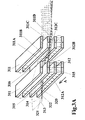
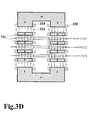
- Figure 3a is a three dimensional diagrammatic representation of an embodiment of the invention for mass analysis of a ribbon charged particle beam.
- Figure 3b is a plan view of the apparatus of Figure 3a taken in a plane extending between two of the pairs of analysis magnets.
- Figure 3c is an end view of the apparatus of Figure 3a, taken in the direction of the arrow A which is parallel to the source.
- an array of elongate magnetic poles 311 is energised by electromagnetic coils 330 shown in Figure 3d and arranged to produce a mass analysis magnetic field directed upwardly through the magnetic poles to the left of the drawing and downwardly through the magnetic poles to the right of the drawing as indicated by notional magnetic field lines 312.
- the array of elongate magnetic poles extends in the direction of a longitudinal axis 350 shown in Figure 3b.
- the array has a reference plane indicated at 320 in Figure 3c.
- a source 313 of a substantially parallel ribbon beam 314 of charged particles for example boron ions produced from a gaseous plasma discharge source, is directed to a gap 315 between a pair of adjacent magnetic poles 311A and 311B and thereafter through a gap 316 between a pair of magnetic poles 311 C and 311D.
- the beam is repeated above and below this pair from a series of stacked source slots, shown in Figure 3C but omitted for clarity from Figure 3a.
- the magnetic field between poles 311A and 311B is substantially perpendicular to the poles 311A and 311B throughout the major portion of the gap 315, but is curved at the boundary fringe fields indicated at 312A and 312B.
- the magnetic field between the poles 311 C and 311D has curved boundary fringe fields at the edges of the gap 316.
- the ribbon beam 314 is substantially uniform there is slight divergence of the beam between the source slot 313 and the first pair of poles 311A and 311B.
- the central plane of the beam 314 is indicated at 320, which constitutes a virtual reference surface, and the divergence of the beam is indicated diagrammatically by edge portions 321 and 322 of the beam 314.
- the beam 314 When the beam 314 enters the gap 315 the beam 314 is bent in a curved path to the right in the plan view of Figure 3b due to the effect of the magnetic field 312 on the charged particle beam.
- the beam 314 is arranged to enter the entry region of the gap 315 perpendicular to the front faces of the magnetic poles 311A and 311B which is a special condition in this embodiment.
- the curved entry fringe field 312A has no significant effect upon the divergence of the ribbon beam 314 from the central plane 320, and the divergence 321, 322 of the beam 314 continues as the beam moves through the gap 315 while being bent in a curved path to the right as shown in Figure 3b.
- the effect of the curved boundary fringe magnetic field 312B because of the oblique exit angle of the beam is to focus the divergence 321, 322 of the beam 314 with the effect, in this example, of a convergent lens.
- the dimensions and field strengths are arranged to be such that the beam 314 emerging from the gap 315 has the divergence angle rendered into a parallel sided ribbon beam. This is also dependent upon the energy and mass and charge state of the particles in the beam. Thus for a given energy and charge of particles in the beam, heavier particles will experience a less converging effect, and lighter ions will experience a more converging effect.
- the parameters are arranged in a practical embodiment such that the required species exits from the gap 315 as a parallel sided ribbon beam.
- the ribbon beam 314 exiting from the gap 315 follows a non-curved path, viewed in the plan view of the plane 320.
- the two sets of magnetic poles 311 there is no magnetic field acting upon the beam, so that the beam follows a straight line path.
- the two sets of magnetic poles 311 are placed close together, so that this portion of the beam part is as small as practical, but in other arrangements the path could be longer if required.
- the effects of the curved boundary fringe magnetic field 312C combined with the oblique angle at which the parallel ribbon beam enters the second gap 316, produces a converging lens focusing effect upon the beam, as shown in Figure 3c.
- the effect of the downwardly directed magnetic field in the gap 316 is to produce a curved path of movement of the beam 314 in the central plane 320, as viewed in plan view in Figure 3b.
- the focusing effect of the fringe magnetic field at the entry to the gap 316 takes place only at the entry boundary.
- the curved path of the beam shown in plan view in Figure 3b is effected throughout the movement of the beam through the gap 316.
- the parameters of the beam and analysing magnets are arranged to be such that for the required species of charged particle, the beam emerges when viewed in plan view in the same direction of propagation as the direction of propagation at the entry to the first gap 315.
- the ribbon beam emerging from the second gap 316 is convergent due to the effect of the curved magnetic boundary field.
- the convergence of the exiting beam 314 will be focused at a focal point, indicated in Figure 3c at 331, which will be different for different species in the original beam 314 leaving the source 313. Heavier charged particles within the original beam will be focused at a greater distance from the analysing magnets and charged particles (for the same energy of particle) of a lighter mass will be focused closer to the source.
- a mass analysis aperture is provided at the focal point 331 for the required species.
- This may be achieved in two main forms.
- a thin barrier 332 which is placed along the central plane 320 of the beam 314 exiting from the magnetic assembly 311.
- An aperture 333 is provided in the barrier 332, at the required focal point 331 to allow passage of the required species.
- the aperture 333 shown in Figure 3c is diagrammatic, and is shown much greater than is required in a practical embodiment. All dimensions shown in these explanatory Figures 3a, to 3f are purely diagrammatic and do not represent actual dimensions of an analysis apparatus.
- barrier can be provided by siting barrier components one on either side of the central plane 320, as will be described hereinafter for example in Figure 14.
- Figure 3e is an enlargement of the side view of gap 315 shown in Figure 3c.
- the magnetic field 312A can be regarded as having components 312D and 312E.
- the component 312D provides the bending effects of the ribbon beam 314 as shown in plan view in Figure 3b.
- the component 312E has no effect upon the incoming beam 314, because the beam is travelling in the same direction as the component of magnetic field 312E. (In this explanation second order effects are ignored, and will be described more fully hereinafter). Thus, no significant focusing is produced by the component 312e on the incoming beam 314.
- the curved magnetic fringe field 312B can be regarded as having components 312F and 312G.
- the component 312G is responsible for some bending of the beam in plan view as shown in Figure 3b as the beam exits..
- the component 312F is now not parallel to the exiting beam, which exits at an oblique angle to the pole boundary.
- a bending effect is imposed on the beam by the reaction between the charged particles in the diverging beam and the magnetic field component 312F. This effect will vary according to the angle in plan view between the beam 314 and the component 312F, and dependent upon the charged mass and energy of the particles.
- the parameters are chosen in the particular embodiment described to be such that the effect of the component 312F on the diverging regions of the beam 314 in Figure 3e, is to converge the beam to be a parallel faced ribbon beam, for the required species.
- the magnetic field 312B is perpendicular to the plane of the ribbon beam, so that there is no component equivalent to the component 312F.
- the focusing effect occurs only at the divergent regions of the ribbon beam, as for an optical lens, portions of the beam at the centre of the lens merely pass through without deflection.
- Apparatus for acting upon charged particles has particular application in a mass analysis apparatus.
- An array of elongate magnetic poles 311 extends longitudinally in the direction of a longitudinal axis 350 of the array, the array having a symmetrical reference surface 320 containing the longitudinal axis and passing through the array with magnetic poles 311 on each side of the reference surface.
- Charged particles 314 enter into, or originate in, the field of the magnetic pole array at a position spaced from the said longitudinal axis 350.
- the array of magnetic poles is such as to provide between opposed poles 311A, 311B, an extended region of magnetic field in which the charged magnetic particles pass with a curved motion imposed thereon by the field, together with entry and exit regions 312A and 312B which provide curved fringe magnetic fields 312A, 312B, giving focusing or divergence of the beam of charged particles passing through the fringe field at an angle to the normal to the entry or exit region.
- the apparatus includes resolving means 332 for selecting a required species of particle from the beam by parameter dependent dispersion in a plane transverse to the reference surface 320, by focusing of the beam of particles at different focal points 331 along the general direction of propagation of the beam 314.
- the beam may enter the magnetic analysing system at an oblique angle, or may be allowed to exit at an oblique angle.
- the beam may enter at an oblique plan view angle, it will always exit at the same oblique plan view angle.
- the magnetic field systems may be designed differently so that different angles of entry and exit may be achieved.
- focusing effects by the boundary fields may be such as to produce the effects of converging or diverging lenses, as required.
- FIG 3f is a detail of the plan view of Figure 3b.
- the beam components 314H represent the paths of heavier charged particles within the beam and the components 314L represent lighter components within the beam. It will be seen that some dispersion of the beam takes place in the plane of the paper in Figure 3f, since the lighter components 314L of the beam pass along more curved paths through the gaps between the magnetic poles than the heavier components 314H, with the end result that for the lighter components 314L the ribbon beam is displaced side ways to a greater extent than for the heavier components.
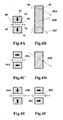
- Figure 4a shows the simplest case of a transverse field dipole with a section through two long poles 41 with parallel magnetisation and with an ion beam 42 passing along the plane of geometric symmetry (central plane) between the parallel pole faces 43, the magnetic field crossing this central plane at right angles.
- the entry fringe field 44 and the exit fringe field 45 have a curved geometry which gives a focusing action which is dependent on the angle that the ion beam passes though the fringing field (and also the direction of the field and the electrical charge on the ion).
- the ion beam it is necessary for the ion beam to be travelling at an angle to this direction for their to be a strong focusing action on the beam.
- Figure 4b is a view along the direction of magnetisation showing a number of ion beams passing across the central plane between the pole faces.
- Beam 42A enters the entry field at right angles and there will be no focusing. As it passes across the magnetic field it is deflected so that it exits at an angle which gives convergent focusing.
- the focusing action on beam 42B is convergent at entry and divergent at exit and the focusing action on beam 42C, like that in Figure 1 e is convergent at entry and exit.
- the entry boundary 46 and exit boundary 47 are parallel and therefore no focusing occurs in the central plane.
- Figure 4c is structurally a dipole but the field geometry is that of a double dipole or, for a short pole width (between the entry and exit boundaries), a quadrupole.
- the focusing effect for an angled entry beam 42D is generally converging but the situation becomes complex for low energy beams which are substantially deflected producing powerful convergent focusing of a type which will be discussed in the next section.
- Figures 4e & 4f show dipoles of an axial field type where the direction of the magnetic field in the central plane is along that plane in directions perpendicular to the entry and exit boundaries.
- the fringe fields 44B and 45B are in opposite general directions and fields 44C and 45C are parallel when the dipoles are considered in isolation but the detailed behaviour is dependent on the nature of the rest of the magnetic circuit.
- the focusing is generally weakly convergent for a beam entering normal to the entry boundary. Oblique entry results in a displacement of the beam axis out of the central plane.
- the magnetisation in the pole region can be produced electromagnetically; the pole can be (and normally would be) be a magnetic material of substantial magnetic permeability to enhance or control this electromagnetically produced magnetic field or the poles can be permanent magnets.
- the directions of magnetisation are shown in Figures 4 in orthogonal directions for simplicity but they may advantageously be at intermediate orientations. The position of conductors relative to the poles will influence the shape of the magnetic field.
- the entry and exit dipoles are the transverse-field type shown in Figure 4a and the pole width is chosen so as to produce substantial deflection of the beam.
- the beam starts or is introduced by appropriate means into an extended magnetic field region between these transverse-field dipoles and passes through into another region. If the field is uniform, the charged particle path would be circular in both of these regions, and the particle path may repeatedly cross through the multipole region, being focused appropriately for the particular requirements. The position of crossing through the multipole will tend to drift in one direction; if the multipole axis is curved then this can be made into a closed loop with particles of opposite charge deflecting and drifting in opposite directions.
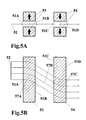
- Figs 5a&b show a ribbon beam from a line source 52 entering at normal incidence into the entry boundary 51A.
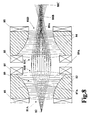
- Figure 6 shows the same view as Figure 5a showing the focusing action in a plane parallel to the beam direction and at right angles to the central plane of the multipole for a computer modelled geometry with shaped electromagnetic poles 53 and 54, conductor coils 55 producing magnetic flux lines 56.
- the beam 57B travels in a straight line through the field free space between the two dipoles, experiences convergent focusing upon oblique entry into boundary 51 C to give a convergent beam 57C and no further significant focusing upon normal exit from the final boundary 51 D.
- the position of the focus crossover 58 in Figure 6 is mass dependent and is the basis for the mass analysis technique of this invention.
- Figure 7a shows the view along the axis of a quadrupole lens formed by bringing the two dipoles of Figures 5 together so that there is significant field interaction leading to substantial quadrupole field components 71 E and 71 F between dipoles 73 and 74, in addition to the four boundary fringe fields 71A,B,C&D.
- Figure 7b shows a view of the central plane with beams 77 from line source 72 passing through the quadrupole and being continuously deflected in the quadrupole.
- Figure 8 is equivalent to Figure 7a but is a practical computer modelled geometry with shaped poles 83 and 84 with opposite directions of magnetisation produced by electrical conductors 85.
- Figure 8 also shows transverse field regions of magnetic field 89 with curved field lines 89A produced by the inhomogeneous field between the non-parallel pole faces of poles 83.
- the invention in its third aspect makes use of 'reflected' beams to create a useful ion mirror.
- the focusing of a reflected beam is shown in Figure 10a for a dipole (all that is necessary when dealing with the reflection situation), the beam in this case a parallel beam 1 01A entering at 45° incidence being focused to a crossover 108 of an exit beam 101B after 'reflection' through 90°, as shown in Figure 10b.
- a more useful situation is the parallel input beam being reflected out as a parallel beam which will occur at a slightly lower lens power.
- the reflect/transmit criterion or a collector plate 109 can be used to limit the maximum mass reflected.
- Reflection from a dipole is a useful technique for deflecting a wide beam through a large angle such as would be required when there must not be line of sight between the ion source and the target.
- the focus crossover 108 can be used for mass analysis.
- the invention in its fourth aspect consists of a structure which allows only the required beam to be transmitted by focusing at and through an aperture in this structure but for all other beams to be intercepted.
- the invention in one aspect is the particular important case of this structure having an aperture in the position of the crossover at the central plane of the required species.
- the invention in another aspect consists of an additional structure which prevents the transmission of high mass species which either focus to a crossover at some inconveniently long distance along the central plane or do not crossover at all.
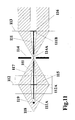
- Figure 11 shows an example of this mass analysing structure.
- the resolving structure 111 consists of a thin structure on the central plane with an aperture at the position chosen for the crossover focus for the required beam 117 as a result of the action of the line lens 112 acting on a beam diverging from an object position 118. This structure extends to the position 111A in the source direction sufficiently to intercept all beams which cross the central axis in this region after reflection. The distance that the resolving structure extends towards the target is dependent on the subsequent optics of the beam. If the resolving structure were to stop at position 111 B, means must be available to prevent transmission of beams not blocked by this structure.
- This means consists of a transmission limiting structure 114 with an aperture 114A at the central plane crossover position combined with beam stops at positions 115 and 116 which determine how much of the centre of the beam is removed and prevent the transmission of any beam focusing to a crossover beyond position 111 B, the limiting case being where the aperture 114 width is the same as the beam stop (115 and 116) width.
- These beam stops are best placed where the beam is widest i.e. at lens 112 and at the position of any subsequent lens 113 used to create a parallel beam for transmission to the target.
- Beam stop 115 combined with aperture 114A also limits line of sight to the extraction region in the vicinity of the object position 118.
- the resolving structure described is most appropriate for high perveance, low energy beams which will have a high divergence. This is partially because the fraction of the beam removed by the beam stops is less for a beam with substantial divergence (a half angle of 3°, for example, with the beam stop removing the centre half angle of 0.25°).
- the invention in a fifth main aspect takes advantage of the need for a beam centre structure for mass resolution by providing means for reducing the space charge potential in the centre of the beam in the extraction region where electrostatic fields prevent the formation of a beam which is space charge neutralised by the presence of low energy secondary electrons (as occurs throughout the multipole lens region where electrostatic fields are absent).
- the wire 119 (or thin strip) has a number of functions:-
- This wire can either be at a controlled potential or it can float and allow the potential to be determined by the effect of the secondary electrons.
- this wire will be eroded (and may suffer undesirable surface changes) and its position needs to be accurately controlled.
- the rate of erosion of the wire 119 in Figure 11 compared with the time interval for other maintenance procedures will determine the need for this wire to be renewed on a continuous basis; the need for continuous replacement of other components will be determined by beam chemistry.
- One particular example for the need for component renewal is for the case of oxygen ion beams; if atomic oxygen is transmitted through the aperture 114A in component 114 in Figure 11, then molecular oxygen will strike component 114 , and, assuming that this is a metallic component, oxide formation could lead to surface charging which would lead to beam degradation.
- the invention in one aspect is concerned not only with mass analysis but also beam formation.
- ion implantation for semiconductor materials requires the beam to be a parallel beam (in the ribbon plane and the dispersion plane).
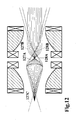
- Figure 12 shows the beam optics when the quadrupole lens of the type shown in Figure 8 is used in a 'strong lens' mode. This is where the required beam 127A passes through a crossover at 128A and the required beam 127B is then focused into a parallel beam using a single quadrupole lens.
- the invention in another aspect is concerned with the use of two or more lenses to achieve mass analysis, enhanced mass analysis due to multiple crossovers, line of sight protection (against sputtered contamination reaching the target) and focusing of the beam to the final required optics.
- the final required beam optics leaving the magnetic line lenses will generally be a parallel beam unless subsequent acceleration or deceleration of the beam is required.
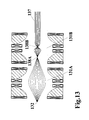
- Figure 13 shows a system consisting of two lenses 131A and 131B (with a common central plane - a useful special case) producing crossovers at positions 138A and 138B for a ribbon beam diverging from object position 132, the final output beam 137 being nominally parallel in the dispersion plane.
- the ribbon beam is uniform and parallel in the ribbon plane when it leaves the source 132 then the beam arriving at target is parallel. If the line source is curved to produce a converging or diverging beam in the ribbon plane, then the lens system is curved concentrically to maintain this geometry.
- the two lenses can have similar or opposite magnetic polarity. It is best for the first lens to be variable independently of the second so that variations in the object position due to variations in extraction conditions can be accommodated. In situations where the lenses can be used as a matching pair, with the same current passing through all conductors, and when the magnetic polarity is opposite in the two lenses, it is possible to create a doublet lens with the two adjacent conductors removed as they will have equal and opposite electrical polarity as shown in Figure 14. The same applies to combinations of more than two lenses.
- Figure 14 is concerned with dealing with (but not restricted to) low perveance beams which leave the source extraction region with a low divergence so that a central resolving structure is not an attractive proposition.
- the first part of the optical system (not shown in Figure 14) is used to create a narrow parallel beam.
- the beam is then passed into a parallel-in/parallel-out lens system consisting of one or more line lenses, where the beam is always on one side or other of the central plane of these lenses.
- the parallel beam condition is unusual in that an off-centre beam has an object position which is apparently on the centre plane because it is at infinity. This means that beam crossovers are on the central plane.
- the use of such asymmetric lens combinations is not restricted to parallel beam conditions.
- Figure 14 shows an example of a doublet line lens 141 with two quadrupole fields indicated by regions 145A and 145B between three regions of transverse field (inhomogeneous) 149A, 149B and 149C producing two crossovers at positions 148A and 148B from a parallel entry beam.
- the resolving structure consists of components 142 and 143 which, if surfaces 144 are on the central plane, creates an infinitely thin resolving structure. There is no line of sight through this structure.
- the beam entering this lens system can be from a lens system with or without a resolving structure.
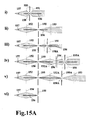
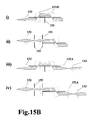
- Figures 15a and 15b Examples of the way these line lenses can be combined are shown in Figures 15a and 15b, Figure 15a showing examples of symmetric systems and Figure 15b asymmetric systems, the views being along the axis of the extraction slot.
- the important components are the 'strong' lenses 151, 'normal' lenses 152, post-acceleration systems 153 which accelerate the beams to a higher energy, post-deceleration systems 154 for decreasing beam energy, transmission limiting structures 155, resolving structures 156, space charge electrode in the form of a wire or strip 157.
- the beam is brought to one or more crossovers 158.
- Figure 15a(i) shows the simplest case of a single lens 151 used in the strong lens mode providing the crossover 158 at the aperture position in resolving structure 156 and transmission limiting structure 155 necessary for analysis and also producing a parallel beam for transmission to the target.
- the main consideration when using any system with a single crossover is the transmission of sputtered material to the target caused by reflected beams hitting surfaces in the region between the source and the crossover position.
- the detailed geometry of the system will determine the line-of-sight situation. This will not be a problem for the case of boron ions produced from boron trifluoride, as there will be no significant impurity beams at lower ion masses.
- Figure 15a(ii) shows a single magnetic lens 152 used in 'normal' lens mode where the post-acceleration system 153 is used to create a parallel beam and in Figure 15a(iii) a second strong lens 151 produces the parallel beam and provides a second crossover 158A which will be very effective in preventing sputtered contamination transmission.
- Figure 15a(iv) shows a deceleration system.
- the first lens 152 focuses the beam to a crossover 158 for mass resolution;
- the second lens 152A provides a converging beam into the post-deceleration system 154 and
- the third lens 151 a strong lens, produces a parallel beam and acts as an energy filter.
- Figure 15a(v) is an example of a two magnetic lens system, lenses 152 and 152A, where the second lens is used to provide a variable crossover position 158A as the input to the post-acceleration system 153, enabling the optics of the final beam to be optimised.
- Figure 15a(vi) shows a lens stage that can be added to the front of any of the above beamlines.
- An initial lens of this type can have a number of functions; it can focus the beam through a narrow slit to improve the emittance of the beam passing through to the next stage and provide an extra crossover, which increases the mass resolution; an independently controlled first lens is always needed to cope with the variable object position (this position being a function of extraction conditions); and when there is a substantial hydrogen beam it may be desirable to prevent reflection of these light ions by making this first lens a hydrogen removal lens.
- Figure 15b(i) shows an example of an asymmetric system where a low divergence beam is extracted from the source and where the requirement for a central resolving structure would not be convenient.
- the first lens 152 produces a parallel beam which is introduced asymmetrically into lens 151D, a strong lens doublet, giving excellent line-of-sight characteristics.
- Figure 15b(ii) shows an alternative asymmetric layout; lens 151 need not be a strong lens and lenses 152 and 151 could be replaced with a single lens to produce the parallel beam, the choice being determined by resolving power and line of sight issues.
- Figs15b(iii)&(iv) are similar systems with post-acceleration 153 preceded by an optional lens 152A controlling the input optics into the acceleration stage.
- the system shown in Figure 15b(iv) is ideal for a very high current oxygen machine; when the required beam is atomic oxygen, most of the molecular beam will strike one component 155, the transmission limiting structure, and this structure can be a moving strip (to prevent oxide charging problems) or it can be carbon, the oxides being gaseous and therefore can be pumped away.
- the invention in another aspect concerns the ability to combine line lens systems to mass analyse and focus many ribbon beams travelling in parallel planes from multiple slot ion sources.
- This aspect covers the general case for any mass analysis technique which retains the beam in the plane containing the long ion source slot and a further aspect covers the specific case of magnetic line lenses.
- Figure 16 shows multiple two lens beamlines using multiple lenses 161 and 161A with parallel directions of magnetisation 163 and 164 producing common magnetic circuits.
- a series of beams 167 in parallel planes are produced from parallel line sources 162.
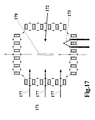
- Figure 17 is concerned with the need to be able to implant the high beam currents made available by this invention without damage to the surface of the target caused by surface charging.
- Figure 17 shows beams 177 leaving line lens mass analysis and focusing system beamlines 171 and entering the multicusp plasma region 172.
- Filaments 173 can be used to generate a gaseous plasma in the multicusp region and the target elements 179 ( a single target element shown for simplicity) can move into, through or mechanically scanned in the multicusp region 172, passing through the ion beams 177 in the process.
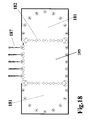
- Figure 18 is concerned with the need to provide uniform moderate and high intensity ion beams because the invention relies on the ability to achieve a uniform implant of the target by simply passing the target through a series of uniform ribbon beams, there being no beam scanning involved.
- a virtual pole source can provide such uniform beams but, for very high uniformity and/or high beam current densities, substantial improvement is possible by making the ionisation a two (or more) stage process.
- Figure 18 shows two plasma generation regions 181 where plasma is produced by one of a number of mechanisms (not shown), hot filament arc discharge and microwave generation being two of the most important techniques.
- the plasma generated in region 181 is very uniform when the gas pressure is low enough for primary electrons formed by the generation technique to have a mean free path between ionising events which is large enough for the plasma not to be excessively concentrated close to the region of primary electron generation.
- This uniform plasma then extends through the virtual poles 182 into the plasma region 183 from which the ion beams 187 are extracted, producing a better uniformity plasma than would be possible if the primary electron generation means was situated in this region.
- This technique becomes critically important when high beam current densities are required that make it necessary to generate the plasma at a pressure where the uniformity becomes sensitive to the distribution of primary electron generation.
- This aspect of the invention is important when very uniform intense plasmas are required for the production of very uniform, high current density ion beams.
- the requirement for both uniformity and high current creates a conflict in the ion source.
- the high current density requirement means the beam must be extracted from an intense plasma which can be best achieved at relatively high gas pressures in the plasma region; the requirement for good uniformity is best achieved in a low pressure environment where plasma particles are free to move rapidly throughout the plasma region in order that the plasma should be uniform.
- the best solution is to create the plasma initially in relatively high pressure regions (of the order of 10 -3 torr) and then to feed this plasma through virtual poles into a lower pressure (pumped) region (with a pressure of the order of 10 -4 torr) from which the ion beam is extracted.
- This is a good technique for producing extremely uniform moderate current density beams, the virtual poles acting as uniform sources of primary electrons and plasma in contrast to the localised sources created from an array of filaments, for example, in a single stage source.
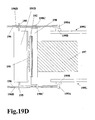
- Figure 19 is concerned with the need to extract a uniform beam from the uniform plasma. This requires precise adjustment of precise geometry extraction electrodes. It is not possible, in practice, to achieve this by accurate fixed positioning.
- the extraction gap must be consistent along the length of the extraction slot because the beam current will, in general, depend on the electric gradient at the plasma surface in the extraction slot (the exception being when the beam current is limited by the source and when space charge considerations do not significantly affect extraction optics).
- the extraction electrode must be accurately aligned with the central plane of symmetry of the ribbon beam extraction system so that the beam axis and the geometric axis are accurately aligned. Again, fixed positioning will rarely achieve this requirement.
- This aspect of the invention therefore deals with creating a variable geometry extraction field by controlling the other electrodes involved in the extraction process.
- Figure 19a shows the outlet electrode 191 of the ion source, the extraction electrode assembly 192A and 192B (also called an accelerating or screening electrode) and the decelerating electrode assembly 193A and 193B (also called a ground electrode, as it is usually at ground potential when the subsequent beamline is at ground potential), producing an ion beam 197 from the plasma surface 191A.
- the structure containing electrodes 192A, 192B, 193A and 193B would be a fixed geometry assembly. This aspect of the invention allows some or all of these components to be individually moved.
- the voltage difference between electrodes 192 and 193 is a way of providing an electric field which prevents low energy electrons, important for space charge neutralisation of the beam, from being accelerated towards the ion source and consequently lost from the beam.
- this field generally has only a minor influence in determining the optics of the extraction field, it will generally be acceptable for the relative positions of electrodes 192A and 193A, and also 192B and 193B to be fixed.
- the position of the extraction electrode/deceleration electrode assembly 192A to 193B can be moved as a fixed whole towards and away from the outlet electrode 191, along a direction perpendicular to the plane of the outlet electrode 191.
- Figure 19B is a plan view of an apparatus embodying the invention in this aspect, for achieving the path of movement 194.
- the outlet electrode 191, the extraction electrode assembly 192A and the decelerating electrode assembly 193A and B are all elongate members which are elongate in a direction perpendicular to the plane of the paper in Figure 19b.
- the electrode assemblies 192A and B and 193A and B are mounted on extraction electrode support structures 198A and B which are also elongate, and are attached at their upper and lower ends to a pair of inclined rods 196A and 196B.
- the rods 196A and B are pivotally connected at proximal ends thereof by swivel pins 199A to a support bar 199B which in turn is mounted on a shaft 199C.
- the rods contact pins 195 and are biased inwardly towards the pin 195 by resilient biasing means (not shown).
- the support bar 199B is slidably mounted on the shaft 199C to allow movement of the support bar 199B in a linear manner towards and away from the outlet electrode 191, and in a rotational manner by swivelling about the pin 199D.
- Figure 19b shows one of the many practical embodiments of this aspect of the invention.
- a pair of pins 195 (one at each end of the extraction electrode structure) are positioned behind the outlet electrode in line with the beamline axis. These pins can be on the source or above and below the source at ground potential.
- Two sets (top and bottom) of two rods or bars 196 are spring loaded against these pins; the extraction electrode support structures 198 are fixed to these rods and they carry tensioned electrodes 192A, 193A and 192B, 193B (tensioned to keep them accurately straight); the rods 196 are fixed to swivel pins 199A on support bar 199B which can swivel about pin 199D on a general assembly 199.
- Movement of the shaft 199C along and across its axis combined with rotation about 199D can give a wide range of mechanical movements with convenient mechanical advantage for fine adjustment of the electrode assembly position (beam alignment by two techniques available - displacement or shear). Similar independent mechanisms at each end of the long extraction system give the adjustments necessary to achieve uniform extraction.
- Figure 19c shows the other technique where the movement of the extraction fields is achieved electrically. This is particularly suited to very low energy extraction where the extraction electrode needs to be very close to the ion source outlet electrode.
- Two sets of potential distributions are shown as examples, giving 5kV and 1kV beam acceleration respectively. In this case the spacing between electrodes is as small as the 1kV potential between them reliably allows.
- Beam alignment is achieved by applying a bias potential across the beam on one or more electrodes. The electrodes are tensioned to keep them straight.
- Figure 19d shows a side view of the embodiment shown in Figure 19b.
- the important aspect of the embodiment shown by this view is the ability to move the upper and lower components of assembly 199 (the upper component 199U and the lower component 199L) independently. This makes it possible to place the upper and lower ends of the extraction electrode assembly in exactly the position necessary to achieve a uniform beam (dependent upon the extraction gap between the extraction electrodes 192A and 192B and the ion source outlet electrode 191)) travelling in the required direction (dependent upon correct positioning of extraction electrodes 192A and 192B relative to each other and relative to the central plane of the analysis system).
- the extraction electrode support structures 198A and 198B are connected to the support rods 196 and 196B by components 198C and the extraction electrodes 192A, 192B, 193A and 193B are kept straight by a tensioning system (not shown) based on the use of compression springs mounted on the support structures 198A and 198B.
- the pins 195 that provide positional location for the support rods 196 and 196B are mounted on the top and bottom of the ion source chamber 191B.
- Figures 15a and 15b has indicated some of the beamline layouts possible for various requirements. Possibly the most important immediate application is for low energy (500eV-5keV) boron implantation of integrated circuit semiconductor wafers. Figure 20 shows a preferred embodiment for this dedicated application.
- Figure 20 shows the plan view of a 5-beam implanter for the ion implantation of 300mm wafers.
- the multicusp ion source consists of 23 circular aluminium tubes 210 containing 12mm x 3mm section neodynium iron boron permanent magnets 211 which provide the real pole magnetic containment of the source plasma and 5 virtual poles formed by electrical conductors in square external section aluminium tubes 212 carrying a current of approximately 500A total, shared by any convenient number of conductors in series. Beam is extracted from 5 virtual poles 203.
- These square section tubes are held in tension by compression springs so that the 2mm wide extraction slot can be held accurately parallel over the entire length of these virtual pole electrodes and particularly along the extraction length of 40cm.
- the source plasma is created using a low voltage hot filament discharge or by utilising microwave ionisation in the source regions 201, and the beam is extracted from the central source region 202 through the virtual poles 203.
- the source gas or vapour is contained within a thin walled aluminium box 213.
- the end plates of the source contain a permanent magnet array to complete the multicusp containment.
- the magnets and conductors are cooled by flowing coolant in the tubes.
- the ion beams are extracted by variable geometry, tensioned extraction electrodes 214 (to keep them straight) into the magnetic line lens system.
- a multicusp cage 220 which provides confinement for surface charge neutralising plasma which can be generated by beam interaction with the target or by other means, such a hot filament discharge
- beam profile Faraday systems 221 which are used to set up the beam profile, the position of the extraction electrodes being the major variable affecting the uniformity of the beams arriving at the target region.
- the multiple beam nature of this system has the advantage that whatever small non-uniformities are present in the beam due to mechanical tolerance issues will tend to be averaged out over in a multi-beam implant.
- the schematic representation of the 300mm wafer holders 230 gives an indication of scale. These holders carry 300mm wafers through the target region, passing between the real pole tubes 231.
- the beam displacements can be arranged to either maximise or minimise the final resultant displacement or with more than two line lenses, useful intermediate displacements can lead to more than two positions being available.
- the polarity of one or more of these line lenses can be reversed to achieve the required separated beam trajectories.
Landscapes
- Chemical & Material Sciences (AREA)
- Analytical Chemistry (AREA)
- Particle Accelerators (AREA)
- Electron Tubes For Measurement (AREA)
- Analysing Materials By The Use Of Radiation (AREA)
Applications Claiming Priority (3)
| Application Number | Priority Date | Filing Date | Title |
|---|---|---|---|
| GBGB9813327.5A GB9813327D0 (en) | 1998-06-19 | 1998-06-19 | Apparatus and method relating to charged particles |
| GB9813327 | 1998-06-19 | ||
| PCT/GB1999/001879 WO1999066535A2 (en) | 1998-06-19 | 1999-06-15 | Apparatus and method relating to charged particles |
Publications (2)
| Publication Number | Publication Date |
|---|---|
| EP1090411A2 EP1090411A2 (en) | 2001-04-11 |
| EP1090411B1 true EP1090411B1 (en) | 2006-11-08 |
Family
ID=10834093
Family Applications (1)
| Application Number | Title | Priority Date | Filing Date |
|---|---|---|---|
| EP99926600A Expired - Lifetime EP1090411B1 (en) | 1998-06-19 | 1999-06-15 | Apparatus and method relating to charged particles |
Country Status (7)
| Country | Link |
|---|---|
| US (1) | US6498348B2 (enExample) |
| EP (1) | EP1090411B1 (enExample) |
| JP (1) | JP4677099B2 (enExample) |
| AU (1) | AU4378899A (enExample) |
| DE (1) | DE69933930D1 (enExample) |
| GB (1) | GB9813327D0 (enExample) |
| WO (1) | WO1999066535A2 (enExample) |
Families Citing this family (48)
| Publication number | Priority date | Publication date | Assignee | Title |
|---|---|---|---|---|
| US6888146B1 (en) * | 1998-04-10 | 2005-05-03 | The Regents Of The University Of California | Maskless micro-ion-beam reduction lithography system |
| US6639227B1 (en) * | 2000-10-18 | 2003-10-28 | Applied Materials, Inc. | Apparatus and method for charged particle filtering and ion implantation |
| FR2826765A1 (fr) * | 2001-06-29 | 2003-01-03 | Thomson Plasma | Mode de connexion d'un panneau a plasma a son alimentation electrique dans un dispositif de visualisation d'images |
| JP2003203836A (ja) * | 2001-12-28 | 2003-07-18 | Canon Inc | 露光装置及びその制御方法並びにデバイス製造方法 |
| US6664547B2 (en) * | 2002-05-01 | 2003-12-16 | Axcelis Technologies, Inc. | Ion source providing ribbon beam with controllable density profile |
| US6881966B2 (en) * | 2003-05-15 | 2005-04-19 | Axcelis Technologies, Inc. | Hybrid magnetic/electrostatic deflector for ion implantation systems |
| IL156719A0 (en) * | 2003-06-30 | 2004-01-04 | Axiomic Technologies Inc | A multi-stage open ion system in various topologies |
| KR100589243B1 (ko) * | 2003-08-27 | 2006-06-15 | 엘지전자 주식회사 | 플라즈마 디스플레이 패널 및 그의 모듈 |
| US20050061997A1 (en) * | 2003-09-24 | 2005-03-24 | Benveniste Victor M. | Ion beam slit extraction with mass separation |
| JP4646920B2 (ja) | 2003-12-12 | 2011-03-09 | セメクイップ, インコーポレイテッド | イオン注入における設備の動作可能時間を延長するための方法および装置 |
| KR20050086196A (ko) * | 2004-02-25 | 2005-08-30 | 엘지전자 주식회사 | 세탁기 |
| US7675050B2 (en) * | 2006-06-12 | 2010-03-09 | Advanced Ion Beam Technology, Inc. | Apparatus and method for ion beam implantation using ribbon and spot beams |
| US7902527B2 (en) * | 2004-05-18 | 2011-03-08 | Jiong Chen | Apparatus and methods for ion beam implantation using ribbon and spot beams |
| US7462843B2 (en) * | 2004-05-18 | 2008-12-09 | Advanced Ion Bean Technology Inc. | Apparatus and methods for ion beam implantation |
| US6903350B1 (en) * | 2004-06-10 | 2005-06-07 | Axcelis Technologies, Inc. | Ion beam scanning systems and methods for improved ion implantation uniformity |
| WO2006060378A2 (en) * | 2004-11-30 | 2006-06-08 | Purser Kenneth H | Broad energy-range ribbon ion beam collimation using a variable-gradient dipole |
| US7598594B2 (en) * | 2004-12-20 | 2009-10-06 | Electronics And Telecommunications Research Institute | Wafer-scale microcolumn array using low temperature co-fired ceramic substrate |
| US7598505B2 (en) * | 2005-03-08 | 2009-10-06 | Axcelis Technologies, Inc. | Multichannel ion gun |
| US7498572B2 (en) * | 2005-09-14 | 2009-03-03 | Nissin Ion Equipment Co., Ltd. | Deflecting electromagnet and ion beam irradiating apparatus |
| US7507978B2 (en) * | 2006-09-29 | 2009-03-24 | Axcelis Technologies, Inc. | Beam line architecture for ion implanter |
| US20080116390A1 (en) * | 2006-11-17 | 2008-05-22 | Pyramid Technical Consultants, Inc. | Delivery of a Charged Particle Beam |
| US7888652B2 (en) * | 2006-11-27 | 2011-02-15 | Nissin Ion Equipment Co., Ltd. | Ion implantation apparatus |
| WO2009039382A1 (en) | 2007-09-21 | 2009-03-26 | Semequip. Inc. | Method for extending equipment uptime in ion implantation |
| US8642959B2 (en) | 2007-10-29 | 2014-02-04 | Micron Technology, Inc. | Method and system of performing three-dimensional imaging using an electron microscope |
| US7915597B2 (en) * | 2008-03-18 | 2011-03-29 | Axcelis Technologies, Inc. | Extraction electrode system for high current ion implanter |
| US8124946B2 (en) * | 2008-06-25 | 2012-02-28 | Axcelis Technologies Inc. | Post-decel magnetic energy filter for ion implantation systems |
| GB2478265B (en) * | 2008-09-03 | 2013-06-19 | Superion Ltd | Apparatus and method relating to the focusing of charged particles |
| WO2010030645A2 (en) * | 2008-09-10 | 2010-03-18 | Varian Semiconductor Equipment Associates, Inc. | Techniques for manufacturing solar cells |
| US8263941B2 (en) * | 2008-11-13 | 2012-09-11 | Varian Semiconductor Equipment Associates, Inc. | Mass analysis magnet for a ribbon beam |
| US8466431B2 (en) * | 2009-02-12 | 2013-06-18 | Varian Semiconductor Equipment Associates, Inc. | Techniques for improving extracted ion beam quality using high-transparency electrodes |
| US9587292B2 (en) * | 2009-10-01 | 2017-03-07 | Advanced Applied Physics Solutions, Inc. | Method and apparatus for isolating the radioisotope molybdenum-99 |
| JP2011171009A (ja) * | 2010-02-16 | 2011-09-01 | Sii Nanotechnology Inc | 集束イオンビーム装置 |
| GB201011862D0 (en) * | 2010-07-14 | 2010-09-01 | Thermo Fisher Scient Bremen | Ion detection arrangement |
| US8921802B2 (en) * | 2011-03-17 | 2014-12-30 | Nicholas R. White | Mass analyzer apparatus and systems operative for focusing ribbon ion beams and for separating desired ion species from unwanted ion species in ribbon ion beams |
| US8513619B1 (en) * | 2012-05-10 | 2013-08-20 | Kla-Tencor Corporation | Non-planar extractor structure for electron source |
| US9053893B2 (en) * | 2013-03-14 | 2015-06-09 | Schlumberger Technology Corporation | Radiation generator having bi-polar electrodes |
| US9117617B2 (en) * | 2013-06-24 | 2015-08-25 | Agilent Technologies, Inc. | Axial magnetic ion source and related ionization methods |
| JP6596798B2 (ja) * | 2014-10-21 | 2019-10-30 | 国立研究開発法人理化学研究所 | アンジュレータ磁石列及びアンジュレータ |
| US10176977B2 (en) | 2014-12-12 | 2019-01-08 | Agilent Technologies, Inc. | Ion source for soft electron ionization and related systems and methods |
| US9870891B1 (en) * | 2016-02-24 | 2018-01-16 | Euclid Techlabs LLC | High gradient permanent magnet elements for charged particle beamlines |
| US9905396B1 (en) * | 2016-10-18 | 2018-02-27 | Varian Semiconductor Equipment Associates, Inc. | Curved post scan electrode |
| US11017974B2 (en) * | 2016-11-11 | 2021-05-25 | Nissin Ion Equipment Co., Ltd. | Ion source |
| CN107864546B (zh) * | 2017-10-31 | 2019-06-07 | 华中科技大学 | 一种回旋加速器的束流强度稳定调制装置 |
| US11049691B2 (en) * | 2017-12-21 | 2021-06-29 | Varian Semiconductor Equipment Associates, Inc. | Ion beam quality control using a movable mass resolving device |
| JP7201523B2 (ja) * | 2018-06-07 | 2023-01-10 | 株式会社ニューフレアテクノロジー | マルチ電子ビーム偏向器及びマルチビーム画像取得装置 |
| US11037765B2 (en) * | 2018-07-03 | 2021-06-15 | Tokyo Electron Limited | Resonant structure for electron cyclotron resonant (ECR) plasma ionization |
| CN111694045A (zh) * | 2020-06-28 | 2020-09-22 | 核工业西南物理研究院 | 一种中性粒子分析器及分析电磁场和探测面的布置方法 |
| US11574796B1 (en) | 2021-07-21 | 2023-02-07 | Applied Materials, Inc. | Dual XY variable aperture in an ion implantation system |
Family Cites Families (21)
| Publication number | Priority date | Publication date | Assignee | Title |
|---|---|---|---|---|
| US3141993A (en) * | 1959-12-24 | 1964-07-21 | Zeiss Jena Veb Carl | Very fine beam electron gun |
| JPS476365Y1 (enExample) * | 1967-06-09 | 1972-03-06 | ||
| JPS55161343A (en) * | 1979-06-01 | 1980-12-15 | Mitsubishi Electric Corp | Permanent magnet electromagnetic lens |
| JPS5753054A (en) * | 1980-09-16 | 1982-03-29 | Hitachi Ltd | Ion detector |
| JPS6037642A (ja) * | 1983-08-10 | 1985-02-27 | Hitachi Ltd | イオン打込装置用質量分離器 |
| US4578589A (en) * | 1983-08-15 | 1986-03-25 | Applied Materials, Inc. | Apparatus and methods for ion implantation |
| JPS60121659A (ja) * | 1983-12-02 | 1985-06-29 | Toshiba Corp | 粒子分析器 |
| AT391772B (de) * | 1986-05-16 | 1990-11-26 | Ims Ionen Mikrofab Syst | Anordnung zum positionieren der abbildung der struktur einer maske auf ein substrat |
| DE3705294A1 (de) * | 1987-02-19 | 1988-09-01 | Kernforschungsz Karlsruhe | Magnetisches ablenksystem fuer geladene teilchen |
| JPS6419660A (en) * | 1987-07-13 | 1989-01-23 | Nissin Electric Co Ltd | Ion beam irradiation device |
| US5311028A (en) * | 1990-08-29 | 1994-05-10 | Nissin Electric Co., Ltd. | System and method for producing oscillating magnetic fields in working gaps useful for irradiating a surface with atomic and molecular ions |
| US5177366A (en) * | 1992-03-06 | 1993-01-05 | Eaton Corporation | Ion beam implanter for providing cross plane focusing |
| JP3430557B2 (ja) * | 1993-05-21 | 2003-07-28 | 日新電機株式会社 | 加速管 |
| JPH0836988A (ja) * | 1994-07-22 | 1996-02-06 | Nissin Electric Co Ltd | イオン注入装置 |
| JPH08124515A (ja) * | 1994-10-21 | 1996-05-17 | Toshiba Corp | イオン注入装置 |
| US5691537A (en) * | 1996-01-22 | 1997-11-25 | Chen; John | Method and apparatus for ion beam transport |
| US5760405A (en) * | 1996-02-16 | 1998-06-02 | Eaton Corporation | Plasma chamber for controlling ion dosage in ion implantation |
| JP3235466B2 (ja) * | 1996-04-30 | 2001-12-04 | 日新電機株式会社 | イオン注入装置 |
| US5969470A (en) * | 1996-11-08 | 1999-10-19 | Veeco Instruments, Inc. | Charged particle source |
| DE19851097A1 (de) * | 1997-11-05 | 1999-05-06 | Ims Ionen Mikrofab Syst | Mechanisch einstellbare, elektrostatische Linse |
| JP4103016B2 (ja) * | 1998-05-21 | 2008-06-18 | 株式会社 Sen−Shi・アクセリス カンパニー | 傾斜ディセル装置とそのイオンビームの形成方法 |
-
1998
- 1998-06-19 GB GBGB9813327.5A patent/GB9813327D0/en not_active Ceased
-
1999
- 1999-06-15 WO PCT/GB1999/001879 patent/WO1999066535A2/en not_active Ceased
- 1999-06-15 AU AU43788/99A patent/AU4378899A/en not_active Abandoned
- 1999-06-15 DE DE69933930T patent/DE69933930D1/de not_active Expired - Lifetime
- 1999-06-15 EP EP99926600A patent/EP1090411B1/en not_active Expired - Lifetime
- 1999-06-15 JP JP2000555277A patent/JP4677099B2/ja not_active Expired - Fee Related
-
2000
- 2000-12-15 US US09/736,253 patent/US6498348B2/en not_active Expired - Fee Related
Also Published As
| Publication number | Publication date |
|---|---|
| US6498348B2 (en) | 2002-12-24 |
| WO1999066535A3 (en) | 2000-04-27 |
| GB9813327D0 (en) | 1998-08-19 |
| AU4378899A (en) | 2000-01-05 |
| DE69933930D1 (de) | 2006-12-21 |
| JP4677099B2 (ja) | 2011-04-27 |
| JP2002518809A (ja) | 2002-06-25 |
| US20020043621A1 (en) | 2002-04-18 |
| EP1090411A2 (en) | 2001-04-11 |
| WO1999066535A2 (en) | 1999-12-23 |
Similar Documents
| Publication | Publication Date | Title |
|---|---|---|
| US6498348B2 (en) | Apparatus and method relating to charged particles | |
| US5206516A (en) | Low energy, steered ion beam deposition system having high current at low pressure | |
| US7902527B2 (en) | Apparatus and methods for ion beam implantation using ribbon and spot beams | |
| US8110820B2 (en) | Ion beam apparatus and method for ion implantation | |
| US4818872A (en) | Integrated charge neutralization and imaging system | |
| US6777882B2 (en) | Ion beam generator | |
| US7675050B2 (en) | Apparatus and method for ion beam implantation using ribbon and spot beams | |
| US7928406B2 (en) | Method and system for extracting ion beams composed of molecular ions (cluster ion beam extraction system) | |
| US20030168588A1 (en) | Ion beam mass separation filter, mass separation method thereof and ion source using the same | |
| CN111164731A (zh) | 进入多通道质谱分析仪的离子注入 | |
| EP1981060B1 (en) | Ion implantation apparatus and method of converging/shaping ion beam used therefor | |
| US11017974B2 (en) | Ion source | |
| WO2004112078A2 (en) | Ion implanter having enhanced low energy ion beam transport | |
| EP2478546B1 (en) | Distributed ion source acceleration column | |
| JP2000204470A (ja) | イオン注入装置、イオンビ―ム径路形成装置、及び加工物のイオンビ―ム処理方法。 | |
| US10573485B1 (en) | Tetrode extraction apparatus for ion source | |
| JP4793696B2 (ja) | イオン注入システムにおいて引き出されたイオンビームの選択的プレディスパージョンのための方法及び装置 | |
| CN106469634B (zh) | 离子束线 | |
| KR20060090672A (ko) | 질량 분리를 갖는 이온 빔 슬릿 추출 | |
| WO2006018840A2 (en) | Electron microscope array for inspection and lithography | |
| US6974950B2 (en) | Positive and negative ion beam merging system for neutral beam production | |
| US20020033446A1 (en) | Neutral beam processing apparatus and method | |
| US11574796B1 (en) | Dual XY variable aperture in an ion implantation system | |
| Geisse et al. | The optics of ISOLDE 3—The new on-line mass separator at CERN | |
| CN115662675A (zh) | 离子分离器、离子同轴传输束线及离子束加速器 |
Legal Events
| Date | Code | Title | Description |
|---|---|---|---|
| PUAI | Public reference made under article 153(3) epc to a published international application that has entered the european phase |
Free format text: ORIGINAL CODE: 0009012 |
|
| 17P | Request for examination filed |
Effective date: 20001229 |
|
| AK | Designated contracting states |
Kind code of ref document: A2 Designated state(s): DE FR GB IT NL |
|
| 17Q | First examination report despatched |
Effective date: 20010511 |
|
| GRAP | Despatch of communication of intention to grant a patent |
Free format text: ORIGINAL CODE: EPIDOSNIGR1 |
|
| GRAS | Grant fee paid |
Free format text: ORIGINAL CODE: EPIDOSNIGR3 |
|
| GRAA | (expected) grant |
Free format text: ORIGINAL CODE: 0009210 |
|
| AK | Designated contracting states |
Kind code of ref document: B1 Designated state(s): DE FR GB IT NL |
|
| PG25 | Lapsed in a contracting state [announced via postgrant information from national office to epo] |
Ref country code: NL Free format text: LAPSE BECAUSE OF FAILURE TO SUBMIT A TRANSLATION OF THE DESCRIPTION OR TO PAY THE FEE WITHIN THE PRESCRIBED TIME-LIMIT Effective date: 20061108 Ref country code: IT Free format text: LAPSE BECAUSE OF FAILURE TO SUBMIT A TRANSLATION OF THE DESCRIPTION OR TO PAY THE FEE WITHIN THE PRE;WARNING: LAPSES OF ITALIAN PATENTS WITH EFFECTIVE DATE BEFORE 2007 MAY HAVE OCCURRED AT ANY TIME BEFORE 2007. THE CORRECT EFFECTIVE DATE MAY BE DIFFERENT FROM THE ONE RECORDED.SCRIBED TIME-LIMIT Effective date: 20061108 |
|
| REG | Reference to a national code |
Ref country code: GB Ref legal event code: FG4D |
|
| REF | Corresponds to: |
Ref document number: 69933930 Country of ref document: DE Date of ref document: 20061221 Kind code of ref document: P |
|
| PG25 | Lapsed in a contracting state [announced via postgrant information from national office to epo] |
Ref country code: DE Free format text: LAPSE BECAUSE OF FAILURE TO SUBMIT A TRANSLATION OF THE DESCRIPTION OR TO PAY THE FEE WITHIN THE PRESCRIBED TIME-LIMIT Effective date: 20070209 |
|
| NLV1 | Nl: lapsed or annulled due to failure to fulfill the requirements of art. 29p and 29m of the patents act | ||
| EN | Fr: translation not filed | ||
| PLBE | No opposition filed within time limit |
Free format text: ORIGINAL CODE: 0009261 |
|
| STAA | Information on the status of an ep patent application or granted ep patent |
Free format text: STATUS: NO OPPOSITION FILED WITHIN TIME LIMIT |
|
| 26N | No opposition filed |
Effective date: 20070809 |
|
| PG25 | Lapsed in a contracting state [announced via postgrant information from national office to epo] |
Ref country code: FR Free format text: LAPSE BECAUSE OF FAILURE TO SUBMIT A TRANSLATION OF THE DESCRIPTION OR TO PAY THE FEE WITHIN THE PRESCRIBED TIME-LIMIT Effective date: 20070622 |
|
| PG25 | Lapsed in a contracting state [announced via postgrant information from national office to epo] |
Ref country code: FR Free format text: LAPSE BECAUSE OF FAILURE TO SUBMIT A TRANSLATION OF THE DESCRIPTION OR TO PAY THE FEE WITHIN THE PRESCRIBED TIME-LIMIT Effective date: 20061108 |
|
| PGFP | Annual fee paid to national office [announced via postgrant information from national office to epo] |
Ref country code: GB Payment date: 20100726 Year of fee payment: 12 |
|
| GBPC | Gb: european patent ceased through non-payment of renewal fee |
Effective date: 20110615 |
|
| PG25 | Lapsed in a contracting state [announced via postgrant information from national office to epo] |
Ref country code: GB Free format text: LAPSE BECAUSE OF NON-PAYMENT OF DUE FEES Effective date: 20110615 |