EP1084716B1 - Wundauflage zur gesteuerten Abgabe von Wirkstoff an Wunden und Verfahren zu ihrer Herstellung - Google Patents
Wundauflage zur gesteuerten Abgabe von Wirkstoff an Wunden und Verfahren zu ihrer Herstellung Download PDFInfo
- Publication number
- EP1084716B1 EP1084716B1 EP00110783A EP00110783A EP1084716B1 EP 1084716 B1 EP1084716 B1 EP 1084716B1 EP 00110783 A EP00110783 A EP 00110783A EP 00110783 A EP00110783 A EP 00110783A EP 1084716 B1 EP1084716 B1 EP 1084716B1
- Authority
- EP
- European Patent Office
- Prior art keywords
- wound dressing
- polymer
- active substance
- growth factor
- wound
- Prior art date
- Legal status (The legal status is an assumption and is not a legal conclusion. Google has not performed a legal analysis and makes no representation as to the accuracy of the status listed.)
- Expired - Lifetime
Links
- 206010052428 Wound Diseases 0.000 title claims abstract description 98
- 208000027418 Wounds and injury Diseases 0.000 title claims abstract description 95
- 239000013543 active substance Substances 0.000 title claims abstract description 26
- 238000013270 controlled release Methods 0.000 title claims abstract 3
- 238000000034 method Methods 0.000 title claims description 31
- 238000004519 manufacturing process Methods 0.000 title claims description 10
- 229920000642 polymer Polymers 0.000 claims abstract description 40
- 239000000017 hydrogel Substances 0.000 claims abstract description 31
- 239000000416 hydrocolloid Substances 0.000 claims abstract description 10
- 239000000126 substance Substances 0.000 claims abstract description 9
- 210000000416 exudates and transudate Anatomy 0.000 claims abstract description 8
- 239000007788 liquid Substances 0.000 claims abstract description 8
- 230000001684 chronic effect Effects 0.000 claims abstract description 6
- 230000002745 absorbent Effects 0.000 claims abstract description 4
- 239000002250 absorbent Substances 0.000 claims abstract description 4
- 238000004659 sterilization and disinfection Methods 0.000 claims description 25
- 230000008569 process Effects 0.000 claims description 21
- 239000003102 growth factor Substances 0.000 claims description 17
- 239000000243 solution Substances 0.000 claims description 17
- 108010038512 Platelet-Derived Growth Factor Proteins 0.000 claims description 16
- 102000010780 Platelet-Derived Growth Factor Human genes 0.000 claims description 16
- 239000001768 carboxy methyl cellulose Substances 0.000 claims description 9
- 229920000036 polyvinylpyrrolidone Polymers 0.000 claims description 9
- NMWKYTGJWUAZPZ-WWHBDHEGSA-N (4S)-4-[[(4R,7S,10S,16S,19S,25S,28S,31R)-31-[[(2S)-2-[[(1R,6R,9S,12S,18S,21S,24S,27S,30S,33S,36S,39S,42R,47R,53S,56S,59S,62S,65S,68S,71S,76S,79S,85S)-47-[[(2S)-2-[[(2S)-4-amino-2-[[(2S)-2-[[(2S)-2-[[(2S)-2-[[(2S)-2-[[(2S)-2-amino-3-methylbutanoyl]amino]-3-methylbutanoyl]amino]-3-hydroxypropanoyl]amino]-3-(1H-imidazol-4-yl)propanoyl]amino]-3-phenylpropanoyl]amino]-4-oxobutanoyl]amino]-3-carboxypropanoyl]amino]-18-(4-aminobutyl)-27,68-bis(3-amino-3-oxopropyl)-36,71,76-tribenzyl-39-(3-carbamimidamidopropyl)-24-(2-carboxyethyl)-21,56-bis(carboxymethyl)-65,85-bis[(1R)-1-hydroxyethyl]-59-(hydroxymethyl)-62,79-bis(1H-imidazol-4-ylmethyl)-9-methyl-33-(2-methylpropyl)-8,11,17,20,23,26,29,32,35,38,41,48,54,57,60,63,66,69,72,74,77,80,83,86-tetracosaoxo-30-propan-2-yl-3,4,44,45-tetrathia-7,10,16,19,22,25,28,31,34,37,40,49,55,58,61,64,67,70,73,75,78,81,84,87-tetracosazatetracyclo[40.31.14.012,16.049,53]heptaoctacontane-6-carbonyl]amino]-3-methylbutanoyl]amino]-7-(3-carbamimidamidopropyl)-25-(hydroxymethyl)-19-[(4-hydroxyphenyl)methyl]-28-(1H-imidazol-4-ylmethyl)-10-methyl-6,9,12,15,18,21,24,27,30-nonaoxo-16-propan-2-yl-1,2-dithia-5,8,11,14,17,20,23,26,29-nonazacyclodotriacontane-4-carbonyl]amino]-5-[[(2S)-1-[[(2S)-1-[[(2S)-3-carboxy-1-[[(2S)-1-[[(2S)-1-[[(1S)-1-carboxyethyl]amino]-4-methyl-1-oxopentan-2-yl]amino]-4-methyl-1-oxopentan-2-yl]amino]-1-oxopropan-2-yl]amino]-1-oxopropan-2-yl]amino]-3-(1H-imidazol-4-yl)-1-oxopropan-2-yl]amino]-5-oxopentanoic acid Chemical compound CC(C)C[C@H](NC(=O)[C@H](CC(C)C)NC(=O)[C@H](CC(O)=O)NC(=O)[C@H](C)NC(=O)[C@H](Cc1c[nH]cn1)NC(=O)[C@H](CCC(O)=O)NC(=O)[C@@H]1CSSC[C@H](NC(=O)[C@@H](NC(=O)[C@@H]2CSSC[C@@H]3NC(=O)[C@H](Cc4ccccc4)NC(=O)[C@H](CCC(N)=O)NC(=O)[C@@H](NC(=O)[C@H](Cc4c[nH]cn4)NC(=O)[C@H](CO)NC(=O)[C@H](CC(O)=O)NC(=O)[C@@H]4CCCN4C(=O)[C@H](CSSC[C@H](NC(=O)[C@@H](NC(=O)CNC(=O)[C@H](Cc4c[nH]cn4)NC(=O)[C@H](Cc4ccccc4)NC3=O)[C@@H](C)O)C(=O)N[C@@H](CCCNC(N)=N)C(=O)N[C@@H](Cc3ccccc3)C(=O)N[C@@H](CC(C)C)C(=O)N[C@@H](C(C)C)C(=O)N[C@@H](CCC(N)=O)C(=O)N[C@@H](CCC(O)=O)C(=O)N[C@@H](CC(O)=O)C(=O)N[C@@H](CCCCN)C(=O)N3CCC[C@H]3C(=O)N[C@@H](C)C(=O)N2)NC(=O)[C@H](CC(O)=O)NC(=O)[C@H](CC(N)=O)NC(=O)[C@H](Cc2ccccc2)NC(=O)[C@H](Cc2c[nH]cn2)NC(=O)[C@H](CO)NC(=O)[C@@H](NC(=O)[C@@H](N)C(C)C)C(C)C)[C@@H](C)O)C(C)C)C(=O)N[C@@H](Cc2c[nH]cn2)C(=O)N[C@@H](CO)C(=O)NCC(=O)N[C@@H](Cc2ccc(O)cc2)C(=O)N[C@@H](C(C)C)C(=O)NCC(=O)N[C@@H](C)C(=O)N[C@@H](CCCNC(N)=N)C(=O)N1)C(=O)N[C@@H](C)C(O)=O NMWKYTGJWUAZPZ-WWHBDHEGSA-N 0.000 claims description 7
- 102000006747 Transforming Growth Factor alpha Human genes 0.000 claims description 7
- 101800004564 Transforming growth factor alpha Proteins 0.000 claims description 7
- 229920002678 cellulose Polymers 0.000 claims description 7
- 239000001913 cellulose Substances 0.000 claims description 7
- 239000001267 polyvinylpyrrolidone Substances 0.000 claims description 7
- 235000013855 polyvinylpyrrolidone Nutrition 0.000 claims description 7
- 108010081589 Becaplermin Proteins 0.000 claims description 6
- 229920002134 Carboxymethyl cellulose Polymers 0.000 claims description 6
- 235000010948 carboxy methyl cellulose Nutrition 0.000 claims description 6
- 239000008112 carboxymethyl-cellulose Substances 0.000 claims description 6
- 229920000728 polyester Polymers 0.000 claims description 6
- -1 polyethylene Polymers 0.000 claims description 6
- 102000009024 Epidermal Growth Factor Human genes 0.000 claims description 5
- 101800003838 Epidermal growth factor Proteins 0.000 claims description 5
- 102100040990 Platelet-derived growth factor subunit B Human genes 0.000 claims description 5
- 230000001070 adhesive effect Effects 0.000 claims description 5
- HYNPZTKLUNHGPM-KKERQHFVSA-N becaplermin Chemical compound CC[C@H](C)[C@@H](C(=O)N[C@@H](Cc1ccccc1)C(=O)N[C@@H](CCCCN)C(=O)N[C@@H](CCCCN)C(=O)N[C@@H](C)C(=O)N[C@@H]([C@@H](C)O)C(=O)N[C@@H](C(C)C)C(=O)N[C@@H]([C@@H](C)O)C(=O)N[C@@H](CC(C)C)C(=O)N[C@@H](CCC(=O)O)C(=O)N[C@@H](CC(=O)O)C(=O)N[C@@H](Cc2cnc[nH]2)C(=O)N[C@@H](CC(C)C)C(=O)N[C@@H](C)C(=O)N[C@@H](CS)C(=O)N[C@@H](CCCCN)C(=O)N[C@@H](CS)C(=O)N[C@@H](CCC(=O)O)C(=O)N[C@@H]([C@@H](C)O)C(=O)N[C@@H](C(C)C)C(=O)N[C@@H](C)C(=O)N[C@@H](C)C(=O)N[C@@H](C)C(=O)N[C@@H](CCCNC(=N)N)C(=O)N3CCC[C@H]3C(=O)N[C@@H](C(C)C)C(=O)N[C@@H]([C@@H](C)O)C(=O)O)NC(=O)[C@@H]4CCCN4C(=O)[C@H](CCCCN)NC(=O)[C@H](CCCCN)NC(=O)[C@H](CCCNC(=N)N)NC(=O)[C@H](C(C)C)NC(=O)[C@H]([C@@H](C)CC)NC(=O)[C@H](CCC(=O)O)NC(=O)[C@H]([C@@H](C)CC)NC(=O)[C@H](CCCCN)NC(=O)[C@H](CCCNC(=N)N)NC(=O)[C@H](C(C)C)NC(=O)[C@H](CCC(=O)N)NC(=O)[C@H](C(C)C)NC(=O)[C@@H]5CCCN5C(=O)[C@H](CCCNC(=N)N)NC(=O)[C@H](CC(C)C)NC(=O)[C@H](CCC(=O)N)NC(=O)[C@H](C(C)C)NC(=O)[C@H](CCC(=O)N)NC(=O)[C@H]([C@@H](C)O)NC(=O)[C@@H]6CCCN6C(=O)[C@H](CCCNC(=N)N)NC(=O)[C@H](CS)NC(=O)[C@H](CCC(=O)N)NC(=O)[C@H](C(C)C)NC(=O)[C@H](CC(=O)N)NC(=O)[C@H](CCCNC(=N)N)NC(=O)[C@H](CC(=O)N)NC(=O)[C@H](CC(=O)N)NC(=O)[C@H](CS)NC(=O)[C@H](CS)NC(=O)CNC(=O)[C@H](CO)NC(=O)[C@H](CS)NC(=O)[C@H](CCCNC(=N)N)NC(=O)[C@H](CCC(=O)N)NC(=O)[C@H](C(C)C)NC(=O)[C@H](CCC(=O)O)NC(=O)[C@H](C(C)C)NC(=O)[C@H](CS)NC(=O)[C@H](CCCNC(=N)N)NC(=O)[C@@H]7CCCN7C(=O)[C@H](Cc8c[nH]c9c8cccc9)NC(=O)[C@H](C(C)C)NC(=O)[C@H](CC(C)C)NC(=O)[C@H](Cc1ccccc1)NC(=O)[C@H](CC(=O)N)NC(=O)[C@H](C)NC(=O)[C@H](CC(=O)N)NC(=O)[C@H]([C@@H](C)O)NC(=O)[C@H](CCCNC(=N)N)NC(=O)[C@H](CC(=O)O)NC(=O)[C@H]([C@@H](C)CC)NC(=O)[C@H](CC(C)C)NC(=O)[C@H](CCCNC(=N)N)NC(=O)[C@H](CCCNC(=N)N)NC(=O)[C@H](CO)NC(=O)[C@H]([C@@H](C)CC)NC(=O)[C@H](CCC(=O)O)NC(=O)[C@H](Cc1ccccc1)NC(=O)[C@H](C(C)C)NC(=O)[C@H](CCC(=O)O)NC(=O)[C@H]([C@@H](C)O)NC(=O)[C@H](CCCNC(=N)N)NC(=O)[C@H]([C@@H](C)O)NC(=O)[C@H](CCCCN)NC(=O)[C@H](CS)NC(=O)[C@H](CCC(=O)O)NC(=O)[C@H](C)NC(=O)[C@H]([C@@H](C)CC)NC(=O)[C@H](CCSC)NC(=O)[C@H](C)NC(=O)[C@@H]1CCCN1C(=O)[C@H](CCC(=O)O)NC(=O)[C@H](C)NC(=O)[C@H]([C@@H](C)CC)NC(=O)[C@H]([C@@H](C)O)NC(=O)[C@H](CC(C)C)NC(=O)[C@H](CO)NC(=O)CNC(=O)[C@H](CC(C)C)NC(=O)[C@H](CO)N HYNPZTKLUNHGPM-KKERQHFVSA-N 0.000 claims description 5
- 229960004787 becaplermin Drugs 0.000 claims description 5
- 229940116977 epidermal growth factor Drugs 0.000 claims description 5
- VBEQCZHXXJYVRD-GACYYNSASA-N uroanthelone Chemical compound C([C@@H](C(=O)N[C@H](C(=O)N[C@@H](CS)C(=O)N[C@@H](CC(N)=O)C(=O)N[C@@H](CS)C(=O)N[C@H](C(=O)N[C@@H]([C@@H](C)CC)C(=O)NCC(=O)N[C@@H](CC=1C=CC(O)=CC=1)C(=O)N[C@@H](CO)C(=O)NCC(=O)N[C@@H](CC(O)=O)C(=O)N[C@@H](CCCNC(N)=N)C(=O)N[C@@H](CS)C(=O)N[C@@H](CCC(N)=O)C(=O)N[C@@H]([C@@H](C)O)C(=O)N[C@@H](CCCNC(N)=N)C(=O)N[C@@H](CC(O)=O)C(=O)N[C@@H](CC(C)C)C(=O)N[C@@H](CCCNC(N)=N)C(=O)N[C@@H](CC=1C2=CC=CC=C2NC=1)C(=O)N[C@@H](CC=1C2=CC=CC=C2NC=1)C(=O)N[C@@H](CCC(O)=O)C(=O)N[C@@H](CC(C)C)C(=O)N[C@@H](CCCNC(N)=N)C(O)=O)C(C)C)[C@@H](C)O)NC(=O)[C@H](CO)NC(=O)[C@H](CC(O)=O)NC(=O)[C@H](CC(C)C)NC(=O)[C@H](CO)NC(=O)[C@H](CCC(O)=O)NC(=O)[C@@H](NC(=O)[C@H](CC=1NC=NC=1)NC(=O)[C@H](CCSC)NC(=O)[C@H](CS)NC(=O)[C@@H](NC(=O)CNC(=O)CNC(=O)[C@H](CC(N)=O)NC(=O)[C@H](CC(C)C)NC(=O)[C@H](CS)NC(=O)[C@H](CC=1C=CC(O)=CC=1)NC(=O)CNC(=O)[C@H](CC(O)=O)NC(=O)[C@H](CC=1C=CC(O)=CC=1)NC(=O)[C@H](CO)NC(=O)[C@H](CO)NC(=O)[C@H]1N(CCC1)C(=O)[C@H](CS)NC(=O)CNC(=O)[C@H]1N(CCC1)C(=O)[C@H](CC=1C=CC(O)=CC=1)NC(=O)[C@H](CO)NC(=O)[C@@H](N)CC(N)=O)C(C)C)[C@@H](C)CC)C1=CC=C(O)C=C1 VBEQCZHXXJYVRD-GACYYNSASA-N 0.000 claims description 5
- 239000006096 absorbing agent Substances 0.000 claims description 4
- 230000005855 radiation Effects 0.000 claims description 4
- 102000003972 Fibroblast growth factor 7 Human genes 0.000 claims description 3
- 108090000385 Fibroblast growth factor 7 Proteins 0.000 claims description 3
- 101000599951 Homo sapiens Insulin-like growth factor I Proteins 0.000 claims description 3
- 102100037852 Insulin-like growth factor I Human genes 0.000 claims description 3
- 239000002202 Polyethylene glycol Substances 0.000 claims description 3
- 102100031372 Thymidine phosphorylase Human genes 0.000 claims description 3
- 108700023160 Thymidine phosphorylases Proteins 0.000 claims description 3
- 108060008682 Tumor Necrosis Factor Proteins 0.000 claims description 3
- DPXJVFZANSGRMM-UHFFFAOYSA-N acetic acid;2,3,4,5,6-pentahydroxyhexanal;sodium Chemical compound [Na].CC(O)=O.OCC(O)C(O)C(O)C(O)C=O DPXJVFZANSGRMM-UHFFFAOYSA-N 0.000 claims description 3
- 239000007864 aqueous solution Substances 0.000 claims description 3
- 238000001035 drying Methods 0.000 claims description 3
- 229920001223 polyethylene glycol Polymers 0.000 claims description 3
- 229920002635 polyurethane Polymers 0.000 claims description 3
- 239000004814 polyurethane Substances 0.000 claims description 3
- 102000004169 proteins and genes Human genes 0.000 claims description 3
- 108090000623 proteins and genes Proteins 0.000 claims description 3
- 235000019812 sodium carboxymethyl cellulose Nutrition 0.000 claims description 3
- 229920001027 sodium carboxymethylcellulose Polymers 0.000 claims description 3
- 102000003390 tumor necrosis factor Human genes 0.000 claims description 3
- SMZOUWXMTYCWNB-UHFFFAOYSA-N 2-(2-methoxy-5-methylphenyl)ethanamine Chemical compound COC1=CC=C(C)C=C1CCN SMZOUWXMTYCWNB-UHFFFAOYSA-N 0.000 claims description 2
- CERQOIWHTDAKMF-UHFFFAOYSA-N Methacrylic acid Chemical compound CC(=C)C(O)=O CERQOIWHTDAKMF-UHFFFAOYSA-N 0.000 claims description 2
- 229920000881 Modified starch Polymers 0.000 claims description 2
- 102000004887 Transforming Growth Factor beta Human genes 0.000 claims description 2
- 108090001012 Transforming Growth Factor beta Proteins 0.000 claims description 2
- 150000002334 glycols Chemical class 0.000 claims description 2
- 235000019426 modified starch Nutrition 0.000 claims description 2
- 229920001296 polysiloxane Polymers 0.000 claims description 2
- ZRKFYGHZFMAOKI-QMGMOQQFSA-N tgfbeta Chemical compound C([C@H](NC(=O)[C@H](C(C)C)NC(=O)CNC(=O)[C@H](CCC(O)=O)NC(=O)[C@H](CCCNC(N)=N)NC(=O)[C@H](CC(N)=O)NC(=O)[C@H](CC(C)C)NC(=O)[C@H]([C@@H](C)O)NC(=O)[C@H](CCC(O)=O)NC(=O)[C@H]([C@@H](C)O)NC(=O)[C@H](CC(C)C)NC(=O)CNC(=O)[C@H](C)NC(=O)[C@H](CO)NC(=O)[C@H](CCC(N)=O)NC(=O)[C@@H](NC(=O)[C@H](C)NC(=O)[C@H](C)NC(=O)[C@@H](NC(=O)[C@H](CC(C)C)NC(=O)[C@@H](N)CCSC)C(C)C)[C@@H](C)CC)C(=O)N[C@@H]([C@@H](C)O)C(=O)N[C@@H](C(C)C)C(=O)N[C@@H](CC=1C=CC=CC=1)C(=O)N[C@@H](C)C(=O)N1[C@@H](CCC1)C(=O)N[C@@H]([C@@H](C)O)C(=O)N[C@@H](CC(N)=O)C(=O)N[C@@H](CCC(O)=O)C(=O)N[C@@H](C)C(=O)N[C@@H](CC=1C=CC=CC=1)C(=O)N[C@@H](CCCNC(N)=N)C(=O)N[C@@H](C)C(=O)N[C@@H](CC(C)C)C(=O)N1[C@@H](CCC1)C(=O)N1[C@@H](CCC1)C(=O)N[C@@H](CCCNC(N)=N)C(=O)N[C@@H](CCC(O)=O)C(=O)N[C@@H](CCCNC(N)=N)C(=O)N[C@@H](CO)C(=O)N[C@@H](CCCNC(N)=N)C(=O)N[C@@H](CC(C)C)C(=O)N[C@@H](CC(C)C)C(O)=O)C1=CC=C(O)C=C1 ZRKFYGHZFMAOKI-QMGMOQQFSA-N 0.000 claims description 2
- RRHGJUQNOFWUDK-UHFFFAOYSA-N Isoprene Chemical compound CC(=C)C=C RRHGJUQNOFWUDK-UHFFFAOYSA-N 0.000 claims 2
- PPBRXRYQALVLMV-UHFFFAOYSA-N Styrene Chemical compound C=CC1=CC=CC=C1 PPBRXRYQALVLMV-UHFFFAOYSA-N 0.000 claims 2
- 239000000835 fiber Substances 0.000 claims 2
- 229940068918 polyethylene glycol 400 Drugs 0.000 claims 2
- 108090000765 processed proteins & peptides Proteins 0.000 claims 2
- 108090000386 Fibroblast Growth Factor 1 Proteins 0.000 claims 1
- 102000003971 Fibroblast Growth Factor 1 Human genes 0.000 claims 1
- 102000003974 Fibroblast growth factor 2 Human genes 0.000 claims 1
- 108090000379 Fibroblast growth factor 2 Proteins 0.000 claims 1
- 101001076292 Homo sapiens Insulin-like growth factor II Proteins 0.000 claims 1
- 102100025947 Insulin-like growth factor II Human genes 0.000 claims 1
- VQTUBCCKSQIDNK-UHFFFAOYSA-N Isobutene Chemical group CC(C)=C VQTUBCCKSQIDNK-UHFFFAOYSA-N 0.000 claims 1
- WHNWPMSKXPGLAX-UHFFFAOYSA-N N-Vinyl-2-pyrrolidone Chemical compound C=CN1CCCC1=O WHNWPMSKXPGLAX-UHFFFAOYSA-N 0.000 claims 1
- 239000004698 Polyethylene Substances 0.000 claims 1
- 229920000573 polyethylene Polymers 0.000 claims 1
- 239000002759 woven fabric Substances 0.000 claims 1
- 239000000499 gel Substances 0.000 description 22
- 239000004480 active ingredient Substances 0.000 description 21
- 230000001954 sterilising effect Effects 0.000 description 15
- 238000002360 preparation method Methods 0.000 description 12
- 239000004744 fabric Substances 0.000 description 10
- 239000000203 mixture Substances 0.000 description 10
- XLYOFNOQVPJJNP-UHFFFAOYSA-N water Chemical compound O XLYOFNOQVPJJNP-UHFFFAOYSA-N 0.000 description 10
- 230000035876 healing Effects 0.000 description 9
- 230000029663 wound healing Effects 0.000 description 9
- OKTJSMMVPCPJKN-UHFFFAOYSA-N Carbon Chemical compound [C] OKTJSMMVPCPJKN-UHFFFAOYSA-N 0.000 description 8
- LFQSCWFLJHTTHZ-UHFFFAOYSA-N Ethanol Chemical compound CCO LFQSCWFLJHTTHZ-UHFFFAOYSA-N 0.000 description 8
- PEDCQBHIVMGVHV-UHFFFAOYSA-N Glycerine Chemical compound OCC(O)CO PEDCQBHIVMGVHV-UHFFFAOYSA-N 0.000 description 8
- 235000010443 alginic acid Nutrition 0.000 description 8
- 229920000615 alginic acid Polymers 0.000 description 8
- 239000003937 drug carrier Substances 0.000 description 8
- 239000011159 matrix material Substances 0.000 description 7
- 239000002245 particle Substances 0.000 description 6
- 238000009472 formulation Methods 0.000 description 5
- 239000001301 oxygen Substances 0.000 description 5
- 229910052760 oxygen Inorganic materials 0.000 description 5
- 210000003491 skin Anatomy 0.000 description 5
- FHVDTGUDJYJELY-UHFFFAOYSA-N 6-{[2-carboxy-4,5-dihydroxy-6-(phosphanyloxy)oxan-3-yl]oxy}-4,5-dihydroxy-3-phosphanyloxane-2-carboxylic acid Chemical compound O1C(C(O)=O)C(P)C(O)C(O)C1OC1C(C(O)=O)OC(OP)C(O)C1O FHVDTGUDJYJELY-UHFFFAOYSA-N 0.000 description 4
- 229920002565 Polyethylene Glycol 400 Polymers 0.000 description 4
- 229920002125 Sokalan® Polymers 0.000 description 4
- 229940072056 alginate Drugs 0.000 description 4
- 238000004140 cleaning Methods 0.000 description 4
- 239000011888 foil Substances 0.000 description 4
- 229920000159 gelatin Polymers 0.000 description 4
- 235000019322 gelatine Nutrition 0.000 description 4
- NOESYZHRGYRDHS-UHFFFAOYSA-N insulin Chemical compound N1C(=O)C(NC(=O)C(CCC(N)=O)NC(=O)C(CCC(O)=O)NC(=O)C(C(C)C)NC(=O)C(NC(=O)CN)C(C)CC)CSSCC(C(NC(CO)C(=O)NC(CC(C)C)C(=O)NC(CC=2C=CC(O)=CC=2)C(=O)NC(CCC(N)=O)C(=O)NC(CC(C)C)C(=O)NC(CCC(O)=O)C(=O)NC(CC(N)=O)C(=O)NC(CC=2C=CC(O)=CC=2)C(=O)NC(CSSCC(NC(=O)C(C(C)C)NC(=O)C(CC(C)C)NC(=O)C(CC=2C=CC(O)=CC=2)NC(=O)C(CC(C)C)NC(=O)C(C)NC(=O)C(CCC(O)=O)NC(=O)C(C(C)C)NC(=O)C(CC(C)C)NC(=O)C(CC=2NC=NC=2)NC(=O)C(CO)NC(=O)CNC2=O)C(=O)NCC(=O)NC(CCC(O)=O)C(=O)NC(CCCNC(N)=N)C(=O)NCC(=O)NC(CC=3C=CC=CC=3)C(=O)NC(CC=3C=CC=CC=3)C(=O)NC(CC=3C=CC(O)=CC=3)C(=O)NC(C(C)O)C(=O)N3C(CCC3)C(=O)NC(CCCCN)C(=O)NC(C)C(O)=O)C(=O)NC(CC(N)=O)C(O)=O)=O)NC(=O)C(C(C)CC)NC(=O)C(CO)NC(=O)C(C(C)O)NC(=O)C1CSSCC2NC(=O)C(CC(C)C)NC(=O)C(NC(=O)C(CCC(N)=O)NC(=O)C(CC(N)=O)NC(=O)C(NC(=O)C(N)CC=1C=CC=CC=1)C(C)C)CC1=CN=CN1 NOESYZHRGYRDHS-UHFFFAOYSA-N 0.000 description 4
- 239000000463 material Substances 0.000 description 4
- 239000004584 polyacrylic acid Substances 0.000 description 4
- 229920006267 polyester film Polymers 0.000 description 4
- 230000028327 secretion Effects 0.000 description 4
- 230000008961 swelling Effects 0.000 description 4
- 101150021185 FGF gene Proteins 0.000 description 3
- 108010010803 Gelatin Proteins 0.000 description 3
- 102000002274 Matrix Metalloproteinases Human genes 0.000 description 3
- 108010000684 Matrix Metalloproteinases Proteins 0.000 description 3
- QVGXLLKOCUKJST-UHFFFAOYSA-N atomic oxygen Chemical compound [O] QVGXLLKOCUKJST-UHFFFAOYSA-N 0.000 description 3
- 230000008859 change Effects 0.000 description 3
- 229940079593 drug Drugs 0.000 description 3
- 239000003814 drug Substances 0.000 description 3
- 239000012530 fluid Substances 0.000 description 3
- 239000008273 gelatin Substances 0.000 description 3
- 235000011852 gelatine desserts Nutrition 0.000 description 3
- 235000011187 glycerol Nutrition 0.000 description 3
- 230000001737 promoting effect Effects 0.000 description 3
- 229920002554 vinyl polymer Polymers 0.000 description 3
- ZCYVEMRRCGMTRW-UHFFFAOYSA-N 7553-56-2 Chemical compound [I] ZCYVEMRRCGMTRW-UHFFFAOYSA-N 0.000 description 2
- SNPLKNRPJHDVJA-ZETCQYMHSA-N D-panthenol Chemical compound OCC(C)(C)[C@@H](O)C(=O)NCCCO SNPLKNRPJHDVJA-ZETCQYMHSA-N 0.000 description 2
- 235000004866 D-panthenol Nutrition 0.000 description 2
- 239000011703 D-panthenol Substances 0.000 description 2
- MYMOFIZGZYHOMD-UHFFFAOYSA-N Dioxygen Chemical compound O=O MYMOFIZGZYHOMD-UHFFFAOYSA-N 0.000 description 2
- 239000004354 Hydroxyethyl cellulose Substances 0.000 description 2
- 229920000663 Hydroxyethyl cellulose Polymers 0.000 description 2
- 102000004877 Insulin Human genes 0.000 description 2
- 108090001061 Insulin Proteins 0.000 description 2
- 108090000723 Insulin-Like Growth Factor I Proteins 0.000 description 2
- 229920005830 Polyurethane Foam Polymers 0.000 description 2
- BQCADISMDOOEFD-UHFFFAOYSA-N Silver Chemical compound [Ag] BQCADISMDOOEFD-UHFFFAOYSA-N 0.000 description 2
- 102000013275 Somatomedins Human genes 0.000 description 2
- 229930006000 Sucrose Natural products 0.000 description 2
- CZMRCDWAGMRECN-UGDNZRGBSA-N Sucrose Chemical compound O[C@H]1[C@H](O)[C@@H](CO)O[C@@]1(CO)O[C@@H]1[C@H](O)[C@@H](O)[C@H](O)[C@@H](CO)O1 CZMRCDWAGMRECN-UGDNZRGBSA-N 0.000 description 2
- 230000002378 acidificating effect Effects 0.000 description 2
- 239000000853 adhesive Substances 0.000 description 2
- 230000000274 adsorptive effect Effects 0.000 description 2
- 239000003242 anti bacterial agent Substances 0.000 description 2
- 229940088710 antibiotic agent Drugs 0.000 description 2
- 230000001580 bacterial effect Effects 0.000 description 2
- 244000052616 bacterial pathogen Species 0.000 description 2
- 210000004027 cell Anatomy 0.000 description 2
- 230000001427 coherent effect Effects 0.000 description 2
- 238000011109 contamination Methods 0.000 description 2
- 239000002537 cosmetic Substances 0.000 description 2
- 229960003949 dexpanthenol Drugs 0.000 description 2
- 239000000428 dust Substances 0.000 description 2
- 230000000694 effects Effects 0.000 description 2
- 238000001914 filtration Methods 0.000 description 2
- 239000003349 gelling agent Substances 0.000 description 2
- 150000004676 glycans Chemical class 0.000 description 2
- 235000019447 hydroxyethyl cellulose Nutrition 0.000 description 2
- 229940125396 insulin Drugs 0.000 description 2
- 230000002452 interceptive effect Effects 0.000 description 2
- 229910052740 iodine Inorganic materials 0.000 description 2
- 239000011630 iodine Substances 0.000 description 2
- 230000007246 mechanism Effects 0.000 description 2
- 230000010534 mechanism of action Effects 0.000 description 2
- LXCFILQKKLGQFO-UHFFFAOYSA-N methylparaben Chemical compound COC(=O)C1=CC=C(O)C=C1 LXCFILQKKLGQFO-UHFFFAOYSA-N 0.000 description 2
- 230000002906 microbiologic effect Effects 0.000 description 2
- 244000005700 microbiome Species 0.000 description 2
- 239000000546 pharmaceutical excipient Substances 0.000 description 2
- 229920001282 polysaccharide Polymers 0.000 description 2
- 239000005017 polysaccharide Substances 0.000 description 2
- 239000011496 polyurethane foam Substances 0.000 description 2
- 229910052709 silver Inorganic materials 0.000 description 2
- 239000004332 silver Substances 0.000 description 2
- 229960004793 sucrose Drugs 0.000 description 2
- 230000001225 therapeutic effect Effects 0.000 description 2
- 229920003169 water-soluble polymer Polymers 0.000 description 2
- OFMQLVRLOGHAJI-FGHAYEPSSA-N (4r,7s,10s,13r,16s,19r)-n-[(2s,3r)-1-amino-3-hydroxy-1-oxobutan-2-yl]-19-[[(2r)-2-amino-3-phenylpropanoyl]amino]-10-[3-(diaminomethylideneamino)propyl]-7-[(1r)-1-hydroxyethyl]-16-[(4-hydroxyphenyl)methyl]-13-(1h-indol-3-ylmethyl)-3,3-dimethyl-6,9,12,15,18 Chemical compound C([C@H]1C(=O)N[C@H](CC=2C3=CC=CC=C3NC=2)C(=O)N[C@@H](CCCNC(N)=N)C(=O)N[C@H](C(=O)N[C@@H](C(SSC[C@@H](C(=O)N1)NC(=O)[C@H](N)CC=1C=CC=CC=1)(C)C)C(=O)N[C@@H]([C@H](O)C)C(N)=O)[C@@H](C)O)C1=CC=C(O)C=C1 OFMQLVRLOGHAJI-FGHAYEPSSA-N 0.000 description 1
- HRPVXLWXLXDGHG-UHFFFAOYSA-N Acrylamide Chemical compound NC(=O)C=C HRPVXLWXLXDGHG-UHFFFAOYSA-N 0.000 description 1
- 241001136792 Alle Species 0.000 description 1
- 102000008186 Collagen Human genes 0.000 description 1
- 108010035532 Collagen Proteins 0.000 description 1
- 229920000742 Cotton Polymers 0.000 description 1
- FBPFZTCFMRRESA-FSIIMWSLSA-N D-Glucitol Natural products OC[C@H](O)[C@H](O)[C@@H](O)[C@H](O)CO FBPFZTCFMRRESA-FSIIMWSLSA-N 0.000 description 1
- FBPFZTCFMRRESA-JGWLITMVSA-N D-glucitol Chemical compound OC[C@H](O)[C@@H](O)[C@H](O)[C@H](O)CO FBPFZTCFMRRESA-JGWLITMVSA-N 0.000 description 1
- XUIIKFGFIJCVMT-GFCCVEGCSA-N D-thyroxine Chemical compound IC1=CC(C[C@@H](N)C(O)=O)=CC(I)=C1OC1=CC(I)=C(O)C(I)=C1 XUIIKFGFIJCVMT-GFCCVEGCSA-N 0.000 description 1
- 206010013710 Drug interaction Diseases 0.000 description 1
- 108010037362 Extracellular Matrix Proteins Proteins 0.000 description 1
- 102000010834 Extracellular Matrix Proteins Human genes 0.000 description 1
- 208000005422 Foreign-Body reaction Diseases 0.000 description 1
- 241000237858 Gastropoda Species 0.000 description 1
- 239000001828 Gelatine Substances 0.000 description 1
- 229920002153 Hydroxypropyl cellulose Polymers 0.000 description 1
- QNAYBMKLOCPYGJ-REOHCLBHSA-N L-alanine Chemical compound C[C@H](N)C(O)=O QNAYBMKLOCPYGJ-REOHCLBHSA-N 0.000 description 1
- KDXKERNSBIXSRK-YFKPBYRVSA-N L-lysine Chemical compound NCCCC[C@H](N)C(O)=O KDXKERNSBIXSRK-YFKPBYRVSA-N 0.000 description 1
- 239000004472 Lysine Substances 0.000 description 1
- KDXKERNSBIXSRK-UHFFFAOYSA-N Lysine Natural products NCCCCC(N)C(O)=O KDXKERNSBIXSRK-UHFFFAOYSA-N 0.000 description 1
- FYYHWMGAXLPEAU-UHFFFAOYSA-N Magnesium Chemical compound [Mg] FYYHWMGAXLPEAU-UHFFFAOYSA-N 0.000 description 1
- 101001055320 Myxine glutinosa Insulin-like growth factor Proteins 0.000 description 1
- 206010029113 Neovascularisation Diseases 0.000 description 1
- 102000015336 Nerve Growth Factor Human genes 0.000 description 1
- 108010025020 Nerve Growth Factor Proteins 0.000 description 1
- 229920002367 Polyisobutene Polymers 0.000 description 1
- 239000004793 Polystyrene Substances 0.000 description 1
- 239000004820 Pressure-sensitive adhesive Substances 0.000 description 1
- 102000003923 Protein Kinase C Human genes 0.000 description 1
- 108090000315 Protein Kinase C Proteins 0.000 description 1
- 229920000297 Rayon Polymers 0.000 description 1
- 229920002472 Starch Polymers 0.000 description 1
- AUYYCJSJGJYCDS-LBPRGKRZSA-N Thyrolar Chemical compound IC1=CC(C[C@H](N)C(O)=O)=CC(I)=C1OC1=CC=C(O)C(I)=C1 AUYYCJSJGJYCDS-LBPRGKRZSA-N 0.000 description 1
- HCHKCACWOHOZIP-UHFFFAOYSA-N Zinc Chemical compound [Zn] HCHKCACWOHOZIP-UHFFFAOYSA-N 0.000 description 1
- 238000010521 absorption reaction Methods 0.000 description 1
- 239000002253 acid Substances 0.000 description 1
- 230000001154 acute effect Effects 0.000 description 1
- 239000002390 adhesive tape Substances 0.000 description 1
- 235000004279 alanine Nutrition 0.000 description 1
- 235000001014 amino acid Nutrition 0.000 description 1
- 150000001413 amino acids Chemical class 0.000 description 1
- 125000003277 amino group Chemical group 0.000 description 1
- 229940035676 analgesics Drugs 0.000 description 1
- 229920006318 anionic polymer Polymers 0.000 description 1
- 239000000730 antalgic agent Substances 0.000 description 1
- 230000001857 anti-mycotic effect Effects 0.000 description 1
- 230000002421 anti-septic effect Effects 0.000 description 1
- 229940125715 antihistaminic agent Drugs 0.000 description 1
- 239000000739 antihistaminic agent Substances 0.000 description 1
- 239000002543 antimycotic Substances 0.000 description 1
- 229940064004 antiseptic throat preparations Drugs 0.000 description 1
- 239000003443 antiviral agent Substances 0.000 description 1
- 230000008901 benefit Effects 0.000 description 1
- 239000011230 binding agent Substances 0.000 description 1
- 229920000249 biocompatible polymer Polymers 0.000 description 1
- 210000004369 blood Anatomy 0.000 description 1
- 239000008280 blood Substances 0.000 description 1
- 125000002057 carboxymethyl group Chemical group [H]OC(=O)C([H])([H])[*] 0.000 description 1
- 239000000969 carrier Substances 0.000 description 1
- 229920006317 cationic polymer Polymers 0.000 description 1
- 230000001413 cellular effect Effects 0.000 description 1
- 239000003795 chemical substances by application Substances 0.000 description 1
- 229920001436 collagen Polymers 0.000 description 1
- 239000000084 colloidal system Substances 0.000 description 1
- 239000000599 controlled substance Substances 0.000 description 1
- 238000004132 cross linking Methods 0.000 description 1
- 230000000120 cytopathologic effect Effects 0.000 description 1
- 230000007123 defense Effects 0.000 description 1
- 239000005549 deoxyribonucleoside Substances 0.000 description 1
- 238000013461 design Methods 0.000 description 1
- 235000013681 dietary sucrose Nutrition 0.000 description 1
- 238000012377 drug delivery Methods 0.000 description 1
- 239000002532 enzyme inhibitor Substances 0.000 description 1
- 230000007717 exclusion Effects 0.000 description 1
- 210000002744 extracellular matrix Anatomy 0.000 description 1
- 239000006260 foam Substances 0.000 description 1
- 239000007789 gas Substances 0.000 description 1
- 239000007863 gel particle Substances 0.000 description 1
- 239000003862 glucocorticoid Substances 0.000 description 1
- 239000000122 growth hormone Substances 0.000 description 1
- 239000003906 humectant Substances 0.000 description 1
- 239000001257 hydrogen Substances 0.000 description 1
- 229910052739 hydrogen Inorganic materials 0.000 description 1
- 239000001863 hydroxypropyl cellulose Substances 0.000 description 1
- 235000010977 hydroxypropyl cellulose Nutrition 0.000 description 1
- 239000001866 hydroxypropyl methyl cellulose Substances 0.000 description 1
- 229920003088 hydroxypropyl methyl cellulose Polymers 0.000 description 1
- 235000010979 hydroxypropyl methyl cellulose Nutrition 0.000 description 1
- UFVKGYZPFZQRLF-UHFFFAOYSA-N hydroxypropyl methyl cellulose Chemical compound OC1C(O)C(OC)OC(CO)C1OC1C(O)C(O)C(OC2C(C(O)C(OC3C(C(O)C(O)C(CO)O3)O)C(CO)O2)O)C(CO)O1 UFVKGYZPFZQRLF-UHFFFAOYSA-N 0.000 description 1
- 208000015181 infectious disease Diseases 0.000 description 1
- 230000036512 infertility Effects 0.000 description 1
- 238000011835 investigation Methods 0.000 description 1
- 230000005865 ionizing radiation Effects 0.000 description 1
- 230000007794 irritation Effects 0.000 description 1
- 210000000265 leukocyte Anatomy 0.000 description 1
- 229910052749 magnesium Inorganic materials 0.000 description 1
- 239000011777 magnesium Substances 0.000 description 1
- 229910021645 metal ion Inorganic materials 0.000 description 1
- 239000004292 methyl p-hydroxybenzoate Substances 0.000 description 1
- 235000010270 methyl p-hydroxybenzoate Nutrition 0.000 description 1
- 229960002216 methylparaben Drugs 0.000 description 1
- 210000004400 mucous membrane Anatomy 0.000 description 1
- 230000035515 penetration Effects 0.000 description 1
- 230000035699 permeability Effects 0.000 description 1
- 239000008177 pharmaceutical agent Substances 0.000 description 1
- 239000011505 plaster Substances 0.000 description 1
- 239000004014 plasticizer Substances 0.000 description 1
- 229920000729 poly(L-lysine) polymer Polymers 0.000 description 1
- 229920000141 poly(maleic anhydride) Polymers 0.000 description 1
- 229920002401 polyacrylamide Polymers 0.000 description 1
- 229920000058 polyacrylate Polymers 0.000 description 1
- 229920002239 polyacrylonitrile Polymers 0.000 description 1
- 229920001195 polyisoprene Polymers 0.000 description 1
- 229920002503 polyoxyethylene-polyoxypropylene Polymers 0.000 description 1
- 229920002223 polystyrene Polymers 0.000 description 1
- 239000003755 preservative agent Substances 0.000 description 1
- 230000002335 preservative effect Effects 0.000 description 1
- 238000012545 processing Methods 0.000 description 1
- 235000018102 proteins Nutrition 0.000 description 1
- 239000008213 purified water Substances 0.000 description 1
- 229920006395 saturated elastomer Polymers 0.000 description 1
- 230000037307 sensitive skin Effects 0.000 description 1
- 238000000926 separation method Methods 0.000 description 1
- 150000003384 small molecules Chemical class 0.000 description 1
- 239000002904 solvent Substances 0.000 description 1
- 239000011877 solvent mixture Substances 0.000 description 1
- 239000000600 sorbitol Substances 0.000 description 1
- 238000010561 standard procedure Methods 0.000 description 1
- 239000008107 starch Substances 0.000 description 1
- 235000019698 starch Nutrition 0.000 description 1
- 238000012414 sterilization procedure Methods 0.000 description 1
- 150000003431 steroids Chemical class 0.000 description 1
- 238000003756 stirring Methods 0.000 description 1
- 239000005720 sucrose Substances 0.000 description 1
- 229940037128 systemic glucocorticoids Drugs 0.000 description 1
- 238000002560 therapeutic procedure Methods 0.000 description 1
- 238000003856 thermoforming Methods 0.000 description 1
- 229940034208 thyroxine Drugs 0.000 description 1
- XUIIKFGFIJCVMT-UHFFFAOYSA-N thyroxine-binding globulin Natural products IC1=CC(CC([NH3+])C([O-])=O)=CC(I)=C1OC1=CC(I)=C(O)C(I)=C1 XUIIKFGFIJCVMT-UHFFFAOYSA-N 0.000 description 1
- 230000001131 transforming effect Effects 0.000 description 1
- 229940035722 triiodothyronine Drugs 0.000 description 1
- 125000000391 vinyl group Chemical group [H]C([*])=C([H])[H] 0.000 description 1
- 239000011782 vitamin Substances 0.000 description 1
- 235000013343 vitamin Nutrition 0.000 description 1
- 229940088594 vitamin Drugs 0.000 description 1
- 229930003231 vitamin Natural products 0.000 description 1
- 229920003176 water-insoluble polymer Polymers 0.000 description 1
- 238000004383 yellowing Methods 0.000 description 1
- 229910052725 zinc Inorganic materials 0.000 description 1
- 239000011701 zinc Substances 0.000 description 1
Images
Classifications
-
- A—HUMAN NECESSITIES
- A61—MEDICAL OR VETERINARY SCIENCE; HYGIENE
- A61M—DEVICES FOR INTRODUCING MEDIA INTO, OR ONTO, THE BODY; DEVICES FOR TRANSDUCING BODY MEDIA OR FOR TAKING MEDIA FROM THE BODY; DEVICES FOR PRODUCING OR ENDING SLEEP OR STUPOR
- A61M31/00—Devices for introducing or retaining media, e.g. remedies, in cavities of the body
- A61M31/002—Devices for releasing a drug at a continuous and controlled rate for a prolonged period of time
Definitions
- the invention relates to a wound dressing for controlled delivery of active ingredient to wounds, in particular wound healing substances to poorly healing chronic wounds and a process for their preparation.
- MMPs matrix metalloproteinases
- Gels can be used alone or together with active ingredients. If gels are as such e.g. used without active ingredient, they are mainly used to regulate the wound environment. The aim is to create a wound environment that promotes wound healing. This is based on the knowledge that wounds heal better and faster in hot humid conditions.
- Gels are also used as carriers for active ingredients.
- a controlled drug delivery is enriched to the wound.
- Active substances or active substance groups mentioned in this context are, for example: deoxyribonucleosides, growth factors (PDGF, TGF, FGF, CGF, CTAP), protein kinase C, antibiotics, antimycotics, enzyme inhibitors, antihistamines, antiseptics, vitamins, glucocorticoids, antiviral agents , Steroids, insulin and analgesics.
- hydrogels for example based on gelatin, for the delivery of therapeutic and / or cosmetic active ingredients to the skin or for the cosmetic care and treatment of sensitive skin and nail sites.
- the hydrogels described are characterized in that they are surface-shaped and adapted to contours of human body sites star-elastic Entities are.
- the hydrogels may be characterized by a pressure-sensitive adhesive surface.
- WO 98/17252 describes a water-insoluble, film-forming gel with (bio) adhesive properties for the local delivery of pharmaceutical active substances.
- the gel contains at least one water-insoluble cellulose derivative and a nonaqueous solvent. It can be applied to both skins and mucous membranes.
- PDGF Plater Derived Growth Factor
- Cellulosic derivatives for example carboxymethylcellulose, are used as gelling agents.
- agents bearing a charge opposite to the PDGF include amino acids such as lysine or alanine, but also metal ions such as magnesium or zinc.
- US 5 591 709 describes a gel as an active ingredient delivery system.
- Gel-forming components mentioned are gelatin, Agrose, collagen and hydrophilic cellulose derivatives.
- the system is used to deliver insulin, growth hormones and thyroxine or triiodothyronine.
- US 5 578 661 describes a gel suitable for delivery of PDGF. It is an aqueous mixture of at least three components which are capable of yellowing. They contain a hydrophilic, water-soluble Polymer as component 1: polyethylene glycol, polyvinylpyrrolidone; an acidic polymer as component 2: polyvinyl pyrrolidone-polyacrylic acid copolymer, polyacrylic acid, polymethyl vinyl ether-polymaleic anhydride copolymer, polyethylene maleic anhydride; a polymer which has amino groups as component 3: for example, polysaccharides, poly-L-lysine.
- the acid functions of the second component lead to cross-linking and / or form hydrogen bonds together with the first component.
- the third component serves to take up hydronium ions.
- the result is a cohesive hydrogel. Characteristic of this system is that the gel does not form spontaneously, but only over time. Accordingly, it is possible to first process a low-viscosity mixture. However, the mixture cures with time and forms a hydrogel.
- US 5,427,778 describes a gel for delivery of growth factors (EGF, FGF, PDGF, TGF, NGF and IGF).
- the gelling agent used is a polymer based on acrylamide.
- WO 98 28013 A discloses wound dressings consisting of a porous container, e.g. A sachet of polyester fabric or cotton gauze, which includes hydrogel particles suitable for absorbing wound exudate.
- the hydrogel particles can be made of various polymers such. As polyacrylates, polyurethanes or polyacrylonitrile are prepared and processed with binders and plasticizers to a matrix.
- the absorbent particles may contain pharmaceutical agents (eg, growth factors, antibiotics).
- the entire container may be attached with adhesive tape.
- US-A-5 705 485 relates to aqueous gel formulations for wounds, which formulations may contain growth factors (e.g., becaplermin) and may be applied to a bandage.
- the gel formulations are adhesive, absorb wound exudate and allow controlled delivery of the growth factor.
- They contain water-soluble polymers which can form viscous aqueous solutions, or water-insoluble polymers which are swellable in water.
- the following polymers can be used: vinyl polymers, in particular polyacrylic acid, polyoxyethylene-polyoxypropylene copolymers, acrylamide polymers, polysaccharides, in particular cellulose derivatives, proteins.
- US-A-5,705,485 further describes a process for preparing a gel formulation wherein in a first step, a sodium carboxymethyl cellulose based hydrogel is prepared and heat sterilized. Subsequently, a growth factor is added under aseptic conditions.
- a major disadvantage of the systems described is that they are characterized by a significantly limited swelling capacity, and that they lose more or less form and cohesion on swelling. Therefore, after their application to wounds an intensive wound cleaning is required. The cleaning may cause irritation or disruption of the healing process. Especially with the use of hydrocolloid and hydropolymerics, despite careful cleaning gel particles in the wound can be encapsulated, possibly leading to a foreign body reaction. This can result in significant complications.
- the present invention seeks to provide a wound dressing referred to in the preamble of claim 1 for the controllable release of active substance and in particular of wound healing promoting substances, the volume increase Liquid can absorb without losing their cohesion, and also promotes the healing process significantly.
- the wound dressing for the controllable delivery of active substances to wounds in particular of wound healing substances, proposed with the invention that it is constructed in layers for the purpose of recording fluid volume increase, in particular for receiving wound exudate, and two polymer-containing layers , two fabric or nonwoven layers and at least one active ingredient, wherein the layers are arranged one above the other in alternating order and connected to each other, and wherein the polymer-containing layers contain as a liquid absorber hydrocolloid-containing swellable hydrogel.
- the inventive design of the wound dressing that on the one hand can absorb fluid such as wound exudate in volume increase volume increase, without losing their cohesion, and that are given by the other wound healing promoting substances to the wound, which in particular taking into account the healing Promoting occlusion of the wound an accelerated healing process is initiated, which makes a frequent change of the dressing unnecessary as a result of the fluid intake.
- the active ingredient-containing wound dressing according to the invention advantageously contains hydrocolloid-containing hydrogels, which can absorb liquid by the swelling capacity, while maintaining their cohesion.
- the colloid portion of the wound dressing gradually binds exudate, transforming it into free gel that lines the wound with their pits.
- the hydrogel forms a coherent matrix, which swells especially in dry wounds and dissolves deposits and necroses.
- the active ingredient-containing wound dressing serves to deliver growth factors to poorly healing, chronic wounds.
- the growth factors PDGF Platinum Derived Growth Factor
- rhPDGF-BB becaplermin
- EGF Epidermal Growth Factor
- PDECGF Platinum Derived Endothelial Cell Growth Factor
- aFGF Acidic Fibroplast Growth Factor
- bFGF Basic Fibroplast Growth Factor
- TGF transforming growth factor alpha
- TGF transforming growth factor beta
- KGF keratinocyte growth factor
- IGF1 / insulin-like growth factor (IGF2) tumor necrosis factor
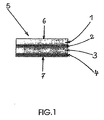
- the matrix (5) thus formed can be applied both to the upper side (6), which may have adhesive properties, and to the lower side (7), which is generally non-adhesive.
- biocompatible polymers For the preparation of the polymer-containing layer, all known biocompatible polymers can be used. These include, for example, polyethylene glycol derivatives, polyvinylpyrrolidone derivatives, polymers of acrylic or methacrylic acid, silicones, polyisobutylenes, polyisoprenes, polystyrenes and similar substances.
- the matrix can absorb many times its own weight of liquid (such as water or exudate) and swell accordingly.
- the absorption capacity is ensured by the incorporated absorber.
- suitable absorbers are polymers, such as cellulose or starch derivatives (for example carboxymethylcellulose, hydroxyethylcellulose, hydroxypropylcellulose, hydroxypropylmethylcellulose, carboxymethyl starch and others) and also polyacrylic acid derivatives (for example Aquakeep), but also low molecular weight compounds, such as glycerol, sorbitol or PEG 400.
- the cohesion of the edition is ensured by the inserted fleece or fabric.
- a nonwoven or fabric for example, materials based on polyurethane, polyester, cellulose or others are suitable.
- the invention is explained below by way of example by way of example for the production of a wound dressing containing a growth factor, namely PDGF.
- the active substance-containing wound dressing is produced in a two-stage process. For this, first the actual wound dressing with techniques, by the plaster production are known manufactured. In the second step, the active ingredient is then added in the form of a solution to the pad.
- carboxymethylcellulose is dispersed in an organic solution consisting of polyvinylpyrrolidone, PEG 400 and ethanol. This mixture is applied using a applicator in a defined layer thickness on a siliconized polyester film and dried at 60 ° C for 30 min. The dried layer corresponds to the polymer-containing layer (1), as shown in FIG.1. After the drying process, a polyester fabric (2) is laminated on the polymer-containing layer (1). As a result, a "bilayer" is obtained.
- the siliconized polyester film is removed and the upper side of the polymer-containing layer (1) of a "bilayer” is laminated to the underside of the polymer fabric (3) of a second "bilayer".
- the result is a wound dressing consisting of four layers (1-4).
- the PDGF-containing solution is added either to the polymer-containing layer (1) or to the polyester fabric (3).
- a sterile PDGF-containing wound dressing can be produced. Since PDGF is sensitive to conventional sterility methods, manufacturing must be done under aseptic conditions. For this purpose, as described above, the actual wound dressing (5) is first manufactured and subjected to a conventional temperature-neutral sterilization process, preferably gamma sterilization. Then, the drug solution under aseptic conditions, for example using a so-called laminar flow box, added to the wound dressing (5) and finally packaged under aseptic conditions.
- the wound dressing according to the invention shown in section in FIG. 1 has four layers (1-4), namely the polymer-containing layers (1) and (3), as well as the non-woven or fabric-like layers (2) and (4).
- the polymer-containing layer (1) forms the upper side (6) and the fabric or fleece-like layer (4) the lower side (7).
- One of these upper or lower sides (6) or (7) can be pressure-sensitive.
- a drug carrier is prepared, the drug carrier subjected to a sterilization process and equipped with at least one drug under aseptic conditions.
- Suitable equivalence or alternative methods may also be used.
- the drug is added under aseptic conditions.
- the addition can be carried out, for example, in the form of a solution, wherein the active ingredient dissolved in sterilized water, an autosterilic Solvent mixture or other suitable carrier is present.
- Aseptic work is understood to mean strictly avoiding the introduction of germs during manufacture. Since aseptic preparation lacks final sterilization in the final, bacteria-tightly sealed container, aseptic work does not count as a sterilization measure. Apart from a painstakingly careful hygiene of the exact disinfection of rooms and indoor air, so-called “clean rooms” are a prerequisite for aseptic work today. "Clean rooms” means rooms or certain areas in rooms in which the degree of contamination was reduced to at most 3.5 particles ⁇ 0.5 microns per liter of air by filtration of the air. Considering that a dust can be expected with 1000 dust particles, a germ occurs in such areas in about 3 m 3 .
- the air flow is such that at a speed of about 0.5 m / sec as laminar air flow displaces all airborne particles from the swept space. It can be created in this way "pure areas" in otherwise normal clean rooms. The aseptic work then takes place within the clean areas, while the operator moves outside and represents a risk of contamination only in case of wrong behavior.
- Hydrogels are moist dressings that absorb water by swelling and release it by emanating. They consist of higher molecular weight molecules that form a coherent matrix, which includes smaller molecules and aqueous solutions. These gels are extremely stable to consistency.
Landscapes
- Health & Medical Sciences (AREA)
- Engineering & Computer Science (AREA)
- Hematology (AREA)
- Life Sciences & Earth Sciences (AREA)
- Medicinal Chemistry (AREA)
- Anesthesiology (AREA)
- Biomedical Technology (AREA)
- Heart & Thoracic Surgery (AREA)
- Chemical & Material Sciences (AREA)
- Bioinformatics & Cheminformatics (AREA)
- Animal Behavior & Ethology (AREA)
- General Health & Medical Sciences (AREA)
- Public Health (AREA)
- Veterinary Medicine (AREA)
- Materials For Medical Uses (AREA)
- Medicinal Preparation (AREA)
Description
- Die Erfindung betrifft eine Wundauflage zur gesteuerten Abgabe von Wirkstoff an Wunden, insbesondere von wundheilungsfördernden Substanzen an schlecht heilende chronische Wunden sowie ein Verfahren zu ihrer Herstellung.
- Definitionsgemäß ist jede Wunde, die innerhalb von acht Wochen keine Tendenz zur Heilung zeigt, als chronisch anzusehen.
Hinsichtlich aktueller Wundtherapie hat eine Wundauflage die folgenden Therapieaspekte zu berücksichtigen: - Sie soll ein feucht-warmes Wundmilieu unter weitgehendem Ausschluß von atmosphärischem Sauerstoff schaffen, weil Wunden unter Okklusion schneller heilen. Als Ursache für die "heilende" Wirkung eines okklusiven Milieus wird in der Literatur unter anderen folgender Mechanismus diskutiert: Durch Sauerstoffausschluß ist die Wunde gezwungen, über das Blut Sauerstoff in das Wundgebiet zu bringen. Dies erfolgt durch vermehrte Gefäßeinsprossung unter Gefäßneubildung und damit geförderte Wundheilung.
- Um den Heilungsprozeß nicht zu stören, sollte die Wundauflage nur selten gewechselt werden, weil das Abnehmen einer vollgesaugten Wundauflage einen Verlust von Bestandteilen des Wundexsudats und damit immunkompetenter Zellen verursacht.
- Alles, womit die körpereigenen Abwehr- und Reinigungsmechanismen nicht fertig werden, muß aus der Wunde entfernt werden. Besonders nicht abfließendes, eventuell mit Keimen besetztes Sekret birgt ein hohes Infektionsrisiko. Es bildet sich eine feuchte Kammer. Womöglich wird dieser negative Effekt noch durch einen ungeeigneten Verband mit schlechter Saugkraft und Wasserdampfdurchlässigkeit verstärkt.
- Wundauflagen lassen sich aufgrund ihrer Eigenschaften in verschiedene Gruppen einteilen. Es werden unterschieden:
- Interaktive Wundauflagen: Hydrokolloide, Hydrogele, Alginate, Polyurethan-Schäume und Folien.
- Aktive Wandauflagen: Aktivkohle-Kompressen, Silber-Aktivkohle-Kompressen und Jodgaze. Sie greifen durch absorptive Vorgänge aktiv ins Wundklima ein und haben einen chemisch-physiklisch definierten Wirkungsmechanismus, aber keine nennenswerte Saugleistung für Sekret.
- Klassifiziert man auch nach Atmungsfähigkeit, so gehören die Alginate, Hydrokolloid-Gele, Hydrogele und Spezialfolien zu den gaspermeablen Systemen und die Hydrokolloid-, Hydrogel- und Weichschaum-Kompressen sowie die Standardfolien zu den somipermeablen/semiokklusiven Systemen.
- Untersuchungen haben ergeben, daß im Vergleich zu akuten Wunden in chronischen Wunden erheblich mehr Leukozyten und Matrixmetalloproteinasen (MMP) zu finden sind. Durch erhöhte Konzentration an MMP wird die extrazelluläre Matrix abgebaut und zudem Wachstumsfaktoren, einschließlich ihrer Rezepturen, an den Zielzellen degradiert, so daß die Wundheilungskaskade ins Stocken gerät. Durch die externe Zufuhr von Wundheilungsfaktoren, insbesondere von Wachstumsfaktoren, kann der Teufelskreis durchbrochen werden und die Wundheilungskaskade wieder anlaufen.
- Der Einsatz von Gelen, insbesondere von Hydrogelen, zur Behandlung von geschädigter Haut und Wunden wird in der Literatur beschrieben. Vorteilhaft bei ihrem Einsatz ist, daß sie eine gute biologische Verträglichkeit aufweisen, insbesondere dann, wenn sie über einen längeren Zeitraum appliziert werden. Hierbei werden für die Herstellung unterschiedliche Substanzen, Hilfsstoffe und Wirkstoffe eingesetzt.
- Gele können allein oder zusammen mit Wirkstoffen eingesetzt werden. Werden Gele als solche z.B. ohne Wirkstoff eingesetzt, dann dienen sie vor allem der Regulierung des Wundmilieus. Ziel ist es, ein Wundmilieu zu schaffen, das die Wundheilung fördert. Dies beruht auf der Erkenntnis, daß Wunden unter feucht-warmen Bedingungen besser und schneller heilen.
- Gele werden auch als Träger für Wirkstoffe eingesetzt. Hierbei wird eine gesteuerte Wirkstoffabgabe an die Wunde angerebt. Wirkstoffe bzw. Wirkstoffgruppen, die in diesem Zusammenhang genannt werden, sind beispielsweise: Deoxyribonucleoside, Wachstumsfaktoren (PDGF, TGF, FGF, CGF, CTAP), Protein Kinase C, Antibiotika, Antimykotika, Enzyminhibitoren, Antihistaminika, Antiseptika, Vitamine, Glucocorticoide, antivirale Wirkstoffe, Steroide, Insulin und Analgetika.
- DE 38 27 561 C beschreibt den Einsatz von flexiblen, hydrophilen, in Wasser quellbaren Gelfilmen. Zu ihrer Herstellung werden anionaktive Polymere zusammen mit kationenaktiven Polymeren eingesetzt. Zusätzlich sind Feuchthaltemittel, wasserdispergierbare Hilfsstoffe, bis zu 70 % Wasser und Wirkstoff enthalten.
- DE 44 46 380 A1 beschreibt Hydrogele, beispielsweise auf der Basis von Gelatine, zur Abgabe von therapeutischen und/oder kosmetischen wirkstoffen an die Haut bzw. zur kosmetischen Pflege und Behandlung empfindlicher Haut- und Nagelstellen. Die beschriebenen Hydrogele sind dadurch gekennzeichnet, daß sie flächenförmig ausgebildete und an Konturen menschlicher Körperstellen angepaßte starrelastische Gebilde sind. Die Hydrogele können durch eine haftklebende Oberfläche gekennzeichnet sein.
- WO 98/17252 beschreibt ein in Wasser nicht lösliches, filmbildendes Gel mit (bio)adhäsiven Eigenschaften zur lokalen Abgabe von pharmazeutischen Wirkstoffen. Das Gel enthält mindestens ein wasserunlösliches Cellulosederivat und ein nichtwäßriges Lösungsmittel. Es kann sowohl auf Häuten als auch auf Schleimhäuten appliziert werden.
- US 5 770 228, US 4 717 717 und WO 93/08825 beschreiben Gele auf der Basis von Hydroxyethylcellulose. Diese Gele werden zur Abgabe von Wachstumsfaktoren eingesetzt, z.B. PDGF, TGF, EGF und FGF. Zusätzlich können Gele ein Konservierungsmittel, wie beispielsweise Methylparaben oder Ethanol, enthalten.
- US 5 705 485 und US 5 457 093 beschreiben Gele zur Behandlung von Wunden. Sie enthalten wirksame Mengen an PDGF (Platelet Derived Growth Factor). Als Gelbildner werden Cellulosederivate, beispielsweise Carboxymethylcellulose, eingesetzt. Ferner enthalten sind Agenzien, die eine dem PDGF entgegengerichtete Ladung tragen. Genannt werden hierbei Aminosäuren wie beispielsweise Lysin oder Alanin, aber auch Metallionen wie Magnesium oder Zink.
- US 5 591 709 beschreibt ein Gel als Wirkstoffabgabesystem. Als gelbildende Komponenten werden Gelatine, Agrose, Kollagen und hydrophile Cellulosederivate genannt. Das System dient der Abgabe von Insulin, Wachstumshormonen und Thyroxin bzw. Triiodothyronin.
- US 5 578 661 beschreibt ein Gel, das zur Abgabe von PDGF geeignet ist. Es handelt sich dabei um ein wäßriges Gemisch aus mindestens drei Bestandteilen, die zur Gelbilung befähigt sind. Sie enthalten ein hydrophiles, wasserlösliches Polymer als Komponente 1: Polyethylenglycol, Polyvinylpyrrolidon;
ein säurehaltiges Polymer als Komponente 2: Polyvinylpyrrolidon-Polyacryl-säure-Copolymer, Polyacrylsäure, Polymethylvinylether-Polymaleinsäureanhyddrid-Copolymer, Polyethylenmaleinsäureanhydrid;
ein Polymer, welches Aminogruppen aufweist als Komponente 3: z.B. Polysaccharide, Poly-L-Lysin.
Die Säurefunktionen der zweiten Komponente führen zur Quervernetzung und/oder bilden Wasserstoffbrücken zusammen mit der ersten Komponente aus. Dabei dient die dritte Komponente der Aufnahme von Hydroniumionen. Es resultiert ein kohäsives Hydrogel. Kennzeichnend für dieses System ist, daß sich das Gel nicht spontan bildet, sondern erst mit der zeit. Demzufolge ist es möglich, zunächst ein niedrigviskoses Gemisch zu verarbeiten. Das Gemisch härtet jedoch mit der Zeit aus und bildet ein Hydrogel. - US 5 427 778 beschreibt ein Gel zur Abgabe von Wachstumsfaktoren (EGF, FGF, PDGF, TGF, NGF und IGF). Als Gelbildner wird ein Polymer auf der Basis von Acrylamid eingesetzt.
- WO 98 28013 A offenbart Wundauflagen bestehend aus einem porösen Behälter, z. B. einem Sachet aus Polyestergewebe oder Baumwoll-Gaze, worin Hydrogelpartikel eingeschlossen sind, die zum Absorbieren von Wundexsudat geeignet sind. Die Hydrogelpartikel können aus verschiedenen Polymeren wie z. B. Polyacrylaten, Polyurethanen oder Polyacrylonitril hergestellt werden und mit Bindern und Weichmachern zu einer Matrix verarbeitet werden. Die absorbierenden Partikel können pharmazeutische Wirkstoffe (z. B. Wachstumsfaktoren, Antibiotika) enthalten. Um eine Befestigung der Wundauflage auf der Haut zu ermöglichen, kann der gesamte Behälter mit einem Klebeband verbunden sein.
- US-A-5 705 485 bezieht sich auf wässrige Gelformulierungen für Wunden, wobei diese Formulierungen Wachstumsfaktoren (z. B. Becaplermin) enthalten können und auf eine Bandage aufgebracht werden können. Die Gelformulierungen sind adhäsiv, absorbieren Wundexsudat und ermöglichen die kontrollierte Abgabe des Wachstumsfaktors. Sie enthalten wasserlösliche Polymere, die visköse wässrige Lösungen bilden können, oder wasserunlösliche Polymere, die in Wasser quellfähig sind. Beispielsweise können folgende Polymere Verwendung finden: Vinylpolymere, insbesondere Polyacrylsäure, Polyoxyethylen-Polyoxypropylen-Copolymere, Acrylamid-Polymere, Polysaccharide, insbesondere CelluloseDerivate, Proteine. US-A-5 705 485 beschreibt ferner ein Verfahren zur Herstellung einer Gelformulierung, wobei in einem ersten Schritt ein Hydrogel auf Basis von NatriumCarboxymethylcellulose hergestellt und durch Hitze sterilisiert wird. Anschließend wird ein Wachstumsfaktor unter aseptischen Bedingungen hinzugefügt.
- Ein wesentlicher Nachteil der beschriebenen Systeme ist, daß sie durch eine erheblich begrenzte Quellfähigkeit gekennzeichnet sind, und daß sie bei Quellung mehr oder weniger Form und Zusammenhalt verlieren. Deshalb ist nach ihrer Applikation auf Wunden eine intensive Wundreinigung erforderlich. Die Reinigung kann zu einer Reizung oder Störung des Heilungsprozesses führen. Speziell beim Einsatz von hydrokolloiden und Hydropolymeren können sich trotz sorgsamer Reinigung Gelpartikel in der Wunde abkapseln, die möglicherweise zu einer Fremdkörperreaktion führen. Hieraus können sich erhebliche Komplikationen ergeben.
- Ausgehend vom vorstehend diskutierten Stand der Technik liegt der Erfindung die Aufgabe zugrunde, eine Wundauflage der im Oberbegriff von Anspruch 1 genannten Art zur steuerbaren Abgabe von Wirkstoff und insbesondere von wundheilungsfördernden Stoffen anzugeben, die unter Volumenzunahme Flüssigkeit aufzunehmen vermag, ohne hierbei ihren Zusammenhalt zu verlieren, und die darüber hinaus den Heilungsprozeß maßgeblich fördert.
- Zur Lösung der Aufgabe wird bei der Wundauflage zur steuerbaren Abgabe von Wirkstoffen an Wunden, insbesondere von wundheilungsfördernden Substanzen, mit der Erfindung vorgeschlagen, daß sie zum Zwecke der Aufnahme von Flüssigkeit unter Volumenzunahme, insbesondere zur Aufnahme von Wundexsudat, schichtweise aufgebaut ist und zwei polymerhaltige Schichten, zwei gewebe- oder vliesartige Schichten und mindestens einen Wirkstoff enthält, wobei die Schichten in abwechselnder Reihenfolge übereinander angeordnet und miteinander verbunden sind, und wobei die polymerhaltigen Schichten als Absorber für Flüssigkeit hydrokolloidhaltiges quellfähiges Hydrogel enthalten.
- Mit Vorteil wird durch die erfindungsgemäße Ausbildung der Wundauflage erreicht, daß sie einerseits Flüssigkeit wie Wundexsudat in größeren Mengen unter Volumenzunahme aufnehmen kann, ohne ihren Zusammenhalt zu verlieren, und daß durch die andererseits wundheilungsfördernde Stoffe an die Wunde abgegeben werden, wodurch insbesondere unter Berücksichtigung der heilungs fördernden Okklusion der Wunde ein beschleunigter Heilungsprozeß eingeleitet wird, der infolge der Flüssigkeitsaufnahme ein häufiges Wechseln des Verbandes überflüssig macht.
- Die erfindungsgemäße wirkstoffhaltige Wundauflage enthält vorteilhaft Hydrokolloidhaltige Hydrogele, die durch die Quellfähigkeit Flüssigkeit aufnehmen können, unter Wahrung ihres Zusammenhaltes. Der Kolloidanteil der Wundauflage bindet dabei nach und nach Exsudat unter Verwandlung in ein freies Gel, welches die Wunde mit ihren Vertiefungen auskleidet.
Im Gegensatz hierzu bildet das Hydrogel eine kohärente Matrix, die besonders in trockenen Wunden aufquellend wirkt und Beläge sowie Nekrosen löst. - Die erfindungsgemäße, wirkstoffhaltige wundauflage dient darüber hinaus der Abgabe von Wachstumsfaktoren an schlecht heilende, chronische Wunden. Beispielsweise sind folgende Wachstumsfaktoren zu nennen: PDGF (Platelet Derived Growth Factor), rhPDGF-BB (Becaplermin), EGF (Epidermal Growth Factor), PDECGF ((Platelet Derived Endothelial Cell Growth Factor), aFGF (Acidic Fibroplast Growth Factor), bFGF (Basic Fibroplast Growth Factor),TGF α (Transforming Growth Factor alpha), TGF β (Transforming Growth Factor beta), KGF (Keratinocyte Growth Factor), IGF1/IGF2 (Insulin-Like Growth Factor) und TNF (Tumor Necrosis Factor).
- Wesentliche Ausgestaltungen der Wundauflage nach der Erfindung sind entsprechend den Merkmalen der Unteransprüche vorgesehen, in welchen auch die in den einzelnen Schichten enthaltenen Wirk- und Hilfsstoffe angegeben sind.
- Die Wundauflage nach der Erfindung wird nachfolgend anhand eines in der Zeichnung FIG.1 gezeigten Ausführungsbeispiels näher erläutert und ihre Herstellung beispielhaft angegeben.
- Figur 1 zeigt im Schnitt quer zur Ober- bzw. Unterseite die einzelnen Schichten der Wundauflage.
- Die so gebildete Matrix (5) kann sowohl mit der Oberseite (6), die adhäsive Eigenschaften haben kann, als auch mit der Unterseite (7), welche in der Regel nicht klebend ist, appliziert werden.
- Für die Herstellung der polymerhaltigen Schicht können alle bekannten biokompatiblen Polymere verwendet werden. Hier sind beispielsweise zu nennen Polyethylenglykolderivate, Polyvinylpyrrolidonderivate, Polymere der Acryl- bzw. Methacrylsäure, Silicone, Polyisobutylene, Polyisoprene, Polystyrole und ähnliche Substanzen.
- Die Matrix kann ein Vielfaches ihres Eigengewichtes an Flüssigkeit (wie Wasser oder Exsudat) aufnehmen und dementsprechend anschwellen. Die Aufnahmekapazität wird hierbei durch den eingearbeiteten Absorber sichergestellt. Als Absorber geeignet sind beispielsweise Polymere, wie Cellulose- oder Stärkederivate (beispielsweise Carboxymethylcellulose, Hydroxyethylcellulose, Hydroxypropylcellulose, Bydroxypropylmethylcellulose, Carboxymethylstärke und andere) sowie Polyacrylsäurederivate (z.B. Aquakeep) aber auch niedermolekulare Verbindungen, wie Glycerol, Sorbit oder PEG 400.
- Der Zusammenhalt der Auflage wird durch das eingelegte Vlies bzw. Gewebe sichergestellt. Als Vlies bzw. Gewebe sind beispielsweise Materialien auf der Basis von Polyurethan, Polyester, Cellulose oder andere geeignet.
- Die Erfindung wird im folgenden anhand eines Beispiels zur Herstellung einer Wundauflage beispielhaft erläutert, die einen Wachstumsfaktor, namentlich PDGF, enthält.
- Die wirkstoffhaltige Wundauflage wird in einem zweistufigen Prozeß hergestellt. Dazu wird zunächst die eigentliche Wundauflage mit Techniken, die von der Pflasterfertigung bekannt sind, hergestellt. Im zweiten Schritt wird dann der Wirkstoff in Form einer Lösung zu der Auflage addiert.
Zur Herstellung der eigentlichen Wundauflage wird Carboxymethylcellulose in einer organischen Lösung, bestehend aus Polyvinylpyrrolidon, PEG 400 und Ethanol, dispergiert. Dieses Gemisch wird mit Hilfe eines Auftragwerkes in einer definierten Schichtdicke auf eine silikonisierte Polyesterfolie aufgetragen und 30 min bei 60 °C getrocknet. Die getrocknete Schicht entspricht der polymerhaltigen Schicht (1), wie in FIG.1 dargestellt. Nach dem Trocknungsprozeß wird ein Polyestergewebe (2) auf die polymerhaltige Schicht (1) laminiert. Als Resultat wird ein "Bilayer" erhalten. Zur Präparation des in FIG.1 dargestellten "Multilayer" wird die silikonisierte Polyesterfolie entfernt und die Oberseite der polymerhaltigen Schicht (1) eines "Bilayers" auf die unterseite des Polymergewebes (3) eines zweiten "Bilayers" laminiert. Als Ergbnis wird eine Wundauflage erhalten, die aus vier Schichten (1-4) besteht. Wie bereits erwähnt, wird nach Fertigstellung der eigentlichen Wundauflage (5) die PDGF-haltige Lösung entweder auf die polymerhaltige Schicht (1) oder auf das Polyestergewebe (3) addiert. - Optional kann auch eine sterile PDGF-haltige Wundauflage hergestellt werden. Da PDGF empfindlich gegenüber den herkömmlichen Sterilitätsmethoden ist, muß die Fertigung unter aseptischen Bedingungen erfolgen. Dazu wird, wie oben beschrieben, zunächst die eigentliche Wundauflage (5) gefertigt und einem herkömmlichen temperaturneutralen Sterilisationsverfahren, bevorzugt der Gamma-Sterilisation, unterworfen. Darauf wird die Wirkstofflösung unter aseptischen Bedingungen, beispielsweise unter Einsatz einer sogenannten Laminar Flow Box, zur Wundauflage (5) addiert und abschließend unter aseptischen Bedingungen verpackt.
- Die in der Figur 1 im Schnitt dargestellte Wundauflage nach der Erfindung weist vier schichten (1-4) auf, und zwar die polmerhaltigen Schichten (1) und (3), sowie die vlies- bzw. gewebeartigen Schichten (2) und (4). Die polymerhaltige Schicht (1) bildet die Oberseite (6) und die gewebe- oder vliesartige Schicht (4) die Unterseite (7) aus. Jeweils eine dieser Ober- bzw. Unterseiten (6) bzw. (7) kann haftklebend sein.
- Im folgenden wird detailliert auf die aseptische Herstellungsweise eingegangen, welche dann notwendig wird, wenn Wirkstoffe verarbeitet werden, die gegenüber herkömmlichen Sterilisationsmethoden empfindlich sind.
- Bei dem Verfahren gemäß vorliegender Erfindung wird ein Wirkstoffträger hergestellt, der Wirkstoffträger einem Sterilisationsverfahren unterworfen und mit mindestens einem Wirkstoff unter aseptischen Bedingungen bestückt.
- Die Herstellung des Wirkstoffträgers erfolgt nach bekannten Techniken. Als Wirkstoffträger kommen alle Typen von Wundauflagen in Frage. Beispielsweise sind hier zu nennen:
- inaktive Wundauflagen (Mullkompressen, Tupfer, Viskose-Gaze-Kompressen und Saugvlies-Kompressen), die auf zellulärer und stofflicher Ebene nichts verändern, das heißt, sie saugen lediglich mehr oder weniger Sekret auf,
- interaktive Wundauflagen (Hydrokoloide, Hydrokoloid-Kompressen, Hydrogele, Hydrogel-Kompressen, Alginate, Polyurethan-Schaum und -folien), die das Mikroklima in der Wunde verändern, ein physiologisches Milieu schaffen, den Heilungsprozeß beschleunigen, das Sekret absaugen und es speichern,
- aktive Wundauflagen (Aktivkohle-Kompressen, Silber-Aktivkohle-Kompressen und Iodgaze), die durch zytopathische/adsorptive Vorgänge ins Wundklima eingreifen und einen chemisch/physikalisch definierten/gezielten Wirkungsmechanismus haben; sie besitzen in der Regel keine nennenswerte Saugleistung,
- Gaspermeable Systeme (Alginate, Hydrokoloid-Gele, Hyrogele und Spezialfolien), die eine wesentlich höhere Atmungsfähigkeit als die Haut haben. Sie haben ein breites Indikationsgebiet und sind auch bei infizierten Wunden einsetzbar.
- Nach Herstellung des Wirkstoffträgers wird dieser einer gängigen Sterilisationsmethode, deren Auswahl sich in erster Linie nach dem zu sterilisierenden Produkt richtet, unterworfen. Da im allgemeinen die pro Zeit-Einheit absterbende Zahl von Mikroorganismen unter konstanten Bedingungen in einem Sterilisationsprozeß von der ursprünglich vorhandenen Anzahl lebensfähiger Keime abhängt, kommt der jeweiligen Ausgangskeimzahl eine große Bedeutung zu. Der Sterilisationsprozeß wird jedoch nicht nur von der Ausgangskeimzahl, sondern in noch höherem Maße von der Art der vorhandenen Mikroorganismen sowie deren Funktionszustand beeinflußt. Die ausgewählte Methode muß einen ausreichenden Wirkungsgrad besitzen. Standardverfahren sind
- Sterilisation mit gespanntem, gesättigtem Wasserdampf (15 min, 2 bar, 121 °C),
- Sterilisation durch trockene Hitze (30 min, 180 °C),
- Strahlensterilisation,
- Gassterilisation.
- Es können auch geeignete Äquivalenzverfahren oder Alternativverfahren angewendet werden.
- Zu dem sterilisierten Wirkstoffträger wird der Wirkstoff unter aseptischen Bedingungen zugegeben. Die Zugabe kann beispielsweise in Form einer Lösung erfolgen, wobei der Wirkstoff gelöst in sterilisiertem Wasser, einem autosterilen Lösungsmittelgemisch oder einem anderen geeigneten Träger vorliegt.
- Unter aseptischem Arbeiten wird das strikte Vermeiden des Einbringens von Keimen während der Herstellung verstanden. Da bei der aseptischen Bereitung die Schlußsterilisation im endgültigen, bakteriendicht verschlossenen Behältnis fehlt, zählt aseptisches Arbeiten nicht zu den Sterilisationsmaßnahmen. Außer einer peinlich sorgfältigen Produngktionshygiene exakter Desinfektion von Räumen und Raumluft gelten heute sogenannte "reine Räume" als Voraussetzung für aseptisches Arbeiten. Unter "reinen Räumen" versteht man Räume oder bestimmte Bereiche in Räumen, in denen durch Filtration der Luft der Grad der Verunreinigung auf höchstens 3,5 Teilchen ≥ 0,5 µm pro Liter Luft herabgesetzt wurde. Bedenkt man, daß bei 1000 Staubteilchen mit einem Keim zu rechnen ist, so kommt in solchen Räumen in etwa 3 m3 ein Keim vor. Bei der Luftfiltration erfolgt die Luftführung so, daß bei einer Geschwindigkeit von etwa 0,5 m/sec ein möglichst laminarer Luftstrom alle Schwebeteilchen aus dem bestrichenen Raum verdrängt. Es können auf diese Weise "reine Bereiche" in sonst normal sauberen Räumen geschaffen werden. Die aseptischen Arbeiten erfolgen dann innerhalb der reinen Bereiche, während sich das Bedienungspersonal außerhalb bewegt und nur bei falschem Verhalten eine Kontaminationsgefahr darstellt.
- Das erfindungsgemäße Verfahren wird im folgenden anhand der aseptischen Herstellung wirkstoffhaltiger Hydrogele beschrieben.
- Hydrogele sind Feuchtverbände, die Wasser durch Quellen aufnehmen und durch Entquellen abgeben. Sie bestehen aus höhermolekularen Molekülen, die eine kohärente Matrix bilden, welche kleinere Moleküle und wäßrige Lösungen einschließt. Diese Gele sind ausgesprochen konsistenzstabil.
- Das Herstellungsverfahren umfaßt die folgenden Schritte:
- Herstellung eines Wirkstoffträgers auf Hydrogelbasis; im folgenden werden zwei Ausführungsbeispiele beschrieben:
- a) Herstellung eines Uni-Laminates: Polyvinylpyrrolidon (2,7 Gew.%) wird in gereinigtem Wasser (34,4 Gew.%) aufgelöst und Glycerin (26,7 Gew.%) sowie Gelatine (15,5 Gew.%) dazugegeben. Die Lösung wird für 10 min quellen gelassen und anschließend bis zur Klärung auf 65 °C erhitzt. Zu dieser Lösung werden nacheinander Saccharose (10,7 Gew.%) und Dexpanthenol (10 Gew.%) unter kontinuierlichem Rühren zugesetzt. Die homogenisierte Lösung wird nachfolgend auf eine geeignete Folie aufgetragen oder in geeignete Behältnisse (z.B. Tiefziehfolien) gefüllt und erstarren gelassen.
- b) Herstellung eines Multi-Laminates: Carboxymethylcellulose wird in einer organischen Lösung, bestehend aus Polyvinylpyrrolidon, PEG 400 und Ethanol, dispergiert. Dieses Gemisch wird mit Hilfe eines Auftragwerkes in einer definierten Schichtdicke auf eine silikonisierte Polyesterfolie aufgetragen und für 30 min bei 60 °C getrocknet. Die getrocknete Schicht wird im folgenden als polymerhaltige Schicht bezeichnet. Nach dem Trocknungsprozeß wird ein Polyestergewebe auf die Oberflächen der polymerhaltigen Schicht laminiert und es resultiert ein "Bi-layer". Zur Präparation eines Multi-Laminates wird die silikonisierte Polyesterfolie entfernt und die Oberseite der polymerhaltigen Schicht eines "Bi-layers" auf die Unterseite des Polymergewebes eines zweiten "Bi-layers" laminiert. Als Ergebnis wird eine Wundauflage erhalten, die aus vier Schichten besteht.
- Abtrennung von Teilmengen
wird das Hydrogel flächenförmig auf eine Folie aufgetragen, dann werden anschließend mit Hilfe einer geeigneten Stanze einzelne Hydrogelstanzlinge ausgestanzt und diese in geeignete Behältnisse (z.B. Tiefziehfolien) überführt, - Sterilisationsverfahren
Die Sterilisation des erstarrten Hydrogels wird mit Hilfe von ionisierenden Strahlen (Strahlensterilisation) durchgeführt. Bevorzugt finden Gamma-Strahlen Anwendung, da diese eine hohe Eindringtiefe haben und nur geringfügig in Wechselwirkung mit dem zu sterilisierenden Material treten. Die anzuwendende Dosis (z.B. 25 kGy) richtet sich hierbei nach der mikrobiologischen Ausgangslage (F=n x D). Als Strahlenquelle dient üblicherweise das Radionuklid 60Co. - Bestückung des Wirkstoffträgers mit Wirkstoff
Der in sterilisiertem Wasser gelöste Wirkstoff (z.B. PPDGF) wird zu dem sterilisierten Hydrogel dosiert, so daß die Wirkstofflösung die Oberfläche des Wirkstoffträgers gleichmäßig benetzt und von diesem aufgenommen wird. - Endverpackung
Die mit Wirkstoffträger und -lösung bestückten Hydrogele werden abschließend verpackt, so daß ein ausreichender Schutz vor mikrobiologischer Rekontamination gewährleistet ist.
Sie enthält vier Schichten (1-4), und zwar zwei polymerhaltige Schichten (1) bzw. (3) und zwei vlies- bzw. gewebeartige Schichten (2) bzw. (4). Diese bilden insgesamt eine Matrix (5) mit einer Oberseite (6) und einer Unterseite (7) aus.
Claims (23)
- Wundauflage zur gesteuerten Abgabe von Wirkstoff an Wunden, insbesondere von wundheilungsfördernden Substanzen an schlecht heilende chronische Wunden, dadurch gekenn- zeichnet, dass sie zum Zwecke der Aufnahme von Flüssigkeit unter Volumenzunahme, insbesondere zur Aufnahme von Wundexsudat, schichtweise aufgebaut ist und zwei polymerhaltige Schichten (1, 3), zwei gewebe- oder vliesartige Schichten (2, 4) und mindestens einen Wirkstoff enthält, wobei die Schichten (1, 2, 3, 4) in abwechselnder Reihenfolge übereinander angeordnet und miteinander verbunden sind, und wobei die polymerhaltigen Schichten (1, 3) als Absorber für Flüssigkeit hydrokolloidhaltiges quellfähiges Hydrogel enthalten.
- Wundauflage nach Anspruch 1, dadurch gekennzeichnet, dass die polymerhaltige Schicht (1, 3) wenigstens ein Polyethylenglykolderivat enthält.
- Wundauflage nach Anspruch 1, dadurch gekennzeichnet, dass die polymerhaltige Schicht (1, 3) wenigstens ein Polymer auf der Basis von Vinylpyrrolidon enthält.
- Wundauflage nach Anspruch 1, dadurch gekennzeichnet, dass die polymerhaltige Schicht (1, 3) wenigstens ein Polymer auf Basis von Acryl- und/oder Methacrylsäure enthält.
- Wundauflage nach Anspruch 1, dadurch gekennzeichnet, dass die polymerhaltige Schicht (1, 3) wenigstens ein Polymer auf Basis von Silicon enthält.
- Wundauflage nach Anspruch 1, dadurch gekennzeichnet, dass die polymerhaltige Schicht (1, 3) wenigstens ein Polymer auf Basis von Isobutylen, Isopren oder Styrol enthält.
- Wundauflage nach Anspruch 1, dadurch gekennzeichnet, dass der Absorber ein Polymer ist.
- Wundauflage nach Anspruch 7, dadurch gekennzeichnet, dass das Polymer ein Cellulosederivat wie Carboxymethylcellulose, ein Stärkederivat oder ein Polyethylenderivat ist.
- Wundauflage nach Anspruch 1, dadurch gekennzeichnet, dass der wundheilungsfördernde Wirkstoff ein biologisch aktives Peptid oder Protein ist.
- Wundauflage nach Anspruch 1, dadurch gekennzeichnet, dass das biologisch aktive Peptid oder Protein ein Wachstumsfaktor ist.
- Wundauflage nach Anspruch 10, dadurch gekennzeichnet, dass der Wachstumsfaktor Platelet Derived Growth Factor (insbesondere Becaplermin), Epidermal Growth Factor, Platelet Derived Endothelial Cell Growth Factor, Acidic Fibroblast Growth Factor, Basic Fibroblast Growth Factor, Transforming Growth Factor alpha, Transforming Growth Factor beta, Keratinocyte Growth Factor, Insulin-Like Growth Factor 1 bzw. 2 oder Tumor Necrosis Factor ist.
- Wundauflage nach Anspruch 1, dadurch gekennzeichnet, dass sie ein Gewebe oder Vlies auf Basis von Polyester, Polyurethan oder Cellulose enthält.
- Wundauflage nach einem der vorhergehenden Ansprüche, dadurch gekennzeichnet, dass ihre zur Applikation vorgesehene Oberfläche adhäsive Eigenschaften aufweist.
- Wundauflage nach Anspruch 1, dadurch gekennzeichnet, dass sie(1) mindestens eine polymerhaltige Schicht (1, 3), enthaltend 40-80 Gew.% Polyvinylpyrrolidon, 15-45 Gew.% Polyethylenglycol 400 und bis zu 40 Gew.% NatriumCarboxymethylcellulose,(2) mindestens eine vliesartige Schicht (2, 4) enthaltend Langfaserpapier mit einem Flächengewicht von 5-100 g/m2 und(3) Becaplermin als Wirkstoff
enthält. - Wundauflage nach Anspruch 14, dadurch gekennzeichnet, dass sie(1) mindestens eine polymerhaltige Schicht (1, 3), enthaltend 60 Gew.% Polyvinylpyrrolidon, 35 Gew.% Polyethylenglycol 400 und 5 Gew.% Natrium-Carboxymethylcellulose,(2) mindestens eine vliesartige Schicht (2, 4) enthaltend Langfaserpapier mit einem Flächengewicht von 17 g/m2 und(3) Becaplermin als Wirkstoff
enthält. - Verfahren zur Herstellung einer Wundauflage nach einem der Ansprüche 1 bis 15, dadurch gekennzeichnet, dass- durch Auftragen einer ein Hydrogel enthaltenden polymerhaltigen Schicht (1) auf eine gewebe- oder vliesartige Schicht (2) und nachfolgendes Trocknen ein zweischichtiges Laminat (1, 2) hergestellt wird;- zwecks Herstellung eines Wirkstoffträgers das zweischichtige Laminat mit einem weiteren, auf dieselbe Weise hergestellten zweischichtigen Laminat (3, 4) verbunden wird, so daß ein vierschichtiges Laminat gebildet wird, in welchem die Schichten (1, 2, 3, 4) in abwechselnder Reihenfolge übereinander angeordnet sind;- der so erhaltene Wirkstoffträger einem Sterilisationsverfahren unterworfen wird und- der Wirkstoffträger unter aseptischen Bedingungen mit mindestens einem Wirkstoff versehen wird.
- Verfahren nach Anspruch 16, dadurch gekennzeichnet, dass ein einen Wirkstoff enthaltender Wirkstoffträger hergestellt wird.
- Verfahren nach Anspruch 16, dadurch gekennzeichnet, dass das Sterilisationsverfahren nach der Methode der Hitzesterilisation, der Strahlensterilisation oder der Gassterilisation durchgeführt wird.
- Verfahren nach Anspruch 16, dadurch gekennzeichnet, dass der Wirkstoff in Form einer Lösung, insbesondere einer wässrigen Lösung, zu dem Wirkstoffträger dosiert wird.
- Verfahren nach Anspruch 18, dadurch gekennzeichnet, dass der Wirkstoff bei Anwendung der Sterilisationsmethoden instabil ist.
- Verfahren nach Anspruch 16, dadurch gekennzeichnet, dass der Wirkstoff ein Wachstumsfaktor ist.
- Verfahren nach Anspruch 16, dadurch gekennzeichnet, dass der Wirkstoff Platelet Derived Growth Factor (PDGF) ist.
- Verfahren nach Anspruch 16, dadurch gekennzeichnet, dass der wirkstoffhaltige Träger verpackt wird.
Applications Claiming Priority (2)
| Application Number | Priority Date | Filing Date | Title |
|---|---|---|---|
| DE19925519 | 1999-06-04 | ||
| DE19925519A DE19925519A1 (de) | 1999-06-04 | 1999-06-04 | Wundauflage zur gesteuerten Abgabe von Wirkstoff an Wunden und Verfahren zu ihrer Herstellung |
Publications (3)
| Publication Number | Publication Date |
|---|---|
| EP1084716A2 EP1084716A2 (de) | 2001-03-21 |
| EP1084716A3 EP1084716A3 (de) | 2002-04-24 |
| EP1084716B1 true EP1084716B1 (de) | 2006-01-04 |
Family
ID=7910175
Family Applications (1)
| Application Number | Title | Priority Date | Filing Date |
|---|---|---|---|
| EP00110783A Expired - Lifetime EP1084716B1 (de) | 1999-06-04 | 2000-05-20 | Wundauflage zur gesteuerten Abgabe von Wirkstoff an Wunden und Verfahren zu ihrer Herstellung |
Country Status (5)
| Country | Link |
|---|---|
| US (1) | US6399091B1 (de) |
| EP (1) | EP1084716B1 (de) |
| AT (1) | ATE314866T1 (de) |
| DE (2) | DE19925519A1 (de) |
| ES (1) | ES2257238T3 (de) |
Families Citing this family (38)
| Publication number | Priority date | Publication date | Assignee | Title |
|---|---|---|---|---|
| US6992066B2 (en) * | 1998-10-16 | 2006-01-31 | Zimmer Orthobiologics, Inc. | Povidone-containing carriers for polypeptide growth factors |
| US7390935B1 (en) * | 2000-10-19 | 2008-06-24 | Ideagen Incorporated | Hydrogel vapor dispenser |
| US20060193905A1 (en) * | 2002-05-14 | 2006-08-31 | University Of Louisville Research Foundation, Inc. | Direct cellular energy delivery system |
| US7056529B2 (en) * | 2002-05-14 | 2006-06-06 | University Of Louisville Research Foundation, Inc. | Direct cellular energy delivery system |
| US7622562B2 (en) | 2002-06-26 | 2009-11-24 | Zimmer Orthobiologics, Inc. | Rapid isolation of osteoinductive protein mixtures from mammalian bone tissue |
| DE10328261B4 (de) | 2003-06-23 | 2007-10-25 | Beiersdorf Ag | Desinfizierende Auflage mit Silberbeschichtung und ihre Verwendung |
| NZ543643A (en) * | 2003-06-23 | 2007-09-28 | Beiersdorf Ag | Antimicrobial wound dressing with two layers and antimicrobial metal between layers but not on exterior |
| US8563447B2 (en) * | 2003-08-14 | 2013-10-22 | Milliken & Company | Silver-containing wound care device |
| US20050035327A1 (en) * | 2003-08-14 | 2005-02-17 | Canada T. Andrew | Topical silver-based antimicrobial composition for wound care devices |
| US20050147657A1 (en) * | 2003-08-14 | 2005-07-07 | Milliken & Company | White silver-containing wound care device |
| US7118761B2 (en) | 2003-08-14 | 2006-10-10 | Canada T Andrew | Method for producing a silver-containing wound care device |
| US20050037057A1 (en) * | 2003-08-14 | 2005-02-17 | Schuette Robert L. | Silver-containing antimicrobial fabric |
| US7842306B2 (en) | 2003-08-14 | 2010-11-30 | Milliken & Company | Wound care device having fluid transfer properties |
| EP1673112A1 (de) * | 2003-10-10 | 2006-06-28 | Coloplast A/S | Wundverband enthaltend proteolytische enzyme |
| CA2576040A1 (en) * | 2003-10-21 | 2005-04-28 | Bioartificial Gel Technologies Inc. | Hydrogel-containing medical articles and methods of using and making the same |
| DE102005004924A1 (de) * | 2005-02-02 | 2006-08-03 | Paul Hartmann Ag | Wundauflage |
| KR100742266B1 (ko) | 2005-12-30 | 2007-07-26 | 한국원자력연구원 | 수분 방지 효과가 우수한 상처 치료용 수화겔 및 이의제조방법 |
| GB0613042D0 (en) * | 2006-06-30 | 2006-08-09 | Hill Catherine | Combined wound plaster and swab |
| DE102006061539A1 (de) * | 2006-12-27 | 2008-07-03 | Paul Hartmann Ag | Medizinisches Flächengebilde |
| CN104888263B (zh) | 2008-01-14 | 2018-11-30 | 北京环球利康科技有限公司 | 生物相容性止血、防粘连、促愈合、外科封闭的变性淀粉材料 |
| DE202009013208U1 (de) | 2009-10-01 | 2010-02-18 | Neubauer, Norbert | Vakuumventil |
| CA2780274C (en) | 2009-11-09 | 2018-06-26 | Spotlight Technology Partners Llc | Fragmented hydrogels |
| WO2011057131A1 (en) | 2009-11-09 | 2011-05-12 | Spotlight Technology Partners Llc | Polysaccharide based hydrogels |
| DE202009016141U1 (de) | 2009-11-26 | 2010-03-04 | Neubauer, Norbert | Vakuumventil |
| DE102011120492A1 (de) * | 2011-09-02 | 2013-03-07 | BLüCHER GMBH | Wundauflage mit luftdurchlässiger Lage |
| CA2890757C (en) | 2012-11-14 | 2021-10-26 | Smith & Nephew, Inc. | Stable thermolysin hydrogel |
| JP6893086B2 (ja) | 2013-03-13 | 2021-06-23 | エーブリー デニソン コーポレイション | 接着特性の向上 |
| RU2015137174A (ru) | 2013-03-15 | 2017-04-24 | Смит энд Невью, Инк. | Растворимая образующая гель плёнка и способ очистки раны |
| EP2997084A4 (de) * | 2013-05-17 | 2016-10-12 | Acupac Packaging Inc | Wasserfreie hydrogelzusammensetzung |
| MY184693A (en) * | 2013-08-22 | 2021-04-17 | Univ Kebangsaan Malaysia Ukm | Bilayer hydrocolloid films containing therapeutic agents |
| US9999677B1 (en) * | 2015-03-07 | 2018-06-19 | Connie D. Starns | Wound healing composition |
| DE202015007868U1 (de) | 2015-11-14 | 2016-01-26 | Norbert Neubauer | Belüftungsdrain für Wunden |
| CN105963772A (zh) * | 2016-07-06 | 2016-09-28 | 江苏达胜伦比亚生物科技有限公司 | 一种辐照交联生长因子水凝胶医用冷敷贴 |
| CN106178093A (zh) * | 2016-07-20 | 2016-12-07 | 江苏达胜伦比亚生物科技有限公司 | 一种辐照交联丝素蛋白水凝胶医用冷敷贴 |
| WO2019089856A1 (en) * | 2017-10-31 | 2019-05-09 | InMEDBio, LLC | Absorbent, breathable and pathogen blocking/killing wound care dressing and fabrication thereof |
| EP3706689A4 (de) * | 2017-11-08 | 2021-12-01 | University Of Massachusetts | Postoperativer hybridverband zur optimierung von hautimplantatverfahren in der rekonstruktionschirurgie |
| CN108653718B (zh) * | 2018-05-31 | 2022-03-11 | 广州润虹医药科技股份有限公司 | 一种可吸收促愈合止血组合物及敷料 |
| WO2020086812A1 (en) * | 2018-10-24 | 2020-04-30 | Somnio Global Holdings, Llc | Functional wound healing dressings |
Family Cites Families (22)
| Publication number | Priority date | Publication date | Assignee | Title |
|---|---|---|---|---|
| JPS58213709A (ja) * | 1982-06-05 | 1983-12-12 | Teikoku Seiyaku Kk | 歯肉粘膜用貼付剤 |
| US4608249A (en) * | 1982-11-02 | 1986-08-26 | Nitto Electric Industrial Co., Ltd. | Hydrophilic therapeutic material |
| JPS60163811A (ja) * | 1984-02-06 | 1985-08-26 | Watanabe Yakuhin Kogyo Kk | プロプラノロ−ル含有外用貼付剤 |
| US4717717A (en) | 1986-11-05 | 1988-01-05 | Ethicon, Inc. | Stabilized compositions containing epidermal growth factor |
| US5457093A (en) | 1987-09-18 | 1995-10-10 | Ethicon, Inc. | Gel formulations containing growth factors |
| US5705485A (en) * | 1987-09-18 | 1998-01-06 | Ethicon, Inc. | Gel formulations containing growth factors |
| NZ226171A (en) | 1987-09-18 | 1990-06-26 | Ethicon Inc | Gel formulation containing polypeptide growth factor |
| DE3827561C1 (de) | 1988-08-13 | 1989-12-28 | Lts Lohmann Therapie-Systeme Gmbh & Co Kg, 5450 Neuwied, De | |
| NO176278C (no) * | 1988-08-24 | 1995-03-08 | Allied Colloids Ltd | Fremgangsmåte for fremstilling av en partikkelformig blanding av aktiv bestanddel i et polymert materiale |
| DE3901551A1 (de) * | 1989-01-20 | 1990-07-26 | Lohmann Therapie Syst Lts | Superfizielles therapeutisches system mit einem gehalt an einem antineoplastischen wirkstoff, insbesondere 5-fluoruracil |
| US5591709A (en) | 1991-08-30 | 1997-01-07 | Life Medical Sciences, Inc. | Compositions and methods for treating wounds |
| AU3062392A (en) | 1991-11-04 | 1993-06-07 | Novo Nordisk A/S | Pdgf gel formulation |
| US5681579A (en) * | 1993-03-22 | 1997-10-28 | E.R. Squibb & Sons, Inc. | Polymeric support wound dressing |
| DK94693D0 (da) * | 1993-08-19 | 1993-08-19 | Coloplast As | Ikke-fibroest poroest materiale, saarbandage omfattende en saadan bandage samt fremgangsmaade til fremstilling af materialet |
| US5578661A (en) * | 1994-03-31 | 1996-11-26 | Nepera, Inc. | Gel forming system for use as wound dressings |
| DE4446380A1 (de) | 1994-07-05 | 1996-01-11 | Lohmann Therapie Syst Lts | Hydrogel für die Applikation von therapeutischen und/oder kosmetischen Wirkstoffen an die Haut |
| SE9501670L (sv) * | 1995-05-05 | 1996-06-10 | Perstorp Ab | Omläggningsset |
| CA2260257C (en) * | 1996-07-10 | 2008-03-18 | Coloplast A/S | Adhesive agent and use of such agent |
| US5955097A (en) | 1996-10-18 | 1999-09-21 | Virotex Corporation | Pharmaceutical preparation applicable to mucosal surfaces and body tissues |
| US5977428A (en) * | 1996-12-20 | 1999-11-02 | Procyte Corporation | Absorbent hydrogel particles and use thereof in wound dressings |
| GB2325668B (en) * | 1997-05-30 | 1999-12-01 | Bristol Myers Squibb Co | Adhesive composition or structure |
| US6072100A (en) * | 1998-01-28 | 2000-06-06 | Johnson & Johnson Consumer Products, Inc. | Extrudable compositions for topical or transdermal drug delivery |
-
1999
- 1999-06-04 DE DE19925519A patent/DE19925519A1/de not_active Withdrawn
-
2000
- 2000-05-20 EP EP00110783A patent/EP1084716B1/de not_active Expired - Lifetime
- 2000-05-20 AT AT00110783T patent/ATE314866T1/de not_active IP Right Cessation
- 2000-05-20 ES ES00110783T patent/ES2257238T3/es not_active Expired - Lifetime
- 2000-05-20 DE DE50012001T patent/DE50012001D1/de not_active Expired - Lifetime
- 2000-06-01 US US09/584,876 patent/US6399091B1/en not_active Expired - Fee Related
Also Published As
| Publication number | Publication date |
|---|---|
| EP1084716A3 (de) | 2002-04-24 |
| ES2257238T3 (es) | 2006-08-01 |
| ATE314866T1 (de) | 2006-02-15 |
| EP1084716A2 (de) | 2001-03-21 |
| US6399091B1 (en) | 2002-06-04 |
| DE19925519A1 (de) | 2000-12-07 |
| DE50012001D1 (de) | 2006-03-30 |
Similar Documents
| Publication | Publication Date | Title |
|---|---|---|
| EP1084716A2 (de) | Wundauflage zur gesteuerten Abgabe von Wirkstoff an Wunden und Verfahren zu ihrer Herstellung | |
| DE60209813T2 (de) | Hydrogelschicht enthaltender, absorbierender wundverband | |
| DE60126506T2 (de) | Verbände zur behandlung von exsudierenden wunden | |
| EP2731635B1 (de) | Perforiertes, geschichtetes wundbehandlungsmaterial | |
| EP2762177B1 (de) | Vorrichtung zur Unterdrucktherapie von Wunden | |
| DE69303718T2 (de) | Verband zur dosierung eines oder mehrerer medikamenten | |
| DE69531104T2 (de) | Transdermales system zur verabreichung durch entepithelisierte haut | |
| DE69323398T2 (de) | Wundverband | |
| DE69032125T2 (de) | Gelwundverbandszusammensetzungen und verfahren zu deren gebrauch | |
| EP2185206B1 (de) | Blutstillender wundpflegeartikel | |
| DE69829690T2 (de) | Verbesserte wundauflagen | |
| DE19503336C2 (de) | Arzneiform zur Abgabe von Wirkstoffen an Wunden, Verfahren zu ihrer Herstellung und ihre Verwendung | |
| JP2022523780A (ja) | 抗菌ドレッシング、ドレッシング構成要素、及び方法 | |
| WO2009019229A2 (de) | Wundpflegeartikel, aufweisend mindestens eine lage aufweisend superabsorbierende polymere, sowie eine lage aufweisend einen weichschaumstoff | |
| JP2012162561A (ja) | キセロゲルまたはフィルムの形態での局所使用のための医薬組成物および製造方法 | |
| DE3305473A1 (de) | Hydrophiler, elastomerer, druckempfindlicher kleber | |
| DE112017004570T5 (de) | Wundabdeckung mit hämostatischer wirkung und verfahren zur herstellung einer solchen | |
| EP1272140B1 (de) | Wundauflage mit verminderter verwachsungstendenz | |
| EP3558400A1 (de) | Wasserhaltige hydrogele zur wundversorgung | |
| DE60215347T2 (de) | Wundverband | |
| DE3586569T2 (de) | Verband und verfahren zu seiner herstellung. | |
| DE60309425T2 (de) | Alginatgewebe und Superabsorbens enthaltendes Wundpflaster | |
| DE3901551C2 (de) | ||
| RU2270646C2 (ru) | Перевязочное средство | |
| DE202023100113U1 (de) | Dreidimensional vernetztes Hydrogel |
Legal Events
| Date | Code | Title | Description |
|---|---|---|---|
| PUAI | Public reference made under article 153(3) epc to a published international application that has entered the european phase |
Free format text: ORIGINAL CODE: 0009012 |
|
| AK | Designated contracting states |
Kind code of ref document: A2 Designated state(s): AT BE CH CY DE DK ES FI FR GB GR IE IT LI LU MC NL PT SE |
|
| AX | Request for extension of the european patent |
Free format text: AL;LT;LV;MK;RO;SI |
|
| PUAL | Search report despatched |
Free format text: ORIGINAL CODE: 0009013 |
|
| AK | Designated contracting states |
Kind code of ref document: A3 Designated state(s): AT BE CH CY DE DK ES FI FR GB GR IE IT LI LU MC NL PT SE |
|
| AX | Request for extension of the european patent |
Free format text: AL;LT;LV;MK;RO;SI |
|
| 17P | Request for examination filed |
Effective date: 20020525 |
|
| AKX | Designation fees paid |
Free format text: AT BE CH CY DE DK ES FI FR GB GR IE IT LI LU MC NL PT SE |
|
| 17Q | First examination report despatched |
Effective date: 20030604 |
|
| GRAP | Despatch of communication of intention to grant a patent |
Free format text: ORIGINAL CODE: EPIDOSNIGR1 |
|
| GRAS | Grant fee paid |
Free format text: ORIGINAL CODE: EPIDOSNIGR3 |
|
| GRAA | (expected) grant |
Free format text: ORIGINAL CODE: 0009210 |
|
| AK | Designated contracting states |
Kind code of ref document: B1 Designated state(s): AT BE CH CY DE DK ES FI FR GB GR IE IT LI LU MC NL PT SE |
|
| PG25 | Lapsed in a contracting state [announced via postgrant information from national office to epo] |
Ref country code: FI Free format text: LAPSE BECAUSE OF FAILURE TO SUBMIT A TRANSLATION OF THE DESCRIPTION OR TO PAY THE FEE WITHIN THE PRESCRIBED TIME-LIMIT Effective date: 20060104 Ref country code: IE Free format text: LAPSE BECAUSE OF FAILURE TO SUBMIT A TRANSLATION OF THE DESCRIPTION OR TO PAY THE FEE WITHIN THE PRESCRIBED TIME-LIMIT Effective date: 20060104 Ref country code: NL Free format text: LAPSE BECAUSE OF FAILURE TO SUBMIT A TRANSLATION OF THE DESCRIPTION OR TO PAY THE FEE WITHIN THE PRESCRIBED TIME-LIMIT Effective date: 20060104 |
|
| REG | Reference to a national code |
Ref country code: GB Ref legal event code: FG4D Free format text: NOT ENGLISH |
|
| REG | Reference to a national code |
Ref country code: CH Ref legal event code: EP |
|
| REG | Reference to a national code |
Ref country code: IE Ref legal event code: FG4D Free format text: LANGUAGE OF EP DOCUMENT: GERMAN |
|
| REF | Corresponds to: |
Ref document number: 50012001 Country of ref document: DE Date of ref document: 20060330 Kind code of ref document: P |
|
| PG25 | Lapsed in a contracting state [announced via postgrant information from national office to epo] |
Ref country code: DK Free format text: LAPSE BECAUSE OF FAILURE TO SUBMIT A TRANSLATION OF THE DESCRIPTION OR TO PAY THE FEE WITHIN THE PRESCRIBED TIME-LIMIT Effective date: 20060404 Ref country code: SE Free format text: LAPSE BECAUSE OF FAILURE TO SUBMIT A TRANSLATION OF THE DESCRIPTION OR TO PAY THE FEE WITHIN THE PRESCRIBED TIME-LIMIT Effective date: 20060404 |
|
| GBT | Gb: translation of ep patent filed (gb section 77(6)(a)/1977) |
Effective date: 20060405 |
|
| PG25 | Lapsed in a contracting state [announced via postgrant information from national office to epo] |
Ref country code: AT Free format text: LAPSE BECAUSE OF NON-PAYMENT OF DUE FEES Effective date: 20060520 |
|
| PG25 | Lapsed in a contracting state [announced via postgrant information from national office to epo] |
Ref country code: CH Free format text: LAPSE BECAUSE OF NON-PAYMENT OF DUE FEES Effective date: 20060531 Ref country code: BE Free format text: LAPSE BECAUSE OF NON-PAYMENT OF DUE FEES Effective date: 20060531 Ref country code: LI Free format text: LAPSE BECAUSE OF NON-PAYMENT OF DUE FEES Effective date: 20060531 Ref country code: MC Free format text: LAPSE BECAUSE OF NON-PAYMENT OF DUE FEES Effective date: 20060531 |
|
| PG25 | Lapsed in a contracting state [announced via postgrant information from national office to epo] |
Ref country code: PT Free format text: LAPSE BECAUSE OF FAILURE TO SUBMIT A TRANSLATION OF THE DESCRIPTION OR TO PAY THE FEE WITHIN THE PRESCRIBED TIME-LIMIT Effective date: 20060605 |
|
| NLV1 | Nl: lapsed or annulled due to failure to fulfill the requirements of art. 29p and 29m of the patents act | ||
| REG | Reference to a national code |
Ref country code: ES Ref legal event code: FG2A Ref document number: 2257238 Country of ref document: ES Kind code of ref document: T3 |
|
| REG | Reference to a national code |
Ref country code: IE Ref legal event code: FD4D |
|
| ET | Fr: translation filed | ||
| PLBE | No opposition filed within time limit |
Free format text: ORIGINAL CODE: 0009261 |
|
| STAA | Information on the status of an ep patent application or granted ep patent |
Free format text: STATUS: NO OPPOSITION FILED WITHIN TIME LIMIT |
|
| 26N | No opposition filed |
Effective date: 20061005 |
|
| REG | Reference to a national code |
Ref country code: CH Ref legal event code: PL |
|
| BERE | Be: lapsed |
Owner name: LTS LOHMANN THERAPIE-SYSTEME A.G. Effective date: 20060531 |
|
| PG25 | Lapsed in a contracting state [announced via postgrant information from national office to epo] |
Ref country code: GR Free format text: LAPSE BECAUSE OF FAILURE TO SUBMIT A TRANSLATION OF THE DESCRIPTION OR TO PAY THE FEE WITHIN THE PRESCRIBED TIME-LIMIT Effective date: 20060405 |
|
| PG25 | Lapsed in a contracting state [announced via postgrant information from national office to epo] |
Ref country code: LU Free format text: LAPSE BECAUSE OF NON-PAYMENT OF DUE FEES Effective date: 20060520 |
|
| PG25 | Lapsed in a contracting state [announced via postgrant information from national office to epo] |
Ref country code: CY Free format text: LAPSE BECAUSE OF FAILURE TO SUBMIT A TRANSLATION OF THE DESCRIPTION OR TO PAY THE FEE WITHIN THE PRESCRIBED TIME-LIMIT Effective date: 20060104 |
|
| PGFP | Annual fee paid to national office [announced via postgrant information from national office to epo] |
Ref country code: DE Payment date: 20120523 Year of fee payment: 13 |
|
| PGFP | Annual fee paid to national office [announced via postgrant information from national office to epo] |
Ref country code: GB Payment date: 20120522 Year of fee payment: 13 Ref country code: FR Payment date: 20120601 Year of fee payment: 13 |
|
| PGFP | Annual fee paid to national office [announced via postgrant information from national office to epo] |
Ref country code: IT Payment date: 20120529 Year of fee payment: 13 |
|
| PGFP | Annual fee paid to national office [announced via postgrant information from national office to epo] |
Ref country code: ES Payment date: 20120525 Year of fee payment: 13 |
|
| GBPC | Gb: european patent ceased through non-payment of renewal fee |
Effective date: 20130520 |
|
| PG25 | Lapsed in a contracting state [announced via postgrant information from national office to epo] |
Ref country code: DE Free format text: LAPSE BECAUSE OF NON-PAYMENT OF DUE FEES Effective date: 20131203 |
|
| PG25 | Lapsed in a contracting state [announced via postgrant information from national office to epo] |
Ref country code: IT Free format text: LAPSE BECAUSE OF NON-PAYMENT OF DUE FEES Effective date: 20130520 |
|
| REG | Reference to a national code |
Ref country code: DE Ref legal event code: R119 Ref document number: 50012001 Country of ref document: DE Effective date: 20131203 |
|
| REG | Reference to a national code |
Ref country code: FR Ref legal event code: ST Effective date: 20140131 |
|
| PG25 | Lapsed in a contracting state [announced via postgrant information from national office to epo] |
Ref country code: GB Free format text: LAPSE BECAUSE OF NON-PAYMENT OF DUE FEES Effective date: 20130520 |
|
| PG25 | Lapsed in a contracting state [announced via postgrant information from national office to epo] |
Ref country code: FR Free format text: LAPSE BECAUSE OF NON-PAYMENT OF DUE FEES Effective date: 20130531 |
|
| REG | Reference to a national code |
Ref country code: ES Ref legal event code: FD2A Effective date: 20140606 |
|
| PG25 | Lapsed in a contracting state [announced via postgrant information from national office to epo] |
Ref country code: ES Free format text: LAPSE BECAUSE OF NON-PAYMENT OF DUE FEES Effective date: 20130521 |