EP1083378A1 - Elément tubulaire à double paroi et procédé de fabrication d'un tel élément tubulaire - Google Patents
Elément tubulaire à double paroi et procédé de fabrication d'un tel élément tubulaire Download PDFInfo
- Publication number
- EP1083378A1 EP1083378A1 EP00402466A EP00402466A EP1083378A1 EP 1083378 A1 EP1083378 A1 EP 1083378A1 EP 00402466 A EP00402466 A EP 00402466A EP 00402466 A EP00402466 A EP 00402466A EP 1083378 A1 EP1083378 A1 EP 1083378A1
- Authority
- EP
- European Patent Office
- Prior art keywords
- wall
- walls
- tubular element
- tubular
- element according
- Prior art date
- Legal status (The legal status is an assumption and is not a legal conclusion. Google has not performed a legal analysis and makes no representation as to the accuracy of the status listed.)
- Granted
Links
- 238000000034 method Methods 0.000 title claims abstract description 7
- 238000004519 manufacturing process Methods 0.000 title claims description 17
- 239000011810 insulating material Substances 0.000 claims abstract description 9
- 238000000465 moulding Methods 0.000 claims description 22
- 239000000463 material Substances 0.000 claims description 11
- 238000003466 welding Methods 0.000 claims description 11
- 230000004323 axial length Effects 0.000 claims description 6
- 239000012212 insulator Substances 0.000 claims description 3
- 230000000717 retained effect Effects 0.000 claims description 3
- 238000010079 rubber tapping Methods 0.000 claims description 3
- 239000007789 gas Substances 0.000 abstract description 8
- 229910000831 Steel Inorganic materials 0.000 description 3
- 230000008901 benefit Effects 0.000 description 3
- 238000005520 cutting process Methods 0.000 description 3
- 239000010959 steel Substances 0.000 description 3
- 229910052751 metal Inorganic materials 0.000 description 2
- 239000002184 metal Substances 0.000 description 2
- 238000005096 rolling process Methods 0.000 description 2
- 238000007789 sealing Methods 0.000 description 2
- RNFJDJUURJAICM-UHFFFAOYSA-N 2,2,4,4,6,6-hexaphenoxy-1,3,5-triaza-2$l^{5},4$l^{5},6$l^{5}-triphosphacyclohexa-1,3,5-triene Chemical compound N=1P(OC=2C=CC=CC=2)(OC=2C=CC=CC=2)=NP(OC=2C=CC=CC=2)(OC=2C=CC=CC=2)=NP=1(OC=1C=CC=CC=1)OC1=CC=CC=C1 RNFJDJUURJAICM-UHFFFAOYSA-N 0.000 description 1
- 229910052782 aluminium Inorganic materials 0.000 description 1
- XAGFODPZIPBFFR-UHFFFAOYSA-N aluminium Chemical compound [Al] XAGFODPZIPBFFR-UHFFFAOYSA-N 0.000 description 1
- 230000004858 capillary barrier Effects 0.000 description 1
- 239000000919 ceramic Substances 0.000 description 1
- 238000006073 displacement reaction Methods 0.000 description 1
- 230000000694 effects Effects 0.000 description 1
- 229920001971 elastomer Polymers 0.000 description 1
- 239000000806 elastomer Substances 0.000 description 1
- 239000003063 flame retardant Substances 0.000 description 1
- 238000009434 installation Methods 0.000 description 1
- 238000009413 insulation Methods 0.000 description 1
- 239000012774 insulation material Substances 0.000 description 1
- 238000002955 isolation Methods 0.000 description 1
- 238000005304 joining Methods 0.000 description 1
- 238000012423 maintenance Methods 0.000 description 1
- 238000002360 preparation method Methods 0.000 description 1
- 230000000630 rising effect Effects 0.000 description 1
- 239000000779 smoke Substances 0.000 description 1
- 229910001220 stainless steel Inorganic materials 0.000 description 1
- 239000010935 stainless steel Substances 0.000 description 1
Images



Classifications
-
- F—MECHANICAL ENGINEERING; LIGHTING; HEATING; WEAPONS; BLASTING
- F23—COMBUSTION APPARATUS; COMBUSTION PROCESSES
- F23J—REMOVAL OR TREATMENT OF COMBUSTION PRODUCTS OR COMBUSTION RESIDUES; FLUES
- F23J13/00—Fittings for chimneys or flues
- F23J13/02—Linings; Jackets; Casings
-
- F—MECHANICAL ENGINEERING; LIGHTING; HEATING; WEAPONS; BLASTING
- F16—ENGINEERING ELEMENTS AND UNITS; GENERAL MEASURES FOR PRODUCING AND MAINTAINING EFFECTIVE FUNCTIONING OF MACHINES OR INSTALLATIONS; THERMAL INSULATION IN GENERAL
- F16L—PIPES; JOINTS OR FITTINGS FOR PIPES; SUPPORTS FOR PIPES, CABLES OR PROTECTIVE TUBING; MEANS FOR THERMAL INSULATION IN GENERAL
- F16L59/00—Thermal insulation in general
- F16L59/14—Arrangements for the insulation of pipes or pipe systems
-
- F—MECHANICAL ENGINEERING; LIGHTING; HEATING; WEAPONS; BLASTING
- F23—COMBUSTION APPARATUS; COMBUSTION PROCESSES
- F23J—REMOVAL OR TREATMENT OF COMBUSTION PRODUCTS OR COMBUSTION RESIDUES; FLUES
- F23J2213/00—Chimneys or flues
- F23J2213/40—Heat insulation fittings
Definitions
- the invention relates to a double-walled tubular element for a hot gas pipe, a method of manufacturing such a tubular element and a hot gas conduit obtained by fitting of at least two of these tubular elements.
- hot gases such as smoke from a boiler
- conduits obtained by simply fitting two or more elements tubular aluminum or steel.
- Each of these elements tubular has an inner wall and an outer wall which define between them a filled intermediate space, for the less over part of their axial length, of a material thermally insulating.
- the document FR-A-2,566,095 describes a metallic conduit to double wall for very hot gases.
- the space between the two walls and their joining are obtained by means of rings rigid insulation which traps an insulating material. Sealing the interlocking of two tubular elements is obtained by through a ring of flexible flame retardant material retained by a removable elastic band. In order to make nesting possible tubular elements, each of them is conical.
- tubular elements having a conical shape or having, at the very least, tapered ends often involves an additional step in manufacturing. Independently of this, the temperature difference between the cold pipe and the duct heated by hot gases is so large, that the expansion longitudinal, or axial, resulting from the walls causes a blockage conical ends between them. To remedy this, we usually provides for a sufficiently large gap between the cold tubular elements and the installation of a joint suitable sealing.
- the object of the invention is to remedy the drawbacks mentioned above and to propose a tubular element which makes it possible to give up conical shapes and which, preferably, is simple to achieve.
- the object of the invention is achieved by a tubular element with double wall with at least two fittings including a male fitting and a female connector, for a hot gas pipe, the two walls interior and exterior being limited to each of the connections by a annular edge and delimiting between them an intermediate space at least partially filled with a first thermal material insulating.
- the female connector comprises a cylindrical flare of the inner wall and the male connector includes a cylindrical flare of the outer wall.
- the object of the invention is also achieved by a method of manufacture of a double-walled tubular element with at least two fittings, including a male fitting and a female fitting, one first part of the walls being coaxial with respect to a first axis and a second part of the walls being coaxial with respect to a second axis, the two axes forming an angle.
- the first and second parts of walls are arranged so that their axes form an angle, for example, 30 ° or 90 °.
- the tubular member has the shape of a T
- the inner wall should be provided with that of the two parts of the tubular element which must receive the other part, of a support tapping and the outer wall of the part receiving the other part, a side opening or possibly also a support stitching.
- the second step in the manufacturing process is implementation by bringing out the stitching support by the lateral opening until the inner wall of the second part of walls on the stitching support
- the fourth step is implemented by welding the outer wall of the second part of walls on the side opening - or, if applicable if necessary, on the other tapping support - from the outer wall of the first part of walls.
- each fittings except one in an intermediate space delimited between the inner and outer walls of the tubular element, each fittings except one, a washer consisting of a material compact and thermally insulating, we inject into space intermediate, using compressed air, a loose material and thermally insulating and we close the space at the fitting matching by inserting a washer consisting of compact and thermally insulating material.
- the object of the invention is finally achieved by a gas pipe hot, obtained by fitting at least one first element tubular in a second tubular member.
- each of the tubular elements conforms to the tubular element described above.
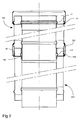
- Figure 1 shows a double-walled tubular element along the invention.
- Figure 2 shows a duct made up of two elements tubulars according to the invention.
- Figure 3 shows a bent tubular member
- Figure 4 shows a T-shaped tubular element.
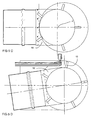
- Figures 5A to 5D show the stages of the manufacture of the tubular element according to the invention for the production of a T-shaped tubular element
- the tubular element (100), shown in Figure 1, is a double walled tubular element with two fittings consisting of a male end 1 and a female end 2.
- the double wall consists of an inner wall 3 and an outer wall 4 limited to each of the connections by an annular edge referenced 5, 6, 7 and 8 respectively.
- the inner and outer walls have each an essentially straight cylindrical shape, with cross-section circular around an axis of symmetry A, and are made, by example in stainless steel.
- This intermediate space 9 is filled, over most of the axial length of the element tubular 100, of a first thermally insulating material 10 held in place by two washers 11, 12 also called “Plugs" and consisting of a second thermally material insulator different from the first.
- the plug 11 is arranged so that its outer surface opposite to the one which is in contact with the insulating material 10, or set back relative to the edge 6 of the outer wall 4.
- the edge 6 is provided with an additional flare 42 which extends from edge 6 over a short axial length which can be obtained by stamping or coiling to give it, when the wall outer 4 is formed, a conical shape.
- the flare additional conical 42 is intended to facilitate the introduction of the outer wall of a first tubular element in the wall corresponding exterior of a second tubular element.
- the inner wall 3 is provided, on the side of female connector 2, with a cylindrical flare straight 31 and the outer wall 4 is provided, on the side of the fitting male 1, of a straight cylindrical flare 41.
- the flares 31 and 41 are distinguished from the remaining sections of the corresponding wall 3 or 4 by the fact that their diameter is slightly larger.
- the difference between the diameter d 1 of the flare 31 and the diameter d 2 of the remaining part of the inner wall 3 is of the order of 2 to 3 mm. for a wall thickness of 10 tenths of a mm.
- the difference between the diameter d 3 of the flaring 41 and the diameter d 4 of the outer wall 4 is of the order of 2 mm for a steel thickness of 10 tenths of a mm.
- the flare 31 slightly larger than the flare 41 for take into account the greater expansion of the inner wall 3 by compared to that of the outer wall 4.
- the inner wall 3 exceeds the outer wall 4, in axial length, on the side of the male connector 1, of a length e in order to obtain a secure and waterproof connection after fitting tubular elements one inside the other.
- retaining means 13 having the shape of legs clip. In general, two or three clip legs are sufficient. These clip tabs are distributed around the circumference of the inner wall 3 and are fixed to the latter by spot welding, to one of their ends. The other end of each clip tab is introduced into a corresponding molding of two moldings 14, 16 with which the outer wall is provided 4.
- the clip tabs 13 have small dimensions to avoid a thermal bridge between interior and exterior walls. In addition, they do not need to be very strong since they share the role of maintenance between the inner 3 and outer 4 walls with the plugs 11 and 12 formed so as to enter by their outer circumference in the moldings 14, 16 and, by their inner circumference, in moldings 15, 17 with which the inner wall is provided 3.
- the inner 3 and outer 4 walls are held in position coaxial by the washers, or plugs, 11 and 12 firmly enclosed between walls 3 and 4 and having gear with the moldings 14 to 17 as shown in Figure 1.
- the walls are kept in the longitudinal position relative along the axis of symmetry A, by the clip lugs 13 fixed on the inner wall 3 by welding and clipping into the corresponding molding 16 at the other end.
- the moldings Apart from this mechanical effect of holding in position relative of the two inner 3 and outer 4 walls, the moldings, and in particular the molding 17 of the inner wall 3 on the side of the connection 2, constitute a capillary barrier allowing block any rising humidity inside the space 9 intended for the insulation material.
- the molding 17 can also receive an elastomeric seal 400. This is shown in Figure 2 by the elastomeric seal 400 introduced into a molding 217 of the tubular element 200, which corresponds to the molding 17 of the tubular element 100.
- the great advantage of the design of the tubular element according to the invention consists of the identity between the forms of moldings 14 to 17, on the one hand, and shapes of the flares 31 and 41 on the other hand.
- This identity of the shapes of the moldings allows get them with one tool.
- the identity between the shapes of the flares can also be obtained by a same tool. So the difference in diameter between the two flares is obtained by cutting in one dimension different according to the respective circumferences of the wall interior 3 and exterior wall 4.
- Figures 1 and 2 represent an element tubular, or two straight tubular elements, each having two fittings
- Figures 3 and 4 show tubular elements comprising a first part 32, 42 of coaxial walls by report a first axis A and a second part 33, 43 or 34, 44 coaxial walls with respect to a second axis referenced respectively at C.
- the tubular element shown in the Figure 3 is a bent tubular member whose two parts of walls are coaxial with axes A and B forming between them an angle ⁇ whose value is of the order of 30 °.
- tubular elements shown on Figure 4 include two wall parts whose axes of symmetry A and C form an angle a whose value is 90 °. More particularly, the tubular element shown in Figure 4 is a T-shaped element because the second part of the coaxial walls is arranged between the two ends 1 and 2 of the first part coaxial walls. This tubular element has three fittings referenced 1, 2 and 51 respectively.
- the second part of coaxial walls could be arranged at one or other of the ends corresponding to the fittings 1 and 2 of the first part of the coaxial wall of so as to form a tubular element in an elbow in L.
- the steps necessary for the manufacture of one or the other of the different types of tubular elements shown more above can be grouped essentially into two groups.
- the first group consists of the leaf preparation steps metallic intended to constitute the coaxial walls or respectively the first or the second part of these walls coaxial of the double wall of the tubular element of the invention.
- the second group consists of the assembly of the elements tubular from two walls obtained by welding longitudinal sheets rolled around a longitudinal axis to get either a straight tubular or a tubular bent or a T-shaped tubular element
- first metal sheets advantageously made of steel stainless, according to the dimensions of each interior wall and outside of the tubular element.
- the tubular element a usually an inside diameter between 125mm and 600 mm and an outside diameter which is greater than the inside diameter by about 50 mm, depending on the thickness of a material thermally insulating provided.
- the length of a tubular element right is located between approximately 100 mm and 1400 mm. So is even for the total length of the two wall parts of a elbow element. Regarding the length of the part to bring in a T-shaped element, the third fitting and the part corresponding walls exceed the outer wall of a length of the order of 50 to 60 mm.
- each of the sheets is subjected to a molding, advantageously by rolling with a single tool, at each of the two sides intended to constitute the ends of the walls of a straight tubular element or the fittings constituted by one or the other part of a bent or T-shaped element. are made at distances from the corresponding edges of sheets, these distances being defined according to the tubular element to get.
- the last step in this group of steps is to roll the cut and molded sheets around the axis of the right tubular member or the corresponding part of the tubular member and perform a length weld to get the cylindrical wall.
- the walls are first covered interior of the side which is intended to form a female connector, two or possibly 3 clip legs 13. These legs are fixed on the outside of the inside wall by welding point. Thus, the legs are arranged on the outer face of the inner wall and oriented substantially radially with respect to it. Then the inner wall is introduced in the outer wall until the clip tabs 13 snap, by their free ends formed in a curve, into the corresponding molding, referenced in 16, of the wall outside.
- the inner wall is provided, before being introduced into the wall exterior, of a stitching support 52 shown in the Figures 5A to 5D.
- the inner wall is inserted therein until the clip lugs 13 are supported on the outer wall.
- the stitching support 52 is released by a lateral opening 62 provided for this purpose in the outer wall.
- the corresponding part of the outer wall intended to constitute the third fitting, is applied to the outer wall of the first part of the coaxial walls and is there welded.
- the inner wall is moved axially and / or angularly at an angle ⁇ indicated on the Figure 5D, around the axis A of the tubular element.
- the axial and angular displacements of the interior wall relative to the outer wall are made according to the progress of the welding tool intended for spot welding of walls.
- the moldings 14 and 16 of the wall outer of each of the nested tubular elements contribute in two ways to fix the tubular elements together.
- the additional flare 42 of the first element tubular 100 is supported on a face opposite a molding 216 of the tubular element 200.
- the molding 216 corresponds to the molding 16 of the tubular element 100.
- the moldings 14 and 16 help the nesting by the fact that they lend their sides to a collar 300 constituted by a quick-closing ring fastener.
- This necklace 300 has a cross section in the general shape of a "C" and allows the times a rigid assembly of the two tubular elements 100 and 200, after interlocking, and the benefit of the elasticity of the collar for hold the two tubular elements together, even under the influence of mechanical stresses.
- the elastomer seal can be replaced by a seal braided ceramic.
Landscapes
- Engineering & Computer Science (AREA)
- General Engineering & Computer Science (AREA)
- Mechanical Engineering (AREA)
- Separation Using Semi-Permeable Membranes (AREA)
- Thermal Insulation (AREA)
- Extrusion Moulding Of Plastics Or The Like (AREA)
- Quick-Acting Or Multi-Walled Pipe Joints (AREA)
- Rigid Pipes And Flexible Pipes (AREA)
- Shaping Of Tube Ends By Bending Or Straightening (AREA)
- Laminated Bodies (AREA)
- External Artificial Organs (AREA)
- Materials For Medical Uses (AREA)
Abstract
Description
- le premier matériau thermiquement isolant est retenu entre les parois par des rondelles consistant en un second matériau thermiquement isolant, plus compact que le premier, et disposées une à une à chaque raccord, la rondelle disposée au raccord femelle étant supportée par des moyens de retenue fixés par point à une des deux parois,
- les parois sont pourvues, à chacun des raccords d'une moulure disposée à une distance axiale du bord annulaire correspondant,
- la paroi intérieure dépasse, en longueur axiale, la paroi extérieure au raccord mâle,
- l'élément tubulaire comprend une première partie de parois coaxiales par rapport à un premier axe et une seconde partie de parois coaxiales par rapport à un second axe, les deux axes formant un angle et l'élément tubulaire ayant deux ou trois raccords en fonction du positionnement de la seconde partie des parois à une extrémité de la première partie de parois ou entre ses deux extrémités,
- l'angle entre les deux axes est de l'ordre de 90°,
- l'élément tubulaire est coudé,
- l'élément tubulaire est un élément en T.
- introduire la paroi intérieure de la première partie de parois axialement à l'intérieur de la paroi extérieure de la première partie de parois,
- faire ressortir la paroi intérieure de la paroi extérieure jusqu'à pouvoir souder la paroi intérieure de la seconde partie de parois sur la paroi intérieure de la première partie de parois,
- effectuer ce soudage
- et souder ensuite la paroi extérieure de la seconde partie de parois sur la paroi extérieure de la première partie de parois.
Claims (12)
- Elément tubulaire à double paroi avec au moins deux raccords (1, 2) dont un raccord mâle (1) et un raccord femelle (2), pour un conduit de gaz chauds, les deux parois intérieure (3) et extérieure (4) étant limitées à chacun des raccords par un bord annulaire (5-8) et délimitant entre elles un espace intermédiaire (9) rempli au moins partiellement d'un premier matériau thermiquement isolant (10), caractérisé en ce que le raccord femelle (2) comprend un évasement cylindrique (31) de la paroi intérieure (3) et en ce que le raccord mâle (1) comprend un évasement cylindrique (41) de la paroi extérieure (4).
- Elément tubulaire selon la revendication 1, caractérisé en ce que le premier matériau thermiquement isolant (10) est retenu entre les parois (3, 4) par des rondelles (11, 12) consistant en un second matériau thermiquement isolant, plus compact que le premier, et disposées une à une à chaque raccord (1, 2), la rondelle (12) disposée au raccord femelle (2) étant supportée par des moyens de retenue (13) fixés par point à une (3) des deux parois (3, 4).
- Elément tubulaire selon la revendication 1 ou 2, caractérisé en ce que les parois (3, 4) sont pourvues, à chacun des raccords (1, 2), d'une moulure (14-17) disposée à une distance axiale du bord annulaire (5-8) correspondant.
- Elément tubulaire selon l'une quelconque des revendications 1 à 3, caractérisé en ce que la paroi intérieure (3) dépasse, en longueur axiale, la paroi extérieure (4) au raccord mâle (1).
- Elément tubulaire selon l'une quelconque des revendications 1 à 4, caractérisé en ce qu'il comprend une première partie (32, 42) de parois coaxiales par rapport à un premier axe (A) et une seconde partie (33,43; 34,44) de parois coaxiales par rapport à un second axe (B; C), les deux axes formant un angle (α) et l'élément tubulaire ayant deux ou trois raccords (12, 51) en fonction du positionnement de la seconde partie des parois (33;43, 34,44) à une extrémité de la première partie de parois (32, 42) ou entre ses deux extrémités.
- Elément tubulaire selon la revendication 5, caractérisé en ce que l'angle entre les deux axes est de l'ordre de 90°.
- Elément tubulaire selon la revendication 5 ou 6, caractérisé en ce qu'il est coudé.
- Elément tubulaire selon la revendication 5 ou 6, caractérisé en ce qu'il est un élément en T.
- Procédé de fabrication d'un élément tubulaire à double paroi avec au moins deux raccords, dont un raccord mâle (1) et un raccord femelle (2), une première partie (32, 42) des parois étant coaxiales par rapport à un premier axe (A) et une seconde partie (34, 44) des parois étant coaxiales par rapport à un second axe (B; C), les deux axes formant un angle (α), caractérisé en ce que le procédé comprend les étapes:introduire la paroi intérieure (32) de la première partie de parois (32, 42) axialement à l'intérieur de la paroi extérieure (42) de la première partie de parois (32, 42),faire ressortir la paroi intérieure (32) de la paroi extérieure (42) jusqu'à pouvoir souder la paroi intérieure (34) de la seconde partie de parois (34, 44) sur la paroi intérieure (32) de la première partie de parois,effectuer ce soudage etsouder la paroi extérieure (44) de la seconde partie de parois (34, 44) sur celle (42) de la première partie.
- Procédé de fabrication selon la revendication 9, mis en oeuvre pour obtenir un élément tubulaire à double paroi ayant une forme en T, la paroi intérieure (32) de celle des deux parties de parois destinée à recevoir l'autre partie de parois étant pourvue d'un support de piquage (52) et la paroi extérieure (42) correspondante étant pourvue d'une ouverture latérale, caractérisé en ce qu'il comprend les étapes de ressortir le support de piquage (52) par l'ouverture latérale (62) jusqu'à pouvoir souder la paroi intérieure (34) de la seconde partie de parois sur le support de piquage (52) et de souder la paroi supérieure (44) de la seconde partie de parois sur l'ouverture latérale (62) de la paroi extérieure (42) de la première partie de paroi.
- Procédé de fabrication selon la revendication 9 ou 10, caractérisé en ce que l'on place, dans un espace intermédiaire (9) délimité entre les parois intérieure (3, 32, 33) et extérieure (4, 42, 43, 44) de l'élément tubulaire, à chacun des raccords sauf à un, une rondelle (11, 12) consistant en un matériau compact et thermiquement isolant, que l'on injecte dans l'espace intermédiaire (9), à l'aide d'air comprimé, un matériau meuble et thermiquement isolant (10) et que l'on ferme l'espace (9) au raccord correspondant par insertion d'une rondelle (11, 12) consistant en un matériau compact et thermiquement isolant.
- Conduit de gaz chauds, obtenu par emmanchement d'au moins un premier élément tubulaire (100) dans un deuxième élément tubulaire (200), les éléments tubulaires (100, 200) étant des éléments tubulaires conformes à l'une quelconque des revendications 1 à 8.
Applications Claiming Priority (2)
| Application Number | Priority Date | Filing Date | Title |
|---|---|---|---|
| FR9911236 | 1999-09-08 | ||
| FR9911236A FR2798183B1 (fr) | 1999-09-08 | 1999-09-08 | Element tubulaire a double paroi et procede de fabrication d'un tel element tubulaire |
Publications (2)
| Publication Number | Publication Date |
|---|---|
| EP1083378A1 true EP1083378A1 (fr) | 2001-03-14 |
| EP1083378B1 EP1083378B1 (fr) | 2004-08-11 |
Family
ID=9549640
Family Applications (1)
| Application Number | Title | Priority Date | Filing Date |
|---|---|---|---|
| EP00402466A Expired - Lifetime EP1083378B1 (fr) | 1999-09-08 | 2000-09-07 | Elément tubulaire à double paroi et procédé de fabrication d'un tel élément tubulaire |
Country Status (8)
| Country | Link |
|---|---|
| EP (1) | EP1083378B1 (fr) |
| AT (1) | ATE273478T1 (fr) |
| DE (1) | DE60012835T2 (fr) |
| DK (1) | DK1083378T3 (fr) |
| ES (1) | ES2222165T3 (fr) |
| FR (1) | FR2798183B1 (fr) |
| PL (1) | PL195434B1 (fr) |
| PT (1) | PT1083378E (fr) |
Cited By (1)
| Publication number | Priority date | Publication date | Assignee | Title |
|---|---|---|---|---|
| ITPD20110155A1 (it) * | 2011-05-16 | 2012-11-17 | Alessandro Marangoni | Dispositivo per lo scarico dei fumi sporgente oltre la copertura degli edifici |
Citations (6)
| Publication number | Priority date | Publication date | Assignee | Title |
|---|---|---|---|---|
| GB1363683A (en) * | 1971-10-25 | 1974-08-14 | Anvil Ind Inc | Conduit systems |
| GB1419810A (en) * | 1973-11-30 | 1975-12-31 | Park Sectional Insulating Co | Flue sections |
| GB2052715A (en) * | 1979-05-31 | 1981-01-28 | Webster Ltd T | Chimney Elements and End Caps for Use Therein |
| EP0100692A1 (fr) * | 1982-06-18 | 1984-02-15 | Etablissements Poujoulat | Dispositif de raccordement de tubages de cheminée |
| FR2566095A1 (fr) | 1984-06-14 | 1985-12-20 | Tolerie Ind Sa | Conduit metallique a double paroi pour gaz tres chauds |
| US4846147A (en) * | 1987-10-05 | 1989-07-11 | Simpson Dura Vent Company, Inc. | Chimney liner system |
-
1999
- 1999-09-08 FR FR9911236A patent/FR2798183B1/fr not_active Expired - Fee Related
-
2000
- 2000-09-07 PT PT00402466T patent/PT1083378E/pt unknown
- 2000-09-07 AT AT00402466T patent/ATE273478T1/de active
- 2000-09-07 EP EP00402466A patent/EP1083378B1/fr not_active Expired - Lifetime
- 2000-09-07 ES ES00402466T patent/ES2222165T3/es not_active Expired - Lifetime
- 2000-09-07 DE DE60012835T patent/DE60012835T2/de not_active Expired - Lifetime
- 2000-09-07 DK DK00402466T patent/DK1083378T3/da active
- 2000-09-08 PL PL342439A patent/PL195434B1/pl unknown
Patent Citations (6)
| Publication number | Priority date | Publication date | Assignee | Title |
|---|---|---|---|---|
| GB1363683A (en) * | 1971-10-25 | 1974-08-14 | Anvil Ind Inc | Conduit systems |
| GB1419810A (en) * | 1973-11-30 | 1975-12-31 | Park Sectional Insulating Co | Flue sections |
| GB2052715A (en) * | 1979-05-31 | 1981-01-28 | Webster Ltd T | Chimney Elements and End Caps for Use Therein |
| EP0100692A1 (fr) * | 1982-06-18 | 1984-02-15 | Etablissements Poujoulat | Dispositif de raccordement de tubages de cheminée |
| FR2566095A1 (fr) | 1984-06-14 | 1985-12-20 | Tolerie Ind Sa | Conduit metallique a double paroi pour gaz tres chauds |
| US4846147A (en) * | 1987-10-05 | 1989-07-11 | Simpson Dura Vent Company, Inc. | Chimney liner system |
Cited By (1)
| Publication number | Priority date | Publication date | Assignee | Title |
|---|---|---|---|---|
| ITPD20110155A1 (it) * | 2011-05-16 | 2012-11-17 | Alessandro Marangoni | Dispositivo per lo scarico dei fumi sporgente oltre la copertura degli edifici |
Also Published As
| Publication number | Publication date |
|---|---|
| FR2798183A1 (fr) | 2001-03-09 |
| EP1083378B1 (fr) | 2004-08-11 |
| PL195434B1 (pl) | 2007-09-28 |
| PL342439A1 (en) | 2001-03-12 |
| PT1083378E (pt) | 2004-10-29 |
| DE60012835D1 (de) | 2004-09-16 |
| ES2222165T3 (es) | 2005-02-01 |
| ATE273478T1 (de) | 2004-08-15 |
| DK1083378T3 (da) | 2004-10-11 |
| FR2798183B1 (fr) | 2001-11-16 |
| DE60012835T2 (de) | 2005-08-18 |
Similar Documents
| Publication | Publication Date | Title |
|---|---|---|
| EP0870967B1 (fr) | Joint verrouillé entre éléments de canalisation et jonc fendu métallique utilisable dans un tel joint | |
| FR2465942A1 (fr) | Raccord pour elements tubulaires | |
| EP0687884B1 (fr) | Manchon anti-arcure | |
| EP0877890B1 (fr) | Conduit metallique modulaire a emboitement, notamment pour l'evacuation des fumees | |
| EP1083378B1 (fr) | Elément tubulaire à double paroi et procédé de fabrication d'un tel élément tubulaire | |
| FR2644223A1 (fr) | Raccord rapide et procede de montage | |
| EP0713044B1 (fr) | Elément tubulaire soudé pour un conduit de gaz chaud, et son procédé de réalisation | |
| FR3002376A1 (fr) | Bouchon d'etancheite pour cable electrique contre les infiltrations d'air dans les batiments et procede de pose du cable electrique | |
| EP0286488B1 (fr) | Elément de conduit de fumée étanche, à double paroi et calorifugé | |
| EP0546893B1 (fr) | Segment à double emboitement pour conduit de fumée | |
| EP0743111B1 (fr) | Procédé de fabrication d'un balancier de cornadis, le balancier de cornadis réalisé par le procédé et un cornadis incorporant un tel balancier | |
| FR2566094A1 (fr) | Conduit metallique a double paroi pour gaz chauds | |
| EP0427598A1 (fr) | Segment emboîtable pour conduit de fumée | |
| FR2866376A1 (fr) | Element de conduit de fumee a double paroi | |
| FR2729210A1 (fr) | Ensemble d'isolation de tuyaux forme d'elements et procede de fabrication de tels elements | |
| FR3112591A1 (fr) | Tronçon de conduit de fumée du type à deux tubes concentriques et son procédé de fabrication | |
| EP1095672B1 (fr) | Bouche de ventilation coupe-feu | |
| FR2701305A1 (fr) | Elément tubulaire pour conduit de gaz chaud. | |
| EP1197707A1 (fr) | Ensemble de deux conduits de gaz chauds raccordés au moyen d'un coupleur, procédé de raccordement et coupleur correspondant | |
| EP1987311A1 (fr) | Boite collectrice metallique, echangeur de chaleur comportant une telle boite collectrice et procede de fabrication d'une telle boite collectrice | |
| FR2537636A1 (fr) | Conduit de fumee etanche, notamment pour cheminees | |
| FR3147337A1 (fr) | Collier d’assemblage, pour le positionnement et le maintien des extrémités de deux éléments de conduit qui sont mises bout à bout | |
| EP1428590A1 (fr) | Procédé de fabrication d'un élément de conduit à tuyaux concentriques et élément de conduit à tuyaux concentriques correspondant | |
| FR2714687A1 (fr) | Conduit de fumée du type à double enveloppe. | |
| FR2833665A1 (fr) | Soufflet d'etancheite et joint de transmission correspondant |
Legal Events
| Date | Code | Title | Description |
|---|---|---|---|
| PUAI | Public reference made under article 153(3) epc to a published international application that has entered the european phase |
Free format text: ORIGINAL CODE: 0009012 |
|
| AK | Designated contracting states |
Kind code of ref document: A1 Designated state(s): AT BE CH CY DE DK ES FI FR GB GR IE IT LI LU MC NL PT SE |
|
| AX | Request for extension of the european patent |
Free format text: AL;LT;LV;MK;RO;SI |
|
| 17P | Request for examination filed |
Effective date: 20010914 |
|
| AKX | Designation fees paid |
Free format text: AT BE CH CY DE DK ES FI FR GB GR IE IT LI LU MC NL PT SE |
|
| 17Q | First examination report despatched |
Effective date: 20030319 |
|
| GRAP | Despatch of communication of intention to grant a patent |
Free format text: ORIGINAL CODE: EPIDOSNIGR1 |
|
| GRAS | Grant fee paid |
Free format text: ORIGINAL CODE: EPIDOSNIGR3 |
|
| GRAA | (expected) grant |
Free format text: ORIGINAL CODE: 0009210 |
|
| AK | Designated contracting states |
Kind code of ref document: B1 Designated state(s): AT BE CH CY DE DK ES FI FR GB GR IE IT LI LU MC NL PT SE |
|
| REG | Reference to a national code |
Ref country code: GB Ref legal event code: FG4D Free format text: NOT ENGLISH |
|
| REG | Reference to a national code |
Ref country code: CH Ref legal event code: EP |
|
| REG | Reference to a national code |
Ref country code: CH Ref legal event code: NV Representative=s name: KIRKER & CIE SA |
|
| REG | Reference to a national code |
Ref country code: IE Ref legal event code: FG4D Free format text: FRENCH |
|
| REF | Corresponds to: |
Ref document number: 60012835 Country of ref document: DE Date of ref document: 20040916 Kind code of ref document: P |
|
| PG25 | Lapsed in a contracting state [announced via postgrant information from national office to epo] |
Ref country code: MC Free format text: LAPSE BECAUSE OF NON-PAYMENT OF DUE FEES Effective date: 20040930 |
|
| REG | Reference to a national code |
Ref country code: DK Ref legal event code: T3 |
|
| REG | Reference to a national code |
Ref country code: SE Ref legal event code: TRGR |
|
| REG | Reference to a national code |
Ref country code: PT Ref legal event code: SC4A Free format text: AVAILABILITY OF NATIONAL TRANSLATION Effective date: 20040901 |
|
| REG | Reference to a national code |
Ref country code: GR Ref legal event code: EP Ref document number: 20040403138 Country of ref document: GR |
|
| GBT | Gb: translation of ep patent filed (gb section 77(6)(a)/1977) |
Effective date: 20041115 |
|
| REG | Reference to a national code |
Ref country code: ES Ref legal event code: FG2A Ref document number: 2222165 Country of ref document: ES Kind code of ref document: T3 |
|
| PLBE | No opposition filed within time limit |
Free format text: ORIGINAL CODE: 0009261 |
|
| STAA | Information on the status of an ep patent application or granted ep patent |
Free format text: STATUS: NO OPPOSITION FILED WITHIN TIME LIMIT |
|
| 26N | No opposition filed |
Effective date: 20050512 |
|
| PGFP | Annual fee paid to national office [announced via postgrant information from national office to epo] |
Ref country code: LU Payment date: 20100629 Year of fee payment: 11 |
|
| PGFP | Annual fee paid to national office [announced via postgrant information from national office to epo] |
Ref country code: IE Payment date: 20100824 Year of fee payment: 11 Ref country code: CH Payment date: 20100810 Year of fee payment: 11 |
|
| PGFP | Annual fee paid to national office [announced via postgrant information from national office to epo] |
Ref country code: AT Payment date: 20100706 Year of fee payment: 11 Ref country code: FI Payment date: 20100806 Year of fee payment: 11 Ref country code: SE Payment date: 20100914 Year of fee payment: 11 |
|
| PGFP | Annual fee paid to national office [announced via postgrant information from national office to epo] |
Ref country code: GR Payment date: 20100928 Year of fee payment: 11 |
|
| PGFP | Annual fee paid to national office [announced via postgrant information from national office to epo] |
Ref country code: PT Payment date: 20100903 Year of fee payment: 11 Ref country code: DK Payment date: 20100924 Year of fee payment: 11 |
|
| PGFP | Annual fee paid to national office [announced via postgrant information from national office to epo] |
Ref country code: CY Payment date: 20100827 Year of fee payment: 11 |
|
| REG | Reference to a national code |
Ref country code: PT Ref legal event code: MM4A Free format text: LAPSE DUE TO NON-PAYMENT OF FEES Effective date: 20120307 |
|
| REG | Reference to a national code |
Ref country code: DK Ref legal event code: EBP Ref country code: CH Ref legal event code: PL |
|
| REG | Reference to a national code |
Ref country code: GR Ref legal event code: ML Ref document number: 20040403138 Country of ref document: GR Effective date: 20120403 |
|
| PG25 | Lapsed in a contracting state [announced via postgrant information from national office to epo] |
Ref country code: FI Free format text: LAPSE BECAUSE OF NON-PAYMENT OF DUE FEES Effective date: 20110907 Ref country code: PT Free format text: LAPSE BECAUSE OF NON-PAYMENT OF DUE FEES Effective date: 20120307 |
|
| REG | Reference to a national code |
Ref country code: IE Ref legal event code: MM4A |
|
| REG | Reference to a national code |
Ref country code: SE Ref legal event code: EUG |
|
| PG25 | Lapsed in a contracting state [announced via postgrant information from national office to epo] |
Ref country code: IE Free format text: LAPSE BECAUSE OF NON-PAYMENT OF DUE FEES Effective date: 20110907 Ref country code: LI Free format text: LAPSE BECAUSE OF NON-PAYMENT OF DUE FEES Effective date: 20110930 Ref country code: CH Free format text: LAPSE BECAUSE OF NON-PAYMENT OF DUE FEES Effective date: 20110930 |
|
| PG25 | Lapsed in a contracting state [announced via postgrant information from national office to epo] |
Ref country code: GR Free format text: LAPSE BECAUSE OF NON-PAYMENT OF DUE FEES Effective date: 20120403 |
|
| PG25 | Lapsed in a contracting state [announced via postgrant information from national office to epo] |
Ref country code: DK Free format text: LAPSE BECAUSE OF NON-PAYMENT OF DUE FEES Effective date: 20110930 Ref country code: CY Free format text: LAPSE BECAUSE OF NON-PAYMENT OF DUE FEES Effective date: 20110907 |
|
| REG | Reference to a national code |
Ref country code: AT Ref legal event code: MM01 Ref document number: 273478 Country of ref document: AT Kind code of ref document: T Effective date: 20110907 |
|
| PG25 | Lapsed in a contracting state [announced via postgrant information from national office to epo] |
Ref country code: AT Free format text: LAPSE BECAUSE OF NON-PAYMENT OF DUE FEES Effective date: 20110907 |
|
| PG25 | Lapsed in a contracting state [announced via postgrant information from national office to epo] |
Ref country code: SE Free format text: LAPSE BECAUSE OF NON-PAYMENT OF DUE FEES Effective date: 20110908 |
|
| PG25 | Lapsed in a contracting state [announced via postgrant information from national office to epo] |
Ref country code: LU Free format text: LAPSE BECAUSE OF NON-PAYMENT OF DUE FEES Effective date: 20110907 |
|
| REG | Reference to a national code |
Ref country code: FR Ref legal event code: PLFP Year of fee payment: 17 |
|
| REG | Reference to a national code |
Ref country code: FR Ref legal event code: PLFP Year of fee payment: 18 |
|
| REG | Reference to a national code |
Ref country code: FR Ref legal event code: PLFP Year of fee payment: 19 |
|
| PGFP | Annual fee paid to national office [announced via postgrant information from national office to epo] |
Ref country code: IT Payment date: 20190611 Year of fee payment: 20 |
|
| PGFP | Annual fee paid to national office [announced via postgrant information from national office to epo] |
Ref country code: BE Payment date: 20190604 Year of fee payment: 20 Ref country code: FR Payment date: 20190603 Year of fee payment: 20 |
|
| PGFP | Annual fee paid to national office [announced via postgrant information from national office to epo] |
Ref country code: NL Payment date: 20190918 Year of fee payment: 20 Ref country code: DE Payment date: 20190606 Year of fee payment: 20 |
|
| PGFP | Annual fee paid to national office [announced via postgrant information from national office to epo] |
Ref country code: GB Payment date: 20190702 Year of fee payment: 20 |
|
| PGFP | Annual fee paid to national office [announced via postgrant information from national office to epo] |
Ref country code: ES Payment date: 20191004 Year of fee payment: 20 |
|
| REG | Reference to a national code |
Ref country code: DE Ref legal event code: R071 Ref document number: 60012835 Country of ref document: DE |
|
| REG | Reference to a national code |
Ref country code: NL Ref legal event code: MK Effective date: 20200906 |
|
| REG | Reference to a national code |
Ref country code: GB Ref legal event code: PE20 Expiry date: 20200906 |
|
| REG | Reference to a national code |
Ref country code: BE Ref legal event code: MK Effective date: 20200907 |
|
| PG25 | Lapsed in a contracting state [announced via postgrant information from national office to epo] |
Ref country code: GB Free format text: LAPSE BECAUSE OF EXPIRATION OF PROTECTION Effective date: 20200906 |
|
| PG25 | Lapsed in a contracting state [announced via postgrant information from national office to epo] |
Ref country code: ES Free format text: LAPSE BECAUSE OF EXPIRATION OF PROTECTION Effective date: 20200908 |