EP1083241B1 - Acier ferritique à 14% de chrome stabilisé au niobium et son utilisation dans le domaine de l'automobile - Google Patents
Acier ferritique à 14% de chrome stabilisé au niobium et son utilisation dans le domaine de l'automobile Download PDFInfo
- Publication number
- EP1083241B1 EP1083241B1 EP00402447A EP00402447A EP1083241B1 EP 1083241 B1 EP1083241 B1 EP 1083241B1 EP 00402447 A EP00402447 A EP 00402447A EP 00402447 A EP00402447 A EP 00402447A EP 1083241 B1 EP1083241 B1 EP 1083241B1
- Authority
- EP
- European Patent Office
- Prior art keywords
- niobium
- steel sheet
- δnb
- equation
- temperature
- Prior art date
- Legal status (The legal status is an assumption and is not a legal conclusion. Google has not performed a legal analysis and makes no representation as to the accuracy of the status listed.)
- Expired - Lifetime
Links
Images


Classifications
-
- C—CHEMISTRY; METALLURGY
- C22—METALLURGY; FERROUS OR NON-FERROUS ALLOYS; TREATMENT OF ALLOYS OR NON-FERROUS METALS
- C22C—ALLOYS
- C22C38/00—Ferrous alloys, e.g. steel alloys
- C22C38/001—Ferrous alloys, e.g. steel alloys containing N
-
- C—CHEMISTRY; METALLURGY
- C21—METALLURGY OF IRON
- C21D—MODIFYING THE PHYSICAL STRUCTURE OF FERROUS METALS; GENERAL DEVICES FOR HEAT TREATMENT OF FERROUS OR NON-FERROUS METALS OR ALLOYS; MAKING METAL MALLEABLE, e.g. BY DECARBURISATION OR TEMPERING
- C21D8/00—Modifying the physical properties of ferrous metals or ferrous alloys by deformation combined with, or followed by, heat treatment
- C21D8/02—Modifying the physical properties of ferrous metals or ferrous alloys by deformation combined with, or followed by, heat treatment during manufacturing of plates or strips
-
- C—CHEMISTRY; METALLURGY
- C22—METALLURGY; FERROUS OR NON-FERROUS ALLOYS; TREATMENT OF ALLOYS OR NON-FERROUS METALS
- C22C—ALLOYS
- C22C38/00—Ferrous alloys, e.g. steel alloys
- C22C38/008—Ferrous alloys, e.g. steel alloys containing tin
-
- C—CHEMISTRY; METALLURGY
- C22—METALLURGY; FERROUS OR NON-FERROUS ALLOYS; TREATMENT OF ALLOYS OR NON-FERROUS METALS
- C22C—ALLOYS
- C22C38/00—Ferrous alloys, e.g. steel alloys
- C22C38/18—Ferrous alloys, e.g. steel alloys containing chromium
- C22C38/22—Ferrous alloys, e.g. steel alloys containing chromium with molybdenum or tungsten
-
- C—CHEMISTRY; METALLURGY
- C22—METALLURGY; FERROUS OR NON-FERROUS ALLOYS; TREATMENT OF ALLOYS OR NON-FERROUS METALS
- C22C—ALLOYS
- C22C38/00—Ferrous alloys, e.g. steel alloys
- C22C38/18—Ferrous alloys, e.g. steel alloys containing chromium
- C22C38/26—Ferrous alloys, e.g. steel alloys containing chromium with niobium or tantalum
-
- C—CHEMISTRY; METALLURGY
- C21—METALLURGY OF IRON
- C21D—MODIFYING THE PHYSICAL STRUCTURE OF FERROUS METALS; GENERAL DEVICES FOR HEAT TREATMENT OF FERROUS OR NON-FERROUS METALS OR ALLOYS; MAKING METAL MALLEABLE, e.g. BY DECARBURISATION OR TEMPERING
- C21D8/00—Modifying the physical properties of ferrous metals or ferrous alloys by deformation combined with, or followed by, heat treatment
- C21D8/02—Modifying the physical properties of ferrous metals or ferrous alloys by deformation combined with, or followed by, heat treatment during manufacturing of plates or strips
- C21D8/0221—Modifying the physical properties of ferrous metals or ferrous alloys by deformation combined with, or followed by, heat treatment during manufacturing of plates or strips characterised by the working steps
- C21D8/0226—Hot rolling
-
- C—CHEMISTRY; METALLURGY
- C21—METALLURGY OF IRON
- C21D—MODIFYING THE PHYSICAL STRUCTURE OF FERROUS METALS; GENERAL DEVICES FOR HEAT TREATMENT OF FERROUS OR NON-FERROUS METALS OR ALLOYS; MAKING METAL MALLEABLE, e.g. BY DECARBURISATION OR TEMPERING
- C21D8/00—Modifying the physical properties of ferrous metals or ferrous alloys by deformation combined with, or followed by, heat treatment
- C21D8/02—Modifying the physical properties of ferrous metals or ferrous alloys by deformation combined with, or followed by, heat treatment during manufacturing of plates or strips
- C21D8/0221—Modifying the physical properties of ferrous metals or ferrous alloys by deformation combined with, or followed by, heat treatment during manufacturing of plates or strips characterised by the working steps
- C21D8/0236—Cold rolling
-
- C—CHEMISTRY; METALLURGY
- C21—METALLURGY OF IRON
- C21D—MODIFYING THE PHYSICAL STRUCTURE OF FERROUS METALS; GENERAL DEVICES FOR HEAT TREATMENT OF FERROUS OR NON-FERROUS METALS OR ALLOYS; MAKING METAL MALLEABLE, e.g. BY DECARBURISATION OR TEMPERING
- C21D8/00—Modifying the physical properties of ferrous metals or ferrous alloys by deformation combined with, or followed by, heat treatment
- C21D8/02—Modifying the physical properties of ferrous metals or ferrous alloys by deformation combined with, or followed by, heat treatment during manufacturing of plates or strips
- C21D8/0247—Modifying the physical properties of ferrous metals or ferrous alloys by deformation combined with, or followed by, heat treatment during manufacturing of plates or strips characterised by the heat treatment
- C21D8/0273—Final recrystallisation annealing
Definitions
- the invention relates to a ferritic steel known as 14% chromium stabilized niobium and its use in the automotive field.
- the object of the invention is to propose a ferritic steel, economic, which has a very good resistance to hot creep as well as oxidation, up to 1000 ° C and an improved hardness characteristic for its formatting.
- EP-A-0 225 263 discloses a ferritic steel having good resistance to oxidation and creep at high temperature, especially with combined addition of Nb + Al + Zr, after hot rolling and cold, followed by a short final annealing at 1000 ° C. An addition of 0.025-0.10% of P is considered in EP-A-0 678 587 as being favorable for formability.
- the invention also relates to a use of the steel sheet ferritics in the automotive field and in particular for the realization of exhaust line collector.
- FIGS. 1A and 1B respectively show a microstructure a steel according to the invention, referenced 1 in Tables I and II, and a microstructure of a comparison steel, referenced 6 in Tables I and II, after heat treatment, each of the two steels comprising the same ⁇ Nb of about 0.25%.
- Figure 2 shows a microstructure of a comparison steel referenced 9 in Tables I and II, with a relatively high ⁇ Nb of about 0.43% having after heat treatment precipitates intergranular Fe2Nb, distributed in a disordered manner.
- Figure 3 shows the mechanical characteristics in hardness for a steel according to the invention, referenced 1 in Tables I and II, and two comparative steels, referenced 6 and 9 in Tables I and II, before and after heat treatment of formation of precipitates respectively of Fe2Nb3 or Fe2Nb type.
- ⁇ Nb ⁇ 0.3% the phase of Laves Fe2Nb is completely dissolved at temperatures equal to or greater than 950 ° C, as shown in Figure 1 B. This explains the poor behavior of these steels with creep resistance at or above 950 ° C.
- This phase has a lower solubility than the Laves Fe2Nb phase.
- a significant amount of Fe2Nb3 remains present as can be seen on the microstructure of the Figure 1A.
- the presence of the Fe2Nb3 phase at high temperature, large quantity has the advantage of generating a very good creep resistance and shaping the steels according to the invention.
- the Fe2Nb Laves phase is an intermetallic compound, which when present in steel, intragranularly precipitates and at joints grain in an anarchic manner and does not sufficiently prevent the displacement of the grain boundaries, so the material flows. An amount important of this intermetallic precipitate is necessary to improve the creep.
- the ratio Si / Mn greater than 1 is not respected, it is also the intermetallic Fe2Nb3 that appears.
- manganese increases the solubility of intermetallic Fe2Nb3 and the formation, at high temperature, a Z phase of the CrNbN type in the grains. At 950 ° C, the Fe2Nb3 intermetallic is thus dissolved. Steel has a bad creep and oxidation resistance. Silicon compensates for this effect.
- a heat treatment at a temperature of the order of 900 ° C, preferably of the order of 850 ° C, for a relatively short period, less than or equal to 30 minutes, after final annealing or prior to use has been performed.
- the treatment temperature allows very fine homogeneous precipitation at grain boundaries of the Fe2Nb3 phase. These precipitates serve as a center germination. They allow a very homogeneous precipitation, at joints of grains, of the Fe2Nb3 phase at any temperature greater than or equal to 750 ° C which is favorable for a good resistance to creep.
- a copper addition in a moderate content less than or equal to 1.5%, can be carried out.
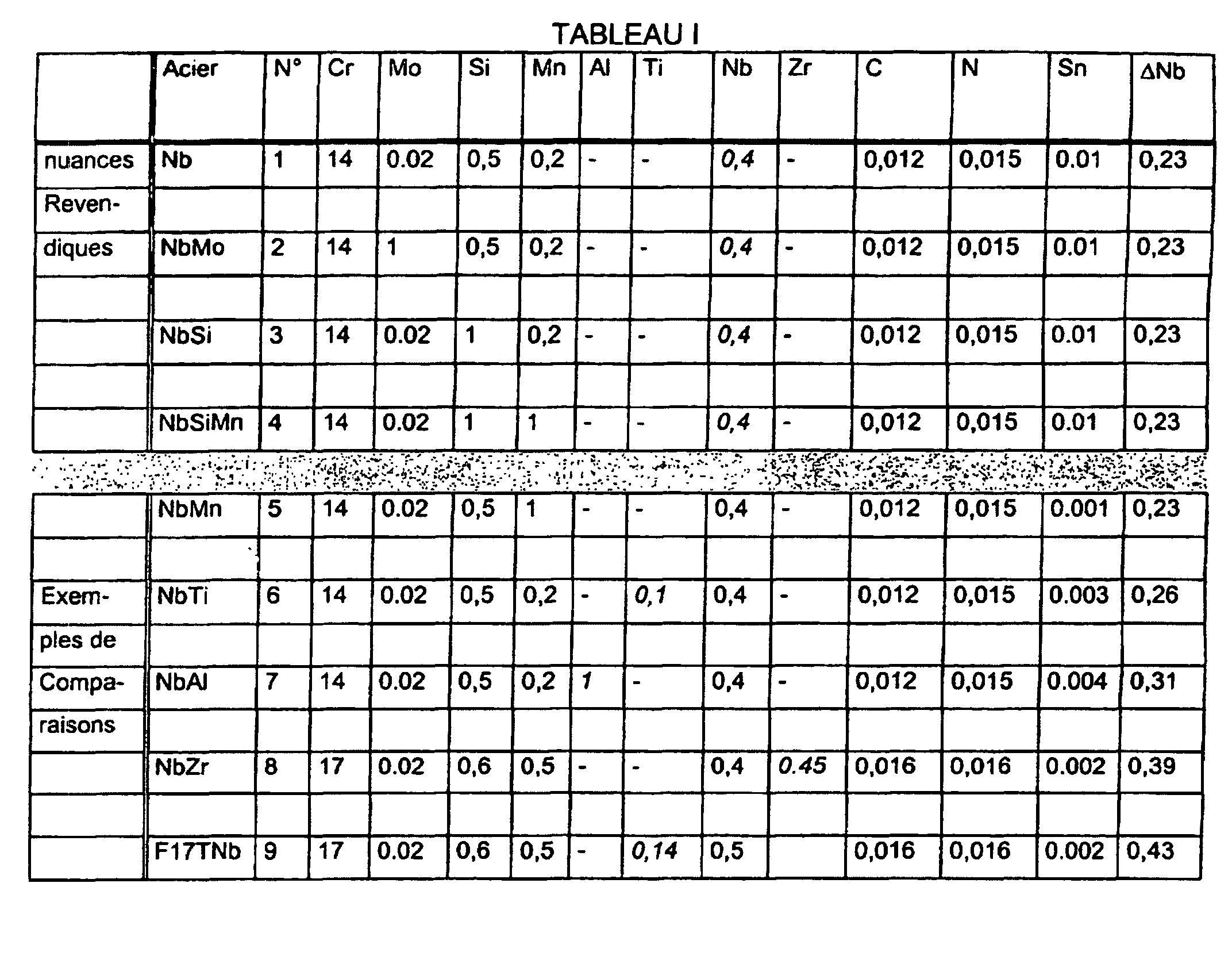
- Table I presents the chemical analyzes of the grades studied. Shades 1 to 4 are shades according to the invention. Shades 5 to 9 are examples of comparisons.
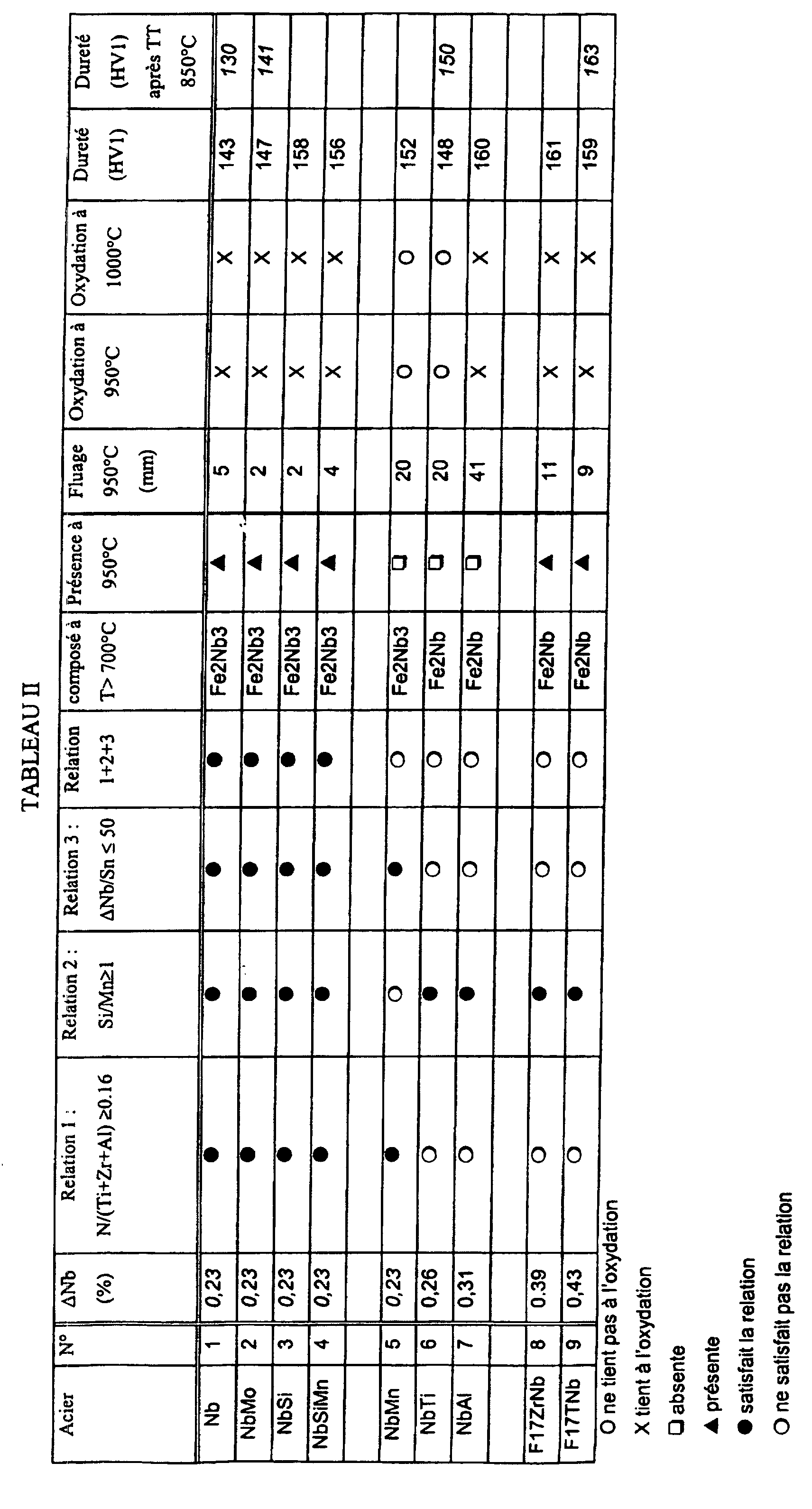
- Table II presents the creep results at 950 ° C. after 100h. cyclic oxidation at 950 ° C and 1000 ° C after 200h, the hardness after annealing final and after heat treatment at 850 ° C according to the invention, as well as the ANb, the type of intermetallic present at T> 700 ° C and the presence or absence intermetallics at 950 ° C.
- This table also presents the relationships satisfied or not by the elements of the compositions presented.
- compositions which satisfy all the relationships and which thus have the best creep, oxidation and hardness characteristics before and after heat treatment, with the lowest ⁇ Nb, are the grades 1-4 according to the invention.
Landscapes
- Chemical & Material Sciences (AREA)
- Engineering & Computer Science (AREA)
- Materials Engineering (AREA)
- Mechanical Engineering (AREA)
- Metallurgy (AREA)
- Organic Chemistry (AREA)
- Thermal Sciences (AREA)
- Crystallography & Structural Chemistry (AREA)
- Physics & Mathematics (AREA)
- Heat Treatment Of Sheet Steel (AREA)
- Catalysts (AREA)
- Treatment Of Steel In Its Molten State (AREA)
- Soft Magnetic Materials (AREA)
Description
- un réchauffage avant laminage à chaud à une température comprise entre 1150°C et 1250°C et de préférence à environ 1175°C,
- un bobinage à une température comprise entre 600°C et 800°C et de préférence à environ 600°C,
- un laminage à froid de la bobine avec ou sans recuit préalable,
- un recuit final de la bande de tôle à une température comprise entre 800°C et 1100°C pendant une durée comprise entre 1 mn et 5 mn et de préférence à une température d'environ 1050°C pendant un temps d'environ 2 mn,
- après recuit final ou préalable à l'utilisation, la tôle est soumise à un traitement thermique à une température comprise entre 800°C et 1000°C pendant un temps compris entre 1mn et 100h et de préférence à une température d'environ 850°C pendant un temps égal ou inférieur à 30mn.
- carbone ≤ 0,02%
- 0,002% ≤ azote ≤ 0,02%
- 0,05% ≤ silicium ≤ 1 %
- 0% < manganèse ≤ 1 %
- 0,2% ≤ niobium ≤ 0,6%
- 13,5% ≤ chrome ≤ 16,5%
- 0.02% ≤ molybdène ≤ 1.5%
- 0% < cuivre ≤ 1,5%
- 0% < nickel ≤ 0.2%
- 0% < phosphore ≤ 0,020%
- 0% < soufre ≤ 0,003%
- 0,005% < étain ≤ 0,04%
- éventuellement titane ≤ 0,01%, zirconium ≤ 0,01%, aluminium ≤ 0,1%
- les impuretés inhérentes à l'élaboration, reste fer
- la teneur en niobium, carbone, azote satisfaisant la relation:
- la teneur en Nb satisfait la relation 0.1 ≤ ΔNb ≤ 0.5 avec ΔNb = Nb - 7(C+N) et de préférence 0.2 ≤ ΔNb ≤ 0.3
- les teneurs en niobium, silicium, molybdène satisfont la relation:
- ΔNb/(Si+Mo) ≤ 0.9
- les teneurs pondérales en niobium et étain satisfont la relation :
- ΔNb/Sn ≤ 50
- les teneurs en manganèse et en Silicium satisfont la relation :
- Si/Mn ≥ 1.
- N/(Ti+Zr+Al) ≥ 0,16
- l'acier comporte, après traitement thermique, au niveau des joints des grains, un intermétallique de maille quadratique de type Fe2Nb3.
Claims (10)
- Procédé de réalisation d'une bande de tôle en acier ferritique dit à 14% de chrome stabilisé au niobium, dans lequel l'acier de composition pondérale suivante
carbone ≤ 0,02%
0,002% ≤ azote ≤ 0,02%
0.05% ≤ silicium ≤ 1%
0% < manganèse ≤ 1%
0,2% ≤ niobium ≤ 0,6%
13,5% ≤ chrome ≤ 16,5%
0.02% ≤ molybdène ≤ 1.5%
0% < cuivre ≤ 1,5%
0% < nickel ≤ 0.2%
0% < phosphore ≤ 0,020%
0% < soufre ≤ 0,003%
0,005% < étain ≤ 0,04%
éventuellement titane ≤ 0,01%, zirconium ≤ 0,01%, aluminium ≤ 0,1%
les impuretés inhérentes à l'élaboration, reste fer
la teneur en niobium, carbone, azote satisfaisant la relation :un réchauffage avant laminage à chaud à une température comprise entre 1150°C et 1250°C et de préférence à environ 1175°C,un bobinage à une température comprise entre 600°C et 800°C et de préférence à environ 600°C,un laminage à froid de la bobine avec ou sans recuit préalable,un recuit final de la bande de tôle à une température comprise entre 800°C et 1100°C pendant une durée comprise entre 1 mn et 5 mn et de préférence à une température d'environ 1050°C pendant un temps d'environ 2 mn. - Procédé selon la revendication 1 caractérisé en ce qu'après le recuit final ou préalablement à l'utilisation, la tôle est soumise à un traitement thermique à une température comprise entre 800°C et 1000°C pendant un temps compris entre 1 mn et 100 h et de préférence à une température d'environ 850°C pendant un temps égal ou inférieur à 30 mn.
- Tôle en acier ferritique dit à 14% de chrome stabilisé au niobium, obtenue par la mise en oeuvre du procédé selon l'une des revendications 1 ou 2, et présentant la composition pondérale suivante:carbone ≤ 0,02%0,002% ≤ azote ≤ 0,02%0,05% ≤ silicium ≤ 1%0% < manganèse ≤ 1 %0,2% ≤ niobium ≤ 0,6%13,5% ≤ chrome ≤ 16,5%0.02% ≤ molybdène ≤ 1.5%0% < cuivre ≤ 1,5%0% < nickel ≤ 0.2%0% < phosphore ≤ 0,020%0% < soufre ≤ 0,003%0,005% < étain ≤ 0,04%éventuellement titane, ≤ 0,01%, zirconium ≤ 0,01 %, aluminium ≤ 0,1%les impuretés inhérentes à l'élaboration, reste ferla teneur en niobium, carbone, azote satisfaisant la relation :
- Tôle d'acier ferritique selon la revendication 3 caractérisée en ce que la teneur en Nb satisfait la relation 0.1 ≤ ΔNb ≤ 0.5 avec ΔNb = Nb - 7(C+N) et de préférence 0.2 ≤ ΔNb ≤ 0.3.
- Tôle en acier ferritique selon l'une des revendications 3 et 4 caractérisée en ce que les teneurs en niobium, silicium et molybdène satisfont la relation :
- Tôle en acier selon l'une des revendications 3 à 5 caractérisée en ce que les teneurs pondérales en niobium et étain satisfont la relation : ΔNb/Sn > 50
- Tôle en acier selon l'une des revendications 3 à 6 caractérisée en ce que les teneurs pondérales en silicium et manganèse satisfont la relation :
- Tôle en acier ferritique selon l'une des revendications 3 à 7 caractérisée en ce que les teneurs en niobium, titane, zirconium, aluminium satisfont la relation :
- Tôle en acier ferritique selon l'une des revendications 3 à 8 caractérisée en ce que l'acier comporte, après traitement thermique, au niveau des joints de grains, un composé intermétallique de maille quadratique du type Fe2Nb3.
- Utilisation de la tôle d'acier ferritique selon les revendications 3 à 9, obtenue par le procédé selon les revendications 1 et 2, dans le domaine de l'automobile et notamment pour la réalisation de collecteur de ligne d'échappement.
Applications Claiming Priority (2)
| Application Number | Priority Date | Filing Date | Title |
|---|---|---|---|
| FR9911257 | 1999-09-09 | ||
| FR9911257A FR2798394B1 (fr) | 1999-09-09 | 1999-09-09 | Acier ferritique a 14% de chrome stabilise au niobium et son utilisation dans le domaine de l'automobile |
Publications (2)
| Publication Number | Publication Date |
|---|---|
| EP1083241A1 EP1083241A1 (fr) | 2001-03-14 |
| EP1083241B1 true EP1083241B1 (fr) | 2004-11-10 |
Family
ID=9549656
Family Applications (1)
| Application Number | Title | Priority Date | Filing Date |
|---|---|---|---|
| EP00402447A Expired - Lifetime EP1083241B1 (fr) | 1999-09-09 | 2000-09-06 | Acier ferritique à 14% de chrome stabilisé au niobium et son utilisation dans le domaine de l'automobile |
Country Status (8)
| Country | Link |
|---|---|
| US (2) | US6423159B1 (fr) |
| EP (1) | EP1083241B1 (fr) |
| AT (1) | ATE282096T1 (fr) |
| BR (1) | BR0004032B1 (fr) |
| DE (1) | DE60015682T2 (fr) |
| ES (1) | ES2233308T3 (fr) |
| FR (1) | FR2798394B1 (fr) |
| PT (1) | PT1083241E (fr) |
Families Citing this family (12)
| Publication number | Priority date | Publication date | Assignee | Title |
|---|---|---|---|---|
| KR100933387B1 (ko) * | 2000-04-24 | 2009-12-22 | 비자 인터내셔날 써비스 어쏘시에이션 | 온라인 지불인 인증 서비스 |
| JP4225976B2 (ja) * | 2002-12-12 | 2009-02-18 | 新日鐵住金ステンレス株式会社 | 加工性に優れたCr含有耐熱鋼板およびその製造方法 |
| EP1818421A1 (fr) * | 2006-02-08 | 2007-08-15 | UGINE & ALZ FRANCE | Acier inoxydable ferritique dit à 19% de chrome stabilisé au niobium |
| WO2008106978A1 (fr) * | 2007-03-05 | 2008-09-12 | Danmarks Tekniske Universitet (Technical University Of Denmark) | Acier martensitique résistant au fluage renforcé par phase z |
| JP4651682B2 (ja) * | 2008-01-28 | 2011-03-16 | 新日鐵住金ステンレス株式会社 | 耐食性と加工性に優れた高純度フェライト系ステンレス鋼およびその製造方法 |
| JP4624473B2 (ja) * | 2008-12-09 | 2011-02-02 | 新日鐵住金ステンレス株式会社 | 耐銹性に優れた高純度フェライト系ステンレス鋼およびその製造方法 |
| DE102009039552B4 (de) * | 2009-09-01 | 2011-05-26 | Thyssenkrupp Vdm Gmbh | Verfahren zur Herstellung einer Eisen-Chrom-Legierung |
| JP5586279B2 (ja) * | 2010-03-15 | 2014-09-10 | 新日鐵住金ステンレス株式会社 | 自動車排気系部材用フェライト系ステンレス鋼 |
| JP6050701B2 (ja) * | 2012-03-01 | 2016-12-21 | 新日鐵住金ステンレス株式会社 | 外装パネル用フェライト系ステンレス鋼板 |
| UA111115C2 (uk) | 2012-04-02 | 2016-03-25 | Ейкей Стіл Пропертіс, Інк. | Рентабельна феритна нержавіюча сталь |
| JP6006660B2 (ja) * | 2013-02-26 | 2016-10-12 | 新日鐵住金ステンレス株式会社 | 耐酸化性および耐食性に優れた自動車排気系部材用省合金型フェライト系ステンレス鋼 |
| ES2927078T3 (es) | 2018-12-21 | 2022-11-02 | Outokumpu Oy | Acero inoxidable ferrítico |
Family Cites Families (12)
| Publication number | Priority date | Publication date | Assignee | Title |
|---|---|---|---|---|
| JPS519365Y2 (fr) * | 1972-09-05 | 1976-03-12 | ||
| US3963532A (en) * | 1974-05-30 | 1976-06-15 | E. I. Du Pont De Nemours And Company | Fe, Cr ferritic alloys containing Al and Nb |
| EP0050356B2 (fr) * | 1980-10-21 | 1990-03-07 | Nippon Steel Corporation | Procédé de fabrication de tôles ou bandes en acier ferritique et inoxydable, contenant de l'aluminium |
| JPS59153831A (ja) * | 1983-02-23 | 1984-09-01 | Sumitomo Metal Ind Ltd | フエライト系耐熱ステンレス鋼板の製造法 |
| FR2589482B1 (fr) * | 1985-11-05 | 1987-11-27 | Ugine Gueugnon Sa | Tole ou bande en acier ferritique inoxydable, en particulier pour systemes d'echappement |
| US5019332A (en) * | 1988-03-16 | 1991-05-28 | Carpenter Technology Corporation | Heat, corrosion, and wear resistant steel alloy |
| DE3911104C1 (fr) * | 1989-04-06 | 1990-11-29 | Krupp Stahl Ag, 4630 Bochum, De | |
| JP3001718B2 (ja) * | 1992-04-17 | 2000-01-24 | 新日本製鐵株式会社 | フェライト系ステンレス鋼薄肉鋳片の製造方法 |
| JP2705459B2 (ja) * | 1992-06-01 | 1998-01-28 | 住友金属工業株式会社 | フェライト系ステンレス鋼板の製造法 |
| JP2772237B2 (ja) * | 1994-03-29 | 1998-07-02 | 川崎製鉄株式会社 | 面内異方性が小さいフェライト系ステンレス鋼帯の製造方法 |
| KR100240742B1 (ko) * | 1994-04-21 | 2000-01-15 | 에모또 간지 | 자동차 배기재료용 열연페라이트강 |
| JP3904683B2 (ja) * | 1997-09-12 | 2007-04-11 | 新日鐵住金ステンレス株式会社 | 表面性状に優れたフェライト系ステンレス鋼及びその製造方法 |
-
1999
- 1999-09-09 FR FR9911257A patent/FR2798394B1/fr not_active Expired - Fee Related
-
2000
- 2000-09-06 ES ES00402447T patent/ES2233308T3/es not_active Expired - Lifetime
- 2000-09-06 EP EP00402447A patent/EP1083241B1/fr not_active Expired - Lifetime
- 2000-09-06 AT AT00402447T patent/ATE282096T1/de active
- 2000-09-06 PT PT00402447T patent/PT1083241E/pt unknown
- 2000-09-06 DE DE60015682T patent/DE60015682T2/de not_active Expired - Lifetime
- 2000-09-06 BR BRPI0004032-0A patent/BR0004032B1/pt not_active IP Right Cessation
- 2000-09-08 US US09/658,110 patent/US6423159B1/en not_active Expired - Lifetime
-
2002
- 2002-03-14 US US10/097,008 patent/US6921440B2/en not_active Expired - Lifetime
Also Published As
| Publication number | Publication date |
|---|---|
| PT1083241E (pt) | 2005-03-31 |
| EP1083241A1 (fr) | 2001-03-14 |
| ES2233308T3 (es) | 2005-06-16 |
| FR2798394B1 (fr) | 2001-10-26 |
| US6423159B1 (en) | 2002-07-23 |
| FR2798394A1 (fr) | 2001-03-16 |
| DE60015682T2 (de) | 2005-12-15 |
| BR0004032A (pt) | 2001-04-03 |
| ATE282096T1 (de) | 2004-11-15 |
| BR0004032B1 (pt) | 2010-04-06 |
| US6921440B2 (en) | 2005-07-26 |
| US20020129877A1 (en) | 2002-09-19 |
| DE60015682D1 (de) | 2004-12-16 |
Similar Documents
| Publication | Publication Date | Title |
|---|---|---|
| EP0889145B1 (fr) | Acier inoxydable austénoferritique à très bas nickel et présentant un fort allongement en traction | |
| EP1649069B1 (fr) | Procede de fabrication de toles d'acier austenitique fer-carbone-manganese, a haute resistance, excellente tenacite et aptitude a la mise en forme a froid, et toles ainsi produites | |
| EP1819461B1 (fr) | Procede de fabrication de toles d' acier austenitique , fer-carbone-manganese a tres hautes caracteristiques de resistance et excellente homogénéité. | |
| EP1818422B1 (fr) | Acier inoxydable ferritique dit a 19% de chrome stabilisé au niobium | |
| WO2004083477A1 (fr) | Acier inoxydable a haute resistance mecanique, recipient et quincaillerie realises en un tel acier | |
| JPH08507107A (ja) | 優れた熱間加工性を有する高マンガン鋼、および亀裂を生じないで高マンガン熱間圧延鋼板を製造する方法 | |
| EP1083241A1 (fr) | Acier ferritique à 14% de chrome stabilisé au niobium et son utilisation dans le domaine de l'automobile | |
| JPH0674488B2 (ja) | ▲高▼温用フェライト鋼 | |
| FR2480311A1 (fr) | Tole d'acier laminee a froid a faible limite d'allongement et haute resistance apte a un emboutissage profond | |
| CN100567542C (zh) | 高压氢气用不锈钢、由该钢制作的容器以及器具 | |
| US11008636B2 (en) | Stainless steel sheet and stainless steel foil | |
| EP0745697B1 (fr) | Alliage fer-cobalt-nickel et utilisation pour la fabrication d'un masque d'ombre | |
| JPH11236650A (ja) | 加工性、耐粒界腐食性および高温強度に優れるエンジン排気部材用フェライト系ステンレス鋼 | |
| EP2257652B1 (fr) | Procede de fabrication de tôles d'acier inoxydable austenitique a hautes caracteristiques mecaniques, et tôles ainsi obtenues | |
| JP7341016B2 (ja) | フェライト系ステンレス冷延鋼板 | |
| JPH08260107A (ja) | 耐酸化性と高温強度に優れたフェライト系ステンレス鋼 | |
| FR2477178A1 (fr) | Procede pour fabriquer des toles d'acier par laminage a chaud | |
| JP2801832B2 (ja) | 加工性に優れたFe−Cr合金 | |
| FR2864108A1 (fr) | Tole en acier inoxydable presentant une grande resistance et un bon allongement, et procede de fabrication | |
| EP0748877B1 (fr) | Procédé de réalisation d'une bande de tôle d'acier laminée à chaud à très haute limite d'élasticité et tôle d'acier obtenue | |
| EP0703298B1 (fr) | Procédé de fabrication d'un acier présentant une bonne aptitude à la mise en forme et une bonne résistance à l'indentation | |
| JP2004218066A (ja) | 疲労特性に優れた複合組織鋼板およびその製造方法 | |
| JP3491334B2 (ja) | 耐酸化性に優れた触媒コンバーター担体用Fe−Cr−Al合金およびこれを用いた合金箔の製造方法 | |
| US20240279764A1 (en) | Martensitic stainless steel for hydrogen gas environment and manufacturing method therefor | |
| JP3021656B2 (ja) | 耐高温塩害性及び高温強度に優れたフェライト系ステンレス鋼 |
Legal Events
| Date | Code | Title | Description |
|---|---|---|---|
| PUAI | Public reference made under article 153(3) epc to a published international application that has entered the european phase |
Free format text: ORIGINAL CODE: 0009012 |
|
| AK | Designated contracting states |
Kind code of ref document: A1 Designated state(s): AT BE CH CY DE DK ES FI FR GB GR IE IT LI LU MC NL PT SE |
|
| AX | Request for extension of the european patent |
Free format text: AL;LT;LV;MK;RO;SI |
|
| 17P | Request for examination filed |
Effective date: 20010914 |
|
| AKX | Designation fees paid |
Free format text: AT BE CH CY DE DK ES FI FR GB GR IE IT LI LU MC NL PT SE |
|
| GRAP | Despatch of communication of intention to grant a patent |
Free format text: ORIGINAL CODE: EPIDOSNIGR1 |
|
| GRAS | Grant fee paid |
Free format text: ORIGINAL CODE: EPIDOSNIGR3 |
|
| RAP1 | Party data changed (applicant data changed or rights of an application transferred) |
Owner name: UGINE & ALZ FRANCE |
|
| GRAA | (expected) grant |
Free format text: ORIGINAL CODE: 0009210 |
|
| AK | Designated contracting states |
Kind code of ref document: B1 Designated state(s): AT BE CH CY DE DK ES FI FR GB GR IE IT LI LU MC NL PT SE |
|
| REG | Reference to a national code |
Ref country code: GB Ref legal event code: FG4D Free format text: NOT ENGLISH |
|
| REG | Reference to a national code |
Ref country code: CH Ref legal event code: EP |
|
| REG | Reference to a national code |
Ref country code: IE Ref legal event code: FG4D Free format text: FRENCH |
|
| REF | Corresponds to: |
Ref document number: 60015682 Country of ref document: DE Date of ref document: 20041216 Kind code of ref document: P |
|
| PG25 | Lapsed in a contracting state [announced via postgrant information from national office to epo] |
Ref country code: DK Free format text: LAPSE BECAUSE OF FAILURE TO SUBMIT A TRANSLATION OF THE DESCRIPTION OR TO PAY THE FEE WITHIN THE PRESCRIBED TIME-LIMIT Effective date: 20050210 |
|
| REG | Reference to a national code |
Ref country code: SE Ref legal event code: TRGR |
|
| REG | Reference to a national code |
Ref country code: GR Ref legal event code: EP Ref document number: 20050400511 Country of ref document: GR |
|
| REG | Reference to a national code |
Ref country code: PT Ref legal event code: SC4A Free format text: AVAILABILITY OF NATIONAL TRANSLATION Effective date: 20050201 |
|
| GBT | Gb: translation of ep patent filed (gb section 77(6)(a)/1977) |
Effective date: 20050316 |
|
| REG | Reference to a national code |
Ref country code: ES Ref legal event code: FG2A Ref document number: 2233308 Country of ref document: ES Kind code of ref document: T3 |
|
| PG25 | Lapsed in a contracting state [announced via postgrant information from national office to epo] |
Ref country code: CY Free format text: LAPSE BECAUSE OF FAILURE TO SUBMIT A TRANSLATION OF THE DESCRIPTION OR TO PAY THE FEE WITHIN THE PRESCRIBED TIME-LIMIT Effective date: 20050906 |
|
| PLBE | No opposition filed within time limit |
Free format text: ORIGINAL CODE: 0009261 |
|
| STAA | Information on the status of an ep patent application or granted ep patent |
Free format text: STATUS: NO OPPOSITION FILED WITHIN TIME LIMIT |
|
| PG25 | Lapsed in a contracting state [announced via postgrant information from national office to epo] |
Ref country code: MC Free format text: LAPSE BECAUSE OF NON-PAYMENT OF DUE FEES Effective date: 20050930 |
|
| 26N | No opposition filed |
Effective date: 20050811 |
|
| PGFP | Annual fee paid to national office [announced via postgrant information from national office to epo] |
Ref country code: LU Payment date: 20080916 Year of fee payment: 9 |
|
| PGFP | Annual fee paid to national office [announced via postgrant information from national office to epo] |
Ref country code: IE Payment date: 20080917 Year of fee payment: 9 |
|
| PGFP | Annual fee paid to national office [announced via postgrant information from national office to epo] |
Ref country code: CH Payment date: 20081002 Year of fee payment: 9 |
|
| PGFP | Annual fee paid to national office [announced via postgrant information from national office to epo] |
Ref country code: GR Payment date: 20080818 Year of fee payment: 9 |
|
| REG | Reference to a national code |
Ref country code: CH Ref legal event code: PL |
|
| REG | Reference to a national code |
Ref country code: IE Ref legal event code: MM4A |
|
| PG25 | Lapsed in a contracting state [announced via postgrant information from national office to epo] |
Ref country code: IE Free format text: LAPSE BECAUSE OF NON-PAYMENT OF DUE FEES Effective date: 20090907 |
|
| PG25 | Lapsed in a contracting state [announced via postgrant information from national office to epo] |
Ref country code: CH Free format text: LAPSE BECAUSE OF NON-PAYMENT OF DUE FEES Effective date: 20090930 Ref country code: GR Free format text: LAPSE BECAUSE OF NON-PAYMENT OF DUE FEES Effective date: 20100406 Ref country code: LI Free format text: LAPSE BECAUSE OF NON-PAYMENT OF DUE FEES Effective date: 20090930 |
|
| PG25 | Lapsed in a contracting state [announced via postgrant information from national office to epo] |
Ref country code: LU Free format text: LAPSE BECAUSE OF NON-PAYMENT OF DUE FEES Effective date: 20090906 |
|
| PGFP | Annual fee paid to national office [announced via postgrant information from national office to epo] |
Ref country code: NL Payment date: 20140828 Year of fee payment: 15 |
|
| PGFP | Annual fee paid to national office [announced via postgrant information from national office to epo] |
Ref country code: AT Payment date: 20140828 Year of fee payment: 15 |
|
| PGFP | Annual fee paid to national office [announced via postgrant information from national office to epo] |
Ref country code: PT Payment date: 20140306 Year of fee payment: 15 |
|
| REG | Reference to a national code |
Ref country code: PT Ref legal event code: MM4A Free format text: LAPSE DUE TO NON-PAYMENT OF FEES Effective date: 20160307 |
|
| REG | Reference to a national code |
Ref country code: AT Ref legal event code: MM01 Ref document number: 282096 Country of ref document: AT Kind code of ref document: T Effective date: 20150906 |
|
| PG25 | Lapsed in a contracting state [announced via postgrant information from national office to epo] |
Ref country code: PT Free format text: LAPSE BECAUSE OF NON-PAYMENT OF DUE FEES Effective date: 20160307 |
|
| REG | Reference to a national code |
Ref country code: NL Ref legal event code: MM Effective date: 20151001 |
|
| PG25 | Lapsed in a contracting state [announced via postgrant information from national office to epo] |
Ref country code: NL Free format text: LAPSE BECAUSE OF NON-PAYMENT OF DUE FEES Effective date: 20151001 Ref country code: AT Free format text: LAPSE BECAUSE OF NON-PAYMENT OF DUE FEES Effective date: 20150906 |
|
| REG | Reference to a national code |
Ref country code: FR Ref legal event code: PLFP Year of fee payment: 17 |
|
| REG | Reference to a national code |
Ref country code: FR Ref legal event code: PLFP Year of fee payment: 18 |
|
| REG | Reference to a national code |
Ref country code: FR Ref legal event code: PLFP Year of fee payment: 19 |
|
| PGFP | Annual fee paid to national office [announced via postgrant information from national office to epo] |
Ref country code: DE Payment date: 20190913 Year of fee payment: 20 Ref country code: IT Payment date: 20190916 Year of fee payment: 20 Ref country code: FI Payment date: 20190820 Year of fee payment: 20 Ref country code: FR Payment date: 20190822 Year of fee payment: 20 Ref country code: SE Payment date: 20190917 Year of fee payment: 20 |
|
| PGFP | Annual fee paid to national office [announced via postgrant information from national office to epo] |
Ref country code: BE Payment date: 20190925 Year of fee payment: 20 |
|
| PGFP | Annual fee paid to national office [announced via postgrant information from national office to epo] |
Ref country code: GB Payment date: 20190919 Year of fee payment: 20 |
|
| PGFP | Annual fee paid to national office [announced via postgrant information from national office to epo] |
Ref country code: ES Payment date: 20191016 Year of fee payment: 20 |
|
| REG | Reference to a national code |
Ref country code: DE Ref legal event code: R071 Ref document number: 60015682 Country of ref document: DE |
|
| REG | Reference to a national code |
Ref country code: GB Ref legal event code: PE20 Expiry date: 20200905 |
|
| REG | Reference to a national code |
Ref country code: FI Ref legal event code: MAE |
|
| REG | Reference to a national code |
Ref country code: BE Ref legal event code: MK Effective date: 20200906 |
|
| PG25 | Lapsed in a contracting state [announced via postgrant information from national office to epo] |
Ref country code: GB Free format text: LAPSE BECAUSE OF EXPIRATION OF PROTECTION Effective date: 20200905 |
|
| REG | Reference to a national code |
Ref country code: ES Ref legal event code: FD2A Effective date: 20210108 |
|
| PG25 | Lapsed in a contracting state [announced via postgrant information from national office to epo] |
Ref country code: ES Free format text: LAPSE BECAUSE OF EXPIRATION OF PROTECTION Effective date: 20200907 |