EP1073301B1 - Medium allocation method - Google Patents
Medium allocation method Download PDFInfo
- Publication number
- EP1073301B1 EP1073301B1 EP00306044A EP00306044A EP1073301B1 EP 1073301 B1 EP1073301 B1 EP 1073301B1 EP 00306044 A EP00306044 A EP 00306044A EP 00306044 A EP00306044 A EP 00306044A EP 1073301 B1 EP1073301 B1 EP 1073301B1
- Authority
- EP
- European Patent Office
- Prior art keywords
- user
- data rate
- assigned
- time slot
- time slots
- Prior art date
- Legal status (The legal status is an assumption and is not a legal conclusion. Google has not performed a legal analysis and makes no representation as to the accuracy of the status listed.)
- Expired - Lifetime
Links
- 238000000034 method Methods 0.000 title claims description 26
- 230000005540 biological transmission Effects 0.000 claims description 10
- 230000006870 function Effects 0.000 claims description 10
- 238000013507 mapping Methods 0.000 claims description 6
- 238000004891 communication Methods 0.000 description 15
- 238000012360 testing method Methods 0.000 description 9
- 230000003247 decreasing effect Effects 0.000 description 2
- 238000013461 design Methods 0.000 description 2
- 230000010363 phase shift Effects 0.000 description 2
- 230000003044 adaptive effect Effects 0.000 description 1
- 230000003466 anti-cipated effect Effects 0.000 description 1
- 230000002457 bidirectional effect Effects 0.000 description 1
- 239000000872 buffer Substances 0.000 description 1
- JJWKPURADFRFRB-UHFFFAOYSA-N carbonyl sulfide Chemical compound O=C=S JJWKPURADFRFRB-UHFFFAOYSA-N 0.000 description 1
- 230000015556 catabolic process Effects 0.000 description 1
- 238000007796 conventional method Methods 0.000 description 1
- 238000012937 correction Methods 0.000 description 1
- 230000001186 cumulative effect Effects 0.000 description 1
- 238000006731 degradation reaction Methods 0.000 description 1
- 238000001514 detection method Methods 0.000 description 1
- 230000000694 effects Effects 0.000 description 1
- 238000005516 engineering process Methods 0.000 description 1
- 238000012544 monitoring process Methods 0.000 description 1
- 230000011218 segmentation Effects 0.000 description 1
- 238000012549 training Methods 0.000 description 1
Images


Classifications
-
- H—ELECTRICITY
- H04—ELECTRIC COMMUNICATION TECHNIQUE
- H04W—WIRELESS COMMUNICATION NETWORKS
- H04W72/00—Local resource management
- H04W72/04—Wireless resource allocation
- H04W72/044—Wireless resource allocation based on the type of the allocated resource
- H04W72/0446—Resources in time domain, e.g. slots or frames
-
- H—ELECTRICITY
- H04—ELECTRIC COMMUNICATION TECHNIQUE
- H04L—TRANSMISSION OF DIGITAL INFORMATION, e.g. TELEGRAPHIC COMMUNICATION
- H04L1/00—Arrangements for detecting or preventing errors in the information received
- H04L1/0001—Systems modifying transmission characteristics according to link quality, e.g. power backoff
- H04L1/0002—Systems modifying transmission characteristics according to link quality, e.g. power backoff by adapting the transmission rate
- H04L1/0003—Systems modifying transmission characteristics according to link quality, e.g. power backoff by adapting the transmission rate by switching between different modulation schemes
-
- H—ELECTRICITY
- H04—ELECTRIC COMMUNICATION TECHNIQUE
- H04W—WIRELESS COMMUNICATION NETWORKS
- H04W72/00—Local resource management
- H04W72/50—Allocation or scheduling criteria for wireless resources
- H04W72/54—Allocation or scheduling criteria for wireless resources based on quality criteria
- H04W72/543—Allocation or scheduling criteria for wireless resources based on quality criteria based on requested quality, e.g. QoS
-
- H—ELECTRICITY
- H04—ELECTRIC COMMUNICATION TECHNIQUE
- H04L—TRANSMISSION OF DIGITAL INFORMATION, e.g. TELEGRAPHIC COMMUNICATION
- H04L1/00—Arrangements for detecting or preventing errors in the information received
- H04L1/0001—Systems modifying transmission characteristics according to link quality, e.g. power backoff
- H04L1/0015—Systems modifying transmission characteristics according to link quality, e.g. power backoff characterised by the adaptation strategy
-
- H—ELECTRICITY
- H04—ELECTRIC COMMUNICATION TECHNIQUE
- H04L—TRANSMISSION OF DIGITAL INFORMATION, e.g. TELEGRAPHIC COMMUNICATION
- H04L5/00—Arrangements affording multiple use of the transmission path
- H04L5/003—Arrangements for allocating sub-channels of the transmission path
- H04L5/0058—Allocation criteria
- H04L5/0064—Rate requirement of the data, e.g. scalable bandwidth, data priority
-
- H—ELECTRICITY
- H04—ELECTRIC COMMUNICATION TECHNIQUE
- H04W—WIRELESS COMMUNICATION NETWORKS
- H04W24/00—Supervisory, monitoring or testing arrangements
-
- H—ELECTRICITY
- H04—ELECTRIC COMMUNICATION TECHNIQUE
- H04W—WIRELESS COMMUNICATION NETWORKS
- H04W28/00—Network traffic management; Network resource management
- H04W28/16—Central resource management; Negotiation of resources or communication parameters, e.g. negotiating bandwidth or QoS [Quality of Service]
- H04W28/18—Negotiating wireless communication parameters
- H04W28/22—Negotiating communication rate
-
- H—ELECTRICITY
- H04—ELECTRIC COMMUNICATION TECHNIQUE
- H04W—WIRELESS COMMUNICATION NETWORKS
- H04W74/00—Wireless channel access
- H04W74/04—Scheduled access
Definitions
- This invention relates to methods, apparatus and software for use in wireless transmission in a system that has available to it a plurality of data modulation schemes, each said scheme mapping a different number of bits per symbol.
- Typical prior art wireless systems employ a fixed data rate allocation per user. Once a user is assigned a modulation scheme, i.e., a constellation for mapping the user's bits into symbols, the user's data rate is fixed unless the user is assigned further, e.g., an additional one or more, time slots.
- a modulation scheme i.e., a constellation for mapping the user's bits into symbols
- the user's data rate is fixed unless the user is assigned further, e.g., an additional one or more, time slots.
- Such systems a) maintain a fixed data rate for the user at all times provided the user is assigned no additional time slots nor loses any already assigned ones, and b) are unable to take advantage of improvements in channel quality, and suffer in the event of channel quality degradation.
- TDMA-Based Adaptive Modulation with Dynamic Channel Assignment for High Capacity Multi-media Microcellular Systems by Ikeda et al., published in IEEE Vehicular Technology Conference, US, New York, IEEE vol, CONF. 47, 4 May 1997 (1997-05-04) pages 1479-1483 , XP000738608 ISBN: 0-7803-3660-7 discloses a system in which the modulation scheme employed for all time slots of a user varies according with C/(N+1).
- the user data rate requirement may further be a function of a quality of service (QoS) contracted for by the user.
- QoS quality of service
- modulation schemes are available, but the ability to use any particular one of them is determined by the current channel quality.
- Each modulation scheme provides the ability to transmit a different number of bits per symbol within a time slot, and the modulation scheme employed may be changed on a per-time-slot basis.
- the actual available user data rate for the time slots already assigned to the user may be rapidly changing.
- the assignment of the time slots within the frame is made dynamically and the number of time slots employed by a user is increased or decreased according to the user's current data rate requirements and the ability of the time slots already assigned to the user to meet those requirements.
- channel quality includes effects from channel properties, such as multipath; interference from other sources, such as other radio sources of the same or other systems as well as cosmic sources; and noise, such as thermal noise within the receiver itself.
- FIG. 1 shows exemplary steerable beam TDMA wireless communication system 100.
- Wireless communication system 100 includes base station antenna 101 serving remote terminals 103-1 through 103-N, collectively remote terminals 103, and base station antenna 105 serving remote terminals 107-1 through 107-N, collectively remote terminals 107.
- the pairing of a remote terminal with a particular base station is determined by the implementor based on the best signal power and least interference that can be achieved for a remote terminal-base station pair.
- the beam pattern formed at the remote terminal location may be of any arbitrary width.
- the particular width of the beam is a function of the directionality of the antenna design and often it is a wide beam.
- the same beam pattern is used for both transmitting and receiving.
- an antenna at the remote terminal location having a 30° angle has been employed in one embodiment of the invention, although any other angle may be used.
- the base station has the ability to controllably form beam patterns of substantially arbitrary width, so as to listen and transmit on either a wide beam or on a narrow beam, depending on the situation.
- communication between a base station and a remote terminal is carried out by having the base station use a wide beam.
- the base station typically uses a narrow beam.
- the base station directs the beam in the direction of the remote terminal at the time communication is to take place between the base station and the remote terminal.
- Communication may be simultaneously bidirectional between the base station and the remote terminal, e.g., one frequency is used for transmission from the base station to the remote terminal while a second frequency is used for transmission from the remote terminal to the base station.
- FIG. 1 is a time division multiple access (TDMA) system.
- TDMA time division multiple access
- FIG. 2 shows an exemplary frame structure 201 for use in steerable beam wireless communication system 100.
- Frame structure 201 is 2.5 ms long and contains within it 64 time slots 203, including time slots 203-1 through 203-64.
- Each of time slots 203 includes a data part (DP) 205 and a guard interval (G) part 207.
- DP data part
- G guard interval
- each of time slots 203 is 2.5/64 ms, which is 39.0625 ⁇ s.
- Each guard interval 207 is 2 ⁇ s leaving each data part 205 as being 37.0625 ⁇ s.
- the same frame structure is used for both the uplink, i.e., from the remote terminal to the base station, and for the downlink, i.e., from the base station to the remote terminal.
- each time slot 203 is divided into symbols, the number of which is determined by the implementor based on bandwidth and the time slot period. For example, as noted above, a 39.0625 ⁇ s time slot period with a guard interval of 2 ⁇ s leaves a data part of 37.0625 ⁇ s. If the channel bandwidth is 5 MHz, and the useful bandwidth 3.9936 MHz, then there are 148 symbols, each of length approximately 250.04 ns.
- the number of bits per symbol determines the number of bits that are transmitted in each time slot.
- the number of bits per symbol may be changed on a per-time slot basis regardless of the position of the data that is to be placed in time slot within the data stream of the user, i.e., regardless of the state of the segmentation algorithm which is dividing the user data into radio link packets for transmission in time slot-sized units.
- five different modulation schemes are employed, namely, a) quadrature phase shift keying (QPSK), b) 8-ary phase shift keying (8-PSK), c) 16 quadrature amplitude modulation (16-QAM), d) 32 quadrature amplitude modulation (32-QAM), d) 64 quadrature amplitude modulation (64-QAM).
- QPSK quadrature phase shift keying
- 8-PSK 8-ary phase shift keying
- 16-QAM 16 quadrature amplitude modulation
- 32-QAM 32 quadrature amplitude modulation
- 64-QAM 64 quadrature amplitude modulation
- these modulation schemes enable the transmission therein of a) 296, b) 444, c) 592, d) 740, and e) 888 raw bits, respecitively.
- the actual bits available for user data in a time slot will often be less than the number of raw bits due to the
- a "user” as referred to herein may be reflective of a particular person, a particular terminal, or particular applications or instantiations thereof, depending on the implementor. Those of ordinary skill in the art will readily be able to design from the description herein systems that accommodate any of these meanings for the "user", and even for any combination of such meanings.
- FIG. 3 shows an exemplary initialization process which is performed when a user becomes active and requests user traffic service or when the user needs to receive incoming traffic, e.g., an incoming call.
- the process is entered in step 301 when a condition for the user to receive service occurs.
- a condition may be the user deciding to originate a voice telephone call, the user opening a data communication based application, the user opening a new instantiation of an already open data communications application, the user receiving an incoming voice call, the user receiving an incoming data communication, or the like.
- an initial number of time slots is assigned for use by the user.
- the number of time slots initially assigned may be a prescribed default number, may be a function of anticipated initial data rate given historical use by the user, may be a data rate based on the type of service that is requested, or the like.
- an initial modulation scheme is assigned for each time slot assigned for use by the user.
- the initial modulation scheme assigned may be a default one, e.g., the lowest most cautious modulation scheme, or may be based on historical information as to a modulation scheme that is usually successful for this user.
- an optional initial quality of service (QoS) is assigned for the user.
- the QoS assigned may be a default QoS or may be based on the type of service that is requested, or the like.
- step 305 the user is entered into the list of active users, so that it will be recognized to be provided with service by other processes.
- the process then exits in step 307.
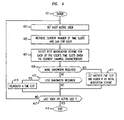
- FIG. 4 shows an exemplary process for assigning number of time slots, and modulation schemes for those time slots given a required data rate and QoS.
- the process is entered periodically via step 401.
- the periodicity is a function of the coherence time of the channel, i.e., the rate at which the channel properties change, which may be readily determined by the implementor using conventional techniques. For example, in fixed wireless system, the process was executed approximately every tenth of a second.
- step 403 the next user on the active list is identified. Thereafter, in step 405, the current number of time slots presently being used by that user and the QoS for that user is retrieved.
- step 407 a modulation scheme is selected for each time slot employed by the user. Since the modulation scheme that may be employed for any channel is a function of the channel quality, which may change over time, it is necessary to monitor the channel quality in order to determine the modulation scheme that can be employed. Typically, the modulation scheme selected is the one having the highest bit/symbol ratio that can be achieved which satisfies the QoS requirements given the current channel characteristics. However, one significant exception to this rule may be when the service of the user is a constant bit-rate service, such as voice communication. In such a case the modulation scheme selected is one that minimizes the error rate and meets the bit-rate requirement of the service.
- Conditional branch point 409 evaluates the bit rate that is available given the current number of time slots assigned for the user and the modulation scheme of each of those time slots and tests to determine if additional data rate is required to meet the users required bit-rate. If the test result in step 409 is YES, control passes to step 411, in which another time slot is obtained and assigned to the user. Also, in step 411, an initial modulation scheme is assigned to the time slot that was just assigned to the user. The selection of the initial modulation scheme in step 411 is performed similar to the selection of the initial modulation scheme in step 303 (FIG. 3).
- the time slot with the worst modulation scheme i.e., the time slot capable of carrying the least data rate for the user from those that are carrying its data, is the one that is relinquished.
- test result in step 413 is NO, indicating that the user's required data rate and the data rate currently available to the user substantially match, or after completion of steps 411 or 415, control passes to conditional branch point 417 which tests to determine if the current user is the last user on the active user list. If the test result in step 417 is NO, indicating that there are additional users that remain to be processed, control passes back to step 403 to process the next active user. If the test result in step 417 in YES, indicating the current user is the last user on the active list, control passes to step 419 and the process exits.
- the matching receiver is notified as to which time slots are assigned to the user in the usual manner.
- time slots that may be added or relinquished for a user there is no reason to limit the number of time slots that may be added or relinquished for a user to one for each execution of the process of FIG. 4. Instead, as will be readily apparent to these of ordinary skill in the art, more than one time slot may be added or relinquished until the target data rate is met.
- the estimating of whether more, less, or the same data rate is required by a user may be performed by monitoring the user's input and output buffers.
- the user may contract for a particular quality of sevice (QoS).
- QoS quality of sevice
- exemplary factors that may be specified as determining the quality of service are a) the error rate; b) the latency, such as the maximum, or the variance thereof; and c) the data rate, e.g., a minimum required data rate or a maximum allowable data rate.
- the particular QoS contracted for, if any, is considered in steps 409 and 413 so as to determine whether to increase or decrease the number of time slots assigned to the user.
- frame structure i.e., the frame is defined as being bounded by a known regularly repeating time slot, although other smaller frames may be included therein.
- a base station may employ a sectorized antenna, and furthermore, it may employ multiple beams per sector. If multiple radio beams are employed, each radio beam may transmit its own independent frame.
- the time slots that are employed for a user within a single time frame period need not all be transmitted by the same radio beam. In other words, such time slots may appear within the different frames that are transmitted by the various radio beams.
- a remote station may only receive on a single beam for the duration of any one time slot, it may receive data from different ones of the beams in different ones of the time slots during a single frame period. The only requirement is that the time slots must be nonoverlapping in time to prevent a collision from occurring and the data from being corrupted. It is therefore necessary to coordinate the assignment of time slots for transmission via each of the beams to achieve the user's required data rate.
Landscapes
- Engineering & Computer Science (AREA)
- Quality & Reliability (AREA)
- Signal Processing (AREA)
- Computer Networks & Wireless Communication (AREA)
- Mobile Radio Communication Systems (AREA)
- Small-Scale Networks (AREA)
- Time-Division Multiplex Systems (AREA)
- Transmitters (AREA)
- Digital Transmission Methods That Use Modulated Carrier Waves (AREA)
Applications Claiming Priority (2)
| Application Number | Priority Date | Filing Date | Title |
|---|---|---|---|
| US362002 | 1999-07-27 | ||
| US09/362,002 US6636500B2 (en) | 1999-07-27 | 1999-07-27 | Medium allocation method |
Publications (2)
| Publication Number | Publication Date |
|---|---|
| EP1073301A1 EP1073301A1 (en) | 2001-01-31 |
| EP1073301B1 true EP1073301B1 (en) | 2007-10-24 |
Family
ID=23424299
Family Applications (1)
| Application Number | Title | Priority Date | Filing Date |
|---|---|---|---|
| EP00306044A Expired - Lifetime EP1073301B1 (en) | 1999-07-27 | 2000-07-17 | Medium allocation method |
Country Status (9)
| Country | Link |
|---|---|
| US (1) | US6636500B2 (enExample) |
| EP (1) | EP1073301B1 (enExample) |
| JP (1) | JP4629196B2 (enExample) |
| KR (1) | KR100786026B1 (enExample) |
| CN (1) | CN1164052C (enExample) |
| AU (1) | AU4869700A (enExample) |
| BR (1) | BR0002977A (enExample) |
| CA (1) | CA2314032C (enExample) |
| DE (1) | DE60036837T2 (enExample) |
Cited By (1)
| Publication number | Priority date | Publication date | Assignee | Title |
|---|---|---|---|---|
| US10117234B2 (en) | 2000-11-15 | 2018-10-30 | Wi-Lan, Inc. | Framing for an adaptive modulation communication system |
Families Citing this family (41)
| Publication number | Priority date | Publication date | Assignee | Title |
|---|---|---|---|---|
| US6804211B1 (en) | 1999-08-03 | 2004-10-12 | Wi-Lan Inc. | Frame structure for an adaptive modulation wireless communication system |
| MXPA02007068A (es) * | 2000-01-20 | 2004-02-26 | Nortel Networks Ltd | Estructura de marco adaptable para un sistema hibrido cdma/tdma. |
| JP4409743B2 (ja) * | 2000-02-25 | 2010-02-03 | パナソニック株式会社 | 無線通信装置及び無線通信方式 |
| US7088701B1 (en) * | 2000-04-14 | 2006-08-08 | Qualcomm, Inc. | Method and apparatus for adaptive transmission control in a high data rate communication system |
| GB2367447B (en) * | 2000-09-27 | 2003-11-05 | Airspan Networks Inc | Transfer of data in a telecommunications system |
| US7016296B2 (en) * | 2000-10-16 | 2006-03-21 | Broadcom Corporation | Adaptive modulation for fixed wireless link in cable transmission system |
| US7230931B2 (en) | 2001-01-19 | 2007-06-12 | Raze Technologies, Inc. | Wireless access system using selectively adaptable beam forming in TDD frames and method of operation |
| US7173916B2 (en) * | 2001-01-19 | 2007-02-06 | Raze Technologies, Inc. | Wireless access system using multiple modulation formats in TDD frames and method of operation |
| US20020077097A1 (en) * | 2000-12-19 | 2002-06-20 | Jerry Mizell | Method and apparatus in a GPRS ready mobile terminal for providing differentiated quality of service |
| AU2002235258A1 (en) | 2000-12-27 | 2002-07-08 | Ensemble Communications, Inc. | Adaptive call admission control for use in a wireless communication system |
| JP4623865B2 (ja) * | 2001-06-04 | 2011-02-02 | 京セラ株式会社 | 基地局、携帯通信端末及び携帯通信方法 |
| JP2003018647A (ja) * | 2001-06-28 | 2003-01-17 | Mitsubishi Electric Corp | 無線通信システムの基地局 |
| US7577100B2 (en) * | 2001-07-27 | 2009-08-18 | Stephen Pollmann | System and method for measuring signal to noise values in an adaptive wireless communication system |
| US6549759B2 (en) * | 2001-08-24 | 2003-04-15 | Ensemble Communications, Inc. | Asymmetric adaptive modulation in a wireless communication system |
| JP3591726B2 (ja) * | 2001-12-07 | 2004-11-24 | ソニー株式会社 | データ通信制御システム、送信機及び送信方法 |
| JP3977639B2 (ja) * | 2001-12-28 | 2007-09-19 | 日本電信電話株式会社 | 回線割当制御方法及び回線割当装置 |
| KR100434382B1 (ko) * | 2001-12-28 | 2004-06-04 | 엘지전자 주식회사 | 순방향 링크 속도 보상을 위한 스케쥴링 방법 및장치 |
| SE524599C2 (sv) * | 2002-01-18 | 2004-08-31 | Ericsson Telefon Ab L M | Metod, system och datorprogramprodukt för att anordna tjänstekvalitet QoS |
| JP4198921B2 (ja) * | 2002-02-28 | 2008-12-17 | 株式会社エヌ・ティ・ティ・ドコモ | 適応無線パラメータ制御方法、QoS制御装置、基地局及び無線通信システム |
| US8194703B2 (en) * | 2002-08-07 | 2012-06-05 | Kyocera Corporation | Wireless communication system |
| JP2004180154A (ja) * | 2002-11-28 | 2004-06-24 | Matsushita Electric Ind Co Ltd | 基地局装置および適応変調方法 |
| US8059537B2 (en) * | 2002-12-11 | 2011-11-15 | Broadcom Corporation | Quality of service support in a media exchange network |
| TWI270304B (en) * | 2003-07-09 | 2007-01-01 | Interdigital Tech Corp | Method and system for managing radio resources in a time-slotted communication system |
| US7860074B2 (en) * | 2003-07-31 | 2010-12-28 | Motorola, Inc. | Method and apparatus for allocating communication resources |
| CN100380831C (zh) * | 2003-09-23 | 2008-04-09 | 四川大学 | 用于信息安全传输的数字调制解调方法 |
| TWI271071B (en) * | 2003-11-06 | 2007-01-11 | Ind Tech Res Inst | Communication method of scalable QAM and scalable QAM system |
| KR101015708B1 (ko) | 2004-09-14 | 2011-02-24 | 삼성전자주식회사 | 다중반송파 시스템을 위한 적응적 비트/전력 로딩 기법 |
| ATE491270T1 (de) * | 2004-10-25 | 2010-12-15 | Ericsson Telefon Ab L M | Auf funkqualität basierende kanalbetriebsmittelverwaltung |
| CN100431382C (zh) * | 2004-12-10 | 2008-11-05 | 大唐移动通信设备有限公司 | 基于分组业务动态调整资源的方法 |
| JP4569374B2 (ja) * | 2005-05-10 | 2010-10-27 | 富士通株式会社 | 無線通信装置、無線通信方法 |
| US7640021B2 (en) * | 2005-09-13 | 2009-12-29 | Interdigital Technology Corporation | Method and apparatus for radio resource allocation in a wireless communication system |
| US8843086B2 (en) * | 2006-01-31 | 2014-09-23 | Blackberry Limited | Method and apparatus for enabling transmission in a slotted radio data communication system by pausing data reception |
| JP4783648B2 (ja) * | 2006-02-28 | 2011-09-28 | 富士通株式会社 | 中継装置及び中継方法 |
| US8638726B2 (en) * | 2006-11-08 | 2014-01-28 | Intel Corporation | Device, system, and method for broadcasting predefined reference maps for wireless communication |
| CN101197778B (zh) * | 2007-12-27 | 2010-08-18 | 腾讯科技(深圳)有限公司 | 数据包传输的方法、装置和系统 |
| CN101516111B (zh) * | 2008-02-21 | 2011-04-06 | 中兴通讯股份有限公司 | 资源分配方法及系统 |
| CN101547433B (zh) * | 2008-03-25 | 2013-02-13 | 华为技术有限公司 | 上报终端能力信息的方法、时隙资源分配方法、装置及系统 |
| US8873502B2 (en) * | 2009-02-18 | 2014-10-28 | Clearwire Ip Holdings Llc | Carrier selection |
| US9173196B2 (en) * | 2010-10-07 | 2015-10-27 | GM Global Technology Operations LLC | Adaptive multi-channel access for vehicular networks |
| US10021695B2 (en) * | 2015-04-14 | 2018-07-10 | Qualcomm Incorporated | Apparatus and method for generating and transmitting data frames |
| JP6808742B2 (ja) * | 2016-09-30 | 2021-01-06 | 株式会社日立製作所 | 無線電池システム |
Family Cites Families (16)
| Publication number | Priority date | Publication date | Assignee | Title |
|---|---|---|---|---|
| US5369637A (en) | 1991-04-03 | 1994-11-29 | U.S. Philips Corporation | Signal transmission system |
| DE69223961T2 (de) * | 1991-06-03 | 1998-07-30 | British Telecommunications P.L.C., London | Funksystem |
| JP2776094B2 (ja) * | 1991-10-31 | 1998-07-16 | 日本電気株式会社 | 可変変調通信方法 |
| IT1270938B (it) * | 1993-05-14 | 1997-05-16 | Cselt Centro Studi Lab Telecom | Procedimento per il controllo della trasmissione su uno stesso canale di flussi informativi a velocita' variabile in sistemi di comunicazione tra mezzi mobili, e sistema utilizzante tale procedimento |
| US5764699A (en) * | 1994-03-31 | 1998-06-09 | Motorola, Inc. | Method and apparatus for providing adaptive modulation in a radio communication system |
| US5392280A (en) * | 1994-04-07 | 1995-02-21 | Mitsubishi Electric Research Laboratories, Inc. | Data transmission system and scheduling protocol for connection-oriented packet or cell switching networks |
| US5533004A (en) * | 1994-11-07 | 1996-07-02 | Motorola, Inc. | Method for providing and selecting amongst multiple data rates in a time division multiplexed system |
| US5701294A (en) | 1995-10-02 | 1997-12-23 | Telefonaktiebolaget Lm Ericsson | System and method for flexible coding, modulation, and time slot allocation in a radio telecommunications network |
| US5745480A (en) * | 1996-04-03 | 1998-04-28 | Adicom Wireless, Inc. | Multi-rate wireless communications system |
| GB9709285D0 (en) * | 1997-05-08 | 1997-06-25 | Philips Electronics Nv | Flexible two-way telecommunications system |
| JPH1141310A (ja) * | 1997-07-18 | 1999-02-12 | Matsushita Electric Ind Co Ltd | 通信方法 |
| US6167031A (en) * | 1997-08-29 | 2000-12-26 | Telefonaktiebolaget Lm Ericsson (Publ) | Method for selecting a combination of modulation and channel coding schemes in a digital communication system |
| US5909469A (en) | 1997-08-29 | 1999-06-01 | Telefonaktoebolaget Lm Ericsson | Link adaptation method for links using modulation schemes that have different symbol rates |
| JP2981455B2 (ja) * | 1997-12-31 | 1999-11-22 | 株式会社ケンウッド | 受信エラー測定システム |
| JP3741858B2 (ja) * | 1998-03-19 | 2006-02-01 | 富士通株式会社 | 適応変調方式 |
| US6212240B1 (en) * | 1998-06-24 | 2001-04-03 | Motorola, Inc. | Method and apparatus for conveying data between communication devices |
-
1999
- 1999-07-27 US US09/362,002 patent/US6636500B2/en not_active Expired - Fee Related
-
2000
- 2000-07-13 CA CA002314032A patent/CA2314032C/en not_active Expired - Fee Related
- 2000-07-17 EP EP00306044A patent/EP1073301B1/en not_active Expired - Lifetime
- 2000-07-17 DE DE60036837T patent/DE60036837T2/de not_active Expired - Lifetime
- 2000-07-19 AU AU48697/00A patent/AU4869700A/en not_active Abandoned
- 2000-07-19 BR BR0002977-7A patent/BR0002977A/pt not_active Application Discontinuation
- 2000-07-25 CN CNB001217062A patent/CN1164052C/zh not_active Expired - Fee Related
- 2000-07-26 KR KR1020000043070A patent/KR100786026B1/ko not_active Expired - Fee Related
- 2000-07-26 JP JP2000224837A patent/JP4629196B2/ja not_active Expired - Fee Related
Cited By (2)
| Publication number | Priority date | Publication date | Assignee | Title |
|---|---|---|---|---|
| US10117234B2 (en) | 2000-11-15 | 2018-10-30 | Wi-Lan, Inc. | Framing for an adaptive modulation communication system |
| US10873930B2 (en) | 2000-11-15 | 2020-12-22 | Wi-Lan Inc. | Framing for an adaptive modulation communication system |
Also Published As
| Publication number | Publication date |
|---|---|
| KR20010049893A (ko) | 2001-06-15 |
| DE60036837T2 (de) | 2008-08-28 |
| BR0002977A (pt) | 2001-03-13 |
| CA2314032C (en) | 2004-04-13 |
| US20020051424A1 (en) | 2002-05-02 |
| DE60036837D1 (de) | 2007-12-06 |
| JP2001077833A (ja) | 2001-03-23 |
| CN1291016A (zh) | 2001-04-11 |
| US6636500B2 (en) | 2003-10-21 |
| JP4629196B2 (ja) | 2011-02-09 |
| CA2314032A1 (en) | 2001-01-27 |
| KR100786026B1 (ko) | 2007-12-17 |
| AU4869700A (en) | 2001-02-08 |
| CN1164052C (zh) | 2004-08-25 |
| EP1073301A1 (en) | 2001-01-31 |
Similar Documents
| Publication | Publication Date | Title |
|---|---|---|
| EP1073301B1 (en) | Medium allocation method | |
| EP0720405B1 (en) | Multiple access cellular communication with dynamic slot allocation and reduced co-channel interference | |
| US5579373A (en) | Transmission power control method in cellular radiotelephone system | |
| US7529548B2 (en) | Method and system for adapting a wireless link to achieve a desired channel quality | |
| EP1374448B1 (en) | A cellular radio communication system with frequency reuse | |
| US7130311B2 (en) | Adaptive data rate control for mobile data transfer | |
| US6044270A (en) | Apparatuses and methods for signal strength measurement in a wireless communication system | |
| EP1224747B1 (en) | A method and apparatus for uplink scheduling | |
| EP1555771B1 (en) | Method and means for allocating time slots in a TDD system | |
| US6535503B1 (en) | Channel allocation method and radio system using a combination of TDMA and CDMA | |
| US20030123410A1 (en) | Compensating forward link speed | |
| US20060063500A1 (en) | Frequency band allocation device and method | |
| KR20020014836A (ko) | 적응 변조 무선통신시스템용 개선된 프레임 구조 | |
| WO1997015169A1 (en) | Apparatuses and methods for signal strength measurement in a wireless communication system | |
| US7499439B2 (en) | Method for controlling transmission rates in a wireless communications system | |
| JP3778580B2 (ja) | 周波数ホッピング通信システムにおけるバースト周波数割当てを先取りするための装置および方法 | |
| WO2002061954A2 (en) | Method and system for receiver-characterized power setting in a cellular communication system | |
| JP3480761B2 (ja) | 無線通信方法 | |
| JP2005535177A (ja) | 符号化合成トランスポートチャネルをサポートする複数の異なる物理チャネルの信号対干渉比の等化 | |
| EP0990362B1 (en) | Channel allocation for a communications system | |
| JP3396644B2 (ja) | 基地局装置、端末局装置、通信システムおよび通信制御方法 | |
| US7418270B2 (en) | Apparatus and method for optimal power allocation between data and voice in a 1xEV-DV wireless network | |
| JP4111707B2 (ja) | 無線基地局、プログラム | |
| JP2005244820A (ja) | 無線回線品質判定方法および無線アクセスシステム |
Legal Events
| Date | Code | Title | Description |
|---|---|---|---|
| PUAI | Public reference made under article 153(3) epc to a published international application that has entered the european phase |
Free format text: ORIGINAL CODE: 0009012 |
|
| 17P | Request for examination filed |
Effective date: 20000727 |
|
| AK | Designated contracting states |
Kind code of ref document: A1 Designated state(s): DE FI FR GB SE |
|
| AX | Request for extension of the european patent |
Free format text: AL;LT;LV;MK;RO;SI |
|
| AKX | Designation fees paid |
Free format text: DE FI FR GB SE |
|
| APBX | Invitation to file observations in appeal sent |
Free format text: ORIGINAL CODE: EPIDOSNOBA2E |
|
| APAF | Appeal reference modified |
Free format text: ORIGINAL CODE: EPIDOSCREFNE |
|
| APBT | Appeal procedure closed |
Free format text: ORIGINAL CODE: EPIDOSNNOA9E |
|
| GRAP | Despatch of communication of intention to grant a patent |
Free format text: ORIGINAL CODE: EPIDOSNIGR1 |
|
| GRAS | Grant fee paid |
Free format text: ORIGINAL CODE: EPIDOSNIGR3 |
|
| GRAA | (expected) grant |
Free format text: ORIGINAL CODE: 0009210 |
|
| AK | Designated contracting states |
Kind code of ref document: B1 Designated state(s): DE FI FR GB SE |
|
| REG | Reference to a national code |
Ref country code: GB Ref legal event code: FG4D |
|
| REF | Corresponds to: |
Ref document number: 60036837 Country of ref document: DE Date of ref document: 20071206 Kind code of ref document: P |
|
| ET | Fr: translation filed | ||
| PG25 | Lapsed in a contracting state [announced via postgrant information from national office to epo] |
Ref country code: SE Free format text: LAPSE BECAUSE OF FAILURE TO SUBMIT A TRANSLATION OF THE DESCRIPTION OR TO PAY THE FEE WITHIN THE PRESCRIBED TIME-LIMIT Effective date: 20080124 |
|
| PLBE | No opposition filed within time limit |
Free format text: ORIGINAL CODE: 0009261 |
|
| STAA | Information on the status of an ep patent application or granted ep patent |
Free format text: STATUS: NO OPPOSITION FILED WITHIN TIME LIMIT |
|
| 26N | No opposition filed |
Effective date: 20080725 |
|
| PG25 | Lapsed in a contracting state [announced via postgrant information from national office to epo] |
Ref country code: FI Free format text: LAPSE BECAUSE OF FAILURE TO SUBMIT A TRANSLATION OF THE DESCRIPTION OR TO PAY THE FEE WITHIN THE PRESCRIBED TIME-LIMIT Effective date: 20071024 |
|
| REG | Reference to a national code |
Ref country code: GB Ref legal event code: 732E Free format text: REGISTERED BETWEEN 20131031 AND 20131106 |
|
| REG | Reference to a national code |
Ref country code: FR Ref legal event code: CD Owner name: ALCATEL-LUCENT USA INC. Effective date: 20131122 |
|
| REG | Reference to a national code |
Ref country code: FR Ref legal event code: GC Effective date: 20140410 |
|
| PGFP | Annual fee paid to national office [announced via postgrant information from national office to epo] |
Ref country code: DE Payment date: 20140721 Year of fee payment: 15 |
|
| REG | Reference to a national code |
Ref country code: FR Ref legal event code: RG Effective date: 20141015 |
|
| PGFP | Annual fee paid to national office [announced via postgrant information from national office to epo] |
Ref country code: FR Payment date: 20140721 Year of fee payment: 15 Ref country code: GB Payment date: 20140721 Year of fee payment: 15 |
|
| REG | Reference to a national code |
Ref country code: DE Ref legal event code: R119 Ref document number: 60036837 Country of ref document: DE |
|
| GBPC | Gb: european patent ceased through non-payment of renewal fee |
Effective date: 20150717 |
|
| PG25 | Lapsed in a contracting state [announced via postgrant information from national office to epo] |
Ref country code: GB Free format text: LAPSE BECAUSE OF NON-PAYMENT OF DUE FEES Effective date: 20150717 Ref country code: DE Free format text: LAPSE BECAUSE OF NON-PAYMENT OF DUE FEES Effective date: 20160202 |
|
| REG | Reference to a national code |
Ref country code: FR Ref legal event code: ST Effective date: 20160331 |
|
| PG25 | Lapsed in a contracting state [announced via postgrant information from national office to epo] |
Ref country code: FR Free format text: LAPSE BECAUSE OF NON-PAYMENT OF DUE FEES Effective date: 20150731 |