EP1055449B1 - Verfahren zur Überwachung der Funktion eines Systems zur Abgasnachbehandlung - Google Patents
Verfahren zur Überwachung der Funktion eines Systems zur Abgasnachbehandlung Download PDFInfo
- Publication number
- EP1055449B1 EP1055449B1 EP00110872A EP00110872A EP1055449B1 EP 1055449 B1 EP1055449 B1 EP 1055449B1 EP 00110872 A EP00110872 A EP 00110872A EP 00110872 A EP00110872 A EP 00110872A EP 1055449 B1 EP1055449 B1 EP 1055449B1
- Authority
- EP
- European Patent Office
- Prior art keywords
- catalytic converter
- temperature
- akt
- exhaust gas
- concentration
- Prior art date
- Legal status (The legal status is an assumption and is not a legal conclusion. Google has not performed a legal analysis and makes no representation as to the accuracy of the status listed.)
- Expired - Lifetime
Links
Images

Classifications
-
- F—MECHANICAL ENGINEERING; LIGHTING; HEATING; WEAPONS; BLASTING
- F01—MACHINES OR ENGINES IN GENERAL; ENGINE PLANTS IN GENERAL; STEAM ENGINES
- F01N—GAS-FLOW SILENCERS OR EXHAUST APPARATUS FOR MACHINES OR ENGINES IN GENERAL; GAS-FLOW SILENCERS OR EXHAUST APPARATUS FOR INTERNAL-COMBUSTION ENGINES
- F01N3/00—Exhaust or silencing apparatus having means for purifying, rendering innocuous, or otherwise treating exhaust
- F01N3/08—Exhaust or silencing apparatus having means for purifying, rendering innocuous, or otherwise treating exhaust for rendering innocuous
- F01N3/10—Exhaust or silencing apparatus having means for purifying, rendering innocuous, or otherwise treating exhaust for rendering innocuous by thermal or catalytic conversion of noxious components of exhaust
- F01N3/18—Exhaust or silencing apparatus having means for purifying, rendering innocuous, or otherwise treating exhaust for rendering innocuous by thermal or catalytic conversion of noxious components of exhaust characterised by methods of operation; Control
- F01N3/20—Exhaust or silencing apparatus having means for purifying, rendering innocuous, or otherwise treating exhaust for rendering innocuous by thermal or catalytic conversion of noxious components of exhaust characterised by methods of operation; Control specially adapted for catalytic conversion
- F01N3/206—Adding periodically or continuously substances to exhaust gases for promoting purification, e.g. catalytic material in liquid form, NOx reducing agents
- F01N3/2066—Selective catalytic reduction [SCR]
-
- B—PERFORMING OPERATIONS; TRANSPORTING
- B01—PHYSICAL OR CHEMICAL PROCESSES OR APPARATUS IN GENERAL
- B01D—SEPARATION
- B01D53/00—Separation of gases or vapours; Recovering vapours of volatile solvents from gases; Chemical or biological purification of waste gases, e.g. engine exhaust gases, smoke, fumes, flue gases, aerosols
- B01D53/34—Chemical or biological purification of waste gases
- B01D53/92—Chemical or biological purification of waste gases of engine exhaust gases
- B01D53/94—Chemical or biological purification of waste gases of engine exhaust gases by catalytic processes
- B01D53/9495—Controlling the catalytic process
-
- F—MECHANICAL ENGINEERING; LIGHTING; HEATING; WEAPONS; BLASTING
- F01—MACHINES OR ENGINES IN GENERAL; ENGINE PLANTS IN GENERAL; STEAM ENGINES
- F01N—GAS-FLOW SILENCERS OR EXHAUST APPARATUS FOR MACHINES OR ENGINES IN GENERAL; GAS-FLOW SILENCERS OR EXHAUST APPARATUS FOR INTERNAL-COMBUSTION ENGINES
- F01N11/00—Monitoring or diagnostic devices for exhaust-gas treatment apparatus
- F01N11/002—Monitoring or diagnostic devices for exhaust-gas treatment apparatus the diagnostic devices measuring or estimating temperature or pressure in, or downstream of the exhaust apparatus
-
- F—MECHANICAL ENGINEERING; LIGHTING; HEATING; WEAPONS; BLASTING
- F01—MACHINES OR ENGINES IN GENERAL; ENGINE PLANTS IN GENERAL; STEAM ENGINES
- F01N—GAS-FLOW SILENCERS OR EXHAUST APPARATUS FOR MACHINES OR ENGINES IN GENERAL; GAS-FLOW SILENCERS OR EXHAUST APPARATUS FOR INTERNAL-COMBUSTION ENGINES
- F01N11/00—Monitoring or diagnostic devices for exhaust-gas treatment apparatus
- F01N11/007—Monitoring or diagnostic devices for exhaust-gas treatment apparatus the diagnostic devices measuring oxygen or air concentration downstream of the exhaust apparatus
-
- F—MECHANICAL ENGINEERING; LIGHTING; HEATING; WEAPONS; BLASTING
- F01—MACHINES OR ENGINES IN GENERAL; ENGINE PLANTS IN GENERAL; STEAM ENGINES
- F01N—GAS-FLOW SILENCERS OR EXHAUST APPARATUS FOR MACHINES OR ENGINES IN GENERAL; GAS-FLOW SILENCERS OR EXHAUST APPARATUS FOR INTERNAL-COMBUSTION ENGINES
- F01N2550/00—Monitoring or diagnosing the deterioration of exhaust systems
- F01N2550/02—Catalytic activity of catalytic converters
-
- F—MECHANICAL ENGINEERING; LIGHTING; HEATING; WEAPONS; BLASTING
- F01—MACHINES OR ENGINES IN GENERAL; ENGINE PLANTS IN GENERAL; STEAM ENGINES
- F01N—GAS-FLOW SILENCERS OR EXHAUST APPARATUS FOR MACHINES OR ENGINES IN GENERAL; GAS-FLOW SILENCERS OR EXHAUST APPARATUS FOR INTERNAL-COMBUSTION ENGINES
- F01N2550/00—Monitoring or diagnosing the deterioration of exhaust systems
- F01N2550/05—Systems for adding substances into exhaust
-
- F—MECHANICAL ENGINEERING; LIGHTING; HEATING; WEAPONS; BLASTING
- F01—MACHINES OR ENGINES IN GENERAL; ENGINE PLANTS IN GENERAL; STEAM ENGINES
- F01N—GAS-FLOW SILENCERS OR EXHAUST APPARATUS FOR MACHINES OR ENGINES IN GENERAL; GAS-FLOW SILENCERS OR EXHAUST APPARATUS FOR INTERNAL-COMBUSTION ENGINES
- F01N2610/00—Adding substances to exhaust gases
- F01N2610/14—Arrangements for the supply of substances, e.g. conduits
- F01N2610/1473—Overflow or return means for the substances, e.g. conduits or valves for the return path
-
- Y—GENERAL TAGGING OF NEW TECHNOLOGICAL DEVELOPMENTS; GENERAL TAGGING OF CROSS-SECTIONAL TECHNOLOGIES SPANNING OVER SEVERAL SECTIONS OF THE IPC; TECHNICAL SUBJECTS COVERED BY FORMER USPC CROSS-REFERENCE ART COLLECTIONS [XRACs] AND DIGESTS
- Y02—TECHNOLOGIES OR APPLICATIONS FOR MITIGATION OR ADAPTATION AGAINST CLIMATE CHANGE
- Y02T—CLIMATE CHANGE MITIGATION TECHNOLOGIES RELATED TO TRANSPORTATION
- Y02T10/00—Road transport of goods or passengers
- Y02T10/10—Internal combustion engine [ICE] based vehicles
- Y02T10/12—Improving ICE efficiencies
-
- Y—GENERAL TAGGING OF NEW TECHNOLOGICAL DEVELOPMENTS; GENERAL TAGGING OF CROSS-SECTIONAL TECHNOLOGIES SPANNING OVER SEVERAL SECTIONS OF THE IPC; TECHNICAL SUBJECTS COVERED BY FORMER USPC CROSS-REFERENCE ART COLLECTIONS [XRACs] AND DIGESTS
- Y02—TECHNOLOGIES OR APPLICATIONS FOR MITIGATION OR ADAPTATION AGAINST CLIMATE CHANGE
- Y02T—CLIMATE CHANGE MITIGATION TECHNOLOGIES RELATED TO TRANSPORTATION
- Y02T10/00—Road transport of goods or passengers
- Y02T10/10—Internal combustion engine [ICE] based vehicles
- Y02T10/40—Engine management systems
Definitions
- the invention relates to the exhaust aftertreatment in internal combustion engines.
- the problem of exhaust aftertreatment is already in a comprehensive overview in the Bosch / Automotive Handbook 22nd Edition (ISBN 3-18-419122-2) in the chapter “Exhaust gas from gasoline engines” (p.486ff) explained.
- Diesel / Automotive Handbook 22nd Edition ISBN 3-18-419122-2
- Exhaust gas from gasoline engines p.486ff
- the nitric oxide is colorless, odorless and tasteless and slowly converts to NO 2 in the air.
- This NO 2 is in pure form a pungent, poisonous gas, so that it can irritate the mucous membranes at higher concentrations.
- NO and NO 2 are commonly referred to collectively as nitrogen oxides NOx.
- Hydrocarbons are present in great variety in the exhaust gas and form oxidants in the presence of nitrogen oxide and sunlight.
- This exhaust gas mixture enters the exhaust gas line, where it is usually first introduced into an oxidation catalyst which oxidizes the hydrocarbons to carbon dioxide and water and the carbon monoxide to carbon dioxide. At the same time, nitrogen monoxide NO is also oxidized to nitrogen dioxide.
- a number of measures for influencing the exhaust gas composition are known, these measures can be divided into motor measures and exhaust aftertreatment measures substantially. Since the present invention relates to the measures for aftertreatment, the motor measures should not be further explained here.
- the possibilities of exhaust aftertreatment include the thermal Afterburning and catalytic afterburning.
- the catalysts used in the catalytic afterburning usually consist of a carrier material with active coating, which favors the chemical reaction, in particular the harmful constituents of the exhaust gas.
- so-called Vollextrudationskatalysatoren can be used. Since the efficiency of the catalyst depends essentially on its operating temperature, catalysts are often installed close to the engine, since so the time is shortened until reaching the operating temperature, whereby an optimal efficiency is achieved quickly.
- oxidation catalysts which essentially oxidize the carbon monoxide CO and the hydrocarbons HC is known. They are operated either by lean engine operation or by additional air injection with excess air or in the superstoichiometric diesel exhaust gas so that carbon monoxide and the HC components are oxidized. Furthermore, reduction catalysts are known which reduce the nitrogen oxides in the exhaust gas. The series connection of oxidation and reduction catalyst with an air injection between the two catalysts has the advantage that both NOx and HC and CO can be degraded.
- the inventive method for monitoring the function of a system for exhaust aftertreatment with the features of the main claim has over the known the advantage that when using a series circuit of oxidation catalyst and reduction catalyst in the exhaust line, the function and thus the reliability of each catalyst monitors itself or both in combination can be.
- the function of the oxidation catalyst is permanently affected by excessive thermal stress at high exhaust gas temperatures, there is a thermal aging. Decisive for the extent of aging are the frequency and the level of critical temperatures above a reference value. By adding up the temperatures above the reference value, a statement about the thermal load of the oxidation catalyst is made.
- the detection of the NOx concentration or the NOx and NH 3 concentration in the exhaust gas after the reducing agent catalyst and the comparison of the NOx concentration at a defined operating point of the internal combustion engine with a stored control value of the NOx content has the advantage that very quickly a statement is possible via the exhaust gas composition and when recognizing an increase in the NOx concentration, an error message for the driver takes place.
- an error message for the driver may preferably be provided in the instrument cluster optical and / or acoustic information.
- a corresponding error entry in the control unit can take place, which can then be read out in the workshop.
- a more detailed information such as which catalyst has caused the error message or how high the maximum temperature in the Oxikat or the NOx or. NH 3 concentration after the reduction catalyst was to be stored.
- Fig. 1 shows the block diagram of the output strand of an internal combustion engine.
- the reference numeral 10 the engine block is shown.
- the resulting during combustion in the individual cylinders of the engine block 10 exhaust gas is discharged via the exhaust line 11.
- an oxidation catalyst (Oxi-Kat) 12 In the exhaust line 11 is located in the immediate vicinity of the engine block 10, an oxidation catalyst (Oxi-Kat) 12, wherein a first temperature sensor 13 is disposed in the exhaust line 11 in front of the oxidation catalyst 12 and the temperature clock-v detected before the oxidation catalyst 12 and wherein a second temperature sensor 14 in the exhaust line 11 after the oxidation catalyst detects the temperature clock-n after the oxidation catalyst 12.
- a reduction catalyst 20 In series connection to the oxidation catalyst 12 is a reduction catalyst 20, wherein before the reduction catalyst, a temperature sensor 18 and after the reduction catalyst, a temperature sensor 19 is arranged. Also in front of the reduction catalyst 20, a first exhaust gas sensor 21 for detecting the raw emission of nitrogen oxides E-NOx is arranged. A second exhaust gas sensor 22 is disposed in the exhaust line after the reduction catalyst and detects the NOx or NOx / NH3 concentration of the exhaust gas.
- the exhaust line 11 is further associated with a reducing agent tank 15, which is added via a reducing agent addition 16, which is arranged in the exhaust line 11 between the oxidation catalyst 12 and the reduction catalyst 20, the exhaust gas targeted reducing agent.
- a mixer 17 in the exhaust gas line 11 ensures homogeneous mixing of the exhaust gas with the reducing agent 15.
- the monitoring of the oxidation catalyst with a single temperature sensor, which may be arranged either before or after the oxidation catalyst.
- the current temperature is detected clock, here either the temperature of the temperature sensor 13 or the temperature of the temperature sensor 14 is determined before or after the oxidation catalyst.
- This detected current temperature clock is then compared in a query 26 with a predetermined reference value Tref (clock> Tref), this predetermined Refernzwert Tref is beauschbelgt possibly with engine operating variables and weighting factors, so, for example, at higher exhaust gas flow a stronger weighting of the critical temperature Tref respectively.
- step 27 If the current temperature value is greater than the predefinable temperature reference value (clock> Tref), then the Yes output of the query 26 to a step 27.
- a subsequent query 29 it is checked whether the calculated sum ⁇ Ü is greater than a predefinable limit value GW for the error display. If the query 29 ⁇ Ü> GW has been answered in the negative, the No output leads back to the beginning of the method at step 25, and the next temperature value is detected. On the other hand, if the query 29 was answered in the affirmative, that is to say that the sum ⁇ Ü formed is greater than the permissible limit value GW, an error information occurs in step 30.
- This error information can be made visually and / or acoustically.
- a corresponding error information can also be stored in the memory so that, if necessary, more accurate data about the error that occurred can then be read out at a workshop visit. It is conceivable, for example, to simultaneously store the operating point at which the elevated temperature was measured.
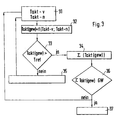
- FIG. 3 shows the method for checking the oxidation catalytic converter by utilizing the measured actual temperature values of two temperature sensors, a first temperature sensor 13 being arranged in the exhaust gas line 11 upstream of the oxidation catalytic converter and a second temperature sensor 14 in the exhaust gas line downstream of the oxidation catalytic converter.
- the first temperature sensor 13 before the oxidation catalyst takes into account in this case exhaust gas temperatures, which can cause thermal aging on the catalyst, while the temperature sensor 14 after the oxidation catalyst takes into account a possible burning off of soot and / or stored hydrocarbons in the oxidation catalyst.
- the burning of these substances can be triggered by an increase in the exhaust gas temperature after prolonged operation with low exhaust gas temperatures, which are below the operating temperature of the oxidation catalyst.
- Clock (w) f (clock-v; clock-n).
- the subsequent query 33 is analogous to the step 26 of FIG. 2, the comparison of these Mean gas temperature clock (gew) with a predefinable reference temperature Tref.
- the further steps or queries are carried out analogously to the flowchart of FIG. 2 and will not be explained separately here again.
- An essential difference of this method according to FIG. 3 for the method according to FIG. 2 is merely that a value for the catalyst mean temperature is determined from the temperatures before and after the oxidation catalyst and the further method steps are taken as a basis.
- step 34 exceeding the reference temperature in the query 33 means that in step 34, the sum of the exceedances is formed by respective addition of the last too high temperature values, while in the other case the last determined value for the catalyst means temperature is deleted in step 35.
- the sum ⁇ (clock (gew)) formed in step 34 is compared in the query 36 with a predefinable limit value GW. Depending on the result of the comparison, it is then either jumped to the beginning of the method or there is an error information in step 37.
- the reducing agent metering unit 16 shown in FIG. 1 adds to the exhaust gas after the oxidation catalyst 12 either an aqueous urea solution, a solid urea, an NH 3 -containing gas or an ammonia-forming substance.
- the nitrogen oxide concentration in defined operating points BP1 and BP2 is known. By comparing this expected nitric oxide concentration and the actually measured nitric oxide concentration, if the expected nitric oxide concentration is exceeded, a corresponding malfunction can be detected and error information output.
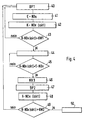
- FIG. 4 shows a flow chart for checking the functionality and the operation of the reduction catalytic converter.
- a defined operating point BP1 is present or the current operating point is determined.
- Each operating point, a NOx concentration in the exhaust gas can be assigned, these values are usually determined in the application and stored in a memory on a map.
- the raw emission of the engine E-NOx before the reduction catalyst is detected and measured in a further step 42, the current emission after the Reduktionslkatalysator K-NOx (akt).
- a query 43 checks whether the NOx concentration in the exhaust gas downstream of the reduction catalytic converter is greater than a predefinable control value KW1 (K-NOx (akt)> KW1). If this is not the case, then the no output of query 43 leads back to the beginning of the method for operation 40. However, if query 43 was answered with yes, ie the NOx content in the exhaust gas is greater than the predefinable control value KW1, then In a subsequent step 44, the addition of the reducing agent is adjusted. In the following query 45 it is checked whether the nitrogen oxide concentration downstream of the reduction catalyst K-NOx (akt) is approximately equal to the raw emission of the engine E-NOx. If this is not the case, the No output returns to step 44, where the NH3 dosage remains set.
- the metering of the reducing agent NH3 is in turn activated in a subsequent operation 46.
- a subsequent step 47 a defined operating point BP2 is awaited and then in step 48, the raw emission of nitrogen oxide of the engine E-NOx before the reduction catalyst and the current nitrogen oxide concentration after the reducing agent catalyst K-NOx (akt) measured again.
- the NOx concentration after the reducing agent catalyst is greater than a predetermined control value, takes place in Step 50 an error information. If no increased NOx concentration has been determined, the No output of query 49 returns to the beginning of the procedure.
- a query can be made at query 45 still a sensor. If NH3 dosing is not active, a comparison of the NOx sensors with values stored in the map is possible. Too large deviations of the gelled from the sensor value from the map is usually a sensor defect, which can also be detected so quickly. Furthermore, an indirect monitoring of the Oxikats is possible. Thus, in the case of a defective oxime, the NO x conversion proceeds at low temperatures, even though the reduction catalyst has not aged, since usually the reaction catalyst has a higher activity at low temperatures and upstream of the oxy-cat.
Landscapes
- Engineering & Computer Science (AREA)
- Chemical & Material Sciences (AREA)
- Chemical Kinetics & Catalysis (AREA)
- Combustion & Propulsion (AREA)
- General Engineering & Computer Science (AREA)
- Mechanical Engineering (AREA)
- Health & Medical Sciences (AREA)
- Biomedical Technology (AREA)
- Toxicology (AREA)
- Environmental & Geological Engineering (AREA)
- Analytical Chemistry (AREA)
- General Chemical & Material Sciences (AREA)
- Oil, Petroleum & Natural Gas (AREA)
- Exhaust Gas After Treatment (AREA)
- Combined Controls Of Internal Combustion Engines (AREA)
- Exhaust Gas Treatment By Means Of Catalyst (AREA)
Applications Claiming Priority (2)
| Application Number | Priority Date | Filing Date | Title |
|---|---|---|---|
| DE19924029 | 1999-05-26 | ||
| DE19924029A DE19924029C2 (de) | 1999-05-26 | 1999-05-26 | Verfahren zur Überwachung der Funktion eines Systems zur Abgasnachbehandlung |
Publications (2)
| Publication Number | Publication Date |
|---|---|
| EP1055449A1 EP1055449A1 (de) | 2000-11-29 |
| EP1055449B1 true EP1055449B1 (de) | 2006-06-21 |
Family
ID=7909184
Family Applications (1)
| Application Number | Title | Priority Date | Filing Date |
|---|---|---|---|
| EP00110872A Expired - Lifetime EP1055449B1 (de) | 1999-05-26 | 2000-05-23 | Verfahren zur Überwachung der Funktion eines Systems zur Abgasnachbehandlung |
Country Status (5)
| Country | Link |
|---|---|
| US (1) | US6367320B1 (enExample) |
| EP (1) | EP1055449B1 (enExample) |
| JP (1) | JP2001003737A (enExample) |
| DE (2) | DE19924029C2 (enExample) |
| ES (1) | ES2261120T3 (enExample) |
Families Citing this family (42)
| Publication number | Priority date | Publication date | Assignee | Title |
|---|---|---|---|---|
| US6849239B2 (en) | 2000-10-16 | 2005-02-01 | E. I. Du Pont De Nemours And Company | Method and apparatus for analyzing mixtures of gases |
| JP2004523731A (ja) * | 2000-10-16 | 2004-08-05 | イー・アイ・デュポン・ドウ・ヌムール・アンド・カンパニー | ガスの混合物を分析する方法および装置 |
| DE10142236A1 (de) * | 2001-08-29 | 2003-04-10 | Conti Temic Microelectronic | Verfahren zum Bestimmen der Reduktionsmittelkonzentration (NH3) im Abgasstrom eines Verbrennungsmotors |
| KR20030085733A (ko) * | 2002-05-01 | 2003-11-07 | 현대자동차주식회사 | 자동차의 이상 연료 검출 장치 및 이의 방법 |
| US7065958B2 (en) * | 2002-05-07 | 2006-06-27 | Extengine Transport Systems | Emission control system |
| US7497076B2 (en) | 2002-05-07 | 2009-03-03 | Extengine Transport Systems | Emission control system |
| DE10254843A1 (de) * | 2002-11-25 | 2004-06-03 | Robert Bosch Gmbh | Verfahren und Vorrichtung zur Überwachung eines Abgasnachbehandlungssystems |
| US7140232B2 (en) * | 2002-12-16 | 2006-11-28 | Radiodetection Limited | Method and apparatus for multiple gas sensor |
| DE10301603B4 (de) * | 2003-01-17 | 2020-03-19 | Robert Bosch Gmbh | Verfahren zum Dosieren von Ammoniak oder eines Ammoniak freisetzenden Reagenzmittels in ein Abgas |
| JP2006527815A (ja) * | 2003-06-18 | 2006-12-07 | ジョンソン、マッセイ、パブリック、リミテッド、カンパニー | 還元体添加の制御方法 |
| GB0314463D0 (en) * | 2003-06-23 | 2003-07-23 | Eminox Ltd | Method of calibrating reductant injection in a SCR system |
| GB0428289D0 (en) * | 2004-12-24 | 2005-01-26 | Johnson Matthey Plc | Reductant addition in exhaust system comprising NOx-absorbent |
| GB0428291D0 (en) * | 2004-12-24 | 2005-01-26 | Johnson Matthey Plc | Methods of regenerating NOx-Absorbent |
| EP1770253B1 (en) * | 2004-07-16 | 2012-09-26 | Nissan Diesel Motor Co., Ltd. | Exhaust purification apparatus for engine |
| JP4290109B2 (ja) | 2004-10-29 | 2009-07-01 | 日産ディーゼル工業株式会社 | 排気浄化装置 |
| ES2341653T3 (es) * | 2004-12-14 | 2010-06-24 | Volvo Lastvagnar Ab | Metodo, dispositivo y producto programa de ordenador para el diagnostico de un catalizador de oxidacion. |
| US8286417B2 (en) * | 2005-02-03 | 2012-10-16 | Avl List Gmbh | Diagnosis method for an exhaust gas post-treatment system |
| DE102005012568A1 (de) * | 2005-03-18 | 2006-09-21 | Daimlerchrysler Ag | Vorrichtung zur Entfernung von Stickoxiden aus Brennkraftmaschinenabgas und Verfahren zur Dosierung eines Zuschlagstoffs für Brennkraftmaschinenabgas |
| JP4718613B2 (ja) * | 2005-09-29 | 2011-07-06 | ボルボ ラストバグナー アーベー | 排気後処理システムの診断方法 |
| US7533520B2 (en) * | 2006-04-24 | 2009-05-19 | Fleetguard, Inc. | Exhaust aftertreatment mixer with stamped muffler flange |
| WO2008004917A1 (en) * | 2006-07-06 | 2008-01-10 | Volvo Technology Group | Diagnosis of a cracked multi-chamber solid-electrolyte gas sensor |
| US7770384B2 (en) * | 2006-09-18 | 2010-08-10 | Ford Global Technologies, Llc | Ammonia vapor storage and purge system and method |
| DE102006055036B4 (de) * | 2006-11-22 | 2023-03-02 | Faurecia Emissions Control Technologies, Germany Gmbh | Mischelement sowie Abgasanlage für eine Verbrennungskraftmaschine |
| JP4779959B2 (ja) * | 2006-12-20 | 2011-09-28 | 株式会社デンソー | 排気浄化装置 |
| DE102007020812B4 (de) * | 2007-05-04 | 2010-01-14 | Audi Ag | Vorrichtung und Verfahren zur Zudosierung von fluiden schadstoffreduzierenden Medien in einen Abgaskanal einer Brennkraftmaschine |
| JP2009085050A (ja) | 2007-09-28 | 2009-04-23 | Denso Corp | 添加剤噴射弁、添加剤噴射装置、及び排気浄化システム |
| DE102008042678A1 (de) | 2007-10-09 | 2009-05-07 | Denso Corp., Kariya-shi | Abgasreinigungsgerät mit verbessertem Aufbau zur Sicherstellung einer exakten Einspritzung von Reduktionsmittel |
| JP4445002B2 (ja) * | 2007-11-21 | 2010-04-07 | 株式会社日本自動車部品総合研究所 | 排気浄化装置 |
| JP4458182B2 (ja) * | 2008-04-25 | 2010-04-28 | トヨタ自動車株式会社 | 還元剤供給装置の診断装置 |
| KR101331086B1 (ko) * | 2009-01-09 | 2013-11-19 | 도요타 지도샤(주) | 내연 기관의 배기 정화 장치 |
| EP2381077A4 (en) * | 2009-01-19 | 2017-11-22 | Toyota Jidosha Kabushiki Kaisha | Abnormality detection device for exhaust purification device and abnormality detection method for exhaust purification device |
| DE102010040678A1 (de) | 2010-09-14 | 2012-03-15 | Robert Bosch Gmbh | Verfahren zur Überwachung der Schadstoff-Konvertierungsfähigkeit in einem Abgasnachbehandlungssystem |
| JP5767158B2 (ja) * | 2012-04-26 | 2015-08-19 | 日本特殊陶業株式会社 | ガスセンサ評価方法およびガスセンサ評価装置 |
| JP5928884B2 (ja) * | 2012-04-26 | 2016-06-01 | 三菱ふそうトラック・バス株式会社 | 内燃機関の排ガス浄化装置 |
| US20140150528A1 (en) * | 2012-11-30 | 2014-06-05 | Engine Control and Monitoring | Simplified method for measuring concentration of various exhaust gas mixture components utilizing dissimilar sensors |
| US9273587B2 (en) | 2013-01-28 | 2016-03-01 | Cummins Ip, Inc. | Method, system, and apparatus for diagnosing an exhaust aftertreatment component |
| US20140216130A1 (en) * | 2013-02-04 | 2014-08-07 | Engine Control and Monitoring | Simplified method for measuring concentrations of exhaust gas components |
| US20140216131A1 (en) * | 2013-02-04 | 2014-08-07 | Engine Control and Monitoring | Simplified method for measuring concentrations of exhaust gas components utilizing differential measurement across an absorber |
| JP6037035B2 (ja) * | 2013-09-25 | 2016-11-30 | トヨタ自動車株式会社 | 排気浄化装置の診断装置 |
| US9702284B2 (en) * | 2015-01-15 | 2017-07-11 | Tenneco Automotive Operating Company Inc. | System and method for detecting face-plugging of an exhaust aftertreatment component |
| US10125658B2 (en) | 2015-08-05 | 2018-11-13 | Tenneco Automotive Operating Company Inc. | Particulate sensor assembly |
| CN106289789B (zh) * | 2016-08-31 | 2018-07-06 | 郑州精益达环保科技有限公司 | Scr催化消声器低温尿素结晶模拟试验系统 |
Family Cites Families (8)
| Publication number | Priority date | Publication date | Assignee | Title |
|---|---|---|---|---|
| IT1187855B (it) * | 1986-01-14 | 1987-12-23 | Fiat Auto Spa | Dispositivo di protezione per il catalizzatore di una marmitta catalitica per autoveicoli |
| US5426934A (en) * | 1993-02-10 | 1995-06-27 | Hitachi America, Ltd. | Engine and emission monitoring and control system utilizing gas sensors |
| DE4315278A1 (de) * | 1993-05-07 | 1994-11-10 | Siemens Ag | Verfahren und Einrichtung zur Dosierung eines Reduktionsmittels in ein stickoxidhaltiges Abgas |
| DE4440276C2 (de) * | 1994-11-11 | 1996-09-05 | Volkswagen Ag | Verfahren zur Überwachung des Konvertierungsgrades eines Abgaskatalysators |
| DE19645202B4 (de) * | 1995-12-23 | 2006-05-11 | Volkswagen Ag | Verfahren zur Überwachung der Konvertierungsrate eines Abgaskatalysators für eine Brennkraftmaschine |
| DE19629163C1 (de) * | 1996-07-19 | 1997-10-09 | Daimler Benz Ag | Verfahren und Vorrichtung zum stickoxidemissionsarmen Betrieb eines Verbrennungsmotors |
| DE19745012A1 (de) * | 1997-10-11 | 1999-04-15 | Eastman Kodak Co | Transportvorrichtung für Röntgenkassetten mit je einem für Röntgenstrahlen anregbaren Leuchtstoffblatt in einem Kassettenbearbeitungsgerät |
| US6009742A (en) * | 1997-11-14 | 2000-01-04 | Engelhard Corporation | Multi-channel pellistor type emission sensor |
-
1999
- 1999-05-26 DE DE19924029A patent/DE19924029C2/de not_active Expired - Fee Related
-
2000
- 2000-05-23 ES ES00110872T patent/ES2261120T3/es not_active Expired - Lifetime
- 2000-05-23 EP EP00110872A patent/EP1055449B1/de not_active Expired - Lifetime
- 2000-05-23 DE DE50013020T patent/DE50013020D1/de not_active Expired - Fee Related
- 2000-05-25 JP JP2000155119A patent/JP2001003737A/ja active Pending
- 2000-05-26 US US09/578,443 patent/US6367320B1/en not_active Expired - Fee Related
Also Published As
| Publication number | Publication date |
|---|---|
| EP1055449A1 (de) | 2000-11-29 |
| DE19924029C2 (de) | 2001-05-23 |
| US6367320B1 (en) | 2002-04-09 |
| JP2001003737A (ja) | 2001-01-09 |
| DE50013020D1 (de) | 2006-08-03 |
| ES2261120T3 (es) | 2006-11-16 |
| DE19924029A1 (de) | 2000-12-21 |
Similar Documents
| Publication | Publication Date | Title |
|---|---|---|
| DE19924029C2 (de) | Verfahren zur Überwachung der Funktion eines Systems zur Abgasnachbehandlung | |
| EP0697062B1 (de) | Verfahren und einrichtung zur gesteuerten einbringung eines reduktionsmittels in ein stickoxidhaltiges abgas | |
| EP1097299B1 (de) | VERFAHREN ZUR ÜBERPRÜFUNG DES WIRKUNGSGRADES EINES NOx-SPEICHERKATALYSATORS | |
| EP2326809B1 (de) | Verfahren zum betreiben einer abgasreinigungsanlage mit einem scr-katalysator und einem vorgeschalteten oxidationskatalytisch wirksamen abgasreinigungsbauteil | |
| DE69923403T2 (de) | Abgasreinigungseinrichtung | |
| EP1373693B2 (de) | Verfahren und vorrichtung zur überwachung eines abgasnachbehandlungssystems | |
| EP1426575B1 (de) | Verfahren und Vorrichtung zur Überwachung eines Abgasnachbehandlungssystems | |
| WO2006081598A2 (de) | Verfahren zur diagnose eines abgasnachbehandlungssystems | |
| DE102007044192A1 (de) | Verfahren und Vorrichtung zur selektiven Reduzierung von NOx in einem Abgaszustrom | |
| EP2657478B1 (de) | Verfahren und Vorrichtung zur Überprüfung der Funktionsfähigkeit eines NO-Oxidationskatalysators | |
| DE10022981A1 (de) | Schadstoffbegrenzungssystem | |
| DE102010003705A1 (de) | Verfahren zum Heizen eines Katalysators in einem Motorsystem und zur Diagnose der Wirksamkeit von Maßnahmen zum Heizen des Katalysators | |
| WO2000023702A1 (de) | VERFAHREN UND VORRICHTUNG ZUR DE-SULFATIERUNG EINES NOx-SPEICHERKATALYSATORS | |
| DE102011004557A1 (de) | Verfahren zum Betreiben einer Abgasanlage einer Brennkraftmaschine | |
| DE102005022420A1 (de) | Abgasreinigungsanlage und Abgasreinigungsverfahren mit externer Reduktionsmittelzudosierung | |
| EP0796390B1 (de) | Verfahren und vorrichtung zur überwachung der funktionsweise eines katalysators | |
| DE102016222010B4 (de) | Verfahren zum Steuern einer Brennkraftmaschine mit einem Niederdruck-Abgasrückführungssystem | |
| EP1099053A1 (de) | Verfahren und vorrichtung zur steuerung einer brennkraftmaschine | |
| DE102014202035A1 (de) | Verfahren und Vorrichtung zur Überwachung eines Stickoxid-Speicher-Katalysators | |
| EP1132584B1 (de) | Verfahren und Vorrichtung zur Steuerung einer Heizmassnahme in einer Abgasreinigungsanlage von Brennkraftmaschinen | |
| EP2525060B1 (de) | Verfahren und vorrichtung zur überprüfung der funktionsfähigkeit, insbesondere der oxidationsfähigkeit, eines in der abgasleitung einer mit luftüberschuss betriebenen brennkraftmaschine verbauten no-oxidationskatalysators | |
| DE102016210897B4 (de) | Steuerung einer Stickoxidemission in Betriebsphasen hoher Last | |
| DE102004033969B4 (de) | Verfahren und Steuergerät zur Abgastemperaturregelung | |
| EP0881367B1 (de) | Katalysatorsystem zur Entstickung von Abgasen bei Dieselbrennkraftmaschinen | |
| EP1300572B1 (de) | Verfahren und Vorrichtung zur Steuerung einer magerlauffähigen Verbrennungskraftmaschine |
Legal Events
| Date | Code | Title | Description |
|---|---|---|---|
| PUAI | Public reference made under article 153(3) epc to a published international application that has entered the european phase |
Free format text: ORIGINAL CODE: 0009012 |
|
| AK | Designated contracting states |
Kind code of ref document: A1 Designated state(s): DE ES FR GB IT SE |
|
| AX | Request for extension of the european patent |
Free format text: AL;LT;LV;MK;RO;SI |
|
| 17P | Request for examination filed |
Effective date: 20010529 |
|
| AKX | Designation fees paid |
Free format text: DE ES FR GB IT SE |
|
| GRAP | Despatch of communication of intention to grant a patent |
Free format text: ORIGINAL CODE: EPIDOSNIGR1 |
|
| GRAS | Grant fee paid |
Free format text: ORIGINAL CODE: EPIDOSNIGR3 |
|
| GRAA | (expected) grant |
Free format text: ORIGINAL CODE: 0009210 |
|
| AK | Designated contracting states |
Kind code of ref document: B1 Designated state(s): DE ES FR GB IT SE |
|
| PG25 | Lapsed in a contracting state [announced via postgrant information from national office to epo] |
Ref country code: IT Free format text: LAPSE BECAUSE OF FAILURE TO SUBMIT A TRANSLATION OF THE DESCRIPTION OR TO PAY THE FEE WITHIN THE PRESCRIBED TIME-LIMIT;WARNING: LAPSES OF ITALIAN PATENTS WITH EFFECTIVE DATE BEFORE 2007 MAY HAVE OCCURRED AT ANY TIME BEFORE 2007. THE CORRECT EFFECTIVE DATE MAY BE DIFFERENT FROM THE ONE RECORDED. Effective date: 20060621 |
|
| REG | Reference to a national code |
Ref country code: GB Ref legal event code: FG4D Free format text: NOT ENGLISH |
|
| RAP2 | Party data changed (patent owner data changed or rights of a patent transferred) |
Owner name: DAIMLERCHRYSLER AG Owner name: DR.ING. H.C.F. PORSCHE AKTIENGESELLSCHAFT Owner name: AUDI AG Owner name: VOLKSWAGEN AG Owner name: BAYERISCHE MOTOREN WERKE AKTIENGESELLSCHAFT |
|
| REF | Corresponds to: |
Ref document number: 50013020 Country of ref document: DE Date of ref document: 20060803 Kind code of ref document: P |
|
| REG | Reference to a national code |
Ref country code: SE Ref legal event code: TRGR |
|
| GBT | Gb: translation of ep patent filed (gb section 77(6)(a)/1977) |
Effective date: 20060921 |
|
| REG | Reference to a national code |
Ref country code: ES Ref legal event code: FG2A Ref document number: 2261120 Country of ref document: ES Kind code of ref document: T3 |
|
| ET | Fr: translation filed | ||
| RAP2 | Party data changed (patent owner data changed or rights of a patent transferred) |
Owner name: VOLKSWAGEN AG Owner name: DR.ING. H.C.F. PORSCHE AKTIENGESELLSCHAFT Owner name: AUDI AG Owner name: BAYERISCHE MOTOREN WERKE AKTIENGESELLSCHAFT Owner name: DAIMLERCHRYSLER AG |
|
| PLBE | No opposition filed within time limit |
Free format text: ORIGINAL CODE: 0009261 |
|
| STAA | Information on the status of an ep patent application or granted ep patent |
Free format text: STATUS: NO OPPOSITION FILED WITHIN TIME LIMIT |
|
| 26N | No opposition filed |
Effective date: 20070322 |
|
| PGFP | Annual fee paid to national office [announced via postgrant information from national office to epo] |
Ref country code: ES Payment date: 20090521 Year of fee payment: 10 |
|
| PGFP | Annual fee paid to national office [announced via postgrant information from national office to epo] |
Ref country code: IT Payment date: 20090525 Year of fee payment: 10 Ref country code: SE Payment date: 20090514 Year of fee payment: 10 Ref country code: DE Payment date: 20090525 Year of fee payment: 10 Ref country code: FR Payment date: 20090513 Year of fee payment: 10 |
|
| REG | Reference to a national code |
Ref country code: FR Ref legal event code: TQ |
|
| REG | Reference to a national code |
Ref country code: FR Ref legal event code: CD |
|
| PGFP | Annual fee paid to national office [announced via postgrant information from national office to epo] |
Ref country code: GB Payment date: 20090522 Year of fee payment: 10 |
|
| GBPC | Gb: european patent ceased through non-payment of renewal fee |
Effective date: 20100523 |
|
| EUG | Se: european patent has lapsed | ||
| REG | Reference to a national code |
Ref country code: FR Ref legal event code: ST Effective date: 20110131 |
|
| PG25 | Lapsed in a contracting state [announced via postgrant information from national office to epo] |
Ref country code: SE Free format text: LAPSE BECAUSE OF NON-PAYMENT OF DUE FEES Effective date: 20100524 Ref country code: IT Free format text: LAPSE BECAUSE OF NON-PAYMENT OF DUE FEES Effective date: 20100523 |
|
| PG25 | Lapsed in a contracting state [announced via postgrant information from national office to epo] |
Ref country code: DE Free format text: LAPSE BECAUSE OF NON-PAYMENT OF DUE FEES Effective date: 20101201 |
|
| PG25 | Lapsed in a contracting state [announced via postgrant information from national office to epo] |
Ref country code: FR Free format text: LAPSE BECAUSE OF NON-PAYMENT OF DUE FEES Effective date: 20100531 |
|
| REG | Reference to a national code |
Ref country code: ES Ref legal event code: FD2A Effective date: 20110714 |
|
| PG25 | Lapsed in a contracting state [announced via postgrant information from national office to epo] |
Ref country code: ES Free format text: LAPSE BECAUSE OF NON-PAYMENT OF DUE FEES Effective date: 20110704 Ref country code: GB Free format text: LAPSE BECAUSE OF NON-PAYMENT OF DUE FEES Effective date: 20100523 |
|
| PG25 | Lapsed in a contracting state [announced via postgrant information from national office to epo] |
Ref country code: ES Free format text: LAPSE BECAUSE OF NON-PAYMENT OF DUE FEES Effective date: 20100524 |