EP1051435B1 - Minimum residence time hydrogenation process for polyisoprene-polybutadiene block copolymers - Google Patents
Minimum residence time hydrogenation process for polyisoprene-polybutadiene block copolymers Download PDFInfo
- Publication number
- EP1051435B1 EP1051435B1 EP99907462A EP99907462A EP1051435B1 EP 1051435 B1 EP1051435 B1 EP 1051435B1 EP 99907462 A EP99907462 A EP 99907462A EP 99907462 A EP99907462 A EP 99907462A EP 1051435 B1 EP1051435 B1 EP 1051435B1
- Authority
- EP
- European Patent Office
- Prior art keywords
- block
- butadiene
- isoprene
- polymerised
- residual unsaturation
- Prior art date
- Legal status (The legal status is an assumption and is not a legal conclusion. Google has not performed a legal analysis and makes no representation as to the accuracy of the status listed.)
- Expired - Lifetime
Links
- 238000005984 hydrogenation reaction Methods 0.000 title claims description 140
- 229920001400 block copolymer Polymers 0.000 title claims description 69
- 239000005062 Polybutadiene Substances 0.000 title claims description 39
- 229920002857 polybutadiene Polymers 0.000 title claims description 39
- RRHGJUQNOFWUDK-UHFFFAOYSA-N Isoprene Chemical compound CC(=C)C=C RRHGJUQNOFWUDK-UHFFFAOYSA-N 0.000 claims description 422
- KAKZBPTYRLMSJV-UHFFFAOYSA-N Butadiene Chemical compound C=CC=C KAKZBPTYRLMSJV-UHFFFAOYSA-N 0.000 claims description 400
- 229920000642 polymer Polymers 0.000 claims description 83
- 239000003054 catalyst Substances 0.000 claims description 79
- 238000000034 method Methods 0.000 claims description 68
- 229920001195 polyisoprene Polymers 0.000 claims description 52
- 230000008569 process Effects 0.000 claims description 51
- 238000006243 chemical reaction Methods 0.000 claims description 47
- QNRMTGGDHLBXQZ-UHFFFAOYSA-N buta-1,2-diene Chemical compound CC=C=C QNRMTGGDHLBXQZ-UHFFFAOYSA-N 0.000 claims description 22
- 229920002587 poly(1,3-butadiene) polymer Polymers 0.000 claims description 16
- 238000004519 manufacturing process Methods 0.000 claims description 8
- 230000008859 change Effects 0.000 claims description 7
- 230000000379 polymerizing effect Effects 0.000 claims description 4
- PXHVJJICTQNCMI-UHFFFAOYSA-N Nickel Chemical compound [Ni] PXHVJJICTQNCMI-UHFFFAOYSA-N 0.000 description 16
- 229910052782 aluminium Inorganic materials 0.000 description 8
- 229910052759 nickel Inorganic materials 0.000 description 7
- XAGFODPZIPBFFR-UHFFFAOYSA-N aluminium Chemical compound [Al] XAGFODPZIPBFFR-UHFFFAOYSA-N 0.000 description 6
- 238000004458 analytical method Methods 0.000 description 6
- 238000010539 anionic addition polymerization reaction Methods 0.000 description 6
- 150000001993 dienes Chemical class 0.000 description 6
- 125000003118 aryl group Chemical group 0.000 description 5
- 238000004364 calculation method Methods 0.000 description 5
- -1 vinyl aromatic hydrocarbon Chemical class 0.000 description 5
- 238000005160 1H NMR spectroscopy Methods 0.000 description 4
- UFHFLCQGNIYNRP-UHFFFAOYSA-N Hydrogen Chemical compound [H][H] UFHFLCQGNIYNRP-UHFFFAOYSA-N 0.000 description 4
- PPBRXRYQALVLMV-UHFFFAOYSA-N Styrene Chemical compound C=CC1=CC=CC=C1 PPBRXRYQALVLMV-UHFFFAOYSA-N 0.000 description 4
- VLLYOYVKQDKAHN-UHFFFAOYSA-N buta-1,3-diene;2-methylbuta-1,3-diene Chemical compound C=CC=C.CC(=C)C=C VLLYOYVKQDKAHN-UHFFFAOYSA-N 0.000 description 4
- 239000001257 hydrogen Substances 0.000 description 4
- 229910052739 hydrogen Inorganic materials 0.000 description 4
- UHOVQNZJYSORNB-UHFFFAOYSA-N Benzene Chemical compound C1=CC=CC=C1 UHOVQNZJYSORNB-UHFFFAOYSA-N 0.000 description 3
- RTZKZFJDLAIYFH-UHFFFAOYSA-N Diethyl ether Chemical compound CCOCC RTZKZFJDLAIYFH-UHFFFAOYSA-N 0.000 description 3
- YXFVVABEGXRONW-UHFFFAOYSA-N Toluene Chemical compound CC1=CC=CC=C1 YXFVVABEGXRONW-UHFFFAOYSA-N 0.000 description 3
- 150000004945 aromatic hydrocarbons Chemical class 0.000 description 3
- 230000008034 disappearance Effects 0.000 description 3
- DMEGYFMYUHOHGS-UHFFFAOYSA-N heptamethylene Natural products C1CCCCCC1 DMEGYFMYUHOHGS-UHFFFAOYSA-N 0.000 description 3
- 229930195733 hydrocarbon Natural products 0.000 description 3
- 150000002430 hydrocarbons Chemical class 0.000 description 3
- 229910052751 metal Inorganic materials 0.000 description 3
- 239000002184 metal Substances 0.000 description 3
- 239000000178 monomer Substances 0.000 description 3
- VLKZOEOYAKHREP-UHFFFAOYSA-N n-Hexane Chemical compound CCCCCC VLKZOEOYAKHREP-UHFFFAOYSA-N 0.000 description 3
- 239000002904 solvent Substances 0.000 description 3
- CXWXQJXEFPUFDZ-UHFFFAOYSA-N tetralin Chemical compound C1=CC=C2CCCCC2=C1 CXWXQJXEFPUFDZ-UHFFFAOYSA-N 0.000 description 3
- 229920002554 vinyl polymer Polymers 0.000 description 3
- RGSFGYAAUTVSQA-UHFFFAOYSA-N Cyclopentane Chemical compound C1CCCC1 RGSFGYAAUTVSQA-UHFFFAOYSA-N 0.000 description 2
- LCGLNKUTAGEVQW-UHFFFAOYSA-N Dimethyl ether Chemical compound COC LCGLNKUTAGEVQW-UHFFFAOYSA-N 0.000 description 2
- IMNFDUFMRHMDMM-UHFFFAOYSA-N N-Heptane Chemical compound CCCCCCC IMNFDUFMRHMDMM-UHFFFAOYSA-N 0.000 description 2
- UFWIBTONFRDIAS-UHFFFAOYSA-N Naphthalene Chemical compound C1=CC=CC2=CC=CC=C21 UFWIBTONFRDIAS-UHFFFAOYSA-N 0.000 description 2
- OFBQJSOFQDEBGM-UHFFFAOYSA-N Pentane Chemical compound CCCCC OFBQJSOFQDEBGM-UHFFFAOYSA-N 0.000 description 2
- WYURNTSHIVDZCO-UHFFFAOYSA-N Tetrahydrofuran Chemical compound C1CCOC1 WYURNTSHIVDZCO-UHFFFAOYSA-N 0.000 description 2
- RTAQQCXQSZGOHL-UHFFFAOYSA-N Titanium Chemical compound [Ti] RTAQQCXQSZGOHL-UHFFFAOYSA-N 0.000 description 2
- 125000000217 alkyl group Chemical group 0.000 description 2
- 125000000129 anionic group Chemical group 0.000 description 2
- 239000003795 chemical substances by application Substances 0.000 description 2
- 150000001875 compounds Chemical class 0.000 description 2
- 229920001577 copolymer Polymers 0.000 description 2
- NNBZCPXTIHJBJL-UHFFFAOYSA-N decalin Chemical compound C1CCCC2CCCCC21 NNBZCPXTIHJBJL-UHFFFAOYSA-N 0.000 description 2
- 230000003247 decreasing effect Effects 0.000 description 2
- 230000000694 effects Effects 0.000 description 2
- 150000002739 metals Chemical class 0.000 description 2
- 239000000203 mixture Substances 0.000 description 2
- BASFCYQUMIYNBI-UHFFFAOYSA-N platinum Chemical compound [Pt] BASFCYQUMIYNBI-UHFFFAOYSA-N 0.000 description 2
- 239000011414 polymer cement Substances 0.000 description 2
- 239000003505 polymerization initiator Substances 0.000 description 2
- 239000002243 precursor Substances 0.000 description 2
- 238000009790 rate-determining step (RDS) Methods 0.000 description 2
- 150000003440 styrenes Chemical class 0.000 description 2
- 239000010936 titanium Substances 0.000 description 2
- 229910052719 titanium Inorganic materials 0.000 description 2
- IGGDKDTUCAWDAN-UHFFFAOYSA-N 1-vinylnaphthalene Chemical class C1=CC=C2C(C=C)=CC=CC2=C1 IGGDKDTUCAWDAN-UHFFFAOYSA-N 0.000 description 1
- XDTMQSROBMDMFD-UHFFFAOYSA-N Cyclohexane Chemical compound C1CCCCC1 XDTMQSROBMDMFD-UHFFFAOYSA-N 0.000 description 1
- IAYPIBMASNFSPL-UHFFFAOYSA-N Ethylene oxide Chemical compound C1CO1 IAYPIBMASNFSPL-UHFFFAOYSA-N 0.000 description 1
- DGAQECJNVWCQMB-PUAWFVPOSA-M Ilexoside XXIX Chemical compound C[C@@H]1CC[C@@]2(CC[C@@]3(C(=CC[C@H]4[C@]3(CC[C@@H]5[C@@]4(CC[C@@H](C5(C)C)OS(=O)(=O)[O-])C)C)[C@@H]2[C@]1(C)O)C)C(=O)O[C@H]6[C@@H]([C@H]([C@@H]([C@H](O6)CO)O)O)O.[Na+] DGAQECJNVWCQMB-PUAWFVPOSA-M 0.000 description 1
- XOBKSJJDNFUZPF-UHFFFAOYSA-N Methoxyethane Chemical compound CCOC XOBKSJJDNFUZPF-UHFFFAOYSA-N 0.000 description 1
- CTQNGGLPUBDAKN-UHFFFAOYSA-N O-Xylene Chemical compound CC1=CC=CC=C1C CTQNGGLPUBDAKN-UHFFFAOYSA-N 0.000 description 1
- ZLMJMSJWJFRBEC-UHFFFAOYSA-N Potassium Chemical compound [K] ZLMJMSJWJFRBEC-UHFFFAOYSA-N 0.000 description 1
- 239000007868 Raney catalyst Substances 0.000 description 1
- 229910000564 Raney nickel Inorganic materials 0.000 description 1
- NPXOKRUENSOPAO-UHFFFAOYSA-N Raney nickel Chemical compound [Al].[Ni] NPXOKRUENSOPAO-UHFFFAOYSA-N 0.000 description 1
- 125000003158 alcohol group Chemical group 0.000 description 1
- 125000001931 aliphatic group Chemical group 0.000 description 1
- 229910052783 alkali metal Inorganic materials 0.000 description 1
- 125000003342 alkenyl group Chemical group 0.000 description 1
- 150000001408 amides Chemical class 0.000 description 1
- 125000002178 anthracenyl group Chemical group C1(=CC=CC2=CC3=CC=CC=C3C=C12)* 0.000 description 1
- 230000008901 benefit Effects 0.000 description 1
- 235000010290 biphenyl Nutrition 0.000 description 1
- 150000004074 biphenyls Chemical class 0.000 description 1
- 125000004432 carbon atom Chemical group C* 0.000 description 1
- 150000007942 carboxylates Chemical class 0.000 description 1
- 238000012512 characterization method Methods 0.000 description 1
- 150000004292 cyclic ethers Chemical class 0.000 description 1
- 230000001419 dependent effect Effects 0.000 description 1
- 229960004132 diethyl ether Drugs 0.000 description 1
- 239000000839 emulsion Substances 0.000 description 1
- 238000006735 epoxidation reaction Methods 0.000 description 1
- 125000003700 epoxy group Chemical group 0.000 description 1
- 238000002474 experimental method Methods 0.000 description 1
- 239000003999 initiator Substances 0.000 description 1
- 239000007788 liquid Substances 0.000 description 1
- WGOPGODQLGJZGL-UHFFFAOYSA-N lithium;butane Chemical compound [Li+].CC[CH-]C WGOPGODQLGJZGL-UHFFFAOYSA-N 0.000 description 1
- 239000003607 modifier Substances 0.000 description 1
- DVTHIMLUHWEZOM-UHFFFAOYSA-L nickel(2+);octanoate Chemical compound [Ni+2].CCCCCCCC([O-])=O.CCCCCCCC([O-])=O DVTHIMLUHWEZOM-UHFFFAOYSA-L 0.000 description 1
- 229910000510 noble metal Inorganic materials 0.000 description 1
- TVMXDCGIABBOFY-UHFFFAOYSA-N octane Chemical compound CCCCCCCC TVMXDCGIABBOFY-UHFFFAOYSA-N 0.000 description 1
- 150000002900 organolithium compounds Chemical class 0.000 description 1
- 238000005949 ozonolysis reaction Methods 0.000 description 1
- 239000008188 pellet Substances 0.000 description 1
- 229910052697 platinum Inorganic materials 0.000 description 1
- 239000002685 polymerization catalyst Substances 0.000 description 1
- 238000006116 polymerization reaction Methods 0.000 description 1
- 229910052700 potassium Inorganic materials 0.000 description 1
- 239000011591 potassium Substances 0.000 description 1
- 239000000843 powder Substances 0.000 description 1
- 238000004886 process control Methods 0.000 description 1
- 229910052708 sodium Inorganic materials 0.000 description 1
- 239000011734 sodium Substances 0.000 description 1
- 239000007787 solid Substances 0.000 description 1
- 239000000126 substance Substances 0.000 description 1
- YLQBMQCUIZJEEH-UHFFFAOYSA-N tetrahydrofuran Natural products C=1C=COC=1 YLQBMQCUIZJEEH-UHFFFAOYSA-N 0.000 description 1
- 238000004448 titration Methods 0.000 description 1
- 230000007704 transition Effects 0.000 description 1
- 229910052723 transition metal Inorganic materials 0.000 description 1
- 150000003624 transition metals Chemical class 0.000 description 1
- VOITXYVAKOUIBA-UHFFFAOYSA-N triethylaluminium Chemical compound CC[Al](CC)CC VOITXYVAKOUIBA-UHFFFAOYSA-N 0.000 description 1
- PXXNTAGJWPJAGM-UHFFFAOYSA-N vertaline Natural products C1C2C=3C=C(OC)C(OC)=CC=3OC(C=C3)=CC=C3CCC(=O)OC1CC1N2CCCC1 PXXNTAGJWPJAGM-UHFFFAOYSA-N 0.000 description 1
- 125000000391 vinyl group Chemical group [H]C([*])=C([H])[H] 0.000 description 1
- XLYOFNOQVPJJNP-UHFFFAOYSA-N water Substances O XLYOFNOQVPJJNP-UHFFFAOYSA-N 0.000 description 1
- 239000008096 xylene Substances 0.000 description 1
Images
Classifications
-
- C—CHEMISTRY; METALLURGY
- C08—ORGANIC MACROMOLECULAR COMPOUNDS; THEIR PREPARATION OR CHEMICAL WORKING-UP; COMPOSITIONS BASED THEREON
- C08L—COMPOSITIONS OF MACROMOLECULAR COMPOUNDS
- C08L53/00—Compositions of block copolymers containing at least one sequence of a polymer obtained by reactions only involving carbon-to-carbon unsaturated bonds; Compositions of derivatives of such polymers
- C08L53/005—Modified block copolymers
-
- C—CHEMISTRY; METALLURGY
- C08—ORGANIC MACROMOLECULAR COMPOUNDS; THEIR PREPARATION OR CHEMICAL WORKING-UP; COMPOSITIONS BASED THEREON
- C08F—MACROMOLECULAR COMPOUNDS OBTAINED BY REACTIONS ONLY INVOLVING CARBON-TO-CARBON UNSATURATED BONDS
- C08F287/00—Macromolecular compounds obtained by polymerising monomers on to block polymers
-
- C—CHEMISTRY; METALLURGY
- C08—ORGANIC MACROMOLECULAR COMPOUNDS; THEIR PREPARATION OR CHEMICAL WORKING-UP; COMPOSITIONS BASED THEREON
- C08F—MACROMOLECULAR COMPOUNDS OBTAINED BY REACTIONS ONLY INVOLVING CARBON-TO-CARBON UNSATURATED BONDS
- C08F297/00—Macromolecular compounds obtained by successively polymerising different monomer systems using a catalyst of the ionic or coordination type without deactivating the intermediate polymer
- C08F297/02—Macromolecular compounds obtained by successively polymerising different monomer systems using a catalyst of the ionic or coordination type without deactivating the intermediate polymer using a catalyst of the anionic type
-
- C—CHEMISTRY; METALLURGY
- C08—ORGANIC MACROMOLECULAR COMPOUNDS; THEIR PREPARATION OR CHEMICAL WORKING-UP; COMPOSITIONS BASED THEREON
- C08F—MACROMOLECULAR COMPOUNDS OBTAINED BY REACTIONS ONLY INVOLVING CARBON-TO-CARBON UNSATURATED BONDS
- C08F8/00—Chemical modification by after-treatment
- C08F8/04—Reduction, e.g. hydrogenation
-
- C—CHEMISTRY; METALLURGY
- C08—ORGANIC MACROMOLECULAR COMPOUNDS; THEIR PREPARATION OR CHEMICAL WORKING-UP; COMPOSITIONS BASED THEREON
- C08L—COMPOSITIONS OF MACROMOLECULAR COMPOUNDS
- C08L51/00—Compositions of graft polymers in which the grafted component is obtained by reactions only involving carbon-to-carbon unsaturated bonds; Compositions of derivatives of such polymers
- C08L51/006—Compositions of graft polymers in which the grafted component is obtained by reactions only involving carbon-to-carbon unsaturated bonds; Compositions of derivatives of such polymers grafted on to block copolymers containing at least one sequence of polymer obtained by reactions only involving carbon-to-carbon unsaturated bonds
-
- C—CHEMISTRY; METALLURGY
- C08—ORGANIC MACROMOLECULAR COMPOUNDS; THEIR PREPARATION OR CHEMICAL WORKING-UP; COMPOSITIONS BASED THEREON
- C08L—COMPOSITIONS OF MACROMOLECULAR COMPOUNDS
- C08L53/00—Compositions of block copolymers containing at least one sequence of a polymer obtained by reactions only involving carbon-to-carbon unsaturated bonds; Compositions of derivatives of such polymers
Definitions
- This invention relates to the production of hydrogenated block copolymers made from isoprene and butadiene. More particularly, this invention relates to a process that minimizes the residence time of the hydrogenation step in the production of polyisoprene-polybutadiene block copolymers which are intended to incorporate a small amount of residual unsaturation in the polyisoprene blocks.
- U.S. Patents Nos. 5,229,464 and 5,382,604 describe conjugated diene block copolymers which have at least one block each of two different polymerized conjugated dienes.
- the conjugated dienes are isoprene and butadiene.
- the patents describe methods for making such polymers and then hydrogenating them in order to as completely as possible hydrogenate the polybutadiene blocks while leaving a certain amount of residual unsaturation in the polyisoprene blocks. This residual unsaturation may then be reacted to attach epoxy groups to the polymer or some other functionality.
- the hydrogenation process described utilizes a nickel-aluminum catalyst as described in U.S. Patent No. 4,879,349 but other Group VIII metals and titanium catalysts have been used as well as described in U.S. Patent No. 5,039,755.
- Polybutadiene is known to be relatively easy to hydrogenate whereas polyisoprene is more difficult to hydrogenate.
- the rates of hydrogenation of both of the main microstructure configurations of polybutadiene, 1,2-butadiene and 1,4-butadiene are higher than the rate of hydrogenation of the main microstructure configuration in polyisoprene, 1,4-isoprene.
- the rate of hydrogenation of 1,4-butadiene is noticeably faster than that of 1,4-isoprene and the rate of hydrogenation of 1,2-butadiene is noticeably faster than that of 1,4-butadiene.
- the hydrogenation of the polyisoprene blocks in polybutadiene-polyisoprene block copolymers can be a rate limiting step in the overall process for the production of hydrogenated polybutadiene-polyisoprene block copolymers.
- the current mode of hydrogenating such block copolymers involves two stages.
- the focus is on hydrogenating the polybutadiene blocks as completely as possible, for example to a residual unsaturation of 0.3 meq/g, which for a 4800 number average molecular weight butadiene block is equivalent to a total butadiene double bond conversion of 95% as shown in Example 3 below.
- Residual unsaturation in this sense means the milliequivalents of unsaturated double bonds per gram of polymer which are left in the polymer block after the hydrogenation step. Residual unsaturation is thus defined once the total conversion of double bonds as a percentage is known and the molecular weight of the polymer or the polymer block is known or chosen.
- the second stage more stringent conditions or more catalyst are utilized to hydrogenate the polyisoprene blocks to the desired level.
- Residence time is the average time the polymer cement spends in a continuous hydrogenation in a batch reactor.
- Cycle time is the complete time taken to complete the hydrogenation in a batch reactor.
- the present invention describes such a method for minimizing the hydrogenation residence time during the production of hydrogenated polybutadiene-polyisoprene block copolymers.
- the method focuses on producing a molecule that contains the desired amount of residual unsaturation in the polybutadiene blocks and also the targeted residual unsaturation in the polyisoprene blocks.
- This invention is a method for producing such polymers with a specified amount of residual unsaturation in the polyisoprene blocks utilizing a hydrogenation catalyst wherein the hydrogenation cycle time is minimized.
- the method adjusts the relative amounts of butadiene and isoprene in the polymer such that the desired level of residual unsaturation in the isoprene block is achieved at the same time the desired degree of butadiene hydrogenation is attained.
- the required hydrogenation of the butadiene and isoprene run co-currently and end simultaneously so that no additional time beyond butadiene hydrogenation is required for isoprene hydrogenation.
- the present invention relates to a process for selectively hydrogenating a block copolymer having at least one butadiene polymer block and at least one isoprene polymer block with a hydrogenation catalyst that hydrogenates isoprene blocks and butadiene blocks at a different rate, which process comprises
- the present invention relates to a process for selectively hydrogenating a block copolymer having at least one butadiene polymer block and at least one isoprene polymer block with a hydrogenation catalyst that hydrogenates isoprene blocks and butadiene blocks at a different rate, which process comprises
- the present invention relates to a process for selectively hydrogenating a block copolymer having at least one butadiene polymer block and at least one isoprene polymer block with a hydrogenation catalyst that hydrogenates isoprene blocks and butadiene blocks at a different rate, which process comprises
- the hydrogenation rate of the whole butadiene block(s) and isoprene block(s) is considered and does not take into account any different hydrogenation rates for 1,2-polymerised butadiene, 1,4-polymerised butadiene, 1,4-polymerised isoprene and 3,4-polymerised isoprene.
- the microstructure is not fixed by e.g. process constraints and there exists a degree of freedom in choosing the desired 1,2-polymerised butadiene content and optionally the desired 3,4-polymerised isoprene content, then it may be desired to consider any differences in hydrogenation rate of 1,2-polymerised butadiene, 1,4-polymerised butadiene, 1,4-polymerised isoprene and, optionally 3,4-polymerised isoprene.
- the invention relates to a process for selectively hydrogenating a block copolymer having at least one butadiene polymer block containing 1,4-polymerised butadiene and 1,2-polymerised butadiene and at least one isoprene polymer block containing 1,4-polymerised isoprene and 3,4-polymerised isoprene with a hydrogenation catalyst that hydrogenates 1,4-polymerised butadiene and 1,2-polymerised butadiene at a different rate; 1,4-polymerised butadiene and 1,4-polymerised isoprene at a different rate, and, optionally, 1,4-polymerised isoprene and 3,4-polymerised isoprene at a different rate, which process comprises
- the present invention relates to a process for selectively hydrogenating a block copolymer having at least one butadiene polymer block containing 1,4-polymerised butadiene and 1,2-polymerised butadiene and at least one isoprene polymer block containing 1,4-polymerised isoprene and 3,4-polymerised isoprene with a hydrogenation catalyst that hydrogenates 1,4-polymerised butadiene and 1,2-polymerised butadiene at a different rate; 1,4-polymerised butadiene and 1,4-polymerised isoprene at a different rate, and, optionally, 1,4-polymerised isoprene and 3,4-polymerised isoprene at a different rate, which process comprises
- the present invention relates to a process for selectively hydrogenating a block copolymer having at least one butadiene polymer block containing 1,4-polymerised butadiene and 1,2-polymerised butadiene and at least one isoprene polymer block containing 1,4-polymerised isoprene and 3,4-polymerised isoprene with a hydrogenation catalyst that hydrogenates 1,4-polymerised butadiene and 1,2-polymerised butadiene at a different rate; 1,4-polymerised butadiene and 1,4-polymerised isoprene at a different rate, and, optionally, 1,4-polymerised isoprene and 3,4-polymerised isoprene at a different rate, which process comprises
- both the isoprene and the butadiene block(s) molecular weights are chosen and the microstructure is adapted such that the time required to hydrogenate the butadiene and isoprene blocks to the desired residual unsaturation is substantially the same.
- the invention relates to a process for selectively hydrogenating a block copolymer having at least one butadiene polymer block containing 1,4-polymerised butadiene and 1,2-polymerised butadiene and at least one isoprene polymer block containing 1,4-polymerised isoprene and 3,4-polymerised isoprene with a hydrogenation catalyst that hydrogenates 1,4-polymerised butadiene and 1,2-polymerised butadiene at a different rate; 1,4-polymerised butadiene and 1,4-polymerised isoprene at a different rate, and, optionally, 1,4-polymerised isoprene and 3,4-polymerised isoprene at a different rate, which process comprises
- the time required to hydrogenate the butadiene block(s) and isoprene block(s) is substantially the same if the time required to hydrogenate the isoprene block(s) to the desired residual unsaturation is in the range from 0.9 to 1.1, preferably 0.92 to 1.08, more preferably 0.95 to 1.05, times the time required to hydrogenate the butadiene block(s) to the desired residual unsaturation.
- the total time required to hydrogenate the blockcopolymers to the desired residual unsaturation levels may vary widely and is typically in the range of from 0.5 to 20 hours.
- process conditions are chosen such that the time required to hydrogenate the block copolymers is at least 1 hour. This allows easier process control. It will be appreciated that if the time required to hydrogenate is very short, the time required to analyse the degree of hydrogenation of the block copolymer during the hydrogenation process becomes a limiting factor in controlling the hydrogenation process.
- the time required to analyse is typically up to 15 minutes, preferably up to 10 minutes. With on-line analytical techniques it should be possible to analyse in less than 5 minutes.
- the time required to hydrogenate the block copolymer is at least 2 hours.
- the time required to hydrogenate the block copolymer is less than 15 hours, more preferably less than 10 hours, in particular less than 5 hours. Most preferably, the time required to hydrogenate the block copolymer is in the range of from 2 to 4 hours.
- a more detailed methodology for defining this optimized family of molecules comprises:
- steps a through g are carried out using the first set of rates up to the amount of conversion at which the significant rate change is observed and then steps a through g are repeated using the new values for S1 and S2. This is repeated as many times as there are points at which there are significant changes in the relative rates S1 and/or S2.
- the polymers of this invention contain ethylenic unsaturation and may also contain aromatic unsaturation in the form of incorporated vinyl aromatic hydrocarbon blocks or randomly distributed mers.
- the polymers are prepared by anionic polymerization using anionic initiators or polymerization catalysts. Such polymers may be prepared using bulk, solution, or emulsion techniques. When polymerized to high molecular weight, such a polymer containing ethylenic unsaturation will, generally, be recovered as a solid such as a crumb, a powder, or a pellet. When polymerized to low molecular weight, it may be recovered as a liquid. Methods for polymerizing the polymers of the present invention are described in U.S. Patents Nos. 5,229,464 and 5,382,604. The disclosures of these two patents are incorporated herein by reference.
- copolymers of conjugated diolefins are prepared by contacting the monomer or monomers to be polymerized simultaneously or sequentially with an anionic polymerization initiator such as group IA metals, their alkyls, amides, silanolates, naphthalides, biphenyls or anthracenyl derivatives.
- an anionic polymerization initiator such as group IA metals, their alkyls, amides, silanolates, naphthalides, biphenyls or anthracenyl derivatives.
- an organo alkali metal such as sodium or potassium
- Particularly effective anionic polymerization initiators are organo lithium compounds having the general formula: RLi n wherein R is an aliphatic, cycloaliphatic, aromatic or alkyl-substituted aromatic hydrocarbon radical having from 1 to 20 carbon atoms and n is an integer of 1 to 4.
- the block copolymers of this invention contain blocks of polymerized 1,3-butadiene and polymerized isoprene.
- Alkenyl(vinyl) aromatic hydrocarbons may also be copolymerized in separate blocks or randomly distributed in the polybutadiene or polyisoprene blocks.
- Suitable vinylaromatic hydrocarbons include styrene, various alkyl-substituted styrenes, alkoxy-substituted styrenes, vinylnaphthalene, and alkyl-substituted vinyinaphthalenes.
- any of the solvents known in the prior art to be useful in the preparation of such polymers may be used.
- Suitable solvents include straight and branched chain hydrocarbons such as pentane, hexane, heptane and octane, as well as alkyl-substituted derivatives thereof; cycloaliphatic hydrocarbons such as cyclopentane, cyclohexane and cycloheptane, as well as alkyl-substituted derivatives thereof; aromatic and alkyl-substituted aromatic hydrocarbons such as benzene, naphthalene, toluene and xylene; hydrogenated aromatic hydrocarbons such as tetralin and decalin; linear and cyclic ethers such as dimethylether, methylethylether, diethylether and tetrahydrofuran.
- the hydrogenation is typically carried out in one stage rather than in two stages as described above for the prior art method.
- process conditions i.e., temperature, pressure, and catalyst concentration
- process conditions can be varied in any way desirable to change the selectivities S1, S2, and S2'.
- variability of the selectivities should not be a strong function of temperature, hydrogen pressure, and catalyst concentration over a typical, but not necessarily limited, range of process conditions.
- the methodology used here should be relatively insensitive to typical variability in other process parameters and any such variability can be accounted for in the measured selectivities.
- the polymers of this invention may be hydrogenated as disclosed in U.S. Patent Reissue 27,145 which is herein incorporated by reference.
- the hydrogenation of these polymers and copolymers may be carried out by a variety of well established processes including hydrogenation in the presence of such catalysts as Raney Nickel, noble metals such as platinum and the like, soluble transition metal catalysts and titanium catalysts as in U.S. Patent No. 5,039,755 which is also incorporated herein by reference.
- the polymers may have different diene blocks and these diene blocks may be selectively hydrogenated as described in U.S. Patent No. 5,229,464 which is also incorporated herein by reference.
- the intent here is to hydrogenate the polybutadiene and polyisoprene blocks at the same time, taking advantage of the fact that the polybutadiene blocks will hydrogenate faster than the polyisoprene blocks will.
- the desired amount of residual unsaturation in the polyisoprene blocks is achieved by using polyisoprene blocks of a molecular weight that is more "process friendly.” In this context, it means that the polyisoprene blocks are smaller in molecular weight than taught by the prior art, assuming the degree of butadiene hydrogenation is held constant. Since the polyisoprene residual unsaturation is typically smaller, the total amount of unsaturation to be hydrogenated is also smaller and it takes less time to perform the hydrogenation. Thus, the polyisoprene blocks are hydrogenated to the desired degree in the same amount of time as the polybutadiene blocks are almost completely hydrogenated.
- the optimum size for the polyisoprene block or, in other words, the optimum molecular weight ratio of the polyisoprene block to the polybutadiene block it is necessary to determine the rates of hydrogenation of the different microstructures of the butadiene used and also of the isoprene used. These rates of hydrogenation will depend upon the efficacy or selectivity of the catalyst used. The selectivity often varies from catalyst batch to catalyst batch and, of course, will vary when parameters such as the nickel/aluminum ratio are changed.
- the methodology used to identify the process with the minimal cycle time is derived from fundamentals of chemical kinetics.
- Butadiene is made up of mers of several different microstructures. The predominant microstructures are 1,2 butadiene and 1,4-butadiene. Isoprene has microstructures of 1,4-isoprene and 3,4-isoprene. In the examples below, the 1,4-isoprene content is approximately 90 percent. Also, for nickel/aluminum catalyst systems, the rate of hydrogenation of 1,4 and 3,4-isoprene mers is about the same. Thus the total conversion of isoprene is approximately the same as the conversion of 1,4-isoprene. This will be true even if the 3,4-isoprene content is much higher in another system because the rates of hydrogenation are about the same.
- equations and methodology used to derive equations (3) and (4) can easily be extended to account for all levels of 3,4- isoprene. If, under some other set of process conditions, the 1,4- and 3,4-isoprene should be significantly different and a larger amount of 3,4-isoprene is present, the calculation described below will be more complicated but will be carried out in the same manner.
- the ratio of the rate constant of 1,4-butadiene to that of 1,4-isoprene is defined as S2.
- a similar equation can be derived for the 1,2 and 1,4 butadiene mers, using equation (1) and this same methodology: where the ratio k Bd1,2 to k Bd1,4 can be represented as S1, and V1,2 represents the fraction of 1,2-butadiene in the butadiene block polymer backbone.
- the relative amount of 1,2-butadiene mers in the polymer to 1,4-butadiene mers can be modified by known means using microstructure control agents. This is well known in the prior art and is described in U.S. Patent Reissue 27,145 which is herein incorporated by reference.
- the polymers herein have a 1,2-butadiene content of from 30 to 70 percent by weight, more preferably 40 to 60% by weight.
- the relative amount of 1,2-butadiene as compared to 1,4-butadiene is typically determined in advance in order to follow the process of the present invention. In the following analysis the weight fraction of 1,2-butadiene in the polybutadiene blocks is V1,2.
- Microstructure agents can also be used to modify the relative amount of 1,4 and 3,4 isoprene.
- the polymers herein have a 1,4 isoprene content greater than 80%.
- the catalyst batch being used is typically tested in order to determine the average relative rate of hydrogenation (selectivity) of 1,2-butadiene to 1,4-butadiene (S1) and of 1,4-butadiene to 1,4-isoprene (S2).
- This determination is made by carrying out hydrogenation of a polymer with polybutadiene and polyisoprene blocks and measuring the conversion of the various mers over time. This can be carried out in a number of ways. For example, using 1 H NMR, the disappearance of the mers can be monitored as a function of batch residence time. This data can be used to measure rate constants for the disappearance of these mers assuming the hydrogenation is first order in the respective mer concentration. The ratio of these kinetic rate constants defines the selectivities. It will, however, be appreciated that if a catalyst is used for which the average relative rates of hydrogenation do not significantly vary between individual batches, it may be sufficient to determine the average relative rates of hydrogenation for a typical catalyst batch and use those selectivities in the calculations
- the next step is to choose the desired polybutadiene block residual unsaturation (RU Bd ).
- RU Bd polybutadiene block residual unsaturation
- This is usually chosen as low as possible, for instance, 0.2 to 0.5, preferably around 0.3.
- 0.3 is preferred because it takes quite a bit of time to reduce the residual unsaturation from 0.3 to 0.2 and a residual unsaturation of 0.3 in the polybutadiene block generally is sufficient to maintain sufficient stability for the product whereas in some cases 0.5 is not sufficient.
- the units of residual unsaturation are milliequivalents of double bonds per gram of polymer.
- the next step is to choose the desired polyisoprene block residual unsaturation (RU Ip ). This is chosen so that there is a sufficient amount of unsaturation in the polyisoprene blocks.
- the residual unsaturation of the polyisoprene blocks is chosen so that the polymer can be epoxidized to the desired degree and the epoxidation can be localized in the polyisoprene blocks.
- the residual unsaturation of the polymer generally ranges from 1.6 to 2.2 milliequivalents per gram of polymer.
- the amount of 1,4-butadiene that is converted or hydrogenated is used herein because it provides the appropriate degree of stability in its various product applications. This is represented by the term 1,4BdC.
- each butadiene unit in the polymer is 54.
- the molecular weight of each isoprene unit in the polymer is 68.
- RU tot 1000 ⁇ [F Bd ((1-V 1,2 )(1-1,4BdC) + V 1,2 (1-1,4BdC) S1 )]/54 + [F Ip (1-(1-1,4BdC) 1/S2 )]/68 ⁇
- equations (10) and (11) can be solved simultaneously to determine the weight fractions for Bd and Ip.
- the molecular weight of either the butadiene block or of the entire polymer must be designated. Molecular weight is chosen basis the particular product application for which the molecule is being defined. The mathematics of solving for the above equation are more straightforward if the butadiene block molecular weight is specified.
- butadiene and isoprene are polymerized anionically to form a block copolymer which has the block molecular weights calculated above. Finally, this polymer is hydrogenated.
- the polyisoprene block of this polymer is of such a size that its time of hydrogenation will be minimized and the overall hydrogenation cycle time will also be minimized.
- the relationships described above hold true regardless of the total molecular weight of the polymer desired. It works equally well for low molecular weight polymers, i.e., having a molecular weight under 10,000, typically from 500 to less than 10,000, and for higher molecular weight polymers, i.e., from 10,000 to 200,000.
- the molecular weight as used herein is the true number average molecular weight as determined with 1 H NMR.
- the above methodology is not dependent upon the overall molecular weight of the polymer and other monomers can also be included in the backbone as long as they are non-reactive in the hydrogenation part of the process (e.g. styrene).
- the selectivity of the catalyst is generally in the range of 2 to 10 for 1,2-butadiene to 1,4-butadiene and 2 to 20 for 1,4-butadiene to 1,4-isoprene for the nickel and aluminum systems, although higher selectivities have been observed for both.
- Other hydrogenation catalysts with different selectivities could also be employed, leading to a polymer with a different blend of isoprene and butadiene if the minimal residence time criterion is applied.
- X The degree of 1,4 Bd conversion at which the selectivity changes from S2 to S2'.
- butadiene-isoprene block polymers shown in Table 1, were prepared via anionic polymerization. The living end of the polymer was capped with stoichiometric amounts of ethylene oxide to give mono-ol functionality. The polymers were then each individually hydrogenated in a batch or semi-batch (i.e. polymer cement added to a batch reactor over 90 minutes time) mode of operation. Hydrogenation conditions for the three polymers are summarized in Table 1.
- the hydrogenation catalyst used was a nickel octanoate/triethyl aluminum catalyst with a nickel to aluminum ratio of 2.0. Catalyst was added initially and then at designated intervals during the batch hydrogenation to keep the hydrogenation rate high.
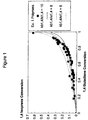
- FIG. 1 A plot of 1,4-isoprene conversion versus 1,4-butadiene conversion for these three hydrogenations is summarized in Figure 1. Conversions were determined using 1 H NMR. The experimental data are plotted along side the curves that predict conversion using the theory discussed above. Equation (3) is evaluated in Figure 1 using selectivies, represented by variable S2, of 6, 8, and 10. From Figure 1 it is shown that the conversion data generally follow that predicted by theory over the range of process conditions studied. Also, the data appear to follow the curve defined by a selectivity of 8 to 10 between 0 and 80% conversion and a selectivity of less than 6 at greater than 80% conversion. Overall, the equations derived from the theory give an adequate representation of the selective hydrogenation process.
- Table 2 shows experimental data for a batch hydrogenation.
- the precursor to the hydrogenation process was an isoprene-butadiene block copolymer with alcohol functionality on one end of the molecule.
- the isoprene block molecular weight was 1180, and the butadiene block molecular weight was 5260.
- the fraction of 1,2-butadiene in the butadiene block was 46.7% while the fraction of 1,4-isoprene in the isoprene block was 87.9%.
- the hydrogenation was carried out using a total of 3 ppm nickel catalyst with a nickel to aluminum catalyst ratio of 2.0.
- the hydrogenation temperature started at 38 °C, rose to a maximum of 70 °C in the first 45 minutes of hydrogenation, and leveled off to a temperature range of 60 to 75 °C for the remaining batch time.
- the hydrogen pressure of the reactor was maintained at 700 psi (4.83 MPa).
- the data in Table 2 show the hydrogenation of the four mers as a function of hydrogenation time.
- the mer concentrations were measured using 1 H NMR.
- First order rate constants i.e., first order in mer concentration
- the rate constants were generated using the previous data point at time "1" and the current data point for time "2".
- the selectivities S1 and S2 were then calculated from these rate constants.
- S1 has an average value of 3.5.
- S2 appears to be decreasing at batch times less than 100 minutes. Beyond 100 minutes, or greater than 80% 1,4 butadiene conversion or about 90% total butadiene conversion, S2 is steady with an average value of 2.96.
- Example 3 Determination of the Isoprene/Butadiene Block Size that Minimizes Hydrogenation Residence Time for a Residual Unsaturation level of 1.6 meq/g for Isoprene.
- the selectivity of 1,4 butadiene to 1,4-isoprene was represented by a value between 6 and 10 when the 1,4-butadiene conversion was less than about 80%.
- a value of 7.5 is used for S2 when the 1,4-butadiene conversion is less than 80%.
- the selectivity of 1,4 butadiene to 1,4-isoprene after 80% 1,4 butadiene conversion (S2') was 2.96.
- An S2' value of 3 is used in this example.
- the selectivity of 1,2-butadiene to 1,4-butadiene was estimated to be 3.5.
- the relative amounts of isoprene and butadiene needed to meet a target residual unsaturation are calculated as follows.
- the target residual unsaturation in the butadiene block is 0.3 meq/g
- the target in the isoprene block is 1.6 meq/g.
- the butadiene block has a number average molecular weight of 4800, and the percentage of 1,2-butadiene is 48%.
- Example 3 subsequent batches of the isoprene-butadiene polymer are shown where the target isoprene/butadiene blend was that calculated in Example 3.
- the target isoprene block molecular weight which includes the s-butyl lithium required for anionic polymerization (molecular weight of 64) plus the isoprene block (1215 from Example 3) was set at 1300. That is, the target molecular weight was calculated to be 64 plus 1215 to equal 1279. This number was rounded up to the nearest hundred for convenience.
- Table 3 (which includes data from other runs including that described in Example 2) show that for batches 82 through 90, the isoprene block molecular weight ranged between 1251 and 1368 with an average of 1306.
Landscapes
- Chemical & Material Sciences (AREA)
- Health & Medical Sciences (AREA)
- Chemical Kinetics & Catalysis (AREA)
- Medicinal Chemistry (AREA)
- Polymers & Plastics (AREA)
- Organic Chemistry (AREA)
- Inorganic Chemistry (AREA)
- General Chemical & Material Sciences (AREA)
- Addition Polymer Or Copolymer, Post-Treatments, Or Chemical Modifications (AREA)
- Graft Or Block Polymers (AREA)
Applications Claiming Priority (3)
| Application Number | Priority Date | Filing Date | Title |
|---|---|---|---|
| US7317898P | 1998-01-30 | 1998-01-30 | |
| US73178P | 1998-01-30 | ||
| PCT/EP1999/000607 WO1999038895A1 (en) | 1998-01-30 | 1999-01-29 | Minimum residence time hydrogenation process for polyisoprene-polybutadiene block copolymers |
Publications (2)
| Publication Number | Publication Date |
|---|---|
| EP1051435A1 EP1051435A1 (en) | 2000-11-15 |
| EP1051435B1 true EP1051435B1 (en) | 2003-05-28 |
Family
ID=22112207
Family Applications (1)
| Application Number | Title | Priority Date | Filing Date |
|---|---|---|---|
| EP99907462A Expired - Lifetime EP1051435B1 (en) | 1998-01-30 | 1999-01-29 | Minimum residence time hydrogenation process for polyisoprene-polybutadiene block copolymers |
Country Status (8)
| Country | Link |
|---|---|
| US (1) | US6184307B1 (enExample) |
| EP (1) | EP1051435B1 (enExample) |
| JP (1) | JP4612185B2 (enExample) |
| KR (1) | KR100607067B1 (enExample) |
| DE (1) | DE69908300T2 (enExample) |
| ES (1) | ES2194442T3 (enExample) |
| TW (1) | TW486490B (enExample) |
| WO (1) | WO1999038895A1 (enExample) |
Families Citing this family (10)
| Publication number | Priority date | Publication date | Assignee | Title |
|---|---|---|---|---|
| JP4000874B2 (ja) * | 2001-03-16 | 2007-10-31 | 日本ゼオン株式会社 | 油展ゴムおよびゴム組成物 |
| US20040167281A1 (en) * | 2001-06-14 | 2004-08-26 | Hideo Takamatsu | Rubber composition, crosslinkable rubber composition and crosslinked articles |
| WO2003054079A1 (en) * | 2001-12-20 | 2003-07-03 | Kuraray Co., Ltd. | Rubber composition, crosslinkable rubber composition and crosslinked rubber |
| US7241540B2 (en) * | 2004-04-27 | 2007-07-10 | Kraton Polymers U.S. Llc | Photocurable compositions and flexographic printing plates comprising the same |
| WO2006094060A1 (en) | 2005-03-01 | 2006-09-08 | Firestone Polymers, Llc | Oxygen scavenging polyesters with reduced recycle color |
| ES2370416T5 (es) * | 2005-05-20 | 2016-04-25 | Bridgestone Corporation | Método para preparar polímeros de bajo peso molecular |
| CN101679544B (zh) * | 2007-04-09 | 2013-02-13 | 加利福尼亚大学董事会 | 得自半结晶-无定形聚烯烃嵌段共聚物的软而强的弹性体组合物 |
| JP6928102B2 (ja) | 2016-11-09 | 2021-09-01 | 株式会社ブリヂストン | ポリブタジエンとポリイソプレンとの高シス−1,4ブロックコポリマー |
| KR20210092249A (ko) | 2018-11-13 | 2021-07-23 | 에보닉 오퍼레이션스 게엠베하 | 베이스 오일 또는 윤활 첨가제로서 사용하기 위한 랜덤 공중합체 |
| ES2950909T3 (es) * | 2020-05-05 | 2023-10-16 | Evonik Operations Gmbh | Copolímeros de polidieno lineales hidrogenados como material base o aditivos lubricantes para composiciones lubricantes |
Family Cites Families (5)
| Publication number | Priority date | Publication date | Assignee | Title |
|---|---|---|---|---|
| US3465063A (en) * | 1965-10-06 | 1969-09-02 | Shell Oil Co | Hydrogenated diolefin block copolymers |
| US4879349A (en) * | 1987-11-05 | 1989-11-07 | Shell Oil Company | Selective hydrogenation process |
| US5208296A (en) * | 1992-09-02 | 1993-05-04 | Polysar Rubber Corporation | Nitrile rubber hydrogenation |
| JPH06306128A (ja) * | 1993-04-23 | 1994-11-01 | Kuraray Co Ltd | ブロック共重合体及び組成物 |
| JPH08100023A (ja) * | 1994-09-29 | 1996-04-16 | Nippon Zeon Co Ltd | ブロック共重合体水素添加物、樹脂組成物、およびブロック共重合体 |
-
1999
- 1999-01-20 US US09/234,336 patent/US6184307B1/en not_active Expired - Lifetime
- 1999-01-29 JP JP2000529361A patent/JP4612185B2/ja not_active Expired - Fee Related
- 1999-01-29 DE DE69908300T patent/DE69908300T2/de not_active Expired - Lifetime
- 1999-01-29 KR KR1020007008127A patent/KR100607067B1/ko not_active Expired - Fee Related
- 1999-01-29 ES ES99907462T patent/ES2194442T3/es not_active Expired - Lifetime
- 1999-01-29 EP EP99907462A patent/EP1051435B1/en not_active Expired - Lifetime
- 1999-01-29 WO PCT/EP1999/000607 patent/WO1999038895A1/en not_active Ceased
- 1999-02-05 TW TW088101795A patent/TW486490B/zh not_active IP Right Cessation
Also Published As
| Publication number | Publication date |
|---|---|
| DE69908300T2 (de) | 2003-12-11 |
| US6184307B1 (en) | 2001-02-06 |
| KR100607067B1 (ko) | 2006-08-01 |
| WO1999038895A1 (en) | 1999-08-05 |
| JP2002501951A (ja) | 2002-01-22 |
| TW486490B (en) | 2002-05-11 |
| JP4612185B2 (ja) | 2011-01-12 |
| EP1051435A1 (en) | 2000-11-15 |
| ES2194442T3 (es) | 2003-11-16 |
| KR20010034376A (ko) | 2001-04-25 |
| DE69908300D1 (de) | 2003-07-03 |
Similar Documents
| Publication | Publication Date | Title |
|---|---|---|
| KR0185670B1 (ko) | 수소화 공역 디올레핀 중합체의 제조 방법 | |
| US4764572A (en) | Anionic polymerization process | |
| EP1051435B1 (en) | Minimum residence time hydrogenation process for polyisoprene-polybutadiene block copolymers | |
| US7763696B2 (en) | Diene elastomer with cyclic vinyl units and processes for obtaining same | |
| US6815509B2 (en) | Method for hydrogenation of polymer | |
| US4960842A (en) | Amine containing initiator system for anionic polymerization | |
| US5336726A (en) | Butadiene polymers having terminal silyl groups | |
| WO1996035509A1 (en) | Functionalized chain extended initiators for anionic polymerization | |
| EP0584860A1 (en) | Selective partial hydrogenation of conjugated diene polymers | |
| JP3817011B2 (ja) | 共役ジエンモノマーの重合方法 | |
| WO1989004843A1 (en) | Amine containing initiator system for anionic polymerization | |
| US5418296A (en) | Capping of anionic polymers with oxetanes | |
| RU2123012C1 (ru) | Способ получения избирательно гидрированных сопряженных диолефиновых полимеров | |
| US4268705A (en) | Addition of monomer in production of liquid polymers | |
| KR19990011596A (ko) | 리빙 중합체 수첨용 신규 촉매 및 촉매를 이용한 수첨방법 | |
| US5202499A (en) | Liquid telechelic polymers having high 1,4-diene structure | |
| CN103848948B (zh) | 一种部分氢化的三元共聚物及其制备方法和应用 | |
| EP0998502B1 (en) | Enhanced hydrogenation catalyst removal from block copolymers by reduction in polymer cement viscosity by increasing the vinyl content of the block copolymers | |
| JP4912519B2 (ja) | 効率的な共役ジエン系重合体の水素添加方法 | |
| CN109749011A (zh) | 三元无规共聚物和三元无规共聚物组合物及其应用以及阴离子聚合方法 | |
| AU611747B2 (en) | Amine containing initiator system for anionic polymerization | |
| US20060293466A1 (en) | Methods for synthesis of graft polymers | |
| EP4242244A1 (en) | Method for producing block copolymer | |
| EP0986584A1 (en) | Process for making terminally functionalized polymers using protected functional initiator | |
| Mushina et al. | Heterogenized Bifunctional Catalysts in Olefin Polymerization |
Legal Events
| Date | Code | Title | Description |
|---|---|---|---|
| PUAI | Public reference made under article 153(3) epc to a published international application that has entered the european phase |
Free format text: ORIGINAL CODE: 0009012 |
|
| 17P | Request for examination filed |
Effective date: 20000727 |
|
| AK | Designated contracting states |
Kind code of ref document: A1 Designated state(s): BE DE ES FR GB IT NL |
|
| RAP1 | Party data changed (applicant data changed or rights of an application transferred) |
Owner name: KRATON POLYMERS RESEARCH B.V. |
|
| GRAH | Despatch of communication of intention to grant a patent |
Free format text: ORIGINAL CODE: EPIDOS IGRA |
|
| GRAH | Despatch of communication of intention to grant a patent |
Free format text: ORIGINAL CODE: EPIDOS IGRA |
|
| GRAA | (expected) grant |
Free format text: ORIGINAL CODE: 0009210 |
|
| AK | Designated contracting states |
Designated state(s): BE DE ES FR GB IT NL |
|
| PG25 | Lapsed in a contracting state [announced via postgrant information from national office to epo] |
Ref country code: NL Free format text: LAPSE BECAUSE OF FAILURE TO SUBMIT A TRANSLATION OF THE DESCRIPTION OR TO PAY THE FEE WITHIN THE PRESCRIBED TIME-LIMIT Effective date: 20030528 Ref country code: IT Free format text: LAPSE BECAUSE OF FAILURE TO SUBMIT A TRANSLATION OF THE DESCRIPTION OR TO PAY THE FEE WITHIN THE PRE;WARNING: LAPSES OF ITALIAN PATENTS WITH EFFECTIVE DATE BEFORE 2007 MAY HAVE OCCURRED AT ANY TIME BEFORE 2007. THE CORRECT EFFECTIVE DATE MAY BE DIFFERENT FROM THE ONE RECORDED.SCRIBED TIME-LIMIT Effective date: 20030528 Ref country code: BE Free format text: LAPSE BECAUSE OF FAILURE TO SUBMIT A TRANSLATION OF THE DESCRIPTION OR TO PAY THE FEE WITHIN THE PRESCRIBED TIME-LIMIT Effective date: 20030528 |
|
| REG | Reference to a national code |
Ref country code: GB Ref legal event code: FG4D |
|
| REF | Corresponds to: |
Ref document number: 69908300 Country of ref document: DE Date of ref document: 20030703 Kind code of ref document: P |
|
| NLV1 | Nl: lapsed or annulled due to failure to fulfill the requirements of art. 29p and 29m of the patents act | ||
| REG | Reference to a national code |
Ref country code: ES Ref legal event code: FG2A Ref document number: 2194442 Country of ref document: ES Kind code of ref document: T3 |
|
| PG25 | Lapsed in a contracting state [announced via postgrant information from national office to epo] |
Ref country code: GB Free format text: LAPSE BECAUSE OF NON-PAYMENT OF DUE FEES Effective date: 20040129 |
|
| ET | Fr: translation filed | ||
| PLBE | No opposition filed within time limit |
Free format text: ORIGINAL CODE: 0009261 |
|
| STAA | Information on the status of an ep patent application or granted ep patent |
Free format text: STATUS: NO OPPOSITION FILED WITHIN TIME LIMIT |
|
| 26N | No opposition filed |
Effective date: 20040302 |
|
| GBPC | Gb: european patent ceased through non-payment of renewal fee |
Effective date: 20040129 |
|
| REG | Reference to a national code |
Ref country code: FR Ref legal event code: PLFP Year of fee payment: 17 |
|
| PGFP | Annual fee paid to national office [announced via postgrant information from national office to epo] |
Ref country code: DE Payment date: 20150121 Year of fee payment: 17 Ref country code: ES Payment date: 20150128 Year of fee payment: 17 |
|
| PGFP | Annual fee paid to national office [announced via postgrant information from national office to epo] |
Ref country code: FR Payment date: 20150122 Year of fee payment: 17 |
|
| REG | Reference to a national code |
Ref country code: DE Ref legal event code: R119 Ref document number: 69908300 Country of ref document: DE |
|
| REG | Reference to a national code |
Ref country code: FR Ref legal event code: ST Effective date: 20160930 |
|
| PG25 | Lapsed in a contracting state [announced via postgrant information from national office to epo] |
Ref country code: DE Free format text: LAPSE BECAUSE OF NON-PAYMENT OF DUE FEES Effective date: 20160802 |
|
| PG25 | Lapsed in a contracting state [announced via postgrant information from national office to epo] |
Ref country code: FR Free format text: LAPSE BECAUSE OF NON-PAYMENT OF DUE FEES Effective date: 20160201 |
|
| REG | Reference to a national code |
Ref country code: ES Ref legal event code: FD2A Effective date: 20170224 |
|
| PG25 | Lapsed in a contracting state [announced via postgrant information from national office to epo] |
Ref country code: ES Free format text: LAPSE BECAUSE OF NON-PAYMENT OF DUE FEES Effective date: 20160130 |