EP1032799B1 - Verfahren zur herstellung poröser strukturen - Google Patents
Verfahren zur herstellung poröser strukturen Download PDFInfo
- Publication number
- EP1032799B1 EP1032799B1 EP98966152A EP98966152A EP1032799B1 EP 1032799 B1 EP1032799 B1 EP 1032799B1 EP 98966152 A EP98966152 A EP 98966152A EP 98966152 A EP98966152 A EP 98966152A EP 1032799 B1 EP1032799 B1 EP 1032799B1
- Authority
- EP
- European Patent Office
- Prior art keywords
- afore mentioned
- temperature
- mixture
- freeze
- sample
- Prior art date
- Legal status (The legal status is an assumption and is not a legal conclusion. Google has not performed a legal analysis and makes no representation as to the accuracy of the status listed.)
- Expired - Lifetime
Links
- 238000004519 manufacturing process Methods 0.000 title claims description 10
- 238000000034 method Methods 0.000 claims description 38
- 239000000203 mixture Substances 0.000 claims description 36
- 238000001816 cooling Methods 0.000 claims description 27
- 238000004108 freeze drying Methods 0.000 claims description 20
- 235000011837 pasties Nutrition 0.000 claims description 17
- 238000007711 solidification Methods 0.000 claims description 14
- 230000008023 solidification Effects 0.000 claims description 14
- 239000000654 additive Substances 0.000 claims description 13
- 239000000126 substance Substances 0.000 claims description 6
- 230000000996 additive effect Effects 0.000 claims description 5
- 239000000463 material Substances 0.000 claims description 4
- 239000011149 active material Substances 0.000 claims description 3
- 239000013543 active substance Substances 0.000 claims description 3
- 239000002537 cosmetic Substances 0.000 claims description 3
- 239000000825 pharmaceutical preparation Substances 0.000 claims description 3
- 239000007864 aqueous solution Substances 0.000 claims description 2
- 239000007900 aqueous suspension Substances 0.000 claims description 2
- 238000005516 engineering process Methods 0.000 claims description 2
- 229940127557 pharmaceutical product Drugs 0.000 claims description 2
- 238000001953 recrystallisation Methods 0.000 claims description 2
- 239000012530 fluid Substances 0.000 claims 5
- 230000001105 regulatory effect Effects 0.000 claims 1
- 239000000523 sample Substances 0.000 description 42
- 239000013078 crystal Substances 0.000 description 19
- 239000007788 liquid Substances 0.000 description 17
- 239000011148 porous material Substances 0.000 description 11
- 239000000725 suspension Substances 0.000 description 11
- 102000008186 Collagen Human genes 0.000 description 10
- 108010035532 Collagen Proteins 0.000 description 10
- 229920001436 collagen Polymers 0.000 description 10
- QTBSBXVTEAMEQO-UHFFFAOYSA-N Acetic acid Chemical compound CC(O)=O QTBSBXVTEAMEQO-UHFFFAOYSA-N 0.000 description 9
- 210000004027 cell Anatomy 0.000 description 6
- 238000010438 heat treatment Methods 0.000 description 6
- 238000009826 distribution Methods 0.000 description 5
- 239000011888 foil Substances 0.000 description 5
- 239000012071 phase Substances 0.000 description 5
- 230000009467 reduction Effects 0.000 description 5
- RYGMFSIKBFXOCR-UHFFFAOYSA-N Copper Chemical compound [Cu] RYGMFSIKBFXOCR-UHFFFAOYSA-N 0.000 description 4
- 235000011054 acetic acid Nutrition 0.000 description 4
- 238000010924 continuous production Methods 0.000 description 4
- 229910052802 copper Inorganic materials 0.000 description 4
- 239000010949 copper Substances 0.000 description 4
- 239000000835 fiber Substances 0.000 description 4
- 230000012010 growth Effects 0.000 description 4
- 230000015572 biosynthetic process Effects 0.000 description 3
- 230000005779 cell damage Effects 0.000 description 3
- 208000037887 cell injury Diseases 0.000 description 3
- 230000008014 freezing Effects 0.000 description 3
- 238000007710 freezing Methods 0.000 description 3
- 239000002245 particle Substances 0.000 description 3
- 238000000859 sublimation Methods 0.000 description 3
- 230000008022 sublimation Effects 0.000 description 3
- LFQSCWFLJHTTHZ-UHFFFAOYSA-N Ethanol Chemical compound CCO LFQSCWFLJHTTHZ-UHFFFAOYSA-N 0.000 description 2
- 239000004480 active ingredient Substances 0.000 description 2
- 238000002425 crystallisation Methods 0.000 description 2
- 230000008025 crystallization Effects 0.000 description 2
- 238000011049 filling Methods 0.000 description 2
- 239000007789 gas Substances 0.000 description 2
- 102000004169 proteins and genes Human genes 0.000 description 2
- 108090000623 proteins and genes Proteins 0.000 description 2
- 230000029663 wound healing Effects 0.000 description 2
- 108010053481 Antifreeze Proteins Proteins 0.000 description 1
- 108090000790 Enzymes Proteins 0.000 description 1
- 102000004190 Enzymes Human genes 0.000 description 1
- 229920001612 Hydroxyethyl starch Polymers 0.000 description 1
- 206010052428 Wound Diseases 0.000 description 1
- 208000027418 Wounds and injury Diseases 0.000 description 1
- 150000001243 acetic acids Chemical class 0.000 description 1
- 239000002253 acid Substances 0.000 description 1
- 150000007513 acids Chemical class 0.000 description 1
- 239000003242 anti bacterial agent Substances 0.000 description 1
- 230000002528 anti-freeze Effects 0.000 description 1
- 229940088710 antibiotic agent Drugs 0.000 description 1
- 239000008346 aqueous phase Substances 0.000 description 1
- 238000010923 batch production Methods 0.000 description 1
- 239000012620 biological material Substances 0.000 description 1
- 230000031018 biological processes and functions Effects 0.000 description 1
- 239000012472 biological sample Substances 0.000 description 1
- 210000001124 body fluid Anatomy 0.000 description 1
- 239000010839 body fluid Substances 0.000 description 1
- 239000000316 bone substitute Substances 0.000 description 1
- 239000012267 brine Substances 0.000 description 1
- 239000003990 capacitor Substances 0.000 description 1
- 210000000845 cartilage Anatomy 0.000 description 1
- 230000021164 cell adhesion Effects 0.000 description 1
- 230000010261 cell growth Effects 0.000 description 1
- 239000013553 cell monolayer Substances 0.000 description 1
- 230000001413 cellular effect Effects 0.000 description 1
- 210000003850 cellular structure Anatomy 0.000 description 1
- 210000001612 chondrocyte Anatomy 0.000 description 1
- 230000036425 denaturation Effects 0.000 description 1
- 238000004925 denaturation Methods 0.000 description 1
- 238000003795 desorption Methods 0.000 description 1
- 238000010586 diagram Methods 0.000 description 1
- 238000009792 diffusion process Methods 0.000 description 1
- 210000002889 endothelial cell Anatomy 0.000 description 1
- 230000007613 environmental effect Effects 0.000 description 1
- 230000008020 evaporation Effects 0.000 description 1
- 238000001704 evaporation Methods 0.000 description 1
- 210000002950 fibroblast Anatomy 0.000 description 1
- 239000012520 frozen sample Substances 0.000 description 1
- 230000023597 hemostasis Effects 0.000 description 1
- 229940050526 hydroxyethylstarch Drugs 0.000 description 1
- 229910052588 hydroxylapatite Inorganic materials 0.000 description 1
- 230000002631 hypothermal effect Effects 0.000 description 1
- 239000007943 implant Substances 0.000 description 1
- 208000015181 infectious disease Diseases 0.000 description 1
- 238000009413 insulation Methods 0.000 description 1
- 230000001788 irregular Effects 0.000 description 1
- 210000002510 keratinocyte Anatomy 0.000 description 1
- 239000011159 matrix material Substances 0.000 description 1
- 229940127554 medical product Drugs 0.000 description 1
- 239000002184 metal Substances 0.000 description 1
- 229910052751 metal Inorganic materials 0.000 description 1
- 238000002156 mixing Methods 0.000 description 1
- 238000000465 moulding Methods 0.000 description 1
- 210000005036 nerve Anatomy 0.000 description 1
- 230000006911 nucleation Effects 0.000 description 1
- 238000010899 nucleation Methods 0.000 description 1
- XYJRXVWERLGGKC-UHFFFAOYSA-D pentacalcium;hydroxide;triphosphate Chemical compound [OH-].[Ca+2].[Ca+2].[Ca+2].[Ca+2].[Ca+2].[O-]P([O-])([O-])=O.[O-]P([O-])([O-])=O.[O-]P([O-])([O-])=O XYJRXVWERLGGKC-UHFFFAOYSA-D 0.000 description 1
- 238000004886 process control Methods 0.000 description 1
- 102000004196 processed proteins & peptides Human genes 0.000 description 1
- 108090000765 processed proteins & peptides Proteins 0.000 description 1
- 230000005855 radiation Effects 0.000 description 1
- 150000003839 salts Chemical class 0.000 description 1
- HPALAKNZSZLMCH-UHFFFAOYSA-M sodium;chloride;hydrate Chemical compound O.[Na+].[Cl-] HPALAKNZSZLMCH-UHFFFAOYSA-M 0.000 description 1
- 239000000243 solution Substances 0.000 description 1
- 238000003860 storage Methods 0.000 description 1
- 235000000346 sugar Nutrition 0.000 description 1
- 150000008163 sugars Chemical class 0.000 description 1
- 239000013526 supercooled liquid Substances 0.000 description 1
- 210000001519 tissue Anatomy 0.000 description 1
- XLYOFNOQVPJJNP-UHFFFAOYSA-N water Substances O XLYOFNOQVPJJNP-UHFFFAOYSA-N 0.000 description 1
Images

Classifications
-
- F—MECHANICAL ENGINEERING; LIGHTING; HEATING; WEAPONS; BLASTING
- F26—DRYING
- F26B—DRYING SOLID MATERIALS OR OBJECTS BY REMOVING LIQUID THEREFROM
- F26B5/00—Drying solid materials or objects by processes not involving the application of heat
- F26B5/04—Drying solid materials or objects by processes not involving the application of heat by evaporation or sublimation of moisture under reduced pressure, e.g. in a vacuum
- F26B5/06—Drying solid materials or objects by processes not involving the application of heat by evaporation or sublimation of moisture under reduced pressure, e.g. in a vacuum the process involving freezing
-
- A—HUMAN NECESSITIES
- A61—MEDICAL OR VETERINARY SCIENCE; HYGIENE
- A61L—METHODS OR APPARATUS FOR STERILISING MATERIALS OR OBJECTS IN GENERAL; DISINFECTION, STERILISATION OR DEODORISATION OF AIR; CHEMICAL ASPECTS OF BANDAGES, DRESSINGS, ABSORBENT PADS OR SURGICAL ARTICLES; MATERIALS FOR BANDAGES, DRESSINGS, ABSORBENT PADS OR SURGICAL ARTICLES
- A61L15/00—Chemical aspects of, or use of materials for, bandages, dressings or absorbent pads
- A61L15/16—Bandages, dressings or absorbent pads for physiological fluids such as urine or blood, e.g. sanitary towels, tampons
- A61L15/42—Use of materials characterised by their function or physical properties
- A61L15/425—Porous materials, e.g. foams or sponges
-
- A—HUMAN NECESSITIES
- A61—MEDICAL OR VETERINARY SCIENCE; HYGIENE
- A61L—METHODS OR APPARATUS FOR STERILISING MATERIALS OR OBJECTS IN GENERAL; DISINFECTION, STERILISATION OR DEODORISATION OF AIR; CHEMICAL ASPECTS OF BANDAGES, DRESSINGS, ABSORBENT PADS OR SURGICAL ARTICLES; MATERIALS FOR BANDAGES, DRESSINGS, ABSORBENT PADS OR SURGICAL ARTICLES
- A61L27/00—Materials for grafts or prostheses or for coating grafts or prostheses
- A61L27/50—Materials characterised by their function or physical properties, e.g. injectable or lubricating compositions, shape-memory materials, surface modified materials
- A61L27/56—Porous materials, e.g. foams or sponges
-
- A—HUMAN NECESSITIES
- A61—MEDICAL OR VETERINARY SCIENCE; HYGIENE
- A61L—METHODS OR APPARATUS FOR STERILISING MATERIALS OR OBJECTS IN GENERAL; DISINFECTION, STERILISATION OR DEODORISATION OF AIR; CHEMICAL ASPECTS OF BANDAGES, DRESSINGS, ABSORBENT PADS OR SURGICAL ARTICLES; MATERIALS FOR BANDAGES, DRESSINGS, ABSORBENT PADS OR SURGICAL ARTICLES
- A61L31/00—Materials for other surgical articles, e.g. stents, stent-grafts, shunts, surgical drapes, guide wires, materials for adhesion prevention, occluding devices, surgical gloves, tissue fixation devices
- A61L31/14—Materials characterised by their function or physical properties, e.g. injectable or lubricating compositions, shape-memory materials, surface modified materials
- A61L31/146—Porous materials, e.g. foams or sponges
-
- B—PERFORMING OPERATIONS; TRANSPORTING
- B29—WORKING OF PLASTICS; WORKING OF SUBSTANCES IN A PLASTIC STATE IN GENERAL
- B29C—SHAPING OR JOINING OF PLASTICS; SHAPING OF MATERIAL IN A PLASTIC STATE, NOT OTHERWISE PROVIDED FOR; AFTER-TREATMENT OF THE SHAPED PRODUCTS, e.g. REPAIRING
- B29C67/00—Shaping techniques not covered by groups B29C39/00 - B29C65/00, B29C70/00 or B29C73/00
- B29C67/20—Shaping techniques not covered by groups B29C39/00 - B29C65/00, B29C70/00 or B29C73/00 for porous or cellular articles, e.g. of foam plastics, coarse-pored
- B29C67/202—Shaping techniques not covered by groups B29C39/00 - B29C65/00, B29C70/00 or B29C73/00 for porous or cellular articles, e.g. of foam plastics, coarse-pored comprising elimination of a solid or a liquid ingredient
Definitions
- the invention relates to a method for producing sponges in which a liquid or pasty mixture of substances at least partially solidified and then freeze-dried becomes.
- the invention is therefore based on the object at the outset to further develop the described method so that products with a more homogeneous structure can be generated.
- This object is achieved with a generic method in which the mixture between two temperable, spaced apart arranged surfaces of different temperatures is cooled, characterized in that an accurate temperature control is carried out, such that an orderly one during the solidification process Structure arises.
- This special temperature control causes crystal structure to grow from the colder to the warmer area.
- the crystal front grows continuously from one surface to the other and leaves one in the sample homogeneous distribution between crystalline and non-crystalline structures arise.
- the subsequent freeze-drying is due to the homogeneous Crystal structure relieves and lays through evaporation or sublimation the crystalline and liquid components the homogeneous porous structure free. By setting the temperature gradient or The resulting structure is optimal influenced.
- a simple way of carrying out the method provides that the Areas are arranged parallel to each other. Between these in parallel arranged surfaces, the mixture is brought and cooled so that crystal formation progresses from one surface to another.
- the warmer area limitation of the mixture can also be achieved directly Heat radiation or convection can be tempered.
- the surfaces are arranged concentrically to each other. It can either the inner or outer surface are kept warmer so that crystal formation either from the inside out or from the outside out progresses inside.
- the surfaces are radial or parallel mutually extending crystal structures that span the entire Can extend area between the surfaces or only a part of the Fill in the area.
- a particularly advantageous embodiment of the invention provides that the Mixing is introduced on a first side between the surfaces and is left out on a second side between surfaces, wherein from the first page to the second page the temperature of the opposite surface areas drops.
- This enables both arranged parallel to each other as well as concentric to each other arranged surfaces a continuous solidification of a liquid or pasty mixture.
- the poured liquid or pasty mixture and at the other end continuously removed the porous structure from the device.
- a particularly simple type of freeze drying is made possible by that the at least partially solidified product is freeze-dried by one surface is removed and the other surface is tempered. To Removing a surface, the at least partially solidified product is free accessible for an applied negative pressure, which by sublimation, Desorption and diffusion processes the ice phase and others unfrozen water removed from the concentrated phase.
- the already for setting the temperature gradient during the Solidification process is also carried out during the Freeze drying tempered to control the freeze drying process.
- the invention primarily provides that as a liquid or pasty mixture an aqueous solution or suspension is used.
- the aqueous phase is easy to remove by freeze drying and allows production of porous materials that can be used in a variety of ways, especially in medical technology Structures such as sponges.
- the process can be designed to influence the crystal structure be that there is no reorientation or postponement of the suspended foreign phase particles such as fibers by the Crystal growth is coming.
- inventive Procedures are generated using a very orderly structure homogeneous distribution of the foreign phase particles, which is essentially the Distribution in the liquid or pasty mixture corresponds. After Freeze drying gives you very fine structures, for example as Sponges for hemostasis or burn wound treatment, however can also be advantageous as a biomaterial for cartilage cultivation.
- the liquid or pasty mixture of active ingredients or additives can be used to influence the crystal structure be added to the liquid mixture.
- Processes then grow e.g. B. finger-shaped or tree-like (Dendritic) ice crystals through the liquid or pasty mixture that cause a reorientation of the suspended foreign phase particles can.
- these sublimate finger-shaped ice crystals and homogeneous open pores remain.
- the Ice crystal structure and thus the subsequent pore structure can be determined by the Process control during cooling (temperature gradient over the sample and Ice front speed) and the type and concentration of additives to be influenced.
- Collagen suspensions can be added by adding, for example, hydroxyapatite produce harder structures that suit the suitability of the sponge Improve bone substitute.
- B. in medical Implants advantageous, even the liquid mixture is biologically active Add substances or even living cells with anti-freeze additives that help with the use of the porous structures, the desired ones improve biological processes.
- B. Antibiotics are added. About wound healing z. B. by colonizing the structures with cells or growing in of vessels or nerves can accelerate as biologically active Substances peptides, proteins or enzymes are added, which, for. B.
- biological Cells such as chondrocytes, fibroblasts, keratinocytes and Endothelial cells promote the formation of a new cell matrix or one Cell monolayers or vessels and produce for wound healing important substances.
- Hydroxyethyl starch as an example of a macromolecular Cyroprotective - possibly supplemented by the addition of certain sugars - restricts cell damage during the freezing process and is also used for Freeze drying suitable.
- the sponges produced in this way can Rehydration through body fluids or special solutions perform biological or medical functions.
- the above-mentioned active ingredients or additives, biologically active Materials or living cells can also be generated, freeze-dried structure can be added because the porous structure is a Storage of these substances in the structure is facilitated.
- a particularly advantageous use of the invention is in use for medical or pharmaceutical Products or products of environmental and biotechnology.
- Sponges for cosmetic or medical purposes especially in the Tissue engineering area of particular importance.
- Another possibility for solving the problem according to the invention lies in making porous structures by a process in which a liquid or pasty mixture of substances at least partially for Solidification is brought and then freeze-dried, whereby the mixture is pre-cooled under positive pressure and then is suddenly relaxed.
- the mixture is advantageously until shortly before Freezing point cooled at elevated pressure and the sudden Relaxation leads to crystallization of the supercooled liquid Mixture, taking place throughout the mix at the same time form homogeneously distributed ice crystals, depending on the temperature and Pressure guidance continues to grow or remain small and through that Freeze drying can be removed so that a homogeneous porous structure arises.
- the temperature and pressure control allows either one To produce a large number of smaller crystals or a few larger crystals, so that fine-pored or coarse-pored structures arise. It is advantageous if the overpressure is between 1 and 250 MPa.
- the Crystallization can be used to increase gas bubble nucleation To maintain porosity and lower density of the structure. This possibility for the creation of larger porosity exists both in the variant with Pressure reduction as well as in the previously described variant without Pressure reduction.
- Another advantageous variant for producing larger porosity is after solidification according to the invention, recrystallization of the sample in close to the solidification temperature, and only then the Freeze drying step to connect. This allows smaller ones crystalline areas grow together to larger, creating larger Pores arise.
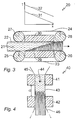
- the device 1 shown in FIG. 1 has a lower sample limit 2 and an upper sample limit 3, between which within a insulating sample frame 4 the sample space is arranged: the upper and lower sample limits 2 and 3 are identical and serve to control the temperature between these sample limits in the Sample space 5 arranged sample during the solidification process and if necessary also during the freeze drying process.
- the Temperature control takes place via copper blocks 6 and 7, which laterally in one Thermal insulation jacket 8 and 9 are embedded. Between Copper blocks 6 and 7 and the lower and upper sample limit 2 and 3 there is an electric foil heating element 10 and 11 for compensation heating.
- the upper sample limit 3 by means of a spindle 14, which in the drawing is only shown schematically as a double arrow, pneumatic or be raised hydraulically.
- the device can be used in a closed vacuum chamber Capacitor (not shown) can be set up so that the Freeze drying process can be carried out directly afterwards.
- Capacitor (not shown) can be set up so that the Freeze drying process can be carried out directly afterwards.
- the vacuum chamber is evacuated and closed Sample temperature during freeze-drying can be the lower one, for example Foil heating element 10 can be used.
- the temperature profiles are schematic over time applied.
- the sample limits 2 and 3 depending on the time exactly at the temperatures shown in the diagram.
- the ice front 17 grows with a cellular structure from the lower to the upper sample limit.
- the temperature will change set so that the difference between the temperature at the bottom Sample limit 2 and the temperature at the upper sample limit 3 is kept constant.
- the temperature difference was slightly smaller held. This ensures a controlled temperature reduction with constant Cooling rate set.
- FIG. 3 shows a continuous device 20.
- a sample space 21 In this case, a hose 22 is used between two conveyor belts 23, 24 is guided.
- the conveyor belts 23 and 24 are each of two Drive rollers 25, 26 and 27, 28 driven. Between these rollers is on the top and on the bottom of the hose 22 each Cooling element 29 and 30 arranged.
- These cooling elements 29 and 30 are constructed in such a way that they have a longitudinal extension Generate temperature gradients, which acts on the sample space 21.
- the for this purpose, cooling elements 29, 30 can be constructed in a segmented manner by one to produce gradual temperature reductions. However, one is advantageous almost continuous temperature reduction, which in the over the Device indicated graphic is shown. In this graphic it is Temperature over the longitudinal extent of the cooling elements 29, 30 applied.
- the straight line 31 shows the temperature curve on the underside of the sample space 21 and the straight line 32 shows the temperature profile the top of the sample space 21. This graphic shows that at constant Cooling rates the temperature difference at opposite places between the cooling elements 29, 30 is kept constant
- this device 20 When using this device 20 is in the sample space 21 a liquid or pasty mixture into the hose 22 on the left-hand side filled.
- This hose is connected by means of the conveyor belts 23 and 24 continuous speed between the cooling elements 29 and 30 passed so that by cooling within the tube 22nd from the bottom to the top of the tube an ice front grows that grow through the entire sample at the end of the cooling elements 29 and 30 should have, so that the frozen sample is then in a Vacuum chamber (not shown) can be freeze-dried.
- the tube 22 can be rounded, rectangular, or otherwise Have shape, so that depending on the application, special moldings, such as For example, bars or plates with the device in a continuous process can be generated.
- the device 20 can also have lateral boundaries, so that which the sample can be passed between the cooling elements without a hose.
- the sample can also be placed between two individual foils be performed.
- FIG. 4 shows a further continuous device 40
- the liquid is placed between two devices Cooling elements 41, 42 guided in a tube 43.
- the distance D the Cooling elements 41 and 42 lead to a space between the Cooling elements in which a temperature gradient can be set.
- the sample enters the space between the Cooling elements 41 and 42, so that when flowing through the tube 43 forms an ice front between the cooling elements.
- the device 20 can also be used lateral arrangement according to the device 40 the sample in one Hose or between foils.
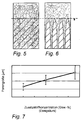
- Figures 5 and 6 show two typical variants of the cooling possible homogeneous structures according to the invention
- the collagen fibers are relatively even distributed. Are the approx. 2 weight percent collagen suspension none Additives added, can be done by a process temperature control achieve a flat ice front growth as described in FIG. 2, wherein the fiber position and distribution, as shown in Figure 5, essentially remains unchanged. The area that has already crystallized is shown in the figures hatched.
- Figure 7 shows the example of a suspension with 1.8 percent by weight Collagen at a cooling rate of 9 K / min and a Temperature gradient of 50 K / cm was frozen, the influence of Additive acetic acid to the pore size. (Where is as pore size always the shortest diameter of the non-circular pores.)
- the additive concentration in% by weight (acetic acid) is on the abscissa and on the ordinate the pore size is given in ⁇ m.
Landscapes
- Health & Medical Sciences (AREA)
- Chemical & Material Sciences (AREA)
- Engineering & Computer Science (AREA)
- Life Sciences & Earth Sciences (AREA)
- Public Health (AREA)
- Dispersion Chemistry (AREA)
- Veterinary Medicine (AREA)
- Epidemiology (AREA)
- Animal Behavior & Ethology (AREA)
- General Health & Medical Sciences (AREA)
- Mechanical Engineering (AREA)
- Vascular Medicine (AREA)
- Molecular Biology (AREA)
- Dermatology (AREA)
- Medicinal Chemistry (AREA)
- Oral & Maxillofacial Surgery (AREA)
- Transplantation (AREA)
- Hematology (AREA)
- Heart & Thoracic Surgery (AREA)
- Materials Engineering (AREA)
- Surgery (AREA)
- General Engineering & Computer Science (AREA)
- Materials For Medical Uses (AREA)
- Apparatus Associated With Microorganisms And Enzymes (AREA)
- Manufacture Of Porous Articles, And Recovery And Treatment Of Waste Products (AREA)
- Drying Of Solid Materials (AREA)
- Medicinal Preparation (AREA)
Description
- Figur 1
- eine Vorrichtung für die Herstellung poröser Strukturen im Batch-Prozeß,
- Figur 2
- ein Beispiel für die Temperaturführung an verschiedenen Stellen der Proben über der Zeit,
- Figur 3
- eine Vorrichtung für die Herstellung poröser Strukturen im kontinuierlichen Prozeß mit darüber schematisch aufgetragener Temperaturführung,
- Figur 4
- eine weitere Vorrichtung für die Herstellung poröser Strukturen im kontinuierlichen Prozeß,
- Figur 5
- eine homogene gleichmäßige Struktur einer wäßrigen Kollagensuspension,
- Figur 6
- eine homogene fingerförmige Eiskristallstruktur einer wäßrigen Kollagensuspension und
- Figur 7
- eine Darstellung der Porengröße über der Essigsäurekonzentration.
| Erzeugter Temperaturgradient | 1 K/cm bis 100 K/cm |
| vorteilhaft | 10 K/cm bis 60 K/cm |
| Zusatzstoffkonzentration | 0,1 Gew.-% bis 25 Gew.-% |
| vorteilhaft | 1 Gew.-% bis 10 Gew.-% |
| Abkühlrate | 0,1 K/min bis 500 K/min |
| vorteilhaft | 1 K/min bis 50 K/min |
Claims (17)
- Verfahren zur Herstellung von Schwämmen, bei dem eine flüssige oder pastöse Mischung von Substanzen zumindest partiell zur Erstarrung gebracht wird und anschließend gefriergetrocknet wird, wobei die Mischung zwischen zwei temperierbaren, beabstandet voneinander angeordneten Flächen unterschiedlicher Temperaturen abgekühlt wird, dadurch gekennzeichnet, daß eine genaue Temperaturregelung durchgeführt wird, derart, daß während des Erstarrungsprozesses eine geordnete Struktur entsteht.
- Verfahren nach Anspruch 1, dadurch gekennzeichnet, daß die Differenz der Temperaturen sich gegenüberliegender Flächenbereiche während der Abkühlung im wesentlichen konstant gehalten wird.
- Verfahren nach Anspruch 1, dadurch gekennzeichnet, daß die Temperatur eines Flächenbereiches solange konstant gehalten wird, bis der andere Flächenbereich soweit abgekühlt ist, dass der gewünschte Gradient aufgebaut ist.
- Verfahren nach einem der vorhergehenden Ansprüche, dadurch gekennzeichnet, daß die Flächen parallel zueinander angeordnet sind.
- Verfahren nach einem der Ansprüche 1 bis 3, dadurch gekennzeichnet, daß die Flächen konzentrisch zueinander angeordnet sind.
- Verfahren nach einem der vorhergehenden Ansprüche, dadurch gekennzeichnet, daß die Mischung auf einer ersten Seite zwischen den Flächen eingeleitet wird und auf einer zweiten Seite zwischen Flächen herausgelassen wird, wobei von der ersten Seite zur zweiten Seite die Temperatur der sich gegenüberliegenden Flächenbereiche abfällt.
- Verfahren nach einem der vorhergehenden Ansprüche, dadurch gekennzeichnet, daß die Mischung durch wärmeleitende Transportbänder oder Schläuche geleitet oder mit ihnen geführt wird.
- Verfahren nach einem der vorhergehenden Ansprüche, dadurch gekennzeichnet, daß das zumindest partiell erstarrte Produkt gefriergetrocknet wird, in dem eine Fläche entfernt wird und die andere Fläche temperiert wird.
- Verfahren nach einem der vorhergehenden Ansprüche, dadurch gekennzeichnet, daß als flüssige oder pastöse Mischung eine wäßrige Lösung oder Suspension verwendet wird.
- Verfahren nach einem der vorhergehenden Ansprüche, dadurch gekennzeichnet, daß der flüssigen oder pastösen Mischung ein Wirkstoff oder Zusatzstoff zugegeben werden.
- Verfahren nach einem der vorhergehenden Ansprüche, dadurch gekennzeichnet, daß der flüssigen oder pastösen Mischung biologisch aktive Materialien, lebende Zellen und/oder Kryoprotektive zugesetzt werden.
- Verfahren nach einem der vorhergehenden Ansprüche, dadurch gekennzeichnet, daß der gefriergetrockneten Struktur ein Wirkstoff, biologisch aktive Materialien oder lebende Zellen zugegeben werden.
- Verfahren nach einem der vorhergehenden Ansprüche, dudurch gekennzeichnet, daß zusätzlich Gase in der Mischung gelöst werden.
- Verfahren nach einem der vorhergehenden Ansprüche, dadurch gekennzeichnet, daß die Mischung nach Abschluß der Abkühlung auf eine Rekristallisationstemperatur wiedererwärmt und für eine bestimmte Zeit gehalten wird, bevor sie gefriergetrocknet wird.
- Verfahren nach einem der vorhergehenden Ansprüche, dadurch gekennzeichnet, daß Fremdmaterialien in gewünschter Geometrie und Orientierung in die flüssige oder pastöse Mischung eingebracht werden, die erst nach der Gefriertrocknung entfernt werden.
- Verwendung des Verfahrens nach einem der Ansprüche 1 bis 15 zur Herstellung von medizinischen, pharmazeutischen Produkten oder Produkten der Umwelt- und Biotechnologie.
- Verwendung des Verfahrens nach einem der Ansprüche 1 bis 15 zur Herstellung von Schwämmen für kosmetische oder medizinische Zwecke.
Applications Claiming Priority (3)
| Application Number | Priority Date | Filing Date | Title |
|---|---|---|---|
| DE19751031A DE19751031A1 (de) | 1997-11-19 | 1997-11-19 | Verfahren zur Herstellung poröser Strukturen |
| DE19751031 | 1997-11-19 | ||
| PCT/DE1998/003403 WO1999027315A1 (de) | 1997-11-19 | 1998-11-18 | Verfahren zur herstellung poröser strukturen |
Publications (2)
| Publication Number | Publication Date |
|---|---|
| EP1032799A1 EP1032799A1 (de) | 2000-09-06 |
| EP1032799B1 true EP1032799B1 (de) | 2004-05-12 |
Family
ID=7849061
Family Applications (1)
| Application Number | Title | Priority Date | Filing Date |
|---|---|---|---|
| EP98966152A Expired - Lifetime EP1032799B1 (de) | 1997-11-19 | 1998-11-18 | Verfahren zur herstellung poröser strukturen |
Country Status (7)
| Country | Link |
|---|---|
| US (1) | US6447701B1 (de) |
| EP (1) | EP1032799B1 (de) |
| JP (1) | JP4046172B2 (de) |
| AU (1) | AU2262999A (de) |
| DE (3) | DE19751031A1 (de) |
| ES (1) | ES2221236T3 (de) |
| WO (1) | WO1999027315A1 (de) |
Families Citing this family (34)
| Publication number | Priority date | Publication date | Assignee | Title |
|---|---|---|---|---|
| DE10135275A1 (de) | 2001-07-13 | 2003-01-30 | Jotec Gmbh | Implantat und Verfahren zu seiner Herstellung |
| DE10351661B4 (de) * | 2003-11-05 | 2010-07-08 | Dritte Patentportfolio Beteiligungsgesellschaft Mbh & Co.Kg | Verfahren zur Herstellung eines Kompositmaterials, dadurch hergestelltes Kompositmaterial und dessen Verwendung |
| EP1537839A1 (de) * | 2003-12-02 | 2005-06-08 | Dr. h. c. Robert Mathys Foundation | Prothesenvorrchtung zur Knorpelreparatur |
| EP2567708A3 (de) * | 2004-06-02 | 2013-10-16 | Victor Bronshtein | Konservierung mittels Verdampfung |
| US20080102438A1 (en) * | 2004-10-27 | 2008-05-01 | Yannas Ioannis V | Novel Technique to Fabricate Molded Structures Having a Patterned Porosity |
| AU2013206694B2 (en) * | 2005-09-19 | 2016-01-07 | Histogenics Corp. | Cell-support matrix and a method for preparation thereof |
| CA2623106C (en) * | 2005-09-19 | 2013-12-24 | Histogenics Corporation | Cell-support matrix having narrowly defined uniformly vertically and non-randomly organized porosity and pore density and a method for preparation thereof |
| US9005646B2 (en) | 2005-10-12 | 2015-04-14 | Lifenet Health | Compositions for repair of defects in tissues, and methods of making the same |
| US9132208B2 (en) * | 2008-08-07 | 2015-09-15 | Lifenet Health | Composition for a tissue repair implant and methods of making the same |
| US20070151638A1 (en) * | 2005-12-29 | 2007-07-05 | Robert Burgermeister | Method to develop an organized microstructure within an implantable medical device |
| US8793895B2 (en) * | 2006-02-10 | 2014-08-05 | Praxair Technology, Inc. | Lyophilization system and method |
| US9453675B2 (en) | 2006-02-10 | 2016-09-27 | Sp Industries, Inc. | Method of inducing nucleation of a material |
| CN101379357B (zh) * | 2006-02-10 | 2012-08-29 | 普莱克斯技术有限公司 | 冷冻干燥系统和方法 |
| DE102006042631A1 (de) | 2006-09-05 | 2008-03-20 | Jotec Gmbh | Implantat und Verfahren zu seiner Herstellung |
| US8240065B2 (en) * | 2007-02-05 | 2012-08-14 | Praxair Technology, Inc. | Freeze-dryer and method of controlling the same |
| US8685107B2 (en) | 2007-07-03 | 2014-04-01 | Histogenics Corporation | Double-structured tissue implant and a method for preparation and use thereof |
| US20090054984A1 (en) | 2007-08-20 | 2009-02-26 | Histogenics Corporation | Method For Use Of A Double-Structured Tissue Implant For Treatment Of Tissue Defects |
| US9421304B2 (en) | 2007-07-03 | 2016-08-23 | Histogenics Corporation | Method for improvement of differentiation of mesenchymal stem cells using a double-structured tissue implant |
| US8708944B2 (en) * | 2009-02-26 | 2014-04-29 | Javin C. Pierce | System for harvesting and dispensing a fibrin clot |
| US20110129515A1 (en) | 2009-05-29 | 2011-06-02 | Integra Lifesciences Corporation | Devices and Methods for Nerve Regeneration |
| US20110091711A1 (en) * | 2009-10-20 | 2011-04-21 | University Of Maine System Board Of Trustees | Carbon nanostructures from organic polymers |
| GB201119173D0 (en) | 2011-11-07 | 2011-12-21 | Fujifilm Mfg Europe Bv | Porous tissue scaffolds |
| GB201119182D0 (en) | 2011-11-07 | 2011-12-21 | Fujifilm Mfg Europe Bv | Porous tissue scaffolds |
| US10576694B2 (en) | 2011-12-08 | 2020-03-03 | Julius-Maximilians-Universitaet Wuerzburg | Production of materials having an anisotropic structure |
| ES2869959T3 (es) | 2011-12-08 | 2021-10-26 | Kai Stuckensen | Producción de materiales que tienen estructura anisotrópica |
| US10077420B2 (en) | 2014-12-02 | 2018-09-18 | Histogenics Corporation | Cell and tissue culture container |
| DE102016007931A1 (de) | 2016-06-30 | 2018-01-04 | Matricel Gmbh | Biomaterial |
| EP3547934B1 (de) | 2016-12-02 | 2023-11-22 | Integra LifeSciences Corporation | Vorrichtungen und verfahren zur nervenregeneration |
| US20200171208A1 (en) * | 2017-06-19 | 2020-06-04 | Deakin University | Scaffolds for cell culture and tissue regeneration |
| US20210252773A1 (en) | 2020-02-14 | 2021-08-19 | Trustees Of Dartmouth College | Three-dimensional freeze extrusion for the manufacture of homogeneous and graded rods and tubes |
| EP3892311B1 (de) | 2020-04-06 | 2023-09-20 | Integra LifeSciences Corporation | Vorrichtungen und verfahren zur nervenregeneration |
| US11927393B2 (en) * | 2020-04-30 | 2024-03-12 | Dci Donor Services, Inc. | Fiber slurry tray and process |
| TW202220639A (zh) * | 2020-08-06 | 2022-06-01 | 英商4D製藥有限公司 | 凍乾方法 |
| US11287185B1 (en) | 2020-09-09 | 2022-03-29 | Stay Fresh Technology, LLC | Freeze drying with constant-pressure and constant-temperature phases |
Family Cites Families (35)
| Publication number | Priority date | Publication date | Assignee | Title |
|---|---|---|---|---|
| DE656555C (de) | 1935-09-26 | 1938-02-09 | Gewerkschaft Ver Klosterbusch | Herstellung von Russ und Wasserstoff |
| NL68275C (de) * | 1946-09-11 | |||
| US2610625A (en) * | 1947-10-14 | 1952-09-16 | Armour & Co | Surgical sponge and the preparation thereof |
| US2804653A (en) * | 1953-03-06 | 1957-09-03 | Dayton Rubber Company | Method for the molding of foram rubber products |
| DE1807612U (de) * | 1959-11-03 | 1960-03-10 | Rudolf Dr Ing Kinzer | Massageschwamm. |
| US3157524A (en) * | 1960-10-25 | 1964-11-17 | Ethicon Inc | Preparation of collagen sponge |
| US3424826A (en) * | 1964-07-08 | 1969-01-28 | Monsanto Co | Method for selective absorption of foaming agent in foaming plastic articles |
| US3300994A (en) * | 1964-11-17 | 1967-01-31 | Fiskeridirektoratets Kjemisk T | Freezing of foodstuffs |
| GB1194220A (en) * | 1967-10-16 | 1970-06-10 | Ici Ltd | Crystallisation Process. |
| US3477137A (en) * | 1968-03-25 | 1969-11-11 | Sun Freeze Inc | Quick freezing of liquids for dehydration |
| US3504060A (en) * | 1969-03-10 | 1970-03-31 | Bendix Corp | Method of strengthening flexible fiber bundles |
| US3812224A (en) * | 1969-05-05 | 1974-05-21 | Polysar Ltd | Process for the production of porous polymeric materials |
| US3784658A (en) * | 1971-06-09 | 1974-01-08 | Monsanto Co | Method for the selective absorption of a volatile liquid foaming agent by heating in forming plastic articles |
| US3864840A (en) * | 1973-07-16 | 1975-02-11 | Matthews Jr Donnell R | Lyophilic waste disposal |
| CH627078A5 (en) * | 1975-06-05 | 1981-12-31 | Pentapharm Ag | Process for the preparation of a sterile collagen product with felt-like or web-like fibre structure |
| DK171108B1 (da) * | 1976-08-30 | 1996-06-10 | Akzo Nv | Mikroporøst polymerlegeme samt dettes fremstilling og anvendelse |
| US4412947A (en) * | 1979-09-12 | 1983-11-01 | Seton Company | Collagen sponge |
| US4522753A (en) * | 1980-07-17 | 1985-06-11 | Massachusetts Institute Of Technology | Method for preserving porosity in porous materials |
| US4501719A (en) * | 1981-05-04 | 1985-02-26 | Marquest Medical Products, Inc. | Tray apparatus for freeze-drying biologicals having a predetermined unit dosage |
| EP0069176A1 (de) * | 1981-07-03 | 1983-01-12 | American Home Products Corporation | Verfahren zur Herstellung eines gefriergetrockneten Produktes |
| JPS5935242B2 (ja) * | 1981-10-29 | 1984-08-28 | 山之内製薬株式会社 | 凍結乾燥機の棚 |
| US4687672A (en) * | 1983-11-07 | 1987-08-18 | L'air Liquide, Societe Anonyme Pour L'etude Et L'exploitation Des Procedes Georges Claude | Method and apparatus for preparing frozen free-flowing food particles |
| US4531373A (en) * | 1984-10-24 | 1985-07-30 | The Regents Of The University Of California | Directional solidification for the controlled freezing of biomaterials |
| US4590684A (en) * | 1984-11-20 | 1986-05-27 | Eden Research Laboratories, Inc. | Continuous freeze drying |
| JPS61191609A (ja) | 1985-02-20 | 1986-08-26 | Bio Materiaru Yunibaasu:Kk | 徐放性製剤 |
| FR2623277B1 (fr) * | 1987-11-17 | 1990-04-27 | Bioetica Sa | Procede et appareil de lyophilisation comportant des moyens formant ecran thermique entre les etageres de lyophilisation |
| DE3817906A1 (de) * | 1988-05-26 | 1989-11-30 | Boehringer Mannheim Gmbh | Verfahren und behaeltnis zum gefriertrocknen unter sterilen bedingungen |
| IT1219663B (it) * | 1988-06-20 | 1990-05-24 | Agrofil Coop Sarl | Procedimento per la preparazione di un prodotto alimentare in forma solida,a base di yogurt e/o latte e/o frutta liofilizzati,e relativo prodotto cosi' ottenuto |
| DE3832162A1 (de) * | 1988-09-22 | 1990-04-12 | Lohmann Therapie Syst Lts | Verfahren zur herstellung von kollagenschaeumen in form endloser baender und verwendung in medizin, kosmetik und hygiene |
| DE4028622C2 (de) * | 1990-09-08 | 1994-01-27 | Suwelack Nachf Dr Otto | Verfahren zum Herstellen von Kollagenschwämmen |
| DE4328329C2 (de) * | 1992-08-26 | 1998-02-12 | Suwelack Nachf Dr Otto | Gefriergetrocknete Biomatrix |
| DE4414757A1 (de) * | 1994-04-27 | 1995-11-02 | Christian Dr Mahl | Verfahren zur Herstellung von Testsubstanzen für Verfahren mit Erfassung elektromagnetischer Schwingungen |
| DE4415844A1 (de) * | 1994-05-05 | 1995-11-16 | Santrade Ltd | Verfahren und Vorrichtung zur Stofftrennung durch Kristallisation von Schmelzen |
| GB2301362B (en) * | 1995-05-30 | 1999-01-06 | Johnson & Johnson Medical | Absorbable implant materials having controlled porosity |
| DE29714492U1 (de) * | 1997-08-13 | 1997-10-09 | Humbs, Martin, Dipl.-Ing., 83626 Valley | Vorrichtung zur Cryokonservierung von biologischen Materialien |
-
1997
- 1997-11-19 DE DE19751031A patent/DE19751031A1/de not_active Withdrawn
-
1998
- 1998-11-18 DE DE19881801T patent/DE19881801D2/de not_active Expired - Lifetime
- 1998-11-18 JP JP2000522412A patent/JP4046172B2/ja not_active Expired - Lifetime
- 1998-11-18 ES ES98966152T patent/ES2221236T3/es not_active Expired - Lifetime
- 1998-11-18 DE DE59811395T patent/DE59811395D1/de not_active Expired - Lifetime
- 1998-11-18 EP EP98966152A patent/EP1032799B1/de not_active Expired - Lifetime
- 1998-11-18 AU AU22629/99A patent/AU2262999A/en not_active Abandoned
- 1998-11-18 WO PCT/DE1998/003403 patent/WO1999027315A1/de not_active Ceased
-
2000
- 2000-05-19 US US09/575,863 patent/US6447701B1/en not_active Expired - Lifetime
Also Published As
| Publication number | Publication date |
|---|---|
| US6447701B1 (en) | 2002-09-10 |
| JP2001524596A (ja) | 2001-12-04 |
| DE59811395D1 (de) | 2004-06-17 |
| DE19751031A1 (de) | 1999-06-24 |
| DE19881801D2 (de) | 2001-03-22 |
| JP4046172B2 (ja) | 2008-02-13 |
| AU2262999A (en) | 1999-06-15 |
| WO1999027315A1 (de) | 1999-06-03 |
| EP1032799A1 (de) | 2000-09-06 |
| ES2221236T3 (es) | 2004-12-16 |
Similar Documents
| Publication | Publication Date | Title |
|---|---|---|
| EP1032799A1 (de) | Verfahren zur herstellung poröser strukturen | |
| EP1275405B1 (de) | Implantat mit poröser Proteinmatrix und Verfahren zu seiner Herstellung | |
| DE60103498T2 (de) | Fläschchen und verfahren zur kryokonservierung | |
| DE3789401T2 (de) | Biologische Kryoprotektion. | |
| Schoof et al. | Control of pore structure and size in freeze‐dried collagen sponges | |
| EP1470407B1 (de) | Verfahren zur kryokonservierung biologischer proben | |
| DE19936281C2 (de) | Verfahren zur Gefriertrocknung | |
| DE60115460T2 (de) | Hochtemperatur kryogene konservierung von biologisch aktivem material | |
| EP3060268B1 (de) | Formstabile knochenersatzformkörper mit verbleibender hydraulischer aktivität | |
| DE2161820A1 (de) | Verfahren zur Lagerung von biologischen Substanzen | |
| DE60008013T2 (de) | Verfahren zur gefriertrocknung von verschiedenen mikroorganismen | |
| EP1754809A2 (de) | Grossvolumige orientierte Einkristalle mit homogener Brechzahl und geringer Spannungsdoppelbrechung | |
| DE2614668C2 (de) | Verfahren zur Herstellung von sterilem, kristallinem Cefalotinnatrium, Cefaloridinbetain oder Cefazolinnatrium | |
| EP3600464B1 (de) | Trägerzusammensetzung für knochenersatzmaterialien | |
| DE3888527T2 (de) | Biologisch abbaubare und resorbierbare chirurgische materialien und verfahren zu deren herstellung. | |
| DE3873695T2 (de) | Vorrichtung zur gefriertrocknung mit mitteln zur bildung einer aktiven thermischen abschirmung zwischen den gefriertrocknungsregalen. | |
| DE102017210327A1 (de) | Verfahren zum Einfrieren und Verfahren sowie Vorrichtung zum Trocknen von Lebensmitteln, insbesondere von Obst und Gemüse | |
| DE10351661B4 (de) | Verfahren zur Herstellung eines Kompositmaterials, dadurch hergestelltes Kompositmaterial und dessen Verwendung | |
| EP2877828B1 (de) | Verfahren und vorrichtung zur hochgeschwindigkeits-temperierung einer probe | |
| DE2311573A1 (de) | Verfahren und vorrichtung zur bildung von einkristallen | |
| DE3311525A1 (de) | Verfahren und vorrichtung zum gefriertrocknen eines produktes in einem gefaess mit enger oeffnung | |
| DE1592455B2 (de) | Verfahren zum Züchten von Vanadiumdioxyd-EinkristaUen | |
| DE102008048709B4 (de) | Verfahren und Vorrichtung zur Temperierung von Gewebeteilen | |
| DD275709A5 (de) | Schale zur bewehrung eines quarztiegels | |
| DE1238618B (de) | Verfahren zur Konservierung biologischer Substanzen |
Legal Events
| Date | Code | Title | Description |
|---|---|---|---|
| PUAI | Public reference made under article 153(3) epc to a published international application that has entered the european phase |
Free format text: ORIGINAL CODE: 0009012 |
|
| 17P | Request for examination filed |
Effective date: 20000513 |
|
| AK | Designated contracting states |
Kind code of ref document: A1 Designated state(s): DE ES FR GB IT NL |
|
| 17Q | First examination report despatched |
Effective date: 20011123 |
|
| GRAP | Despatch of communication of intention to grant a patent |
Free format text: ORIGINAL CODE: EPIDOSNIGR1 |
|
| GRAS | Grant fee paid |
Free format text: ORIGINAL CODE: EPIDOSNIGR3 |
|
| GRAA | (expected) grant |
Free format text: ORIGINAL CODE: 0009210 |
|
| AK | Designated contracting states |
Kind code of ref document: B1 Designated state(s): DE ES FR GB IT NL |
|
| REG | Reference to a national code |
Ref country code: GB Ref legal event code: FG4D Free format text: NOT ENGLISH |
|
| REF | Corresponds to: |
Ref document number: 59811395 Country of ref document: DE Date of ref document: 20040617 Kind code of ref document: P |
|
| GBT | Gb: translation of ep patent filed (gb section 77(6)(a)/1977) |
Effective date: 20040902 |
|
| REG | Reference to a national code |
Ref country code: ES Ref legal event code: FG2A Ref document number: 2221236 Country of ref document: ES Kind code of ref document: T3 |
|
| ET | Fr: translation filed | ||
| PLBE | No opposition filed within time limit |
Free format text: ORIGINAL CODE: 0009261 |
|
| STAA | Information on the status of an ep patent application or granted ep patent |
Free format text: STATUS: NO OPPOSITION FILED WITHIN TIME LIMIT |
|
| 26N | No opposition filed |
Effective date: 20050215 |
|
| REG | Reference to a national code |
Ref country code: FR Ref legal event code: PLFP Year of fee payment: 18 |
|
| REG | Reference to a national code |
Ref country code: FR Ref legal event code: PLFP Year of fee payment: 19 |
|
| REG | Reference to a national code |
Ref country code: FR Ref legal event code: PLFP Year of fee payment: 20 |
|
| PGFP | Annual fee paid to national office [announced via postgrant information from national office to epo] |
Ref country code: DE Payment date: 20171123 Year of fee payment: 20 Ref country code: NL Payment date: 20171120 Year of fee payment: 20 Ref country code: FR Payment date: 20171121 Year of fee payment: 20 |
|
| PGFP | Annual fee paid to national office [announced via postgrant information from national office to epo] |
Ref country code: GB Payment date: 20171123 Year of fee payment: 20 Ref country code: ES Payment date: 20171220 Year of fee payment: 20 Ref country code: IT Payment date: 20171124 Year of fee payment: 20 |
|
| REG | Reference to a national code |
Ref country code: DE Ref legal event code: R071 Ref document number: 59811395 Country of ref document: DE |
|
| REG | Reference to a national code |
Ref country code: NL Ref legal event code: MK Effective date: 20181117 |
|
| REG | Reference to a national code |
Ref country code: GB Ref legal event code: PE20 Expiry date: 20181117 |
|
| PG25 | Lapsed in a contracting state [announced via postgrant information from national office to epo] |
Ref country code: GB Free format text: LAPSE BECAUSE OF EXPIRATION OF PROTECTION Effective date: 20181117 |
|
| REG | Reference to a national code |
Ref country code: ES Ref legal event code: FD2A Effective date: 20201203 |
|
| PG25 | Lapsed in a contracting state [announced via postgrant information from national office to epo] |
Ref country code: ES Free format text: LAPSE BECAUSE OF EXPIRATION OF PROTECTION Effective date: 20181119 |