EP1024185A2 - Kieselsäurenanopartikelbindemittel für Phosphorbeschichtungen - Google Patents
Kieselsäurenanopartikelbindemittel für Phosphorbeschichtungen Download PDFInfo
- Publication number
- EP1024185A2 EP1024185A2 EP00101096A EP00101096A EP1024185A2 EP 1024185 A2 EP1024185 A2 EP 1024185A2 EP 00101096 A EP00101096 A EP 00101096A EP 00101096 A EP00101096 A EP 00101096A EP 1024185 A2 EP1024185 A2 EP 1024185A2
- Authority
- EP
- European Patent Office
- Prior art keywords
- phosphor
- coating
- silica nanoparticles
- suspension
- binder
- Prior art date
- Legal status (The legal status is an assumption and is not a legal conclusion. Google has not performed a legal analysis and makes no representation as to the accuracy of the status listed.)
- Withdrawn
Links
Images

Classifications
-
- H—ELECTRICITY
- H01—ELECTRIC ELEMENTS
- H01J—ELECTRIC DISCHARGE TUBES OR DISCHARGE LAMPS
- H01J61/00—Gas-discharge or vapour-discharge lamps
- H01J61/02—Details
- H01J61/38—Devices for influencing the colour or wavelength of the light
- H01J61/42—Devices for influencing the colour or wavelength of the light by transforming the wavelength of the light by luminescence
- H01J61/46—Devices characterised by the binder or other non-luminescent constituent of the luminescent material, e.g. for obtaining desired pouring or drying properties
-
- C—CHEMISTRY; METALLURGY
- C09—DYES; PAINTS; POLISHES; NATURAL RESINS; ADHESIVES; COMPOSITIONS NOT OTHERWISE PROVIDED FOR; APPLICATIONS OF MATERIALS NOT OTHERWISE PROVIDED FOR
- C09K—MATERIALS FOR MISCELLANEOUS APPLICATIONS, NOT PROVIDED FOR ELSEWHERE
- C09K11/00—Luminescent materials, e.g. electroluminescent or chemiluminescent
- C09K11/08—Luminescent materials, e.g. electroluminescent or chemiluminescent containing inorganic luminescent materials
- C09K11/77—Luminescent materials, e.g. electroluminescent or chemiluminescent containing inorganic luminescent materials containing rare earth metals
- C09K11/7766—Luminescent materials, e.g. electroluminescent or chemiluminescent containing inorganic luminescent materials containing rare earth metals containing two or more rare earth metals
- C09K11/7774—Aluminates
-
- C—CHEMISTRY; METALLURGY
- C09—DYES; PAINTS; POLISHES; NATURAL RESINS; ADHESIVES; COMPOSITIONS NOT OTHERWISE PROVIDED FOR; APPLICATIONS OF MATERIALS NOT OTHERWISE PROVIDED FOR
- C09K—MATERIALS FOR MISCELLANEOUS APPLICATIONS, NOT PROVIDED FOR ELSEWHERE
- C09K11/00—Luminescent materials, e.g. electroluminescent or chemiluminescent
- C09K11/02—Use of particular materials as binders, particle coatings or suspension media therefor
- C09K11/025—Use of particular materials as binders, particle coatings or suspension media therefor non-luminescent particle coatings or suspension media
Definitions
- This invention relates to phosphor coatings. More particularly, this invention relates to binder materials used in phosphor coatings for lighting applications.
- Ultrafine aluminum oxides such as Aluminum Oxide C (AOC) have been used traditionally as an inorganic binder in phosphor coatings for fluorescent lighting.
- AOC has a typical particle size of about 20 nm and may comprise upwards of six weight percent of the phosphor coating.
- phosphor excitation is achieved primarily with the 254 nm line from a low pressure mercury discharge. Since AOC is nearly transparent to the 254 nm radiation, the presence of AOC in the phosphor coating does not significantly impact the light output of the fluorescent lamp.
- AOC has a strong absorption at 74 nm and therefore the light output from neon discharge lamps is significantly attenuated by the presence of AOC.
- AOC effects a 30-40% decrease in lumen output relative a phosphor only coating.
- lowering the amount of AOC results is poor adhesion of the coating.
- a phosphor coating for fluorescent lamps using vacuum ultraviolet light as a primary source of phosphor excitation comprising a phosphor and an amount of an inorganic binder comprised of silica nanoparticles.
- a phosphor coating suspension for fluorescent lamps using vacuum ultraviolet light as a primary source of phosphor excitation comprising an amount of a phosphor and an amount of an inorganic binder suspended in a liquid medium, the inorganic binder comprising silica nanoparticles.
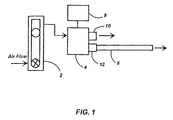
- Fig. 1 is a schematic diagram of the testing apparatus used to evaluate phosphor coating adherence.
- Fig. 2 is a plot of percentage phosphor loss as a function of air flow through phosphor coated tubes.
- This invention employs silica (SiO 2 ) nanoparticles as the inorganic binder in the phosphor coating to increase the efficiency of fluorescent lamps using vacuum ultraviolet as a primary source of phosphor excitation.
- the increased efficiency is achieved without sacrificing coating adherence.
- the SiO 2 nanoparticles range in size from about 12 to about 40 nm with a corresponding range in surface area of about 200 to about 50 m 2 /g. Both particle size and surface area must be considered when evaluating the effect of the SiO 2 nanoparticles on phosphor adherence.
- the silica nanoparticles have a particle size of about 12 nm and a surface area of about 200 m 2 /g.
- the particles In order for the silica nanoparticles to be effective in promoting phosphor adherence, the particles must be well dispersed in the phosphor suspension (i.e., low SiO 2 particle-particle agglomeration) and provide increased intergranular contact of the phosphor particles.
- the dispersion and stability of the SiO 2 nanoparticles in an aqueous system is dependent on the pH of the system. Colloidal silica-water solutions display good stability for pH values of 9 to 10. However, the particles undergo rapid aggregation at pH values of 5 to 7. If the phosphor and SiO 2 nanoparticles are well dispersed in the coating suspension, smaller amounts of the SiO 2 nanoparticles can be used to obtain satisfactory phosphor adherence to the glass. Decreasing the amount of binder phase results in an increase in the lumens/watt (LPW) output of the lamp.
- LPF lumens/watt
- the phosphor coating suspension is made by combining the phosphor with an amount of an aqueous solution of polyethylene oxide. An amount of a defoaming agent is added and the pH of the suspension is adjusted to above 8 with 1N ammonium hydroxide. An amount of the colloidal silica is added and the pH is adjusted again to a pH of about 8.5 to about 9.5 with ammonium hydroxide. The suspension is then mixed before being applied to the glass tubing.
- the colloidal silica dispersion contains the SiO 2 nanoparticles and is commercially available as AEROSIL OX50 (Degussa AG), AEROSIL 200 (Degussa AG), LUDOX AS40 (DuPont), and LUDOX TMA (DuPont).
- the specific proportions of the suspension components will vary according to the lamp application and manufacturing technique.
- the silica nanoparticles comprise from about 0.5 to about 2.5 weight percent of the phosphor coating. More preferably, the silica nanoparticles comprise about 0.5 weight percent of the phosphor coating.
- Coating suspensions were prepared which contained a cerium-activated yttrium aluminum garnet phosphor (Sylvania Type 251) and various amounts of SiO 2 nanoparticles.
- the coatings were applied using a fill and drain procedure to a 10 inch long glass tube (3 mm I.D. x 5 mm O.D. Corning Type 1724 glass). Two phosphor coats were applied. The second coat was applied in the opposite fill/drain position. Each coat was dried vertically at 95°C with flowing air, and fired at 600°C for approximately 25 minutes in dry air.
- Coated tubes were stored in a nitrogen or argon box. The final coating weight for each tube was approximately 100 mg.
- FIG. 1 shows a schematic of the test set-up. Air flow, as indicated by the arrows, was regulated using a flow meter 2. The direction of flow was actuated with a 3-way solenoid valve 4 controlled by switch/timer 8. Phosphor coated tubes 6 were attached to the apparatus with a compression fitting. The air flow prior to testing was directed through open port 10. Phosphor adherence was determined by diverting the air flow to the sample position 12 for two seconds. The coated tube was then removed and weighed to determine the percent phosphor removed from the tube. The air flow was varied to obtain several data points corresponding to removal of approximately 10-70% of the phosphor coating from the tube. A separate coated tube was used for each measurement. Two to six coated tubes were tested for each flow setting. The adherence properties of these coatings were compared with coatings having AOC as the inorganic binder and coatings having no inorganic binder at all (phosphor only).
- Fig. 2 shows the phosphor adherence test data for various coatings.
- the average percent phosphor loss for a particular coating is given as a function of air flow. There was considerable variation in some of the data. In particular, the percent variation in the data was highest for the phosphor only system, a very weak coating.
- the values for the 1.2 wt.% AOC coating represent the minimum acceptable level of adherence for these lamps. Relative comparisons of the curves indicate that SiO 2 nanoparticle binder additions of 0.5 wt.% result in slightly higher phosphor adherence than the 1.2 wt.% AOC system; i.e., much less (approximately half) SiO 2 nanoparticle binder is required to attain comparable phosphor adherence. Decreasing the SiO 2 nanoparticle content to 0.25 wt.% results in unacceptable phosphor adherence.
- Neon amber lamps were made from similarly prepared tubes. The lumen output of these lamps (at the same power input) is compared in Table 1. The data show that decreasing the SiO 2 nanoparticle loading in the coating improves the lumen output relative to the standard 5.9 wt. % AOC system under the same operating conditions. The combined data demonstrates that lamp efficiency can be improved without sacrificing phosphor coating adherence by using lesser amounts of SiO 2 nanoparticles as the inorganic binder in place of AOC.
- Phosphor Coating Lamp Output 5.9 wt.% AOC 220-230 2.5 wt.% silica 244 1.3 wt.% silica 253 1 wt.% silica 270 0.8 wt.% silica 278 0.5 wt.% silica 290
Landscapes
- Chemical & Material Sciences (AREA)
- Engineering & Computer Science (AREA)
- Materials Engineering (AREA)
- Organic Chemistry (AREA)
- Inorganic Chemistry (AREA)
- Luminescent Compositions (AREA)
- Vessels And Coating Films For Discharge Lamps (AREA)
Applications Claiming Priority (2)
| Application Number | Priority Date | Filing Date | Title |
|---|---|---|---|
| US11785799P | 1999-01-29 | 1999-01-29 | |
| US117857P | 1999-01-29 |
Publications (2)
| Publication Number | Publication Date |
|---|---|
| EP1024185A2 true EP1024185A2 (de) | 2000-08-02 |
| EP1024185A3 EP1024185A3 (de) | 2001-09-19 |
Family
ID=22375207
Family Applications (1)
| Application Number | Title | Priority Date | Filing Date |
|---|---|---|---|
| EP00101096A Withdrawn EP1024185A3 (de) | 1999-01-29 | 2000-01-20 | Kieselsäurenanopartikelbindemittel für Phosphorbeschichtungen |
Country Status (1)
| Country | Link |
|---|---|
| EP (1) | EP1024185A3 (de) |
Cited By (6)
| Publication number | Priority date | Publication date | Assignee | Title |
|---|---|---|---|---|
| WO2003093393A1 (de) * | 2002-05-06 | 2003-11-13 | Osram Opto Semiconductors Gmbh | Wellenlängenkonvertierende reaktionsharzmasse und leuchtdiodenbauelement |
| US7045956B2 (en) | 2002-05-06 | 2006-05-16 | Osram Opto Semiconductors Gmbh | Light emitting diode with wavelength conversion |
| WO2005074011A3 (en) * | 2004-02-02 | 2007-06-14 | Koninkl Philips Electronics Nv | Low-pressure mercury vapor discharge lamp and compact fluorescent lamp |
| US8703017B2 (en) | 2010-12-29 | 2014-04-22 | Industrial Technology Research Institute | Method of modifying phosphor and phosphor composition and manufacturing method of the same and phosphor solution |
| CN107043093A (zh) * | 2017-04-21 | 2017-08-15 | 北京工业大学 | 一种黑磷纳米颗粒表面包裹介孔二氧化硅的方法 |
| CN108102642A (zh) * | 2017-12-18 | 2018-06-01 | 上海极优威光电科技有限公司 | 一种紫外荧光粉膜层及其制备方法 |
Family Cites Families (3)
| Publication number | Priority date | Publication date | Assignee | Title |
|---|---|---|---|---|
| US5032420A (en) * | 1990-06-19 | 1991-07-16 | Gte Products Corporation | Method of applying cadium-free incandescent lamp powder coating |
| FR2677659B1 (fr) * | 1991-06-14 | 1994-09-30 | Hoechst France | Composition fluide luminescente polymerisable et son application. |
| CN1160065A (zh) * | 1996-03-15 | 1997-09-24 | 东南大学 | 无机粘结剂荧光粉涂覆液及其配制方法 |
-
2000
- 2000-01-20 EP EP00101096A patent/EP1024185A3/de not_active Withdrawn
Cited By (9)
| Publication number | Priority date | Publication date | Assignee | Title |
|---|---|---|---|---|
| WO2003093393A1 (de) * | 2002-05-06 | 2003-11-13 | Osram Opto Semiconductors Gmbh | Wellenlängenkonvertierende reaktionsharzmasse und leuchtdiodenbauelement |
| JP2005524737A (ja) * | 2002-05-06 | 2005-08-18 | オスラム オプト セミコンダクターズ ゲゼルシャフト ミット ベシュレンクテル ハフツング | 波長変換する反応性樹脂材料及び発光ダイオード素子 |
| US7045956B2 (en) | 2002-05-06 | 2006-05-16 | Osram Opto Semiconductors Gmbh | Light emitting diode with wavelength conversion |
| CN100352885C (zh) * | 2002-05-06 | 2007-12-05 | 奥斯兰姆奥普托半导体有限责任公司 | 波长变化的反应性树脂材料和发光二极管元件 |
| WO2005074011A3 (en) * | 2004-02-02 | 2007-06-14 | Koninkl Philips Electronics Nv | Low-pressure mercury vapor discharge lamp and compact fluorescent lamp |
| US8703017B2 (en) | 2010-12-29 | 2014-04-22 | Industrial Technology Research Institute | Method of modifying phosphor and phosphor composition and manufacturing method of the same and phosphor solution |
| CN107043093A (zh) * | 2017-04-21 | 2017-08-15 | 北京工业大学 | 一种黑磷纳米颗粒表面包裹介孔二氧化硅的方法 |
| CN108102642A (zh) * | 2017-12-18 | 2018-06-01 | 上海极优威光电科技有限公司 | 一种紫外荧光粉膜层及其制备方法 |
| CN108102642B (zh) * | 2017-12-18 | 2023-11-14 | 上海极优威光电科技有限公司 | 一种紫外荧光粉膜层及其制备方法 |
Also Published As
| Publication number | Publication date |
|---|---|
| EP1024185A3 (de) | 2001-09-19 |
Similar Documents
| Publication | Publication Date | Title |
|---|---|---|
| US5417886A (en) | Phosphor coating composition, and discharge lamp | |
| US7205710B2 (en) | Fluorescent lamp with ultraviolet reflecting layer | |
| US5552665A (en) | Electric lamp having an undercoat for increasing the light output of a luminescent layer | |
| EP1169407B1 (de) | Lumineszente nanophasebindersystemen für uv und vuv anwendungen | |
| EP0993020B1 (de) | Phosphor-Überzug für Gasentladungslampen | |
| CA1285599C (en) | Fluorescent lamp with silica layer | |
| US5051653A (en) | Silicon dioxide selectively reflecting layer for mercury vapor discharge lamps | |
| US5438234A (en) | Fluorescent lamp | |
| JPH11312491A (ja) | 蛍光ランプおよびその製造方法 | |
| CA2296649A1 (en) | Silica nanoparticle binder for phosphor coatings | |
| US20050285537A1 (en) | Fluorescent lamp | |
| CA1184966A (en) | Compact fluorescent lamp | |
| US4923425A (en) | Fluorescent lamp with a predetermined CRI and method for making | |
| US7550910B2 (en) | Fluorescent lamp with barrier layer containing pigment particles | |
| CN101740309B (zh) | 高压放电灯用扩散膜的涂布用液剂及高压放电灯 | |
| JPS6127055A (ja) | 曲管形螢光ランプ | |
| JPH07320693A (ja) | 蛍光ランプ | |
| JP3336598B2 (ja) | 細管形蛍光ランプ | |
| JP2000113857A (ja) | 蛍光ランプ及び光源装置 | |
| JP3171438B2 (ja) | 蛍光体及び蛍光ランプ | |
| JP3444609B2 (ja) | 混合赤色蛍光体及びカラーブラウン管 | |
| KR940006311B1 (ko) | 형광램프 | |
| WO2006009349A1 (en) | Fluorescent light source comprising yttria layer | |
| JP2008288132A (ja) | 蛍光ランプ用塗料とそれを用いた塗膜及び塗膜の製造方法並びに蛍光ランプ | |
| JP3260563B2 (ja) | 蛍光体およびその製造方法 |
Legal Events
| Date | Code | Title | Description |
|---|---|---|---|
| PUAI | Public reference made under article 153(3) epc to a published international application that has entered the european phase |
Free format text: ORIGINAL CODE: 0009012 |
|
| AK | Designated contracting states |
Kind code of ref document: A2 Designated state(s): AT BE CH CY DE DK ES FI FR GB GR IE IT LI LU MC NL PT SE |
|
| AX | Request for extension of the european patent |
Free format text: AL;LT;LV;MK;RO;SI |
|
| PUAL | Search report despatched |
Free format text: ORIGINAL CODE: 0009013 |
|
| AK | Designated contracting states |
Kind code of ref document: A3 Designated state(s): AT BE CH CY DE DK ES FI FR GB GR IE IT LI LU MC NL PT SE |
|
| AX | Request for extension of the european patent |
Free format text: AL;LT;LV;MK;RO;SI |
|
| 17P | Request for examination filed |
Effective date: 20011023 |
|
| AKX | Designation fees paid |
Free format text: AT BE CH CY DE DK ES FI FR GB GR IE IT LI LU MC NL PT SE |
|
| 17Q | First examination report despatched |
Effective date: 20030127 |
|
| STAA | Information on the status of an ep patent application or granted ep patent |
Free format text: STATUS: THE APPLICATION IS DEEMED TO BE WITHDRAWN |
|
| 18D | Application deemed to be withdrawn |
Effective date: 20040330 |