EP1016641A1 - Verfahren und Katalysatorstation zur Dehydrierung von Alkanen - Google Patents
Verfahren und Katalysatorstation zur Dehydrierung von Alkanen Download PDFInfo
- Publication number
- EP1016641A1 EP1016641A1 EP99125259A EP99125259A EP1016641A1 EP 1016641 A1 EP1016641 A1 EP 1016641A1 EP 99125259 A EP99125259 A EP 99125259A EP 99125259 A EP99125259 A EP 99125259A EP 1016641 A1 EP1016641 A1 EP 1016641A1
- Authority
- EP
- European Patent Office
- Prior art keywords
- catalyst
- alkanes
- fraction
- hydrogen
- dehydrogenation
- Prior art date
- Legal status (The legal status is an assumption and is not a legal conclusion. Google has not performed a legal analysis and makes no representation as to the accuracy of the status listed.)
- Ceased
Links
- 150000001335 aliphatic alkanes Chemical class 0.000 title claims abstract description 30
- 230000003197 catalytic effect Effects 0.000 title claims abstract description 16
- 238000006356 dehydrogenation reaction Methods 0.000 title claims abstract description 16
- 238000000034 method Methods 0.000 title claims description 28
- 239000003054 catalyst Substances 0.000 claims abstract description 59
- 239000001257 hydrogen Substances 0.000 claims abstract description 18
- 229910052739 hydrogen Inorganic materials 0.000 claims abstract description 18
- UFHFLCQGNIYNRP-UHFFFAOYSA-N Hydrogen Chemical compound [H][H] UFHFLCQGNIYNRP-UHFFFAOYSA-N 0.000 claims abstract description 14
- BASFCYQUMIYNBI-UHFFFAOYSA-N platinum Chemical compound [Pt] BASFCYQUMIYNBI-UHFFFAOYSA-N 0.000 claims abstract description 14
- 150000001336 alkenes Chemical class 0.000 claims abstract description 7
- GDVKFRBCXAPAQJ-UHFFFAOYSA-A dialuminum;hexamagnesium;carbonate;hexadecahydroxide Chemical compound [OH-].[OH-].[OH-].[OH-].[OH-].[OH-].[OH-].[OH-].[OH-].[OH-].[OH-].[OH-].[OH-].[OH-].[OH-].[OH-].[Mg+2].[Mg+2].[Mg+2].[Mg+2].[Mg+2].[Mg+2].[Al+3].[Al+3].[O-]C([O-])=O GDVKFRBCXAPAQJ-UHFFFAOYSA-A 0.000 claims abstract description 6
- 229960001545 hydrotalcite Drugs 0.000 claims abstract description 6
- 229910001701 hydrotalcite Inorganic materials 0.000 claims abstract description 6
- 239000000203 mixture Substances 0.000 claims abstract description 6
- 229910052697 platinum Inorganic materials 0.000 claims abstract description 6
- ATJFFYVFTNAWJD-UHFFFAOYSA-N Tin Chemical compound [Sn] ATJFFYVFTNAWJD-UHFFFAOYSA-N 0.000 claims abstract description 5
- OKTJSMMVPCPJKN-UHFFFAOYSA-N Carbon Chemical compound [C] OKTJSMMVPCPJKN-UHFFFAOYSA-N 0.000 claims abstract description 3
- ATUOYWHBWRKTHZ-UHFFFAOYSA-N Propane Chemical compound CCC ATUOYWHBWRKTHZ-UHFFFAOYSA-N 0.000 claims description 38
- QQONPFPTGQHPMA-UHFFFAOYSA-N Propene Chemical compound CC=C QQONPFPTGQHPMA-UHFFFAOYSA-N 0.000 claims description 32
- 239000001294 propane Substances 0.000 claims description 19
- XLYOFNOQVPJJNP-UHFFFAOYSA-N water Chemical compound O XLYOFNOQVPJJNP-UHFFFAOYSA-N 0.000 claims description 11
- 239000007789 gas Substances 0.000 claims description 9
- 239000002245 particle Substances 0.000 claims description 8
- 239000000571 coke Substances 0.000 claims description 7
- 230000018044 dehydration Effects 0.000 claims description 7
- 238000006297 dehydration reaction Methods 0.000 claims description 7
- 230000008929 regeneration Effects 0.000 claims description 7
- 238000011069 regeneration method Methods 0.000 claims description 7
- 239000003085 diluting agent Substances 0.000 claims description 5
- 238000000926 separation method Methods 0.000 claims description 5
- IJGRMHOSHXDMSA-UHFFFAOYSA-N Atomic nitrogen Chemical compound N#N IJGRMHOSHXDMSA-UHFFFAOYSA-N 0.000 claims description 4
- QVGXLLKOCUKJST-UHFFFAOYSA-N atomic oxygen Chemical compound [O] QVGXLLKOCUKJST-UHFFFAOYSA-N 0.000 claims description 4
- 239000001273 butane Substances 0.000 claims description 4
- 125000004432 carbon atom Chemical group C* 0.000 claims description 4
- 150000002431 hydrogen Chemical class 0.000 claims description 4
- IJDNQMDRQITEOD-UHFFFAOYSA-N n-butane Chemical compound CCCC IJDNQMDRQITEOD-UHFFFAOYSA-N 0.000 claims description 4
- OFBQJSOFQDEBGM-UHFFFAOYSA-N n-pentane Natural products CCCCC OFBQJSOFQDEBGM-UHFFFAOYSA-N 0.000 claims description 4
- 239000001301 oxygen Substances 0.000 claims description 4
- 229910052760 oxygen Inorganic materials 0.000 claims description 4
- 239000011261 inert gas Substances 0.000 claims description 3
- 238000009833 condensation Methods 0.000 claims description 2
- 230000005494 condensation Effects 0.000 claims description 2
- 229910052757 nitrogen Inorganic materials 0.000 claims description 2
- SUAICDWVYXQSNC-UHFFFAOYSA-N butane;2-methylpropane Chemical compound CCCC.CC(C)C SUAICDWVYXQSNC-UHFFFAOYSA-N 0.000 claims 1
- 239000000969 carrier Substances 0.000 claims 1
- 238000002485 combustion reaction Methods 0.000 abstract description 2
- 229910052799 carbon Inorganic materials 0.000 abstract 1
- 238000006243 chemical reaction Methods 0.000 description 20
- 238000010790 dilution Methods 0.000 description 9
- 239000012895 dilution Substances 0.000 description 9
- NNPPMTNAJDCUHE-UHFFFAOYSA-N isobutane Chemical compound CC(C)C NNPPMTNAJDCUHE-UHFFFAOYSA-N 0.000 description 4
- 238000004519 manufacturing process Methods 0.000 description 4
- 230000015572 biosynthetic process Effects 0.000 description 3
- VGGSQFUCUMXWEO-UHFFFAOYSA-N Ethene Chemical compound C=C VGGSQFUCUMXWEO-UHFFFAOYSA-N 0.000 description 2
- VQTUBCCKSQIDNK-UHFFFAOYSA-N Isobutene Chemical compound CC(C)=C VQTUBCCKSQIDNK-UHFFFAOYSA-N 0.000 description 2
- 229930195733 hydrocarbon Natural products 0.000 description 2
- 150000002430 hydrocarbons Chemical class 0.000 description 2
- 239000001282 iso-butane Substances 0.000 description 2
- 229910052751 metal Inorganic materials 0.000 description 2
- 239000002184 metal Substances 0.000 description 2
- 150000002739 metals Chemical class 0.000 description 2
- 229910018072 Al 2 O 3 Inorganic materials 0.000 description 1
- 239000004215 Carbon black (E152) Substances 0.000 description 1
- VYZAMTAEIAYCRO-UHFFFAOYSA-N Chromium Chemical compound [Cr] VYZAMTAEIAYCRO-UHFFFAOYSA-N 0.000 description 1
- 229910006404 SnO 2 Inorganic materials 0.000 description 1
- 239000003570 air Substances 0.000 description 1
- 150000004645 aluminates Chemical class 0.000 description 1
- 150000001722 carbon compounds Chemical class 0.000 description 1
- 229910052804 chromium Inorganic materials 0.000 description 1
- 239000011651 chromium Substances 0.000 description 1
- 230000007423 decrease Effects 0.000 description 1
- 230000003247 decreasing effect Effects 0.000 description 1
- 230000001419 dependent effect Effects 0.000 description 1
- 238000000605 extraction Methods 0.000 description 1
- 230000002349 favourable effect Effects 0.000 description 1
- 239000002737 fuel gas Substances 0.000 description 1
- 150000002736 metal compounds Chemical class 0.000 description 1
- 230000000737 periodic effect Effects 0.000 description 1
- 230000001172 regenerating effect Effects 0.000 description 1
- 230000001105 regulatory effect Effects 0.000 description 1
- 239000012974 tin catalyst Substances 0.000 description 1
Images
Classifications
-
- B—PERFORMING OPERATIONS; TRANSPORTING
- B01—PHYSICAL OR CHEMICAL PROCESSES OR APPARATUS IN GENERAL
- B01J—CHEMICAL OR PHYSICAL PROCESSES, e.g. CATALYSIS OR COLLOID CHEMISTRY; THEIR RELEVANT APPARATUS
- B01J23/00—Catalysts comprising metals or metal oxides or hydroxides, not provided for in group B01J21/00
- B01J23/38—Catalysts comprising metals or metal oxides or hydroxides, not provided for in group B01J21/00 of noble metals
- B01J23/54—Catalysts comprising metals or metal oxides or hydroxides, not provided for in group B01J21/00 of noble metals combined with metals, oxides or hydroxides provided for in groups B01J23/02 - B01J23/36
- B01J23/56—Platinum group metals
- B01J23/62—Platinum group metals with gallium, indium, thallium, germanium, tin or lead
- B01J23/622—Platinum group metals with gallium, indium, thallium, germanium, tin or lead with germanium, tin or lead
- B01J23/626—Platinum group metals with gallium, indium, thallium, germanium, tin or lead with germanium, tin or lead with tin
-
- B—PERFORMING OPERATIONS; TRANSPORTING
- B01—PHYSICAL OR CHEMICAL PROCESSES OR APPARATUS IN GENERAL
- B01J—CHEMICAL OR PHYSICAL PROCESSES, e.g. CATALYSIS OR COLLOID CHEMISTRY; THEIR RELEVANT APPARATUS
- B01J23/00—Catalysts comprising metals or metal oxides or hydroxides, not provided for in group B01J21/00
- B01J23/007—Mixed salts
-
- C—CHEMISTRY; METALLURGY
- C07—ORGANIC CHEMISTRY
- C07C—ACYCLIC OR CARBOCYCLIC COMPOUNDS
- C07C5/00—Preparation of hydrocarbons from hydrocarbons containing the same number of carbon atoms
- C07C5/32—Preparation of hydrocarbons from hydrocarbons containing the same number of carbon atoms by dehydrogenation with formation of free hydrogen
- C07C5/327—Formation of non-aromatic carbon-to-carbon double bonds only
- C07C5/333—Catalytic processes
- C07C5/3335—Catalytic processes with metals
- C07C5/3337—Catalytic processes with metals of the platinum group
-
- C—CHEMISTRY; METALLURGY
- C07—ORGANIC CHEMISTRY
- C07C—ACYCLIC OR CARBOCYCLIC COMPOUNDS
- C07C2523/00—Catalysts comprising metals or metal oxides or hydroxides, not provided for in group C07C2521/00
- C07C2523/38—Catalysts comprising metals or metal oxides or hydroxides, not provided for in group C07C2521/00 of noble metals
- C07C2523/40—Catalysts comprising metals or metal oxides or hydroxides, not provided for in group C07C2521/00 of noble metals of the platinum group metals
- C07C2523/42—Platinum
-
- C—CHEMISTRY; METALLURGY
- C07—ORGANIC CHEMISTRY
- C07C—ACYCLIC OR CARBOCYCLIC COMPOUNDS
- C07C2523/00—Catalysts comprising metals or metal oxides or hydroxides, not provided for in group C07C2521/00
- C07C2523/38—Catalysts comprising metals or metal oxides or hydroxides, not provided for in group C07C2521/00 of noble metals
- C07C2523/54—Catalysts comprising metals or metal oxides or hydroxides, not provided for in group C07C2521/00 of noble metals combined with metals, oxides or hydroxides provided for in groups C07C2523/02 - C07C2523/36
- C07C2523/56—Platinum group metals
- C07C2523/60—Platinum group metals with zinc, cadmium or mercury
Definitions
- the invention relates to a process for the catalytic dehydrogenation of alkanes Chain length of 2 to 10 carbon atoms, one containing the alkanes Use a diluent admixed, the mixed stream under dehydrating Conditions are passed over a catalyst section with catalyst particles and the alkanes in the mixed stream are at least partially dehydrated and mainly in Alkenes of the same carbon chain length as the alkanes are implemented.
- the invention also relates to a catalyst station with at least two Reactors for the catalytic dehydrogenation of alkanes, each reactor in parallel contains connected pipes with catalyst beds and the connected in parallel Pipes are arranged in a firebox with ceiling lighting.
- the decoupling is achieved by introducing methods for dehydration Alkanes enables. Such a method is e.g. in the publication: H. Bölt u.a. "Dehydrogenation of propane / butane” in Linde Reports on Science and Technology No. 49 (1991).
- the endothermic dehydrogenation is carried out in a reactor "Reformer type” carried out with ceiling lighting. With such a reactor almost isothermal operation possible.
- a constant conversion and Product composition, as it is especially in the dismantling part after the reactor is necessary to obtain the pure products in a technical operation achieved by gradually increasing the temperature of the reactor.
- the object of the invention is therefore the conversion and selectivity of the dehydrogenation at low water vapor dilution and a more economical one To enable production of alkene products.
- the diluent gas is formed with water vapor and hydrogen
- the mixed flow on the Catalyst route is isothermally and the favoring the dehydrogenation Platinum and tin catalyst formed on a hydrotalcite support and in Particle shape is used in the catalyst zone.
- the dilution enables the setting of a lower alkane partial pressure compared to the process pressure with a favorable equilibrium for the reaction.
- the use of water vapor and hydrogen leads to long operating times with the catalyst used, since, compared to the prior art, less coke is deposited on the catalyst, since the latter largely depends on the reaction C + H 2 O ⁇ CO + H 2 is gassed.
- Butane is preferably used isobutane.
- the catalyst according to the invention is developed for these types of use and therefore particularly suitable for them.
- Pressure between atmospheric pressure and 10 bar, preferably between Atmospheric pressure and 1.3 bar can be used. At low pressures it will Reaction equilibrium shifted to the alkene and thus the alkene yield increased. By avoiding negative pressure, air can leak into the reaction space be prevented.
- a temperature between 570 and 650 ° C preferably between 580 and 620 ° C be used.
- a high conversion e.g. from 40 to 60% propane too Propene, there is very little coke formation and there are long operating times achieved without regeneration.
- a space velocity between 500 and 2000 h -1, preferably between 800 and 1100 h -1 can be used.
- the dehydrating conditions are advantageously carried out over a period of between 6 and 100 h, preferably maintained between 30 and 80 hours without too regenerate.
- the catalyst route is best timed before and after the dehydrogenation period regenerates.
- At least one further catalyst route in which Cyclical changes constantly dehydrating at least one catalytic converter section Operating conditions and regenerating a further catalyst section becomes.
- a total of three reactor sections can be used for continuous operation are used, with two catalytic converter sections alternating cyclically operated under dehydrating conditions and a third Catalyst section is regenerated.
- the regeneration of the catalyst zone can be done by burning off during the Dehydration of coke formed can be done by using a regeneration gas the catalyst section is passed, the regeneration gas by sliding or in Stages increased oxygen supply, for example by adding air or Oxygen, water vapor and / or an inert gas such as e.g. Nitrogen formed and, in a subsequent document, hydrogen or a mixture with Hydrogen and with alkanes is passed over the catalyst zone, with e.g. Alkanes can be used as in use. This will reduce the Catalyst surface achieved for a next dehydrogenation step.
- a regeneration gas the catalyst section is passed, the regeneration gas by sliding or in Stages increased oxygen supply, for example by adding air or Oxygen, water vapor and / or an inert gas such as e.g. Nitrogen formed and, in a subsequent document, hydrogen or a mixture with Hydrogen and with alkanes is passed over the catalyst zone, with e.g. Alkanes can be used as in use. This will reduce
- C x stands for carbon compounds with a chain length of x carbon atoms in the molecule
- C x + (or C x- ) for molecules with x or more than x (or x or less than x) carbon atoms.
- propane can be used, mainly converted to propene in the catalyst zone, compressed as a crude propene stream emerging from the catalyst zone and rectified in a C 2 / C 4 separation column into a C 3 overhead product and a C 3+ bottoms product are broken down and then the C 3 overhead product is broken down by low-temperature rectification (TTR) into a C 3 fraction and a fraction mainly containing hydrogen.
- TTR low-temperature rectification
- the C 2 / C 4 separation before the TTR ensures that a large part of C 3 gets into the bottom product and is thereby bypassed the TTR, which considerably relieves the time-consuming TTR and is smaller can be interpreted.
- the C 3+ sump product is advantageously broken down by rectification into a C 4+ fraction and a second C 3 fraction.
- the first and second C 3 fraction can then be fed to a single C 3 splitter, and are separated into a Propenfr forcing and a propane fraction.
- the C 3+ bottom product can be fed to the C 3 splitter and the C 4+ components can be separated from the bottom product of the C 3 splitter.
- the propene fraction can be used as a pure propene product be fed.
- the propane fraction obtained can advantageously precede the Catalyst route can be recycled and used in use.
- Catalyst beds Catalyst particles with platinum and tin on a hydrotalcite carrier contain.
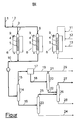
- the figure shows schematically an embodiment of the method according to the invention
- Catalyst station 1 to 13, with the separating part 14 to 29 after the catalyst station typical for an application of the method according to the invention in a plant for Propene extraction is designed.
- An insert 1 containing propane becomes a Diluent gas 2 mixed, which contains steam and hydrogen.
- the mixed flow 3 is at a temperature just below 600 ° C in a catalyst station with three Reactors 6 passed, in the catalyst tubes 4 catalyst beds 5 with a platinum / tin / hydrotalcite catalyst in the form of catalyst particles.
- the reactors 6 have a ceiling-fired combustion chamber with burners 9 fitted.
- the mixed stream 3 is divided into two streams 7 and 8 and below dehydrating conditions passed in parallel over two of the three reactors 6.
- the reactor regenerates by first using a regeneration gas which is produced by supplying inert gas 11 and air 12 is formed, passed through the reactor 6 to at Dehydration operation to burn coke formed, and in a later step hydrogen-containing gas 13 is passed through the reactor to the surface of the Hydrogenate catalyst particles.
- the crude propene stream 10 passed into the separating part is compressed and, in a C 2 / C 4 separating column 14, is rectified into a C 3 top product 15 and a C 3+ bottom product 16.
- the top product 15 is separated by stepwise condensation 17 into a C 2 / C 3 fraction 18 and a fraction 19 containing mainly hydrogen.
- Fraction 18 is broken down into a C 2 fraction 21 and a first C 3 fraction 22 in a C 2 / C 3 separation column 20.
- the C 3+ bottom product 16 is broken down into a C 4+ fraction 24 and a second C 3 fraction 25 in a C 3 / C 4 separation column 23.
- the first C 3 fraction 22 and the second C 3 fraction 25 are fed to a C 3 splitter 26 and separated into a propene product 27 and a propane fraction 28.
- Fraction 19 and fraction 21 can be brought together and used as fuel gas 29 be used.
- the propane fraction 28 can be put to use particularly recycled and used in propane.
- Vapor dilution is lower than, for example, in the process according to US 4,902,849. Nevertheless, the conversion and selectivity are higher. As a result, the Plant throughput for a given product quantity smaller, the whole plant can be made smaller and uses less propane, less Resource consumption and lower investment costs more economical than one State-of-the-art system.
Landscapes
- Chemical & Material Sciences (AREA)
- Organic Chemistry (AREA)
- Chemical Kinetics & Catalysis (AREA)
- Engineering & Computer Science (AREA)
- Materials Engineering (AREA)
- Organic Low-Molecular-Weight Compounds And Preparation Thereof (AREA)
- Low-Molecular Organic Synthesis Reactions Using Catalysts (AREA)
Abstract
Die Erfindung betrifft ein Verfahren und eine Katalysatorstation zur katalytischen Dehydrierung von Alkanen einer Kettenlänge von 2 bis 10 Kohlenstoffatomen, wobei einem die Alkane enthaltenden Einsatz ein Verdünnungsgas zugemischt, der Mischstrom unter dehydrierenden Bedingungen über eine Katalysatorstrecke mit Katalysatorpartikeln geleitet wird und die Alkane im Mischstrom mindestens teilweise dehydriert und dabei hauptsächlich in Alkene gleicher Kohlenstoffkettenlänge wie die Alkane umgesetzt werden. Erfindungsgemäß wird das Verdünnungsgas mit Wasserdampf und Wasserstoff gebildet und der Mischstrom auf der Katalysatorstrecke isotherm geführt. Der die Dehydrierung begünstigende Katalysator enthält Platin und Zinn auf einem Hydrotalcit-Träger und wird in Partikelform in der Katalysatorstrecke verwendet. <IMAGE>
Description
Die Erfindung betrifft ein Verfahren zur katalytischen Dehydrierung von Alkanen einer
Kettenlänge von 2 bis 10 Kohlenstoffatomen, wobei einem die Alkane enthaltenden
Einsatz ein Verdünnungsgas zugemischt, der Mischstrom unter dehydrierenden
Bedingungen über eine Katalysatorstrecke mit Katalysatorpartikeln geleitet wird und
die Alkane im Mischstrom mindestens teilweise dehydriert und dabei hauptsächlich in
Alkene gleicher Kohlenstoffkettenlänge wie die Alkane umgesetzt werden.
Die Erfindung betrifft außerdem eine Katalysatorstation mit mindestens zwei
Reaktoren zur katalytischen Dehydrierung von Alkanen, wobei jeder Reaktor parallel
geschaltete Rohre mit Katalysatorschüttungen enthält und die parallel geschalteten
Rohre in einem Feuerraum mit Deckenbefeuerung angeordnet sind.
Bekannt ist die Herstellung von Propen aus einem Kohlenwasserstoffeinsatz in einem
Steamcracker. Sie ist in einem bestimmten Verhältnis an die Ethenproduktion aus
dem Kohlenwasserstoffeinsatz gekoppelt. Der stärker als der Ethenverbrauch
steigende Propenverbrauch erfordert jedoch eine Entkoppelung der Propen- und der
Ethenproduktion.
Die Entkoppelung wird durch Einführung von Verfahren zur Dehydrierung von
Alkanen ermöglicht. Ein solches Verfahren ist z.B. in der Veröffentlichung: H. Bölt u.a.
"Dehydrogenation of propane/butane" in Linde Reports on Science and Technology
No. 49 (1991) beschrieben. Die endotherme Dehydrierung wird in einem Reaktor vom
"Reformer-Typ" mit Deckenbefeuerung durchgeführt. Mit einem solchen Reaktor ist
ein nahezu isothermer Betrieb möglich. Eine konstante Konversion und
Produktzusammensetzung, wie sie insbesondere im Zerlegungsteil nach dem Reaktor
zur Gewinnung der reinen Produkte in einem technischen Betrieb erforderlich ist, wird
durch sukzessive Erhöhung der Temperatur des Reaktors erreicht. Im Verlauf von 6
Stunden kann so ein Dehydrierbetrieb ohne Abnahme der Konversion und der
Selektivität der Reaktion in Richtung der gewünschten Alkene erzielt werden, ohne
den Reaktor in dieser Zeit zu regenerieren. Die gewünschte Konversion und
Selektivität werden in diesem Verfahren mit Hilfe eines in der Veröffentlichung nicht
genannten Chrom-Katalysators ohne Wasserdampfverdünnung und meist ohne
Wasserstoffverdünnung des Einsatzes erreicht.
Daten zur Konversion und Selektivität werden nicht genannt.
Aus der Patentschrift US 4 902 849 ist ein Verfahren bekannt, das einen Katalysator
mit aus Metallen der Gruppe IIA und IIB gebildetem Aluminat, mit Metallverbindungen
der Gruppe IVA und mit Metallen der Gruppe VIII des Periodensystems der Elemente
enthält. In einem Beispiel zu diesem Verfahren wird gezeigt, daß mit einem
ZnO/Al2O3/SnO2/Pt-Katalysator während einer Laufzeit von 6,7 Stunden und mit einer
hohen Wasserdampfverdünnung von etwa 4 mol/mol die Isobutan-Konversion von
58,2 auf 50,8% abnimmt und die Selektivität der Umsetzung zu Isobuten von 84,4%
auf 92,0% zunimmt. Erwünscht sind jedoch eine bessere Selektivität und Konversion,
sowie eine niedrigere Dampfverdünnung.
Aufgabe der Erfindung ist es daher, die Konversion und Selektivität der Dehydrierung
bei niedriger Wasserdampfverdünnung zu erhöhen und eine wirtschaftlichere
Herstellung der Alken-Produkte zu ermöglichen.
Diese Aufgabe wird erfindungsgemäß gelöst von einem Verfahren mit dem
Merkmalen des Anspruchs 1 und von einer Katalysatorstation mit den Merkmalen des
Anspruchs 16. Ausführungen der Erfindung sind Gegenstand von Unteransprüchen.
Kennzeichnend an dem erfindungsgemäßen Verfahren ist, daß das Verdünnungsgas
mit Wasserdampf und Wasserstoff gebildet wird, der Mischstrom auf der
Katalysatorstrecke isotherm geführt wird und der die Dehydrierung begünstigende
Katalysator mit Platin und Zinn auf einem Hydrotalcit-Träger gebildet und in
Partikelform in der Katalysatorstrecke verwendet wird.
Die Verdünnung ermöglicht die Einstellung eines gegenüber dem Verfahrensdruck
erniedrigten Alkanpartialdruckes mit einem günstigen Gleichgewicht für die
Umsetzung. Die Verwendung von Wasserdampf und Wasserstoff führt zu langen
Betriebszeiten mit dem verwendeten Katalysator, da im Vergleich zum Stand der
Technik weniger Koks auf dem Katalysator abgeschieden wird, da dieser zum größten
Teil gemäß der Reaktion
C+H2O → CO+H2
vergast wird.
Im Einsatz können als die Alkane Butan und Propan oder deren Gemische und als
Butan bevorzugt Isobutan verwendet werden. Der erfindungsgemäße Katalysator ist
für diese Einsatzarten entwickelt worden und deshalb für diese besonders geeignet.
In dem mit dem Wasserdampf, mit dem Wasserstoff und mit den Alkanen gebildeten
Mischstrom kann gemessen an den eingesetzten Alkanen ein Wasserdampfanteil von
0,5 bis 2 mol/mol und ein Wasserstoffanteil von 5 bis 25 mol% verwendet werden. Die
unerwünschte Koksbildung beträgt dann weniger als 0,05 Gewichtsprozent der
eingesetzten Alkane.
Zur Einstellung von dehydrierenden Bedingungen kann auf der Katalysatorstrecke ein
Druck zwischen Atmosphärendruck und 10 bar, vorzugsweise zwischen
Atmosphärendruck und 1,3 bar verwendet werden. Zu niedrigen Drücken hin wird das
Reaktionsgleichgewicht zum Alken verschoben und damit die Alkenausbeute erhöht.
Indem Unterdruck vermieden wird, können Leckagen von Luft in den Reaktionsraum
hinein verhindert werden.
Zur Einstellung von dehydrierenden Bedingungen kann auf der Katalysatorstrecke
eine Temperatur zwischen 570 und 650°C, vorzugsweise zwischen 580 und 620°C
verwendet werden. Bei einer hohen Konversion, z.B. von 40 bis 60% Propan zu
Propen, tritt nur sehr geringe Koksbildung auf und es werden lange Betriebszeiten
ohne Regenerierung erreicht.
Zur Einstellung von dehydrierenden Bedingungen auf der Katalysatorstrecke kann
eine Raumgeschwindigkeit zwischen 500 und 2000 h-1 vorzugsweise zwischen 800
und 1100 h-1 verwendet werden.
Die dehydrierenden Bedingungen werden mit Vorteil über eine Laufzeit zwischen 6
und 100 h, vorzugsweise zwischen 30 und 80 Stunden beibehalten ohne zu
regenerieren.
Die Katalysatorstrecke wird am besten zeitlich vor und nach der Dehydrierlaufzeit
regeneriert.
Für einen kontinuierlichen Betrieb über die Laufzeit der Katalysatorstrecke hinaus
kann mindestens eine weitere Katalysatorstrecke verwendet werden, wobei im
zyklischen Wechsel ständig mindestens eine Katalysatorstrecke unter dehydrierenden
Bedingungen betrieben wird und dabei eine weitere Katalysatorstrecke regeneriert
wird.
Für den kontinuierlichen Betrieb können günstig insgesamt drei Reaktorstrecken
verwendet werden, wobei im zyklischen Wechsel ständig zwei Katalysatorstrecken
unter dehydrierenden Bedingungen betrieben werden und dabei eine dritte
Katalysatorstrecke regeneriert wird.
Das Regenerieren der Katalysatorstrecke kann durch Abbrennen von während der
Dehydrierung gebildetem Koks vorgenommen werden, indem ein Regeneriergas über
die Katalysatorstrecke geleitet wird, wobei das Regeneriergas durch gleitend oder in
Stufen erhöhte Sauerstoffzufuhr, beispielsweise durch Zuspeisung von Luft oder
Sauerstoff, zu Wasserdampf und/oder zu einem Inertgas wie z.B. Stickstoff gebildet
wird, und indem in einem nachfolgenden Schrift Wasserstoff oder eine Mischung mit
Wasserstoff und mit Alkanen über die Katalysatorstrecke geleitet wird, wobei z.B.
Alkane wie im Einsatz verwendet werden. Dadurch wird eine Reduktion der
Katalysatoroberfläche für einen nächsten Dehydrierschritt erzielt.
Im folgenden steht Cx für Kohlenstoffverbindungen mit einer Kettenlänge von x
Kohlenstoffatomen im Molekül, Cx+ (bzw. Cx-) für Moleküle mit x oder mehr als x (bzw.
x oder weniger als x) Kohlenstoffatomen.
In dem die Alkane enthaltenden Einsatz kann Propan verwendet, in der
Katalysatorstrecke hauptsächlich zu Propen umgesetzt, als aus der
Katalysatorstrecke austretender Rohpropenstrom verdichtet und in einer C2/C4-Trennsäule
rektifikatorisch in ein C3--Kopfprodukt und ein C3+-Sumpfprodukt zerlegt
werden und anschließend das C3--Kopfprodukt durch Tieftemperaturrektifikation (TTR)
in eine C3-Fraktion und eine hauptsächlich Wasserstoff enthaltende Fraktion zerlegt
werden.
Bei der Umsetzung von Propan zu Propen wird mit der C2/C4-Trennung vor der TTR
erreicht, daß C3 zu einem großen Teil in das Sumpfprodukt gelangt und dadurch an
der TTR vorbeigeführt wird, wodurch die aufwendige TTR wesentlich entlastet wird
und kleiner ausgelegt werden kann.
Das C3+-Sumpfprodukt wird mit Vorteil rektifikatorisch in eine C4+-Fraktion und eine
zweite C3-Fraktion zerlegt.
Die erste und die zweite C3-Fraktion können dann einem einzigen C3-Splitter
zugeführt und in eine Propenfraktion und eine Propanfraktion getrennt werden.
Alternativ kann das C3+-Sumpfprodukt dem C3-Splitter zugeführt werden und die
Abtrennung der C4+-Komponenten aus dem Sumpfprodukt des C3-Splitters erfolgen.
Die Propenfraktion kann als reines Propenprodukt einer weiteren Verwendung
zugeführt werden. Die gewonnene Propanfraktion kann mit Vorteil vor die
Katalysatorstrecke zurückgeführt und im Einsatz verwendet werden.
Kennzeichnend an der erfindungsgemäßen Katalysatorstation ist, daß die
Katalysatorschüttungen Katalysatorpartikel mit Platin und Zinn auf einem Hydrotalcit-Träger
enthalten.
Die Erfindung wird anhand einer Ausführungsform mit einer Figur näher erläutert.
Die Figur zeigt schematisch eine Ausführung des erfindungsgemäßen Verfahrens mit
Katalysatorstation 1 bis 13, wobei der Trennteil 14 bis 29 nach der Katalysatorstation
typisch für eine Anwendung des erfindungsgemäßen Verfahrens in einer Anlage zur
Propengewinnung ausgestaltet ist. Einem Propan enthaltenden Einsatz 1 wird ein
Verdünnungsgas 2 zugemischt, das Dampf und Wasserstoff enthält. Der Mischstrom
3 wird bei einer Temperatur knapp unter 600°C in eine Katalysatorstation mit drei
Reaktoren 6 geleitet, die in den Katalysatorrohren 4 Katalysatorschüttungen 5 mit
einem Platin/Zinn/Hydrotalcit-Katalysator in Form von Katalysatorpartikeln enthalten.
Die Reaktoren 6 sind mit einem deckenbefeuerten Feuerraum mit Brennern 9
ausgestattet. Der Mischstrom 3 wird auf zwei Ströme 7 und 8 aufgeteilt und unter
dehydrierenden Bedingungen parallel über zwei der drei Reaktoren 6 geleitet. Die
insbesondere auf dem ersten Drittel der Katalysatorstrecke (in der Figur im oberen
Drittel der Katalysatorschüttung 5 des Reaktors 6 nahe dem Eintritt des Mischstromes
3 in die Schüttung 5) benötigte Wärmezufuhr und isotherme Reaktionsführung wird
durch den deckenbefeuerten Feuerraum mit geregelten Brennern 9 auf einfache
Weise und genau genug ermöglicht. Die Ströme 7 und 8 werden nach der Reaktion
und weitgehenden Konversion des enthaltenen Propan zu Propen zu einem
Rohpropenstrom 10 zusammengeführt und in den Trennteil 14 bis 29 geleitet.
Während zwei der drei Reaktoren dehydrierend betrieben werden, wird ein dritter
Reaktor regeneriert, indem erst ein Regeneriergas, das durch Zufuhr von Inertgas 11
und Luft 12 gebildet wird, durch den Reaktor 6 geleitet wird, um beim
Dehydrierbetrieb gebildeten Koks abzubrennen, und in einem späteren Schritt ein
wasserstoffhaltiges Gas 13 durch den Reaktor geleitet wird, um die Oberfläche der
Katalysatorpartikel zu hydrieren.
Der in den Trennteil geleitete Rohpropenstrom 10 wird verdichtet und in einer C2/C4
Trennsäule 14 rektifikatorisch in ein C3-Kopfprodukt 15 und ein C3+-Sumpfprodukt 16
zerlegt. Das Kopfprodukt 15 wird durch stufenweise Kondensation 17 in eine C2/C3-Fraktion
18 und eine hauptsächlich Wasserstoff enthaltende Fraktion 19 zerlegt. Die
Fraktion 18 wird in einer C2/C3-Trennsäule 20 in eine C2-Fraktion 21 und eine erste
C3-Fraktion 22 zerlegt.
Das C3+-Sumpfprodukt 16 wird in einer C3/C4-Trennsäule 23 in eine C4+-Fraktion 24
und eine zweite C3-Fraktion 25 zerlegt. Die erste C3-Fraktion 22 und die zweite C3-Fraktion
25 werden einem C3-Splitter 26 zugeführt und in ein Propenprodukt 27 und
eine Propanfraktion 28 getrennt.
Die Fraktion 19 und die Fraktion 21 können zusammengeführt und als Brenngas 29
verwendet werden. Die Propanfraktion 28 kann einer Verwendung zugeführt,
insbesondere rezykliert und im Propaneinsatz genutzt werden.
Eine Propandehydrieranlage wird mit drei Reaktoren von jeweils 50%
Anlagenkapazität betrieben. Mit einem Dehydriertakt von 75h, einer H2-Verdünnung
von 12 mol% und einer Dampfverdünnung von 1:1 Molanteilen (Mole jeweils im
Vergleich zum eingesetzten Propan) und mit einem Betrieb bei 1,2 bar, 590°C und
einer Raumgeschwindigkeit von 700 h-1 werden folgende Ergebnisse erzielt:
- Propankonversion
- > 50 Prozent
- Propenselektivität
- > 97 Gewichtsprozent
- Koksbildung
- < 0,05 Gewichtsprozent
Wie das Beispiel zeigt, werden mit der Erfindung in einer Anlage zur Dehydrierung
von Alkanen im Vergleich zum Stand der Technik folgende Vorteile erzielt: Die
Dampfverdünnung ist niedriger als beispielsweise im Verfahren nach US 4 902 849.
Trotzdem sind die Konversion und die Selektivität höher. Als Folge hiervon ist der
Anlagendurchsatz für eine vorgegebene Produktmenge kleiner, die ganze Anlage
kann kleiner ausgeführt werden und ist mit weniger Propaneinsatz, geringerem
Betriebsmittelverbrauch und geringeren Investitionskosten wirtschaftlicher als eine
Anlage nach dem Stand der Technik.
Claims (16)
- Verfahren zur katalytischen Dehydrierung von Alkanen einer Kettenlänge von 2 bis 10 Kohlenstoffatomen, wobei einem die Alkane enthaltenden Einsatz ein Verdünnungsgas zugemischt, der Mischstrom unter dehydrierenden Bedingungen über eine Katalysatorstrecke mit Katalysatorpartikeln geleitet wird und die Alkane im Mischstrom mindestens teilweise dehydriert und dabei hauptsächlich in Alkene gleicher Kohlenstoffkettenlänge wie die Alkane umgesetzt werden, dadurch gekennzeichnet, daß das Verdünnungsgas mit Wasserdampf und Wasserstoff gebildet wird, der Mischstrom auf der Katalysatorstrecke isotherm geführt wird und der die Dehydrierung begünstigende Katalysator mit Platin und Zinn auf einem Hydrotalcit-Träger gebildet und in Partikelform in der Katalysatorstrecke verwendet wird.
- Verfahren nach Anspruch 1, dadurch gekennzeichnet, daß im Einsatz als die Alkane Butan oder Propan oder deren Gemische und als Butan bevorzugt Isobutan verwendet werden.
- Verfahren nach Anspruch 1 oder 2, dadurch gekennzeichnet, daß in dem mit dem Wasserdampf, mit dem Wasserstoff und mit den Alkanen gebildeten Mischstrom gemessen an den eingesetzten Alkanen ein Dampfanteil von 0,5 bis 2,0 mol/mol und ein Wasserstoffanteil von 5 bis 25 mol% verwendet werden.
- Verfahren nach einem der Ansprüche 1 bis 3, dadurch gekennzeichnet, daß zur Einstellung von dehydrierenden Bedingungen auf der Katalysatorstrecke Drücke zwischen Atmosphärendruck und 10 bar, vorzugsweise zwischen Atmosphärendruck und 1,3 bar verwendet werden.
- Verfahren nach einem der Ansprüche 1 bis 4, dadurch gekennzeichnet, daß zur Einstellung von dehydrierenden Bedingungen auf der Katalysatorstrecke eine Temperatur zwischen 570 und 650°C, vorzugsweise zwischen 580 und 620°C verwendet wird.
- Verfahren nach einem der Ansprüche 1 bis 5, dadurch gekennzeichnet, daß zur Einstellung von dehydrierenden Bedingungen auf der Katalysatorstrecke eine Raumgeschwindigkeit zwischen 500 und 2000 h-1, vorzugsweise zwischen 800 und 1100 h-1 verwendet wird.
- Verfahren nach einem der Ansprüche 1 bis 6, dadurch gekennzeichnet, daß die dehydrierenden Bedingungen über eine Laufzeit zwischen 6 und 100 h, vorzugsweise zwischen 30 und 80 Stunden beibehalten werden.
- Verfahren nach Anspruch 7, dadurch gekennzeichnet, daß die Katalysatorstrecke zeitlich vor und nach der Dehydrierlaufzeit regeneriert wird.
- Verfahren nach Anspruch 8, dadurch gekennzeichnet, daß für einen kontinuierlichen Betrieb über die Laufzeit der Katalysatorstrecke hinaus mindestens eine weitere Katalysatorstrecke verwendet wird, wobei im zyklischen Wechsel ständig mindestens eine Katalysatorstrecke unter dehydrierenden Bedingungen betrieben wird und dabei eine weitere Katalysatorstrecke regeneriert wird.
- Verfahren nach Anspruch 9, dadurch gekennzeichnet, daß für den kontinuierlichen Betrieb insgesamt drei Reaktorstrecken verwendet werden, wobei im zyklischen Wechsel ständig zwei Katalysatorstrecken unter dehydrierenden Bedingungen betrieben werden und dabei eine dritte Katalysatorstrecke regeneriert wird.
- Verfahren nach einem der Ansprüche 8 bis 10, dadurch gekennzeichnet, daß das Regenerieren der Katalysatorstrecke durch Abbrennen von während der Dehydrierung gebildetem Koks vorgenommen wird, indem ein Regeneriergas über die Katalysatorstrecke geleitet wird, wobei das Regeneriergas durch gleitend oder in Stufen erhöhte Sauerstoffzufuhr, beispielsweise durch Zuspeisung von Luft oder Sauerstoff, zu Wasserdampf und/oder zu einem Inertgas wie z.B. Stickstoff gebildet wird, und indem in einem nachfolgenden Schritt Wasserstoff oder eine Mischung mit Wasserstoff und mit Alkanen über die Katalysatorstrecke geleitet wird, wobei z.B. Alkane wie im Einsatz verwendet werden.
- Verfahren nach einem der Ansprüche 1 bis 11, dadurch gekennzeichnet, daß in dem die Alkane enthaltenden Einsatz Propan verwendet, in der Katalysatorstrecke hauptsächlich zu Propen umgesetzt, als aus der Katalysatorstrecke austretender Rohpropenstrom verdichtet, in einer C2/C4-Trennsäule rektifikatorisch in ein C3--Kopfprodukt und ein C3+-Sumpfprodukt zerlegt und anschließend das C3-Kopfprodukt durch stufenweise Kondensation in eine C2/C3-Fraktion und eine hauptsächlich Wasserstoff enthaltende Fraktion zerlegt und die C2/C3-Fraktion weiter rektifikatorisch in eine C2--Fraktion und eine erste C3-Fraktion zerlegt wird.
- Verfahren nach Anspruch 12, dadurch gekennzeichnet, daß das C3+-Sumpfprodukt rektifikatorisch in eine C4+-Fraktion und eine zweite C3-Fraktion zerlegt wird.
- Verfahren nach Anspruch 13, dadurch gekennzeichnet, daß die erste und die zweite C3-Fraktion einem C3-Splitter zugeführt und in eine Propenfraktion und eine Propanfraktion getrennt werden.
- Verfahren nach Anspruch 12, dadurch gekennzeichnet, daß das C3+-Sumpfprodukt dem C3-Splitter zugeführt wird und die Abtrennung der C4+-Komponenten aus dem Sumpfprodukt des C3-Splitters erfolgt.
- Katalysatorstation mit mindestens zwei Reaktoren zur katalytischen Dehydrierung von Alkanen, wobei jeder Reaktor parallel geschaltete Rohre mit Katalysatorschüttungen enthält und die parallel geschalteten Rohre in einem Feuerraum mit Deckenbefeuerung angeordnet sind, dadurch gekennzeichnet, daß die Katalysatorschüttungen Katalysatorpartikel mit Platin und Zinn auf einem Hydrotalcit-Träger enthalten.
Applications Claiming Priority (2)
| Application Number | Priority Date | Filing Date | Title |
|---|---|---|---|
| DE19858747 | 1998-12-18 | ||
| DE19858747A DE19858747A1 (de) | 1998-12-18 | 1998-12-18 | Verfahren und Katalysatorstation zur Dehydrierung von Alkanen |
Publications (1)
| Publication Number | Publication Date |
|---|---|
| EP1016641A1 true EP1016641A1 (de) | 2000-07-05 |
Family
ID=7891759
Family Applications (1)
| Application Number | Title | Priority Date | Filing Date |
|---|---|---|---|
| EP99125259A Ceased EP1016641A1 (de) | 1998-12-18 | 1999-12-17 | Verfahren und Katalysatorstation zur Dehydrierung von Alkanen |
Country Status (5)
| Country | Link |
|---|---|
| EP (1) | EP1016641A1 (de) |
| DE (1) | DE19858747A1 (de) |
| NO (1) | NO996297L (de) |
| SG (1) | SG87871A1 (de) |
| ZA (1) | ZA997723B (de) |
Cited By (12)
| Publication number | Priority date | Publication date | Assignee | Title |
|---|---|---|---|---|
| RU2178398C1 (ru) * | 2000-07-27 | 2002-01-20 | Открытое акционерное общество Научно-исследовательский институт "Ярсинтез" | Способ получения олефиновых углеводородов |
| WO2006050957A1 (de) | 2004-11-11 | 2006-05-18 | Uhde Gmbh | Verfahren zur katalytischen dehydrierung von propan zu propylen |
| RU2349378C1 (ru) * | 2007-09-05 | 2009-03-20 | Открытое Акционерное Общество "Алтайская Краевая Расчетная Палата" | Микросферический катализатор для дегидрирования парафиновых углеводородов |
| RU2448770C1 (ru) * | 2010-09-30 | 2012-04-27 | Учреждение Российской Академии наук Институт катализа им. Г.К. Борескова Сибирского отделения РАН (ИК СО РАН) | Катализатор дегидрирования парафиновых углеводородов c3-c5, способ его получения и способ дегидрирования парафиновых углеводородов c3-c5 |
| WO2014157432A1 (ja) | 2013-03-26 | 2014-10-02 | 住友化学株式会社 | メタクリル酸エステルの製造方法 |
| CN104148109A (zh) * | 2013-05-16 | 2014-11-19 | 中国石油化工股份有限公司 | 低碳烷烃脱氢钒基催化剂的再生方法 |
| CN113769664A (zh) * | 2021-08-31 | 2021-12-10 | 山东神驰石化有限公司 | 一种丙烷脱氢制丙烯反应产物的分离装置 |
| WO2023107797A1 (en) | 2021-12-06 | 2023-06-15 | Exxonmobil Chemical Patents Inc. | Catalyst compositions and processes for making and using same |
| US11760703B2 (en) | 2020-03-06 | 2023-09-19 | Exxonmobil Chemical Patents Inc. | Processes for upgrading alkanes and alkyl aromatic hydrocarbons |
| US11760702B2 (en) | 2020-03-06 | 2023-09-19 | Exxonmobil Chemical Patents Inc. | Processes for upgrading alkanes and alkyl aromatic hydrocarbons |
| US11859136B2 (en) | 2020-03-06 | 2024-01-02 | Exxonmobil Chemical Patents Inc. | Processes for upgrading alkanes and alkyl aromatic hydrocarbons |
| US12054456B2 (en) | 2020-08-06 | 2024-08-06 | Exxonmobil Chemical Patents Inc. | Processes for upgrading alkanes and alkyl aromatic hydrocarbons |
Families Citing this family (5)
| Publication number | Priority date | Publication date | Assignee | Title |
|---|---|---|---|---|
| DE10251135B4 (de) | 2002-10-31 | 2006-07-27 | Uhde Gmbh | Verfahren zur katalytischen Dehydrierung von leichten Paraffinen zu Olefinen |
| RU2271860C1 (ru) * | 2005-03-15 | 2006-03-20 | Татьяна Владимировна Борисова | Катализатор для дегидрирования парафиновых углеводородов |
| DE102007036750A1 (de) | 2007-08-03 | 2009-02-05 | Uhde Gmbh | Regeneration von Katalysatoren zur Dehydrierung von Alkanen |
| EP2689843A1 (de) | 2012-07-26 | 2014-01-29 | Saudi Basic Industries Corporation | Alkan-Dehydrierungskatalysator und Prozess für dessen Herstellung |
| EP3028763A1 (de) * | 2014-12-05 | 2016-06-08 | Linde Aktiengesellschaft | Verfahren und Anlage zur Gewinnung von Propylen |
Citations (1)
| Publication number | Priority date | Publication date | Assignee | Title |
|---|---|---|---|---|
| WO1994029021A1 (en) * | 1993-06-14 | 1994-12-22 | Den Norske Stats Oljeselskap A.S. | New catalyst, and processes for dehydrogenating dehydrogenatable hydrocarbons |
Family Cites Families (2)
| Publication number | Priority date | Publication date | Assignee | Title |
|---|---|---|---|---|
| US5246899A (en) * | 1991-08-16 | 1993-09-21 | Amoco Corporation | Simplified preparation of hydrotalcite-type clays |
| US5689029A (en) * | 1993-04-26 | 1997-11-18 | Uop | Process for the dehydrogenation of paraffinic hydrocarbons |
-
1998
- 1998-12-18 DE DE19858747A patent/DE19858747A1/de not_active Withdrawn
-
1999
- 1999-12-13 SG SG9906358A patent/SG87871A1/en unknown
- 1999-12-17 EP EP99125259A patent/EP1016641A1/de not_active Ceased
- 1999-12-17 ZA ZA9907723A patent/ZA997723B/xx unknown
- 1999-12-17 NO NO996297A patent/NO996297L/no not_active Application Discontinuation
Patent Citations (1)
| Publication number | Priority date | Publication date | Assignee | Title |
|---|---|---|---|---|
| WO1994029021A1 (en) * | 1993-06-14 | 1994-12-22 | Den Norske Stats Oljeselskap A.S. | New catalyst, and processes for dehydrogenating dehydrogenatable hydrocarbons |
Cited By (16)
| Publication number | Priority date | Publication date | Assignee | Title |
|---|---|---|---|---|
| RU2178398C1 (ru) * | 2000-07-27 | 2002-01-20 | Открытое акционерное общество Научно-исследовательский институт "Ярсинтез" | Способ получения олефиновых углеводородов |
| WO2006050957A1 (de) | 2004-11-11 | 2006-05-18 | Uhde Gmbh | Verfahren zur katalytischen dehydrierung von propan zu propylen |
| EA010463B1 (ru) * | 2004-11-11 | 2008-08-29 | Уде Гмбх | Способ каталитического дегидрирования пропана в пропилен |
| US7678956B2 (en) | 2004-11-11 | 2010-03-16 | Uhde Gmbh | Method for catalytically dehydrating propane to form propylene |
| RU2349378C1 (ru) * | 2007-09-05 | 2009-03-20 | Открытое Акционерное Общество "Алтайская Краевая Расчетная Палата" | Микросферический катализатор для дегидрирования парафиновых углеводородов |
| RU2448770C1 (ru) * | 2010-09-30 | 2012-04-27 | Учреждение Российской Академии наук Институт катализа им. Г.К. Борескова Сибирского отделения РАН (ИК СО РАН) | Катализатор дегидрирования парафиновых углеводородов c3-c5, способ его получения и способ дегидрирования парафиновых углеводородов c3-c5 |
| WO2014157432A1 (ja) | 2013-03-26 | 2014-10-02 | 住友化学株式会社 | メタクリル酸エステルの製造方法 |
| CN104148109B (zh) * | 2013-05-16 | 2016-08-03 | 中国石油化工股份有限公司 | 低碳烷烃脱氢钒基催化剂的再生方法 |
| CN104148109A (zh) * | 2013-05-16 | 2014-11-19 | 中国石油化工股份有限公司 | 低碳烷烃脱氢钒基催化剂的再生方法 |
| US11760703B2 (en) | 2020-03-06 | 2023-09-19 | Exxonmobil Chemical Patents Inc. | Processes for upgrading alkanes and alkyl aromatic hydrocarbons |
| US11760702B2 (en) | 2020-03-06 | 2023-09-19 | Exxonmobil Chemical Patents Inc. | Processes for upgrading alkanes and alkyl aromatic hydrocarbons |
| US11859136B2 (en) | 2020-03-06 | 2024-01-02 | Exxonmobil Chemical Patents Inc. | Processes for upgrading alkanes and alkyl aromatic hydrocarbons |
| US12054456B2 (en) | 2020-08-06 | 2024-08-06 | Exxonmobil Chemical Patents Inc. | Processes for upgrading alkanes and alkyl aromatic hydrocarbons |
| CN113769664A (zh) * | 2021-08-31 | 2021-12-10 | 山东神驰石化有限公司 | 一种丙烷脱氢制丙烯反应产物的分离装置 |
| CN113769664B (zh) * | 2021-08-31 | 2023-08-29 | 山东神驰石化有限公司 | 一种丙烷脱氢制丙烯反应产物的分离装置 |
| WO2023107797A1 (en) | 2021-12-06 | 2023-06-15 | Exxonmobil Chemical Patents Inc. | Catalyst compositions and processes for making and using same |
Also Published As
| Publication number | Publication date |
|---|---|
| SG87871A1 (en) | 2002-04-16 |
| ZA997723B (en) | 2000-10-22 |
| NO996297L (no) | 2000-06-19 |
| NO996297D0 (no) | 1999-12-17 |
| DE19858747A1 (de) | 2000-06-21 |
Similar Documents
| Publication | Publication Date | Title |
|---|---|---|
| EP1016641A1 (de) | Verfahren und Katalysatorstation zur Dehydrierung von Alkanen | |
| DE69215080T2 (de) | Verfahren zur Herstellung von Olefinen | |
| DE69214499T2 (de) | Herstellung von Olefinen | |
| DE69210508T2 (de) | Verfahren zur Herstellung von Mono-Olefinen | |
| DE60122429T2 (de) | Verfahren zur Hydrierung von Kohlenwasserstoffschnitten | |
| DE69923701T2 (de) | Verfahren zur herstellung von mono-olefinen aus paraffinischen kohlenwasserstoffen | |
| DE69503214T2 (de) | Verfahren und Vorrichtung zur oxidativen Kupplung von Methan | |
| US4097364A (en) | Hydrocracking in the presence of water and a low hydrogen partial pressure | |
| DE3313573C2 (de) | Verfahren zur Herstellung von Acrolein oder Methacrolin aus dem entsprechenden Alkan | |
| DE69308145T2 (de) | Verfahren zur herstellung von monoolefinen | |
| DE60301340T2 (de) | Verfahren zur katalytischen reformierung eines kohlenwasserstoffhaltigen einsatzstoffs | |
| DE69513620T2 (de) | Kohlenwasserstoffumwandlungsverfahren | |
| DE10027159A1 (de) | Verfahren zum Erzeugen von Propylen aus Methanol | |
| EP1824803B1 (de) | Verfahren zur herstellung von propen aus propan | |
| DE69206961T3 (de) | Verfahren zur Dehydrierung von Kohlenwasserstoffen und von sauerstoffenthaltenden Kohlenwasserstoffen | |
| DE3230517A1 (de) | Verfahren zur dehydrierung von alkanen | |
| DE69906375T2 (de) | Verfahren zur herstellung von olefinen | |
| DE2747517C2 (de) | ||
| WO2006050957A1 (de) | Verfahren zur katalytischen dehydrierung von propan zu propylen | |
| DE69522988T2 (de) | Verfahren zur Umsetzung von Erdgas zu Kohlenwasserstoffen | |
| DE2219949B2 (de) | Verfahren zur Herstellung von methanreichen Gasprodukten durch katalytisch« Wasserdampfreformierung einer Kohlenwasserstoffbeschickung | |
| DE69007647T2 (de) | Verfahren zur Herstellung von Nitrilen und Oxiden. | |
| DE1543152A1 (de) | Verfahren zur Dehydrierung von Kohlenwasserstoffen,insbesondere Paraffinen | |
| DE10229661A1 (de) | Verfahren zur Dehydrierung von Alkanen | |
| DE1908284C3 (de) | Verfahren zur kontinuierlichen Herstellung von Schwefelkohlenstoff durch Umsetzen von Schwefel mit Kohlenwasserstoffen in der Dampfphase |
Legal Events
| Date | Code | Title | Description |
|---|---|---|---|
| PUAI | Public reference made under article 153(3) epc to a published international application that has entered the european phase |
Free format text: ORIGINAL CODE: 0009012 |
|
| AK | Designated contracting states |
Kind code of ref document: A1 Designated state(s): BE DE ES FI SE |
|
| AX | Request for extension of the european patent |
Free format text: AL;LT;LV;MK;RO;SI |
|
| 17P | Request for examination filed |
Effective date: 20000610 |
|
| AKX | Designation fees paid |
Free format text: BE DE ES FI SE |
|
| 17Q | First examination report despatched |
Effective date: 20010821 |
|
| STAA | Information on the status of an ep patent application or granted ep patent |
Free format text: STATUS: THE APPLICATION HAS BEEN REFUSED |
|
| 18R | Application refused |
Effective date: 20020725 |