EP1009601B1 - Verfahren zum herstellen von holzspanplatten, faserplatten und ähnlichen platten - Google Patents
Verfahren zum herstellen von holzspanplatten, faserplatten und ähnlichen platten Download PDFInfo
- Publication number
- EP1009601B1 EP1009601B1 EP98907897A EP98907897A EP1009601B1 EP 1009601 B1 EP1009601 B1 EP 1009601B1 EP 98907897 A EP98907897 A EP 98907897A EP 98907897 A EP98907897 A EP 98907897A EP 1009601 B1 EP1009601 B1 EP 1009601B1
- Authority
- EP
- European Patent Office
- Prior art keywords
- mat
- steam
- pressure
- press
- pressing
- Prior art date
- Legal status (The legal status is an assumption and is not a legal conclusion. Google has not performed a legal analysis and makes no representation as to the accuracy of the status listed.)
- Expired - Lifetime
Links
- 238000004519 manufacturing process Methods 0.000 title claims description 17
- 239000000835 fiber Substances 0.000 title claims description 10
- 239000011093 chipboard Substances 0.000 title claims description 7
- 238000000034 method Methods 0.000 claims description 43
- 238000003825 pressing Methods 0.000 claims description 40
- 239000011230 binding agent Substances 0.000 claims description 13
- XLYOFNOQVPJJNP-UHFFFAOYSA-N water Substances O XLYOFNOQVPJJNP-UHFFFAOYSA-N 0.000 claims description 13
- 230000009172 bursting Effects 0.000 claims description 9
- 239000002245 particle Substances 0.000 claims description 9
- 238000012545 processing Methods 0.000 claims description 9
- 239000002028 Biomass Substances 0.000 claims description 7
- 238000007731 hot pressing Methods 0.000 claims description 7
- 230000008569 process Effects 0.000 claims description 6
- 229920001187 thermosetting polymer Polymers 0.000 claims description 6
- 239000002994 raw material Substances 0.000 claims description 5
- 238000010793 Steam injection (oil industry) Methods 0.000 claims description 4
- 238000002347 injection Methods 0.000 claims description 4
- 239000007924 injection Substances 0.000 claims description 4
- 229920006395 saturated elastomer Polymers 0.000 claims description 4
- 230000003247 decreasing effect Effects 0.000 claims description 3
- 230000007480 spreading Effects 0.000 claims description 3
- 238000003892 spreading Methods 0.000 claims description 3
- 238000013459 approach Methods 0.000 claims description 2
- 238000010924 continuous production Methods 0.000 claims description 2
- 238000005259 measurement Methods 0.000 claims description 2
- 238000010438 heat treatment Methods 0.000 description 17
- 229910000831 Steel Inorganic materials 0.000 description 10
- 239000010959 steel Substances 0.000 description 10
- 238000012546 transfer Methods 0.000 description 10
- 239000000047 product Substances 0.000 description 9
- 239000002023 wood Substances 0.000 description 8
- 230000000694 effects Effects 0.000 description 7
- 239000003292 glue Substances 0.000 description 5
- 230000006835 compression Effects 0.000 description 4
- 238000007906 compression Methods 0.000 description 4
- 238000007796 conventional method Methods 0.000 description 4
- 238000005265 energy consumption Methods 0.000 description 3
- 230000000670 limiting effect Effects 0.000 description 3
- 229920002522 Wood fibre Polymers 0.000 description 2
- 230000001143 conditioned effect Effects 0.000 description 2
- 238000001035 drying Methods 0.000 description 2
- 238000001704 evaporation Methods 0.000 description 2
- 230000008020 evaporation Effects 0.000 description 2
- 239000000463 material Substances 0.000 description 2
- 230000007246 mechanism Effects 0.000 description 2
- 239000002184 metal Substances 0.000 description 2
- 230000000149 penetrating effect Effects 0.000 description 2
- 230000035515 penetration Effects 0.000 description 2
- 230000035699 permeability Effects 0.000 description 2
- 238000005507 spraying Methods 0.000 description 2
- 230000015572 biosynthetic process Effects 0.000 description 1
- 238000009835 boiling Methods 0.000 description 1
- 239000007795 chemical reaction product Substances 0.000 description 1
- 230000001427 coherent effect Effects 0.000 description 1
- 238000009833 condensation Methods 0.000 description 1
- 230000005494 condensation Effects 0.000 description 1
- 238000001816 cooling Methods 0.000 description 1
- 238000001514 detection method Methods 0.000 description 1
- 238000009826 distribution Methods 0.000 description 1
- 239000004753 textile Substances 0.000 description 1
- 230000007704 transition Effects 0.000 description 1
Images






Classifications
-
- B—PERFORMING OPERATIONS; TRANSPORTING
- B27—WORKING OR PRESERVING WOOD OR SIMILAR MATERIAL; NAILING OR STAPLING MACHINES IN GENERAL
- B27N—MANUFACTURE BY DRY PROCESSES OF ARTICLES, WITH OR WITHOUT ORGANIC BINDING AGENTS, MADE FROM PARTICLES OR FIBRES CONSISTING OF WOOD OR OTHER LIGNOCELLULOSIC OR LIKE ORGANIC MATERIAL
- B27N3/00—Manufacture of substantially flat articles, e.g. boards, from particles or fibres
- B27N3/08—Moulding or pressing
- B27N3/24—Moulding or pressing characterised by using continuously acting presses having endless belts or chains moved within the compression zone
-
- B—PERFORMING OPERATIONS; TRANSPORTING
- B27—WORKING OR PRESERVING WOOD OR SIMILAR MATERIAL; NAILING OR STAPLING MACHINES IN GENERAL
- B27N—MANUFACTURE BY DRY PROCESSES OF ARTICLES, WITH OR WITHOUT ORGANIC BINDING AGENTS, MADE FROM PARTICLES OR FIBRES CONSISTING OF WOOD OR OTHER LIGNOCELLULOSIC OR LIKE ORGANIC MATERIAL
- B27N3/00—Manufacture of substantially flat articles, e.g. boards, from particles or fibres
- B27N3/08—Moulding or pressing
- B27N3/18—Auxiliary operations, e.g. preheating, humidifying, cutting-off
-
- Y—GENERAL TAGGING OF NEW TECHNOLOGICAL DEVELOPMENTS; GENERAL TAGGING OF CROSS-SECTIONAL TECHNOLOGIES SPANNING OVER SEVERAL SECTIONS OF THE IPC; TECHNICAL SUBJECTS COVERED BY FORMER USPC CROSS-REFERENCE ART COLLECTIONS [XRACs] AND DIGESTS
- Y10—TECHNICAL SUBJECTS COVERED BY FORMER USPC
- Y10S—TECHNICAL SUBJECTS COVERED BY FORMER USPC CROSS-REFERENCE ART COLLECTIONS [XRACs] AND DIGESTS
- Y10S264/00—Plastic and nonmetallic article shaping or treating: processes
- Y10S264/65—Processes of preheating prior to molding
Definitions
- the invention relates to a method of optimizing the production capacity and the flexibility of the product properties when manufacturing chipboards, fibre boards and the like boards by a continuous process, where a .thermosetting binder is applied onto the raw material in form of biomass particles, such as chips, fibres and the like, said raw material being spread on a preforming band to form an endless mat, where said mat is preferably pre-compressed in a continuously operating prepress and finally pressed in a preferably continuously operating hot press in such a manner that said mat is compressed into the desired thickness of the finished plate and the thermosetting binder is hardened and where said mat is pretreated by injection of steam into the surface of the mat immediately before the introduction into the hot press.
- the hot press is essential to the production capacity of an apparatus and for the properties of the product, said hot press having two basic functions viz. to compress a mat of biomass particles glued to the desired thickness of the plate and to heat said mat to a temperature causing a hardening, i.e. a polymerisation/condensation of the binder.
- two types of hot presses are used, viz. conventional step presses pressing a section of the mat per pressing cycle and continuously operating through-type presses advancing an endless mat by means of steel bands through a wedge-shaped slot between two pressing planes with the result that said mat is gradually compressed and full-hardened by means of heat from said pressing planes and said steel bands.
- These modern presses become more and more important and they are expected to dominate the market.
- the invention is in particular directed towards a use in connection with this type of press.
- Fig. 4 shows an example of the temperature course at four different depths of the mat versus the time and consequently the position of the measuring location above the pressing length.
- the curve segments with a steep temperature gradient represent the "Dampfstoss- 1952" in the layer in question.
- the flat temperature gradients represent the heat conducting phase taking over when steam is no longer supplied from the outside.
- the conventional method of pressing chipboards or fibre mats in a continuous hot press has, however, not only a limiting effect on the capacity of the press, but also a negative effect on the properties of the product.
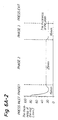
- a precompressed 80 mm thick mat of glued wood fibres with a moisture content of 9 to 10% corresponding to a 16 mm thick MDF plate is introduced in a continuous press and subjected to a compressing in the first section of the press by means of a very high pressure, usually of the magnitude of 40 to 50 kp/cm 2 , into a thickness usually being 5 to 10% smaller than the final thickness of the plate, cf.
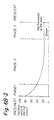
- Fig. 6A-2 shows the distance of the pressing planes, i.e. the thickness of the mat, over the length of the press
- Fig. 6A-1 shows the specific pressure in the mat over the length of the press.
- the high pressure in the first phase and the heating from the press bands result in a plastifying and compression of the fibres in the outermost layer of the mat into a density often in the range of 1000 to 1100 kg/m 3 for standard MDF-plates.
- the pressure is then reduced in the second phase to for instance 1 to 3 kp/cm 2 so as to improve the permeability of the middle layer to the steam penetrating from the heated cover layer.
- the thickness of the mat increases to approximately 25 mm in the illustrated example.
- the distance of the pressing planes is adjusted to the final thickness of the plate with the effect that the pressure is increased to for instance 5 to 10 kp/cm 2 so as finally to decrease towards 0 at the termination of the third phase, viz. the calibration phase.
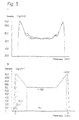
- the described method is a method known especially within the MDF industry and it is suited for achieving specific density profiles, cf. fig. 5. It is, however, encumbered with a few essential draw-backs which can be avoided by the use of the invention:
- this method is solely intended for achieving a specific density profile, but it is not suited for achieving an optimum utilization of the binder.
- the transverse tensile strength of the plate can vary a great deal, and the damage in the middle layer is not always associated with the lowest density, cf. Fig. 7.
- the latter is in principle an efficient method because the potential amount of steam for the heat transfer is increased without increasing the total amount of moisture and consequently the risk of steam burstings. It is, however, difficult to control the procedure, and in addition it is not possible immediately before the press to apply water onto the bottom side of the mat.
- the result can be asymmetrical cross sections of the plates and curved plates.
- the process is difficult to control because even insignificant moisture variations in the mat result in a heterogeneous heating, the dielectric constant of water being approximately 80 times higher than the one for wood.
- a heating of the middle layer involves a plastifying which is not desired because the middle layer must be able to offer resistance at the compressing and hardening of the surface of the mat during the first phase of the pressing.
- a method and an apparatus according to the preamble of claim 1 and 9, respectively, are disclosed in US-A-50 63 010 and are also directed to achieving an uniform temperature and a homogeneous moisture content in the entire cross section of the mat.
- the above methods and apparatus are not advantageous because of the undesired plastifying of the middle layer and the not-optimum "Dampfstoss-hormon", where the moisture content and the temperature are also increased in the middle layer of the mat, and accordingly it is the object of the invention to obtain a specific and controllable gradient of the moisture content and the temperature in the mat immediately before entering into the continuously operating press.
- This object is according to the invention obtained by subjecting the mat immediately before the introduction into the hot press to a pretreatment with steam, whereby the length being subjected to the steam treatment depends on the measured density profile in such a manner that a gradient of the moisture content/temperature is obtained across the thickness of the mat which is optimal with respect to the plastifying degree for a desired product quality and a predetermined pressing process.
- the capacity of the apparatus can be increased at the same time as the energy consumption is reduced.
- the dimensions of the press can be reduced.
- the mat may according to the invention have a temperature of preferably below 40°C before the pretreatment.
- the mat may according to the invention have a moisture content of preferably less than 5% relative to the dry weight of said mat before the pretreatment.
- the pretreatment can advantageously be carried out with saturated water steam at a temperature of 100 to 115°C, preferably 102 to 110°C, especially in the range 104 to 108°C.
- the pretreatment may according to the invention be carried out at a steam pressure of 0.1 to 0.5 bar overpressure, preferably 0.2 to 0.4 bar overpressure.
- the introduction of steam may advantageously be controlled such that the gradient of temperature and the moisture content are adjusted to the subsequent hot pressing parameters temperature, pressure and positioning of the pressing planes across the pressing length and the plastifying and compressing of the mat in order to achieve a predetermined density profile of the finished plate.
- the pretreatment is controlled such that steam burstings in the finished plate in the press outlet are avoided partly by way of an optimizing of the moisture profile in the mat and partly by way of keeping the total moisture content in the mat at less than 10%, preferably less than 8% of dry weight of the mat.
- the invention relates to a method and an apparatus for continuously producing plates, such as chipboards, fibre boards and the like boards, where the raw material in form of biomass particles, such as wood particles, wood fibres and the like fibres, and applied a thermosetting binder is spread on a preforming band into an endless mat, said mat subsequently being pre-compressed in a continuously operating prepress and then pressed in a continuously operating hot press, wherein the mat is compressed into the desired thickness of the finished plate and the thermosetting binder is hardened and said mat being pretreated by injection of steam into the surface of the mat immediately before the introduction into the hot press.
- biomass particles such as wood particles, wood fibres and the like fibres
- the length being subjected to the steam processing is determined using the density profile of the finished board being measured in-line at the outlet of the hot press in such a manner that a specific gradient of the moisture content and the temperature is obtained which is optimal for a predetermined pressing processing and a desired product quality.
- Fig. 1 shows a production apparatus in form of a production line for continuously producing biomass-based plates; including especially, but not exclusively wood-based chipboards and fibre boards.
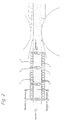
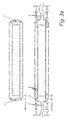
- the apparatus F for steam injection is shown in greater detail in Figs. 2 and 3.
- the hot press E is of vital importance for the capacity of a production line and the properties of the products, said hot press having two basic functions:
- Fig. 4 shows an example of the temperature course at four different depths of the mat B versus the time and consequently the position of the measuring location above the pressing length.
- the curve segments with a steep temperature gradient represent the "Dampfstoss- 1952" in the layer in question, whereas the flat temperature gradients represent the heat conducting phase taking over when steam is no longer supplied from the outside.
- the "Dampfstoss- 1952” is an ideal mechanism for transferring heat, but it is of limited use because a high steam pressure in the middle layer ML may cause steam burstings in said layer when the plate exits the press E.
- the method is carried out as follows:
- the pre-compressed mat B is supplied with saturated steam at a temperature of preferably, but not exclusively 105 to 110°C corresponding to an overpressure of 0.2 to 0.4 bar.
- the position of the press E in the production line appears from Fig. 1.
- the detailed structure of the press inlet and the apparatus F for injection of steam according to the invention appears from Figs. 2 and 3.
- a device comprising a plane below and a plane above the mat B is accommodated directly in the inlet of the continuously operating press E, preferably, but not exclusively as an integrated portion of a retractable feeding device D.
- These planes are provided with channels 2 for distribution of steam across the width of the production line, and they comprise bores in the surface for the feeding of steam to the mat B being advanced between said planes by means of strainer bands 15, i.e. permeable bands made of textile or metal tissue or the like tissue.
- the planes are structured as shown in Figs. 2 and 3.
- the bottom plane 1 is shaped as a coherent plane with cylindrical channels 2 parallel to the plane 1, but perpendicular to the introduction direction of the mat B.
- the steam is supplied through resilient coils 3 to the channels 2 through pistons 4 in form of tubes, cf. Fig. 3,
- the tubes can be moved and positioned in the outermost portion of the channels 2.
- Steam to the mat B leaks through bores 5 in the surface of the planes, and the leaking can be limited by means of the pistons 4 to the portion of the width of the production line which is relevant for a predetermined production width.
- the production width can vary according to desire by means of the spreading machine A.
- the upper plane is structured correspondingly concerning the introduction of steam, but it comprises segments interconnected through hinges 6 with the result that each segment can be pressed downwards by means of hydraulic cylinders 7 towards the strainer bands 15 and the mat B in such a manner that a leaking of steam between the plans, the strainer bands 15 and the mat B can be limited.
- the structuring of the planes for steam processing in form of modules allows a simple adjustment of the capacity, viz. the length being processed, to the instant advancing speed associated with the length and capacity of the hot press E in question.
- the supply of steam can be adjusted to each segment or to each channel 2.
- the pressure and the temperature can also be adjusted individually.
- the penetration of steam and the heating can be completely or partially limited to the cover layer in accordance with a profile which can be maximally adjusted to a predetermined processing and a desired product quality.
- the detector H is used as auxiliary means for the control of the total supply of moisture to the mat B, said detector appearing from Fig. 1 and detecting a possible formation of blisters caused by a too high steam pressure.
- this profile has been replaced by a geometrically formalized profile with the same main data as the actual profile, cf. Fig. 5B.
- the layer structure of the plate is as follows:
- the middle layer ML thickness 9 mm, average density 700 kg/m 3 ,
- the thickness is 16 mm, and the total density is 800 kg/m 3 .
- a fibre mat is required, said mat in the following calculations being divided into a cover layer DL, and a middle layer ML corresponding to the finished plate.
- the hot pressing in a continuous press by way of the method according to the invention runs typically in the following manner, cf. Fig. 6B-1 illustrating the pressure course across the length of the press, and Fig. 6B-2 illustrating the distance of the pressing planes across the pressing length,
- the pressing procedure runs typically as follows:
- the total capacity of the apparatus can thus be substantially increased while the energy consumption is simultaneously reduced.
- the size, dimensioning and hydraulics of the press E can be reduced to a predetermined capacity.
- the length being subjected to the steam processing is typically 1 to 2 m, but it depends on the advancing speed and the thickness of the plate.
Landscapes
- Life Sciences & Earth Sciences (AREA)
- Engineering & Computer Science (AREA)
- Manufacturing & Machinery (AREA)
- Wood Science & Technology (AREA)
- Forests & Forestry (AREA)
- Dry Formation Of Fiberboard And The Like (AREA)
Claims (12)
- Verfahren zur Optimierung der Produktionskapazität und der Flexibilität der Produkteigenschaften bei der Herstellung von Spanplatten, Faserplatten und ähnlichen Platten mittels eines kontinuierlichen Prozesses, wobeidadurch gekennzeichnet, dass die Länge, die der Dampfbehandlung unterzogen wird, unter Verwendung des Dichteprofils der fertigen Platte, das während des Betriebs am Auslass der Heißpresse gemessen wird, in solch einer Weise bestimmt wird, dass ein Gradient des Feuchtigkeitsgehalts/der Temperatur über die Dicke des Vlieses (B) erhalten wird, der optimal in Bezug auf den Plastifizierungsgrad für eine gewünschte Produktqualität und einen vorbestimmten Pressprozess ist.ein in Wärme aushärtendes Bindemittel auf das Rohmaterial in Form von Biomassepartikeln, wie zum Beispiel Spänen, Fasern und dergleichen, aufgebracht wird, das Rohmaterial auf einem Vorformungsband zu einem endlosen Vlies (B) gestreut wird,das Vlies (B) vorzugsweise in einer kontinuierlich arbeitenden Vorpresse (C) vorgepresst und vollständig in einer vorzugsweise kontinuierlich arbeitenden Heißpresse (E) gepresst wird und wobei das Vlies (B) zu der gewünschten Dicke der fertigen Platte gepresst und das in Wärme aushärtende Bindemittel ausgehärtet wird,das Vlies (B) durch Injektion von Dampf in die Oberfläche des Vlieses (B) unmittelbar vor der Einführung in die Heißpresse (E) vorhandelt wird,
- Verfahren nach Anspruch 1, dadurch gekennzeichnet, dass das Vlies (B) eine Temperatur unterhalb von 40 °C vor der Vorbehandlung hat.
- Verfahren nach Anspruch 1 oder 2, dadurch gekennzeichnet, dass das Vlies (B) einen Feuchtigkeitsgehalt von weniger als 5% relativ zu dem Trockengewicht des Vlieses vor der Vorbehandlung hat.
- Verfahren nach einem der Ansprüche 1 bis 3, dadurch gekennzeichnet, dass die Vorbehandlung mit gesättigtem Wasserdampf bei einer Temperatur in dem Bereich von 102 bis 110 °C, insbesondere in dem Bereich von 104 bis 108 °C, durchgeführt wird.
- Verfahren nach einem der Ansprüche 1 bis 4, dadurch gekennzeichnet, dass die Vorbehandlung bei einem Dampfdruck von 0,1 bis 0,5 bar Überdruck, vorzugsweise bei einem Dampfdruck von 0,2 bis 0,4 bar Überdruck, durchgeführt wird.
- Verfahren nach einem der Ansprüche 1 bis 5, dadurch gekennzeichnet, dass das Einführen von Dampf in solch einer Weise gesteuert wird, dass der Dampf- und Feuchtigkeitsgehaltgradient angepasst ist anwobei die Vorbehandlung so gesteuert wird, dass Dampfberstungen in der fertigen Platte in dem Pressenauslass teilweise durch ein Optimieren des Feuchtigkeitsprofils in dem Vlies (B) und teilweise durch ein Halten des Gesamtfeuchtigkeitsgehalts in dem Vlies (B) bei weniger als 10%, vorzugsweise bei weniger als 8% des Trockengewichts des Vlieses vermieden werden.die Heißpressungsparameter Temperatur, Druck und Positionierung der Pressflächen über die Presslänge unddie gewünschte Plastifizierungs- und Pressprozedur des Vlieses (B), um ein vorbestimmtes Dichteprofil der fertigen Platte zu erhalten,
- Verfahren nach einem der Ansprüche 1 bis 6, dadurch gekennzeichnet, dass das Dichteprofil der fertigen Platte, das (bei G) unmittelbar nach dem Ausgang der Heißpresse (E) gemessen wird, als Steuerparameter für das Einstellen des Drucks und der Temperatur der Vorhandlung mittels Dampf verwendet wird.
- Verfahren nach einem der Ansprüche 1 bis 6, dadurch gekennzeichnet, dass die Dosierung der gesamten bei der Vorbehandlung verwendeten Dampfmenge auf der Basis einer Ultraschallmessung (bei H) von beginnenden Dampfberstungen in der fertigen Platte an dem Ausgang der Heißpresse (E) gesteuert wird.
- Vorrichtung zum Ausführen des Verfahrens nach Anspruch 1, aufweisend eine Streumaschine (A), vorzugsweise eine kontinuierlich arbeitende Vorpresse (C), eine Dampfinjektionsvorrichtung (F), die in vorzugsweise miteinander verbundene Segmente unterteilt ist, und wobei die Länge/Zeit der Behandlung in der Dampfinjektionsvorrichtung (F) an das fragliche Vlies (B) und den gewünschten Feuchtigkeitsgradienten und den gewünschten Temperaturgradienten angepasst werden kann durch eine Verbindung/Trennung der individuellen Segmente und optional eine Verbindung/Trennung individueller Kanäle in jedem Segment, und ferner aufweisend eine vorzugsweise kontinuierlich arbeitende Heißpresse (E),
wobei die Vorrichtung Mittel (G) für eine In-Betrieb-Messung des Dichteprofils einer fertigen Platte an dem Auslass der Heißpresse aufweist. - Vorrichtung nach Anspruch 9, dadurch gekennzeichnet, dass die individuellen Segmente mittels hydraulischer Zylinder (7) nach unten gegen das Vlies (B) gepresst werden können.
- Vorrichtung nach Anspruch 9, dadurch gekennzeichnet, dass die Dampfinjektionsvorrichtung (F) einige bewegbare Kolben aufweist, die als Zylinder (4) zur Einführung von Dampf in zylindrische Kanäle (2) strukturiert sind, wobei die Kolben eine Einstellung der Breite der Behandlungszone entsprechend der Breite des Vlieses (B) erlauben.
- Verfahren nach einem der Ansprüche 1 bis 8, gekennzeichnet durch den folgenden Ablauf des Heißpressens:in einer ersten Phase wird ein Druck hergestellt, der typischerweise von der Größe 10 bis 15 kp/cm2 ist, wobei der Druck aufrechterhalten wird, bis die Deckschicht die gewünschte Dicke erreicht hat,in einer zweiten Phase wird der Druck gemäß einer gleichförmig abnehmenden Kurve reduziert, wobei die Kurvenform entscheidend ist für die Form des Dichteprofils in der Mittelschicht der Platte,und dann, wenn das Vlies die Enddicke der Platte erreicht hat, übernimmt der Abstand zwischen den Pressflächen die Funktion als primärer Steuerparameter, bis der Druck 0 erreicht.
Applications Claiming Priority (3)
| Application Number | Priority Date | Filing Date | Title |
|---|---|---|---|
| DK199700302A DK176116B1 (da) | 1997-03-18 | 1997-03-18 | Fremgangsmåde til fremstilling af spånplader, fiberplader og lignende |
| DK30297 | 1997-03-18 | ||
| PCT/DK1998/000090 WO1998041372A1 (en) | 1997-03-18 | 1998-03-10 | A method of manufacturing chipboards, fibre boards and the like boards |
Publications (3)
| Publication Number | Publication Date |
|---|---|
| EP1009601A1 EP1009601A1 (de) | 2000-06-21 |
| EP1009601B1 true EP1009601B1 (de) | 2001-07-25 |
| EP1009601B2 EP1009601B2 (de) | 2007-11-14 |
Family
ID=8092020
Family Applications (1)
| Application Number | Title | Priority Date | Filing Date |
|---|---|---|---|
| EP98907897A Expired - Lifetime EP1009601B2 (de) | 1997-03-18 | 1998-03-10 | Verfahren zum herstellen von holzspanplatten, faserplatten und ähnlichen platten |
Country Status (8)
| Country | Link |
|---|---|
| US (1) | US6533889B2 (de) |
| EP (1) | EP1009601B2 (de) |
| CN (1) | CN1134326C (de) |
| AU (1) | AU6610198A (de) |
| CA (1) | CA2283592C (de) |
| DE (1) | DE69801228T3 (de) |
| DK (1) | DK176116B1 (de) |
| WO (1) | WO1998041372A1 (de) |
Families Citing this family (32)
| Publication number | Priority date | Publication date | Assignee | Title |
|---|---|---|---|---|
| DE19909607A1 (de) * | 1999-03-05 | 2000-09-07 | Dieffenbacher Schenck Panel | Verfahren zur Herstellung von plattenförmigen Produkten |
| DE10106815A1 (de) * | 2001-02-14 | 2002-08-29 | Dieffenbacher Gmbh Maschf | Verfahren und Anlage zur Herstellung von Holzwerkstoffplatten |
| MXPA03008382A (es) * | 2001-03-16 | 2004-11-12 | Altech Generating Systems Llc | Alternador y metodo de fabricacion. |
| DE10124929B4 (de) * | 2001-05-21 | 2004-09-30 | Metso Paper Inc. | Verfahren zur kontinuierlichen Herstellung von Faserplatten |
| PL198570B1 (pl) * | 2001-05-31 | 2008-06-30 | Biotek Sp Z Oo | Sposób wytwarzania materiałów aglomerowanych z biomasy w postaci płyty lub elementu profilowanego oraz materiały aglomerowane z biomasy w postaci płyty lub elementu profilowanego |
| US20030127763A1 (en) * | 2001-08-16 | 2003-07-10 | Josef Stutz | Mechanically glued board of wood material |
| DE10230191B4 (de) * | 2002-07-05 | 2004-09-02 | Herbert Georg Nopper | Verfahren und Vorrichtung zum Verpressen von Vliesen aus Streugut |
| DE10261730A1 (de) * | 2002-12-30 | 2004-07-08 | Dieffenbacher Gmbh + Co. Kg | Verfahren mit Anlage und kontinuierlich arbeitende Presse zur Herstellung von Holzwerkstoffplatten |
| MXPA05009028A (es) * | 2003-02-24 | 2006-04-07 | Jeld Wen Inc | Compuestos de lignocelulosa en capa delgada que tienen resistencia aumentada a la humedad y metodos para elaborarlos. |
| DE20305236U1 (de) * | 2003-04-01 | 2003-07-17 | Kronospan Technical Co. Ltd., Engomi, Nicosia | Vorrichtung zum Bedampfen |
| US7943070B1 (en) | 2003-05-05 | 2011-05-17 | Jeld-Wen, Inc. | Molded thin-layer lignocellulose composites having reduced thickness and methods of making same |
| US7258761B2 (en) * | 2004-11-12 | 2007-08-21 | Huber Engineered Woods Llc | Multi-step preheating processes for manufacturing wood based composites |
| DE102005053981B4 (de) | 2004-11-27 | 2018-01-11 | Dieffenbacher GmbH Maschinen- und Anlagenbau | Verfahren und Vorrichtung zum Einleiten von Dampf in eine Matte bzw. in deren Deckschichten |
| DE102004057418B4 (de) * | 2004-11-27 | 2017-08-31 | Dieffenbacher GmbH Maschinen- und Anlagenbau | Verfahren und Vorrichtung zum Einleiten von Dampf in eine Matte bzw. in deren Deckschichten |
| DE102006058612A1 (de) * | 2006-12-11 | 2008-06-19 | Fritz Egger Gmbh & Co. | Optimierte Trägerplatte |
| DE102007044163A1 (de) * | 2007-09-15 | 2009-03-19 | Dieffenbacher Gmbh + Co. Kg | Verfahren zur Herstellung von Dämm- und/oder Schallschutzplatten aus Holzfasern im Trockenverfahren und eine Kalibrier- und Aushärtevorrichtung |
| US20090113830A1 (en) * | 2007-11-07 | 2009-05-07 | Jeld-Wen, Inc. | Composite garage doors and processes for making such doors |
| ES2389509T3 (es) * | 2007-11-23 | 2012-10-26 | Glunz Ag | Placa a base de fibras de madera encoladas con aglutinante |
| US20090297818A1 (en) * | 2008-05-29 | 2009-12-03 | Jeld-Wen, Inc. | Primer compositions and methods of making the same |
| US8058193B2 (en) * | 2008-12-11 | 2011-11-15 | Jeld-Wen, Inc. | Thin-layer lignocellulose composites and methods of making the same |
| EP2213432A1 (de) * | 2009-01-29 | 2010-08-04 | Imal S.R.L. | Vorrichtung zur Befeuchtung von Matten basierend auf losem Holzmaterial |
| US9481777B2 (en) | 2012-03-30 | 2016-11-01 | The Procter & Gamble Company | Method of dewatering in a continuous high internal phase emulsion foam forming process |
| CN103449924B (zh) * | 2013-09-03 | 2014-11-26 | 广西大学 | 一种制备缓释肥料壳体的方法 |
| EP3345774B1 (de) * | 2017-01-04 | 2020-11-18 | Akzenta Paneele + Profile GmbH | Verfahren zur herstellung eines dekorierten wand- oder bodenpaneels |
| DE102018131159A1 (de) * | 2018-12-06 | 2020-06-10 | Dieffenbacher GmbH Maschinen- und Anlagenbau | Kontinuierlich arbeitende Presse mit Rohdichteprofilregelung |
| IT201900019799A1 (it) * | 2019-10-25 | 2021-04-25 | Imal Srl | Procedimento ed impianto per la realizzazione di pannelli in materiale legnoso |
| CN115349734B (zh) * | 2022-08-19 | 2024-04-30 | 大自然科技股份有限公司 | 一种植物纤维床垫热压工艺 |
| CN116178036B (zh) * | 2023-02-24 | 2024-04-05 | 陕西美兰德新材料股份有限公司 | 一种碳碳复合材料托杆及其制备方法 |
| CN117443681B (zh) * | 2023-12-20 | 2024-03-12 | 全南虔芯半导体有限公司 | 芯片制造用恒温匀胶系统 |
| DE102023136273A1 (de) * | 2023-12-21 | 2025-06-26 | Siempelkamp Maschinen- Und Anlagenbau Gmbh | Verfahren zur Herstellung einer Werkstoffplatte |
| DE102023136272A1 (de) * | 2023-12-21 | 2025-06-26 | Siempelkamp Maschinen- Und Anlagenbau Gmbh | Verfahren zur Herstellung einer Werkstoffplatte |
| DE102023136271A1 (de) * | 2023-12-21 | 2025-06-26 | Siempelkamp Maschinen- Und Anlagenbau Gmbh | Verfahren zur Herstellung einer Werkstoffplatte |
Family Cites Families (13)
| Publication number | Priority date | Publication date | Assignee | Title |
|---|---|---|---|---|
| US3779843A (en) | 1971-01-21 | 1973-12-18 | H Knapp | Continuous process for producing consolidated lignocellulosic material |
| DE2343427C3 (de) † | 1973-08-29 | 1986-10-02 | Peter 7869 Holzinshaus Voelskow | Kontinuierlich arbeitende Preß- und Kalibriervorrichtung zur Herstellung von Spanplatten |
| US4393019A (en) * | 1981-11-30 | 1983-07-12 | The United States Of America As Represented By The Secretary Of Agriculture | Method of pressing reconstituted lignocellulosic materials |
| FI71018C (fi) | 1983-07-06 | 1986-10-27 | Valmet Oy | Foerfarande baserande sig pao ekolodning med ultraljud foer at foelja med banbildningen och/eller massasuspensionsstroe mmn pao en viradel och/eller i en inloppslaoda i en pappers makin och anordning foer tillaempning av foerfarandet samt vanendning av foerfarandet och/eller anordningen |
| CA2009909A1 (en) † | 1989-02-14 | 1990-08-14 | Thomas Tisch | Production process and apparatus |
| DE3914106A1 (de) | 1989-04-28 | 1990-10-31 | Siempelkamp Gmbh & Co | Verfahren und anlage zur kontinuierlichen herstellung von spanplatten, faserplatten u. dgl. |
| CA2025555A1 (en) * | 1990-07-23 | 1992-01-24 | Macmillan Bloedel Limited | Wood composite forming and curing system |
| SE502272C2 (sv) * | 1994-01-28 | 1995-09-25 | Sunds Defibrator Ind Ab | Förfarande för framställning av lignocellulosahaltiga skivor |
| DE4441017A1 (de) | 1994-11-17 | 1996-05-23 | Dieffenbacher Gmbh Maschf | Verfahren und Anlage zur kontinuierlichen Herstellung von Holzwerkstoffplatten |
| SE504221C2 (sv) † | 1995-04-07 | 1996-12-09 | Sunds Defibrator Ind Ab | Förfarande för framställning av lignocellulosahaltiga skivor |
| SE504637C2 (sv) * | 1995-07-27 | 1997-03-24 | Sunds Defibrator Ind Ab | Förfarande vid framställning av lignocellulosahaltiga skivor |
| SE506224C2 (sv) * | 1996-03-07 | 1997-11-24 | Sunds Defibrator Ind Ab | Sätt att förpressa fibermaterial vid framställning av skivor |
| DE19640593A1 (de) | 1996-10-01 | 1998-04-09 | Fraunhofer Ges Forschung | Verfahren zur Herstellung organischgebundener Holzwerkstoffe |
-
1997
- 1997-03-18 DK DK199700302A patent/DK176116B1/da not_active IP Right Cessation
-
1998
- 1998-03-10 CN CNB988049279A patent/CN1134326C/zh not_active Expired - Fee Related
- 1998-03-10 US US09/380,627 patent/US6533889B2/en not_active Expired - Fee Related
- 1998-03-10 CA CA002283592A patent/CA2283592C/en not_active Expired - Fee Related
- 1998-03-10 AU AU66101/98A patent/AU6610198A/en not_active Abandoned
- 1998-03-10 WO PCT/DK1998/000090 patent/WO1998041372A1/en not_active Ceased
- 1998-03-10 DE DE69801228T patent/DE69801228T3/de not_active Expired - Lifetime
- 1998-03-10 EP EP98907897A patent/EP1009601B2/de not_active Expired - Lifetime
Also Published As
| Publication number | Publication date |
|---|---|
| DE69801228T3 (de) | 2008-05-21 |
| US20020036046A1 (en) | 2002-03-28 |
| DK30297A (da) | 1998-09-19 |
| AU6610198A (en) | 1998-10-12 |
| DK176116B1 (da) | 2006-08-14 |
| EP1009601B2 (de) | 2007-11-14 |
| DE69801228D1 (de) | 2001-08-30 |
| EP1009601A1 (de) | 2000-06-21 |
| CN1255081A (zh) | 2000-05-31 |
| CN1134326C (zh) | 2004-01-14 |
| US6533889B2 (en) | 2003-03-18 |
| DE69801228T2 (de) | 2002-05-16 |
| WO1998041372A1 (en) | 1998-09-24 |
| CA2283592A1 (en) | 1998-09-24 |
| CA2283592C (en) | 2001-04-24 |
Similar Documents
| Publication | Publication Date | Title |
|---|---|---|
| EP1009601B1 (de) | Verfahren zum herstellen von holzspanplatten, faserplatten und ähnlichen platten | |
| RU2068339C1 (ru) | Устройство и способ непрерывного изготовления древесностружечных плит | |
| US5063010A (en) | Making pressed board | |
| FI96494C (fi) | Menetelmä lastulevyjen tms. valmistamiseksi ja vastaavat kaksoishihnapuristimet | |
| US5913990A (en) | Method and device for the continuous production of panels of lignocellulose-containing particles | |
| US6290809B1 (en) | Apparatus for the production of boards of wood-based material | |
| KR100341872B1 (ko) | 링고셀룰로오즈보오드를제조하는방법 | |
| JP3704378B2 (ja) | 木材チップ板体製造の過程において木材チップを予め設定される予備加熱温度に予備加熱する方法 | |
| FI82409B (fi) | Anordning foer kontinuerlig framstaellning av en aendloes tunn spaonplattebana. | |
| CA2132230C (en) | Process and plant for the continuous production of particleboards | |
| WO2006036713A2 (en) | Systems and methods for the production of steam-pressed long fiber reconsolidated wood products | |
| US9452546B2 (en) | Method and plant for producing material boards, and a device for compressing the narrow sides of a pressed-material mat | |
| CA2236633A1 (en) | Process and equipment for producing sheets made from wood-derivatives | |
| US6201224B1 (en) | Method of making a composite wood product from wood elements | |
| EP0819043B1 (de) | Verfahren zum herstellen von platten aus lignocelluloseteilchen | |
| JPS62174101A (ja) | 木屑、繊維および類似物の板の連続的製造法 | |
| EP0842021B1 (de) | Verfahren zum kontinuierlichen herstellen von holzwerkstoffplatten | |
| CA2368328A1 (en) | Process and installation for manufacture of particle board and fiber board panels | |
| JPH08509920A (ja) | ボードの製造において繊維材料を予備プレスする方法および装置 | |
| CA2334271A1 (en) | Process and facility for the continuous production of organically bonded derived timber product board | |
| CA2313229C (en) | A method of making a composite wood product from wood elements | |
| CN112454599A (zh) | 一种多功能超高密度板材制作工艺 | |
| HK1027316A (en) | A method of manufacturing chipboards, fibre boards and the like boards | |
| CN1799799A (zh) | 用于向无光料垫或其覆盖层内导入蒸汽的方法和装置 |
Legal Events
| Date | Code | Title | Description |
|---|---|---|---|
| PUAI | Public reference made under article 153(3) epc to a published international application that has entered the european phase |
Free format text: ORIGINAL CODE: 0009012 |
|
| 17P | Request for examination filed |
Effective date: 19990903 |
|
| AK | Designated contracting states |
Kind code of ref document: A1 Designated state(s): DE FI IT SE |
|
| 17Q | First examination report despatched |
Effective date: 20000830 |
|
| GRAG | Despatch of communication of intention to grant |
Free format text: ORIGINAL CODE: EPIDOS AGRA |
|
| GRAG | Despatch of communication of intention to grant |
Free format text: ORIGINAL CODE: EPIDOS AGRA |
|
| GRAH | Despatch of communication of intention to grant a patent |
Free format text: ORIGINAL CODE: EPIDOS IGRA |
|
| GRAG | Despatch of communication of intention to grant |
Free format text: ORIGINAL CODE: EPIDOS AGRA |
|
| GRAH | Despatch of communication of intention to grant a patent |
Free format text: ORIGINAL CODE: EPIDOS IGRA |
|
| GRAA | (expected) grant |
Free format text: ORIGINAL CODE: 0009210 |
|
| RIN1 | Information on inventor provided before grant (corrected) |
Inventor name: DUEHOLM, STEN |
|
| RAP1 | Party data changed (applicant data changed or rights of an application transferred) |
Owner name: WESSER & DUEHOLM |
|
| AK | Designated contracting states |
Kind code of ref document: B1 Designated state(s): DE FI IT SE |
|
| ITF | It: translation for a ep patent filed | ||
| REF | Corresponds to: |
Ref document number: 69801228 Country of ref document: DE Date of ref document: 20010830 |
|
| PLBQ | Unpublished change to opponent data |
Free format text: ORIGINAL CODE: EPIDOS OPPO |
|
| PLBI | Opposition filed |
Free format text: ORIGINAL CODE: 0009260 |
|
| PLBQ | Unpublished change to opponent data |
Free format text: ORIGINAL CODE: EPIDOS OPPO |
|
| PLBI | Opposition filed |
Free format text: ORIGINAL CODE: 0009260 |
|
| 26 | Opposition filed |
Opponent name: SIEMPELKAMP MASCHINEN- UND ANLAGENBAU GMBH & CO. K Effective date: 20020422 |
|
| PLBF | Reply of patent proprietor to notice(s) of opposition |
Free format text: ORIGINAL CODE: EPIDOS OBSO |
|
| 26 | Opposition filed |
Opponent name: METSO PAPER SUNDSVALL AB Effective date: 20020425 Opponent name: SIEMPELKAMP MASCHINEN- UND ANLAGENBAU GMBH & CO. K Effective date: 20020422 |
|
| PLBF | Reply of patent proprietor to notice(s) of opposition |
Free format text: ORIGINAL CODE: EPIDOS OBSO |
|
| PLAB | Opposition data, opponent's data or that of the opponent's representative modified |
Free format text: ORIGINAL CODE: 0009299OPPO |
|
| R26 | Opposition filed (corrected) |
Opponent name: METSO PAPER SUNDSVALL AB Effective date: 20020425 Opponent name: SIEMPELKAMP MASCHINEN- UND ANLAGENBAU GMBH & CO. K Effective date: 20020422 |
|
| PLBP | Opposition withdrawn |
Free format text: ORIGINAL CODE: 0009264 |
|
| PLBP | Opposition withdrawn |
Free format text: ORIGINAL CODE: 0009264 |
|
| PLAY | Examination report in opposition despatched + time limit |
Free format text: ORIGINAL CODE: EPIDOSNORE2 |
|
| PLBC | Reply to examination report in opposition received |
Free format text: ORIGINAL CODE: EPIDOSNORE3 |
|
| PUAH | Patent maintained in amended form |
Free format text: ORIGINAL CODE: 0009272 |
|
| STAA | Information on the status of an ep patent application or granted ep patent |
Free format text: STATUS: PATENT MAINTAINED AS AMENDED |
|
| 27A | Patent maintained in amended form |
Effective date: 20071114 |
|
| AK | Designated contracting states |
Kind code of ref document: B2 Designated state(s): DE FI IT SE |
|
| REG | Reference to a national code |
Ref country code: SE Ref legal event code: RPEO |
|
| PLAB | Opposition data, opponent's data or that of the opponent's representative modified |
Free format text: ORIGINAL CODE: 0009299OPPO |
|
| PG25 | Lapsed in a contracting state [announced via postgrant information from national office to epo] |
Ref country code: IT Free format text: LAPSE BECAUSE OF NON-PAYMENT OF DUE FEES Effective date: 20100310 |
|
| PGFP | Annual fee paid to national office [announced via postgrant information from national office to epo] |
Ref country code: FI Payment date: 20110310 Year of fee payment: 14 Ref country code: SE Payment date: 20110311 Year of fee payment: 14 |
|
| PGFP | Annual fee paid to national office [announced via postgrant information from national office to epo] |
Ref country code: IT Payment date: 20110321 Year of fee payment: 14 Ref country code: DE Payment date: 20110302 Year of fee payment: 14 |
|
| PGRI | Patent reinstated in contracting state [announced from national office to epo] |
Ref country code: IT Effective date: 20110616 |
|
| REG | Reference to a national code |
Ref country code: SE Ref legal event code: EUG |
|
| PG25 | Lapsed in a contracting state [announced via postgrant information from national office to epo] |
Ref country code: SE Free format text: LAPSE BECAUSE OF NON-PAYMENT OF DUE FEES Effective date: 20120311 Ref country code: FI Free format text: LAPSE BECAUSE OF NON-PAYMENT OF DUE FEES Effective date: 20120310 |
|
| REG | Reference to a national code |
Ref country code: DE Ref legal event code: R119 Ref document number: 69801228 Country of ref document: DE Effective date: 20121002 |
|
| PG25 | Lapsed in a contracting state [announced via postgrant information from national office to epo] |
Ref country code: IT Free format text: LAPSE BECAUSE OF NON-PAYMENT OF DUE FEES Effective date: 20120310 |
|
| PG25 | Lapsed in a contracting state [announced via postgrant information from national office to epo] |
Ref country code: DE Free format text: LAPSE BECAUSE OF NON-PAYMENT OF DUE FEES Effective date: 20121002 |