EP1007702B1 - Procede d'augmentation de l'expression du gene de la saccharose synthase - Google Patents
Procede d'augmentation de l'expression du gene de la saccharose synthase Download PDFInfo
- Publication number
- EP1007702B1 EP1007702B1 EP98949962A EP98949962A EP1007702B1 EP 1007702 B1 EP1007702 B1 EP 1007702B1 EP 98949962 A EP98949962 A EP 98949962A EP 98949962 A EP98949962 A EP 98949962A EP 1007702 B1 EP1007702 B1 EP 1007702B1
- Authority
- EP
- European Patent Office
- Prior art keywords
- gene
- saccharose synthase
- saccharose
- sucrose
- enzyme
- Prior art date
- Legal status (The legal status is an assumption and is not a legal conclusion. Google has not performed a legal analysis and makes no representation as to the accuracy of the status listed.)
- Expired - Lifetime
Links
- QCNANSHOVAHMSD-UHFFFAOYSA-N C=CC1=CC=CC1 Chemical compound C=CC1=CC=CC1 QCNANSHOVAHMSD-UHFFFAOYSA-N 0.000 description 1
Images


Classifications
-
- C—CHEMISTRY; METALLURGY
- C12—BIOCHEMISTRY; BEER; SPIRITS; WINE; VINEGAR; MICROBIOLOGY; ENZYMOLOGY; MUTATION OR GENETIC ENGINEERING
- C12N—MICROORGANISMS OR ENZYMES; COMPOSITIONS THEREOF; PROPAGATING, PRESERVING, OR MAINTAINING MICROORGANISMS; MUTATION OR GENETIC ENGINEERING; CULTURE MEDIA
- C12N9/00—Enzymes; Proenzymes; Compositions thereof; Processes for preparing, activating, inhibiting, separating or purifying enzymes
- C12N9/10—Transferases (2.)
- C12N9/1048—Glycosyltransferases (2.4)
- C12N9/1051—Hexosyltransferases (2.4.1)
- C12N9/1062—Sucrose synthase (2.4.1.13)
-
- C—CHEMISTRY; METALLURGY
- C12—BIOCHEMISTRY; BEER; SPIRITS; WINE; VINEGAR; MICROBIOLOGY; ENZYMOLOGY; MUTATION OR GENETIC ENGINEERING
- C12N—MICROORGANISMS OR ENZYMES; COMPOSITIONS THEREOF; PROPAGATING, PRESERVING, OR MAINTAINING MICROORGANISMS; MUTATION OR GENETIC ENGINEERING; CULTURE MEDIA
- C12N15/00—Mutation or genetic engineering; DNA or RNA concerning genetic engineering, vectors, e.g. plasmids, or their isolation, preparation or purification; Use of hosts therefor
- C12N15/09—Recombinant DNA-technology
- C12N15/63—Introduction of foreign genetic material using vectors; Vectors; Use of hosts therefor; Regulation of expression
- C12N15/79—Vectors or expression systems specially adapted for eukaryotic hosts
- C12N15/80—Vectors or expression systems specially adapted for eukaryotic hosts for fungi
- C12N15/81—Vectors or expression systems specially adapted for eukaryotic hosts for fungi for yeasts
Definitions
- the invention relates to a method for increasing the gene expression of sucrose Synthase according to claims 1 to 8, a sucrose synthase gene according to claim 9, Gene structures according to claim 10, vectors according to claim 11 and transformed cells according to claim 12 to 15.
- Sucrose synthase is a plant-restricted enzyme. From many higher In the meantime, plants are each known to have two different genes per species; come with the rice even 3 different genes. Little in their biochemical properties different, they serve with different promoters especially one exact control of enzyme expression in different stages of development and Organs of the plant. So in rice 8 days after germination comes the sucrose synthase 1 especially in root and stem before, while the sucrose 2 synthase throughout Plant distributed occurs. Sucrose synthase 3 is particularly self-filling rice grains active, ie in a completely different life phase of the plant.
- the enzyme serves to cleave sucrose according to the following equation, whereby in vivo only the cleavage reaction has meaning:
- sucrose as a transport form of carbohydrates in plants is so in their Target cells, such as cells of the storage organs, seeds, developing plant organs, in split directly usable UDP-glucose and fructose. While the fructose For further use must first be rearranged, the UDP-glucose is directly available for the synthesis of starch and cellulose.
- nucleoside diphosphates prefer UDP, ADP and TDP.
- sucrose-analogous disaccharides become accessible.
- glycoconjugates such as Glycolipids and glycoproteins. Since glycoconjugates are also involved in the communication of Many of these structures also have a meaning in of medical research.
- the enzyme is recoverable from different plant sources.
- the seeds For the Processing, for example from rice seeds, the seeds must first be swollen become; then they are unlocked, the solid ingredients largely filtered off and prepurified the filtrate on an ion exchange column. That after the Large volume column step is concentrated and subjected to gel filtration. their active fractions can be used for syntheses (see also DE 4 221 595).
- sucrose synthase from rice seeds only a low activity of 0.56 units per gram Dry weight.
- disturbing the purification are the abundant existing carbohydrates in the form of starch and cellulose.
- invertase which splits sucrose, can not be completely separated.
- a reduction of the additionally interfering enzyme phosphatase, which decomposes NDPs, and Nucleotide-sugar-cleaving enzymes that degrade NDP sugars would be useful.
- it is disadvantageous that the sucrose synthase in rice does not appear as pure enzyme, but is present in varying ratios of isoenzymes, the obviously have different synthesis properties.
- sucrose synthase gene from Solanum tuberosum (compare Salanoubat, M. and Belliard, G .: Molecular cloning and sequencing of sucrose synthase cDNA from potato (Solanum tuberosum L.): preliminory characterization of sucrose synthase mRNA distribution, in Gene 60, 47-56, 1987) in the Saccharomyces cerevisiae strain YSH (see Riesmeier, JW et al .: Isolation and characterization of a sucrose carrier cDNA from spinach by functional expression in yeast, EMBO J 11 (13), 4705-4713, (1992), for which the gene was cloned into the plasmid 128A2 under the control of an ADH promoter (see Figure 1) and subsequently transformed into the yeast strain mentioned
- the ADH promoter normally regulates the reading frequency of the yeast enzyme alcohol dehydrogenase, which is constitutively expressed and therefore always present in roughly equal amounts in
- the obtained expression gave the yeast strain the Ability to split sucrose. However, that was specific Activity of the enzyme is relatively low. Depending on Method of determination were 5 to 25 mU sucrose synthase / mg Protein determined.
- NRR1 encodes a higher affinity oligopeptide transporter in Avatidopsis by Doris Rentsch et. as (FEBS Letters 370 (1995) 264-268) shows a heterologous Complementation of yeast mutants which has enabled 8 genes that for different families of amino acid transporters encode to isolate.
- WO 94/00574 discloses a DNA sequence encoding an oligosaccharide transporter, its introduction into a Plant genome the formation and transport of Storage material in transgenic plants, bacteria and Modified plasmids.
- the object is achieved according to the invention by a method in which the expression of the sucrose synthase gene among the Control of a proton ATPase promoter is provided. Therefore the proton ATPase promoter becomes the sucrose synthase gene in particular upstream.
- the gene is preferably derived Solanum tuberosum, while the proton ATPase promoter preferably from yeast, in particular from Saccharomyces cerevisiae is native.
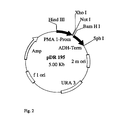
- the gene with the promoter is incorporated into a gene construct, preferably into the plasmid pDR195 (see Figure 2), and the gene construct is subsequently transformed into a microorganism, in particular into the yeast strain Saccharomyces cerevisiae 22574d (compare Jauniaux, J.-C. et al , Nitrogen catabolite regulation of proline permease in Saccharomyces cerevisiae, Cloning of the PUT4 gene and study of PUT4 RNA levels in wild-type and mutant strains, Eur. J. Biochem., 164 , 601-606, 1987).
- the recombinant enzyme is preferably added after disruption of the cells purified by ion exchange and ultrafiltration. As it is for protein-chemical Applications often necessary to provide very pure protein is done for the Further purification of the mentioned technical enzyme preparation therefore in particular a further cleaning at Chelating Sepharose.
- sucrose synthase is for Cleavage of disaccharides, such as 2-deoxysucrose or N-acetylsucrosamine, usable with UDP.
- the enzyme is for the cleavage of Sucrose with ADP.
- the recombinant enzyme is generally as useful as the enzyme from rice (see. Patent DE 42 21 595)
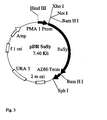
- the sus1 gene was excised by means of the restriction enzyme BamHI.
- the cut products were separated electrophoretically in an agarose gel, the sus1 sequence cut out and eluted.
- the vector pDR195 ( Figure 2) was also digested with the restriction enzyme BamHI cut. This approach was then purified by phenolization, with Ethanol precipitated, taken up again and dephosphorylated with alkaline phosphatase. The alkaline phosphatase was incubated with 50 mM EDTA at 65 ° C within 30 minutes deactivated. It was phenolated again and then precipitated with ethanol.
- the yeast cells were grown overnight at 30 ° C and 200 revolutions per minute in 5 ml YPD medium: 10 g yeast extract 20 g peptone 20 g glucose to 1 liter dist. Water.
- the yeasts of strain 22574d thus transformed with plasmid pDRSuSy were grown on plates for 2 days at 30 ° C. The colonies showing were further propagated on SD medium. In addition, these colonies were grown in liquid SD medium to the stationary phase (30 ° C, 120 rpm shaking rate), the cells were disrupted and the resulting extract compared to the non-transformed cell extract on a 10% SDS Polyacrylamide gel separated by electrophoresis. In parallel, the extract was measured by an enzyme assay (Elling, L. and Kula, M.-R .: Purification of sucrose synthase from rice and its protein-chemical characterization, J. Biotechnol., 29 , 277-286, 1993).
- the polyacrylamide gel yielded a 90,000 kD band in the transformed cells, the lacked in the untransformed. A band of this size was for the monomer the sucrose synthase is expected.
- the enzyme test provided a clear activity of the Extract of the transformed cells. In contrast, the activity was the untransformed Cells below the detection limit.
- the cells are harvested by centrifugation, in 200 mM HEPES pH 7.6 in the ratio Recorded 4: 6 (w / w) and can then be unlocked directly or for a few months -20 ° C are stored.
- the cells taken up in 200 mM HEPES pH 7.6 were placed in a glass bead mill Grind for 20 minutes at 4000 revolutions per minute.
- the used glass beads had a diameter of 0.5 mm.
- the suspension was kept on ice.
- the fixed Ingredients by centrifuging at 15000 rpm and 4 ° C above Separated 15 minutes.
- sucrose synthase was then purified by anion exchange chromatography purified.
- the chromatographic unit consisted of a column with 300 ml of Q-Sepharose FF, a P1 pump, a detector UV-1 (280 nm), a Fraction collector Frac 300 and a recorder REC 101. All materials came from from Pharmacia.
- the salt gradient was treated with buffer A (standard buffer with 0.1 M KCl) and buffer B (Standard buffer with 0.4 M KCl) started.
- the total volume of the gradient was 1 Liter, but can also be stretched to 1.5 liters. In the range between 0.2 and 0.3 M KCl elutes the sucrose synthase.
- the column was regenerated with the following rinsing scheme: 500 ml of 0.1 M potassium acetate pH 4.0 with 1 M NaCl; 1 liter of water; 300 ml 2 M NaOH; 1 liter of water; 500 ml 50 mM HEPES pH7.6 with 1 M NaCl; 1 liter of water.
- the gel was placed in 20% ethanol.
- sucrose synthase-containing fractions were pooled and successively concentrated in a 50 ml ultrafiltration cell from Amicon.
- a membrane served a Amicon YM30 (exclusion size 30000d), diameter 43 mm.
- Per run of a 300 ml Q-Sepharose FF column can be concentrated to 5 to 10 ml.
- the resulting preparation is suitable for syntheses.
- the column Prior to sample loading, the column was equilibrated as follows: It was first with 150 mM KCl in 200 mM HEPES pH 7.2, then with 3 column volumes of this buffer and 10 mM imidazole and finally rinsed with this buffer and 1 mM imidazole.
- the sample or protein solution was first adjusted to a concentration of 1 mM Imidazole brought and then pumped through the column. Unbound proteins were removed from the column with 1 mM imidazole in 150 mM KCl and 200 mM HEPES pH 7.2 washed. Gradual elution of bound proteins was via an imidazole gradient from 1 mM to 70 mM in 150 mM KCl and 200 mM HEPES pH 7.2. there Most proteins appear at 20 to 30 mM imidazole while the sucrose Synthase appears at 30 to 55 mM.
- the column With the aid of a subsequent washing step with 100 mM imidazole in 150 mM KCl and 200 mM HEPES pH 7.2, the column was in the state of re-usability brought. If further use is not desired, the copper will be with 3 column volumes Washed down 10 mM EDTA in 150 mM KCL and 200 mM HEPES pH 7.2. For complete cleaning, another wash with 3 column volumes 50 mM EDTA in water. This returns the material to its original state. It is stored in 20% ethanol at 4 ° C.
- Table 1 shows a comparison of the purification schemes of yeast and rice.
- the following steps of ion exchange chromatography and ultrafiltration occur Yeast and rice identical: the chromatography on Q-Sepharose FF, the ultrafiltration on Membranes with a cut-off of 30,000 Da.
- the rice preparation must subsequently still be finely cleaned on a gel filtration column to still existing invertase separate, but not completely succeed. This leads to the application of the Sucrose synthase in syntheses to unwanted degradation reactions of the products.
- yeast does not contain invertase when placed on sucrose-free medium attracts. A fine cleaning by gel filtration is therefore not necessary. This saves Material, accelerates the purification process and increases the yield of enzyme, provides So an economic advantage.
- Table 2 shows a comparison of two preparations of yeast and rice after the Purification scheme of Table 1:
- the activity present in the biomass is in the Yeast 10 times higher than in rice.
- the specific one is correspondingly higher Activity of the enzyme in the crude digest.
- a larger amount of enzyme can be purified per column run.
- the recombinant enzyme is yeast cleaner than the enzyme from rice. More important, however, is that the preparation of the recombinant enzyme does not contain any relevant quantities of secondary activities.
- the enzyme from yeast is the cleaning with a total yield of 40% completed.
- the rice preparation still has a gel filtration step be subjected, which increases the cleanliness by a factor of 10, but the Side activities can only be separated off insufficiently. Instead, the yield of the Total cleaning to 11.3%.
- Table 3 compares the side activities in the described enzyme preparations Yeast and rice. As shown in Table 1, purification involves the recombinant Yeast enzyme is 4 steps, while rice cleaning involves 5 steps. In In both cases, the NDP-degrading phosphatases can be completely removed. The Invertase not present in yeast due to culture conditions is in the Preparation of rice is still present in such quantities that some slow synthesis reactions be greatly disturbed, since the invertase the synthesis product immediately again splits. UDP-glucose degrading activities occur in the preparation of yeast in much to a lesser extent.
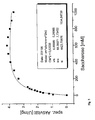
- sucrose synthase was used to determine the Michaelis-Menten kinetics of sucrose cleavage with UDP as a function of the sucrose concentration.
- the reaction conditions for this were as follows: UDP concentration 1.6 mM Sucrose synthase 14 mU Buffer (HEPES-KOH, pH 7.6) 200 mM volume 1 ml
- the reactions were carried out at a temperature of 30 ° C; the reaction time was 10 minutes each.
- reaction mixture was sterile filtered and then stirred overnight at 30 ° C. The next day, the reaction solution in an Amicon cell type 8050 with a YM 10 membrane (cut-off of 10,000 d) concentrated to 10 ml. This left the Proteins in the approach, while the reaction products were withdrawn.
- the reactions were incubated for 24 hours at 30 ° C and the reactions then stopped at 95 ° C for 5 minutes.
Landscapes
- Life Sciences & Earth Sciences (AREA)
- Health & Medical Sciences (AREA)
- Genetics & Genomics (AREA)
- Chemical & Material Sciences (AREA)
- Engineering & Computer Science (AREA)
- Bioinformatics & Cheminformatics (AREA)
- Organic Chemistry (AREA)
- Zoology (AREA)
- Wood Science & Technology (AREA)
- Biomedical Technology (AREA)
- General Engineering & Computer Science (AREA)
- Biotechnology (AREA)
- Mycology (AREA)
- Microbiology (AREA)
- Biochemistry (AREA)
- General Health & Medical Sciences (AREA)
- Molecular Biology (AREA)
- Plant Pathology (AREA)
- Biophysics (AREA)
- Physics & Mathematics (AREA)
- Medicinal Chemistry (AREA)
- Enzymes And Modification Thereof (AREA)
- Micro-Organisms Or Cultivation Processes Thereof (AREA)
- Preparation Of Compounds By Using Micro-Organisms (AREA)
Claims (15)
- Procédé pour augmenter l'expression génique de la saccharose synthase
caractérisé en ce que l'expression de la saccharose synthase à partir du gène de la saccharose synthase provenant de solanum tuberosum s'effectue sous le contrôle d'un promoteur de proton-ATPase provenant de saccharomyces cerevisiae, qui est incorporé dans un assemblage de gène, par lequel saccharomyces cerevisiae est transformé. - Procédé suivant la revendication 1
caractérisé en ce que le promoteur de proton-ATPase est en amont du gène de la saccharose synthase. - Procédé suivant l'une des revendications 1 ou 2
caractérisé en ce que l'expression génique de la saccharose synthase est augmentée en outre en augmentant le nombre de copies du gène de la saccharose synthase et du promoteur de la proton-ATPase. - Procédé suivant l'une des revendications précédentes
caractérisé en ce que la saccharose synthase est en outre purifiée. - Procédé suivant la revendication 4
caractérisé en ce qu'un stade de purification comprend une chromatographie avec échange d'ions. - Procédé suivant la revendication 5
caractérisé en ce que la chromatographie avec échange d'ions est une chromatographie avec échange d'anions. - Procédé suivant l'une des revendications 4 à 6
caractérisé en ce qu'un stade de purification comprend une ultrafiltration. - Procédé suivant l'une des revendications 4 à 7
caractérisé en ce que pour purifier finement l'enzyme une opération de purification sur sépharose de chélation est effectuée. - Gène de la saccharose synthase provenant de solanum tuberosum ayant un promoteur de proton-ATPase en amont provenant de saccharomyces cerevisiae.
- Structure de gène contenant un gène de saccharose synthase suivant la revendication 9.
- Vecteur contenant un gène de saccharose synthase suivant la revendication 9 ou une structure de gène suivant la revendication 10.
- Cellule transformée contenant sous une forme réplicable un gène de saccharose synthase suivant la revendication 9.
- Cellule transformée suivant la question 12 contenant une structure de gène suivant la revendication 10 ou un vecteur suivant la revendication 11.
- Cellule transformée suivant la revendication 12 ou 13
caractérisée en ce que c'est une cellule de levure. - Cellule transformée suivant la revendication 14
caractérisée en ce que c'est saccharomyces cerevisiae.
Applications Claiming Priority (3)
| Application Number | Priority Date | Filing Date | Title |
|---|---|---|---|
| DE19736343A DE19736343B4 (de) | 1997-08-21 | 1997-08-21 | Verfahren zur Erhöhung der Genexpression von Saccharose Synthase |
| DE19736343 | 1997-08-21 | ||
| PCT/EP1998/005309 WO1999010511A1 (fr) | 1997-08-21 | 1998-08-20 | Procede d'augmentation de l'expression genique de saccharose synthase |
Publications (2)
| Publication Number | Publication Date |
|---|---|
| EP1007702A1 EP1007702A1 (fr) | 2000-06-14 |
| EP1007702B1 true EP1007702B1 (fr) | 2005-08-17 |
Family
ID=7839690
Family Applications (1)
| Application Number | Title | Priority Date | Filing Date |
|---|---|---|---|
| EP98949962A Expired - Lifetime EP1007702B1 (fr) | 1997-08-21 | 1998-08-20 | Procede d'augmentation de l'expression du gene de la saccharose synthase |
Country Status (7)
| Country | Link |
|---|---|
| US (1) | US6444454B1 (fr) |
| EP (1) | EP1007702B1 (fr) |
| JP (1) | JP2001514008A (fr) |
| CA (1) | CA2300953A1 (fr) |
| DE (2) | DE19736343B4 (fr) |
| NO (1) | NO20000817D0 (fr) |
| WO (1) | WO1999010511A1 (fr) |
Families Citing this family (1)
| Publication number | Priority date | Publication date | Assignee | Title |
|---|---|---|---|---|
| ES2245867B1 (es) | 2004-02-05 | 2007-04-01 | Universidad Publica De Navarra | Procedimiento produccion sacarosa sintasa recombinante a partir de escherichia coli y uso en fabricacion de kits de determinacion de sacarosa, produccion de azucares-nucleotidos y obtencion de plantas transgenicas con alto contenido de almidon y alto balance amilosa/amilopectina. |
Family Cites Families (4)
| Publication number | Priority date | Publication date | Assignee | Title |
|---|---|---|---|---|
| CA1304020C (fr) * | 1987-03-23 | 1992-06-23 | Meher H. Irani | Haut niveau d'expression dans la levure |
| DE4220759A1 (de) | 1992-06-24 | 1994-01-05 | Inst Genbiologische Forschung | DNA-Sequenzen für Oligosaccharid-Transporter, Plasmide, Bakterien und Pflanzen enthaltend einen Transporter sowie Verfahren zur Herstellung und Transformation von Hefestämmen zur Identifikation des Transporteers |
| US5750389A (en) | 1992-07-01 | 1998-05-12 | Forschungszentrum Julich Gmbh | Purified saccharose-synthase, process for its production and its use |
| JPH08173170A (ja) | 1994-05-25 | 1996-07-09 | Kirin Brewery Co Ltd | キャンディダ・ユティリス酵母の形質転換系、およびそれによる異種遺伝子の発現 |
-
1997
- 1997-08-21 DE DE19736343A patent/DE19736343B4/de not_active Expired - Fee Related
-
1998
- 1998-08-20 CA CA002300953A patent/CA2300953A1/fr not_active Abandoned
- 1998-08-20 JP JP2000507819A patent/JP2001514008A/ja not_active Withdrawn
- 1998-08-20 WO PCT/EP1998/005309 patent/WO1999010511A1/fr not_active Ceased
- 1998-08-20 US US09/486,291 patent/US6444454B1/en not_active Expired - Fee Related
- 1998-08-20 DE DE59813015T patent/DE59813015D1/de not_active Expired - Fee Related
- 1998-08-20 EP EP98949962A patent/EP1007702B1/fr not_active Expired - Lifetime
-
2000
- 2000-02-18 NO NO20000817A patent/NO20000817D0/no not_active Application Discontinuation
Non-Patent Citations (2)
| Title |
|---|
| GIETZ R.D.; SUGINO A.: "New yeast-Escherichia coli shuttle vectors constructed with in vitro mutagenized yeast genes lacking six-base pair restriction sites", GENE, vol. 74, 1988, pages 527 - 534 * |
| RENTSCH D. ET AL: "NTR1 encodes a high affinity oligopeptide transporter in Arabidopsis", FEBS LETTERS, vol. 370, 1995, pages 264 - 268 * |
Also Published As
| Publication number | Publication date |
|---|---|
| WO1999010511A1 (fr) | 1999-03-04 |
| NO20000817L (no) | 2000-02-18 |
| US6444454B1 (en) | 2002-09-03 |
| NO20000817D0 (no) | 2000-02-18 |
| JP2001514008A (ja) | 2001-09-11 |
| EP1007702A1 (fr) | 2000-06-14 |
| DE19736343A1 (de) | 1999-02-25 |
| CA2300953A1 (fr) | 1999-03-04 |
| DE19736343B4 (de) | 2006-02-09 |
| DE59813015D1 (de) | 2005-09-22 |
Similar Documents
| Publication | Publication Date | Title |
|---|---|---|
| DE4226971C2 (de) | Modifizierte Pilzzellen und Verfahren zur Herstellung rekombinanter Produkte | |
| DE3587168T2 (de) | Glucoamylasegen. | |
| DE69333180T2 (de) | Für oligosaccharidetransporter kodierende dna sequenzen | |
| DE19626564A1 (de) | Genetische Transformation von Ciliatenzellen durch Microcarrier-Bombardement mit DNA beladenen Goldpartikeln | |
| DE19509695A1 (de) | Verfahren zur Herstellung einer modifizieren Stärke in Pflanzen, sowie die aus den Pflanzen isolierbare modifizierte Stärke | |
| DE69028769T2 (de) | Thermostabile (1,3-1,4)-beta-glucanase | |
| KR102186997B1 (ko) | 단백질 정제의 신규한 방법 | |
| DE3688743T2 (de) | Hefestaemme. | |
| DE19502053A1 (de) | Verfahren und DNA-Moleküle zur Steigerung der Photosyntheserate in Pflanzen, sowie Pflanzenzellen und Pflanzen mit gesteigerter Photosyntheserate | |
| DE69034051T2 (de) | Stabil transformierte Hefezellen und ihre Verwendung zur Herstellung von Albumin | |
| CH640268A5 (en) | Process for the preparation of filamentous hybrid phages, novel hybrid phages and their use | |
| DE68907166T2 (de) | Verfahren zur Herstellung von menschlichem Lysozym. | |
| DE19736343B4 (de) | Verfahren zur Erhöhung der Genexpression von Saccharose Synthase | |
| DE19853778C1 (de) | DNA-Sequenzen kodierend einen Glutamat/Malat-Translokator, Plasmide Bakterien, Hefen und Pflanzen enthaltend diesen Transporter | |
| EP0300425B1 (fr) | Procédé de production de protéines sous forme soluble | |
| EP1280893B1 (fr) | Procede de production de proteines dans une levure du genre arxula et promoteurs adaptes a cette fin | |
| DE69122940T2 (de) | Von E-coli abgeleitete stromaufwärts gelegene, in Hefe wirksame, regulatorische Sequenzen | |
| EP1918379B1 (fr) | Vecteurs d'expression pour l'intégration multiple de gène et l'expression des protéines homologues et hétérologues en levures de l'espèce Arxula | |
| EP0846180A1 (fr) | Cellules vegetales transgeniques et plantes a taux de glycolyse augmente | |
| JPH08509867A (ja) | イースト菌株およびイースト中での異種構造たんぱく質の発現方法 | |
| DE19732926C2 (de) | DNA-Sequenzen, kodierend einen Glukose-6-phosphat-Phosphat-Translokator, sowie Plasmide, Bakterien, Hefen und Pflanzen, enthaltend diesen Transporter | |
| EP0323838B1 (fr) | Vecteur d'expression et procédé de préparation réglable des protéins en eucaryotes | |
| DE19632121C2 (de) | Transgene Pflanzenzellen und Pflanzen mit veränderter Acetyl-CoA-Bildung | |
| DE4417879A1 (de) | DNA-Sequenzen die die Synthese linearer alpha-1,4-Glukane in Pflanzen, Pilzen und Mikroorganismen ermöglichen | |
| DE4447388A1 (de) | DNA-Sequenzen, die die Synthese linearer alpha-1,4-Glukane in Pflanzen, Pilzen und Mikroorganismen ermöglichen |
Legal Events
| Date | Code | Title | Description |
|---|---|---|---|
| PUAI | Public reference made under article 153(3) epc to a published international application that has entered the european phase |
Free format text: ORIGINAL CODE: 0009012 |
|
| 17P | Request for examination filed |
Effective date: 20000201 |
|
| AK | Designated contracting states |
Kind code of ref document: A1 Designated state(s): BE CH DE DK FR GB IT LI NL SE |
|
| RAP1 | Party data changed (applicant data changed or rights of an application transferred) |
Owner name: FORSCHUNGSZENTRUM JUELICH GMBH |
|
| 17Q | First examination report despatched |
Effective date: 20031120 |
|
| GRAP | Despatch of communication of intention to grant a patent |
Free format text: ORIGINAL CODE: EPIDOSNIGR1 |
|
| GRAS | Grant fee paid |
Free format text: ORIGINAL CODE: EPIDOSNIGR3 |
|
| GRAA | (expected) grant |
Free format text: ORIGINAL CODE: 0009210 |
|
| PGFP | Annual fee paid to national office [announced via postgrant information from national office to epo] |
Ref country code: DE Payment date: 20050722 Year of fee payment: 8 |
|
| AK | Designated contracting states |
Kind code of ref document: B1 Designated state(s): BE CH DE DK FR GB IT LI NL SE |
|
| PG25 | Lapsed in a contracting state [announced via postgrant information from national office to epo] |
Ref country code: NL Free format text: LAPSE BECAUSE OF FAILURE TO SUBMIT A TRANSLATION OF THE DESCRIPTION OR TO PAY THE FEE WITHIN THE PRESCRIBED TIME-LIMIT Effective date: 20050817 Ref country code: IT Free format text: LAPSE BECAUSE OF FAILURE TO SUBMIT A TRANSLATION OF THE DESCRIPTION OR TO PAY THE FEE WITHIN THE PRESCRIBED TIME-LIMIT;WARNING: LAPSES OF ITALIAN PATENTS WITH EFFECTIVE DATE BEFORE 2007 MAY HAVE OCCURRED AT ANY TIME BEFORE 2007. THE CORRECT EFFECTIVE DATE MAY BE DIFFERENT FROM THE ONE RECORDED. Effective date: 20050817 Ref country code: GB Free format text: LAPSE BECAUSE OF FAILURE TO SUBMIT A TRANSLATION OF THE DESCRIPTION OR TO PAY THE FEE WITHIN THE PRESCRIBED TIME-LIMIT Effective date: 20050817 |
|
| REG | Reference to a national code |
Ref country code: GB Ref legal event code: FG4D Free format text: NOT ENGLISH |
|
| PG25 | Lapsed in a contracting state [announced via postgrant information from national office to epo] |
Ref country code: LI Free format text: LAPSE BECAUSE OF NON-PAYMENT OF DUE FEES Effective date: 20050831 Ref country code: CH Free format text: LAPSE BECAUSE OF NON-PAYMENT OF DUE FEES Effective date: 20050831 Ref country code: BE Free format text: LAPSE BECAUSE OF NON-PAYMENT OF DUE FEES Effective date: 20050831 |
|
| REG | Reference to a national code |
Ref country code: CH Ref legal event code: EP |
|
| REF | Corresponds to: |
Ref document number: 59813015 Country of ref document: DE Date of ref document: 20050922 Kind code of ref document: P |
|
| PG25 | Lapsed in a contracting state [announced via postgrant information from national office to epo] |
Ref country code: SE Free format text: LAPSE BECAUSE OF FAILURE TO SUBMIT A TRANSLATION OF THE DESCRIPTION OR TO PAY THE FEE WITHIN THE PRESCRIBED TIME-LIMIT Effective date: 20051117 Ref country code: DK Free format text: LAPSE BECAUSE OF FAILURE TO SUBMIT A TRANSLATION OF THE DESCRIPTION OR TO PAY THE FEE WITHIN THE PRESCRIBED TIME-LIMIT Effective date: 20051117 |
|
| NLV1 | Nl: lapsed or annulled due to failure to fulfill the requirements of art. 29p and 29m of the patents act | ||
| GBV | Gb: ep patent (uk) treated as always having been void in accordance with gb section 77(7)/1977 [no translation filed] |
Effective date: 20050817 |
|
| REG | Reference to a national code |
Ref country code: CH Ref legal event code: PL |
|
| PLBE | No opposition filed within time limit |
Free format text: ORIGINAL CODE: 0009261 |
|
| STAA | Information on the status of an ep patent application or granted ep patent |
Free format text: STATUS: NO OPPOSITION FILED WITHIN TIME LIMIT |
|
| 26N | No opposition filed |
Effective date: 20060518 |
|
| PG25 | Lapsed in a contracting state [announced via postgrant information from national office to epo] |
Ref country code: FR Free format text: LAPSE BECAUSE OF FAILURE TO SUBMIT A TRANSLATION OF THE DESCRIPTION OR TO PAY THE FEE WITHIN THE PRESCRIBED TIME-LIMIT Effective date: 20060818 |
|
| EN | Fr: translation not filed | ||
| PG25 | Lapsed in a contracting state [announced via postgrant information from national office to epo] |
Ref country code: DE Free format text: LAPSE BECAUSE OF NON-PAYMENT OF DUE FEES Effective date: 20070301 |
|
| BERE | Be: lapsed |
Owner name: FORSCHUNGSZENTRUM JULICH G.M.B.H. Effective date: 20050831 |
|
| PG25 | Lapsed in a contracting state [announced via postgrant information from national office to epo] |
Ref country code: FR Free format text: LAPSE BECAUSE OF FAILURE TO SUBMIT A TRANSLATION OF THE DESCRIPTION OR TO PAY THE FEE WITHIN THE PRESCRIBED TIME-LIMIT Effective date: 20050831 |
|
| PG25 | Lapsed in a contracting state [announced via postgrant information from national office to epo] |
Ref country code: FR Free format text: LAPSE BECAUSE OF FAILURE TO SUBMIT A TRANSLATION OF THE DESCRIPTION OR TO PAY THE FEE WITHIN THE PRESCRIBED TIME-LIMIT Effective date: 20050817 |