EP1007702B1 - Method for increasing the gene expression of saccharose synthase - Google Patents
Method for increasing the gene expression of saccharose synthase Download PDFInfo
- Publication number
- EP1007702B1 EP1007702B1 EP98949962A EP98949962A EP1007702B1 EP 1007702 B1 EP1007702 B1 EP 1007702B1 EP 98949962 A EP98949962 A EP 98949962A EP 98949962 A EP98949962 A EP 98949962A EP 1007702 B1 EP1007702 B1 EP 1007702B1
- Authority
- EP
- European Patent Office
- Prior art keywords
- gene
- saccharose synthase
- saccharose
- sucrose
- enzyme
- Prior art date
- Legal status (The legal status is an assumption and is not a legal conclusion. Google has not performed a legal analysis and makes no representation as to the accuracy of the status listed.)
- Expired - Lifetime
Links
- QCNANSHOVAHMSD-UHFFFAOYSA-N C=CC1=CC=CC1 Chemical compound C=CC1=CC=CC1 QCNANSHOVAHMSD-UHFFFAOYSA-N 0.000 description 1
Images


Classifications
-
- C—CHEMISTRY; METALLURGY
- C12—BIOCHEMISTRY; BEER; SPIRITS; WINE; VINEGAR; MICROBIOLOGY; ENZYMOLOGY; MUTATION OR GENETIC ENGINEERING
- C12N—MICROORGANISMS OR ENZYMES; COMPOSITIONS THEREOF; PROPAGATING, PRESERVING, OR MAINTAINING MICROORGANISMS; MUTATION OR GENETIC ENGINEERING; CULTURE MEDIA
- C12N9/00—Enzymes; Proenzymes; Compositions thereof; Processes for preparing, activating, inhibiting, separating or purifying enzymes
- C12N9/10—Transferases (2.)
- C12N9/1048—Glycosyltransferases (2.4)
- C12N9/1051—Hexosyltransferases (2.4.1)
- C12N9/1062—Sucrose synthase (2.4.1.13)
-
- C—CHEMISTRY; METALLURGY
- C12—BIOCHEMISTRY; BEER; SPIRITS; WINE; VINEGAR; MICROBIOLOGY; ENZYMOLOGY; MUTATION OR GENETIC ENGINEERING
- C12N—MICROORGANISMS OR ENZYMES; COMPOSITIONS THEREOF; PROPAGATING, PRESERVING, OR MAINTAINING MICROORGANISMS; MUTATION OR GENETIC ENGINEERING; CULTURE MEDIA
- C12N15/00—Mutation or genetic engineering; DNA or RNA concerning genetic engineering, vectors, e.g. plasmids, or their isolation, preparation or purification; Use of hosts therefor
- C12N15/09—Recombinant DNA-technology
- C12N15/63—Introduction of foreign genetic material using vectors; Vectors; Use of hosts therefor; Regulation of expression
- C12N15/79—Vectors or expression systems specially adapted for eukaryotic hosts
- C12N15/80—Vectors or expression systems specially adapted for eukaryotic hosts for fungi
- C12N15/81—Vectors or expression systems specially adapted for eukaryotic hosts for fungi for yeasts
Definitions
- the invention relates to a method for increasing the gene expression of sucrose Synthase according to claims 1 to 8, a sucrose synthase gene according to claim 9, Gene structures according to claim 10, vectors according to claim 11 and transformed cells according to claim 12 to 15.
- Sucrose synthase is a plant-restricted enzyme. From many higher In the meantime, plants are each known to have two different genes per species; come with the rice even 3 different genes. Little in their biochemical properties different, they serve with different promoters especially one exact control of enzyme expression in different stages of development and Organs of the plant. So in rice 8 days after germination comes the sucrose synthase 1 especially in root and stem before, while the sucrose 2 synthase throughout Plant distributed occurs. Sucrose synthase 3 is particularly self-filling rice grains active, ie in a completely different life phase of the plant.
- the enzyme serves to cleave sucrose according to the following equation, whereby in vivo only the cleavage reaction has meaning:
- sucrose as a transport form of carbohydrates in plants is so in their Target cells, such as cells of the storage organs, seeds, developing plant organs, in split directly usable UDP-glucose and fructose. While the fructose For further use must first be rearranged, the UDP-glucose is directly available for the synthesis of starch and cellulose.
- nucleoside diphosphates prefer UDP, ADP and TDP.
- sucrose-analogous disaccharides become accessible.
- glycoconjugates such as Glycolipids and glycoproteins. Since glycoconjugates are also involved in the communication of Many of these structures also have a meaning in of medical research.
- the enzyme is recoverable from different plant sources.
- the seeds For the Processing, for example from rice seeds, the seeds must first be swollen become; then they are unlocked, the solid ingredients largely filtered off and prepurified the filtrate on an ion exchange column. That after the Large volume column step is concentrated and subjected to gel filtration. their active fractions can be used for syntheses (see also DE 4 221 595).
- sucrose synthase from rice seeds only a low activity of 0.56 units per gram Dry weight.
- disturbing the purification are the abundant existing carbohydrates in the form of starch and cellulose.
- invertase which splits sucrose, can not be completely separated.
- a reduction of the additionally interfering enzyme phosphatase, which decomposes NDPs, and Nucleotide-sugar-cleaving enzymes that degrade NDP sugars would be useful.
- it is disadvantageous that the sucrose synthase in rice does not appear as pure enzyme, but is present in varying ratios of isoenzymes, the obviously have different synthesis properties.
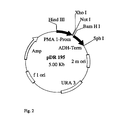
- sucrose synthase gene from Solanum tuberosum (compare Salanoubat, M. and Belliard, G .: Molecular cloning and sequencing of sucrose synthase cDNA from potato (Solanum tuberosum L.): preliminory characterization of sucrose synthase mRNA distribution, in Gene 60, 47-56, 1987) in the Saccharomyces cerevisiae strain YSH (see Riesmeier, JW et al .: Isolation and characterization of a sucrose carrier cDNA from spinach by functional expression in yeast, EMBO J 11 (13), 4705-4713, (1992), for which the gene was cloned into the plasmid 128A2 under the control of an ADH promoter (see Figure 1) and subsequently transformed into the yeast strain mentioned
- the ADH promoter normally regulates the reading frequency of the yeast enzyme alcohol dehydrogenase, which is constitutively expressed and therefore always present in roughly equal amounts in
- the obtained expression gave the yeast strain the Ability to split sucrose. However, that was specific Activity of the enzyme is relatively low. Depending on Method of determination were 5 to 25 mU sucrose synthase / mg Protein determined.
- NRR1 encodes a higher affinity oligopeptide transporter in Avatidopsis by Doris Rentsch et. as (FEBS Letters 370 (1995) 264-268) shows a heterologous Complementation of yeast mutants which has enabled 8 genes that for different families of amino acid transporters encode to isolate.
- WO 94/00574 discloses a DNA sequence encoding an oligosaccharide transporter, its introduction into a Plant genome the formation and transport of Storage material in transgenic plants, bacteria and Modified plasmids.
- the object is achieved according to the invention by a method in which the expression of the sucrose synthase gene among the Control of a proton ATPase promoter is provided. Therefore the proton ATPase promoter becomes the sucrose synthase gene in particular upstream.
- the gene is preferably derived Solanum tuberosum, while the proton ATPase promoter preferably from yeast, in particular from Saccharomyces cerevisiae is native.
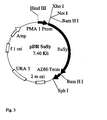
- the gene with the promoter is incorporated into a gene construct, preferably into the plasmid pDR195 (see Figure 2), and the gene construct is subsequently transformed into a microorganism, in particular into the yeast strain Saccharomyces cerevisiae 22574d (compare Jauniaux, J.-C. et al , Nitrogen catabolite regulation of proline permease in Saccharomyces cerevisiae, Cloning of the PUT4 gene and study of PUT4 RNA levels in wild-type and mutant strains, Eur. J. Biochem., 164 , 601-606, 1987).
- the recombinant enzyme is preferably added after disruption of the cells purified by ion exchange and ultrafiltration. As it is for protein-chemical Applications often necessary to provide very pure protein is done for the Further purification of the mentioned technical enzyme preparation therefore in particular a further cleaning at Chelating Sepharose.
- sucrose synthase is for Cleavage of disaccharides, such as 2-deoxysucrose or N-acetylsucrosamine, usable with UDP.
- the enzyme is for the cleavage of Sucrose with ADP.
- the recombinant enzyme is generally as useful as the enzyme from rice (see. Patent DE 42 21 595)
- the sus1 gene was excised by means of the restriction enzyme BamHI.
- the cut products were separated electrophoretically in an agarose gel, the sus1 sequence cut out and eluted.
- the vector pDR195 ( Figure 2) was also digested with the restriction enzyme BamHI cut. This approach was then purified by phenolization, with Ethanol precipitated, taken up again and dephosphorylated with alkaline phosphatase. The alkaline phosphatase was incubated with 50 mM EDTA at 65 ° C within 30 minutes deactivated. It was phenolated again and then precipitated with ethanol.
- the yeast cells were grown overnight at 30 ° C and 200 revolutions per minute in 5 ml YPD medium: 10 g yeast extract 20 g peptone 20 g glucose to 1 liter dist. Water.
- the yeasts of strain 22574d thus transformed with plasmid pDRSuSy were grown on plates for 2 days at 30 ° C. The colonies showing were further propagated on SD medium. In addition, these colonies were grown in liquid SD medium to the stationary phase (30 ° C, 120 rpm shaking rate), the cells were disrupted and the resulting extract compared to the non-transformed cell extract on a 10% SDS Polyacrylamide gel separated by electrophoresis. In parallel, the extract was measured by an enzyme assay (Elling, L. and Kula, M.-R .: Purification of sucrose synthase from rice and its protein-chemical characterization, J. Biotechnol., 29 , 277-286, 1993).
- the polyacrylamide gel yielded a 90,000 kD band in the transformed cells, the lacked in the untransformed. A band of this size was for the monomer the sucrose synthase is expected.
- the enzyme test provided a clear activity of the Extract of the transformed cells. In contrast, the activity was the untransformed Cells below the detection limit.
- the cells are harvested by centrifugation, in 200 mM HEPES pH 7.6 in the ratio Recorded 4: 6 (w / w) and can then be unlocked directly or for a few months -20 ° C are stored.
- the cells taken up in 200 mM HEPES pH 7.6 were placed in a glass bead mill Grind for 20 minutes at 4000 revolutions per minute.
- the used glass beads had a diameter of 0.5 mm.
- the suspension was kept on ice.
- the fixed Ingredients by centrifuging at 15000 rpm and 4 ° C above Separated 15 minutes.
- sucrose synthase was then purified by anion exchange chromatography purified.
- the chromatographic unit consisted of a column with 300 ml of Q-Sepharose FF, a P1 pump, a detector UV-1 (280 nm), a Fraction collector Frac 300 and a recorder REC 101. All materials came from from Pharmacia.
- the salt gradient was treated with buffer A (standard buffer with 0.1 M KCl) and buffer B (Standard buffer with 0.4 M KCl) started.
- the total volume of the gradient was 1 Liter, but can also be stretched to 1.5 liters. In the range between 0.2 and 0.3 M KCl elutes the sucrose synthase.
- the column was regenerated with the following rinsing scheme: 500 ml of 0.1 M potassium acetate pH 4.0 with 1 M NaCl; 1 liter of water; 300 ml 2 M NaOH; 1 liter of water; 500 ml 50 mM HEPES pH7.6 with 1 M NaCl; 1 liter of water.
- the gel was placed in 20% ethanol.
- sucrose synthase-containing fractions were pooled and successively concentrated in a 50 ml ultrafiltration cell from Amicon.
- a membrane served a Amicon YM30 (exclusion size 30000d), diameter 43 mm.
- Per run of a 300 ml Q-Sepharose FF column can be concentrated to 5 to 10 ml.
- the resulting preparation is suitable for syntheses.
- the column Prior to sample loading, the column was equilibrated as follows: It was first with 150 mM KCl in 200 mM HEPES pH 7.2, then with 3 column volumes of this buffer and 10 mM imidazole and finally rinsed with this buffer and 1 mM imidazole.
- the sample or protein solution was first adjusted to a concentration of 1 mM Imidazole brought and then pumped through the column. Unbound proteins were removed from the column with 1 mM imidazole in 150 mM KCl and 200 mM HEPES pH 7.2 washed. Gradual elution of bound proteins was via an imidazole gradient from 1 mM to 70 mM in 150 mM KCl and 200 mM HEPES pH 7.2. there Most proteins appear at 20 to 30 mM imidazole while the sucrose Synthase appears at 30 to 55 mM.
- the column With the aid of a subsequent washing step with 100 mM imidazole in 150 mM KCl and 200 mM HEPES pH 7.2, the column was in the state of re-usability brought. If further use is not desired, the copper will be with 3 column volumes Washed down 10 mM EDTA in 150 mM KCL and 200 mM HEPES pH 7.2. For complete cleaning, another wash with 3 column volumes 50 mM EDTA in water. This returns the material to its original state. It is stored in 20% ethanol at 4 ° C.
- Table 1 shows a comparison of the purification schemes of yeast and rice.
- the following steps of ion exchange chromatography and ultrafiltration occur Yeast and rice identical: the chromatography on Q-Sepharose FF, the ultrafiltration on Membranes with a cut-off of 30,000 Da.
- the rice preparation must subsequently still be finely cleaned on a gel filtration column to still existing invertase separate, but not completely succeed. This leads to the application of the Sucrose synthase in syntheses to unwanted degradation reactions of the products.
- yeast does not contain invertase when placed on sucrose-free medium attracts. A fine cleaning by gel filtration is therefore not necessary. This saves Material, accelerates the purification process and increases the yield of enzyme, provides So an economic advantage.
- Table 2 shows a comparison of two preparations of yeast and rice after the Purification scheme of Table 1:
- the activity present in the biomass is in the Yeast 10 times higher than in rice.
- the specific one is correspondingly higher Activity of the enzyme in the crude digest.
- a larger amount of enzyme can be purified per column run.
- the recombinant enzyme is yeast cleaner than the enzyme from rice. More important, however, is that the preparation of the recombinant enzyme does not contain any relevant quantities of secondary activities.
- the enzyme from yeast is the cleaning with a total yield of 40% completed.
- the rice preparation still has a gel filtration step be subjected, which increases the cleanliness by a factor of 10, but the Side activities can only be separated off insufficiently. Instead, the yield of the Total cleaning to 11.3%.
- Table 3 compares the side activities in the described enzyme preparations Yeast and rice. As shown in Table 1, purification involves the recombinant Yeast enzyme is 4 steps, while rice cleaning involves 5 steps. In In both cases, the NDP-degrading phosphatases can be completely removed. The Invertase not present in yeast due to culture conditions is in the Preparation of rice is still present in such quantities that some slow synthesis reactions be greatly disturbed, since the invertase the synthesis product immediately again splits. UDP-glucose degrading activities occur in the preparation of yeast in much to a lesser extent.
- sucrose synthase was used to determine the Michaelis-Menten kinetics of sucrose cleavage with UDP as a function of the sucrose concentration.
- the reaction conditions for this were as follows: UDP concentration 1.6 mM Sucrose synthase 14 mU Buffer (HEPES-KOH, pH 7.6) 200 mM volume 1 ml
- the reactions were carried out at a temperature of 30 ° C; the reaction time was 10 minutes each.
- reaction mixture was sterile filtered and then stirred overnight at 30 ° C. The next day, the reaction solution in an Amicon cell type 8050 with a YM 10 membrane (cut-off of 10,000 d) concentrated to 10 ml. This left the Proteins in the approach, while the reaction products were withdrawn.
- the reactions were incubated for 24 hours at 30 ° C and the reactions then stopped at 95 ° C for 5 minutes.
Landscapes
- Life Sciences & Earth Sciences (AREA)
- Health & Medical Sciences (AREA)
- Genetics & Genomics (AREA)
- Chemical & Material Sciences (AREA)
- Engineering & Computer Science (AREA)
- Bioinformatics & Cheminformatics (AREA)
- Organic Chemistry (AREA)
- Zoology (AREA)
- Wood Science & Technology (AREA)
- Biomedical Technology (AREA)
- General Engineering & Computer Science (AREA)
- Biotechnology (AREA)
- Mycology (AREA)
- Microbiology (AREA)
- Biochemistry (AREA)
- General Health & Medical Sciences (AREA)
- Molecular Biology (AREA)
- Plant Pathology (AREA)
- Biophysics (AREA)
- Physics & Mathematics (AREA)
- Medicinal Chemistry (AREA)
- Enzymes And Modification Thereof (AREA)
- Micro-Organisms Or Cultivation Processes Thereof (AREA)
- Preparation Of Compounds By Using Micro-Organisms (AREA)
Description
Die Erfindung betrifft ein Verfahren zur Erhöhung der Genexpression von Saccharose
Synthase gemäß den Ansprüchen 1 bis 8, ein Saccharose Synthasegen gemäß Anspruch 9,
Genstrukturen nach Anspruch 10, Vektoren nach Anspruch 11 sowie transformierte Zellen
nach Anspruch 12 bis 15.The invention relates to a method for increasing the gene expression of sucrose
Synthase according to
Die Saccharose Synthase ist ein auf Pflanzen beschränktes Enzym. Von vielen höheren
Pflanzen sind inzwischen je 2 unterschiedliche Gene pro Art bekannt; beim Reis kommen
sogar 3 unterschiedliche Gene vor. In ihren biochemischen Eigenschaften nur wenig
unterschiedlich, dienen sie mit unterschiedlichen Promotoren ausgestattet vor allem einer
exakten Steuerung der Enzymexpression in unterschiedlichen Entwicklungsstadien und
Organen der Pflanze. So kommt im Reis 8 Tage nach der Keimung die Saccharose Synthase 1
besonders in Wurzel und Stengel vor, während die Saccharose Synthase 2 in der gesamten
Pflanze verteilt vorkommt. Saccharose Synthase 3 ist besonders in sich füllenden Reiskörnern
aktiv, also in einer ganz anderen Lebensphase der Pflanze.Sucrose synthase is a plant-restricted enzyme. From many higher
In the meantime, plants are each known to have two different genes per species; come with the rice
even 3 different genes. Little in their biochemical properties
different, they serve with different promoters especially one
exact control of enzyme expression in different stages of development and
Organs of the plant. So in rice 8 days after germination comes the
In der Pflanze dient das Enzym der Spaltung von Saccharose gemäß folgender Gleichung,
wobei in vivo ausschließlich die Spaltreaktion Bedeutung hat:

Die Saccharose als Transportform der Kohlenhydrate in Pflanzen wird so in ihren Zielzellen, wie Zellen der Speicherorgane, Samen, sich entwickelnde Pflanzenorgane, in die direkt weiter nutzbare UDP-Glucose und Fructose gespalten. Während die Fructose für weitere Nutzungen zunächst umgelagert werden muß, steht die UDP-Glucose direkt für die Synthese von Stärke und Cellulose zur Verfügung.The sucrose as a transport form of carbohydrates in plants is so in their Target cells, such as cells of the storage organs, seeds, developing plant organs, in split directly usable UDP-glucose and fructose. While the fructose For further use must first be rearranged, the UDP-glucose is directly available for the synthesis of starch and cellulose.
Von wirtschaftlichem und wissenschaftlichem Interesse sind sowohl Spalt- wie Syntheserichtung des Enzyms. In Syntheserichtung wird eine Vielzahl von räumlich ähnlich aufgebauten Zuckern und Nichtzuckern akzeptiert. In Spaltrichtung werden Derivate der Saccharose akzeptiert, außerdem bevorzugt die Nucleosiddiphosphate (NDPs) UDP, ADP und TDP.Of economic and scientific interest are both gap and synthesis direction of the enzyme. In the synthesis direction, a variety of spatially similar built up sugars and non-sugars accepted. In cleavage, derivatives of Sucrose, moreover, the nucleoside diphosphates (NDPs) prefer UDP, ADP and TDP.
Somit wird eine große Zahl von saccharoseanalogen Disacchariden zugänglich. Diese sind interessant zur Erforschung von Struktur und Funktion von Glykokonjugaten, wie Glykolipiden und Glykoproteinen. Da Glykokonjugate auch an der Kommunikation der Zellen untereinander beteiligt sind, haben viele dieser Strukturen auch eine Bedeutung in der medizinischen Forschung.Thus, a large number of sucrose-analogous disaccharides become accessible. These are interesting to study the structure and function of glycoconjugates, such as Glycolipids and glycoproteins. Since glycoconjugates are also involved in the communication of Many of these structures also have a meaning in of medical research.
Gewinnbar ist das Enzym aus unterschiedlichen pflanzlichen Quellen. Für die Aufarbeitung beispielsweise aus Reissamen müssen die Samen zunächst gequollen werden; anschließend werden sie aufgeschlossen, die festen Bestandteile weitgehend abfiltriert und das Filtrat an einer Ionenaustauschersäule vorgereinigt. Das nach dem Säulenschritt große Volumen wird eingeengt und einer Gelfiltration unterworfen. Deren aktive Fraktionen sind für Synthesen verwendbar (vgl. dazu auch DE 4 221 595).The enzyme is recoverable from different plant sources. For the Processing, for example from rice seeds, the seeds must first be swollen become; then they are unlocked, the solid ingredients largely filtered off and prepurified the filtrate on an ion exchange column. That after the Large volume column step is concentrated and subjected to gel filtration. their active fractions can be used for syntheses (see also DE 4 221 595).
Die beschriebene Gewinnung der Saccharose Synthase aus Reissamen ist insofern problematisch, als Reissamen nur eine geringe Aktivität von 0,56 Units pro Gramm Trockengewicht besitzen. Bei der Aufreinigung störend sind außerdem die reichlich vorhandenen Kohlenhydrate in Form von Stärke und Cellulose. Weiterhin konnte das störende Enzym Invertase, das Saccharose spaltet, nicht vollständig abgetrennt werden. Eine Reduktion des außerdem störenden Enzyms Phosphatase, das NDPs zersetzt, und der Nucleotidzucker spaltenden Enzyme, die NDP-Zucker zersetzen, wäre sinnvoll. Darüber hinaus ist von Nachteil, daß die Saccharose Synthase im Reis offenbar nicht als reines Enzym, sondern in wechselnden Verhältnissen von Isoenzymen vorliegt, die offensichtlich unterschiedliche Syntheseeigenschaften besitzen. Einige Synthesen von Disacchariden lassen sich deshalb mit unterschiedlichen Enzymchargen nur schwer reproduzieren. Da die Isoenzyme unterschiedlichen Reaktionskinetiken folgen, wurden Messungen der Kinetiken erschwert. Weiterhin lassen sich die Isoenzyme nicht voneinander trennen, da sie einander sehr ähnlich sind. Schließlich ist die Aufreinigung auch sehr langwierig, da sich insbesondere auf die Gelfiltrationssäule nur kleine Fraktionen laden lassen. Eine Verkürzung der Reinigung wäre daher wünschenswert.The described extraction of sucrose synthase from rice seeds is insofar problematic, as rice seeds only a low activity of 0.56 units per gram Dry weight. In addition, disturbing the purification are the abundant existing carbohydrates in the form of starch and cellulose. Furthermore, that could disturbing enzyme invertase, which splits sucrose, can not be completely separated. A reduction of the additionally interfering enzyme phosphatase, which decomposes NDPs, and Nucleotide-sugar-cleaving enzymes that degrade NDP sugars would be useful. In addition, it is disadvantageous that the sucrose synthase in rice does not appear as pure enzyme, but is present in varying ratios of isoenzymes, the obviously have different synthesis properties. Some syntheses of Disaccharides are therefore difficult to digest with different enzyme charges reproduce. Since the isoenzymes follow different reaction kinetics were Measurements of kinetics difficult. Furthermore, the isoenzymes can not be separate because they are very similar to each other. Finally, the purification also very tedious, since in particular on the gel filtration column only small Let fractions load. A shortening of the purification would therefore be desirable.
Zur Vermeidung der oben angeführten Nachteile ist die Schaffung eines rekombinanten mikrobiellen Systems die Methode der Wahl. Um damit auch größere Mengen des Enzyms kostengünstig und umweltfreundlich produzieren zu können, sollten teure Zusatzstoffe oder Gifte im Anzuchtmedium vermieden werden. Ferner sollte nur ein einziges Saccharose Synthasegen zur Expression gelangen. Im Sinne einer beschleunigten Aufreinigung sollten Expressionen und / oder Aktivitäten von störenden Enzymen möglichst gering sein. To avoid the above-mentioned disadvantages, the creation of a recombinant microbial system the method of choice. Order also larger quantities of the Being able to produce enzymes cheaply and environmentally friendly should be expensive Additives or toxins are avoided in the growing medium. Furthermore, only one should single sucrose synthase gene for expression. In the sense of an accelerated Purification should include expressions and / or activities of interfering enzymes be as low as possible.
Es wurde daher bereits der Versuch unternommen, ein Saccharose Synthasegen aus Solanum tuberosum (vgl. Salanoubat, M. und Belliard, G.: Molecular cloning and sequencing of sucrose synthase cDNA from potato (Solanum tuberosum L.): preliminory characterization of sucrose synthase mRNA distribution, in Gene 60, 47 - 56, 1987) in dem Saccharomyces cerevisiae - Stamm YSH zu exprimieren (vgl. Riesmeier, J.W. et. al.: Isolation and characterization of a sucrose carrier cDNA from spinach by functional expression in yeast. EMBO J. 11 (13), 4705-4713, (1992). Dafür wurde das Gen unter der Kontrolle eines ADH-Promotors in das Plasmid 128A2 kloniert (vgl. Figur 1) und anschließend in den genannten Hefestamm transformiert. Der ADH-Promotor regelt normalerweise die Ablesehäufigkeit des Hefeenzyms Alkoholdehydrogenase, das konstitutiv exprimiert wird und daher stets in ungefähr gleichen Mengen im Organismus vorhanden ist. Somit sollte also auch die Saccharose Synthase unter Kontrolle dieses Promotors ähnliche Expressionseigenschaften besitzen.An attempt has therefore already been made to use a sucrose synthase gene from Solanum tuberosum (compare Salanoubat, M. and Belliard, G .: Molecular cloning and sequencing of sucrose synthase cDNA from potato (Solanum tuberosum L.): preliminory characterization of sucrose synthase mRNA distribution, in Gene 60, 47-56, 1987) in the Saccharomyces cerevisiae strain YSH (see Riesmeier, JW et al .: Isolation and characterization of a sucrose carrier cDNA from spinach by functional expression in yeast, EMBO J 11 (13), 4705-4713, (1992), for which the gene was cloned into the plasmid 128A2 under the control of an ADH promoter (see Figure 1) and subsequently transformed into the yeast strain mentioned The ADH promoter normally regulates the reading frequency of the yeast enzyme alcohol dehydrogenase, which is constitutively expressed and therefore always present in roughly equal amounts in the organism, so that the sucrose synthase should also be under the control of this promoter rs have similar expression properties.
Die erzielte Expression verlieh dem Hefestamm zwar die Fähigkeit, Saccharose zu spalten. Jedoch war die spezifische Aktivität des Enzyms relativ gering. Je nach Bestimmungsmethode wurden 5 bis 25 mU Saccharose Synthase / mg Protein bestimmt. The obtained expression gave the yeast strain the Ability to split sucrose. However, that was specific Activity of the enzyme is relatively low. Depending on Method of determination were 5 to 25 mU sucrose synthase / mg Protein determined.
Die Veröffentlichung " New yeast- Escherichia coli shuttle vectors constructed with in vito mutagenized yeast genes lacking six-base pair restriction sites" (Gene, 74, (1988) 527 - 534); R. Daniel Gietz, Akio Sugino) offenbart die Produktion von Allelen von LEU2, URA3 und TRP1 Genen von Saccharomyces cerevisiae durch in vito Mutagenese. Die Allele werden verwendet um Hefe-Escherichia coli shuttle-Vektoren herzustellen.The publication "New yeast Escherichia coli shuttle vectors constructed with in vitro mutagenized yeast genes Lacking six-base pair restriction sites "(Gene, 74, (1988) 527 - 534); R. Daniel Gietz, Akio Sugino) reveals the production of alleles of LEU2, URA3 and TRP1 genes of Saccharomyces cerevisiae by in vitro mutagenesis. The alleles will be used for yeast Escherichia coli shuttle vectors manufacture.
Die Veröffentlichung "NTR1 encodes a higher affinity oligopeptide transporter in Avatidopsis von Doris Rentsch et. als (FEBS Letters 370 (1995) 264-268) zeigt eine heterologe Complementation von Hefe-Mutanten die 8 ermöglicht hat, Gene die für verschiedene Familien von Aminosäurentransportern kodieren zu isolieren.The publication "NTR1 encodes a higher affinity oligopeptide transporter in Avatidopsis by Doris Rentsch et. as (FEBS Letters 370 (1995) 264-268) shows a heterologous Complementation of yeast mutants which has enabled 8 genes that for different families of amino acid transporters encode to isolate.
In der Veröffentlichung von R. David et.al., Gene, 74 (1988) 527 - 574 wird die Konstruktion von neuen Allelen für Saccaromyces cerevisiae LEU2, U/2A send TRP1 Gene beschreiben.In the publication by R. David et al., Gene, 74 (1988) 527 - 574 is the construction of new alleles for Saccaromyces cerevisiae LEU2, U / 2A send TRP1 genes.
Die WO 94/00574 offenbart eine DNA Sequenz, codierend für einen Oligosaccharid Transporter, dessen Einführung in ein Pflanzengenom die Bildung und den Transport von Speichermaterial in transgenen Pflanzen, Bakterien und Plasmiden modifiziert.WO 94/00574 discloses a DNA sequence encoding an oligosaccharide transporter, its introduction into a Plant genome the formation and transport of Storage material in transgenic plants, bacteria and Modified plasmids.
Es ist daher Aufgabe der Erfindung, ein Verfahren zur Erhöhung der Genexpression von Saccharose Synthase zu schaffen, durch das ein erhöhter Anteil an Enzym gebildet wird. Es ist ferner Aufgabe der Erfindung, Stoffe bereit zu stellen, die in einem solchen Verfahren einsetzbar sind.It is therefore an object of the invention to provide a method for increasing to create gene expression of sucrose synthase by that an increased proportion of enzyme is formed. It is further Object of the invention to provide substances that in one such methods are used.
Die Aufgabe wird erfindungsgemäß durch ein Verfahren gelöst, bei dem die Expression des Saccharose Synthasegens unter die Kontrolle eines Protonen-ATPase-Promotors gestellt wird. Dafür wird der Protonen-ATPase-Promotor dem Saccharose Synthasegen insbesondere vorgeschaltet. Das Gen stammt vorzugsweise aus Solanum tuberosum, während der Protonen-ATPase-Promotor vorzugsweise aus Hefe, insbesondere aus Saccharomyces cerevisiae stammt. The object is achieved according to the invention by a method in which the expression of the sucrose synthase gene among the Control of a proton ATPase promoter is provided. Therefore the proton ATPase promoter becomes the sucrose synthase gene in particular upstream. The gene is preferably derived Solanum tuberosum, while the proton ATPase promoter preferably from yeast, in particular from Saccharomyces cerevisiae is native.
Eine weitere Erhöhung der Genexpression wird erzielt, indem die Kopienzahl des Saccharose Synthasegens und des Protonen-ATPase-Promotors erhöht wird. Dafür wird das Gen mit dem Promotor in ein Genkonstrukt, vorzugsweise in das Plasmid pDR195 (vgl. Figur 2) eingebaut und das Genkonstrukt anschließend in einen Mikroorganismus, insbesondere in den Hefestamm Saccharomyces cerevisiae 22574d (vgl. Jauniaux, J.-C. et al., Nitrogen catabolite regulation of proline permease in Saccharomyces cerevisiae. Cloning of the PUT4 gene and study of PUT4 RNA levels in wild-type and mutant strains, Eur. J. Biochem. 164, 601 - 606, 1987) transformiert.Further increase in gene expression is achieved by increasing the copy number of the sucrose synthase gene and the proton ATPase promoter. For this purpose, the gene with the promoter is incorporated into a gene construct, preferably into the plasmid pDR195 (see Figure 2), and the gene construct is subsequently transformed into a microorganism, in particular into the yeast strain Saccharomyces cerevisiae 22574d (compare Jauniaux, J.-C. et al , Nitrogen catabolite regulation of proline permease in Saccharomyces cerevisiae, Cloning of the PUT4 gene and study of PUT4 RNA levels in wild-type and mutant strains, Eur. J. Biochem., 164 , 601-606, 1987).
Das rekombinante Enzym wird vorzugsweise nach Aufschluß der Zellen zusätzlich mittels Ionenaustausch und Ultrafiltration aufgereinigt. Da es für proteinchemische Anwendungen oft notwendig ist, sehr reines Protein bereit zu stellen, erfolgt für die weitere Reinigung der erwähnten technischen Enzympräparation daher insbesondere ein weiterer Reinigungsgang an Chelating Sepharose.The recombinant enzyme is preferably added after disruption of the cells purified by ion exchange and ultrafiltration. As it is for protein-chemical Applications often necessary to provide very pure protein is done for the Further purification of the mentioned technical enzyme preparation therefore in particular a further cleaning at Chelating Sepharose.
Die nach dem erfindungsgemäßen Verfahren erhältliche Saccharose Synthase ist für die Spaltung von Disacchariden, wie beispielsweise 2-Desoxysaccharose oder N-Acetylsaccharosamin, mit UDP verwendbar. Ebenso ist das Enzym für die Spaltung von Saccharose mit ADP verwendbar.The obtainable by the process according to the invention sucrose synthase is for Cleavage of disaccharides, such as 2-deoxysucrose or N-acetylsucrosamine, usable with UDP. Likewise, the enzyme is for the cleavage of Sucrose with ADP.
Das rekombinante Enzym ist generell genauso verwendbar wie das Enzym aus Reis (vgl. Patentschrift DE 42 21 595)The recombinant enzyme is generally as useful as the enzyme from rice (see. Patent DE 42 21 595)
Die Erfindung wird im folgenden anhand eines Ausführungsbeispiels näher erläutert. The invention will be explained in more detail below with reference to an embodiment.
Aus dem Plasmid 128A2SuSy (Figur 1) wurde das sus1-Gen mittels des Restriktionsenzyms BamHI herausgeschnitten. Die Schnittprodukte wurden elektrophoretisch in einem Agarosegel aufgetrennt, die sus1-Sequenz herausgeschnitten und eluiert.From the plasmid 128A2SuSy (FIG. 1), the sus1 gene was excised by means of the restriction enzyme BamHI. The cut products were separated electrophoretically in an agarose gel, the sus1 sequence cut out and eluted.
Der Vektor pDR195 (Figur 2) wurde ebenfalls mit dem Restriktionsenzym BamHI geschnitten. Dieser Ansatz wurde anschließend durch eine Phenolisierung gereinigt, mit Ethanol gefällt, wieder aufgenommen und mit alkalischer Phosphatase dephosphoryliert. Die alkalische Phosphatase wurde innerhalb von 30 Minuten mit 50 mM EDTA bei 65°C desaktiviert. Es wurde erneut phenolisiert und anschließend mit Ethanol gefällt.The vector pDR195 (Figure 2) was also digested with the restriction enzyme BamHI cut. This approach was then purified by phenolization, with Ethanol precipitated, taken up again and dephosphorylated with alkaline phosphatase. The alkaline phosphatase was incubated with 50 mM EDTA at 65 ° C within 30 minutes deactivated. It was phenolated again and then precipitated with ethanol.
Mit ca. 200 µg Vektor und ca. 100 µg sus1-Sequenz wurde über Nacht bei 16°C mit T4-Ligase ligiert. Die Ligationsprodukte wurden in kompetente E. coli-Zellen, Stamm DH5α, transformiert und auf diese Weise vereinzelt und auf Selektivmedium vermehrt. Diese E. coli-Kolonien wurden im 3 ml-Maßstab angezogen und eine Plasmidpräparation daraus durchgeführt. Die Plasmide wurden jeweils mit den Restriktionsenzymen BamHI, BamHI+XhoI, HindIII geschnitten und die Schnittprodukte auf einem Agarosegel elektrophoretisch aufgetrennt. Mit Hilfe der sich ergebenden Bandenmuster konnten diejenigen Plasmidkonstrukte identifiziert werden, die die Sequenz sus1 in der gewünschten Orientierung enthielten. Sie wurden als pDRSuSy bezeichnet (Figur 3). Ein zugehöriger E. coli-Stamm wurde ausgewählt und erneut im 3 ml-Maßstab angezogen, um hinreichend Plasmid für die Transformation der Hefezellen gewinnen zu können. With about 200 ug vector and about 100 ug sus1 sequence was ligated overnight at 16 ° C with T4 ligase. The ligation products were transformed into competent E. coli cells, strain DH5α, and thus separated and propagated on selective medium. These E. coli colonies were grown on a 3 ml scale and a plasmid preparation made therefrom. The plasmids were each cut with the restriction enzymes BamHI, BamHI + XhoI, HindIII and the cut products were electrophoresed on an agarose gel. With the aid of the resulting band patterns, it was possible to identify those plasmid constructs which contained the sequence sus1 in the desired orientation. They were designated pDRSuSy (FIG. 3). An associated strain of E. coli was selected and rearranged on a 3 ml scale in order to obtain enough plasmid for the transformation of the yeast cells.
Zur Transformation der Hefezellen wurden zunächst kompetente Hefen erstellt. Dazu
wurde nach dem folgenden, allgemeinen Protokoll vorgegangen:
10 mM BICINE pH 8,35 (eingestellt mit KOH)
1 M Sorbit
3 % Ethylenglycol
200 mM BICINE pH 8,35
40
10 mM BICINE pH 8,35
150 mM NaCl
10 mM BICINE pH 8.35 (adjusted with KOH)
1 M sorbitol
3% ethylene glycol
200 mM BICINE pH 8.35
40
10 mM BICINE pH 8.35
150 mM NaCl
Die Hefezellen wurden über Nacht bei 30°C und 200 Umdrehungen pro Minute in 5 ml
YPD-Medium angezogen:
Diese 5 ml-Kulturen wurden vollständig überführt in 200 ml YPD, die auf 30°C angewärmt wurden. Bei dieser Temperatur und 120 Umdrehungen pro Minute erreicht die Kultur nach ca. 3 Stunden eine OD600 von 0,6. Die Kultur wurde 10 Minuten bei 4000 Umdrehungen pro Minute und 4°C abzentrifugiert und auf Eis mit 30 ml Lösung A gewaschen. Unter gleichen Bedingungen wurde erneut zentrifugiert und die Zellen in 2 ml Lösung A aufgenommen. Je 200 µl wurden in Reaktionsgefäße aliquotiert und im -70°C-Schrank eingefroren. Nach 60 Minuten sind sie weiter verwendbar und bleiben dies einige Monate lang.These 5 ml cultures were completely transferred to 200 ml YPD warmed to 30 ° C. At this temperature and 120 revolutions per minute, the culture reaches an OD 600 of 0.6 after about 3 hours. The culture was centrifuged for 10 minutes at 4000 rpm and 4 ° C and washed on ice with 30 ml of solution A. Centrifugation was repeated under the same conditions and the cells were taken up in 2 ml of solution A. 200 μl each were aliquoted into reaction vessels and frozen in a -70 ° C cabinet. After 60 minutes, they are still usable and stay that way for a few months.
Für die Transformation wurden 1-2 µg des Plasmids mit 50 µg Heringssperma-DNA in
10 µl Wasser gemischt und diese Lösung zu einem Aliquot der eingefrorenen Zellen
gegeben. Diese wurden bei 37°C für 5 Minuten unter Schütteln getaut. Anschließend
wurde 1 ml Lösung B zugegeben und der Ansatz unter vorsichtigem Schütteln bei 30°C
60 Minuten lang inkubiert. Danach wurden die Zellen für 2 Minuten bei 3000
Umdrehungen pro Minute zentrifugiert, das Pellet mit 500 µl Lösung C gewaschen,
erneut zentrifugiert und in 100 µl Lösung C aufgenommen. Diese Suspension wurde auf
SD-Festmedium mit 2 % Glucose ausplattiert.For the transformation, 1-2 μg of the plasmid with 50 μg herring sperm DNA in
Die so mit Plasmid pDRSuSy transformierten Hefen des Stammes 22574d wurden 2 Tage bei 30°C auf Platten wachsen gelassen. Die sich zeigenden Kolonien wurden auf SD-Medium weitervermehrt. Außerdem wurden diese Kolonien in flüssigem SD-Medium bis in die stationäre Phase angezogen (30°C, 120 Umdrehungen pro Minute Schüttelgeschwindigkeit), die Zellen aufgeschlossen und der sich ergebende Extrakt im Vergleich mit dem Extrakt aus nicht transformierten Zellen auf einem 10%igen SDS-Polyacrylamidgel elektrophoretisch aufgetrennt. Parallel wurde der Extrakt mit einem Enzymtest vermessen (Elling, L. und Kula, M.-R.: Purification of sucrose synthase from rice and its protein-chemical characterization, in: J. Biotechnol. 29, 277 - 286, 1993). The yeasts of strain 22574d thus transformed with plasmid pDRSuSy were grown on plates for 2 days at 30 ° C. The colonies showing were further propagated on SD medium. In addition, these colonies were grown in liquid SD medium to the stationary phase (30 ° C, 120 rpm shaking rate), the cells were disrupted and the resulting extract compared to the non-transformed cell extract on a 10% SDS Polyacrylamide gel separated by electrophoresis. In parallel, the extract was measured by an enzyme assay (Elling, L. and Kula, M.-R .: Purification of sucrose synthase from rice and its protein-chemical characterization, J. Biotechnol., 29 , 277-286, 1993).
Das Polyacrylamidgel lieferte eine 90.000 kD Bande bei den transformierten Zellen, die bei den nicht transformierten fehlte. Eine Bande dieser Größe wurde für das Monomer der Saccharose Synthase erwartet. Der Enzymtest lieferte eine eindeutige Aktivität des Extrakts der transformierten Zellen. Demgegenüber war die Aktivität der nichttransformierten Zellen unterhalb der Nachweisgrenze.The polyacrylamide gel yielded a 90,000 kD band in the transformed cells, the lacked in the untransformed. A band of this size was for the monomer the sucrose synthase is expected. The enzyme test provided a clear activity of the Extract of the transformed cells. In contrast, the activity was the untransformed Cells below the detection limit.
Da die Zellen das Gen konstitutiv exprimieren, muß kein besonderer Erntezeitpunkt beachtet werden. Für den 10 l-Anzuchtmaßstab wird wie folgt vorgegangen: Von den monatlich neu auszustreichenden Erhaltungskulturen wird eine Kolonie ausgewählt und in ein Röhrchen mit 3 ml SD - 2 % Glucose überführt. Nach ca. 24 Stunden ist die Kultur ausgewachsen (alle Angaben beziehen sich auf 30°C Temperatur und 120 Umdrehungen pro Minute Schüttelgeschwindigkeit). Die Kultur wird in 50 ml des gleichen Mediums überführt und erneut 24 Stunden inkubiert. Anschließend wird die 50 ml-Kultur in 250 ml überführt und wiederum 24 Stunden geschüttelt. Mit den 250 ml impft man schließlich 5 mal 2 l SD - 2 % Glucose an und läßt die Kulturen zu Ende wachsen (über Nacht zu einer OD600 von ca. 3,5 bis 4,0).Since the cells express the gene constitutively, no special harvest time must be considered. For the 10 l seed scale, proceed as follows: One colony is selected from the maintenance cultures to be reseeded monthly and transferred to a tube containing 3 ml SD - 2% glucose. After about 24 hours, the culture is fully grown (all data refer to 30 ° C temperature and 120 revolutions per minute shaking speed). The culture is transferred to 50 ml of the same medium and incubated again for 24 hours. Subsequently, the 50 ml culture is transferred to 250 ml and again shaken for 24 hours. Finally, with the 250 ml, 5 × 2 l SD-2% glucose are added by injection and the cultures are allowed to grow to an end (overnight at an OD 600 of about 3.5-4.0).
Die Zellen werden per Zentrifugation geerntet, in 200 mM HEPES pH 7,6 im Verhältnis 4:6 (w/w) aufgenommen und können dann direkt aufgeschlossen oder einige Monate bei -20°C gelagert werden.The cells are harvested by centrifugation, in 200 mM HEPES pH 7.6 in the ratio Recorded 4: 6 (w / w) and can then be unlocked directly or for a few months -20 ° C are stored.
Die in 200 mM HEPES pH 7,6 aufgenommenen Zellen wurden in einer Glasperlenmühle 20 Minuten bei 4000 Umdrehungen pro Minute Rührgeschwindigkeit zermahlen. Die verwendeten Glasperlen hatten einen Durchmesser von 0,5 mm. Während und nach dem Mahlvorgang wurde die Suspension auf Eis gehalten. Abschließend wurden die festen Bestandteile durch eine Zentrifugation bei 15000 Umdrehungen pro Minute und 4°C über 15 Minuten abgetrennt. The cells taken up in 200 mM HEPES pH 7.6 were placed in a glass bead mill Grind for 20 minutes at 4000 revolutions per minute. The used glass beads had a diameter of 0.5 mm. During and after the Grinding operation, the suspension was kept on ice. In conclusion, the fixed Ingredients by centrifuging at 15000 rpm and 4 ° C above Separated 15 minutes.
Die Saccharose Synthase wurde anschließend mittels Anionenaustauschchromatographie aufgereinigt. Die Chromatographieanlage bestand aus einer Säule mit 300 ml Q-Sepharose FF, einer P1-Pumpe, einem Detektor UV-1 (280 nm), einem Fraktionssammler Frac 300 sowie einem Schreiber REC 101. Alle Materialien stammten von Pharmacia.The sucrose synthase was then purified by anion exchange chromatography purified. The chromatographic unit consisted of a column with 300 ml of Q-Sepharose FF, a P1 pump, a detector UV-1 (280 nm), a Fraction collector Frac 300 and a recorder REC 101. All materials came from from Pharmacia.
Die Säule wurde mit 1 Liter 50 mM HEPES-NaOH pH 8,0 (Standardpuffer) bei einer Flußrate von 10 ml pro Minute äquilibriert. Die Flußgeschwindigkeit blieb für alle weiteren Schritte konstant.The column was washed with 1 liter of 50 mM HEPES-NaOH pH 8.0 (standard buffer) at Flow rate of 10 ml per minute equilibrated. The river speed remained for everyone constant steps.
Anschließend erfolgte die Ladung von Zentrifugationsüberstand, wobei Material aus bis zu 5 Litern Kultur aufgegeben werden kann. Nicht gebundene Proteine wurden mit 1 Liter Standardpuffer mit 0,1 M KCl ausgewaschen.Subsequently, the charge of centrifugation supernatant, wherein material from bis can be given up to 5 liters of culture. Unbound proteins were labeled 1 Liters of standard buffer washed out with 0.1 M KCl.
Der Salzgradient wurde mit Puffer A (Standardpuffer mit 0,1 M KCI) und Puffer B (Standardpuffer mit 0,4 M KCl) gestartet. Das Gesamtvolumen des Gradienten betrug 1 Liter, kann aber auch auf 1,5 Liter gestreckt werden. Im Bereich zwischen 0,2 und 0,3 M KCl eluiert die Saccharose Synthase.The salt gradient was treated with buffer A (standard buffer with 0.1 M KCl) and buffer B (Standard buffer with 0.4 M KCl) started. The total volume of the gradient was 1 Liter, but can also be stretched to 1.5 liters. In the range between 0.2 and 0.3 M KCl elutes the sucrose synthase.
Mit dem folgenden Spülschema wurde die Säule regeneriert: 500 ml 0,1 M Kaliumacetat
pH 4,0 mit 1 M NaCl; 1 Liter Wasser; 300 ml 2 M NaOH; 1 Liter Wasser; 500 ml 50
mM HEPES pH7,6 mit 1 M NaCl; 1 Liter Wasser.The column was regenerated with the following rinsing scheme: 500 ml of 0.1 M potassium acetate
pH 4.0 with 1 M NaCl; 1 liter of water; 300 ml 2 M NaOH; 1 liter of water; 500
Zur Lagerung bei 4°C wurde das Gel in 20 % Ethanol eingelegt.For storage at 4 ° C, the gel was placed in 20% ethanol.
Die Saccharose Synthase enthaltenden Fraktionen wurden vereinigt und sukzessive an einer 50 ml Ultrafiltrationszelle der Firma Amicon eingeengt. Als Membran diente eine Amicon YM30 (Ausschlußgröße 30000d), Durchmesser 43 mm. The sucrose synthase-containing fractions were pooled and successively concentrated in a 50 ml ultrafiltration cell from Amicon. As a membrane served a Amicon YM30 (exclusion size 30000d), diameter 43 mm.
Pro Lauf einer 300 ml Q-Sepharose FF-Säule kann auf 5 bis 10 ml eingeengt werden.Per run of a 300 ml Q-Sepharose FF column can be concentrated to 5 to 10 ml.
Die erhaltene Präparation ist für Synthesen verwendbar.The resulting preparation is suitable for syntheses.
Für Untersuchungen des Proteins selbst wurde anschließend die rekombinante Saccharose Synthase einer weiteren Reinigung an Chelating Sepharose unterworfen. Dafür wurde das Gelmaterial "Chelating Sepharose Fast Flow" von Pharmacia verwendet.For investigations of the protein itself was subsequently the recombinant Sucrose synthase subjected to further purification on chelating sepharose. For this, the gel material "Chelating Sepharose Fast Flow" by Pharmacia used.
Die mit 50 ml Gelmaterial gepackte Säule wurde mit 3 Volumen 1 M NaCl in 0,1 M Natriumacetat pH 4,0 äquilibriert. Anschließend wurden im gleichen Puffer 0.1 M CuSO4 gelöst und so lange über die Säule gespült, bis die Säule gleichmäßig blau gefärbt war. Überschüssiges Kupfersulfat wurde mit 3 Säulenvolumen 1 M NaCl in 0,1 M Natriumacetat pH 4,0 heruntergespült.The column packed with 50 ml of gel material was equilibrated with 3 volumes of 1 M NaCl in 0.1 M sodium acetate pH 4.0. Subsequently, 0.1 M CuSO 4 were dissolved in the same buffer and rinsed over the column until the column was dyed uniformly blue. Excess copper sulfate was flushed down with 3 column volumes of 1 M NaCl in 0.1 M sodium acetate pH 4.0.
Vor Probenaufgabe wurde die Säule wie folgt äquilibriert: Es wurde zunächst mit 150 mM KCl in 200 mM HEPES pH 7,2, anschließend mit je 3 Säulenvolumen dieses Puffers und 10 mM Imidazol und schließlich mit diesem Puffer und 1 mM Imidazol gespült.Prior to sample loading, the column was equilibrated as follows: It was first with 150 mM KCl in 200 mM HEPES pH 7.2, then with 3 column volumes of this buffer and 10 mM imidazole and finally rinsed with this buffer and 1 mM imidazole.
Die Probe bzw. Proteinlösung wurde zunächst auf eine Konzentration von 1 mM Imidazol gebracht und anschließend über die Säule gepumpt. Ungebundene Proteine wurden von der Säule mit 1 mM Imidazol in 150 mM KCl und 200 mM HEPES pH 7,2 gewaschen. Die allmähliche Elution der gebundenen Proteine erfolgte über einen Imidazolgradienten von 1 mM bis 70 mM in 150 mM KCl und 200 mM HEPES pH 7,2. Dabei erscheinen die meisten Proteine bei 20 bis 30 mM Imidazol, während die Saccharose Synthase bei 30 bis 55 mM erscheint. The sample or protein solution was first adjusted to a concentration of 1 mM Imidazole brought and then pumped through the column. Unbound proteins were removed from the column with 1 mM imidazole in 150 mM KCl and 200 mM HEPES pH 7.2 washed. Gradual elution of bound proteins was via an imidazole gradient from 1 mM to 70 mM in 150 mM KCl and 200 mM HEPES pH 7.2. there Most proteins appear at 20 to 30 mM imidazole while the sucrose Synthase appears at 30 to 55 mM.
Mit Hilfe eines anschließenden Waschschrittes mit 100 mM Imidazol in 150 mM KCl
und 200 mM HEPES pH 7,2 wurde die Säule in den Zustand der erneuten Benutzbarkeit
gebracht. Ist eine weitere Nutzung nicht gewünscht, wird das Kupfer mit 3 Säulenvolumen
10 mM EDTA in 150 mM KCL und 200 mM HEPES pH 7,2 heruntergewaschen.
Zur vollständigen Reinigung erfolgt eine weitere Waschung mit 3 Säulenvolumen
50 mM EDTA in Wasser. Damit ist das Material wieder in seinem Ausgangszustand.
Es wird in 20 % Ethanol bei 4°C gelagert.With the aid of a subsequent washing step with 100 mM imidazole in 150 mM KCl
and 200 mM HEPES pH 7.2, the column was in the state of re-usability
brought. If further use is not desired, the copper will be with 3 column volumes
Washed down 10 mM EDTA in 150 mM KCL and 200 mM HEPES pH 7.2.
For complete cleaning, another wash with 3
Mit Hilfe dieses Reinigungsganges gelang die Weiterreinigung einer Präparation von 2,4 U Saccharose Synthase / mg Protein auf 6,4 U / mg Protein bei einer Ausbeute von 82 %. Das entspricht einem Reinigungsfaktor von 2,7. Insgesamt konnten im Eluat 96 % der eingesetzten Aktivität wiedergefunden werden.With the help of this cleaning process, the further purification of a preparation of 2,4 succeeded U sucrose synthase / mg protein to 6.4 U / mg protein with a yield of 82 %. This corresponds to a cleaning factor of 2.7. Overall, 96% of the eluate the activity used.
Tabelle 1 zeigt einen Vergleich der Reinigungsschemen von Hefe und Reis. Die folgenden Schritte der Ionenaustauschchromatographie und Ultrafiltration erfolgen bei Hefe und Reis identisch: die Chromatographie an Q-Sepharose FF, die Ultrafiltration an Membranen mit einem cut-off von 30000 Da. Die Reispräparation muß anschließend noch auf einer Gelfiltrationssäule feingereinigt werden, um noch vorhandene Invertase abzutrennen, was allerdings nicht vollständig gelingt. Dies führt bei der Applikation der Saccharose Synthase in Synthesen zu unerwünschten Abbaureaktionen der Produkte. Demgegenüber enthält Hefe keine Invertase, wenn man sie auf saccharosefreiem Medium anzieht. Eine Feinreinigung per Gelfiltration ist daher nicht notwendig. Dies spart Material, beschleunigt den Reinigungsprozeß und erhöht die Ausbeute an Enzym, stellt also einen ökonomischen Vorteil dar. Table 1 shows a comparison of the purification schemes of yeast and rice. The The following steps of ion exchange chromatography and ultrafiltration occur Yeast and rice identical: the chromatography on Q-Sepharose FF, the ultrafiltration on Membranes with a cut-off of 30,000 Da. The rice preparation must subsequently still be finely cleaned on a gel filtration column to still existing invertase separate, but not completely succeed. This leads to the application of the Sucrose synthase in syntheses to unwanted degradation reactions of the products. In contrast, yeast does not contain invertase when placed on sucrose-free medium attracts. A fine cleaning by gel filtration is therefore not necessary. This saves Material, accelerates the purification process and increases the yield of enzyme, provides So an economic advantage.
Tabelle 2 zeigt einen Vergleich zweier Aufarbeitungen aus Hefe und Reis nach dem
Reinigungsschema von Tabelle 1: Die in der Biomasse vorhandenen Aktivität ist in der
Hefe um den Faktor 10 höher als im Reis. Entsprechend höher ist auch die spezifische
Aktivität des Enzyms im Rohaufschluß. Da die in den folgenden Aufarbeitungsschritten
benutzten Säulen in ihrer Beladungskapazität durch die Menge an aufgegebenem Protein
begrenzt sind, kann daher pro Säulenlauf eine größere Menge Enzym gereinigt werden.Table 2 shows a comparison of two preparations of yeast and rice after the
Purification scheme of Table 1: The activity present in the biomass is in the
Nach Ionenaustauscher und Ultrafiltration ist das rekombinante Enzym aus Hefe sauberer als das Enzym aus Reis. Wichtiger ist jedoch, daß die Präparation des rekombinanten Enzyms keine relevanten Mengen an Nebenaktivitäten mehr enthält. Für das Enzym aus Hefe ist die Reinigung damit bei einer Gesamtausbeute von 40% abgeschlossen. Demgegenüber muß die Reispräparation noch einem Gelfiltrationsschritt unterworfen werden, der die Sauberkeit um den Faktor 10 erhöht, aber die Nebenaktivitäten nur ungenügend abtrennen kann. Statt dessen sinkt die Ausbeute der Gesamtreinigung auf 11,3%.After ion exchange and ultrafiltration, the recombinant enzyme is yeast cleaner than the enzyme from rice. More important, however, is that the preparation of the recombinant enzyme does not contain any relevant quantities of secondary activities. For the enzyme from yeast is the cleaning with a total yield of 40% completed. In contrast, the rice preparation still has a gel filtration step be subjected, which increases the cleanliness by a factor of 10, but the Side activities can only be separated off insufficiently. Instead, the yield of the Total cleaning to 11.3%.
Tabelle 3 vergleicht die Nebenaktivitäten in den beschriebenen Enzympräparationen aus Hefe und Reis. Wie in Tabelle 1 dargestellt, umfaßt die Reinigung des rekombinanten Enzyms aus Hefe 4 Schritte, während die Reinigung aus Reis 5 Schritte umfaßt. In beiden Fällen können die NDP abbauenden Phosphatasen komplett entfernt werden. Die in der Hefe aufgrund der Kulturbedingungen nicht vorhandene Invertase ist in der Präparation aus Reis noch in solchen Mengen vorhanden, daß einige langsame Synthesereaktionen stark gestört werden, da die Invertase das Syntheseprodukt sogleich wieder spaltet. UDP-Glucose abbauende Aktivitäten treten in der Präparation aus Hefe in viel geringerem Maße auf. Table 3 compares the side activities in the described enzyme preparations Yeast and rice. As shown in Table 1, purification involves the recombinant Yeast enzyme is 4 steps, while rice cleaning involves 5 steps. In In both cases, the NDP-degrading phosphatases can be completely removed. The Invertase not present in yeast due to culture conditions is in the Preparation of rice is still present in such quantities that some slow synthesis reactions be greatly disturbed, since the invertase the synthesis product immediately again splits. UDP-glucose degrading activities occur in the preparation of yeast in much to a lesser extent.
Es wurde zunächst die Akzeptanz der rekombinanten Saccharose Synthase für
unterschiedliche NDPs zur Saccharose Spaltung untersucht. Die Reaktionsbedingungen
für diese Untersuchung waren wie folgt:
Die Reaktionen mit den unterschiedlichen NDPs wurden bei einer Temperatur von 30°C durchgeführt.The reactions with the different NDPs were at a temperature of 30 ° C carried out.
Die Ergebnisse sind in Figur 4 dargestellt. Als Akzeptanz von NDPs zur Saccharose
Spaltung in Abhängigkeit von der Reaktionszeit ergibt sich die folgende Reihe:
Desweiteren wurde mit der rekombinanten Saccharose Synthase die Michaelis-Menten-Kinetik
der Saccharose Spaltung mit UDP in Abhängigkeit zur Saccharosekonzentration
bestimmt. Die Reaktionsbedingungen dafür waren wie folgt:
Die Reaktionen wurden bei einer Temperatur von 30°C durchgeführt; die Reaktionszeit betrug jeweils 10 Minuten.The reactions were carried out at a temperature of 30 ° C; the reaction time was 10 minutes each.
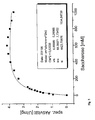
In Figur 5 ist die Michaelis-Menten-Kinetik der Saccharose Spaltung in Abhängigkeit zur Saccharosekonzentration dargestellt. Die Auftragung zeigt einen Km für Saccharose von 66 mM. Bei Konzentrationen von mehr als 600 mM Saccharose kommt es zu einer Substratüberschußhemmung.In Figure 5, the Michaelis-Menten kinetics of sucrose cleavage depending on Sucrose concentration shown. The plot shows a Km for sucrose of 66 mM. At concentrations of more than 600 mM sucrose, it comes to a Excess substrate inhibition.
Die im folgenden beschriebenen Synthesen von ADP-Glucose, UDP-2-Desoxyglucose und UDP-N-Acetylglucosamin folgen der Spaltrichtung des Enzyms mit ADP bzw. UDP.The syntheses of ADP-glucose, UDP-2-deoxyglucose described below and UDP-N-acetylglucosamine follow the cleavage direction of the enzyme with ADP or UDP.
Für die Synthese von ADP-Glucose wurde folgender Reaktionsansatz verwendet:
Der Reaktionsansatz wurde sterilfiltriert und anschließend über Nacht bei 30°C gerührt.
Am nächsten Tag wurde die Reaktionslösung in einer Amiconzelle Typ 8050 mit einer
YM 10-Membran (cut-off von 10.000 d) auf 10 ml eingeengt. Dadurch blieben die
Proteine im Ansatz, während die Reaktionsprodukte abgezogen wurden.The reaction mixture was sterile filtered and then stirred overnight at 30 ° C.
The next day, the reaction solution in an Amicon cell type 8050 with a
Mit 90 ml der folgenden Substratlösung:
Auf diese Weise waren 2,8 g ADP-Glucose mit einer Ausbeute von 55% in Bezug auf die eingesetzten AMP und ATP herstellbar. Die Gesamtausbeute der Synthese nach erfolgter Reinigung betrug 2,2 g entsprechend 43,6%.In this way, 2.8 g of ADP-glucose were obtained in 55% yield the used AMP and ATP can be produced. The total yield of the synthesis according to Successful purification was 2.2 g, corresponding to 43.6%.
Für die Synthese von UDP-2-Desoxyglucose und UDP-N-Acetylglucosamin wurde
folgender Reaktionsansatz verwendet:
Die Reaktionsansätze wurden 24 Stunden bei 30°C inkubiert und die Reaktionen anschließend bei 95°C über 5 Minuten gestoppt.The reactions were incubated for 24 hours at 30 ° C and the reactions then stopped at 95 ° C for 5 minutes.
Auf diese Weise waren mit 0,11 U Saccharose Synthase 5,9% der 2-Desoxysaccharose
spaltbar. Mit 1,25 U des Enzyms konnten 12,4% des N-Acetylsaccharosamins umgesetzt
werden.
Claims (15)
- Method for increasing the gene expression of saccharose synthase, characterised in that the expression of the saccharose synthase from saccharose synthase gene of solanum tuberosum is carried out under control of a proton ATPase promotor of saccharomyces cerevisiae which are incorporated in a gene structure by means of which saccharomyces cerevisiae is transformed.
- Method according to Claim 1, characterised in that the proton ATPase promotor is ahead of the saccharose synthase gene.
- Method according to one of Claims 1 or 2, characterised in that the gene expression of the saccharose synthase is additionally increased by increasing the copy number of the saccharose synthase gene and the proton ATPase promotor.
- Method according to one of the above claims, characterised in that the saccharose synthase is additionally purified.
- Method according to Claim 4, characterised in that a purification stage includes an ion exchange chromatography.
- Method according to Claim 5, characterised in that the ion exchange chromatography is an anion exchange chromatography.
- Method according to one of Claims 4 to 6, characterised in that a purification stage includes ultra filtration.
- Method according to one of Claims 4 to 7, characterised in that a purification stage on chelating sepharose is carried out for fine purification of the encyme.
- Saccharose synthase gene of solanum tuberosum with a leading proton-ATPase promotor of saccharomyces cerevisiae.
- Gene structure contqining a saccharose synthase gene according to Claim 9.
- Vector containing a saccharose synthase gene according to Claim 9 or a gene structure according to Claim 10.
- Transformed cell containing a replicable form of a saccharose synthase gene according to Claim 9.
- Transformed cell according to Claim 12, containing a gene structure according to Claim 10 or a vector according to Claim 11.
- Transformed cell according to Claim 12 or 13, characterised in that it is a yeast cell.
- Transformed cell according to Claim 14, characterised in that it is saccharomyces cerevisiae.
Applications Claiming Priority (3)
| Application Number | Priority Date | Filing Date | Title |
|---|---|---|---|
| DE19736343A DE19736343B4 (en) | 1997-08-21 | 1997-08-21 | Method for increasing gene expression of sucrose synthase |
| DE19736343 | 1997-08-21 | ||
| PCT/EP1998/005309 WO1999010511A1 (en) | 1997-08-21 | 1998-08-20 | Method for increasing the gene expression of saccharose synthase |
Publications (2)
| Publication Number | Publication Date |
|---|---|
| EP1007702A1 EP1007702A1 (en) | 2000-06-14 |
| EP1007702B1 true EP1007702B1 (en) | 2005-08-17 |
Family
ID=7839690
Family Applications (1)
| Application Number | Title | Priority Date | Filing Date |
|---|---|---|---|
| EP98949962A Expired - Lifetime EP1007702B1 (en) | 1997-08-21 | 1998-08-20 | Method for increasing the gene expression of saccharose synthase |
Country Status (7)
| Country | Link |
|---|---|
| US (1) | US6444454B1 (en) |
| EP (1) | EP1007702B1 (en) |
| JP (1) | JP2001514008A (en) |
| CA (1) | CA2300953A1 (en) |
| DE (2) | DE19736343B4 (en) |
| NO (1) | NO20000817D0 (en) |
| WO (1) | WO1999010511A1 (en) |
Families Citing this family (1)
| Publication number | Priority date | Publication date | Assignee | Title |
|---|---|---|---|---|
| ES2245867B1 (en) | 2004-02-05 | 2007-04-01 | Universidad Publica De Navarra | PROCEDURE SACAROSA SINTASA RECOMBINANT PRODUCTION FROM ESCHERICHIA COLI AND USE IN THE MANUFACTURE OF KITS OF DETERMINATION OF SACAROSE, PRODUCTION OF SUGAR-NUCLEOTID SUGARS AND OBTAINING OF TRANSGENIC PLANTS WITH HIGH CONTENT OF ALMIDON AND HIGH AMP. |
Family Cites Families (4)
| Publication number | Priority date | Publication date | Assignee | Title |
|---|---|---|---|---|
| CA1304020C (en) * | 1987-03-23 | 1992-06-23 | Meher H. Irani | High level expression in yeast |
| DE4220759A1 (en) | 1992-06-24 | 1994-01-05 | Inst Genbiologische Forschung | DNA sequences for oligosaccharide transporters, plasmids, bacteria and plants containing a transporter as well as methods for the production and transformation of yeast strains to identify the transporter |
| US5750389A (en) | 1992-07-01 | 1998-05-12 | Forschungszentrum Julich Gmbh | Purified saccharose-synthase, process for its production and its use |
| JPH08173170A (en) | 1994-05-25 | 1996-07-09 | Kirin Brewery Co Ltd | Transformation system of Candida utilis yeast and expression of heterologous gene by it |
-
1997
- 1997-08-21 DE DE19736343A patent/DE19736343B4/en not_active Expired - Fee Related
-
1998
- 1998-08-20 CA CA002300953A patent/CA2300953A1/en not_active Abandoned
- 1998-08-20 JP JP2000507819A patent/JP2001514008A/en not_active Withdrawn
- 1998-08-20 WO PCT/EP1998/005309 patent/WO1999010511A1/en not_active Ceased
- 1998-08-20 US US09/486,291 patent/US6444454B1/en not_active Expired - Fee Related
- 1998-08-20 DE DE59813015T patent/DE59813015D1/en not_active Expired - Fee Related
- 1998-08-20 EP EP98949962A patent/EP1007702B1/en not_active Expired - Lifetime
-
2000
- 2000-02-18 NO NO20000817A patent/NO20000817D0/en not_active Application Discontinuation
Non-Patent Citations (2)
| Title |
|---|
| GIETZ R.D.; SUGINO A.: "New yeast-Escherichia coli shuttle vectors constructed with in vitro mutagenized yeast genes lacking six-base pair restriction sites", GENE, vol. 74, 1988, pages 527 - 534 * |
| RENTSCH D. ET AL: "NTR1 encodes a high affinity oligopeptide transporter in Arabidopsis", FEBS LETTERS, vol. 370, 1995, pages 264 - 268 * |
Also Published As
| Publication number | Publication date |
|---|---|
| WO1999010511A1 (en) | 1999-03-04 |
| NO20000817L (en) | 2000-02-18 |
| US6444454B1 (en) | 2002-09-03 |
| NO20000817D0 (en) | 2000-02-18 |
| JP2001514008A (en) | 2001-09-11 |
| EP1007702A1 (en) | 2000-06-14 |
| DE19736343A1 (en) | 1999-02-25 |
| CA2300953A1 (en) | 1999-03-04 |
| DE19736343B4 (en) | 2006-02-09 |
| DE59813015D1 (en) | 2005-09-22 |
Similar Documents
| Publication | Publication Date | Title |
|---|---|---|
| DE4226971C2 (en) | Modified fungal cells and processes for the production of recombinant products | |
| DE3587168T2 (en) | GLUCOAMYLASEGEN. | |
| DE69333180T2 (en) | DNA SEQUENCES CODING FOR OLIGOSACCHARIDE TRANSPORTER | |
| DE19626564A1 (en) | Genetic transformation of ciliate cells by microcarrier bombardment with DNA-loaded gold particles | |
| DE19509695A1 (en) | Process for the preparation of a modified starch in plants, and the modified starch isolatable from the plants | |
| DE69028769T2 (en) | THERMOSTABILE (1.3-1.4) BETA GLUCANASE | |
| KR102186997B1 (en) | Novel method of protein purification | |
| DE3688743T2 (en) | YEAST STEM. | |
| DE19502053A1 (en) | Processes and DNA molecules to increase the rate of photosynthesis in plants, as well as plant cells and plants with an increased rate of photosynthesis | |
| DE69034051T2 (en) | Stably transformed yeast cells and their use in the production of albumin | |
| CH640268A5 (en) | Process for the preparation of filamentous hybrid phages, novel hybrid phages and their use | |
| DE68907166T2 (en) | Process for the production of human lysozyme. | |
| DE19736343B4 (en) | Method for increasing gene expression of sucrose synthase | |
| DE19853778C1 (en) | DNA sequences encoding a glutamate / malate translocator, plasmid bacteria, yeast and plants containing this transporter | |
| EP0300425B1 (en) | Method for the production of proteins in a soluble form | |
| EP1280893B1 (en) | Method for the production of proteins in a yeast of the genus arxula and suitable promoters | |
| DE69122940T2 (en) | E-coli derived upstream regulatory sequences effective in yeast | |
| EP1918379B1 (en) | Expression vectors for multiple gene integration and Overexpression of homologous and heterologous proteins in yeasts of the species Arxula | |
| EP0846180A1 (en) | Transgenic plantcells and plants having an increased glycolysis rate | |
| JPH08509867A (en) | Methods for expressing heterologous structural proteins in yeast strains and yeast. | |
| DE19732926C2 (en) | DNA sequences encoding a glucose-6-phosphate-phosphate translocator, as well as plasmids, bacteria, yeasts and plants containing this transporter | |
| EP0323838B1 (en) | Expression vector and method for controllable production of proteins in eukaryotes | |
| DE19632121C2 (en) | Transgenic plant cells and plants with altered acetyl-CoA formation | |
| DE4417879A1 (en) | New DNA sequence encoding amylo:sucrase of Neisseria | |
| DE4447388A1 (en) | DNA encoding amylo:sucrase from Neisseria polysaccharea |
Legal Events
| Date | Code | Title | Description |
|---|---|---|---|
| PUAI | Public reference made under article 153(3) epc to a published international application that has entered the european phase |
Free format text: ORIGINAL CODE: 0009012 |
|
| 17P | Request for examination filed |
Effective date: 20000201 |
|
| AK | Designated contracting states |
Kind code of ref document: A1 Designated state(s): BE CH DE DK FR GB IT LI NL SE |
|
| RAP1 | Party data changed (applicant data changed or rights of an application transferred) |
Owner name: FORSCHUNGSZENTRUM JUELICH GMBH |
|
| 17Q | First examination report despatched |
Effective date: 20031120 |
|
| GRAP | Despatch of communication of intention to grant a patent |
Free format text: ORIGINAL CODE: EPIDOSNIGR1 |
|
| GRAS | Grant fee paid |
Free format text: ORIGINAL CODE: EPIDOSNIGR3 |
|
| GRAA | (expected) grant |
Free format text: ORIGINAL CODE: 0009210 |
|
| PGFP | Annual fee paid to national office [announced via postgrant information from national office to epo] |
Ref country code: DE Payment date: 20050722 Year of fee payment: 8 |
|
| AK | Designated contracting states |
Kind code of ref document: B1 Designated state(s): BE CH DE DK FR GB IT LI NL SE |
|
| PG25 | Lapsed in a contracting state [announced via postgrant information from national office to epo] |
Ref country code: NL Free format text: LAPSE BECAUSE OF FAILURE TO SUBMIT A TRANSLATION OF THE DESCRIPTION OR TO PAY THE FEE WITHIN THE PRESCRIBED TIME-LIMIT Effective date: 20050817 Ref country code: IT Free format text: LAPSE BECAUSE OF FAILURE TO SUBMIT A TRANSLATION OF THE DESCRIPTION OR TO PAY THE FEE WITHIN THE PRESCRIBED TIME-LIMIT;WARNING: LAPSES OF ITALIAN PATENTS WITH EFFECTIVE DATE BEFORE 2007 MAY HAVE OCCURRED AT ANY TIME BEFORE 2007. THE CORRECT EFFECTIVE DATE MAY BE DIFFERENT FROM THE ONE RECORDED. Effective date: 20050817 Ref country code: GB Free format text: LAPSE BECAUSE OF FAILURE TO SUBMIT A TRANSLATION OF THE DESCRIPTION OR TO PAY THE FEE WITHIN THE PRESCRIBED TIME-LIMIT Effective date: 20050817 |
|
| REG | Reference to a national code |
Ref country code: GB Ref legal event code: FG4D Free format text: NOT ENGLISH |
|
| PG25 | Lapsed in a contracting state [announced via postgrant information from national office to epo] |
Ref country code: LI Free format text: LAPSE BECAUSE OF NON-PAYMENT OF DUE FEES Effective date: 20050831 Ref country code: CH Free format text: LAPSE BECAUSE OF NON-PAYMENT OF DUE FEES Effective date: 20050831 Ref country code: BE Free format text: LAPSE BECAUSE OF NON-PAYMENT OF DUE FEES Effective date: 20050831 |
|
| REG | Reference to a national code |
Ref country code: CH Ref legal event code: EP |
|
| REF | Corresponds to: |
Ref document number: 59813015 Country of ref document: DE Date of ref document: 20050922 Kind code of ref document: P |
|
| PG25 | Lapsed in a contracting state [announced via postgrant information from national office to epo] |
Ref country code: SE Free format text: LAPSE BECAUSE OF FAILURE TO SUBMIT A TRANSLATION OF THE DESCRIPTION OR TO PAY THE FEE WITHIN THE PRESCRIBED TIME-LIMIT Effective date: 20051117 Ref country code: DK Free format text: LAPSE BECAUSE OF FAILURE TO SUBMIT A TRANSLATION OF THE DESCRIPTION OR TO PAY THE FEE WITHIN THE PRESCRIBED TIME-LIMIT Effective date: 20051117 |
|
| NLV1 | Nl: lapsed or annulled due to failure to fulfill the requirements of art. 29p and 29m of the patents act | ||
| GBV | Gb: ep patent (uk) treated as always having been void in accordance with gb section 77(7)/1977 [no translation filed] |
Effective date: 20050817 |
|
| REG | Reference to a national code |
Ref country code: CH Ref legal event code: PL |
|
| PLBE | No opposition filed within time limit |
Free format text: ORIGINAL CODE: 0009261 |
|
| STAA | Information on the status of an ep patent application or granted ep patent |
Free format text: STATUS: NO OPPOSITION FILED WITHIN TIME LIMIT |
|
| 26N | No opposition filed |
Effective date: 20060518 |
|
| PG25 | Lapsed in a contracting state [announced via postgrant information from national office to epo] |
Ref country code: FR Free format text: LAPSE BECAUSE OF FAILURE TO SUBMIT A TRANSLATION OF THE DESCRIPTION OR TO PAY THE FEE WITHIN THE PRESCRIBED TIME-LIMIT Effective date: 20060818 |
|
| EN | Fr: translation not filed | ||
| PG25 | Lapsed in a contracting state [announced via postgrant information from national office to epo] |
Ref country code: DE Free format text: LAPSE BECAUSE OF NON-PAYMENT OF DUE FEES Effective date: 20070301 |
|
| BERE | Be: lapsed |
Owner name: FORSCHUNGSZENTRUM JULICH G.M.B.H. Effective date: 20050831 |
|
| PG25 | Lapsed in a contracting state [announced via postgrant information from national office to epo] |
Ref country code: FR Free format text: LAPSE BECAUSE OF FAILURE TO SUBMIT A TRANSLATION OF THE DESCRIPTION OR TO PAY THE FEE WITHIN THE PRESCRIBED TIME-LIMIT Effective date: 20050831 |
|
| PG25 | Lapsed in a contracting state [announced via postgrant information from national office to epo] |
Ref country code: FR Free format text: LAPSE BECAUSE OF FAILURE TO SUBMIT A TRANSLATION OF THE DESCRIPTION OR TO PAY THE FEE WITHIN THE PRESCRIBED TIME-LIMIT Effective date: 20050817 |