EP0989481A2 - Mobiler Rechner mit Audiounterbrechungssystem - Google Patents
Mobiler Rechner mit Audiounterbrechungssystem Download PDFInfo
- Publication number
- EP0989481A2 EP0989481A2 EP99304720A EP99304720A EP0989481A2 EP 0989481 A2 EP0989481 A2 EP 0989481A2 EP 99304720 A EP99304720 A EP 99304720A EP 99304720 A EP99304720 A EP 99304720A EP 0989481 A2 EP0989481 A2 EP 0989481A2
- Authority
- EP
- European Patent Office
- Prior art keywords
- computer
- commands
- user
- power
- audio
- Prior art date
- Legal status (The legal status is an assumption and is not a legal conclusion. Google has not performed a legal analysis and makes no representation as to the accuracy of the status listed.)
- Withdrawn
Links
Images
Classifications
-
- G—PHYSICS
- G06—COMPUTING OR CALCULATING; COUNTING
- G06F—ELECTRIC DIGITAL DATA PROCESSING
- G06F1/00—Details not covered by groups G06F3/00 - G06F13/00 and G06F21/00
- G06F1/26—Power supply means, e.g. regulation thereof
- G06F1/32—Means for saving power
- G06F1/3203—Power management, i.e. event-based initiation of a power-saving mode
- G06F1/3234—Power saving characterised by the action undertaken
- G06F1/324—Power saving characterised by the action undertaken by lowering clock frequency
-
- G—PHYSICS
- G06—COMPUTING OR CALCULATING; COUNTING
- G06F—ELECTRIC DIGITAL DATA PROCESSING
- G06F1/00—Details not covered by groups G06F3/00 - G06F13/00 and G06F21/00
-
- G—PHYSICS
- G06—COMPUTING OR CALCULATING; COUNTING
- G06F—ELECTRIC DIGITAL DATA PROCESSING
- G06F1/00—Details not covered by groups G06F3/00 - G06F13/00 and G06F21/00
- G06F1/26—Power supply means, e.g. regulation thereof
- G06F1/32—Means for saving power
- G06F1/3203—Power management, i.e. event-based initiation of a power-saving mode
-
- G—PHYSICS
- G06—COMPUTING OR CALCULATING; COUNTING
- G06F—ELECTRIC DIGITAL DATA PROCESSING
- G06F1/00—Details not covered by groups G06F3/00 - G06F13/00 and G06F21/00
- G06F1/26—Power supply means, e.g. regulation thereof
- G06F1/32—Means for saving power
- G06F1/3203—Power management, i.e. event-based initiation of a power-saving mode
- G06F1/3234—Power saving characterised by the action undertaken
- G06F1/3246—Power saving characterised by the action undertaken by software initiated power-off
-
- G—PHYSICS
- G06—COMPUTING OR CALCULATING; COUNTING
- G06F—ELECTRIC DIGITAL DATA PROCESSING
- G06F3/00—Input arrangements for transferring data to be processed into a form capable of being handled by the computer; Output arrangements for transferring data from processing unit to output unit, e.g. interface arrangements
- G06F3/16—Sound input; Sound output
- G06F3/167—Audio in a user interface, e.g. using voice commands for navigating, audio feedback
-
- Y—GENERAL TAGGING OF NEW TECHNOLOGICAL DEVELOPMENTS; GENERAL TAGGING OF CROSS-SECTIONAL TECHNOLOGIES SPANNING OVER SEVERAL SECTIONS OF THE IPC; TECHNICAL SUBJECTS COVERED BY FORMER USPC CROSS-REFERENCE ART COLLECTIONS [XRACs] AND DIGESTS
- Y02—TECHNOLOGIES OR APPLICATIONS FOR MITIGATION OR ADAPTATION AGAINST CLIMATE CHANGE
- Y02D—CLIMATE CHANGE MITIGATION TECHNOLOGIES IN INFORMATION AND COMMUNICATION TECHNOLOGIES [ICT], I.E. INFORMATION AND COMMUNICATION TECHNOLOGIES AIMING AT THE REDUCTION OF THEIR OWN ENERGY USE
- Y02D10/00—Energy efficient computing, e.g. low power processors, power management or thermal management
Definitions
- This invention relates to mobile body supported computers and more specifically to a system for reducing the temperature in a body-worn computer.
- a novel body-worn computer voice activated computer which is completely supported by a user for hands-free retrieval and display of information.
- the computing apparatus includes a voice-recognition module, in communication with a processor, for receiving audio commands from the user, for converting the received audio commands into electrical signals, for recognizing the converted electrical signals and for sending the recognized electrical signals to the processor for processing, the voice-recognition module being supported by the user.
- the computing apparatus further includes a display in communication with the processor for receiving information from the processor and for displaying the received information for the user, the display being supported by the user whereby the user may operate the computing apparatus to display information in a hands-free manner utilizing only audio commands.
- the computing apparatus described in U.S. Patent 5,305,244 includes a housing having securing means for removably securing the housing to a user for support by the user.
- the housing further includes storage means for storing previously entered information, and processor means, communicating with the storage means, for receiving, retrieving and processing information and user commands in accordance with a stored program.
- the computing apparatus also includes audio transducer and converter means, in communication with the processor means, for receiving audio commands from the user, for converting the received audio commands into electrical signals, for recognizing the converted electrical signals, and for sending the recognized electrical signals to the processor means, the audio transducer and converter means also being supported by the user.
- the computing apparatus further includes display means in communication with the processor means for receiving information from the processor means and for displaying the received information for the user, the display means being supported by the user whereby the user may operate the computing apparatus to display information in a hands-free manner utilizing only audio commands.
- Newman et al. II a hands-free portable computer system similar to that in U.S. Patent 5,305,244 is described; however, various activation means other than voice activation are disclosed.
- the invention disclosed in Newman et al II is directed to a compact, portable computing apparatus at least part of which is completely supported by a user for hands-free retrieval and display of information for the user.
- the computing apparatus includes a housing which may or may not have securing means for removably securing the housing to a user for support by the user. Alternatively, the housing may be located in a remote location not attached to the user and apart from the other components.
- the housing further includes storage means for storing previously entered information, and processor means, communicating with the storage means, for receiving, retrieving, and processing information and user commands in accordance with a stored program. Since large databases of ETMs and IETMs will be accessed by the mobile self-contained computing apparatus, a means of easily interfacing storage means containing the databases is required - the housing of the computing apparatus includes an access port whereby various storage means containing data can be interfaced and communication established. Access and transfer of data between the storage means and the computing apparatus can be accomplished entirely under control of various hands-free activation means described in this application.
- the access port allows direct electrical attachment of the storage means; however, other wired and wireless connections are also used.
- the computing apparatus also includes eye tracking, brain actuation means, transducer and converter means with or without audio transducer and converter means in communication with the processor means, for receiving commands from the user, for converting the received commands into electrical signals, for recognizing the converted electrical signals, and for sending the recognized electrical signals to the processor means.
- the transducer and converter means may or may not be supported by the user.
- the computing apparatus further includes display means in communication with the processor means for receiving information from the processor means and for displaying the received information for the user, the display means being supported by the user whereby the user may operate the computing apparatus to display information in a hands-free manner utilizing only brain activation or eye tracking with or without audio commands.
- a body-worn mobile computer which comprises a computer housing having a heat insulating surface which fits adjacent a user's body, and heat conducting top and side surfaces which dissipate heat from the internal portion of the housing to the atmosphere.
- This is to remedy a problem uniquely faced by mobile body-worn computers; that is heat generated by the CPU and conducted to the housing could cause a major problem to wearers.
- the problems faced with body-worn computers are completely different than those of desk top or laptop computers. Attempts to remedy this heat problem in body-worn computers have led to highly insulated components or housings, but these efforts have resulted in larger and heavier computers; a situation just opposite to the desired goal of smaller and lighter body-worn units.
- Toyosato also uses heat sinks together with selected materials to alleviate the heat problems in body-worn computers.
- Other references that deal with heat problems in computers are U.S. patents 5,559,675 (Hsiek et al), 5,287,292 (Kenny et al), 5,452,434 (MacDonald) and 4,980,836 (Carter et al). All of these prior art patents disclose ways for reducing power and heat to a desk top computer by the use of a mouse or a keyboard.
- the problems in desk top computers and their solutions do not equate to problems in wearable computers.
- the wearable computers discussed herein are hands-free, whereas desk top or lap top computers require the use of hands. None of the prior art patents noted above teach how hands-free computers can be powered down to reduce heat and power without the use of hands.
- U.S. Patent 5,606,341 a laptop computer having CPU cooling means is disclosed, In this laptop computer, CPU-generated heat is thermally conducted passively to a radiator-like element disposed behind the LCD, which uses the heat to warm the LCD.
- the CPU is surrounded by a liquid-tight housing containing a bi-phase coolant.
- a first tube in fluid communication with an outlet port in the housing conveys heat-vaporized coolant to an input port on the radiator.
- the coolant flows through a plurality of columns formed in the radiator-like element, transferring heat and condensing in the process.
- the transferred heat is radiated to the LCD, which is desirably warmed in the process.
- the condensed coolant is conducted from an export port in the radiator-like element through a second tube to an input port in the housing.
- a pressure sensor may be included to provide a coolant pressure drop signal that can be used to shutdown the CPU in the event of a coolant leak.
- Aguilera a heat dissipating coolant is deposited or disposed adjacent a rear surface of the LCD. Then the CPU is surrounded with a coolant-containing chamber, whereby heat generated by the CPU is carried by a conductor to a coolant.
- Aguilera uses a radiator type system to maintain the temperature at a workable level and to control the heat generated by the CPU. Obviously, the weight of the radiator and the use of chemical coolants make Aguilera's system undesirable for use in body-worn computers.
- Those components include monitor, floppy, CD-ROM, hard drive, etc.
- Those components include monitor, floppy, CD-ROM, hard drive, etc.
- For convenience laptop computer manufacturers have implemented a simple button that a user can hit to immediately place the computer in a sleep or suspend mode. To "wake up” or reactivate a computer in sleep or suspend mode, all that the user needs to do is move the mouse or key a key on the keyboard.
- Another way to reduce battery consumption or place the laptop in sleep or suspend mode is to "program" the operating software to monitor the use of the computer and to place the computer in sleep or suspend mode when certain conditions are met.
- Another object of this invention is to provide a hands-free method for powering down a body-worn computer.
- a further object of this invention is to provide a body-worn computer that has extended power life and reduced heat generation.
- Yet a further object of this invention is to provide a method for reducing the heat generated by the CPU of a hands-free body-worn computer.
- Still a further object of this invention is to provide a simple, practical and efficient method for controlling the heat and power generation of a body-worn computer.
- Another yet further object of this invention is to provide an audio means for controlling heat and power in a hands-free body-worn computer and reduce the heat in contact with a user's body.
- a voice recognition module which controls the power and heat in the body-worn computer.
- the computer further includes audio transducer and converter means in communication with the system unit for receiving audio commands from the user, for converting the receiver audio commands into electrical signals and for sending the recognized electrical signals to a processor within the system unit.
- the audio transducer and converter means includes a microphone for receiving verbal commands from the operator.
- the microphone which in the present embodiment is electrically connected to the system unit via a cable, is preferably an ear-supported microphone, although those with ordinary skill in the art will appreciate that any audio-input or transducer device could be used and that the audio input or transducer could be supported by the user at some other location such as proximate the mouth or throat of the user.
- the computer system used in the present invention is disclosed in detail in U.S. Patent 5,305,244 and EP-A-0,767,417.
- an application program could interact with an independent (or dependent) voice-recognition module in order to cause the voice-recognition module to recognize a verbal utterance against a subset of an entire trained vocabulary model.
- the vocabulary subset could include, for example, the words in the speech recognition module that correspond to the operating system commands to power down the CPU. The heat/power can be controlled by key words in the vocabulary sub-set.
- dependent voice-recognition modules cannot be integrated with application programs.
- the computer When the body-worn computer is not operational, the computer should be powered down to conserve the limited power of the battery. Since the computer is hands-free, there is no mouse or keyboard to use to power down. Also, no body-worn computer known has any practical means to conserve the battery power and lower the heat that will be conveyed to the body of a user. It is very beneficial in body-worn computers to conserve energy because of the limited power provided by the battery, and to lower the heat generated by the computer since the computer will be in constant contact with the body of a user.
- a computer system is comprised of a CPU (central processing unit), a chip set (IC for controlling the system), an audio process IC, a video output control IC, and the like.
- the audio process IC operates such that audio data composed and processed in digital manner is converted into analog format and creates from the converted data sound that can be listened to with the human ear. Also the audio process converts analog sound generated externally into digital signals and processes it such that it becomes in a processable state at the CPU.
- the chip set arbitrates the CPU and functional ICs, such as an audio process IC and a video output control IC, while it controls the operation speed of the CPU from the view point of decreasing electric power consumed and controlling temperature increase in the CPU.
- the operation speed of the CPU is decreased and the electric power consumed is minimized. Once there are inputs from any external input devices, the operation speed of the CPU is increased to perform processes quickly.
- a circuit for detecting the existence of the audio input is provided. Then, by processing the output from the circuit at a chip set and controlling the operation speed of the CPU with the processed data, processing the audio data by the CPU is performed smoothly.
- the predetermined level is set by components on the circuit, such as resistance.
- the result of the determination is carried to the chip set as interrupt signals.
- the operation speed of the CPU is varied by the point of change in the interrupt signals as a trigger.
- processing the audio data is not necessary when the output from the comparator is none, the control of the operation speed of the CPU is performed with external input devices and the temperature at the CPU. On the other hand, when there is output from the comparator, the operation speed of the CPU is maximized regardless of other causes. Furthermore, it is possible to most prioritize the process of the audio data if the CPU is processing multiple tasks in parallel.
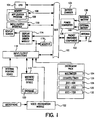
- the computer also includes a memory 106 having, for example, one Mbyte to twenty Mbytes of random access memory (RAM); however any amount of RAM is suitable.
- the memory 106 which is also connected to the bus 102 and is preferably contained in the system unit, stores an application program 108 while the computer is operating.
- the application program 108 may have been loaded into the memory 106 from a magnetic storage device 119 (described below) pursuant to operator instructions.
- the computer also includes an input/output interface 110 which controls all data transfers between the CPU 104 and certain other components (herein called peripherals) which communicate with the CPU 104 but which are not connected directly to the bus 102.
- the input/output interface 110 includes a video interface, a controller for at least two RS-232 compatible serial ports, a controller for the Centronics-compatible parallel port, keyboard and mouse controllers, a floppy disk controller, and a hard drive interface.
- the input/output interface 110 could include additional and/or different interfaces and controllers for use with other types of peripherals.
- the input/output interface 110 is connected to the bus 102 and preferably is located in the system unit.
- the computer also includes various peripherals such as storing means, such as a magnetic storage device 119, measurement means such as an instrument pack, a microphone and a voice-recognition module 122, which are all connected to the system unit (and, specifically, to the input/output interface 110 which controls data traffic between the peripherals and the CPU 104) via the input/output connectors 118.
- the voice recognition module 122 will contain means to recognize a voice command to power down.
- the voice-recognition module 122 is preferably contained in the system unit and is connected to the microphone (which is preferably an ear microphone located outside of the system unit). Alternatively, the voice-recognition module 122 may be located outside of the system unit and, for example, may be incorporated with the microphone as a single unit. Alternatively, the analog-to-digital converter component of the voice-recognition module 122 is located outside of the system unit while the remaining components of the voice-recognition module 122 are located inside the system unit, the external analog-to-digital converter preferably communicating with the system unit via a serial communication stream.
- the microphone receives audio input (also called verbal utterances) from the operator, converts the audio input to electrical signals and digitizes the electrical signals.
- the voice-recognition module 122 recognizes the verbal utterances (which are in the form of digitized electrical signals) and transfers the recognized verbal utterances to the CPU 104 for processing according to the application program 108. Thus, a voice command to power down will reduce power and heat when desirable.
- a conventional keyboard driver interprets as characters and words the electrical signals which result from an operator typing on a conventional keyboard
- the voice-recognition module 122 interprets (or recognizes) as characters and words the digitized electrical signals which result from an operator speaking near or into the microphone. Consequently, like conventional input devices such as keyboards and pointing devices, the voice-recognition module 122 in combination with the microphone provides a means for operators to interact with and control the operation of the computer.
- the voice-recognition module 122 operates according to well-known dependent voice recognition algorithms and is implemented in hardware of a type well known in the art.
- the voice-recognition module 522 is a dependent voice recognition circuit card available from Voice Connection of Irving, California.
- any dependent voice recognition circuit card having a size compatible with the size of the system unit could be used.
- the voice-recognition module 122 operates according to well-known independent voice recognition algorithms, the independent voice recognition algorithms representing an improvement over dependent voice recognition algorithms.
- an independent voice-recognition module is able to recognize the voices of multiple speakers and includes "good listener", a learning feature for real time modification of a trained vocabulary model.
- a dependent voice-recognition module can recognize only a single speaker's voice.
Landscapes
- Engineering & Computer Science (AREA)
- Theoretical Computer Science (AREA)
- Physics & Mathematics (AREA)
- General Engineering & Computer Science (AREA)
- General Physics & Mathematics (AREA)
- Health & Medical Sciences (AREA)
- Multimedia (AREA)
- Audiology, Speech & Language Pathology (AREA)
- General Health & Medical Sciences (AREA)
- Human Computer Interaction (AREA)
- Power Sources (AREA)
- User Interface Of Digital Computer (AREA)
- Mobile Radio Communication Systems (AREA)
- Measuring And Recording Apparatus For Diagnosis (AREA)
- Controls And Circuits For Display Device (AREA)
Applications Claiming Priority (2)
| Application Number | Priority Date | Filing Date | Title |
|---|---|---|---|
| US160849 | 1998-09-25 | ||
| US09/160,849 US6301593B1 (en) | 1998-09-25 | 1998-09-25 | Mobile computer with audio interrupt system |
Publications (2)
| Publication Number | Publication Date |
|---|---|
| EP0989481A2 true EP0989481A2 (de) | 2000-03-29 |
| EP0989481A3 EP0989481A3 (de) | 2004-06-16 |
Family
ID=22578722
Family Applications (1)
| Application Number | Title | Priority Date | Filing Date |
|---|---|---|---|
| EP99304720A Withdrawn EP0989481A3 (de) | 1998-09-25 | 1999-06-16 | Mobiler Rechner mit Audiounterbrechungssystem |
Country Status (9)
| Country | Link |
|---|---|
| US (1) | US6301593B1 (de) |
| EP (1) | EP0989481A3 (de) |
| JP (1) | JP3417876B2 (de) |
| KR (1) | KR100400414B1 (de) |
| CN (1) | CN1169038C (de) |
| BR (1) | BR9904300A (de) |
| CA (1) | CA2261905C (de) |
| IL (1) | IL128596A (de) |
| TW (1) | TW495662B (de) |
Families Citing this family (26)
| Publication number | Priority date | Publication date | Assignee | Title |
|---|---|---|---|---|
| US6532482B1 (en) | 1998-09-25 | 2003-03-11 | Xybernaut Corporation | Mobile computer with audio interrupt system |
| US20020040377A1 (en) * | 1998-09-25 | 2002-04-04 | Newman Edward G. | Computer with audio interrupt system |
| JP2000196730A (ja) * | 1998-12-25 | 2000-07-14 | Nec Saitama Ltd | 無線通信機 |
| US7150526B2 (en) | 2000-06-02 | 2006-12-19 | Oakley, Inc. | Wireless interactive headset |
| US8482488B2 (en) | 2004-12-22 | 2013-07-09 | Oakley, Inc. | Data input management system for wearable electronically enabled interface |
| US7461936B2 (en) | 2000-06-02 | 2008-12-09 | Oakley, Inc. | Eyeglasses with detachable adjustable electronics module |
| US6325507B1 (en) | 2000-06-02 | 2001-12-04 | Oakley, Inc. | Eyewear retention system extending across the top of a wearer's head |
| US20120105740A1 (en) | 2000-06-02 | 2012-05-03 | Oakley, Inc. | Eyewear with detachable adjustable electronics module |
| US7013009B2 (en) | 2001-06-21 | 2006-03-14 | Oakley, Inc. | Eyeglasses with wireless communication features |
| US7107081B1 (en) | 2001-10-18 | 2006-09-12 | Iwao Fujisaki | Communication device |
| CN1720763B (zh) * | 2002-07-26 | 2013-06-12 | 奥克利有限公司 | 一种眼镜 |
| US20050184954A1 (en) * | 2004-02-23 | 2005-08-25 | Adams Michael D. | Portable communication system |
| US20070015999A1 (en) * | 2005-07-15 | 2007-01-18 | Heldreth Mark A | System and method for providing orthopaedic surgical information to a surgeon |
| US20070078678A1 (en) * | 2005-09-30 | 2007-04-05 | Disilvestro Mark R | System and method for performing a computer assisted orthopaedic surgical procedure |
| US8635082B2 (en) | 2006-05-25 | 2014-01-21 | DePuy Synthes Products, LLC | Method and system for managing inventories of orthopaedic implants |
| WO2008076774A2 (en) | 2006-12-14 | 2008-06-26 | Oakley, Inc. | Wearable high resolution audio visual interface |
| US8265949B2 (en) | 2007-09-27 | 2012-09-11 | Depuy Products, Inc. | Customized patient surgical plan |
| US10028750B2 (en) | 2007-09-30 | 2018-07-24 | DePuy Synthes Products, Inc. | Apparatus and method for fabricating a customized patient-specific orthopaedic instrument |
| US9864211B2 (en) | 2012-02-17 | 2018-01-09 | Oakley, Inc. | Systems and methods for removably coupling an electronic device to eyewear |
| US20140006825A1 (en) * | 2012-06-30 | 2014-01-02 | David Shenhav | Systems and methods to wake up a device from a power conservation state |
| JP5996371B2 (ja) | 2012-10-29 | 2016-09-21 | 株式会社東芝 | 電子機器 |
| US9265458B2 (en) | 2012-12-04 | 2016-02-23 | Sync-Think, Inc. | Application of smooth pursuit cognitive testing paradigms to clinical drug development |
| US9380976B2 (en) | 2013-03-11 | 2016-07-05 | Sync-Think, Inc. | Optical neuroinformatics |
| EP2973533A4 (de) | 2013-03-15 | 2016-11-30 | Oakley Inc | Elektronische dekoration für brillen |
| WO2014201213A1 (en) | 2013-06-12 | 2014-12-18 | Oakley, Inc. | Modular heads-up display system |
| US11051829B2 (en) | 2018-06-26 | 2021-07-06 | DePuy Synthes Products, Inc. | Customized patient-specific orthopaedic surgical instrument |
Family Cites Families (11)
| Publication number | Priority date | Publication date | Assignee | Title |
|---|---|---|---|---|
| JPH04138512A (ja) * | 1990-09-29 | 1992-05-13 | Nippon Steel Corp | パーソナルコンピュータのスリープ装置 |
| JPH0522779A (ja) * | 1991-07-09 | 1993-01-29 | Sony Corp | 音声認識遠隔制御装置 |
| US5305244B2 (en) * | 1992-04-06 | 1997-09-23 | Computer Products & Services I | Hands-free user-supported portable computer |
| US5698834A (en) * | 1993-03-16 | 1997-12-16 | Worthington Data Solutions | Voice prompt with voice recognition for portable data collection terminal |
| JPH0716388U (ja) * | 1993-08-20 | 1995-03-17 | カシオ計算機株式会社 | 音声認識スイッチアダプタ |
| JPH07134628A (ja) * | 1993-11-10 | 1995-05-23 | Hitachi Ltd | 省電力制御方法および情報処理装置 |
| US6311287B1 (en) * | 1994-10-11 | 2001-10-30 | Compaq Computer Corporation | Variable frequency clock control for microprocessor-based computer systems |
| JPH08115142A (ja) * | 1994-10-13 | 1996-05-07 | Canon Inc | 電子機器 |
| US5774859A (en) * | 1995-01-03 | 1998-06-30 | Scientific-Atlanta, Inc. | Information system having a speech interface |
| JPH09114543A (ja) * | 1995-10-02 | 1997-05-02 | Xybernaut Corp | ハンドフリーコンピュータ装置 |
| JP3446857B2 (ja) * | 1996-02-07 | 2003-09-16 | 株式会社リコー | 音声認識装置 |
-
1998
- 1998-09-25 US US09/160,849 patent/US6301593B1/en not_active Expired - Lifetime
-
1999
- 1999-02-12 CA CA002261905A patent/CA2261905C/en not_active Expired - Fee Related
- 1999-02-18 IL IL12859699A patent/IL128596A/en not_active IP Right Cessation
- 1999-03-06 TW TW088103474A patent/TW495662B/zh not_active IP Right Cessation
- 1999-03-29 CN CNB99104441XA patent/CN1169038C/zh not_active Expired - Fee Related
- 1999-05-25 KR KR10-1999-0018824A patent/KR100400414B1/ko not_active Expired - Fee Related
- 1999-06-16 EP EP99304720A patent/EP0989481A3/de not_active Withdrawn
- 1999-06-25 JP JP18086199A patent/JP3417876B2/ja not_active Expired - Fee Related
- 1999-09-22 BR BR9904300-9A patent/BR9904300A/pt not_active IP Right Cessation
Also Published As
| Publication number | Publication date |
|---|---|
| JP2000112709A (ja) | 2000-04-21 |
| BR9904300A (pt) | 2000-09-05 |
| IL128596A (en) | 2002-11-10 |
| EP0989481A3 (de) | 2004-06-16 |
| CA2261905A1 (en) | 2000-03-25 |
| KR100400414B1 (ko) | 2003-10-04 |
| IL128596A0 (en) | 2000-01-31 |
| US6301593B1 (en) | 2001-10-09 |
| CN1249452A (zh) | 2000-04-05 |
| CN1169038C (zh) | 2004-09-29 |
| KR20000022635A (ko) | 2000-04-25 |
| HK1026962A1 (en) | 2000-12-29 |
| CA2261905C (en) | 2002-05-28 |
| JP3417876B2 (ja) | 2003-06-16 |
| TW495662B (en) | 2002-07-21 |
| AU710225B1 (en) | 1999-09-16 |
Similar Documents
| Publication | Publication Date | Title |
|---|---|---|
| US6301593B1 (en) | Mobile computer with audio interrupt system | |
| CA2311849C (en) | Mobile computer with audio interrupt system | |
| US20020040377A1 (en) | Computer with audio interrupt system | |
| US7197584B2 (en) | Removable personal digital assistant in a dual personal computer/personal digital assistant computer architecture | |
| US7219240B2 (en) | Monitor and method for controlling power-on and power-off of host computer | |
| US6802015B2 (en) | Method for accelerating the speed of a CPU using a system command having an operation not associated with changing the speed of the CPU | |
| US20020065662A1 (en) | Voice recognition peripheral device | |
| WO2001015159A1 (en) | Launch key, low power cd-rom player for portable computers | |
| CN1177145A (zh) | 编程为复制预测输入表的移动客户计算机 | |
| US20030067744A1 (en) | Modular information processing system | |
| US7343501B2 (en) | Power-saving device for notebook computer | |
| AU736030B2 (en) | Mobile computer with audio interrupt system | |
| JP2873268B2 (ja) | 手を使わずにユーザにより支持される携帯用計算機とその操作方法 | |
| EP1213639A1 (de) | Tragbares Rechnersystem | |
| HK1038269A (en) | Mobile computer with audio interrupt system | |
| MXPA99008804A (es) | Computadora movil con sistema de interrupcion deaudio | |
| HK1026962B (en) | Mobile computer with audio interrupt system | |
| CN217880141U (zh) | 笔记本电脑 | |
| JPH07104748B2 (ja) | 小型電子機器 | |
| CN114967897A (zh) | 一种功耗优化方法、装置及移动终端 | |
| CN114649000A (zh) | 语音唤醒装置及其控制方法 | |
| HK1010759B (en) | Hands-free user-supported portable computer |
Legal Events
| Date | Code | Title | Description |
|---|---|---|---|
| PUAI | Public reference made under article 153(3) epc to a published international application that has entered the european phase |
Free format text: ORIGINAL CODE: 0009012 |
|
| AK | Designated contracting states |
Kind code of ref document: A2 Designated state(s): AT BE CH CY DE DK ES FI FR GB GR IE IT LI LU MC NL PT SE |
|
| AX | Request for extension of the european patent |
Free format text: AL;LT;LV;MK;RO;SI |
|
| PUAL | Search report despatched |
Free format text: ORIGINAL CODE: 0009013 |
|
| AK | Designated contracting states |
Kind code of ref document: A3 Designated state(s): AT BE CH CY DE DK ES FI FR GB GR IE IT LI LU MC NL PT SE |
|
| AX | Request for extension of the european patent |
Extension state: AL LT LV MK RO SI |
|
| RIC1 | Information provided on ipc code assigned before grant |
Ipc: 7G 06F 1/26 B Ipc: 7G 06F 3/16 B Ipc: 7G 06F 1/32 A |
|
| AKX | Designation fees paid | ||
| 17P | Request for examination filed |
Effective date: 20041217 |
|
| RBV | Designated contracting states (corrected) |
Designated state(s): AT BE CH DE DK ES FR GB GR LI |
|
| RBV | Designated contracting states (corrected) |
Designated state(s): BE CH DE ES FR GB GR IT LI NL PT SE |
|
| REG | Reference to a national code |
Ref country code: DE Ref legal event code: 8566 |
|
| 17Q | First examination report despatched |
Effective date: 20050504 |
|
| STAA | Information on the status of an ep patent application or granted ep patent |
Free format text: STATUS: THE APPLICATION IS DEEMED TO BE WITHDRAWN |
|
| 18D | Application deemed to be withdrawn |
Effective date: 20051115 |