EP0986674B1 - Stabilized turf for athletic field - Google Patents
Stabilized turf for athletic field Download PDFInfo
- Publication number
- EP0986674B1 EP0986674B1 EP98926198A EP98926198A EP0986674B1 EP 0986674 B1 EP0986674 B1 EP 0986674B1 EP 98926198 A EP98926198 A EP 98926198A EP 98926198 A EP98926198 A EP 98926198A EP 0986674 B1 EP0986674 B1 EP 0986674B1
- Authority
- EP
- European Patent Office
- Prior art keywords
- backing
- fibers
- turf
- biodegradable
- layer
- Prior art date
- Legal status (The legal status is an assumption and is not a legal conclusion. Google has not performed a legal analysis and makes no representation as to the accuracy of the status listed.)
- Expired - Lifetime
Links
- 230000000386 athletic effect Effects 0.000 title description 16
- 239000000835 fiber Substances 0.000 claims description 110
- 244000025254 Cannabis sativa Species 0.000 claims description 40
- 239000000463 material Substances 0.000 claims description 28
- 238000000354 decomposition reaction Methods 0.000 claims description 26
- 239000003795 chemical substances by application Substances 0.000 claims description 24
- 240000000491 Corchorus aestuans Species 0.000 claims description 21
- 235000011777 Corchorus aestuans Nutrition 0.000 claims description 21
- 235000010862 Corchorus capsularis Nutrition 0.000 claims description 21
- 239000001963 growth medium Substances 0.000 claims description 19
- 239000003381 stabilizer Substances 0.000 claims description 18
- 238000005273 aeration Methods 0.000 claims description 17
- 230000000087 stabilizing effect Effects 0.000 claims description 13
- 230000012010 growth Effects 0.000 claims description 11
- 238000000034 method Methods 0.000 claims description 10
- 230000002787 reinforcement Effects 0.000 claims description 10
- 230000004044 response Effects 0.000 claims description 7
- 238000009732 tufting Methods 0.000 claims description 7
- 230000005012 migration Effects 0.000 claims description 4
- 238000013508 migration Methods 0.000 claims description 4
- 235000012766 Cannabis sativa ssp. sativa var. sativa Nutrition 0.000 claims description 3
- 235000012765 Cannabis sativa ssp. sativa var. spontanea Nutrition 0.000 claims description 3
- 235000004431 Linum usitatissimum Nutrition 0.000 claims description 3
- 235000009120 camo Nutrition 0.000 claims description 3
- 235000005607 chanvre indien Nutrition 0.000 claims description 3
- 239000011487 hemp Substances 0.000 claims description 3
- 239000000203 mixture Substances 0.000 claims description 3
- 244000198134 Agave sisalana Species 0.000 claims 2
- 241000208202 Linaceae Species 0.000 claims 2
- 239000010410 layer Substances 0.000 description 79
- 239000004576 sand Substances 0.000 description 27
- 229920002994 synthetic fiber Polymers 0.000 description 17
- -1 polypropylene Polymers 0.000 description 11
- 239000004743 Polypropylene Substances 0.000 description 10
- 229920001155 polypropylene Polymers 0.000 description 10
- XLYOFNOQVPJJNP-UHFFFAOYSA-N water Substances O XLYOFNOQVPJJNP-UHFFFAOYSA-N 0.000 description 10
- 230000004888 barrier function Effects 0.000 description 8
- 238000000576 coating method Methods 0.000 description 8
- 235000015097 nutrients Nutrition 0.000 description 8
- 230000009418 agronomic effect Effects 0.000 description 7
- 239000011248 coating agent Substances 0.000 description 7
- 239000002131 composite material Substances 0.000 description 7
- 230000000694 effects Effects 0.000 description 7
- 230000008901 benefit Effects 0.000 description 6
- 238000012423 maintenance Methods 0.000 description 6
- 230000009286 beneficial effect Effects 0.000 description 5
- 238000009434 installation Methods 0.000 description 5
- 239000004816 latex Substances 0.000 description 5
- 229920000126 latex Polymers 0.000 description 5
- 239000004033 plastic Substances 0.000 description 5
- 229920003023 plastic Polymers 0.000 description 5
- 239000002689 soil Substances 0.000 description 5
- VTYYLEPIZMXCLO-UHFFFAOYSA-L Calcium carbonate Chemical compound [Ca+2].[O-]C([O-])=O VTYYLEPIZMXCLO-UHFFFAOYSA-L 0.000 description 4
- 241000196324 Embryophyta Species 0.000 description 4
- NIXOWILDQLNWCW-UHFFFAOYSA-N acrylic acid group Chemical group C(C=C)(=O)O NIXOWILDQLNWCW-UHFFFAOYSA-N 0.000 description 4
- 230000002411 adverse Effects 0.000 description 4
- 238000006065 biodegradation reaction Methods 0.000 description 4
- 238000003973 irrigation Methods 0.000 description 4
- 239000007788 liquid Substances 0.000 description 4
- 238000004519 manufacturing process Methods 0.000 description 4
- 239000012044 organic layer Substances 0.000 description 4
- 230000008635 plant growth Effects 0.000 description 4
- PICXIOQBANWBIZ-UHFFFAOYSA-N zinc;1-oxidopyridine-2-thione Chemical compound [Zn+2].[O-]N1C=CC=CC1=S.[O-]N1C=CC=CC1=S PICXIOQBANWBIZ-UHFFFAOYSA-N 0.000 description 4
- 239000006185 dispersion Substances 0.000 description 3
- 230000002262 irrigation Effects 0.000 description 3
- 230000002786 root growth Effects 0.000 description 3
- 230000006641 stabilisation Effects 0.000 description 3
- 238000011105 stabilization Methods 0.000 description 3
- 230000000845 anti-microbial effect Effects 0.000 description 2
- 239000004599 antimicrobial Substances 0.000 description 2
- 229910000019 calcium carbonate Inorganic materials 0.000 description 2
- 230000015556 catabolic process Effects 0.000 description 2
- CRQQGFGUEAVUIL-UHFFFAOYSA-N chlorothalonil Chemical compound ClC1=C(Cl)C(C#N)=C(Cl)C(C#N)=C1Cl CRQQGFGUEAVUIL-UHFFFAOYSA-N 0.000 description 2
- 238000010276 construction Methods 0.000 description 2
- 238000006731 degradation reaction Methods 0.000 description 2
- 230000003111 delayed effect Effects 0.000 description 2
- 239000002270 dispersing agent Substances 0.000 description 2
- 238000010438 heat treatment Methods 0.000 description 2
- 230000006872 improvement Effects 0.000 description 2
- 230000014759 maintenance of location Effects 0.000 description 2
- 230000035800 maturation Effects 0.000 description 2
- 239000005416 organic matter Substances 0.000 description 2
- 230000000737 periodic effect Effects 0.000 description 2
- 239000000575 pesticide Substances 0.000 description 2
- 230000008569 process Effects 0.000 description 2
- 238000005096 rolling process Methods 0.000 description 2
- 239000004577 thatch Substances 0.000 description 2
- 229920000742 Cotton Polymers 0.000 description 1
- 241001241702 Cynodon dactylon x Cynodon transvaalensis Species 0.000 description 1
- 241000219146 Gossypium Species 0.000 description 1
- 240000006240 Linum usitatissimum Species 0.000 description 1
- 239000004677 Nylon Substances 0.000 description 1
- 239000004698 Polyethylene Substances 0.000 description 1
- 229920002472 Starch Polymers 0.000 description 1
- XSQUKJJJFZCRTK-UHFFFAOYSA-N Urea Chemical compound NC(N)=O XSQUKJJJFZCRTK-UHFFFAOYSA-N 0.000 description 1
- 230000009471 action Effects 0.000 description 1
- 230000001154 acute effect Effects 0.000 description 1
- 239000000654 additive Substances 0.000 description 1
- 230000003466 anti-cipated effect Effects 0.000 description 1
- 239000003124 biologic agent Substances 0.000 description 1
- 230000015572 biosynthetic process Effects 0.000 description 1
- 239000004202 carbamide Substances 0.000 description 1
- 206010061592 cardiac fibrillation Diseases 0.000 description 1
- 229920002678 cellulose Polymers 0.000 description 1
- 239000001913 cellulose Substances 0.000 description 1
- 230000008859 change Effects 0.000 description 1
- 239000004927 clay Substances 0.000 description 1
- 238000005056 compaction Methods 0.000 description 1
- 230000002596 correlated effect Effects 0.000 description 1
- 230000000875 corresponding effect Effects 0.000 description 1
- 238000011161 development Methods 0.000 description 1
- 230000018109 developmental process Effects 0.000 description 1
- 230000003292 diminished effect Effects 0.000 description 1
- 238000009826 distribution Methods 0.000 description 1
- 229920001971 elastomer Polymers 0.000 description 1
- 239000004744 fabric Substances 0.000 description 1
- 239000003337 fertilizer Substances 0.000 description 1
- 230000002600 fibrillogenic effect Effects 0.000 description 1
- 230000036541 health Effects 0.000 description 1
- 230000003993 interaction Effects 0.000 description 1
- 229910052751 metal Inorganic materials 0.000 description 1
- 239000002184 metal Substances 0.000 description 1
- 244000005700 microbiome Species 0.000 description 1
- 239000005445 natural material Substances 0.000 description 1
- 238000010899 nucleation Methods 0.000 description 1
- 229920001778 nylon Polymers 0.000 description 1
- 239000011236 particulate material Substances 0.000 description 1
- 229920000728 polyester Polymers 0.000 description 1
- 229920000573 polyethylene Polymers 0.000 description 1
- KNVAYBMMCPLDOZ-UHFFFAOYSA-N propan-2-yl 12-hydroxyoctadecanoate Chemical compound CCCCCCC(O)CCCCCCCCCCC(=O)OC(C)C KNVAYBMMCPLDOZ-UHFFFAOYSA-N 0.000 description 1
- 239000011253 protective coating Substances 0.000 description 1
- 238000011084 recovery Methods 0.000 description 1
- 238000000926 separation method Methods 0.000 description 1
- 238000009958 sewing Methods 0.000 description 1
- 239000007787 solid Substances 0.000 description 1
- 239000008107 starch Substances 0.000 description 1
- 235000019698 starch Nutrition 0.000 description 1
- 239000002344 surface layer Substances 0.000 description 1
- 239000012209 synthetic fiber Substances 0.000 description 1
- 239000002699 waste material Substances 0.000 description 1
Images

Classifications
-
- E—FIXED CONSTRUCTIONS
- E01—CONSTRUCTION OF ROADS, RAILWAYS, OR BRIDGES
- E01C—CONSTRUCTION OF, OR SURFACES FOR, ROADS, SPORTS GROUNDS, OR THE LIKE; MACHINES OR AUXILIARY TOOLS FOR CONSTRUCTION OR REPAIR
- E01C13/00—Pavings or foundations specially adapted for playgrounds or sports grounds; Drainage, irrigation or heating of sports grounds
- E01C13/08—Surfaces simulating grass ; Grass-grown sports grounds
- E01C13/083—Construction of grass-grown sports grounds; Drainage, irrigation or heating arrangements therefor
-
- A—HUMAN NECESSITIES
- A01—AGRICULTURE; FORESTRY; ANIMAL HUSBANDRY; HUNTING; TRAPPING; FISHING
- A01G—HORTICULTURE; CULTIVATION OF VEGETABLES, FLOWERS, RICE, FRUIT, VINES, HOPS OR SEAWEED; FORESTRY; WATERING
- A01G20/00—Cultivation of turf, lawn or the like; Apparatus or methods therefor
-
- E—FIXED CONSTRUCTIONS
- E01—CONSTRUCTION OF ROADS, RAILWAYS, OR BRIDGES
- E01C—CONSTRUCTION OF, OR SURFACES FOR, ROADS, SPORTS GROUNDS, OR THE LIKE; MACHINES OR AUXILIARY TOOLS FOR CONSTRUCTION OR REPAIR
- E01C13/00—Pavings or foundations specially adapted for playgrounds or sports grounds; Drainage, irrigation or heating of sports grounds
- E01C13/08—Surfaces simulating grass ; Grass-grown sports grounds
- E01C2013/086—Combination of synthetic and natural grass
-
- Y—GENERAL TAGGING OF NEW TECHNOLOGICAL DEVELOPMENTS; GENERAL TAGGING OF CROSS-SECTIONAL TECHNOLOGIES SPANNING OVER SEVERAL SECTIONS OF THE IPC; TECHNICAL SUBJECTS COVERED BY FORMER USPC CROSS-REFERENCE ART COLLECTIONS [XRACs] AND DIGESTS
- Y10—TECHNICAL SUBJECTS COVERED BY FORMER USPC
- Y10T—TECHNICAL SUBJECTS COVERED BY FORMER US CLASSIFICATION
- Y10T428/00—Stock material or miscellaneous articles
- Y10T428/23907—Pile or nap type surface or component
- Y10T428/23957—Particular shape or structure of pile
-
- Y—GENERAL TAGGING OF NEW TECHNOLOGICAL DEVELOPMENTS; GENERAL TAGGING OF CROSS-SECTIONAL TECHNOLOGIES SPANNING OVER SEVERAL SECTIONS OF THE IPC; TECHNICAL SUBJECTS COVERED BY FORMER USPC CROSS-REFERENCE ART COLLECTIONS [XRACs] AND DIGESTS
- Y10—TECHNICAL SUBJECTS COVERED BY FORMER USPC
- Y10T—TECHNICAL SUBJECTS COVERED BY FORMER US CLASSIFICATION
- Y10T428/00—Stock material or miscellaneous articles
- Y10T428/23907—Pile or nap type surface or component
- Y10T428/23979—Particular backing structure or composition
Definitions
- This invention relates to a natural turf for athletic fields, and more particularly to a natural turf which is stabilized via fibers and a growth media such as sand.
- European patent application EP 0 403 008 Al discloses a combination of natural grass and artificial fibers which extend upwardly from a horizontally disposed artificial backing to stabilize the natural grass.
- the roots of the natural grass extend downwardly through the backing, the grass extends upwardly above the fibers, and the artificial fibers are supported laterally by a fill layer, such as sand.
- U.S. Patent Nos. 5,489,317 and 5,586,408, issued to Bergevin disclose and claim a structure similar to these prior disclosures, but with the specific feature of the sand fill layer terminating at the same vertical level as the tops of the artificial fibers. This results in an above-ground playing surface which is entirely natural grass, because the fibers do not extend above the sand.
- Such a substantial sand fill layer atop the horizontal layer and surrounding the artificial fibers forms a tight, uniformly compacted playing surface of natural grass.
- the ground surface tends to become slick and hard once the natural turf begins to wear.
- the reason for this problem requires a discussion of the importance of turf management practices. It is a commonly understood turf management practice to apply periodic layers of "topdressing,” usually sand, on a natural turf athletic surface, such as a ball field or golf course putting green or tee.
- the periodically applied layers of topdressing provide stability and some degree of firmness to the ground, but more importantly they create and help maintain an environment conducive to healthy plant growth and rapid recovery from use.
- topdressing i.e., a layer of growth media, usually sand or sand based, with a thickness in the range of about 3,17-6,35 mm (about 0.125-0.25 inches)
- Topdressing helps to prevent the forming of an organic layer of this type. Topdressing also ameliorates these harmful conditions if such a layer should begin to develop. Topdressing is typically applied 1-3 times per year. The number of applications depends to some extent on the availability of the field. The surface cannot be used immediately after topdressing because topdressing creates a loose layer on the playing surface, which adversely affects footing in the short term.
- the application of the first layer of topdressing would immediately result in completely burying the upright artificial fibers, so that the fibers would be diminished in their ability to perform the intended purpose of providing lateral stability for the turf.
- the owner of the field must choose between the lesser of two evils, i.e., completely burying the stabilizing fibers with the first application of topdressing or risking the possibility that an adverse "black layer" may eventually form at the ground surface.
- the written turf management guidelines for the Bergevin turf product specifically emphasize that topdressing should not be applied to the turf because it would negate the beneficial aspects of the product. Stated another way, this product forces the owner of an athletic field to disregard the well known turf maintenance practice of applying topdressing.
- the wear of the turf eventually causes slickness, but one of the normal turf management steps for ameliorating this condition is discouraged.
- Another commonly recommended and practiced turf management strategy involves aerating a natural turf.
- aerating is periodically performed to decrease the build-up of organic matter on the surface, decrease compaction, keep the surface well drained and to maintain a vigorous natural turf canopy.
- aerating is done with the same frequency or in conjunction with topdressing, due to scheduling, although additional aerations without topdressing may provide further agronomic benefits.
- the frequency depends on field availability and scheduling.
- Aerating is usually done by inserting and removing into the turf hollow tines which are 9,52-19,1 mm (0.375-0.75 inches) in width. In order to penetrate an entire thatch layer and the uppermost root zone area of the natural turf it is typically necessary to aerate to a depth of three inches or greater.
- the horizontal backing can also act as a flow barrier between the layers of growth media located above and below. This can adversely affect drainage or subirrigation of the field. This concern arises particularly with respect to subsurface drainage, irrigation and heating systems, and controls therefor, as disclosed in applicant's PCT Application Nos. PCT/US95/11891 and PCT/US96/02207.
- the horizontal backing and/or the organic surface layer can create a "perched water table" above the underlying growth media, a condition which is readily understood by those skilled in the art.
- a stabilized natural turf may be initially grown on a sod farm, on top of a plastic layer, until it is ready to be cut and then transported to the ultimate site where it is to be used. Since the transporter will typically pay transportation costs which are directly proportional to the weight of the material being transported, it is desirable to minimize the overall weight of the components which make up the stabilized athletic turf grown at the sod farm. Large layers of sand atop the horizontal backing are counter-productive in this regard.
- the present invention achieves the above-stated objects by providing a stabilized natural turf comprising the features given in claim 1, a method of maintaining the stabilized natural turf given in claim 10, and a stabilizer for stabilizing a natural turf comprising the features given in claim 12.
- an improved stabilizing mat having non-biodegradable fibers secured to a substantially biodegradable backing. When the backing is disposed horizontally, the fibers are generally upright.
- the backing is only temporary, because it eventually goes away.
- the substantial biodegrading, i.e., decomposing, of the backing promotes drainage and subirrigation, by eliminating any barrier effects.
- aeration will cause the upright fibers to vertically disperse somewhat, thereby increasing the vertical dimension of the stabilized ground beyond the vertical dimension of the individual fibers. This occurs as a result of the interaction of the aerating tines and the fibers. Because the fibers initially extend well above the upper layer, the stabilized turf of this invention can be topdressed without burying the fibers on the first application of topdressing, or even within the first few applications.
- the biodegrading of the backing makes it easy for the hollow aeration tines to move vertically therethrough to allow aeration of the natural turf down to optimal depths, to promote healthy maturation of the natural grass plants. Because the stabilized turf of this invention can be aerated and topdressed when needed, the turf has excellent drainage capabilities with minimal opportunity of "black layer" formation.
- the invention contemplates treating the biodegradable backing so as to accelerate or decelerate the biodegrading process, as desired.
- an untreated homogenous woven backing of jute for instance, will decompose completely within about one year or so, but it will lose its structural integrity much sooner than that, i.e., within several months.
- time periods to some extent depend on the climate, i.e., temperature and wetness.
- the substantial decomposition time period should be determined and correlated to the time it takes for stable root growth for the natural grass plants. Stated another way, once a suitable grow in period is determined for the natural grass plants for the athletic field in question, the backing can be made and/or treated to substantially biodegrade within about that same time period.
- the non-biodegradable fibers are able to reorient from generally upright positions and even to migrate vertically in response to aeration of the turf. As a result, the fibers become distributed over a stabilizing band which is greater in vertical dimension than the fibers themselves.
- the non-biodegradable fibers continue to provide stabilized support for the natural grass plants, because their performance of that function does not require the continued presence of the backing. Moreover, this vertical redistribution of the fibers minimizes the possibility that subsequent applications of topdressing will eventually bury all of the fibers.
- the mat comprises non-biodegradable artificial fibers made of polypropylene secured in upright orientation to a homogenous horizontal backing woven out of jute.
- the preferred manner of securement is by tufting.
- the backing is "finished" on both sides by applying a secondary coating thereto in liquid form, such as an acrylic latex suspended in a dispersing agent such as water.
- the first finishing step occurs on the upper surface of the backing before securement of the non-biodegradable fibers, while the second finishing step, i.e., the backside application, occurs after fiber securement.
- These secondary backings as known in the carpet backing industry, help to secure the fibers to this backing. In affect, they serve as temporary stabilizing agents.
- the stabilizing agent may affect decomposition.
- a decomposition agent specifically an anti-microbial such as zinc omadine, may also be included in the liquid dispersion in an effective amount to slow the rate of degradation of the woven portion of the backing.
- the mat i.e., the backing with the fibers secured generally upright thereto, is laid upon a lower fill layer of growth media, such as sand, then an upper fill layer is applied thereto.
- the upper fill layer of growth media extends only about halfway to two thirds of the way up the fibers.
- the upper fill layer is seeded, sprigged or in some cases, covered with a sod which has been pressure washed, or any other form of turfing.
- natural grass plants extend upwardly above the upward layer, alongside and eventually above the tops of the upright fibers, with roots that extend downwardly through the backing and into the lower layer of growth media.
- the stabilized turf is grown at a remote site such as a sod farm, then there is no lower layer of sand used at the sod farm.
- the mat is placed directly on a sheet of plastic. Everything above remains the same. Because the total material transported to the installation site includes only a relatively thin upper layer of growth media, this invention minimizes the vertical dimension and the overall weight of the turf to be transported. Since the upright fibers extend above the sand, the playing surface comprises natural grass plants and upright fibers, with the tops of the fibers generally located below the tops of the natural grass plants. The location of the fibers above the top of the upper layer of growth media helps to maintain good footing and minimum slickness of the playing surface as the natural grass plants decompose.
- topdressing layers usually have a vertical dimension of about 3,17 to 6,35 mm (about 0.125 to 0.25 inches), and because some settling may occur after the application of topdressing, none of the first few applications of topdressing will bury the fibers.
- this invention helps to eliminate or at least to significantly reduce the undesired build up of homogenous organic residue at the surface.
- the playing surface of the stabilized turf does not become slick or slippery as the natural turf begins to wear.
- the fibers still extend above the ground surface even after several applications of topdressing, they continue to provide some degree of added surface friction to the ground. This helps to assure continued sure footing on the playing surface, and athletic play on the field can be resumed relatively soon after applying topdressing.
- the substantially biodegradable backing absorbs and holds moisture and soluble nutrients, unlike the artificial non-biodegradable backing materials of prior art stabilized turfs.
- This moisture and nutrient holding capability is particularly beneficial in the turf establishment period.
- a fertilizing agent can also be incorporated into the backing, to further assist natural plant growth.
- the backing becomes heavier and less likely to slide laterally relative to the underlying layers. Applicant believes this feature to be particularly true for a woven jute backing. This also helps to minimize the possibility of differential shift of different sections of a turf athletic field.
- the substantially biodegradable backing also provides important advantages in both turf stability and economics for turf grown at a sod farm.
- the backings of adjacent sections can be secured, i.e., sewn or stapled, together to provide a seamless turf.
- This securement together of adjacent backing sections is particularly advantageous prior to transport from a turf farm to a site, particularly for end to end seams of rolled turf sections residing in a single row. As the turf is rolled up along the row, it may tend to separate or tear along the transverse seam. Securement of the transverse end to end seams eliminates this problem.
- the backing can be supplemented with a synthetic material, such as polypropylene, and woven therein to provide reinforcement and added strength, and to slow the overall decomposition rate, so that substantial degradation is delayed.
- This reinforcement may comprise the longitudinal or the transverse fibers of the backing.
- the backing may be reinforced with a layer of relatively lightweight mesh, having open cells or a relatively high degree of openness, thereby to form a non-biodegradable layer of the backing. It is believed that a composite backing having a first "primary" layer of woven jute reinforced with a second "primary” layer of mesh would not necessarily need to be treated with a decomposition agent to decelerate substantial biodegrading nor a stabilizing agent to assist in temporarily holding the fibers. Alternatively, at least one of the above-described finishing applications could be omitted.
- the reinforcement layer of mesh aids in laterally stabilizing the turf after the biodegradable backing has substantially decomposed. Nevertheless, this mesh layer is of such a light weight and such an open cell construction as to permit vertical flow therethrough of water and nutrients and also to permit relatively easy aeration therethrough with hollow tines. Even if such an aerating tine should contact the mesh, the mesh is sufficiently thin so as to be frangible, or breakable under such a force.
- the non-degradable mesh layer and the biodegradable layer of the backing i.e., the two "primary" backings, are simultaneously run through a tufting machine, which tufts the non-biodegradable fibers thereto.
- the horizontal portion of the mat is substantially biodegradable, but not completely biodegradable.
- Figure 1 shows, in cross-section, a stabilized natural turf surface or stabilized turf 10 in accordance with a first preferred embodiment of the invention.
- the terms stabilized natural turf surface and stabilized turf are used interchangeably.
- the surface 10 includes a compacted subsurface 12, which is typically graded to a desired level with a desired degree of uniformity.
- a barrier 14 may reside on the subsurface 12, the barrier 14 supporting one or more drainage components 15 for draining, subirrigating or heating the surface 10, as disclosed in applicant's PCT Patent Application Serial Nos. PCT/US95/11891 and PCT/US96/02207, which are expressly incorporated by reference herein in their entirety.
- the natural turf surface 10 may be installed over sand or soil fields which may or may not have a prepared or compacted subsurface and installed drainage or irrigation components.
- a lower fill layer 16 of growth media such as sand, soil or the like, resides above the subsurface 12, at a depth which varies depending upon the application.
- sand sports fields are constructed with about 15,2-30,5 cm (about 6-12 inches) of fill layer 16.
- a stabilizing mat 18 rests on the lower layer 16.
- the mat 18 has generally upright fibers 20 which extend generally upwardly from a horizontally disposed backing 22.
- These fibers 20 are non-biodegradable and preferably have a length dimension above the backing 22 which is in the range of about 25,4-50,8 mm (about 1-2 inches), although the length could be lesser or greater, and a target denier in the range of about 7,600-10,000.
- the fibers 20 are made from a tape which is fibrillated, and then spun into a thread at a rate of 314 twist/25,4 mm (3/4 twist/inch), although those skilled in the art readily understand that this is only one of several methods of manufacturing the non-biodegradable fibers 20.
- the fibers 20 may be made of synthetic material, such as polypropylene, polyethylene, nylon, polyester, or they could even be made of a natural material which is either inherently non-biodegradable or treated so as to be non-biodegradable.
- the fibers 20 are secured to the backing 22 preferably at a density of 11.5 stitches per 7,6 cm (3 inch) section and a stitch gauge of 9,5 to 15,9 mm (3/8" to 5/8"). This is preferably done by tufting the fibers 20 to the backing 22 in a zig zag pattern.
- the backing 22 is substantially biodegradable, so that it will substantially decompose within a predetermined time period.
- woven jute is a suitable material for the backing 22. This is similar to what was previously done with respect to the manufacture of primary backings for carpet, before the standardized use of synthetic materials for that purpose.
- the jute backing of carpet represented a disadvantage, because the jute was susceptible to moisture retention if the carpet became wet, in this application the jute backing 22 provides an agronomic advantage in that the moisture retention promotes growth of the natural grass plants 26.
- the natural jute backing 22 preferably has a weave density of 15 threads by 13 threads per 6,45 cm 2 (square inch), resulting in a weight of approximately 305 g/m 2 (approximately 9 oz. per square yard) and a sheet width in the range of 3,6-4,6 m (12-15 feet).
- Such a backing 22, as shown in Fig. 1, is completely biodegradable over a sufficient period of time. However, as described above, "complete" decomposition is not necessary, only decomposition such that the backing 22 has little or no remaining horizontal structural integrity. At this point, water flow is unimpeded and the fibers 20 are free to migrate vertically in response to contact with aerating tines.
- the stabilized turf 10 can be aerated at any time it makes agronomic sense to do so. It is not necessary for the backing 22 to completely decompose in order for the aerating tines to pass therethrough and extend therebelow.
- the phrase "substantially biodegradable” refers to something which is sufficiently biodegradable, within a given time period, to lose all or most of its horizontal structural integrity. At that point, water and nutrients flow readily in a vertical direction through the space previously occupied by the backing 22. With the backing 22 substantially biodegraded, there is no impeding effect at all on the aerating tines, and these tines cause vertical movement of the fibers 20.
- the backing 22 is woven, with transversely and longitudinally extending strands of the same material, such as jute, so that the backing 22 is homogenous.
- the backing 22 could also be stitched or knitted.
- the fibers 20 are held to the backing 22 by stitching, i.e., tufting, preferably in a zig-zag pattern.
- two secondary backings help to temporarily hold the fibers 20 to the backing 22.
- One secondary backing is applied prior to tufting the fibers 20 to the jute backing 22, and the second secondary backing is applied thereafter.
- Each of these secondary backings is applied by using a liquid-coating "finishing" technique recognized in the carpet-making industry.
- the possible materials for the secondary backing include but are not limited to acrylic latex, starch, calcium carbonate and urea, applied in a dispersing agent and then heated to achieve a desired coating. The amount of coating is usually quantified in dry weight per unit area.
- acrylic latex was used to produce a dry weight on the primary of about 50-136 g/m 2 (about 1.5-4.0 ounces per square yard), with a dry weight of 102 g/m 2 (3 ounces per square yard) being preferable.
- These secondary backing materials are all considered biodegradable. Within a period of weeks, they will decompose due to subsurface conditions. Their primary function is to temporarily assist in holding the fibers 20 during handling and installation. In essence, these materials serve as agents for temporary securement of the fibers. Yet, to some extent they may have an effect on biodegradation time, because they provide a protective coating for the backing 22. Applicants believe that a coating of acrylic latex of this type will extend, or decelerate, substantial biodegrading to about 5-8 months, but that again depends on other factors.
- a decomposition agent specifically zinc omadine, an anti-microbial, was included in the liquid dispersion in a range of about 0-10 parts per million to decelerate decomposition of the backing 22.
- Applicant used zinc omadine 48% FPS, provided by Olin under product code CPE00306#, in a quantity of about 4 parts per million.
- a natural grass growth agent such as a fertilizer or a pesticide may also be included in the liquid dispersion.
- Some of the above-identified stabilizing agents also can serve as growth agents, such as calcium carbonate.
- the decomposition agent is used because in most climates substantial biodegrading occurs too soon, i.e., within two to three months. This usually will not be long enough for sufficient maturation of the root system.
- a specific decomposition agent such as zinc omadine
- the amount of the decomposition agent, the type of decomposition agent and the manner of application will depend upon the climate and wetness at the site, the soil conditions at the site, the density and material of the backing 22, the other agents used on the backing 22, and how soon the field needs to be ready for play, among other things. There may be other instances where it is desirable to accelerate decomposition.
- the backing 22 is no hindrance to water or nutrient flow, i.e., it does not create any barrier effect, and it also promotes aeration.
- the substantial biodegradation is selectively controlled, preferably via the decomposition agent, so that the horizontal structural integrity of the mat 18 remains intact during the important grow-in period.
- an upper fill layer 24 is located above the stabilizing mat 18.
- the upper layer 24 of growth media may be of sand, or any other particulate material which promotes plant growth and provides stabilization and cushion, such as diatomaceous material, calcined clay, crumbed rubber or other organic or inorganic additives.
- the upper layer 24 resides within and surrounds the fibers 20 of the stabilizing mat 18, to laterally support the fibers 20 in a generally upright position and to provide stabilization for the turf surface 10.
- the upper layer 24 extends about halfway to two-thirds of the way up the vertical lengths of the fibers 20, to allow sufficient room for initial application of topdressing, and to reduce the overall weight, which is particularly advantageous in the case of sod farm production.
- the layer 24 preferably resides at least about 0.50" below the tops of the fibers 20, with the fibers 20 extending 3,81 cm (about 1.50") above the backing 22.
- Natural grass plants 26 extend upwardly through the upper layer, with the tops 28 of the grass plants 26 extending above the fibers 20.
- the natural plants 26 also extend downwardly through the backing 22 and into the lower layer 16.
- the tops 28 of the grass plants 26 are above the tops of the fibers 20, and the crowns of the grass plants 26 reside within the upper layer 24, while the roots 30 extend through the backing 22 and terminate in the lower layer 16.
- the playing surface i.e., the material residing above the upper layer 24 of growth media, comprises both natural grass 26 and non-biodegradable fibers 20.
- the upper layer 24 and/or the lower layer 16 may be inoculated with microbes to establish a beneficial population of micro-organisms, since sand is typically sterile, prior to sodding the upper layer 24 with grass plants 26.
- these microbes could be considered a decomposition agent and a growth agent, because depending on their composition and distribution, they could accelerate biodegrading of the backing 22 and also promote growth of the grass 26. To that extent, these effects need to be taken into account in determining the time period for substantial biodegrading.
- the grass plants 26 can be generated by seeding, sprigging or even laying down sod which has been jet washed to remove undesired soil and particulate.
- Ballooning results when the exposed tips of the fibers 20 fray and/or fluff, which is beneficial to the turf system 10 because it will promote fibrillation and movement of the fibers 20 throughout the depth of the turf 10 in response to normal wear, aeration and/or other standard turf maintenance procedures. It also provides a less slick playing surface in the event natural turf is worn away.
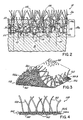
- Fig. 2 shows the backing 22 after substantial biodegradation has occurred, and after topdressing 24a has been applied.
- Fig. 2 shows the fibers 20 vertically distributed within a vertical band 20a.
- This band 20a is greater in vertical dimension than the fibers 20 themselves, because the fibers 20 have migrated vertically. This migration occurs in response to movement of the aerating tines downwardly through the turf 10 during aeration. This migration effectively produces this subsurface stabilizing band 20a.
- aerating of the turf 10 not only produces the commonly known agronomic benefits, it also assures continued stabilization of the turf 10 long after installation, by continuing to redistribute the fibers 20. These advantages are possible only because the backing 22 is substantially biodegradable within a predetermined time period.
- the backing 22 may be woven, knitted or tufted.
- the backing 22 may also be reinforced for added strength for certain applications.
- the reinforcement may be done by increasing the thickness of the transverse and/or longitudinal fibers, or by adding a synthetic strand, fiber or filament such a polypropylene. These added strands could be laced into the weave of the backing 22 or perhaps substituted for the transverse or the longitudinal fibers.
- Fig. 3 shows a second preferred embodiment of this invention.
- a turf 10 made according to this embodiment would be identical to the turf 10 of Figs. 1-2 except that the mat 118 is different.
- mat 118 includes a backing 122 with a non-biodegradable open cell web 122a for reinforcement.
- the backing 122 is a composite which has two "primary" backings, or layers. The first is a completely biodegradable layer 122b, of a material such as jute, and the second is a non-biodegradable layer 122a, such as a synthetic web.
- the web 122a is made of non-biodegradable polypropylene, to provide some minimal ongoing lateral structural integrity for the mat 118.
- the cells of the web 122a are sufficiently open and the longitudinal and transverse strands are sufficiently thin that the composite backing 122 is still considered substantially biodegradable. This is because there is sufficient openness to allow passage therethrough of water and nutrients and there is no barrier effect created. Also, the fibers 120 are relatively free to migrate in response to contact with aerating tines. The individual strands of the web 122a will break if they happen to be contacted by hollow tines during aeration.
- the composite backing 122 included a layer 122a made from polypropylene, with a strand count of 5 x 5 and a weight of 53,6 g/m (1.728 ounces per yard).
- This layer 122a is commercially available from Conwed Plastics of Roseville, Minnesota, and identified as Product No. R07821-002.
- the "strand count” refers to the number of "cells" per square inch.
- a stand count of 5 x 5 refers to a mesh with 3,9 cells per cm 2 (25 cells per square inch), in 5 rows and 5 columns. Applicant believes that a strand count as low as 2 x 2 would also work, but that a strand count with larger openings would possibly cause problems with aeration tines due to thickness of material.
- the layers 122a and 122b are simultaneously run through a tufting machine to secure the non-biodegradable fibers 120 thereto.
- the fibers 120 are tufted in a predetermined density, by stitching with a 15,9 mm (5/8") gauge, in an acute zig zag pattern to maximize the amount of material on the underside of the backing 122.
- This manner of fiber securement provides additional initial horizontal strength for the mat 118 and increases the ability of the turf 10 to vertically redistribute the fibers 120 through the rootzone during aeration (Fig. 3).
- this reinforcement layer 122a it may not be necessary to treat the backing 122 with a decomposition or a stabilizing agent because of the added lateral stability provided by the mesh.
- the need to apply one or more secondary coatings in finishing steps may be eliminated.
- the benefits of the invention result from the ability to practice standard agronomic maintenance principles for the turf 10, i.e., aerating and topdressing, whenever desired after installation.
- standard agronomic maintenance principles for the turf 10 i.e., aerating and topdressing
- prior stabilized turfs either did not recommend these practices, or resulted in other disadvantages if these turf maintenance practices were used.
- the stabilized turf 10 is initially grown at a remote site such as a sod farm, in preferably 3,6 to 4,6 m (12 to 15 feet) wide sections of any desired length, the mat 18 (or 118) is rolled out on a synthetic barrier of some sort, such as plastic.
- the plastic barrier inhibits root growth into the ground below, thereby eliminating the need to cut the turf 10 at the roots prior to transport.
- the structure of the turf 10 thereabove remains the same as shown in Fig. 1 except that the grass 26 has not yet grown in and there is no lower layer 16. That is, the upper layer 24 of growth media is filled in around the fibers 20 (or 120), preferably leaving at least about 12,7 mm (0.5 inches) of the fibers 20 extending thereabove. The upper layer 24 is then seeded, sprigged or planted with power washed sod, or other known turfing method.
- the natural turf 10 is ready to be cut longitudinally and rolled in desired lengths for transport to a site for use, such as an athletic stadium.
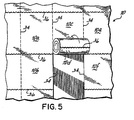
- the lines 34 show longitudinal seams extending along adjacent rows of sections of turf 10.
- Reference lines 36 show transverse seams.
- Reference numerals 10a-10f show the locations of individual sections of turf 10. Sections 10a and 10b are in one row, while sections 10c and 10d and 10e and 10f are in the next two rows, respectively. Sections 10c and 10d have been rolled up, while the other sections are shown in place.
- the individual sections of the turf 10 may be joined to adjacent sections by securement of the edges of the corresponding backings 22 (or 122). This can be done by sewing with a fabric thread such as jute or a synthetic thread such as polypropylene. It can also be done by stapling the backings 22 together. Thin metal staples typically degrade by rusting within about 8 months. Securing the adjacent sections of turf 10 is beneficial whether the turf 10 is initially installed on-site or grown at a sod farm. For turf 10 grown at a sod farm, it is particularly advantageous along the transverse, or butt joints, of sections residing in a single row. This is because rolling of the turf 10 for transport to a remote site generates a stretching force on the turf 10. This stretching force can cause separation of the turf 10, particularly along the transverse seams of adjacent sections, for instance along the seam between rolled sections 10c and 10d (Fig. 5). Securing the transverse edges together eliminates the risk of the turf 10 pulling apart during rolling.
- a laser graded surface is covered with a stabilized synthetic, sand-filled mat 18 constructed of 100% polypropylene fibers 20 (10,000 denier, .75 twist, approx. 970g/m 2 ), stitched (tufted) in a chevron pattern into a woven backing 22 made of natural and biodegradable fibers.
- the fiber mat 22 has a plain weave, with a fiber count of 15 x 13 count, a face weight of approx. 340g/m 2 and is manufactured in 4.6m widths. It is treated with a stabilizing agent and a decomposition agent, as described previously, to extend the time required for biodegradation once placed in the field and to help secure the fibers 20, as described previously.
- the backing 22 including this coating has a minimum weight of 408 g/m 2 .
- the polypropylene fibers 20 tufted into the mat 18 extend 38mm above the surface in a vertical orientation.
- the manufactured mat 18 has a minimum total weight of 1.375kg/m 2 .
- the mat 18 is rolled onto a laser graded sand surface, adjacent rolls abutted and the seams secured together to create a continuous, seamless "carpet" across the entire playing surface.
- the vertically stitched fibers 22 are filled to approximately 65% of their height (i.e., slightly less than 25 mm) with the same specified sand as was used to create the rootzone.
- the sand is applied in lifts and broomed into the mat to assure the synthetic fibers 20 remain upright.
- the surface is planted with top quality, nursery grown hybrid Bermudagrass sprigs, such as GN-1, or similar. The grow-in period begins immediately following completion of the sprigging process and is expected to last about eight weeks, and possibly longer.
- Example II is identical to Example I, except that mat 118 is used instead of mat 18.
- the backing 122 includes two primaries, one 122b being biodegradable jute and the other 122a being a polypropylene mesh with a strand count of 5 x 5.
- the fibers 120 are tufted thereto.
- the treatment for the backing 118 may differ, because no decomposition agent nor any stabilizing agent for the fibers 120 may be necessary, or at least only one side may need to be coated.
- the stabilized natural turf 10 of this invention provides a stable playing surface with a stable base and a completely natural turf look and feel, with the playing surface comprising natural grass 26 and, to some extent, the upper ends of the fibers 20 (or 120).
- the fibers 20 become buried due to topdressing applications. But by then the backing 22 (or 122) has substantially biodegraded.
- the fibers 20 (or 120) have also vertically migrated and reoriented.
Landscapes
- Life Sciences & Earth Sciences (AREA)
- Environmental Sciences (AREA)
- Engineering & Computer Science (AREA)
- Architecture (AREA)
- Civil Engineering (AREA)
- Structural Engineering (AREA)
- Cultivation Of Plants (AREA)
Description
Claims (18)
- A stabilized turf (10) comprising:characterized in that the backing (22; 122) is substantially biodegradable within a predetermined time period, thereby to promote vertical migration of the fibers in response to aeration, and the backing (22; 122), the growth media or the secondary layer of the backing (22; 122) includes a decomposition agent to control the predetermined time period for substantial biodegrading.a mat (18; 118) including a backing (22;122) oriented horizontally and a plurality of non-biodegradable fibers (20; 120) held by the backing (22; 122) and extending generally upright therefrom;an upper layer (24) of growth media located above the mat (18;118); andnatural grass plants (26) having roots (30) and crowns (28), the roots (30) extending downwardly through the upper layer (24) and through the backing (22; 122) and the crowns (28) located above the backing (22; 122), the tops of the grass plants (26) and the fibers (20; 120) extending above the upper layer (24), wherein the backing (22; 122) includes at least one secondary layer
- The stabilized turf of claim 1 wherein the secondary layer of the backing (22; 122) further includes a stabilizing agent and/or a growth agent.
- The stabilized turf of claim 1 or claim 2 wherein the substantially biodegradable backing (22; 122) includes a woven primary layer (22; 122b).
- The stabilized turf of claim 3 wherein the woven primary layer (22; 122b) is of homogenous composition.
- The stabilized turf of any of the previous claims wherein the backing (22; 122) comprises one of the following materials: jute, burlap, hemp, flax, sisal.
- The stabilized turf of any one of the previous claims wherein the fibers (20; 120) are tufted to the backing (22; 122).
- The stabilized turf of any one of the previous claims wherein the substantially biodegradable backing (122) includes a reinforcement (122a) of non-biodegradable material.
- The stabilized turf of claims 4 and 7 wherein the fibers (120) are secured to both the primary layer (122b) and the reinforcement (122a) of the backing (122).
- The stabilized turf of claim 8 wherein the fibers (120) are secured by tufting.
- A method of maintaining a stabilized turf (10) according to any one of claims 1-9, characterized by the steps of
aerating the stabilized turf (10) by moving tines downwardly beyond the level of the backing (22; 122) after the backing (22; 122) has substantially biodegraded, thereby causing at least some of the fibers (20; 120) to vertically disperse and to migrate within a vertical band (20a) at least including the upper layer (24) of growth media. - The method of claim 10 further comprising the step of topdressing the stabilized turf (10).
- A stabilizer for stabilizing a natural turf (10), comprising:characterized in that the backing (22; 122) is substantially biodegradable within a predetermined time period, thereby to promote in use, vertical migration of the fibers (20; 120) in response to aeration and in that the backing (22; 122) or the secondary layer of the backing (22; 122) includes a decomposition agent to control the predetermined time period for substantial biodegrading.a backing (22; 122) which when oriented horizontally below an upper layer (24) of growth media permits roots (30) of natural grass plants (26) extending through the upper layer (24) to extend therethrough;a plurality of non-biodegradable fibers (20; 120) secured to the backing (22; 122) so as to extend generally upright therefrom when the backing (22; 122) is disposed horizontally, and wherein the backing (22, 122) incluclesat least one secondary layer,
- The stabilizer of claim 12 wherein the secondary layer of the backing (22; 122) further includes a stabilizing agent and/or a growth agent.
- The stabilizer of claims 12 or 13 wherein the substantially biodegradable backing (22; 122) includes a woven primary layer (22; 122b) of homogenous composition.
- The stabilizer of any of claims 12 - 14 wherein the backing (22; 122) comprises one of the following materials: jute, burlap, hemp, flax, sisal.
- The stabilizer of any of claims 12 - 15 wherein the non-biodegradable fibers (20; 120) are tufted to the backing (22; 122).
- The stabilizer of claim 14 and further comprising:a reinforcement (122a) of non-biodegradable material secured to the primary layer (122b).
- The stabilizer of claim 17 and further comprising:the non-biodegradable fibers (120) being tufted to both the primary layer (122b) and the reinforcement (122a) of the backing (122).
Priority Applications (1)
| Application Number | Priority Date | Filing Date | Title |
|---|---|---|---|
| EP20030022677 EP1394324A1 (en) | 1997-06-06 | 1998-06-08 | Stabilized turf for athletic field |
Applications Claiming Priority (3)
| Application Number | Priority Date | Filing Date | Title |
|---|---|---|---|
| US08/870,541 US6029397A (en) | 1997-06-06 | 1997-06-06 | Stabilized natural turf for athletic field |
| US870541 | 1997-06-06 | ||
| PCT/US1998/011323 WO1998055697A1 (en) | 1997-06-06 | 1998-06-08 | Stabilized turf for athletic field |
Related Child Applications (1)
| Application Number | Title | Priority Date | Filing Date |
|---|---|---|---|
| EP20030022677 Division EP1394324A1 (en) | 1997-06-06 | 1998-06-08 | Stabilized turf for athletic field |
Publications (2)
| Publication Number | Publication Date |
|---|---|
| EP0986674A1 EP0986674A1 (en) | 2000-03-22 |
| EP0986674B1 true EP0986674B1 (en) | 2004-09-01 |
Family
ID=25355607
Family Applications (2)
| Application Number | Title | Priority Date | Filing Date |
|---|---|---|---|
| EP98926198A Expired - Lifetime EP0986674B1 (en) | 1997-06-06 | 1998-06-08 | Stabilized turf for athletic field |
| EP20030022677 Withdrawn EP1394324A1 (en) | 1997-06-06 | 1998-06-08 | Stabilized turf for athletic field |
Family Applications After (1)
| Application Number | Title | Priority Date | Filing Date |
|---|---|---|---|
| EP20030022677 Withdrawn EP1394324A1 (en) | 1997-06-06 | 1998-06-08 | Stabilized turf for athletic field |
Country Status (6)
| Country | Link |
|---|---|
| US (4) | US6029397A (en) |
| EP (2) | EP0986674B1 (en) |
| AU (1) | AU738632B2 (en) |
| CA (1) | CA2293374C (en) |
| DE (1) | DE69825997T2 (en) |
| WO (1) | WO1998055697A1 (en) |
Cited By (1)
| Publication number | Priority date | Publication date | Assignee | Title |
|---|---|---|---|---|
| DE102015113210A1 (en) * | 2015-08-11 | 2017-02-16 | heiler GmbH & Co. KG | Fiber-reinforced turf layer |
Families Citing this family (79)
| Publication number | Priority date | Publication date | Assignee | Title |
|---|---|---|---|---|
| US6691455B1 (en) * | 1992-06-22 | 2004-02-17 | Turf Stabilization Technologies, Inc. | Sports playing surfaces with biodegradable backings |
| US6295756B1 (en) | 1992-06-22 | 2001-10-02 | Turf Stabilization Technologies Inc. | Surface for sports and other uses |
| US5651213A (en) * | 1992-08-07 | 1997-07-29 | Egan; Michael Andrew | Production of sod using a soil-less sand based root medium |
| US20040200145A1 (en) * | 1995-07-31 | 2004-10-14 | Egan Michael Andrew | Production of sod using a soil-less sand based root medium |
| NL1004656C2 (en) * | 1996-11-29 | 1998-07-02 | Hugo De Vries | Combination lawn. |
| US6216389B1 (en) * | 1997-06-06 | 2001-04-17 | Technology Licensing Corp. | Stabilized natural turf with decomposition agent |
| US6336291B1 (en) * | 1998-07-27 | 2002-01-08 | Jerome Skuba | Method of growing a garden and product produced thereby |
| US20030152743A1 (en) * | 1999-04-26 | 2003-08-14 | Atsushi Matsunaga | Base cloth for tufted carpet and tufted carpet using the same |
| ATE286768T1 (en) * | 1999-06-04 | 2005-01-15 | John Granville Burns | PLAYING SUBSTRATE, ESPECIALLY LAWN MATS |
| US6491991B2 (en) | 2000-02-14 | 2002-12-10 | Southwest Recreational Industries, Inc. | Artificial turf system |
| BR0113793A (en) * | 2000-09-05 | 2003-07-15 | Fieldturf Inc | Artificial grass for landscapes |
| US6698141B2 (en) * | 2001-01-23 | 2004-03-02 | Uni-Systems, Llc | Convertible stadium and method of operating |
| US6858272B2 (en) | 2001-03-14 | 2005-02-22 | Troy Squires | Horizontally draining, pre-engineered synthetic turf field |
| US20020136846A1 (en) * | 2001-03-23 | 2002-09-26 | Jean Prevost | Hook and loop attachment for artificial grass |
| US20030118755A1 (en) * | 2001-12-21 | 2003-06-26 | Motz Joseph E. | Filled synthetic turf with ballast layer |
| US6933036B2 (en) * | 2002-07-11 | 2005-08-23 | Textron Inc. | Non-skid floor mat design |
| ES2366539T3 (en) * | 2002-12-19 | 2011-10-21 | Greenfields B.V. | ARTIFICIAL LAWN COVER AND METHOD FOR MANUFACTURING THE SAME. |
| FR2850527B1 (en) * | 2003-02-05 | 2006-02-10 | Arnold Julia | METHOD AND DEVICE FOR MAKING A VEGETABLE COATING AND PLANT COATING OBTAINED |
| WO2004073388A1 (en) * | 2003-02-19 | 2004-09-02 | Wolfgang Behrens | Mat used for a vegetation body |
| GB0307671D0 (en) * | 2003-04-03 | 2003-05-07 | Nottinghamshire Sports And Saf | Improvements relating to the construction of playing surfaces |
| GB0307672D0 (en) * | 2003-04-03 | 2003-05-07 | Nottinghamshire Sports And Saf | Playing surface structure and method of construction of a playing surface |
| US7001111B2 (en) * | 2003-10-24 | 2006-02-21 | Maxwell Victoria H | Landscape/erosion control product |
| JP2007510075A (en) * | 2003-10-31 | 2007-04-19 | ウォーターフォード、ギャリー・ウェイン | Surface drainage for sports |
| US7189445B2 (en) * | 2003-12-12 | 2007-03-13 | Generalsports Turf, Llc | Synthetic sports turf having improved playability and wearability |
| US7335406B2 (en) * | 2003-12-16 | 2008-02-26 | Stabilizer Solutions, Inc. | Surfaces for supporting artificial playing surfaces |
| US7434721B2 (en) * | 2004-06-25 | 2008-10-14 | Smurfit-Stone Container Enterprises, Inc. | Polygonal collapsible bulk bin |
| US7758281B2 (en) * | 2004-07-08 | 2010-07-20 | General Sports Venue Llc | Synthetic sports turf having improved playability and wearability |
| ITPI20040052A1 (en) * | 2004-07-15 | 2004-10-15 | Roberto Nusca | CONSTRUCTION SYSTEM FOR THE REALIZATION OF SPORTS, RECREATIONAL AND / OR ORNAMENTAL SURFACES WITH THE USE OF ARTIFICIAL GRASS TECHNOLOGY COMBINED WITH LIVING VEGETABLE COVERS |
| US20070048096A1 (en) * | 2004-12-07 | 2007-03-01 | Hubbs Jonathan W | Soil conditioner |
| US20060118009A1 (en) * | 2004-12-07 | 2006-06-08 | Hubbs Jonathan W | Soil conditioner |
| US9267232B2 (en) * | 2005-03-24 | 2016-02-23 | Tarkett Inc. | Synthetic turf system having an infill trapping structure |
| RU2408758C2 (en) * | 2005-06-17 | 2011-01-10 | Филдтерф Таркетт Инк. | Method to give rigidity to synthetic tapes of synthetic grass cover |
| ITMI20051403A1 (en) * | 2005-07-21 | 2007-01-22 | Italgreen S P A | STRUCTURE OF ARTIFICIAL HERBAL MANTO AND RELATIVE METHOD OF REALIZATION |
| US7399145B2 (en) * | 2005-07-25 | 2008-07-15 | Clark Kevin L | Multi-layer liner assembly for a sand trap |
| NL1031837C2 (en) * | 2006-05-19 | 2007-11-20 | Inventress B V | Synthetic turf system, artificial turf mat and method for manufacturing an artificial turf mat. |
| US7699562B2 (en) * | 2006-05-31 | 2010-04-20 | Clark Kevin L | Liner assembly for a sand trap |
| CA2667360A1 (en) * | 2006-10-23 | 2008-08-21 | Fieldturf Tarkett Inc. | Aircraft arrestor system and method of decelerating an aircraft |
| US20080098652A1 (en) * | 2006-10-30 | 2008-05-01 | Kenneth Thomas Weinbel | Sport playing field |
| NL1032876C2 (en) * | 2006-11-16 | 2008-05-19 | Ten Cate Thiolon Bv | Composite artificial grass fiber and method for manufacturing such an artificial grass fiber. |
| DE102007006766B3 (en) * | 2007-02-12 | 2008-05-29 | Zinco Gmbh | Irrigation device for e.g. capillary irrigation of vegetation substrate, has substrate carrier and capillary irrigation structure combined to irrigation mat, where carrier is supplied with water over irrigation structure |
| DK2142705T3 (en) * | 2007-04-12 | 2012-06-04 | Mar Project S R L | Method of providing an artificial lawn |
| US20080277017A1 (en) * | 2007-05-11 | 2008-11-13 | Young Chul Kwon | Degreasing Cloth |
| WO2009020868A2 (en) | 2007-08-04 | 2009-02-12 | Rezzorb, Llc | Method and apparatus for reducing fertilizer use in agricultural operations |
| FR2922719A1 (en) * | 2007-10-24 | 2009-05-01 | Sarl Fibersoil Sarl | Turf area creating or reconstructing method for sports field, involves depositing pregrown lawn strip on soil, and sample has thickness of specific centimeters, where strip is obtained by sample in culturing zone of grass seedlings |
| FR2932196A1 (en) * | 2008-06-04 | 2009-12-11 | Cyril Rene Lucien Moussard | New or recycled synthetic turf for use during practice of e.g. sports, has synthetic turf base comprising synthetic herb fibers fixed on rot-proof support material and filled by filling material, where base is sown with grains |
| US20100088957A1 (en) * | 2008-10-09 | 2010-04-15 | Hubbs Jonathan W | Natural turf with binder |
| US9011740B2 (en) | 2008-12-15 | 2015-04-21 | Textile Management Associates, Inc. | Method of recycling synthetic turf and infill product |
| US20100216639A1 (en) * | 2009-02-20 | 2010-08-26 | Hubbs Jonathon W | Gypsum soil conditioner |
| EP2494109B1 (en) * | 2009-10-30 | 2013-12-11 | MAR. Project S.r.l. | Mixed turf |
| DE102010007552B4 (en) * | 2010-02-11 | 2014-07-10 | Xf Technologies B.V. | Vegetation element for greening artificial non-terrestrial areas with lower and / or higher plants and method for producing the vegetation element |
| US20120034039A1 (en) * | 2010-08-09 | 2012-02-09 | Victoria Lynn Hawkins-Maxwell | Landscape Erosion Control Fabric with Mulch Blocking Members |
| KR101044653B1 (en) * | 2010-10-27 | 2011-06-29 | 주식회사 이신상사 | Artificial turf |
| US20140250780A1 (en) * | 2010-10-27 | 2014-09-11 | Hyo-sang Lee | Removable support surface |
| DE102011006840A1 (en) | 2011-04-06 | 2012-10-11 | Jöst Gmbh | Industrially produced natural turf for use as e.g. covering of swimming pool, has foil layer that is formed on plastic base layer, and turf seeds that are evenly secured on bottom side of foil layer by water soluble adhesive |
| NZ617452A (en) * | 2011-05-23 | 2014-10-31 | Hg Sports Turf Pty Ltd | Improved relocatable turf |
| ES2791848T3 (en) | 2011-08-25 | 2020-11-06 | Richard Campey Ltd | Lawn treatment |
| DE102011083454A1 (en) * | 2011-09-26 | 2013-03-28 | Horst Schwab Gmbh | Natural turf system, particular for application to synthetic turf, has planar configuration and water-permeable support layer, where natural turf layer is directly arrangeable on support layer |
| PL2626468T3 (en) * | 2012-02-13 | 2016-04-29 | Nikolaos Sarris | Mixed turf and method of making |
| PL400399A1 (en) * | 2012-08-14 | 2014-02-17 | Dywilan Spólka Akcyjna | Mat for hybrid sports or decorative field |
| GB201219124D0 (en) | 2012-10-24 | 2012-12-05 | Richard Campey Ltd | Turf treatment implement |
| ES2401631B1 (en) * | 2013-02-18 | 2013-11-11 | Profesional Sportsverd Futbol, S. L. | Mixed lawn system for sports floors and landscaped grounds and cultivation procedure of said mixed lawn |
| CN104412842A (en) * | 2013-09-07 | 2015-03-18 | 郑建锋 | Plant base cushion used for decorating surface |
| EP2921044A1 (en) * | 2014-03-21 | 2015-09-23 | DOLD Sportflächen GmbH | Ready-made lawn and manufacturing method for a ready-made lawn |
| NL2014906B1 (en) * | 2015-06-02 | 2017-01-31 | Desso Sports B V | Method for applying fibers to a substrate. |
| EP3201398B8 (en) * | 2014-10-01 | 2018-12-19 | Desso Sports B.V. | Water barrier, in particular a dike |
| CN107709667B (en) | 2015-09-18 | 2021-03-12 | 体育场草坪科技私人有限公司 | Hybrid turf surface and support therefor |
| FR3041365B1 (en) * | 2015-09-23 | 2018-08-31 | Id Verde | SOIL WITH MIXED STRUCTURE NATURAL TURF AND ARTIFICIAL TURF |
| JP6750343B2 (en) * | 2016-06-24 | 2020-09-02 | 住友ゴム工業株式会社 | Mat for greening |
| WO2018171911A1 (en) * | 2017-03-23 | 2018-09-27 | Polytex Sportbeläge Produktions-Gmbh | Support mat for hybrid turf |
| EP3585935A1 (en) * | 2017-03-23 | 2020-01-01 | Polytex Sportbeläge Produktions-GmbH | Hybrid turf or artificial turf with inhomogeneous latex backing |
| CN107326775A (en) * | 2017-06-30 | 2017-11-07 | 镇江市润州园林绿化研究所 | The lawn system that a kind of Artificial grass and natural grass are combined |
| EP3623530B1 (en) * | 2018-09-11 | 2021-03-24 | Hydrofields BV | Hybrid grass support structure with stone wool layer and biodegradable box comprising such structure |
| RU2759933C1 (en) * | 2018-08-21 | 2021-11-18 | Хайдрофилдс Бв | Support structure for hybrid lawn containing layer of rock wool, method for installing such structure and biodegradable box containing such structure |
| JP7040822B2 (en) * | 2018-12-21 | 2022-03-23 | 株式会社グリーンズグリーン | Vegetation sheet |
| CA3158398A1 (en) | 2019-12-16 | 2021-06-24 | Harold Meherg | Aragonite based ground covering |
| CN112942017B (en) * | 2021-03-03 | 2022-05-27 | 浙江省一建建设集团有限公司 | Football field anchoring type mixed lawn and construction method thereof |
| IT202100007019A1 (en) * | 2021-03-23 | 2022-09-23 | Safitex Turf S R L | COMPOSITE ARTIFICIAL SUBSTRATE FOR MAKING HYBRID TURF FOR SPORTS FACILITIES, LEISURE AREAS OR GARDENS, PROCESS FOR MAKING HYBRID TURF AND HYBRID TURF SO MADE |
| RU2764735C1 (en) * | 2021-06-15 | 2022-01-20 | Алексей Александрович Зайцев | Method for forming a rolled combined grass cover |
| GB2634275A (en) * | 2023-10-04 | 2025-04-09 | Notts Sport Group Ltd | Surface layer for artificial surfacing |
Family Cites Families (67)
| Publication number | Priority date | Publication date | Assignee | Title |
|---|---|---|---|---|
| DE8200994U1 (en) * | 1982-08-26 | GFL-Sportstättenbau GmbH, 5928 Laasphe | Mat-like component for producing a floor covering | |
| US2605589A (en) * | 1950-11-14 | 1952-08-05 | Alfred E E Kuestner | Sod unit |
| US2713012A (en) * | 1952-03-13 | 1955-07-12 | Fred W Hartstein | Floor rug |
| US3513062A (en) * | 1968-05-14 | 1970-05-19 | Monsanto Co | Synthetic turf surface |
| US3995079A (en) * | 1969-08-08 | 1976-11-30 | Haas Jr Frederick T | Artificial turf-like product |
| US3863388A (en) * | 1970-09-10 | 1975-02-04 | Mercer Ltd F B | Growing of grasses |
| GB1396034A (en) * | 1972-05-04 | 1975-05-29 | Mercer Ltd F B | Grassbearing laminae |
| DE2522864A1 (en) * | 1975-05-23 | 1976-12-30 | Berleburger Schaumstoffwerk | Grid for growing grass for landscaped areas - consists of ridges of artificial grass bristles on the top, between cavities of nutrient |
| US4044179A (en) * | 1975-11-18 | 1977-08-23 | Mod-Sod Sport Surfaces | Playing surface for athletic games |
| NO764028L (en) * | 1975-12-04 | 1977-06-07 | Dunlop Ltd | |
| US4023506A (en) * | 1976-03-08 | 1977-05-17 | Purdue Research Foundation | System and process for providing durability enhanced area |
| JPS5929114B2 (en) | 1976-07-23 | 1984-07-18 | 株式会社トクヤマ | Corrosion prevention method for nozzles |
| US4389435A (en) * | 1978-09-29 | 1983-06-21 | Mod-Sod Sports Surfaces, Inc. | Top dressed plating surface with resilient underpad |
| US4462184A (en) * | 1979-05-18 | 1984-07-31 | Cunningham Percy C | System for improving synthetic surfaces |
| US4337283A (en) * | 1980-09-11 | 1982-06-29 | Haas Jr Frederick T | Synthetic turf playing surface with resilient top-dressing |
| DE3116231A1 (en) * | 1981-04-23 | 1982-11-11 | J.F. Adolff Ag, 7150 Backnang | FLOORING FOR FREE AREAS |
| DE8112126U1 (en) * | 1981-04-23 | 1982-10-07 | J.F. Adolff Ag, 7150 Backnang | Mat, especially as a sub-layer for an artificial lawn |
| US4426415A (en) * | 1981-12-11 | 1984-01-17 | V&L Manufacturing Company, Inc. | Tufted carpeting, especially artificial turf, with tufts stitched through multiple layers of pre-woven backing material of differing gauge |
| JPS5915183A (en) * | 1982-07-13 | 1984-01-26 | 日本板硝子株式会社 | Plastic view window having anti-electrostatic property |
| US4396653A (en) * | 1982-09-24 | 1983-08-02 | Tomarin Seymour A | Simulated grass playing field surface with rubber particle layer and sand layer |
| JPS59151813A (en) * | 1983-02-19 | 1984-08-30 | 日本植生株式会社 | Greening construction by artificial lawn plate |
| US4572700A (en) * | 1983-03-31 | 1986-02-25 | Monsanto Company | Elongated bendable drainage mat |
| FR2556381B1 (en) * | 1983-12-12 | 1986-11-21 | Masquelier Henry | NATURAL GRASS FIELD |
| DE3409361A1 (en) * | 1984-03-14 | 1985-09-19 | J.F. Adolff Ag, 7150 Backnang | ARTIFICIAL LAWN |
| DE3573815D1 (en) * | 1984-08-25 | 1989-11-23 | Nottingham County Council | Pedestrian, vehicular, or sports playing surfaces and underlays/shock pads |
| NL8501610A (en) * | 1985-06-04 | 1987-01-02 | Hollandsche Betongroep Nv | SPORTS FIELD. |
| GB8619850D0 (en) * | 1985-12-14 | 1986-09-24 | Mansfield Standard Sand Co Ltd | All weather surfaces |
| NL8602322A (en) * | 1986-09-15 | 1988-04-05 | Heijmans Wegenbouwmij | METHOD FOR APPLYING A SUBSTRUCTURE STRUCTURE FOR AN ARTIFICIAL GRASS FIELD AND ARTIFICIAL GRASS FIELD WITH SUCH A SUBSTRUCTURE STRUCTURE. |
| US4705706A (en) * | 1986-09-16 | 1987-11-10 | Avco Synthetic Turf Production Distribution, Inc. | Tufted carpeting having stitches thermally bonded to backing |
| US4867614A (en) * | 1986-10-03 | 1989-09-19 | Freed W Wayne | Reinforced soil and method |
| US4790691A (en) * | 1986-10-03 | 1988-12-13 | Freed W Wayne | Fiber reinforced soil and method |
| NL8602514A (en) * | 1986-10-07 | 1988-05-02 | Desseaux H Tapijtfab | ARTIFICIAL GRASS FIELD AND FIBER MATERIAL APPARENTLY INTENDED FOR SUCH ARTIFICIAL GRASS FIELD. |
| DE3703866C2 (en) * | 1987-02-07 | 1994-03-17 | Balsam Ag | Multi-layer playing surface |
| GB2206611B (en) * | 1987-03-30 | 1990-11-21 | John Halliday | Reinforcing a grassed surface |
| DE3723364A1 (en) * | 1987-07-15 | 1989-01-26 | Ruediger Lothar Von Di Reppert | Process for producing and applying carrier means for natural grass |
| US4941282A (en) * | 1987-12-29 | 1990-07-17 | Gene Milstein | Wildflower sod mat and method of propagation |
| EP0373282A1 (en) * | 1988-12-13 | 1990-06-20 | "H.R.B. Chemie Hiroba Belgium" | Process for constructing and keeping up a terrain, particularly a sports ground, and terrain constructed according to this process |
| US4913596A (en) * | 1989-05-04 | 1990-04-03 | Erosion Control Systems, Inc. | Athletic field construction |
| NL8901484A (en) * | 1989-06-12 | 1991-01-02 | Heidemij Uitvoering | SPORTS FIELD WITH NATURAL GRASS AND ARTIFICIAL GRASS, AND A METHOD OF APPLICATION THEREOF. |
| GB2232795B (en) * | 1989-06-15 | 1992-02-19 | Plessey Co Plc | Improvements relating to dc-dc converters |
| US5014462A (en) * | 1989-12-29 | 1991-05-14 | International Soil Systems, Inc. | Soil amendment with rubber particles |
| US5205068A (en) * | 1990-03-20 | 1993-04-27 | Solomou Christopher J | Method for cultivation of turf |
| JP2634296B2 (en) * | 1990-05-17 | 1997-07-23 | 三菱重工業株式会社 | Zone air conditioner |
| GB9020624D0 (en) | 1990-09-21 | 1990-10-31 | Heckmondwike Fb Ltd | Ground stabilisation material |
| US5346514A (en) * | 1991-06-17 | 1994-09-13 | Molnar Charles I | Versatile plant sod mat and method for propagation |
| US5224290A (en) * | 1991-06-17 | 1993-07-06 | Molnar Charles J | Versatile herb, vegetable, flower and groundcover sod mat and method for propagation |
| US5345713A (en) * | 1991-08-14 | 1994-09-13 | Molnar Charles J | Low cost, versatile sod mat and method for propagation |
| JPH05312742A (en) * | 1992-05-07 | 1993-11-22 | I N R Kenkyusho:Kk | Material judging apparatus |
| US5850708C1 (en) * | 1992-06-22 | 2001-09-25 | Turf Stabilization Technologie | Surface for sports and other uses |
| US5489317A (en) * | 1992-06-22 | 1996-02-06 | Turf Systems International, Inc. | Surface for sports and other uses |
| KR100278823B1 (en) * | 1992-06-22 | 2001-01-15 | 헤인레인 마크 에이. | Improved surface for sports and other uses |
| US5326192A (en) * | 1992-10-20 | 1994-07-05 | Synthetic Industries, Inc. | Methods for improving appearance and performance characteristics of turf surfaces |
| US5445860A (en) * | 1992-12-29 | 1995-08-29 | Gff Holding Company | Tufted product having an improved backing |
| EP0612885A1 (en) * | 1993-02-12 | 1994-08-31 | Sommer Levasseur S.A. | Element for a synthetic tennis court and its manufacturing process |
| US5397368A (en) * | 1993-07-21 | 1995-03-14 | Charles J. Molnar | Specialty sod mats constructed of nonwoven fabric |
| US5464455A (en) * | 1993-07-21 | 1995-11-07 | Charles J. Molnar | Specialty sod mats constructed of nonwoven fabric with apertures |
| US5555674A (en) * | 1993-07-21 | 1996-09-17 | Charles J. Molnar | Sod mats constructed of stable fibers and degradable matrix material and method for propagation |
| US5344470A (en) * | 1993-07-21 | 1994-09-06 | Charles J. Molnar | Sod mats constructed of stable fibers and a degradable matrix material |
| JPH07207614A (en) * | 1994-01-20 | 1995-08-08 | Sumitomo Rubber Ind Ltd | Lawn pavement structure and its construction method |
| US5507845A (en) * | 1994-10-11 | 1996-04-16 | Charles J. Molnar | Plant sod mats |
| CA2164399C (en) * | 1994-12-05 | 2000-04-18 | Donald A. Irwin, Sr. | Carpet with fluid barrier |
| US5752784A (en) | 1995-02-17 | 1998-05-19 | The Motz Group | Low profile drainage network for athletic field drainage system |
| AU5024396A (en) | 1995-02-17 | 1996-09-04 | Motz Group, The | Control system for draining, irrigating and heating an athletic field |
| JPH08228512A (en) * | 1995-02-22 | 1996-09-10 | Otsuka Chem Co Ltd | Plant growing sheet structural body for growing plant such as turf, etc., natural turf structural body and artificial turf structural body |
| DE19532173A1 (en) * | 1995-08-31 | 1997-03-06 | Hans Gilgen | Process for making a green carpet and green carpet |
| JPH09201127A (en) * | 1996-01-24 | 1997-08-05 | Nhk Spring Co Ltd | Base material for plant growing |
| NL1004656C2 (en) * | 1996-11-29 | 1998-07-02 | Hugo De Vries | Combination lawn. |
-
1997
- 1997-06-06 US US08/870,541 patent/US6029397A/en not_active Expired - Lifetime
-
1998
- 1998-06-08 CA CA 2293374 patent/CA2293374C/en not_active Expired - Lifetime
- 1998-06-08 DE DE1998625997 patent/DE69825997T2/en not_active Expired - Lifetime
- 1998-06-08 EP EP98926198A patent/EP0986674B1/en not_active Expired - Lifetime
- 1998-06-08 WO PCT/US1998/011323 patent/WO1998055697A1/en not_active Ceased
- 1998-06-08 EP EP20030022677 patent/EP1394324A1/en not_active Withdrawn
- 1998-06-08 AU AU78092/98A patent/AU738632B2/en not_active Expired
- 1998-11-11 US US09/189,704 patent/US6094860A/en not_active Expired - Lifetime
-
1999
- 1999-04-09 US US09/376,221 patent/US6173528B1/en not_active Expired - Lifetime
-
2000
- 2000-02-22 US US09/510,265 patent/US6247267B1/en not_active Expired - Lifetime
Cited By (1)
| Publication number | Priority date | Publication date | Assignee | Title |
|---|---|---|---|---|
| DE102015113210A1 (en) * | 2015-08-11 | 2017-02-16 | heiler GmbH & Co. KG | Fiber-reinforced turf layer |
Also Published As
| Publication number | Publication date |
|---|---|
| EP1394324A1 (en) | 2004-03-03 |
| US6247267B1 (en) | 2001-06-19 |
| DE69825997D1 (en) | 2004-10-07 |
| WO1998055697A1 (en) | 1998-12-10 |
| US6094860A (en) | 2000-08-01 |
| AU7809298A (en) | 1998-12-21 |
| CA2293374C (en) | 2007-09-18 |
| AU738632B2 (en) | 2001-09-20 |
| CA2293374A1 (en) | 1998-12-10 |
| DE69825997T2 (en) | 2005-01-27 |
| US6173528B1 (en) | 2001-01-16 |
| EP0986674A1 (en) | 2000-03-22 |
| US6029397A (en) | 2000-02-29 |
Similar Documents
| Publication | Publication Date | Title |
|---|---|---|
| CA2293374C (en) | Stabilized turf for athletic field | |
| US6216389B1 (en) | Stabilized natural turf with decomposition agent | |
| US6219965B1 (en) | Plant growth sheet structure, natural turf sheet structure, method of growing turf and method of laying turf sheet structure | |
| AU2016291546B2 (en) | Hybrid turf surface and support therefor | |
| US12144292B2 (en) | Hybrid grass support structure with stone wool layer | |
| WO2013121348A1 (en) | Mixed turf | |
| EP3114282B1 (en) | Mixed turf | |
| AU769873B2 (en) | Stabilized turf for athletic field | |
| JPH08228512A (en) | Plant growing sheet structural body for growing plant such as turf, etc., natural turf structural body and artificial turf structural body | |
| JPH0833406A (en) | Natural lawn sheet structure | |
| EP3623530B1 (en) | Hybrid grass support structure with stone wool layer and biodegradable box comprising such structure | |
| JPH08228513A (en) | Plant growing sheet structural body for growing plant such as turf, etc., and natural turf structural body |
Legal Events
| Date | Code | Title | Description |
|---|---|---|---|
| PUAI | Public reference made under article 153(3) epc to a published international application that has entered the european phase |
Free format text: ORIGINAL CODE: 0009012 |
|
| 17P | Request for examination filed |
Effective date: 20000105 |
|
| AK | Designated contracting states |
Kind code of ref document: A1 Designated state(s): BE CH DE ES FR GB GR IE IT LI NL |
|
| AX | Request for extension of the european patent |
Free format text: SI PAYMENT 20000105 |
|
| RAP1 | Party data changed (applicant data changed or rights of an application transferred) |
Owner name: TECHNOLOGY LICENSING CORP. |
|
| 17Q | First examination report despatched |
Effective date: 20020918 |
|
| GRAP | Despatch of communication of intention to grant a patent |
Free format text: ORIGINAL CODE: EPIDOSNIGR1 |
|
| GRAS | Grant fee paid |
Free format text: ORIGINAL CODE: EPIDOSNIGR3 |
|
| GRAA | (expected) grant |
Free format text: ORIGINAL CODE: 0009210 |
|
| AK | Designated contracting states |
Kind code of ref document: B1 Designated state(s): BE CH DE ES FR GB GR IE IT LI NL |
|
| AX | Request for extension of the european patent |
Extension state: SI |
|
| PG25 | Lapsed in a contracting state [announced via postgrant information from national office to epo] |
Ref country code: NL Free format text: LAPSE BECAUSE OF FAILURE TO SUBMIT A TRANSLATION OF THE DESCRIPTION OR TO PAY THE FEE WITHIN THE PRESCRIBED TIME-LIMIT Effective date: 20040901 Ref country code: LI Free format text: LAPSE BECAUSE OF FAILURE TO SUBMIT A TRANSLATION OF THE DESCRIPTION OR TO PAY THE FEE WITHIN THE PRESCRIBED TIME-LIMIT Effective date: 20040901 Ref country code: FR Free format text: LAPSE BECAUSE OF FAILURE TO SUBMIT A TRANSLATION OF THE DESCRIPTION OR TO PAY THE FEE WITHIN THE PRESCRIBED TIME-LIMIT Effective date: 20040901 Ref country code: CH Free format text: LAPSE BECAUSE OF FAILURE TO SUBMIT A TRANSLATION OF THE DESCRIPTION OR TO PAY THE FEE WITHIN THE PRESCRIBED TIME-LIMIT Effective date: 20040901 Ref country code: BE Free format text: LAPSE BECAUSE OF FAILURE TO SUBMIT A TRANSLATION OF THE DESCRIPTION OR TO PAY THE FEE WITHIN THE PRESCRIBED TIME-LIMIT Effective date: 20040901 |
|
| REG | Reference to a national code |
Ref country code: GB Ref legal event code: FG4D |
|
| REG | Reference to a national code |
Ref country code: CH Ref legal event code: EP |
|
| REG | Reference to a national code |
Ref country code: IE Ref legal event code: FG4D |
|
| REF | Corresponds to: |
Ref document number: 69825997 Country of ref document: DE Date of ref document: 20041007 Kind code of ref document: P |
|
| PG25 | Lapsed in a contracting state [announced via postgrant information from national office to epo] |
Ref country code: GR Free format text: LAPSE BECAUSE OF FAILURE TO SUBMIT A TRANSLATION OF THE DESCRIPTION OR TO PAY THE FEE WITHIN THE PRESCRIBED TIME-LIMIT Effective date: 20041201 |
|
| PG25 | Lapsed in a contracting state [announced via postgrant information from national office to epo] |
Ref country code: ES Free format text: LAPSE BECAUSE OF FAILURE TO SUBMIT A TRANSLATION OF THE DESCRIPTION OR TO PAY THE FEE WITHIN THE PRESCRIBED TIME-LIMIT Effective date: 20041212 |
|
| NLV1 | Nl: lapsed or annulled due to failure to fulfill the requirements of art. 29p and 29m of the patents act | ||
| REG | Reference to a national code |
Ref country code: CH Ref legal event code: PL |
|
| PLBE | No opposition filed within time limit |
Free format text: ORIGINAL CODE: 0009261 |
|
| STAA | Information on the status of an ep patent application or granted ep patent |
Free format text: STATUS: NO OPPOSITION FILED WITHIN TIME LIMIT |
|
| 26N | No opposition filed |
Effective date: 20050602 |
|
| EN | Fr: translation not filed | ||
| PGFP | Annual fee paid to national office [announced via postgrant information from national office to epo] |
Ref country code: IE Payment date: 20060525 Year of fee payment: 9 |
|
| REG | Reference to a national code |
Ref country code: IE Ref legal event code: MM4A |
|
| PG25 | Lapsed in a contracting state [announced via postgrant information from national office to epo] |
Ref country code: IE Free format text: LAPSE BECAUSE OF NON-PAYMENT OF DUE FEES Effective date: 20070608 |
|
| PGFP | Annual fee paid to national office [announced via postgrant information from national office to epo] |
Ref country code: IT Payment date: 20100622 Year of fee payment: 13 |
|
| PG25 | Lapsed in a contracting state [announced via postgrant information from national office to epo] |
Ref country code: IT Free format text: LAPSE BECAUSE OF NON-PAYMENT OF DUE FEES Effective date: 20110608 |
|
| PGFP | Annual fee paid to national office [announced via postgrant information from national office to epo] |
Ref country code: GB Payment date: 20170526 Year of fee payment: 20 |
|
| PGFP | Annual fee paid to national office [announced via postgrant information from national office to epo] |
Ref country code: DE Payment date: 20170623 Year of fee payment: 20 |
|
| REG | Reference to a national code |
Ref country code: DE Ref legal event code: R071 Ref document number: 69825997 Country of ref document: DE |
|
| REG | Reference to a national code |
Ref country code: GB Ref legal event code: PE20 Expiry date: 20180607 |
|
| PG25 | Lapsed in a contracting state [announced via postgrant information from national office to epo] |
Ref country code: GB Free format text: LAPSE BECAUSE OF EXPIRATION OF PROTECTION Effective date: 20180607 |