EP0983232B1 - Reagenz zur guanidinylierung - Google Patents
Reagenz zur guanidinylierung Download PDFInfo
- Publication number
- EP0983232B1 EP0983232B1 EP98926066A EP98926066A EP0983232B1 EP 0983232 B1 EP0983232 B1 EP 0983232B1 EP 98926066 A EP98926066 A EP 98926066A EP 98926066 A EP98926066 A EP 98926066A EP 0983232 B1 EP0983232 B1 EP 0983232B1
- Authority
- EP
- European Patent Office
- Prior art keywords
- guanidine
- protected
- group
- product
- boc
- Prior art date
- Legal status (The legal status is an assumption and is not a legal conclusion. Google has not performed a legal analysis and makes no representation as to the accuracy of the status listed.)
- Expired - Lifetime
Links
- 0 CNC(**)=*S(*)(=O)=O Chemical compound CNC(**)=*S(*)(=O)=O 0.000 description 6
- XJJPBWGZFXYDPI-UHFFFAOYSA-N CC(C)(C)OC(N/C(/N1CCCC1)=N/C(OC(C)(C)C)=O)=O Chemical compound CC(C)(C)OC(N/C(/N1CCCC1)=N/C(OC(C)(C)C)=O)=O XJJPBWGZFXYDPI-UHFFFAOYSA-N 0.000 description 1
- WJOYEXALWUBHIL-UHFFFAOYSA-N CN/C(/NC1=CC#CCC=C1)=N\OC(c1ccccc1)=O Chemical compound CN/C(/NC1=CC#CCC=C1)=N\OC(c1ccccc1)=O WJOYEXALWUBHIL-UHFFFAOYSA-N 0.000 description 1
Images


Classifications
-
- C—CHEMISTRY; METALLURGY
- C07—ORGANIC CHEMISTRY
- C07C—ACYCLIC OR CARBOCYCLIC COMPOUNDS
- C07C279/00—Derivatives of guanidine, i.e. compounds containing the group, the singly-bound nitrogen atoms not being part of nitro or nitroso groups
- C07C279/04—Derivatives of guanidine, i.e. compounds containing the group, the singly-bound nitrogen atoms not being part of nitro or nitroso groups having nitrogen atoms of guanidine groups bound to acyclic carbon atoms of a carbon skeleton
- C07C279/14—Derivatives of guanidine, i.e. compounds containing the group, the singly-bound nitrogen atoms not being part of nitro or nitroso groups having nitrogen atoms of guanidine groups bound to acyclic carbon atoms of a carbon skeleton being further substituted by carboxyl groups
-
- C—CHEMISTRY; METALLURGY
- C07—ORGANIC CHEMISTRY
- C07C—ACYCLIC OR CARBOCYCLIC COMPOUNDS
- C07C279/00—Derivatives of guanidine, i.e. compounds containing the group, the singly-bound nitrogen atoms not being part of nitro or nitroso groups
- C07C279/20—Derivatives of guanidine, i.e. compounds containing the group, the singly-bound nitrogen atoms not being part of nitro or nitroso groups containing any of the groups, X being a hetero atom, Y being any atom, e.g. acylguanidines
- C07C279/24—Y being a hetero atom
-
- C—CHEMISTRY; METALLURGY
- C07—ORGANIC CHEMISTRY
- C07C—ACYCLIC OR CARBOCYCLIC COMPOUNDS
- C07C311/00—Amides of sulfonic acids, i.e. compounds having singly-bound oxygen atoms of sulfo groups replaced by nitrogen atoms, not being part of nitro or nitroso groups
- C07C311/50—Compounds containing any of the groups, X being a hetero atom, Y being any atom
- C07C311/52—Y being a hetero atom
- C07C311/64—X and Y being nitrogen atoms, e.g. N-sulfonylguanidine
-
- C—CHEMISTRY; METALLURGY
- C07—ORGANIC CHEMISTRY
- C07K—PEPTIDES
- C07K1/00—General methods for the preparation of peptides, i.e. processes for the organic chemical preparation of peptides or proteins of any length
- C07K1/006—General methods for the preparation of peptides, i.e. processes for the organic chemical preparation of peptides or proteins of any length of peptides containing derivatised side chain amino acids
-
- C—CHEMISTRY; METALLURGY
- C07—ORGANIC CHEMISTRY
- C07K—PEPTIDES
- C07K1/00—General methods for the preparation of peptides, i.e. processes for the organic chemical preparation of peptides or proteins of any length
- C07K1/06—General methods for the preparation of peptides, i.e. processes for the organic chemical preparation of peptides or proteins of any length using protecting groups or activating agents
- C07K1/061—General methods for the preparation of peptides, i.e. processes for the organic chemical preparation of peptides or proteins of any length using protecting groups or activating agents using protecting groups
- C07K1/064—General methods for the preparation of peptides, i.e. processes for the organic chemical preparation of peptides or proteins of any length using protecting groups or activating agents using protecting groups for omega-amino or -guanidino functions
-
- Y—GENERAL TAGGING OF NEW TECHNOLOGICAL DEVELOPMENTS; GENERAL TAGGING OF CROSS-SECTIONAL TECHNOLOGIES SPANNING OVER SEVERAL SECTIONS OF THE IPC; TECHNICAL SUBJECTS COVERED BY FORMER USPC CROSS-REFERENCE ART COLLECTIONS [XRACs] AND DIGESTS
- Y02—TECHNOLOGIES OR APPLICATIONS FOR MITIGATION OR ADAPTATION AGAINST CLIMATE CHANGE
- Y02P—CLIMATE CHANGE MITIGATION TECHNOLOGIES IN THE PRODUCTION OR PROCESSING OF GOODS
- Y02P20/00—Technologies relating to chemical industry
- Y02P20/50—Improvements relating to the production of bulk chemicals
- Y02P20/55—Design of synthesis routes, e.g. reducing the use of auxiliary or protecting groups
Definitions
- the invention relates to reagents and methods for the synthesis of organic molecules containing a guanidine group. It relates particularly to reagents useful for introducing a protected guanidine group into a molecule.
- Guanidine-containing bioactive molecules are now significant targets for drug design and discovery.
- the guanidine moiety in the bioactive compound frequently occurs in arginine-containing polypeptide chains which may comprise the entire biomolecule or exist as an incorporated moiety.
- Arginine together with lysine, another amino acid with a positively charged side chain, plays an important role in biologically active proteins and peptides.
- Various arginine analogues and derivatives have been synthesized and incorporated into peptides and peptidomimetics to study the structure-activity relationships of arginine-containing molecules. These residues are frequently the critical amino acid residues in peptidomimetics.
- EP 0 646 573 A1 discloses a process for the preparation of protected and unprotected guanidino-substituted carboxylic acids.
- US 3,896,160 discloses carbamates, their manufacture and their use for combating phytopathogenic fungi.
- guanidinylating reagent A completely satisfactory guanidinylating reagent has not yet been achieved. More effective guanidinylation reagents are useful in improving the synthesis of arginine analogues and other guanidine-containing molecules.
- alkyl refers to a monovalent straight or branched chain radical of from one to ten carbon atoms, including, but not limited to methyl, ethyl, n propyl, isopropyl, n-butyl, isobutyl, tert -butyl, n-hexyl, and the like.
- Alkyl also represents cyclic radicals, including, but not limited to cyclopropyl, cyclobutyl, cyclopentyl, cyclohexyl, and the like.
- perfluoroalkyl refers to a monovalent straight chain radical of from one to four carbon atoms, in which all hydrogen atoms are substituted by fluorine.
- a typical perfluorinated alkyl group is the trifluoromethyl group.
- aryl when used alone refers to an aromatic radical whether or not fused. Preferred aryl groups include phenyl, naphthyl, biphenyl and the like. Aryl also refers to heteroaromatic groups including, but not limited to, furanyl, pyrrolyl, thienyl, pyrazolyl, thiazolyl, oxazolyl, pyridyl, pyrimidinyl, indolyl, and the like.
- substituted aryl denotes an aryl group substituted with one, two or three substituents chosen from halogen, cyano, nitro, C1-C10 alkyl, C1-C10-alkyloxy, trifluoromethyl, alkyloxycarbonyl, and the like. Examples of such groups are 4-chlorophenyl, 2-methylphenyl, and 3-ethoxyphenyl.
- arylalkyl means one, two or three aryl groups having the designated number of carbons, appended to an alkyl chain having the number of carbons designated.
- a typical arylalkyl group is the benzyl group.
- alkenyl refers to a straight or branched chain group of from two to ten carbon atoms containing a carbon-carbon double bond, including, but not limited to allyl, vinyl, and the like.
- Compounds of type I comprise guanidines with three symmetrically arranged electron-withdrawing protecting groups ( P ) and have the structure wherein P 1 , P 2 and P 3 are the same or different urethane protecting groups, each having the general structure wherein R is a substituted or unsubstituted alkyl or aryl group or heterocyclic group.
- P is chosen from urethane protecting groups which are conveniently removable. These groups are available in an almost limitless number. Reviews of urethane groups and their use in peptide synthesis are provided by Geiger, R. and König, W. in "The Peptides” (Gross, E. Meienhofer, J., eds) Vol.3, p3. New York , NY 1981 and in Wünsch, E. Methoden der Org. Chem. (Houben-Weyl) Vol. 15/1 (Wünsch, E.,ed.), p.46, Stuttgart: Thieme 1974. Particularly preferred are the urethane groups containing a substituted or unsubstituted benzylic carbon atom.
- Urethane-type protecting groups having a benzylic carbon atom are described by Bodanszky, M. (1984) Principles of Peptide Synthesis Chap. III Sec. C, Springer-Verlag, New York 1984. Such groups are removable by hydrogenolysis and by acidolysis, as well as by base-induced ⁇ -elimination.
- Boc tert -butyloxycarbonyl
- Cbz benzyloxycarbonyl
- Troc 2,2,2-trichloroethyloxycarbonyl
- Moz 4-methoxy-benzyloxycarbonyl.
- Boc and Cbz are particularly preferred.
- the protected type I guanidines of the invention are weak acids and can be used to guanidinylate primary or secondary alcohols in a Mitsunobu-reaction to produce triprotected alkyl guanidines (scheme 1).
- the product of such a reaction still possesses one acidic hydrogen atom which can be exploited in a second Mitsunobu-reaction to produce protected dialkylated guanidines.
- R 1 , R 2 , R 3 , and R 4 can be hydrogen or any substituted or unsubstituted alkyl, alkenyl, aryl, or arylalkyl group as described earlier.
- R 1 and R 2 (and/or R3 and R4) may be part of a ring structure as in cyclopropanol, cyclobutanol, cyclopentanol, cyclohexanol and the like.
- Compounds of type II comprise guanidines with a sulfonyl group in addition to two urethane protecting groups, having the structure wherein P 1 and P 2 are as defined above and R 1 is a substituted or unsubstituted alkyl or aryl group. Perfluoroalkyl groups are preferred.
- Type II protected guanidines react with primary or secondary amines to produce diprotected alkyl guanidines (scheme 2).
- R 2 and R 3 can be hydrogen or any substituted or unsubstituted alkyl, alkenyl, aryl, or arylalkyl group as described earlier.
- R 2 and R 3 may be part of a ring structure as in aziridine, azetidine, pyrrolidine, piperidine, morpholine, and the like.
- P is Boc or Cbz and R 1 is phenyl, 4-methylphenyl, methyl, or trifluoromethyl. Analogs with other protecting groups such as Troc, Alloc or Moz at the P-position are expected to show the same kind of reaction.
- a general route towards symmetrical trisubstituted guanidines is shown in scheme 3.
- the introduction of the first two protecting groups into guanidine hydrochloride is accomplished in one step. Yields between 50 and 80% are usually obtained.
- the diprotected guanidine is then treated with two equivalents of sodium hydride under anhydrous conditions. Acylation of the resulting anion then completes the synthesis.
- R is benzyl, 2-chlorobenzyl, 4-methoxylbenzyl, 2,2,2-trichloroethyl, allyl, or tert -butyl and
- X is chloro, azido, succinimidyloxy, or alkoxycarbonyloxy.
- symmetrical triprotected guanidines can be synthesized in one step from guanidine hydrochloride by phase transfer catalysis (scheme 4).
- Guanidinylation agents of type II can be synthesized by deprotonation of diprotected guanidines with sodium hydride in an inert solvent and reaction of the resulting anion with a sulfonyl chloride (scheme 5).
- sulfonyl chlorides instead of sulfonyl chlorides, sulfonyl anhydrides can be used as shown in the synthesis of N-,N'-di-Cbz-N''-triflyl-guanidine (scheme 6).
- triethylamine can be used as a base instead of sodium hydride.
- An example is given in scheme 7 with the synthesis of N-,N'-di-Boc-N"-triflyl-guanidine.
- Guanidinylation reagents of type I react with primary and secondary alcohols in a Mitsunobu-reaction to produce protected alkylated guanidines. This is exemplified in the synthesis of several orthogonally protected arginine analogs (scheme 8) from suitable precursor molecules.
- the reactions with N-,N'-,N"-tri-Boc-guanidine are preferably carried out in refluxing THF and yields of up to 70% can be obtained. If N-,N'-,N"-tri-Cbz-guanidine is used as the guanidinylating species, the reaction can be carried out at room temperature. In addition, the yields are usually somewhat higher (up to 86%) than in comparable reactions with N-,N'-,N"-tri-Boc-guanidine.
- guanidines contain two different alkyl substituents connected to two different N-atoms of the guanidine nucleus. Compounds of this type are accessible from triprotected guanidines by two consecutive Mitsunobu-reactions.
- An example is given in scheme 9 with the synthesis of protected derivative of ⁇ -methyl-arginine, an important inhibitor of nitric oxide synthethase.
- N-,N'-Di-Boc-N"-triflyl-guanidine reacts rapidly and under mild conditions with primary (scheme 10) and secondary amines (scheme 11). The reactions are carried out at room temperature and are usually complete within 1h. Succesful guanidinylation reactions have been performed in a wide range of solvents such as benzene, chloroform, or dichloromethane, acetonitrile or DMSO. Unpolar solvents such as benzene, chloroform, or dichloromethane are preferred.[U6] Compounds that are insoluble in one of the preferred solvents can in many cases be converted into a more soluble derivative which can then be successivefully guanidinylated.
- solvents such as benzene, chloroform, or dichloromethane
- N- ⁇ -Fmoc-lysine is first silylated with MSTFA (N-methyl-N-trimethylsilyl-trifluoroacetamide) to generate a derivative that is soluble in dichloromethane.
- MSTFA N-methyl-N-trimethylsilyl-trifluoroacetamide
- This derivative is then guanidinylated in the same pot with N-,N'-di-Boc-N"-triflyl-guanidine.
- the silyl-groups used to solubilize the starting material are removed again during the workup procedure.
- N-,N'-Di-Cbz-N"-triflyl-guanidine is an excellent reagent for the guanidinylation of unreactive aromatic amines.
- the reaction with aniline is complete after 1h at room temperature (scheme 12).
- Ornithine the ⁇ -amino group protected by Fmoc, was incorporated in place of arginine.
- the Fmoc-group on the omithine side chain was removed selectively and the free amino group was guanidinylated with N-,N'-di-Boc-N"-triflyl-guanidine.
- the unprotected arginine-containing peptide was then obtained after removal of the Boc-groups and cleavage of the peptide from the resin with HF.
- Analysis of the crude peptide by FAB-MS indicated a homogeneous product. No peaks suggesting incomplete guanidinylation could be detected.
- the strategy as outlined in scheme 13 could prove to be very valuable for synthesis of peptides containing multiple arginine residues. Such peptides are often difficult to synthesize by conventional methods.
- guanidinylation of benzylamine in benzene was chosen as a model reaction to compare two commercially available guanidinylating agents with N-,N'-di-Boc-N"-triflyl-guanidine (scheme 14). All three reactions were carried out in an NMR-instrument and the formation of product was followed by integration of the signals of the benzylic CH 2 -groups. Under the conditions chosen, N-,N'-di-Boc-N"-triflyl-guanidine proved superior to the other reagents. Similar results were obtained in deuterated chloroform and ind deuterated acetonitrile.
- Potassium hydroxide pellets (2.81 g, 50 mmol) and sodium carbonate (5.30 g, 50 mmol) are finely ground in a mortar and transferred into a 250 ml round bottomed flask equipped with a magnetic stirrer and a reflux condenser.
- DMSO 50 ml
- Guanidine hydrochloride (4.78 g, 50 mmol) is added and the mixture is again stirred for 5 min
- di- tert -butyl-dicarbonate (51.7 ml, 225 mmol) the mixture is stirred for 60 h at 40°C.
- N-,N'-N"-tri-Cbz-guanidine (2.07g, 90%) is obtained as a white powder: mp: 111-112°C; 1 H NMR (360 MHz, DMSO-d 6 ) ⁇ 10.55, (s, 2H), 7.36 (s, 10H), 5.22 (br s, 6H); FAB-MS m / e (relative intensity) 506 (5, M-H + +2Na + ), 484 (100, M+Na + ), 462 (24, M+H + ); Anal. Calc. for C, 65.07%; H, 5.02%;.N, 9.11%; Found: C, 64.89%; H, 4.74%;.N, 8.82%.
- 1,4-Dioxane (50ml) is added to a solution of guanidine hydrochloride (2.39g, 25mmol) and sodium hydroxide (4.0g, 0.lmol) in water (25ml) and the resulting mixture is cooled to 0°C.
- Di- tert -butyl-pyrocarbonate(12.0g, 55mmol) is added in one portion while stirring.
- the reaction mixture is allowed to warm to room temperature within 2h. After stirring for 20h the mixture is concentrated in vacuo to one third of its original volume.
- the resulting suspension is diluted with water (50ml) and extracted three times with ethyl acetate (50ml each).
- N-,N'-di-Boc-guanidine (3.84g, 59%) is obtained as a colorless powder: mp: 144°C; 1 H NMR (360 MHz, DMSO-d 6 ) ⁇ 10.42 (br s, 1H), 8.47 (br s, 2H), 1.39 (s, 18H); FAB-MS m / e (relative intensity) 260 (50, M+H + ), 204 (48), 148 (100); Anal. Calc. for: C, 50.95%; H, 8.16%;.N, 16.21%; Found: C, 50.83%; H, 8.04%;.N, 16.26%.
- Dichloromethane (80ml) is added to a solution of guanidine hydrochloride (3.82g, 40mmol) and sodium hydroxide (8g, 0.2 mol) in water (40ml) and the resulting mixture is cooled to 0°C.
- Benzyloxycarbonyl chloride (17.1ml, 120mmol) is added dropwise with vigorous stirring over a period of 45min. After the addition is completed, stirring is continued for 20 h at 0°C.
- the mixture is diluted with dichloromethane (100ml), the layers are separated and the aqueous layer is extracted with dichloromethane (100ml). The extracts are combined, washed with water and dried with magnesium sulfate.
- N-,N'-Di-Cbz-guanidine (9.85g, 75%) is obtained as colorless crystals: mp: 149-150°C; 1 H NMR (360 MHz, DMSO-d 6 ) ⁇ 10.88 (br s, 1H), 8.67 (br s, 2H), 7.40-7.25 (m, 10H), 5.10 (s, 4H); Anal. Calc. for C, 62.38%; H, 5.23%;.N, 12.84%. Found: C, 62.26%; H, 5.01%;.N, 12.79%.
- N-N'-Di-Cbz-N"'-trifluoromethanesulfonyl-guanidine (1.58g, 69%) is obtained as a pale oil that crystallizes in vacuo: mp: 74-75°C; 1 H NMR (360 MHz, DMSO-d 6 ) ⁇ 11.55 (br s, 2H), 7.45-7.28 (m, 10H), 5.20 (s, 4H); Electrospray-MS m / e (relative intensity) 498 (30, M+K + ), 482 (100, M+Na + ), 460 (2, M+H + ); Anal. Calc.
- 1,4-Dioxane (20ml) is added to a solution of guanidine hydrochloride (0.96g, 10mmol) and sodium hydroxide (0.8g, 20mmol) in water (10ml) and the resulting mixture is cooled to 0°C.
- Benzyloxycarbonyl chloride (1.1ml, 7.7mmol) is added dropwise with vigorous stirring over a period of 10min. After the addition is completed, the ice-bath is removed and stirring is continued for 1h at room temperature.
- the mixture is concentrated in vacuo to one third of its original volume and extracted three times with ethyl acetate (20ml each). The combined extracts are washed with brine (20ml) and dried with anhydrous sodium sulfate.
- N-Cbz-guanidine (1.31g, 88%) is obtained as a white powder: mp: 120-122°C; 1 H NMR (360 MHz, DMSO-d 6 ) ⁇ 7.35-7.25 (m, 5H), 6.88 (br s, 4H), 4.95 (s, 2H); Electrospray-MS m / e 194 (M+H + ).
- N-Boc-N'-Cbz-guanidine (1.44g, 82%) is obtained as a white powder: mp: 125-126°C; 1 H NMR (360 MHz, DMSO-d 6 ) ⁇ 10.59 (br s, 1H), 8.69 (br s, 1H), 8.50 (br s, 1H), 7.40-7.25 (m, 5H), 5.04 (s, 2H), 1.42 (s, 9H).
- N- N'-Di-Boc-N"-trifluoromethanesulfonyl-guanidine (235mg, 0.6mmol) is added to a solution of pyrrolidine (0.042ml, 0.5mmol) and triethyl amine (0.083ml) in chloroform (1ml). After stirring for 4h at room temperature, the product is isolated by flash chromatography on silica gel (eluent: ethyl acetate-hexane 2:3).
Landscapes
- Chemical & Material Sciences (AREA)
- Organic Chemistry (AREA)
- Genetics & Genomics (AREA)
- Medicinal Chemistry (AREA)
- Life Sciences & Earth Sciences (AREA)
- Biochemistry (AREA)
- Biophysics (AREA)
- General Health & Medical Sciences (AREA)
- Analytical Chemistry (AREA)
- Health & Medical Sciences (AREA)
- Molecular Biology (AREA)
- Proteomics, Peptides & Aminoacids (AREA)
- Organic Low-Molecular-Weight Compounds And Preparation Thereof (AREA)
- Acyclic And Carbocyclic Compounds In Medicinal Compositions (AREA)
- Medicines That Contain Protein Lipid Enzymes And Other Medicines (AREA)
- Polysaccharides And Polysaccharide Derivatives (AREA)
- Peptides Or Proteins (AREA)
Claims (13)
- Geschütztes Guanidin der Strukturworin P1, P2 und P3 die gleichen oder verschiedene Urethan-Schutzgruppen sind, und Salze und Solvate davon.

- Geschütztes Arginin-Homolog der Strukturworin Q, P1, P2 und P3 die gleichen oder verschiedene Urethan-Schutzgruppen sind und n eine ganze Zahl von 0-3 ist, und Salze und Solvate davon.

- Die geschützten Moleküle der Ansprüche 1-2, wobei die Urethan-Schutzgruppen ausgewählt werden aus der Gruppe bestehend aus(a) tert-Butyloxycarbonyl (Boc),(b) Benzyloxycarbonyl (Cbz),(c) Allyloxycarbonyl (Alloc),(d) 2,2,2-Tricnlaroethyloxycarbonyl (Troc),(e) 2-Chlorobenzyloxycarbonyl; und(f) 4-Methoxy-benzyloxycarbonyl (Moz).
- Geschütztes Guanidin nach Anspruch 1 oder 3, das ausgewählt wird aus der Gruppe bestehend aus N-, N'-, N"-Tri-tert-butyloxycarbonyl-guanidin, N-, N'-, N"-Tribenzyloxycarbonyl-guanidin, N-Methyl-N-, N'-, N"-Tri-tert-butyloxycarbonyl-guanidin und N-Methyl- N-, N'-, N"-Tri-tert-benzyloxycarbonyl-guanidin.
- Geschütztes Guanidin der Strukturworin P1 und P2 die gleichen oder verschiedene Urethan-Schutzgruppen sind und R eine substituierte oder unsubstituierte Alkyl- oder Arylgruppe oder eine heterocyclische Gruppe ist, und Salze und Solvate davon.

- Geschütztes Guanidin nach Anspruch 5, worin R = CF3.
- Geschütztes Guanidin nach Anspruch 6, das ausgewählt wird aus der Gruppe bestehend aus N-N'-Di-Boc-N"-trifluoromethansulfonyl-guanidin, N-N'-Di-Cbz-N"trifluoromethansulfonyl-guanidin und N-Boc-N'-Cbz-N"-trifluoromethansulfonyl-guanidin.
- Verfahren zur Guanidinylierung, umfassend die Umsetzung eines geschützten Guanidins der Strukturworin P1, P2 und P3 die gleichen oder verschiedene Urethan-Gruppen sind, mit einem Alkohol der Struktur
 worin R1 und R2 ausgewählt werden aus der Gruppe bestehend aus H, einer substituierten oder unsubstituierten Alkyl-, Alkenyl- Aryl-, Arylalkylgruppe oder R1 und R2 Bestandteile einer 3-6-gliedrigen Cycloalkylstruktur sind, um ein Produkt der Struktur
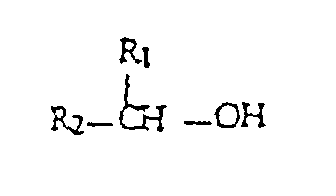 zu erhalten.

- Verfahren nach Anspruch 8, umfassend weiter den Schritt der Umsetzung eines primären oder sekundären Alkohols mit der Strukturworin R3 und R4 unabhängig voneinander gleich oder verschieden von R1 oder R2 sind, mit dem Produkt des Verfahrens nach Anspruch 8, um eine Verbindung mit der Struktur
 zu erhalten.

- Verfahren nach Anspruch 8 zur Herstellung von Arginin-Homologen, wobei der Alkohol eine geschützte Aminosäure der Strukturist, worin R1 eine substituierte oder unsubstituierte Alkyl- oder Arylgruppe ist, Q eine Urethan-Schutzgruppe ist und n den Wert 0-3 hat, um ein Produkt der Struktur
 zu erhalten.

- Verfahren zur Guanidinylierung von Aminen, umfassend die Umsetzung eines geschützten Guanidins der Strukturworin P1, P2 und P3 die gleichen oder verschiedene Urethangruppen sind und R1 eine substituierte oder unsubstituierte Alkylgruppe ist, und eines primären oder sekundären Amins der Struktur
 worin R2 und R3 unabhängig voneinander H oder eine substituierte oder unsubstituierte Alkylgruppe oder eine Aminosäure oder ein Polypeptid sind oder R2 und R3 Teil einer cyclischen Struktur wie in Piperidin, Pyrrolidin oder Morpholin sind, um ein Produkt der Struktur
 zu erhalten.

- Verfahren nach Anspruch 11, wobei die Sulfonylguanidinylierungsgruppe die Strukturbesitzt.

- Verfahren zur Festphasensynthese eines Peptids, das ein oder mehrere Arginin-Homologe enthält, umfassend die Schritte:(a) Zusammenbauen einer Sequenz (Xaa)n von Aminosäuren an einem Festphasen-Peptidsyntheseharz, bei dem Xaa jede geeignet geschützte Aminosäure bedeutet;(b) Anbinden einer Aminosäure der Strukturworin Q Boc oder Fmoc und P jede Schutzgruppe ist, die selektiv entfernt werden kann, und n den Wert 0-3 hat, an den Aminoterminus des Produkts aus Schritt (a);
 (c) Koppeln einer beliebigen Sequenz von geeignet geschützten Aminosäuren an den Aminoterminus des Produkts aus Schritt (b);(d) selektives Entfernen aller Schutzgruppen P wie definiert in (b) aus dem Produkt von Schritt (c);(e) Umsetzen eines geschützten Guanidins der Strukturmit dem Produkt aus Schritt (d), um alle ungeschützten vorhandenen Aminofunktionalitäten zu guanidinylieren; und
 (f) Entfernen aller Schutzgruppen und Abspalten des Peptids vom Harz, um das Produktzu erhalten.

Applications Claiming Priority (3)
| Application Number | Priority Date | Filing Date | Title |
|---|---|---|---|
| US08/861,942 US6072075A (en) | 1997-05-22 | 1997-05-22 | Guanidinylation reagents |
| US861942 | 1997-05-22 | ||
| PCT/US1998/010669 WO1998052917A2 (en) | 1997-05-22 | 1998-05-21 | Guanidinylation reagents |
Publications (2)
| Publication Number | Publication Date |
|---|---|
| EP0983232A2 EP0983232A2 (de) | 2000-03-08 |
| EP0983232B1 true EP0983232B1 (de) | 2002-11-13 |
Family
ID=25337171
Family Applications (1)
| Application Number | Title | Priority Date | Filing Date |
|---|---|---|---|
| EP98926066A Expired - Lifetime EP0983232B1 (de) | 1997-05-22 | 1998-05-21 | Reagenz zur guanidinylierung |
Country Status (15)
| Country | Link |
|---|---|
| US (3) | US6072075A (de) |
| EP (1) | EP0983232B1 (de) |
| JP (1) | JP2002502378A (de) |
| KR (1) | KR20010012732A (de) |
| AT (1) | ATE227705T1 (de) |
| AU (1) | AU736072B2 (de) |
| BR (1) | BR9809859A (de) |
| CA (1) | CA2288196A1 (de) |
| DE (1) | DE69809412D1 (de) |
| HU (1) | HUP0003978A3 (de) |
| IL (1) | IL132773A0 (de) |
| NO (1) | NO995693L (de) |
| PL (1) | PL336996A1 (de) |
| SK (1) | SK157099A3 (de) |
| WO (1) | WO1998052917A2 (de) |
Families Citing this family (13)
| Publication number | Priority date | Publication date | Assignee | Title |
|---|---|---|---|---|
| US6525182B1 (en) * | 2000-01-21 | 2003-02-25 | Regents Of The University Of California | Guanidinylation, guanidinoglycosides, uses, and methods of assaying their activity |
| FR2822463B1 (fr) | 2001-03-21 | 2004-07-30 | Lipha | Derives bicycliques de guanidines et leurs applications en therapeutique |
| US20060264608A1 (en) * | 2001-08-03 | 2006-11-23 | Wender Paul A | Bi-directional synthesis of oligoguanidine transport agents |
| US7067698B2 (en) * | 2001-08-03 | 2006-06-27 | The Board Of Trustees Of The Leland Stanford Junior University | Bi-directional synthesis of oligoguanidine transport agents |
| PL195917B1 (pl) * | 2001-10-31 | 2007-11-30 | Inst Farmaceutyczny | Nowe peptydy - analogi ludzkiego hormonu uwalniającego hormon wzrostu |
| US7022214B2 (en) * | 2004-01-21 | 2006-04-04 | Bio-Rad Laboratories, Inc. | Carrier ampholytes of high pH range |
| JP4777225B2 (ja) * | 2006-12-04 | 2011-09-21 | キヤノン株式会社 | 吐出用液体及び吐出方法 |
| WO2013070808A1 (en) | 2011-11-07 | 2013-05-16 | Feng Tian | Peptide-based compounds as inhibitors of neurotransmitter secretion |
| US10202337B2 (en) * | 2014-03-28 | 2019-02-12 | Kaneka Corporation | Method for producing tri-carbobenzoxy-arginine |
| CN107236056A (zh) * | 2017-07-27 | 2017-10-10 | 山东百玛海洋生物科技有限公司 | 胍基化壳聚糖衍生物、纳米粒及其制备方法 |
| CN107266610A (zh) * | 2017-07-27 | 2017-10-20 | 山东百玛海洋生物科技有限公司 | 胍基化壳聚糖衍生物以及纳米粒的应用 |
| US20200323962A1 (en) * | 2017-09-19 | 2020-10-15 | Yissum Research Development Company Of The Hebrew University Of Jerusalem Ltd. | Lipophilic peptide prodrugs |
| CN114907241B (zh) * | 2021-02-09 | 2024-05-17 | 中宏鑫投资控股(深圳)有限公司 | 一种含氟磺酰基的胍类化合物及其制备方法和应用 |
Family Cites Families (25)
| Publication number | Priority date | Publication date | Assignee | Title |
|---|---|---|---|---|
| US1681806A (en) * | 1928-08-21 | Ments | ||
| US1677235A (en) * | 1928-07-17 | Balph v | ||
| US1953494A (en) * | 1926-08-26 | 1934-04-03 | Ig Farbenindustrie Ag | Process of preparing substituted guanidines |
| US1795738A (en) * | 1927-09-12 | 1931-03-10 | Scheringkahlbaum A G | Method of producing substituted guanidines |
| US2898369A (en) * | 1956-02-23 | 1959-08-04 | Mcneilab Inc | N,n,n',n'' tetraethyl guanidine and its acid addition salts |
| US3062805A (en) * | 1957-03-08 | 1962-11-06 | Sterling Drug Inc | Peptide synthesis and intermediates therefor |
| US3062804A (en) * | 1957-03-08 | 1962-11-06 | Sterling Drug Inc | Peptide synthesis and intermediates therefor |
| US3117994A (en) * | 1959-12-03 | 1964-01-14 | Monsanto Canada Ltd | Nu, nu', nu'-trisubstituted guanidines |
| US3301755A (en) * | 1962-04-18 | 1967-01-31 | Ciba Geigy Corp | Allylic guanidines |
| US3320229A (en) * | 1963-08-26 | 1967-05-16 | Stauffer Chemical Co | Complexes of guanidines with completely halogenated acetones |
| US3479437A (en) * | 1963-08-26 | 1969-11-18 | Stauffer Chemical Co | Guanidine complexes as fungicides |
| CH426863A (de) * | 1963-08-30 | 1966-12-31 | Sandoz Ag | Verfahren zur Herstellung von Arginin enthaltenden Polypeptiden |
| US3609164A (en) * | 1968-03-27 | 1971-09-28 | Tanabe Seiyaku Co | Process for preparing {11 -butoxycarbonyl compounds |
| US3551490A (en) * | 1968-05-21 | 1970-12-29 | American Cyanamid Co | Method for preparing tetramethyl-guanidine |
| US3646029A (en) * | 1968-09-25 | 1972-02-29 | Monsanto Co | Piperazino methyl 1 3 diarylguandines |
| IL38933A0 (en) * | 1971-03-17 | 1972-05-30 | Ciba Geigy Ag | New carbamates,their manufacture and their use in plant protection |
| DE2315271C3 (de) * | 1973-03-27 | 1975-09-11 | Max-Planck-Gesellschaft Zur Foerderung Der Wissenschaften E.V., 3400 Goettingen | L- Norleucin-13-Motilin, Verfahren zu dessen Herstellung und dasselbe enthaltendes Mittel |
| US4014915A (en) * | 1975-04-22 | 1977-03-29 | Fujisawa Pharmaceutical Co., Ltd. | Oxime carbonates |
| DE2544348C3 (de) * | 1975-10-03 | 1979-12-13 | Max-Planck-Gesellschaft Zur Foerderung Der Wissenschaften E.V., 3400 Goettingen | L-Leucin-13-Motilin, Verfahren zu dessen Herstellung und dasselbe enthaltendes Mittel |
| US4358613A (en) * | 1979-12-26 | 1982-11-09 | General Electric Company | Process for the preparation of substituted guanidines |
| FR2509724B1 (fr) * | 1981-07-15 | 1985-10-25 | Centre Nat Rech Scient | Nouvelles guanidines a fort encombrement sterique et procedes pour leur preparation |
| US4956388A (en) * | 1986-12-22 | 1990-09-11 | Eli Lilly And Company | 3-aryloxy-3-substituted propanamines |
| JPH0692357B2 (ja) * | 1989-10-18 | 1994-11-16 | キヤノン株式会社 | グアニジン化合物およびグアニジン化合物を含有する静電荷像現像用トナー |
| US5262568A (en) * | 1990-03-02 | 1993-11-16 | State Of Oregon | Tri- and tetra-substituted guanidines and their use as excitatory amino acid antagonists |
| EP0646573A1 (de) * | 1993-09-30 | 1995-04-05 | Hoechst Aktiengesellschaft | Herstellung von geschützten und nicht geschützten Guanidino-substituierten Carbonsäure |
-
1997
- 1997-05-22 US US08/861,942 patent/US6072075A/en not_active Expired - Lifetime
-
1998
- 1998-05-21 DE DE69809412T patent/DE69809412D1/de not_active Expired - Lifetime
- 1998-05-21 PL PL98336996A patent/PL336996A1/xx unknown
- 1998-05-21 AU AU77984/98A patent/AU736072B2/en not_active Ceased
- 1998-05-21 HU HU0003978A patent/HUP0003978A3/hu unknown
- 1998-05-21 EP EP98926066A patent/EP0983232B1/de not_active Expired - Lifetime
- 1998-05-21 CA CA002288196A patent/CA2288196A1/en not_active Abandoned
- 1998-05-21 BR BR9809859-4A patent/BR9809859A/pt not_active Application Discontinuation
- 1998-05-21 KR KR1019997010693A patent/KR20010012732A/ko not_active Withdrawn
- 1998-05-21 JP JP55074698A patent/JP2002502378A/ja active Pending
- 1998-05-21 WO PCT/US1998/010669 patent/WO1998052917A2/en not_active Ceased
- 1998-05-21 AT AT98926066T patent/ATE227705T1/de not_active IP Right Cessation
- 1998-05-21 IL IL13277398A patent/IL132773A0/xx unknown
- 1998-05-21 SK SK1570-99A patent/SK157099A3/sk unknown
-
1999
- 1999-11-19 NO NO995693A patent/NO995693L/no not_active Application Discontinuation
- 1999-12-01 US US09/452,895 patent/US6380358B1/en not_active Expired - Fee Related
-
2002
- 2002-04-30 US US10/137,119 patent/US20030055214A1/en not_active Abandoned
Also Published As
| Publication number | Publication date |
|---|---|
| US6072075A (en) | 2000-06-06 |
| NO995693L (no) | 2000-01-18 |
| PL336996A1 (en) | 2000-07-31 |
| AU736072B2 (en) | 2001-07-26 |
| WO1998052917A2 (en) | 1998-11-26 |
| HUP0003978A2 (en) | 2001-03-28 |
| DE69809412D1 (de) | 2002-12-19 |
| CA2288196A1 (en) | 1998-11-26 |
| ATE227705T1 (de) | 2002-11-15 |
| AU7798498A (en) | 1998-12-11 |
| NO995693D0 (no) | 1999-11-19 |
| WO1998052917A3 (en) | 1999-04-22 |
| US6380358B1 (en) | 2002-04-30 |
| EP0983232A2 (de) | 2000-03-08 |
| HUP0003978A3 (en) | 2002-03-28 |
| BR9809859A (pt) | 2000-12-19 |
| JP2002502378A (ja) | 2002-01-22 |
| SK157099A3 (en) | 2000-06-12 |
| KR20010012732A (ko) | 2001-02-26 |
| US20030055214A1 (en) | 2003-03-20 |
| IL132773A0 (en) | 2001-03-19 |
Similar Documents
| Publication | Publication Date | Title |
|---|---|---|
| US11414375B2 (en) | Mild and efficient preparation method for α-acyloxyenamide compounds and use thereof in synthesis of amide and polypeptide | |
| US6380358B1 (en) | Guanidinylation reagents | |
| Guisado et al. | The facile preparation of primary and secondary amines via an improved Fukuyama–Mitsunobu procedure. Application to the synthesis of a lung-targeted gene delivery agent | |
| EP2429988A2 (de) | Lysinverbindungen und deren verwendung bei der stellen- und chemoselektiven modifikation von peptiden und proteinen | |
| US4954616A (en) | Use of guanidine-related compounds comprising a substituted tetraphenylborate ion in solution phase peptide synthesis | |
| AU2009201025A1 (en) | Process for preparing intermediates useful to prepare certain antibacterial N-formyl hydroxylamines | |
| ES2201271T3 (es) | Tecnica en fase solida para la preparacion de amidas. | |
| KR20220038320A (ko) | 용액공정상 pna 올리고머의 제조방법 | |
| CN118084926B (zh) | 一种sp3-碳氢键伯胺化反应的催化剂及制备伯胺化合物的方法 | |
| US20140142279A1 (en) | Method for peptide synthesis | |
| DesMarteau et al. | Easy Preparation of Bioactive Peptides from the Novel N α-Trifluoroethyl Amino Acids | |
| JPH0558629B2 (de) | ||
| CN108689858A (zh) | 一种高效制备端炔酰胺类化合物的方法 | |
| CA2272664A1 (en) | Process for the preparation of 3-amino-2-oxo-pyrrolidines, novel intermediates and their use | |
| MXPA99010786A (es) | Reactivos de guanidinilacion | |
| Tantry et al. | 1-(t-Butyldimethylsilyloxy) benzotriazole (TBDMS-OBt): A new and novel reagent for the synthesis of peptides | |
| JPH078855B2 (ja) | スルホニウム化合物 | |
| CN113087765B (zh) | 一种芥子气肽类加合物的制备方法 | |
| CZ407099A3 (cs) | Guanidinizační činidlo a způsob guanidinizace | |
| CN112430243B (zh) | 一种制备硫酯类化合物的方法 | |
| US20020128383A1 (en) | Combinatorial active compound synthesis and its intermediates | |
| JPH0327353A (ja) | スルホニウム化合物の調製法 | |
| JPH0641088A (ja) | スルホニル尿素の製造方法 | |
| US6664410B1 (en) | Solid phase nitrile synthesis | |
| US20230312479A1 (en) | Novel amino acid derivatives |
Legal Events
| Date | Code | Title | Description |
|---|---|---|---|
| PUAI | Public reference made under article 153(3) epc to a published international application that has entered the european phase |
Free format text: ORIGINAL CODE: 0009012 |
|
| 17P | Request for examination filed |
Effective date: 19991110 |
|
| AK | Designated contracting states |
Kind code of ref document: A2 Designated state(s): AT BE CH DE DK ES FI FR GB LI NL PT SE |
|
| 17Q | First examination report despatched |
Effective date: 20010305 |
|
| GRAG | Despatch of communication of intention to grant |
Free format text: ORIGINAL CODE: EPIDOS AGRA |
|
| GRAG | Despatch of communication of intention to grant |
Free format text: ORIGINAL CODE: EPIDOS AGRA |
|
| GRAH | Despatch of communication of intention to grant a patent |
Free format text: ORIGINAL CODE: EPIDOS IGRA |
|
| GRAH | Despatch of communication of intention to grant a patent |
Free format text: ORIGINAL CODE: EPIDOS IGRA |
|
| GRAA | (expected) grant |
Free format text: ORIGINAL CODE: 0009210 |
|
| AK | Designated contracting states |
Kind code of ref document: B1 Designated state(s): AT BE CH DE DK ES FI FR GB LI NL PT SE |
|
| PG25 | Lapsed in a contracting state [announced via postgrant information from national office to epo] |
Ref country code: NL Free format text: LAPSE BECAUSE OF FAILURE TO SUBMIT A TRANSLATION OF THE DESCRIPTION OR TO PAY THE FEE WITHIN THE PRESCRIBED TIME-LIMIT Effective date: 20021113 Ref country code: LI Free format text: LAPSE BECAUSE OF FAILURE TO SUBMIT A TRANSLATION OF THE DESCRIPTION OR TO PAY THE FEE WITHIN THE PRESCRIBED TIME-LIMIT Effective date: 20021113 Ref country code: FR Free format text: LAPSE BECAUSE OF FAILURE TO SUBMIT A TRANSLATION OF THE DESCRIPTION OR TO PAY THE FEE WITHIN THE PRESCRIBED TIME-LIMIT Effective date: 20021113 Ref country code: FI Free format text: LAPSE BECAUSE OF FAILURE TO SUBMIT A TRANSLATION OF THE DESCRIPTION OR TO PAY THE FEE WITHIN THE PRESCRIBED TIME-LIMIT Effective date: 20021113 Ref country code: CH Free format text: LAPSE BECAUSE OF FAILURE TO SUBMIT A TRANSLATION OF THE DESCRIPTION OR TO PAY THE FEE WITHIN THE PRESCRIBED TIME-LIMIT Effective date: 20021113 Ref country code: BE Free format text: LAPSE BECAUSE OF FAILURE TO SUBMIT A TRANSLATION OF THE DESCRIPTION OR TO PAY THE FEE WITHIN THE PRESCRIBED TIME-LIMIT Effective date: 20021113 Ref country code: AT Free format text: LAPSE BECAUSE OF FAILURE TO SUBMIT A TRANSLATION OF THE DESCRIPTION OR TO PAY THE FEE WITHIN THE PRESCRIBED TIME-LIMIT Effective date: 20021113 |
|
| REF | Corresponds to: |
Ref document number: 227705 Country of ref document: AT Date of ref document: 20021115 Kind code of ref document: T |
|
| REG | Reference to a national code |
Ref country code: GB Ref legal event code: FG4D |
|
| REG | Reference to a national code |
Ref country code: CH Ref legal event code: EP |
|
| REF | Corresponds to: |
Ref document number: 69809412 Country of ref document: DE Date of ref document: 20021219 |
|
| PG25 | Lapsed in a contracting state [announced via postgrant information from national office to epo] |
Ref country code: SE Free format text: LAPSE BECAUSE OF FAILURE TO SUBMIT A TRANSLATION OF THE DESCRIPTION OR TO PAY THE FEE WITHIN THE PRESCRIBED TIME-LIMIT Effective date: 20030213 Ref country code: PT Free format text: LAPSE BECAUSE OF FAILURE TO SUBMIT A TRANSLATION OF THE DESCRIPTION OR TO PAY THE FEE WITHIN THE PRESCRIBED TIME-LIMIT Effective date: 20030213 Ref country code: DK Free format text: LAPSE BECAUSE OF FAILURE TO SUBMIT A TRANSLATION OF THE DESCRIPTION OR TO PAY THE FEE WITHIN THE PRESCRIBED TIME-LIMIT Effective date: 20030213 |
|
| PG25 | Lapsed in a contracting state [announced via postgrant information from national office to epo] |
Ref country code: DE Free format text: LAPSE BECAUSE OF FAILURE TO SUBMIT A TRANSLATION OF THE DESCRIPTION OR TO PAY THE FEE WITHIN THE PRESCRIBED TIME-LIMIT Effective date: 20030214 |
|
| NLV1 | Nl: lapsed or annulled due to failure to fulfill the requirements of art. 29p and 29m of the patents act | ||
| PG25 | Lapsed in a contracting state [announced via postgrant information from national office to epo] |
Ref country code: ES Free format text: LAPSE BECAUSE OF FAILURE TO SUBMIT A TRANSLATION OF THE DESCRIPTION OR TO PAY THE FEE WITHIN THE PRESCRIBED TIME-LIMIT Effective date: 20030529 |
|
| REG | Reference to a national code |
Ref country code: CH Ref legal event code: PL |
|
| EN | Fr: translation not filed | ||
| PLBE | No opposition filed within time limit |
Free format text: ORIGINAL CODE: 0009261 |
|
| STAA | Information on the status of an ep patent application or granted ep patent |
Free format text: STATUS: NO OPPOSITION FILED WITHIN TIME LIMIT |
|
| 26N | No opposition filed |
Effective date: 20030814 |
|
| PGFP | Annual fee paid to national office [announced via postgrant information from national office to epo] |
Ref country code: GB Payment date: 20040512 Year of fee payment: 7 |
|
| PG25 | Lapsed in a contracting state [announced via postgrant information from national office to epo] |
Ref country code: GB Free format text: LAPSE BECAUSE OF NON-PAYMENT OF DUE FEES Effective date: 20050521 |
|
| GBPC | Gb: european patent ceased through non-payment of renewal fee |
Effective date: 20050521 |