EP0975597B1 - Derives de quinoleines en tant qu'inhibiteurs de la vih integrase - Google Patents
Derives de quinoleines en tant qu'inhibiteurs de la vih integrase Download PDFInfo
- Publication number
- EP0975597B1 EP0975597B1 EP98920581A EP98920581A EP0975597B1 EP 0975597 B1 EP0975597 B1 EP 0975597B1 EP 98920581 A EP98920581 A EP 98920581A EP 98920581 A EP98920581 A EP 98920581A EP 0975597 B1 EP0975597 B1 EP 0975597B1
- Authority
- EP
- European Patent Office
- Prior art keywords
- group
- formula
- derivatives
- substituents
- quinoline
- Prior art date
- Legal status (The legal status is an assumption and is not a legal conclusion. Google has not performed a legal analysis and makes no representation as to the accuracy of the status listed.)
- Expired - Lifetime
Links
- 229940027991 antiseptic and disinfectant quinoline derivative Drugs 0.000 title claims abstract description 9
- 125000002943 quinolinyl group Chemical class N1=C(C=CC2=CC=CC=C12)* 0.000 title claims abstract description 5
- 238000002360 preparation method Methods 0.000 title claims description 11
- 230000000840 anti-viral effect Effects 0.000 title claims description 9
- 125000001424 substituent group Chemical group 0.000 claims abstract description 21
- 125000003178 carboxy group Chemical group [H]OC(*)=O 0.000 claims abstract description 14
- 230000002401 inhibitory effect Effects 0.000 claims abstract description 11
- 239000003814 drug Substances 0.000 claims abstract description 10
- -1 -N(Q)-(CH2)m- Chemical group 0.000 claims abstract description 8
- 125000003118 aryl group Chemical group 0.000 claims abstract description 8
- 125000004435 hydrogen atom Chemical class [H]* 0.000 claims abstract description 7
- 125000000217 alkyl group Chemical group 0.000 claims abstract description 6
- 150000003839 salts Chemical class 0.000 claims abstract description 5
- 229910052739 hydrogen Inorganic materials 0.000 claims abstract 3
- 239000001257 hydrogen Substances 0.000 claims abstract 3
- 150000001875 compounds Chemical class 0.000 claims description 26
- SMUQFGGVLNAIOZ-UHFFFAOYSA-N quinaldine Chemical compound C1=CC=CC2=NC(C)=CC=C21 SMUQFGGVLNAIOZ-UHFFFAOYSA-N 0.000 claims description 14
- 230000000903 blocking effect Effects 0.000 claims description 11
- 125000004432 carbon atom Chemical group C* 0.000 claims description 9
- 150000003248 quinolines Chemical class 0.000 claims description 8
- 238000000034 method Methods 0.000 claims description 7
- 125000000391 vinyl group Chemical group [H]C([*])=C([H])[H] 0.000 claims description 7
- CIUQDSCDWFSTQR-UHFFFAOYSA-N [C]1=CC=CC=C1 Chemical compound [C]1=CC=CC=C1 CIUQDSCDWFSTQR-UHFFFAOYSA-N 0.000 claims description 6
- 230000015572 biosynthetic process Effects 0.000 claims description 6
- 125000005843 halogen group Chemical group 0.000 claims description 5
- 150000002923 oximes Chemical class 0.000 claims description 5
- 125000006239 protecting group Chemical group 0.000 claims description 5
- WXXVQWSDMOAHHV-UHFFFAOYSA-N quinoline-7-carboxylic acid Chemical compound C1=CC=NC2=CC(C(=O)O)=CC=C21 WXXVQWSDMOAHHV-UHFFFAOYSA-N 0.000 claims description 5
- 125000001072 heteroaryl group Chemical group 0.000 claims description 4
- 125000001997 phenyl group Chemical group [H]C1=C([H])C([H])=C(*)C([H])=C1[H] 0.000 claims description 4
- 108010002459 HIV Integrase Proteins 0.000 claims description 3
- 238000003786 synthesis reaction Methods 0.000 claims description 3
- JWSIJFDOWHFZTK-UHFFFAOYSA-N (2-formylphenyl) acetate Chemical compound CC(=O)OC1=CC=CC=C1C=O JWSIJFDOWHFZTK-UHFFFAOYSA-N 0.000 claims description 2
- 239000003153 chemical reaction reagent Substances 0.000 claims description 2
- 239000008194 pharmaceutical composition Substances 0.000 claims description 2
- SMWDFEZZVXVKRB-UHFFFAOYSA-N Quinoline Chemical compound N1=CC=CC2=CC=CC=C21 SMWDFEZZVXVKRB-UHFFFAOYSA-N 0.000 claims 2
- 230000036436 anti-hiv Effects 0.000 claims 2
- UFHFLCQGNIYNRP-UHFFFAOYSA-N Hydrogen Chemical compound [H][H] UFHFLCQGNIYNRP-UHFFFAOYSA-N 0.000 claims 1
- 229940124158 Protease/peptidase inhibitor Drugs 0.000 claims 1
- 238000006243 chemical reaction Methods 0.000 claims 1
- 239000003937 drug carrier Substances 0.000 claims 1
- 125000003700 epoxy group Chemical group 0.000 claims 1
- 125000004356 hydroxy functional group Chemical group O* 0.000 claims 1
- 239000000137 peptide hydrolase inhibitor Substances 0.000 claims 1
- 239000003419 rna directed dna polymerase inhibitor Substances 0.000 claims 1
- 229940079593 drug Drugs 0.000 abstract description 4
- 229910052736 halogen Inorganic materials 0.000 abstract description 4
- 150000002367 halogens Chemical group 0.000 abstract description 4
- 125000002887 hydroxy group Chemical group [H]O* 0.000 abstract description 3
- 239000004593 Epoxy Substances 0.000 abstract description 2
- 150000002391 heterocyclic compounds Chemical group 0.000 abstract 2
- 125000006527 (C1-C5) alkyl group Chemical group 0.000 abstract 1
- 125000004209 (C1-C8) alkyl group Chemical group 0.000 abstract 1
- 239000005977 Ethylene Substances 0.000 abstract 1
- IAZDPXIOMUYVGZ-UHFFFAOYSA-N Dimethylsulphoxide Chemical compound CS(C)=O IAZDPXIOMUYVGZ-UHFFFAOYSA-N 0.000 description 45
- 238000012360 testing method Methods 0.000 description 27
- 239000000203 mixture Substances 0.000 description 25
- 230000000694 effects Effects 0.000 description 24
- 210000004027 cell Anatomy 0.000 description 23
- YMWUJEATGCHHMB-UHFFFAOYSA-N Dichloromethane Chemical compound ClCCl YMWUJEATGCHHMB-UHFFFAOYSA-N 0.000 description 21
- 241000725303 Human immunodeficiency virus Species 0.000 description 16
- 102100034343 Integrase Human genes 0.000 description 16
- XLYOFNOQVPJJNP-UHFFFAOYSA-N water Substances O XLYOFNOQVPJJNP-UHFFFAOYSA-N 0.000 description 16
- WFDIJRYMOXRFFG-UHFFFAOYSA-N Acetic anhydride Chemical compound CC(=O)OC(C)=O WFDIJRYMOXRFFG-UHFFFAOYSA-N 0.000 description 15
- 230000003612 virological effect Effects 0.000 description 15
- RTZKZFJDLAIYFH-UHFFFAOYSA-N Diethyl ether Chemical compound CCOCC RTZKZFJDLAIYFH-UHFFFAOYSA-N 0.000 description 14
- 229940125904 compound 1 Drugs 0.000 description 13
- 108010061833 Integrases Proteins 0.000 description 12
- JUJWROOIHBZHMG-UHFFFAOYSA-N Pyridine Chemical compound C1=CC=NC=C1 JUJWROOIHBZHMG-UHFFFAOYSA-N 0.000 description 12
- 230000005764 inhibitory process Effects 0.000 description 11
- WYHMNJKAVNPOOR-UHFFFAOYSA-N (2-acetyloxy-4-formylphenyl) acetate Chemical compound CC(=O)OC1=CC=C(C=O)C=C1OC(C)=O WYHMNJKAVNPOOR-UHFFFAOYSA-N 0.000 description 10
- 238000000338 in vitro Methods 0.000 description 10
- 230000010076 replication Effects 0.000 description 10
- QTBSBXVTEAMEQO-UHFFFAOYSA-N Acetic acid Chemical compound CC(O)=O QTBSBXVTEAMEQO-UHFFFAOYSA-N 0.000 description 9
- 208000015181 infectious disease Diseases 0.000 description 9
- 239000007787 solid Substances 0.000 description 9
- 241000700605 Viruses Species 0.000 description 8
- 230000002829 reductive effect Effects 0.000 description 8
- 238000010992 reflux Methods 0.000 description 8
- 102000004190 Enzymes Human genes 0.000 description 7
- 108090000790 Enzymes Proteins 0.000 description 7
- 108700020129 Human immunodeficiency virus 1 p31 integrase Proteins 0.000 description 7
- 238000001816 cooling Methods 0.000 description 7
- 239000012074 organic phase Substances 0.000 description 7
- 239000002245 particle Substances 0.000 description 7
- 239000011541 reaction mixture Substances 0.000 description 7
- LFQSCWFLJHTTHZ-UHFFFAOYSA-N Ethanol Chemical compound CCO LFQSCWFLJHTTHZ-UHFFFAOYSA-N 0.000 description 6
- XEKOWRVHYACXOJ-UHFFFAOYSA-N Ethyl acetate Chemical compound CCOC(C)=O XEKOWRVHYACXOJ-UHFFFAOYSA-N 0.000 description 6
- KFZMGEQAYNKOFK-UHFFFAOYSA-N Isopropanol Chemical compound CC(C)O KFZMGEQAYNKOFK-UHFFFAOYSA-N 0.000 description 6
- CSNNHWWHGAXBCP-UHFFFAOYSA-L Magnesium sulfate Chemical compound [Mg+2].[O-][S+2]([O-])([O-])[O-] CSNNHWWHGAXBCP-UHFFFAOYSA-L 0.000 description 6
- 239000013078 crystal Substances 0.000 description 6
- UMJSCPRVCHMLSP-UHFFFAOYSA-N pyridine Natural products COC1=CC=CN=C1 UMJSCPRVCHMLSP-UHFFFAOYSA-N 0.000 description 6
- 159000000000 sodium salts Chemical class 0.000 description 6
- 238000002965 ELISA Methods 0.000 description 5
- 239000008346 aqueous phase Substances 0.000 description 5
- 230000003197 catalytic effect Effects 0.000 description 5
- 238000001727 in vivo Methods 0.000 description 5
- 238000004519 manufacturing process Methods 0.000 description 5
- 239000000047 product Substances 0.000 description 5
- 102000004169 proteins and genes Human genes 0.000 description 5
- 108090000623 proteins and genes Proteins 0.000 description 5
- SEBSWWFAYYLUHF-UHFFFAOYSA-N 8-hydroxy-2-methylquinoline-7-carbaldehyde Chemical compound C1=CC(C=O)=C(O)C2=NC(C)=CC=C21 SEBSWWFAYYLUHF-UHFFFAOYSA-N 0.000 description 4
- 102100025854 Acyl-coenzyme A thioesterase 1 Human genes 0.000 description 4
- 101710175445 Acyl-coenzyme A thioesterase 1 Proteins 0.000 description 4
- 108091034117 Oligonucleotide Proteins 0.000 description 4
- 108010092799 RNA-directed DNA polymerase Proteins 0.000 description 4
- VYPSYNLAJGMNEJ-UHFFFAOYSA-N Silicium dioxide Chemical compound O=[Si]=O VYPSYNLAJGMNEJ-UHFFFAOYSA-N 0.000 description 4
- 108020005202 Viral DNA Proteins 0.000 description 4
- 125000004429 atom Chemical group 0.000 description 4
- WQZGKKKJIJFFOK-FPRJBGLDSA-N beta-D-galactose Chemical compound OC[C@H]1O[C@@H](O)[C@H](O)[C@@H](O)[C@H]1O WQZGKKKJIJFFOK-FPRJBGLDSA-N 0.000 description 4
- 108010005774 beta-Galactosidase Proteins 0.000 description 4
- 238000003776 cleavage reaction Methods 0.000 description 4
- 229940125782 compound 2 Drugs 0.000 description 4
- 125000000896 monocarboxylic acid group Chemical group 0.000 description 4
- 230000007017 scission Effects 0.000 description 4
- 231100000419 toxicity Toxicity 0.000 description 4
- 230000001988 toxicity Effects 0.000 description 4
- IMPHRIMYMBPILK-UHFFFAOYSA-N 2-methylquinoline-5,7-dicarboxylic acid Chemical compound OC(=O)C1=CC(C(O)=O)=CC2=NC(C)=CC=C21 IMPHRIMYMBPILK-UHFFFAOYSA-N 0.000 description 3
- 108020004414 DNA Proteins 0.000 description 3
- 239000012979 RPMI medium Substances 0.000 description 3
- HEMHJVSKTPXQMS-UHFFFAOYSA-M Sodium hydroxide Chemical compound [OH-].[Na+] HEMHJVSKTPXQMS-UHFFFAOYSA-M 0.000 description 3
- 239000002253 acid Substances 0.000 description 3
- 150000002148 esters Chemical class 0.000 description 3
- 239000003112 inhibitor Substances 0.000 description 3
- 229940124524 integrase inhibitor Drugs 0.000 description 3
- 239000002850 integrase inhibitor Substances 0.000 description 3
- 230000010354 integration Effects 0.000 description 3
- 229910052943 magnesium sulfate Inorganic materials 0.000 description 3
- 235000019341 magnesium sulphate Nutrition 0.000 description 3
- 239000012071 phase Substances 0.000 description 3
- 239000013612 plasmid Substances 0.000 description 3
- 239000000758 substrate Substances 0.000 description 3
- 239000006228 supernatant Substances 0.000 description 3
- 230000002194 synthesizing effect Effects 0.000 description 3
- SHOHIXCIFBPUAP-UHFFFAOYSA-N 8-hydroxy-2-methylquinoline-7-carboxylic acid Chemical compound C1=CC(C(O)=O)=C(O)C2=NC(C)=CC=C21 SHOHIXCIFBPUAP-UHFFFAOYSA-N 0.000 description 2
- CSCPPACGZOOCGX-UHFFFAOYSA-N Acetone Chemical compound CC(C)=O CSCPPACGZOOCGX-UHFFFAOYSA-N 0.000 description 2
- QGZKDVFQNNGYKY-UHFFFAOYSA-N Ammonia Chemical compound N QGZKDVFQNNGYKY-UHFFFAOYSA-N 0.000 description 2
- IJGRMHOSHXDMSA-UHFFFAOYSA-N Atomic nitrogen Chemical compound N#N IJGRMHOSHXDMSA-UHFFFAOYSA-N 0.000 description 2
- XDTMQSROBMDMFD-UHFFFAOYSA-N Cyclohexane Chemical compound C1CCCCC1 XDTMQSROBMDMFD-UHFFFAOYSA-N 0.000 description 2
- VEXZGXHMUGYJMC-UHFFFAOYSA-N Hydrochloric acid Chemical compound Cl VEXZGXHMUGYJMC-UHFFFAOYSA-N 0.000 description 2
- WTDHULULXKLSOZ-UHFFFAOYSA-N Hydroxylamine hydrochloride Chemical compound Cl.ON WTDHULULXKLSOZ-UHFFFAOYSA-N 0.000 description 2
- 108091005804 Peptidases Proteins 0.000 description 2
- 239000004365 Protease Substances 0.000 description 2
- 102100037486 Reverse transcriptase/ribonuclease H Human genes 0.000 description 2
- VMDIWYYHJMMURD-UHFFFAOYSA-N [2-acetyloxy-4-(2-quinolin-2-ylethenyl)phenyl] acetate Chemical compound C1=C(OC(C)=O)C(OC(=O)C)=CC=C1C=CC1=CC=C(C=CC=C2)C2=N1 VMDIWYYHJMMURD-UHFFFAOYSA-N 0.000 description 2
- BVIKBMYJXPYNNC-UHFFFAOYSA-N [2-acetyloxy-4-[2-(8-acetyloxyquinolin-2-yl)ethenyl]phenyl] acetate Chemical compound C1=C(OC(C)=O)C(OC(=O)C)=CC=C1C=CC1=CC=C(C=CC=C2OC(C)=O)C2=N1 BVIKBMYJXPYNNC-UHFFFAOYSA-N 0.000 description 2
- 230000027455 binding Effects 0.000 description 2
- 230000036983 biotransformation Effects 0.000 description 2
- 238000009833 condensation Methods 0.000 description 2
- 230000005494 condensation Effects 0.000 description 2
- 230000008030 elimination Effects 0.000 description 2
- 238000003379 elimination reaction Methods 0.000 description 2
- 230000002616 endonucleolytic effect Effects 0.000 description 2
- 230000002458 infectious effect Effects 0.000 description 2
- 238000003780 insertion Methods 0.000 description 2
- 230000037431 insertion Effects 0.000 description 2
- 210000004698 lymphocyte Anatomy 0.000 description 2
- 239000011159 matrix material Substances 0.000 description 2
- RQNVIKXOOKXAJQ-UHFFFAOYSA-N naphthazarin Chemical compound O=C1C=CC(=O)C2=C1C(O)=CC=C2O RQNVIKXOOKXAJQ-UHFFFAOYSA-N 0.000 description 2
- 230000031689 negative regulation of reverse transcription Effects 0.000 description 2
- 230000001681 protective effect Effects 0.000 description 2
- 238000000746 purification Methods 0.000 description 2
- 108091008146 restriction endonucleases Proteins 0.000 description 2
- 239000000377 silicon dioxide Substances 0.000 description 2
- 229940124597 therapeutic agent Drugs 0.000 description 2
- QAIPRVGONGVQAS-DUXPYHPUSA-N trans-caffeic acid Chemical compound OC(=O)\C=C\C1=CC=C(O)C(O)=C1 QAIPRVGONGVQAS-DUXPYHPUSA-N 0.000 description 2
- MLPOXDZQEHKDMW-UHFFFAOYSA-N (2,3-diacetyloxy-5-formylphenyl) acetate Chemical compound CC(=O)OC1=CC(C=O)=CC(OC(C)=O)=C1OC(C)=O MLPOXDZQEHKDMW-UHFFFAOYSA-N 0.000 description 1
- AAWZDTNXLSGCEK-LNVDRNJUSA-N (3r,5r)-1,3,4,5-tetrahydroxycyclohexane-1-carboxylic acid Chemical compound O[C@@H]1CC(O)(C(O)=O)C[C@@H](O)C1O AAWZDTNXLSGCEK-LNVDRNJUSA-N 0.000 description 1
- ACEAELOMUCBPJP-UHFFFAOYSA-N (E)-3,4,5-trihydroxycinnamic acid Natural products OC(=O)C=CC1=CC(O)=C(O)C(O)=C1 ACEAELOMUCBPJP-UHFFFAOYSA-N 0.000 description 1
- WHTVZRBIWZFKQO-AWEZNQCLSA-N (S)-chloroquine Chemical compound ClC1=CC=C2C(N[C@@H](C)CCCN(CC)CC)=CC=NC2=C1 WHTVZRBIWZFKQO-AWEZNQCLSA-N 0.000 description 1
- RANKPAATSBWOOC-UHFFFAOYSA-N 2-(8-hydroxyquinolin-2-yl)acetic acid Chemical compound C1=CC=C(O)C2=NC(CC(=O)O)=CC=C21 RANKPAATSBWOOC-UHFFFAOYSA-N 0.000 description 1
- NBYLBWHHTUWMER-UHFFFAOYSA-N 2-Methylquinolin-8-ol Chemical compound C1=CC=C(O)C2=NC(C)=CC=C21 NBYLBWHHTUWMER-UHFFFAOYSA-N 0.000 description 1
- QMYNGXWWLNNZRF-UHFFFAOYSA-N 2-[2-(3,4-dihydroxyphenyl)ethenyl]-8-hydroxyquinoline-7-carbonitrile Chemical compound C1=C(O)C(O)=CC=C1C=CC1=CC=C(C=CC(C#N)=C2O)C2=N1 QMYNGXWWLNNZRF-UHFFFAOYSA-N 0.000 description 1
- VQWSTCIVRTWDLK-UHFFFAOYSA-N 4-(2-quinolin-2-ylethenyl)benzene-1,2-diol Chemical compound C1=C(O)C(O)=CC=C1C=CC1=CC=C(C=CC=C2)C2=N1 VQWSTCIVRTWDLK-UHFFFAOYSA-N 0.000 description 1
- WNDFQQZTILEGAV-UHFFFAOYSA-N 4-[2-(8-hydroxyquinolin-2-yl)ethenyl]benzene-1,2-diol Chemical compound C1=C(O)C(O)=CC=C1C=CC1=CC=C(C=CC=C2O)C2=N1 WNDFQQZTILEGAV-UHFFFAOYSA-N 0.000 description 1
- VOJOOGPALCATLT-ZFQBPCNVSA-N 5-[1-(3-carboxy-5-chloro-4-hydroxyphenyl)-4-[(3s,5s,8r,9s,10s,13r,14s,17r)-10,13-dimethyl-17-[(2r)-6-methylheptan-2-yl]-2,3,4,5,6,7,8,9,11,12,14,15,16,17-tetradecahydro-1h-cyclopenta[a]phenanthren-3-yl]but-1-enyl]-3-chloro-2-hydroxybenzoic acid Chemical compound C([C@@H]1C[C@@H]2CC[C@H]3[C@@H]4CC[C@@H]([C@]4(CC[C@@H]3[C@@]2(C)CC1)C)[C@H](C)CCCC(C)C)CC=C(C=1C=C(C(O)=C(Cl)C=1)C(O)=O)C1=CC(Cl)=C(O)C(C(O)=O)=C1 VOJOOGPALCATLT-ZFQBPCNVSA-N 0.000 description 1
- KBZFDRWPMZESDI-UHFFFAOYSA-N 5-aminobenzene-1,3-dicarboxylic acid Chemical compound NC1=CC(C(O)=O)=CC(C(O)=O)=C1 KBZFDRWPMZESDI-UHFFFAOYSA-N 0.000 description 1
- 108091003079 Bovine Serum Albumin Proteins 0.000 description 1
- WKBOTKDWSSQWDR-UHFFFAOYSA-N Bromine atom Chemical group [Br] WKBOTKDWSSQWDR-UHFFFAOYSA-N 0.000 description 1
- ZAMOUSCENKQFHK-UHFFFAOYSA-N Chlorine atom Chemical compound [Cl] ZAMOUSCENKQFHK-UHFFFAOYSA-N 0.000 description 1
- 108010077544 Chromatin Proteins 0.000 description 1
- AAWZDTNXLSGCEK-UHFFFAOYSA-N Cordycepinsaeure Natural products OC1CC(O)(C(O)=O)CC(O)C1O AAWZDTNXLSGCEK-UHFFFAOYSA-N 0.000 description 1
- 102000004163 DNA-directed RNA polymerases Human genes 0.000 description 1
- 108090000626 DNA-directed RNA polymerases Proteins 0.000 description 1
- 108020005199 Dehydrogenases Proteins 0.000 description 1
- PXGOKWXKJXAPGV-UHFFFAOYSA-N Fluorine Chemical compound FF PXGOKWXKJXAPGV-UHFFFAOYSA-N 0.000 description 1
- 208000031886 HIV Infections Diseases 0.000 description 1
- 208000037357 HIV infectious disease Diseases 0.000 description 1
- 241000713772 Human immunodeficiency virus 1 Species 0.000 description 1
- CTQNGGLPUBDAKN-UHFFFAOYSA-N O-Xylene Chemical compound CC1=CC=CC=C1C CTQNGGLPUBDAKN-UHFFFAOYSA-N 0.000 description 1
- 108010021757 Polynucleotide 5'-Hydroxyl-Kinase Proteins 0.000 description 1
- 102000008422 Polynucleotide 5'-hydroxyl-kinase Human genes 0.000 description 1
- AAWZDTNXLSGCEK-ZHQZDSKASA-N Quinic acid Natural products O[C@H]1CC(O)(C(O)=O)C[C@H](O)C1O AAWZDTNXLSGCEK-ZHQZDSKASA-N 0.000 description 1
- VMHLLURERBWHNL-UHFFFAOYSA-M Sodium acetate Chemical compound [Na+].CC([O-])=O VMHLLURERBWHNL-UHFFFAOYSA-M 0.000 description 1
- 108010067390 Viral Proteins Proteins 0.000 description 1
- 208000036142 Viral infection Diseases 0.000 description 1
- DGEZNRSVGBDHLK-UHFFFAOYSA-N [1,10]phenanthroline Chemical compound C1=CN=C2C3=NC=CC=C3C=CC2=C1 DGEZNRSVGBDHLK-UHFFFAOYSA-N 0.000 description 1
- PRVKQLXVHFLFDS-UHFFFAOYSA-N [2-acetyloxy-4-[2-(8-acetyloxy-7-cyanoquinolin-2-yl)ethenyl]phenyl] acetate Chemical compound C1=C(OC(C)=O)C(OC(=O)C)=CC=C1C=CC1=CC=C(C=CC(C#N)=C2OC(C)=O)C2=N1 PRVKQLXVHFLFDS-UHFFFAOYSA-N 0.000 description 1
- 230000004913 activation Effects 0.000 description 1
- 239000011543 agarose gel Substances 0.000 description 1
- 229910021529 ammonia Inorganic materials 0.000 description 1
- 238000004458 analytical method Methods 0.000 description 1
- 150000008064 anhydrides Chemical class 0.000 description 1
- 239000002259 anti human immunodeficiency virus agent Substances 0.000 description 1
- 239000003443 antiviral agent Substances 0.000 description 1
- 238000003556 assay Methods 0.000 description 1
- 230000004071 biological effect Effects 0.000 description 1
- 229940074360 caffeic acid Drugs 0.000 description 1
- 235000004883 caffeic acid Nutrition 0.000 description 1
- 230000001413 cellular effect Effects 0.000 description 1
- 238000005119 centrifugation Methods 0.000 description 1
- 229910052801 chlorine Inorganic materials 0.000 description 1
- 239000000460 chlorine Substances 0.000 description 1
- 229960003677 chloroquine Drugs 0.000 description 1
- WHTVZRBIWZFKQO-UHFFFAOYSA-N chloroquine Natural products ClC1=CC=C2C(NC(C)CCCN(CC)CC)=CC=NC2=C1 WHTVZRBIWZFKQO-UHFFFAOYSA-N 0.000 description 1
- 210000003483 chromatin Anatomy 0.000 description 1
- 210000000349 chromosome Anatomy 0.000 description 1
- QAIPRVGONGVQAS-UHFFFAOYSA-N cis-caffeic acid Natural products OC(=O)C=CC1=CC=C(O)C(O)=C1 QAIPRVGONGVQAS-UHFFFAOYSA-N 0.000 description 1
- 238000004737 colorimetric analysis Methods 0.000 description 1
- 238000002648 combination therapy Methods 0.000 description 1
- 229940126214 compound 3 Drugs 0.000 description 1
- 238000007796 conventional method Methods 0.000 description 1
- MLUCVPSAIODCQM-NSCUHMNNSA-N crotonaldehyde Chemical compound C\C=C\C=O MLUCVPSAIODCQM-NSCUHMNNSA-N 0.000 description 1
- MLUCVPSAIODCQM-UHFFFAOYSA-N crotonaldehyde Natural products CC=CC=O MLUCVPSAIODCQM-UHFFFAOYSA-N 0.000 description 1
- 239000012228 culture supernatant Substances 0.000 description 1
- 230000003013 cytotoxicity Effects 0.000 description 1
- 231100000135 cytotoxicity Toxicity 0.000 description 1
- 239000003599 detergent Substances 0.000 description 1
- 239000005546 dideoxynucleotide Substances 0.000 description 1
- 230000007717 exclusion Effects 0.000 description 1
- 238000002474 experimental method Methods 0.000 description 1
- 239000012894 fetal calf serum Substances 0.000 description 1
- 229910052731 fluorine Inorganic materials 0.000 description 1
- 239000011737 fluorine Substances 0.000 description 1
- 238000010438 heat treatment Methods 0.000 description 1
- 208000033519 human immunodeficiency virus infectious disease Diseases 0.000 description 1
- 230000007062 hydrolysis Effects 0.000 description 1
- 238000006460 hydrolysis reaction Methods 0.000 description 1
- 230000002452 interceptive effect Effects 0.000 description 1
- 230000007246 mechanism Effects 0.000 description 1
- 230000002438 mitochondrial effect Effects 0.000 description 1
- VMGAPWLDMVPYIA-HIDZBRGKSA-N n'-amino-n-iminomethanimidamide Chemical compound N\N=C\N=N VMGAPWLDMVPYIA-HIDZBRGKSA-N 0.000 description 1
- 229910052757 nitrogen Inorganic materials 0.000 description 1
- 238000000655 nuclear magnetic resonance spectrum Methods 0.000 description 1
- 239000002773 nucleotide Substances 0.000 description 1
- 125000003729 nucleotide group Chemical group 0.000 description 1
- 125000000286 phenylethyl group Chemical group [H]C1=C([H])C([H])=C(C([H])=C1[H])C([H])([H])C([H])([H])* 0.000 description 1
- YJGVMLPVUAXIQN-XVVDYKMHSA-N podophyllotoxin Chemical class COC1=C(OC)C(OC)=CC([C@@H]2C3=CC=4OCOC=4C=C3[C@H](O)[C@@H]3[C@@H]2C(OC3)=O)=C1 YJGVMLPVUAXIQN-XVVDYKMHSA-N 0.000 description 1
- 108091033319 polynucleotide Proteins 0.000 description 1
- 239000002157 polynucleotide Substances 0.000 description 1
- 102000040430 polynucleotide Human genes 0.000 description 1
- 239000002244 precipitate Substances 0.000 description 1
- 229960005179 primaquine Drugs 0.000 description 1
- INDBQLZJXZLFIT-UHFFFAOYSA-N primaquine Chemical compound N1=CC=CC2=CC(OC)=CC(NC(C)CCCN)=C21 INDBQLZJXZLFIT-UHFFFAOYSA-N 0.000 description 1
- OENLEHTYJXMVBG-UHFFFAOYSA-N pyridine;hydrate Chemical compound [OH-].C1=CC=[NH+]C=C1 OENLEHTYJXMVBG-UHFFFAOYSA-N 0.000 description 1
- ZVOLCUVKHLEPEV-UHFFFAOYSA-N quercetagetin Chemical compound C1=C(O)C(O)=CC=C1C1=C(O)C(=O)C2=C(O)C(O)=C(O)C=C2O1 ZVOLCUVKHLEPEV-UHFFFAOYSA-N 0.000 description 1
- 238000001953 recrystallisation Methods 0.000 description 1
- BOLDJAUMGUJJKM-LSDHHAIUSA-N renifolin D Natural products CC(=C)[C@@H]1Cc2c(O)c(O)ccc2[C@H]1CC(=O)c3ccc(O)cc3O BOLDJAUMGUJJKM-LSDHHAIUSA-N 0.000 description 1
- 238000010839 reverse transcription Methods 0.000 description 1
- 239000001632 sodium acetate Substances 0.000 description 1
- 235000017281 sodium acetate Nutrition 0.000 description 1
- 230000035892 strand transfer Effects 0.000 description 1
- 239000000725 suspension Substances 0.000 description 1
- NYBWUHOMYZZKOR-UHFFFAOYSA-N tes-adt Chemical class C1=C2C(C#C[Si](CC)(CC)CC)=C(C=C3C(SC=C3)=C3)C3=C(C#C[Si](CC)(CC)CC)C2=CC2=C1SC=C2 NYBWUHOMYZZKOR-UHFFFAOYSA-N 0.000 description 1
- 238000002560 therapeutic procedure Methods 0.000 description 1
- 231100000041 toxicology testing Toxicity 0.000 description 1
- 238000012546 transfer Methods 0.000 description 1
- YNJBWRMUSHSURL-UHFFFAOYSA-N trichloroacetic acid Chemical compound OC(=O)C(Cl)(Cl)Cl YNJBWRMUSHSURL-UHFFFAOYSA-N 0.000 description 1
- 125000003866 trichloromethyl group Chemical group ClC(Cl)(Cl)* 0.000 description 1
- 150000005691 triesters Chemical class 0.000 description 1
- 230000009385 viral infection Effects 0.000 description 1
- 210000002845 virion Anatomy 0.000 description 1
- 239000008096 xylene Substances 0.000 description 1
Classifications
-
- C—CHEMISTRY; METALLURGY
- C07—ORGANIC CHEMISTRY
- C07D—HETEROCYCLIC COMPOUNDS
- C07D215/00—Heterocyclic compounds containing quinoline or hydrogenated quinoline ring systems
- C07D215/02—Heterocyclic compounds containing quinoline or hydrogenated quinoline ring systems having no bond between the ring nitrogen atom and a non-ring member or having only hydrogen atoms or carbon atoms directly attached to the ring nitrogen atom
- C07D215/16—Heterocyclic compounds containing quinoline or hydrogenated quinoline ring systems having no bond between the ring nitrogen atom and a non-ring member or having only hydrogen atoms or carbon atoms directly attached to the ring nitrogen atom with hetero atoms or with carbon atoms having three bonds to hetero atoms with at the most one bond to halogen, e.g. ester or nitrile radicals, directly attached to ring carbon atoms
- C07D215/20—Oxygen atoms
- C07D215/24—Oxygen atoms attached in position 8
- C07D215/26—Alcohols; Ethers thereof
-
- A—HUMAN NECESSITIES
- A61—MEDICAL OR VETERINARY SCIENCE; HYGIENE
- A61P—SPECIFIC THERAPEUTIC ACTIVITY OF CHEMICAL COMPOUNDS OR MEDICINAL PREPARATIONS
- A61P31/00—Antiinfectives, i.e. antibiotics, antiseptics, chemotherapeutics
- A61P31/12—Antivirals
- A61P31/14—Antivirals for RNA viruses
- A61P31/18—Antivirals for RNA viruses for HIV
-
- A—HUMAN NECESSITIES
- A61—MEDICAL OR VETERINARY SCIENCE; HYGIENE
- A61P—SPECIFIC THERAPEUTIC ACTIVITY OF CHEMICAL COMPOUNDS OR MEDICINAL PREPARATIONS
- A61P37/00—Drugs for immunological or allergic disorders
- A61P37/02—Immunomodulators
- A61P37/04—Immunostimulants
-
- C—CHEMISTRY; METALLURGY
- C07—ORGANIC CHEMISTRY
- C07D—HETEROCYCLIC COMPOUNDS
- C07D215/00—Heterocyclic compounds containing quinoline or hydrogenated quinoline ring systems
- C07D215/02—Heterocyclic compounds containing quinoline or hydrogenated quinoline ring systems having no bond between the ring nitrogen atom and a non-ring member or having only hydrogen atoms or carbon atoms directly attached to the ring nitrogen atom
- C07D215/12—Heterocyclic compounds containing quinoline or hydrogenated quinoline ring systems having no bond between the ring nitrogen atom and a non-ring member or having only hydrogen atoms or carbon atoms directly attached to the ring nitrogen atom with substituted hydrocarbon radicals attached to ring carbon atoms
- C07D215/14—Radicals substituted by oxygen atoms
-
- C—CHEMISTRY; METALLURGY
- C07—ORGANIC CHEMISTRY
- C07D—HETEROCYCLIC COMPOUNDS
- C07D215/00—Heterocyclic compounds containing quinoline or hydrogenated quinoline ring systems
- C07D215/02—Heterocyclic compounds containing quinoline or hydrogenated quinoline ring systems having no bond between the ring nitrogen atom and a non-ring member or having only hydrogen atoms or carbon atoms directly attached to the ring nitrogen atom
- C07D215/16—Heterocyclic compounds containing quinoline or hydrogenated quinoline ring systems having no bond between the ring nitrogen atom and a non-ring member or having only hydrogen atoms or carbon atoms directly attached to the ring nitrogen atom with hetero atoms or with carbon atoms having three bonds to hetero atoms with at the most one bond to halogen, e.g. ester or nitrile radicals, directly attached to ring carbon atoms
- C07D215/48—Carbon atoms having three bonds to hetero atoms with at the most one bond to halogen
Definitions
- the present invention relates to quinoline derivatives having in particular inhibitory properties of the integrase of the human immunodeficiency virus.
- an integrase inhibitor is ipso facto a candidate for blocking HIV infection, and possibly an effective therapeutic agent.
- integrase is the last to be targeted by any therapeutic agent. In the context of polytherapy, which currently seems to be the only way to effectively combat the rapid evolution of the virus, obtaining an integrase inhibitor is an essential goal.
- the object of the invention is therefore to provide novel quinoline derivatives capable in particular of inhibiting the HIV integrase activity in vitro and in vivo .
- the invention also aims to exploit the anti-integrase properties of these derivatives for the production of drugs.
- Halogen means a fluorine, chlorine, bromine atom or a tritralogenomethyl group, in particular trichloromethyl.
- Alkyl without further specification denotes a radical of 1 to 5 carbon atoms.
- -R a represents two substituents, one of which is a -OH group and the other is selected from OH, COOH.
- -R c represents two or three substituents -OH.
- Particularly preferred products of the invention include 8-hydroxy-2- [2 - [(3,4-dihydroxyphenyl) ethenyl] -7-quinolinecarboxylic acid, the sodium salt of 2- [2 - [(3,4-dihydroxyphenyl) ethenyl]] 7-quinolinecarboxylic acid, 7-cyano-8-hydroxy-2- [2 - [(3,4-dihydroxyphenyl) ethenyl]] quinoline, 8-hydroxy-2- [2 - [(3,4,5-trihydroxyphenyl) ethenyl]] 7-quinoline carboxylic acid,
- the invention also relates to a process for synthesizing the derivatives defined above.
- a quinaldine of formula V in which R a is at least one substituent selected from the group -OH, or -COOH, or an oxime, and preferably two substituents, one of which is a -OH group, and the other has one of the above meanings, with one acetoxybenzaldehyde of formula VII: wherein R c represents at least two -OH groups blocked by protecting groups.
- the condensation step leads to the formation of quinoline derivatives having a double bond, and can be processed if desired, according to conventional techniques.
- the blocking groups are removed by hydrolysis.
- the invention therefore relates to pharmaceutical compositions characterized in that they comprise an effective amount of at least one derivative as defined above, in association with pharmaceutically acceptable vehicles.
- compositions are advantageously used in combination with other anti-HIV drugs, in particular drugs having an inhibitory effect on the reverse transcriptase and / or the protease.
- the dosages and the modes of administration will be adapted according to the mono-, bi- or triple therapy treatment used.
- the invention also relates to the use of the derivatives defined above as biological reagents that can be used in particular for studies of mechanisms relating to viral infection.
- the compounds are particularly useful for inhibiting HIV integrase and / or preventing or treating HIV.
- said compounds of formula (I) are chosen from compounds of formula (II) as defined above.
- Step 1 preparation of 2 - [(3,4-diacetoxyphenyl) ethenyl] quinoline.
- a mixture of quinaldine (0.90 g, 6.3 mmol) and 3,4-diacetoxybenzaldehyde (1.15 g, 7.0 mmol) in 10 ml of acetic anhydride is refluxed for 12 h.
- 2nd step preparation of 2 - [(3,4-dihydroxyphenyl) ethenyl] quinoline.
- step 1 To a solution of the above ester (step 1) (2.00 g, 5.76 mmol) in pyridine (20 ml) is added 8 ml of water. After refluxing for 3 hours, the mixture is brought to 20 ° C. and 20 ml of dichloromethane are added. The phases are separated and the aqueous phase extracted with dichloromethane. The combined organic phases are dried over magnesium sulfate and concentrated under reduced pressure to give a yellow solid which is recrystallized from isopropanol. (1.51 g, 96%) M.p.
- Step 1 Preparation of 8-acetoxy-2 - [(3,4-diacetoxyphenyl) ethenyl] quinoline.
- a mixture of 8-hydroxyquinaldine (2.23 g, 14 mmol) and 3,4-diacetoxybenzaldehyde (2.6 g, 12 mmol) in 30 ml of acetic anhydride is refluxed for 12 h. After cooling to 20 ° C., the reaction mixture is concentrated under reduced pressure, taken up in ether and filtered.
- 2nd step preparation of 8-hydroxy-2 - [(3,4-dihydroxyphenyl) ethenyl] quinoline.
- step 1 To a solution of the above ester (step 1) (1.40 g, 3.4 mmol) in pyridine (10 ml) is added 5 ml of water. After refluxing for 3 hours, the mixture is brought to 20 ° C. and diluted with 30 ml of water. The reaction mixture is then left at 20 ° C. After 12 hours, the crystals obtained are filtered, washed with water, ethanol and then with ether.
- the 8-hydroxy-7-quinaldine carboxylic acid is synthesized by operating according to Meek et al in J. Chem. Engineering data, 1969, 14, 388-391 .
- Step 1 Preparation of the oxime of 8-hydroxy-7-quinaldine carbaldehyde.
- 8-hydroxy-7-quinaldine carbaldehyde (1 g, 53 mmol) in acetic acid (20 ml) is successively added 0.73 g (10 mmol) of hydroxylamine hydrochloride and then 0.87 g ( 0.01 mmol) of sodium acetate.
- 8-hydroxy-7quinaldine carbaldehyde is synthesized by operating according to Przystal et al., J. Heterocycl. Chem, 1967, 4, 131-2 .
- Step 3 Preparation of 7-cyano-8-hydroxy-2 - [(3,4-dihydroxyphenyl) ethenyl] quinoline.
- a solution of the above triester (step 2) (0.60 g, 1.4 mmol) in pyridine (10 ml) is added 5 ml of water. After refluxing for 3 hours, the mixture is brought to 20 ° C. and diluted with 20 ml of water. The phases are separated and the aqueous phase extracted with dichloromethane. The combined organic phases are dried over magnesium sulfate and concentrated under reduced pressure to give give give a yellow solid which is recrystallized from isopropanol (0.3 g, 71%).
- a mixture of 8-hydroxyquinaldine carboxylic acid (0.23 g, 1.13 mmol) and 3,4,5-triacetoxybenzaldehyde (0.32 g, 1.16 mmol) in 7 ml of acetic anhydride is reflux for 48 h. After cooling to 20 ° C., the reaction mixture is concentrated under pressure. The residue obtained is dissolved in pyridine (7 ml) and 3 ml of water are added. After refluxing for 3 hours, the mixture is brought to 20 ° C. and diluted with 20 ml of water. The mixture is extracted with dichloromethane, the organic phase is discarded and the aqueous phase is left at 20 ° C.
- 1st step Preparation of 2-methyl-5,7-quinoline dicarboxylic acid: A solution of 5-amino-1,3-benzenedicarboxylic acid (5.3 g, 29 mmol) in 60 ml of 6 N hydrochloric acid is brought to reflux. 2.6 ml (32 mmol) of crotonaldehyde are added dropwise over a period of one hour and the heating is maintained for one hour. After cooling to 20 ° C, the mixture is extracted with ether. The organic phase is removed and the aqueous phase is basified by a solution 30% ammonia.
- Step 2 Preparation of 2- [2 - [(3,4-dihydroxyphenyl) ethenyl]] 5,7-quinolinecarboxylic acid : A mixture of 2-methyl-5,7-quinoline dicarboxylic acid (0.60 g, 2.6 mmol) and 3,4-diacetoxybenzaldehyde (0.71 g, 3.1 mmol) in 10 mL of acetic anhydride is refluxed for 48 h. After cooling to 20 ° C., the reaction mixture is concentrated under reduced pressure and the residue is taken up in pyridine (10 ml). The mixture is refluxed and then 3 ml of water are added.
- Compounds 1 and 3, according to the present invention inhibit the three activities of HIV-1 integrase. Inhibition of disintegration suggests that they are inhibitors of the catalytic activity of the enzyme. The degrees of inhibition in the three tests for each of the compounds are comparable, which shows that the compounds 1 and 3 do not disturb the binding of the integrase on its substrate.
- Table I indicates the inhibitory activities of the compounds according to the invention. Inhibition is expressed as the concentration needed to block 50% of HIV-1 integrase activity.
- Compound 2 which is the sodium salt of free acid 1, has the same anti-integrase activity as this one in in vitro potency tests.
- the Compound 2 is water soluble at 10 mM while Compound 1 is soluble in DMSO.
- the catalytic site of HIV-1 integrase is very close to that of the restriction enzyme EcoRI.
- the compounds that block both proteins are therefore catalytic inhibitors of integrase.
- Compound 1 according to the present invention inhibits the cleavage of a plasmid linearized with the enzyme EcoRI.
- the test is carried out as follows: The plasmid pSP65 is linearized and radiolabeled at its 5 'end by the polynucleotide kinase. The linearized plasmid is incubated for 4 hours in the presence of 0.1 units of the enzyme EcoRI. The activity of the enzyme is followed by the appearance of 1.2% agarose gel cleavage products.
- the specificity of the compounds according to the invention for the integrase is estimated by an activity test on the reverse transcriptase enzyme of the HIV-1 virus. This test is carried out as follows: The viral particles of a culture supernatant of the CEM cells (line established lymphocyte) are concentrated by centrifugation at 30,000 RPM. These viral particles are lysed in a nonionic detergent and their reverse transcriptase activity is tested on a substrate formed of an oligo primer (dG) hybridized on a polyrC matrix. In the presence of radiolabeled dG nucleotide, the transcriptase activity results in the formation of precipitated labeled polynucleotide in trichloroacetic acid. It is verified that a dideoxynucleotide ddG inhibits the formation of acid-precipitable.
- dG oligo primer
- Example 4 Inhibition of Replication of the Human Immunodeficiency Virus (HIV-1)
- the toxicity of the compounds is tested by a biotransformation test of MTT formazan by cellular mitochondrial dehydrogenases.
- compound 1 according to the present invention has a protective effect against infection of CEM cells by HIV-1. This protective effect results in an inhibition of the production of viral particles with a 50% efficiency of 4 ⁇ M according to the HeLa ⁇ -gal test and with a 50% efficiency of 28 ⁇ M according to the p24 test.
- Compound 1 is devoid of toxicity at 100 ⁇ M, maximum concentration tested, on the CEM cells according to the MTT test.
- Compound 2 blocks the production of virus particles, measured by the p24 ELISA test, during infection of the CEM cells. This compound is also free of toxicity according to the MTT test, up to 100 ⁇ M.
- Compound 2 which corresponds to the sodium salt of free acid 1 has the same antiviral effect as measured by the inhibition of replication in EMC cells at 72 hours.
- the compounds according to the present invention have been tested on the late stages of the replication of the HIV-1.
- the test is as follows:
- the ACH2 cells that have integrated the viral DNA of HIV-1 are used. These cells do not express viral proteins and therefore do not produce viruses unless they are activated by TNF.
- TNF When the cells are put in the presence of TNF, they express HIV virus from the integrated provirus.
- the production of viral particles is detected 24 hours after activation.
- the viral load in the supernatant is quantified by p24 ELISA.
- the exemplified compounds selectively inhibit the in vitro activity of HIV-1 integrase in the three assays used.
- Compound 1 which lacks cytotoxicity up to 100 ⁇ M in the cell models used, blocks HIV replication by interfering with an early stage of the replication cycle. Given the lack of effect on reverse transcription in vitro, this step is probably the integration of the viral genome into the genome of the infected cell.
Landscapes
- Organic Chemistry (AREA)
- Chemical & Material Sciences (AREA)
- Health & Medical Sciences (AREA)
- Life Sciences & Earth Sciences (AREA)
- Immunology (AREA)
- Pharmacology & Pharmacy (AREA)
- General Health & Medical Sciences (AREA)
- Virology (AREA)
- Veterinary Medicine (AREA)
- Public Health (AREA)
- Chemical Kinetics & Catalysis (AREA)
- General Chemical & Material Sciences (AREA)
- Medicinal Chemistry (AREA)
- Nuclear Medicine, Radiotherapy & Molecular Imaging (AREA)
- Animal Behavior & Ethology (AREA)
- Bioinformatics & Cheminformatics (AREA)
- Molecular Biology (AREA)
- Oncology (AREA)
- Communicable Diseases (AREA)
- AIDS & HIV (AREA)
- Engineering & Computer Science (AREA)
- Tropical Medicine & Parasitology (AREA)
- Pharmaceuticals Containing Other Organic And Inorganic Compounds (AREA)
- Plural Heterocyclic Compounds (AREA)
- Quinoline Compounds (AREA)
- Heterocyclic Carbon Compounds Containing A Hetero Ring Having Nitrogen And Oxygen As The Only Ring Hetero Atoms (AREA)
- Hydrogenated Pyridines (AREA)
- Nitrogen Condensed Heterocyclic Rings (AREA)
Description
- La présente invention a pour objet des dérivés de quinoléines dotés notamment de propriétés inhibitrices de l'intégrase du virus de l'immunodéficience humaine.
- Elle vise également un procédé de synthèse de ces dérivés et leurs applications biologiques.
- L'intégration de l'ADN génomique du VIH dans les chromosomes de la cellule infectée est strictement nécessaire à la réplication du virus. L'enzyme virale qui catalyse l'intégration de l'ADN viral dans la chromatine de l'hôte est l'intégrase. En conséquence, un inhibiteur de l'intégrase constitue ipso facto un candidat pour bloquer l'infection par le VIH, et éventuellement un agent thérapeutique efficace. Des trois enzymes virales qui conditionnent la réplication du VIH, à savoir la réverse transcriptase, la protéase et l'intégrase, l'intégrase est la dernière à n'être la cible d'aucun agent thérapeutique. Dans le contexte de la polythérapie qui semble être à l'heure actuelle l'unique voie à même de combattre efficacement l'évolution rapide du virus, l'obtention d'un inhibiteur de l'intégrase est un objectif essentiel.
- Divers groupes à travers le monde ont développé des inhibiteurs de l'intégrase, certaines de ces molécules présentant des activités inhibitrices in vitro submicromolaires, comme la quercétagénine. D'autres composés ont présenté des activités prometteuses comme les esters phényléthyliques de l'acide caféique, le cosalane, la 5,8-dihydroxy-1,4-naphtoquinone, la cucurmine, la 1,10-phénanthroline, la primaquine, la chloroquine, certains dérivés de la podophyllotoxine ou encore des esters bis-galliques. Les activités de ces différents produits n'ont été cependant rapportés qu'in vitro et ces produits ne se sont pas révélés actifs in vivo.
- Plus récemment des bis-caféates de l'acide quinique ont été décrits comme actifs in vivo mais selon des protocoles comportant la mise en contact préalable de la drogue avec le virus.
- Les travaux des inventeurs dans ce domaine les ont amenés à étudier des dérivés de quinoléine et à mettre en évidence des propriétés anti-intégrase in vitro ainsi qu'in vivo, ces propriétés s'accompagnant d'une grande innocuité.
- L'invention a donc pour but de fournir de nouveaux dérivés de quinoléine capables notamment d'inhiber l'activité intégrase de VIH in vitro et in vivo.
- Elle vise également un procédé de synthèse de ces dérivés de mise en oeuvre aisée à l'échelle industrielle.
- L'invention a également pour but la mise à profit des propriétés anti-intégrase de ces dérivés pour l'élaboration de médicaments.
- Les dérivés selon l'invention sont caractérisés en ce qu'ils répondent à la formule générale II ;
- Les dérivés selon l'invention sont caractérisés en ce qu'ils répondent à la formule générale II :

- Ra représente deux substituants dont l'un est un groupe -OH et l'autre est choisi parmi un groupe -(CH2)n -Y ou -CH=CH-Y,
où Y représente un atome d'halogène, un radical -OH, -OR, -COH, -COR, -COOH, -COOR, -CONH2, -CON (Rx,Ry), -CH=NOH, -CO-CH=NOH, -NH2, -N (Rx, Ry), -NO2, -PO(OR)2, -SH2, -SR, -SO2R, -SO2NHR, -CN, ou Z(Rc),
où R représente un radical alkyle de 1 à 8 atomes de carbone, Rx et Ry, identiques ou différents, représentent un radical alkyle de 1 à 5 atomes de carbone et n est nul ou un entier de 1 à 5, Z représente un radical phényle, - Rc représente deux ou trois substituants -OH, ainsi que les sels pharmaceutiquement acceptables de ces dérivés, leurs formes diastéréoisomères et leurs formes énantiomères.
- "Halogène" désigne un atome de fluor, de chlore, de brome ou un groupe tritralogéno-méthyle, en particulier trichlorométhyle. "Alkyle" sans autre précision désigne un radical de 1 à 5 atomes de carbone.
- Ra représente un groupe choisi parmi -CH=CH-COOH, -CH=CH-COOR, -CH=CH -COH, -CH=CH-COR, -CH=CH-CONH2, -CON(Rx, Ry), et -CH=CH-Z(Rc)
- Des produits selon l'invention présentent la formule II
dans laquelle - -Ra représente deux substituants dont l'un est un groupe -OH et l'autre est choisi parmi OH, COOH.
- -Rc représente deux ou trois substituants -OH.
- Des produits particulièrement avantageux de l'invention comprennent, l'acide 8-hydroxy-2-[2-[(3,4-dihydroxyphényl)éthényl]] 7-quinoléine carboxylique, le sel de sodium de l'acide 8-hydroxy-2-[2-[(3,4-dihydroxyphényl) éthényl]] 7-quinoléinecarboxylique, la 7-cyano-8-hydroxy-2-[2-[(3,4-dihydro-xyphényl)éthényl]] quinoléine, l'acide 8-hydroxy-2-[2-[(3,4,5-trihydroxyphényl)éthényl]] 7-quinoléine carboxylique,
- L'invention vise également un procédé de synthèse des dérivés définis ci-dessus.
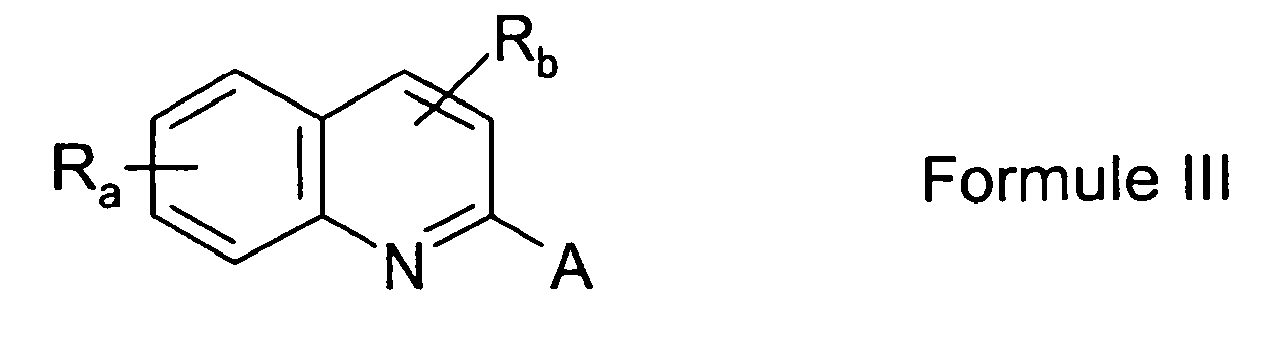
- Ce procédé est caractérisé en ce qu'il comprend - la réaction d'une quinaldine de formule III avec un dérivé aromatique ou hétéroaromatique de formule IV portant les groupes de blocage appropriés:

B-Z(RC) Formule IV
dans lesquelles A et B représentent des groupes réactifs capables d'engendrer le groupe X, tel que défini ci-dessus, Ra, Rc présentant les significations données en rapport avec la formule II, mais comportant des groupes de blocage, et Rb=H, Z=phényle, et
- l'élimination des groupements protecteurs. - Selon un mode de réalisation de l'invention, pour obtenir les dérivés de quinoléine,
- on a recours à une condensation de type Perkin, entre une quinaldine de formule V et un dérivé aromatique ou hétéroaromatique de formule VI portant les groupes de blocage appropriés :
OHC-Z(RC) Formule VI
dans lesquelles les différents substituants ont les significations données en rapport avec la formule II, mais comportent des groupes de blocage, et Rb=H et Z=phényle;
- on élimine les groupements protecteurs. - On opère à reflux dans un mélange pyridine-eau durant environ 2 heures à 3 jours.
- Pour préparer par exemple des dérivés répondant à la formule II, on fait avantageusement réagir une quinaldine de formule V dans laquelle Ra représente au moins un substituant choisi parmi le groupe -OH, ou -COOH, ou une oxime, et de préférence deux substituants, dont l'un est un groupe -OH, et l'autre présente l'une des significations ci-dessus, avec un acétoxybenzaldéhyde de formule VII :

- L'étape de condensation conduit à la formation de dérivés de quinoléine comportant une double liaison, et peuvent être traités si on le souhaite, selon les techniques classiques.
- Les groupes de blocage sont éliminés par hydrolyse.
- L'étude des propriétés biologiques des dérivés de l'invention a mis en évidence une activité inhibitrice vis-à-vis de l'intégrase. de VIH, et de l'enzyme EcoRI in vitro. Les expérimentations effectuées in vivo ont de plus montré leur effet inhibiteur de la réplication de VIH et l'absence d'effet sur les phases tardives de la réplication de VIH. Ces résultats revêtent donc un intérêt majeur pour le traitement d'une infection par ce virus, d'autant plus que les études de toxicité ont mis en évidence la grande innocuité de ces dérivés.
- L'invention vise donc des compositions pharmaceutiques caractérisées en ce qu'elles comprennent une quantité efficace d'au moins un dérivé tel que défini ci-dessus, en association avec des véhicules pharmaceutiquement acceptabl es.
- Ces compositions sont avantageusement utilisées en combinaison avec d'autres médicaments anti-VIH, en particulier des médicaments dotés d'un effet inhibiteur vis-à-vis de la réverse transcriptase et/ou de la protéase.
- Les posologies et les modes d'administration seront adaptés en fonction du traitement mono-, bi-ou trithérapie utilisé.
- L'invention vise également l'utilisation des dérivés définis ci-dessus en tant que réactifs biologiques utilisables en particulier pour des études de mécanismes concernant l'infection virale.
- L'invention vise également un composé de formule (I) :

- Ra, Rb et Rc identiques ou différents les uns des autres, représentent un ou plusieurs substituants, eux-mêmes identiques ou différents, occupant une position quelconque sur les cycles, et étant choisis parmi, un groupe -(CH,)n -Y ou -CH=CH-Y, où Y représente un atome d'halogène, un radical -OH, -OR, -COH, -COR,
- COOH, -COOR, -CONH2, -CON (Rx,Ry),-CH=NOH, -CO-CH=NOH, -NH2, -N(Rx, Ry), -NO2, -PO(OR)2, -SH2,-SR,-SO2R, -SO2NHR, -CN, ou Z(Rc), où R représente un radical alkyle de 1 à 8 atomes de carbone, Rx et Ry, identiques ou différents, représentent un radical alkyle de 1 à 5 atomes de carbone,
- Z représente un radical phényle et n est nul ou un entier de 1 à 5,
Rb pouvant représenter en outre un atome d'hydrogène, et lorsque Y représente un groupe -COOH ou -COOR dans Rc, Z comporte au moins 3 substituants ou le noyau quinoléine est trisubstitué, et lorsque Y représente un groupe -CHO, Rc représente un groupe -(CH2)n-Y, avec n=1 à 5, X représente une double liaison éthylénique, - où n' est un entier de 0 à 8, m est un entier de 0 à 8, t est nul ou un entier égal à 1 ou 2, et Q représente un atome d'hydrogène, un radical alkyle ou phényle,
ainsi que les sels pharmaceutiquement acceptables de ces dérivés, leurs formes diastéréoisomères et leurs formes énantiomères, comme médicament antiviral. - Lesdits composés sont notamment utiles pour inhiber l'intégrase du VIH et/ou prévenir ou traiter le VIH.
- Préférentiellement, lesdits composés de formule (I) sont choisis parmi les composés de formule (II) tels que définis plus haut.
- D'autres caractéristiques et avantages de l'inventicn sont donnés dans les exemples qui suivent relatifs à la synthèse de dérivés de formule XII.

- 1ère étape: préparation de la 2-[(3,4-diacétoxyphényl)éthényl] quinoléine. Un mélange de quinaldine (0,90 g, 6,3 mmol) et de 3,4-diacétoxybenzaldéhyde (1,15 g, 7,0 mmol) dans 10 ml d'anhydride acétique est porté à reflux pendant 12 h. Après refroidissement à 20 °C le mélange réactionnel est concentré sous pression réduite et le résidu chromatographié sur colonne de silice en éluant par un mélange (cyclohexane / acétate d'éthyle: 50 / 50) pour donner 2,08 g (95 %) de 2-[(3,4-diacétoxyphényl)éthényl] quinoléine qui est utilisé sans autre purification dans l'étape suivante.
- 2ème étape : préparation du 2-[(3,4-dihydroxyphényl)éthényl] quinoléine. A une solution de l'ester précédent (étape 1) (2,00 g, 5,76 mmol) dans la pyridine (20 ml) on additionne 8 ml d'eau. Après 3 heures de reflux, le mélange est ramené à 20 °C, et 20 ml de dichlorométhane sont ajoutés. Les phases sont séparées et la phase aqueuse extraite au dichlorométhane. Les phases organiques rassemblées sont séchées sur sulfate magnésium, et concentrées sous pression réduite pour donner un solide jaune qui est recristallisé dans l'isopropanol. (1,51 g, 96 %)
F 246-251 °C
IR (KBr, cm-1) n 3536, 1602.
RMN 1H( DMSO d6, 200 MHz) d: 6,85 (d, J = 8,8 Hz, 1H); 7,10 (dd, J = 8,0, 1.0 Hz, 1H) 7,20 (m, 2H); 7,60 (t, J = 6,8 Hz, 1H); 7,70-8,10 (m, 5H); 8,35 (d, J = 8,8 Hz, 1H); 9,30 (s large, 2H).
RMN 13C ( DMSO d6, 50 MHz) d: 114,1; 116,0; 119,9 (2C); 125,4; 125,9; 126,9; 127,9 (2C); 128,6; 129,8; 134,8; 136,4; 145,7; 146,9; 147,8; 156,3. - 1ère étape: préparation de la 8-acétoxy-2-[(3,4-diacétoxyphényl)éthényl] quinoléine. Un mélange de 8-hydroxyquinaldine (2,23 g, 14 mmol) et de 3,4-diacétoxybenzaldéhyde (2,6 g, 12 mmol) dans 30 ml d'anhydride acétique est porté à reflux pendant 12 h. Après refroidissement à 20 °C le mélange réactionnel est concentré sous pression réduite, repris à l'éther et filtré. Le résidu solide est lavé plusieurs fois à l'éther pour donner 3,5 g (61 %) de 8-acétoxy-2-[(3,4-diacétoxyphényl)éthényl] quinoléine qui est utilisé sans autre purification dans l'étape suivante.
- 2ème étape: préparation de la 8-hydroxy-2-[(3,4-dihydroxyphényl)éthényl] quinoléine. A une solution de l'ester précédent (étape 1) (1,40 g, 3,4 mmol) dans la pyridine (10 ml) on additionne 5 ml d'eau. Après 3 heures de reflux, le mélange est ramené à 20 °C, et dilué par 30 ml d'eau. Le mélange réactionnel est alors abandonné à 20 °C. Après 12 h les cristaux obtenus sont filtrés, lavés à l'eau, l'éthanol puis à l'éther. Après recristallisation dans le xylène on obtient 0,6 g (63 %) de cristaux jaunes
F 232-235 °C
IR (KBr, cm-1) n 3410, 1589.
RMN 1H ( acétone d6, 200 MHz) d: 6,87 (d, J = 8, 1 Hz, 1H); 7,05-7,10 (m, 2H); 7,21 (d, J = 16,2 Hz, 1H); 7,22 (s large, 1H); 7,72 (d, J = 8,7 Hz, 1H); 7,30-7,40 (m, 2H);7.91 (d, J = 16,2 Hz, 1H); 8,23 (d, J = 8,7 Hz, 1H), 8,20-8,70 (massif, 3H).
RMN 13C ( DMSO d6, 50 MHz) d: 111,2; 114,0; 116,0; 117,7; 119,8; 120,8; 124,7; 126,7; 127,5; 128,2; 135,1; 136,4; 138,2; 145,7; 146,8; 152, 9; 154,1. - Un mélange d'acide 8-hydroxy-7-quinaldine carboxylique (1,20 g, 6 mmol) et de 3,4-diacétoxybenzaldéhyde (1,8 g, 8 mmol) dans 15 ml d'anhydride acétique est porté à reflux pendant 12 h.
- L'acide 8-hydroxy-7- quinaldine carboxylique est synthétisé en opérant selon Meek et al dans J. Chem. Engineering data, 1969, 14, 388-391.
- Après refroidissement à 20 °C le mélange réactionnel est concentré sous pression. Le résidu obtenu est dissous dans la pyridine (20 ml) on additionne 8 ml d'eau. Après 3 heures de reflux, le mélange est ramené à 20 °C, et dilué par 20 ml d'eau. Le mélange est extrait au dichlorométhane, la phase organique est écartée et la phase aqueuse abandonnée à 20 °C. Après 12 h les cristaux obtenus sont filtrés, lavés à l'eau, l'éthanol puis à l'éther puis séchés sous vide pour donner 0,96 g (50 %) de cristaux rouge vif.
F ≥ 300 °C
IR (KBr, cm-1) n 3091, 1667, 1589.
RMN 1H (DMSO d6, 200 MHz) d: 6,80 (d, J = 8,1 Hz, 1H); 7,04 (dd, J = 8,2; 1,5 Hz, 1H); 7,10-7,18 (m, 2H); 7,45 (d, J = 16,2 Hz, 1H); 7,78-7,90 (m, 2H), 8,15 (d, J = 8,8 Hz, 1H); 8,48 (d, J = 8,8 Hz, 1H); 9,22 (s, large, 1H); 9,52 (s, large, 1H).
RMN 13C ( DMSO d6, 50 MHz) d: 112,8; 113,2; 114,2, 116,0; 120,2; 120,7; 120,9; 127,3; 127,5; 130,5; 135,2; 139,2; 140,0; 145,7; 148,0; 152,8; 160,8; 170,6. - L'acide (I, R1 = CO2H, R2 = OH, R3 = H) (0,1 g, 0,3 mmol) est additionné par portion à une solution de soude 0,1 M maintenue sous atmosphère d'azote. Le mélange est alors lyophylisé (-40 à +40 °C) pour donner 0,11 g de sel de sodium (quantitatif) sous forme d'un solide gris brun.
IR (KBr, cm-1) n 3436, 1598, 1561.
RMN 1H (DMSO d6, 200 MHz) d: 4,5-5,5 (massif, 2H); 6,74 (d, J = 7,8 Hz, 1H); 6, 95 (m, 2H), 7,13 (s, 1H), 7,24 (d, J = 16,4 Hz, 1H); 7,49 (d, J = 16,4 Hz, 1H); 7,75 (d, J = 8,4 Hz, 1H); 7,84 (d, J = 8,6 Hz, 1H); 8,08 (d, J = 8,6 Hz, 1H); 12,6 (s large, 1H). - RMN 13C ( DMSO d6, 50 MHz) d: 111,9; 113,7; 114,9; 115,8; 119,2; 119,5; 126, 0; 127,0; 127,5; 129,9; 133,6; 136,0; 141,1; 146,2; 147,7; 154,0; 163,7; 171,6.
- 1ère étape: préparation de l'oxime du 8-hydroxy-7-quinaldine carbaldéhyde.
- A une solution de 8-hydroxy-7-quinaldine carbaldéhyde (1g, 53 mmol) dans l'acide acétique (20 ml), sont additionnés successivement 0,73 g (10 mmol) de chlorhydrate d'hydroxylamine puis 0,87 g (0,01 mmol) d'acétate de sodium. Le 8-hydroxy-7quinaldine carbaldéhyde est synthétisé en opérant selon Przystal et al, J. Heterocycl. Chem, 1967, 4, 131-2.
- Le mélange est chauffé à 100 °C durant 1 h puis concentré sous pression réduite. Le résidu est repris par 20 ml d'eau et extrait au dichlorométhane. Les phases organiques sont rassemblées, séchées sur MgSO4 et concentrées pour donner 0,7 g de l'oxime attendue sous forme d'un solide jaune (65 %).
F = 171-175 °C
IR (KBr, cm-1) n 3200-2800, 1643, 1614, 1563. - L'analyse des spectres de RMN révèle la présence de deux isomères syn/anti, seul l'isomère majoritaire est décrit ci-dessous.
- RMN 1H (DMSO d6, 200 MHz) d: 2,68 (s, 3H); 7,32 (d, J = 8,6 Hz, 1H); 7,42 (d, J = 8,3 Hz, 1H); 7,70 (d, J = 8,6 Hz, 1H); 8,16 (d, J = 8,4 Hz, 1H); 8,50 (s, 1H)
RMN 13C (DMSO d6, 50 MHz) d: 24,7; 115,2, 117,9; 122,9; 123,2; 127,2; 136,2; 138,1; 144,7, 150,8; 157,4. 2ème étape:: préparation du 7-cyano-8-acétoxy-2-[(3,4-diacétoxyphényl)éthényl] quinoléine. Un mélange de l'oxime du 8-hydroxy-7-quinaldine carbaldéhyde (0,60 g, 2,9 mmol) et de 3,4-diacétoxybenzaldéhyde (0,78 g, 3,4 mmol) dans 10 ml d'anhydride acétique est porté à reflux pendant 12 h. Après refroidissement à 20 °C le mélange réactionnel est concentré sous pression réduite. Le résidu obtenu est chromatographié sur colonne de silice en éluant par un mélange (cyclohexane / acétate d'éthyle: 50 / 50) pour donner 0,77 g (62 %) de solide jaune clair. - IR (KBr, cm-1) n 2941, 2223, 1782, 1600, 1504.
- RMN 1H (CDCl3, 200 MHz) d: 2,30 (s, 3H); 2,31 (s, 3H); 2,60 (s, 3H); 7,00-7,70 (m, 8H); 8,09 (d, J = 8,6 Hz, 1H).
RMN 13C (CDCl3, 50 MHz) d: 20,7 (2 C); 20,8; 106,8; 115,3; 122,0; 122,6; 123,8; 125,7; 126,2; 129,0; 130,7; 134,3; 134,9; 136,4; 140,5; 142,4; 142,5; 151,6; 156,8; 168,1 (2C); 68,5.
3ème étape: préparation du 7-cyano-8-hydroxy-2-[(3,4-dihydroxyphényl)éthényl] quinoléine. A une solution du triester précédent (étape 2) (0,60 g, 1,4 mmol) dans la pyridine (10 ml) on additionne 5 ml d'eau. Après 3 heures de reflux, le mélange est ramené à 20 °C, et dilué par 20 ml d'eau. Les phases sont séparées et la phase aqueuse extraite au dichlorométhane. Les phases organiques rassemblées sont séchées sur sulfate magnésium, et concentrées sous pression réduite pour donner un solide jaune qui est recristallisé dans l'isopropanol (0,3 g, 71 %).
F 239-244 °C
IR (KBr, cm-1) n 3411, 2194, 1603, 1554.
RMN 1H (DMSO d6, 200 MHz) d: 6,79 (d, J = 8,2 Hz, 1H); 7,00 (d, J = 8,4 Hz, 1H); 7,05-7,25 (m, 2H); 7,41 (d, J = 8,5 Hz, 1H); 7,54 (d, J = 8,5 Hz, 1H); 7,87 (d, J = 8, 6 Hz, 1H); 8,04 (d, J = 16,2 Hz, 1H); 8,32 (d, J = 8,6 Hz, 1H); 8,80-9,50 (massif, 3H).
RMN 13C ( DMSO d6, 50 MHz) d: 114,0; 115,9; 117,1; 118,5; 119,9; 123,3; 123,7; 123,9; 126,5; 127,8; 129,6; 136,7; 137,6; 145,6; 147,0; 149,6; 155,7; 158,2. - Un mélange d'acide 8-hydroxyquinaldine carboxylique (0,23 g, 1,13 mmol) et de 3,4,5-triacétoxybenzaldéhyde (0,32 g, 1,16 mmol) dans 7 ml d'anhydride acétique est porté à reflux pendant 48 h. Après refroidissement à 20 °C le mélange réactionnel est concentré sous pression. Le résidu obtenu est dissous dans la pyridine (7 ml) on additionne 3 ml d'eau. Après 3 heures de reflux, le mélange est ramené à 20 °C, et dilué par 20 ml d'eau. Le mélange est extrait au dichlorométhane, la phase organique est écartée et la phase aqueuse abandonnée à 20 °C. Après 12 h les cristaux obtenus sont filtrés, lavés à l'eau, l'éthanol puis à l'éther puis séchés sous vide pour donner 0,15 g (40 %) de cristaux rouge vif.
F ≥ 300 °C
IR (KBr, cm-1) n 3600-2400, 1630, 1585.
RMN 1H (DMSO d6, 200 MHz) d: 3,50-5,50 (massif, 4H); 6,68 (s, 2H); 7,16 (d, J = 8,4 Hz, 1H); 7,44 (d, J = 16,1 Hz, 1H); 7,80 (d, J = 16,1 Hz, 1H); 7, 84 (d, J = 8,4 Hz, 1H); 8,21 (d, J = 8,8 Hz, 1H); 8,51 (d, J = 8,8 8 Hz, 1H); 9,19 (s, largue, 1H).
RMN 13C (DMSO d6, 50 MHz) d: 107,4 (2C); 112,9; 113,2; 120,0; 120,8; 126,2; 127,8; 130,5; 134,9; 136,3; 140,1; 140,4; 146,4 (2C); 152,7; 161,0; 170,6. -

- 1ère étape: préparation de l'acide 2-méthyl-5,7-quinoléinedicarboxylique: Une solution d'acide 5-amino-1,3-benzènedicarboxylique (5,3 g, 29 mmol) dans 60 mL d'acide chlorhydrique 6 N est portée au reflux. 2,6 mL (32 mmol) de crotonaldéhyde sont additionnés goutte à goutte sur une période d'une heure et le chauffage est maintenu pendant une heure. Après refroidissement à 20°C, le mélange est extrait à l'éther. La phase organique est écartée et la phase aqueuse est basifiée par une solution d'ammoniaque à 30%. Le précipité est filtré, lavé à l'eau puis à l'éther et séché sous vide pour fournir 2,5 g d'acide 2-méthyl-5,7-quinoléinedicarboxylique (Rdt; 37 %)
RMN 1H (CD3OD, 200 MHz) δ: 1,30 (s, 3H); 6,40 (d, J = 8,8 Hz,1H); 7,20 (s,2H) 8,25 (d, J = 8,8 Hz, 1H). - 2ème étape: préparation de l'acide 2-[2-[(3,4-dihydroxyphényl)éthényl]] 5,7-quinoléinedicarboxylique: Un mélange d'acide 2-méthyl-5,7-quinoléinedicarboxylique (0,60 g, 2,6 mmol) et de 3,4-diacétoxybenzaldéhyde
(0,71 g, 3,1 mmol) dans 10 mL d'anhydride acétique est porté à reflux pendant 48 h. Après refroidissement à 20°C le mélange réactionnel est concentré sous pression réduite et le résidu est repris dans la pyridine (10 mL). Le mélange est porté au reflux, puis 3 mL d'eau sont additionnés. Après 3 heures de reflux, le mélange est ramené à 20°C, et 25 mL d'une solution aqueuse d'acide acétique sont ajoutés. Le mélange est extrait au dichlorométhane. Les phases organiques rassemblées, séchées sur sulfate magnésium, et concentrées sous pression réduite pour donner un solide rouge qui est recristallisé dans l'isopropanol.
RMN 1H (DMSO d6, 200 MHz) δ: 6,78(d,J = 8,2 Hz, 1H); 7,00-7,30 (m, 3H); 7,74 (d, J = 16,2 Hz,1H);
8 , 03 (d, J = 9,2 Hz,1H); 8,56 (s,1H); 8,64 (s,1H);
9,22 (d, J = 9,2 Hz, 1H). - Sont décrites ci-après en exemple les activités anti-intégrase et antivirales des composés suivants:
-Composé 1: acide 8-hydroxy-2-[2-[(3,4-dihydroxyphényl)éthényl]] 7-quinoléine carboxylique
(R1 = CO2H, R2 = OH, R3 = R4 = H)
-Composé 2 : sel de sodium de l'acide 8-hydroxy-2-[2-[(3,4-dihydroxyphényl) éthényl]] 7-quinoléine-carboxylique (R1 = CO2Na, R2 = OH, R3 = R4 = H)
-Composé 3: acide 8-hydroxy-2-[2-[(3,4,5-trihydroxyphényl)éthényl]] 7-quinoléine carboxylique
(R1 = CO2H, R2 = R3 = OH, R4 = H)
-Composé 7: acide 2-[2-[(3,4-dihydroxyphényl)éthényl]] 5,7-quinoléinecarboxylique
(R1=R4 = COOH; R2 = R3=H)
- L'activité de l'intégrase du VIH-1 est mesurée par les trois tests suivants:
- 1- L'activité endonucléolytique de la protéine est testée sur un oligonucléotide double-brins de 21 paires de bases, radiomarqué à l'extrémité 5'. L'activité de l'intégrase se traduit par l'élimination du dinucléotide à l'extrémité 3'.
- 2- Le test de transfert de brins est réalisé avec un oligonucléotide double-brins de 21 paires de bases mimant l'extrémité de l'ADN viral dont le dinucléotide 3' terminal a été supprimé. L'activité de la protéine se traduit par l'insertion covalente de cet oligonucléotide dans un oligonucléotide homologue.
- 3- Le test de désintégration est réalisé avec un substrat mimant la structure de l'ADN viral intégré. On mesure la quantité d'ADN excisé par l'intégrase. Ce dernier test quantifie uniquement l'activité catalytique de la protéine à l'exclusion de son activité de fixation sur l'ADN.
- Les composés 1 et 3, selon la présente invention, inhibent les trois activités de l'intégrase du VIH-1. L'inhibition de la désintégration suggère que ce sont des inhibiteurs de l'activité catalytique de l'enzyme. Les degrés d'inhibition dans les trois tests pour chacun des composés sont comparables ce qui montre que les composés 1 et 3 ne perturbent pas la fixation de l'intégrase sur son substrat. Le tableau I indique les activités inhibitrices des composés selon l'invention. L'inhibition est exprimée en concentration nécessaire pour bloquer 50% de l'activité de l'intégrase du VIH-1.
Tableau I: Inhibition de l'activité in vitro de l'intégrase du VIH-1 par les composés 1 et Composé 3 selon la présente invention coupure endonucléolytique transfert de brins désintégration Composé 1 0,9 µM 0,9 µM 0,5 µM Composé 3 0,32 µM 0,31 µM 0,056 µM - Nota: Le composé 2 qui est le sel de sodium de l'acide libre 1 possède la même activité anti-intégrase que celui-ci dans les tests d'activité in vitro. Le composé 2 est soluble dans l'eau à 10 mM tandis que le composé 1 est soluble dans le DMSO.
- Le site catalytique de l'intégrase du VIH-1 est très proche de celui de l'enzyme de restriction EcoRI. Les composés qui bloquent à la fois les deux protéines sont donc des inhibiteurs catalytique de l'intégrase.
- Le composé 1 selon la présente invention inhibe la coupure d'un plasmide linéarisé par l'enzyme EcoRI. Le test est réalisé de la façon suivante: Le plasmide pSP65 est linéarisé et radiomarqué à son extrémité 5' par la polynucléotide kinase. Le plasmide linéarisé est incubé 4 heures en présence de 0,1 unités de l'enzyme EcoRI. L'activité de l'enzyme est suivie par l'apparition des produits de coupure sur gel d'agarose 1,2%.
- En présence du composé 1 selon la présente invention, la coupure par EcoRI est fortement inhibé. Ce composé est donc un inhibiteur de l'activité catalytique de la protéine.
- La spécificité des composés selon l'invention pour l'intégrase est estimée par un test d'activité sur l'enzyme transcriptase inverse du virus VIH-1. Ce test est réalisé de la façon suivante: Les particules virales d'un surnageant de culture des cellules CEM (lignée lymphocytaire établie) sont concentrées par centrifugation à 30 000RPM. Ces particules virales sont lysées dans un détergent non ionique et leur activité transcriptase inverse est testée sur un substrat formé d'un primer oligo(dG) hybridé sur une matrice polyrC. En présence de nucléotide dG radiomarqué, l'activité transcriptase se traduit par la formation de polynucléotide marqué précipitable dans l'acide trichloroacétique. On vérifie qu'un didéoxynucléotide ddG inhibe la formation d'acido-précipitable.
- En présence du composé 1, on n'observe aucune inhibition de la transcription inverse d'une matrice polyrC. Ce résultat traduit la bonne sélectivité du composé 1 pour l'intégrase virale.
- Le test d'activité consiste à mettre en contact des cellules d'une lignée lymphocytaires établie, les cellules CEM, avec un surnageant de cellules infectées contenant les virions infectieux. Le test est réalisé de la façon suivante: Les cellules CEM, cultivées en suspension dans du milieu RPMI complémenté avec 10% de sérum de veau foetal, sont infectées par un surnageant viral avec une multiplicité d'infection de 0,5. Après 2 heures d'infection, les cellules sont lavées deux fois avec du milieu RPMI de façon à éliminer les particules virales résiduelles. Enfin, les cellules sont replacées dans du milieu RPMI contenant le composé selon l'invention. La charge virale est évaluée après 72 heures de culture. Celle-ci est quantifiée des deux manières suivantes:
- 1) La quantité de protéine virale p24 est déterminée par un test ELISA.
- 2) La charge en virus infectieux est estimée par infection des cellules HeLa β-gal CD4+ (cf paragraphe 4).
- La toxicité des composés est testée par un test de biotransformation du MTT en formazan par les déshydrogénases mitochondriales cellulaires.
- Dans les deux tests d'activité, le composé 1 selon la présente invention, possède un effet protecteur contre l'infection des cellules CEM par le VIH-1. Cet effet protecteur se traduit par une inhibition de la production de particules virales avec une efficacité 50% de 4 µM selon le test HeLaβ-gal et avec une efficacité 50% de 28 µM selon le test p24. Le composé 1 est dépourvu de toxicité à 100 µM, concentration maximale testée, sur les cellules CEM d'après le test MTT.
- Le composé 2 bloque la production de particules virales, mesurées par le test ELISA p24, lors de l'infection des cellules CEM. Ce composé est également dépourvu de toxicité selon le test MTT, jusqu'à 100 µM.
- Ces résultats sont résumés dans le tableau II.
- Le composé 2 qui correspond au sel de sodium, de l'acide libre 1 présente le même effet antiviral mesuré par l'inhibition de la réplication dans les cellules CEM à 72 heures.
- Les composés selon la présente invention ont été testés sur les étapes tardives de la réplication du VIH-1. Le test est le suivant: On utilise les cellules ACH2 qui ont intégré l'ADN viral du VIH-1. Ces cellules n'expriment pas les protéines virales et ne produisent donc pas de virus à moins d'être activées par le TNF. Lorsque les cellules sont mises en présence de TNF, elles expriment du virus VIH à partir du provirus intégré. La production de particules virales est détectée 24 heures après activation. La charge virale dans le surnageant est quantifiée par test ELISA p24.
- Aucun effet important n'a été détecté sur la production de particules virales à 24 heures lorque les cellules ACH2 sont traitées avec des concentrations du composé 1 jusqu'à 100 µM. On observe une légère inhibition au-delà de 50 µM mais la concentration inhibitrice 50% n'est pas atteinte à 100 µM.
Tableau II: Effet antiviral du composé 1 MTTi activité β-galj test p24k Cellule CEMa >100 µM 4 uM 20 µM Cellules ACH2b >100 µM - >100 µM Tableau III: Effet antiviral du composé 7 MIT1 activité β-galj test p24k Cellule CEMa >100 µM 1 µM 4 µM Cellules ACH2b >100 µM >100 µM aeffet antiviral global; beffet sur les étapes tardives
iToxicité par biotransformation; jtest colorimètrique;ktest ELISA - En conclusion, les composés donnés en exemple inhibent sélectivement l'activité in vitro de l'intégrase du VIH-1 dans les trois tests utilisés. Le composé 1 qui est dépourvu de cytotoxicité jusqu'à 100 µM dans les modèles cellulaires utilisés, bloque la réplication du VIH en interférant avec une étape précoce du cycle de réplication. Etant donné l'absence d'effet sur la transcription inverse in vitro, cette étape est vraisembablement l'intégration du génome viral dans le génome de la cellule infectée.
Claims (16)
- Dérivés de quinoléine, caractérisés en ce qu'ils répondent à la formule générale II :

où Y représente un atome d'halogène, un radical -OH, -OR, -COH, -COR, -COOH, -COOR, -CONH2, -CON (Rx,Ry), -CH=NOH, -CO-CH=NOH, -NH2, -N(Rx, Ry), -NO2, -PO(OR)2, -SH2, -SR, -SO2R, -SO2NHR, -CN, ou Z(Rc),
où R représente un radical alkyle de 1 à 8 atomes de carbone, Rx et Ry, identiques ou différents, représentent un radical alkyle de 1 à 5 atomes de carbone et n est nul ou un entier de 1 à 5, Z représente un radical phényle ; - Rc représente deux ou trois substituants -OH,
ainsi que les sels pharmaceutiquement acceptables de ces dérivés, leurs formes diastéréoisomères et leurs formes énantiomères. - Dérivés selon la revendication 1, dans lesquels Ra est un groupe choisi parmi -CH=CH-COOH, -CH=CH-COOR, -CH=CH-COH, -CH=CH-COR, -CH=CH-CONH2,-CON(Rx, Ry) et -CH=CH-Z(Rc).
- Dérivés selon la revendication 1 ou 2, caractérisés en ce qu'ils présentent la formule II
 - Ra représente deux substituants dont l'un est un groupe -OH et l'autre est choisi parmi OH, COOH, et- Rc représente deux ou trois substituants -OH.
 - Dérivés de quinoléine caractérisés en ce qu il s'agit de l'acide 8-hydroxy-2-[2-[(3,4-dihydroxyphényl)éthényl]]7-quinoléine carboxylique, le sel de sodium de l'acide 8-hydroxy-2-[2-[(3,4-dihydroxyphényl) éthényl]]7-quinoléine carboxylique, la 7-cyano-8-hydroxy-2-[2-(3,4-dihydroxyphényl) éthényl]] quinoléine, l'acide 8-hydroxy-2-[2-[(3,4,5-trihydroxyphényl)éthényl]] 7-quinoléine carboxylique;
- Procédé de synthèse de dérivés selon la revendication 1, caractérisé ce qu'il comprend - la réaction d'une quinaldine de formule III avec un dérivé aromatique ou hétéroaromatique de formule IV portant les groupes de blocage appropriés :
B-Z(Rc) Formule IV
dans lesquelles A et B représentent des groupes réactifs capables d'engendrer le groupe X, tel que défini ci-dessus, Ra, Rc présentant les significations données en rapport avec la formule II, mais comportant des groupes de blocage, et Rb=H, et Z=phényle ; et
- l'élimination des groupements protecteurs. - Procédé selon la revendication 5, caractérisé en ce que, pour préparer des dérivés de formule II,
- on fait réagir une quinaldine de formule V et un dérivé aromatique ou hétéroaromatique de formule VI portant les groupes de blocage appropriés,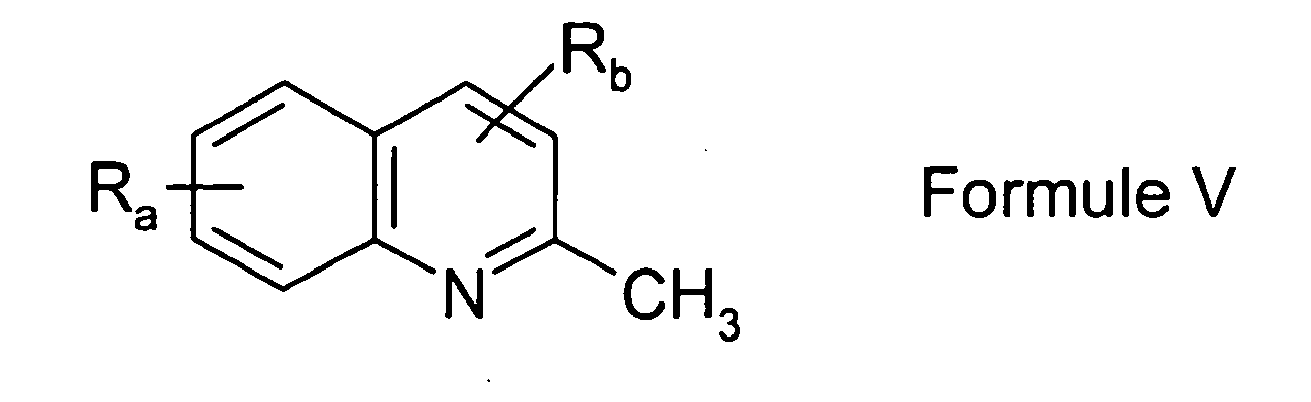
OHC-Z(Rc) Formule IV
dans lesquelles les différents substituants ont les significations données en rapport avec la formule II mais comportant des groupes de blocage, et Rb=H et Z=phényle ;
- on élimine ces groüpes de blocage. - Procédé selon la revendication 6, caractérisé en ce que pour préparer des dérivés de formule II selon la revendication 3, on fait réagir une quinaldine de formule V dans laquelle Ra représente au moins un substituant choisi parmi le groupe -OH, -COOH, ou une oxime, et de préférence deux substituants, dont l'un est un groupe -OH, et l'autre présente l'une des significations ci-dessus, avec un acétoxybenzaldéhyde de formule VII :

- Compositions pharmaceutiques caractérisées en ce qu'elles comprennent en association avec des véhicules pharmaceutiquement acceptables une quantité efficace d'au moins un dérivé de quinoléine de formule (II) selon l'une quelconque des revendications 1 à 4.
- Utilisation d'un composé de formule (II) selon l'une quelconque des revendications 1 à 4 comme réactif biologique.
- Composé de formule (I) :

- Ra, Rb et Rc, identiques ou différents les uns des autres, représentent un ou plusieurs substituants, eux-mêmes identiques ou différents, occupant une position quelconque sur les cycles, et étant choisis parmi un groupe -(CH2)n-Y ou -CH=CH-Y, où Y représente un atome d'halogène, un radical -OH, -OR, -COH, -COR, -COOH, -COOR, -CONH2, -CON (Rx,Ry), -CH=NOH, -CO-CH=NOH, -NH2, -N(Rx, Ry), -NO2, -PO(OR)2, -SH2, -SR, -SO2R, -SO2NHR, -CN, ou Z(Rc),
où R représente un radical alkyle de 1 à 8 atomes de carbone, Rx et Ry, identiques ou différents, représentent un radical alkyle de 1 à 5 atomes de carbone, - Z représente un radical phényle et n est nul ou un entier de 1 à 5,
Rb pouvant représenter en outre un atome d'hydrogène,
et lorsque Y représente un groupe -COOH ou -COOR dans Rc, Z comporte au moins 3 substituants ou le noyau quinoléine est trisubstitué, et lorsque Y représente un groupe -CHO, Rc représente un groupe -(CH2)n-Y, avec n=l à 5, X représente une double liaison éthylénique, ou un groupe -(CH2)n- où n est un entier de 1 à 5, ou un groupe -CH(Rd)-CH(Re)-, Rd et Re, identiques ou différents, représentant un atome d'hydrogène, d'halogène, un groupe hydroxy ou époxy, ou un groupe -(CH2)n'-O-C(O)-(CH2)m-, -(CH2)n'-C(O)-(CH2)m-, -(CH2)n'-O-(CH2)m-, -(CH2)n'-N(Q)-(CH2)m-, ou -(CH2)n'-S(O)t-(CH2)m-, où n' est un entier de 0 à 8, m est un entier de 0 à 8, t est nul ou un entier égal à 1 ou 2, et Q représente un atome d'hydrogène, un radical alkyle ou phényle, ainsi que les sels pharmaceutiquement acceptables de ces dérivés, leurs formes diastéréoisomères et leurs formes énantiomères,
comme médicament antiviral. - Composé selon la revendication 10 pour inhiber l'intégrase du VIH.
- Composé selon la revendication 10 pour prévenir ou traiter le VIH.
- Composé selon l'une quelconque des revendications 10 à 12 tel que défini selon l'une quelconque des revendications 2 à 4.
- Utilisation d'un composé selon l'une quelconque des revendications 10 ou 13 pour la préparation d'un médicament pour prévenir ou traiter le VIH.
- Combinaison comprenant un composé selon la revendication 10 ou 13 avec un autre médicament anti-VIH.
- Combinaison selon la revendication 14 telle que ledit médicament anti-VIH est un inhibiteur de la réverse transcriptase et/ou de la protéase.
Priority Applications (1)
| Application Number | Priority Date | Filing Date | Title |
|---|---|---|---|
| CY20091101257T CY1109553T1 (el) | 1997-04-08 | 2009-12-01 | Παραγωγα κινολεϊνων ως αναστολεις της ιντεγρασης του hiv |
Applications Claiming Priority (3)
| Application Number | Priority Date | Filing Date | Title |
|---|---|---|---|
| FR9704289 | 1997-04-08 | ||
| FR9704289A FR2761687B1 (fr) | 1997-04-08 | 1997-04-08 | Derives de quinoleines, possedant notamment des proprietes antivirales, leurs preparations et leurs applications biologiques |
| PCT/FR1998/000701 WO1998045269A1 (fr) | 1997-04-08 | 1998-04-07 | Derives de quinoleines en tant qu'inhibiteurs de la vih integrase |
Publications (2)
| Publication Number | Publication Date |
|---|---|
| EP0975597A1 EP0975597A1 (fr) | 2000-02-02 |
| EP0975597B1 true EP0975597B1 (fr) | 2009-09-02 |
Family
ID=9505648
Family Applications (1)
| Application Number | Title | Priority Date | Filing Date |
|---|---|---|---|
| EP98920581A Expired - Lifetime EP0975597B1 (fr) | 1997-04-08 | 1998-04-07 | Derives de quinoleines en tant qu'inhibiteurs de la vih integrase |
Country Status (12)
| Country | Link |
|---|---|
| US (1) | US6670377B1 (fr) |
| EP (1) | EP0975597B1 (fr) |
| JP (1) | JP4697679B2 (fr) |
| AT (1) | ATE441634T1 (fr) |
| CA (1) | CA2286385C (fr) |
| CY (1) | CY1109553T1 (fr) |
| DE (1) | DE69841119D1 (fr) |
| DK (1) | DK0975597T3 (fr) |
| ES (1) | ES2332434T3 (fr) |
| FR (1) | FR2761687B1 (fr) |
| PT (1) | PT975597E (fr) |
| WO (1) | WO1998045269A1 (fr) |
Families Citing this family (27)
| Publication number | Priority date | Publication date | Assignee | Title |
|---|---|---|---|---|
| CA2321348A1 (fr) | 2000-09-27 | 2002-03-27 | Blaise Magloire N'zemba | Derives aromatiques ayant des proprietes inhibant l'integrase de l'hiv |
| FR2819507B1 (fr) | 2001-01-17 | 2007-09-28 | Inst Rech Developpement Ird | Quinoleines substituees pour le traitement de co-infections a protozoaires et a retrovirus |
| IL157638A0 (en) | 2001-03-01 | 2004-03-28 | Shionogi & Co | Nitrogen-containing heteroaryl compounds having hiv integrase inhibitory activity |
| FR2830863B1 (fr) | 2001-10-12 | 2004-01-30 | Bioalliance Pharma | Derives de quinoleine, procede de synthese, et medicaments renfermant ces derives |
| FR2839646B1 (fr) * | 2002-05-17 | 2008-04-11 | Bioalliance Pharma | Utilisation de derives de quinoleine a effet anti-integrase et ses applications |
| DE60322920D1 (de) | 2002-08-13 | 2008-09-25 | Shionogi & Co | Heterocyclische verbindungen mit hiv-integrase-hemmender wirkung |
| WO2004046115A1 (fr) * | 2002-11-20 | 2004-06-03 | Japan Tobacco Inc. | Composes 4-oxoquinoliniques et leur utilisation comme inhibiteur de la vih-integrase |
| RU2275361C3 (ru) * | 2002-11-20 | 2021-10-01 | Джапан Тобакко Инк. | Соединение 4-оксохинолина и его применение в качестве ингибитора вич интегразы |
| KR100866296B1 (ko) * | 2004-05-20 | 2008-11-11 | 니뽄 다바코 산교 가부시키가이샤 | 4―옥소퀴놀린 화합물의 안정한 결정체 |
| MY134672A (en) * | 2004-05-20 | 2007-12-31 | Japan Tobacco Inc | Stable crystal of 4-oxoquinoline compound |
| WO2005113509A1 (fr) | 2004-05-20 | 2005-12-01 | Japan Tobacco Inc. | Nouveau composé 4-oxoquinoline et utilisation de celui-ci comme inhibiteur d'intégrase de vih |
| WO2006129134A1 (fr) * | 2005-06-01 | 2006-12-07 | Bioalliance Pharma | Combinaisons synergiques comprenant un compose de styrylquinoleine et d'autres agents therapeutiques contre une infection au vih |
| KR101023635B1 (ko) | 2006-03-06 | 2011-03-22 | 니뽄 다바코 산교 가부시키가이샤 | 4-옥소퀴놀린 화합물 제조 방법 |
| CA2963784A1 (fr) * | 2007-06-08 | 2008-12-18 | Mannkind Corporation | Inhibiteurs d'ire-1.alpha |
| EP2574610A1 (fr) * | 2007-11-15 | 2013-04-03 | Gilead Sciences, Inc. | Inhibiteurs de la réplication du virus de l'immunodéficience humaine |
| HRP20120328T2 (hr) * | 2007-11-15 | 2012-09-30 | Gilead Sciences | Inhibitori replikacije virusa humane imunodeficijencije |
| CA2705338A1 (fr) * | 2007-11-16 | 2009-05-22 | Boehringer Ingelheim International Gmbh | Inhibiteurs de la replication du virus de l'immunodeficience humaine |
| WO2009062285A1 (fr) * | 2007-11-16 | 2009-05-22 | Boehringer Ingelheim International Gmbh | Inhibiteurs de la réplication du virus de l'immunodéficience humaine |
| EP2147913A1 (fr) | 2008-07-23 | 2010-01-27 | BioAlliance Pharma | Styrylquinolines, leur procédé de préparation et leurs utilisations thérapeutiques |
| EP2149557A1 (fr) | 2008-07-23 | 2010-02-03 | BioAlliance Pharma | Styrylquinolines, leur procédé de préparation et leurs utilisations thérapeutiques |
| EP2147912A1 (fr) | 2008-07-23 | 2010-01-27 | BioAlliance Pharma | Styrylquinolines, leur procédé de préparation et leurs utilisations thérapeutiques |
| PH12013500015A1 (en) * | 2010-07-02 | 2013-02-18 | Gilead Sciences Inc | 2 -quinolinyl- acetic acid derivatives as hiv antiviral compounds |
| WO2013091089A1 (fr) * | 2011-12-22 | 2013-06-27 | UNIVERSITé LAVAL | Cavités tridimensionnelles d'immunorécepteur de cellules dendritiques (dcir), composés se liant à celles-ci et applications thérapeutiques associées à l'inhibition du virus de l'immunodéficience humaine de type 1 (vih-1) |
| KR102280614B1 (ko) | 2013-03-15 | 2021-07-21 | 글로벌 블러드 테라퓨틱스, 인크. | 헤모글로빈 조정을 위한 화합물 및 이의 용도 |
| EA201992707A1 (ru) | 2013-11-18 | 2020-06-30 | Глобал Блад Терапьютикс, Инк. | Соединения и их применения для модуляции гемоглобина |
| AR108435A1 (es) | 2016-05-12 | 2018-08-22 | Global Blood Therapeutics Inc | Proceso para sintetizar 2-hidroxi-6-((2-(1-isopropil-1h-pirazol-5-il)-piridin-3-il)metoxi)benzaldehído |
| WO2020061103A1 (fr) | 2018-09-18 | 2020-03-26 | Nikang Therapeutics, Inc. | Dérivés d'anneaux tricycliques fusionnés utilisés en tant qu'inhibiteurs de la phosphatase src à homologie-2 |
Family Cites Families (12)
| Publication number | Priority date | Publication date | Assignee | Title |
|---|---|---|---|---|
| JPS59152891A (ja) * | 1983-02-18 | 1984-08-31 | Yamada Kagaku Kogyo Kk | 発色性記録材料 |
| DK282986A (da) * | 1985-06-18 | 1987-02-24 | Merck Frosst Canada Inc | Substitueret quinolin og farmaceutisk praeparat indeholdende en saadan forbindelse |
| EP0219307A3 (fr) * | 1985-10-16 | 1987-10-14 | Merck Frosst Canada Inc. | Quinoléines 2-substituées |
| JPS61189988A (ja) * | 1986-08-11 | 1986-08-23 | Yamada Kagaku Kogyo Kk | 発色性記録材料 |
| JPH01199979A (ja) * | 1987-04-07 | 1989-08-11 | Kanebo Ltd | 新規キノリンカルボン酸誘導体および該化合物を有効成分とする抗菌剤 |
| IL88433A0 (en) * | 1987-11-25 | 1989-06-30 | Merck Frosst Canada Inc | Diarylstyrylquinoline diacids and pharmaceutical compositions containing them |
| US5438141A (en) * | 1993-05-21 | 1995-08-01 | Merck Frosst Canada, Inc. | Heteroaryl and haloaryl quinoline derivatives of cyclopropaneacetic acid as leukotriene antagonists |
| EP0643045B1 (fr) * | 1993-09-10 | 2000-03-08 | Novartis AG | Dérivés de quinoléine comme antagonistes de leukotriènes |
| GB9414590D0 (en) * | 1994-07-20 | 1994-09-07 | Leo Pharm Prod Ltd | Chemical compounds |
| ES2103180B1 (es) * | 1994-08-01 | 1998-04-01 | Menarini Lab | Fenilacetamidas con accion antagonista de los leucotrienos. |
| EP0725063A1 (fr) * | 1995-02-01 | 1996-08-07 | Ciba-Geigy Ag | Dérivés de la quinoline |
| US6310211B1 (en) * | 1996-09-10 | 2001-10-30 | Pharmacia & Upjohn Company | 8-hydroxy-7-substituted quinolines as anti-viral agents |
-
1997
- 1997-04-08 FR FR9704289A patent/FR2761687B1/fr not_active Expired - Fee Related
-
1998
- 1998-04-07 CA CA2286385A patent/CA2286385C/fr not_active Expired - Fee Related
- 1998-04-07 DK DK98920581T patent/DK0975597T3/da active
- 1998-04-07 WO PCT/FR1998/000701 patent/WO1998045269A1/fr not_active Ceased
- 1998-04-07 JP JP54245998A patent/JP4697679B2/ja not_active Expired - Fee Related
- 1998-04-07 DE DE69841119T patent/DE69841119D1/de not_active Expired - Lifetime
- 1998-04-07 ES ES98920581T patent/ES2332434T3/es not_active Expired - Lifetime
- 1998-04-07 PT PT98920581T patent/PT975597E/pt unknown
- 1998-04-07 US US09/402,858 patent/US6670377B1/en not_active Expired - Fee Related
- 1998-04-07 AT AT98920581T patent/ATE441634T1/de active
- 1998-04-07 EP EP98920581A patent/EP0975597B1/fr not_active Expired - Lifetime
-
2009
- 2009-12-01 CY CY20091101257T patent/CY1109553T1/el unknown
Also Published As
| Publication number | Publication date |
|---|---|
| PT975597E (pt) | 2010-01-04 |
| US6670377B1 (en) | 2003-12-30 |
| JP2001518890A (ja) | 2001-10-16 |
| ES2332434T3 (es) | 2010-02-04 |
| ATE441634T1 (de) | 2009-09-15 |
| CY1109553T1 (el) | 2014-08-13 |
| WO1998045269A1 (fr) | 1998-10-15 |
| FR2761687B1 (fr) | 2000-09-15 |
| CA2286385A1 (fr) | 1998-10-15 |
| EP0975597A1 (fr) | 2000-02-02 |
| JP4697679B2 (ja) | 2011-06-08 |
| FR2761687A1 (fr) | 1998-10-09 |
| DE69841119D1 (de) | 2009-10-15 |
| CA2286385C (fr) | 2011-02-01 |
| DK0975597T3 (da) | 2009-11-02 |
Similar Documents
| Publication | Publication Date | Title |
|---|---|---|
| FR2761687A1 (fr) | Derives de quinoleines, possedant notamment des proprietes antivirales, leurs preparations et leurs applications biologiques | |
| JP2802547B2 (ja) | 抗炎症剤としてのイソキサゾリン化合物 | |
| WO2010010149A1 (fr) | Styrylquinolines, leur procédé de préparation et leurs utilisations thérapeutiques | |
| EP2321323B9 (fr) | Derives dimeriques d'artemisinine et application en therapie anticancereuse | |
| EP1095029B1 (fr) | Derives de la piperazine pour l'inhibition de la replication du virus de l'immunodeficience humaine | |
| JPS63107958A (ja) | 新規なシクロオキシゲナ−ゼおよびリポキシゲナ−ゼ複合阻害剤 | |
| LT3675B (en) | Indenoindole copounds ii, process for preraring them and pharmaceutical composition containing them | |
| EP0021940A1 (fr) | Nouveaux dérivés aminés du benzothiazole, leur procédé de préparation et leur application en thérapeutique | |
| EP1461319B1 (fr) | Derives de quinoleine, procede de synthese, et medicaments renfermant ces derives | |
| CA2315909C (fr) | Nouveaux derives de l'acronycine, leur procede de preparation et les compositions pharmaceutiques qui les contiennent | |
| EP0259206B1 (fr) | Dérivés de la dihydro-1,4 pyridine leurs procédés de préparation et les compositions pharmaceutiques qui les contiennent | |
| MC1880A1 (fr) | Derives de la triazine | |
| CH650254A5 (fr) | Quinolones, leurs procedes de preparation et compositions therapeutiques les contenant. | |
| JPH06157463A (ja) | 置換されたキノル−2−イル−メトキシ−フエニル酢酸誘導体 | |
| FR2514003A1 (fr) | Nouvelles xanthines a activite pharmacologique, leur procede d'obtention, les compositions pharmaceutiques qui les contiennent et leur utilisation en medecine humaine | |
| EP1268470B1 (fr) | Molecules duales contenant un derive peroxydique, leur synthese et leurs applications therapeutiques | |
| EP0210909B1 (fr) | Nouveaux alcoylamino amides et leurs sels, leur préparation, leur application comme médicaments et les compositions les renfermant | |
| EP0705261A1 (fr) | Naphtyridines antiproliferatives | |
| LU81797A1 (fr) | Combinations antivirales | |
| CH616679A5 (en) | Process for the preparation of N-(5-tetrazolyl)-1-oxo-1H-pyrimido[1,2-a]quinoline-2-carboxamides | |
| KR101096427B1 (ko) | 신규한 4-아릴-4-옥소부탄산 아미드 유도체 또는 이의 약학적으로 허용가능한 염, 이의 제조방법 및 이를 유효성분으로 함유하는 약학적 조성물 | |
| KR100374326B1 (ko) | 6-히드록시-1, 3-디옥신-4-온 고리를 가진인간면역결핍바이러스 프로테아제 억제 화합물 및 그의제조방법 | |
| EP0065909B1 (fr) | ((Pipéridyl-4)-2 alkyl-1 éthyl)-3 indoles et leur utilisation comme médicaments | |
| BE890477A (fr) | Quinolones, leurs procedes de preparation et composition therapeutique les contenant | |
| WO1995000513A1 (fr) | Naphtyridines antiproliferatives |
Legal Events
| Date | Code | Title | Description |
|---|---|---|---|
| PUAI | Public reference made under article 153(3) epc to a published international application that has entered the european phase |
Free format text: ORIGINAL CODE: 0009012 |
|
| 17P | Request for examination filed |
Effective date: 19991102 |
|
| AK | Designated contracting states |
Kind code of ref document: A1 Designated state(s): AT BE CH CY DE DK ES FI FR GB GR IE IT LI LU MC NL PT SE |
|
| 17Q | First examination report despatched |
Effective date: 20020710 |
|
| RAP1 | Party data changed (applicant data changed or rights of an application transferred) |
Owner name: INSTITUT GUSTAVE ROUSSYETABLISSEMENT HOSPITALIER P Owner name: CENTRE NATIONAL DELA RECHERCHE SCIENTIFIQUE |
|
| RAP1 | Party data changed (applicant data changed or rights of an application transferred) |
Owner name: INSTITUT NATIONAL DE LA SANTE ET DE LARECHERCHE ME Owner name: BIOALLIANCE PHARMA (S.A.) Owner name: INSTITUT GUSTAVE ROUSSYETABLISSEMENT HOSPITALIER P Owner name: CENTRE NATIONAL DELA RECHERCHE SCIENTIFIQUE |
|
| RAP1 | Party data changed (applicant data changed or rights of an application transferred) |
Owner name: INSTITUT NATIONAL DE LA SANTE ET DE LA RECHERCHE M Owner name: UNIVERSITE PARIS-SUD (PARIS XI) Owner name: BIOALLIANCE PHARMA Owner name: INSTITUT GUSTAVE ROUSSY Owner name: CENTRE NATIONAL DELA RECHERCHE SCIENTIFIQUE (CNRS) |
|
| RAP1 | Party data changed (applicant data changed or rights of an application transferred) |
Owner name: INSTITUT GUSTAVE ROUSSY Owner name: CENTRE NATIONAL DELA RECHERCHE SCIENTIFIQUE (CNRS) |
|
| 111L | Licence recorded |
Free format text: 0100 BIOALLIANCE PHARMA Effective date: 20050421 |
|
| GRAP | Despatch of communication of intention to grant a patent |
Free format text: ORIGINAL CODE: EPIDOSNIGR1 |
|
| GRAS | Grant fee paid |
Free format text: ORIGINAL CODE: EPIDOSNIGR3 |
|
| GRAA | (expected) grant |
Free format text: ORIGINAL CODE: 0009210 |
|
| AK | Designated contracting states |
Kind code of ref document: B1 Designated state(s): AT BE CH CY DE DK ES FI FR GB GR IE IT LI LU MC NL PT SE |
|
| REG | Reference to a national code |
Ref country code: CH Ref legal event code: PK Free format text: COMPLETEMENT D'ENREGISTREMENT DE LICENCE: LICENCE EXCLUSIVE Ref country code: CH Ref legal event code: EP |
|
| REG | Reference to a national code |
Ref country code: IE Ref legal event code: FG4D Free format text: LANGUAGE OF EP DOCUMENT: FRENCH |
|
| REF | Corresponds to: |
Ref document number: 69841119 Country of ref document: DE Date of ref document: 20091015 Kind code of ref document: P |
|
| REG | Reference to a national code |
Ref country code: GR Ref legal event code: EP Ref document number: 20090402381 Country of ref document: GR |
|
| REG | Reference to a national code |
Ref country code: DK Ref legal event code: T3 |
|
| REG | Reference to a national code |
Ref country code: SE Ref legal event code: TRGR |
|
| REG | Reference to a national code |
Ref country code: PT Ref legal event code: SC4A Free format text: AVAILABILITY OF NATIONAL TRANSLATION Effective date: 20091125 |
|
| REG | Reference to a national code |
Ref country code: ES Ref legal event code: FG2A Ref document number: 2332434 Country of ref document: ES Kind code of ref document: T3 |
|
| REG | Reference to a national code |
Ref country code: CH Ref legal event code: NV Representative=s name: KIRKER & CIE S.A. |
|
| REG | Reference to a national code |
Ref country code: IE Ref legal event code: FD4D |
|
| REG | Reference to a national code |
Ref country code: IE Ref legal event code: ERR Free format text: IN JOURNAL NUMBER 2147, OF 20100331 UNDER THE HEADING EUROPEAN PATENTS DESIGNATING IRELAND TREATED AS ALWAYS HAVING BEEN VOID IN ACCORDANCE WITH SECTION 119(7), EUROPEAN PATENT NUMBER 0975597 WAS ADVERTISED IN ERROR AS ALWAYS HAVING BEEN VOID. |
|
| PLBE | No opposition filed within time limit |
Free format text: ORIGINAL CODE: 0009261 |
|
| STAA | Information on the status of an ep patent application or granted ep patent |
Free format text: STATUS: NO OPPOSITION FILED WITHIN TIME LIMIT |
|
| 26N | No opposition filed |
Effective date: 20100603 |
|
| PGFP | Annual fee paid to national office [announced via postgrant information from national office to epo] |
Ref country code: DK Payment date: 20110323 Year of fee payment: 14 Ref country code: MC Payment date: 20110324 Year of fee payment: 14 Ref country code: IE Payment date: 20110325 Year of fee payment: 14 |
|
| PGFP | Annual fee paid to national office [announced via postgrant information from national office to epo] |
Ref country code: IT Payment date: 20110326 Year of fee payment: 14 Ref country code: FI Payment date: 20110324 Year of fee payment: 14 Ref country code: LU Payment date: 20110328 Year of fee payment: 14 Ref country code: SE Payment date: 20110325 Year of fee payment: 14 Ref country code: CH Payment date: 20110325 Year of fee payment: 14 |
|
| PGFP | Annual fee paid to national office [announced via postgrant information from national office to epo] |
Ref country code: GR Payment date: 20110324 Year of fee payment: 14 |
|
| PGFP | Annual fee paid to national office [announced via postgrant information from national office to epo] |
Ref country code: DE Payment date: 20110404 Year of fee payment: 14 Ref country code: BE Payment date: 20110330 Year of fee payment: 14 Ref country code: GB Payment date: 20110330 Year of fee payment: 14 Ref country code: PT Payment date: 20110404 Year of fee payment: 14 Ref country code: ES Payment date: 20110407 Year of fee payment: 14 Ref country code: FR Payment date: 20110518 Year of fee payment: 14 |
|
| PGFP | Annual fee paid to national office [announced via postgrant information from national office to epo] |
Ref country code: AT Payment date: 20110324 Year of fee payment: 14 Ref country code: NL Payment date: 20110401 Year of fee payment: 14 |
|
| PGFP | Annual fee paid to national office [announced via postgrant information from national office to epo] |
Ref country code: CY Payment date: 20110323 Year of fee payment: 14 |
|
| REG | Reference to a national code |
Ref country code: PT Ref legal event code: MM4A Free format text: LAPSE DUE TO NON-PAYMENT OF FEES Effective date: 20121008 |
|
| BERE | Be: lapsed |
Owner name: CENTRE NATIONAL DE LA RECHERCHE SCIENTIFIQUE (CNR Effective date: 20120430 Owner name: INSTITUT GUSTAVE ROUSSY Effective date: 20120430 |
|
| REG | Reference to a national code |
Ref country code: NL Ref legal event code: V1 Effective date: 20121101 |
|
| REG | Reference to a national code |
Ref country code: DK Ref legal event code: EBP |
|
| PG25 | Lapsed in a contracting state [announced via postgrant information from national office to epo] |
Ref country code: MC Free format text: LAPSE BECAUSE OF NON-PAYMENT OF DUE FEES Effective date: 20120430 |
|
| REG | Reference to a national code |
Ref country code: CH Ref legal event code: PL |
|
| REG | Reference to a national code |
Ref country code: SE Ref legal event code: EUG |
|
| REG | Reference to a national code |
Ref country code: AT Ref legal event code: MM01 Ref document number: 441634 Country of ref document: AT Kind code of ref document: T Effective date: 20120407 |
|
| GBPC | Gb: european patent ceased through non-payment of renewal fee |
Effective date: 20120407 |
|
| REG | Reference to a national code |
Ref country code: IE Ref legal event code: MM4A |
|
| REG | Reference to a national code |
Ref country code: FR Ref legal event code: ST Effective date: 20121228 |
|
| REG | Reference to a national code |
Ref country code: GR Ref legal event code: ML Ref document number: 20090402381 Country of ref document: GR Effective date: 20121102 |
|
| PG25 | Lapsed in a contracting state [announced via postgrant information from national office to epo] |
Ref country code: BE Free format text: LAPSE BECAUSE OF NON-PAYMENT OF DUE FEES Effective date: 20120430 Ref country code: AT Free format text: LAPSE BECAUSE OF NON-PAYMENT OF DUE FEES Effective date: 20120407 Ref country code: GB Free format text: LAPSE BECAUSE OF NON-PAYMENT OF DUE FEES Effective date: 20120407 Ref country code: CH Free format text: LAPSE BECAUSE OF NON-PAYMENT OF DUE FEES Effective date: 20120430 Ref country code: IE Free format text: LAPSE BECAUSE OF NON-PAYMENT OF DUE FEES Effective date: 20120407 Ref country code: CY Free format text: LAPSE BECAUSE OF NON-PAYMENT OF DUE FEES Effective date: 20120407 Ref country code: LI Free format text: LAPSE BECAUSE OF NON-PAYMENT OF DUE FEES Effective date: 20120430 Ref country code: FI Free format text: LAPSE BECAUSE OF NON-PAYMENT OF DUE FEES Effective date: 20120407 |
|
| REG | Reference to a national code |
Ref country code: DE Ref legal event code: R119 Ref document number: 69841119 Country of ref document: DE Effective date: 20121101 |
|
| PG25 | Lapsed in a contracting state [announced via postgrant information from national office to epo] |
Ref country code: GR Free format text: LAPSE BECAUSE OF NON-PAYMENT OF DUE FEES Effective date: 20121102 Ref country code: IT Free format text: LAPSE BECAUSE OF NON-PAYMENT OF DUE FEES Effective date: 20120407 Ref country code: SE Free format text: LAPSE BECAUSE OF NON-PAYMENT OF DUE FEES Effective date: 20120408 Ref country code: FR Free format text: LAPSE BECAUSE OF NON-PAYMENT OF DUE FEES Effective date: 20120430 Ref country code: PT Free format text: LAPSE BECAUSE OF NON-PAYMENT OF DUE FEES Effective date: 20121008 |
|
| PG25 | Lapsed in a contracting state [announced via postgrant information from national office to epo] |
Ref country code: NL Free format text: LAPSE BECAUSE OF NON-PAYMENT OF DUE FEES Effective date: 20121101 |
|
| REG | Reference to a national code |
Ref country code: ES Ref legal event code: FD2A Effective date: 20130715 |
|
| PG25 | Lapsed in a contracting state [announced via postgrant information from national office to epo] |
Ref country code: ES Free format text: LAPSE BECAUSE OF NON-PAYMENT OF DUE FEES Effective date: 20120408 |
|
| PG25 | Lapsed in a contracting state [announced via postgrant information from national office to epo] |
Ref country code: DK Free format text: LAPSE BECAUSE OF NON-PAYMENT OF DUE FEES Effective date: 20120430 |
|
| PG25 | Lapsed in a contracting state [announced via postgrant information from national office to epo] |
Ref country code: LU Free format text: LAPSE BECAUSE OF NON-PAYMENT OF DUE FEES Effective date: 20120407 |
|
| PG25 | Lapsed in a contracting state [announced via postgrant information from national office to epo] |
Ref country code: DE Free format text: LAPSE BECAUSE OF NON-PAYMENT OF DUE FEES Effective date: 20121101 |