EP0960647B1 - Process for the removal of water from evacuated chambers or from gases - Google Patents
Process for the removal of water from evacuated chambers or from gases Download PDFInfo
- Publication number
- EP0960647B1 EP0960647B1 EP99830303A EP99830303A EP0960647B1 EP 0960647 B1 EP0960647 B1 EP 0960647B1 EP 99830303 A EP99830303 A EP 99830303A EP 99830303 A EP99830303 A EP 99830303A EP 0960647 B1 EP0960647 B1 EP 0960647B1
- Authority
- EP
- European Patent Office
- Prior art keywords
- water
- gas
- process according
- boron oxide
- boric acid
- Prior art date
- Legal status (The legal status is an assumption and is not a legal conclusion. Google has not performed a legal analysis and makes no representation as to the accuracy of the status listed.)
- Expired - Lifetime
Links
- XLYOFNOQVPJJNP-UHFFFAOYSA-N water Substances O XLYOFNOQVPJJNP-UHFFFAOYSA-N 0.000 title claims description 88
- 239000007789 gas Substances 0.000 title claims description 84
- 238000000034 method Methods 0.000 title claims description 45
- JKWMSGQKBLHBQQ-UHFFFAOYSA-N diboron trioxide Chemical compound O=BOB=O JKWMSGQKBLHBQQ-UHFFFAOYSA-N 0.000 claims description 43
- 229910052810 boron oxide Inorganic materials 0.000 claims description 40
- 239000004327 boric acid Substances 0.000 claims description 33
- KGBXLFKZBHKPEV-UHFFFAOYSA-N boric acid Chemical compound OB(O)O KGBXLFKZBHKPEV-UHFFFAOYSA-N 0.000 claims description 32
- 238000006243 chemical reaction Methods 0.000 claims description 24
- 238000000354 decomposition reaction Methods 0.000 claims description 22
- 239000000843 powder Substances 0.000 claims description 20
- IJGRMHOSHXDMSA-UHFFFAOYSA-N Atomic nitrogen Chemical compound N#N IJGRMHOSHXDMSA-UHFFFAOYSA-N 0.000 claims description 18
- VEXZGXHMUGYJMC-UHFFFAOYSA-N Hydrochloric acid Chemical compound Cl VEXZGXHMUGYJMC-UHFFFAOYSA-N 0.000 claims description 13
- IXCSERBJSXMMFS-UHFFFAOYSA-N hydrogen chloride Substances Cl.Cl IXCSERBJSXMMFS-UHFFFAOYSA-N 0.000 claims description 13
- 229910000041 hydrogen chloride Inorganic materials 0.000 claims description 13
- 229910052757 nitrogen Inorganic materials 0.000 claims description 9
- 230000003287 optical effect Effects 0.000 claims description 9
- 229910052736 halogen Inorganic materials 0.000 claims description 8
- 150000002367 halogens Chemical class 0.000 claims description 8
- CPELXLSAUQHCOX-UHFFFAOYSA-N Hydrogen bromide Chemical compound Br CPELXLSAUQHCOX-UHFFFAOYSA-N 0.000 claims description 6
- 239000011261 inert gas Substances 0.000 claims description 6
- 125000005619 boric acid group Chemical group 0.000 claims description 5
- 239000000203 mixture Substances 0.000 claims description 5
- 229910000042 hydrogen bromide Inorganic materials 0.000 claims description 3
- VXEGSRKPIUDPQT-UHFFFAOYSA-N 4-[4-(4-methoxyphenyl)piperazin-1-yl]aniline Chemical compound C1=CC(OC)=CC=C1N1CCN(C=2C=CC(N)=CC=2)CC1 VXEGSRKPIUDPQT-UHFFFAOYSA-N 0.000 claims description 2
- ZAMOUSCENKQFHK-UHFFFAOYSA-N Chlorine atom Chemical compound [Cl] ZAMOUSCENKQFHK-UHFFFAOYSA-N 0.000 claims description 2
- KRHYYFGTRYWZRS-UHFFFAOYSA-N Fluorane Chemical compound F KRHYYFGTRYWZRS-UHFFFAOYSA-N 0.000 claims description 2
- 239000000460 chlorine Substances 0.000 claims description 2
- 229910052801 chlorine Inorganic materials 0.000 claims description 2
- MROCJMGDEKINLD-UHFFFAOYSA-N dichlorosilane Chemical compound Cl[SiH2]Cl MROCJMGDEKINLD-UHFFFAOYSA-N 0.000 claims description 2
- 229910000040 hydrogen fluoride Inorganic materials 0.000 claims description 2
- 239000005049 silicon tetrachloride Substances 0.000 claims description 2
- ZDHXKXAHOVTTAH-UHFFFAOYSA-N trichlorosilane Chemical compound Cl[SiH](Cl)Cl ZDHXKXAHOVTTAH-UHFFFAOYSA-N 0.000 claims description 2
- 239000005052 trichlorosilane Substances 0.000 claims description 2
- 238000004320 controlled atmosphere Methods 0.000 claims 2
- 229960002645 boric acid Drugs 0.000 description 28
- 235000010338 boric acid Nutrition 0.000 description 28
- 238000012360 testing method Methods 0.000 description 20
- 238000001179 sorption measurement Methods 0.000 description 17
- 239000000463 material Substances 0.000 description 14
- 238000004519 manufacturing process Methods 0.000 description 11
- 238000005086 pumping Methods 0.000 description 7
- 229910000831 Steel Inorganic materials 0.000 description 6
- 239000010959 steel Substances 0.000 description 6
- 229910045601 alloy Inorganic materials 0.000 description 5
- 239000000956 alloy Substances 0.000 description 5
- 239000012298 atmosphere Substances 0.000 description 5
- 239000002594 sorbent Substances 0.000 description 5
- 238000001228 spectrum Methods 0.000 description 5
- 239000002253 acid Substances 0.000 description 4
- 238000010438 heat treatment Methods 0.000 description 4
- 239000012535 impurity Substances 0.000 description 4
- 229910052751 metal Inorganic materials 0.000 description 4
- 239000002184 metal Substances 0.000 description 4
- 238000004377 microelectronic Methods 0.000 description 4
- 230000002829 reductive effect Effects 0.000 description 4
- 238000001157 Fourier transform infrared spectrum Methods 0.000 description 3
- VYPSYNLAJGMNEJ-UHFFFAOYSA-N Silicium dioxide Chemical compound O=[Si]=O VYPSYNLAJGMNEJ-UHFFFAOYSA-N 0.000 description 3
- 230000000052 comparative effect Effects 0.000 description 3
- 229910001507 metal halide Inorganic materials 0.000 description 3
- 150000005309 metal halides Chemical class 0.000 description 3
- 238000002360 preparation method Methods 0.000 description 3
- 239000000126 substance Substances 0.000 description 3
- XKRFYHLGVUSROY-UHFFFAOYSA-N Argon Chemical compound [Ar] XKRFYHLGVUSROY-UHFFFAOYSA-N 0.000 description 2
- 238000005033 Fourier transform infrared spectroscopy Methods 0.000 description 2
- 229910003910 SiCl4 Inorganic materials 0.000 description 2
- 239000011149 active material Substances 0.000 description 2
- 229910000287 alkaline earth metal oxide Inorganic materials 0.000 description 2
- 229910052782 aluminium Inorganic materials 0.000 description 2
- XAGFODPZIPBFFR-UHFFFAOYSA-N aluminium Chemical compound [Al] XAGFODPZIPBFFR-UHFFFAOYSA-N 0.000 description 2
- PNEYBMLMFCGWSK-UHFFFAOYSA-N aluminium oxide Inorganic materials [O-2].[O-2].[O-2].[Al+3].[Al+3] PNEYBMLMFCGWSK-UHFFFAOYSA-N 0.000 description 2
- QVGXLLKOCUKJST-UHFFFAOYSA-N atomic oxygen Chemical compound [O] QVGXLLKOCUKJST-UHFFFAOYSA-N 0.000 description 2
- 239000002775 capsule Substances 0.000 description 2
- 239000003153 chemical reaction reagent Substances 0.000 description 2
- 238000007872 degassing Methods 0.000 description 2
- 229930195733 hydrocarbon Natural products 0.000 description 2
- 150000002430 hydrocarbons Chemical class 0.000 description 2
- 239000007788 liquid Substances 0.000 description 2
- 238000011068 loading method Methods 0.000 description 2
- QJGQUHMNIGDVPM-UHFFFAOYSA-N nitrogen group Chemical group [N] QJGQUHMNIGDVPM-UHFFFAOYSA-N 0.000 description 2
- 229910052756 noble gas Inorganic materials 0.000 description 2
- 150000002835 noble gases Chemical class 0.000 description 2
- 239000001301 oxygen Substances 0.000 description 2
- 229910052760 oxygen Inorganic materials 0.000 description 2
- 238000000746 purification Methods 0.000 description 2
- FDNAPBUWERUEDA-UHFFFAOYSA-N silicon tetrachloride Chemical compound Cl[Si](Cl)(Cl)Cl FDNAPBUWERUEDA-UHFFFAOYSA-N 0.000 description 2
- 230000003068 static effect Effects 0.000 description 2
- DLYUQMMRRRQYAE-UHFFFAOYSA-N tetraphosphorus decaoxide Chemical compound O1P(O2)(=O)OP3(=O)OP1(=O)OP2(=O)O3 DLYUQMMRRRQYAE-UHFFFAOYSA-N 0.000 description 2
- 238000007669 thermal treatment Methods 0.000 description 2
- 238000011144 upstream manufacturing Methods 0.000 description 2
- 230000004580 weight loss Effects 0.000 description 2
- 239000010457 zeolite Substances 0.000 description 2
- ZOXJGFHDIHLPTG-UHFFFAOYSA-N Boron Chemical compound [B] ZOXJGFHDIHLPTG-UHFFFAOYSA-N 0.000 description 1
- OYPRJOBELJOOCE-UHFFFAOYSA-N Calcium Chemical compound [Ca] OYPRJOBELJOOCE-UHFFFAOYSA-N 0.000 description 1
- 239000004215 Carbon black (E152) Substances 0.000 description 1
- VEXZGXHMUGYJMC-UHFFFAOYSA-M Chloride anion Chemical compound [Cl-] VEXZGXHMUGYJMC-UHFFFAOYSA-M 0.000 description 1
- 239000005046 Chlorosilane Substances 0.000 description 1
- 229910018957 MClx Inorganic materials 0.000 description 1
- MPCRDALPQLDDFX-UHFFFAOYSA-L Magnesium perchlorate Chemical compound [Mg+2].[O-]Cl(=O)(=O)=O.[O-]Cl(=O)(=O)=O MPCRDALPQLDDFX-UHFFFAOYSA-L 0.000 description 1
- 229910000589 SAE 304 stainless steel Inorganic materials 0.000 description 1
- RTAQQCXQSZGOHL-UHFFFAOYSA-N Titanium Chemical compound [Ti] RTAQQCXQSZGOHL-UHFFFAOYSA-N 0.000 description 1
- 238000002835 absorbance Methods 0.000 description 1
- 239000002250 absorbent Substances 0.000 description 1
- 230000002745 absorbent Effects 0.000 description 1
- 230000003213 activating effect Effects 0.000 description 1
- 229910052783 alkali metal Inorganic materials 0.000 description 1
- 150000001340 alkali metals Chemical class 0.000 description 1
- 229910052784 alkaline earth metal Inorganic materials 0.000 description 1
- 150000001342 alkaline earth metals Chemical class 0.000 description 1
- 125000000217 alkyl group Chemical group 0.000 description 1
- 238000004458 analytical method Methods 0.000 description 1
- 229910052786 argon Inorganic materials 0.000 description 1
- 229910052788 barium Inorganic materials 0.000 description 1
- DSAJWYNOEDNPEQ-UHFFFAOYSA-N barium atom Chemical compound [Ba] DSAJWYNOEDNPEQ-UHFFFAOYSA-N 0.000 description 1
- OOULUYZFLXDWDQ-UHFFFAOYSA-L barium perchlorate Chemical compound [Ba+2].[O-]Cl(=O)(=O)=O.[O-]Cl(=O)(=O)=O OOULUYZFLXDWDQ-UHFFFAOYSA-L 0.000 description 1
- 229910052796 boron Inorganic materials 0.000 description 1
- 150000001639 boron compounds Chemical class 0.000 description 1
- 229910052791 calcium Inorganic materials 0.000 description 1
- 239000011575 calcium Substances 0.000 description 1
- 235000011148 calcium chloride Nutrition 0.000 description 1
- BRPQOXSCLDDYGP-UHFFFAOYSA-N calcium oxide Chemical class [O-2].[Ca+2] BRPQOXSCLDDYGP-UHFFFAOYSA-N 0.000 description 1
- 235000012255 calcium oxide Nutrition 0.000 description 1
- 229910052799 carbon Inorganic materials 0.000 description 1
- 239000003795 chemical substances by application Substances 0.000 description 1
- KOPOQZFJUQMUML-UHFFFAOYSA-N chlorosilane Chemical class Cl[SiH3] KOPOQZFJUQMUML-UHFFFAOYSA-N 0.000 description 1
- -1 chlorosiloxanes Chemical class 0.000 description 1
- 229910052681 coesite Inorganic materials 0.000 description 1
- 238000004891 communication Methods 0.000 description 1
- 230000006835 compression Effects 0.000 description 1
- 238000007906 compression Methods 0.000 description 1
- 238000009833 condensation Methods 0.000 description 1
- 230000005494 condensation Effects 0.000 description 1
- 230000003750 conditioning effect Effects 0.000 description 1
- 229910000365 copper sulfate Inorganic materials 0.000 description 1
- ARUVKPQLZAKDPS-UHFFFAOYSA-L copper(II) sulfate Chemical compound [Cu+2].[O-][S+2]([O-])([O-])[O-] ARUVKPQLZAKDPS-UHFFFAOYSA-L 0.000 description 1
- 230000007797 corrosion Effects 0.000 description 1
- 238000005260 corrosion Methods 0.000 description 1
- 229910052906 cristobalite Inorganic materials 0.000 description 1
- 230000007547 defect Effects 0.000 description 1
- 238000005516 engineering process Methods 0.000 description 1
- 230000002708 enhancing effect Effects 0.000 description 1
- 239000003344 environmental pollutant Substances 0.000 description 1
- 239000011521 glass Substances 0.000 description 1
- 239000001307 helium Substances 0.000 description 1
- 229910052734 helium Inorganic materials 0.000 description 1
- SWQJXJOGLNCZEY-UHFFFAOYSA-N helium atom Chemical compound [He] SWQJXJOGLNCZEY-UHFFFAOYSA-N 0.000 description 1
- 238000011065 in-situ storage Methods 0.000 description 1
- 238000009413 insulation Methods 0.000 description 1
- 230000000670 limiting effect Effects 0.000 description 1
- 239000012299 nitrogen atmosphere Substances 0.000 description 1
- 229910000986 non-evaporable getter Inorganic materials 0.000 description 1
- 239000013307 optical fiber Substances 0.000 description 1
- 230000001590 oxidative effect Effects 0.000 description 1
- VGTPKLINSHNZRD-UHFFFAOYSA-N oxoborinic acid Chemical compound OB=O VGTPKLINSHNZRD-UHFFFAOYSA-N 0.000 description 1
- 230000036961 partial effect Effects 0.000 description 1
- 239000008188 pellet Substances 0.000 description 1
- 231100000719 pollutant Toxicity 0.000 description 1
- 230000005855 radiation Effects 0.000 description 1
- 230000009257 reactivity Effects 0.000 description 1
- 238000012827 research and development Methods 0.000 description 1
- 230000002441 reversible effect Effects 0.000 description 1
- 238000007789 sealing Methods 0.000 description 1
- 239000000741 silica gel Substances 0.000 description 1
- 229910002027 silica gel Inorganic materials 0.000 description 1
- 239000000377 silicon dioxide Substances 0.000 description 1
- 229910001220 stainless steel Inorganic materials 0.000 description 1
- 239000010935 stainless steel Substances 0.000 description 1
- 229910052682 stishovite Inorganic materials 0.000 description 1
- 238000003786 synthesis reaction Methods 0.000 description 1
- 238000005979 thermal decomposition reaction Methods 0.000 description 1
- 239000010936 titanium Substances 0.000 description 1
- 229910052719 titanium Inorganic materials 0.000 description 1
- 229910052905 tridymite Inorganic materials 0.000 description 1
- 238000004017 vitrification Methods 0.000 description 1
- 235000005074 zinc chloride Nutrition 0.000 description 1
- JIAARYAFYJHUJI-UHFFFAOYSA-L zinc dichloride Chemical class [Cl-].[Cl-].[Zn+2] JIAARYAFYJHUJI-UHFFFAOYSA-L 0.000 description 1
Images

Classifications
-
- B—PERFORMING OPERATIONS; TRANSPORTING
- B01—PHYSICAL OR CHEMICAL PROCESSES OR APPARATUS IN GENERAL
- B01D—SEPARATION
- B01D53/00—Separation of gases or vapours; Recovering vapours of volatile solvents from gases; Chemical or biological purification of waste gases, e.g. engine exhaust gases, smoke, fumes, flue gases, aerosols
- B01D53/26—Drying gases or vapours
- B01D53/28—Selection of materials for use as drying agents
-
- B—PERFORMING OPERATIONS; TRANSPORTING
- B01—PHYSICAL OR CHEMICAL PROCESSES OR APPARATUS IN GENERAL
- B01D—SEPARATION
- B01D53/00—Separation of gases or vapours; Recovering vapours of volatile solvents from gases; Chemical or biological purification of waste gases, e.g. engine exhaust gases, smoke, fumes, flue gases, aerosols
- B01D53/26—Drying gases or vapours
- B01D53/261—Drying gases or vapours by adsorption
-
- B—PERFORMING OPERATIONS; TRANSPORTING
- B01—PHYSICAL OR CHEMICAL PROCESSES OR APPARATUS IN GENERAL
- B01J—CHEMICAL OR PHYSICAL PROCESSES, e.g. CATALYSIS OR COLLOID CHEMISTRY; THEIR RELEVANT APPARATUS
- B01J20/00—Solid sorbent compositions or filter aid compositions; Sorbents for chromatography; Processes for preparing, regenerating or reactivating thereof
- B01J20/02—Solid sorbent compositions or filter aid compositions; Sorbents for chromatography; Processes for preparing, regenerating or reactivating thereof comprising inorganic material
- B01J20/06—Solid sorbent compositions or filter aid compositions; Sorbents for chromatography; Processes for preparing, regenerating or reactivating thereof comprising inorganic material comprising oxides or hydroxides of metals not provided for in group B01J20/04
Definitions
- the present invention relates to a process for the removal of water from evacuated chambers or from gases by means of boron oxide obtained by boric acid decomposition under vacuum or under a dry gas flow.
- water is one of the main pollutants in systems where vacuum is performed or in pure gases, these latter being mainly used in microelectronics industry.
- Water is one of the gases which have to be removed from evacuated systems employed for thermal insulation, such as the vitreous or metallic gaps in thermos flasks or the evacuated panels filled with polymeric materials for refrigerators; the use of gas sorbing materials inside such panels is disclosed e.g. in the patent US 5.544.490.
- Other applications are in water sorption in mechanical microdevices, known as micromachines, and in polymer-encapsulated integrated circuits; one example of the use of sorbents for gases, among which water, in the latter devices is given in patent US 4.768.081.
- optical amplifiers such as power lasers used in amplifiers for optical fiber communications
- these devices are formed of a sealed chamber, wherein the laser source is contained; a controlled static atmosphere of an inert gas, generally nitrogen, must be maintained in the chamber.
- the optical amplifier chamber contains hydrocarbon impurities as a residue of the production process, affecting the device correct operation.
- nitrogen is added with small amounts of oxygen which, by reacting with the hydrocarbons, generates water and CO 2 ; the latter does not interfere with the optical amplifier operation, and therefore water turns out to be the only gas which has to be removed from the nitrogen atmosphere.
- water can result either as a residue of the production process, or it can be formed in situ , such as in the case of optical amplifiers.
- water removal is extremely important in case of pure gases, which are mainly used in microelectronics industry both as reagents for the manufacture of layers having electric functionality (for example, insulating layers of SiO 2 obtained by oxidizing SiCl 4 ), and for the selective removal of portions of these layers to obtain the microstructures of the integrated electronic devices.
- the purity levels requested for these process gases are higher and higher, because molecules of gases different from the process ones are left inside the materials of the devices, thus forming defects which alter locally the electrical properties of the device and causing production wastes.
- noble gases above all helium and argon having contents of impurities lower than about 5 parts per billion (ppb) are at present requested.
- halogen or a halogen containing gas, such as chlorine, hydrogen fluoride, hydrogen chloride, hydrogen bromide, silicon tetrachloride, trichlorosilane and dichlorosilane; in facts these gases, widely used in microelectronics industry, give rise in the presence of water to corrosion phenomena of gas pipelines and reaction chambers.
- Water removal from evacuated chambers or from gases can be carried out by means of chemical or physical kinds of sorbents.
- sorbents of physical kind are zeolites, porous alumina and silica gel. These sorbents are not suitable for many high technology applications, because they provide for a reversible sorption of water (as well as of the other gases), and the sorbed gases can be released in the presence of a high vacuum or as a consequence of heating; further, for instance in the case of HCl purification, this gas is also sorbed by the zeolites, thus competing with water which is not efficiently removed.
- alkaline-earth metal oxides particularly barium and calcium oxides; magnesium perchlorate and barium perchlorate; copper sulfate; calcium and zinc chlorides; and phosphorus pentoxide.
- alkaline-earth metal oxides are basic and therefore shall not be used for removing water from halogen or halogenated gases because they react with these gases.
- zirconium- or titanium-based alloys generally known as non-evaporable getter alloys; these alloys sorb a wide range of gases, such as O 2 , CO, CO 2 , and water.
- gases such as O 2 , CO, CO 2 , and water.
- the sorbing capacity at room temperature is very limited; besides, these materials shall not be used to purify reactive gases, such as the above-mentioned halogen and halogenated gases, because of their reactivity towards these gases and because they form, by contacting these gases, metal halides which are then found in the flow downstream of the purifier.
- Patents US 4.853.148 and US 4.925.646 disclose water removal from HF, HCl, HBr and HI by means of supported metal halides of general formula MX y , wherein X is a halogen and y stands for the valence of the metal M, which is mono-, di- or trivalent.
- the metal halides can also be covalently bonded to the support, in form of radicals - MX y-1 .
- US patent 4.867.960 discloses water removal from HCl by means of SiCl 4 or of a chloride of an at least tetravalent metal, optionally supported.
- US patent 5.057.242 discloses the removal of water and complex chlorosiloxanes from chlorosilanes by using materials of general formula R a-x MCl x , wherein R is an alkyl, x is in the range from 0 to a, and M is a metal selected among alkali metals, alkaline-earth metals and aluminum.
- EP 0 428 898 A1 shows an oxygen and moisture absorbent comprising boron or reducing boron compounds, e.g. borides.
- Object of the present invention is to provide a process for water removal from evacuated chambers or from gases. This object is obtained according to the present invention by means of a process comprising the following steps:
- Boron oxide is a commonly commercially available product employed mainly as a vitrification agent in the production of glass of mixed composition, but it had never been industrially employed for water sorption.
- the starting reagent is orthoboric acid, H 3 BO 3 , also metaboric acid, HBO 2 , which is by the way intermediate in the total reaction (I), can be employed by the process of the invention; any one of the two above recalled forms of boric acid is meant by the general definition of boric acid in the description and in the claims.
- the first step of the process of the invention consists in boric acid decomposition, according to reaction (I).
- the temperature during reaction (I) can vary in the range of about 70 to 200°C; at lower temperatures the reaction rate is negligible, while at temperatures higher than the indicated ones the boron oxide being formed shows a reduced porosity, resulting in a worsening of the water sorption characteristics.
- the gas flow is preferably higher than 5xC cm 3 /min, wherein C is the volume of the reaction chamber measured in cm 3 .
- High flow rates guarantee an effective removal of the water produced by boric acid decomposition, and therefore a low water partial pressure in chamber, thus enhancing complete decomposition.
- noble gases can be used, but preferably nitrogen or air are preferred on economical grounds.
- reaction (I) is carried out at a reduced pressure, in a chamber connected by means of a porous septum to a vacuum pump.
- the decomposition reaction can be carried out at pressures of 500 mbar or less; lower pressures allow faster reactions. Since the reaction releases water vapor, the vacuum has to be dynamic, that is the reaction has to be carried out under continuous pumping, such as by using a rotary pump.
- the use of the porous septum is intended to prevent powder of boric acid, or of the oxide being formed, from being sucked in the pumping line; the porous septum can be e.g. a disk of sintered metal powders.
- Boric acid is preferably laid in the reaction chamber so that the bed of material to be treated has a low thickness; in fact, high thickness values of the boric acid bed have been found to slow down the water emission, and can cause an incomplete decomposition of the acid which is positioned in the lower portion of the reaction bed.
- the reaction bed height is less than 1 cm.
- an increase of the surface of the boric acid bed enhances the reaction, which therefore is preferably carried out by forming a thin and wide acid bed; arranging in the reaction chamber a plurality of boric acid beds stacked one over the other is also possible.
- boron oxide can not be contacted with the evacuated volume or with the gas as a loose powder, but it must be enclosed in a container permeable by gases, but able to seal out powders, in order to avoid their interference with the operation of the devices.
- the oxide can for instance be formed of a steel portion having a concavity and closed by a porous septum, for instance of the kind made of sintered steel powder.
- a device of this kind is disclosed e.g.
- Boron oxide produced according to one of the so far described methods, is then contacted with the evacuated volume or with the gas from which water has to be removed.
- boron oxide could be used in the form of a loose powder, while in all the other applications (such as optical amplifiers) confinement of the powders by a suitable gas permeable container is requested. Even when employment of the loose powders would be possible, use of a container could be preferred because of the practicality of employment in automated production lines.
- the employment temperature can vary in the range of 0 to 120°C; though, when operating under vacuum is preferable to limit the upper temperature to maximum values of about 80°C, in order to avoid release of the previously sorbed water.
- the water sorption characteristics of boron oxide worsen at temperatures higher than those indicated.
- the lower temperature limit is on the contrary independent on the material characteristics, being essentially due to water condensation at temperatures below 0°C, which does not any more allow water vapor transportation onto boron oxide.
- boron oxide is preferably used inside of a gas permeable container as above described.
- the use of boron oxide according to the invention offers a particular advantage, compared to the known systems: during the sealing of these devices, which is carried out at temperatures of about 100°C, an evacuating operation is provided, by means of pumping; as a consequence, if boron oxide during the previous productive steps had sorbed water by exposition to the atmosphere, it is regenerated during this operation, thus eliminating the need for all the production steps to be carried out in an evacuated chamber.
- the contact between gas and boron oxide is carried out by laying boron oxide inside a container open at two opposite ends, and flowing the gas inside the container with the two open ends used as the inlet of the impure gas and the outlet of the purified gas; the whole, consisting of container and oxide, forms a purifier, which can have varying sizes from the small purifiers of a few centimeters, generally used upstream of and next to the process chambers, to purifiers of the volume in the order of cubic meters.
- Purifiers useable in the process of the invention can be manufactured according to procedures known in the field, for instance by employing stainless steel for the body of the purifier with internal electropolished surfaces.
- Porous septa are preferably positioned at the inlet and outlet of the purifier, thus preventing boron oxide powder from being carried along the gas line.
- Patent GB 2.177.079 e.g., is referred to for details relating to the manufacture of a gas purifier.
- boron oxide does not require any supporting material, thus minimizing the volume occupied by the purifier, with the active material weight being equal.
- boron oxide in the process of the invention has an open structure, which allows reduced load losses downstream of the purifier. Boron oxide is effective in water removal at room temperature, thus simplifying manufacture and use of purifiers that do not need heaters.
- the process of the invention also provides specific advantages, with respect to the already known processes, in the particular case of water removal from halogens or halogenated gases. All the processes described in the afore-mentioned US patents involve an activating or conditioning operation of the material employed for the purification, before use; such operations are not required by the process of the present invention. Further, the known processes often require use of the active material in supported form: besides the above-mentioned inconvenience of the increased volume due to the presence of a support, such a support is often alumina, which at high halogenated gas pressures can react with the gas itself, thus producing volatile aluminum trihalides which are then found in the gas flow from the purifier outlet, which is therefore polluted. This fact reduces employment of the purifiers which make use of the known processes at low gas pressure values, reduction which is not present with the process of the present invention.
- This example refers to preparation of boron oxide by boric acid decomposition under vacuum.
- thermobalance test results confirm that sample 1 is formed of boron oxide.
- This example refers to the preparation of boron oxide by boric acid decomposition in a dry gas flow.
- This example refers to water sorption under vacuum by sample 1.
- thermobalance CAHN D 200 51 mg of powder are loaded into the sample holder of the thermobalance CAHN D 200.
- the temperature of the thermobalance measuring chamber is 25°C.
- the pressure in the measuring chamber is reduced to 10 -5 mbar.
- the pump is excluded and, by means of a needle valve, water is introduced into the chamber up to a pressure of 5 mbar.
- the weight increase of the sample is recorded.
- the test result is plotted in a graph as curve I in figure 1, which reports the percent weight variation of the sample ( ⁇ P%) as a function of the time (t) in minutes.
- This example refers to water sorption under vacuum by a commercial boron oxide sample.
- test of example 3 is repeated by using 291 mg of B 2 O 3 of purity 99.98%, sold by the firm Aldrich, Milan, with a catalogue number 33,907-5.
- the test result is plotted in a graph as curve 2 in figure 1.
- This example relates to water sorption in an inert gas atmosphere by sample 1.
- a gas purifier is prepared, formed of an AISI 304 steel cylindrical container having an internal volume of 15 ml, and end openings provided with fittings for the gas lines and sintered steel porous septa for the confinement of powders; the purifier inner chamber is filled with sample 1 powder.
- the purifier is slowly heated up to 140°C for 10 hours in a dry nitrogen flow, in order to allow complete degassing of the purifier walls. Subsequently, the purifier is allowed to cool to room temperature, and then the water sorption test is started. Nitrogen containing 7 ppm of water is allowed to pass through the purifier with a flow of 0.5 slpm.
- the gas from the purifier outlet is analyzed by a moisture analyzer MicrodowserTM MD2, manufactured and sold by the applicant, which has a water detecting lower limit of 5 ppb.
- a moisture analyzer MicrodowserTM MD2 manufactured and sold by the applicant, which has a water detecting lower limit of 5 ppb.
- the quantity of water in the gas flow from the purifier outlet is lower than the instrument read limit.
- the test is continued until the MicrodowserTM MD2 detects water at the outlet of the purifier, indicating that the purifier has lost its efficiency; this occurs after about 640 hours of continuous operation of the purifier; from the knowledge of the test parameters, the water capacity of the purifier is calculated, which is about 9 l/l (liters of sorbed water per liter of boron oxide bed).
- the test was repeated twice more, in both cases resulting in a water capacity value higher than 9 l/l.
- This example refers to water sorption in an inert gas atmosphere by boron oxide prepared as in example 2.
- test of example 5 is repeated, by loading the purifier with powder of sample 2.
- the purifier capacity turns out to be 4 l/l.
- This example refers to water sorption in an inert gas atmosphere by a commercial sample of boron oxide.
- test of example 5 is repeated by loading the purifier with 15 ml of B 2 O 3 as used in example 4.
- the purifier capacity turns out to be about 0.5 l/l.
- the same test is repeated twice, giving the results of 0.9 and 0.3 l/l capacities.
- This example refers to water sorption from a HCl flow by the boron oxide prepared in example 1.
- a purifier is prepared as described in example 5.
- the purifier is subjected to a degassing treatment in a dry nitrogen flow at 140°C for 10 hours, then the water sorption test is started.
- a 0.2 slpm flow of a 1:1 by volume mixture of HCl and nitrogen containing 15 ppm of water is allowed to pass in the purifier.
- the outlet gas is analyzed with a Protege' FT-IR spectrophotometer, of the company Nicolet, Madison, WI, USA; the measuring chamber is the model 4Runner of the company CIC Photonics, Albuquerque, NM, USA.
- the use of the mixture HCl/nitrogen is rendered necessary by the analytic instrument employed.
- the instrument has a water detecting lower limit of 30 ppb.
- the gas being let into the purifier is analyzed, by deriving from the gas line entering the purifier a secondary line through which the water containing HCl is directly sent to the analyzer.
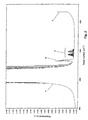
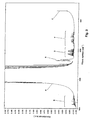
- Figures 2 and 3 show, respectively, the spectra FT-IR of the gas flowing from and into the purifier.
- the spectra show the sample absorbance in arbitrary units (a.u.) as a function of the radiation wave number (cm -1 ); both spectra show an intense peak (indicated with A in the graphs) assigned to HCl; a couple of peaks assigned to CO 2 (indicated with B in the graphs); an isolated peak assigned to CO 2 (C in the graphs); and a peak pattern (D in the graphs) of doubtful assignment, probably due to CO.
- the non-purified gas further shows two peak patterns (E and F in the figure) assigned to water which are not present in the spectrum in figure 2, referred to the purified HCl, thus proving that the gas from the purifier outlet has a water content lower than the instrument detecting limit.
- the test was stopped when the purifier had sorbed an amount of 9 l/l of water with no water detected by the analytic instrument in the gas from the purifier outlet.
- This example refers to the preparation of boron oxide by decomposition of boric acid inside a capsule.
- boric acid employed in example 1 51 mg are loaded into a cylindrical container having the bottom closed and an internal diameter of 7,5 mm and height of 1,5 mm, made with AISI steel 304; the upper opening of the container is closed with a porous septum of sintered steel AISI 316 L, having a porosity of 1 ⁇ m.
- the resulting capsule is mounted on the sample-holder of a thermobalance CAHN model D 200.
- the thermobalance chamber is evacuated at a residual pressure of 10 -4 mbar, and a thermal treatment of boric acid decomposition is started, which consists of heating the sample from room temperature to 105°C at a rate of 2°C/min, and of maintaining the temperature at 105°C for 23 hours.
- the measuring chamber of the thermobalance is allowed to cool (still under pumping) to room temperature, and water is let in through a needle valve up to a pressure of 5 mbar.
- the weight increase of the sample at 25°C is registered.
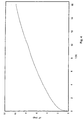
- the result of the test is plotted in the graph as in figure 4, as weight increase in mg as a function of the time in hours; as it can be seen in the figure, after 16 hours of test the sample weight is increased of 10.3 mg, equal to about one half of the weight of water lost during boric acid decomposition.
Landscapes
- Chemical & Material Sciences (AREA)
- Analytical Chemistry (AREA)
- Chemical Kinetics & Catalysis (AREA)
- Engineering & Computer Science (AREA)
- General Chemical & Material Sciences (AREA)
- Oil, Petroleum & Natural Gas (AREA)
- Inorganic Chemistry (AREA)
- Organic Chemistry (AREA)
- Solid-Sorbent Or Filter-Aiding Compositions (AREA)
- Drying Of Gases (AREA)
- Gas Separation By Absorption (AREA)
- Treating Waste Gases (AREA)
Applications Claiming Priority (2)
| Application Number | Priority Date | Filing Date | Title |
|---|---|---|---|
| IT98MI001138A ITMI981138A1 (it) | 1998-05-21 | 1998-05-21 | Processo per la rimozione di acqua da camere evacuate o da gas |
| ITMI981138 | 1998-05-21 |
Publications (2)
| Publication Number | Publication Date |
|---|---|
| EP0960647A1 EP0960647A1 (en) | 1999-12-01 |
| EP0960647B1 true EP0960647B1 (en) | 2003-08-27 |
Family
ID=11380085
Family Applications (1)
| Application Number | Title | Priority Date | Filing Date |
|---|---|---|---|
| EP99830303A Expired - Lifetime EP0960647B1 (en) | 1998-05-21 | 1999-05-17 | Process for the removal of water from evacuated chambers or from gases |
Country Status (10)
| Country | Link |
|---|---|
| US (1) | US6304367B1 (enExample) |
| EP (1) | EP0960647B1 (enExample) |
| JP (1) | JP3510986B2 (enExample) |
| KR (1) | KR100350963B1 (enExample) |
| CN (1) | CN1091634C (enExample) |
| CA (1) | CA2271588C (enExample) |
| DE (1) | DE69910661T2 (enExample) |
| IT (1) | ITMI981138A1 (enExample) |
| SG (1) | SG73634A1 (enExample) |
| TW (1) | TW445170B (enExample) |
Families Citing this family (18)
| Publication number | Priority date | Publication date | Assignee | Title |
|---|---|---|---|---|
| US6522457B2 (en) * | 1999-05-20 | 2003-02-18 | Paolo Battilana | Apparatus for removal of water from evacuated chambers or from gasses using boron oxide |
| TW550307B (en) | 2000-04-19 | 2003-09-01 | Getters Spa | A process for the purification of organometallic compounds or heteroatomic organic compounds with hydrogenated getter alloys |
| IT1317981B1 (it) | 2000-06-16 | 2003-07-21 | Getters Spa | Dispositivi assorbitori di umidita' per amplificatori laser e processo per la loro produzione. |
| US6561012B1 (en) * | 2000-10-20 | 2003-05-13 | Arizona Instrument Llc | Continuous flow moisture analyzer |
| US6905616B2 (en) * | 2003-03-05 | 2005-06-14 | Applied Materials, Inc. | Method of releasing devices from a substrate |
| US6914323B2 (en) * | 2003-03-20 | 2005-07-05 | Honeywell International Inc. | Methods and apparatus for attaching getters to MEMS device housings |
| US20050069475A1 (en) * | 2003-09-30 | 2005-03-31 | Hage Daniel B. | System and process for reducing impurities |
| US7560820B2 (en) * | 2004-04-15 | 2009-07-14 | Saes Getters S.P.A. | Integrated getter for vacuum or inert gas packaged LEDs |
| JP5431673B2 (ja) * | 2005-11-30 | 2014-03-05 | 日本ゼオン株式会社 | 不飽和フッ素化炭素化合物の精製方法、フルオロカーボン膜の成膜方法、及び半導体装置の製造方法 |
| CN104909381A (zh) * | 2015-05-14 | 2015-09-16 | 广东先导稀材股份有限公司 | 一种高纯度无水氧化硼的浇注成型方法及系统 |
| IL303336B2 (en) | 2015-09-03 | 2025-08-01 | Novavax Inc | Vaccine compositions having improved stability and immunogenicity |
| AT518448B1 (de) * | 2016-03-16 | 2017-12-15 | Univ Wien Tech | Verfahren zur thermochemischen Energiespeicherung |
| CN108622912B (zh) * | 2018-07-11 | 2021-08-24 | 广东先导先进材料股份有限公司 | 高温覆盖剂级氧化硼的生产方法 |
| CN110987716B (zh) * | 2019-12-17 | 2022-07-22 | 佛山纬达光电材料股份有限公司 | 一种碘系偏光膜加工槽液中硼酸浓度的测定方法 |
| CN111111387A (zh) * | 2019-12-25 | 2020-05-08 | 中船重工(邯郸)派瑞特种气体有限公司 | 一种氟化氢钢瓶除水的方法 |
| US12378113B2 (en) * | 2021-01-14 | 2025-08-05 | Honeywell International Inc. | Methods for recovering iodine (I2) |
| US12497294B2 (en) * | 2021-01-14 | 2025-12-16 | Solstice Advanced Materials Us, Inc. | Methods for removing water from iodine (I2) |
| WO2023076184A1 (en) * | 2021-10-27 | 2023-05-04 | Entegris, Inc. | Boron oxide-containing adsorbent and related methods and devices |
Family Cites Families (5)
| Publication number | Priority date | Publication date | Assignee | Title |
|---|---|---|---|---|
| FR1603222A (enExample) * | 1968-10-17 | 1971-03-22 | ||
| JP3052317B2 (ja) * | 1989-10-25 | 2000-06-12 | 三菱瓦斯化学株式会社 | 脱酸素剤 |
| US5424052A (en) * | 1993-11-24 | 1995-06-13 | U.S. Borax Inc. | Production of boric oxide |
| US5696785A (en) * | 1994-10-11 | 1997-12-09 | Corning Incorporated | Impurity getters in laser enclosures |
| US5955393A (en) * | 1995-04-21 | 1999-09-21 | Project Earth Industries, Inc. | Enhanced adsorbent and room temperature catalyst particle and method of making therefor |
-
1998
- 1998-05-21 IT IT98MI001138A patent/ITMI981138A1/it unknown
-
1999
- 1999-03-23 TW TW088104593A patent/TW445170B/zh not_active IP Right Cessation
- 1999-04-16 SG SG1999001843A patent/SG73634A1/en unknown
- 1999-05-13 CA CA002271588A patent/CA2271588C/en not_active Expired - Fee Related
- 1999-05-17 EP EP99830303A patent/EP0960647B1/en not_active Expired - Lifetime
- 1999-05-17 DE DE69910661T patent/DE69910661T2/de not_active Expired - Fee Related
- 1999-05-20 US US09/315,600 patent/US6304367B1/en not_active Expired - Lifetime
- 1999-05-20 CN CN99106671A patent/CN1091634C/zh not_active Expired - Fee Related
- 1999-05-21 KR KR1019990018407A patent/KR100350963B1/ko not_active Expired - Fee Related
- 1999-05-21 JP JP14152399A patent/JP3510986B2/ja not_active Expired - Lifetime
Also Published As
| Publication number | Publication date |
|---|---|
| HK1024195A1 (en) | 2000-10-05 |
| DE69910661T2 (de) | 2004-06-17 |
| CN1091634C (zh) | 2002-10-02 |
| KR20000005696A (ko) | 2000-01-25 |
| CN1236661A (zh) | 1999-12-01 |
| TW445170B (en) | 2001-07-11 |
| ITMI981138A1 (it) | 1999-11-21 |
| EP0960647A1 (en) | 1999-12-01 |
| JP2000005552A (ja) | 2000-01-11 |
| JP3510986B2 (ja) | 2004-03-29 |
| SG73634A1 (en) | 2000-06-20 |
| CA2271588A1 (en) | 1999-11-21 |
| CA2271588C (en) | 2005-12-13 |
| KR100350963B1 (ko) | 2002-08-28 |
| DE69910661D1 (de) | 2003-10-02 |
| US6304367B1 (en) | 2001-10-16 |
Similar Documents
| Publication | Publication Date | Title |
|---|---|---|
| CA2271588C (en) | Process for the removal of water from evacuated chambers from gases | |
| Pajonk | Some applications of silica aerogels | |
| EP0769117B1 (en) | Device for maintaining vacuum in thermally insulating jackets and process for manufacturing such a device | |
| JP3436934B2 (ja) | 半導体プロセスガスを精製してそれからルイス酸及び酸化剤不純物を除去するための方法及び組成物 | |
| EP0496711B1 (en) | A device for the removal of hydrogen from a vacuum enclosure at cryogenic temperatures and especially high energy particle accelerators | |
| KR100199885B1 (ko) | 기상 화합물용 저장 및 분배 시스템 | |
| KR100858077B1 (ko) | 가스 공급 장치, 이온 주입 장치, 가스 시약 공급 방법, 흡탈착 방법 및 반도체 제조 설비 | |
| EP1912734B1 (en) | Getter systems comprising an active phase inserted in a porous material distributed in a low permeability means | |
| JP7874615B2 (ja) | 微多孔性エアロゲル | |
| US6027547A (en) | Fluid storage and dispensing vessel with modified high surface area solid as fluid storage medium | |
| EP0609028A1 (en) | Dry exhaust gas conditioning | |
| KR102281728B1 (ko) | 아르곤의 정제를 위한 흡착제 조성물 | |
| WO2001076723A9 (en) | Methods for removal of impurity metals from gases using low metal zeolites | |
| Wang et al. | VOC adsorption and desorption behavior of hydrophobic, functionalized SBA-15 | |
| CA2322730C (en) | Vacuum preparation of hydrogen halide drier | |
| US6522457B2 (en) | Apparatus for removal of water from evacuated chambers or from gasses using boron oxide | |
| HK1024195B (en) | Process for the removal of water from evacuated chambers or from gases | |
| JPH02273511A (ja) | 窒素または炭素のハロゲン化物の無毒化方法 | |
| TWI895643B (zh) | 含氧化硼之吸附劑及相關之方法、自試劑氣體移除雜質之方法與純化器裝置 | |
| JP4711831B2 (ja) | 排ガス処理剤および排ガス処理方法ならびに排ガス処理装置 | |
| WO1994019090A1 (en) | Gas phase degradation of organic compounds | |
| KR0135749B1 (ko) | 가스 정화기 | |
| Haider | Measurement and control of impurity distribution in ultra pure gas delivery systems | |
| KR20020013059A (ko) | 질소 정제 방법 및 정제 장치 | |
| JPH08245210A (ja) | 金属酸化物を担持した活性炭の製造方法 |
Legal Events
| Date | Code | Title | Description |
|---|---|---|---|
| PUAI | Public reference made under article 153(3) epc to a published international application that has entered the european phase |
Free format text: ORIGINAL CODE: 0009012 |
|
| AK | Designated contracting states |
Kind code of ref document: A1 Designated state(s): BE DE FR GB NL SE |
|
| AX | Request for extension of the european patent |
Free format text: AL;LT;LV;MK;RO;SI |
|
| 17P | Request for examination filed |
Effective date: 20000113 |
|
| AKX | Designation fees paid |
Free format text: BE DE FR GB NL SE |
|
| GRAH | Despatch of communication of intention to grant a patent |
Free format text: ORIGINAL CODE: EPIDOS IGRA |
|
| GRAS | Grant fee paid |
Free format text: ORIGINAL CODE: EPIDOSNIGR3 |
|
| GRAA | (expected) grant |
Free format text: ORIGINAL CODE: 0009210 |
|
| AK | Designated contracting states |
Designated state(s): BE DE FR GB NL SE |
|
| REG | Reference to a national code |
Ref country code: GB Ref legal event code: FG4D |
|
| REF | Corresponds to: |
Ref document number: 69910661 Country of ref document: DE Date of ref document: 20031002 Kind code of ref document: P |
|
| REG | Reference to a national code |
Ref country code: SE Ref legal event code: TRGR |
|
| ET | Fr: translation filed | ||
| PLBE | No opposition filed within time limit |
Free format text: ORIGINAL CODE: 0009261 |
|
| STAA | Information on the status of an ep patent application or granted ep patent |
Free format text: STATUS: NO OPPOSITION FILED WITHIN TIME LIMIT |
|
| 26N | No opposition filed |
Effective date: 20040528 |
|
| REG | Reference to a national code |
Ref country code: HK Ref legal event code: GR Ref document number: 1024195 Country of ref document: HK |
|
| PGFP | Annual fee paid to national office [announced via postgrant information from national office to epo] |
Ref country code: NL Payment date: 20070514 Year of fee payment: 9 |
|
| PGFP | Annual fee paid to national office [announced via postgrant information from national office to epo] |
Ref country code: SE Payment date: 20070515 Year of fee payment: 9 |
|
| PGFP | Annual fee paid to national office [announced via postgrant information from national office to epo] |
Ref country code: DE Payment date: 20070522 Year of fee payment: 9 |
|
| PGFP | Annual fee paid to national office [announced via postgrant information from national office to epo] |
Ref country code: BE Payment date: 20070531 Year of fee payment: 9 |
|
| PGFP | Annual fee paid to national office [announced via postgrant information from national office to epo] |
Ref country code: GB Payment date: 20070522 Year of fee payment: 9 |
|
| PGFP | Annual fee paid to national office [announced via postgrant information from national office to epo] |
Ref country code: FR Payment date: 20070516 Year of fee payment: 9 |
|
| BERE | Be: lapsed |
Owner name: *SAES GETTERS S.P.A. Effective date: 20080531 |
|
| GBPC | Gb: european patent ceased through non-payment of renewal fee |
Effective date: 20080517 |
|
| PG25 | Lapsed in a contracting state [announced via postgrant information from national office to epo] |
Ref country code: NL Free format text: LAPSE BECAUSE OF NON-PAYMENT OF DUE FEES Effective date: 20081201 |
|
| REG | Reference to a national code |
Ref country code: FR Ref legal event code: ST Effective date: 20090119 |
|
| PG25 | Lapsed in a contracting state [announced via postgrant information from national office to epo] |
Ref country code: BE Free format text: LAPSE BECAUSE OF NON-PAYMENT OF DUE FEES Effective date: 20080531 |
|
| PG25 | Lapsed in a contracting state [announced via postgrant information from national office to epo] |
Ref country code: FR Free format text: LAPSE BECAUSE OF NON-PAYMENT OF DUE FEES Effective date: 20080602 Ref country code: DE Free format text: LAPSE BECAUSE OF NON-PAYMENT OF DUE FEES Effective date: 20081202 |
|
| PG25 | Lapsed in a contracting state [announced via postgrant information from national office to epo] |
Ref country code: GB Free format text: LAPSE BECAUSE OF NON-PAYMENT OF DUE FEES Effective date: 20080517 |
|
| PG25 | Lapsed in a contracting state [announced via postgrant information from national office to epo] |
Ref country code: SE Free format text: LAPSE BECAUSE OF NON-PAYMENT OF DUE FEES Effective date: 20080518 |