EP0943832A2 - Reibmaterial - Google Patents
Reibmaterial Download PDFInfo
- Publication number
- EP0943832A2 EP0943832A2 EP99105269A EP99105269A EP0943832A2 EP 0943832 A2 EP0943832 A2 EP 0943832A2 EP 99105269 A EP99105269 A EP 99105269A EP 99105269 A EP99105269 A EP 99105269A EP 0943832 A2 EP0943832 A2 EP 0943832A2
- Authority
- EP
- European Patent Office
- Prior art keywords
- friction material
- friction
- weight
- content
- back plate
- Prior art date
- Legal status (The legal status is an assumption and is not a legal conclusion. Google has not performed a legal analysis and makes no representation as to the accuracy of the status listed.)
- Withdrawn
Links
- 239000002783 friction material Substances 0.000 title claims abstract description 79
- 239000011230 binding agent Substances 0.000 claims abstract description 25
- 230000002787 reinforcement Effects 0.000 claims abstract description 23
- 239000003607 modifier Substances 0.000 claims abstract description 11
- 239000000203 mixture Substances 0.000 description 29
- 239000000463 material Substances 0.000 description 24
- 239000011347 resin Substances 0.000 description 24
- 229920005989 resin Polymers 0.000 description 24
- 239000000835 fiber Substances 0.000 description 14
- 238000003825 pressing Methods 0.000 description 10
- 238000000034 method Methods 0.000 description 8
- TZCXTZWJZNENPQ-UHFFFAOYSA-L barium sulfate Chemical compound [Ba+2].[O-]S([O-])(=O)=O TZCXTZWJZNENPQ-UHFFFAOYSA-L 0.000 description 6
- -1 etc. Substances 0.000 description 6
- 239000002245 particle Substances 0.000 description 6
- 229910052751 metal Inorganic materials 0.000 description 5
- 239000002184 metal Substances 0.000 description 5
- 239000005011 phenolic resin Substances 0.000 description 5
- OKTJSMMVPCPJKN-UHFFFAOYSA-N Carbon Chemical compound [C] OKTJSMMVPCPJKN-UHFFFAOYSA-N 0.000 description 4
- 239000000945 filler Substances 0.000 description 4
- 229910002804 graphite Inorganic materials 0.000 description 4
- 239000010439 graphite Substances 0.000 description 4
- 239000000314 lubricant Substances 0.000 description 4
- 239000000919 ceramic Substances 0.000 description 3
- 238000000465 moulding Methods 0.000 description 3
- 239000011148 porous material Substances 0.000 description 3
- 239000000843 powder Substances 0.000 description 3
- VTYYLEPIZMXCLO-UHFFFAOYSA-L Calcium carbonate Chemical compound [Ca+2].[O-]C([O-])=O VTYYLEPIZMXCLO-UHFFFAOYSA-L 0.000 description 2
- RYGMFSIKBFXOCR-UHFFFAOYSA-N Copper Chemical compound [Cu] RYGMFSIKBFXOCR-UHFFFAOYSA-N 0.000 description 2
- CPLXHLVBOLITMK-UHFFFAOYSA-N Magnesium oxide Chemical compound [Mg]=O CPLXHLVBOLITMK-UHFFFAOYSA-N 0.000 description 2
- MCMNRKCIXSYSNV-UHFFFAOYSA-N Zirconium dioxide Chemical compound O=[Zr]=O MCMNRKCIXSYSNV-UHFFFAOYSA-N 0.000 description 2
- 239000000853 adhesive Substances 0.000 description 2
- PNEYBMLMFCGWSK-UHFFFAOYSA-N aluminium oxide Inorganic materials [O-2].[O-2].[O-2].[Al+3].[Al+3] PNEYBMLMFCGWSK-UHFFFAOYSA-N 0.000 description 2
- 229920006231 aramid fiber Polymers 0.000 description 2
- 238000005452 bending Methods 0.000 description 2
- 229910052802 copper Inorganic materials 0.000 description 2
- 239000010949 copper Substances 0.000 description 2
- 238000005238 degreasing Methods 0.000 description 2
- 229920001971 elastomer Polymers 0.000 description 2
- 238000010438 heat treatment Methods 0.000 description 2
- 239000012784 inorganic fiber Substances 0.000 description 2
- 239000011256 inorganic filler Substances 0.000 description 2
- 239000012766 organic filler Substances 0.000 description 2
- 239000002994 raw material Substances 0.000 description 2
- 239000005060 rubber Substances 0.000 description 2
- 229920001187 thermosetting polymer Polymers 0.000 description 2
- 229920002972 Acrylic fiber Polymers 0.000 description 1
- 244000226021 Anacardium occidentale Species 0.000 description 1
- 229920000049 Carbon (fiber) Polymers 0.000 description 1
- 239000004640 Melamine resin Substances 0.000 description 1
- 229920000877 Melamine resin Polymers 0.000 description 1
- ZLMJMSJWJFRBEC-UHFFFAOYSA-N Potassium Chemical compound [K] ZLMJMSJWJFRBEC-UHFFFAOYSA-N 0.000 description 1
- 229910000831 Steel Inorganic materials 0.000 description 1
- RTAQQCXQSZGOHL-UHFFFAOYSA-N Titanium Chemical compound [Ti] RTAQQCXQSZGOHL-UHFFFAOYSA-N 0.000 description 1
- HCHKCACWOHOZIP-UHFFFAOYSA-N Zinc Chemical compound [Zn] HCHKCACWOHOZIP-UHFFFAOYSA-N 0.000 description 1
- 229910052782 aluminium Inorganic materials 0.000 description 1
- XAGFODPZIPBFFR-UHFFFAOYSA-N aluminium Chemical compound [Al] XAGFODPZIPBFFR-UHFFFAOYSA-N 0.000 description 1
- XLJMAIOERFSOGZ-UHFFFAOYSA-N anhydrous cyanic acid Natural products OC#N XLJMAIOERFSOGZ-UHFFFAOYSA-N 0.000 description 1
- 239000004760 aramid Substances 0.000 description 1
- 229920003235 aromatic polyamide Polymers 0.000 description 1
- 229910000019 calcium carbonate Inorganic materials 0.000 description 1
- 239000004917 carbon fiber Substances 0.000 description 1
- 235000020226 cashew nut Nutrition 0.000 description 1
- 239000011248 coating agent Substances 0.000 description 1
- 238000000576 coating method Methods 0.000 description 1
- 238000013329 compounding Methods 0.000 description 1
- 238000010276 construction Methods 0.000 description 1
- 230000000881 depressing effect Effects 0.000 description 1
- QDOXWKRWXJOMAK-UHFFFAOYSA-N dichromium trioxide Chemical compound O=[Cr]O[Cr]=O QDOXWKRWXJOMAK-UHFFFAOYSA-N 0.000 description 1
- NJLLQSBAHIKGKF-UHFFFAOYSA-N dipotassium dioxido(oxo)titanium Chemical compound [K+].[K+].[O-][Ti]([O-])=O NJLLQSBAHIKGKF-UHFFFAOYSA-N 0.000 description 1
- 238000009826 distribution Methods 0.000 description 1
- 239000003822 epoxy resin Substances 0.000 description 1
- 238000002474 experimental method Methods 0.000 description 1
- 239000002657 fibrous material Substances 0.000 description 1
- 239000003365 glass fiber Substances 0.000 description 1
- 239000004615 ingredient Substances 0.000 description 1
- 229910003475 inorganic filler Inorganic materials 0.000 description 1
- 239000000395 magnesium oxide Substances 0.000 description 1
- 229910044991 metal oxide Inorganic materials 0.000 description 1
- 150000004706 metal oxides Chemical class 0.000 description 1
- 150000002739 metals Chemical class 0.000 description 1
- 239000010445 mica Substances 0.000 description 1
- 229910052618 mica group Inorganic materials 0.000 description 1
- 239000011490 mineral wool Substances 0.000 description 1
- CWQXQMHSOZUFJS-UHFFFAOYSA-N molybdenum disulfide Chemical compound S=[Mo]=S CWQXQMHSOZUFJS-UHFFFAOYSA-N 0.000 description 1
- 229910052982 molybdenum disulfide Inorganic materials 0.000 description 1
- 238000005498 polishing Methods 0.000 description 1
- 229920000647 polyepoxide Polymers 0.000 description 1
- 229910052700 potassium Inorganic materials 0.000 description 1
- 239000011591 potassium Substances 0.000 description 1
- 239000010453 quartz Substances 0.000 description 1
- 230000003014 reinforcing effect Effects 0.000 description 1
- VYPSYNLAJGMNEJ-UHFFFAOYSA-N silicon dioxide Inorganic materials O=[Si]=O VYPSYNLAJGMNEJ-UHFFFAOYSA-N 0.000 description 1
- 239000007787 solid Substances 0.000 description 1
- 239000010959 steel Substances 0.000 description 1
- 239000000126 substance Substances 0.000 description 1
- 229920003051 synthetic elastomer Polymers 0.000 description 1
- 239000005061 synthetic rubber Substances 0.000 description 1
- 239000010455 vermiculite Substances 0.000 description 1
- 229910052902 vermiculite Inorganic materials 0.000 description 1
- 235000019354 vermiculite Nutrition 0.000 description 1
- 229910052725 zinc Inorganic materials 0.000 description 1
- 239000011701 zinc Substances 0.000 description 1
Images

Classifications
-
- F—MECHANICAL ENGINEERING; LIGHTING; HEATING; WEAPONS; BLASTING
- F16—ENGINEERING ELEMENTS AND UNITS; GENERAL MEASURES FOR PRODUCING AND MAINTAINING EFFECTIVE FUNCTIONING OF MACHINES OR INSTALLATIONS; THERMAL INSULATION IN GENERAL
- F16D—COUPLINGS FOR TRANSMITTING ROTATION; CLUTCHES; BRAKES
- F16D69/00—Friction linings; Attachment thereof; Selection of coacting friction substances or surfaces
- F16D69/04—Attachment of linings
-
- F—MECHANICAL ENGINEERING; LIGHTING; HEATING; WEAPONS; BLASTING
- F16—ENGINEERING ELEMENTS AND UNITS; GENERAL MEASURES FOR PRODUCING AND MAINTAINING EFFECTIVE FUNCTIONING OF MACHINES OR INSTALLATIONS; THERMAL INSULATION IN GENERAL
- F16D—COUPLINGS FOR TRANSMITTING ROTATION; CLUTCHES; BRAKES
- F16D69/00—Friction linings; Attachment thereof; Selection of coacting friction substances or surfaces
- F16D2069/005—Friction linings; Attachment thereof; Selection of coacting friction substances or surfaces having a layered structure
-
- F—MECHANICAL ENGINEERING; LIGHTING; HEATING; WEAPONS; BLASTING
- F16—ENGINEERING ELEMENTS AND UNITS; GENERAL MEASURES FOR PRODUCING AND MAINTAINING EFFECTIVE FUNCTIONING OF MACHINES OR INSTALLATIONS; THERMAL INSULATION IN GENERAL
- F16D—COUPLINGS FOR TRANSMITTING ROTATION; CLUTCHES; BRAKES
- F16D69/00—Friction linings; Attachment thereof; Selection of coacting friction substances or surfaces
- F16D69/04—Attachment of linings
- F16D2069/0425—Attachment methods or devices
- F16D2069/0441—Mechanical interlocking, e.g. roughened lining carrier, mating profiles on friction material and lining carrier
-
- F—MECHANICAL ENGINEERING; LIGHTING; HEATING; WEAPONS; BLASTING
- F16—ENGINEERING ELEMENTS AND UNITS; GENERAL MEASURES FOR PRODUCING AND MAINTAINING EFFECTIVE FUNCTIONING OF MACHINES OR INSTALLATIONS; THERMAL INSULATION IN GENERAL
- F16D—COUPLINGS FOR TRANSMITTING ROTATION; CLUTCHES; BRAKES
- F16D69/00—Friction linings; Attachment thereof; Selection of coacting friction substances or surfaces
- F16D69/04—Attachment of linings
- F16D2069/0425—Attachment methods or devices
- F16D2069/045—Bonding
- F16D2069/0466—Bonding chemical, e.g. using adhesives, vulcanising
- F16D2069/0475—Bonding chemical, e.g. using adhesives, vulcanising comprising thermal treatment
-
- F—MECHANICAL ENGINEERING; LIGHTING; HEATING; WEAPONS; BLASTING
- F16—ENGINEERING ELEMENTS AND UNITS; GENERAL MEASURES FOR PRODUCING AND MAINTAINING EFFECTIVE FUNCTIONING OF MACHINES OR INSTALLATIONS; THERMAL INSULATION IN GENERAL
- F16D—COUPLINGS FOR TRANSMITTING ROTATION; CLUTCHES; BRAKES
- F16D69/00—Friction linings; Attachment thereof; Selection of coacting friction substances or surfaces
- F16D69/04—Attachment of linings
- F16D2069/0425—Attachment methods or devices
- F16D2069/0483—Lining or lining carrier material shaped in situ
Definitions
- the present invention relates to a friction material used in a brake, or the like, and particularly to a friction material in which the strength of protrusions acting to hold the friction material on a pressure plate can be made large.
- a friction material mainly used in a brake, or the like generally contains, as compounding ingredients, a filler selected from various kinds of fillers, a fibrous reinforcement selected from various kinds of fibers, an abrasive, and a friction modifier such as graphite, metal powder, or the like, and further contains a resin selected from various kinds of resins as a binder for binding these components.
- the amount of resin in the mixture increases, both density and strength of the friction material after molding increase.
- the amount of resin is generally suppressed to be as small as in a range of from about 5 % by weight to about 15 % by weight because both moderate plasticity and the presence of pores are required in terms of friction performance.
- a structure in which the friction material is held by means of adhesively bonding the friction material to a back plate, or the like, is formed as a brake pad.
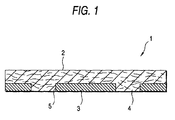
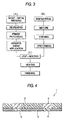
- the structure is as shown in Fig. 4. Because the brake pad 1 has such a structure, an idea for holding the friction material 2 firmly is applied to the back plate 3. That is, a plurality of holes 5 are provided in the back plate. The friction material 2 is preformed so that protrusions 4 are formed in positions corresponding to those of the holes 5. The preformed friction material is put on the back plate and heat-molded. The friction material 2 is integrally bonded to the back plate in the condition that the protrusions 4 are fitted into the holes 5 of the back plate, so that the brake pad 1 is produced.
- the rear surface of the friction material 2 is adhesively bonded to the back plate firmly to thereby attach the friction material 2 to the back plate.
- the present invention is designed to provide a friction material which is so sufficient in terms of friction performance that both moderate plasticity and the presence of pores are given to the friction material inclusive of a friction material having protrusions as in the aforementioned brake pad while the strength of the friction material is enhanced.
- the inventor has discussed various solving means from the view point of the structure and quality of the friction material to solve the aforementioned problem. As a result, it has been found in terms of friction performance that the friction performance need be satisfied only on the friction surface side but the friction performance on the other, back plate side than the friction surface side need not be taken into account, that is, the amount of resin on the back plate side can be increased.
- the inventor has repeated experiments on the basis of the findings and has confirmed the aforementioned function. Thus, the present invention has been reached.
- a friction material containing a fibrous reinforcement, a binder, and a friction modifier.
- the binder content of the friction material on the back plate side is made to be larger than the binder content of the friction material on the friction surface side.
- the fibrous reinforcement content of the friction material on the back plate side is made to be smaller than the fibrous reinforcement content of the friction material on the friction surface side.
- a friction material contains a fibrous reinforcement, a binder resin, and a friction modifier.
- the binder content and fibrous reinforcement content of the friction material on the friction surface side to perform its function by friction are set to be smaller (in a range of from 5 % by weight to 20 % by weight) and larger (in a range of from 5 % by weight to 50 % by weight) respectively in order to make friction performance good.
- the binder content and fibrous reinforcement content of the friction material on the back plate side having no direct relation with friction are set to be larger (in a range of from 10 % by weight to 50 % by weight) and smaller (in a range of from 0 % by weight to 20 % by weight) respectively than those on the friction surface side in order to make strength, or the like, large.
- Fig. 3 shows a process which is performed conventionally, for example, for producing a disc brake pad.
- This producing process comprises: (A) a line for processing a back plate; (B) a line for preforming a friction material; and (C) a line for processing a product from the processed members obtained in (A) and (B) respectively.
- a back plate is molded to a predetermined shape by means of sheet metal pressing, subjected to degreasing and primer processing and coated with an adhesive agent.
- Fibrous reinforcement such as heat-resistant organic or inorganic fiber, metal fiber, or the like, is mixed with powder material such as an inorganic or organic filler, a friction modifier, a thermosetting resin binder, or the like. Then, the mixture is stirred to thereby prepare sufficiently homogeneous raw material.
- the raw material is preformed at a room temperature under a predetermined pressure to prepare a preform.
- the back plate and the preform are subjected to heat molding at a predetermined temperature under a predetermined pressure so that the back plate and the preform are integrally fixed with each other, and then subjected to heating (after curing).
- the cured matter is finally subjected to the finishing step.
- Fig. 2 is for explaining the process of producing a friction material according to the present invention in order of stages.
- Fig. 2 is equivalent to the portion of the preforming step in the producing process shown in Fig. 3. This step is separated into stages (a) to (d).
- the reference numeral 10 designates a mold combination as a whole; and 11, 12 and 13, molds respectively.
- the molds 13 are used for forming cavity portions 14 necessary for forming protrusions.
- the stage (a) shows the condition in which a resin-rich mixture material 15 having a large amount of resin is packed in the mold combination.
- This mixture material may be packed as powder in the mold combination.
- the material portions above the molds 13 may be preferably provided as protrusive portions 16 having an amount which can compensate the depression of a resin-rich mixture material layer 17 to thereby prevent the upper surface of the resin-rich mixture material layer 17 from depressing.
- the stage (b) shows the condition in which the mixture material is preformed by an upper mold after the stage (a).
- the resin-rich mixture material layer 17 thus molded has protrusions 18. Further, in the resin-rich mixture material layer 17, cavity portions 19 are formed above the protrusions 18 respectively. The cavity portions 19 are provided for reinforcing the connection between the resin-rich mixture material layer 17 and a conventional mixture material layer formed on the resin-rich mixture material layer 17. Accordingly, in the stage (a), a mold having protrusive portions for forming the cavity portions 19 is used as the upper mold.
- the stage (c) shows the condition in which a conventional mixture material 20 is packed on the resin-rich mixture material layer 17 obtained in the aforementioned stage (b).
- a composition good in friction performance is selected as the composition of the conventional mixture material 20 so that pores can be formed.
- the stage (d) shows the condition in which the conventional mixture material 20 packed in the aforementioned stage (c) is pressed so as to be preformed.
- the pressing operation is carried out by repeating pressing three times. Pressing is repeated three times for the purpose of making the density of the friction material uniform. The number of pressing is not limited to three times.
- the preform obtained in the preforming step shown in the stages (a) to (d) is then heat-molded so that a friction material according to the present invention can be obtained.
- the friction material obtained according to the present invention is not different from any conventional product in terms of external appearance.
- the density of the protrusions 4 and portions above the protrusions 4 is little different from that of other portions. That is, the density of the protrusions 4 and portions above the protrusions 4 is substantially equal to other portions in the friction material.
- Examples of the aforementioned heat-resistant organic fiber include aromatic polyamide fibers, and flame-resistant acrylic fibers.
- the inorganic fiber include ceramic fibers such as potassium titanate fiber, alumina fiber, etc., glass fibers, carbon fibers, rock wool fibers, and so on.
- the metal fiber include copper fibers, and steel fibers.
- examples of the inorganic filler include particles of metals such as copper, aluminum, zinc, etc., particles of flake-like inorganic substances such as vermiculite, mica, etc., and particles of barium sulfate, calcium carbonate, or the like.
- examples of the organic filler include synthetic rubber, cashew resin, and so on.
- thermosetting resin binder examples include phenol resin (inclusive of straight phenol resin, and various kinds of phenol resins modified by rubber, or the like), melamine resin, epoxy resin, cyanic acid ester resin, and so on.
- friction modifier examples include metal oxides such as alumina, magnesia, zirconia, chrome oxide, quartz, etc., and so on.
- solid lubricant examples include graphite, molybdenum disulfide, and so on.
- the preform was pressed and heated so as to be heat-molded in the condition in which the preform was put on a coating surface of a back plate which was formed by means of sheet plate pressing, subjected to degreasing and primer processing and coated with an adhesive agent.
- the heat-molded matter was fed to the finishing step.
- Conventional Mixture and Resin-Rich Mixture (% by weight) Resin-rich mixture (back plate side) Conventional mixture (friction surface side)
- Kind Component Binder Phenol resin 30 7 Filler Barium sulfate 55 42 Fibrous Reinforcement Aramid fiber, Titanate potassium fiber 5 21 Abrasive
- Various kinds of ceramic particles 0 14 Lubricant Graphite, etc. 0 4 Friction modifier Rubber particles 10 12
- the friction performance of the friction material obtained according to the present invention in the aforementioned manner was as high as that of the conventional friction material. Furthermore, the protrusions of the friction material according to the present invention was hardened to have a hardness of from HRS 74 to HRS 82 whereas the hardness of the protrusions of the conventional friction material was from HRS 60 to HRS 76. Furthermore, the bending strength of the friction material according to the present invention was improved to be in a range of from 15 to 25 kgf whereas the bending strength of the conventional friction material was from 6 to 15 kgf. In addition, the density distribution of the friction material according to the present invention was uniform as a whole.
- the friction performance on the friction surface side is good and the amount of resin and the amount of fibrous material in the binder are large and small respectively on the back plate side. Accordingly, the strength of the friction material is high on the back plate side. Accordingly, a friction material good in friction performance and high in strength as a whole is obtained.
Landscapes
- Engineering & Computer Science (AREA)
- General Engineering & Computer Science (AREA)
- Mechanical Engineering (AREA)
- Braking Arrangements (AREA)
Applications Claiming Priority (2)
| Application Number | Priority Date | Filing Date | Title |
|---|---|---|---|
| JP6551298 | 1998-03-16 | ||
| JP6551298 | 1998-03-16 |
Publications (2)
| Publication Number | Publication Date |
|---|---|
| EP0943832A2 true EP0943832A2 (de) | 1999-09-22 |
| EP0943832A3 EP0943832A3 (de) | 2001-01-31 |
Family
ID=13289185
Family Applications (1)
| Application Number | Title | Priority Date | Filing Date |
|---|---|---|---|
| EP99105269A Withdrawn EP0943832A3 (de) | 1998-03-16 | 1999-03-15 | Reibmaterial |
Country Status (2)
| Country | Link |
|---|---|
| US (1) | US6260674B1 (de) |
| EP (1) | EP0943832A3 (de) |
Cited By (2)
| Publication number | Priority date | Publication date | Assignee | Title |
|---|---|---|---|---|
| US6811820B2 (en) | 1999-12-13 | 2004-11-02 | Miba Frictec Gmbh | Friction lining for wet running |
| WO2015173768A1 (en) * | 2014-05-16 | 2015-11-19 | Freni Brembo S.P.A. | Friction assembly, brake calliper and manufacturing method |
Families Citing this family (12)
| Publication number | Priority date | Publication date | Assignee | Title |
|---|---|---|---|---|
| JP2000290636A (ja) * | 1999-04-06 | 2000-10-17 | Akebono Brake Ind Co Ltd | 摩擦材 |
| JP2001165210A (ja) * | 1999-12-14 | 2001-06-19 | Nisshinbo Ind Inc | ディスクブレーキ、ディスクブレーキパッド、及び該ディスクブレーキパッド用バックプレート |
| JP2002020730A (ja) * | 2000-07-12 | 2002-01-23 | Akebono Brake Ind Co Ltd | ノンアスベスト摩擦材 |
| JP2002362377A (ja) * | 2001-06-01 | 2002-12-18 | Nsk Ltd | 車両用ステアリングコラム保持装置 |
| US7047836B2 (en) * | 2002-02-01 | 2006-05-23 | Trw Inc. | Surface treatment for a locking mechanism |
| US20040147192A1 (en) * | 2003-01-24 | 2004-07-29 | Ballard Material Products Inc. | Carbon fiber friction material |
| DE102006026802B3 (de) * | 2006-06-07 | 2007-09-27 | Tmd Friction Services Gmbh | Verfahren zur Herstellung eines Bremsbelages und Bremsbelag, insbesondere für eine Kraftfahrzeug-Scheibenbremse |
| US8689671B2 (en) | 2006-09-29 | 2014-04-08 | Federal-Mogul World Wide, Inc. | Lightweight armor and methods of making |
| ITTO20070678A1 (it) * | 2007-09-26 | 2009-03-27 | Fq Innovation Technology S R L | Gruppo frenante per autoveicoli, motoveicoli e similari |
| WO2012097768A1 (de) * | 2010-12-13 | 2012-07-26 | Schaeffler Technologies AG & Co. KG | Verfahren zur herstellung eines reibkörpers |
| US20130240304A1 (en) * | 2012-03-19 | 2013-09-19 | United Technologies Corporation | Low conductivity brake pad |
| US9938034B2 (en) * | 2014-12-19 | 2018-04-10 | Coopervision International Holding Company, Lp | Method and apparatus relating to manufacture of molds for forming contact lenses |
Citations (1)
| Publication number | Priority date | Publication date | Assignee | Title |
|---|---|---|---|---|
| JPH1065512A (ja) | 1996-08-20 | 1998-03-06 | Nippon Telegr & Teleph Corp <Ntt> | 論理回路の給電構成 |
Family Cites Families (9)
| Publication number | Priority date | Publication date | Assignee | Title |
|---|---|---|---|---|
| FR1392681A (fr) | 1964-02-07 | 1965-03-19 | Ferodo Sa | Perfectionnements apportés aux patins de frottement |
| DE69512957T3 (de) | 1994-04-26 | 2003-09-11 | Sumitomo Electric Industries, Ltd. | Verfahren zur Herstellung von Scheibenbremsbelägen |
| US5515950A (en) * | 1994-06-08 | 1996-05-14 | Pneumo Abex Corporation | Disc brake friction pad assembly |
| US5413194A (en) * | 1994-07-25 | 1995-05-09 | Pneumo Abex Corporation | Brake friction pad assembly |
| JPH0989016A (ja) | 1995-09-21 | 1997-03-31 | Sumitomo Electric Ind Ltd | ディスクブレーキパッド |
| DE69729939T2 (de) | 1996-04-08 | 2005-07-28 | Minnesota Mining And Mfg. Co., St. Paul | Gemustertes reibungsmaterial, kupplungsscheibenelement und verfahren zur herstellung und benutzen desselben |
| DE19652778A1 (de) * | 1996-12-19 | 1998-06-25 | Textar Gmbh | Bremsbacke |
| US5775465A (en) * | 1997-04-18 | 1998-07-07 | Vossler; Darby J. | Ladder support |
| US5984055A (en) * | 1997-11-21 | 1999-11-16 | Northrop Grumman Corporation | Integrated fiber reinforced ceramic matrix composite brake pad and back plate |
-
1999
- 1999-03-15 EP EP99105269A patent/EP0943832A3/de not_active Withdrawn
- 1999-03-15 US US09/267,652 patent/US6260674B1/en not_active Expired - Fee Related
Patent Citations (1)
| Publication number | Priority date | Publication date | Assignee | Title |
|---|---|---|---|---|
| JPH1065512A (ja) | 1996-08-20 | 1998-03-06 | Nippon Telegr & Teleph Corp <Ntt> | 論理回路の給電構成 |
Cited By (3)
| Publication number | Priority date | Publication date | Assignee | Title |
|---|---|---|---|---|
| US6811820B2 (en) | 1999-12-13 | 2004-11-02 | Miba Frictec Gmbh | Friction lining for wet running |
| WO2015173768A1 (en) * | 2014-05-16 | 2015-11-19 | Freni Brembo S.P.A. | Friction assembly, brake calliper and manufacturing method |
| US10119583B2 (en) | 2014-05-16 | 2018-11-06 | Freni Brembo S.P.A. | Friction assembly, brake calliper and manufacturing method |
Also Published As
| Publication number | Publication date |
|---|---|
| US6260674B1 (en) | 2001-07-17 |
| EP0943832A3 (de) | 2001-01-31 |
Similar Documents
| Publication | Publication Date | Title |
|---|---|---|
| US6260674B1 (en) | Friction material | |
| JP5183900B2 (ja) | ノンアスベスト摩擦部材 | |
| KR101098482B1 (ko) | 마찰재 | |
| US5712029A (en) | Friction material | |
| JPH11322960A (ja) | 摩擦材 | |
| JP2013057337A (ja) | ブレーキパッドおよびその製造方法 | |
| US6080230A (en) | Friction material composition | |
| US20220373053A1 (en) | Friction material | |
| JP2991970B2 (ja) | 摩擦材 | |
| US6632857B1 (en) | Friction material | |
| JP3782243B2 (ja) | ブレーキ用摩擦材 | |
| JP5183902B2 (ja) | ノンアスベスト摩擦部材 | |
| JP3792839B2 (ja) | 造粒物及び摩擦材の製造方法 | |
| KR20110118592A (ko) | 디스크 브레이크 패드 | |
| JP3228096B2 (ja) | 摩擦材の製造方法 | |
| JP2002088345A (ja) | ブレーキ用摩擦材 | |
| JPH05331297A (ja) | 摩擦材の製造法 | |
| JP2000219750A (ja) | ブレーキ用摩擦材 | |
| JP2006275198A (ja) | ディスクパッド | |
| JP2003074610A (ja) | 摩擦材熱成形用金型 | |
| CN117836535A (zh) | 底层材料和摩擦部件 | |
| JP2000002276A (ja) | 摩擦材 | |
| JP2024162484A (ja) | 摩擦材 | |
| JP2003001659A (ja) | 摩擦材の製造方法及び熱成形用金型 | |
| JPH10299799A (ja) | ディスクパッド |
Legal Events
| Date | Code | Title | Description |
|---|---|---|---|
| PUAI | Public reference made under article 153(3) epc to a published international application that has entered the european phase |
Free format text: ORIGINAL CODE: 0009012 |
|
| AK | Designated contracting states |
Kind code of ref document: A2 Designated state(s): AT BE CH CY DE DK ES FI FR GB GR IE IT LI LU MC NL PT SE |
|
| AX | Request for extension of the european patent |
Free format text: AL;LT;LV;MK;RO;SI |
|
| PUAL | Search report despatched |
Free format text: ORIGINAL CODE: 0009013 |
|
| AK | Designated contracting states |
Kind code of ref document: A3 Designated state(s): AT BE CH CY DE DK ES FI FR GB GR IE IT LI LU MC NL PT SE |
|
| AX | Request for extension of the european patent |
Free format text: AL;LT;LV;MK;RO;SI |
|
| AKX | Designation fees paid | ||
| STAA | Information on the status of an ep patent application or granted ep patent |
Free format text: STATUS: THE APPLICATION IS DEEMED TO BE WITHDRAWN |
|
| 18D | Application deemed to be withdrawn |
Effective date: 20010801 |
|
| REG | Reference to a national code |
Ref country code: DE Ref legal event code: 8566 |